in 2025
Introduction:
Data Security and Privacy stands as essential principles as 2025 arrives.
Modern enterprises need these systems to persist and meet their objectives.
Data protection because of evolving cyber attacks and upcoming strict data privacy laws
represents fundamental requirements that businesses must address diligently.
Companies which fail to implement proper security protocols risk severe breaches that
result in substantial financial losses while simultaneously generating legal problems and
reputation damage.
Defending your data serves two vital purposes because it safeguards your information
while it ensures your business maintains its integrity as you operate in a progressively
digital environment.
Top 9 Enterprise Data Security and
Privacy Practices:
Our guide consists of the Top 9 Data Security and Privacy Practices for 2025 which will help
your business lead in an accelerating digital environment.
Actionable security measures described in this text help businesses reduce their exposure
to risks and defend customer information with standards that maintain regulatory
compliance.
Any business from startup to enterprise level will achieve necessary data security tools
through implementation of these best practices
The establishment of data security management consists of policy creation along with technological and
control implementation measures which secure data throughout its entire lifecycle.
Leads to a unified governance model integration of
purpose-built policies alongside technologies for
securing data at every stage of its lifecycle.
But through data classification and robust access
control systems and role definitions businesses can
achieve minimal vulnerability and deploy effective
data protection measures.
Comprehensive Data Security Management
Strategy:
What it involves? Why it’s important?
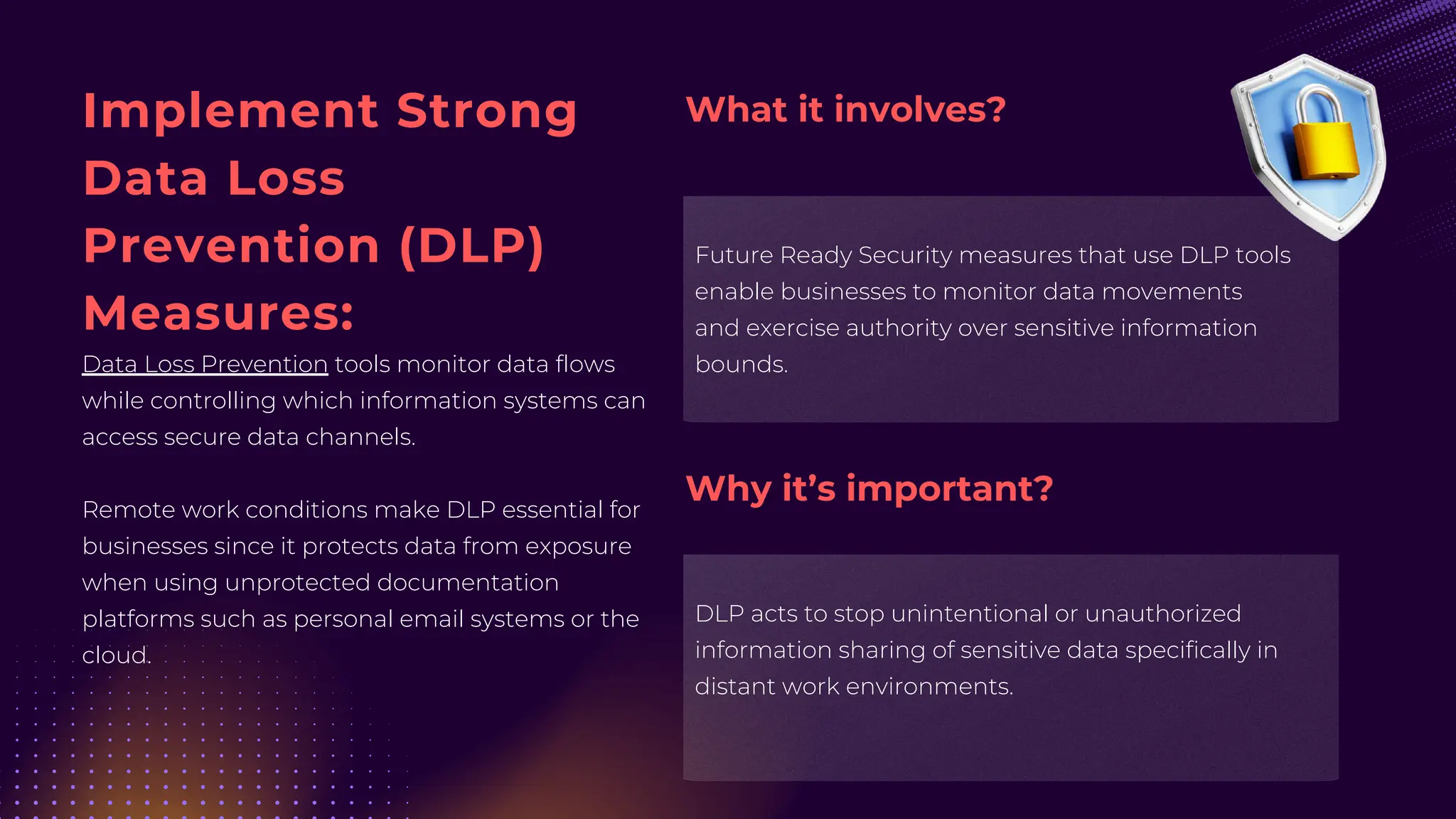
Implement Strong
Data Loss
Prevention (DLP)
Measures:
Data Loss Prevention tools monitor data flows
while controlling which information systems can
access secure data channels.
Remote work conditions make DLP essential for
businesses since it protects data from exposure
when using unprotected documentation
platforms such as personal email systems or the
cloud.
Future Ready Security measures that use DLP tools
enable businesses to monitor data movements
and exercise authority over sensitive information
bounds.
DLP acts to stop unintentional or unauthorized
information sharing of sensitive data specifically in
distant work environments.
What it involves?
Why it’s important?
Adopt End-to-End
Data Encryption:
End-to-end encryption makes data unreadable
through scramble code which acts as a secure
protection covering data from its device exit to
its recipient's reception.
The system provides full protection for data in
transit and data at rest from unauthorized
entities
A security measure which starts by encrypting
data when it exits the user device until encryption
terminates at its final destination.
The system protects transmitted data through
encryption which ensures its ongoing safety
during transport as well as storage.
What it involves?
Why it’s important?
Establish Strict Access
Control and Identity
Management:
Access control limits who can view sensitive
data.
Implement Identity and Access Management
(IAM) systems, role-based access control (RBAC),
and multi-factor authentication (MFA) to ensure
only authorized personnel have access, reducing
breach risks.
Enterprise organizations should deploy identity-
access management controls which combine
role-based access control features with multi-
factor authentication protocols.
Protecting data by granting access to authorized
staff alone helps prevent both unauthorized
insider threats and external breaches of system
information.
What it involves?
Why it’s important?
Regularly Update
and Patch Systems:
Marking software updates alongside fixing
software bugs remains critical for organizations
that want to fill security holes remaining from
old system versions.
System maintenance at current levels enables
defense against known security flaws which
decreases the likelihood of cyberattacks.
Software and systems need uninterrupted
maintenance by teams that handle security patch
and update distribution.
Cyber attackers exploit vulnerabilities in out-of-
date systems which these security measures
successfully shut out.
What it involves?
Why it’s important?
Monitor Data Activity
with Advanced Threat
Detection:
The combination of AI along with machine
learning performs advanced threat detection by
monitoring constant data behavior patterns to
identify suspicious activities.
Informing businesses early on enables them to
act swiftly through fast responses which reduces
both harm and reduces the ramifications of
security breaches.
The continuous data inspection process through
artificial intelligence alongside machine learning
technologies searches for indications of both
suspicious and malicious events.
When threats are discovered early security teams
can swiftly respond to limit security breaches
while reducing their operational impact.
What it involves?
Why it’s important?
Comply with Data
Privacy
Regulations:
Compliance with data privacy laws like GDPR
and CCPA is critical.
Adhering to these regulations by obtaining
consent and securing personal data helps avoid
fines and builds customer trust.
These privacy regulations require data protection
through consent monitoring willingness along
with security protocol implementation.
Following data privacy laws gives your
organization two main advantages: it stops legal
penalties and demonstrates to customers how
seriously you take their privacy protection.
What it involves?
Why it’s important?
Employee Training
and Awareness
Programs:
Websites remember information at different
stages to improve user experience but also need
secure data management protocols and
phishing scam recognition training and strong
password requirements to reduce employee
incidents that lead to data breaches.
The implementation of periodic programs leads
employees to maintain their knowledge about
security best practices.
Repetitive staff training for maintaining secure
data practices helps detect phishing attempts
along with highlighting how strong passwords
build data security.
Expert workers avoid security mistakes that
generate breaches and reduce human mistakes
that pose risks to the system.
What it involves?
Why it’s important?
Implement a
Robust Incident
Response Plan:
An Incident Response Plan (IRP) must contain
clear procedures which describe what to do
when a breach occurs and how to contain it and
communicate about it.
An efficient organized response both minimizes
damage and accelerates the recovery process
from data breaches.
A formal Incident Response Plan (IRP) should
detail exactly how to detect and limit and erase
data breach effects.
Timely organized incident resolution techniques
both decrease damage levels and accelerate
recovery timeframes.
What it involves?
Why it’s important?
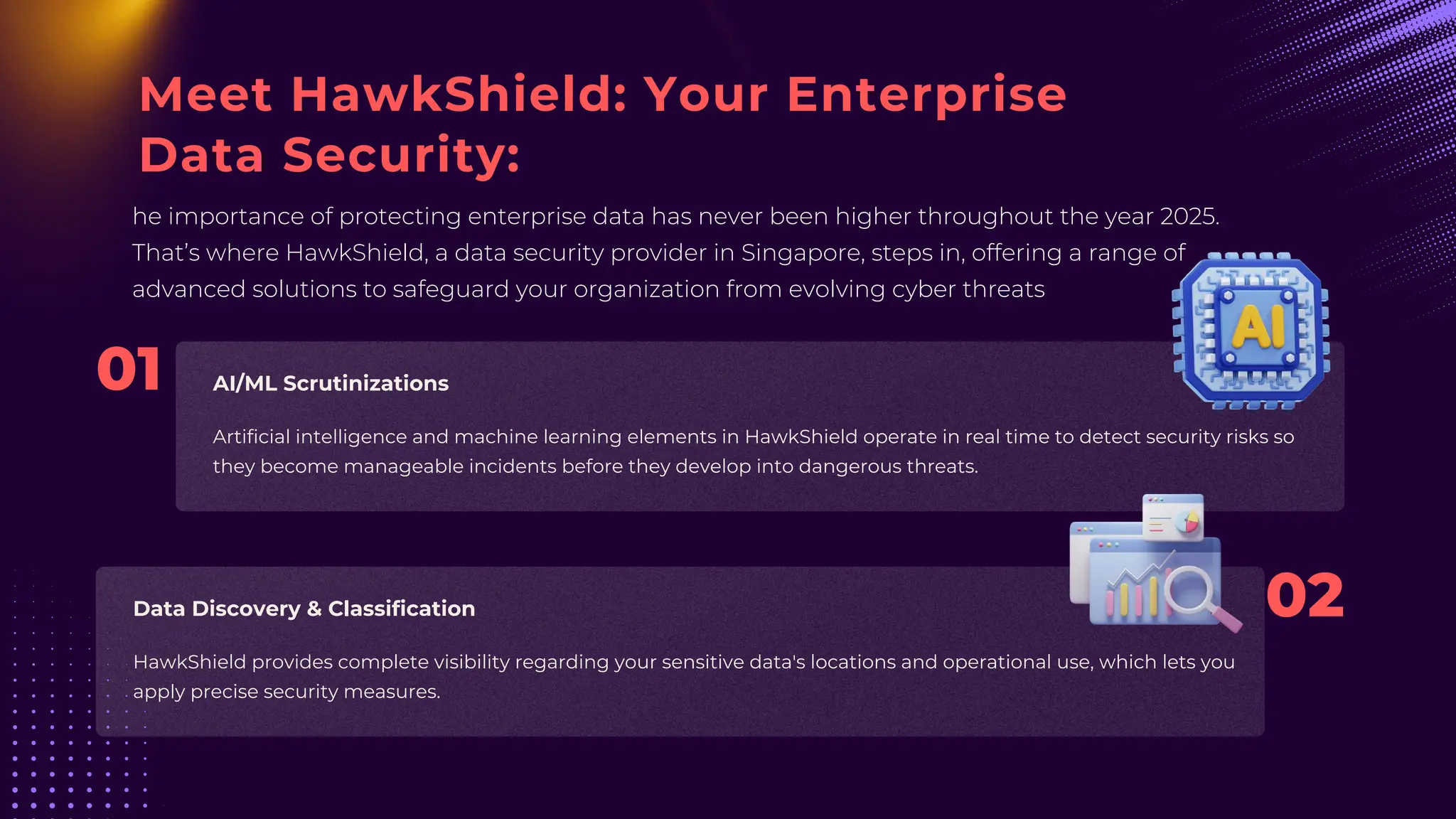
Meet HawkShield: Your Enterprise
Data Security:
he importance of protecting enterprise data has never been higher throughout the year 2025.
That’s where HawkShield, a data security provider in Singapore, steps in, offering a range of
advanced solutions to safeguard your organization from evolving cyber threats
Artificial intelligence and machine learning elements in HawkShield operate in real time to detect security risks so
they become manageable incidents before they develop into dangerous threats.
HawkShield provides complete visibility regarding your sensitive data's locations and operational use, which lets you
apply precise security measures.
AI/ML Scrutinizations
Data Discovery & Classification 02
01
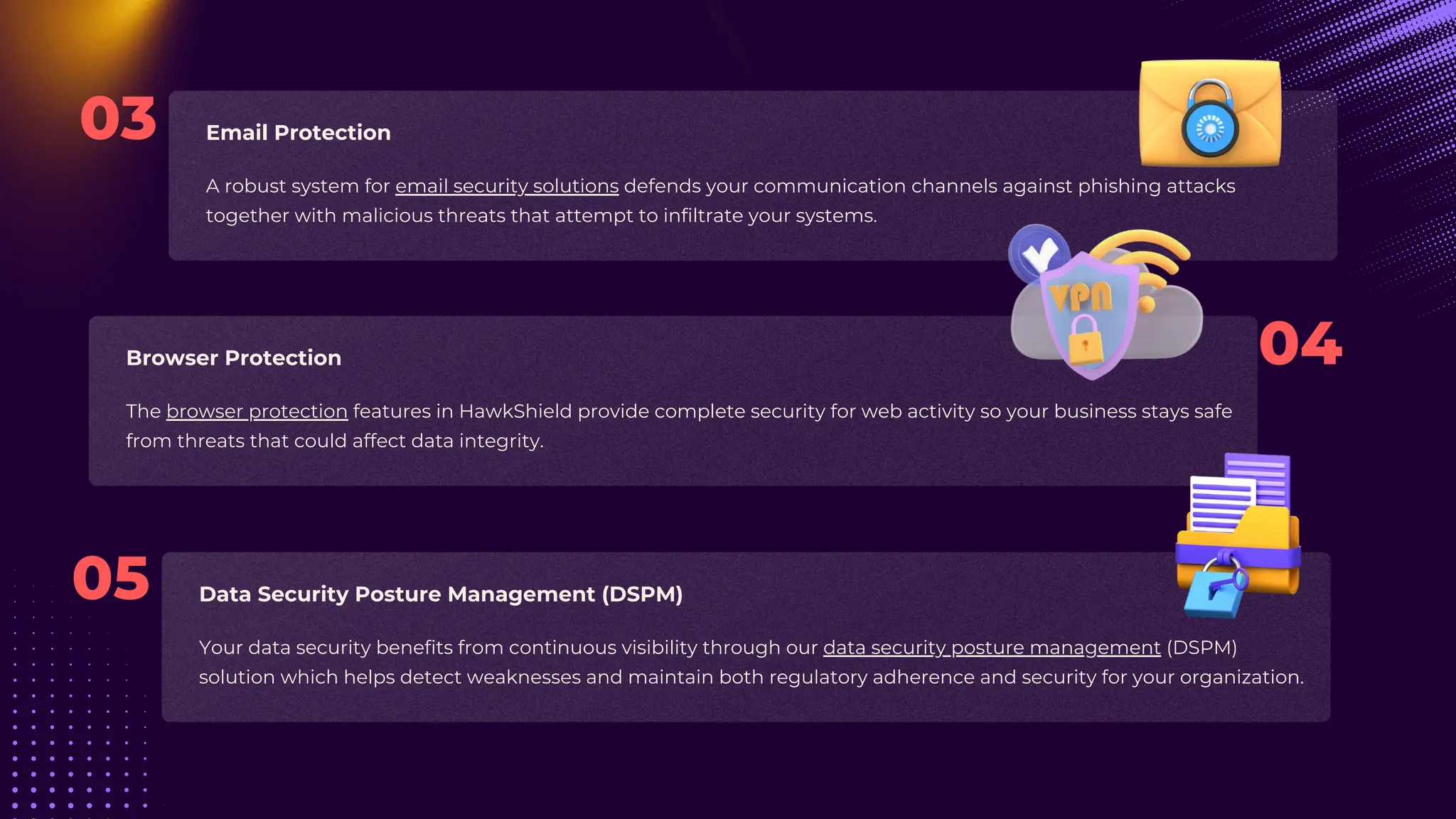
A robust system for email security solutions defends your communication channels against phishing attacks
together with malicious threats that attempt to infiltrate your systems.
Your data security benefits from continuous visibility through our data security posture management (DSPM)
solution which helps detect weaknesses and maintain both regulatory adherence and security for your organization.
The browser protection features in HawkShield provide complete security for web activity so your business stays safe
from threats that could affect data integrity.
Email Protection
Data Security Posture Management (DSPM)
Browser Protection 04
03
05
Conclusion:
Data Security and Privacy remain essential priorities which enterprises need to focus on during the
upcoming years through 2025.
Current security protection requires businesses to use a three-step approach which involves data
security management together with data loss prevention systems and adherence to regulatory
frameworks.
actices establish practices which protect data assets while restoring customer faith and maintaining
security against data breach dangers.
Through strategic planning your enterprise will become prepared to address future evolving data
security challenges. Contact us today to get started.
HAWKSHIELD
Singapore.
https://www.hawkshield.ai/
Thank You

9 Best Enterprise Data Security and Privacy Practices in 2025_compressed (1).pdf

  • 1.
  • 2.
    Introduction: Data Security andPrivacy stands as essential principles as 2025 arrives. Modern enterprises need these systems to persist and meet their objectives. Data protection because of evolving cyber attacks and upcoming strict data privacy laws represents fundamental requirements that businesses must address diligently. Companies which fail to implement proper security protocols risk severe breaches that result in substantial financial losses while simultaneously generating legal problems and reputation damage. Defending your data serves two vital purposes because it safeguards your information while it ensures your business maintains its integrity as you operate in a progressively digital environment.
  • 3.
    Top 9 EnterpriseData Security and Privacy Practices: Our guide consists of the Top 9 Data Security and Privacy Practices for 2025 which will help your business lead in an accelerating digital environment. Actionable security measures described in this text help businesses reduce their exposure to risks and defend customer information with standards that maintain regulatory compliance. Any business from startup to enterprise level will achieve necessary data security tools through implementation of these best practices
  • 4.
    The establishment ofdata security management consists of policy creation along with technological and control implementation measures which secure data throughout its entire lifecycle. Leads to a unified governance model integration of purpose-built policies alongside technologies for securing data at every stage of its lifecycle. But through data classification and robust access control systems and role definitions businesses can achieve minimal vulnerability and deploy effective data protection measures. Comprehensive Data Security Management Strategy: What it involves? Why it’s important?
  • 5.
    Implement Strong Data Loss Prevention(DLP) Measures: Data Loss Prevention tools monitor data flows while controlling which information systems can access secure data channels. Remote work conditions make DLP essential for businesses since it protects data from exposure when using unprotected documentation platforms such as personal email systems or the cloud. Future Ready Security measures that use DLP tools enable businesses to monitor data movements and exercise authority over sensitive information bounds. DLP acts to stop unintentional or unauthorized information sharing of sensitive data specifically in distant work environments. What it involves? Why it’s important?
  • 6.
    Adopt End-to-End Data Encryption: End-to-endencryption makes data unreadable through scramble code which acts as a secure protection covering data from its device exit to its recipient's reception. The system provides full protection for data in transit and data at rest from unauthorized entities A security measure which starts by encrypting data when it exits the user device until encryption terminates at its final destination. The system protects transmitted data through encryption which ensures its ongoing safety during transport as well as storage. What it involves? Why it’s important?
  • 7.
    Establish Strict Access Controland Identity Management: Access control limits who can view sensitive data. Implement Identity and Access Management (IAM) systems, role-based access control (RBAC), and multi-factor authentication (MFA) to ensure only authorized personnel have access, reducing breach risks. Enterprise organizations should deploy identity- access management controls which combine role-based access control features with multi- factor authentication protocols. Protecting data by granting access to authorized staff alone helps prevent both unauthorized insider threats and external breaches of system information. What it involves? Why it’s important?
  • 8.
    Regularly Update and PatchSystems: Marking software updates alongside fixing software bugs remains critical for organizations that want to fill security holes remaining from old system versions. System maintenance at current levels enables defense against known security flaws which decreases the likelihood of cyberattacks. Software and systems need uninterrupted maintenance by teams that handle security patch and update distribution. Cyber attackers exploit vulnerabilities in out-of- date systems which these security measures successfully shut out. What it involves? Why it’s important?
  • 9.
    Monitor Data Activity withAdvanced Threat Detection: The combination of AI along with machine learning performs advanced threat detection by monitoring constant data behavior patterns to identify suspicious activities. Informing businesses early on enables them to act swiftly through fast responses which reduces both harm and reduces the ramifications of security breaches. The continuous data inspection process through artificial intelligence alongside machine learning technologies searches for indications of both suspicious and malicious events. When threats are discovered early security teams can swiftly respond to limit security breaches while reducing their operational impact. What it involves? Why it’s important?
  • 10.
    Comply with Data Privacy Regulations: Compliancewith data privacy laws like GDPR and CCPA is critical. Adhering to these regulations by obtaining consent and securing personal data helps avoid fines and builds customer trust. These privacy regulations require data protection through consent monitoring willingness along with security protocol implementation. Following data privacy laws gives your organization two main advantages: it stops legal penalties and demonstrates to customers how seriously you take their privacy protection. What it involves? Why it’s important?
  • 11.
    Employee Training and Awareness Programs: Websitesremember information at different stages to improve user experience but also need secure data management protocols and phishing scam recognition training and strong password requirements to reduce employee incidents that lead to data breaches. The implementation of periodic programs leads employees to maintain their knowledge about security best practices. Repetitive staff training for maintaining secure data practices helps detect phishing attempts along with highlighting how strong passwords build data security. Expert workers avoid security mistakes that generate breaches and reduce human mistakes that pose risks to the system. What it involves? Why it’s important?
  • 12.
    Implement a Robust Incident ResponsePlan: An Incident Response Plan (IRP) must contain clear procedures which describe what to do when a breach occurs and how to contain it and communicate about it. An efficient organized response both minimizes damage and accelerates the recovery process from data breaches. A formal Incident Response Plan (IRP) should detail exactly how to detect and limit and erase data breach effects. Timely organized incident resolution techniques both decrease damage levels and accelerate recovery timeframes. What it involves? Why it’s important?
  • 13.
    Meet HawkShield: YourEnterprise Data Security: he importance of protecting enterprise data has never been higher throughout the year 2025. That’s where HawkShield, a data security provider in Singapore, steps in, offering a range of advanced solutions to safeguard your organization from evolving cyber threats Artificial intelligence and machine learning elements in HawkShield operate in real time to detect security risks so they become manageable incidents before they develop into dangerous threats. HawkShield provides complete visibility regarding your sensitive data's locations and operational use, which lets you apply precise security measures. AI/ML Scrutinizations Data Discovery & Classification 02 01
  • 14.
    A robust systemfor email security solutions defends your communication channels against phishing attacks together with malicious threats that attempt to infiltrate your systems. Your data security benefits from continuous visibility through our data security posture management (DSPM) solution which helps detect weaknesses and maintain both regulatory adherence and security for your organization. The browser protection features in HawkShield provide complete security for web activity so your business stays safe from threats that could affect data integrity. Email Protection Data Security Posture Management (DSPM) Browser Protection 04 03 05
  • 15.
    Conclusion: Data Security andPrivacy remain essential priorities which enterprises need to focus on during the upcoming years through 2025. Current security protection requires businesses to use a three-step approach which involves data security management together with data loss prevention systems and adherence to regulatory frameworks. actices establish practices which protect data assets while restoring customer faith and maintaining security against data breach dangers. Through strategic planning your enterprise will become prepared to address future evolving data security challenges. Contact us today to get started.
  • 16.