13 ways of Digital
Data Preservation
Amreen Ahmed
Why Preserve data?
Communication
Finance
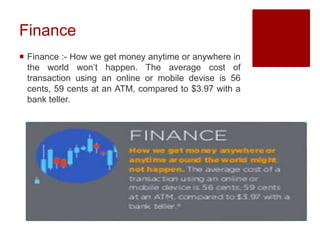
 Finance :- How we get money anytime or anywhere in
the world won’t happen. The average cost of
transaction using an online or mobile devise is 56
cents, 59 cents at an ATM, compared to $3.97 with a
bank teller.
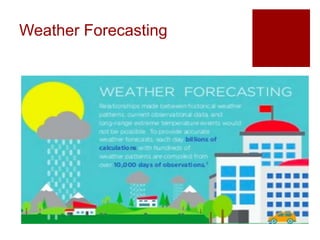
Weather Forecasting
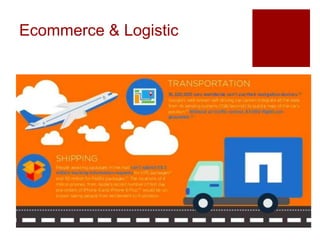
Ecommerce & Logistic
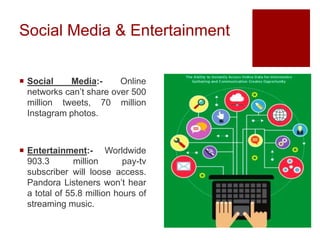
Social Media & Entertainment
 Social Media:- Online
networks can’t share over 500
million tweets, 70 million
Instagram photos.
 Entertainment:- Worldwide
903.3 million pay-tv
subscriber will loose access.
Pandora Listeners won’t hear
a total of 55.8 million hours of
streaming music.
What is digital
preservation?
Digital Preservation
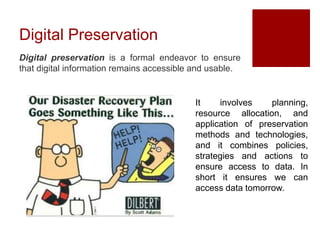
Digital preservation is a formal endeavor to ensure
that digital information remains accessible and usable.
It involves planning,
resource allocation, and
application of preservation
methods and technologies,
and it combines policies,
strategies and actions to
ensure access to data. In
short it ensures we can
access data tomorrow.
How to preserve
Digital Data?
As an ongoing activity
Preservation traditionally proceeds in fits and starts, with
extended periods of inactivity punctuated by bursts of
intensive effort.
It follows the pattern in which materials are left to
approach a state of crisis, at which point the situation is
remedied through large-scale intervention.
As a set of agreed outcome
It is one thing to recognize that
actions must be taken to secure
the long-term persistence of digital
materials; it is another to articulate
precisely what the outcome of
preservation should be.
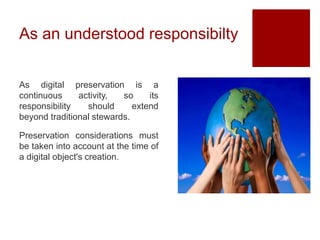
As an understood responsibilty
As digital preservation is a
continuous activity, so its
responsibility should extend
beyond traditional stewards.
Preservation considerations must
be taken into account at the time of
a digital object's creation.
As a selection process
1. Collect as many digital materials as
possible and deposit them into mass
storage systems
2. Select, which digital materials should
be preserved and taking steps to
curate them throughout their
lifecycle
Digital preservation is expensive and it is impossible to
store all the information digitally. We have 2 options.
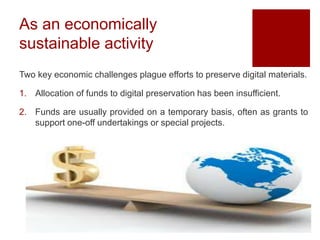
As an economically
sustainable activity
Two key economic challenges plague efforts to preserve digital materials.
1. Allocation of funds to digital preservation has been insufficient.
2. Funds are usually provided on a temporary basis, often as grants to
support one-off undertakings or special projects.
As a Cooperative Effort
Digital preservation is expensive, funding is scarce, and
preservation responsibilities are diffused
Corporation could help digital preservation activities
achieve its goals.
Cooperation can enhance the productive capacity of
digital preservation funds.
As an innocuous Activity
 The archiving agency have to alter the archived content in
some way
 Appropriate permissions must be obtained from the rights
holders.
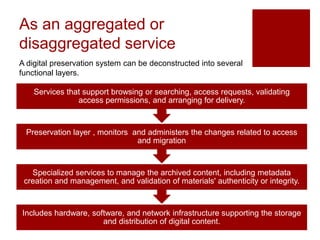
As an aggregated or
disaggregated service
Includes hardware, software, and network infrastructure supporting the storage
and distribution of digital content.
Specialized services to manage the archived content, including metadata
creation and management, and validation of materials' authenticity or integrity.
Preservation layer , monitors and administers the changes related to access
and migration
Services that support browsing or searching, access requests, validating
access permissions, and arranging for delivery.
A digital preservation system can be deconstructed into several
functional layers.
A compliment to other library
service
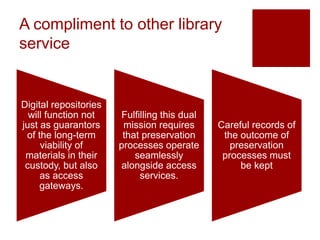
Digital repositories
will function not
just as guarantors
of the long-term
viability of
materials in their
custody, but also
as access
gateways.
Fulfilling this dual
mission requires
that preservation
processes operate
seamlessly
alongside access
services.
Careful records of
the outcome of
preservation
processes must
be kept
A well understood process
There is as yet little consensus on best
practice for carrying out the long-term
preservation of digital materials. suitable
benchmarks and evaluative procedures for
assessing the outcomes of digital
preservation processes.
Prospects for cultivating a shared view on this
issue hinge on three factors: identification and
development of standards to support digital
preservation; and mechanisms for certifying
adherence to a minimum set of practices on the
part of digital repositories.
An arm’s length transaction
 A related question concerns what is supplied in
exchange for payment.
 What preservation guarantees can the digital
repository offer?
 To what compensation is the depositor entitled if
promised outcomes are not achieved?
 Resolution of these issues must emerge from a
convergence of customer expectations and repository
commitments.
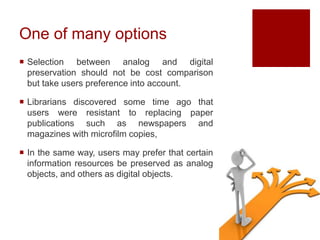
One of many options
 Selection between analog and digital
preservation should not be cost comparison
but take users preference into account.
 Librarians discovered some time ago that
users were resistant to replacing paper
publications such as newspapers and
magazines with microfilm copies,
 In the same way, users may prefer that certain
information resources be preserved as analog
objects, and others as digital objects.
A Public good
Preserving information resource is not
only beneficial to its owner.
An institution that preserves the last copy
of a resource has performed a service of
potentially incalculable value to the
public
In these circumstances, the benefits from
preservation are widely distributed;
unfortunately, the costs of preservation
are not.
Conclusion
Though the article illustrates some very nice ways
of preserving data , it is not absolutely right in the
present context due to the timeframe in which
article was written.
Article emphasizes on the ways of preserving the
data but doesn’t tell how can we achieve data
preservation nor he presents ways of segregating
required data as oppose to available data.
Digital data preservation should be given more
importance at the same time , we should try to find
ways of accessing universal data at the same time
managing access rights.
References
 http://community.netapp.com/t5/Company/A-Quick-Glimpse-A-Day-in-
Our-Lives-Without-Data-Infographic/ba-p/103932
 http://www.dlib.org/dlib/july04/lavoie/07lavoie.html
 http://ifdo.org/wordpress/?page_id=18
 https://en.wikipedia.org/wiki/Digital_preservation
 http://proexcorp.com/e-learn/about-us/social-responsibility/
 http://www.dcc.ac.uk/digital-curation/why-preserve-digital-data

Data preservation

  • 1.
    13 ways ofDigital Data Preservation Amreen Ahmed
  • 2.
  • 3.
  • 4.
    Finance  Finance :-How we get money anytime or anywhere in the world won’t happen. The average cost of transaction using an online or mobile devise is 56 cents, 59 cents at an ATM, compared to $3.97 with a bank teller.
  • 5.
  • 6.
  • 7.
    Social Media &Entertainment  Social Media:- Online networks can’t share over 500 million tweets, 70 million Instagram photos.  Entertainment:- Worldwide 903.3 million pay-tv subscriber will loose access. Pandora Listeners won’t hear a total of 55.8 million hours of streaming music.
  • 8.
  • 9.
    Digital Preservation Digital preservationis a formal endeavor to ensure that digital information remains accessible and usable. It involves planning, resource allocation, and application of preservation methods and technologies, and it combines policies, strategies and actions to ensure access to data. In short it ensures we can access data tomorrow.
  • 10.
  • 11.
    As an ongoingactivity Preservation traditionally proceeds in fits and starts, with extended periods of inactivity punctuated by bursts of intensive effort. It follows the pattern in which materials are left to approach a state of crisis, at which point the situation is remedied through large-scale intervention.
  • 12.
    As a setof agreed outcome It is one thing to recognize that actions must be taken to secure the long-term persistence of digital materials; it is another to articulate precisely what the outcome of preservation should be.
  • 13.
    As an understoodresponsibilty As digital preservation is a continuous activity, so its responsibility should extend beyond traditional stewards. Preservation considerations must be taken into account at the time of a digital object's creation.
  • 14.
    As a selectionprocess 1. Collect as many digital materials as possible and deposit them into mass storage systems 2. Select, which digital materials should be preserved and taking steps to curate them throughout their lifecycle Digital preservation is expensive and it is impossible to store all the information digitally. We have 2 options.
  • 15.
    As an economically sustainableactivity Two key economic challenges plague efforts to preserve digital materials. 1. Allocation of funds to digital preservation has been insufficient. 2. Funds are usually provided on a temporary basis, often as grants to support one-off undertakings or special projects.
  • 16.
    As a CooperativeEffort Digital preservation is expensive, funding is scarce, and preservation responsibilities are diffused Corporation could help digital preservation activities achieve its goals. Cooperation can enhance the productive capacity of digital preservation funds.
  • 17.
    As an innocuousActivity  The archiving agency have to alter the archived content in some way  Appropriate permissions must be obtained from the rights holders.
  • 18.
    As an aggregatedor disaggregated service Includes hardware, software, and network infrastructure supporting the storage and distribution of digital content. Specialized services to manage the archived content, including metadata creation and management, and validation of materials' authenticity or integrity. Preservation layer , monitors and administers the changes related to access and migration Services that support browsing or searching, access requests, validating access permissions, and arranging for delivery. A digital preservation system can be deconstructed into several functional layers.
  • 19.
    A compliment toother library service Digital repositories will function not just as guarantors of the long-term viability of materials in their custody, but also as access gateways. Fulfilling this dual mission requires that preservation processes operate seamlessly alongside access services. Careful records of the outcome of preservation processes must be kept
  • 20.
    A well understoodprocess There is as yet little consensus on best practice for carrying out the long-term preservation of digital materials. suitable benchmarks and evaluative procedures for assessing the outcomes of digital preservation processes. Prospects for cultivating a shared view on this issue hinge on three factors: identification and development of standards to support digital preservation; and mechanisms for certifying adherence to a minimum set of practices on the part of digital repositories.
  • 21.
    An arm’s lengthtransaction  A related question concerns what is supplied in exchange for payment.  What preservation guarantees can the digital repository offer?  To what compensation is the depositor entitled if promised outcomes are not achieved?  Resolution of these issues must emerge from a convergence of customer expectations and repository commitments.
  • 22.
    One of manyoptions  Selection between analog and digital preservation should not be cost comparison but take users preference into account.  Librarians discovered some time ago that users were resistant to replacing paper publications such as newspapers and magazines with microfilm copies,  In the same way, users may prefer that certain information resources be preserved as analog objects, and others as digital objects.
  • 23.
    A Public good Preservinginformation resource is not only beneficial to its owner. An institution that preserves the last copy of a resource has performed a service of potentially incalculable value to the public In these circumstances, the benefits from preservation are widely distributed; unfortunately, the costs of preservation are not.
  • 24.
    Conclusion Though the articleillustrates some very nice ways of preserving data , it is not absolutely right in the present context due to the timeframe in which article was written. Article emphasizes on the ways of preserving the data but doesn’t tell how can we achieve data preservation nor he presents ways of segregating required data as oppose to available data. Digital data preservation should be given more importance at the same time , we should try to find ways of accessing universal data at the same time managing access rights.
  • 25.
    References  http://community.netapp.com/t5/Company/A-Quick-Glimpse-A-Day-in- Our-Lives-Without-Data-Infographic/ba-p/103932  http://www.dlib.org/dlib/july04/lavoie/07lavoie.html http://ifdo.org/wordpress/?page_id=18  https://en.wikipedia.org/wiki/Digital_preservation  http://proexcorp.com/e-learn/about-us/social-responsibility/  http://www.dcc.ac.uk/digital-curation/why-preserve-digital-data

Editor's Notes

  • #4 There is virtually nothing humankind does that does not somehow create data. It’s ingrained in the way we do business and interact with our family and friends. What would happen if we did not have access to the data we take for granted? I want you all to think .what would change in our life without data ? From modern transportation to monetary infrastructure, we depend on the data to power global systems. Now more than ever data needs to be carefully managed across different “boundaries” without loosing control.
  • #7  It would loose up to $2 billion in sales. This in turn could affect the 244 million users on amazon and over 149 million buyers on ebay. Without air traffic control flights will be grounded, car’s won’t be able to use their navigation system. Also nearly 60 million tracking information request won’t process for UPS and nearly 50 million for fedex.
  • #8 As per the statistic approximately 864 million facebook users spend an average of 39 minutes on the network, sharing 5 billion posts( which includes likes, phot sharing, posting status) and sending more than 10 billion messages.
  • #10 So now when have realised the importance of data in our day to day life, we should think of ways of preserving data.
  • #12 As an outgoing activity , which requires to be backup after certain period of time, as oppose of our recent time wherein we leave data inactive for an extended period of time followed by burst of extensive efforts. For example :- our recent efforts to save the movies filmed on nitrate cellulose film stoc
  • #13 So now when have realised the importance of data in our day to day life, we should think of ways of preserving data.
  • #14 So now when have realised the importance of data in our day to day life, we should think of ways of preserving data. , it is authors and publishers, rather than libraries and archives, who must take the first steps toward securing the long-term persistence of digital materials
  • #15 . The choice of which materials to preserve is a difficult one, and will depend on a number of factors, including institutional mission, cultural preferences, economic practicality, and risk management policies.
  • #16 So now when have realised the importance of data in our day to day life, we should think of ways of preserving data.
  • #17 …by building shared resources, eliminating redundancies, and exploiting economies of scale.
  • #18 The archiving agency may have to alter the archived content in some way—for example, by migrating it to another format in order to keep pace with changing technologies, or by disaggregating complex objects into more granular resources, such as breaking up an issue of a journal into its constituent articles. 2) … in order to give the repository sufficient control over the archived materials to carry out its preservation responsibilities
  • #19 A digital preservation system can be deconstructed into several functional layers. The bottom layer includes hardware, software, and network infrastructure supporting the storage and distribution of digital content. The next layer includes more specialized services to manage the archived content residing in the system, including metadata creation and management, and validation of materials' authenticity or integrity. Preservation measures are implemented in the next layer of services, including monitoring the repository's environment for changes that could impact the ability to access and use archived content, as well as initiating processes such as migration or emulation to counteract these changes. The top-most layer includes services that support browsing or searching, access requests, validating access permissions, and arranging for delivery.
  • #20 Preservation should not impede access or reduce the scope for sharing information. : for example, in cases where material is migrated to new formats, users must understand which versions of a particular digital resource are available for access, and what alterations, if any, have been made to these versions as a consequence of preservation.
  • #21 The emergence of standards would benefit many aspects of the preservation process. Some progress can already be reported. The Open Archival Information System reference model (2002), which details a conceptual framework for an archival repository, as well as the environment in which it operates and the information objects it manages, has been well-received and extensively applied in the digital preservation community.
  • #22  in fifty years"), or should only the process itself be guaranteed ("these digital objects will be recorded on up-to-date digital storage media, refreshed at regular intervals, and maintained under environmentally controlled conditions")?
  • #23 The decision to preserve information in digital or analog form should not be a simple cost comparison of the two approached , but Ideally it should also take into acount the preferences of users. Librarians have faced resistance for replacing newpaper and magazines with microfilm copies, despite the advantages the latter format offered in terms of prolonging the longevity of the materials and reducing storage space requirements.
  • #24 Though many people think information preservation is benificial to its owner like library, museum or private collector but they forget that by preserving information they are making it a making it a part of permanent scholarly or cultural record, which also confers benefits on society at large by securing the resources availability for use by current and future generations.
  • #25 So now when have realised the importance of data in our day to day life, we should think of ways of preserving data.