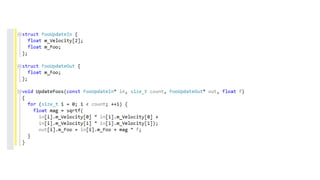
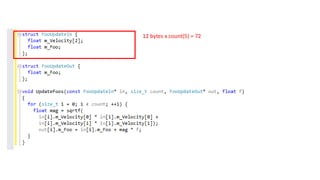
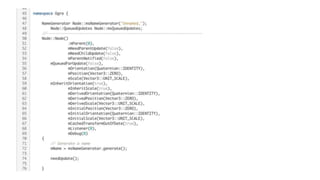
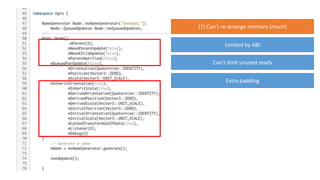
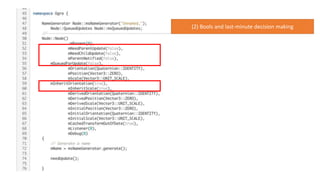
Not even includingshared memory modes…
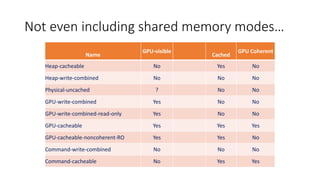
Name
GPU-visible
Cached
GPU Coherent
Heap-cacheable No Yes No
Heap-write-combined No No No
Physical-uncached ? No No
GPU-write-combined Yes No No
GPU-write-combined-read-only Yes No No
GPU-cacheable Yes Yes Yes
GPU-cacheable-noncoherent-RO Yes Yes No
Command-write-combined No No No
Command-cacheable No Yes Yes
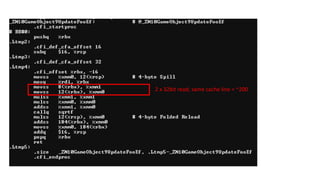
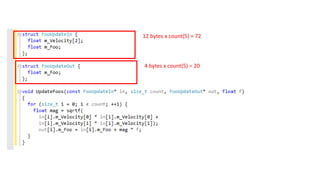
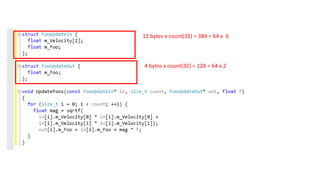
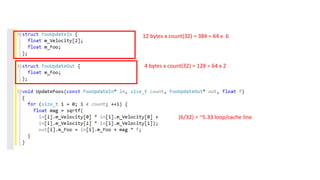
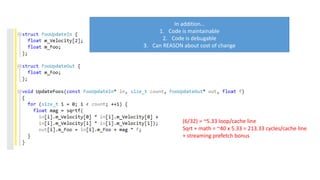
12 bytes xcount(32) = 384 = 64 x 6
4 bytes x count(32) = 128 = 64 x 2
114.
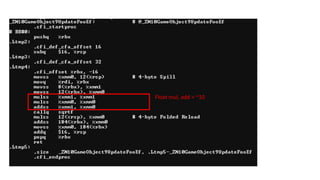
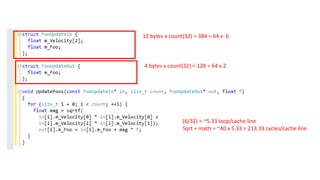
12 bytes xcount(32) = 384 = 64 x 6
4 bytes x count(32) = 128 = 64 x 2
(6/32) = ~5.33 loop/cache line
115.
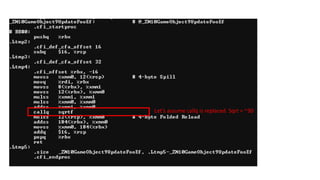
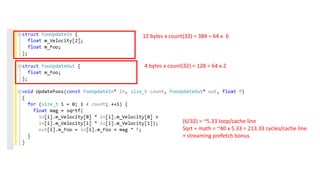
12 bytes xcount(32) = 384 = 64 x 6
4 bytes x count(32) = 128 = 64 x 2
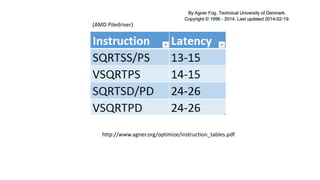
Sqrt + math = ~40 x 5.33 = 213.33 cycles/cache line
(6/32) = ~5.33 loop/cache line
116.
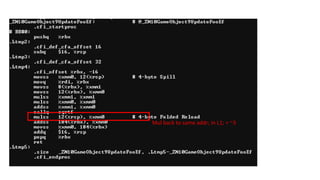
12 bytes xcount(32) = 384 = 64 x 6
4 bytes x count(32) = 128 = 64 x 2
Sqrt + math = ~40 x 5.33 = 213.33 cycles/cache line
(6/32) = ~5.33 loop/cache line
+ streaming prefetch bonus
117.
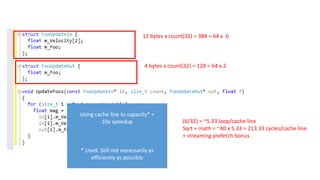
12 bytes xcount(32) = 384 = 64 x 6
4 bytes x count(32) = 128 = 64 x 2
Sqrt + math = ~40 x 5.33 = 213.33 cycles/cache line
(6/32) = ~5.33 loop/cache line
+ streaming prefetch bonus
Using cache line to capacity* =
10x speedup
* Used. Still not necessarily as
efficiently as possible
118.
Sqrt + math= ~40 x 5.33 = 213.33 cycles/cache line
(6/32) = ~5.33 loop/cache line
+ streaming prefetch bonus
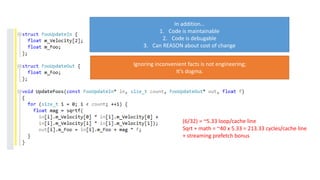
In addition…
1. Code is maintainable
2. Code is debugable
3. Can REASON about cost of change
119.
Sqrt + math= ~40 x 5.33 = 213.33 cycles/cache line
(6/32) = ~5.33 loop/cache line
+ streaming prefetch bonus
In addition…
1. Code is maintainable
2. Code is debugable
3. Can REASON about cost of change
Ignoring inconvenient facts is not engineering;
It’s dogma.
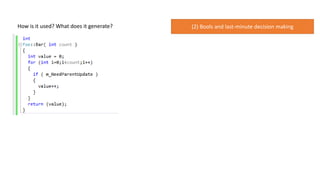
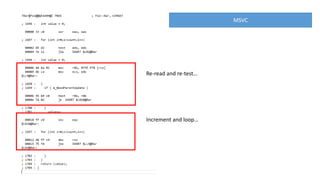
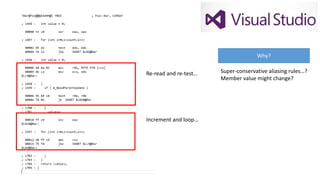
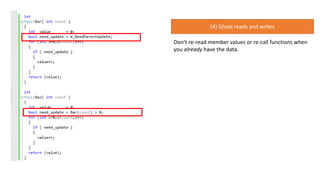
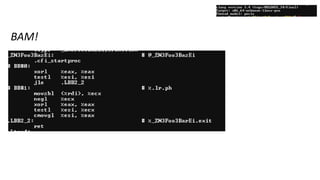
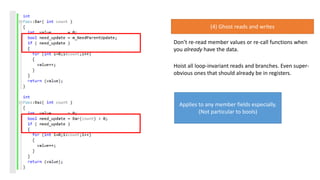
(4) Ghost readsand writes
Don’t re-read member values or re-call functions when
you already have the data.
Hoist all loop-invariant reads and branches. Even super-
obvious ones that should already be in registers.
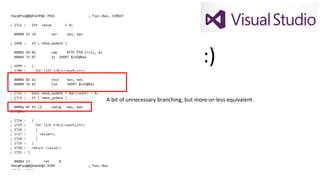
:)
A bit ofunnecessary branching, but more-or-less equivalent.
138.
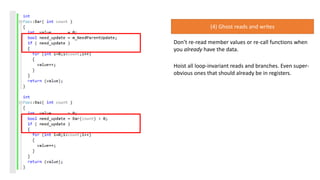
(4) Ghost readsand writes
Don’t re-read member values or re-call functions when
you already have the data.
Hoist all loop-invariant reads and branches. Even super-
obvious ones that should already be in registers.
Applies to any member fields especially.
(Not particular to bools)
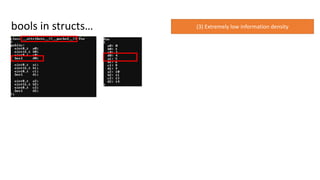
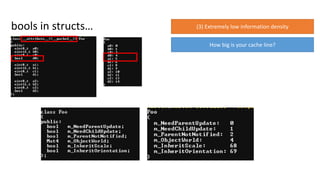
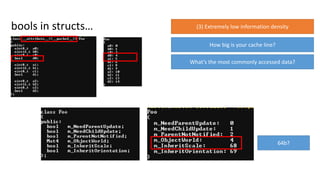
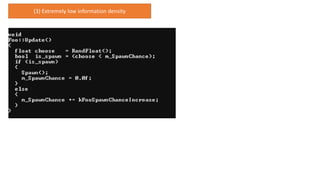
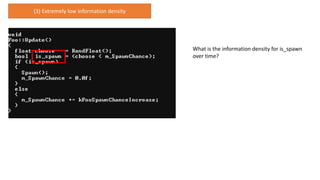
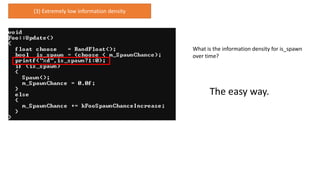
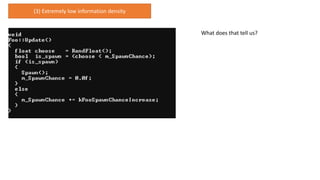
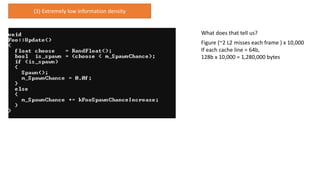
(3) Extremely lowinformation density
What does that tell us?
Figure (~2 L2 misses each frame ) x 10,000
If each cache line = 64b,
128b x 10,000 = 1,280,000 bytes
147.
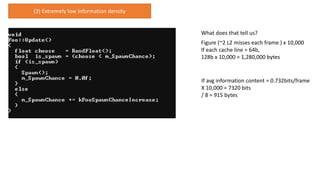
(3) Extremely lowinformation density
What does that tell us?
Figure (~2 L2 misses each frame ) x 10,000
If each cache line = 64b,
128b x 10,000 = 1,280,000 bytes
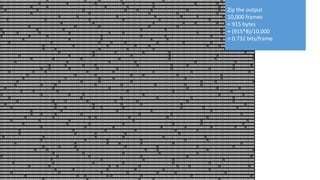
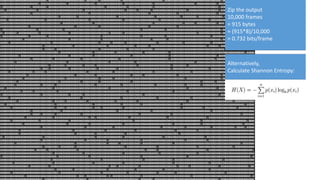
If avg information content = 0.732bits/frame
X 10,000 = 7320 bits
/ 8 = 915 bytes
148.
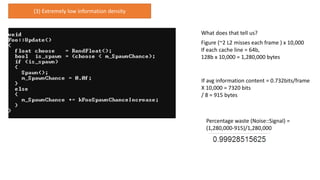
(3) Extremely lowinformation density
What does that tell us?
Figure (~2 L2 misses each frame ) x 10,000
If each cache line = 64b,
128b x 10,000 = 1,280,000 bytes
If avg information content = 0.732bits/frame
X 10,000 = 7320 bits
/ 8 = 915 bytes
Percentage waste (Noise::Signal) =
(1,280,000-915)/1,280,000
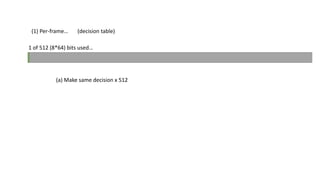
(1) Per-frame…
1 of512 (8*64) bits used…
(decision table)
(a) Make same decision x 512
153.
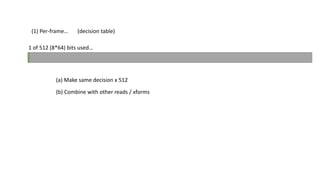
(1) Per-frame…
1 of512 (8*64) bits used…
(decision table)
(a) Make same decision x 512
(b) Combine with other reads / xforms
154.
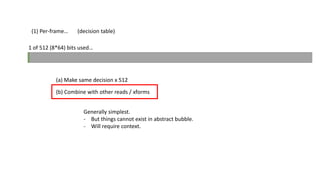
(1) Per-frame…
1 of512 (8*64) bits used…
(decision table)
(a) Make same decision x 512
(b) Combine with other reads / xforms
Generally simplest.
- But things cannot exist in abstract bubble.
- Will require context.
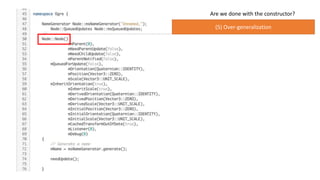
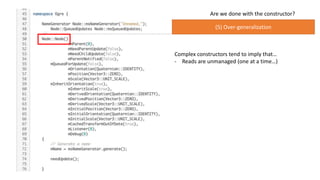
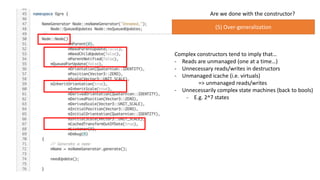
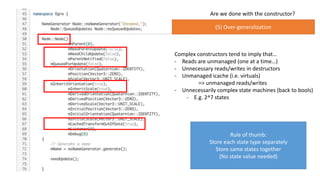
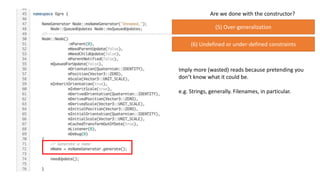
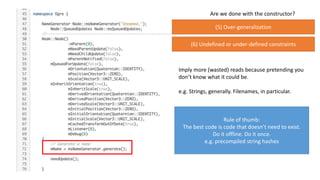
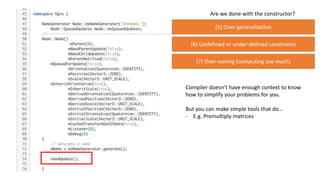
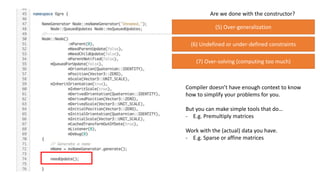
Are we donewith the constructor?
(5) Over-generalization
165.
Are we donewith the constructor?
(5) Over-generalization
Complex constructors tend to imply that…
- Reads are unmanaged (one at a time…)
166.
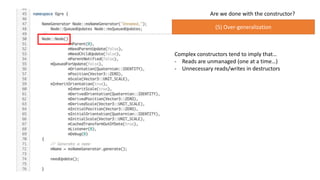
Are we donewith the constructor?
(5) Over-generalization
Complex constructors tend to imply that…
- Reads are unmanaged (one at a time…)
- Unnecessary reads/writes in destructors
167.
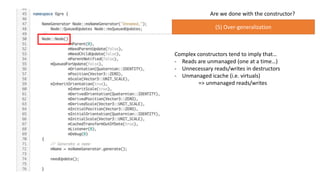
Are we donewith the constructor?
(5) Over-generalization
Complex constructors tend to imply that…
- Reads are unmanaged (one at a time…)
- Unnecessary reads/writes in destructors
- Unmanaged icache (i.e. virtuals)
=> unmanaged reads/writes
168.
Are we donewith the constructor?
(5) Over-generalization
Complex constructors tend to imply that…
- Reads are unmanaged (one at a time…)
- Unnecessary reads/writes in destructors
- Unmanaged icache (i.e. virtuals)
=> unmanaged reads/writes
- Unnecessarily complex state machines (back to bools)
- E.g. 2^7 states
169.
Are we donewith the constructor?
(5) Over-generalization
Complex constructors tend to imply that…
- Reads are unmanaged (one at a time…)
- Unnecessary reads/writes in destructors
- Unmanaged icache (i.e. virtuals)
=> unmanaged reads/writes
- Unnecessarily complex state machines (back to bools)
- E.g. 2^7 states
Rule of thumb:
Store each state type separately
Store same states together
(No state value needed)
170.
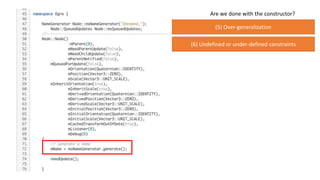
Are we donewith the constructor?
(5) Over-generalization
(6) Undefined or under-defined constraints
171.
Are we donewith the constructor?
(5) Over-generalization
(6) Undefined or under-defined constraints
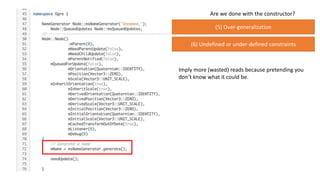
Imply more (wasted) reads because pretending you
don’t know what it could be.
172.
Are we donewith the constructor?
(5) Over-generalization
(6) Undefined or under-defined constraints
Imply more (wasted) reads because pretending you
don’t know what it could be.
e.g. Strings, generally. Filenames, in particular.
173.
Are we donewith the constructor?
(5) Over-generalization
(6) Undefined or under-defined constraints
Imply more (wasted) reads because pretending you
don’t know what it could be.
e.g. Strings, generally. Filenames, in particular.
Rule of thumb:
The best code is code that doesn’t need to exist.
Do it offline. Do it once.
e.g. precompiled string hashes
174.
Are we donewith the constructor?
(5) Over-generalization
(6) Undefined or under-defined constraints
(7) Over-solving (computing too much)
Compiler doesn’t have enough context to know
how to simplify your problems for you.
175.
Are we donewith the constructor?
(5) Over-generalization
(6) Undefined or under-defined constraints
(7) Over-solving (computing too much)
Compiler doesn’t have enough context to know
how to simplify your problems for you.
But you can make simple tools that do…
- E.g. Premultiply matrices
176.
Are we donewith the constructor?
(5) Over-generalization
(6) Undefined or under-defined constraints
(7) Over-solving (computing too much)
Compiler doesn’t have enough context to know
how to simplify your problems for you.
But you can make simple tools that do…
- E.g. Premultiply matrices
Work with the (actual) data you have.
- E.g. Sparse or affine matrices
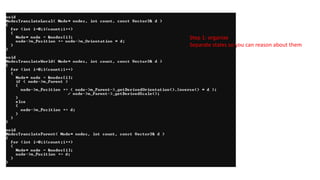
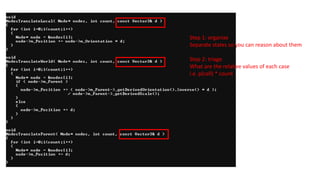
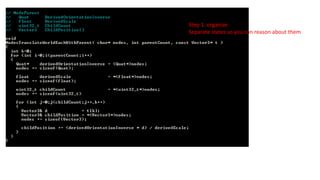
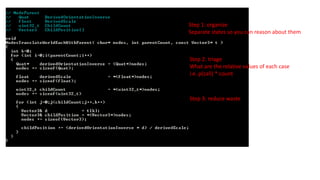
Step 1: organize
Separatestates so you can reason about them
Step 2: triage
What are the relative values of each case
i.e. p(call) * count
182.
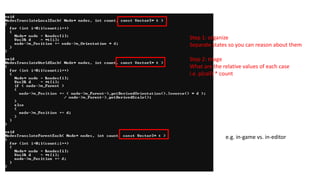
Step 1: organize
Separatestates so you can reason about them
Step 2: triage
What are the relative values of each case
i.e. p(call) * count
e.g. in-game vs. in-editor
183.
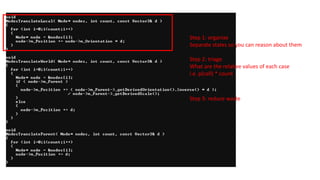
Step 1: organize
Separatestates so you can reason about them
Step 2: triage
What are the relative values of each case
i.e. p(call) * count
Step 3: reduce waste
184.
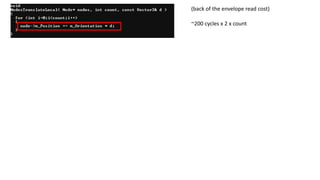
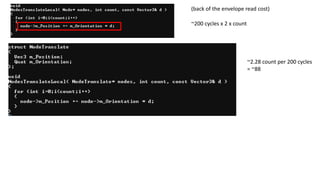
~200 cycles x2 x count
(back of the envelope read cost)
185.
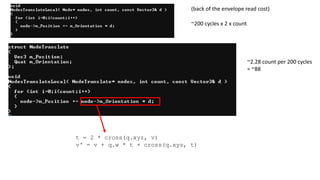
~200 cycles x2 x count
~2.28 count per 200 cycles
= ~88
(back of the envelope read cost)
186.
~200 cycles x2 x count
~2.28 count per 200 cycles
= ~88
(back of the envelope read cost)
t = 2 * cross(q.xyz, v)
v' = v + q.w * t + cross(q.xyz, t)
187.
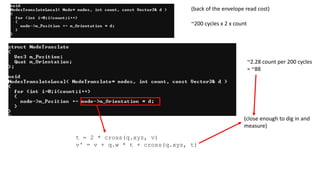
~200 cycles x2 x count
~2.28 count per 200 cycles
= ~88
(back of the envelope read cost)
t = 2 * cross(q.xyz, v)
v' = v + q.w * t + cross(q.xyz, t)
(close enough to dig in and
measure)
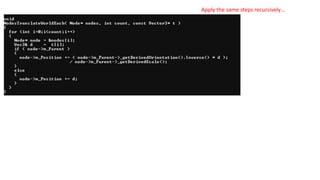
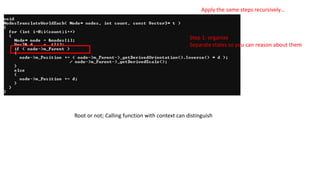
Apply the samesteps recursively…
Step 1: organize
Separate states so you can reason about them
Root or not; Calling function with context can distinguish
190.
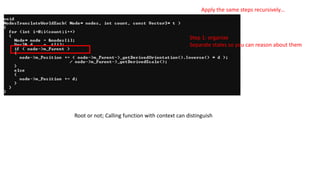
Apply the samesteps recursively…
Step 1: organize
Separate states so you can reason about them
Root or not; Calling function with context can distinguish
191.
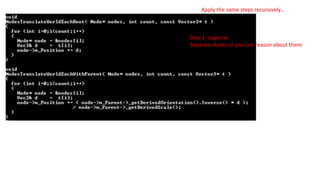
Apply the samesteps recursively…
Step 1: organize
Separate states so you can reason about them
192.
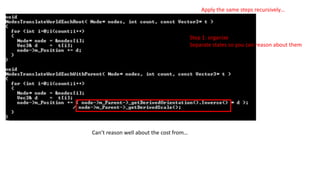
Apply the samesteps recursively…
Step 1: organize
Separate states so you can reason about them
Can’t reason well about the cost from…
Step 1: organize
Separatestates so you can reason about them
Step 2: triage
What are the relative values of each case
i.e. p(call) * count
Step 3: reduce waste