DATA MINING
MEANING, COMPONENTS, STEPS, TECHNIQUES, APPLICATIONS, USES, BENEFITS
AND DISADVANTAGES. (BRIEF EXPLANATION).
WHAT DO YOU
UNDERSTAND BY DATA
MINING?
One of the key elements of database administration is data mining. it is a procedure for selecting the
necessary data from a large collection of data in order to obtain accurate information for the
organisation. the ability of data mining to recognise links and patterns in massive amounts of data from
numerous sources is one of its key advantages. it comprises the procedure of evaluating and analysing
a sizable batch of unstructured data in order to find patterns and extract data.
COMPONENTS OF
DATA MINING
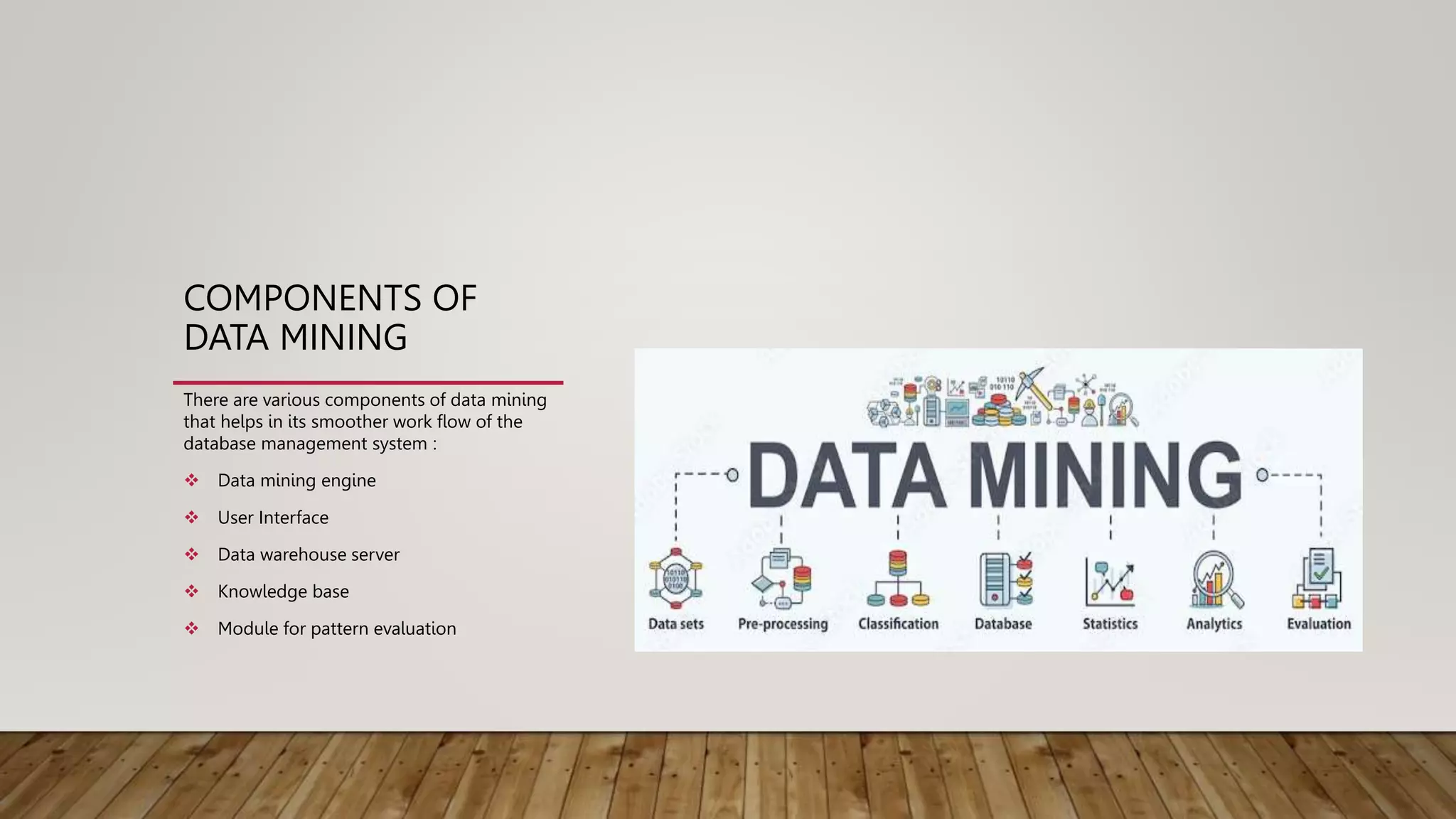
There are various components of data mining
that helps in its smoother work flow of the
database management system :
 Data mining engine
 User Interface
 Data warehouse server
 Knowledge base
 Module for pattern evaluation
STEPS IN DATA
MINING
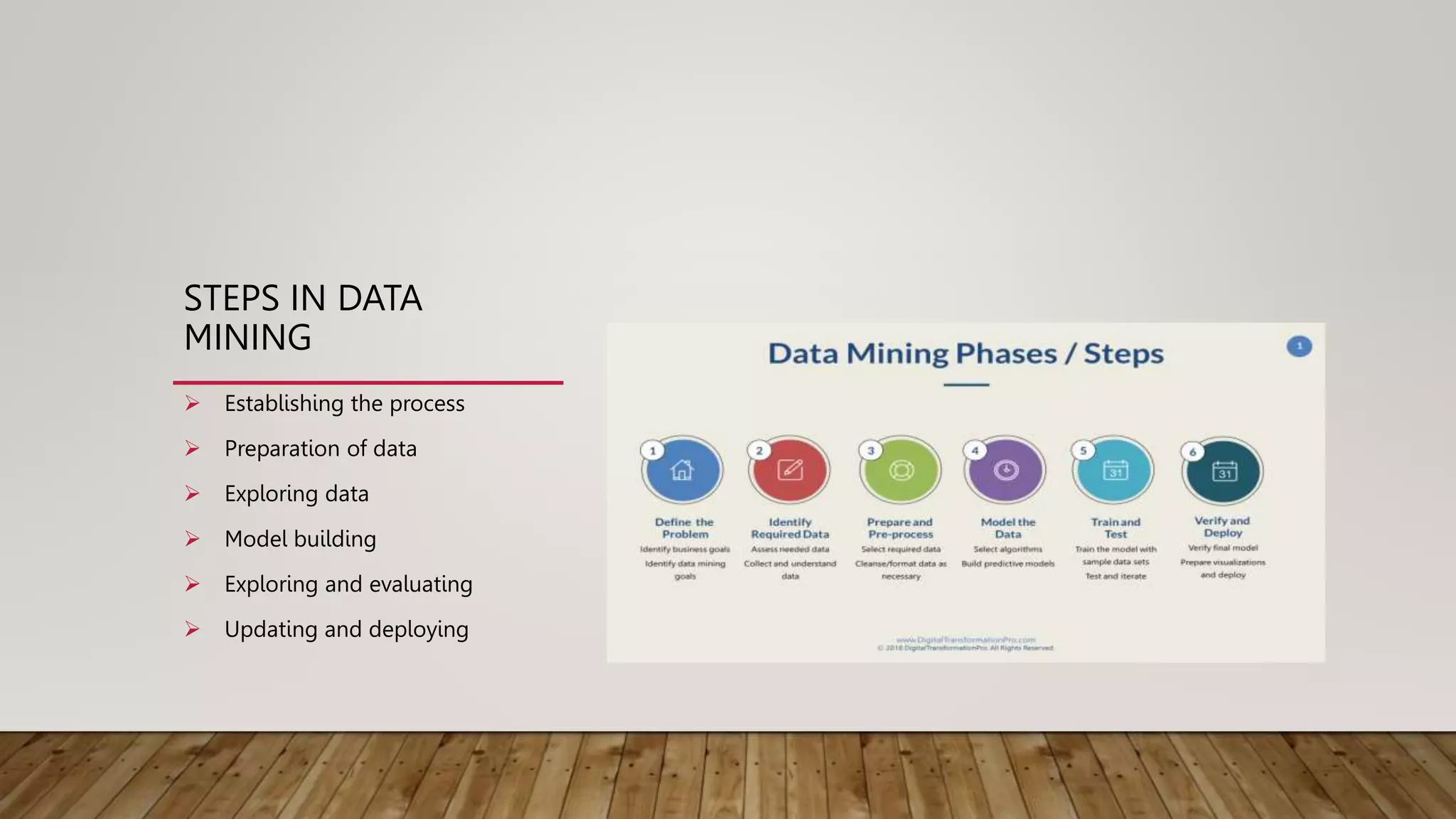
 Establishing the process
 Preparation of data
 Exploring data
 Model building
 Exploring and evaluating
 Updating and deploying
DATA MINING
TECHNIQUES
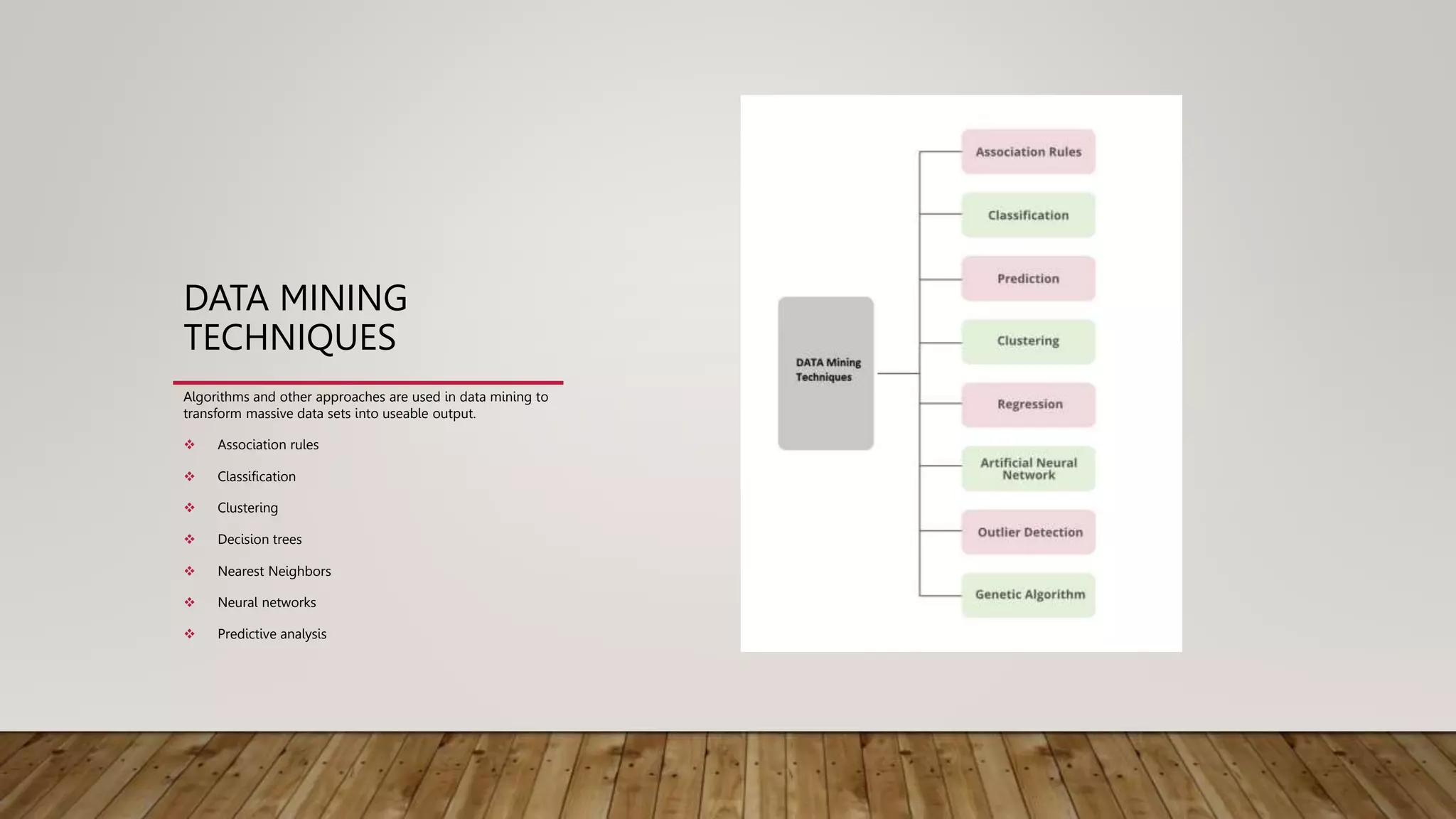
Algorithms and other approaches are used in data mining to
transform massive data sets into useable output.
 Association rules
 Classification
 Clustering
 Decision trees
 Nearest Neighbors
 Neural networks
 Predictive analysis
APPLICATIONS OF DATA MINING
 Sales
 Marketing
 Manufacturing
 Fraud Detection
 Human resources
 Customer satisfaction
USES OF DATA MINING
There are various uses of data mining. List of it is below :-
 Basket Analysis
 Sales forecasting
 Database marketing
 Inventory planning
 Customer loyalty
BENEFITS OF DATA MINING
• It aids businesses in making wise selections.
• It enables data scientists to swiftly launch automated behavioral and trend
predictions and find covert pattern.
• It aids businesses in obtaining accurate information.
• Compared to other data applications, it is a productive and affordable solution.
• Businesses can adapt their operations and production in a lucrative way.
• It aids in identifying fraud and credit risks.
DISADVANTAGES OF DATA MINING
• Data mining is challenging and intricate, so thorough instruction in the use of
numerous technologies is necessary.
 The method is challenging since mining requires a sizable database.
 Data mining is not always accurate and, in some circumstances, might have
negative effects.
 It is certain that each tool has a unique algorithm, choosing the best one for a
certain firm is a difficult issue.
Thank you!

Data Mining.pptx

  • 1.
    DATA MINING MEANING, COMPONENTS,STEPS, TECHNIQUES, APPLICATIONS, USES, BENEFITS AND DISADVANTAGES. (BRIEF EXPLANATION).
  • 2.
    WHAT DO YOU UNDERSTANDBY DATA MINING? One of the key elements of database administration is data mining. it is a procedure for selecting the necessary data from a large collection of data in order to obtain accurate information for the organisation. the ability of data mining to recognise links and patterns in massive amounts of data from numerous sources is one of its key advantages. it comprises the procedure of evaluating and analysing a sizable batch of unstructured data in order to find patterns and extract data.
  • 3.
    COMPONENTS OF DATA MINING Thereare various components of data mining that helps in its smoother work flow of the database management system :  Data mining engine  User Interface  Data warehouse server  Knowledge base  Module for pattern evaluation
  • 4.
    STEPS IN DATA MINING Establishing the process  Preparation of data  Exploring data  Model building  Exploring and evaluating  Updating and deploying
  • 5.
    DATA MINING TECHNIQUES Algorithms andother approaches are used in data mining to transform massive data sets into useable output.  Association rules  Classification  Clustering  Decision trees  Nearest Neighbors  Neural networks  Predictive analysis
  • 6.
    APPLICATIONS OF DATAMINING  Sales  Marketing  Manufacturing  Fraud Detection  Human resources  Customer satisfaction
  • 7.
    USES OF DATAMINING There are various uses of data mining. List of it is below :-  Basket Analysis  Sales forecasting  Database marketing  Inventory planning  Customer loyalty
  • 8.
    BENEFITS OF DATAMINING • It aids businesses in making wise selections. • It enables data scientists to swiftly launch automated behavioral and trend predictions and find covert pattern. • It aids businesses in obtaining accurate information. • Compared to other data applications, it is a productive and affordable solution. • Businesses can adapt their operations and production in a lucrative way. • It aids in identifying fraud and credit risks.
  • 9.
    DISADVANTAGES OF DATAMINING • Data mining is challenging and intricate, so thorough instruction in the use of numerous technologies is necessary.  The method is challenging since mining requires a sizable database.  Data mining is not always accurate and, in some circumstances, might have negative effects.  It is certain that each tool has a unique algorithm, choosing the best one for a certain firm is a difficult issue.
  • 10.