Data mining and machine learning techniques
are helping businesses in optimizing marketing
campaigns, predicting sales, improving
operational efficiency and customer relations,
enabling quality control, efficient inventory
management, etc.
Let’s find out the meaning and differences
between data mining and machine learning.
Data Mining and Machine Learning:
Meaning and Differences
www.capitalnumbers.com
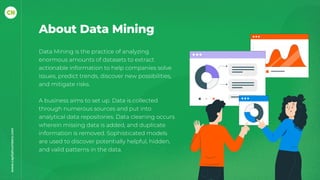
Data Mining is the practice of analyzing
enormous amounts of datasets to extract
actionable information to help companies solve
issues, predict trends, discover new possibilities,
and mitigate risks.
A business aims to set up. Data is collected
through numerous sources and put into
analytical data repositories. Data cleaning occurs
wherein missing data is added, and duplicate
information is removed. Sophisticated models
are used to discover potentially helpful, hidden,
and valid patterns in the data.
About Data Mining
www.capitalnumbers.com
Machine learning is discovering new
algorithms from data and past experiences to
train the machines on the high-quality data
supplied.
Businesses can use machine learning to
automate mundane processes and predict
outcomes. A famous example of a machine
learning use case in the industry includes
companies deploying chatbots to provide a
quick resolution to customers’ queries.
Hence, helping them provide prompt
customer service.
About Machine Learning
www.capitalnumbers.com
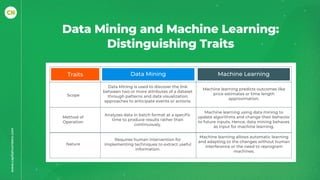
Traits Data Mining Machine Learning
Scope
Data Mining is used to discover the link
between two or more attributes of a dataset
through patterns and data visualization
approaches to anticipate events or actions.
Machine learning predicts outcomes like
price estimates or time length
approximation.
Method of
Operation
Analyzes data in batch format at a specific
time to produce results rather than
continuously.
Machine learning using data mining to
update algorithms and change their behavior
to future inputs. Hence, data mining behaves
as input for machine learning.
Nature
Requires human intervention for
implementing techniques to extract useful
information.
Machine learning allows automatic learning
and adapting to the changes without human
interference or the need to reprogram
machines.
Data Mining and Machine Learning:
Distinguishing Traits
www.capitalnumbers.com
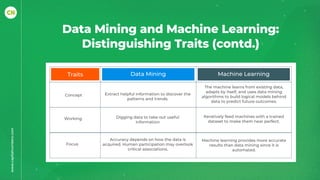
Traits Data Mining Machine Learning
Concept Extract helpful information to discover the
patterns and trends.
The machine learns from existing data,
adapts by itself, and uses data mining
algorithms to build logical models behind
data to predict future outcomes.
Working Digging data to take out useful
information
Iteratively feed machines with a trained
dataset to make them near perfect.
Focus
Accuracy depends on how the data is
acquired. Human participation may overlook
critical associations.
Machine learning provides more accurate
results than data mining since it is
automated.
Data Mining and Machine Learning:
Distinguishing Traits (contd.)
www.capitalnumbers.com
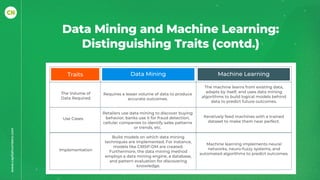
Traits Data Mining Machine Learning
The Volume of
Data Required
Requires a lesser volume of data to produce
accurate outcomes.
The machine learns from existing data,
adapts by itself, and uses data mining
algorithms to build logical models behind
data to predict future outcomes.
Use Cases
Retailers use data mining to discover buying
behavior; banks use it for fraud detection,
cellular companies to identify sales patterns
or trends, etc.
Iteratively feed machines with a trained
dataset to make them near perfect.
Implementation
Build models on which data mining
techniques are implemented. For instance,
models like CRISP-DM are created.
Furthermore, the data mining method
employs a data mining engine, a database,
and pattern evaluation for discovering
knowledge.
Machine learning implements neural
networks, neuro-fuzzy systems, and
automated algorithms to predict outcomes.
Data Mining and Machine Learning:
Distinguishing Traits (contd.)
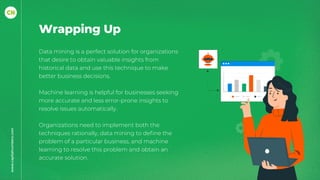
Data mining is a perfect solution for organizations
that desire to obtain valuable insights from
historical data and use this technique to make
better business decisions.
Machine learning is helpful for businesses seeking
more accurate and less error-prone insights to
resolve issues automatically.
Organizations need to implement both the
techniques rationally, data mining to define the
problem of a particular business, and machine
learning to resolve this problem and obtain an
accurate solution.
Wrapping Up
www.capitalnumbers.com

Data Mining vs. Machine Learning Unveiling Major Differences

  • 2.
    Data mining andmachine learning techniques are helping businesses in optimizing marketing campaigns, predicting sales, improving operational efficiency and customer relations, enabling quality control, efficient inventory management, etc. Let’s find out the meaning and differences between data mining and machine learning. Data Mining and Machine Learning: Meaning and Differences www.capitalnumbers.com
  • 3.
    Data Mining isthe practice of analyzing enormous amounts of datasets to extract actionable information to help companies solve issues, predict trends, discover new possibilities, and mitigate risks. A business aims to set up. Data is collected through numerous sources and put into analytical data repositories. Data cleaning occurs wherein missing data is added, and duplicate information is removed. Sophisticated models are used to discover potentially helpful, hidden, and valid patterns in the data. About Data Mining www.capitalnumbers.com
  • 4.
    Machine learning isdiscovering new algorithms from data and past experiences to train the machines on the high-quality data supplied. Businesses can use machine learning to automate mundane processes and predict outcomes. A famous example of a machine learning use case in the industry includes companies deploying chatbots to provide a quick resolution to customers’ queries. Hence, helping them provide prompt customer service. About Machine Learning www.capitalnumbers.com
  • 5.
    www.capitalnumbers.com Traits Data MiningMachine Learning Scope Data Mining is used to discover the link between two or more attributes of a dataset through patterns and data visualization approaches to anticipate events or actions. Machine learning predicts outcomes like price estimates or time length approximation. Method of Operation Analyzes data in batch format at a specific time to produce results rather than continuously. Machine learning using data mining to update algorithms and change their behavior to future inputs. Hence, data mining behaves as input for machine learning. Nature Requires human intervention for implementing techniques to extract useful information. Machine learning allows automatic learning and adapting to the changes without human interference or the need to reprogram machines. Data Mining and Machine Learning: Distinguishing Traits
  • 6.
    www.capitalnumbers.com Traits Data MiningMachine Learning Concept Extract helpful information to discover the patterns and trends. The machine learns from existing data, adapts by itself, and uses data mining algorithms to build logical models behind data to predict future outcomes. Working Digging data to take out useful information Iteratively feed machines with a trained dataset to make them near perfect. Focus Accuracy depends on how the data is acquired. Human participation may overlook critical associations. Machine learning provides more accurate results than data mining since it is automated. Data Mining and Machine Learning: Distinguishing Traits (contd.)
  • 7.
    www.capitalnumbers.com Traits Data MiningMachine Learning The Volume of Data Required Requires a lesser volume of data to produce accurate outcomes. The machine learns from existing data, adapts by itself, and uses data mining algorithms to build logical models behind data to predict future outcomes. Use Cases Retailers use data mining to discover buying behavior; banks use it for fraud detection, cellular companies to identify sales patterns or trends, etc. Iteratively feed machines with a trained dataset to make them near perfect. Implementation Build models on which data mining techniques are implemented. For instance, models like CRISP-DM are created. Furthermore, the data mining method employs a data mining engine, a database, and pattern evaluation for discovering knowledge. Machine learning implements neural networks, neuro-fuzzy systems, and automated algorithms to predict outcomes. Data Mining and Machine Learning: Distinguishing Traits (contd.)
  • 8.
    Data mining isa perfect solution for organizations that desire to obtain valuable insights from historical data and use this technique to make better business decisions. Machine learning is helpful for businesses seeking more accurate and less error-prone insights to resolve issues automatically. Organizations need to implement both the techniques rationally, data mining to define the problem of a particular business, and machine learning to resolve this problem and obtain an accurate solution. Wrapping Up www.capitalnumbers.com