Data Mesh
It’s not about technology, it’s about people
Dr. Arif Wider
Data Innovation Summit 2022, May 5-6, Stockholm, Sweden
Dr. Arif Wide
Who am I
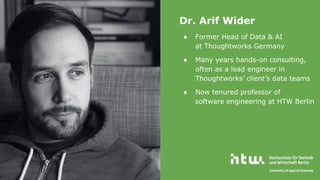
Dr. Arif Wider
â—Ź Former Head of Data & AI
at Thoughtworks Germany
â—Ź Many years hands-on consulting,
often as a lead engineer in
Thoughtworks’ client’s data teams
â—Ź Now tenured professor of
software engineering at HTW Berlin
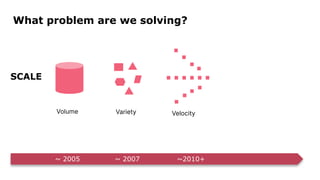
SCALE
~ 2005 ~ 2007 ~2010+
Volume Velocity
Variety
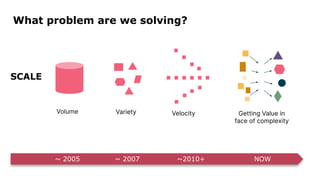
What problem are we solving?
SCALE
~ 2005 ~ 2007 ~2010+ NOW
Volume Velocity
Variety Getting Value in
face of complexity
What problem are we solving?
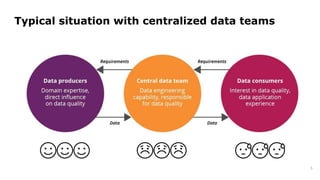
Typical situation with centralized data teams
5
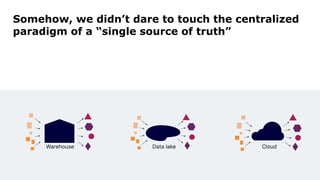
Somehow, we didn’t dare to touch the centralized
paradigm of a “single source of truth”
6
Warehouse Data lake Cloud
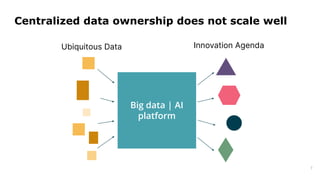
Centralized data ownership does not scale well
7
Big data | AI
platform
Ubiquitous Data Innovation Agenda
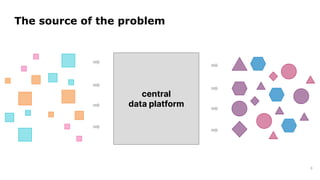
The source of the problem
8
central
data platform
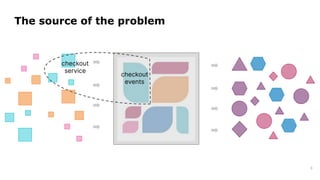
The source of the problem
9
checkout
service
checkout
events
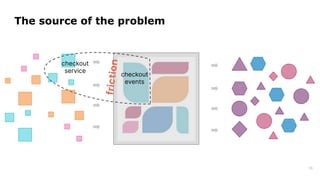
The source of the problem
10
checkout
service
checkout
events
f
r
i
c
t
i
o
n
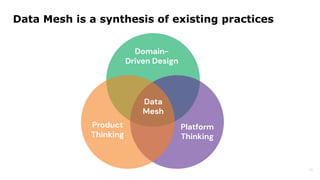
Data Mesh is a synthesis of existing practices
11
Domain-
Driven Design
Product
Thinking
Platform
Thinking
Data
Mesh
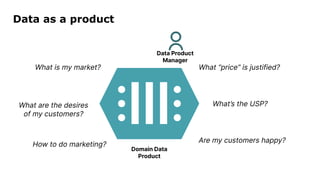
Data as a product
Data Product
Manager
Domain Data
Product
What is my market?
What are the desires
of my customers?
What “price” is justified?
How to do marketing?
What’s the USP?
Are my customers happy?
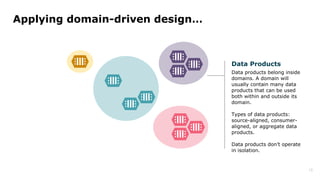
Applying domain-driven design…
13
Data products belong inside
domains. A domain will
usually contain many data
products that can be used
both within and outside its
domain.
Types of data products:
source-aligned, consumer-
aligned, or aggregate data
products.
Data products don’t operate
in isolation.
Data Products
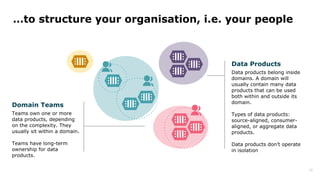
…to structure your organisation, i.e. your people
14
Data products belong inside
domains. A domain will
usually contain many data
products that can be used
both within and outside its
domain.
Types of data products:
source-aligned, consumer-
aligned, or aggregate data
products.
Data products don’t operate
in isolation
Data Products
Domain Teams
Teams own one or more
data products, depending
on the complexity. They
usually sit within a domain.
Teams have long-term
ownership for data
products.
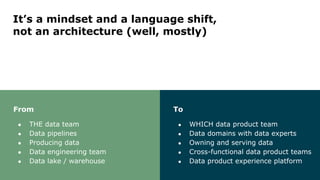
From
â—Ź THE data team
â—Ź Data pipelines
â—Ź Producing data
â—Ź Data engineering team
â—Ź Data lake / warehouse
It’s a mindset and a language shift,
not an architecture (well, mostly)
To
â—Ź WHICH data product team
â—Ź Data domains with data experts
â—Ź Owning and serving data
â—Ź Cross-functional data product teams
â—Ź Data product experience platform
Spreading a mindset
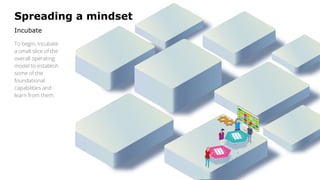
Incubate
16
To begin, incubate
a small slice of the
overall operating
model to establish
some of the
foundational
capabilities and
learn from them.
Spreading a mindset
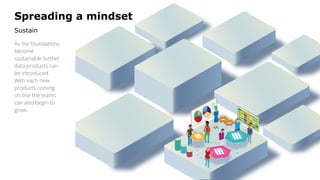
Sustain
17
As the foundations
become
sustainable further
data products can
be introduced.
With each new
products coming
on line the teams
can also begin to
grow.
Spreading a mindset
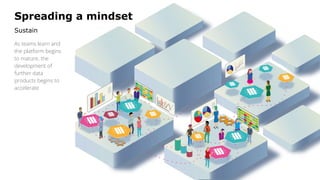
Sustain
18
As teams learn and
the platform begins
to mature, the
development of
further data
products begins to
accelerate
Spreading a mindset
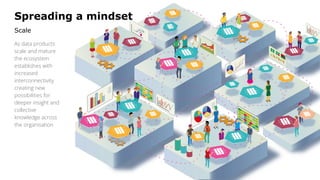
Scale
19
As data products
scale and mature
the ecosystem
establishes with
increased
interconnectivity
creating new
possibilities for
deeper insight and
collective
knowledge across
the organisation
Thank you!
@arifwider
wider@htw-berlin.de
Dr. Arif Wide

Data Mesh - It's not about technology, it's about people

  • 1.
    Data Mesh It’s notabout technology, it’s about people Dr. Arif Wider Data Innovation Summit 2022, May 5-6, Stockholm, Sweden Dr. Arif Wide
  • 2.
    Who am I Dr.Arif Wider ● Former Head of Data & AI at Thoughtworks Germany ● Many years hands-on consulting, often as a lead engineer in Thoughtworks’ client’s data teams ● Now tenured professor of software engineering at HTW Berlin
  • 3.
    SCALE ~ 2005 ~2007 ~2010+ Volume Velocity Variety What problem are we solving?
  • 4.
    SCALE ~ 2005 ~2007 ~2010+ NOW Volume Velocity Variety Getting Value in face of complexity What problem are we solving?
  • 5.
    Typical situation withcentralized data teams 5
  • 6.
    Somehow, we didn’tdare to touch the centralized paradigm of a “single source of truth” 6 Warehouse Data lake Cloud
  • 7.
    Centralized data ownershipdoes not scale well 7 Big data | AI platform Ubiquitous Data Innovation Agenda
  • 8.
    The source ofthe problem 8 central data platform
  • 9.
    The source ofthe problem 9 checkout service checkout events
  • 10.
    The source ofthe problem 10 checkout service checkout events f r i c t i o n
  • 11.
    Data Mesh isa synthesis of existing practices 11 Domain- Driven Design Product Thinking Platform Thinking Data Mesh
  • 12.
    Data as aproduct Data Product Manager Domain Data Product What is my market? What are the desires of my customers? What “price” is justified? How to do marketing? What’s the USP? Are my customers happy?
  • 13.
    Applying domain-driven design… 13 Dataproducts belong inside domains. A domain will usually contain many data products that can be used both within and outside its domain. Types of data products: source-aligned, consumer- aligned, or aggregate data products. Data products don’t operate in isolation. Data Products
  • 14.
    …to structure yourorganisation, i.e. your people 14 Data products belong inside domains. A domain will usually contain many data products that can be used both within and outside its domain. Types of data products: source-aligned, consumer- aligned, or aggregate data products. Data products don’t operate in isolation Data Products Domain Teams Teams own one or more data products, depending on the complexity. They usually sit within a domain. Teams have long-term ownership for data products.
  • 15.
    From ● THE datateam ● Data pipelines ● Producing data ● Data engineering team ● Data lake / warehouse It’s a mindset and a language shift, not an architecture (well, mostly) To ● WHICH data product team ● Data domains with data experts ● Owning and serving data ● Cross-functional data product teams ● Data product experience platform
  • 16.
    Spreading a mindset Incubate 16 Tobegin, incubate a small slice of the overall operating model to establish some of the foundational capabilities and learn from them.
  • 17.
    Spreading a mindset Sustain 17 Asthe foundations become sustainable further data products can be introduced. With each new products coming on line the teams can also begin to grow.
  • 18.
    Spreading a mindset Sustain 18 Asteams learn and the platform begins to mature, the development of further data products begins to accelerate
  • 19.
    Spreading a mindset Scale 19 Asdata products scale and mature the ecosystem establishes with increased interconnectivity creating new possibilities for deeper insight and collective knowledge across the organisation
  • 20.