
Data Governance and
Capitalization
in a Big Data Era
Pieter De Leenheer, PhD
Cofounder and VP, Research and Education at Collibra
MIT ICIQ 2017
October 6, 2017
2 | ©Collibra 2017 Confidential & Proprietary
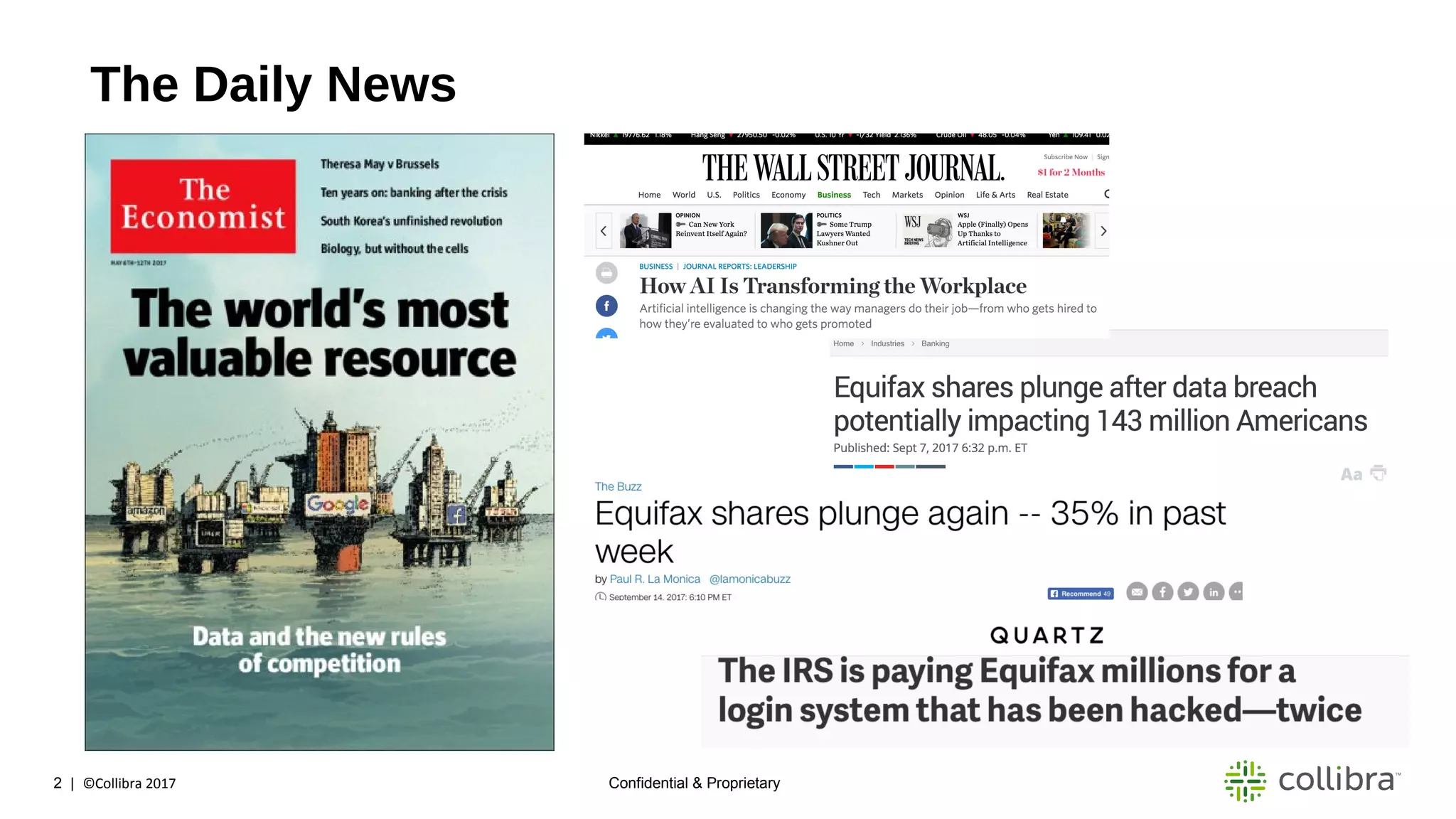
The Daily News
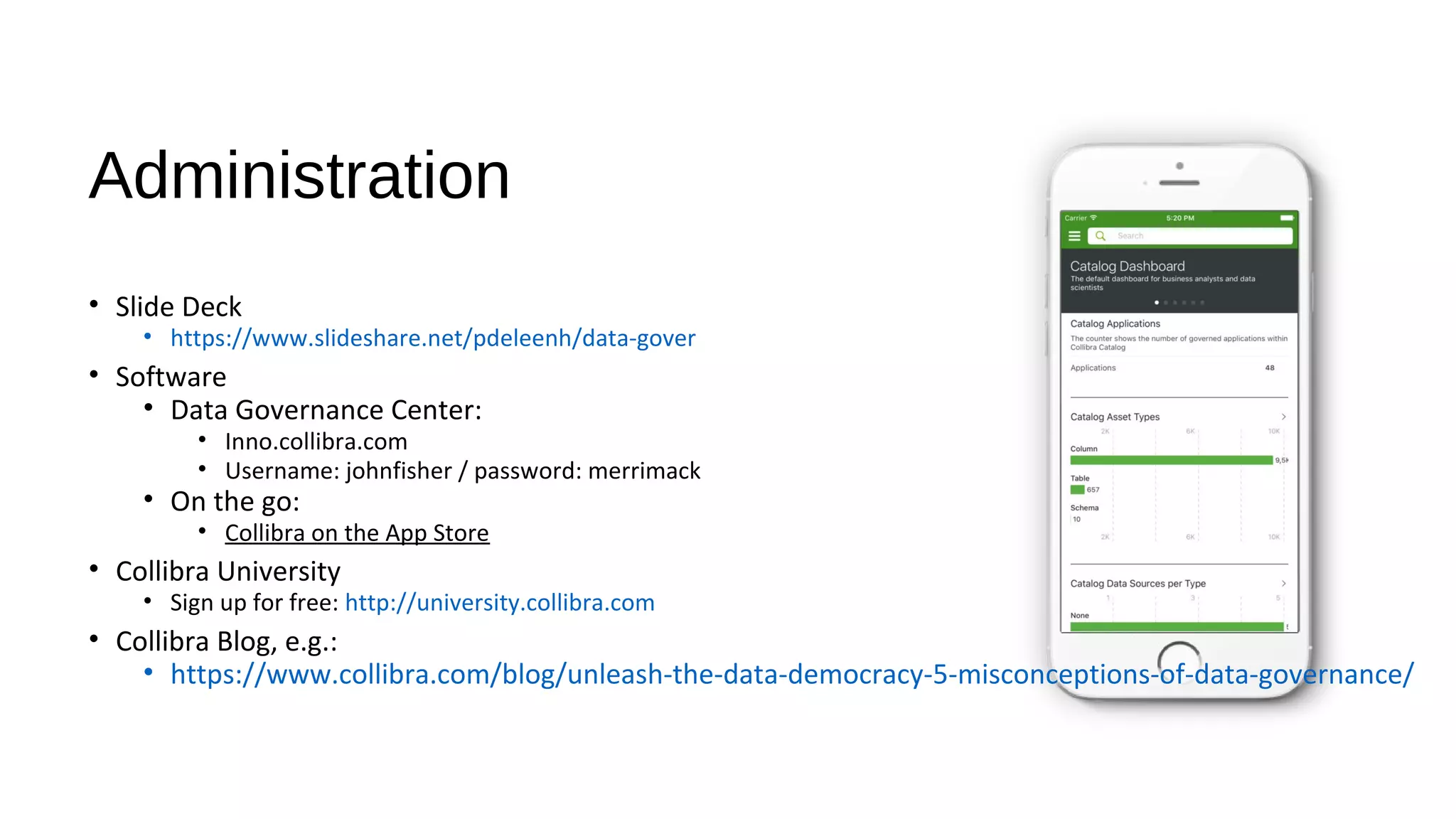
Administration
• Slide Deck
• https://www.slideshare.net/pdeleenh/data-gover
• Software
• Data Governance Center:
• Inno.collibra.com
• Username: johnfisher / password: merrimack
• On the go:
• Collibra on the App Store
• Collibra University
• Sign up for free: http://university.collibra.com
• Collibra Blog, e.g.:
• https://www.collibra.com/blog/unleash-the-data-democracy-5-misconceptions-of-data-governance/
Overview
Intro - A Data Governance
Odyssey
•Finding the “man of the book”
•About the company Collibra
Part 1 – The Chief Data Officer
Rises
•Digital Darwinism
•The Big Data Bang
•Data Brawls and FUD
•The Chief Data Officer Role Types
Part 2: Data Universe Expands
• Data Value Hierarchies, Networks and Hybrids
• Shift in Data Governance Approaches
• Systems of Record vs. Systems of Engagement
• Challenges:
• Big Data Analytics
• Digitalization of Trust
• Weapons of Math Destruction
Part 3: A Lens on the Data Universe
• A system of record for data
• Use Cases
Introduction
2008: A Data Governance Odyssey
Library of Babel
Purifiers
Man of the book
JL Borges
7 | ©Collibra 2016
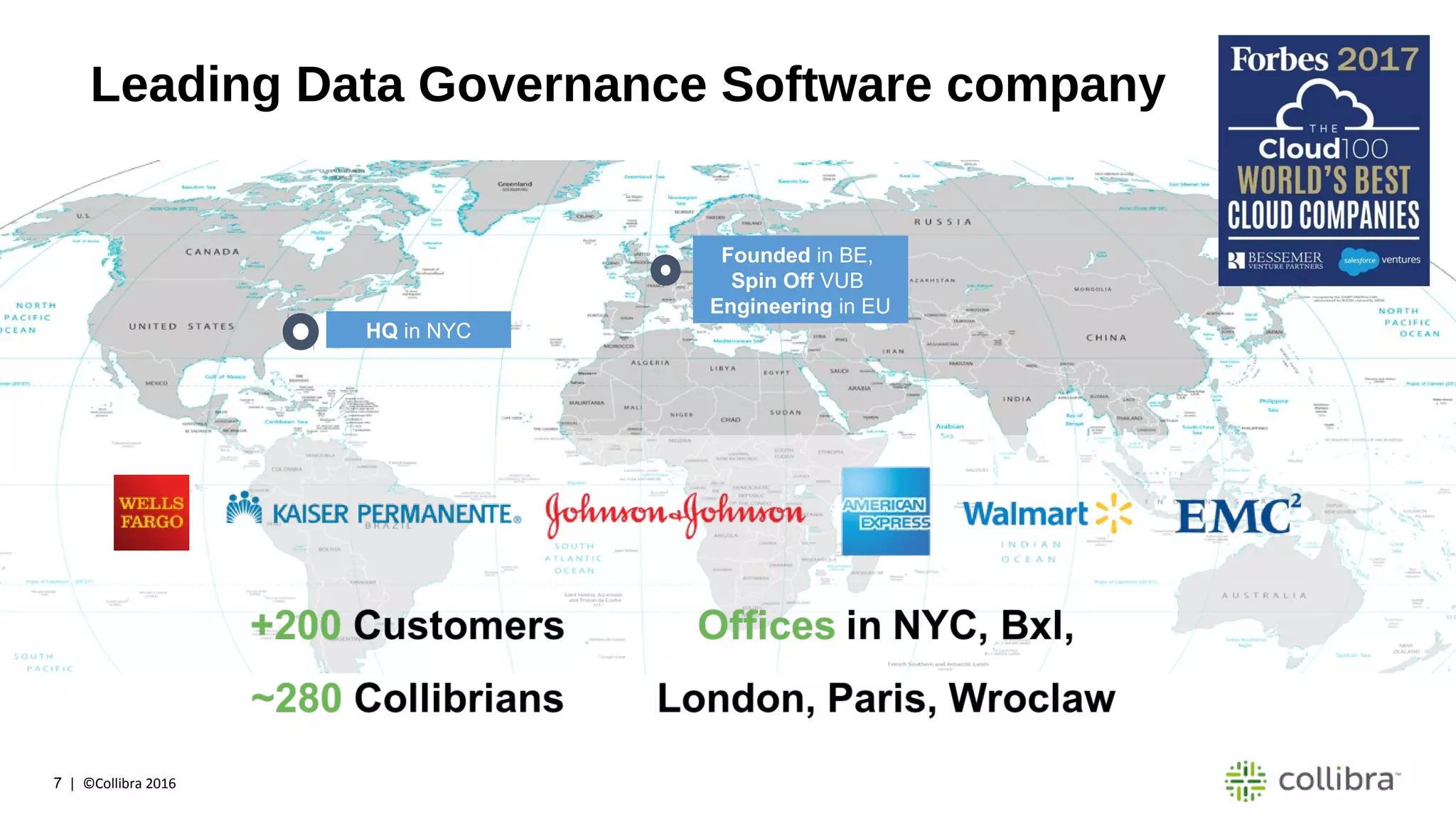
Leading Data Governance Software company
HQ in NYC
Founded in BE,
Spin Off VUB
Engineering in EU
8 | ©Collibra 2016
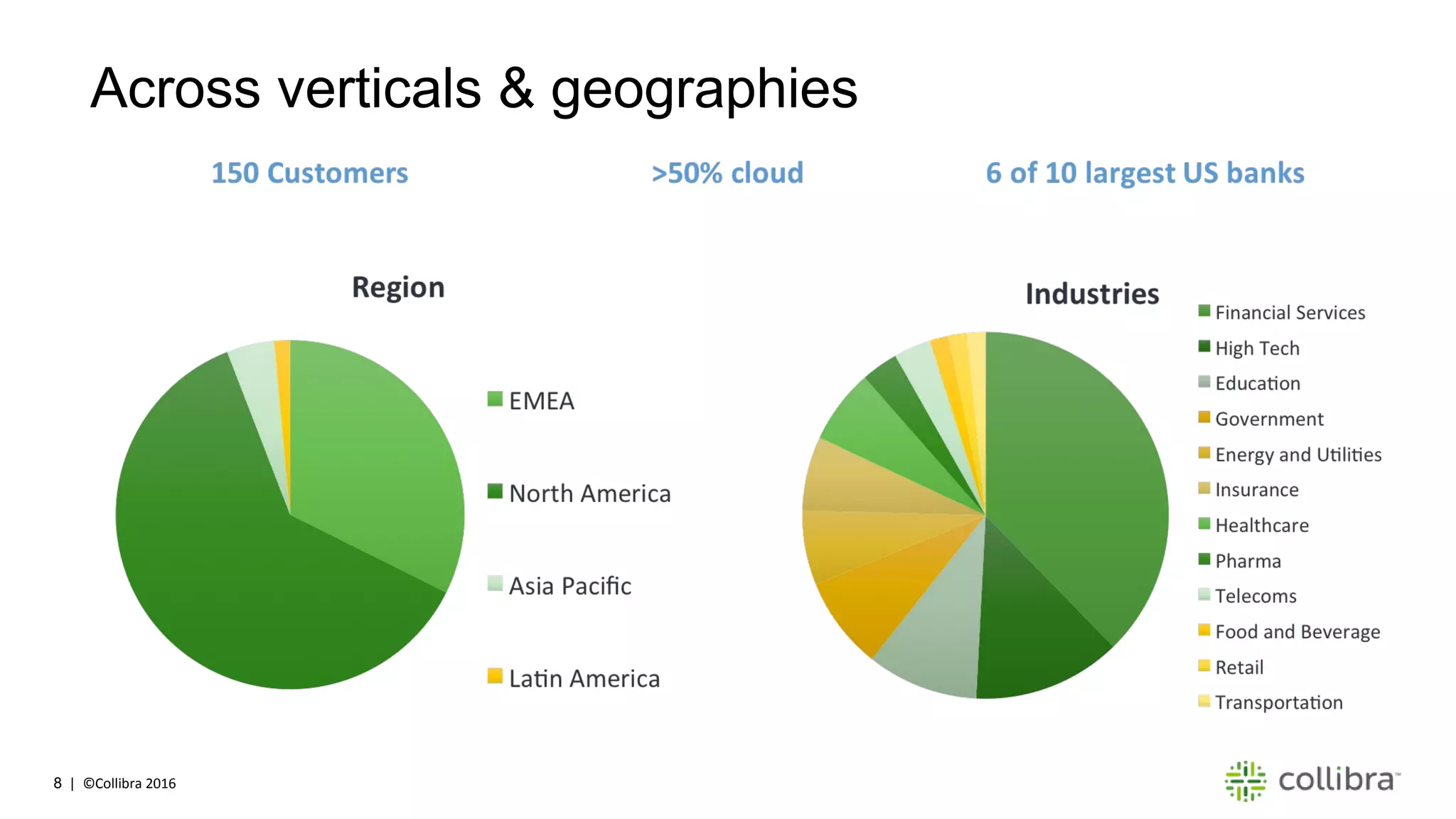
Across verticals & geographies
9 | ©Collibra 2016
With Blue-chip Customers
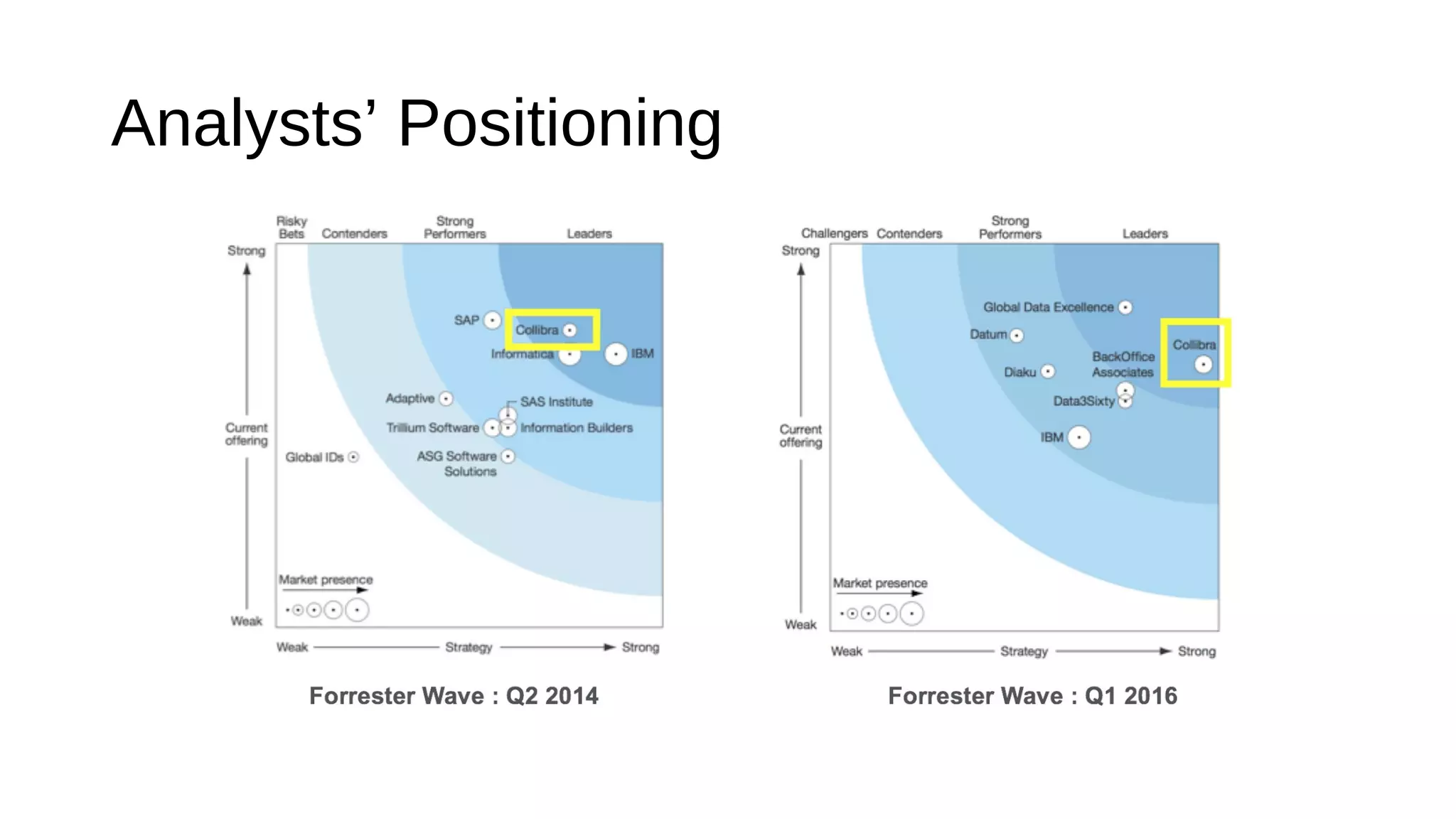
Analysts’ Positioning
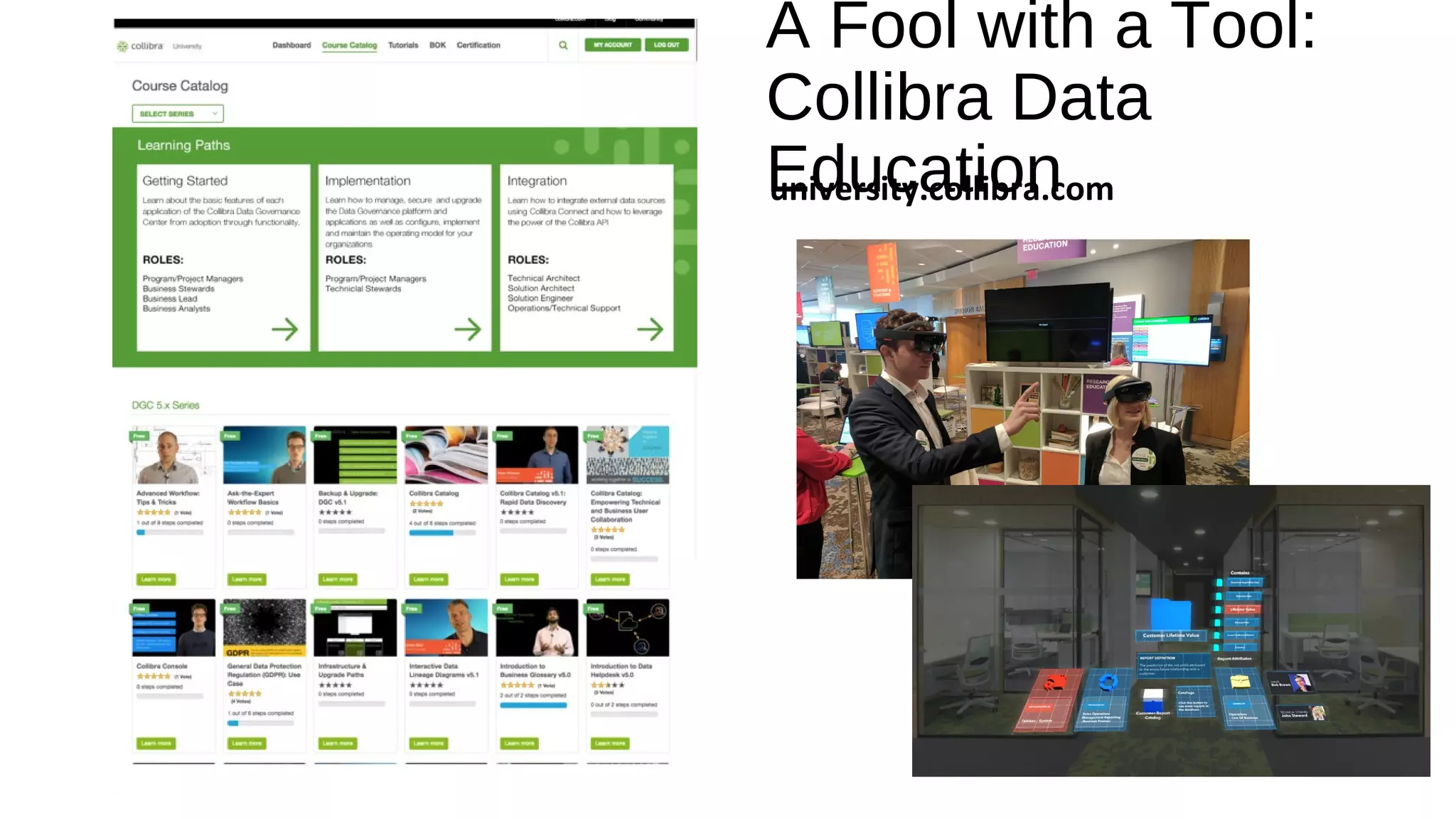
A Fool with a Tool:
Collibra Data
Educationuniversity.collibra.com
Part 1
The Chief Data Officer Rises
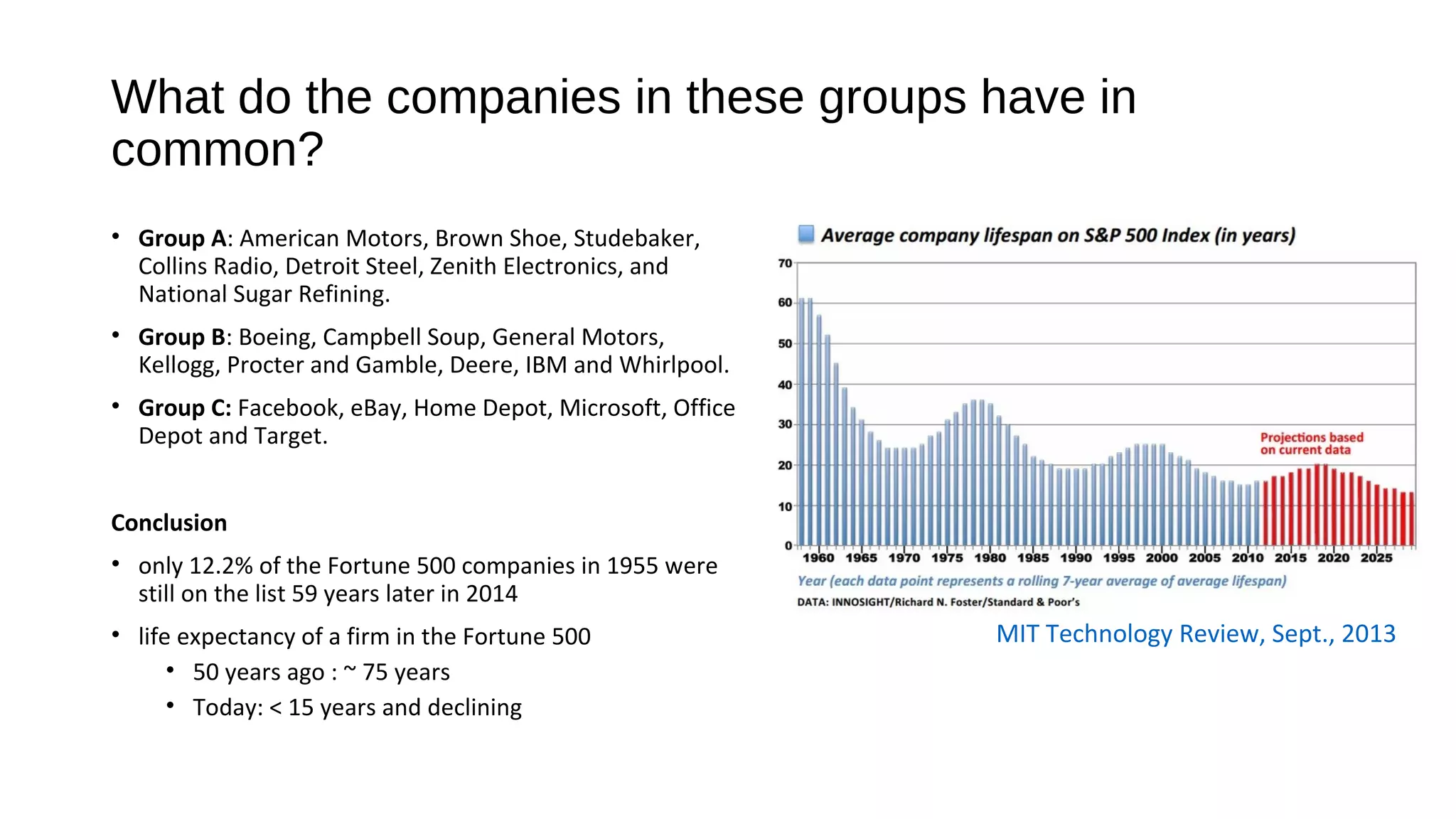
What do the companies in these groups have in
common?
• Group A: American Motors, Brown Shoe, Studebaker,
Collins Radio, Detroit Steel, Zenith Electronics, and
National Sugar Refining.
• Group B: Boeing, Campbell Soup, General Motors,
Kellogg, Procter and Gamble, Deere, IBM and Whirlpool.
• Group C: Facebook, eBay, Home Depot, Microsoft, Office
Depot and Target.
Conclusion
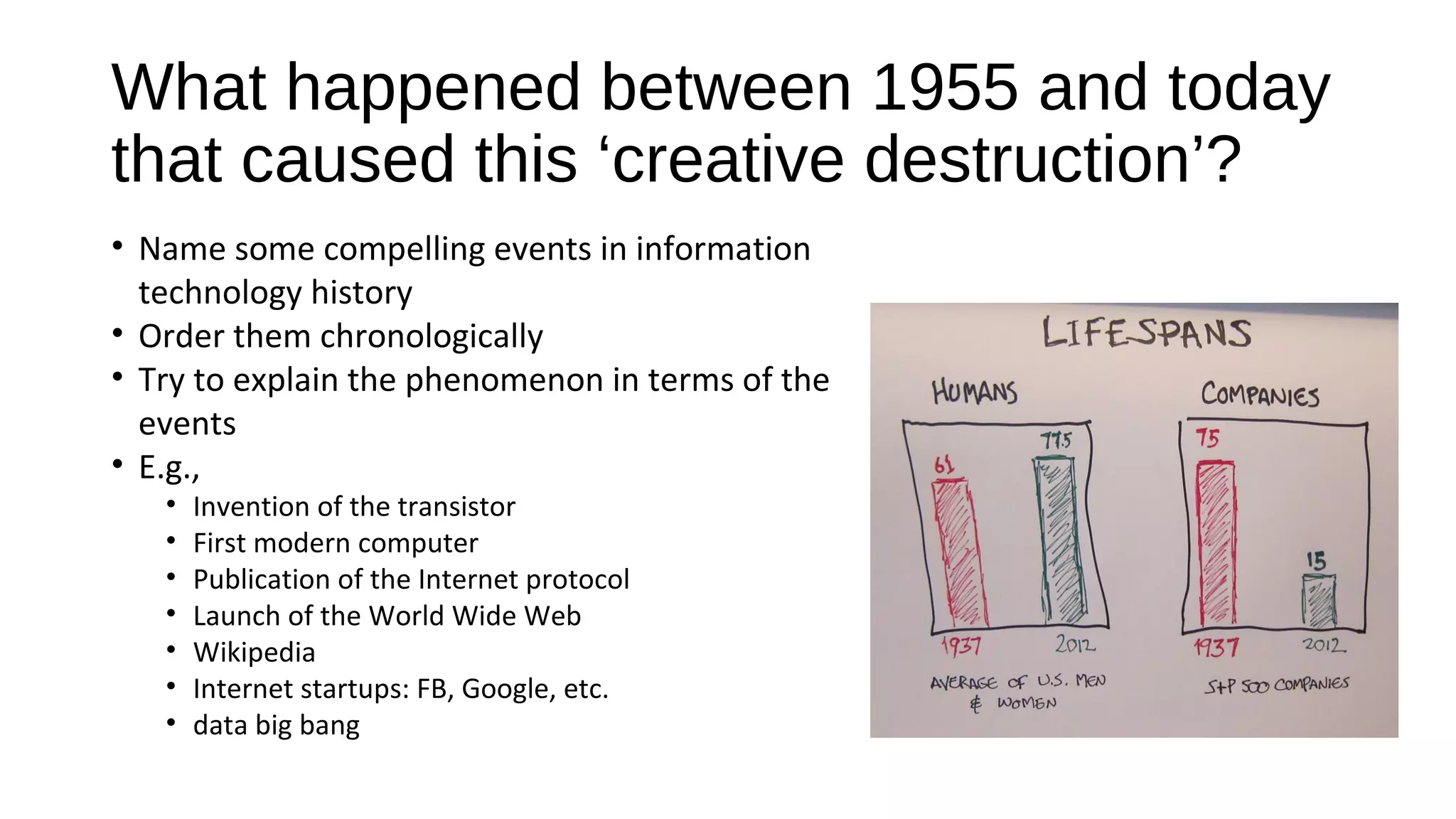
• only 12.2% of the Fortune 500 companies in 1955 were
still on the list 59 years later in 2014
• life expectancy of a firm in the Fortune 500
• 50 years ago : ~ 75 years
• Today: < 15 years and declining
MIT Technology Review, Sept., 2013
What happened between 1955 and today
that caused this ‘creative destruction’?
• Name some compelling events in information
technology history
• Order them chronologically
• Try to explain the phenomenon in terms of the
events
• E.g.,
• Invention of the transistor
• First modern computer
• Publication of the Internet protocol
• Launch of the World Wide Web
• Wikipedia
• Internet startups: FB, Google, etc.
• data big bang
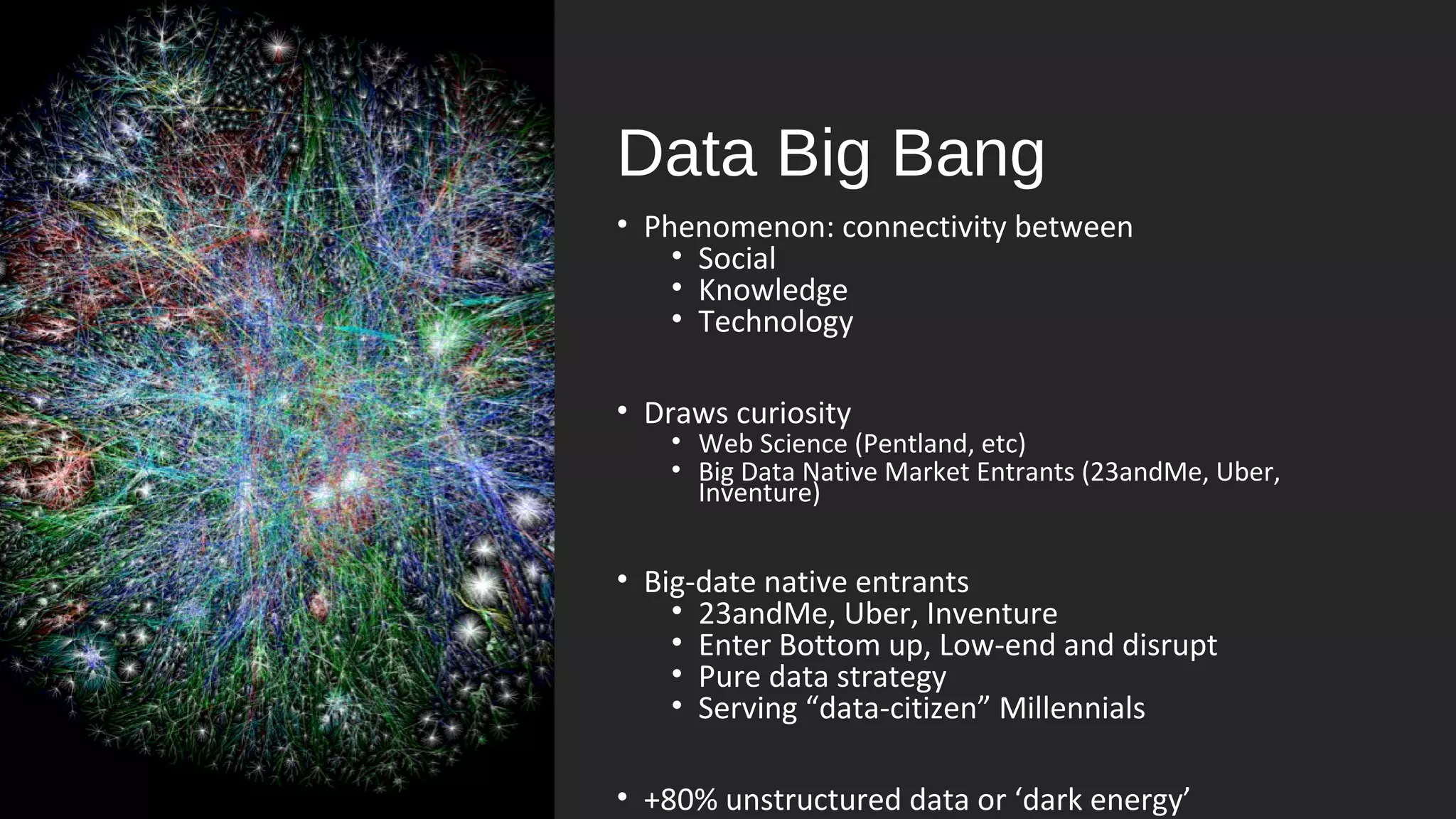
Data Big Bang
• Phenomenon: connectivity between
• Social
• Knowledge
• Technology
• Draws curiosity
• Web Science (Pentland, etc)
• Big Data Native Market Entrants (23andMe, Uber,
Inventure)
• Big-date native entrants
• 23andMe, Uber, Inventure
• Enter Bottom up, Low-end and disrupt
• Pure data strategy
• Serving “data-citizen” Millennials
• +80% unstructured data or ‘dark energy’
17 | ©Collibra 2016
“Data-driven” is the Holy Grail of business
18 | ©Collibra 2016
But Becoming the Fittest is not Easy
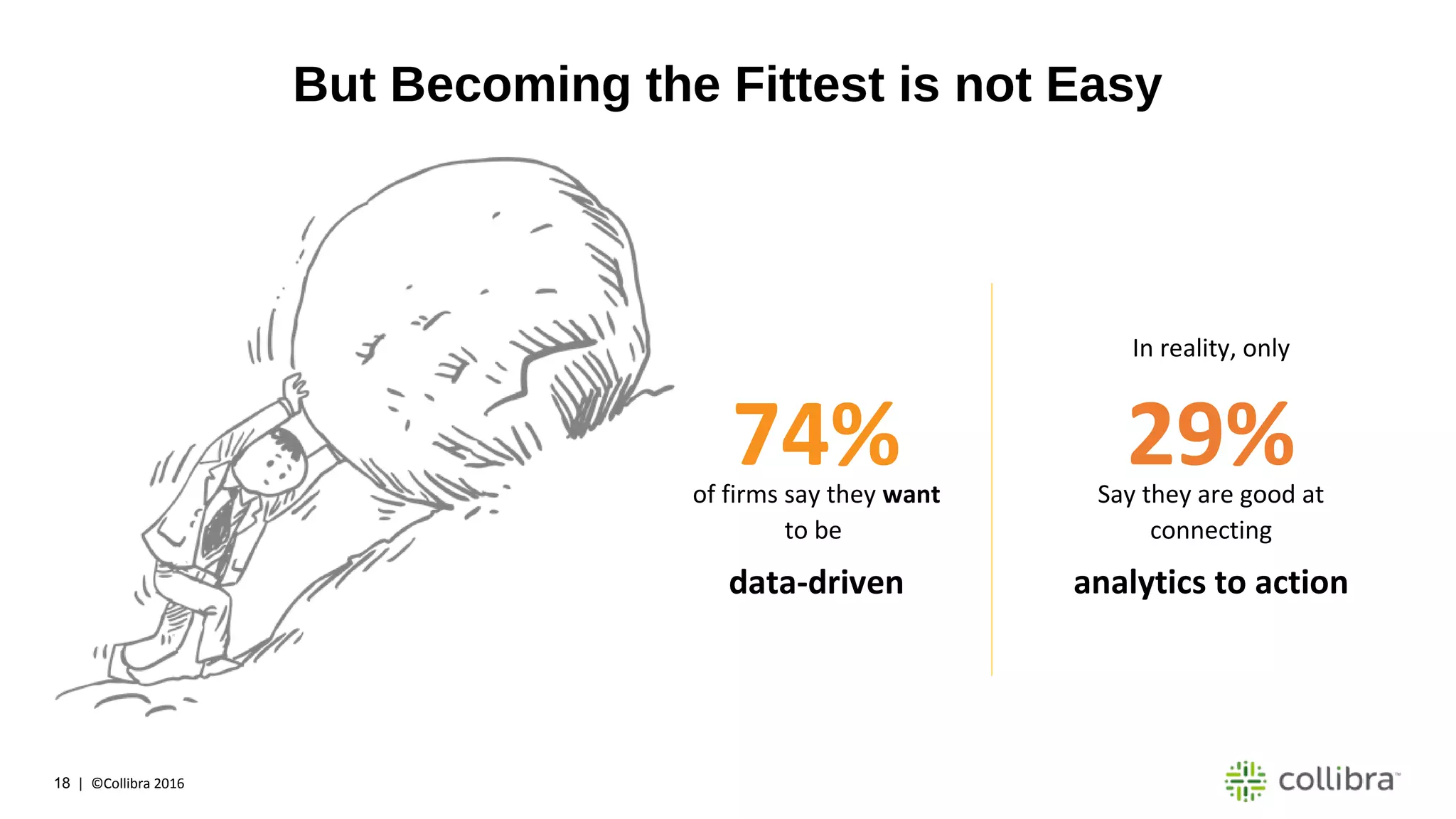
74%of firms say they want
to be
data-driven
29%Say they are good at
connecting
analytics to action
In reality, only
19 | ©Collibra 2016
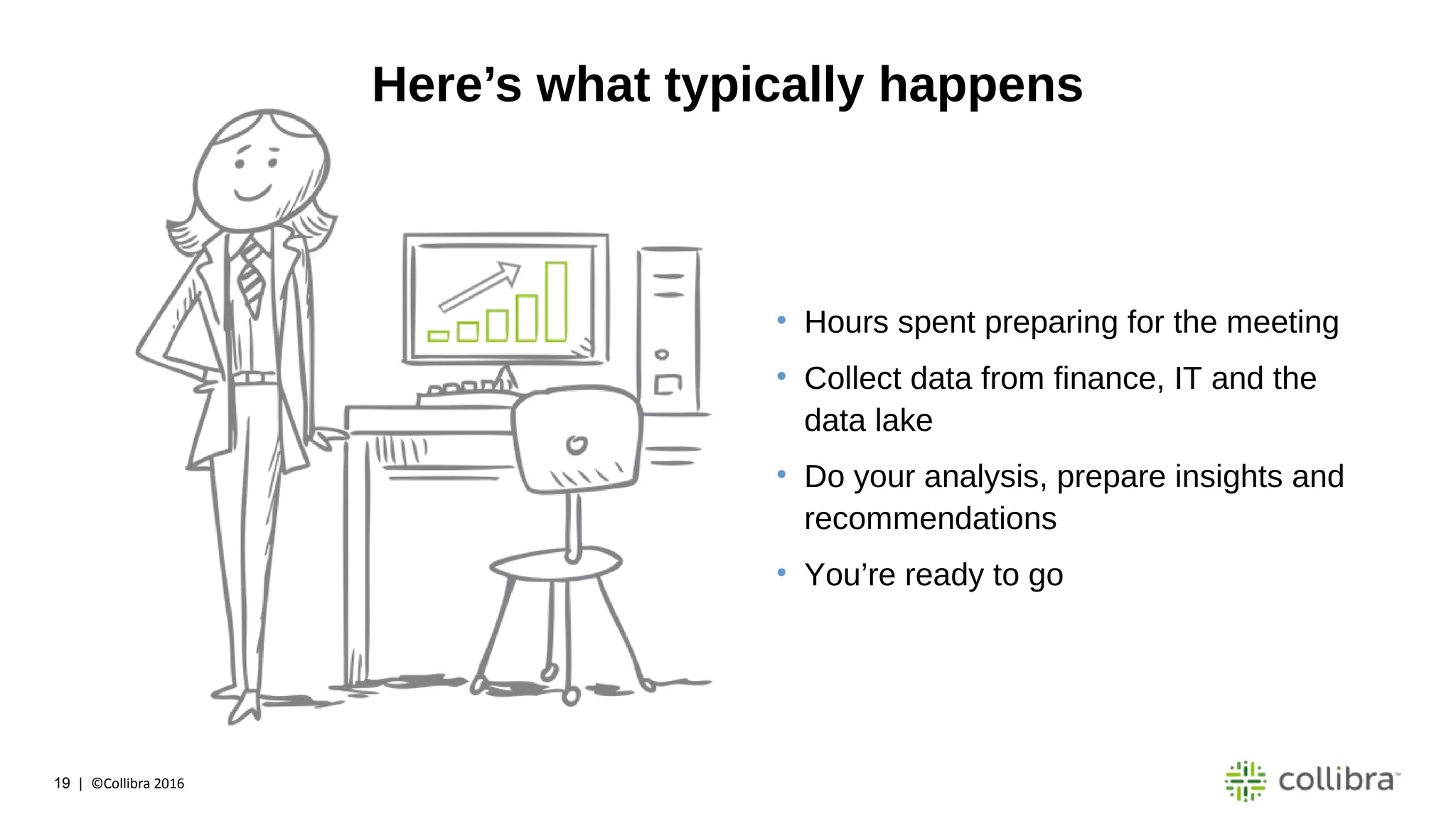
Here’s what typically happens
• Hours spent preparing for the meeting
• Collect data from finance, IT and the
data lake
• Do your analysis, prepare insights and
recommendations
• You’re ready to go
20 | ©Collibra 2016
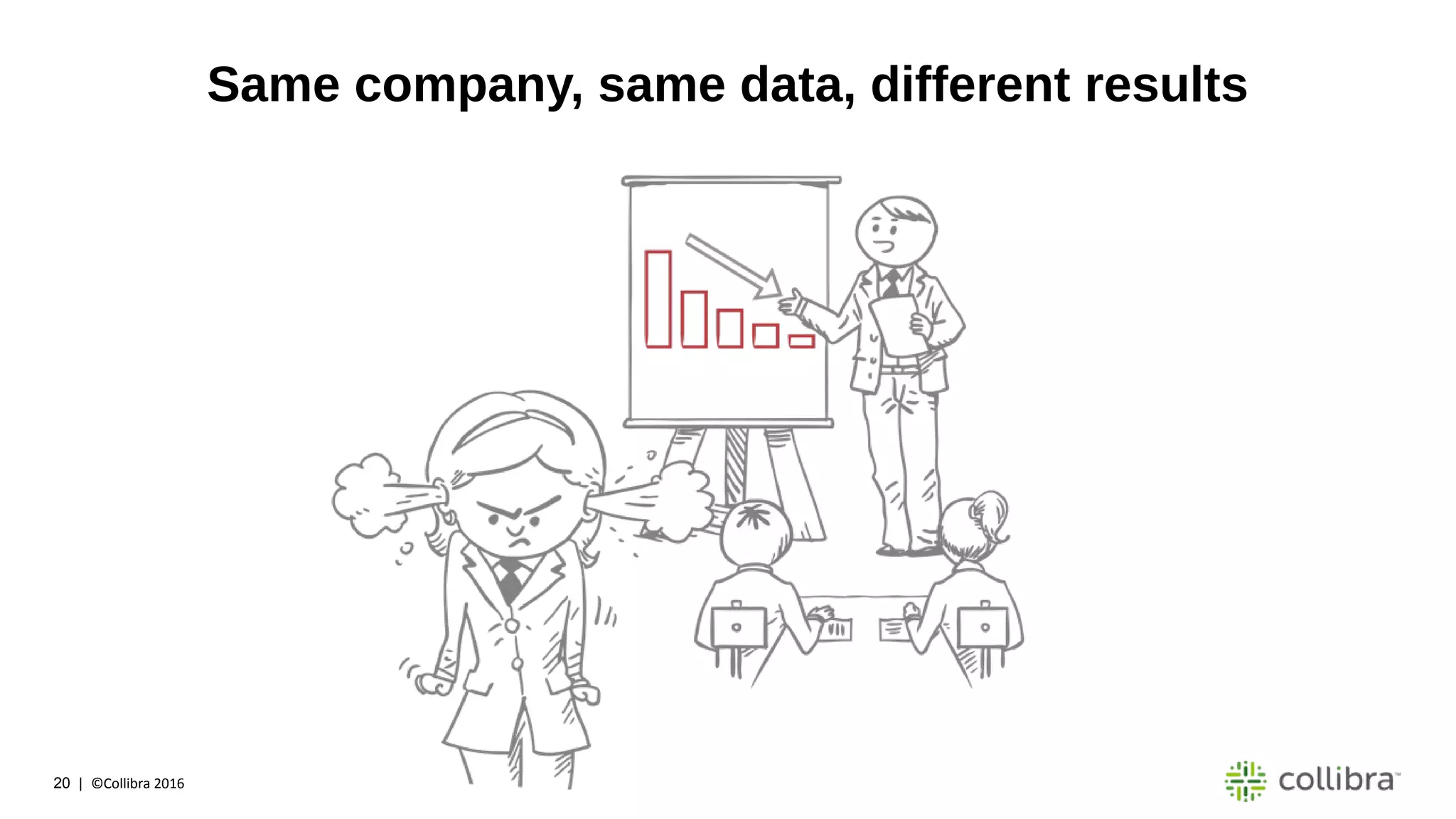
Same company, same data, different results
21 | ©Collibra 2016
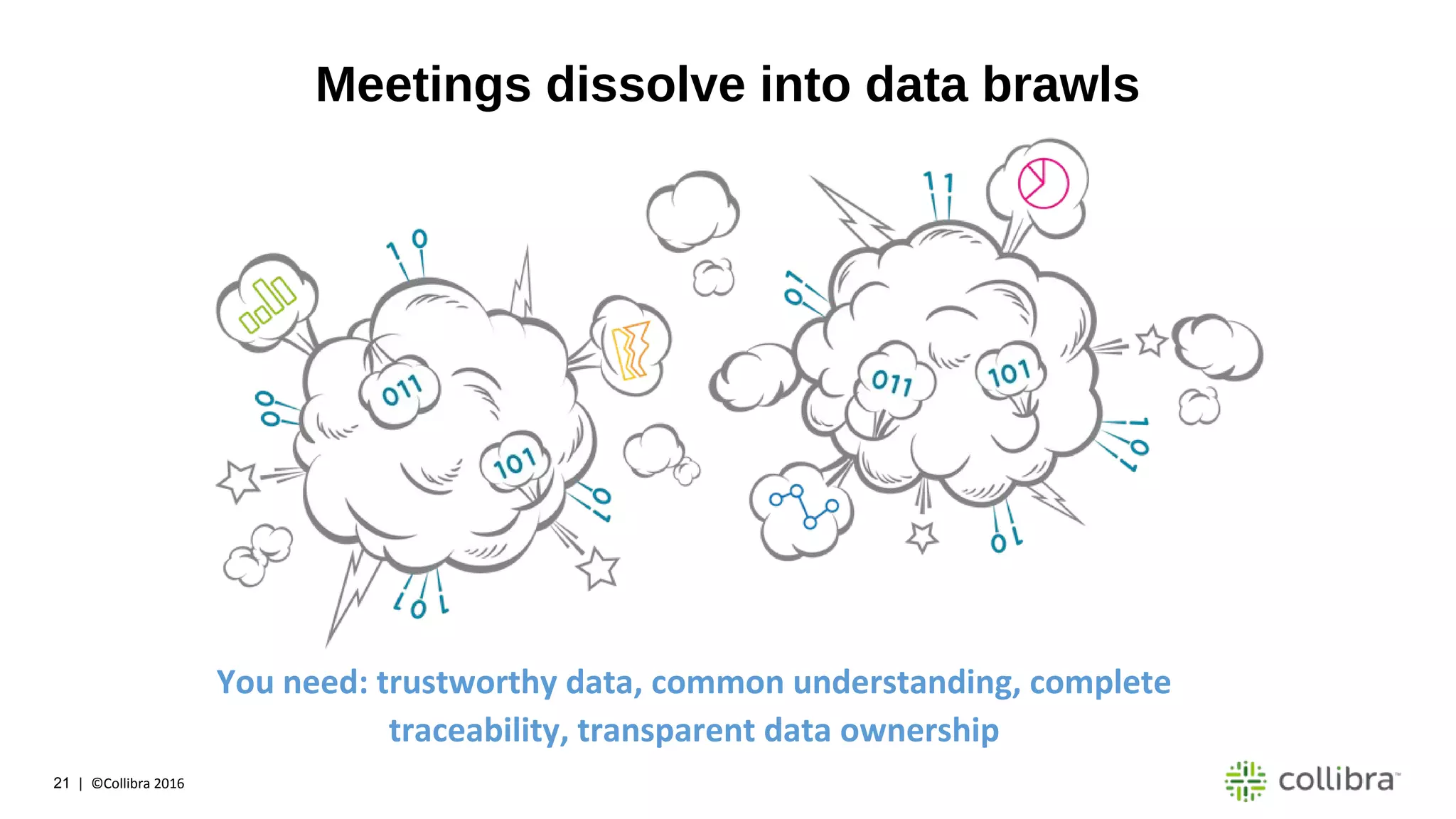
Meetings dissolve into data brawls
You need: trustworthy data, common understanding, complete
traceability, transparent data ownership
22 | ©Collibra 2016
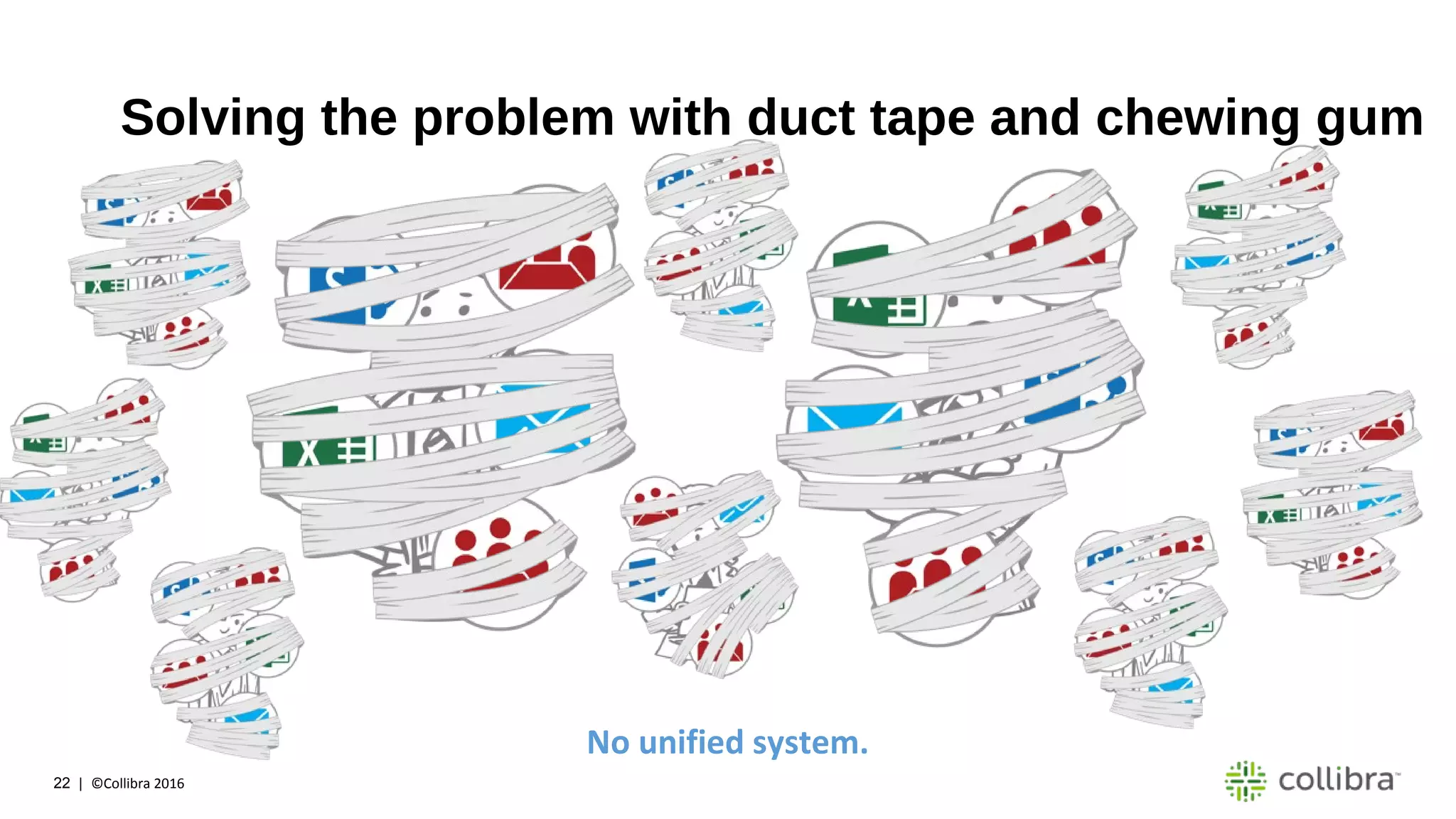
Solving the problem with duct tape and chewing gum
No unified system.
23 | ©Collibra 2016
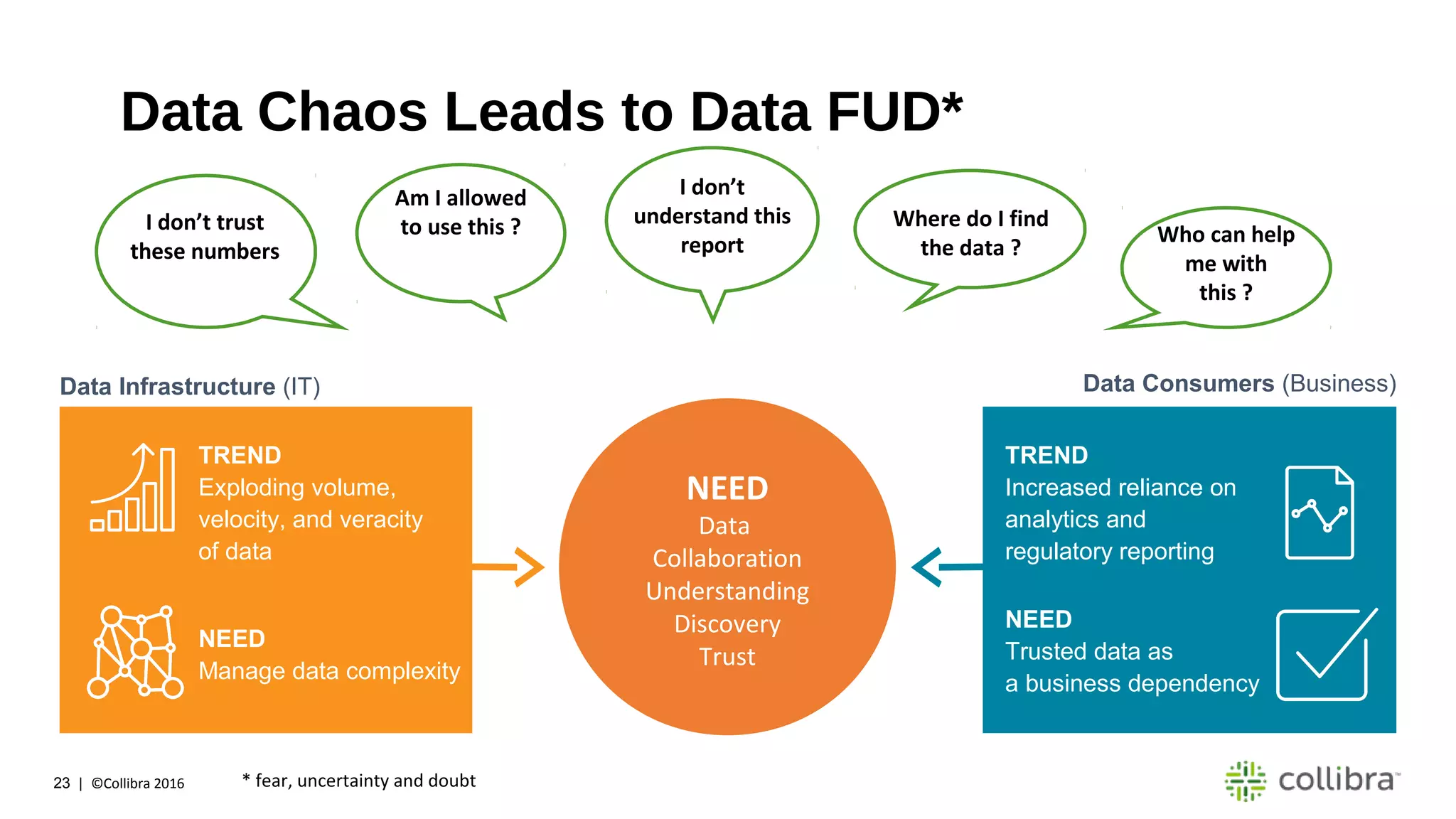
Who can help
me with
this ?
I don’t trust
these numbers
Am I allowed
to use this ? Where do I find
the data ?
I don’t
understand this
report
Data Chaos Leads to Data FUD*
* fear, uncertainty and doubt
TREND
Exploding volume,
velocity, and veracity
of data
NEED
Manage data complexity
TREND
Increased reliance on
analytics and
regulatory reporting
NEED
Trusted data as
a business dependency
NEED
Data
Collaboration
Understanding
Discovery
Trust
Data Infrastructure (IT) Data Consumers (Business)
24 | ©Collibra 2016
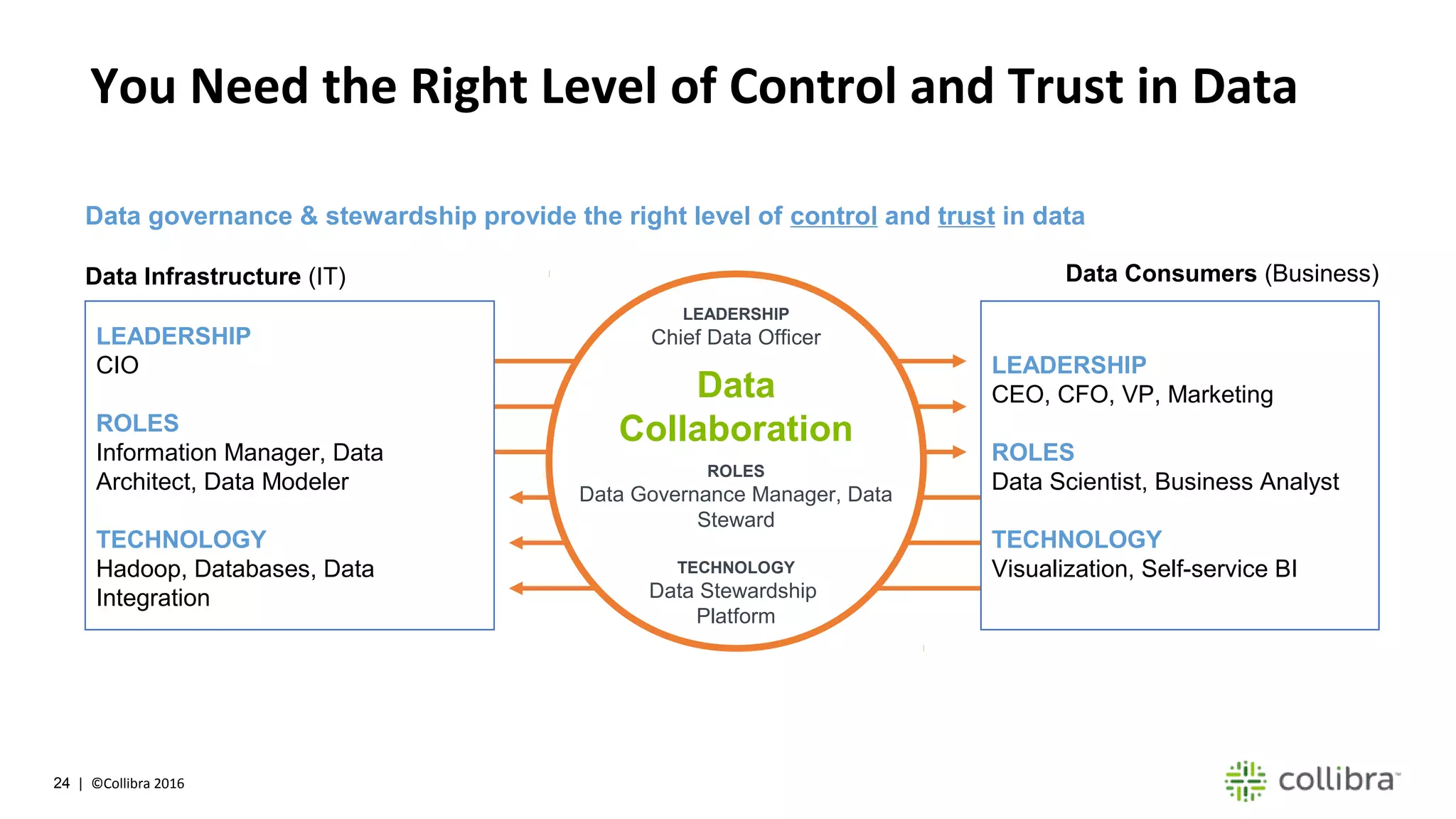
You Need the Right Level of Control and Trust in Data
Data governance & stewardship provide the right level of control and trust in data
LEADERSHIP
CEO, CFO, VP, Marketing
ROLES
Data Scientist, Business Analyst
TECHNOLOGY
Visualization, Self-service BI
LEADERSHIP
CIO
ROLES
Information Manager, Data
Architect, Data Modeler
TECHNOLOGY
Hadoop, Databases, Data
Integration
LEADERSHIP
Chief Data Officer
Data
Collaboration
ROLES
Data Governance Manager, Data
Steward
TECHNOLOGY
Data Stewardship
Platform
Data Infrastructure (IT) Data Consumers (Business)
25 | ©Collibra 2016
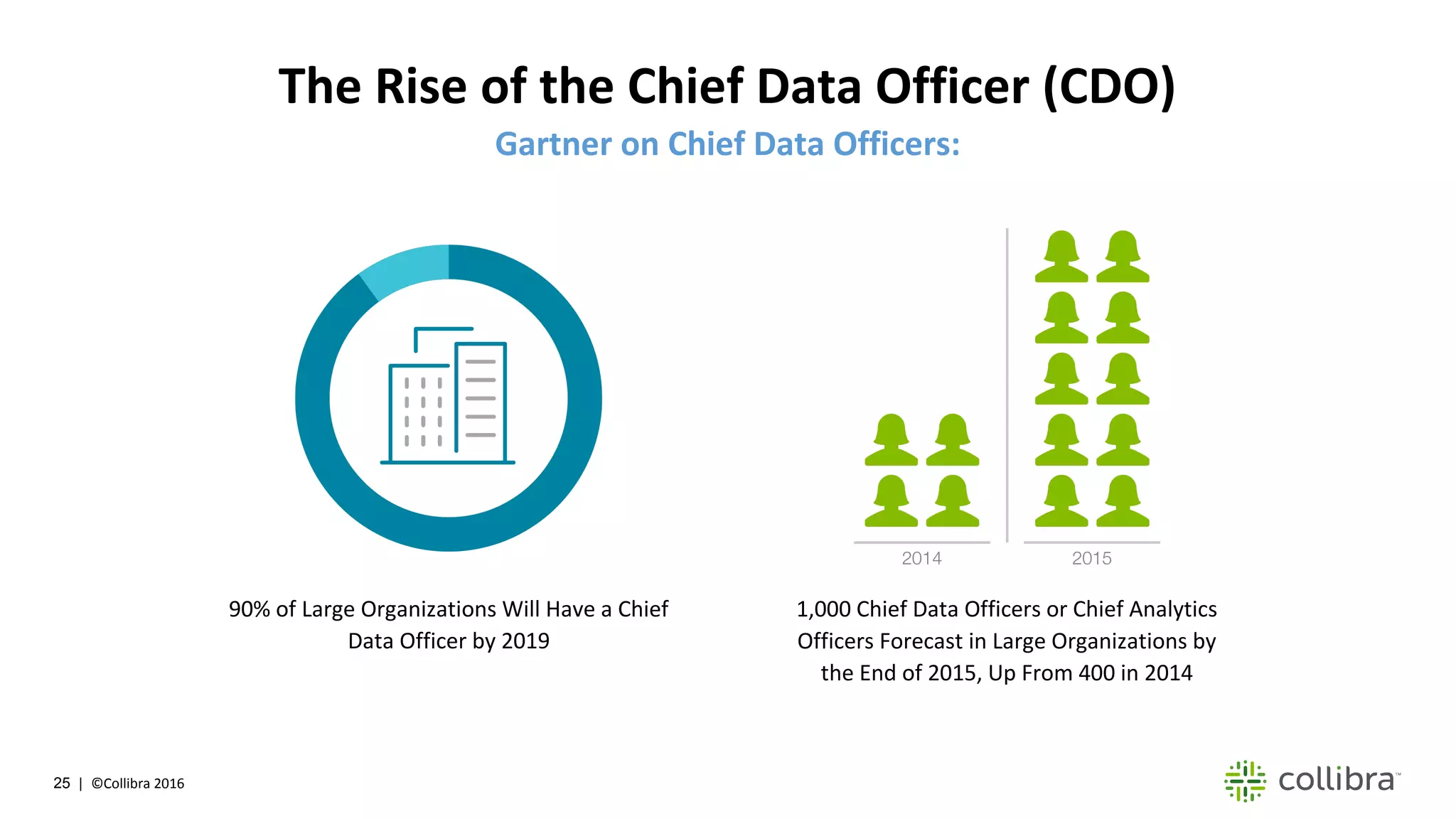
The Rise of the Chief Data Officer (CDO)
Gartner on Chief Data Officers:
1,000 Chief Data Officers or Chief Analytics
Officers Forecast in Large Organizations by
the End of 2015, Up From 400 in 2014
90% of Large Organizations Will Have a Chief
Data Officer by 2019
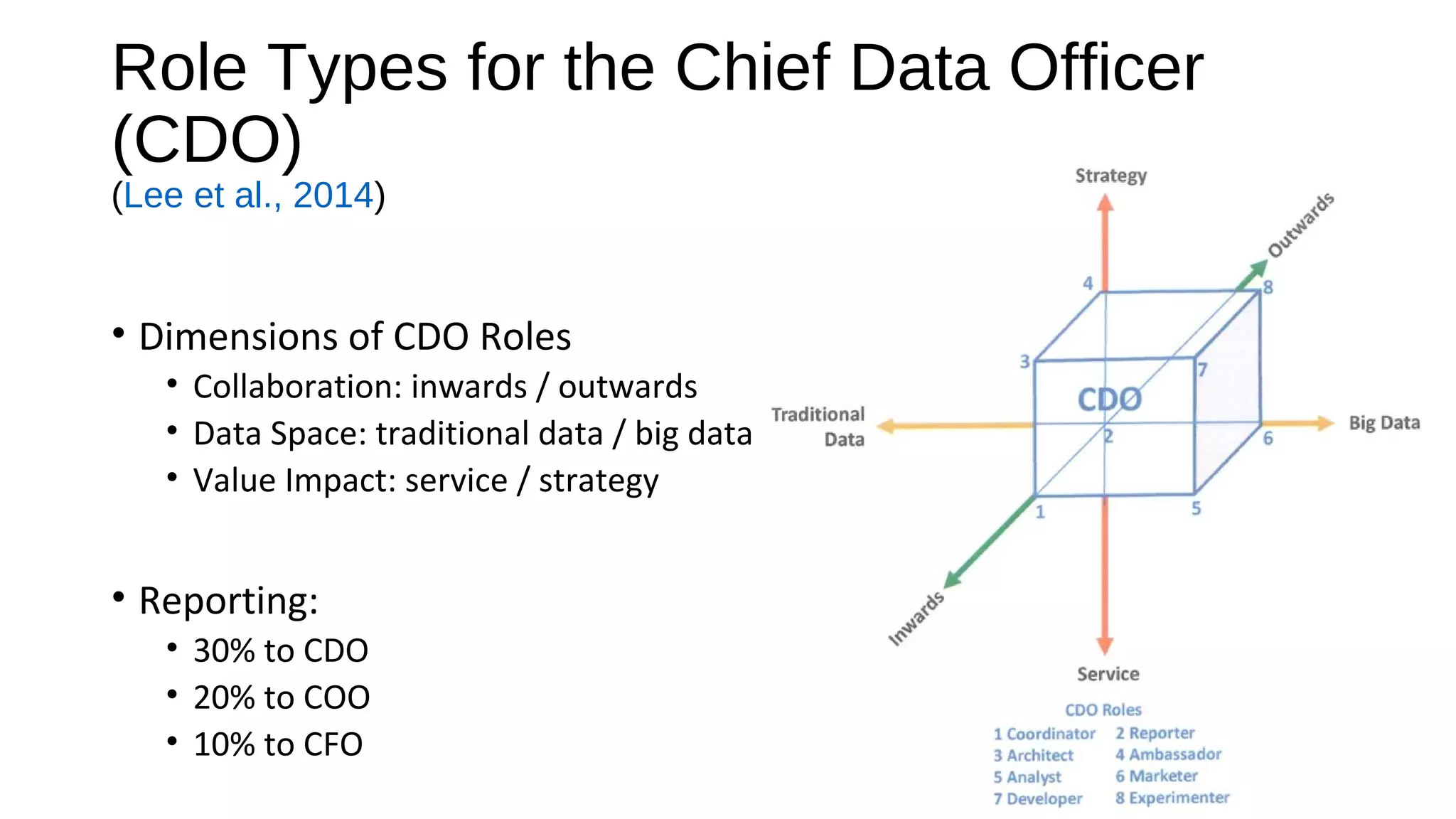
Role Types for the Chief Data Officer
(CDO)
(Lee et al., 2014)
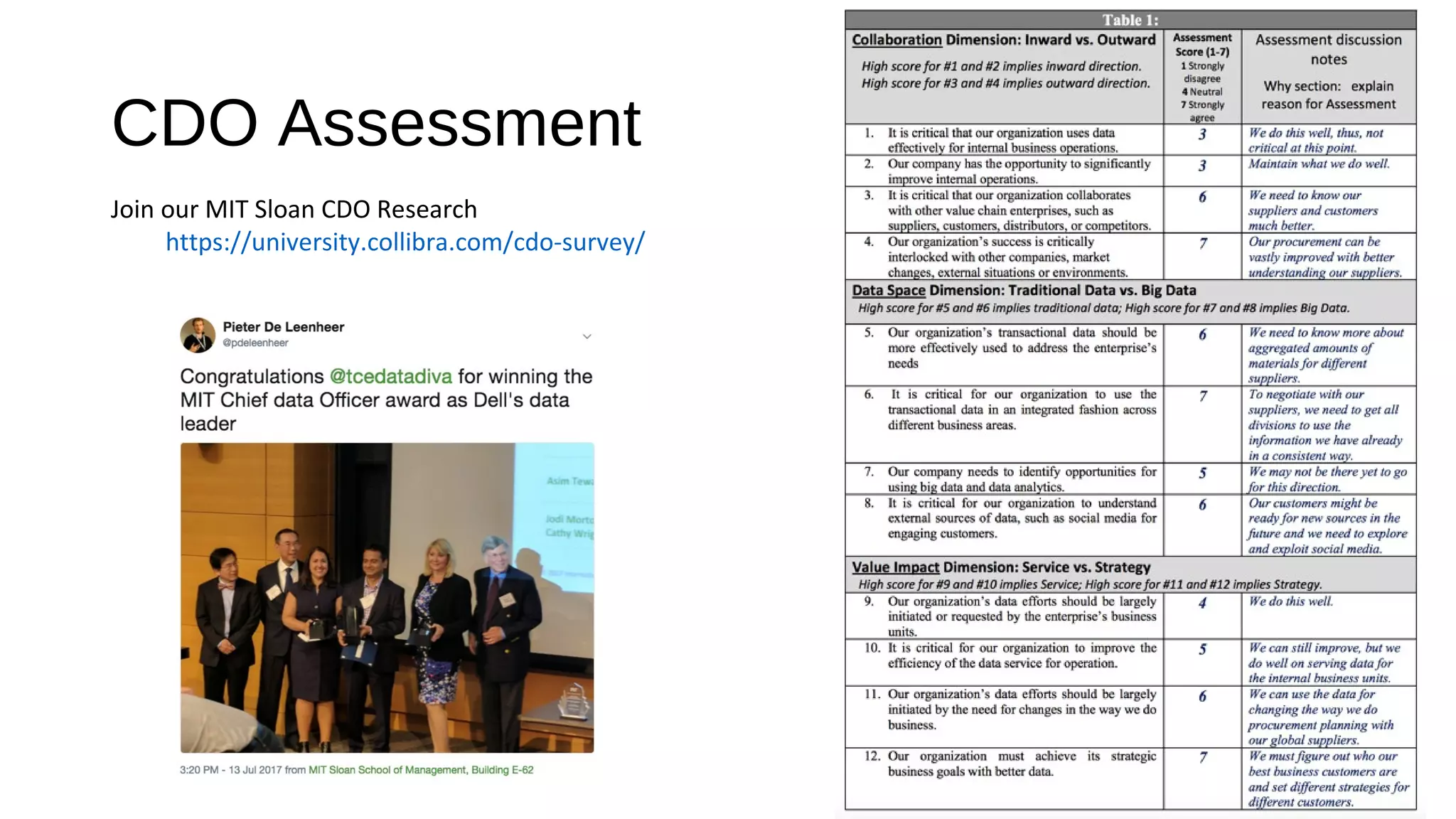
• Dimensions of CDO Roles
• Collaboration: inwards / outwards
• Data Space: traditional data / big data
• Value Impact: service / strategy
• Reporting:
• 30% to CDO
• 20% to COO
• 10% to CFO
CDO Assessment
Join our MIT Sloan CDO Research
https://university.collibra.com/cdo-survey/
Part 2
The Data Universe Expands
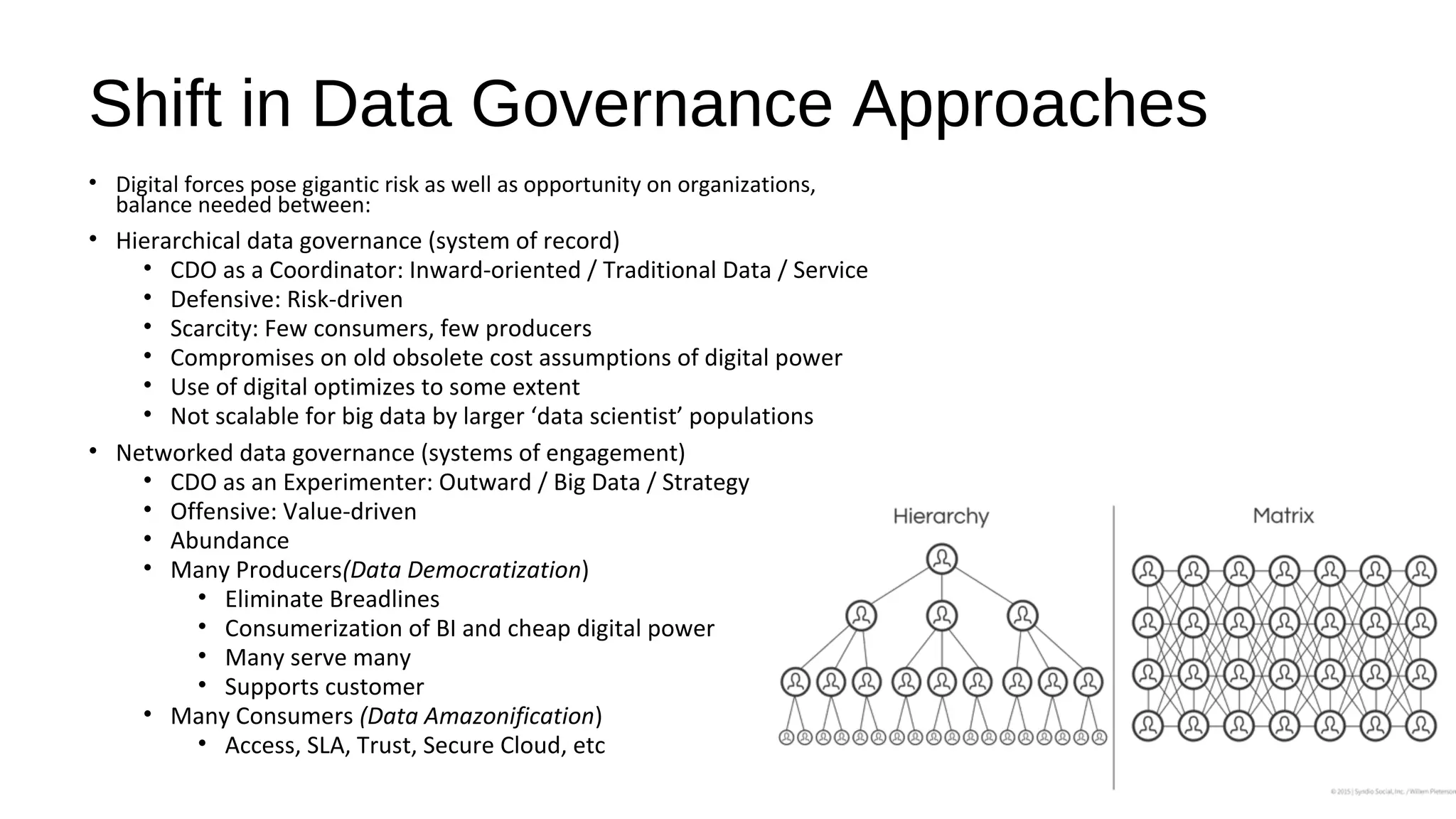
Shift in Data Governance Approaches
• Digital forces pose gigantic risk as well as opportunity on organizations,
balance needed between:
• Hierarchical data governance (system of record)
• CDO as a Coordinator: Inward-oriented / Traditional Data / Service
• Defensive: Risk-driven
• Scarcity: Few consumers, few producers
• Compromises on old obsolete cost assumptions of digital power
• Use of digital optimizes to some extent
• Not scalable for big data by larger ‘data scientist’ populations
• Networked data governance (systems of engagement)
• CDO as an Experimenter: Outward / Big Data / Strategy
• Offensive: Value-driven
• Abundance
• Many Producers(Data Democratization)
• Eliminate Breadlines
• Consumerization of BI and cheap digital power
• Many serve many
• Supports customer
• Many Consumers (Data Amazonification)
• Access, SLA, Trust, Secure Cloud, etc
34 | ©Collibra 2016
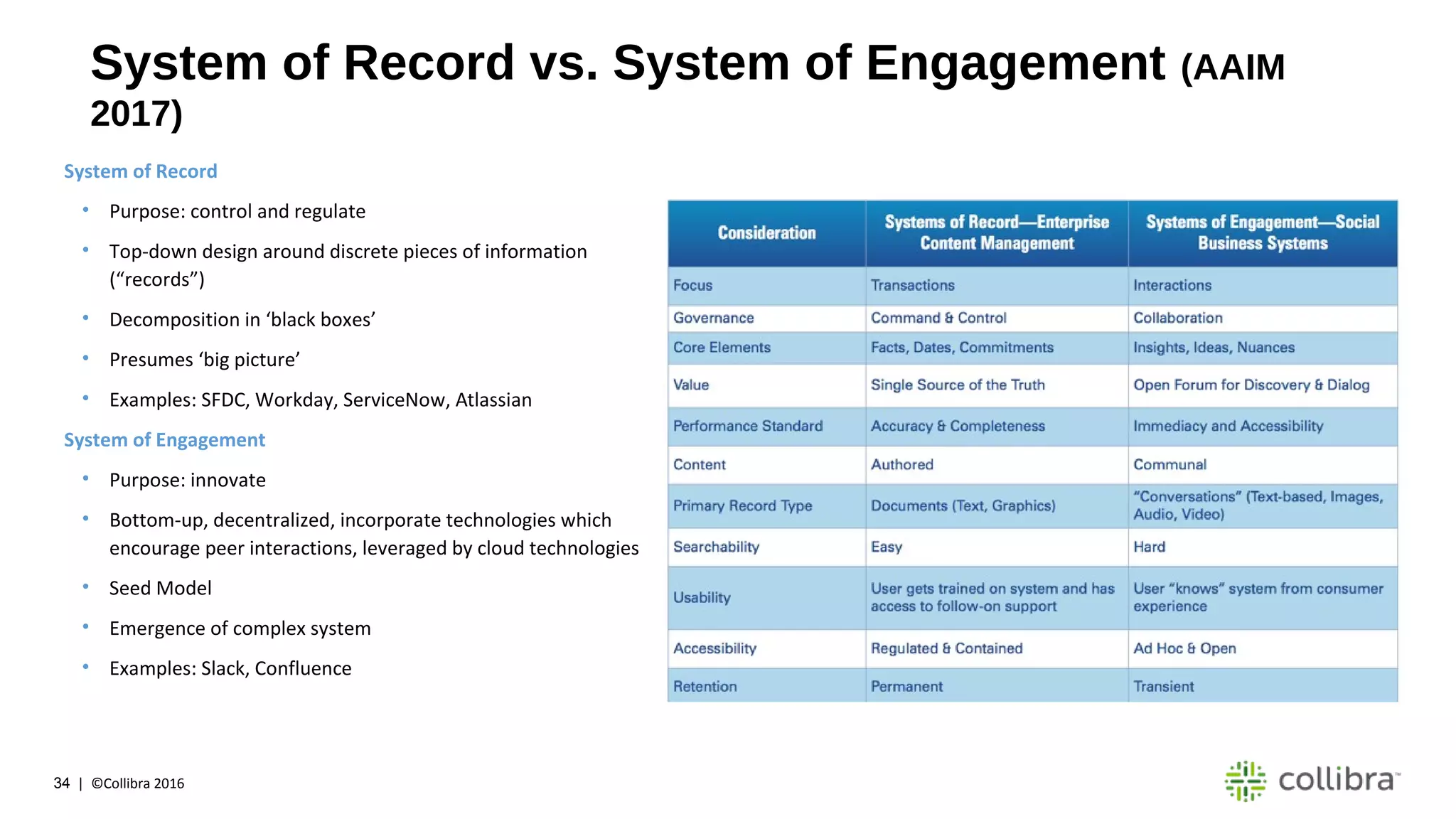
System of Record vs. System of Engagement (AAIM
2017)
System of Record
• Purpose: control and regulate
• Top-down design around discrete pieces of information
(“records”)
• Decomposition in ‘black boxes’
• Presumes ‘big picture’
• Examples: SFDC, Workday, ServiceNow, Atlassian
System of Engagement
• Purpose: innovate
• Bottom-up, decentralized, incorporate technologies which
encourage peer interactions, leveraged by cloud technologies
• Seed Model
• Emergence of complex system
• Examples: Slack, Confluence
Big Data Analytics
Challenges
• Where everybody has data scientists: predict next
transaction is not competitive anymore
• from 'predict next transaction' to life-long relation
building and value creation
• reduce search and navigation for customer with
better apps
• crowd sourcing to cross compare with and learn
from other customers (Opower, INRIX, zillow)
• get trust from customer through branded non-intrusive
apps: personal health monitoring, Nest
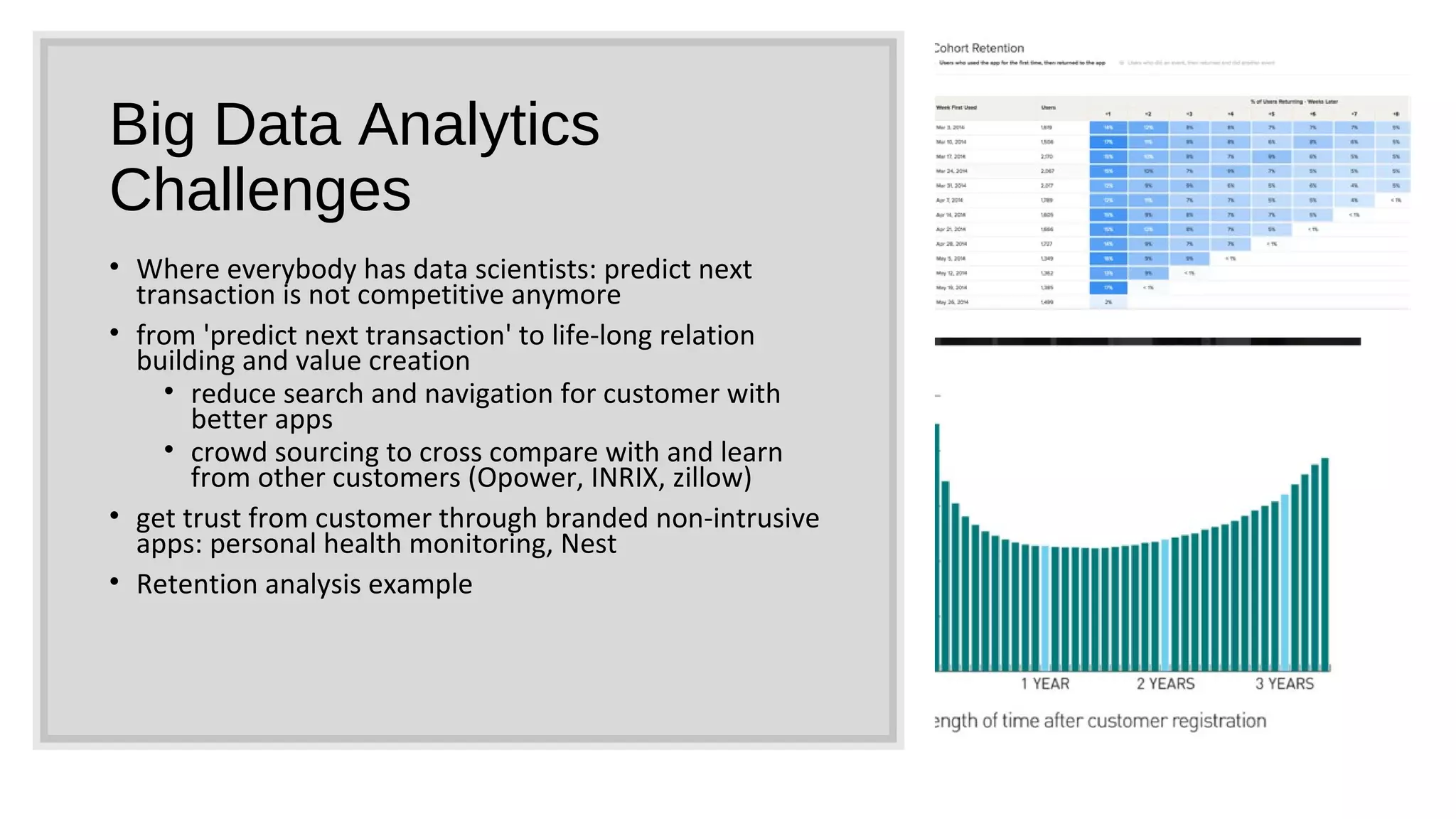
• Retention analysis example
Digitalization of Trust
Challenges
• In Hierarchical Data Governance, trust is
• established by a centrally sanctioned competence center
• Or external appointed trustees with formal roles: steward,
owners, architects
• In Networked Data Governance, trust is more complicated:
• Authenticity: is the data factual or opinioned?
• Intention: does this data have good intentions? Can I use
it without peril? Hidden privacy concerns I should be
aware of?
• Assess expertise or quality: are people involved skilled or
certified stewards?
• Is it accurately representing our business reality, i.e.
customer base?
• Is it complete and up to date?
• Has it be certified through standard process?
Danger of the old paradigm models
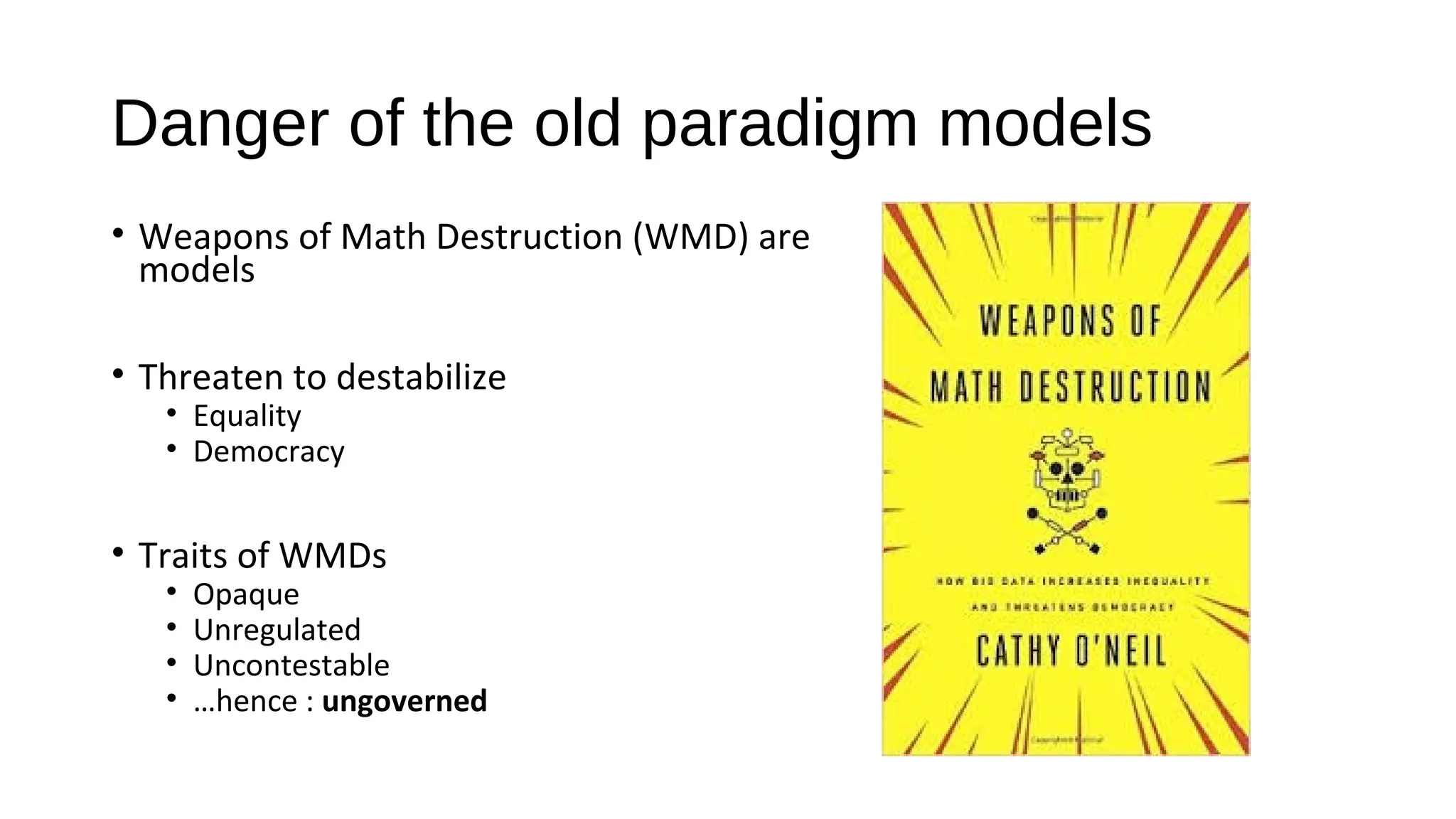
• Weapons of Math Destruction (WMD) are
models
• Threaten to destabilize
• Equality
• Democracy
• Traits of WMDs
• Opaque
• Unregulated
• Uncontestable
• …hence : ungoverned
Preliminary Conclusions
• Digital forces have digitally empowered individuals in the organization
• Hybrid data governance approach should combine
• Top-down governance of critical data assets to enhance internal coordination
• Networked peer-driven empowerment to drive ‘serendipity’
• On a shared platform
• Key challenges are:
• Digitalization of trust with focus on social capital
• Big data analytics that drives life-time value for customer
• Data Valuation based on Usage
• Legacy of oblique, unregulated and incontestable models
• Recognize CDO Leadership and Role transition
Part 3
A Lens on the Data Universe
40 | ©Collibra 2016
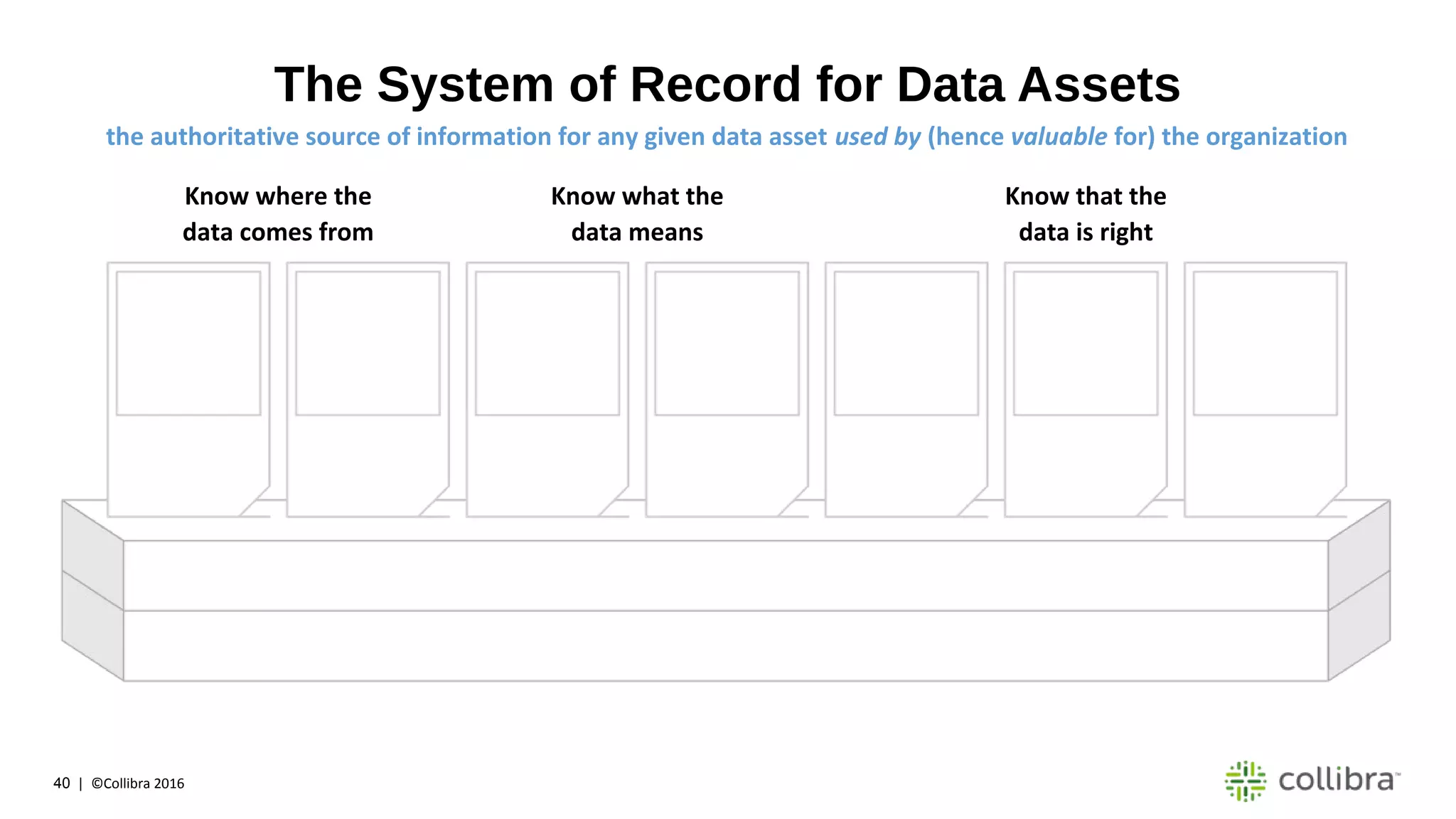
The System of Record for Data Assets
the authoritative source of information for any given data asset used by (hence valuable for) the organization
Know where the
data comes from
Know what the
data means
Know that the
data is right
41 | ©Collibra 2016
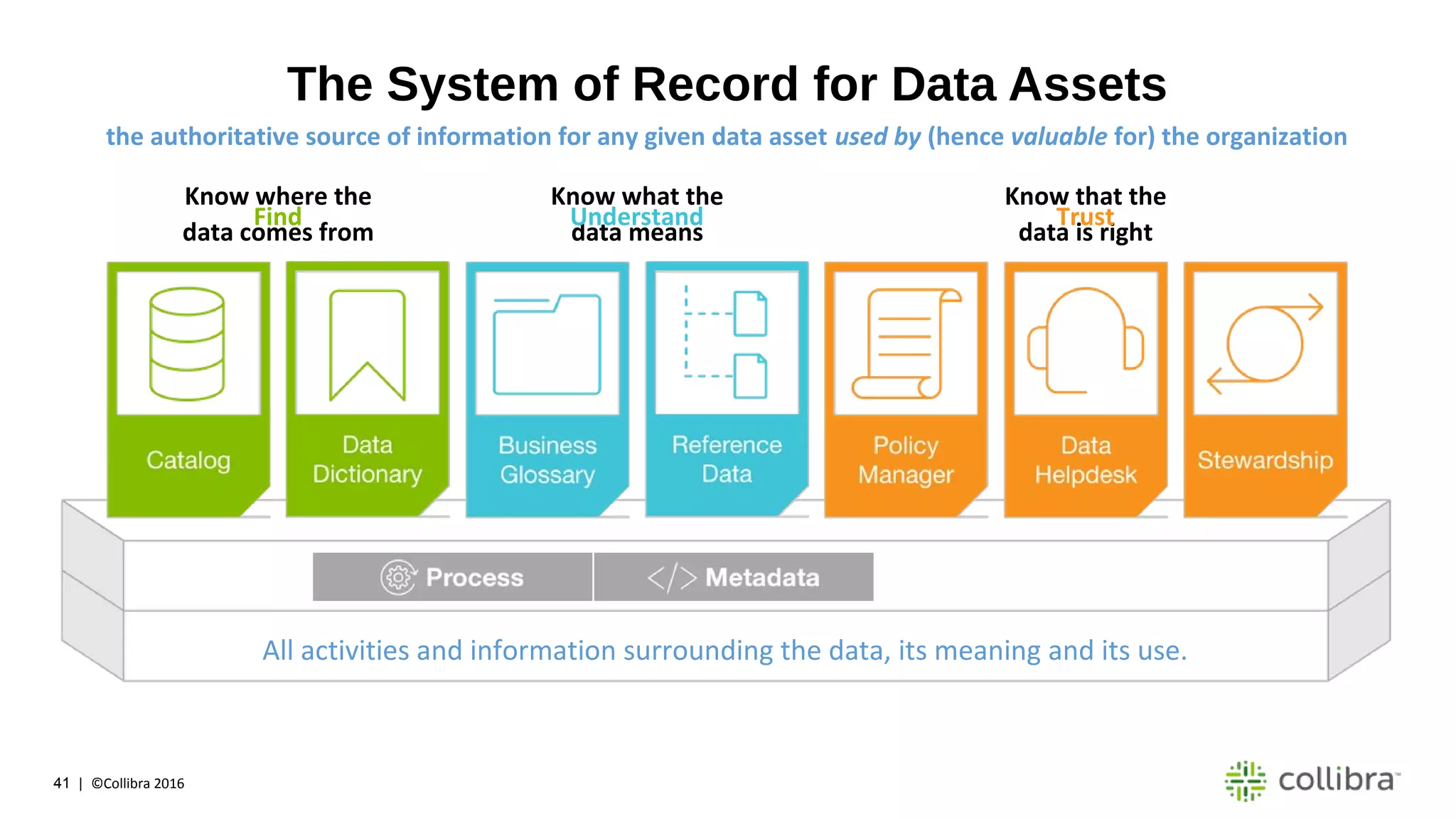
Know where the
data comes from
Know what the
data means
Know that the
data is right
Find Understand Trust
The System of Record for Data Assets
All activities and information surrounding the data, its meaning and its use.
the authoritative source of information for any given data asset used by (hence valuable for) the organization
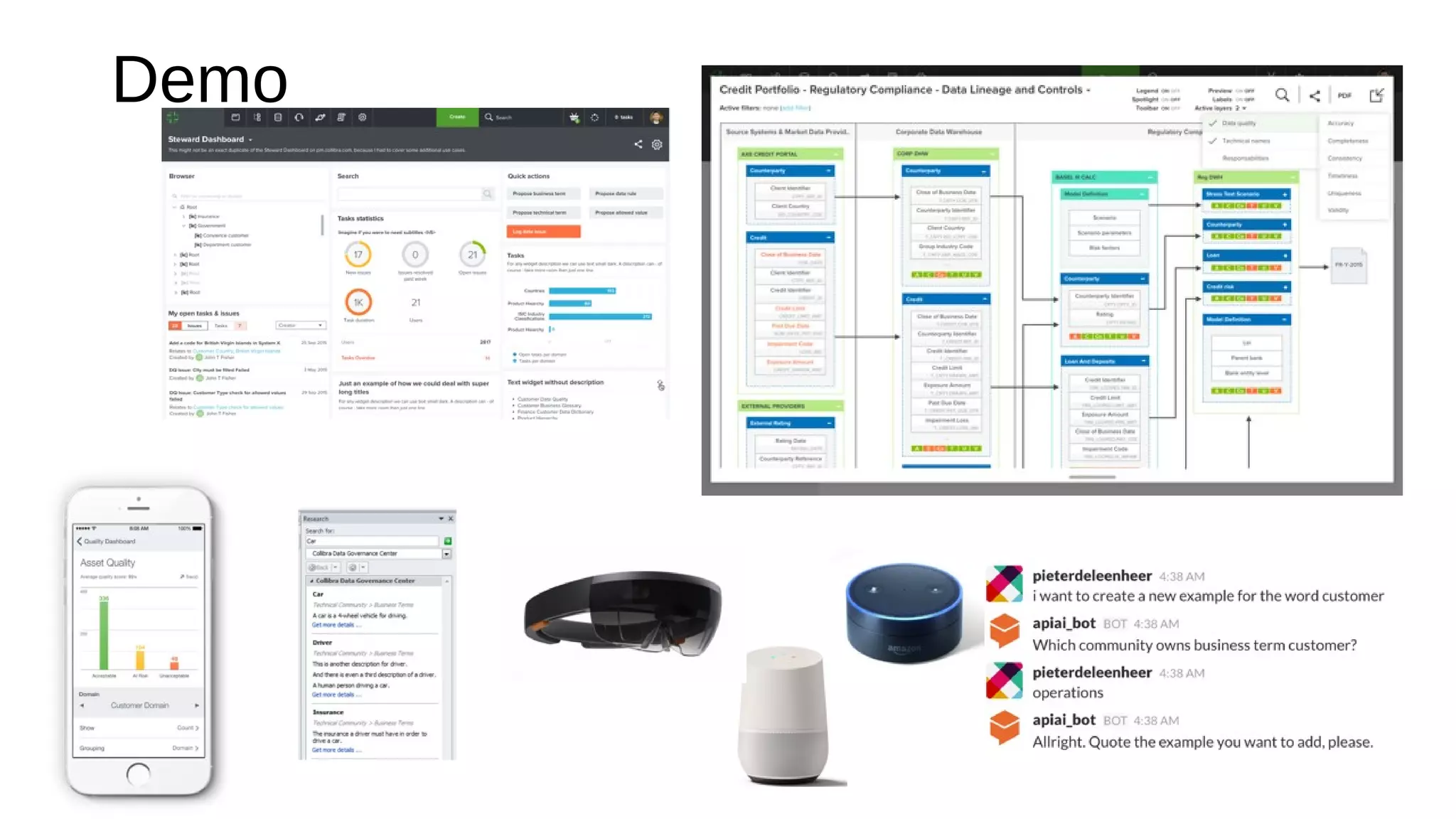
Demo
Recommended Reading
• Books:
• O’Neil, C.: Weapons of Math Destruction
• Franks, B.: Taming the Big Data Tidal Wave
• Sundararajan, A.: The Sharing Economy
• Pentland, S.: Social Physics: How Good Ideas Spread
• Zittrain, J.: The Future of the Internet
• Tunguz, T.; Bien, F. (2016) Winning with Data
• Articles:
• Lee et al. (2014) A Cubic Framework for the Chief Data Officer: Succeeding in a World of Big Data. MIS Quarterly Executive 13:1
• AAIM, Systems of Engagement and the Future of Enterprise IT (2017)
• http://mitiq.mit.edu/IQIS/Documents/CDOIQS_201177/Papers/05_01_7A-1_Laney.pdf
• http://si.deis.unical.it/zumpano/2004-2005/PSI/lezione2/ValueOfInformation.pdf
• http://dupress.deloitte.com/dup-us-en/topics/emerging-technologies/the-burdens-of-the-past.html
• Blog Posts
• https://www.collibra.com/blog/unleash-the-data-democracy-5-misconceptions-of-data-governance/
• https://www.collibra.com/blog/the-rise-of-the-chief-data-officer-cdo/
• https://www.collibra.com/blog/blognew-years-resolution/
• https://www.collibra.com/blog/data-lineage-diagrams-paradigm-shift-information-architects/

MIT ICIQ 2017 Keynote: Data Governance and Data Capitalization in the Big Data Era

  • 1.
    Data Governance and Capitalization ina Big Data Era Pieter De Leenheer, PhD Cofounder and VP, Research and Education at Collibra MIT ICIQ 2017 October 6, 2017
  • 2.
    2 | ©Collibra2017 Confidential & Proprietary The Daily News
  • 3.
    Administration • Slide Deck •https://www.slideshare.net/pdeleenh/data-gover • Software • Data Governance Center: • Inno.collibra.com • Username: johnfisher / password: merrimack • On the go: • Collibra on the App Store • Collibra University • Sign up for free: http://university.collibra.com • Collibra Blog, e.g.: • https://www.collibra.com/blog/unleash-the-data-democracy-5-misconceptions-of-data-governance/
  • 4.
    Overview Intro - AData Governance Odyssey •Finding the “man of the book” •About the company Collibra Part 1 – The Chief Data Officer Rises •Digital Darwinism •The Big Data Bang •Data Brawls and FUD •The Chief Data Officer Role Types Part 2: Data Universe Expands • Data Value Hierarchies, Networks and Hybrids • Shift in Data Governance Approaches • Systems of Record vs. Systems of Engagement • Challenges: • Big Data Analytics • Digitalization of Trust • Weapons of Math Destruction Part 3: A Lens on the Data Universe • A system of record for data • Use Cases
  • 5.
    Introduction 2008: A DataGovernance Odyssey
  • 6.
    Library of Babel Purifiers Manof the book JL Borges
  • 7.
    7 | ©Collibra2016 Leading Data Governance Software company HQ in NYC Founded in BE, Spin Off VUB Engineering in EU
  • 8.
    8 | ©Collibra2016 Across verticals & geographies
  • 9.
    9 | ©Collibra2016 With Blue-chip Customers
  • 10.
  • 11.
    A Fool witha Tool: Collibra Data Educationuniversity.collibra.com
  • 12.
    Part 1 The ChiefData Officer Rises
  • 13.
    What do thecompanies in these groups have in common? • Group A: American Motors, Brown Shoe, Studebaker, Collins Radio, Detroit Steel, Zenith Electronics, and National Sugar Refining. • Group B: Boeing, Campbell Soup, General Motors, Kellogg, Procter and Gamble, Deere, IBM and Whirlpool. • Group C: Facebook, eBay, Home Depot, Microsoft, Office Depot and Target. Conclusion • only 12.2% of the Fortune 500 companies in 1955 were still on the list 59 years later in 2014 • life expectancy of a firm in the Fortune 500 • 50 years ago : ~ 75 years • Today: < 15 years and declining MIT Technology Review, Sept., 2013
  • 14.
    What happened between1955 and today that caused this ‘creative destruction’? • Name some compelling events in information technology history • Order them chronologically • Try to explain the phenomenon in terms of the events • E.g., • Invention of the transistor • First modern computer • Publication of the Internet protocol • Launch of the World Wide Web • Wikipedia • Internet startups: FB, Google, etc. • data big bang
  • 15.
    Data Big Bang •Phenomenon: connectivity between • Social • Knowledge • Technology • Draws curiosity • Web Science (Pentland, etc) • Big Data Native Market Entrants (23andMe, Uber, Inventure) • Big-date native entrants • 23andMe, Uber, Inventure • Enter Bottom up, Low-end and disrupt • Pure data strategy • Serving “data-citizen” Millennials • +80% unstructured data or ‘dark energy’
  • 16.
    17 | ©Collibra2016 “Data-driven” is the Holy Grail of business
  • 17.
    18 | ©Collibra2016 But Becoming the Fittest is not Easy 74%of firms say they want to be data-driven 29%Say they are good at connecting analytics to action In reality, only
  • 18.
    19 | ©Collibra2016 Here’s what typically happens • Hours spent preparing for the meeting • Collect data from finance, IT and the data lake • Do your analysis, prepare insights and recommendations • You’re ready to go
  • 19.
    20 | ©Collibra2016 Same company, same data, different results
  • 20.
    21 | ©Collibra2016 Meetings dissolve into data brawls You need: trustworthy data, common understanding, complete traceability, transparent data ownership
  • 21.
    22 | ©Collibra2016 Solving the problem with duct tape and chewing gum No unified system.
  • 22.
    23 | ©Collibra2016 Who can help me with this ? I don’t trust these numbers Am I allowed to use this ? Where do I find the data ? I don’t understand this report Data Chaos Leads to Data FUD* * fear, uncertainty and doubt TREND Exploding volume, velocity, and veracity of data NEED Manage data complexity TREND Increased reliance on analytics and regulatory reporting NEED Trusted data as a business dependency NEED Data Collaboration Understanding Discovery Trust Data Infrastructure (IT) Data Consumers (Business)
  • 23.
    24 | ©Collibra2016 You Need the Right Level of Control and Trust in Data Data governance & stewardship provide the right level of control and trust in data LEADERSHIP CEO, CFO, VP, Marketing ROLES Data Scientist, Business Analyst TECHNOLOGY Visualization, Self-service BI LEADERSHIP CIO ROLES Information Manager, Data Architect, Data Modeler TECHNOLOGY Hadoop, Databases, Data Integration LEADERSHIP Chief Data Officer Data Collaboration ROLES Data Governance Manager, Data Steward TECHNOLOGY Data Stewardship Platform Data Infrastructure (IT) Data Consumers (Business)
  • 24.
    25 | ©Collibra2016 The Rise of the Chief Data Officer (CDO) Gartner on Chief Data Officers: 1,000 Chief Data Officers or Chief Analytics Officers Forecast in Large Organizations by the End of 2015, Up From 400 in 2014 90% of Large Organizations Will Have a Chief Data Officer by 2019
  • 25.
    Role Types forthe Chief Data Officer (CDO) (Lee et al., 2014) • Dimensions of CDO Roles • Collaboration: inwards / outwards • Data Space: traditional data / big data • Value Impact: service / strategy • Reporting: • 30% to CDO • 20% to COO • 10% to CFO
  • 26.
    CDO Assessment Join ourMIT Sloan CDO Research https://university.collibra.com/cdo-survey/
  • 27.
    Part 2 The DataUniverse Expands
  • 28.
    Shift in DataGovernance Approaches • Digital forces pose gigantic risk as well as opportunity on organizations, balance needed between: • Hierarchical data governance (system of record) • CDO as a Coordinator: Inward-oriented / Traditional Data / Service • Defensive: Risk-driven • Scarcity: Few consumers, few producers • Compromises on old obsolete cost assumptions of digital power • Use of digital optimizes to some extent • Not scalable for big data by larger ‘data scientist’ populations • Networked data governance (systems of engagement) • CDO as an Experimenter: Outward / Big Data / Strategy • Offensive: Value-driven • Abundance • Many Producers(Data Democratization) • Eliminate Breadlines • Consumerization of BI and cheap digital power • Many serve many • Supports customer • Many Consumers (Data Amazonification) • Access, SLA, Trust, Secure Cloud, etc
  • 29.
    34 | ©Collibra2016 System of Record vs. System of Engagement (AAIM 2017) System of Record • Purpose: control and regulate • Top-down design around discrete pieces of information (“records”) • Decomposition in ‘black boxes’ • Presumes ‘big picture’ • Examples: SFDC, Workday, ServiceNow, Atlassian System of Engagement • Purpose: innovate • Bottom-up, decentralized, incorporate technologies which encourage peer interactions, leveraged by cloud technologies • Seed Model • Emergence of complex system • Examples: Slack, Confluence
  • 30.
    Big Data Analytics Challenges •Where everybody has data scientists: predict next transaction is not competitive anymore • from 'predict next transaction' to life-long relation building and value creation • reduce search and navigation for customer with better apps • crowd sourcing to cross compare with and learn from other customers (Opower, INRIX, zillow) • get trust from customer through branded non-intrusive apps: personal health monitoring, Nest • Retention analysis example
  • 31.
    Digitalization of Trust Challenges •In Hierarchical Data Governance, trust is • established by a centrally sanctioned competence center • Or external appointed trustees with formal roles: steward, owners, architects • In Networked Data Governance, trust is more complicated: • Authenticity: is the data factual or opinioned? • Intention: does this data have good intentions? Can I use it without peril? Hidden privacy concerns I should be aware of? • Assess expertise or quality: are people involved skilled or certified stewards? • Is it accurately representing our business reality, i.e. customer base? • Is it complete and up to date? • Has it be certified through standard process?
  • 32.
    Danger of theold paradigm models • Weapons of Math Destruction (WMD) are models • Threaten to destabilize • Equality • Democracy • Traits of WMDs • Opaque • Unregulated • Uncontestable • …hence : ungoverned
  • 33.
    Preliminary Conclusions • Digitalforces have digitally empowered individuals in the organization • Hybrid data governance approach should combine • Top-down governance of critical data assets to enhance internal coordination • Networked peer-driven empowerment to drive ‘serendipity’ • On a shared platform • Key challenges are: • Digitalization of trust with focus on social capital • Big data analytics that drives life-time value for customer • Data Valuation based on Usage • Legacy of oblique, unregulated and incontestable models • Recognize CDO Leadership and Role transition
  • 34.
    Part 3 A Lenson the Data Universe
  • 35.
    40 | ©Collibra2016 The System of Record for Data Assets the authoritative source of information for any given data asset used by (hence valuable for) the organization Know where the data comes from Know what the data means Know that the data is right
  • 36.
    41 | ©Collibra2016 Know where the data comes from Know what the data means Know that the data is right Find Understand Trust The System of Record for Data Assets All activities and information surrounding the data, its meaning and its use. the authoritative source of information for any given data asset used by (hence valuable for) the organization
  • 37.
  • 38.
    Recommended Reading • Books: •O’Neil, C.: Weapons of Math Destruction • Franks, B.: Taming the Big Data Tidal Wave • Sundararajan, A.: The Sharing Economy • Pentland, S.: Social Physics: How Good Ideas Spread • Zittrain, J.: The Future of the Internet • Tunguz, T.; Bien, F. (2016) Winning with Data • Articles: • Lee et al. (2014) A Cubic Framework for the Chief Data Officer: Succeeding in a World of Big Data. MIS Quarterly Executive 13:1 • AAIM, Systems of Engagement and the Future of Enterprise IT (2017) • http://mitiq.mit.edu/IQIS/Documents/CDOIQS_201177/Papers/05_01_7A-1_Laney.pdf • http://si.deis.unical.it/zumpano/2004-2005/PSI/lezione2/ValueOfInformation.pdf • http://dupress.deloitte.com/dup-us-en/topics/emerging-technologies/the-burdens-of-the-past.html • Blog Posts • https://www.collibra.com/blog/unleash-the-data-democracy-5-misconceptions-of-data-governance/ • https://www.collibra.com/blog/the-rise-of-the-chief-data-officer-cdo/ • https://www.collibra.com/blog/blognew-years-resolution/ • https://www.collibra.com/blog/data-lineage-diagrams-paradigm-shift-information-architects/

Editor's Notes

  • #3 First let us set the context for this proposal by reviewing recent news. Few weeks ago The Economist one of the leading magazines on business and economic news confirmed what we already knew: data is the most valuable resource and therefore drives competitive advantage As a result organizations eagerly jump on the AI hype, do not know how to transform to a workplace where AI augments instead of replaces human workers, which is core purpose of DG 3) If not governed properly, this experimentation with AI poses huge risk with disastrous consequences data is the new oil =&amp;gt; heavy investments in analytics, AI =&amp;gt; potential breaches
  • #5 Intro: intro to our company to make sure what the background is of what I am going to tell you
  • #8 inno.com
  • #15 Invention of the transistor 60’s Internet 1989 Publication by CERN of global hypertext system 2004 Social media streaming Explosion of mobie devices
  • #17 * Evolution , not transformation because the latter would not take into account the “creative destruction” part. An acceleration will happen as many of these young data citizens will enter the job market and change their employers behaviour.
  • #18 Data-driven is the word of the day. Increasingly depending on data to thrive
  • #19 According to Forrester Research, even though 74% of firms say they want to be data-driven, in reality, only 29% say the are good at connecting analytics to action. There are many reasons why this happens. See if this one sounds familiar:
  • #20 You spend hours preparing for a meeting. You collect the data you need from finance, IT, and even retrieve some from the data lake. You analyze it from every angle, and prepare your insights and recommendations. You’re confident in your findings, and are ready to make your data-driven argument.
  • #21 But before you have a chance to present, your colleague presents her findings and recommendations, using data he analyzed from the data lake, salesforce.com, and IT. It’s vaguely familiar, but distinctly different and leads to a data-driven argument with a completely different conclusion.
  • #22 Now, instead of making a data driven argument, you find yourself engaged in a data brawl. The meeting is no longer focused on the decisions at hand, but rather on answering questions about the data itself: Where did it come from? What does it mean? What metrics were applied to it? Who can access it? It is correct? If not, how can I fix it? Everyone realizes that “data-driven” doesn’t work without trustworthy data.
  • #23 In an effort to answer those questions so this situation doesn’t happen again, you head back to your office and put in place processes driven by Excel spreadsheets, emails, meetings, and Sharepoint documents. You track information about the data - where it comes from, who can access it, what it means, and more - in all these different ways, holding the process together with duct tape and string. Your colleague does the same, and before you know it, many people across your organization have a similar process that they follow, which only multiplies the problem. These processes are inefficient, inaccurate, and expensive. It’s no wonder your meetings dissolve into data brawls. This approach isn’t just unsustainable – it simply doesn’t work. ENDLESS MEETINGS – people fly in every two weeks
  • #24 On the left side of the diagram, you have the traditional data infrastructure (IT) and they are coping with the trend of exploding volumes and types of data.   In addition, data growth is becoming more and more complex, increasing their challenge. At the same time, on the right side, you have the business who need to report more complex data, faster than ever, as well as a need for analytics.   This can include internal reports, which are often compiled manually on spreadsheets; often reports rely on multiple layers of interrelated spreadsheets. This makes it more difficult than ever to trust and depend on the data.   Then from the Business focus, in the center, you have all kinds of trends like consumerization of IT (where IT is purchasing software tools), social and data maturity.   This leads to a need for a data authority. #
  • #25 If all these communication channels are in place, we can trace whereabouts and usage of every data product individually, from the definition level down to the storage.
  • #26 If all these communication channels are in place, we can trace whereabouts and usage of every data product individually, from the definition level down to the storage.
  • #27 Outwards: e.g., manufacturing company may agree with his suppliers and distributors on 1 global product ID Traditional: enterprise-level MDM, BI and Analytics Big Data: more on the application level, more self-service BI, more data scientist experimenting with big data require appropr. Approvals for data usage and sharing Data as a service as immediate need to improve service quality, regulatory compliance, reputation of the company Data as a strategy: build aggregated data products and resell them as a strategy: e.g., the ab company selling GPS information of cabs to Google.
  • #35 Top-down : methodological step-wise decomposition into sub components ‘black boxes’ in a reverse engineering fasion Presumes a preconcpetion of the ‘big picture’ Bottom =-up Allowed behaviour based on simple rules set Subsystems gives rise to complex systems Original systems become subsystems of the emeging ssytem Perception Seed model
  • #41 To be data driven, an organization needs three things: Knowing where its data comes from Knowing what it means, and Knowing that it’s right What if everyone in your organization had the same ability – to find, understand, and trust their data? This is what Collibra brings to its clients:
  • #42 Collibra allows you to find, understand and trust your data. Finding data by giving you a catalog which ingests information about datasets and the metadata underneath. Understanding data by putting this metadata into context. By linking it to business concepts: tags, business units, data dimensions, KPI’s reports... And finally Collibra allows you to trust this information by enabling policy management, a data helpdesk and the worlds best stewardship platform.