Data For Social Good Nonprofit Sector Data Projects Jane Farmer
Data For Social Good Nonprofit Sector Data Projects Jane Farmer
Data For Social Good Nonprofit Sector Data Projects Jane Farmer
Data For Social Good Nonprofit Sector Data Projects Jane Farmer
Data For Social Good Nonprofit Sector Data Projects Jane Farmer
1.
Data For SocialGood Nonprofit Sector Data
Projects Jane Farmer download
https://ebookbell.com/product/data-for-social-good-nonprofit-
sector-data-projects-jane-farmer-46871168
Explore and download more ebooks at ebookbell.com
2.
Here are somerecommended products that we believe you will be
interested in. You can click the link to download.
Data Science For Social Good Philanthropy And Social Impact In A
Complex World Massimo Lapucci
https://ebookbell.com/product/data-science-for-social-good-
philanthropy-and-social-impact-in-a-complex-world-massimo-
lapucci-46245258
Data Analytics For Social Microblogging Platforms Soumi Dutta
https://ebookbell.com/product/data-analytics-for-social-microblogging-
platforms-soumi-dutta-47210924
Data Analysis For Social Science 1st Elena Llaudet Kosuke Imai
https://ebookbell.com/product/data-analysis-for-social-science-1st-
elena-llaudet-kosuke-imai-47595360
Data Management For Social Scientists Nils B Weidmann
https://ebookbell.com/product/data-management-for-social-scientists-
nils-b-weidmann-48171758
3.
Data Analysis ForSocial Science A Friendly And Practical Introduction
Elena Llaudet
https://ebookbell.com/product/data-analysis-for-social-science-a-
friendly-and-practical-introduction-elena-llaudet-48684150
Data Mining For Social Network Data 1st Edition Nasrullah Memon
https://ebookbell.com/product/data-mining-for-social-network-data-1st-
edition-nasrullah-memon-4201640
Data Visualization For Social And Policy Research A Stepbystep
Approach Using R And Python 1st Edition Jose Manuel Magallanes Reyes
https://ebookbell.com/product/data-visualization-for-social-and-
policy-research-a-stepbystep-approach-using-r-and-python-1st-edition-
jose-manuel-magallanes-reyes-42802666
Data Mining For Social Robotics Toward Autonomously Social Robots 1st
Edition Yasser Mohammad
https://ebookbell.com/product/data-mining-for-social-robotics-toward-
autonomously-social-robots-1st-edition-yasser-mohammad-5354732
Data Visualization For Social And Policy Research A Stepbystep
Approach Using R And Python New Jose Manuel Magallanes Reyes
https://ebookbell.com/product/data-visualization-for-social-and-
policy-research-a-stepbystep-approach-using-r-and-python-new-jose-
manuel-magallanes-reyes-50509802
5.
Data for SocialGood
Non-Profit Sector Data
Projects
Jane Farmer
Anthony McCosker
Kath Albury
Amir Aryani
v
We pay ourrespects to the traditional custodians of the lands on which
we work and acknowledge their Elders, past and present.
We would like to acknowledge funders of our research on data for
social good, including the Australian Research Council (ARC) for
LinkageInfrastructureEquipmentandFacilities,grantno.LE200100074;
Data Co-operative Platform for Social Impact; the ARC Centre of
Excellence for Automated Decision Making and Society, grant no.
CE200100005; ARC Discovery Project, grant no. DP200100419;
Victoria State Government; Australian Red Cross; Lord Mayor’s
Charitable Foundation; and City of Greater Bendigo Data Co-op
partners.
We would like to acknowledge the contribution of the Regional
Innovation Data Lab (RIDL) at Griffith University, Queensland,
Australia, and the Visualisation and Decision Analytics (VIDEA) Lab at
the University of Canberra, Australia.
Acknowledgements
10.
vii
Contents
1 Introduction 1
The Non-ProfitSector and Data 4
Making Good Use of Data 7
Starting to Think About Data Capability 13
Navigating Data Harms by Involving Citizens 15
Key Takeaways from This Chapter 20
References 21
2
Case Studies of Data Projects 27
Case Study 1: Outcomes of Family Violence Policy—A Public
Sector Collaboration 29
Project Goal 29
Project Description 29
Collaborating Partners 31
How the Project Began 31
Summary of Datasets Used 32
Methods 33
Findings 34
Outcomes and Lessons Learned 36
11.
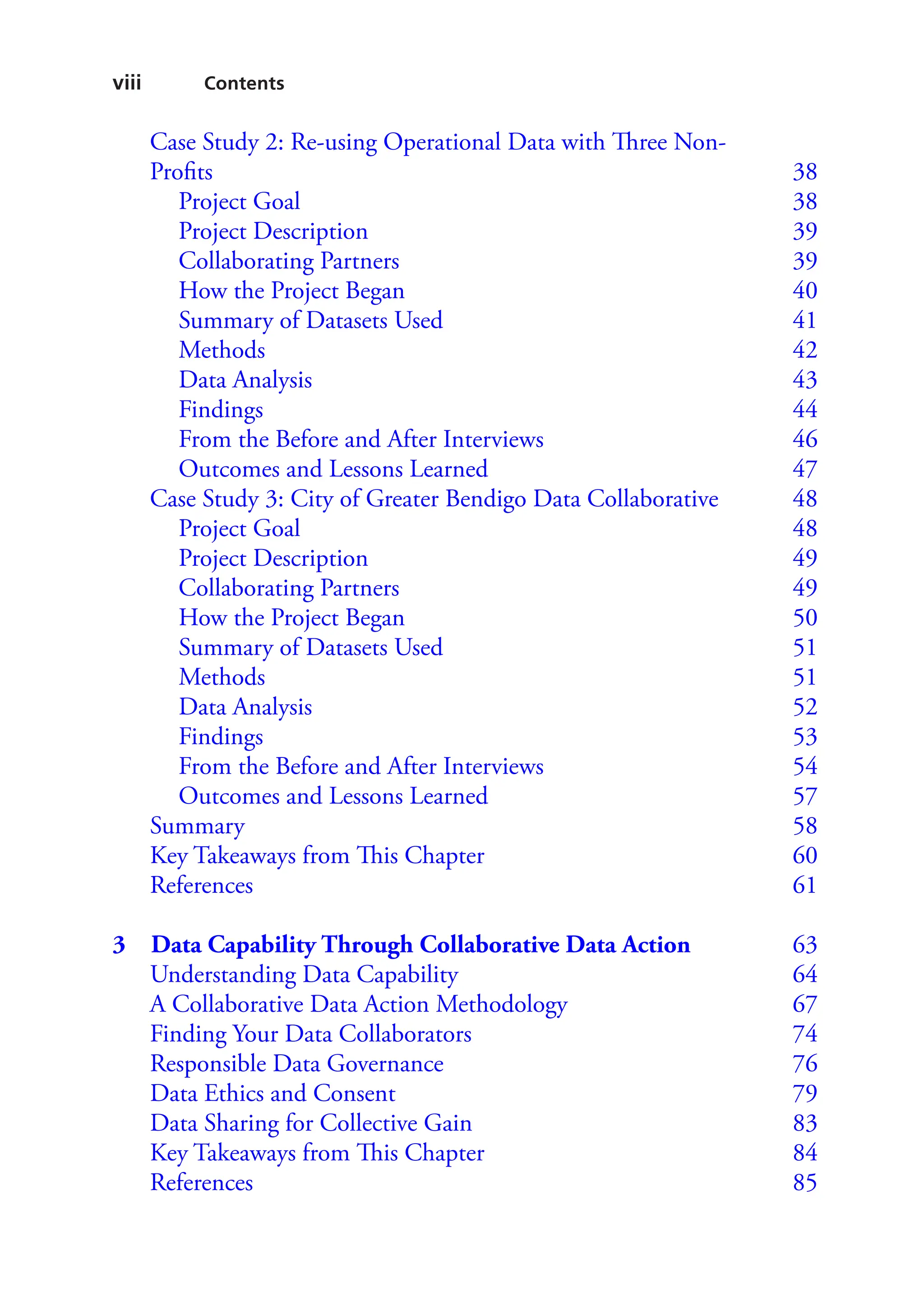
viii Contents
Case Study2: Re-using Operational Data with Three Non-
Profits 38
Project Goal 38
Project Description 39
Collaborating Partners 39
How the Project Began 40
Summary of Datasets Used 41
Methods 42
Data Analysis 43
Findings 44
From the Before and After Interviews 46
Outcomes and Lessons Learned 47
Case Study 3: City of Greater Bendigo Data Collaborative 48
Project Goal 48
Project Description 49
Collaborating Partners 49
How the Project Began 50
Summary of Datasets Used 51
Methods 51
Data Analysis 52
Findings 53
From the Before and After Interviews 54
Outcomes and Lessons Learned 57
Summary 58
Key Takeaways from This Chapter 60
References 61
3
Data Capability Through Collaborative Data Action 63
Understanding Data Capability 64
A Collaborative Data Action Methodology 67
Finding Your Data Collaborators 74
Responsible Data Governance 76
Data Ethics and Consent 79
Data Sharing for Collective Gain 83
Key Takeaways from This Chapter 84
References 85
12.
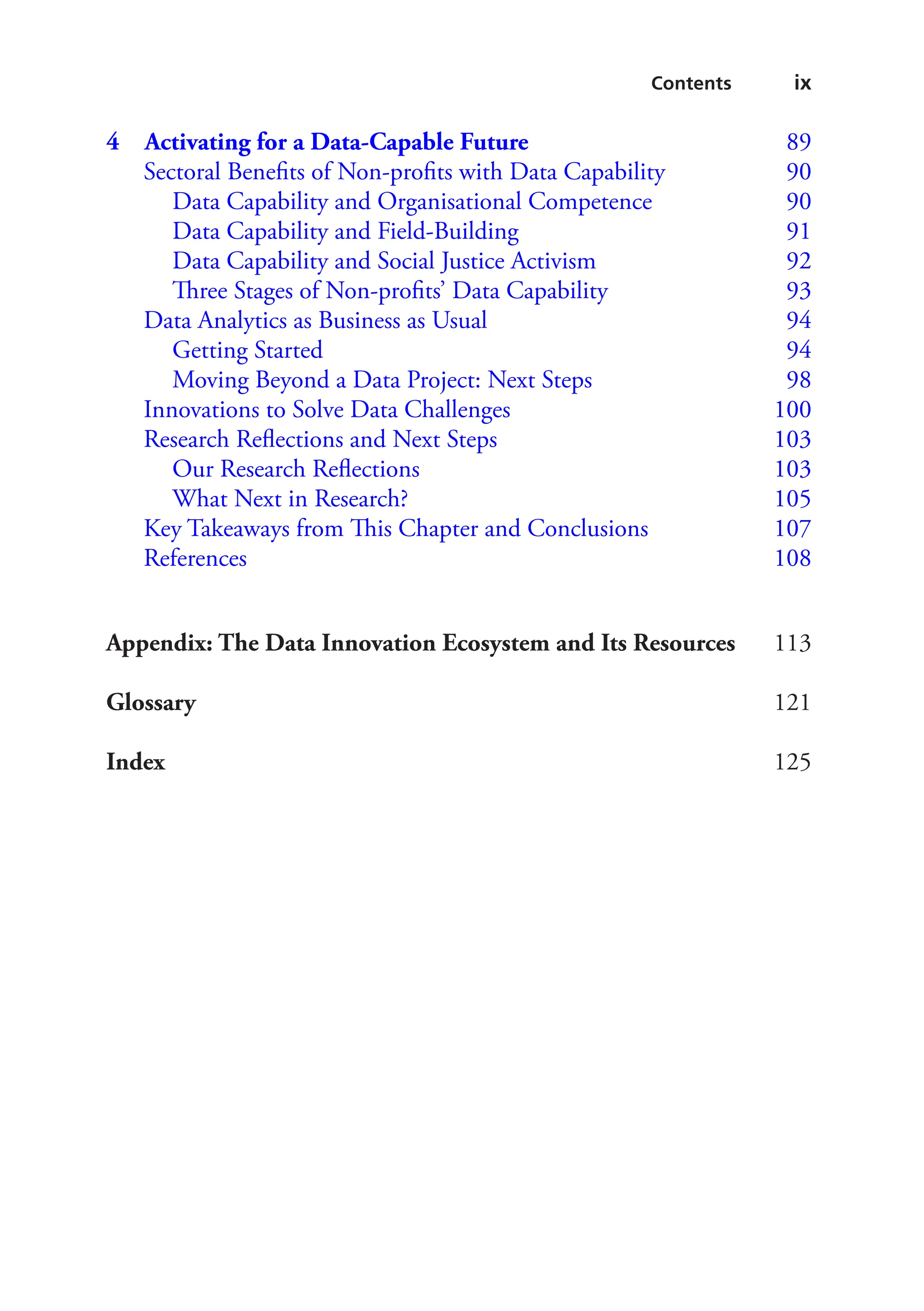
ix
Contents
4
Activating fora Data-Capable Future 89
Sectoral Benefits of Non-profits with Data Capability 90
Data Capability and Organisational Competence 90
Data Capability and Field-Building 91
Data Capability and Social Justice Activism 92
Three Stages of Non-profits’ Data Capability 93
Data Analytics as Business as Usual 94
Getting Started 94
Moving Beyond a Data Project: Next Steps 98
Innovations to Solve Data Challenges 100
Research Reflections and Next Steps 103
Our Research Reflections 103
What Next in Research? 105
Key Takeaways from This Chapter and Conclusions 107
References 108
Appendix: The Data Innovation Ecosystem and Its Resources113
Glossary121
Index125
13.
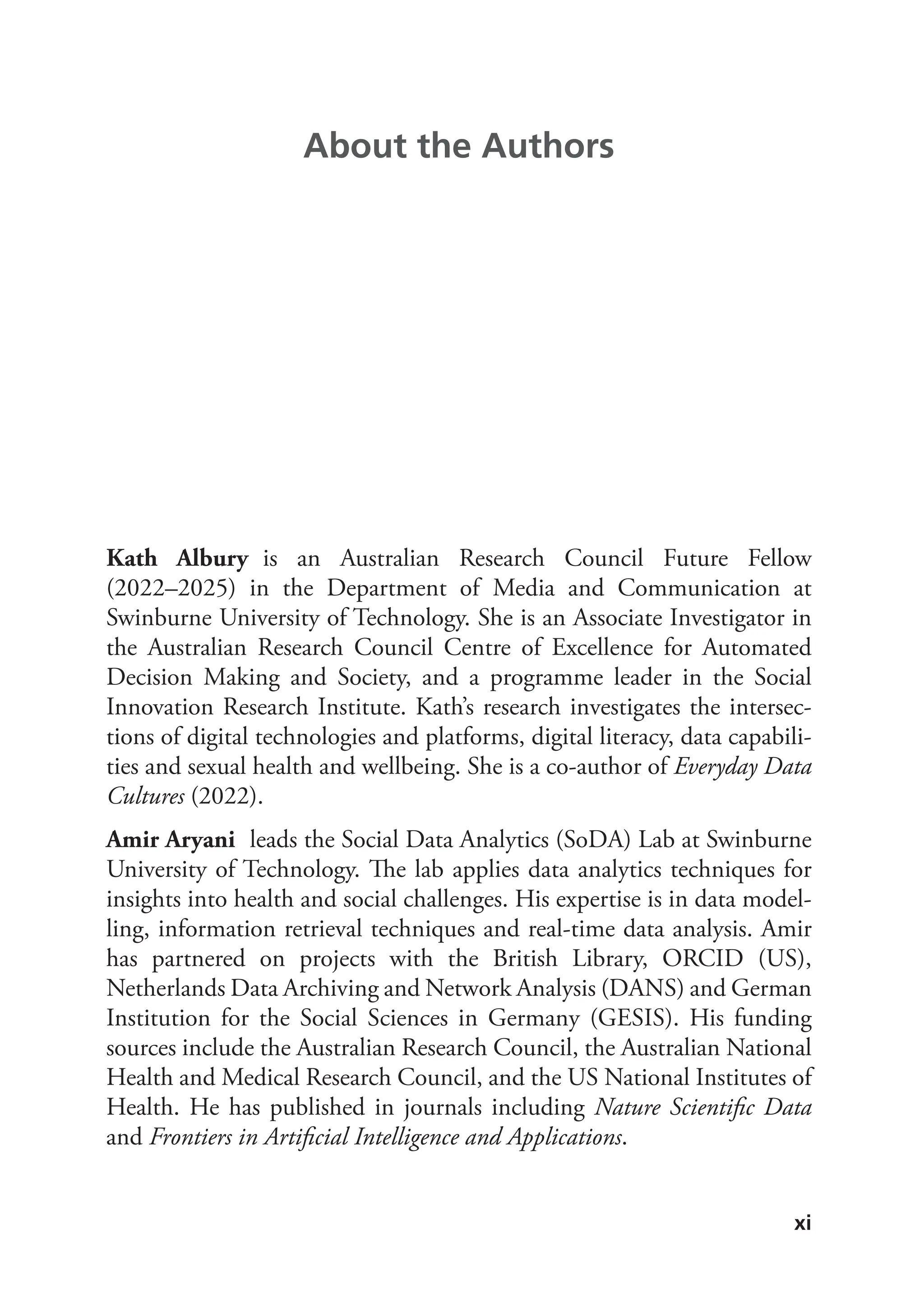
xi
Kath Albury isan Australian Research Council Future Fellow
(2022–2025) in the Department of Media and Communication at
Swinburne University of Technology. She is an Associate Investigator in
the Australian Research Council Centre of Excellence for Automated
Decision Making and Society, and a programme leader in the Social
Innovation Research Institute. Kath’s research investigates the intersec-
tions of digital technologies and platforms, digital literacy, data capabili-
ties and sexual health and wellbeing. She is a co-author of Everyday Data
Cultures (2022).
Amir Aryani leads the Social Data Analytics (SoDA) Lab at Swinburne
University of Technology. The lab applies data analytics techniques for
insights into health and social challenges. His expertise is in data model-
ling, information retrieval techniques and real-time data analysis. Amir
has partnered on projects with the British Library, ORCID (US),
Netherlands Data Archiving and Network Analysis (DANS) and German
Institution for the Social Sciences in Germany (GESIS). His funding
sources include the Australian Research Council, the Australian National
Health and Medical Research Council, and the US National Institutes of
Health. He has published in journals including Nature Scientific Data
and Frontiers in Artificial Intelligence and Applications.
About the Authors
14.
xii About theAuthors
Jane Farmer is Director of the Social Innovation Research Institute at
Swinburne University of Technology, Melbourne, Australia. Her back-
ground is as a researcher in rural health service and workforce innovation,
community engagement and social enterprise. She has a keen interest in
academic-practice research partnerships, innovative research methods,
transdisciplinary studies and translating research into practice. Her other
books include Social Enterprise, Health and Wellbeing (2021), Remote and
Rural Dementia Care (2020) and Community Co-production (2012).
Anthony McCosker is Deputy Director of the Social Innovation
Research Institute and is a Chief Investigator and Swinburne Lead for the
Australian Research Council Centre of Excellence for Automated
Decision Making and Society. His research addresses digital inclusion,
participation and inequality and explores the impact of new communica-
tion technologies, particularly in relation to health and wellbeing and
social inclusion. Current research addresses the social issues related to
automation and machine vision technologies and media and the need for
community-led approaches to data and analytics. He is author or co-
author of numerous articles and books, including Everyday Data Cultures
(2020), Automating Vision: The Social Impact of the New Camera
Consciousness (2020) and Negotiating Digital Citizenship (2016).
15.
xiii
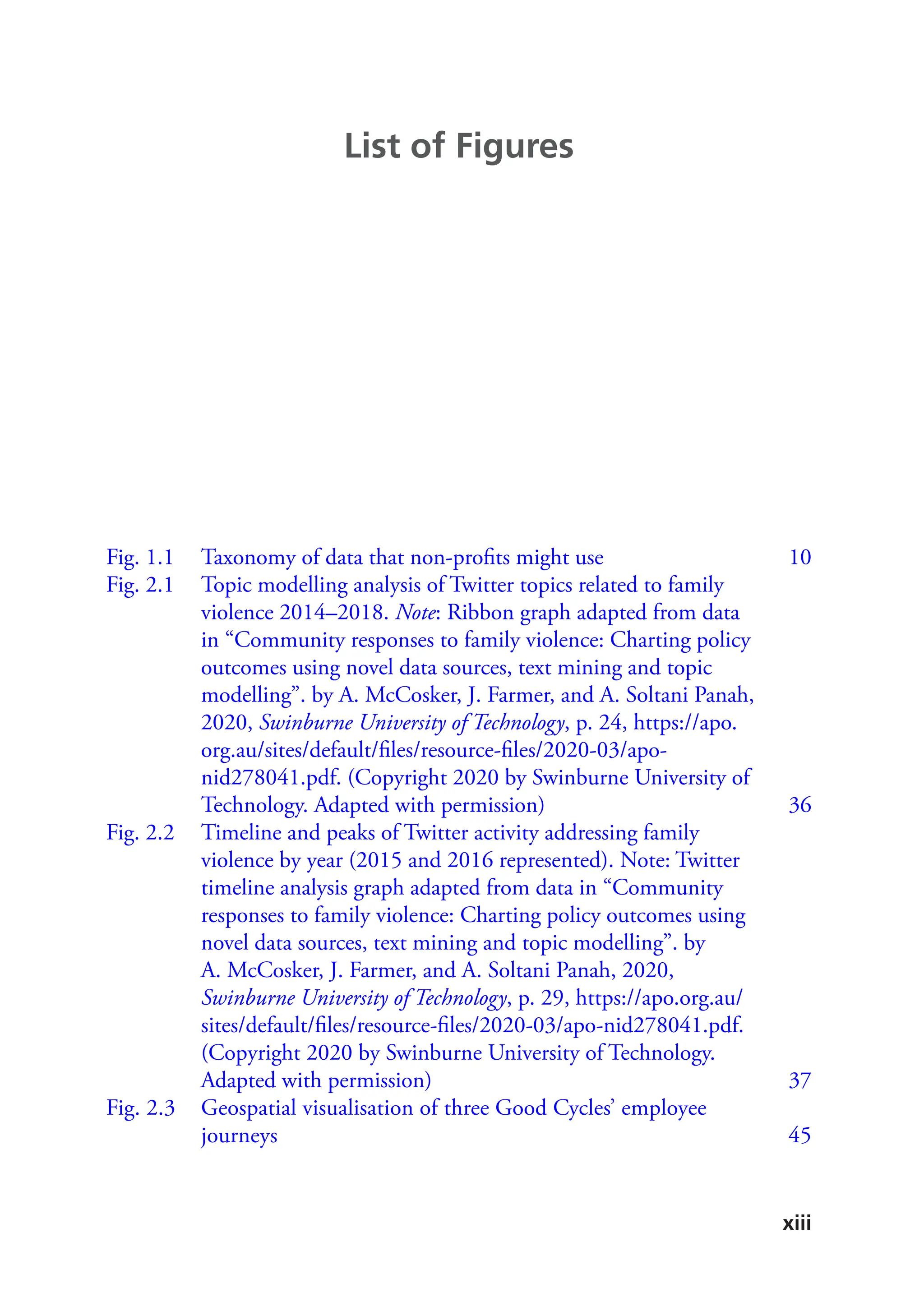
Fig. 1.1 Taxonomyof data that non-profits might use 10
Fig. 2.1 Topic modelling analysis of Twitter topics related to family
violence 2014–2018. Note: Ribbon graph adapted from data
in “Community responses to family violence: Charting policy
outcomes using novel data sources, text mining and topic
modelling”. by A. McCosker, J. Farmer, and A. Soltani Panah,
2020, Swinburne University of Technology, p. 24, https://apo.
org.au/sites/default/files/resource-files/2020-03/apo-
nid278041.pdf. (Copyright 2020 by Swinburne University of
Technology. Adapted with permission) 36
Fig. 2.2 Timeline and peaks of Twitter activity addressing family
violence by year (2015 and 2016 represented). Note: Twitter
timeline analysis graph adapted from data in “Community
responses to family violence: Charting policy outcomes using
novel data sources, text mining and topic modelling”. by
A. McCosker, J. Farmer, and A. Soltani Panah, 2020,
Swinburne University of Technology, p. 29, https://apo.org.au/
sites/default/files/resource-files/2020-03/apo-nid278041.pdf.
(Copyright 2020 by Swinburne University of Technology.
Adapted with permission) 37
Fig. 2.3 Geospatial visualisation of three Good Cycles’ employee
journeys45
List of Figures
16.
xiv List ofFigures
Fig. 2.4 City of Greater Bendigo Community resilience dashboard
layers by suburb 54
Fig. 3.1 Process of collaborative data action for non-profits’ data projects 69
Fig. A.1 Initiatives and goals of the non-profits’ data innovation
ecosystem114
17.
xv
Table 2.1 Summarydata projects case comparison 30
Table 2.2 Data sources for public discussion of family violence 32
Table 2.3 Datasets used in the three non-profits’ analyses 41
Table 2.4 Datasets for community resilience data collaborative 51
Table 3.1 Steps in the process of collaborative data action for non-
profits’ data projects 71
Table A.1 Tools and guides from existing initiatives 119
List of Tables
While these andother thoughts were passing through her mind, the
bell rang twice, and then the curtain rose.
Helen nearly uttered an exclamation of surprise, so unprepared was
she for the spectacle which was presented to her dazzled gaze. The
play was a fairy extravaganza, which depended for its success chiefly
upon scenery and stage effect. In the first scene was represented
the palace of the Queen of the fairies, crowning the summit of a hill,
rising in the centre of a beautiful island. Above floated fleecy clouds,
from a break in which streamed the sunshine, lending its glory to the
scene.
In the foreground stood a circle of children about Helen’s age or
younger, who figured as sylphs. With united voices they sang a song
in honor of the Queen of the fairies, who directly afterwards was
seen floating through the air above the stage, arrayed in such style
as seemed befitting her illustrious rank.
So complete was the illusion to Helen, that she gazed with
suspended breath and a feeling, half of awe, as if the scene she
looked upon was really one of enchantment.
“Is she really a fairy?” she asked of Martha’s cousin.
“No, child, of course not. It’s Henrietta Blake. I’ve seen her in the
street many a time. Once I was introduced to her.”
“What a beautiful creature she must be!” said Helen, admiringly.
“Beautiful!” repeated the cousin, with some disdain. “For my part, I
don’t think she’s anything to boast of in that line. Just notice what a
poor complexion she has. You’d see it if it wasn’t for the paint. You
wouldn’t have thought her very fairy-like if you had seen her in at
Taylor’s the other evening, eating oysters.”
Helen could scarcely believe her ears. It seemed to be almost like
sacrilege to associate such a gross idea with the etherial being that
floated before her in all the majestic beauty of a fairy queen. It took
from the scene before her something of the charm with which her
fancy had invested it. Still it was with a feeling of intense enjoyment
21.
that she followedthe play to its conclusion, watching scene after
scene pass before her, and the music was truly enchanting.
At length the play was finished, and the curtain dropped. This,
however, did not conclude the performance. After a short pause the
curtain rose once more, and a young girl came forward and sang the
well-known little Scotch song, “Comin’ thro’ the Rye.” It was sung
correctly and in good taste, but with no remarkable display of power.
Still it was vociferously encored, and, on its repetition, was
applauded warmly.
There was an afterpiece, but, as it was already late in the afternoon,
Martha and her cousin decided not to remain.
“Well, how did you like it?” asked the cousin, patronizingly.
“Oh, it was beautiful!” exclaimed Helen, enthusiastically. “I am so
much obliged to you for taking me.”
“They have better plays sometimes,” returned the cousin, with an air
of superior knowledge of the world. “I didn’t think much of the
acting to-day, for my part. I’ll take you again some time when
they’ve got something else.”
Even after she was fairly in the street, Helen found it difficult to
throw off the illusion of the stage. She could still see in imagination
the gorgeous spectacle, the splendid fairy palace, the graceful
sylphs, and the queen in her regal magnificence. She was so entirely
under the dominion of fancy that to her the outer world seemed
unreal, and that which she had seen, the real. She walked on,
heeding little, till she was suddenly roused from her reverie in a very
forcible manner, by coming in collision with some person. It proved
to be a very fat old lady, who was walking, or rather waddling,
slowly along the sidewalk, with her head thrown back. At the
unexpected collision, she screamed, and gasped for breath, eyeing
Helen, meanwhile, with no very amiable expression of countenance.
“You’ve just about beaten the breath out of my body, you young
trollop. Where was you brought up, I’d like to know, not to have any
better manners?”
22.
“I hope you’llexcuse me,” said Helen, humbly, somewhat ashamed
of her preoccupation. “I didn’t mean to run against you.”
“Don’t tell me,” said the irritated old lady. “You did it a purpose. I
know you did.”
“She might as well say you ran into her on purpose,” retorted
Martha’s cousin.
“I didn’t speak to you, ma’am,” said the exasperated old lady. “It’s
my belief that you’re all in league together, and I’ve a great mind to
have you given in charge of the police.”
“Indeed!” said the cousin, ironically.
“Come away,” said Martha, in a low voice. “Don’t let us have a scene
here.”
As quickly as possible they escaped from the irate old lady. She
stood panting for breath, and glaring at them over the rims of her
glasses, which had been accidentally misplaced. This encounter,
ludicrous as it was, served to bring Helen back from the ideal world
to the real, and without any further adventures she reached home.
It was already time to prepare their frugal meal. She found her
father as busily occupied as ever. She was glad of this, for it showed
that her presence had not been missed.
The next day Martha Grey was at work harder than ever. She felt
that she must make up by extra exertion for the unwonted
relaxation of the day before.
“What are you thinking of, Martha?” asked Helen, playfully, as she
stole in unperceived, and placed her hands over the eyes of the
seamstress. “Come, tell me before I take my hands away.”
“I was thinking,” said Martha, “that I should like to hear once more
the song that was sung at the theatre yesterday.”
“You enjoyed it, then?”
“Very much.”
23.
“Shall I singit to you?” asked Helen, quietly.
“You, Helen?” asked Martha, lifting up her eyes in astonishment.
“Can you sing? I never heard you.”
“I do not sing very often,” said Helen, sadly. “My mother taught me,
and whenever I sing it brings up thoughts of her.”
“I should like very much to hear you sing, Helen,” said Martha; “but
do not do it if it will make you sad.”
“Never mind, Martha. I will sing, if it will give you pleasure.”
Helen commenced the song, and sang it to the end in a voice of
remarkable richness and power. She was gifted with a voice of
extraordinary flexibility and compass, whose natural power had
evidently been improved by cultivation. Martha, who, though no
singer herself, was very fond of listening to music, and could judge
when it had merit, listened with unaffected astonishment and
delight. She felt that she had never heard a voice of equal
sweetness and power.
“You have a beautiful voice,” she said, when Helen had finished the
song. “You sang it much better than it was sung at the theatre
yesterday. Some day you may become a great singer.”
“Do you really think so?” asked Helen, her eyes sparkling with
delight. “I am very glad.”
Martha looked up in some surprise, not understanding why it was
that Helen felt so much pleased. But a new thought had come to the
child.
“Is there anything else you would like to hear?” she asked.
“I should like to hear ‘Home, Sweet Home.’”
It was a song which Helen had often sung, and to which she could
do full justice. It was not difficult to account for the feeling which led
Martha Grey to make choice of this song. She was one of a large
family, who had never known sorrow or separation till the death of
24.
her parents, followingeach other in quick succession, turned them
all adrift upon the world.
As the song proceeded, Martha called up in fancy the humble farm-
house among the New Hampshire hills, with its comfortable barn
and well-tilled acres around it. She recalled the broad, low kitchen,
with its large fireplace and blazing back-log, around which the family
was wont to gather in the cheerful winter evenings. She recalled her
little sister Ruth, who was about the age of Helen when their home
was broken up, but whom she had not seen since, Ruth having been
placed in the family of an uncle. She recalled her happy school-days,
her school companions, and, above all, her father and mother, who
had never been otherwise than kind to her, and then looked about
the small and desolate room which she now called home. She could
not help contrasting her present lonely position with what it had
been when she was at home in the midst of her family, and as the
last strain died away upon Helen’s lips, she burst into tears.
Helen looked up in surprise at this unwonted display of emotion on
the part of one, usually so quiet and composed as Martha Grey.
“Don’t mind me, Helen,” said Martha, through her tears. “It came
over me, and I couldn’t help it. Some time, perhaps, I will tell you
why it is that that song always makes me shed tears.”
25.
CHAPTER VIII.
SUNDAY ANDTRINITY CHURCH.
It was Sunday morning. To thousands of frames, wearied by
exhausting labors, it brought the benediction of rest. To thousands
of throbbing brains it brought grateful relaxation. The great business
thoroughfares wear a Sunday look. The shops are closed, and no
longer hold out, through showily-arranged windows, invitations to
enter. The bells in a hundred steeples ring out in many voices the
summons to worship.
Helen tapped gently at Martha’s door.
“Where do you attend church?” she inquired.
“I was just going to call for you, Helen,” said the seamstress, “to ask
if you and your father wouldn’t like to attend Trinity Church with
me.”
Helen hesitated a little.
“That is the great church at the lower end of Broadway, isn’t it?” she
inquired.
“Yes.”
“I thought it might be a fashionable church. Father and I have been
to one or two of the great churches, where the sexton didn’t seem
to care about giving us seats, but finally put us away back where we
found it difficult to hear the service.”
“I have had the same experience more than once,” said Martha; “but
we shall have no such trouble at Trinity. Though one of the finest
26.
churches in thecity, it is free to all, and the poor are as welcome as
the rich.”
“Then I shall be glad to go, and so will papa. Wait a moment, and I
will tell him.”
They were soon in the street, mingling with the well-dressed crowds,
wending their way to their respective houses of worship.
“Sunday was always pleasant to me,” said Martha, “even as a child. I
remember the plain old meeting-house, where we all sat in square,
high-backed pews, listening to the good old minister who is gone
now to his rest and his reward. There have been great changes since
then,” and she sighed sadly.
A short walk brought them to the church portals. They were early,
and obtained excellent seats. The organist was already playing.
Helen’s face lit with pleasure, for she had never before heard so fine
an instrument or so skilful a player. Exquisitely fitted by nature for
receiving musical impressions, she felt her soul uplifted by the
grandeur of the music, and her heart penetrated by its sweetness.
Now there was a thunderous clang, as if the organist were seeking
to evoke from the instrument a fitting tribute to the majesty and
power of the Creator. It seemed as if hosts of angels were clashing
their cymbals, and singing God’s high praise. Now a delicate rill of
silver-voiced melody trickled forth, clear and sweet, interpreting the
unfathomable love wherewith God loves his children, even the
lowliest.
Helen listened as one entranced, and when the last strain died away,
and the organ was still, she turned towards Martha, and whispered,
for she could not keep silence, “It lifts me up. It almost seems as if I
were in heaven.”
Unconsciously Helen expressed the same feeling which Milton has
embodied in fitting lines,—
27.
“But let mydue feet never fail
To walk the studious cloisters pale,
And love the high embowered roof
With antique pillars massy proof,
And storied windows richly dight
Casting a dim religious light;
There let the pealing organ blow
To the full-voiced choir below
In service high and anthem clear,
As may with sweetness through mine ear
Dissolve me into ecstasies
And bring all heaven before mine eyes.”
It is a mistake to suppose that the plainest and cheapest churches
are good enough for the poor. Europe is far more democratic in
matters of religion than America. In the great continental cathedrals
I have more than once felt inexpressibly touched to behold at my
side some child of poverty and misfortune bending a reverent gaze
upon some imaged saint. I have pictured to myself his probable
home in some filthy court or dingy alley, with the light of heaven
shut out, dark, forbidding and noisome, and rejoiced to think that it
was his privilege to pass from such a scene into the splendors that
fitly adorn the house of God. It is something to shed a ray of
sunlight upon the life of a poor man—to gratify his taste, mortified
by the gloomy surroundings of his daily life, to nourish the little
flower of sentiment struggling out of the rubbish that has well-nigh
choked out his æsthetic nature, and help him to feel that life has a
beautiful side, from which he is not utterly shut out.
So Helen and the poor seamstress, confined through the week in
poor and unattractive chambers, felt a quiet satisfaction in the grand
architectural proportions and solemn beauty of the great church in
which they felt themselves welcome guests. They derived new
strength for the plain and humble duties of every day in the thought
that one day in seven they could escape into a loftier atmosphere,
and feel God’s presence nearer.
Occasionally, as the service proceeded, Helen stole a glance at her
father, who sat beside her. His face wore a look of calm enjoyment
28.
and intelligent appreciation.
Ashe sat with his clasped hands resting on his knees, and his eyes
fixed upon the preacher, the vanished years returned, and beside
him there sat once more the fair young bride, whose pure and
saintly image lived a hallowed remembrance in the heart of father
and daughter alike.
When the service closed, he did not change his position, till Helen,
touching him gently, said, “It is time to go, papa.”
“We will come again next Sunday, Helen,” he said.
“Yes, papa.”
They walked back slowly and thoughtfully to their humble homes,
speaking little, but each more happy and peaceful for the hour
passed in the great church whose lofty spire seemed ever pointing
upwards to that God in whose service it was reared.
29.
CHAPTER IX.
THE LAWYER’SPROGRESS.
The day after his meeting with Helen and her father, the worthy
attorney, Mr. Sharp, took his way leisurely to the boarding-house of
Mrs. Morton. Although the object of his visit was clearly defined to
his own mind, he scarcely knew in what manner he might best attain
it. But Mr. Sharp was not a man to be abashed or daunted by small
difficulties. Trusting, therefore, to what chance and the inspiration of
the moment might suggest, he mounted the steps and rang the bell.
“Mrs. Morton, I presume,” he remarked, with great affability, as that
lady opened the door in person.
“You are quite right, sir.”
“I believe,” he remarked with suavity, “that I am correct in the
supposition that you take boarders.”
“I wonder what he’s aiming at,” thought Mother Morton, glancing
with something of suspicion at the white hat set jauntily on one side
of his head. “I hope he won’t apply for board. I am always
suspicious of those who are so smooth-tongued.”
“Yes, sir,” she said aloud, “I do take boarders, but I am full now.”
“Indeed!” said Mr. Sharp, with a benignant smile, “I am delighted to
hear of your prosperity. I was not, however, thinking of making an
application for board in my own behalf, though I should undoubtedly
esteem it a high privilege to be an inmate of a boarding-house which
I am confident is so admirably conducted. Will you have the
30.
goodness to tellme whether you have a boarder or lodger named
Dupont?”
It is scarcely necessary to explain that this inquiry was employed by
Mr. Sharp as a plausible method of accounting for his calling, and to
pave the way for something else. He had no particular choice in the
name, but thought Dupont would be as uncommon as any.
“Yes,” was the unexpected reply of Mrs. Morton, “we have a lodger
of that name. I believe he is in. Will you step in and see him, sir?”
Unprepared for this answer, Mr. Sharp was for the moment
undecided how to act. Being sufficiently quick-witted, however, he
soon devised a way to extricate himself from his embarrassment.
“Poor man!” said he with a gentle sigh; “he’s much to be pitied.”
“Pitied!” echoed the landlady, opening wide her eyes in
astonishment. “Why?”
“To a sensitive mind,” continued Mr. Sharp, in a tone of mild pathos,
“bodily deformity must be a great drawback to one’s comfort and
happiness.”
“Deformity!” repeated the landlady in increased surprise.
“Yes, Mr. Dupont is a humpback, is he not?”
“A humpback!” returned Mrs. Morton, in a tone of some asperity.
“You are quite mistaken, sir; I have no humpback among my
boarders.”
“Then it cannot be the man I mean,” said the lawyer, rejoiced to
have got out of the scrape so cleverly. “I beg ten thousand pardons
for having put you to so much trouble.”
“No trouble, sir,” was the civil reply.
Mrs. Morton held the door, wondering why the visitor still remained,
now that his errand was accomplished. The lawyer’s purpose,
however, still remained to be effected. He was even now cudgelling
his brains to devise a method of reaching it.
31.
“A moment more,”he said, with suavity. “I think, as I passed last
evening, that I saw a little girl enter with an elderly gentleman.”
“Helen Ford?”
“Oh, yes. She boards with you, does she not?”
“Helen and her father have a room up stairs. They board
themselves. I only lodge them.”
“Pardon my curiosity, but I have an object in view. What is her
father’s occupation?”
“He is busy about some invention, and has been ever since he came
here. A flying machine, I believe.”
“Ah, yes,” said the lawyer, to whom this was all new. “It is as I
supposed. Can I see them? I picked up a small purse,” he added, by
way of explanation, “just after they passed me in the street, and I
thought it not unlikely that the young lady might have dropped it.”
“Certainly,” said the landlady, somewhat more favorably disposed to
Mr. Sharp, in consequence of this evidence of his integrity. “Their
room is on the fourth floor, at the head of the stairs. Perhaps I had
better go up and show you.”
“Oh, by no means, madam, by no means,” said the lawyer, politely.
“I know the value of your time, and would on no account subject
you to so much unnecessary trouble. I shall easily find it from your
directions.”
Helen was looking out of the window, and her father was busied as
usual, when a low tap was heard at the door.
Supposing it was Martha, who, in fact, with the exception of the
landlady, was her only visitor, she cried, “Come in,” and then
creeping softly to the door, jumped out playfully upon the one who
entered. Her dismay may readily be conceived when, instead of the
quiet seamstress, she found that she had narrowly escaped jumping
into the arms of a tall man with a white hat.
32.
“I am verysorry,—I did not know,—I thought it was Martha,” she
faltered, in great confusion, her cheeks dyed with blushes.
“Don’t apologize, I beg of you,” said the stranger, courteously. “It is
I, on the contrary, who should apologize for intruding upon you,
and,” he added, glancing to the corner of the room, “upon your
respected parent. I am not mistaken,” he added, inquiringly, “in
supposing him to be your father?”
“No, sir,” said Helen, who, without understanding why, felt a little ill
at ease from the elaborate politeness of her visitor.
“But I have not yet disclosed the motive of my visit. I chanced to be
walking behind you and your father yesterday in the afternoon. You
walked out at that time?”
“Yes, sir.”
“I thought I could not be mistaken. There are some countenances,
my dear young lady, that we are not likely to forget.”
Helen, unused as she was to flattery, did not understand that this
was meant for a compliment. Therefore it quite failed of its effect.
Perhaps this was quite as well, since, if understood, it would have
confused rather than pleased her. She was too deficient in vanity to
have felt flattered by a compliment from a stranger. Yet no one was
more desirous of winning the approval of those whose friendship she
valued. Helen was, in short, a truthful, unsophisticated child,
perfectly transparent and straightforward, and imagined that others
were equally so. So she only waited patiently for Mr. Sharp to
announce the object of his call.
“Afterwards I discovered this purse on the sidewalk,” continued the
lawyer, displaying his own purse. “As you and your father had just
passed, I conjectured that one or the other of you must have
dropped it. I have, accordingly, called this morning to ascertain if I
am correct in my supposition, and if so, to return the purse.”
“No,” said Helen, shaking her head. “It cannot be ours.”
33.
“Then I mustseek farther for the owner. I beg you will pardon me
for this intrusion.”
Helen said, rather awkwardly, that it was of no consequence.
“May I inquire,” said Mr. Sharp, as if the idea suddenly struck him,
“whether your father is not an inventor? I think I was told so by the
very respectable lady down stairs.”
“Yes,” said Helen, more at her ease. “Papa has been busy a great
while about his invention. It requires a great deal of time and
patience.”
“Indeed! Would it be taking too great a liberty to inquire the nature
of the proposed invention?”
“It is a flying machine,” said Helen. “Some people laugh at it,” she
added, a little hurriedly. “It seems strange to them because they
have never thought much about it.”
“Let them laugh,” said Mr. Sharp, with warmth. “Let them laugh, my
dear young lady,” he repeated in a tone of profound sympathy. “It is
the way of the world. There has never been any great discovery or
invention, from the earliest ages to the present time, that has not
encountered ridicule. Wait till success crowns your father’s exertions,
and then you will see how all will be changed.”
“So papa thinks,” said Helen, quite grateful to the lawyer for his
words of encouragement; “and it is that which makes him labor so
patiently.”
“Undoubtedly. Would it be too great a liberty to ask permission to
examine your father’s invention. It is a subject in which I feel a very
deep interest. Indeed, I may say that I am something of an inventor
myself.”
Poor confiding Helen! How could she imagine that these words of
sympathy covered an unblushing falsehood?
“Papa will be very glad to show it to you,” she said. Then to her
father: “Papa, this gentleman would like to examine your model.”
34.
“Certainly,” said Mr.Ford, courteously.
This was a subject on which, despite his taciturnity, he could talk
fluently. Mr. Sharp listened with an appearance of profound
attention, occasionally asking a question, and remarking modestly
that he had once entered upon a similar train of investigation, but
that the imperative claims of business had brought it to an abrupt
termination.
“I have not by any means,” he concluded, “lost my interest in
scientific matters; and it would afford me great pleasure if you will
permit me occasionally to look in upon you and note your progress. I
dare not hope that I could offer any suggestions likely to be of
service to one so far my superior in scientific attainments, but should
it be in my power to aid you in any way, you can count on me with
confidence.”
Mr. Ford felt flattered, as was but natural, by this evidence of
interest in his pursuits, and cordially invited Mr. Sharp to call
whenever he found it convenient.
“Well, Sharp,” said that gentleman, apostrophizing himself, as he
made his way down stairs, “you’ve done well, old fellow, though at
one time I trembled for you. You’ve flattered your way into the good
graces of that chimerical old fool, and now you are in a fair way to
accomplish something more, if needful.”
The next day found him closeted with Lewis Rand, from whom he
received instructions as to his future course.
35.
CHAPTER X.
NEW PROJECTS.
Helenhad been long and anxiously considering in what manner she
could employ herself so as to earn a sufficient amount to defray the
expenses of living. Every day the little stock of money remaining in
her purse became less. They lived very frugally, but there was the
rent, and two persons cannot live on air. So the little hoard
diminished, and five dollars were now all that remained to Helen.
Five dollars! it might keep them ten days, but certainly would not
last longer, economize as they might. From her father Helen could
hope for no present assistance. He was always at work, but his
labor, however well it might be compensated in the future, brought
in no money now. And for money there would soon be pressing
occasion. Helen grew very uneasy at the thought that they might be
turned penniless into the street. Hitherto they had never been
without money. The five dollars that remained was the last
instalment of a small property left her father by his mother.
One morning Helen sat at the table, leaning her head upon her
hand, plunged in anxious thought. At first she could think of no
possible resource. But when everything looks dark, and all paths
seem closed to us, suddenly from out the thick darkness there
sometimes streams a ray of hope to cheer and sustain the sinking
heart.
So it was in the present case.
In her humility, Helen had never dreamed that she possessed
extraordinary musical powers, and it was only through the warm
commendation of Martha Grey that this fact became known to her.
36.
Why should shenot employ these in her father’s service? At the
theatre a singer, but little older than herself, and as Martha declared
inferior in talent, had won the popular applause. Why should not she
gain employment in a similar capacity? Full of these thoughts, she
entered Martha’s room.
The seamstress sat at the open window. The cool breeze that found
its way in, lent a faint flush to her pale cheeks. In the cage over her
head a canary bird sang—Martha’s solitary extravagance. As she sat
alone from morning till night engaged in her monotonous task, the
bird supplied the place of human company, and beguiled a portion of
the weary time.
Helen came in and seated herself on a cricket at Martha’s feet.
Martha’s face brightened, for she had already learned to love the
child.
“I am glad to see you, Helen,” she said. “How is your father, to-day?”
“Papa is much as usual.”
“Hard at work as ever, I suppose.”
“Yes; he allows himself no time to rest. I really think he ought. But,
Martha, I am going to ask your advice about something very
important to me,” said the child, gravely.
“Thank you for your confidence, Helen. Whatever is of importance to
you will be of interest to me.”
“You remember telling me the other day that you liked my singing,
and that I might some day become a great singer. You know I told
you at the time how glad I was to hear you say so.”
“Yes, Helen; I remember it.”
“I did not tell you then why I felt glad; but I will now.”
Helen paused a moment, and then in a frank tone, which showed
how little she was affected by the conventional shame some feel in
disclosing their poverty, continued: “My father and I are very poor.
We have been so for some time, but I got a little money by sewing,
37.
and that helpedalong. Now, you know, business is dull, and I can
get no more work to do. The little money we have left will not last a
fortnight, though I am very economical. So you see, Martha, it is
quite necessary that I should find some way of earning more money
at once.”
“Does your father know how near you are to destitution?” inquired
the seamstress.
“No,” was the child’s reply; “and I hope he will not find out. I cannot
bear to trouble him with that, when he has so much to think of. It
can’t be very long before he finishes his model, and then we shall
have plenty of money. If I can only earn enough to keep us along till
that time I shall be very glad.”
“Poor child!” thought Martha, compassionately; “it will be long
enough before your father’s invention fills your purse.”
She was about to offer to procure Helen some work from the
establishment where she was employed, but when she looked at the
bright face of the young girl, and thought to what hours and days of
weariness it would consign her, how it would steal one by one the
roses from her cheeks, and the freshness from her heart, leaving her
with little to enjoy in the present and less to hope for in the future,
she had not the heart to offer her the destiny which she had been
compelled to accept for herself; nor could she bear to dim the child’s
trustful confidence in her father’s success by the expression of a
single doubt.
She remained silent.
Finding that Martha said nothing, Helen continued: “When I came to
see you the other day, Martha, I had been trying to think of some
way in which I could help poor papa, but I could think of nothing.
Then when I sang to you and you liked it, I thought it possible that
others might like it, too. Do you think,” she asked, lifting her eyes
with a look of earnest expectation; “do you think they would hire me
to sing at the theatre?”
38.
Martha started insurprise. As yet no thought of the child’s purpose
had entered her mind. To one so unobtrusive and retiring by natural
temperament, the thought of going forth at the head of an army
would have seemed scarcely more formidable that that of standing
before a public audience. Yet this was what Helen, so diffident
always, actually proposed to do.
“Can you really be in earnest, Helen?” she asked; gazing in
amazement at the child who cherished such bold aspirations.
She did not understand the power of the motive which influenced
Helen; how she made everything subordinate to the promptings of
filial affection, which was stronger than any other feeling of her
nature. That gave her courage to think of what she would otherwise
have shrunk from with nervous timidity. For her father she felt that
she could dare all. It was a strange position, that of a young girl at
her age, called upon to assume the oversight and care of providing
for her father’s comfort and necessities. Stranger still was it, that
with all the knowledge of her father’s dependence upon herself and
his utter ignorance of the world and its ways, she should yet have
retained so thorough a respect and reverence for him.
“Can you be in earnest?”
It was Helen’s turn to be surprised at the question.
“Why not?” she asked. “It is my duty to help poor papa, and if I can
do so in this way, why should I not?”
“That is true, Helen, but think of standing before so many hundreds,
or perhaps thousands of people, with every eye fixed upon you. How
could you bear that?”
“I should not think of it at all, Martha. When I am singing I can see
nothing and hear nothing. I seem to be mounting up—up into the
air, and floating among the clouds. I can’t tell you how much I enjoy
singing.”
As Helen spoke her eyes sparkled, and her face flushed with
enthusiasm. The exhibition of deep natural feeling is always
39.
impressive. Martha feltit to be so, and could not help admiring and
loving the child more than ever. Helen had almost persuaded her.
“But,” she continued with returning caution, “you may not always
feel so. There would be times when you would not feel like singing,
but sing only because you were obliged to. Then when you
encountered the glances of so many eyes, would not your heart sink
and your courage fail you?”
“Then, Martha,” said Helen, with simplicity, “I should think of poor
papa, and how by my exertions I was able to make him comfortable,
and how by and by, when he had succeeded, I should not be obliged
to do anything more. Then I should think how much he had done for
me, and how hard he is laboring even now. There would be a great
satisfaction in that. I ought not to hesitate when I have an
opportunity to do something for him, ought I, Martha?”
“You are a dear, good child,” said the seamstress, affectionately;
“and I will not say a single word more against your plan. But you
must not be too hopeful. You may meet with disappointment about
getting a situation.”
“You mean that perhaps I shall not sing well enough, Martha,” said
Helen. “But I shall do my best when I think how much my father’s
comfort depends upon my success; and that will be sure to help
me.”
“No, Helen; that was not what I meant. I never for a moment
doubted that you would sing well enough. Why, you sing like an
angel.”
“Did you ever hear an angel sing?” asked Helen, a little
mischievously.
“In my dreams,” said Martha, smiling. “But that was not the difficulty
I thought of. Would your father be willing to have you go on the
stage?”
“He would not be willing at first, so I think I shall not tell him till I
find out whether they are willing to employ me. Papa is so
40.
thoughtful of methat he would think I was attempting too much, or
suspect it was poverty that led me to it. It will be better not to tell
him at first.”
“Then there is another thing to be considered. Perhaps there will be
as many singers employed as are required. It is not always easy to
obtain an engagement, even where one is deserving. If you only had
some influential friends——”
“I have you,” said Helen, archly.
Martha smiled faintly.
“I am afraid if that is all you have to rely upon that it will be leaning
on a broken reed. However, we will hope for the best, and not
despond till we have reason to do so.”
So the two conversed till Helen heard a neighboring clock striking
five.
“Five o’clock!” she exclaimed. “I did not know it was so late. I must
go up and prepare supper.”
She tripped lightly up stairs with a new hope in her heart.
Unconscious of the cares which had fallen so early upon his
daughter, Mr. Ford was laboring at his machinery. Helen came and
stood by his side.
“Well, papa, what progress?” she asked, cheerfully.
“Very good, my child,” said the dreamer. “I have just succeeded in
obviating a difficulty which has perplexed me for some time.”
“How very glad I am, papa. That ought to give you a good appetite
for your supper. I shall have it ready in a few minutes.”
41.
CHAPTER XI.
THE ENGAGEMENT.
Thenext day Helen resolved to put her plan into execution. As soon
as her morning duties were completed, and her father seated at his
never-ending task, she dressed herself in the best manner her
limited wardrobe would admit. Though inexperienced in the ways of
the world, she felt instinctively the importance of making a favorable
first impression. When she was quite ready, she left the room softly,
and was soon mingling with the busy crowds that thronged
Broadway. At first she walked rapidly, but, as she drew nearer her
destination, and could see the imposing front of the theatre, her
heart beat quick and her step became slower.
When she actually reached the entrance, a feeling of diffidence
seized her, which she found it almost impossible to overcome. She
felt that she could not enter, at least just then, and walked slowly by.
After a while she walked back, but was withheld from entering again
by a feeling scarcely less strong. Again she walked past, and again
returned. This time she had schooled herself to the effort, and
approaching, with hesitation, the office where tickets were sold for
the evening’s entertainment, inquired, in a low voice, for the
manager.
“Who did you wish to see?” inquired the clerk, with some surprise
visible in his manner.
The request was repeated.
“The manager? Can’t say whether he’s in or not. You must go to the
back entrance and turn to the left. Then knock at the first door.”
42.
Helen looked bewildered.
“Haveyou been here before?”
“No, sir.”
“Stop a minute, and I will show you, then. I shall close the office
directly.”
Helen was very glad of the delay, as it gave her time to assume an
outward semblance of calmness.
Mr. Bowers, the manager, was seated in a small room connecting
with the stage. He was a man of comfortable proportions, and bore
the appearance of one whom the world had used not unkindly.
Though, in general, good-tempered, he was, on this particular
morning, “out of sorts.” A new play was to be brought out in the
evening. The actors had been allowed very little time to “get up”
their parts, and, as a natural consequence, the rehearsal of the
morning had been, thus far, a series of blunders. In addition to this,
the “star” had failed to make his appearance, and the prospect for a
successful evening did not look very bright.
Under these circumstances it was not altogether surprising that Mr.
Bowers should feel disappointed and irritated.
It was at this inauspicious moment that Helen was ushered into his
presence. The manager looked up with visible vexation, serving to
add to the embarrassment under which Helen was already laboring.
“Well?” he demanded, in a quick, impatient tone.
Helen felt that it would be a relief if the floor would open and
swallow her up, or if she could escape in some other way. The
interview, which had seemed comparatively easy in the quiet of her
own room, had now become very formidable. She began to wonder
at her own presumption in supposing herself capable of pleasing the
public with her simple songs, and to feel that Martha’s partiality
must have led astray her better judgment.
43.
While these thoughtswere passing through her mind, she sat silent,
quite unable to frame a sentence. The manager regarded her with
surprise, unable to account for her silence.
“What is your business with me?” he inquired, in a tone which
indicated that his time was of great consequence, and the sooner he
was left to himself the better he should be suited.
Helen understood the tone quite as readily as the words, and,
imperative as it was, it assisted in recalling her to herself. She came
to the point at once.
“Do you wish to engage any one to sing for you?”
She had said all that was necessary, and then she stopped, half-
frightened at her own temerity.
It was the manager’s turn to look surprised. He had not taken the
trouble to wonder what the child’s business was. He had only asked
as a necessary form, preparatory to dismissing her. He looked more
particularly at her now, noticing her childish form and air, and asked,
abruptly,—
“Are you inquiring for yourself?”
“Yes, sir.”
She looked up earnestly in his face. Her bonnet had partly fallen
back, revealing the rare loveliness of which she was unconscious.
She waited breathlessly for the answer.
“Our company is full,” said Mr. Bowers, coldly. He turned again to his
desk, and resumed his writing. His manner said, so plainly, “You may
go,” that Helen prepared to obey the unspoken but implied direction.
Her heart sank within her at this first disappointment. Thoughts of
the coming destitution, which she had hoped to ward off by this
means, crowded upon her, and she could scarcely keep back the
rebellious tears, which, had she been alone would have had free
course.
As she passed slowly out, a messenger hurriedly entered the office.
44.
“Well, what now?”asked the manager, somewhat testily. “Any more
blunders? It seems as if everything conspired against us. Has ——
made his appearance?”
“No, sir.”
“And won’t, I’ll be bound. These fellows claim the lion’s share of the
profits, and trouble themselves little about the convenience of their
employers.”
“Miss De Forrest is indisposed, sir, and will be unable to sing this
evening.”
“Indisposed! Unable to appear!” repeated the manager, angrily. “And
why the d—l must she take this particular evening to be sick? I don’t
believe a word of it. Go to her, and tell her we can’t spare her.”
“It is reported,” said the messenger, deprecatingly, for Mr. Bowers
was in one of those moods when it was difficult to make him listen
to reason; “it is reported that she has a fever, and will not be able to
appear for some time.”
“A fever! And what business has she to have a fever?” growled the
manager. “Well,” said he, after a brief pause, “is there nobody to
take her place?”
“I know of no one.”
Mr. Bowers mused a moment. “It won’t do,” he thought, “to omit the
songs altogether, especially to-night, when we are likely to have so
many other shortcomings. I have it, Jeffries,” he exclaimed. “Did you
notice the child who left the office as you entered?”
“Yes, sir.”
“Do you think you should know her again?”
“I think so.”
“Then follow her immediately, and bring her back with you. Say I
wish to see her.”
45.
When Helen leftthe theatre, she walked very slowly, as if to gain
time to become reconciled to her late disappointment. What a
revulsion of feeling had a single half-hour wrought in her! Her high
hopes had been dashed to the earth, and nothing was left but a
sense of humiliation and rebuked presumption. Had she but been
invited to sing, by way of testing her powers, that would have been
something; but to have been refused so coldly and peremptorily,
might well depress her.
Walking slowly, she had not proceeded far when she heard some
one calling after her, “You are to come back. Mr. Bowers wishes to
see you.”
Not supposing that she was intended, she did not turn till some one
touched her arm, and looking back she recognized the young man
who had entered the manager’s office as she left it.
“Did you just leave the theatre?” he inquired.
“Yes,” said Helen, with sudden hope.
“Mr. Bowers would like to see you again, then.”
Helen experienced another revulsion of feeling. The clouds seemed
breaking. The recall was evidently favorable to her prospects of an
engagement.
Five minutes found her once more in the manager’s presence.
“What is your name?” he asked, abruptly.
“Helen Ford.”
“Humph! that will do. Have you parents living?”
“Only a father.”
“And did he send you here?”
“No, sir,” said Helen.
“Does he know that you have come?”
46.
Welcome to ourwebsite – the perfect destination for book lovers and
knowledge seekers. We believe that every book holds a new world,
offering opportunities for learning, discovery, and personal growth.
That’s why we are dedicated to bringing you a diverse collection of
books, ranging from classic literature and specialized publications to
self-development guides and children's books.
More than just a book-buying platform, we strive to be a bridge
connecting you with timeless cultural and intellectual values. With an
elegant, user-friendly interface and a smart search system, you can
quickly find the books that best suit your interests. Additionally,
our special promotions and home delivery services help you save time
and fully enjoy the joy of reading.
Join us on a journey of knowledge exploration, passion nurturing, and
personal growth every day!
ebookbell.com