Data Fellows |
National Program
on AI
February 2023
Induction Deck for Data Fellows
Agenda
A. Background
B. DMUs and Data Fellows
C. Data Fellows: Roles & Responsibilities
D. Reporting Structure
E. Deployment
F. Learning & Development
Background
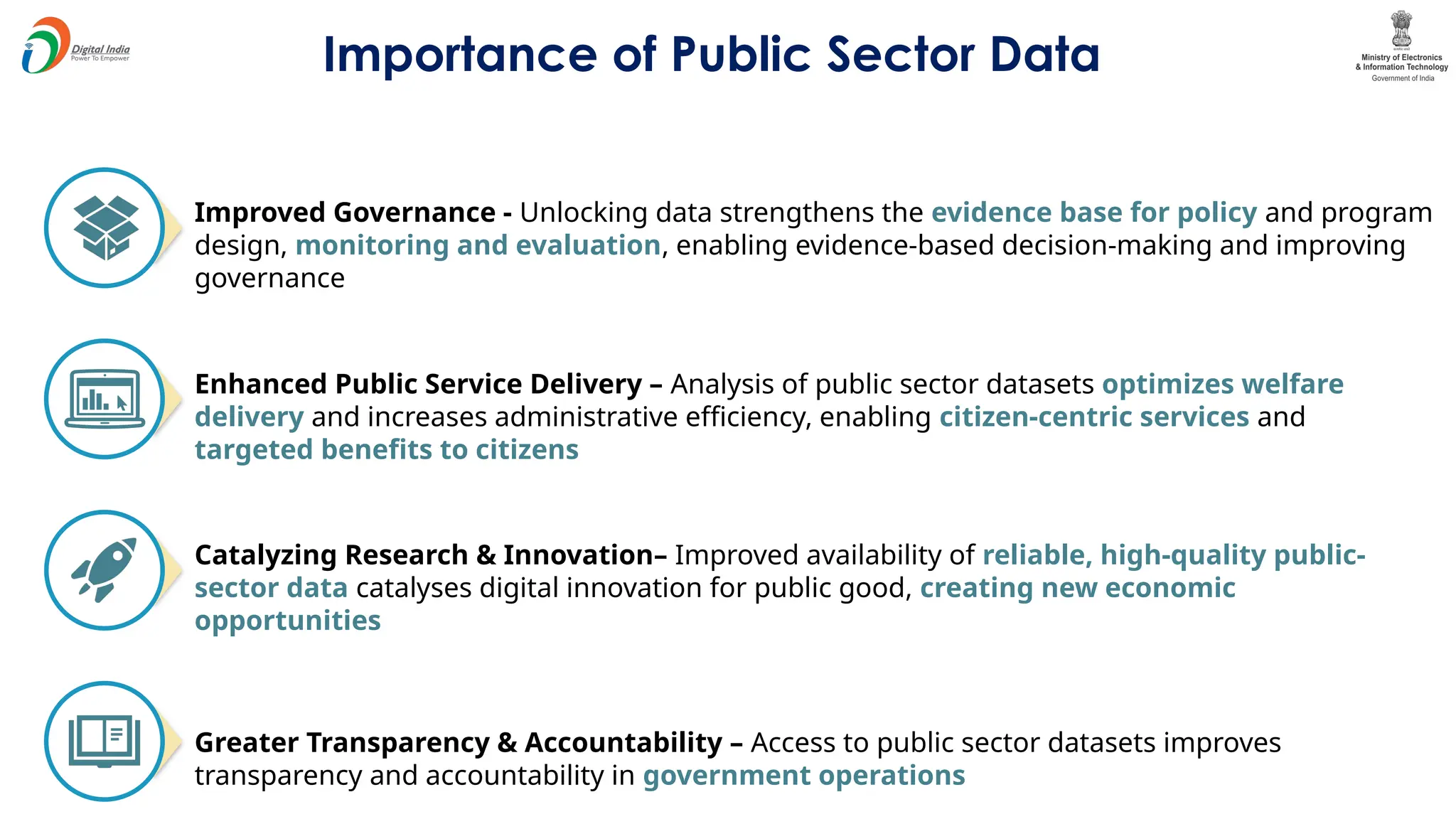
Importance of Public Sector Data
Improved Governance - Unlocking data strengthens the evidence base for policy and program
design, monitoring and evaluation, enabling evidence-based decision-making and improving
governance
Enhanced Public Service Delivery – Analysis of public sector datasets optimizes welfare
delivery and increases administrative efficiency, enabling citizen-centric services and
targeted benefits to citizens
Catalyzing Research & Innovation– Improved availability of reliable, high-quality public-
sector data catalyses digital innovation for public good, creating new economic
opportunities
Greater Transparency & Accountability – Access to public sector datasets improves
transparency and accountability in government operations
Current Challenges in Government Data
Governance
Inconsistency in
Data Management
Processes
Non-compliance to
Meta-Data Standards –
Poor data
interoperability
Inconsistency in Data
Quality – Blank Files,
Missing Fields, Errors,
etc.
Infrequent
Updating of
Datasets & Latency
Lack of API Based
Data Sharing
Variations in File
Format of
Datasets
Limited
Sharing of
Datasets
Limited
curation of
datasets for AI
Major Government Initiatives around Data
SPDI Rules
2011
Notification of
NDSAP Policy
2012
2012
(First Version)
May 2022 Aug 2023
Launch of OGD
Portal
National Data
Governance Framework
Policy
DPDP Act
Founded on the
principle of
Accountability (via
the RTI Act) and
covers:
• Proactive Data
Sharing
• Data Classification
• Interoperability
• Data Licensing &
Pricing
Platform for uploading
datasets under Open
Access
Rules covering
privacy and
security of
sensitive data
(for enterprises)
Comprehensive
Data Protection
Act focusing on
data privacy &
security
(applicable to
all)
Draft policy
focusing on
improving data
quality, access,
and use and
providing
institutional
framework
(National Data
Management
Office) for Data
Governance
Dec 2022
National Program
on AI
Comprehensive
program to
catalyze AI
innovation.
National Data
Management
Office pillar to
focus on Data for
AI
National Data Management Office
The National Data Management Office is a critical part of the National Program on AI and National Data
Governance Policy to improve data management, quality, access, and use
Key Mandate
Standardize Government Data Management Practices
through rules/standards/guidelines
Guidelines for Identification, Classification, and Access to
Datasets
Meta-data, data quality standards, and Anonymization tools
and guidelines
India Datasets Program & Platform for Transforming Non-
Personal Data Ecosystem (Govt. & Private Entities)
Dedicated Government Data Management Capacity Building
& Augmentation
Structure of NDMO
NDMO PMU
Dedicated support to lead
governance, capacity and
platform synergies
Data Management
Units (DMU)
Headed by CDO
2 Analysts + 1 Scientist
Across 50 ministries/depts
Ministry 1 Ministry 2 Ministry n
Data
Scientist
Data
Analyst
. . .
India Data Officer
IndiaAI CEO
DMUs and Data Fellows
Data Management Units
Recognizing the need to augment dedicated data management capacity at a ministry/department level,
Data Management Units (DMUs) will be set up in every government ministry/department as data offices
Assist ministry/department in the management
of data over its lifecycle
Ensure adoption of metadata and data quality
standards
Assist ministry/department in undertaking
assessment of current state of data quality &
maturity
Create secure APIs for sharing data on Data
Platforms
Develop and ensure compliance against SOPs for
data collection, management, storage, and access
Streamline & Process Inter-Government Data
Sharing
Curate & Publish Datasets for AI Innovation
Enhance Data Analysis and Use within
Ministry/Department
Data Capacity Building & Awareness for government
officials
Advise on industry trends and best practices in
data access and sharing
Key Functions
Data Management Units
Structure
Basic DMU Structure
Chief Technology
Officer
Secretary
Data
Management
Cyber Security Applications
Chief Data
Officer
Data Scientist
Data Analyst 1
Data Analyst 2
Mature DMU Structure
While depending on requirements and resource availability, each DMU’s structure and size may vary, the minimum
structure for the DMU must include 1 CDO, 2 Data Analysts, 1 Data Scientist and 1 IT support person
Data Fellows
Data Fellows: Roles & Responsibilities
Key Functions of Data Fellows (1/5)
Functions Data Analyst Data Scientist
Streamlining
Data
Management
● Maintain and ensure quality and accuracy of datasets
● Ensure data collection on all parameters for monitoring
and policy making within the ministry/department
● Document all data points within the
ministry/department and maintain detailed records of
data management decisions
● Ensure no duplication of data collection efforts
● Ensure compliance against defined SOPs/Data
Management processes/Decision-making frameworks
● Enable cross-platform integration by defining metadata
standards and designing data flows for schemes within
the ministry/department
● Assist ministry/department in undertaking an
assessment of their current state of data quality
maturity
● Assist in enhancing data management practices over its
lifecycle (collection, processing, storage, access, and use)
● Streamline and standardize data collection practices and
data enterprise architecture
● Ensure 100% digitization of collected data
● Establish SOPs and protocols for data management
● Lead and mentor Data Analysts
● Design and implement data capturing and data quality
assurance mechanisms
● Institutionalize the creation and curation of datasets from
the available data
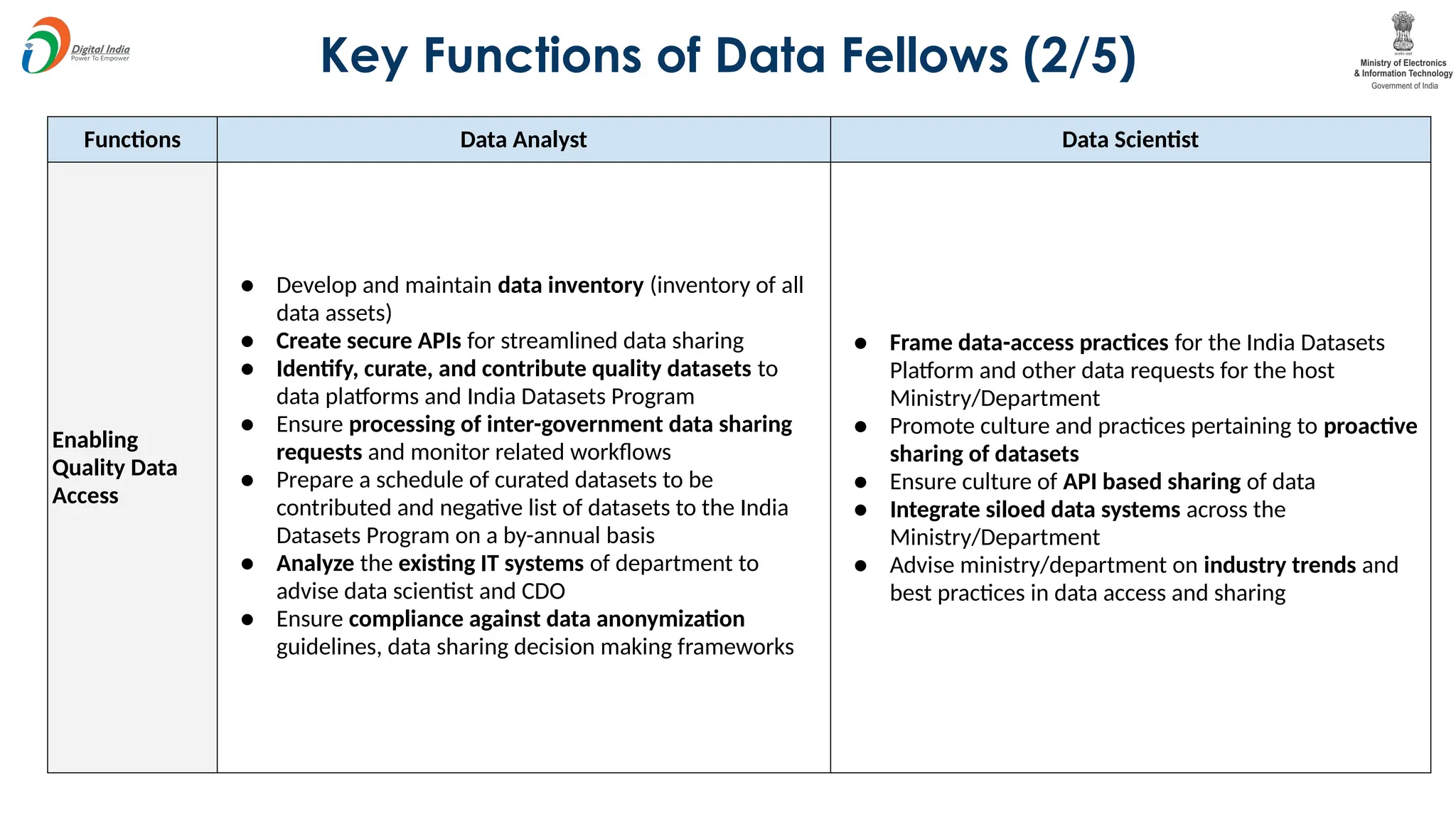
Key Functions of Data Fellows (2/5)
Functions Data Analyst Data Scientist
Enabling
Quality Data
Access
● Develop and maintain data inventory (inventory of all
data assets)
● Create secure APIs for streamlined data sharing
● Identify, curate, and contribute quality datasets to
data platforms and India Datasets Program
● Ensure processing of inter-government data sharing
requests and monitor related workflows
● Prepare a schedule of curated datasets to be
contributed and negative list of datasets to the India
Datasets Program on a by-annual basis
● Analyze the existing IT systems of department to
advise data scientist and CDO
● Ensure compliance against data anonymization
guidelines, data sharing decision making frameworks
● Frame data-access practices for the India Datasets
Platform and other data requests for the host
Ministry/Department
● Promote culture and practices pertaining to proactive
sharing of datasets
● Ensure culture of API based sharing of data
● Integrate siloed data systems across the
Ministry/Department
● Advise ministry/department on industry trends and
best practices in data access and sharing
Key Functions of Data Fellows (3/5)
Functions Data Analyst Data Scientist
Promoting
Data-Led
Governance
● Undertake and promote data analysis and creation of
data visualizations on collected data
● Provide hands-on training to government officials on
tools for data analysis and visualization
● Promote data analysis on collected data and drive a
culture of evidence-based policy making
● Build awareness around potential of data and its
use
● Enhance data management and analysis skills of
government officials
● Advise ministry/department on industry trends and
best practices in data management, analysis and
visualization
● Prepare monitoring frameworks and indicators to
ensure tracking of schemes, broader sectors, and
outcomes
Key Functions of Data Fellows (4/5)
Functions Data Analyst Data Scientist
Data Audits and
Quality
Assurance
● Ensure datasets are in line with the requirements as
specified by the NDMO
● Ensure adoption of metadata and data quality
standards as specified by the NDMO
● Ensure adoption of data storage, archival and deletion
SOPs in alignment with guidelines specified by the
NDMO
● Conduct spot data quality assessments, error checking,
and validation
● Perform statistical tests to determine the reliability and
soundness of insights generated
● Ensure compliance against data security and privacy
protocols as specified by MeitY, NDMO, or any other
government agency
● Ensure compliance against
Rules/Standards/Guidelines specified by the NDMO
● Ensure compliance with the timelines and processes
for the audits that are conducted by NDMO
● Ensure data integrity and quality by overseeing and
reviewing data cleaning and validations performed
by Data Analysts
Key Functions of Data Fellows (5/5)
Functions Data Analyst Data Scientist
Capacity
Building
● Provide insights and inputs on the DGQI action plan
developed by the host ministry/department
● Implement the defined training plan for officials on
data governance, analysis, access, and use
● Identify, on-board, and coordinate with training
partners
● Coordinate with vendors and execute trainings and
hands-on exposure on data analysis and management
tools, dashboarding tools
● Prepare a roadmap for the ministry/department
with specific milestones to enhance their data
preparedness
● Create an overall training strategy plan for the
ministry/department
● Develop and oversee M&E plans for all schemes
and projects
Reporting Structure
MeitY and IndiaAI: Key Structure
IndiaAI is an Independent Business Division under the Digital India Corporation (DIC) that will implement
the National Program on AI, including the National Data Management Office
ET Division
AS – Shri Akash Tripathi
GC – Smt. Kavita Bhatia
Divisions
Digital Governance
Division
Attached Offices
Statutory
Organisations
Section 8 Companies Autonomous Societies
Cyber Security
Cyber Laws
International Co-
operation
Data Governance
NIC
STQC
ICERT
UIDAI
NICSI
NIXI
DIC
BISAG-N
C-DAC
STPI
NIELIT
MeitY Key Structure*
* Key Structure – Does not include all divisions/attached offices/societies, etc.
NeGD IndiaAI MSH ISM
MyGov
IBD
NDMO
Reporting Structure
Illustrative DMU Structure
CEO IndiaAI
India Data Officer
Chief Technology
Officer
Secretary
Data
Management
Cyber Security Applications
Chief Data
Officer
Data Scientist
Data Analyst 1
Data Analyst 2
Data Fellows
Ministry
IndiaAI
The Data Scientists
will report to the
Ministry/Department
CDO as well as the
India Data
Officer/IndiaAI CEO
Deployment
Way Forward
Timelines / Approach Ministries for 1st Cohort
Hiring of Data Fellows
Orientation
Initial Training Week
Kick-Off Meeting with
Ministry/Department &
Deployment
Ministry of Rural Development
Ministry of Finance
Ministry of Health & Family
Welfare
Monitoring & Evaluation (1/2)
# Function KPI Description
Reporting
Frequency
1
Data Management, Audit, and
Assurance
No. of processes/SOPs defined and institutionalized for data management and access Bi-Annually
2 % of datasets compliant with metadata and data quality standards Quarterly
3 Data Completeness ratio Quarterly
4 Data Duplication rate Quarterly
5 Digitally collected/generated data as % of total data collected Quarterly
6 % of Data Tied to Legacy Systems Quarterly
7 Data validation coverage Quarterly
8 Data validation success rate Quarterly
9
No. of datasets tested for completeness, accuracy, and compliance with standards
issued by NDMO
Quarterly
10 No. of data systems and processes audited Quarterly
11 No. of statistical tests performed, insights and results thereof Quarterly
12 Change in DGQI rankings Quarterly
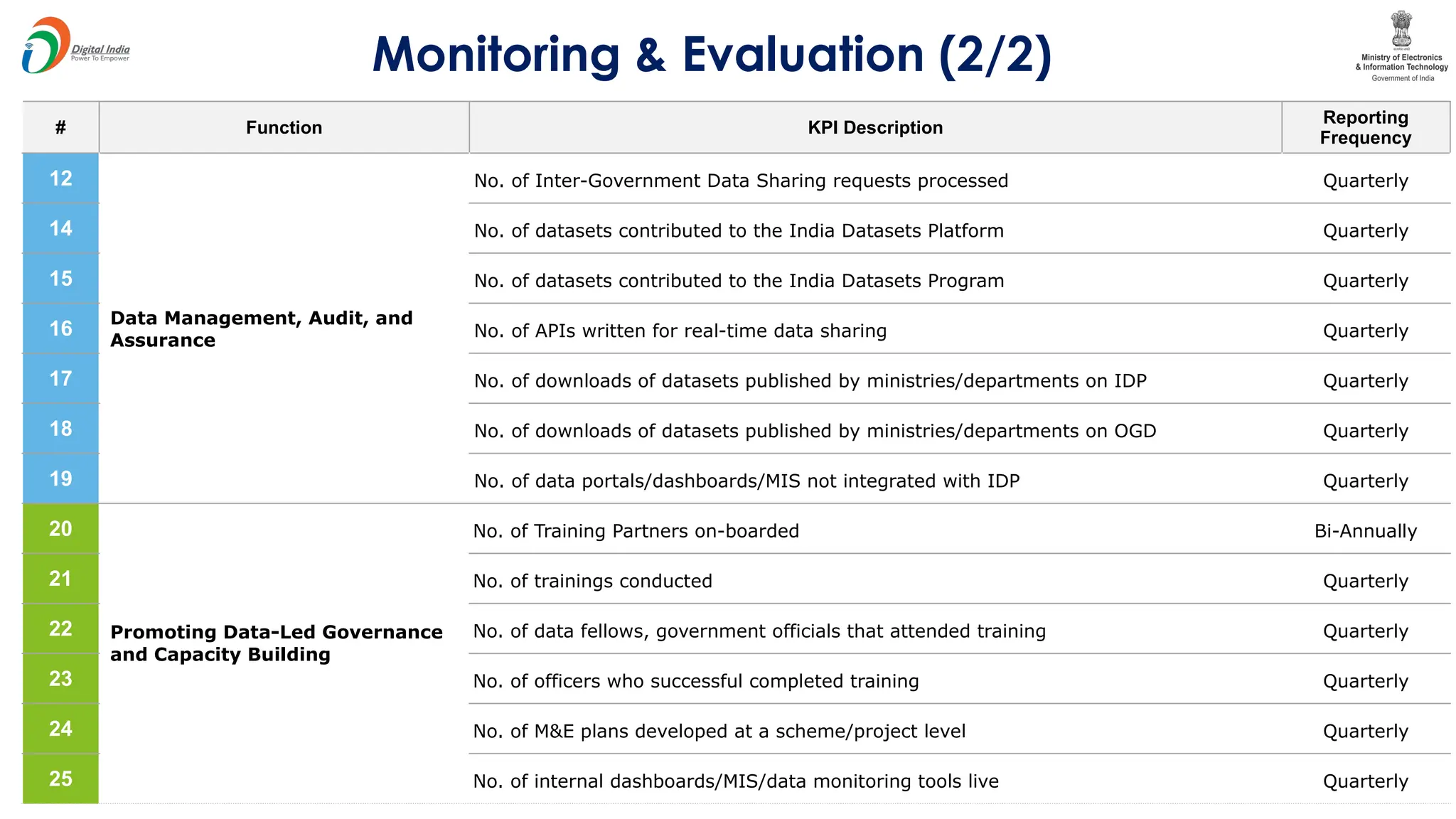
# Function KPI Description
Reporting
Frequency
12
Data Management, Audit, and
Assurance
No. of Inter-Government Data Sharing requests processed Quarterly
14 No. of datasets contributed to the India Datasets Platform Quarterly
15 No. of datasets contributed to the India Datasets Program Quarterly
16 No. of APIs written for real-time data sharing Quarterly
17 No. of downloads of datasets published by ministries/departments on IDP Quarterly
18 No. of downloads of datasets published by ministries/departments on OGD Quarterly
19 No. of data portals/dashboards/MIS not integrated with IDP Quarterly
20
Promoting Data-Led Governance
and Capacity Building
No. of Training Partners on-boarded Bi-Annually
21 No. of trainings conducted Quarterly
22 No. of data fellows, government officials that attended training Quarterly
23 No. of officers who successful completed training Quarterly
24 No. of M&E plans developed at a scheme/project level Quarterly
25 No. of internal dashboards/MIS/data monitoring tools live Quarterly
Monitoring & Evaluation (2/2)
Learning & Development
Key Competencies
Data Analytics
Data Visualization & Dashboarding
Communications and Market Engagement
Data Licenses
Promoting
Data Use
NDSAP DPDP Bill NDGP IT Act Sectoral Policies
Policies
Data Formats
Metadata Standards
Data Security and Privacy
Tools/Protocols
Data Quality & Assurance
Standards
API Development
Publishing Acceptance
Criteria
Cloud & Storage
Data Libraries & Tools
Preparing
Data
Data Structures &
Sources
Data
Cleaning/Curation
Entity Level
Roadmaps
Data Classification Data Prioritization
Governance Roles &
Responsibilities
Data Inventory &
Cataloguing
Data Identification
Access Mechanisms
Data Ingestion (Data
Platforms)
Governance
Strategy &
Processes
MeitY will be undertaking continuous learning and development efforts across the below competencies for
the Data Fellows
Suggested Readings
National Data Sharing &
Accessibility Policy
(NDSAP)
NDSAP
Implementation
Guidelines
Open Government
Data License
Draft National Data
Governance Policy
Digital Personal
Data Act
SPDI Rules (IT Act)
Draft Health Data
Management Policy*
DGQI
Methodology
*
* Only applicable for fellows deployed in MoHFW
Thank You

Data Fellows_Induction DeckAI national mission

  • 1.
    Data Fellows | NationalProgram on AI February 2023 Induction Deck for Data Fellows
  • 2.
    Agenda A. Background B. DMUsand Data Fellows C. Data Fellows: Roles & Responsibilities D. Reporting Structure E. Deployment F. Learning & Development
  • 3.
  • 4.
    Importance of PublicSector Data Improved Governance - Unlocking data strengthens the evidence base for policy and program design, monitoring and evaluation, enabling evidence-based decision-making and improving governance Enhanced Public Service Delivery – Analysis of public sector datasets optimizes welfare delivery and increases administrative efficiency, enabling citizen-centric services and targeted benefits to citizens Catalyzing Research & Innovation– Improved availability of reliable, high-quality public- sector data catalyses digital innovation for public good, creating new economic opportunities Greater Transparency & Accountability – Access to public sector datasets improves transparency and accountability in government operations
  • 5.
    Current Challenges inGovernment Data Governance Inconsistency in Data Management Processes Non-compliance to Meta-Data Standards – Poor data interoperability Inconsistency in Data Quality – Blank Files, Missing Fields, Errors, etc. Infrequent Updating of Datasets & Latency Lack of API Based Data Sharing Variations in File Format of Datasets Limited Sharing of Datasets Limited curation of datasets for AI
  • 6.
    Major Government Initiativesaround Data SPDI Rules 2011 Notification of NDSAP Policy 2012 2012 (First Version) May 2022 Aug 2023 Launch of OGD Portal National Data Governance Framework Policy DPDP Act Founded on the principle of Accountability (via the RTI Act) and covers: • Proactive Data Sharing • Data Classification • Interoperability • Data Licensing & Pricing Platform for uploading datasets under Open Access Rules covering privacy and security of sensitive data (for enterprises) Comprehensive Data Protection Act focusing on data privacy & security (applicable to all) Draft policy focusing on improving data quality, access, and use and providing institutional framework (National Data Management Office) for Data Governance Dec 2022 National Program on AI Comprehensive program to catalyze AI innovation. National Data Management Office pillar to focus on Data for AI
  • 7.
    National Data ManagementOffice The National Data Management Office is a critical part of the National Program on AI and National Data Governance Policy to improve data management, quality, access, and use Key Mandate Standardize Government Data Management Practices through rules/standards/guidelines Guidelines for Identification, Classification, and Access to Datasets Meta-data, data quality standards, and Anonymization tools and guidelines India Datasets Program & Platform for Transforming Non- Personal Data Ecosystem (Govt. & Private Entities) Dedicated Government Data Management Capacity Building & Augmentation Structure of NDMO NDMO PMU Dedicated support to lead governance, capacity and platform synergies Data Management Units (DMU) Headed by CDO 2 Analysts + 1 Scientist Across 50 ministries/depts Ministry 1 Ministry 2 Ministry n Data Scientist Data Analyst . . . India Data Officer IndiaAI CEO
  • 8.
  • 9.
    Data Management Units Recognizingthe need to augment dedicated data management capacity at a ministry/department level, Data Management Units (DMUs) will be set up in every government ministry/department as data offices Assist ministry/department in the management of data over its lifecycle Ensure adoption of metadata and data quality standards Assist ministry/department in undertaking assessment of current state of data quality & maturity Create secure APIs for sharing data on Data Platforms Develop and ensure compliance against SOPs for data collection, management, storage, and access Streamline & Process Inter-Government Data Sharing Curate & Publish Datasets for AI Innovation Enhance Data Analysis and Use within Ministry/Department Data Capacity Building & Awareness for government officials Advise on industry trends and best practices in data access and sharing Key Functions
  • 10.
    Data Management Units Structure BasicDMU Structure Chief Technology Officer Secretary Data Management Cyber Security Applications Chief Data Officer Data Scientist Data Analyst 1 Data Analyst 2 Mature DMU Structure While depending on requirements and resource availability, each DMU’s structure and size may vary, the minimum structure for the DMU must include 1 CDO, 2 Data Analysts, 1 Data Scientist and 1 IT support person Data Fellows
  • 11.
    Data Fellows: Roles& Responsibilities
  • 12.
    Key Functions ofData Fellows (1/5) Functions Data Analyst Data Scientist Streamlining Data Management ● Maintain and ensure quality and accuracy of datasets ● Ensure data collection on all parameters for monitoring and policy making within the ministry/department ● Document all data points within the ministry/department and maintain detailed records of data management decisions ● Ensure no duplication of data collection efforts ● Ensure compliance against defined SOPs/Data Management processes/Decision-making frameworks ● Enable cross-platform integration by defining metadata standards and designing data flows for schemes within the ministry/department ● Assist ministry/department in undertaking an assessment of their current state of data quality maturity ● Assist in enhancing data management practices over its lifecycle (collection, processing, storage, access, and use) ● Streamline and standardize data collection practices and data enterprise architecture ● Ensure 100% digitization of collected data ● Establish SOPs and protocols for data management ● Lead and mentor Data Analysts ● Design and implement data capturing and data quality assurance mechanisms ● Institutionalize the creation and curation of datasets from the available data
  • 13.
    Key Functions ofData Fellows (2/5) Functions Data Analyst Data Scientist Enabling Quality Data Access ● Develop and maintain data inventory (inventory of all data assets) ● Create secure APIs for streamlined data sharing ● Identify, curate, and contribute quality datasets to data platforms and India Datasets Program ● Ensure processing of inter-government data sharing requests and monitor related workflows ● Prepare a schedule of curated datasets to be contributed and negative list of datasets to the India Datasets Program on a by-annual basis ● Analyze the existing IT systems of department to advise data scientist and CDO ● Ensure compliance against data anonymization guidelines, data sharing decision making frameworks ● Frame data-access practices for the India Datasets Platform and other data requests for the host Ministry/Department ● Promote culture and practices pertaining to proactive sharing of datasets ● Ensure culture of API based sharing of data ● Integrate siloed data systems across the Ministry/Department ● Advise ministry/department on industry trends and best practices in data access and sharing
  • 14.
    Key Functions ofData Fellows (3/5) Functions Data Analyst Data Scientist Promoting Data-Led Governance ● Undertake and promote data analysis and creation of data visualizations on collected data ● Provide hands-on training to government officials on tools for data analysis and visualization ● Promote data analysis on collected data and drive a culture of evidence-based policy making ● Build awareness around potential of data and its use ● Enhance data management and analysis skills of government officials ● Advise ministry/department on industry trends and best practices in data management, analysis and visualization ● Prepare monitoring frameworks and indicators to ensure tracking of schemes, broader sectors, and outcomes
  • 15.
    Key Functions ofData Fellows (4/5) Functions Data Analyst Data Scientist Data Audits and Quality Assurance ● Ensure datasets are in line with the requirements as specified by the NDMO ● Ensure adoption of metadata and data quality standards as specified by the NDMO ● Ensure adoption of data storage, archival and deletion SOPs in alignment with guidelines specified by the NDMO ● Conduct spot data quality assessments, error checking, and validation ● Perform statistical tests to determine the reliability and soundness of insights generated ● Ensure compliance against data security and privacy protocols as specified by MeitY, NDMO, or any other government agency ● Ensure compliance against Rules/Standards/Guidelines specified by the NDMO ● Ensure compliance with the timelines and processes for the audits that are conducted by NDMO ● Ensure data integrity and quality by overseeing and reviewing data cleaning and validations performed by Data Analysts
  • 16.
    Key Functions ofData Fellows (5/5) Functions Data Analyst Data Scientist Capacity Building ● Provide insights and inputs on the DGQI action plan developed by the host ministry/department ● Implement the defined training plan for officials on data governance, analysis, access, and use ● Identify, on-board, and coordinate with training partners ● Coordinate with vendors and execute trainings and hands-on exposure on data analysis and management tools, dashboarding tools ● Prepare a roadmap for the ministry/department with specific milestones to enhance their data preparedness ● Create an overall training strategy plan for the ministry/department ● Develop and oversee M&E plans for all schemes and projects
  • 17.
  • 18.
    MeitY and IndiaAI:Key Structure IndiaAI is an Independent Business Division under the Digital India Corporation (DIC) that will implement the National Program on AI, including the National Data Management Office ET Division AS – Shri Akash Tripathi GC – Smt. Kavita Bhatia Divisions Digital Governance Division Attached Offices Statutory Organisations Section 8 Companies Autonomous Societies Cyber Security Cyber Laws International Co- operation Data Governance NIC STQC ICERT UIDAI NICSI NIXI DIC BISAG-N C-DAC STPI NIELIT MeitY Key Structure* * Key Structure – Does not include all divisions/attached offices/societies, etc. NeGD IndiaAI MSH ISM MyGov IBD NDMO
  • 19.
    Reporting Structure Illustrative DMUStructure CEO IndiaAI India Data Officer Chief Technology Officer Secretary Data Management Cyber Security Applications Chief Data Officer Data Scientist Data Analyst 1 Data Analyst 2 Data Fellows Ministry IndiaAI The Data Scientists will report to the Ministry/Department CDO as well as the India Data Officer/IndiaAI CEO
  • 20.
  • 21.
    Way Forward Timelines /Approach Ministries for 1st Cohort Hiring of Data Fellows Orientation Initial Training Week Kick-Off Meeting with Ministry/Department & Deployment Ministry of Rural Development Ministry of Finance Ministry of Health & Family Welfare
  • 22.
    Monitoring & Evaluation(1/2) # Function KPI Description Reporting Frequency 1 Data Management, Audit, and Assurance No. of processes/SOPs defined and institutionalized for data management and access Bi-Annually 2 % of datasets compliant with metadata and data quality standards Quarterly 3 Data Completeness ratio Quarterly 4 Data Duplication rate Quarterly 5 Digitally collected/generated data as % of total data collected Quarterly 6 % of Data Tied to Legacy Systems Quarterly 7 Data validation coverage Quarterly 8 Data validation success rate Quarterly 9 No. of datasets tested for completeness, accuracy, and compliance with standards issued by NDMO Quarterly 10 No. of data systems and processes audited Quarterly 11 No. of statistical tests performed, insights and results thereof Quarterly 12 Change in DGQI rankings Quarterly
  • 23.
    # Function KPIDescription Reporting Frequency 12 Data Management, Audit, and Assurance No. of Inter-Government Data Sharing requests processed Quarterly 14 No. of datasets contributed to the India Datasets Platform Quarterly 15 No. of datasets contributed to the India Datasets Program Quarterly 16 No. of APIs written for real-time data sharing Quarterly 17 No. of downloads of datasets published by ministries/departments on IDP Quarterly 18 No. of downloads of datasets published by ministries/departments on OGD Quarterly 19 No. of data portals/dashboards/MIS not integrated with IDP Quarterly 20 Promoting Data-Led Governance and Capacity Building No. of Training Partners on-boarded Bi-Annually 21 No. of trainings conducted Quarterly 22 No. of data fellows, government officials that attended training Quarterly 23 No. of officers who successful completed training Quarterly 24 No. of M&E plans developed at a scheme/project level Quarterly 25 No. of internal dashboards/MIS/data monitoring tools live Quarterly Monitoring & Evaluation (2/2)
  • 24.
  • 25.
    Key Competencies Data Analytics DataVisualization & Dashboarding Communications and Market Engagement Data Licenses Promoting Data Use NDSAP DPDP Bill NDGP IT Act Sectoral Policies Policies Data Formats Metadata Standards Data Security and Privacy Tools/Protocols Data Quality & Assurance Standards API Development Publishing Acceptance Criteria Cloud & Storage Data Libraries & Tools Preparing Data Data Structures & Sources Data Cleaning/Curation Entity Level Roadmaps Data Classification Data Prioritization Governance Roles & Responsibilities Data Inventory & Cataloguing Data Identification Access Mechanisms Data Ingestion (Data Platforms) Governance Strategy & Processes MeitY will be undertaking continuous learning and development efforts across the below competencies for the Data Fellows
  • 26.
    Suggested Readings National DataSharing & Accessibility Policy (NDSAP) NDSAP Implementation Guidelines Open Government Data License Draft National Data Governance Policy Digital Personal Data Act SPDI Rules (IT Act) Draft Health Data Management Policy* DGQI Methodology * * Only applicable for fellows deployed in MoHFW
  • 27.