Possible themes
• Socio-economicimpact
Challenges
• AI and future of work
• Regulatory challenges
Framework
• Basics of AI
• Evolution of AI
• Scope of AI
• Recent advances in AI
• AI and socio-economic development
• AI and society
• AI and IP rights
• India's strategy: AI for All
Artificial intelligence
5.
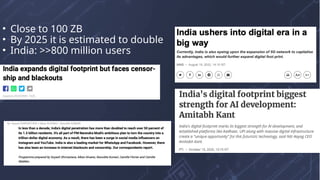
• Close to100 ZB
• By 2025 it is estimated to double
• India: >>800 million users
7.
Using data forbetter living: To drive innovations
Data Sharing
Public Digital Goods
Protecting Privacy
Data Protection
Importance of Data
8.
•Individual POV
1. Datathat I am ok sharing with everyone
2. Data that I am ok sharing with friends
3. Data that I am ok sharing with companies
4. Data that I am not ok sharing with anyone
•Regulation POV
1. Personal data
2. Critical personal data
3. Non-personal data
9.
Non-personal data sharing
•Policy support: Draft India Data
Accessibility & Use Policy 2022
• Technological solution: DEPA
Digital Public Good: IndiaStack
• open-source software
• open data
• open AI models
• open standards
• open content
10.
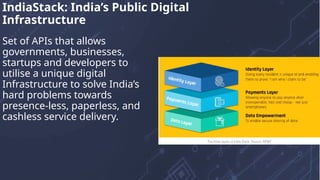
Set of APIsthat allows
governments, businesses,
startups and developers to
utilise a unique digital
Infrastructure to solve India’s
hard problems towards
presence-less, paperless, and
cashless service delivery.
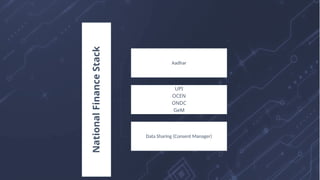
IndiaStack: India’s Public Digital
Infrastructure
11.
1.Aadhaar - APIto ID the consumer.
Identity, Authentication(e-Auth),
Authorization(e-sign)
2.eKYC - Tools to digitise the whole
KYC process. (based on Aadhar)
3.UPI - Platform for micropayments
directly between banks.
4.Digilocker - Storage and retrieval of
digital documents.
5.eSign - Sign documents
electronically.(aadhaar holder can
generate an e-sign)
APIs under IndiaStack
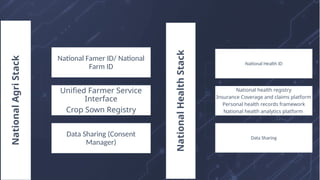
National
Health
Stack
National Health ID
Nationalhealth registry
Insurance Coverage and claims platform
Personal health records framework
National health analytics platform
Data Sharing
National
Agri
Stack
National Famer ID/ National
Farm ID
Unified Farmer Service
Interface
Crop Sown Registry
Data Sharing (Consent
Manager)
14.
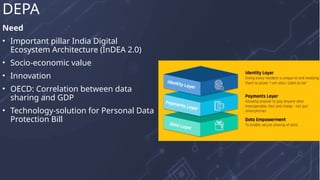
Need
• Important pillarIndia Digital
Ecosystem Architecture (InDEA 2.0)
• Socio-economic value
• Innovation
• OECD: Correlation between data
sharing and GDP
• Technology-solution for Personal Data
Protection Bill
DEPA
15.
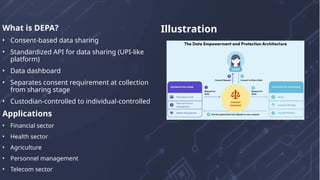
What is DEPA?
•Consent-based data sharing
• Standardized API for data sharing (UPI-like
platform)
• Data dashboard
• Separates consent requirement at collection
from sharing stage
• Custodian-controlled to individual-controlled
Applications
• Financial sector
• Health sector
• Agriculture
• Personnel management
• Telecom sector
Illustration
16.
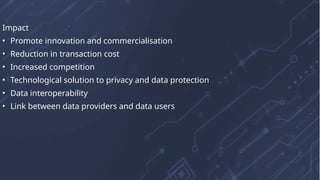
Impact
• Promote innovationand commercialisation
• Reduction in transaction cost
• Increased competition
• Technological solution to privacy and data protection
• Data interoperability
• Link between data providers and data users
17.
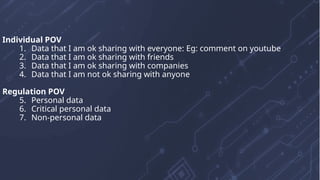
Individual POV
1. Datathat I am ok sharing with everyone: Eg: comment on youtube
2. Data that I am ok sharing with friends
3. Data that I am ok sharing with companies
4. Data that I am not ok sharing with anyone
Regulation POV
5. Personal data
6. Critical personal data
7. Non-personal data
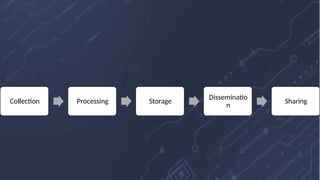
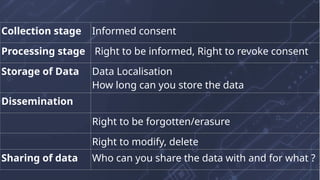
Collection stage Informedconsent
Processing stage Right to be informed, Right to revoke consent
Storage of Data Data Localisation
How long can you store the data
Dissemination
Right to be forgotten/erasure
Right to modify, delete
Sharing of data Who can you share the data with and for what ?
20.
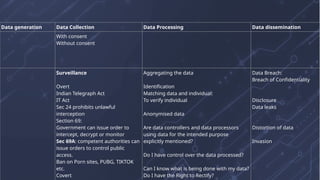
Data generation DataCollection Data Processing Data dissemination
With consent
Without consent
Surveillance
Overt
Indian Telegraph Act
IT Act
Sec 24 prohibits unlawful
interception
Section 69:
Government can issue order to
intercept, decrypt or monitor
Sec 69A: competent authorities can
issue orders to control public
access.
Ban on Porn sites, PUBG, TIKTOK
etc.
Covert
Aggregating the data
Identification
Matching data and individual:
To verify individual
Anonymised data
Are data controllers and data processors
using data for the intended purpose
explicitly mentioned?
Do I have control over the data processed?
Can I know what is being done with my data?
Do I have the Right to Rectify?
Data Breach:
Breach of Confidentiality
Disclosure
Data leaks
Distortion of data
Invasion
21.
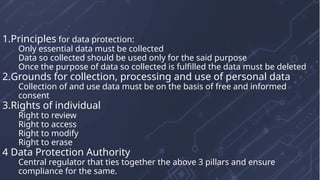
1.Principles for dataprotection:
Only essential data must be collected
Data so collected should be used only for the said purpose
Once the purpose of data so collected is fulfilled the data must be deleted
2.Grounds for collection, processing and use of personal data
Collection of and use data must be on the basis of free and informed
consent
3.Rights of individual
Right to review
Right to access
Right to modify
Right to erase
4 Data Protection Authority
Central regulator that ties together the above 3 pillars and ensure
compliance for the same.
22.
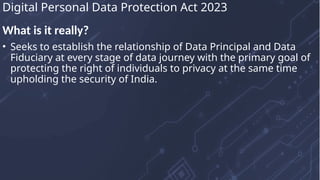
What is itreally?
• Seeks to establish the relationship of Data Principal and Data
Fiduciary at every stage of data journey with the primary goal of
protecting the right of individuals to privacy at the same time
upholding the security of India.
Digital Personal Data Protection Act 2023
23.
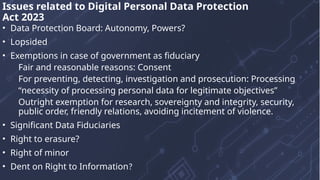
• Data ProtectionBoard: Autonomy, Powers?
• Lopsided
• Exemptions in case of government as fiduciary
Fair and reasonable reasons: Consent
For preventing, detecting, investigation and prosecution: Processing
“necessity of processing personal data for legitimate objectives”
Outright exemption for research, sovereignty and integrity, security,
public order, friendly relations, avoiding incitement of violence.
• Significant Data Fiduciaries
• Right to erasure?
• Right of minor
• Dent on Right to Information?
Issues related to Digital Personal Data Protection
Act 2023
24.
• Write anote on DEPA. Illustrate the importance of such a
framework for ushering in a fully integrated Digital India.
• What is Digital Empowerment and Protection Architecture?
Highlight the opportunities and challenges of implementing such
a framework.
• What is Indiastack? What are the major projects that are being
implemented under indiastack? What are the opportunities that
can be leveraged by Indiastack?
Practice questions
25.
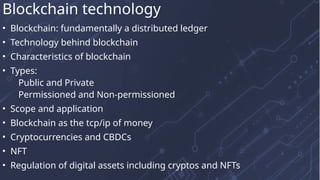
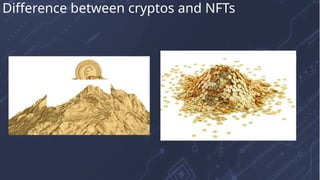
• Blockchain: fundamentallya distributed ledger
• Technology behind blockchain
• Characteristics of blockchain
• Types:
Public and Private
Permissioned and Non-permissioned
• Scope and application
• Blockchain as the tcp/ip of money
• Cryptocurrencies and CBDCs
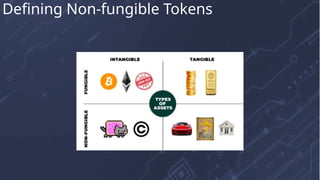
• NFT
• Regulation of digital assets including cryptos and NFTs
Blockchain technology
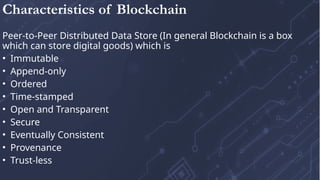
Peer-to-Peer Distributed DataStore (In general Blockchain is a box
which can store digital goods) which is
• Immutable
• Append-only
• Ordered
• Time-stamped
• Open and Transparent
• Secure
• Eventually Consistent
• Provenance
• Trust-less
Characteristics of Blockchain
29.
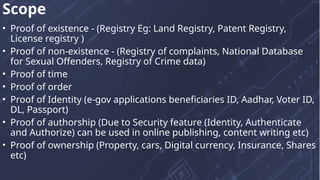
• Proof ofexistence - (Registry Eg: Land Registry, Patent Registry,
License registry )
• Proof of non-existence - (Registry of complaints, National Database
for Sexual Offenders, Registry of Crime data)
• Proof of time
• Proof of order
• Proof of Identity (e-gov applications beneficiaries ID, Aadhar, Voter ID,
DL, Passport)
• Proof of authorship (Due to Security feature (Identity, Authenticate
and Authorize) can be used in online publishing, content writing etc)
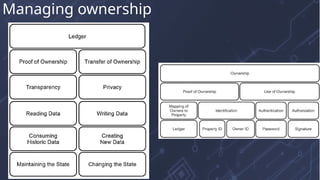
• Proof of ownership (Property, cars, Digital currency, Insurance, Shares
etc)
Scope
30.
• Something thatis used to represent uniqueness in the virtual world.
What are NFTs anyway?
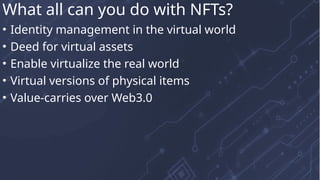
• Identity managementin the virtual world
• Deed for virtual assets
• Enable virtualize the real world
• Virtual versions of physical items
• Value-carries over Web3.0
What all can you do with NFTs?
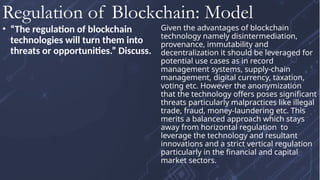
• “The regulationof blockchain
technologies will turn them into
threats or opportunities.” Discuss.
Given the advantages of blockchain
technology namely disintermediation,
provenance, immutability and
decentralization it should be leveraged for
potential use cases as in record
management systems, supply-chain
management, digital currency, taxation,
voting etc. However the anonymization
that the technology offers poses significant
threats particularly malpractices like illegal
trade, fraud, money-laundering etc. This
merits a balanced approach which stays
away from horizontal regulation to
leverage the technology and resultant
innovations and a strict vertical regulation
particularly in the financial and capital
market sectors.
Regulation of Blockchain: Model
36.
Since technological innovationsinevitable outpaces regulation broadly regulatory goals
should be to
• Encourage innovation
• Ensure consumer protection
• Prevent money-laundering
• Prevent fraud
• Taxation regime for cross-border flow
In line with this India is taking a good step in accordance with the recommendation of
Subhash Garg Committee to prevent private cryptocurrencies to function as a currency
instead be treated as a financial asset under the proposed Cryptocurrency Regulation Bill
2021. Thus cryptocurrencies will be rightly subject to capital market regulations of SEBI. In
addition the regulatory aspects should include consumer protection by framing rules for
cryptocurrency activities such as Initial Coin Offerings, imposing capital gains tax, increased
consumer awareness regarding the high-volatile nature of cryptocurrencies, ways to stop
malpractices like short-selling etc.
Thus regulation of blockchain technology should be functional and technology-neutral in
accordance with regulatory principles and goals.
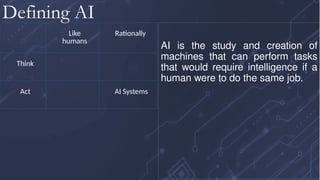
Like
humans
Rationally
Think
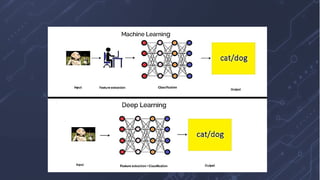
Act AI Systems
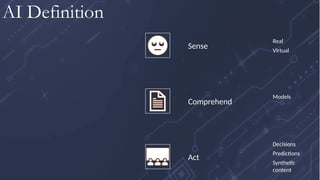
AIis the study and creation of
machines that can perform tasks
that would require intelligence if a
human were to do the same job.
Defining AI
What is
intelligence ?
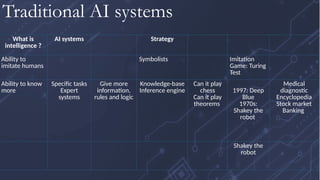
AIsystems Strategy
Ability to
imitate humans
Symbolists Imitation
Game: Turing
Test
Ability to know
more
Specific tasks
Expert
systems
Give more
information,
rules and logic
Knowledge-base
Inference engine
Can it play
chess
Can it play
theorems
1997: Deep
Blue
1970s:
Shakey the
robot
Medical
diagnostic
Encyclopedia
Stock market
Banking
Shakey the
robot
Traditional AI systems
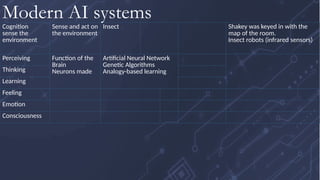
41.
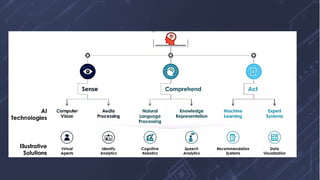
Cognition
sense the
environment
Sense andact on
the environment
Insect Shakey was keyed in with the
map of the room.
Insect robots (infrared sensors)
Perceiving Function of the
Brain
Neurons made
Artificial Neural Network
Genetic Algorithms
Analogy-based learning
Thinking
Learning
Feeling
Emotion
Consciousness
Modern AI systems
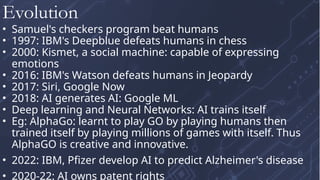
• Samuel's checkersprogram beat humans
• 1997: IBM's Deepblue defeats humans in chess
• 2000: Kismet, a social machine: capable of expressing
emotions
• 2016: IBM's Watson defeats humans in Jeopardy
• 2017: Siri, Google Now
• 2018: AI generates AI: Google ML
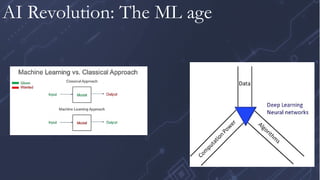
• Deep learning and Neural Networks: AI trains itself
• Eg: AlphaGo: learnt to play GO by playing humans then
trained itself by playing millions of games with itself. Thus
AlphaGO is creative and innovative.
• 2022: IBM, Pfizer develop AI to predict Alzheimer's disease
• 2020-22: AI owns patent rights
Evolution
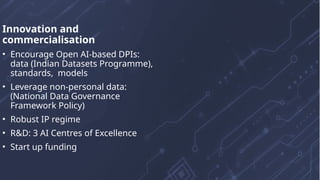
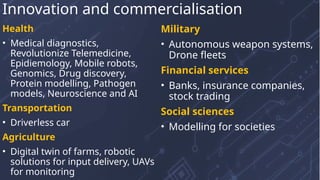
Innovation and
commercialisation
• EncourageOpen AI-based DPIs:
data (Indian Datasets Programme),
standards, models
• Leverage non-personal data:
(National Data Governance
Framework Policy)
• Robust IP regime
• R&D: 3 AI Centres of Excellence
• Start up funding
52.
Health
• Medical diagnostics,
RevolutionizeTelemedicine,
Epidiemology, Mobile robots,
Genomics, Drug discovery,
Protein modelling, Pathogen
models, Neuroscience and AI
Transportation
• Driverless car
Agriculture
• Digital twin of farms, robotic
solutions for input delivery, UAVs
for monitoring
Military
• Autonomous weapon systems,
Drone fleets
Financial services
• Banks, insurance companies,
stock trading
Social sciences
• Modelling for societies
Innovation and commercialisation
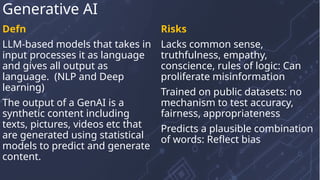
Defn
LLM-based models thattakes in
input processes it as language
and gives all output as
language. (NLP and Deep
learning)
The output of a GenAI is a
synthetic content including
texts, pictures, videos etc that
are generated using statistical
models to predict and generate
content.
Risks
Lacks common sense,
truthfulness, empathy,
conscience, rules of logic: Can
proliferate misinformation
Trained on public datasets: no
mechanism to test accuracy,
fairness, appropriateness
Predicts a plausible combination
of words: Reflect bias
Generative AI
55.
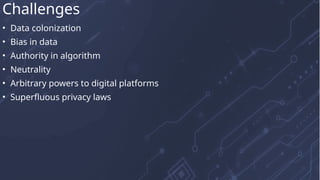
• Data colonization
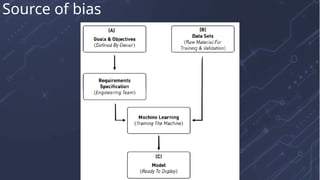
•Bias in data
• Authority in algorithm
• Neutrality
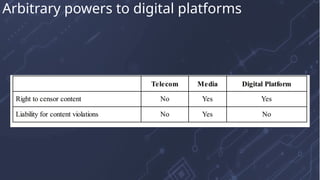
• Arbitrary powers to digital platforms
• Superfluous privacy laws
Challenges
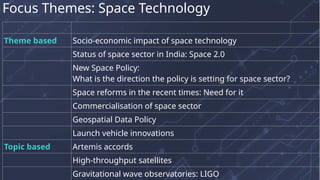
Focus Themes: SpaceTechnology
Theme based Socio-economic impact of space technology
Status of space sector in India: Space 2.0
New Space Policy:
What is the direction the policy is setting for space sector?
Space reforms in the recent times: Need for it
Commercialisation of space sector
Geospatial Data Policy
Launch vehicle innovations
Topic based Artemis accords
High-throughput satellites
Gravitational wave observatories: LIGO
59.
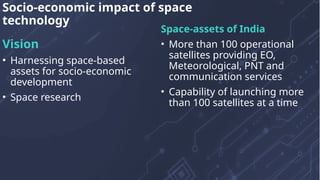
Vision
• Harnessing space-based
assetsfor socio-economic
development
• Space research
Space-assets of India
• More than 100 operational
satellites providing EO,
Meteorological, PNT and
communication services
• Capability of launching more
than 100 satellites at a time
Socio-economic impact of space
technology
60.
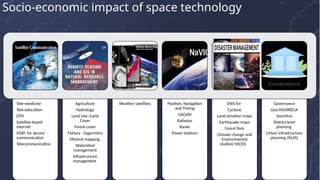
Tele-medicine
Tele-education
DTH
Satellite-based
internet
VSAT: for secure
communication
Telecommunication
Agriculture
Hydrology
LandUse /Land
Cover
Forest cover
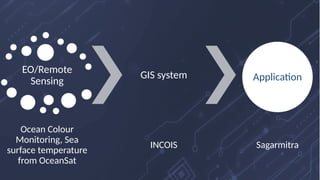
Fishery : Sagarmitra
Mineral mapping
Watershed
management
Infrastructure
management
Weather satellites Position, Navigation
and Timing
GAGAN
Railways
Banks
Power stations
EWS for
Cyclone
Land zonation maps
Earthquake maps
Forest fires
Climate change and
Environmental
studies( NICES)
Governance
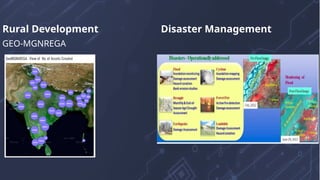
Geo-MGNREGA
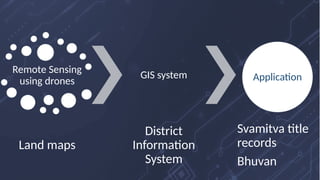
Svamitva
District level
planning
Urban Infrastructure
planning (NUIS)
Socio-economic impact of space technology
61.
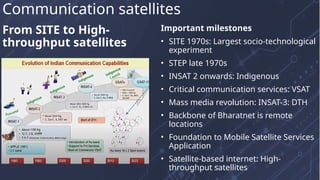
From SITE toHigh-
throughput satellites
Important milestones
• SITE 1970s: Largest socio-technological
experiment
• STEP late 1970s
• INSAT 2 onwards: Indigenous
• Critical communication services: VSAT
• Mass media revolution: INSAT-3: DTH
• Backbone of Bharatnet is remote
locations
• Foundation to Mobile Satellite Services
Application
• Satellite-based internet: High-
throughput satellites
Communication satellites
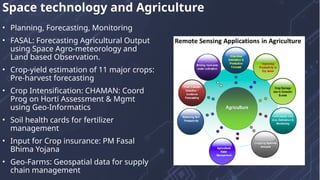
• Planning, Forecasting,Monitoring
• FASAL: Forecasting Agricultural Output
using Space Agro-meteorology and
Land based Observation.
• Crop-yield estimation of 11 major crops:
Pre-harvest forecasting
• Crop Intensification: CHAMAN: Coord
Prog on Horti Assessment & Mgmt
using Geo-Informatics
• Soil health cards for fertilizer
management
• Input for Crop insurance: PM Fasal
Bhima Yojana
• Geo-Farms: Geospatial data for supply
chain management
Space technology and Agriculture
64.
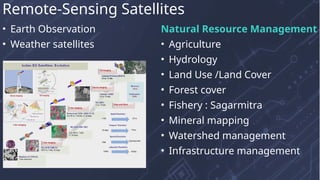
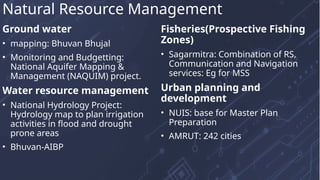
Ground water
• mapping:Bhuvan Bhujal
• Monitoring and Budgetting:
National Aquifer Mapping &
Management (NAQUIM) project.
Water resource management
• National Hydrology Project:
Hydrology map to plan irrigation
activities in flood and drought
prone areas
• Bhuvan-AIBP
Fisheries(Prospective Fishing
Zones)
• Sagarmitra: Combination of RS,
Communication and Navigation
services: Eg for MSS
Urban planning and
development
• NUIS: base for Master Plan
Preparation
• AMRUT: 242 cities
Natural Resource Management
Climate change monitoring
andenvironmental studies
• NICES (National Information
System for Climate and
Environment Studies)
Forest and Ecology studies
67.
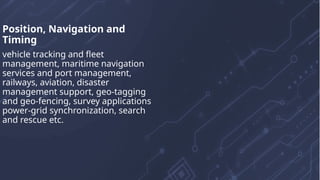
Position, Navigation and
Timing
vehicletracking and fleet
management, maritime navigation
services and port management,
railways, aviation, disaster
management support, geo-tagging
and geo-fencing, survey applications
power-grid synchronization, search
and rescue etc.
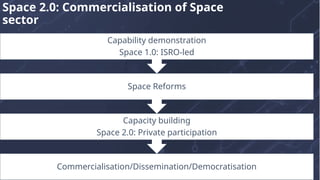
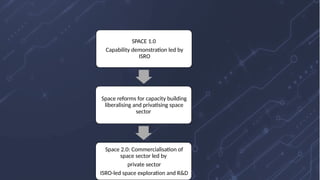
SPACE 1.0
Capability demonstrationled by
ISRO
Space reforms for capacity building
liberalising and privatising space
sector
Space 2.0: Commercialisation of
space sector led by
private sector
ISRO-led space exploration and R&D
78.
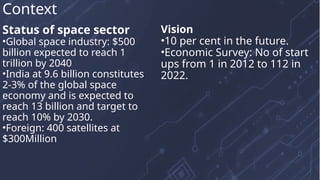
Status of spacesector
•Global space industry: $500
billion expected to reach 1
trillion by 2040
•India at 9.6 billion constitutes
2-3% of the global space
economy and is expected to
reach 13 billion and target to
reach 10% by 2030.
•Foreign: 400 satellites at
$300Million
Vision
•10 per cent in the future.
•Economic Survey: No of start
ups from 1 in 2012 to 112 in
2022.
Context
79.
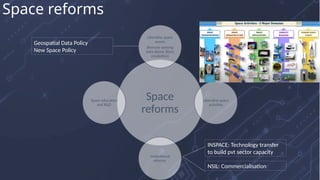
Space
reforms
Liberalise space
assets
(Remote sensing
dataabove 30cm
resolution)
Liberalise space
activities
Institutional
reforms
Space education
and R&D
Space reforms
INSPACE: Technology transfer
to build pvt sector capacity
NSIL: Commercialisation
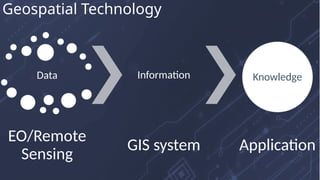
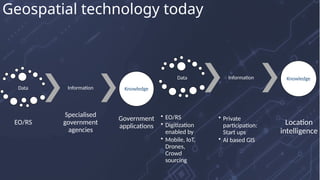
Geospatial Data Policy
New Space Policy
80.
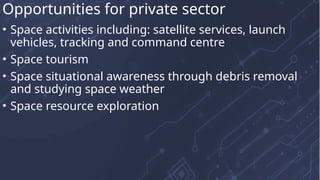
• Space activitiesincluding: satellite services, launch
vehicles, tracking and command centre
• Space tourism
• Space situational awareness through debris removal
and studying space weather
• Space resource exploration
Opportunities for private sector