DATA COMMUNICATION
NETWORKING
DATA COMMUNICATION
• refers to the active process of transmitting data or
information from one point to another through a
medium.
• There are five components of data communication.
FIVE COMPONENTS OF DATA
COMMUNICATION
• Transmitter
• Receiver
• Medium
• Message
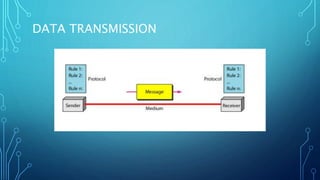
• Protocol
TRANSMITTER
• The transmitter is the device that sends the message.
It can be a computer, workstation, telephone handset,
video camera, and so on.
RECEIVER
• The receiver is the device that receives the message. It
can be a computer, workstation, telephone handset,
television, and so on.
MEDIUM
• The transmission medium is the physical path by
which a message travels from sender to receiver. It
can consist of twisted pair wire, coaxial cable, fiber-
optic cable, laser or radio waves (terrestrial or satellite
microwave).
MESSAGE
• The message is the transmission (data) to be
communicated. It can consist of text, number,
pictures, sound, or video or any combination of these.
PROTOCOL
• A protocol is a set of rules that governs data
communication. It represents an agreement between
the communicating devices. Without a protocol, two
devices may be connected but not communicating.
DATA TRANSMISSION
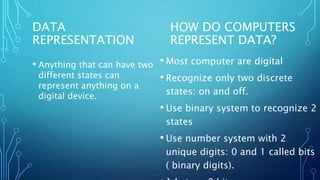
DATA
REPRESENTATION
• Anything that can have two
different states can
represent anything on a
digital device.
• Most computer are digital
• Recognize only two discrete
states: on and off.
• Use binary system to recognize 2
states
• Use number system with 2
unique digits: 0 and 1 called bits
( binary digits).
HOW DO COMPUTERS
REPRESENT DATA?
DATA FLOW
• The route between origin, via nodes, to a destination
taken by a packet of data.
• The transfer of data between the components of a
computer.
• The path taken by the message from origination to
destination that includes all nodes through which the
data travels.
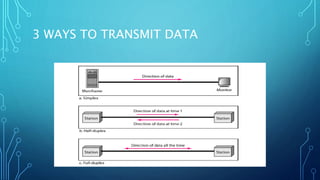
3 WAYS TO TRANSMIT DATA
• Simplex
• Half- duplex (HDX)
• Full- duplex (FDX)
SIMPLEX
• Is one way transmission, it uses one circuit in one
direction only such as in radio or TV transmission. It is
simple and relatively inexpensive.
HALF – DUPLEX (HDX)
• Is two-way transmission and it also use only one
circuit as simplex does but it is used in both
directions, walkie-talkie is the good example of the
half-duplex processor. Half duplex is a circuit, which
can transmit the signal in two directions but only once
at a time. In Half-duplex users can transmit and
receive signals or data but cannot do both
simultaneously.
FULL – DUPLEX (FDX)
• Full duplex transmission is also the two-way
transmission but it uses two circuits for
communication. Full duplex allows users to
communicate in both way simultaneously (i.e. a
common telephone) with no turnaround time. This
mode is clearly easier to use then the half duplex but
the cost may be significant, especially over long
distance.
3 WAYS TO TRANSMIT DATA
END.

Data communication.pptx

  • 1.
  • 2.
    DATA COMMUNICATION • refersto the active process of transmitting data or information from one point to another through a medium. • There are five components of data communication.
  • 3.
    FIVE COMPONENTS OFDATA COMMUNICATION • Transmitter • Receiver • Medium • Message • Protocol
  • 4.
    TRANSMITTER • The transmitteris the device that sends the message. It can be a computer, workstation, telephone handset, video camera, and so on.
  • 5.
    RECEIVER • The receiveris the device that receives the message. It can be a computer, workstation, telephone handset, television, and so on.
  • 6.
    MEDIUM • The transmissionmedium is the physical path by which a message travels from sender to receiver. It can consist of twisted pair wire, coaxial cable, fiber- optic cable, laser or radio waves (terrestrial or satellite microwave).
  • 7.
    MESSAGE • The messageis the transmission (data) to be communicated. It can consist of text, number, pictures, sound, or video or any combination of these.
  • 8.
    PROTOCOL • A protocolis a set of rules that governs data communication. It represents an agreement between the communicating devices. Without a protocol, two devices may be connected but not communicating.
  • 9.
  • 10.
    DATA REPRESENTATION • Anything thatcan have two different states can represent anything on a digital device. • Most computer are digital • Recognize only two discrete states: on and off. • Use binary system to recognize 2 states • Use number system with 2 unique digits: 0 and 1 called bits ( binary digits). HOW DO COMPUTERS REPRESENT DATA?
  • 11.
    DATA FLOW • Theroute between origin, via nodes, to a destination taken by a packet of data. • The transfer of data between the components of a computer. • The path taken by the message from origination to destination that includes all nodes through which the data travels.
  • 12.
    3 WAYS TOTRANSMIT DATA • Simplex • Half- duplex (HDX) • Full- duplex (FDX)
  • 13.
    SIMPLEX • Is oneway transmission, it uses one circuit in one direction only such as in radio or TV transmission. It is simple and relatively inexpensive.
  • 14.
    HALF – DUPLEX(HDX) • Is two-way transmission and it also use only one circuit as simplex does but it is used in both directions, walkie-talkie is the good example of the half-duplex processor. Half duplex is a circuit, which can transmit the signal in two directions but only once at a time. In Half-duplex users can transmit and receive signals or data but cannot do both simultaneously.
  • 15.
    FULL – DUPLEX(FDX) • Full duplex transmission is also the two-way transmission but it uses two circuits for communication. Full duplex allows users to communicate in both way simultaneously (i.e. a common telephone) with no turnaround time. This mode is clearly easier to use then the half duplex but the cost may be significant, especially over long distance.
  • 16.
    3 WAYS TOTRANSMIT DATA
  • 17.