Welcome
THE ROLE OF ARTIFICIAL INTELLIGENCE AND MACHINE LEARNING IN
CLINICAL DATA MANAGEMENT
10/18/2022
www.clinosol.com | follow us on social media
@clinosolresearch
1
Y. Nuthana
B. Pharmacy
Student ID:177/082023
TABLE OF CONTENTS
➢ Introduction
➢ Clinical Data Management
➢ Challenges in clinical data management
➢ AI in clinical Data Management
➢ Machine Learning in clinical data management
➢ Benefits of AI and ML
➢Future Trends
➢ Challenges and limitations
➢ Conclusion
10/18/2022
www.clinosol.com | follow us on social media
@clinosolresearch
2
INTRODUCTION
❑ Artificial Intelligence and Machine Learning streamline clinical data
handling, improving accuracy, predicting patient outcomes, aiding diagnosis,
expediting drug discovery, and enhancing radiology.
❑ They optimize resource allocation, detect fraud, and manage population
health for more efficient and personalized healthcare.
IMPORTANCE OF CLINICAL DATA MANAGEMENT
❑ Clinical data management plays a crucial role in healthcare research and
patient care.
❑ It ensures accurate, organized, and secure handling of medical data, aiding
in evidence based decision making, drug development and regulatory
compliance.
10/18/2022
www.clinosol.com | follow us on social media
@clinosolresearch
CLINICAL DATA MANAGEMENT OVERVIEW
❑ Clinical data management[CDM] is a critical process in clinical
research, which leads to generation of high quality, reliable, and
statistically sound data from clinical trials.
SIGNIFICANCE
❑ Healthcare plays a crucial role in clinical data management for various
reasons like patient safety, compliance, interpretation, adverse event
reporting, protocol adherence, patient recruitment, and data
validation.
❑ It safeguards data integrity and ethical conduct in clinical trials,
advancing medical knowledge and patient care.
10/18/2022
www.clinosol.com | follow us on social media
@clinosolresearch
4
4
CHALLENGES IN CLINICAL DATA MANAGEMENT
➢ DATA INTEGRATION: Managing data from various sources.
➢ DATA SECURITY: Safeguarding sensitive patient information.
➢ TIMELINESS: Meeting study timeliness and deadlines.
➢ QUALITY CONTROL: Detecting and correcting errors in data.
➢ PROTOCOL ADHERENCE: Ensuring participants follow study protocols.
➢ RESOURCE CONSTRAINTS: Limited budget and personnel.
➢ DATA STANDARDIZATION: Ensuring consistency in data formats.
➢ TECHNOLOGY INTEGRATION: updating and integrating CDM system.
10/18/2022
www.clinosol.com | follow us on social media
@clinosolresearch
5
AI IN CLINICAL DATA MANAGEMENT
❑ DATA QUALITY AND CLEANING:- AI algorithms can identify and correct data errors and
missing values in clinical datasets.
❑ DATA EXTRACTION AND ENTRY:- AI powered systems can extract information from various
sources such as handwritten notes and input it into structured databases and saving time.
❑ IMAGE ANALYSIS:- AI driven image recognition and interpretation can assist in radiology
and other medical conditions in medical.
❑ NATURAL LANGUAGE PROCESSING[NLP]:- NLP can extract valuable insights from
unstructured clinical notes, and clinicians to harness the information contained in free
text documents.
❑ DATA SECURITY:-AI systems enhance data security through advanced encryption, and
access control mechanisms, safeguarding sensitive patient information.
10/18/2022
www.clinosol.com | follow us on social media
@clinosolresearch
6
MI IN CLINICAL DATA MANAGEMENT
❑ MACHINE LEARNING [ML] plays a pivot role in clinical data management,
revolutionizing the healthcare industry by enhancing patient care, research,
and operational efficiency.
❑ CLINICAL DATA MANAGEMENT involves handling the vast and complex data
generated in healthcare, including electronic health records[EHRs], medical
imaging, and genomic information.
❑ In disease diagnosis, ML models analyze medical images with remarkable
accuracy, aiding in the detection of conditions such as cancer and
cardiovascular diseases.
10/18/2022
www.clinosol.com | follow us on social media
@clinosolresearch
7
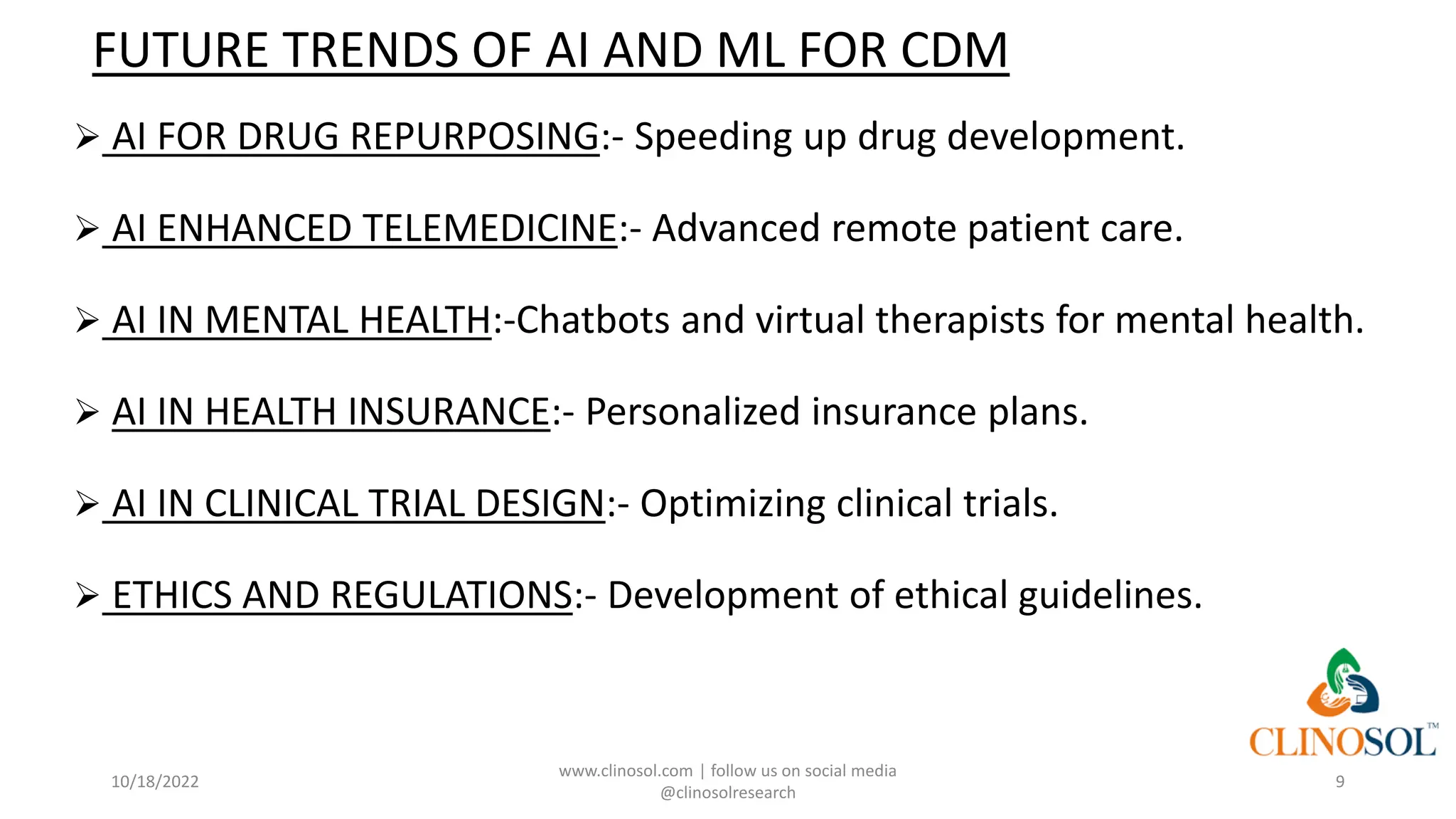
ADVANTAGES OF AI AND ML IN CLINICAL DATA
MANAGEMENT
❑ Improved diagnosis and disease detection.
❑ Data security and privacy.
❑ Cost reduction.
❑ Early warning systems.
❑ Streamlined clinical trials.
❑ Improved patient engagement.
❑ Research advancements.
❑ Real time patient monitoring.
10/18/2022
www.clinosol.com | follow us on social media
@clinosolresearch
8
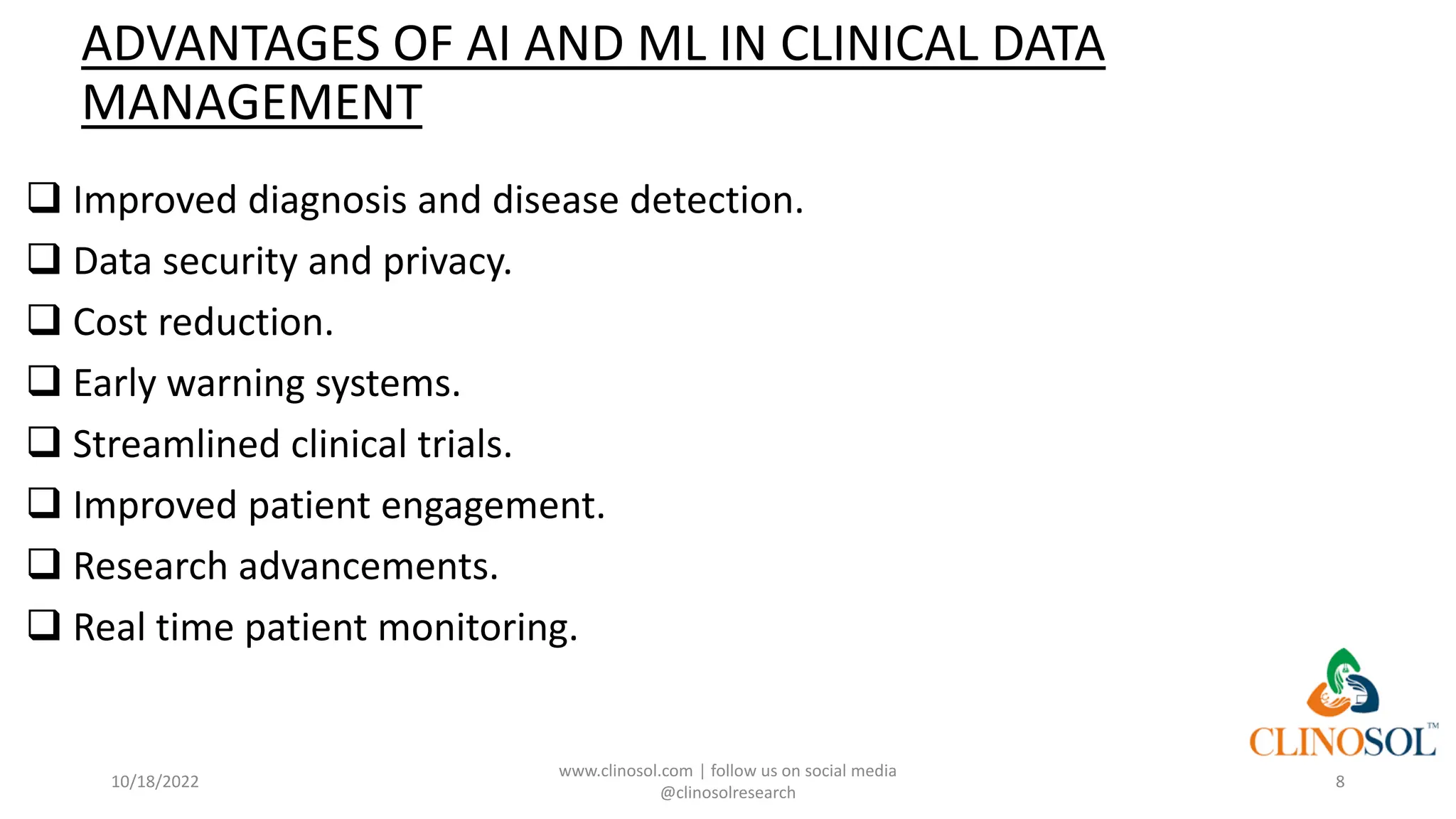
FUTURE TRENDS OF AI AND ML FOR CDM
➢ AI FOR DRUG REPURPOSING:- Speeding up drug development.
➢ AI ENHANCED TELEMEDICINE:- Advanced remote patient care.
➢ AI IN MENTAL HEALTH:-Chatbots and virtual therapists for mental health.
➢ AI IN HEALTH INSURANCE:- Personalized insurance plans.
➢ AI IN CLINICAL TRIAL DESIGN:- Optimizing clinical trials.
➢ ETHICS AND REGULATIONS:- Development of ethical guidelines.
10/18/2022
www.clinosol.com | follow us on social media
@clinosolresearch
9
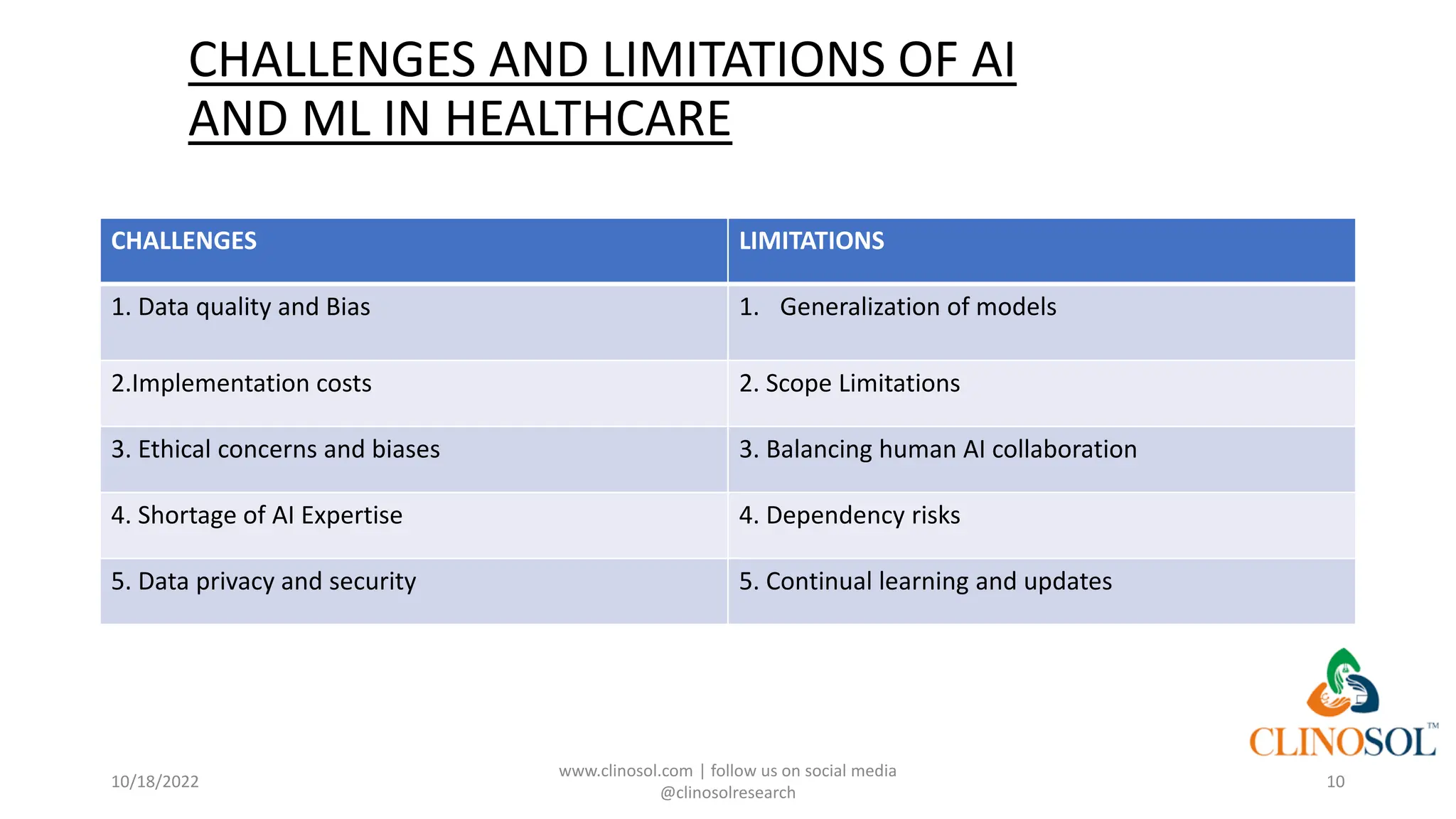
CHALLENGES AND LIMITATIONS OF AI
AND ML IN HEALTHCARE
CHALLENGES LIMITATIONS
1. Data quality and Bias 1. Generalization of models
2.Implementation costs 2. Scope Limitations
3. Ethical concerns and biases 3. Balancing human AI collaboration
4. Shortage of AI Expertise 4. Dependency risks
5. Data privacy and security 5. Continual learning and updates
10/18/2022
www.clinosol.com | follow us on social media
@clinosolresearch
10
ThankYou!
www.clinosol.com
(India | Canada)
9121151622/623/624
info@clinosol.com
10/18/2022
www.clinosol.com | follow us on social media
@clinosolresearch
11

The Role of Artificial Intelligence and Machine Learning in Clinical Data Management

  • 1.
    Welcome THE ROLE OFARTIFICIAL INTELLIGENCE AND MACHINE LEARNING IN CLINICAL DATA MANAGEMENT 10/18/2022 www.clinosol.com | follow us on social media @clinosolresearch 1 Y. Nuthana B. Pharmacy Student ID:177/082023
  • 2.
    TABLE OF CONTENTS ➢Introduction ➢ Clinical Data Management ➢ Challenges in clinical data management ➢ AI in clinical Data Management ➢ Machine Learning in clinical data management ➢ Benefits of AI and ML ➢Future Trends ➢ Challenges and limitations ➢ Conclusion 10/18/2022 www.clinosol.com | follow us on social media @clinosolresearch 2
  • 3.
    INTRODUCTION ❑ Artificial Intelligenceand Machine Learning streamline clinical data handling, improving accuracy, predicting patient outcomes, aiding diagnosis, expediting drug discovery, and enhancing radiology. ❑ They optimize resource allocation, detect fraud, and manage population health for more efficient and personalized healthcare. IMPORTANCE OF CLINICAL DATA MANAGEMENT ❑ Clinical data management plays a crucial role in healthcare research and patient care. ❑ It ensures accurate, organized, and secure handling of medical data, aiding in evidence based decision making, drug development and regulatory compliance. 10/18/2022 www.clinosol.com | follow us on social media @clinosolresearch
  • 4.
    CLINICAL DATA MANAGEMENTOVERVIEW ❑ Clinical data management[CDM] is a critical process in clinical research, which leads to generation of high quality, reliable, and statistically sound data from clinical trials. SIGNIFICANCE ❑ Healthcare plays a crucial role in clinical data management for various reasons like patient safety, compliance, interpretation, adverse event reporting, protocol adherence, patient recruitment, and data validation. ❑ It safeguards data integrity and ethical conduct in clinical trials, advancing medical knowledge and patient care. 10/18/2022 www.clinosol.com | follow us on social media @clinosolresearch 4 4
  • 5.
    CHALLENGES IN CLINICALDATA MANAGEMENT ➢ DATA INTEGRATION: Managing data from various sources. ➢ DATA SECURITY: Safeguarding sensitive patient information. ➢ TIMELINESS: Meeting study timeliness and deadlines. ➢ QUALITY CONTROL: Detecting and correcting errors in data. ➢ PROTOCOL ADHERENCE: Ensuring participants follow study protocols. ➢ RESOURCE CONSTRAINTS: Limited budget and personnel. ➢ DATA STANDARDIZATION: Ensuring consistency in data formats. ➢ TECHNOLOGY INTEGRATION: updating and integrating CDM system. 10/18/2022 www.clinosol.com | follow us on social media @clinosolresearch 5
  • 6.
    AI IN CLINICALDATA MANAGEMENT ❑ DATA QUALITY AND CLEANING:- AI algorithms can identify and correct data errors and missing values in clinical datasets. ❑ DATA EXTRACTION AND ENTRY:- AI powered systems can extract information from various sources such as handwritten notes and input it into structured databases and saving time. ❑ IMAGE ANALYSIS:- AI driven image recognition and interpretation can assist in radiology and other medical conditions in medical. ❑ NATURAL LANGUAGE PROCESSING[NLP]:- NLP can extract valuable insights from unstructured clinical notes, and clinicians to harness the information contained in free text documents. ❑ DATA SECURITY:-AI systems enhance data security through advanced encryption, and access control mechanisms, safeguarding sensitive patient information. 10/18/2022 www.clinosol.com | follow us on social media @clinosolresearch 6
  • 7.
    MI IN CLINICALDATA MANAGEMENT ❑ MACHINE LEARNING [ML] plays a pivot role in clinical data management, revolutionizing the healthcare industry by enhancing patient care, research, and operational efficiency. ❑ CLINICAL DATA MANAGEMENT involves handling the vast and complex data generated in healthcare, including electronic health records[EHRs], medical imaging, and genomic information. ❑ In disease diagnosis, ML models analyze medical images with remarkable accuracy, aiding in the detection of conditions such as cancer and cardiovascular diseases. 10/18/2022 www.clinosol.com | follow us on social media @clinosolresearch 7
  • 8.
    ADVANTAGES OF AIAND ML IN CLINICAL DATA MANAGEMENT ❑ Improved diagnosis and disease detection. ❑ Data security and privacy. ❑ Cost reduction. ❑ Early warning systems. ❑ Streamlined clinical trials. ❑ Improved patient engagement. ❑ Research advancements. ❑ Real time patient monitoring. 10/18/2022 www.clinosol.com | follow us on social media @clinosolresearch 8
  • 9.
    FUTURE TRENDS OFAI AND ML FOR CDM ➢ AI FOR DRUG REPURPOSING:- Speeding up drug development. ➢ AI ENHANCED TELEMEDICINE:- Advanced remote patient care. ➢ AI IN MENTAL HEALTH:-Chatbots and virtual therapists for mental health. ➢ AI IN HEALTH INSURANCE:- Personalized insurance plans. ➢ AI IN CLINICAL TRIAL DESIGN:- Optimizing clinical trials. ➢ ETHICS AND REGULATIONS:- Development of ethical guidelines. 10/18/2022 www.clinosol.com | follow us on social media @clinosolresearch 9
  • 10.
    CHALLENGES AND LIMITATIONSOF AI AND ML IN HEALTHCARE CHALLENGES LIMITATIONS 1. Data quality and Bias 1. Generalization of models 2.Implementation costs 2. Scope Limitations 3. Ethical concerns and biases 3. Balancing human AI collaboration 4. Shortage of AI Expertise 4. Dependency risks 5. Data privacy and security 5. Continual learning and updates 10/18/2022 www.clinosol.com | follow us on social media @clinosolresearch 10
  • 11.