Welcome
AI FOR DATA QUALITY ASSURANCE IN
CLINICAL TRIALS
VEDANT ARVIND CHAUDHARI
B. PHARMACY
100/072024
02/08/2024
www.clinosol.com | follow us on social media
@clinosolresearch
1
 INDEX
o INTRODUCTION
o AI IN CLINICAL TRIALS ADVANTAGES
o IMPORTANCE
o ASPECTS
o TECHNOLOGIES USED
o BENEFITS
o FUTURE DIRECTIONS
o CHALLENGES
o CONCLUSION
www.clinosol.com | follow us on social media
@clinosolresearch
2
02/08/2024
 INTRODUCTION
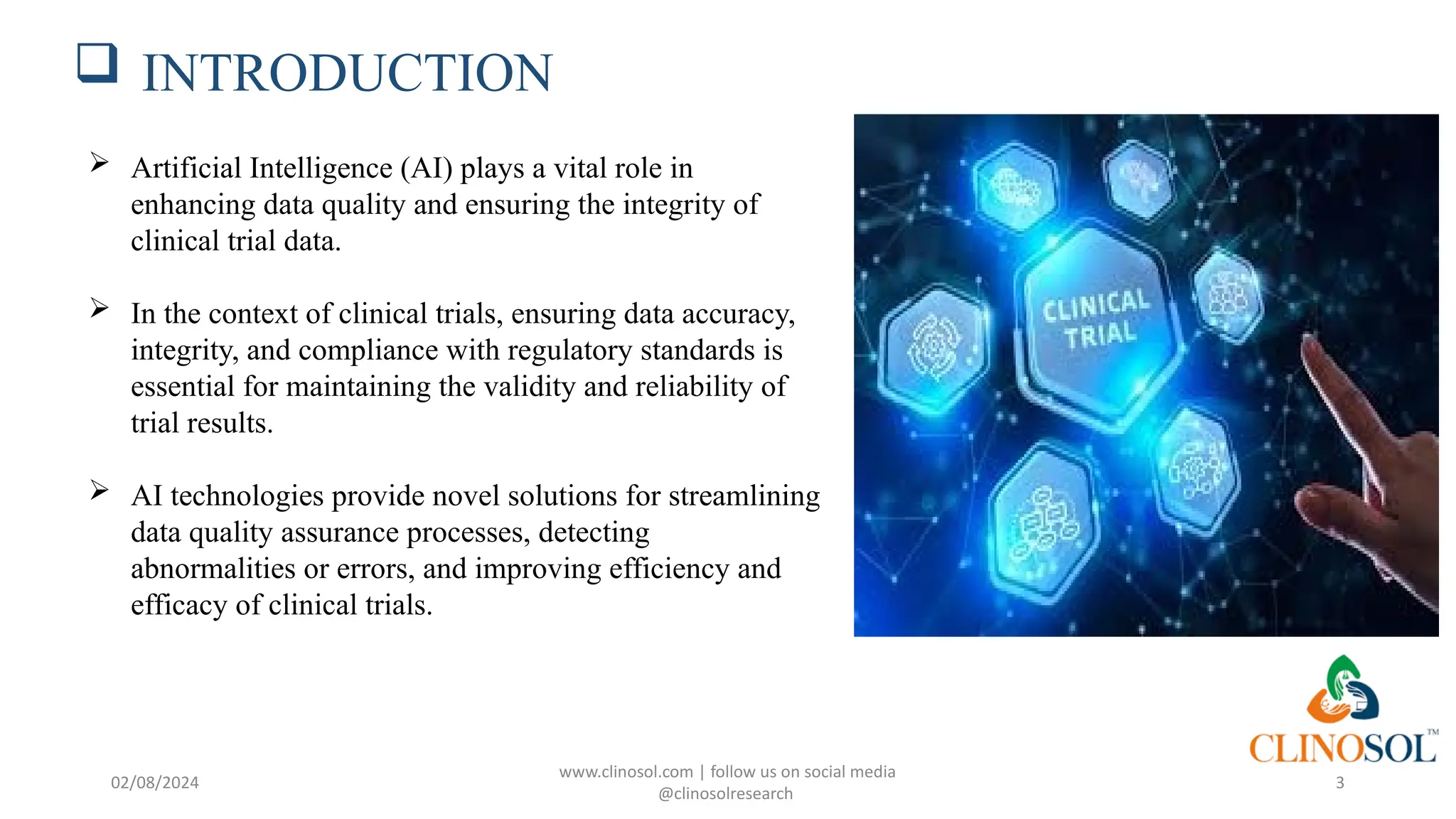
 Artificial Intelligence (AI) plays a vital role in
enhancing data quality and ensuring the integrity of
clinical trial data.
 In the context of clinical trials, ensuring data accuracy,
integrity, and compliance with regulatory standards is
essential for maintaining the validity and reliability of
trial results.
 AI technologies provide novel solutions for streamlining
data quality assurance processes, detecting
abnormalities or errors, and improving efficiency and
efficacy of clinical trials.
www.clinosol.com | follow us on social media
@clinosolresearch
3
02/08/2024
 AI IN CLINICAL TRIALS ADVANTAGES
www.clinosol.com | follow us on social media
@clinosolresearch
4
02/08/2024
 IMPORTANCE
www.clinosol.com | follow us on social media
@clinosolresearch
5
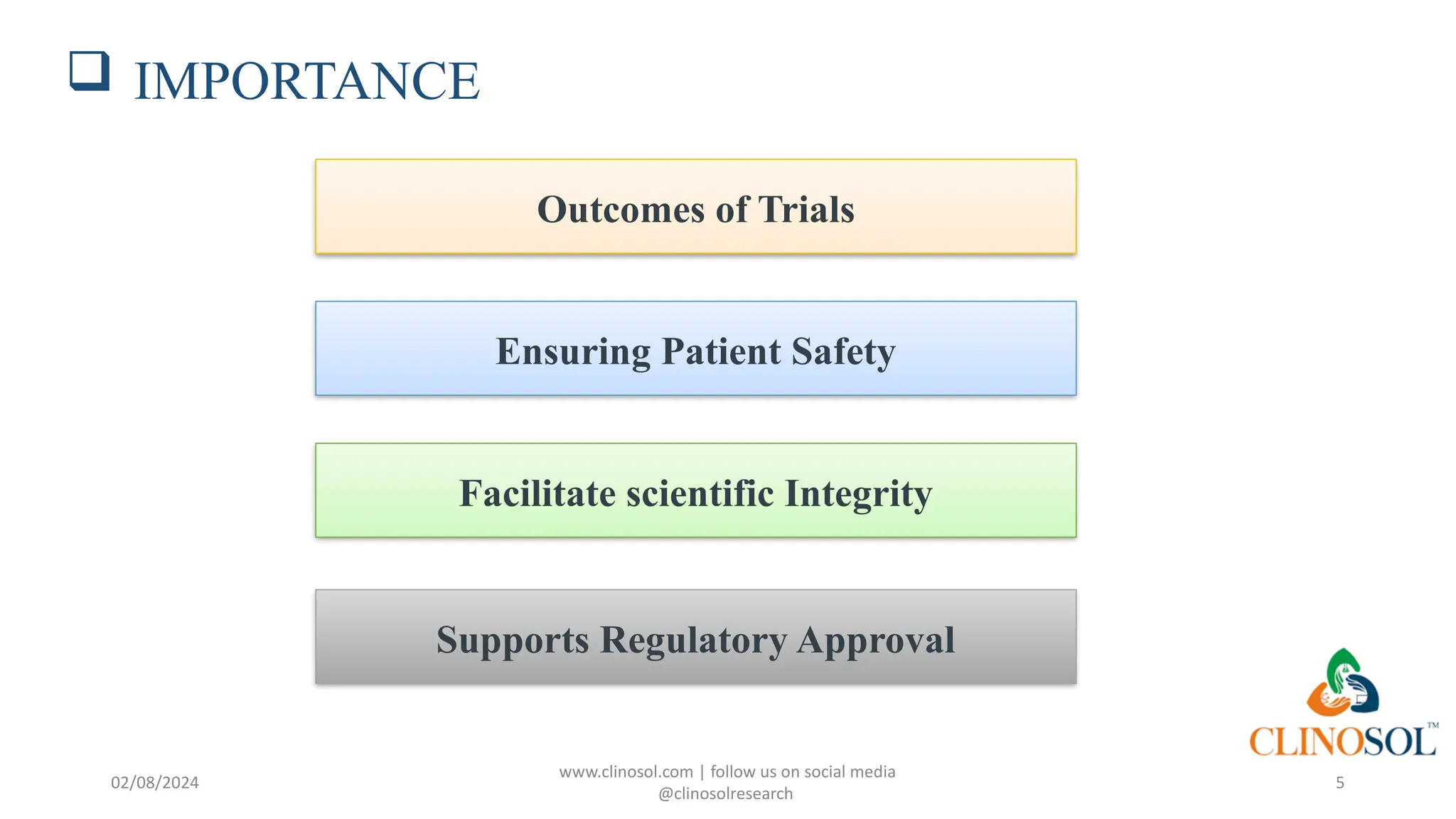
Outcomes of Trials
Facilitate scientific Integrity
Supports Regulatory Approval
Ensuring Patient Safety
02/08/2024
 ASPECTS
 Automated Data Validation:
AI algorithms can automate the process of data validation by analyzing large volumes of clinical trial
data to identify inconsistencies, errors, or missing values.
 Real-time Monitoring and Alerts:
AI-powered systems can provide real-time monitoring of clinical trial data streams to detect
deviations from expected patterns or trends.
 Predictive Analytics for Risk Assessment:
AI-based predictive analytics can assess the risk of data quality issues occurring during clinical trials
by analyzing historical data, identifying risk factors, and predicting potential areas of concern.
www.clinosol.com | follow us on social media
@clinosolresearch
6
02/08/2024
 Quality Control Automation:
AI technologies can automate quality control processes in clinical trials by performing automated
reviews of data accuracy, completeness, and consistency.
 Adaptive Trial Design Optimization:
AI-driven adaptive trial designs leverage real-time data analytics to optimize trial protocols and
data collection strategies based on ongoing feedback and insights.
 Regulatory Compliance and Audit Trails:
AI-enabled platforms can facilitate regulatory compliance and audit trial documentation by
automating the generation of comprehensive audit logs and data audit trials.
www.clinosol.com | follow us on social media
@clinosolresearch
7
02/08/2024
 TECHNOLOGIES USED
 Natural Language Processing (NLP):-
These can parse unstructured data, such as clinical notes
or patient reports, to extract relevant information and flag
potential discrepancies.
 Machine Learning (ML):-
Machine learning can detect anomalies, inconsistencies
and errors in data more efficiently than traditional
methods. These systems can also automatically correct
common errors by learning from examples.
www.clinosol.com | follow us on social media
@clinosolresearch
8
02/08/2024
 BENEFITS
www.clinosol.com | follow us on social media
@clinosolresearch
9
Benefits of AI for data quality assurance in clinical trials
Improved
Accuracy
Efficiency Scalability Consistency
02/08/2024
 Quality Assurance for clinical trials is bright.
 Machine Learning algorithms are becoming for more accurate
predictive modelling and real time monitoring.
 Additionally, advancements in Natural Language Processing
enable AI systems to analyze unstructured data such as patient
records.
 By embracing these innovations, the healthcare industry can
ensure the clinical trials data is of the highest quality, ultimately
benefiting patients and advancing medical research.
10
www.clinosol.com | follow us on social media
@clinosolresearch
02/08/2024
 FUTURE DIRECTIONS
 CHALLENGES
 Data Quality:-
One of the pressing issues faced by AI in clinical trials is that of data quality. To prevent this
issue, researchers must ensure that the AI model’s data is accurate, complete, and error-free.
 Ethical Considerations:-
Another issue that arises is that of ethical considerations. Using AI algorithms in clinical trials
causes security concerns such as data privacy and informed consent.
 Data Bias:-
AI algorithms work based on the data they are trained to interpret. That means if the data fed
into the AI algorithm is biased, then the predictions given by the AI would be biased too.
www.clinosol.com | follow us on social media
@clinosolresearch
11
02/08/2024
 Data Interpretability:-
Data collected by AI algorithms is debatable. It is difficult to understand how AI algorithms arrive
at their predictions. This creates a difficulty for researchers when it comes to interpreting the trial
results.
 Data Regulation:-
The adoption of AI in clinical trials is comparatively new and continuously tested. This creates
uncertainty for researchers who need help with how to comply with specific regulations.
 Integration of AI With Existing Systems:-
It can be challenging to incorporate AI into the existing clinical trial management systems.
Especially if the system was designed in a manner without taking AI into consideration..
www.clinosol.com | follow us on social media
@clinosolresearch
12
02/08/2024
 CONCLUSION
AI is a powerful tool that can significantly enhance data
quality assurance in clinical trials. By automating data
validation, identifying clinical trial results, benefiting
patients and advancing medical research. As AI
technology continues to advance, we can expect even
more sophisticated and innovative applications in
clinical trial data quality assurance.
www.clinosol.com | follow us on social media
@clinosolresearch
13
02/08/2024
ThankYou!
www.clinosol.com
(India | Canada)
9121151622/623/624
info@clinosol.com
02/08/2024
www.clinosol.com | follow us on social media
@clinosolresearch
14

AI for Data Quality Assurance in Clinical

  • 1.
    Welcome AI FOR DATAQUALITY ASSURANCE IN CLINICAL TRIALS VEDANT ARVIND CHAUDHARI B. PHARMACY 100/072024 02/08/2024 www.clinosol.com | follow us on social media @clinosolresearch 1
  • 2.
     INDEX o INTRODUCTION oAI IN CLINICAL TRIALS ADVANTAGES o IMPORTANCE o ASPECTS o TECHNOLOGIES USED o BENEFITS o FUTURE DIRECTIONS o CHALLENGES o CONCLUSION www.clinosol.com | follow us on social media @clinosolresearch 2 02/08/2024
  • 3.
     INTRODUCTION  ArtificialIntelligence (AI) plays a vital role in enhancing data quality and ensuring the integrity of clinical trial data.  In the context of clinical trials, ensuring data accuracy, integrity, and compliance with regulatory standards is essential for maintaining the validity and reliability of trial results.  AI technologies provide novel solutions for streamlining data quality assurance processes, detecting abnormalities or errors, and improving efficiency and efficacy of clinical trials. www.clinosol.com | follow us on social media @clinosolresearch 3 02/08/2024
  • 4.
     AI INCLINICAL TRIALS ADVANTAGES www.clinosol.com | follow us on social media @clinosolresearch 4 02/08/2024
  • 5.
     IMPORTANCE www.clinosol.com |follow us on social media @clinosolresearch 5 Outcomes of Trials Facilitate scientific Integrity Supports Regulatory Approval Ensuring Patient Safety 02/08/2024
  • 6.
     ASPECTS  AutomatedData Validation: AI algorithms can automate the process of data validation by analyzing large volumes of clinical trial data to identify inconsistencies, errors, or missing values.  Real-time Monitoring and Alerts: AI-powered systems can provide real-time monitoring of clinical trial data streams to detect deviations from expected patterns or trends.  Predictive Analytics for Risk Assessment: AI-based predictive analytics can assess the risk of data quality issues occurring during clinical trials by analyzing historical data, identifying risk factors, and predicting potential areas of concern. www.clinosol.com | follow us on social media @clinosolresearch 6 02/08/2024
  • 7.
     Quality ControlAutomation: AI technologies can automate quality control processes in clinical trials by performing automated reviews of data accuracy, completeness, and consistency.  Adaptive Trial Design Optimization: AI-driven adaptive trial designs leverage real-time data analytics to optimize trial protocols and data collection strategies based on ongoing feedback and insights.  Regulatory Compliance and Audit Trails: AI-enabled platforms can facilitate regulatory compliance and audit trial documentation by automating the generation of comprehensive audit logs and data audit trials. www.clinosol.com | follow us on social media @clinosolresearch 7 02/08/2024
  • 8.
     TECHNOLOGIES USED Natural Language Processing (NLP):- These can parse unstructured data, such as clinical notes or patient reports, to extract relevant information and flag potential discrepancies.  Machine Learning (ML):- Machine learning can detect anomalies, inconsistencies and errors in data more efficiently than traditional methods. These systems can also automatically correct common errors by learning from examples. www.clinosol.com | follow us on social media @clinosolresearch 8 02/08/2024
  • 9.
     BENEFITS www.clinosol.com |follow us on social media @clinosolresearch 9 Benefits of AI for data quality assurance in clinical trials Improved Accuracy Efficiency Scalability Consistency 02/08/2024
  • 10.
     Quality Assurancefor clinical trials is bright.  Machine Learning algorithms are becoming for more accurate predictive modelling and real time monitoring.  Additionally, advancements in Natural Language Processing enable AI systems to analyze unstructured data such as patient records.  By embracing these innovations, the healthcare industry can ensure the clinical trials data is of the highest quality, ultimately benefiting patients and advancing medical research. 10 www.clinosol.com | follow us on social media @clinosolresearch 02/08/2024  FUTURE DIRECTIONS
  • 11.
     CHALLENGES  DataQuality:- One of the pressing issues faced by AI in clinical trials is that of data quality. To prevent this issue, researchers must ensure that the AI model’s data is accurate, complete, and error-free.  Ethical Considerations:- Another issue that arises is that of ethical considerations. Using AI algorithms in clinical trials causes security concerns such as data privacy and informed consent.  Data Bias:- AI algorithms work based on the data they are trained to interpret. That means if the data fed into the AI algorithm is biased, then the predictions given by the AI would be biased too. www.clinosol.com | follow us on social media @clinosolresearch 11 02/08/2024
  • 12.
     Data Interpretability:- Datacollected by AI algorithms is debatable. It is difficult to understand how AI algorithms arrive at their predictions. This creates a difficulty for researchers when it comes to interpreting the trial results.  Data Regulation:- The adoption of AI in clinical trials is comparatively new and continuously tested. This creates uncertainty for researchers who need help with how to comply with specific regulations.  Integration of AI With Existing Systems:- It can be challenging to incorporate AI into the existing clinical trial management systems. Especially if the system was designed in a manner without taking AI into consideration.. www.clinosol.com | follow us on social media @clinosolresearch 12 02/08/2024
  • 13.
     CONCLUSION AI isa powerful tool that can significantly enhance data quality assurance in clinical trials. By automating data validation, identifying clinical trial results, benefiting patients and advancing medical research. As AI technology continues to advance, we can expect even more sophisticated and innovative applications in clinical trial data quality assurance. www.clinosol.com | follow us on social media @clinosolresearch 13 02/08/2024
  • 14.