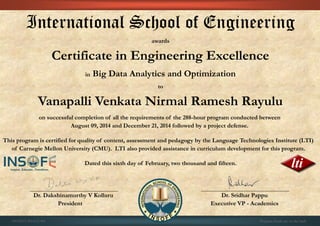
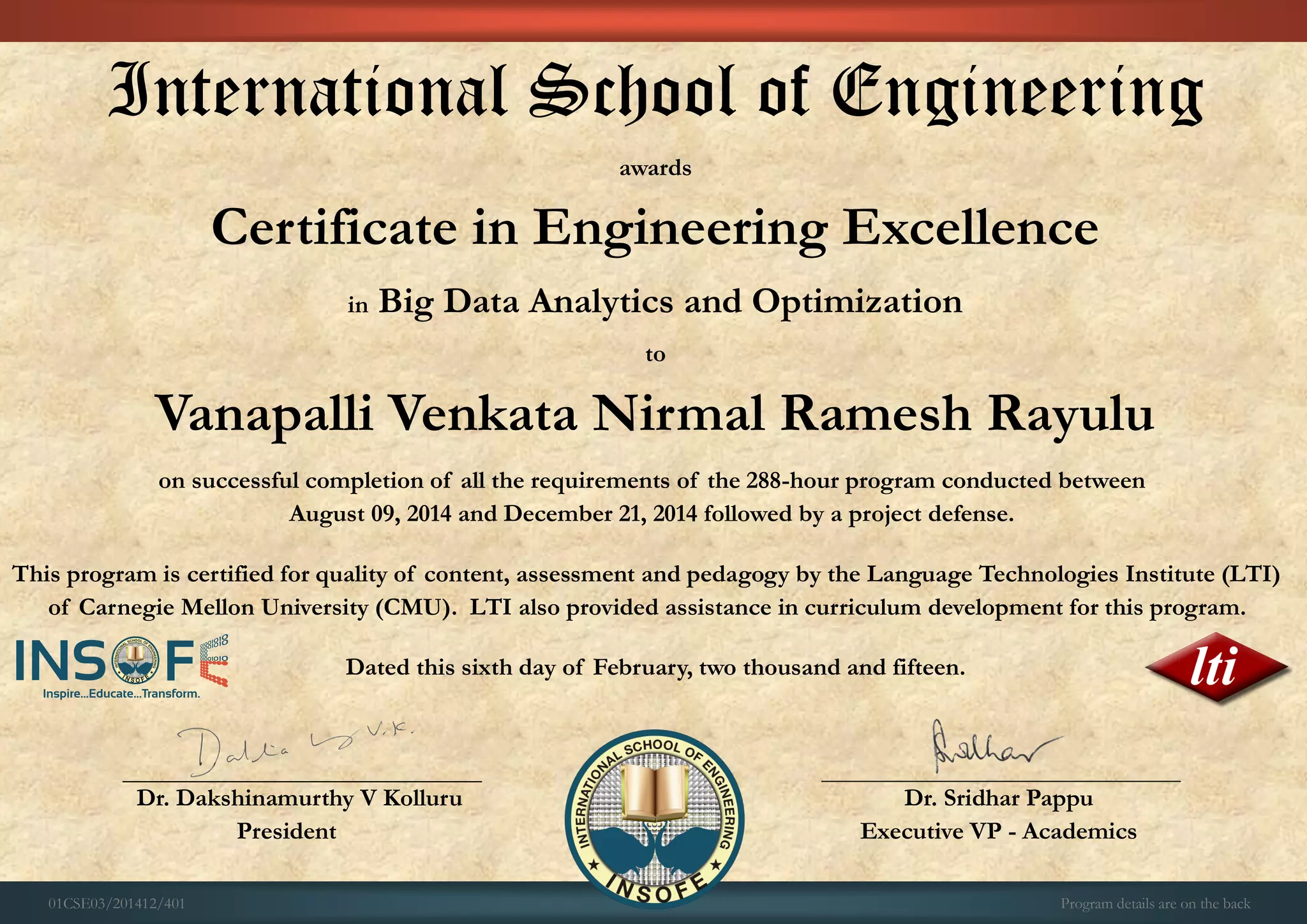
International School of Engineering
awards
Certificate in Engineering Excellence
in Big Data Analytics and Optimization
to
Vanapalli Venkata Nirmal Ramesh Rayulu
on successful completion of all the requirements of the 288-hour program conducted between
August 09, 2014 and December 21, 2014 followed by a project defense.
This program is certified for quality of content, assessment and pedagogy by the Language Technologies Institute (LTI)
of Carnegie Mellon University (CMU). LTI also provided assistance in curriculum development for this program.
Dated this sixth day of February, two thousand and fifteen.
Dr. Dakshinamurthy V Kolluru Dr. Sridhar Pappu
President Executive VP - Academics
01CSE03/201412/401 Program details are on the back
Mode: Classroom Teaching
Topics Covered
Certificate Type
Certificate of Participation Assessment-based training program Professional certification
Essential Business Skills for a Data Scientist
Why build models or use data to run a business? What kind of models are built? Were do models not work? How do
you make predictions? When does big unstructured data become important? What do you need to build an analytics
group in your organization?
Developing a business plan; Case analysis
Planning and Thinking Skills for Architecting Data Science Solutions
Thinking tools: Approximations and estimations, Geometric visualization of data and models, Probabilistic analysis of
data and models, Analyzing networks and graphs: Analyzing transitions, Markov chains and unstructured data;
Estimating complexity of algorithms
Choosing the right models and architecting a solution: Structure and anatomy of models, Problematic data and
choosing the right experimentation
Sources of errors in predictive models and techniques to minimize them
Interacting with technical and business teams; Case study
Essential Engineering Skills in Big Data Analytics
Reading from Excel, CSV and other forms; Data exploration (histograms, bar charts, box plots, line graphs and scatter
graphs); Storytelling with data: The science, ggplot, bubble charts with multiple dimensions, gauge charts, tree maps,
heat maps and motion charts
Advanced data pre-processing using Excel
Data pre-processing of structured data: R, Handling missing values, Binning, Standardization, Outliers/Noise, PCA, Type
conversion
Statistical Modeling for Predictive Analytics in Engineering and Business
Computing the properties of an attribute: Central tendencies (Mean, Median, Mode, Range, Variance, Standard
Deviation); Expectations of a Variable; Moment Generating Functions; Describing an attribute: Probability distributions
(Discrete and Continuous) - Bernoulli, Geometric, Binomial, Poisson and Exponential distributions; Special emphasis on
Normal distribution; Central Limit Theorem
Describing the relationship between attributes: Covariance; Correlation; ChiSquare
Inferential statistics: How to learn about the population from a sample and vice-versa, Sampling distributions,
Confidence Intervals, Hypothesis Testing
ANOVA; SPC
Regression (Linear, Multivariate Regression) in forecasting; Analyzing and interpreting regression results; Logistic
Regression
Trend analysis and Time Series; Cyclical and Seasonal analysis; Box-Jenkins method; Smoothing; Moving averages; Auto
-correlation; ARIMA – Holt-Winters method
Bayesian analysis and Naïve Bayes classifier; Bayesian Belief Networks
Optimization and Decision Analysis
Genetic algorithms: The algorithm and the process, Representing data, Why and how do they work?
Linear Programming: Graphical analysis; Sensitivity and Duality analyses; Integer and Binary programming: Applications,
Problem formulation, Solving in R; Goal programming; Data development analysis; Quadratic programming
Engineering Big Data with R and Hadoop Ecosystem
Introduction—Big Data, Hadoop applications; Parallel and Distributed computing; Introduction to algorithms;
Concurrent algorithms; Linux and Java refresher; R and Python refresher; NoSQL; HDFS; CDH4-HDFS
Map Reduce: YARN
Map Reduce Applications: Text Mining, Page Rank, Graph processing
Hadoop ecosystem components: Pig, Hive, HBase, Sqoop, Mahout, Hama, Flume, Chukwa, Avro, Whirr, Hue, Oozie,
Zookeeper
R-Hadoop
Text Mining, Social Network Analysis and Natural Language Processing
Introduction to text mining and text pre-processing: Write a web crawler to collect data, R, Find unique words and
counts, Handling number, Punctuations, Stop words, Incorrect spellings, Stemming, Lemmatization and TxD
computation
Unstructured vs. semi-structured data; Fundamentals of information retrieval
Properties of words; Vector space models; Creating Term-Document (TxD) matrices; Similarity measures
Low-level processes (Sentence Splitting; Tokenization; Part-of-Speech Tagging; Stemming; Chunking)
Text classification and feature selection: How to use Naïve Bayes classifier for text classification
Evaluation systems on the accuracy of text mining
Sentiment Analysis
Natural Language Analysis
Discussion of text mining tools and applications
Methods and Algorithms in Machine Learning
Rule based knowledge: Logic of rules, Evaluating rules, Rule induction and Association rules
Construction of Decision Trees through simplified examples; Choosing the "best" attribute at each
non-leaf node; Entropy; Information Gain; Generalizing Decision Trees; Information Content and Gain Ratio; Dealing
with numerical variables; Other measures of randomness; Pruning a Decision Tree; Cost as a consideration; Unwrapping
Trees as rules
Specialized decision trees (oblique trees)
Ensemble and Hybrid models
AdaBoost, Random Forests and Gradient boosting machines
K-Nearest Neighbor method; Wilson editing and triangulations; K-nearest neighbors in collaborative filtering, digit
recognition
Motivation for Neural Networks and its applications; Perceptron and Single Layer Neural Network, and hand
calculations; Learning in a Neural Net: Back propagation and conjugant gradient techniques; Application of Neural Net
in Face and Digit Recognition
Deep Learning techniques
Connectivity models (hierarchical clustering); Centroid models (K-Means algorithm); Distribution models (Expectation
maximization); Spectral clustering
Linear learning machines and Kernel methods in learning
VC (Vapnik-Chervonenkis) dimension; Shattering power of models
Algorithm of Support Vector Machines (SVM)
Communication, Ethical and IP Challenges for Analytics Professionals
Why is Communication important?
How to communicate effectively: Telling stories
Communications issues from daily life using examples using audio, video, blogs, charts, email, etc.
Seeing the big picture; Paying attention to details; Seeing things from multiple perspectives
Challenges: Mix of stakeholders, Explicability of results, Visualization
Guiding Principles: Clarity, Transparency, Integrity, Humility
Framework for Effective Presentations; Examples of bad and good presentations
Writing effective technical reports
Difference between Legal and Ethical issues
Challenges in current laws, regulations and fair information practices: Data protection, Intellectual property rights,
Confidentiality, Contractual liability, Competition law, Licensing of Open Source software and Open Data
How to handle legal, ethical and IP issues at an organization and an individual level?
The “Ethics Check” questions

Data Analytics_BigData Cert

  • 1.
    International School ofEngineering awards Certificate in Engineering Excellence in Big Data Analytics and Optimization to Vanapalli Venkata Nirmal Ramesh Rayulu on successful completion of all the requirements of the 288-hour program conducted between August 09, 2014 and December 21, 2014 followed by a project defense. This program is certified for quality of content, assessment and pedagogy by the Language Technologies Institute (LTI) of Carnegie Mellon University (CMU). LTI also provided assistance in curriculum development for this program. Dated this sixth day of February, two thousand and fifteen. Dr. Dakshinamurthy V Kolluru Dr. Sridhar Pappu President Executive VP - Academics 01CSE03/201412/401 Program details are on the back
  • 2.
    Mode: Classroom Teaching TopicsCovered Certificate Type Certificate of Participation Assessment-based training program Professional certification Essential Business Skills for a Data Scientist Why build models or use data to run a business? What kind of models are built? Were do models not work? How do you make predictions? When does big unstructured data become important? What do you need to build an analytics group in your organization? Developing a business plan; Case analysis Planning and Thinking Skills for Architecting Data Science Solutions Thinking tools: Approximations and estimations, Geometric visualization of data and models, Probabilistic analysis of data and models, Analyzing networks and graphs: Analyzing transitions, Markov chains and unstructured data; Estimating complexity of algorithms Choosing the right models and architecting a solution: Structure and anatomy of models, Problematic data and choosing the right experimentation Sources of errors in predictive models and techniques to minimize them Interacting with technical and business teams; Case study Essential Engineering Skills in Big Data Analytics Reading from Excel, CSV and other forms; Data exploration (histograms, bar charts, box plots, line graphs and scatter graphs); Storytelling with data: The science, ggplot, bubble charts with multiple dimensions, gauge charts, tree maps, heat maps and motion charts Advanced data pre-processing using Excel Data pre-processing of structured data: R, Handling missing values, Binning, Standardization, Outliers/Noise, PCA, Type conversion Statistical Modeling for Predictive Analytics in Engineering and Business Computing the properties of an attribute: Central tendencies (Mean, Median, Mode, Range, Variance, Standard Deviation); Expectations of a Variable; Moment Generating Functions; Describing an attribute: Probability distributions (Discrete and Continuous) - Bernoulli, Geometric, Binomial, Poisson and Exponential distributions; Special emphasis on Normal distribution; Central Limit Theorem Describing the relationship between attributes: Covariance; Correlation; ChiSquare Inferential statistics: How to learn about the population from a sample and vice-versa, Sampling distributions, Confidence Intervals, Hypothesis Testing ANOVA; SPC Regression (Linear, Multivariate Regression) in forecasting; Analyzing and interpreting regression results; Logistic Regression Trend analysis and Time Series; Cyclical and Seasonal analysis; Box-Jenkins method; Smoothing; Moving averages; Auto -correlation; ARIMA – Holt-Winters method Bayesian analysis and Naïve Bayes classifier; Bayesian Belief Networks Optimization and Decision Analysis Genetic algorithms: The algorithm and the process, Representing data, Why and how do they work? Linear Programming: Graphical analysis; Sensitivity and Duality analyses; Integer and Binary programming: Applications, Problem formulation, Solving in R; Goal programming; Data development analysis; Quadratic programming Engineering Big Data with R and Hadoop Ecosystem Introduction—Big Data, Hadoop applications; Parallel and Distributed computing; Introduction to algorithms; Concurrent algorithms; Linux and Java refresher; R and Python refresher; NoSQL; HDFS; CDH4-HDFS Map Reduce: YARN Map Reduce Applications: Text Mining, Page Rank, Graph processing Hadoop ecosystem components: Pig, Hive, HBase, Sqoop, Mahout, Hama, Flume, Chukwa, Avro, Whirr, Hue, Oozie, Zookeeper R-Hadoop Text Mining, Social Network Analysis and Natural Language Processing Introduction to text mining and text pre-processing: Write a web crawler to collect data, R, Find unique words and counts, Handling number, Punctuations, Stop words, Incorrect spellings, Stemming, Lemmatization and TxD computation Unstructured vs. semi-structured data; Fundamentals of information retrieval Properties of words; Vector space models; Creating Term-Document (TxD) matrices; Similarity measures Low-level processes (Sentence Splitting; Tokenization; Part-of-Speech Tagging; Stemming; Chunking) Text classification and feature selection: How to use Naïve Bayes classifier for text classification Evaluation systems on the accuracy of text mining Sentiment Analysis Natural Language Analysis Discussion of text mining tools and applications Methods and Algorithms in Machine Learning Rule based knowledge: Logic of rules, Evaluating rules, Rule induction and Association rules Construction of Decision Trees through simplified examples; Choosing the "best" attribute at each non-leaf node; Entropy; Information Gain; Generalizing Decision Trees; Information Content and Gain Ratio; Dealing with numerical variables; Other measures of randomness; Pruning a Decision Tree; Cost as a consideration; Unwrapping Trees as rules Specialized decision trees (oblique trees) Ensemble and Hybrid models AdaBoost, Random Forests and Gradient boosting machines K-Nearest Neighbor method; Wilson editing and triangulations; K-nearest neighbors in collaborative filtering, digit recognition Motivation for Neural Networks and its applications; Perceptron and Single Layer Neural Network, and hand calculations; Learning in a Neural Net: Back propagation and conjugant gradient techniques; Application of Neural Net in Face and Digit Recognition Deep Learning techniques Connectivity models (hierarchical clustering); Centroid models (K-Means algorithm); Distribution models (Expectation maximization); Spectral clustering Linear learning machines and Kernel methods in learning VC (Vapnik-Chervonenkis) dimension; Shattering power of models Algorithm of Support Vector Machines (SVM) Communication, Ethical and IP Challenges for Analytics Professionals Why is Communication important? How to communicate effectively: Telling stories Communications issues from daily life using examples using audio, video, blogs, charts, email, etc. Seeing the big picture; Paying attention to details; Seeing things from multiple perspectives Challenges: Mix of stakeholders, Explicability of results, Visualization Guiding Principles: Clarity, Transparency, Integrity, Humility Framework for Effective Presentations; Examples of bad and good presentations Writing effective technical reports Difference between Legal and Ethical issues Challenges in current laws, regulations and fair information practices: Data protection, Intellectual property rights, Confidentiality, Contractual liability, Competition law, Licensing of Open Source software and Open Data How to handle legal, ethical and IP issues at an organization and an individual level? The “Ethics Check” questions