Tomas Petricek PhD Student Microsoft C# MVP Accessing loosely structured data from F# and C# http://tomasp.net/blog  | @tomaspetricek
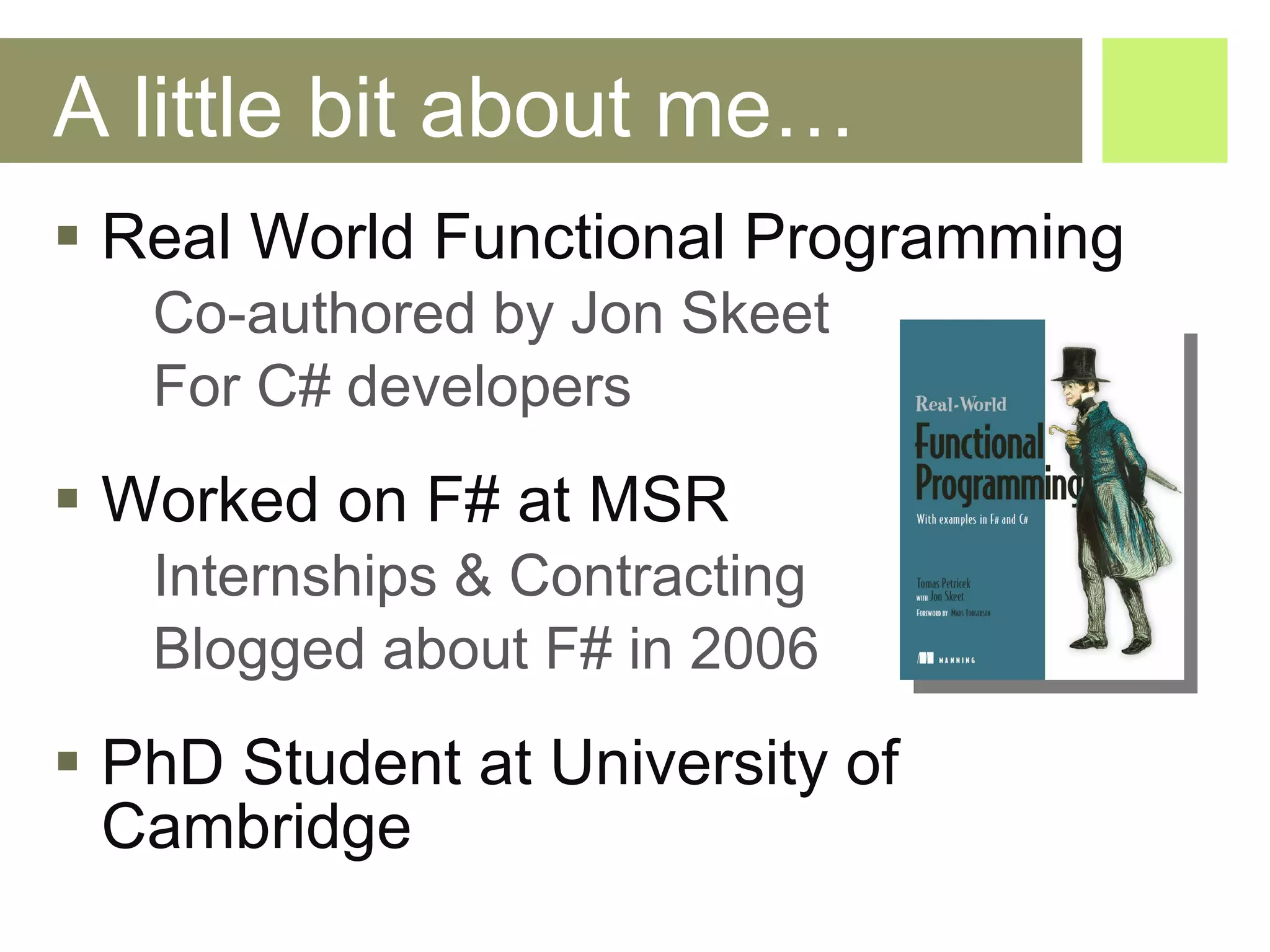
A little bit about me… Real World Functional Programming Co-authored by Jon Skeet For C# developers Worked on F# at MSR Internships & Contracting  Blogged about F# in 2006 PhD Student at University of Cambridge
The Problem
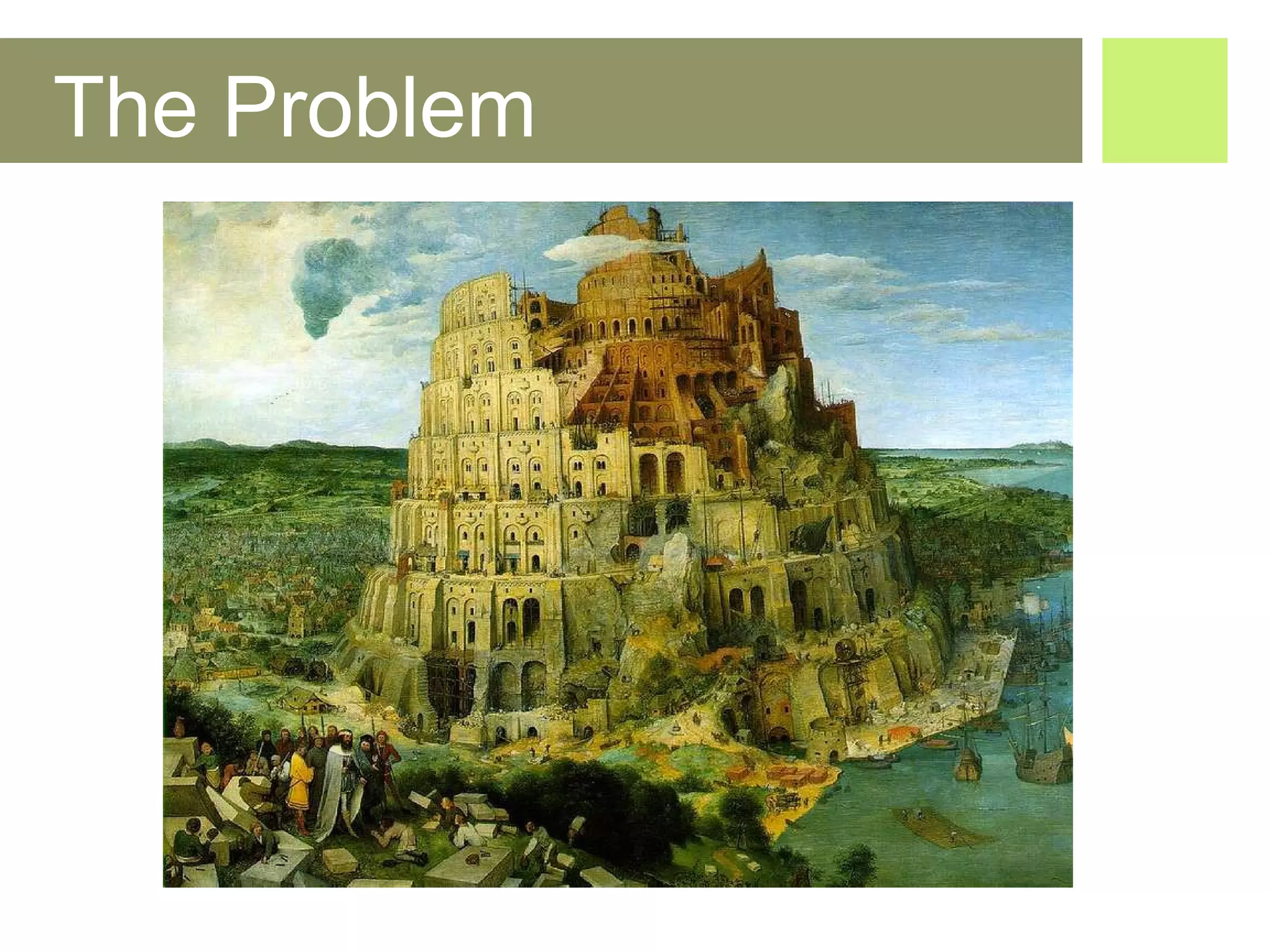
The Problem Structure in the language Classes with properties (C#) Data types or classes (F#) Structure in the data source Database structure, XML schema  (explicit) REST service or JSON file (implicit) How to solve the impedance mismatch?
What you’ll learn today “ Design Patterns” for solving structure mismatch  What options do we have in general Interesting dynamic and reflection tricks Things you can implement in C# or F# How F# type providers work Future F# technology that  “brings data  into the language, strongly typed”
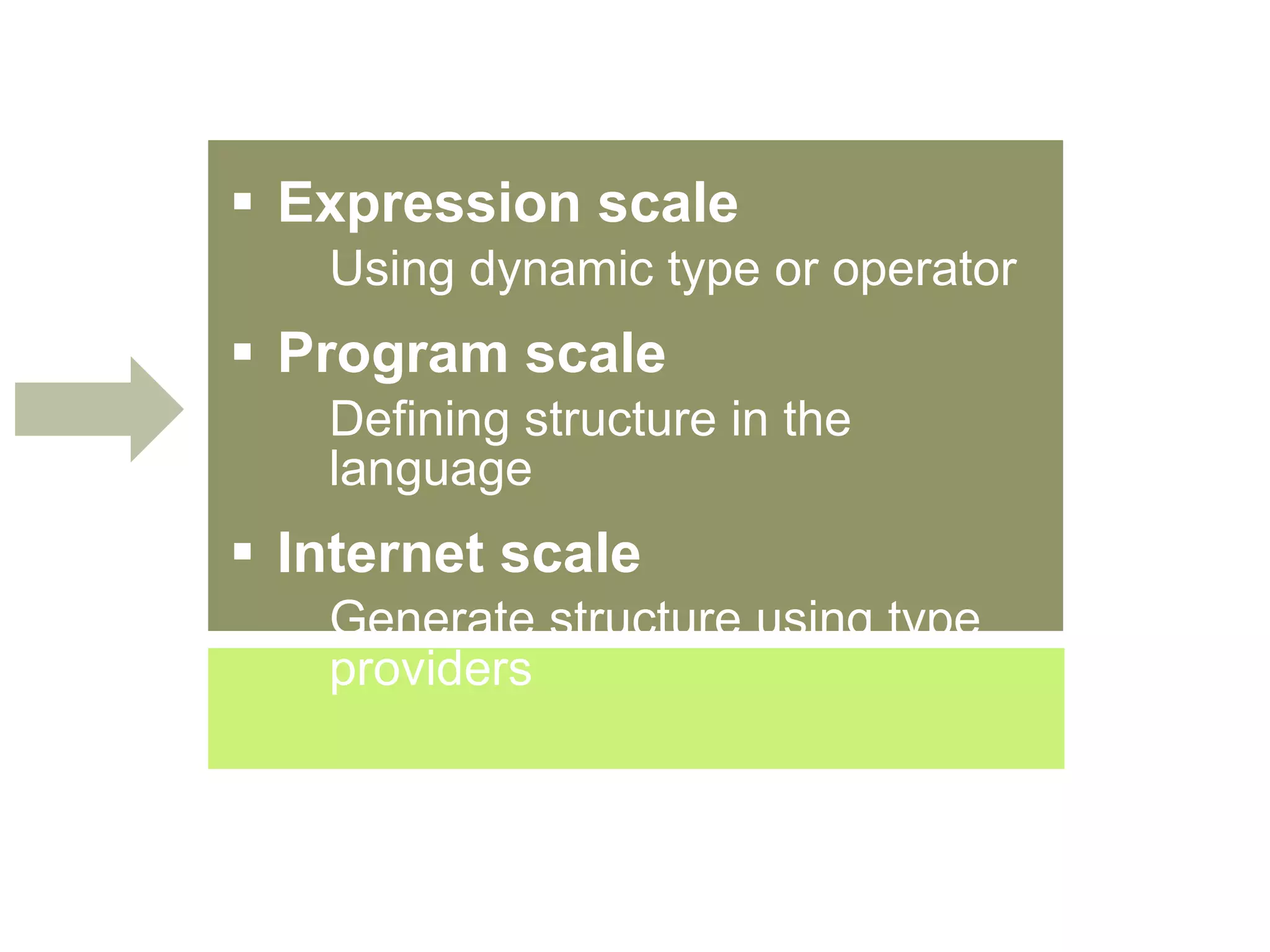
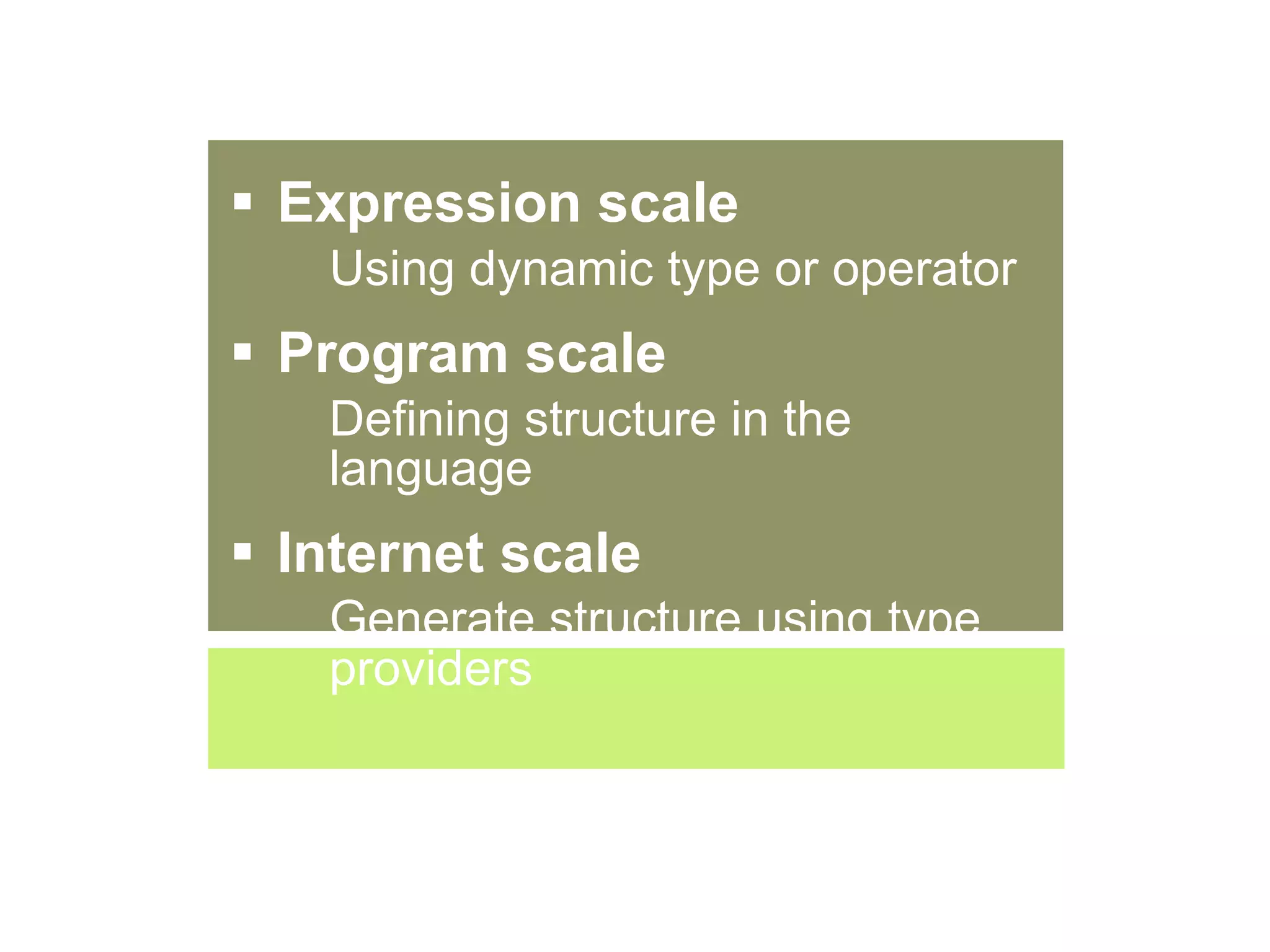
Expression scale Using dynamic type or operator Program scale Defining structure in the language Internet scale Generate structure using type providers
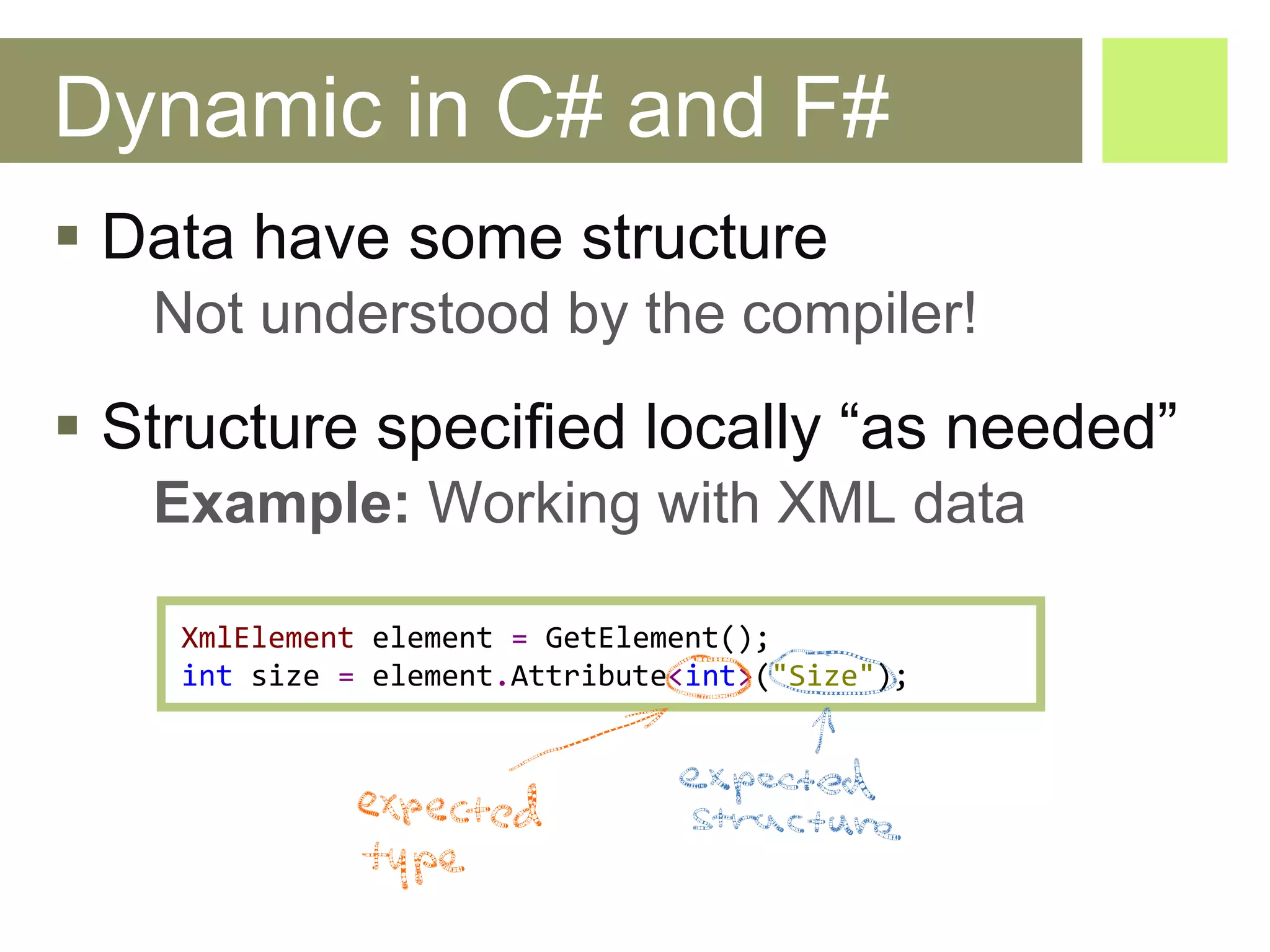
Dynamic in C# and F# Data have some structure Not understood by the compiler! Structure specified locally “as needed” Example:  Working with XML data X ml Element   element   =   GetElement (); int   size  =  e lement . Attribute < int > ( &quot;Size&quot; );
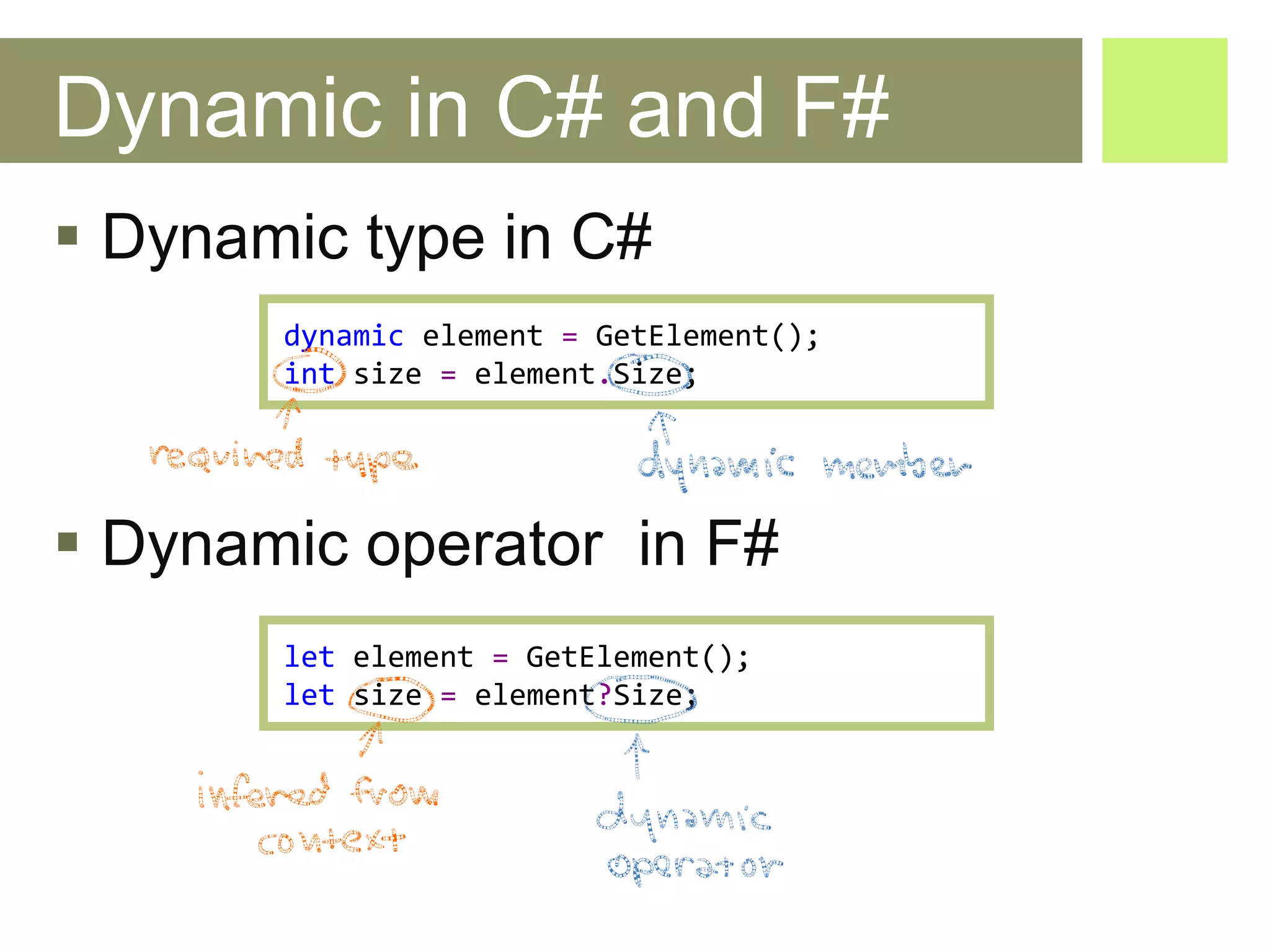
Dynamic in C# and F# Dynamic type in C# Dynamic operator  in F# dynamic   element   =   GetElement (); int   size  =  e lement . Size ; let   element   =   GetElement (); let  size  =  e lement ? Size ;
Demo:  Using  WorldBank data in C#
Dynamic type in C# Operations resolved at runtime Result is dynamic, but can be converted class   DynamicWorldBank  :  DynamicObject   { public   override   bool   TryInvokeMember ( InvokeMemberBinder   binder ,  object []  args ,  out   object   result)   { result   =   /* member access for 'binder.Name' */ return   true ; } } dynamic   wb   =   new   DynamicWorldBank (); dynamic   regions   =   wb . Region ( new  {  PerPage   =   100  });
Simple database access in F# Operation resolved at compile-time Result has statically known type (not dynamic) Can be inferred from context let   getCategories()  :   seq < int   *  string >   =   [   for   row   in   db . Query ? GetProducts ()  ->  row ? ID ,  row ? Name   ] let  ( ? ) ( x : Row)  ( name : string )  :   ' R   =   x . Reader . [ name ]  :?>   ' R
Demo:  Calling database in F#
Expression scale Using dynamic type or operator Program scale Defining structure in the language Internet scale Generate structure using type providers
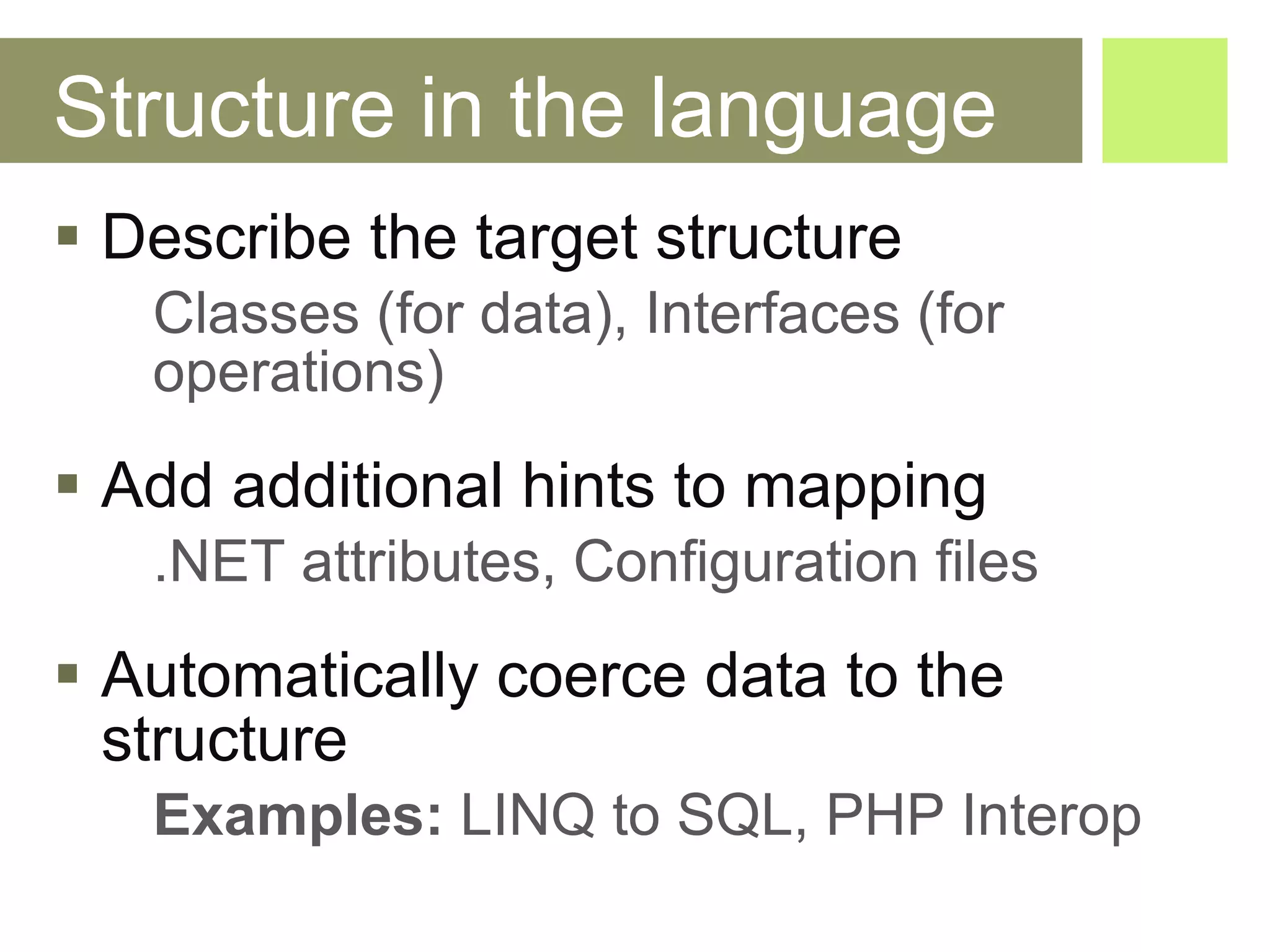
Structure in the language Describe the target structure Classes (for data), Interfaces (for operations) Add additional hints to mapping .NET attributes, Configuration files Automatically coerce data to the structure Examples:  LINQ to SQL, PHP Interop
Domain modeling in LINQ Data structure described as C# class Match data to the structure Done at run-time & can fail public   partial   class   Books   { [ Column ( Storage = &quot;_ID&quot; ,  DbType = &quot;Int&quot; ,  IsPrimaryKey = true )] public   int   ID  {  get ;  set ; } [ Column ( Storage = &quot;_Title&quot; ,  DbType = &quot;VarChar(100)&quot; )] public   string   Title  {  get ;  set ; } } var   q   =   from   p   in   db . GetTable < Books > () select   p . Title ;
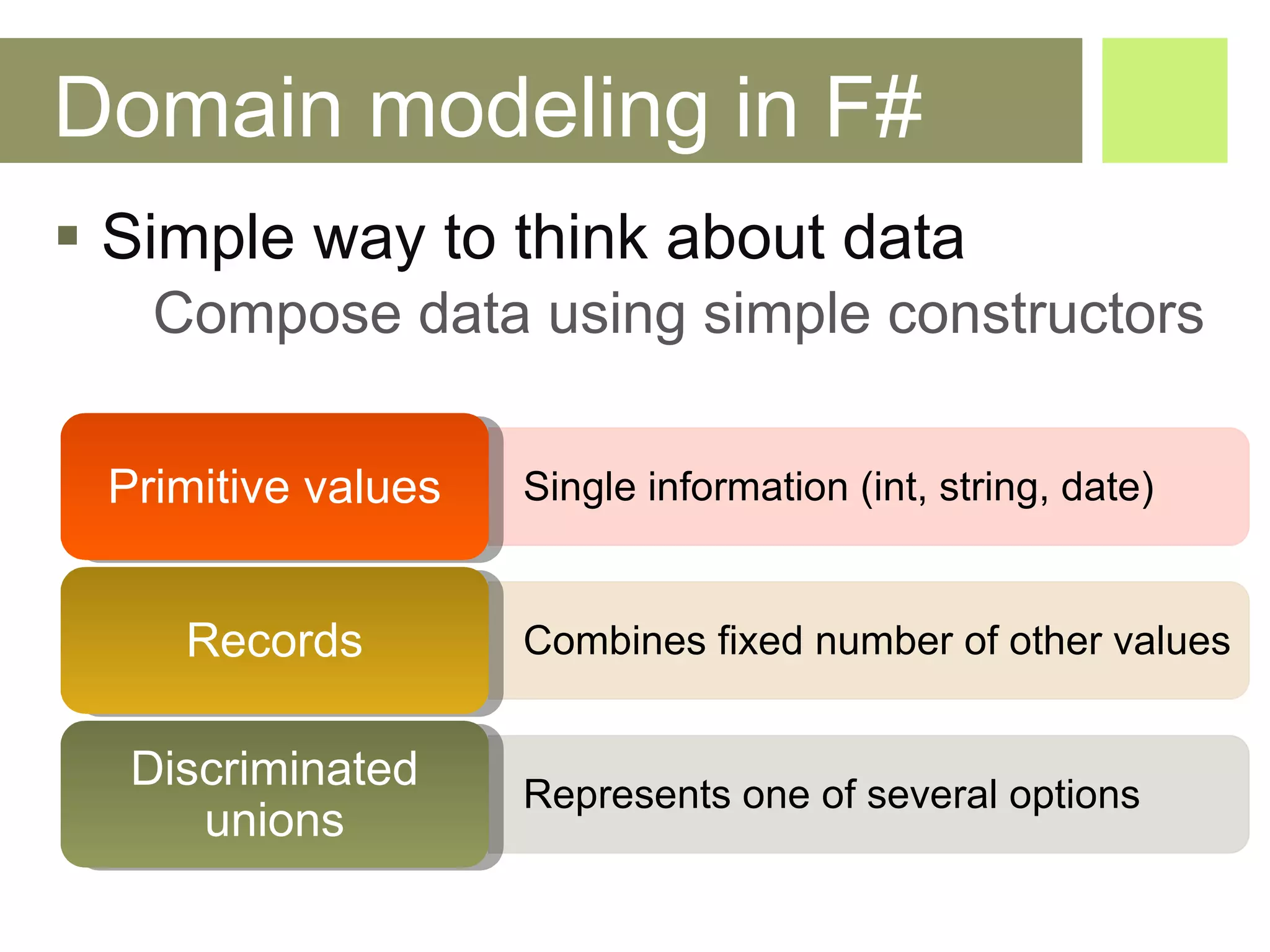
Domain modeling in F# Simple way to think about data Compose data using simple constructors Single information (int, string, date) Primitive values Combines fixed number of other values Records Represents one of several options Discriminated unions
Demo:  Nicer database access
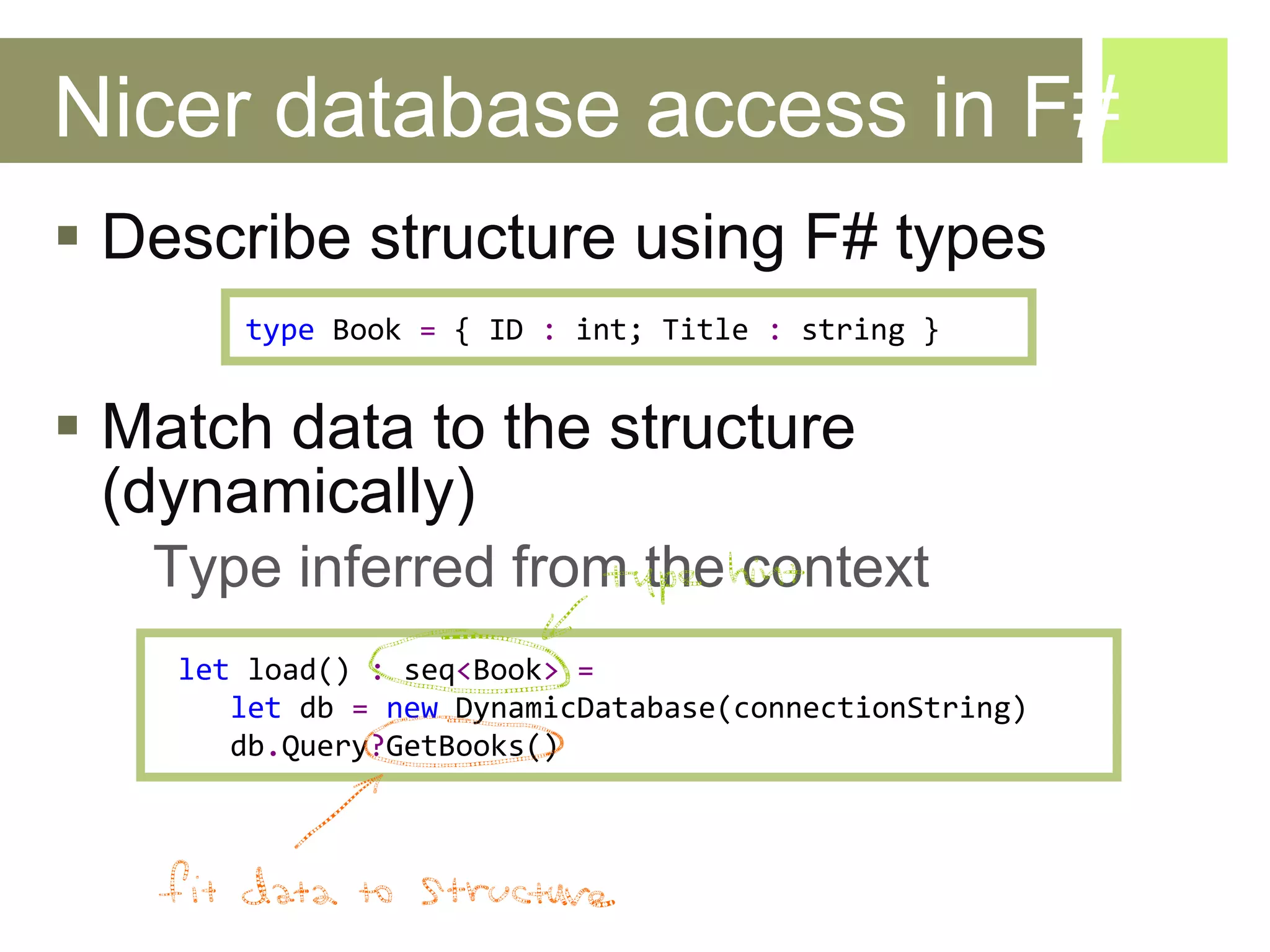
Nicer database access in F# Describe structure using F# types Match data to the structure (dynamically) Type inferred from the context  let   load ()  :   seq < Book >   =   let   db   =   new   DynamicDatabase ( connectionString ) db . Query ? Get Books ()  type   Book   =   {  ID   :   int ;  Title   :   string  }
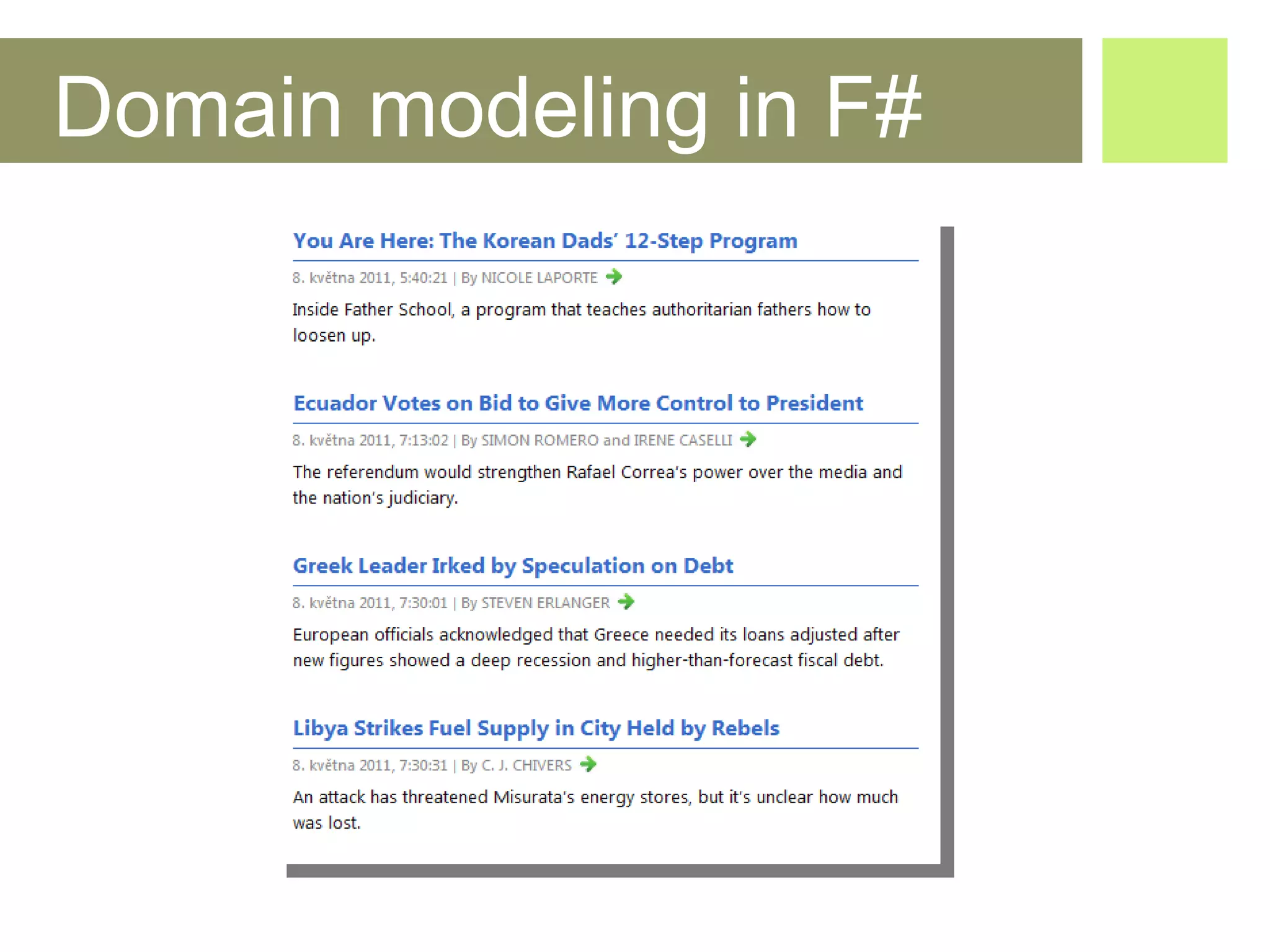
Domain modeling in F#
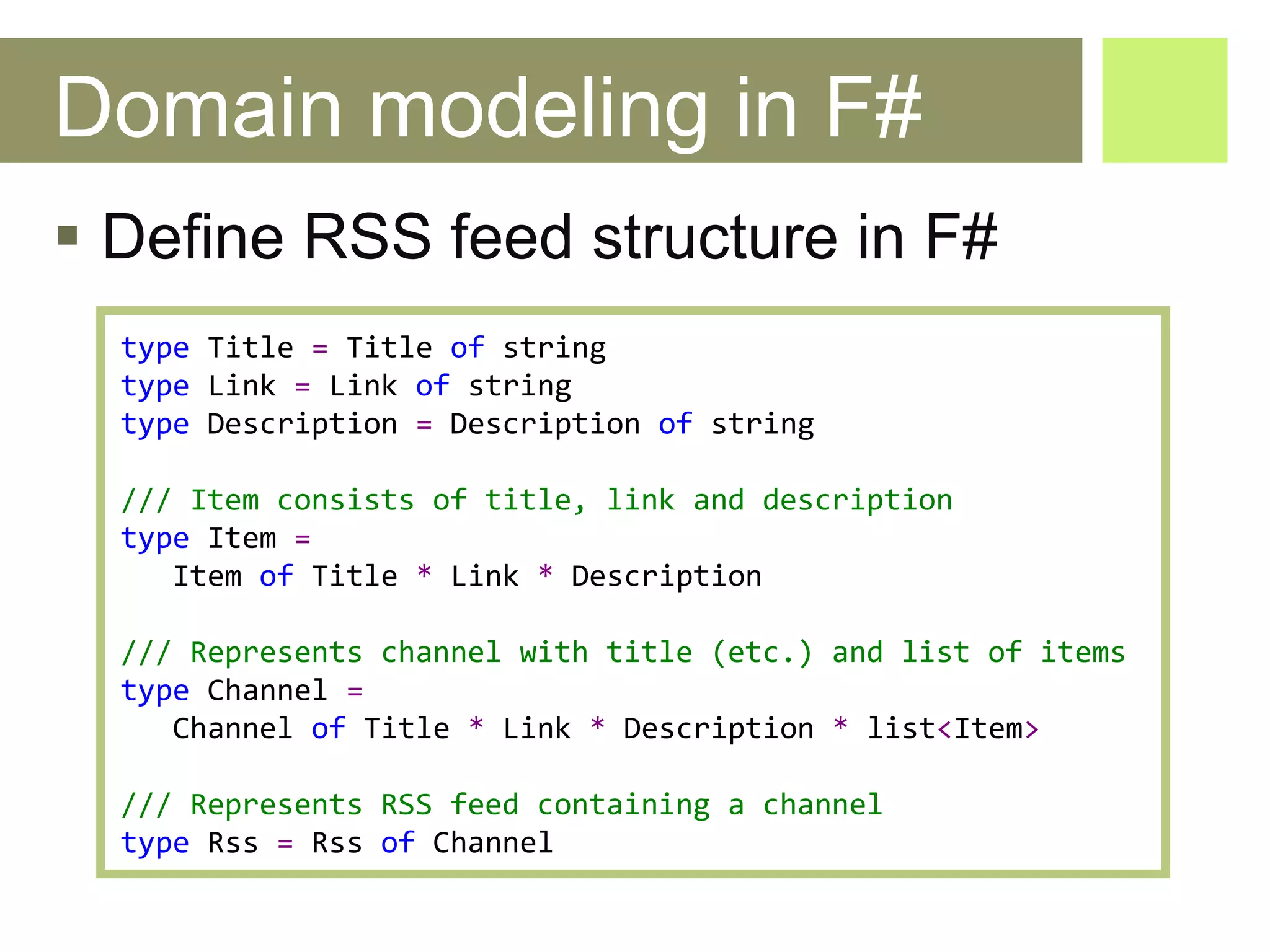
Domain modeling in F# Define RSS feed structure in F# type   Title   =   Title   of   string type   Link   =   Link   of   string type   Description   =   Description   of   string /// Item consists of title, link and description type   Item   =   Item   of   Title   *   Link   *   Description /// Represents channel with title (etc.) and list of items type   Channel   =   Channel   of   Title   *   Link   *   Description   *   list < Item > /// Represents RSS feed containing a channel type   Rss   =   Rss   of   Channel
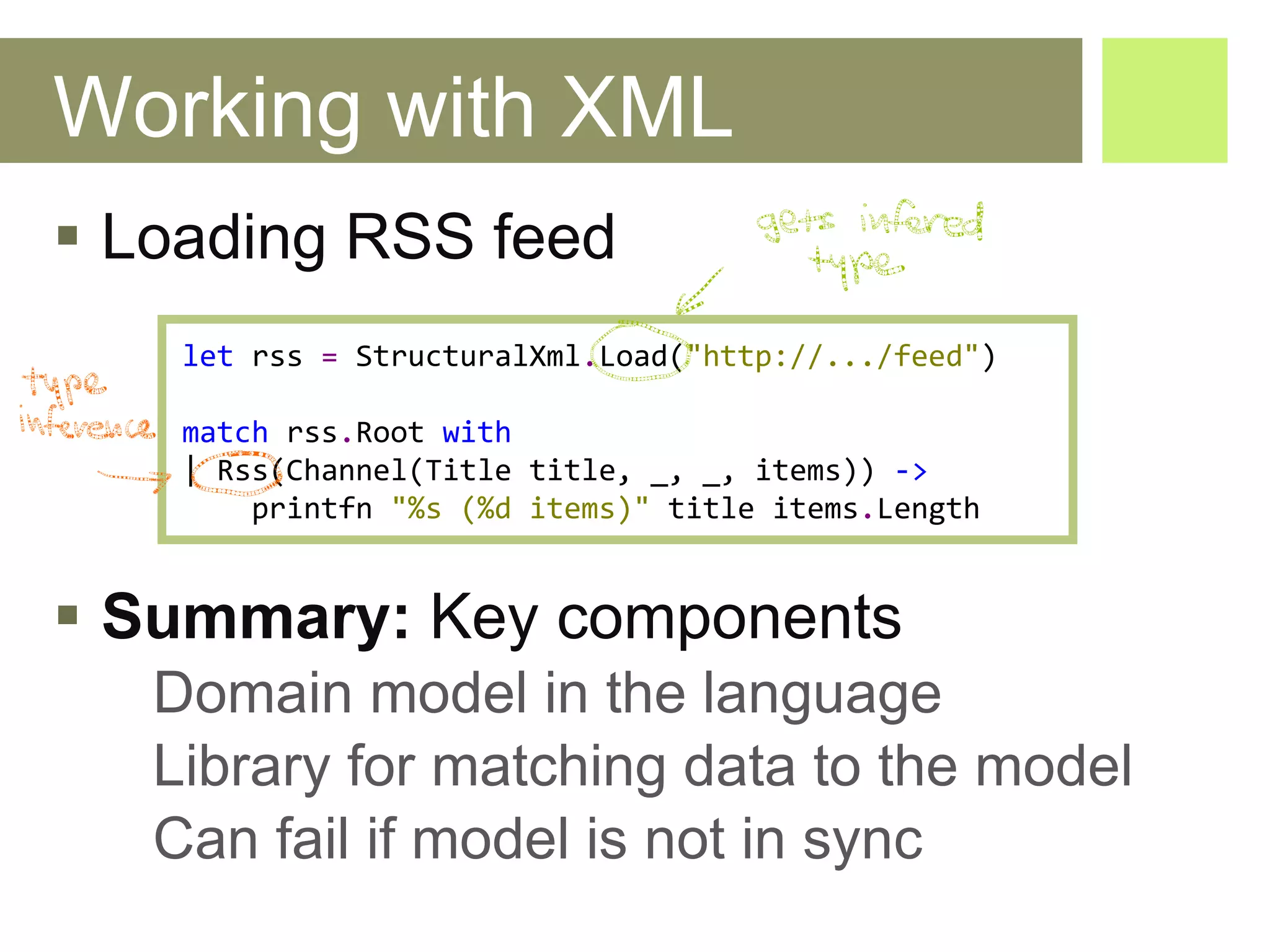
Working with XML Loading RSS feed Summary:  Key components Domain model in the language Library for matching data to the model Can fail if model is not in sync let   rss  =   StructuralXml . Load ( &quot;http://.../feed&quot; ) match   rss . Root   with |  Rss ( Channel ( Title   title ,  _ , _,  items ))  ->   printfn   &quot;%s (%d items)&quot;   title   items . Length
Demo:  Working with XML
Expression scale Using dynamic type or operator Program scale Defining structure in the language Internet scale Generate structure using type providers
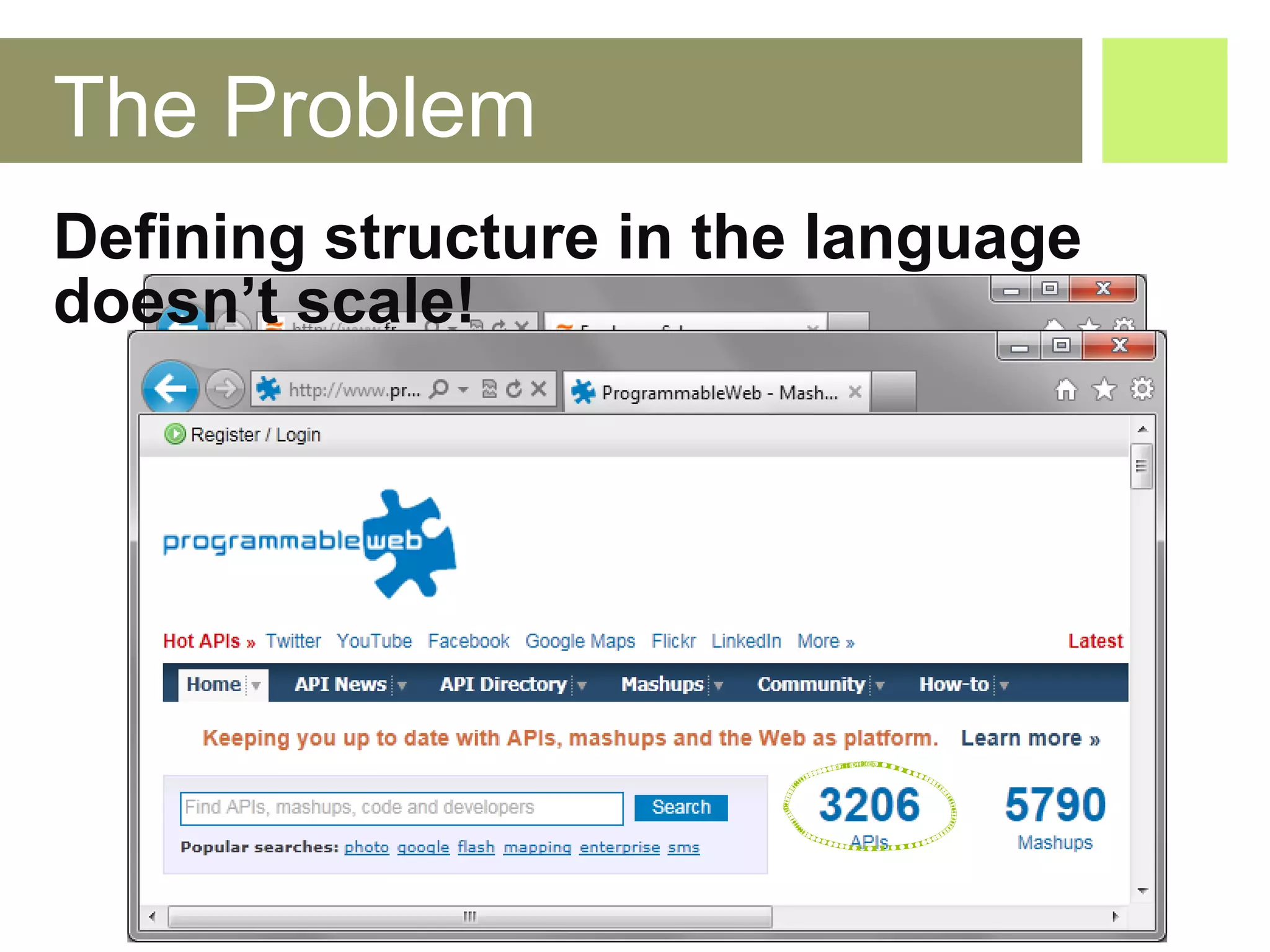
The Problem Defining structure in the language doesn’t scale!
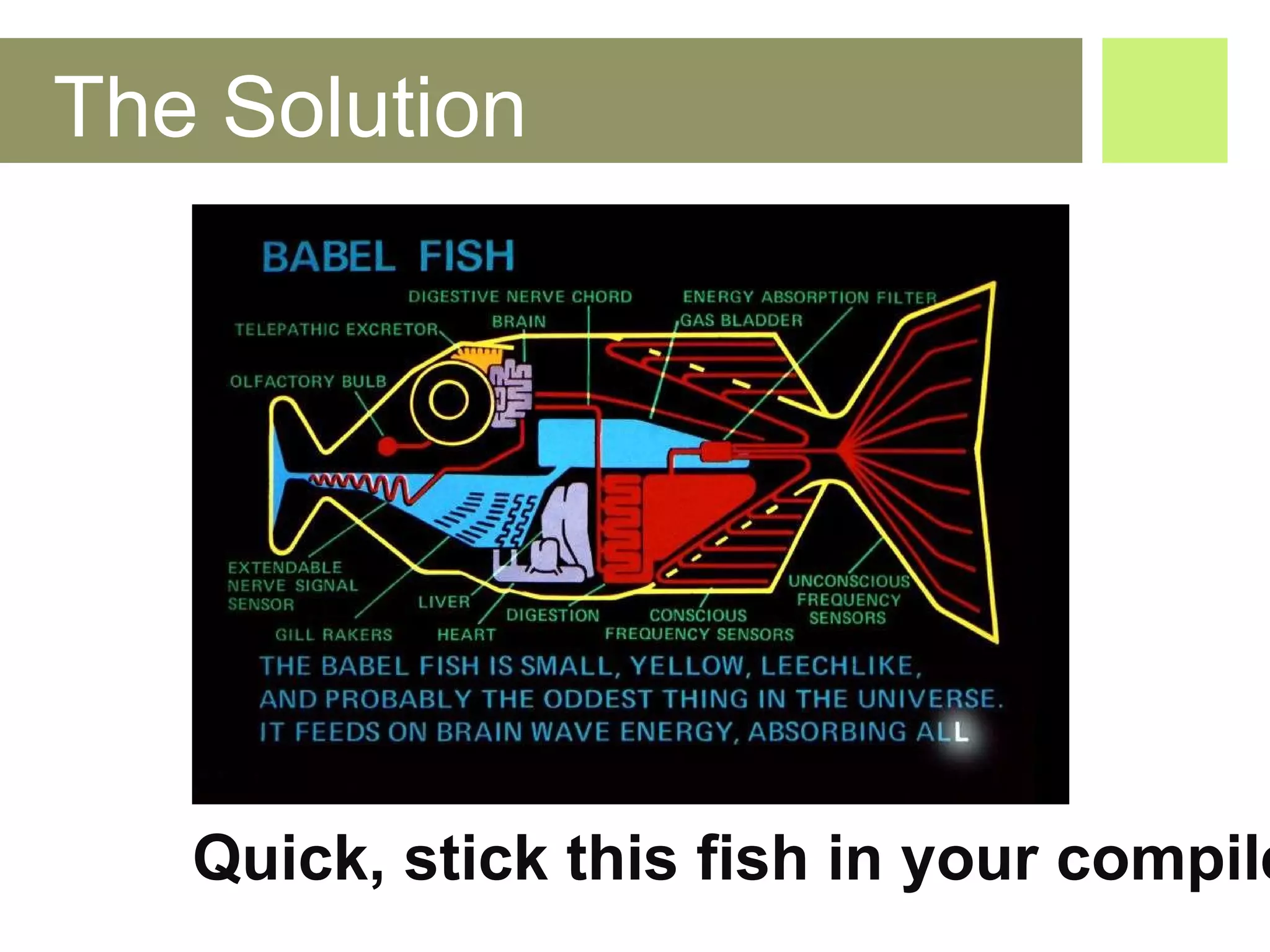
The Solution Quick, stick this fish in your compiler!
Demo:  Accessing WorldBank data
What is a type provider? Assembly containing a special type Creating them is easier than it looks Method calls replaced by expressions … or you can generate real types public   interface   ITypeProvider   { Type []  GetTypes (); Expression   GetInvokerExpression (   MethodBase   method ,  ParameterExpression []  params  ); event   EventHandler   Invalidate ; }
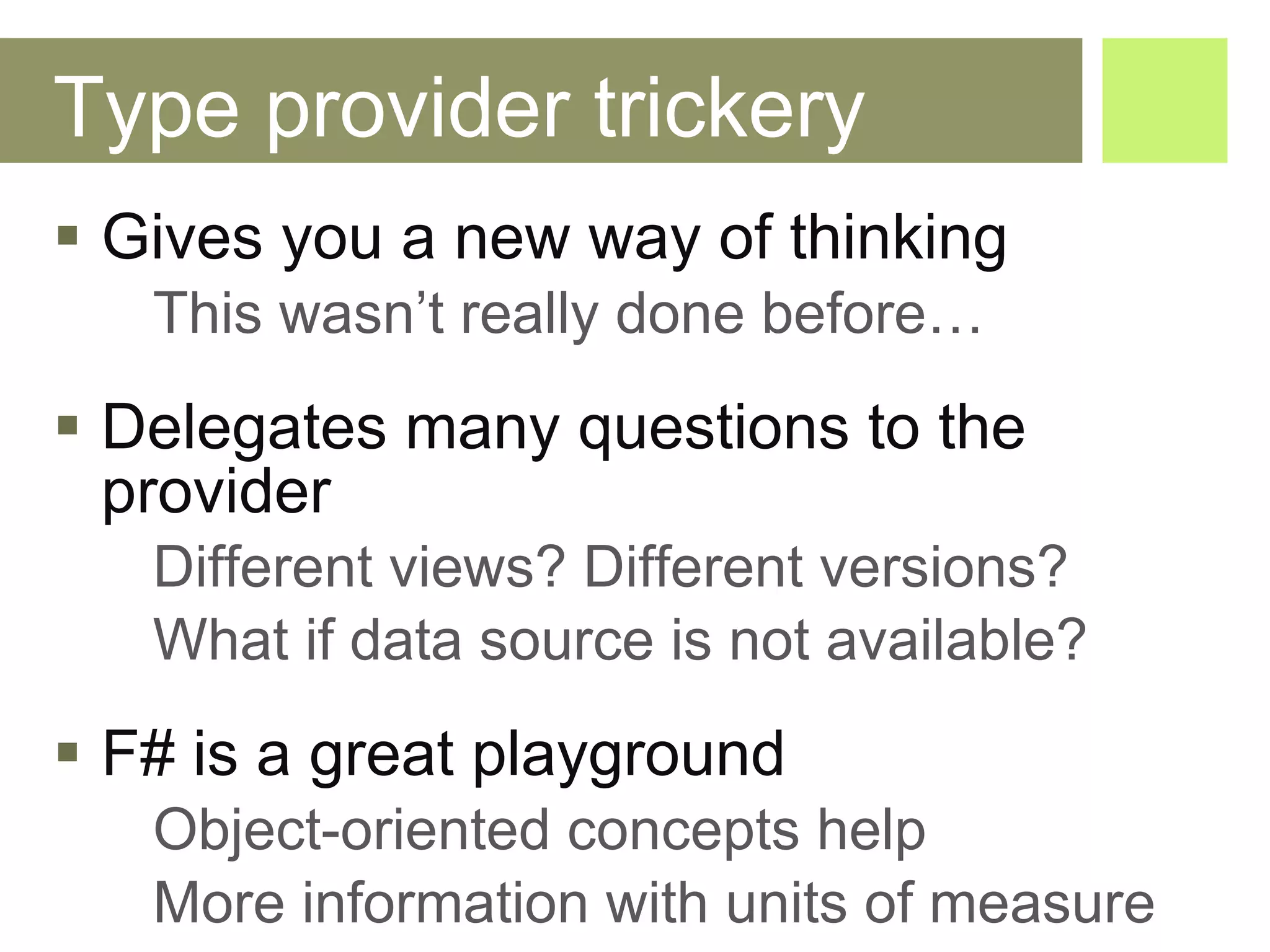
Type provider trickery Gives you a new way of thinking This wasn’t really done before… Delegates many questions to the provider Different views? Different versions? What if data source is not available? F# is a great playground Object-oriented concepts help More information with units of measure
Demo:  Accessing Freebase data
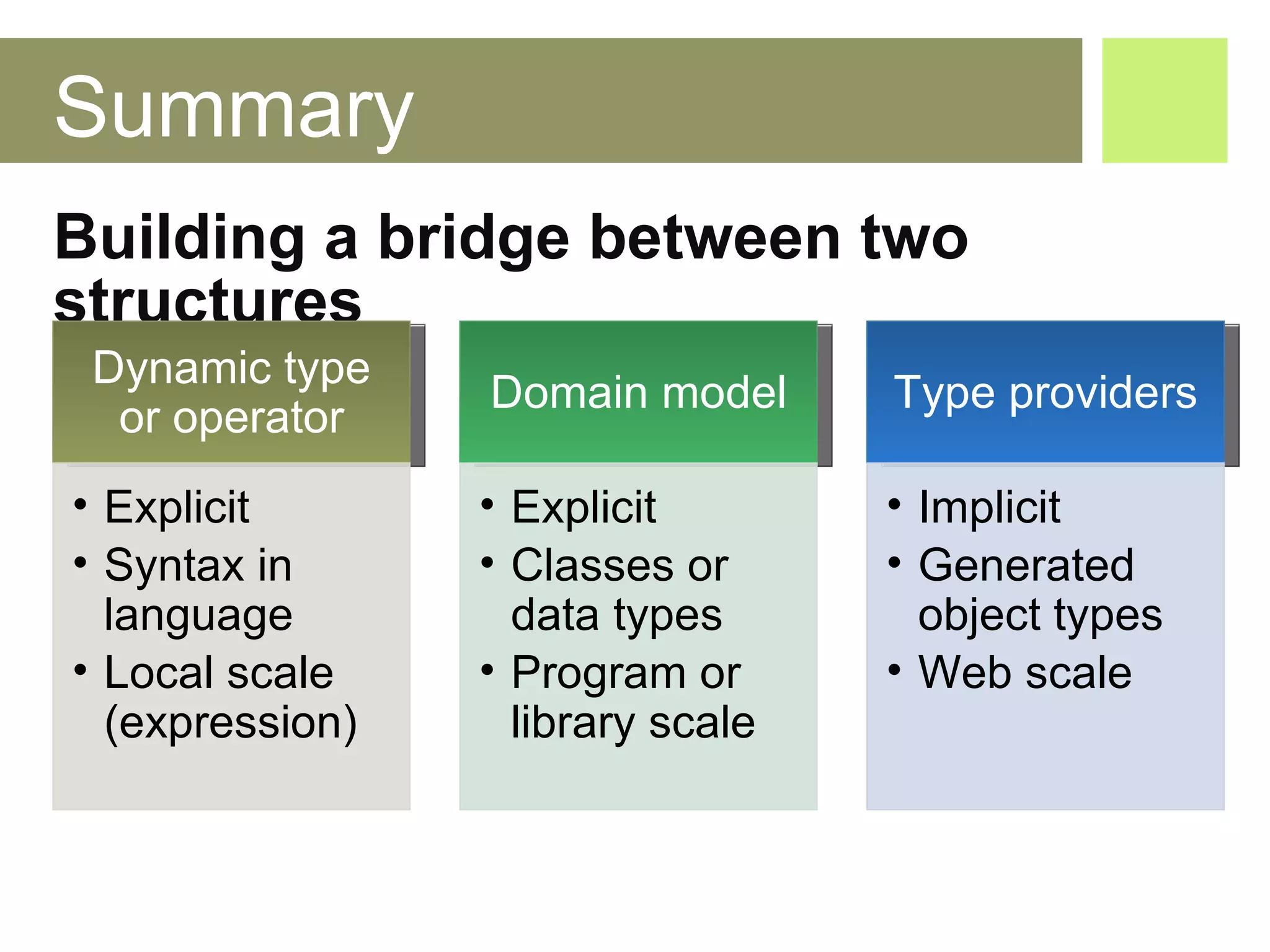
Summary Building a bridge between two structures Dynamic type or operator Explicit Syntax in language Local scale (expression) Domain model Explicit Classes or data types Program or library scale Type providers Implicit Generated object types Web scale
Discussion Questions & Answers? F# training at SkillsMatter Functional Programming with .NET  (27-28 October) Real-World F# Programming  (15-16 December) Contact http://tomasp.net  | @tomaspetricek |  [email_address]
BONUS
World Bank provider details At runtime countries & indicators are strings For example “GBR” or “GC.DOD.TOTL.GD.ZS” Members translated to runtime functions type   Runtime   = static   member   GetValuesByCountryAndIndicator ( country : string ,  indicator : string )  :   seq < int   *   float >   =   seq  {  for  ( k ,  v )  in   WorldBank . GetData  [ country ;  indicator ]  do if   not  ( String . IsNullOrEmpty   v )  then   yield   int   k ,  float   v  } static   member   GetCountriesByRegion ( code : string )  :   seq < string >   = seq  {  for  ( key , _)  in   WorldBank . GetCountries ( code )  ->   key  }
Calling PHP from C# Dynamically typed PHP object Required structure specified as a C# interface class   SampleObj  { function   Add ($ a , $ b ) {  return  $ a   +  $ b ; } } [ DuckType ] public   interface   ISampleObj  { int   Add ( int   i1 ,  int   i2 ); } ISampleObj   so   =   ctx . New < ISampleObj > ( &quot;SampleObj&quot; ); int   res   =   so . Add ( 18 ,  26 );

Accessing loosely structured data from F# and C#

  • 1.
    Tomas Petricek PhDStudent Microsoft C# MVP Accessing loosely structured data from F# and C# http://tomasp.net/blog | @tomaspetricek
  • 2.
    A little bitabout me… Real World Functional Programming Co-authored by Jon Skeet For C# developers Worked on F# at MSR Internships & Contracting Blogged about F# in 2006 PhD Student at University of Cambridge
  • 3.
  • 4.
    The Problem Structurein the language Classes with properties (C#) Data types or classes (F#) Structure in the data source Database structure, XML schema (explicit) REST service or JSON file (implicit) How to solve the impedance mismatch?
  • 5.
    What you’ll learntoday “ Design Patterns” for solving structure mismatch What options do we have in general Interesting dynamic and reflection tricks Things you can implement in C# or F# How F# type providers work Future F# technology that “brings data into the language, strongly typed”
  • 6.
    Expression scale Usingdynamic type or operator Program scale Defining structure in the language Internet scale Generate structure using type providers
  • 7.
    Dynamic in C#and F# Data have some structure Not understood by the compiler! Structure specified locally “as needed” Example: Working with XML data X ml Element element = GetElement (); int size = e lement . Attribute < int > ( &quot;Size&quot; );
  • 8.
    Dynamic in C#and F# Dynamic type in C# Dynamic operator in F# dynamic element = GetElement (); int size = e lement . Size ; let element = GetElement (); let size = e lement ? Size ;
  • 9.
    Demo: Using WorldBank data in C#
  • 10.
    Dynamic type inC# Operations resolved at runtime Result is dynamic, but can be converted class DynamicWorldBank : DynamicObject { public override bool TryInvokeMember ( InvokeMemberBinder binder , object [] args , out object result) { result = /* member access for 'binder.Name' */ return true ; } } dynamic wb = new DynamicWorldBank (); dynamic regions = wb . Region ( new { PerPage = 100 });
  • 11.
    Simple database accessin F# Operation resolved at compile-time Result has statically known type (not dynamic) Can be inferred from context let getCategories() : seq < int * string > = [ for row in db . Query ? GetProducts () -> row ? ID , row ? Name ] let ( ? ) ( x : Row) ( name : string ) : ' R = x . Reader . [ name ] :?> ' R
  • 12.
    Demo: Callingdatabase in F#
  • 13.
    Expression scale Usingdynamic type or operator Program scale Defining structure in the language Internet scale Generate structure using type providers
  • 14.
    Structure in thelanguage Describe the target structure Classes (for data), Interfaces (for operations) Add additional hints to mapping .NET attributes, Configuration files Automatically coerce data to the structure Examples: LINQ to SQL, PHP Interop
  • 15.
    Domain modeling inLINQ Data structure described as C# class Match data to the structure Done at run-time & can fail public partial class Books { [ Column ( Storage = &quot;_ID&quot; , DbType = &quot;Int&quot; , IsPrimaryKey = true )] public int ID { get ; set ; } [ Column ( Storage = &quot;_Title&quot; , DbType = &quot;VarChar(100)&quot; )] public string Title { get ; set ; } } var q = from p in db . GetTable < Books > () select p . Title ;
  • 16.
    Domain modeling inF# Simple way to think about data Compose data using simple constructors Single information (int, string, date) Primitive values Combines fixed number of other values Records Represents one of several options Discriminated unions
  • 17.
    Demo: Nicerdatabase access
  • 18.
    Nicer database accessin F# Describe structure using F# types Match data to the structure (dynamically) Type inferred from the context let load () : seq < Book > = let db = new DynamicDatabase ( connectionString ) db . Query ? Get Books () type Book = { ID : int ; Title : string }
  • 19.
  • 20.
    Domain modeling inF# Define RSS feed structure in F# type Title = Title of string type Link = Link of string type Description = Description of string /// Item consists of title, link and description type Item = Item of Title * Link * Description /// Represents channel with title (etc.) and list of items type Channel = Channel of Title * Link * Description * list < Item > /// Represents RSS feed containing a channel type Rss = Rss of Channel
  • 21.
    Working with XMLLoading RSS feed Summary: Key components Domain model in the language Library for matching data to the model Can fail if model is not in sync let rss = StructuralXml . Load ( &quot;http://.../feed&quot; ) match rss . Root with | Rss ( Channel ( Title title , _ , _, items )) -> printfn &quot;%s (%d items)&quot; title items . Length
  • 22.
    Demo: Workingwith XML
  • 23.
    Expression scale Usingdynamic type or operator Program scale Defining structure in the language Internet scale Generate structure using type providers
  • 24.
    The Problem Definingstructure in the language doesn’t scale!
  • 25.
    The Solution Quick,stick this fish in your compiler!
  • 26.
    Demo: AccessingWorldBank data
  • 27.
    What is atype provider? Assembly containing a special type Creating them is easier than it looks Method calls replaced by expressions … or you can generate real types public interface ITypeProvider { Type [] GetTypes (); Expression GetInvokerExpression ( MethodBase method , ParameterExpression [] params ); event EventHandler Invalidate ; }
  • 28.
    Type provider trickeryGives you a new way of thinking This wasn’t really done before… Delegates many questions to the provider Different views? Different versions? What if data source is not available? F# is a great playground Object-oriented concepts help More information with units of measure
  • 29.
    Demo: AccessingFreebase data
  • 30.
    Summary Building abridge between two structures Dynamic type or operator Explicit Syntax in language Local scale (expression) Domain model Explicit Classes or data types Program or library scale Type providers Implicit Generated object types Web scale
  • 31.
    Discussion Questions &Answers? F# training at SkillsMatter Functional Programming with .NET (27-28 October) Real-World F# Programming (15-16 December) Contact http://tomasp.net | @tomaspetricek | [email_address]
  • 32.
  • 33.
    World Bank providerdetails At runtime countries & indicators are strings For example “GBR” or “GC.DOD.TOTL.GD.ZS” Members translated to runtime functions type Runtime = static member GetValuesByCountryAndIndicator ( country : string , indicator : string ) : seq < int * float > = seq { for ( k , v ) in WorldBank . GetData [ country ; indicator ] do if not ( String . IsNullOrEmpty v ) then yield int k , float v } static member GetCountriesByRegion ( code : string ) : seq < string > = seq { for ( key , _) in WorldBank . GetCountries ( code ) -> key }
  • 34.
    Calling PHP fromC# Dynamically typed PHP object Required structure specified as a C# interface class SampleObj { function Add ($ a , $ b ) { return $ a + $ b ; } } [ DuckType ] public interface ISampleObj { int Add ( int i1 , int i2 ); } ISampleObj so = ctx . New < ISampleObj > ( &quot;SampleObj&quot; ); int res = so . Add ( 18 , 26 );