.25
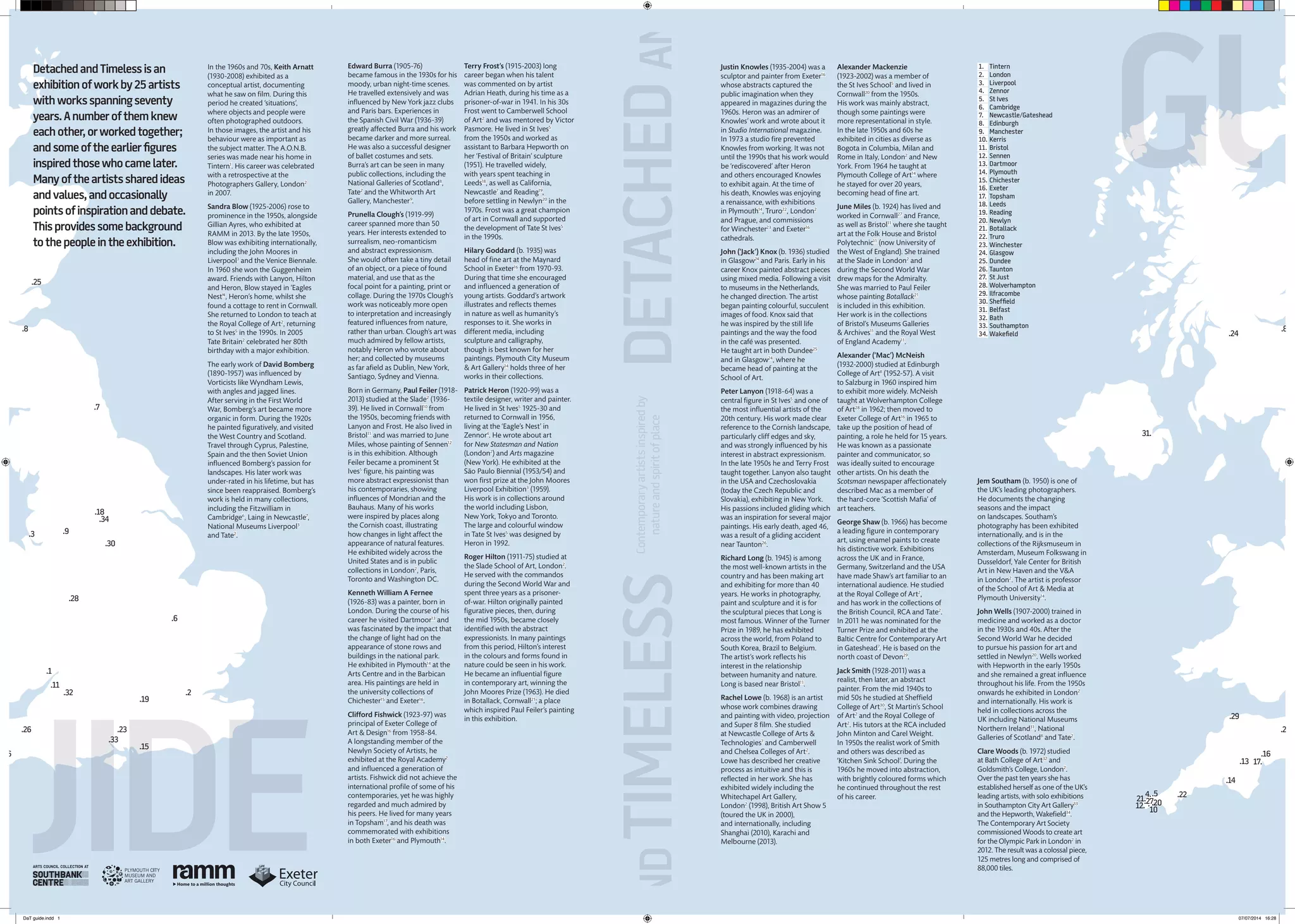
.8
.7
.34
.18
.9.3
.30
.28
.6
.2
.19
.15
.33
.23
.1
.11
.32
.26
.16
7.
31.
.2
.8
.24
.3
.26
.29
.16
17..13
.14
.5
.20
.22
.27
12. .
10
21.
4.
In the 1960s and 70s, Keith Arnatt
(1930-2008) exhibited as a
conceptual artist, documenting
what he saw on film. During this
period he created ‘situations’,
where objects and people were
often photographed outdoors.
In those images, the artist and his
behaviour were as important as
the subject matter. The A.O.N.B.
series was made near his home in
Tintern1
. His career was celebrated
with a retrospective at the
Photographers Gallery, London2
in 2007.
Sandra Blow (1925-2006) rose to
prominence in the 1950s, alongside
Gillian Ayres, who exhibited at
RAMM in 2013. By the late 1950s,
Blow was exhibiting internationally,
including the John Moores in
Liverpool3
and the Venice Biennale.
In 1960 she won the Guggenheim
award. Friends with Lanyon, Hilton
and Heron, Blow stayed in ‘Eagles
Nest’4
, Heron’s home, whilst she
found a cottage to rent in Cornwall.
She returned to London to teach at
the Royal College of Art2
, returning
to St Ives5
in the 1990s. In 2005
Tate Britain2
celebrated her 80th
birthday with a major exhibition.
The early work of David Bomberg
(1890-1957) was influenced by
Vorticists like Wyndham Lewis,
with angles and jagged lines.
After serving in the First World
War, Bomberg’s art became more
organic in form. During the 1920s
he painted figuratively, and visited
the West Country and Scotland.
Travel through Cyprus, Palestine,
Spain and the then Soviet Union
influenced Bomberg’s passion for
landscapes. His later work was
under-rated in his lifetime, but has
since been reappraised. Bomberg’s
work is held in many collections,
including the Fitzwilliam in
Cambridge6
, Laing in Newcastle7
,
National Museums Liverpool3
and Tate2
.
Edward Burra (1905-76)
became famous in the 1930s for his
moody, urban night-time scenes.
He travelled extensively and was
influenced by New York jazz clubs
and Paris bars. Experiences in
the Spanish Civil War (1936-39)
greatly affected Burra and his work
became darker and more surreal.
He was also a successful designer
of ballet costumes and sets.
Burra’s art can be seen in many
public collections, including the
National Galleries of Scotland8
,
Tate2
and the Whitworth Art
Gallery, Manchester9
.
Prunella Clough’s (1919-99)
career spanned more than 50
years. Her interests extended to
surrealism, neo-romanticism
and abstract expressionism.
She would often take a tiny detail
of an object, or a piece of found
material, and use that as the
focal point for a painting, print or
collage. During the 1970s Clough’s
work was noticeably more open
to interpretation and increasingly
featured influences from nature,
rather than urban. Clough’s art was
much admired by fellow artists,
notably Heron who wrote about
her; and collected by museums
as far afield as Dublin, New York,
Santiago, Sydney and Vienna.
Born in Germany, Paul Feiler (1918-
2013) studied at the Slade2
(1936-
39). He lived in Cornwall10
from
the 1950s, becoming friends with
Lanyon and Frost. He also lived in
Bristol11
and was married to June
Miles, whose painting of Sennen12
is in this exhibition. Although
Feiler became a prominent St
Ives5
figure, his painting was
more abstract expressionist than
his contemporaries, showing
influences of Mondrian and the
Bauhaus. Many of his works
were inspired by places along
the Cornish coast, illustrating
how changes in light affect the
appearance of natural features.
He exhibited widely across the
United States and is in public
collections in London2
, Paris,
Toronto and Washington DC.
Kenneth William A Fernee
(1926-83) was a painter, born in
London. During the course of his
career he visited Dartmoor13
and
was fascinated by the impact that
the change of light had on the
appearance of stone rows and
buildings in the national park.
He exhibited in Plymouth14
at the
Arts Centre and in the Barbican
area. His paintings are held in
the university collections of
Chichester15
and Exeter16
.
Clifford Fishwick (1923-97) was
principal of Exeter College of
Art & Design16
from 1958-84.
A longstanding member of the
Newlyn Society of Artists, he
exhibited at the Royal Academy2
and influenced a generation of
artists. Fishwick did not achieve the
international profile of some of his
contemporaries, yet he was highly
regarded and much admired by
his peers. He lived for many years
in Topsham17
, and his death was
commemorated with exhibitions
in both Exeter16
and Plymouth14
.
Terry Frost’s (1915-2003) long
career began when his talent
was commented on by artist
Adrian Heath, during his time as a
prisoner-of-war in 1941. In his 30s
Frost went to Camberwell School
of Art2
and was mentored by Victor
Pasmore. He lived in St Ives5
from the 1950s and worked as
assistant to Barbara Hepworth on
her ‘Festival of Britain’ sculpture
(1951). He travelled widely,
with years spent teaching in
Leeds18
, as well as California,
Newcastle7
and Reading19
,
before settling in Newlyn20
in the
1970s. Frost was a great champion
of art in Cornwall and supported
the development of Tate St Ives5
in the 1990s.
Hilary Goddard (b. 1935) was
head of fine art at the Maynard
School in Exeter16
from 1970-93.
During that time she encouraged
and influenced a generation of
young artists. Goddard’s artwork
illustrates and reflects themes
in nature as well as humanity’s
responses to it. She works in
different media, including
sculpture and calligraphy,
though is best known for her
paintings. Plymouth City Museum
& Art Gallery14
holds three of her
works in their collections.
Patrick Heron (1920-99) was a
textile designer, writer and painter.
He lived in St Ives5
1925-30 and
returned to Cornwall in 1956,
living at the ‘Eagle’s Nest’ in
Zennor4
. He wrote about art
for New Statesman and Nation
(London2
) and Arts magazine
(New York). He exhibited at the
São Paulo Biennial (1953/54) and
won first prize at the John Moores
Liverpool Exhibition3
(1959).
His work is in collections around
the world including Lisbon,
New York, Tokyo and Toronto.
The large and colourful window
in Tate St Ives5
was designed by
Heron in 1992.
Roger Hilton (1911-75) studied at
the Slade School of Art, London2
.
He served with the commandos
during the Second World War and
spent three years as a prisoner-
of-war. Hilton originally painted
figurative pieces, then, during
the mid 1950s, became closely
identified with the abstract
expressionists. In many paintings
from this period, Hilton’s interest
in the colours and forms found in
nature could be seen in his work.
He became an influential figure
in contemporary art, winning the
John Moores Prize (1963). He died
in Botallack, Cornwall21
; a place
which inspired Paul Feiler’s painting
in this exhibition.
Justin Knowles (1935-2004) was a
sculptor and painter from Exeter16
whose abstracts captured the
public imagination when they
appeared in magazines during the
1960s. Heron was an admirer of
Knowles’ work and wrote about it
in Studio International magazine.
In 1973 a studio fire prevented
Knowles from working. It was not
until the 1990s that his work would
be ‘rediscovered’ after Heron
and others encouraged Knowles
to exhibit again. At the time of
his death, Knowles was enjoying
a renaissance, with exhibitions
in Plymouth14
, Truro22
, London2
and Prague, and commissions
for Winchester23
and Exeter16
cathedrals.
John (‘Jack’) Knox (b. 1936) studied
in Glasgow24
and Paris. Early in his
career Knox painted abstract pieces
using mixed media. Following a visit
to museums in the Netherlands,
he changed direction. The artist
began painting colourful, succulent
images of food. Knox said that
he was inspired by the still life
paintings and the way the food
in the café was presented.
He taught art in both Dundee25
and in Glasgow24
, where he
became head of painting at the
School of Art.
Peter Lanyon (1918-64) was a
central figure in St Ives5
and one of
the most influential artists of the
20th century. His work made clear
reference to the Cornish landscape,
particularly cliff edges and sky,
and was strongly influenced by his
interest in abstract expressionism.
In the late 1950s he and Terry Frost
taught together. Lanyon also taught
in the USA and Czechoslovakia
(today the Czech Republic and
Slovakia), exhibiting in New York.
His passions included gliding which
was an inspiration for several major
paintings. His early death, aged 46,
was a result of a gliding accident
near Taunton26
.
Richard Long (b. 1945) is among
the most well-known artists in the
country and has been making art
and exhibiting for more than 40
years. He works in photography,
paint and sculpture and it is for
the sculptural pieces that Long is
most famous. Winner of the Turner
Prize in 1989, he has exhibited
across the world, from Poland to
South Korea, Brazil to Belgium.
The artist’s work reflects his
interest in the relationship
between humanity and nature.
Long is based near Bristol11
.
Rachel Lowe (b. 1968) is an artist
whose work combines drawing
and painting with video, projection
and Super 8 film. She studied
at Newcastle College of Arts &
Technologies7
and Camberwell
and Chelsea Colleges of Art2
.
Lowe has described her creative
process as intuitive and this is
reflected in her work. She has
exhibited widely including the
Whitechapel Art Gallery,
London2
(1998), British Art Show 5
(toured the UK in 2000),
and internationally, including
Shanghai (2010), Karachi and
Melbourne (2013).
Alexander Mackenzie
(1923-2002) was a member of
the St Ives School5
and lived in
Cornwall20
from the 1950s.
His work was mainly abstract,
though some paintings were
more representational in style.
In the late 1950s and 60s he
exhibited in cities as diverse as
Bogota in Columbia, Milan and
Rome in Italy, London2
and New
York. From 1964 he taught at
Plymouth College of Art14
where
he stayed for over 20 years,
becoming head of fine art.
June Miles (b. 1924) has lived and
worked in Cornwall27
and France,
as well as Bristol11
where she taught
art at the Folk House and Bristol
Polytechnic11
(now University of
the West of England). She trained
at the Slade in London2
and
during the Second World War
drew maps for the Admiralty.
She was married to Paul Feiler
whose painting Botallack21
is included in this exhibition.
Her work is in the collections
of Bristol’s Museums Galleries
& Archives11
and the Royal West
of England Academy11
.
Alexander (‘Mac’) McNeish
(1932-2000) studied at Edinburgh
College of Art8
(1952-57). A visit
to Salzburg in 1960 inspired him
to exhibit more widely. McNeish
taught at Wolverhampton College
of Art28
in 1962; then moved to
Exeter College of Art16
in 1965 to
take up the position of head of
painting, a role he held for 15 years.
He was known as a passionate
painter and communicator, so
was ideally suited to encourage
other artists. On his death the
Scotsman newspaper affectionately
described Mac as a member of
the hard-core ‘Scottish Mafia’ of
art teachers.
George Shaw (b. 1966) has become
a leading figure in contemporary
art, using enamel paints to create
his distinctive work. Exhibitions
across the UK and in France,
Germany, Switzerland and the USA
have made Shaw’s art familiar to an
international audience. He studied
at the Royal College of Art2
,
and has work in the collections of
the British Council, RCA and Tate2
.
In 2011 he was nominated for the
Turner Prize and exhibited at the
Baltic Centre for Contemporary Art
in Gateshead7
. He is based on the
north coast of Devon29
.
Jack Smith (1928-2011) was a
realist, then later, an abstract
painter. From the mid 1940s to
mid 50s he studied at Sheffield
College of Art30
, St Martin’s School
of Art2
and the Royal College of
Art2
. His tutors at the RCA included
John Minton and Carel Weight.
In 1950s the realist work of Smith
and others was described as
‘Kitchen Sink School’. During the
1960s he moved into abstraction,
with brightly coloured forms which
he continued throughout the rest
of his career.
Jem Southam (b. 1950) is one of
the UK’s leading photographers.
He documents the changing
seasons and the impact
on landscapes. Southam’s
photography has been exhibited
internationally, and is in the
collections of the Rijksmuseum in
Amsterdam, Museum Folkswang in
Dusseldorf, Yale Center for British
Art in New Haven and the V&A
in London2
. The artist is professor
of the School of Art & Media at
Plymouth University14
.
John Wells (1907-2000) trained in
medicine and worked as a doctor
in the 1930s and 40s. After the
Second World War he decided
to pursue his passion for art and
settled in Newlyn20
. Wells worked
with Hepworth in the early 1950s
and she remained a great influence
throughout his life. From the 1950s
onwards he exhibited in London2
and internationally. His work is
held in collections across the
UK including National Museums
Northern Ireland31
, National
Galleries of Scotland8
and Tate2
.
Clare Woods (b. 1972) studied
at Bath College of Art32
and
Goldsmith’s College, London2
.
Over the past ten years she has
established herself as one of the UK’s
leading artists, with solo exhibitions
in Southampton City Art Gallery33
and the Hepworth, Wakefield34
.
The Contemporary Art Society
commissioned Woods to create art
for the Olympic Park in London2
in
2012. The result was a colossal piece,
125 metres long and comprised of
88,000 tiles.
Contemporaryartistsinspiredby
natureandspiritofplace
1. 	 Tintern
2. 	 London
3.	 Liverpool
4. 	 Zennor
5. 	 St Ives
6. 	 Cambridge
7. 	 Newcastle/Gateshead
8. 	Edinburgh
9. 	Manchester
10.	Kerris
11.	Bristol
12.	Sennen
13.	Dartmoor
14.	Plymouth
15.	Chichester
16.	Exeter
17.	 Topsham
18.	Leeds
19.	Reading
20.	Newlyn
21.	Botallack
22.	Truro
23.	Winchester
24.	Glasgow
25.	Dundee
26.	Taunton
27.	 St Just
28.	Wolverhampton
29.	Ilfracombe
30.	Sheffield
31.	Belfast
32.	Bath
33.	Southampton
34.	Wakefield
DetachedandTimelessisan
exhibitionofworkby25artists
withworksspanningseventy
years.Anumberofthemknew
eachother,orworkedtogether;
andsomeoftheearlierfigures
inspiredthosewhocamelater.
Manyoftheartistssharedideas
andvalues,andoccasionally
pointsofinspirationanddebate.
Thisprovidessomebackground
tothepeopleintheexhibition.
DaT guide.indd 1 07/07/2014 16:28
RoyalAlbertMemorial
Museum&ArtGallery
QueenSt,ExeterEX43RX
HometoamillionthoughtsFreeentrywww.exeter.gov.uk/ramm
T	01392265858
E	RAMM@exeter.gov.uk
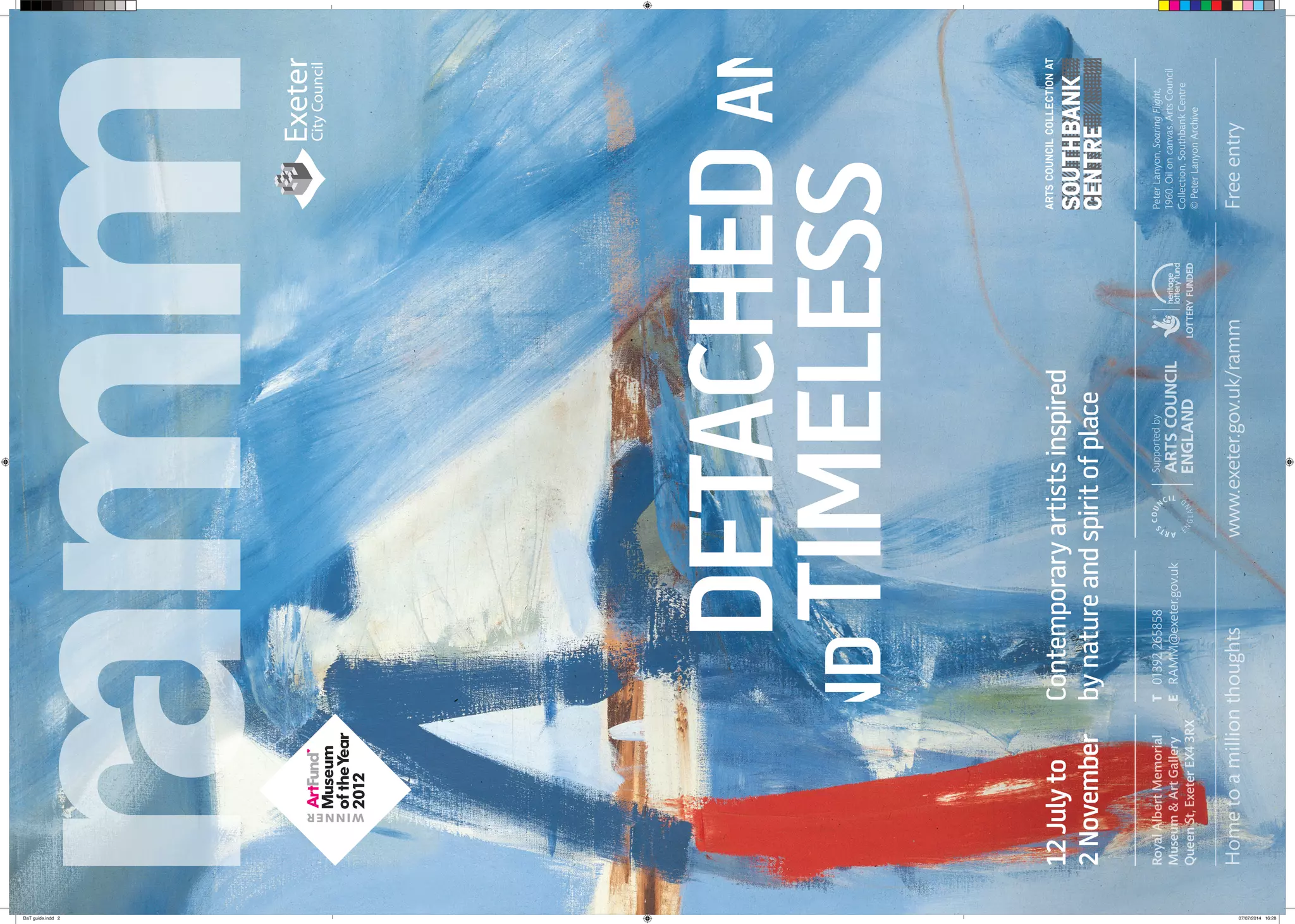
PeterLanyon,SoaringFlight,
1960.Oiloncanvas.ArtsCouncil
Collection,SouthbankCentre
©PeterLanyonArchive
DaT guide.indd 2 07/07/2014 16:28

DaT guide AW

  • 1.
    .25 .8 .7 .34 .18 .9.3 .30 .28 .6 .2 .19 .15 .33 .23 .1 .11 .32 .26 .16 7. 31. .2 .8 .24 .3 .26 .29 .16 17..13 .14 .5 .20 .22 .27 12. . 10 21. 4. In the1960s and 70s, Keith Arnatt (1930-2008) exhibited as a conceptual artist, documenting what he saw on film. During this period he created ‘situations’, where objects and people were often photographed outdoors. In those images, the artist and his behaviour were as important as the subject matter. The A.O.N.B. series was made near his home in Tintern1 . His career was celebrated with a retrospective at the Photographers Gallery, London2 in 2007. Sandra Blow (1925-2006) rose to prominence in the 1950s, alongside Gillian Ayres, who exhibited at RAMM in 2013. By the late 1950s, Blow was exhibiting internationally, including the John Moores in Liverpool3 and the Venice Biennale. In 1960 she won the Guggenheim award. Friends with Lanyon, Hilton and Heron, Blow stayed in ‘Eagles Nest’4 , Heron’s home, whilst she found a cottage to rent in Cornwall. She returned to London to teach at the Royal College of Art2 , returning to St Ives5 in the 1990s. In 2005 Tate Britain2 celebrated her 80th birthday with a major exhibition. The early work of David Bomberg (1890-1957) was influenced by Vorticists like Wyndham Lewis, with angles and jagged lines. After serving in the First World War, Bomberg’s art became more organic in form. During the 1920s he painted figuratively, and visited the West Country and Scotland. Travel through Cyprus, Palestine, Spain and the then Soviet Union influenced Bomberg’s passion for landscapes. His later work was under-rated in his lifetime, but has since been reappraised. Bomberg’s work is held in many collections, including the Fitzwilliam in Cambridge6 , Laing in Newcastle7 , National Museums Liverpool3 and Tate2 . Edward Burra (1905-76) became famous in the 1930s for his moody, urban night-time scenes. He travelled extensively and was influenced by New York jazz clubs and Paris bars. Experiences in the Spanish Civil War (1936-39) greatly affected Burra and his work became darker and more surreal. He was also a successful designer of ballet costumes and sets. Burra’s art can be seen in many public collections, including the National Galleries of Scotland8 , Tate2 and the Whitworth Art Gallery, Manchester9 . Prunella Clough’s (1919-99) career spanned more than 50 years. Her interests extended to surrealism, neo-romanticism and abstract expressionism. She would often take a tiny detail of an object, or a piece of found material, and use that as the focal point for a painting, print or collage. During the 1970s Clough’s work was noticeably more open to interpretation and increasingly featured influences from nature, rather than urban. Clough’s art was much admired by fellow artists, notably Heron who wrote about her; and collected by museums as far afield as Dublin, New York, Santiago, Sydney and Vienna. Born in Germany, Paul Feiler (1918- 2013) studied at the Slade2 (1936- 39). He lived in Cornwall10 from the 1950s, becoming friends with Lanyon and Frost. He also lived in Bristol11 and was married to June Miles, whose painting of Sennen12 is in this exhibition. Although Feiler became a prominent St Ives5 figure, his painting was more abstract expressionist than his contemporaries, showing influences of Mondrian and the Bauhaus. Many of his works were inspired by places along the Cornish coast, illustrating how changes in light affect the appearance of natural features. He exhibited widely across the United States and is in public collections in London2 , Paris, Toronto and Washington DC. Kenneth William A Fernee (1926-83) was a painter, born in London. During the course of his career he visited Dartmoor13 and was fascinated by the impact that the change of light had on the appearance of stone rows and buildings in the national park. He exhibited in Plymouth14 at the Arts Centre and in the Barbican area. His paintings are held in the university collections of Chichester15 and Exeter16 . Clifford Fishwick (1923-97) was principal of Exeter College of Art & Design16 from 1958-84. A longstanding member of the Newlyn Society of Artists, he exhibited at the Royal Academy2 and influenced a generation of artists. Fishwick did not achieve the international profile of some of his contemporaries, yet he was highly regarded and much admired by his peers. He lived for many years in Topsham17 , and his death was commemorated with exhibitions in both Exeter16 and Plymouth14 . Terry Frost’s (1915-2003) long career began when his talent was commented on by artist Adrian Heath, during his time as a prisoner-of-war in 1941. In his 30s Frost went to Camberwell School of Art2 and was mentored by Victor Pasmore. He lived in St Ives5 from the 1950s and worked as assistant to Barbara Hepworth on her ‘Festival of Britain’ sculpture (1951). He travelled widely, with years spent teaching in Leeds18 , as well as California, Newcastle7 and Reading19 , before settling in Newlyn20 in the 1970s. Frost was a great champion of art in Cornwall and supported the development of Tate St Ives5 in the 1990s. Hilary Goddard (b. 1935) was head of fine art at the Maynard School in Exeter16 from 1970-93. During that time she encouraged and influenced a generation of young artists. Goddard’s artwork illustrates and reflects themes in nature as well as humanity’s responses to it. She works in different media, including sculpture and calligraphy, though is best known for her paintings. Plymouth City Museum & Art Gallery14 holds three of her works in their collections. Patrick Heron (1920-99) was a textile designer, writer and painter. He lived in St Ives5 1925-30 and returned to Cornwall in 1956, living at the ‘Eagle’s Nest’ in Zennor4 . He wrote about art for New Statesman and Nation (London2 ) and Arts magazine (New York). He exhibited at the São Paulo Biennial (1953/54) and won first prize at the John Moores Liverpool Exhibition3 (1959). His work is in collections around the world including Lisbon, New York, Tokyo and Toronto. The large and colourful window in Tate St Ives5 was designed by Heron in 1992. Roger Hilton (1911-75) studied at the Slade School of Art, London2 . He served with the commandos during the Second World War and spent three years as a prisoner- of-war. Hilton originally painted figurative pieces, then, during the mid 1950s, became closely identified with the abstract expressionists. In many paintings from this period, Hilton’s interest in the colours and forms found in nature could be seen in his work. He became an influential figure in contemporary art, winning the John Moores Prize (1963). He died in Botallack, Cornwall21 ; a place which inspired Paul Feiler’s painting in this exhibition. Justin Knowles (1935-2004) was a sculptor and painter from Exeter16 whose abstracts captured the public imagination when they appeared in magazines during the 1960s. Heron was an admirer of Knowles’ work and wrote about it in Studio International magazine. In 1973 a studio fire prevented Knowles from working. It was not until the 1990s that his work would be ‘rediscovered’ after Heron and others encouraged Knowles to exhibit again. At the time of his death, Knowles was enjoying a renaissance, with exhibitions in Plymouth14 , Truro22 , London2 and Prague, and commissions for Winchester23 and Exeter16 cathedrals. John (‘Jack’) Knox (b. 1936) studied in Glasgow24 and Paris. Early in his career Knox painted abstract pieces using mixed media. Following a visit to museums in the Netherlands, he changed direction. The artist began painting colourful, succulent images of food. Knox said that he was inspired by the still life paintings and the way the food in the café was presented. He taught art in both Dundee25 and in Glasgow24 , where he became head of painting at the School of Art. Peter Lanyon (1918-64) was a central figure in St Ives5 and one of the most influential artists of the 20th century. His work made clear reference to the Cornish landscape, particularly cliff edges and sky, and was strongly influenced by his interest in abstract expressionism. In the late 1950s he and Terry Frost taught together. Lanyon also taught in the USA and Czechoslovakia (today the Czech Republic and Slovakia), exhibiting in New York. His passions included gliding which was an inspiration for several major paintings. His early death, aged 46, was a result of a gliding accident near Taunton26 . Richard Long (b. 1945) is among the most well-known artists in the country and has been making art and exhibiting for more than 40 years. He works in photography, paint and sculpture and it is for the sculptural pieces that Long is most famous. Winner of the Turner Prize in 1989, he has exhibited across the world, from Poland to South Korea, Brazil to Belgium. The artist’s work reflects his interest in the relationship between humanity and nature. Long is based near Bristol11 . Rachel Lowe (b. 1968) is an artist whose work combines drawing and painting with video, projection and Super 8 film. She studied at Newcastle College of Arts & Technologies7 and Camberwell and Chelsea Colleges of Art2 . Lowe has described her creative process as intuitive and this is reflected in her work. She has exhibited widely including the Whitechapel Art Gallery, London2 (1998), British Art Show 5 (toured the UK in 2000), and internationally, including Shanghai (2010), Karachi and Melbourne (2013). Alexander Mackenzie (1923-2002) was a member of the St Ives School5 and lived in Cornwall20 from the 1950s. His work was mainly abstract, though some paintings were more representational in style. In the late 1950s and 60s he exhibited in cities as diverse as Bogota in Columbia, Milan and Rome in Italy, London2 and New York. From 1964 he taught at Plymouth College of Art14 where he stayed for over 20 years, becoming head of fine art. June Miles (b. 1924) has lived and worked in Cornwall27 and France, as well as Bristol11 where she taught art at the Folk House and Bristol Polytechnic11 (now University of the West of England). She trained at the Slade in London2 and during the Second World War drew maps for the Admiralty. She was married to Paul Feiler whose painting Botallack21 is included in this exhibition. Her work is in the collections of Bristol’s Museums Galleries & Archives11 and the Royal West of England Academy11 . Alexander (‘Mac’) McNeish (1932-2000) studied at Edinburgh College of Art8 (1952-57). A visit to Salzburg in 1960 inspired him to exhibit more widely. McNeish taught at Wolverhampton College of Art28 in 1962; then moved to Exeter College of Art16 in 1965 to take up the position of head of painting, a role he held for 15 years. He was known as a passionate painter and communicator, so was ideally suited to encourage other artists. On his death the Scotsman newspaper affectionately described Mac as a member of the hard-core ‘Scottish Mafia’ of art teachers. George Shaw (b. 1966) has become a leading figure in contemporary art, using enamel paints to create his distinctive work. Exhibitions across the UK and in France, Germany, Switzerland and the USA have made Shaw’s art familiar to an international audience. He studied at the Royal College of Art2 , and has work in the collections of the British Council, RCA and Tate2 . In 2011 he was nominated for the Turner Prize and exhibited at the Baltic Centre for Contemporary Art in Gateshead7 . He is based on the north coast of Devon29 . Jack Smith (1928-2011) was a realist, then later, an abstract painter. From the mid 1940s to mid 50s he studied at Sheffield College of Art30 , St Martin’s School of Art2 and the Royal College of Art2 . His tutors at the RCA included John Minton and Carel Weight. In 1950s the realist work of Smith and others was described as ‘Kitchen Sink School’. During the 1960s he moved into abstraction, with brightly coloured forms which he continued throughout the rest of his career. Jem Southam (b. 1950) is one of the UK’s leading photographers. He documents the changing seasons and the impact on landscapes. Southam’s photography has been exhibited internationally, and is in the collections of the Rijksmuseum in Amsterdam, Museum Folkswang in Dusseldorf, Yale Center for British Art in New Haven and the V&A in London2 . The artist is professor of the School of Art & Media at Plymouth University14 . John Wells (1907-2000) trained in medicine and worked as a doctor in the 1930s and 40s. After the Second World War he decided to pursue his passion for art and settled in Newlyn20 . Wells worked with Hepworth in the early 1950s and she remained a great influence throughout his life. From the 1950s onwards he exhibited in London2 and internationally. His work is held in collections across the UK including National Museums Northern Ireland31 , National Galleries of Scotland8 and Tate2 . Clare Woods (b. 1972) studied at Bath College of Art32 and Goldsmith’s College, London2 . Over the past ten years she has established herself as one of the UK’s leading artists, with solo exhibitions in Southampton City Art Gallery33 and the Hepworth, Wakefield34 . The Contemporary Art Society commissioned Woods to create art for the Olympic Park in London2 in 2012. The result was a colossal piece, 125 metres long and comprised of 88,000 tiles. Contemporaryartistsinspiredby natureandspiritofplace 1. Tintern 2. London 3. Liverpool 4. Zennor 5. St Ives 6. Cambridge 7. Newcastle/Gateshead 8. Edinburgh 9. Manchester 10. Kerris 11. Bristol 12. Sennen 13. Dartmoor 14. Plymouth 15. Chichester 16. Exeter 17. Topsham 18. Leeds 19. Reading 20. Newlyn 21. Botallack 22. Truro 23. Winchester 24. Glasgow 25. Dundee 26. Taunton 27. St Just 28. Wolverhampton 29. Ilfracombe 30. Sheffield 31. Belfast 32. Bath 33. Southampton 34. Wakefield DetachedandTimelessisan exhibitionofworkby25artists withworksspanningseventy years.Anumberofthemknew eachother,orworkedtogether; andsomeoftheearlierfigures inspiredthosewhocamelater. Manyoftheartistssharedideas andvalues,andoccasionally pointsofinspirationanddebate. Thisprovidessomebackground tothepeopleintheexhibition. DaT guide.indd 1 07/07/2014 16:28
  • 2.