Lisa Glickstein, PhD 
Consultant in Medicine, MGH 
Grants Coordinator, Andover Public Schools
Overview & Themes 
 
What Darwin said about women 
 Sex, gender and sexuality 
Women in Darwin’s life 
 Family 
 Colleagues and correspondents 
Feminism, the education of women, and the 
“evolving” role of women in science
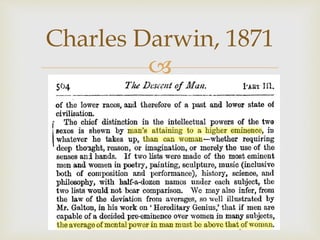
Charles Darwin, 1871 

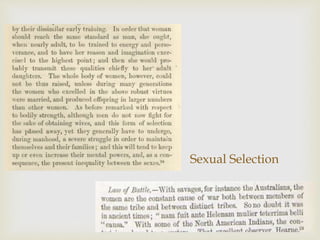
Sexual Selection
What makes a woman? 
 
Sex 
Gender 
Sexuality
Other Genders, other Sexes 
 
 Fluid sex – some fish actually change sex (are 
hermaphrodites with one sex is dominant at a time, 
or permanently), others are true hermaphrodites 
(spontaneous or exclusive), intersex 
 Fluid gender –hyenas in which females exhibit 
“masculine” traits, intersex, and gender-changing 
animals (fish & parthenogenic lizards) 
 Fluid sexuality – in many (perhaps all) species bi-sexuality 
can be observed, including exclusive same-sex 
pair-bonding and intercourse
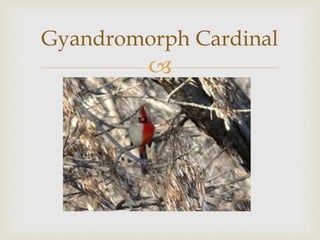
Gyandromorph Cardinal 

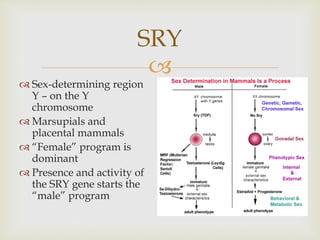
SRY 
 
 Sex-determining region 
Y – on the Y 
chromosome 
 Marsupials and 
placental mammals 
 “Female” program is 
dominant 
 Presence and activity of 
the SRY gene starts the 
“male” program
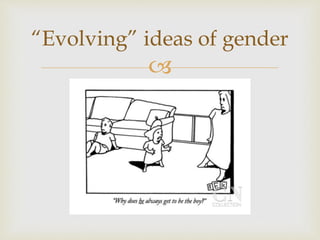
“Evolving” ideas of gender 

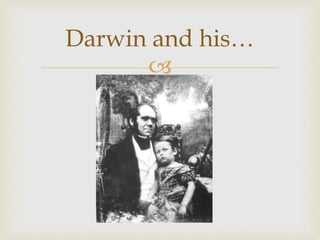
Darwin and his… 

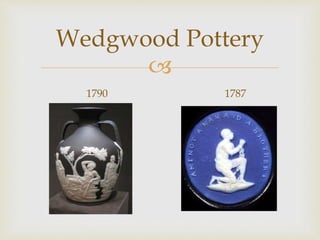
Wedgwood Pottery 
 
1790 1787
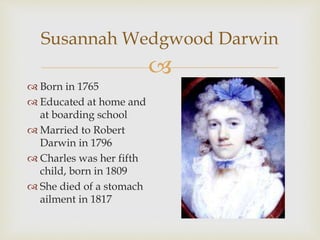
Susannah Wedgwood Darwin 
 
 Born in 1765 
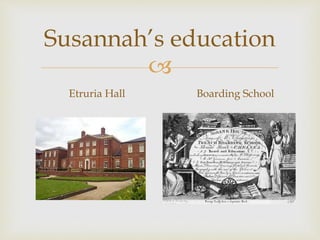
 Educated at home and 
at boarding school 
 Married to Robert 
Darwin in 1796 
 Charles was her fifth 
child, born in 1809 
 She died of a stomach 
ailment in 1817
Susannah’s education 
 
Etruria Hall Boarding School
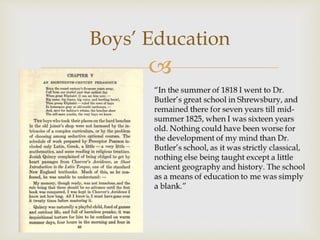
Boys’ Education 

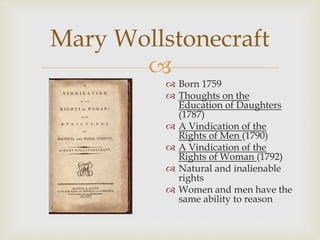
Mary Wollstonecraft 
 
 Born 1759 
 Thoughts on the 
Education of Daughters 
(1787) 
 A Vindication of the 
Rights of Men (1790) 
 A Vindication of the 
Rights of Woman (1792) 
 Natural and inalienable 
rights 
 Women and men have the 
same ability to reason
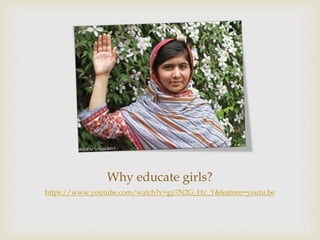
Why educate girls? 
https://www.youtube.com/watch?v=gy7N2G_Hz_Y&feature=youtu.be
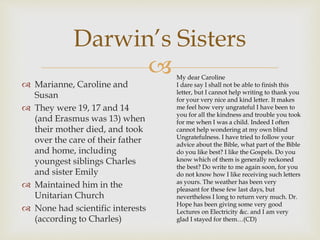
Darwin’s Sisters 
 
 Marianne, Caroline and 
Susan 
 They were 19, 17 and 14 
(and Erasmus was 13) when 
their mother died, and took 
over the care of their father 
and home, including 
youngest siblings Charles 
and sister Emily 
 Maintained him in the 
Unitarian Church 
 None had scientific interests 
(according to Charles) 
My dear Caroline 
I dare say I shall not be able to finish this 
letter, but I cannot help writing to thank you 
for your very nice and kind letter. It makes 
me feel how very ungrateful I have been to 
you for all the kindness and trouble you took 
for me when I was a child. Indeed I often 
cannot help wondering at my own blind 
Ungratefulness. I have tried to follow your 
advice about the Bible, what part of the Bible 
do you like best? I like the Gospels. Do you 
know which of them is generally reckoned 
the best? Do write to me again soon, for you 
do not know how I like receiving such letters 
as yours. The weather has been very 
pleasant for these few last days, but 
nevertheless I long to return very much. Dr. 
Hope has been giving some very good 
Lectures on Electricity &c. and I am very 
glad I stayed for them…(CD)
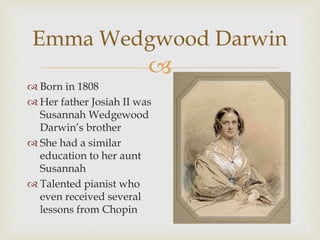
Emma Wedgwood Darwin 
 
 Born in 1808 
 Her father Josiah II was 
Susannah Wedgewood 
Darwin’s brother 
 She had a similar 
education to her aunt 
Susannah 
 Talented pianist who 
even received several 
lessons from Chopin
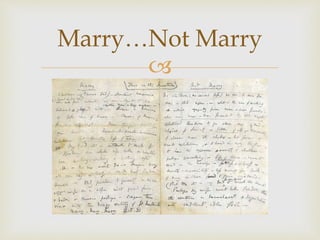
Marry…Not Marry 

It being proved 
necessary to Marry 
When? Soon or Late[20] 
The Governor says soon for otherwise bad if one 
has children— one’s character is more flexible— 
one’s feelings more lively & if one does not marry 
soon,[21] one misses so much good pure 
happiness.— 
But then if I married tomorrow: there would be an 
infinity of trouble & expense in getting & 
furnishing a house,—fighting about no Society— 
morning calls—awkwardness—loss of time every 
day. (without one’s wife was an angel, & made one 
keep industrious).[22] Then how should I manage 
all my business if I were obliged to go every day 
walking with my[23] wife.— Eheu!! I never should 
know French,—or see the Continent—or go to 
America, or go up in a Balloon, or take solitary trip 
in Wales—poor slave.—you will be worse than a 
negro— And[24] then horrid poverty, (without 
one’s wife was better than an angel & had 
money)— Never mind my boy— Cheer up— One 
cannot live this solitary life, with groggy old age, 
friendless & cold, & childless staring one in ones 
face, already beginning to wrinkle.— Never mind, 
trust to chance—keep a sharp look out— There is 
many a happy slave—
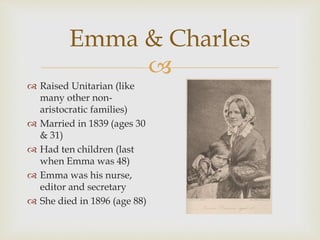
Emma & Charles 
 
 Raised Unitarian (like 
many other non-aristocratic 
families) 
 Married in 1839 (ages 30 
& 31) 
 Had ten children (last 
when Emma was 48) 
 Emma was his nurse, 
editor and secretary 
 She died in 1896 (age 88)
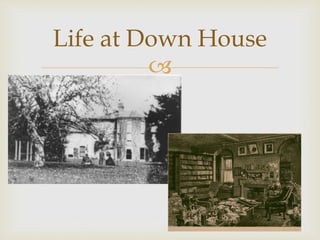
Life at Down House 

Faith (EWD) 
 
 The state of mind that I wish to preserve 
with respect to you, is to feel that while you 
are acting conscientiously & sincerely 
wishing & trying to learn the truth, you 
cannot be wrong, but there are some 
reasons that force themselves upon me & 
prevent my being always able to give 
myself this comfort. 
 May not the habit in scientific pursuits of 
believing nothing till it is proved, influence 
your mind too much in other things which 
cannot be proved in the same way, & which 
if true are likely to be above our 
comprehension. 
 Every thing that concerns you concerns me 
& I should be most unhappy if I thought we 
did not belong to each other forever 
When I am dead, 
know that many 
times, I have 
kissed & cryed 
over this. C. D.
Nannie Helen 
Burroughs 
Educator, orator, religious leader, 
civil rights activist, feminist and 
businesswoman 
For a number of years there has been 
a righteous discontent, a burning zeal 
to go forward in His] name among 
the Baptist women of our churches 
and it will be the dynamic force in the 
religious campaign at the opening of 
the 20th century.
Did the Darwins 
have a Traditional 
Marriage? 
 Biblical view of man – 
centrality, man’s unique 
status 
 Darwin’s view of man – 
one element of the fabric 
of nature 
 Biblical view of woman – 
vulnerability, sin, serving 
man 
 Darwin’s view of woman 
– weakness, vulnerability, 
nurturing man 
Nature versus Nurture 
Pragmatism
Darwin’s Correspondents 
 
 Caroline Kennard – abolitionist, Association for the 
Advancement of Women, botanist 
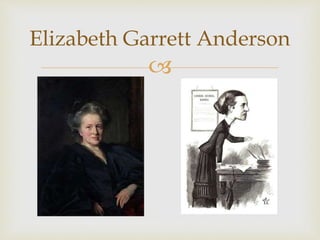
 Elizabeth Garrett Anderson – first British woman 
qualified to practice medicine (as a woman, not as a 
man), medical school dean, mayor 
 Antoinette Brown Blackwell – women’s rights 
activist, social reformer, first ordained woman 
minister in the US, scientist and author 
 Lydia Ernestine Becker – suffragist, botanist, 
astronomer
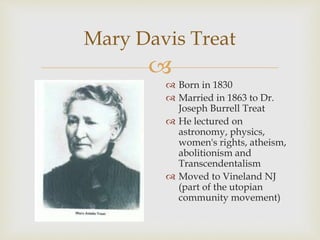
Mary Davis Treat 
 
 Born in 1830 
 Married in 1863 to Dr. 
Joseph Burrell Treat 
 He lectured on 
astronomy, physics, 
women's rights, atheism, 
abolitionism and 
Transcendentalism 
 Moved to Vineland NJ 
(part of the utopian 
community movement)
As a scientist 
 First publication was a note 
in the American 
Entomologist and Botanist 
(1869) 
 Later she also published 
articles in The American 
Naturalist, The Journal of 
the New York 
Entomological Society and 
in popular magazines such 
as the Harper's Monthly and 
Lippincott's 
 In 28 years she wrote 76 
scientific and popular 
articles and five books 
 Injurious Insects of the Farm 
and Field (1882) was 
reprinted five times. 
Separated from her husband in 
1874 and supported herself. 
Lived in Vineland, with visits to 
Florida.
Elizabeth Garrett Anderson 

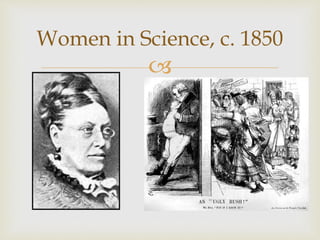
Women in Science, c. 1850 

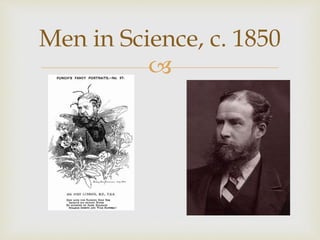
Men in Science, c. 1850 

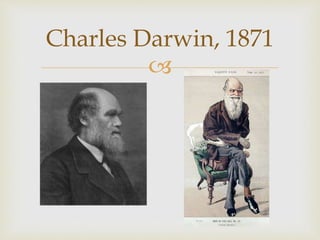
Charles Darwin, 1871 

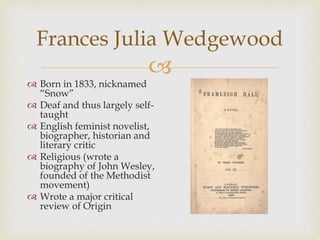
Frances Julia Wedgewood 
 
 Born in 1833, nicknamed 
“Snow” 
 Deaf and thus largely self-taught 
 English feminist novelist, 
biographer, historian and 
literary critic 
 Religious (wrote a 
biography of John Wesley, 
founded of the Methodist 
movement) 
 Wrote a major critical 
review of Origin
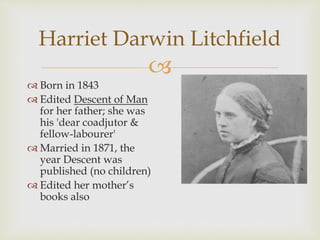
Harriet Darwin Litchfield 
 
 Born in 1843 
 Edited Descent of Man 
for her father; she was 
his 'dear coadjutor & 
fellow-labourer' 
 Married in 1871, the 
year Descent was 
published (no children) 
 Edited her mother’s 
books also
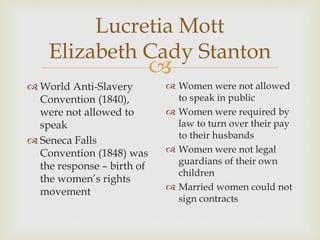
Lucretia Mott 
Elizabeth Cady Stanton 
 
 World Anti-Slavery 
Convention (1840), 
were not allowed to 
speak 
 Seneca Falls 
Convention (1848) was 
the response – birth of 
the women’s rights 
movement 
 Women were not allowed 
to speak in public 
 Women were required by 
law to turn over their pay 
to their husbands 
 Women were not legal 
guardians of their own 
children 
 Married women could not 
sign contracts
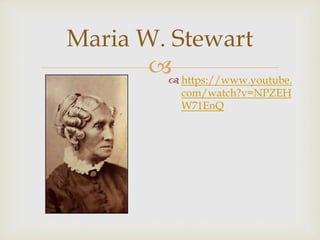
Maria W. Stewart 
 
 https://www.youtube. 
com/watch?v=NPZEH 
W71EnQ
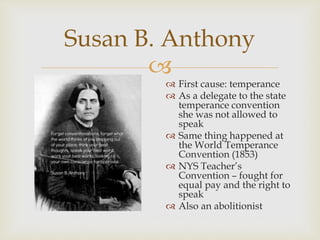
Susan B. Anthony 
 
 First cause: temperance 
 As a delegate to the state 
temperance convention 
she was not allowed to 
speak 
 Same thing happened at 
the World Temperance 
Convention (1853) 
 NYS Teacher’s 
Convention – fought for 
equal pay and the right to 
speak 
 Also an abolitionist
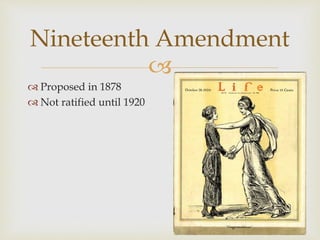
Nineteenth Amendment 
 
 Proposed in 1878 
 Not ratified until 1920
Themes 
 
 Philosophy - natural and inalienable rights 
 Multiple systems of education, but a focus on 
classics (philosophy) 
 The association of radical movements – revolution, 
temperance, religious dissent, utopianism, 
abolition, women’s rights 
 Dual spheres –religion(s) and science – home and 
public lives – coming into conflict

Darwin’s Women

  • 1.
    Lisa Glickstein, PhD Consultant in Medicine, MGH Grants Coordinator, Andover Public Schools
  • 2.
    Overview & Themes  What Darwin said about women  Sex, gender and sexuality Women in Darwin’s life  Family  Colleagues and correspondents Feminism, the education of women, and the “evolving” role of women in science
  • 3.
  • 4.
  • 5.
    What makes awoman?  Sex Gender Sexuality
  • 6.
    Other Genders, otherSexes   Fluid sex – some fish actually change sex (are hermaphrodites with one sex is dominant at a time, or permanently), others are true hermaphrodites (spontaneous or exclusive), intersex  Fluid gender –hyenas in which females exhibit “masculine” traits, intersex, and gender-changing animals (fish & parthenogenic lizards)  Fluid sexuality – in many (perhaps all) species bi-sexuality can be observed, including exclusive same-sex pair-bonding and intercourse
  • 7.
  • 8.
    SRY  Sex-determining region Y – on the Y chromosome  Marsupials and placental mammals  “Female” program is dominant  Presence and activity of the SRY gene starts the “male” program
  • 9.
  • 10.
  • 11.
  • 12.
    Susannah Wedgwood Darwin   Born in 1765  Educated at home and at boarding school  Married to Robert Darwin in 1796  Charles was her fifth child, born in 1809  She died of a stomach ailment in 1817
  • 13.
    Susannah’s education  Etruria Hall Boarding School
  • 14.
  • 15.
    Mary Wollstonecraft   Born 1759  Thoughts on the Education of Daughters (1787)  A Vindication of the Rights of Men (1790)  A Vindication of the Rights of Woman (1792)  Natural and inalienable rights  Women and men have the same ability to reason
  • 16.
    Why educate girls? https://www.youtube.com/watch?v=gy7N2G_Hz_Y&feature=youtu.be
  • 17.
    Darwin’s Sisters   Marianne, Caroline and Susan  They were 19, 17 and 14 (and Erasmus was 13) when their mother died, and took over the care of their father and home, including youngest siblings Charles and sister Emily  Maintained him in the Unitarian Church  None had scientific interests (according to Charles) My dear Caroline I dare say I shall not be able to finish this letter, but I cannot help writing to thank you for your very nice and kind letter. It makes me feel how very ungrateful I have been to you for all the kindness and trouble you took for me when I was a child. Indeed I often cannot help wondering at my own blind Ungratefulness. I have tried to follow your advice about the Bible, what part of the Bible do you like best? I like the Gospels. Do you know which of them is generally reckoned the best? Do write to me again soon, for you do not know how I like receiving such letters as yours. The weather has been very pleasant for these few last days, but nevertheless I long to return very much. Dr. Hope has been giving some very good Lectures on Electricity &c. and I am very glad I stayed for them…(CD)
  • 18.
    Emma Wedgwood Darwin   Born in 1808  Her father Josiah II was Susannah Wedgewood Darwin’s brother  She had a similar education to her aunt Susannah  Talented pianist who even received several lessons from Chopin
  • 19.
  • 20.
    It being proved necessary to Marry When? Soon or Late[20] The Governor says soon for otherwise bad if one has children— one’s character is more flexible— one’s feelings more lively & if one does not marry soon,[21] one misses so much good pure happiness.— But then if I married tomorrow: there would be an infinity of trouble & expense in getting & furnishing a house,—fighting about no Society— morning calls—awkwardness—loss of time every day. (without one’s wife was an angel, & made one keep industrious).[22] Then how should I manage all my business if I were obliged to go every day walking with my[23] wife.— Eheu!! I never should know French,—or see the Continent—or go to America, or go up in a Balloon, or take solitary trip in Wales—poor slave.—you will be worse than a negro— And[24] then horrid poverty, (without one’s wife was better than an angel & had money)— Never mind my boy— Cheer up— One cannot live this solitary life, with groggy old age, friendless & cold, & childless staring one in ones face, already beginning to wrinkle.— Never mind, trust to chance—keep a sharp look out— There is many a happy slave—
  • 21.
    Emma & Charles   Raised Unitarian (like many other non-aristocratic families)  Married in 1839 (ages 30 & 31)  Had ten children (last when Emma was 48)  Emma was his nurse, editor and secretary  She died in 1896 (age 88)
  • 22.
    Life at DownHouse 
  • 23.
    Faith (EWD)   The state of mind that I wish to preserve with respect to you, is to feel that while you are acting conscientiously & sincerely wishing & trying to learn the truth, you cannot be wrong, but there are some reasons that force themselves upon me & prevent my being always able to give myself this comfort.  May not the habit in scientific pursuits of believing nothing till it is proved, influence your mind too much in other things which cannot be proved in the same way, & which if true are likely to be above our comprehension.  Every thing that concerns you concerns me & I should be most unhappy if I thought we did not belong to each other forever When I am dead, know that many times, I have kissed & cryed over this. C. D.
  • 24.
    Nannie Helen Burroughs Educator, orator, religious leader, civil rights activist, feminist and businesswoman For a number of years there has been a righteous discontent, a burning zeal to go forward in His] name among the Baptist women of our churches and it will be the dynamic force in the religious campaign at the opening of the 20th century.
  • 25.
    Did the Darwins have a Traditional Marriage?  Biblical view of man – centrality, man’s unique status  Darwin’s view of man – one element of the fabric of nature  Biblical view of woman – vulnerability, sin, serving man  Darwin’s view of woman – weakness, vulnerability, nurturing man Nature versus Nurture Pragmatism
  • 26.
    Darwin’s Correspondents   Caroline Kennard – abolitionist, Association for the Advancement of Women, botanist  Elizabeth Garrett Anderson – first British woman qualified to practice medicine (as a woman, not as a man), medical school dean, mayor  Antoinette Brown Blackwell – women’s rights activist, social reformer, first ordained woman minister in the US, scientist and author  Lydia Ernestine Becker – suffragist, botanist, astronomer
  • 27.
    Mary Davis Treat   Born in 1830  Married in 1863 to Dr. Joseph Burrell Treat  He lectured on astronomy, physics, women's rights, atheism, abolitionism and Transcendentalism  Moved to Vineland NJ (part of the utopian community movement)
  • 28.
    As a scientist  First publication was a note in the American Entomologist and Botanist (1869)  Later she also published articles in The American Naturalist, The Journal of the New York Entomological Society and in popular magazines such as the Harper's Monthly and Lippincott's  In 28 years she wrote 76 scientific and popular articles and five books  Injurious Insects of the Farm and Field (1882) was reprinted five times. Separated from her husband in 1874 and supported herself. Lived in Vineland, with visits to Florida.
  • 29.
  • 30.
    Women in Science,c. 1850 
  • 31.
    Men in Science,c. 1850 
  • 32.
  • 33.
    Frances Julia Wedgewood   Born in 1833, nicknamed “Snow”  Deaf and thus largely self-taught  English feminist novelist, biographer, historian and literary critic  Religious (wrote a biography of John Wesley, founded of the Methodist movement)  Wrote a major critical review of Origin
  • 34.
    Harriet Darwin Litchfield   Born in 1843  Edited Descent of Man for her father; she was his 'dear coadjutor & fellow-labourer'  Married in 1871, the year Descent was published (no children)  Edited her mother’s books also
  • 35.
    Lucretia Mott ElizabethCady Stanton   World Anti-Slavery Convention (1840), were not allowed to speak  Seneca Falls Convention (1848) was the response – birth of the women’s rights movement  Women were not allowed to speak in public  Women were required by law to turn over their pay to their husbands  Women were not legal guardians of their own children  Married women could not sign contracts
  • 36.
    Maria W. Stewart   https://www.youtube. com/watch?v=NPZEH W71EnQ
  • 37.
    Susan B. Anthony   First cause: temperance  As a delegate to the state temperance convention she was not allowed to speak  Same thing happened at the World Temperance Convention (1853)  NYS Teacher’s Convention – fought for equal pay and the right to speak  Also an abolitionist
  • 38.
    Nineteenth Amendment   Proposed in 1878  Not ratified until 1920
  • 39.
    Themes  Philosophy - natural and inalienable rights  Multiple systems of education, but a focus on classics (philosophy)  The association of radical movements – revolution, temperance, religious dissent, utopianism, abolition, women’s rights  Dual spheres –religion(s) and science – home and public lives – coming into conflict

Editor's Notes

  • #3 Published statements – in the context of the time, beginning with his mother’s time Women in his life – mother, sisters, wife, cousin and daughter, as well as colleagues and correspondents
  • #4 Data vs information
  • #5 Nam fuit ante Helenam cunnus taeterrima belli causa, horace (even before Helen – of Troy – vulva/cunt was the most savage cause of war) – substituted mulier (woman) Lamarckian ideas in the second passage.
  • #6 Two meanings of sex – male/female and intercourse – what do they have in common? Other conditions – intersex Physical differences between men and women, vs polymorphic population Gender – created by society, to a point (examine children whose gender was switched at birth) – genetic component Sexuality – who you want to have sex with – not linked completely to sex (estimates range from 3-30%) – might be all or none – gendered sexuality (assumptions about sexuality based on gender)
  • #7 Social benefit in many of these cases – reduce fighting, increase bonds, improved mating success
  • #9 TDF – testis determining factor http://www.mun.ca/biology/scarr/4241_Devo_MammalSex.html
  • #10 1996 The New Yorker (Kaplan) Exercise – Common gender stereotypes and beliefs
  • #11 Son William, pictured in 1842 "I'm really looking forward to when fashion natural selects me a pair of pants." Read more: http://www.cracked.com/article_20061_6-terrifying-experiments-parents-did-their-own-kids_p2.html#ixzz3G8mvMnlD
  • #12 Josiah Wedgwood – was the artist – this is the Portland Vase Also an abolitionist
  • #13 She was 31 when she got married. She was 44 when Charles was born. She was 52 when she died.
  • #14 Girls – French, music, dancing, drawing, writing and accounts, geography with the use of the globes Quote from Jane Austen’s Emma
  • #15 https://archive.org/stream/anoldnewenglands00fuesrich#page/82/mode/2up An old New England school: a history of Phillips academy Andover (1917) Claude Fuess Boys – classics – possibly with mathematics, use of the globes, chemistry, natural philosophy
  • #16 First vindication – against monarchy (French Revolution) Second vindication – women as possessing individual rights Works were well accepted on publication – however, her husband published a memoir after her death (at age 38 – from “childbed fever”) that detailed the difficulties in her life, including affairs with married men (she once proposed a polygamist relationship to a lover and his wife), having a child out of wedlock and other details – and this destroyed her reputation for a number of years Association of movements – in this case anti-monarchy, religious “dissenters,” sexual freedom, nontraditional familial relationships
  • #17 http://en.wikipedia.org/wiki/Malala_Yousafzai Her family runs a chain of schools in the region. In early 2009, when she was 11–12, Yousafzai wrote a blog under a pseudonym for the BBC detailing her life under Taliban occupation, their attempts to take control of the valley, and her views on promoting education for girls in the Swat Valley. The following summer, journalist Adam B. Ellick made a New York Times documentary [2] about her life as the Pakistani military intervened in the region, culminating in the Second Battle of Swat. Yousafzai rose in prominence, giving interviews in print and on television, and she was nominated for the International Children's Peace Prize by South African activist Desmond Tutu. On the afternoon of 9 October 2012, Yousafzai boarded her school bus in the northwest Pakistani district of Swat. A gunman asked for her by name, then pointed a pistol at her and fired three shots. One bullet hit the left side of Yousafzai's forehead, travelled under her skin through the length of her face, and then went into her shoulder.[4] In the days immediately following the attack, she remained unconscious and in critical condition, but later her condition improved enough for her to be sent to the Queen Elizabeth Hospital in Birmingham, England, for intensive rehabilitation. On 12 October, a group of 50 Islamic clerics in Pakistan issued a fatwā against those who tried to kill her, but the Taliban reiterated their intent to kill Yousafzai and her father. http://plan-international.org/girls/
  • #18 Letter of 1926 – Charles was 17 and Caroline was 26 – from Edinburgh Dr. Hope was Thomas Charles Hope – who discovered strontium Susan lived at home until her death (the other sisters married)
  • #19 Darwin is one year younger (born in 1809)
  • #20 This is the Question[13] – written in…1838 Not Marry[18] Freedom to go where one liked— choice of Society & little of it. — Conversation of clever men at clubs— Not forced to visit relatives, & to bend in every trifle.— to have the expense & anxiety of children— perhaps quarelling— Loss of time. — cannot read in the Evenings— fatness & idleness— Anxiety & responsibility— less money for books &c— if many children forced to gain one’s bread.— (But then it is very bad for ones health[19] to work too much) Perhaps my wife wont like London; then the sentence is banishment & degradation into indolent, idle fool— Marry Children—(if it Please God) [14] — Constant companion, (& friend in old age) who will feel interested in one,— object to be beloved & played with.— —better than a dog anyhow.— [15] Home, & someone to take care of house— Charms of music & female chit-chat.— These things good for one’s health.— [16] but terrible loss of time. — My[17] God, it is intolerable to think of spending ones whole life, like a neuter bee, working, working, & nothing after all.— No, no won’t do.— Imagine living all one’s day solitarily in smoky dirty London House.— Only picture to yourself a nice soft wife on a sofa with good fire, & books & music perhaps— Compare this vision with the dingy reality of Grt. Marlbro’ St. Marry—Mary—Marry Q.E.D.
  • #21 Written in…1838 Slavery abolished in England – 1833 -
  • #22 With Leonard in 1853 – 14 years after she was married
  • #23 http://www.english-heritage.org.uk/daysout/properties/home-of-charles-darwin-down-house/
  • #24 Written in…1839 CD asked her to publish his work in case of his sudden death (1844) Also asked her to read his work – important role as a skeptic of his work
  • #25 Born in 1878 – her father was a “free person of color” and her mother was at least a second generation free woman
  • #26 Is religion oppressive or empowering to women? To Emma Darwin?
  • #27 Kennard – 1 son – argued with Darwin about his statements in Descent Anderson – 3 children (known – James Barry) – Edward Cresy begged Emma’s support in convincing Erasmus to support her appointment to teach Blackwell – 5 children survived of 7 – acknowledgement of a science book – “dear sir” Becker – contributed samples to Darwin Margaretta Hare Morris – entomologist Mary Elizabeth Barber - she made a name for herself in botany, ornithology and entomology. She was also an accomplished poet and painter, and illustrated her scientific contributions that were published by learned societies such as the Royal Entomological Society in London, the Royal Botanical Gardens in Kew, and the Linnean Society of London. http://www.darwinproject.ac.uk/all-darwins-female-correspondents
  • #28 33 when she was married Vineland – home of Welch’s grape juice (unfermented wine) – temperance and abolition Fruitlands (Transcendental Wild Oats; Louisa May Alcott) Oneida Community (complex marriage, eugenics in 1869, and silverware) Amana Colonies
  • #29 Darwin believed that theory-building was physically taxing and suited to men, while specimen collecting and making natural observations was appropriate for women.
  • #30 Caricature of Elizabeth Garrett Anderson from F. Waddy, Cartoon portraits and biographical sketches of men of the day, (1873). Painting by John Singer Sargent
  • #31 Lydia Becker and other Suffragists beat at the door of John Bull demanding reform, whilst more demurely depicted women watch in the background. Punch Magazine, 28 May 1870 “Women who distinguish themselves exhibit traits in their character which have gained for them the status of “masculine women”. You have only to glance at the portrait…to see at once that Miss Becker exhibits in her face and features all those distinguishing parts which being to the countenance of man. We cannot help thinking that if Miss Becker had been called to a life of domesticity and maternity she would have felt that woman has a far higher and holier mission in life, in increasing the comforts of home, in nurturing and training her offspring and in all the duties prompted by wifely affection which renders the arduous work of the breadwinner lighter and more pleasant”.
  • #32 Sir John Lubbock
  • #33 What can we say about the popular image of scientists vis a vis gender?
  • #34 Emma’s niece – brother’s oldest daughter An Old Debt (as Florence Dawson), 1858 Framleigh Hall, 1858 Life of John Wesley, 1870 The Moral Ideal, 1888 and 1907 The Message of Israel, 1894 Nineteenth Century Teachers, 1909 EM Forster was her secretary
  • #35 Age 28 when she was married; her husband was a mathematician, college founder
  • #36 Passionate about social reform "By marriage, the husband and wife are one person in law: that is, the very being or legal existence of the woman is suspended during the marriage“ http://www.pbs.org/stantonanthony/resources/index.html?body=biography.html
  • #37 Daughter free parents in CT in 1803, orphaned by age 5, indentured to a clergyman Before her time – first woman to address a convention of both men and women http://digital.library.upenn.edu/women/stewart-maria/meditations/meditations.html
  • #38 We shall someday be heeded, and when we shall have our amendment to the Constitution of the United States, everybody will think it was always so, just exactly as many young people think that all the privileges, all the freedom, all the enjoyments which woman now possesses always were hers. They have no idea of how every single inch of ground that she stands upon today has been gained by the hard work of some little handful of women of the past. Susan B. Anthony, 1894
  • #39 Minerva/Athena
  • #40 Why at a time of such progress, such a struggle for “right,” was Darwin’s great idea used against the “right” (as we see it now) not once but twice? Survival of the fittest, nature vs nurture