Göttingen State and University Library:
DARIAH-DE’s digital research infrastructure for the arts
and humanities and the services for enhanced research of
the eResearch Alliance at Göttingen University Campus
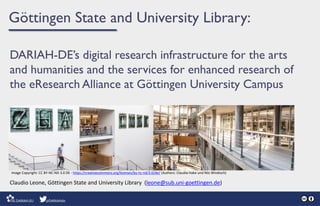
Image Copyright: CC BY-NC-ND 3.0 DE - https://creativecommons.org/licenses/by-nc-nd/3.0/de/ (Authors: Claudia Hake und Nils Windisch)
Claudio Leone, Göttingen State and University Library (leone@sub.uni-goettingen.de)
Göttingen State and University Library – Brief Overview
 founded in 1734 (Historical Building)
 one of the largest academic libraries in Germany
 over 8 million media units
 5.9 million volumes, 1.6 million microforms, 50,000 licensed
electronic journals as well as 126,000 further digital media,
327,000 maps and more than 14,000 manuscripts, 3,100
incunabula and 400 literary remains, Gutenberg Bible (1450’s)
 about 5.500 visitors a day in the central library (build 1993)
Göttingen State and University Library – Brief Overview
 Center for Retrospective Digitization (GDZ) since 1997
 operates Göttingen University Press since 2003 (open access)
 offers a broad range of services for study and research
• supplies literature and information services
• secures the national provision for certain tasks and disciplines
• preservation of scientific outcomes and cultural heritage
• research and development partner for future information
infrastructures nationally and internationally
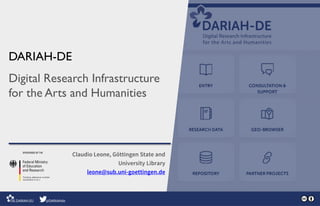
Digital Research Infrastructure
for the Arts and Humanities
Claudio Leone, Göttingen State and
University Library
leone@sub.uni-goettingen.de
DARIAH-DE
DARIAH-DE – Brief Overview
 one of 17 members of DARIAH-EU
 funded by the German Federal Ministry of Education and
Research (BMBF)
 preliminary phase: 2008 – 2011
 development phase: 2011 – 2016
 operating phase: 2016-2019
 used by 80 projects and more than 4.000 scholars
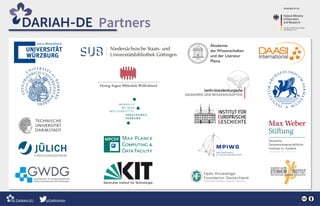
Partners
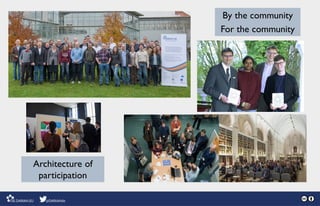
By the community
For the community
Architecture of
participation
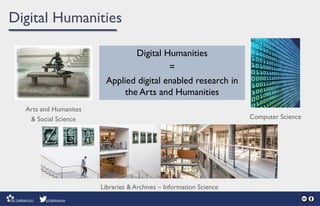
Digital Humanities
Digital Humanities
=
Applied digital enabled research in
the Arts and Humanities
Arts and Humanites
& Social Science Computer Science
Libraries & Archives – Information Science
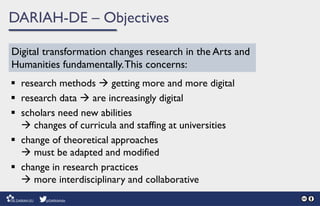
Digital transformation changes research in the Arts and
Humanities fundamentally.This concerns:
DARIAH-DE – Objectives
 research methods  getting more and more digital
 research data  are increasingly digital
 scholars need new abilities
 changes of curricula and staffing at universities
 change of theoretical approaches
 must be adapted and modified
 change in research practices
 more interdisciplinary and collaborative
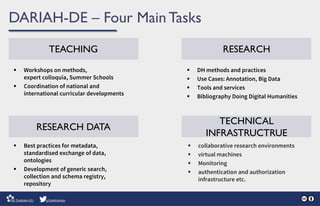
 DH methods and practices
 Use Cases: Annotation, Big Data
 Tools and services
 Bibliography Doing Digital Humanities
TEACHING RESEARCH
RESEARCH DATA
TECHNICAL
INFRASTRUCTRUE
 Workshops on methods,
expert colloquia, Summer Schools
 Coordination of national and
international curricular developments
 Best practices for metadata,
standardised exchange of data,
ontologies
 Development of generic search,
collection and schema registry,
repository
 collaborative research environments
 virtual machines
 Monitoring
 authentication and authorization
infrastructure etc.
DARIAH-DE – Four Main Tasks
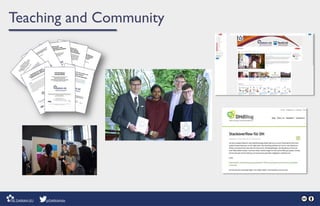
Teaching and Community
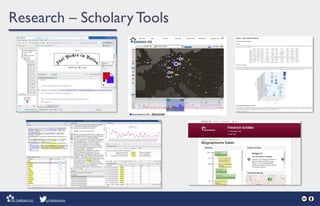
Research – Scholary Tools
Research Data Collection – epidat
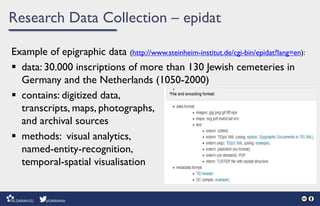
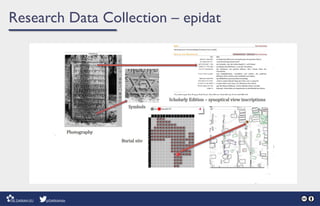
Example of epigraphic data (http://www.steinheim-institut.de/cgi-bin/epidat?lang=en):
 data: 30.000 inscriptions of more than 130 Jewish cemeteries in
Germany and the Netherlands (1050-2000)
 contains: digitized data,
transcripts, maps, photographs,
and archival sources
 methods: visual analytics,
named-entity-recognition,
temporal-spatial visualisation
Research Data Collection – epidat
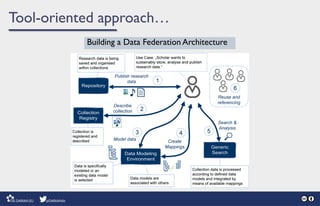
Building a Data Federation Architecture
Tool-oriented approach…
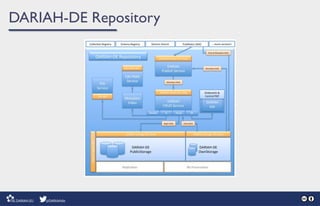
DARIAH-DE Repository
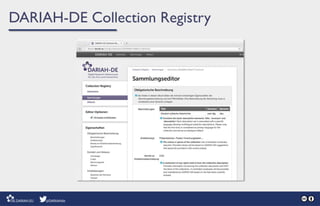
DARIAH-DE Collection Registry
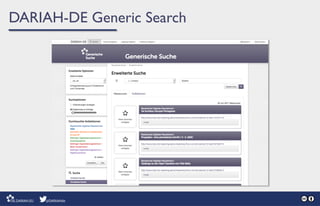
DARIAH-DE Generic Search
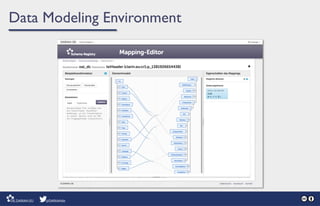
Data Modeling Environment
Göttingen
eResearch Alliance
status quo: mission, governance, people, offers
Starting Point
 start-up funding of 5 FTE’s for 4 years (2014-2018) by the
Presidential Board to establish the Göttingen eResearch Alliance
 eResearch = enhanced research
 co-chaired by Library and Computing Centre (IT)
• GWDG: ~120 people, 30 in eResearch related fields
• SUB: ~450 people, 40 in eResearch related fields
 central contact point, broker, and service provider for enhanced
Research related topics
 aiming for sustainability
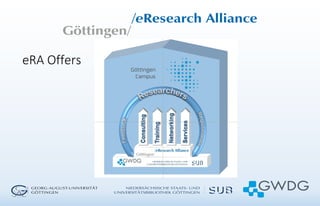
eRA Offers
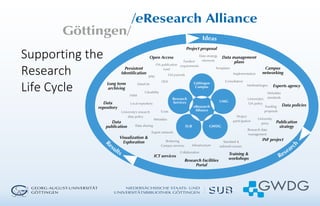
Supporting the
Research
Life Cycle
THANKYOU FORYOUR ATTENTION!
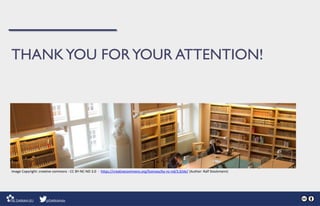
Image Copyright: creative commons - CC BY-NC-ND 3.0 - https://creativecommons.org/licenses/by-nc-nd/3.0/de/ (Author: Ralf Stockmann)

Dariah de and e research alliance, germany

  • 1.
    Göttingen State andUniversity Library: DARIAH-DE’s digital research infrastructure for the arts and humanities and the services for enhanced research of the eResearch Alliance at Göttingen University Campus Image Copyright: CC BY-NC-ND 3.0 DE - https://creativecommons.org/licenses/by-nc-nd/3.0/de/ (Authors: Claudia Hake und Nils Windisch) Claudio Leone, Göttingen State and University Library (leone@sub.uni-goettingen.de)
  • 2.
    Göttingen State andUniversity Library – Brief Overview  founded in 1734 (Historical Building)  one of the largest academic libraries in Germany  over 8 million media units  5.9 million volumes, 1.6 million microforms, 50,000 licensed electronic journals as well as 126,000 further digital media, 327,000 maps and more than 14,000 manuscripts, 3,100 incunabula and 400 literary remains, Gutenberg Bible (1450’s)  about 5.500 visitors a day in the central library (build 1993)
  • 3.
    Göttingen State andUniversity Library – Brief Overview  Center for Retrospective Digitization (GDZ) since 1997  operates Göttingen University Press since 2003 (open access)  offers a broad range of services for study and research • supplies literature and information services • secures the national provision for certain tasks and disciplines • preservation of scientific outcomes and cultural heritage • research and development partner for future information infrastructures nationally and internationally
  • 4.
    Digital Research Infrastructure forthe Arts and Humanities Claudio Leone, Göttingen State and University Library leone@sub.uni-goettingen.de DARIAH-DE
  • 5.
    DARIAH-DE – BriefOverview  one of 17 members of DARIAH-EU  funded by the German Federal Ministry of Education and Research (BMBF)  preliminary phase: 2008 – 2011  development phase: 2011 – 2016  operating phase: 2016-2019  used by 80 projects and more than 4.000 scholars
  • 6.
  • 7.
    By the community Forthe community Architecture of participation
  • 8.
    Digital Humanities Digital Humanities = Applieddigital enabled research in the Arts and Humanities Arts and Humanites & Social Science Computer Science Libraries & Archives – Information Science
  • 9.
    Digital transformation changesresearch in the Arts and Humanities fundamentally.This concerns: DARIAH-DE – Objectives  research methods  getting more and more digital  research data  are increasingly digital  scholars need new abilities  changes of curricula and staffing at universities  change of theoretical approaches  must be adapted and modified  change in research practices  more interdisciplinary and collaborative
  • 10.
     DH methodsand practices  Use Cases: Annotation, Big Data  Tools and services  Bibliography Doing Digital Humanities TEACHING RESEARCH RESEARCH DATA TECHNICAL INFRASTRUCTRUE  Workshops on methods, expert colloquia, Summer Schools  Coordination of national and international curricular developments  Best practices for metadata, standardised exchange of data, ontologies  Development of generic search, collection and schema registry, repository  collaborative research environments  virtual machines  Monitoring  authentication and authorization infrastructure etc. DARIAH-DE – Four Main Tasks
  • 11.
  • 12.
  • 13.
    Research Data Collection– epidat Example of epigraphic data (http://www.steinheim-institut.de/cgi-bin/epidat?lang=en):  data: 30.000 inscriptions of more than 130 Jewish cemeteries in Germany and the Netherlands (1050-2000)  contains: digitized data, transcripts, maps, photographs, and archival sources  methods: visual analytics, named-entity-recognition, temporal-spatial visualisation
  • 14.
  • 15.
    Building a DataFederation Architecture Tool-oriented approach…
  • 16.
  • 17.
  • 18.
  • 19.
  • 20.
    Göttingen eResearch Alliance status quo:mission, governance, people, offers
  • 21.
    Starting Point  start-upfunding of 5 FTE’s for 4 years (2014-2018) by the Presidential Board to establish the Göttingen eResearch Alliance  eResearch = enhanced research  co-chaired by Library and Computing Centre (IT) • GWDG: ~120 people, 30 in eResearch related fields • SUB: ~450 people, 40 in eResearch related fields  central contact point, broker, and service provider for enhanced Research related topics  aiming for sustainability
  • 22.
  • 23.
  • 24.
    THANKYOU FORYOUR ATTENTION! ImageCopyright: creative commons - CC BY-NC-ND 3.0 - https://creativecommons.org/licenses/by-nc-nd/3.0/de/ (Author: Ralf Stockmann)