Integrated Teacher Education Programme (ITEP) - 1st Semester
Understanding India ( Indian Ethos and Knowledge
System ) - 1
By - Shivani Chauhan
Research Scholar
MDU, Rohtak
Unit- 2 Culture-Art and Literature
Topic : Performing Arts भारतीय प्रदर्शन
कला
Useful for B.A.B.Ed, B.Com.B.Ed, and B.Sc.B.Ed.
Content
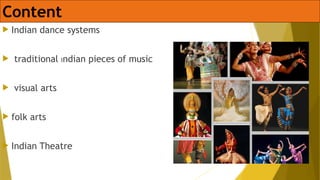
 Indian dance systems
 traditional Indian pieces of music
 visual arts
 folk arts
 Indian Theatre
Introduction
 The performing arts of India are rich, diverse, and deeply embedded in the country's
cultural fabric.
 They encompass a wide range of art forms, including various dance systems,
traditional music, folk arts, and visual arts.
Indian Dance Systems
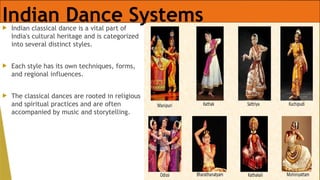
 Indian classical dance is a vital part of
India's cultural heritage and is categorized
into several distinct styles.
 Each style has its own techniques, forms,
and regional influences.
 The classical dances are rooted in religious
and spiritual practices and are often
accompanied by music and storytelling.
Indian Dance Systems
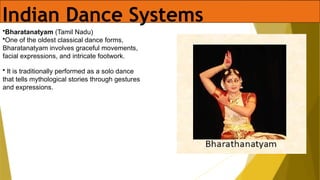
•Bharatanatyam (Tamil Nadu)
•One of the oldest classical dance forms,
Bharatanatyam involves graceful movements,
facial expressions, and intricate footwork.
• It is traditionally performed as a solo dance
that tells mythological stories through gestures
and expressions.
Indian Dance Systems
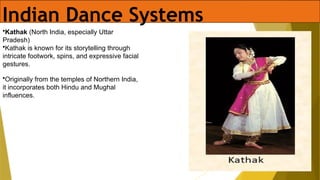
•Kathak (North India, especially Uttar
Pradesh)
•Kathak is known for its storytelling through
intricate footwork, spins, and expressive facial
gestures.
•Originally from the temples of Northern India,
it incorporates both Hindu and Mughal
influences.
Indian Dance Systems
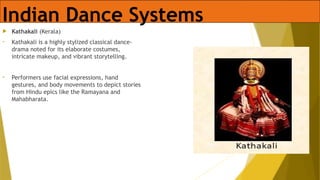
 Kathakali (Kerala)
• Kathakali is a highly stylized classical dance-
drama noted for its elaborate costumes,
intricate makeup, and vibrant storytelling.
• Performers use facial expressions, hand
gestures, and body movements to depict stories
from Hindu epics like the Ramayana and
Mahabharata.
Indian Dance Systems
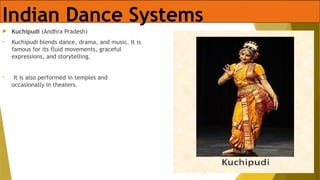
 Kuchipudi (Andhra Pradesh)
• Kuchipudi blends dance, drama, and music. It is
famous for its fluid movements, graceful
expressions, and storytelling.
• It is also performed in temples and
occasionally in theaters.
Indian Dance Systems
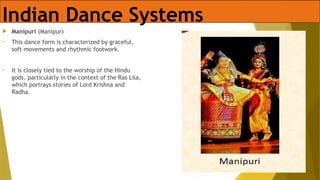
 Manipuri (Manipur)
• This dance form is characterized by graceful,
soft movements and rhythmic footwork.
• It is closely tied to the worship of the Hindu
gods, particularly in the context of the Ras Lila,
which portrays stories of Lord Krishna and
Radha.
Indian Dance Systems
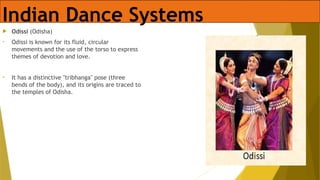
 Odissi (Odisha)
• Odissi is known for its fluid, circular
movements and the use of the torso to express
themes of devotion and love.
• It has a distinctive "tribhanga" pose (three
bends of the body), and its origins are traced to
the temples of Odisha.
Indian Dance Systems
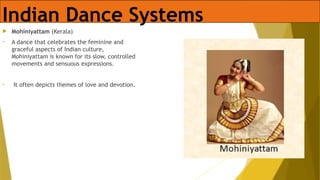
 Mohiniyattam (Kerala)
• A dance that celebrates the feminine and
graceful aspects of Indian culture,
Mohiniyattam is known for its slow, controlled
movements and sensuous expressions.
• It often depicts themes of love and devotion.
Indian Dance Systems
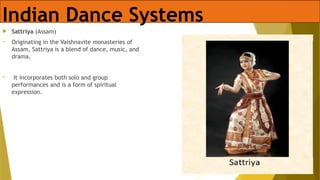
 Sattriya (Assam)
• Originating in the Vaishnavite monasteries of
Assam, Sattriya is a blend of dance, music, and
drama.
• It incorporates both solo and group
performances and is a form of spiritual
expression.
Folk and Regional Dance Forms:
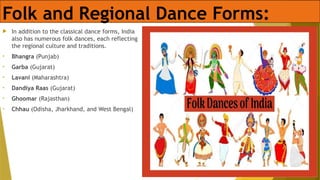
 In addition to the classical dance forms, India
also has numerous folk dances, each reflecting
the regional culture and traditions.
• Bhangra (Punjab)
• Garba (Gujarat)
• Lavani (Maharashtra)
• Dandiya Raas (Gujarat)
• Ghoomar (Rajasthan)
• Chhau (Odisha, Jharkhand, and West Bengal)
Traditional Indian Music
 Indian music is divided into two primary traditions: Hindustani Classical Music (North Indian) and Carnatic
Classical Music (South Indian).
 Both traditions are based on ragas (melodic frameworks) and talas (rhythmic cycles).
 Hindustani Classical Music (North India)
 Raga: A raga is a Traditional Indian Music
• lodic structure used for improvisation, designed to evoke particular emotions or moods. Common ragas include
Raga Yaman, Raga Bhairav, and Raga Hamsadhwani.
• Tala: The rhythmic pattern in Hindustani music. Popular talas include Teentaal (16 beats), Jhaptaal (10 beats),
and Ektaal (12 beats).
• Instruments: Key instruments include the sitar, tabla, sarod, santoor, flute, and harmonium.
Traditional Indian Music
 Carnatic Classical Music (South India)
• Raga: Carnatic music also revolves around ragas, but it places more emphasis on fixed
compositions and is known for its intricate structures.
• Tala: Complex and varied rhythmic cycles, such as Adi Tala (8 beats) and Rupaka Tala (6
beats).
• Instruments: Prominent instruments include the veena, mridangam, violin, and flute.
Traditional Indian Music
 Folk Music & Popular Music
• Bhajan: Devotional songs, often sung in praise of Hindu deities. They are common across India,
particularly in temples.
• Qawwali: A form of Sufi devotional music popular in North India, characterized by its emotional depth
and group singing.
• Bhangra Music: A fast-paced and rhythmically vibrant form of music from Punjab, typically
accompanied by traditional instruments like the dhol (drum).
• Lori: A traditional lullaby sung to soothe babies, particularly in the Punjab region.
Visual Arts
 Indian visual arts are vast and diverse, ranging from ancient temple art to contemporary forms. They often carry
spiritual and cultural significance.
 Traditional Visual Arts:
• Madhubani (Bihar): A traditional folk art characterized by intricate patterns and vibrant colors, often depicting
nature, religious themes, and folklore.
• Warli (Maharashtra): A tribal art form that uses simple, geometric shapes and motifs to depict daily life and
nature.
• Tanjore Painting (Tamil Nadu): Known for its rich colors and surface texture, Tanjore paintings often feature
deities and are highlighted with gold foil.
• Pattachitra (Odisha): A traditional art form that involves intricate detailing and storytelling through paintings,
usually on cloth or palm leaves.
• Miniature Paintings: These include the Mughal, Rajput, and Pahari styles, known for their small, detailed, and
colorful depictions of royal courts, historical events, and religious subjects.
 Sculpture and Architecture:
• Temple Architecture: Indian temples, like the Kailasa Temple at Ellora and the Meenakshi Temple in Madurai,
are known for their intricate sculptures and grand architectural designs.
• Buddhist Art: The Ajanta and Ellora caves in Maharashtra are famous for their ancient Buddhist murals and
sculptures.
Folk Arts and Performances
 Indian folk art and performances are closely tied to regional traditions, community life, and celebrations.
They are often passed down through generations and serve as an expression of local culture.
• Ramlila (North India): A theatrical performance that re-enacts the life of Lord Rama from the Ramayana. It is
performed annually during the festival of Dussehra.
• Yakshagana (Karnataka): A traditional dance-drama that combines dance, music, and dialogue to depict
stories from the epics. It is particularly popular in coastal Karnataka.
• Theyyam (Kerala): A form of ritualistic dance performed to honor gods and spirits. The performers often wear
elaborate costumes and masks and act as a medium for divine spirits.
• Bhaona (Assam): A traditional one-act play from Assam, often performed in Vaishnavite monasteries. It
combines elements of drama, music, and dance.
Theatre and Drama
 Indian theatre has a long history, from its ancient religious rituals to modern-day theatrical productions.
Traditional theatre often integrates music, dance, and dialogue.
• Nautanki (North India): A folk theater form that is melodramatic, often featuring music and dance. It has a
strong narrative focus, dealing with themes of romance, morality, and heroism.
• Bengali Theatre: Known for its intellectual and literary content, Bengali theatre includes works by great
playwrights like Rabindranath Tagore.
• Kutiyattam (Kerala): One of the oldest surviving theatrical traditions in India, Kutiyattam is a Sanskrit theatre
form that integrates dance, drama, and music.
Conclusion
 Indian performing arts are a fusion of spiritual, cultural, and social traditions, offering a glimpse into the
diverse and rich heritage of the country.
 Whether through classical dances like Bharatanatyam and Kathak, the devotional melodies of Hindustani and
Carnatic music, or the intricate designs of traditional visual arts like Madhubani and Tanjore, India's
performing arts continue to inspire and influence global culture, preserving ancient traditions while evolving
in contemporary settings.
ITEP  1st semester  Performing Arts.pptx

ITEP 1st semester Performing Arts.pptx

  • 1.
    Integrated Teacher EducationProgramme (ITEP) - 1st Semester Understanding India ( Indian Ethos and Knowledge System ) - 1 By - Shivani Chauhan Research Scholar MDU, Rohtak Unit- 2 Culture-Art and Literature Topic : Performing Arts भारतीय प्रदर्शन कला Useful for B.A.B.Ed, B.Com.B.Ed, and B.Sc.B.Ed.
  • 2.
    Content  Indian dancesystems  traditional Indian pieces of music  visual arts  folk arts  Indian Theatre
  • 3.
    Introduction  The performingarts of India are rich, diverse, and deeply embedded in the country's cultural fabric.  They encompass a wide range of art forms, including various dance systems, traditional music, folk arts, and visual arts.
  • 4.
    Indian Dance Systems Indian classical dance is a vital part of India's cultural heritage and is categorized into several distinct styles.  Each style has its own techniques, forms, and regional influences.  The classical dances are rooted in religious and spiritual practices and are often accompanied by music and storytelling.
  • 5.
    Indian Dance Systems •Bharatanatyam(Tamil Nadu) •One of the oldest classical dance forms, Bharatanatyam involves graceful movements, facial expressions, and intricate footwork. • It is traditionally performed as a solo dance that tells mythological stories through gestures and expressions.
  • 6.
    Indian Dance Systems •Kathak(North India, especially Uttar Pradesh) •Kathak is known for its storytelling through intricate footwork, spins, and expressive facial gestures. •Originally from the temples of Northern India, it incorporates both Hindu and Mughal influences.
  • 7.
    Indian Dance Systems Kathakali (Kerala) • Kathakali is a highly stylized classical dance- drama noted for its elaborate costumes, intricate makeup, and vibrant storytelling. • Performers use facial expressions, hand gestures, and body movements to depict stories from Hindu epics like the Ramayana and Mahabharata.
  • 8.
    Indian Dance Systems Kuchipudi (Andhra Pradesh) • Kuchipudi blends dance, drama, and music. It is famous for its fluid movements, graceful expressions, and storytelling. • It is also performed in temples and occasionally in theaters.
  • 9.
    Indian Dance Systems Manipuri (Manipur) • This dance form is characterized by graceful, soft movements and rhythmic footwork. • It is closely tied to the worship of the Hindu gods, particularly in the context of the Ras Lila, which portrays stories of Lord Krishna and Radha.
  • 10.
    Indian Dance Systems Odissi (Odisha) • Odissi is known for its fluid, circular movements and the use of the torso to express themes of devotion and love. • It has a distinctive "tribhanga" pose (three bends of the body), and its origins are traced to the temples of Odisha.
  • 11.
    Indian Dance Systems Mohiniyattam (Kerala) • A dance that celebrates the feminine and graceful aspects of Indian culture, Mohiniyattam is known for its slow, controlled movements and sensuous expressions. • It often depicts themes of love and devotion.
  • 12.
    Indian Dance Systems Sattriya (Assam) • Originating in the Vaishnavite monasteries of Assam, Sattriya is a blend of dance, music, and drama. • It incorporates both solo and group performances and is a form of spiritual expression.
  • 13.
    Folk and RegionalDance Forms:  In addition to the classical dance forms, India also has numerous folk dances, each reflecting the regional culture and traditions. • Bhangra (Punjab) • Garba (Gujarat) • Lavani (Maharashtra) • Dandiya Raas (Gujarat) • Ghoomar (Rajasthan) • Chhau (Odisha, Jharkhand, and West Bengal)
  • 14.
    Traditional Indian Music Indian music is divided into two primary traditions: Hindustani Classical Music (North Indian) and Carnatic Classical Music (South Indian).  Both traditions are based on ragas (melodic frameworks) and talas (rhythmic cycles).  Hindustani Classical Music (North India)  Raga: A raga is a Traditional Indian Music • lodic structure used for improvisation, designed to evoke particular emotions or moods. Common ragas include Raga Yaman, Raga Bhairav, and Raga Hamsadhwani. • Tala: The rhythmic pattern in Hindustani music. Popular talas include Teentaal (16 beats), Jhaptaal (10 beats), and Ektaal (12 beats). • Instruments: Key instruments include the sitar, tabla, sarod, santoor, flute, and harmonium.
  • 15.
    Traditional Indian Music Carnatic Classical Music (South India) • Raga: Carnatic music also revolves around ragas, but it places more emphasis on fixed compositions and is known for its intricate structures. • Tala: Complex and varied rhythmic cycles, such as Adi Tala (8 beats) and Rupaka Tala (6 beats). • Instruments: Prominent instruments include the veena, mridangam, violin, and flute.
  • 16.
    Traditional Indian Music Folk Music & Popular Music • Bhajan: Devotional songs, often sung in praise of Hindu deities. They are common across India, particularly in temples. • Qawwali: A form of Sufi devotional music popular in North India, characterized by its emotional depth and group singing. • Bhangra Music: A fast-paced and rhythmically vibrant form of music from Punjab, typically accompanied by traditional instruments like the dhol (drum). • Lori: A traditional lullaby sung to soothe babies, particularly in the Punjab region.
  • 17.
    Visual Arts  Indianvisual arts are vast and diverse, ranging from ancient temple art to contemporary forms. They often carry spiritual and cultural significance.  Traditional Visual Arts: • Madhubani (Bihar): A traditional folk art characterized by intricate patterns and vibrant colors, often depicting nature, religious themes, and folklore. • Warli (Maharashtra): A tribal art form that uses simple, geometric shapes and motifs to depict daily life and nature. • Tanjore Painting (Tamil Nadu): Known for its rich colors and surface texture, Tanjore paintings often feature deities and are highlighted with gold foil. • Pattachitra (Odisha): A traditional art form that involves intricate detailing and storytelling through paintings, usually on cloth or palm leaves. • Miniature Paintings: These include the Mughal, Rajput, and Pahari styles, known for their small, detailed, and colorful depictions of royal courts, historical events, and religious subjects.  Sculpture and Architecture: • Temple Architecture: Indian temples, like the Kailasa Temple at Ellora and the Meenakshi Temple in Madurai, are known for their intricate sculptures and grand architectural designs. • Buddhist Art: The Ajanta and Ellora caves in Maharashtra are famous for their ancient Buddhist murals and sculptures.
  • 18.
    Folk Arts andPerformances  Indian folk art and performances are closely tied to regional traditions, community life, and celebrations. They are often passed down through generations and serve as an expression of local culture. • Ramlila (North India): A theatrical performance that re-enacts the life of Lord Rama from the Ramayana. It is performed annually during the festival of Dussehra. • Yakshagana (Karnataka): A traditional dance-drama that combines dance, music, and dialogue to depict stories from the epics. It is particularly popular in coastal Karnataka. • Theyyam (Kerala): A form of ritualistic dance performed to honor gods and spirits. The performers often wear elaborate costumes and masks and act as a medium for divine spirits. • Bhaona (Assam): A traditional one-act play from Assam, often performed in Vaishnavite monasteries. It combines elements of drama, music, and dance.
  • 19.
    Theatre and Drama Indian theatre has a long history, from its ancient religious rituals to modern-day theatrical productions. Traditional theatre often integrates music, dance, and dialogue. • Nautanki (North India): A folk theater form that is melodramatic, often featuring music and dance. It has a strong narrative focus, dealing with themes of romance, morality, and heroism. • Bengali Theatre: Known for its intellectual and literary content, Bengali theatre includes works by great playwrights like Rabindranath Tagore. • Kutiyattam (Kerala): One of the oldest surviving theatrical traditions in India, Kutiyattam is a Sanskrit theatre form that integrates dance, drama, and music.
  • 20.
    Conclusion  Indian performingarts are a fusion of spiritual, cultural, and social traditions, offering a glimpse into the diverse and rich heritage of the country.  Whether through classical dances like Bharatanatyam and Kathak, the devotional melodies of Hindustani and Carnatic music, or the intricate designs of traditional visual arts like Madhubani and Tanjore, India's performing arts continue to inspire and influence global culture, preserving ancient traditions while evolving in contemporary settings.