浅谈电商网站数据访问层 
(DAL)与ORM 之适用性 
2012.11.2 
中国,上海
What’s Data ? 
Data Files、Database、Data Service、etc. 
SQL、NoSQL、AWS RDS、SQL Azure、etc.
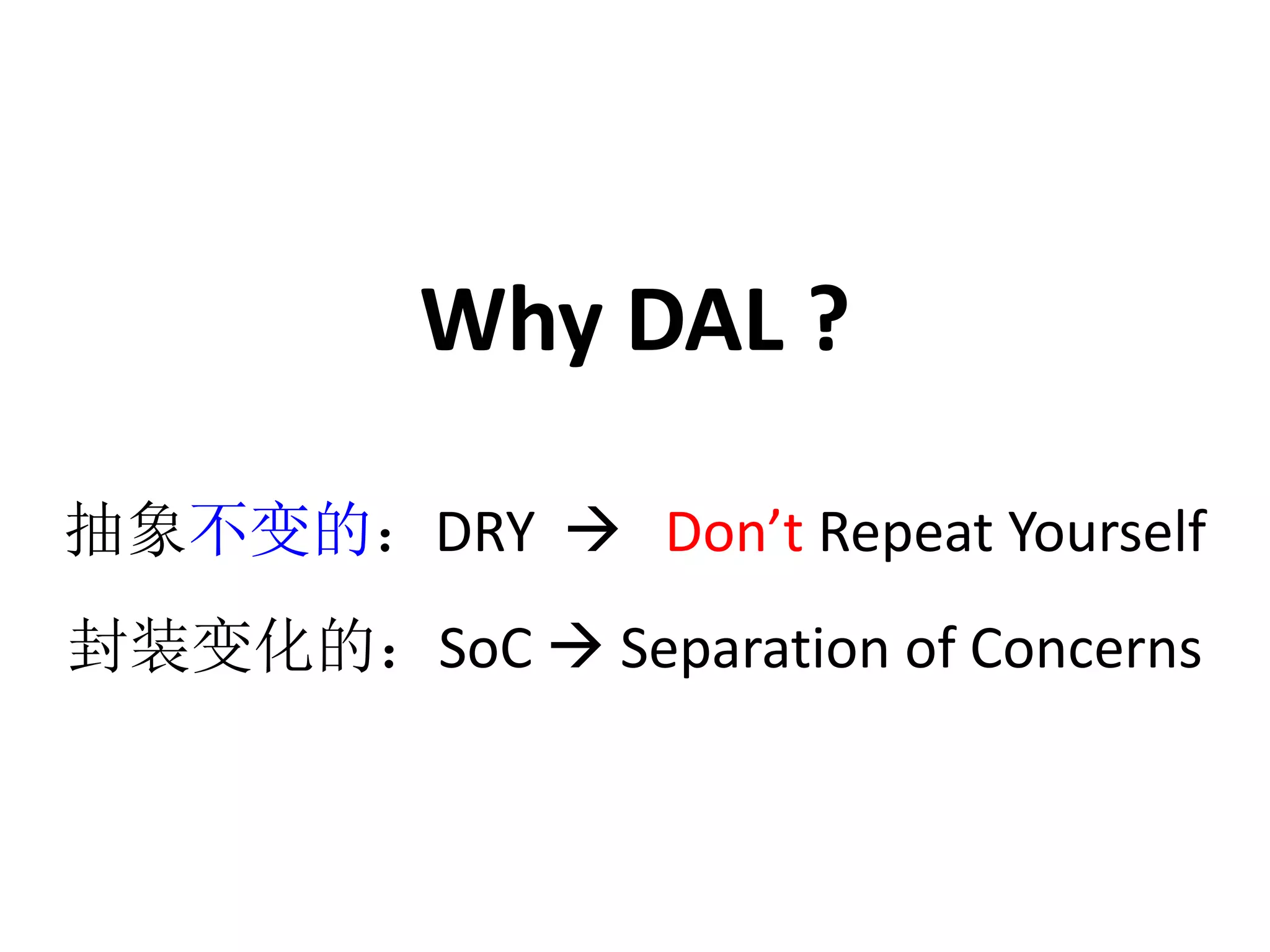
Why DAL ? 
抽象不变的:DRY  Don’t Repeat Yourself 
封装变化的:SoC  Separation of Concerns
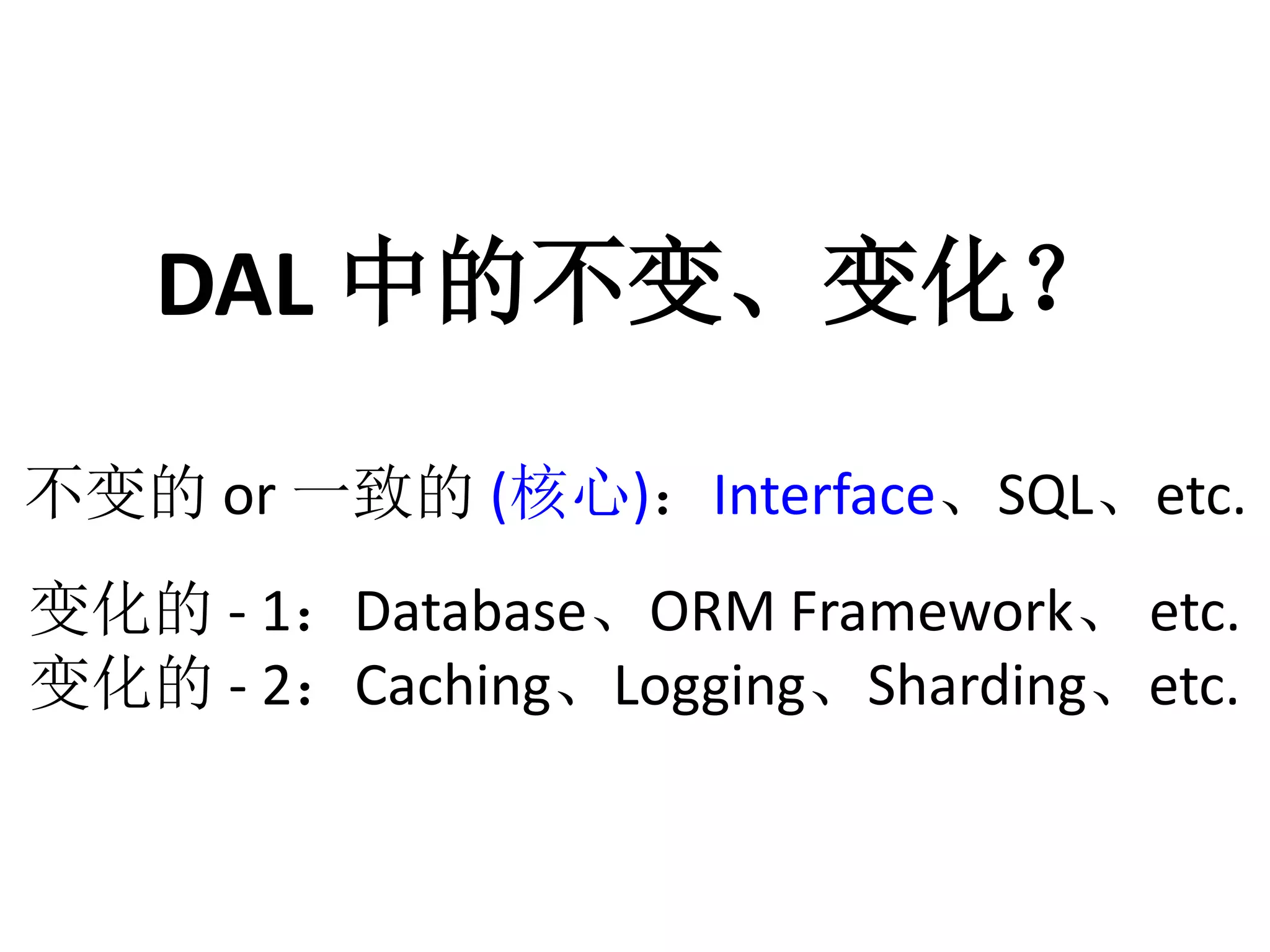
DAL 中的不变、变化? 
不变的or 一致的(核心):Interface、SQL、etc. 
变化的- 1:Database、ORM Framework、etc. 
变化的- 2:Caching、Logging、Sharding、etc.
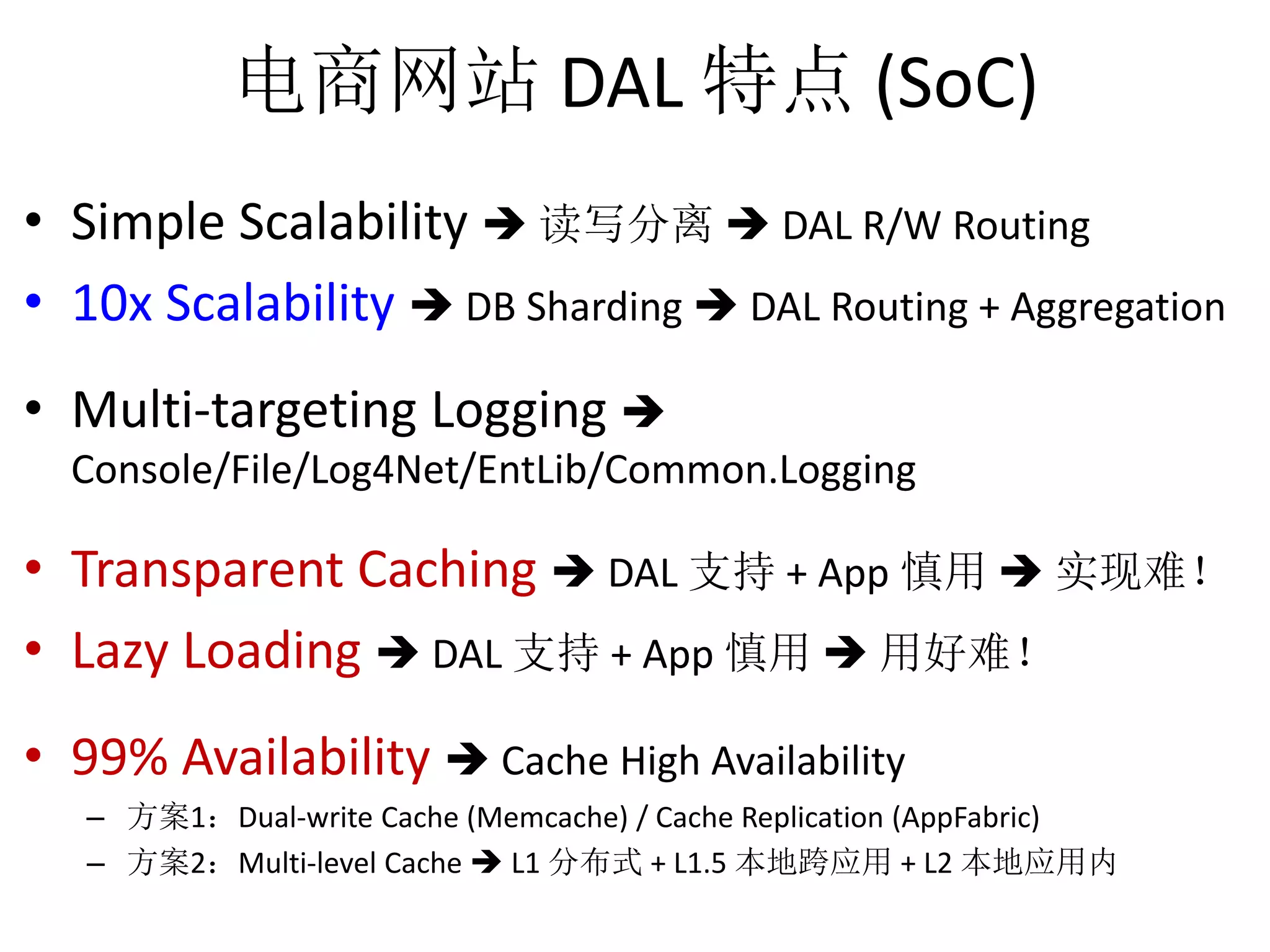
电商网站DAL 特点(SoC) 
• Simple Scalability  读写分离 DAL R/W Routing 
• 10x Scalability  DB Sharding  DAL Routing + Aggregation 
• Multi-targeting Logging  
Console/File/Log4Net/EntLib/Common.Logging 
• Transparent Caching  DAL 支持+ App 慎用 实现难! 
• Lazy Loading  DAL 支持+ App 慎用 用好难! 
• 99% Availability  Cache High Availability 
– 方案1:Dual-write Cache (Memcache) / Cache Replication (AppFabric) 
– 方案2:Multi-level Cache  L1 分布式+ L1.5 本地跨应用+ L2 本地应用内
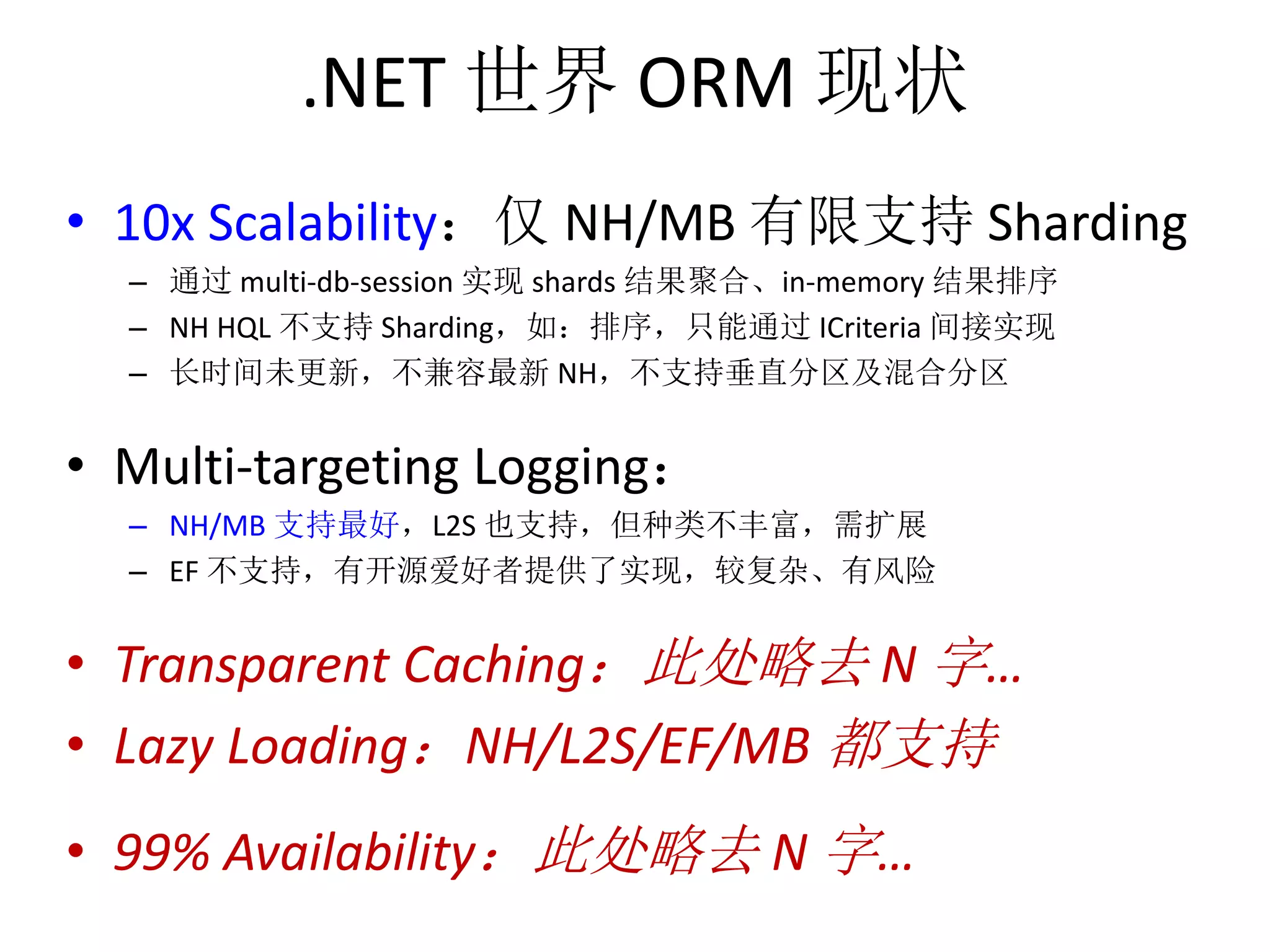
.NET 世界ORM 现状 
• 10x Scalability:仅NH/MB 有限支持Sharding 
– 通过multi-db-session 实现shards 结果聚合、in-memory 结果排序 
– NH HQL 不支持Sharding,如:排序,只能通过ICriteria 间接实现 
– 长时间未更新,不兼容最新NH,不支持垂直分区及混合分区 
• Multi-targeting Logging: 
– NH/MB 支持最好,L2S 也支持,但种类不丰富,需扩展 
– EF 不支持,有开源爱好者提供了实现,较复杂、有风险 
• Transparent Caching:此处略去N 字… 
• Lazy Loading:NH/L2S/EF/MB 都支持 
• 99% Availability:此处略去N 字…
DAL Sharding Demo (ORM Extension) – 
NHibernate.Shards (ISessionFactory)
DAL Sharding Demo (ORM Plug-in) – 
ShardBatis (SQL Interception)
DAL Sharding Demo (ADO.NET Extension) – 
Enzo SQL Shard (C# Extension Method)
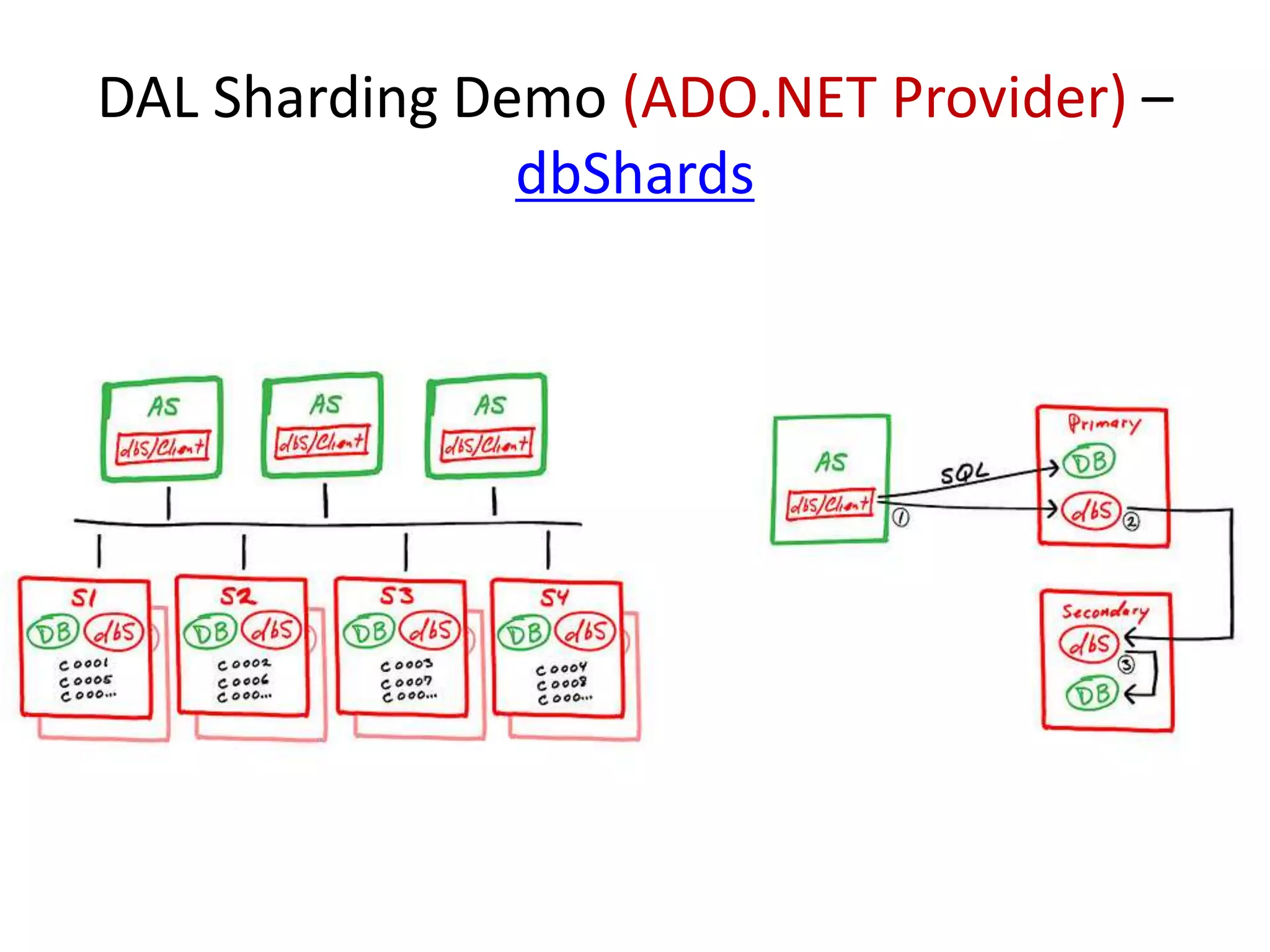
DAL Sharding Demo (ADO.NET Provider) – 
dbShards
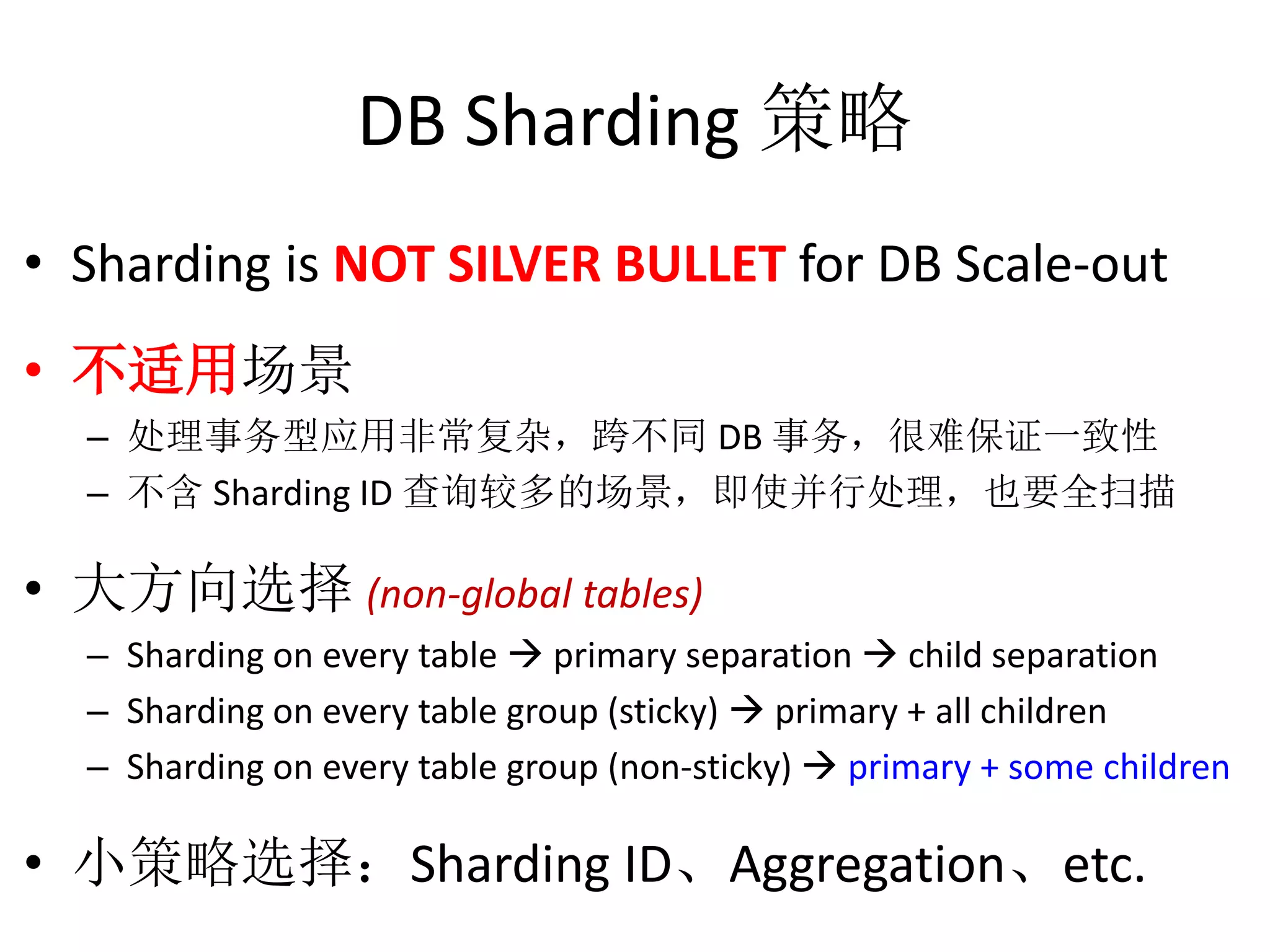
DB Sharding 策略 
• Sharding is NOT SILVER BULLET for DB Scale-out 
• 不适用场景 
– 处理事务型应用非常复杂,跨不同DB 事务,很难保证一致性 
– 不含Sharding ID 查询较多的场景,即使并行处理,也要全扫描 
• 大方向选择(non-global tables) 
– Sharding on every table  primary separation  child separation 
– Sharding on every table group (sticky)  primary + all children 
– Sharding on every table group (non-sticky)  primary + some children 
• 小策略选择:Sharding ID、Aggregation、etc.
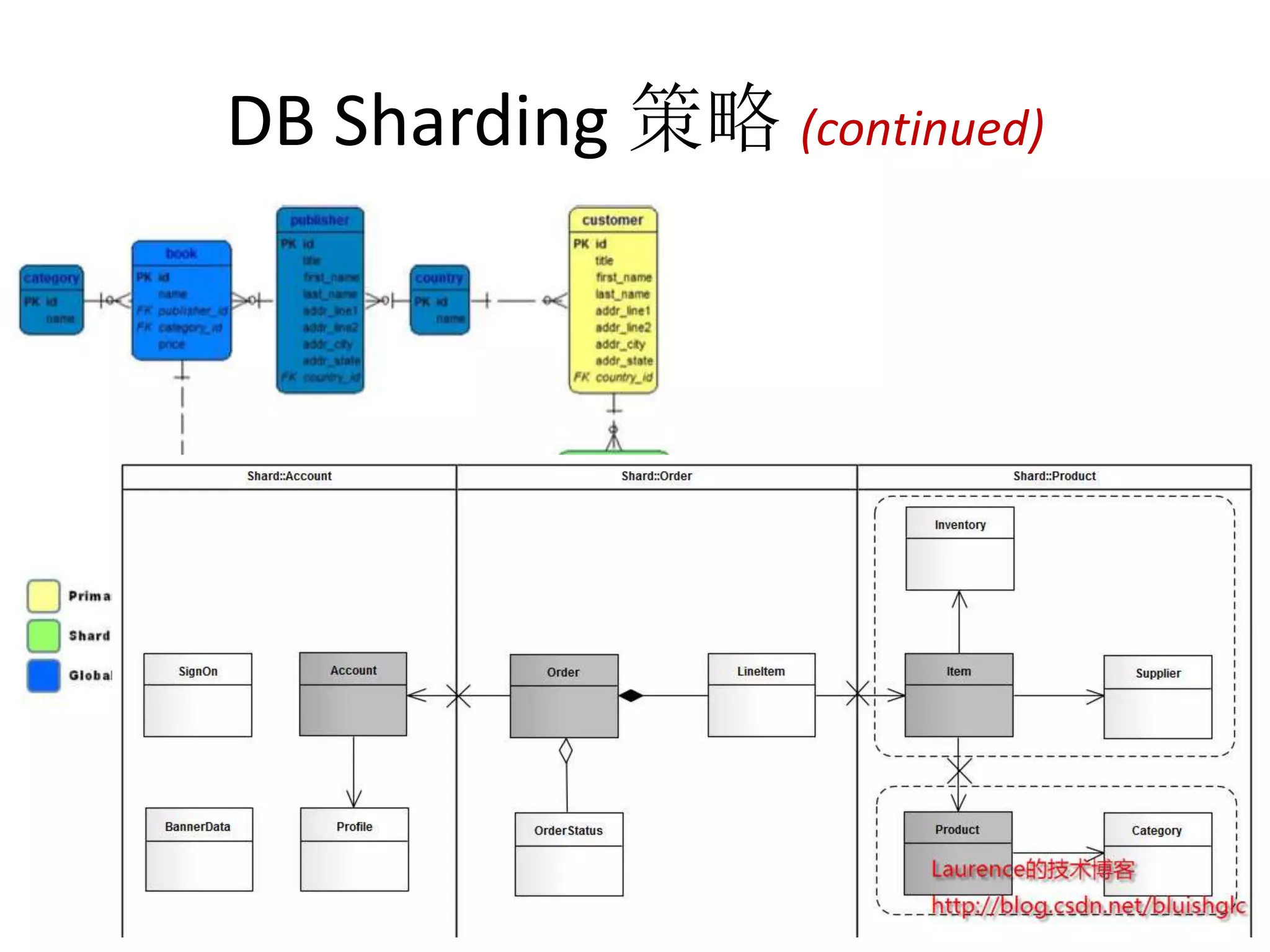
DB Sharding 策略(continued)
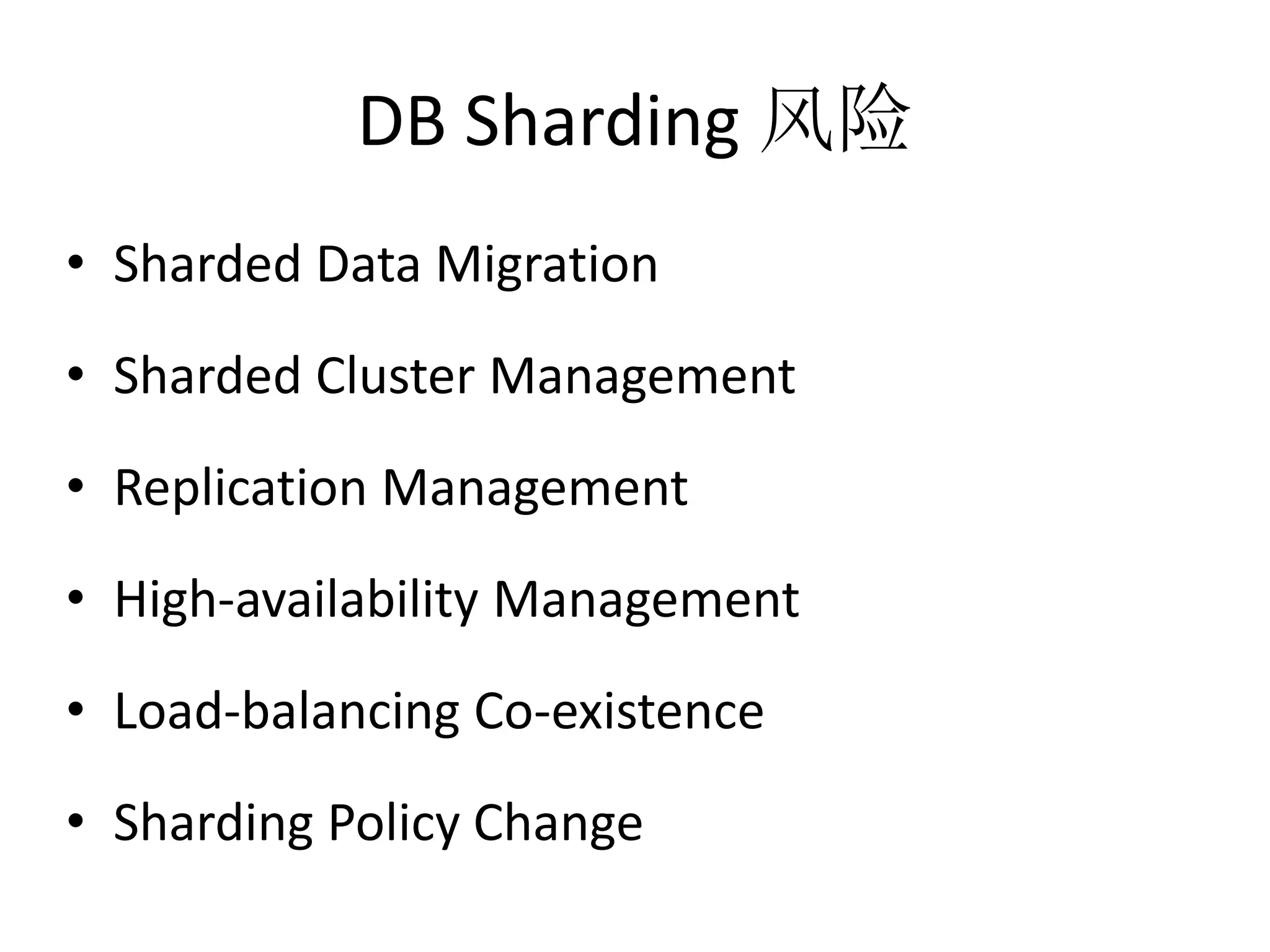
DB Sharding 风险 
• Sharded Data Migration 
• Sharded Cluster Management 
• Replication Management 
• High-availability Management 
• Load-balancing Co-existence 
• Sharding Policy Change
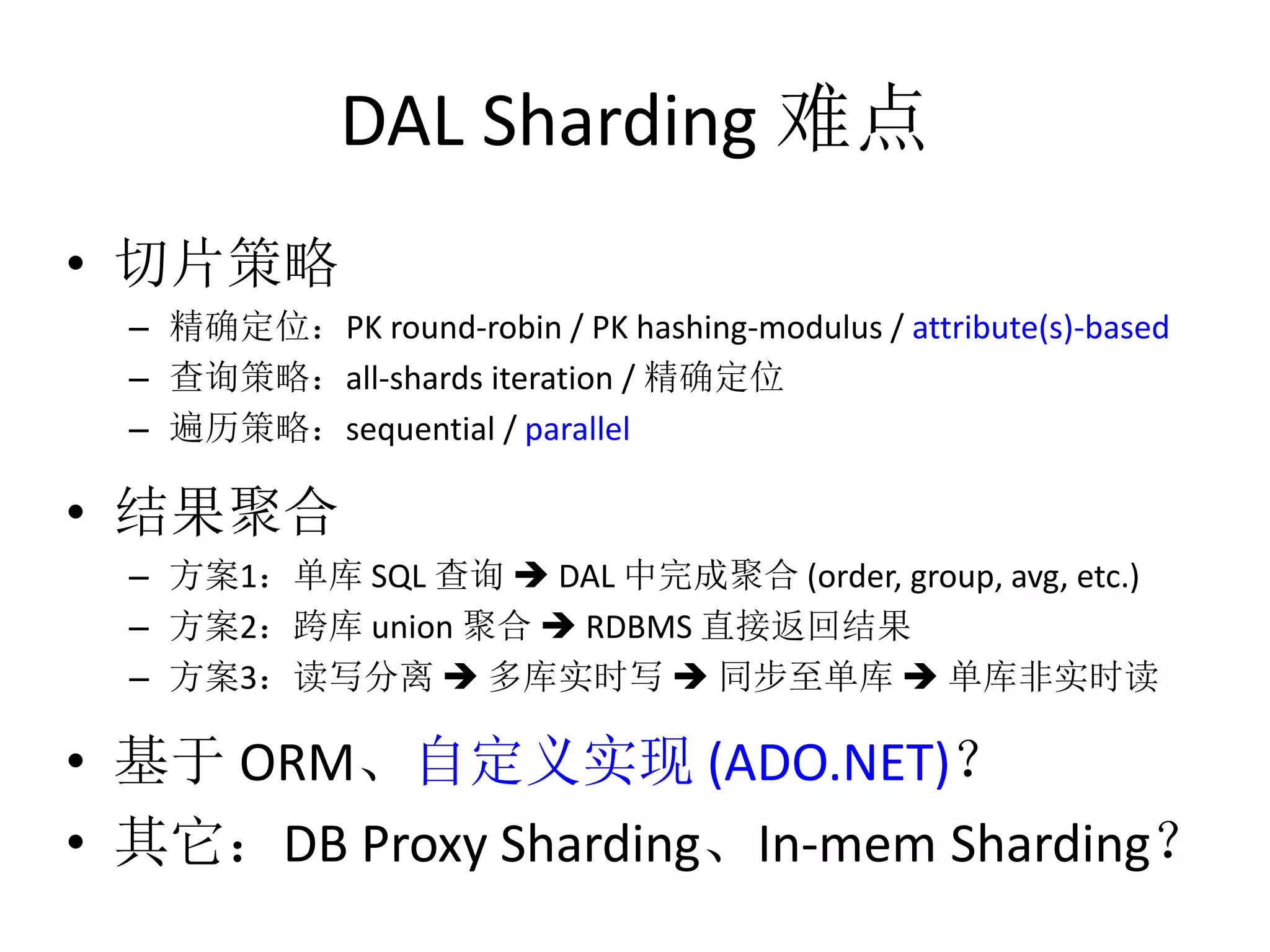
DAL Sharding 难点 
• 切片策略 
– 精确定位:PK round-robin / PK hashing-modulus / attribute(s)-based 
– 查询策略:all-shards iteration / 精确定位 
– 遍历策略:sequential / parallel 
• 结果聚合 
– 方案1:单库SQL 查询 DAL 中完成聚合(order, group, avg, etc.) 
– 方案2:跨库union 聚合 RDBMS 直接返回结果 
– 方案3:读写分离 多库实时写 同步至单库 单库非实时读 
• 基于ORM、自定义实现(ADO.NET)? 
• 其它:DB Proxy Sharding、In-mem Sharding?
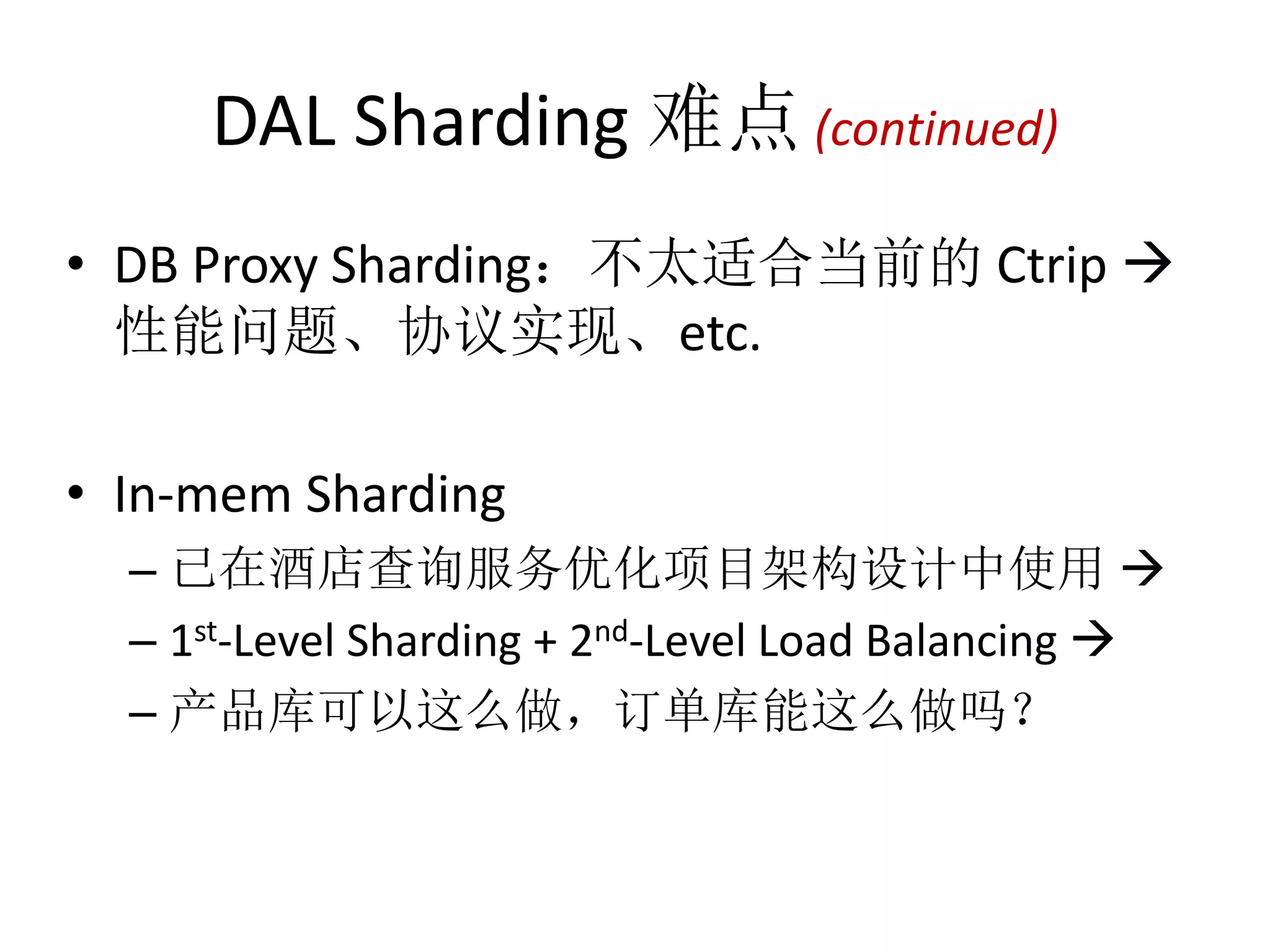
DAL Sharding 难点(continued) 
• DB Proxy Sharding:不太适合当前的Ctrip  
性能问题、协议实现、etc. 
• In-mem Sharding 
– 已在酒店查询服务优化项目架构设计中使用 
– 1st-Level Sharding + 2nd-Level Load Balancing  
– 产品库可以这么做,订单库能这么做吗?
DAL Sharding 设计参考 
1、eBay Data Access Layer (QCon) 
2、DAL Sharding 设计方案
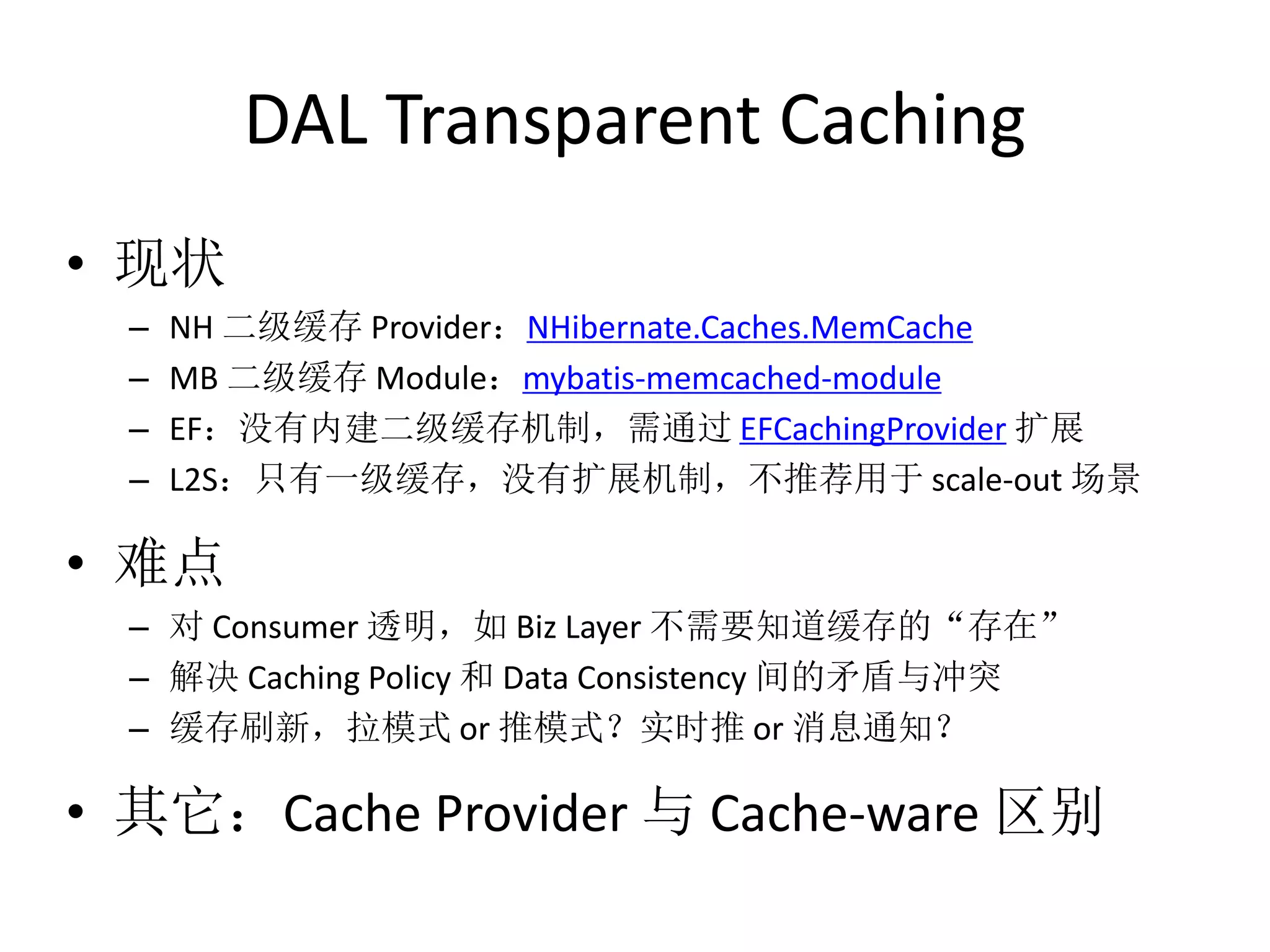
DAL Transparent Caching 
• 现状 
– NH 二级缓存Provider:NHibernate.Caches.MemCache 
– MB 二级缓存Module:mybatis-memcached-module 
– EF:没有内建二级缓存机制,需通过EFCachingProvider 扩展 
– L2S:只有一级缓存,没有扩展机制,不推荐用于scale-out 场景 
• 难点 
– 对Consumer 透明,如Biz Layer 不需要知道缓存的“存在” 
– 解决Caching Policy 和Data Consistency 间的矛盾与冲突 
– 缓存刷新,拉模式or 推模式?实时推or 消息通知? 
• 其它:Cache Provider 与Cache-ware 区别
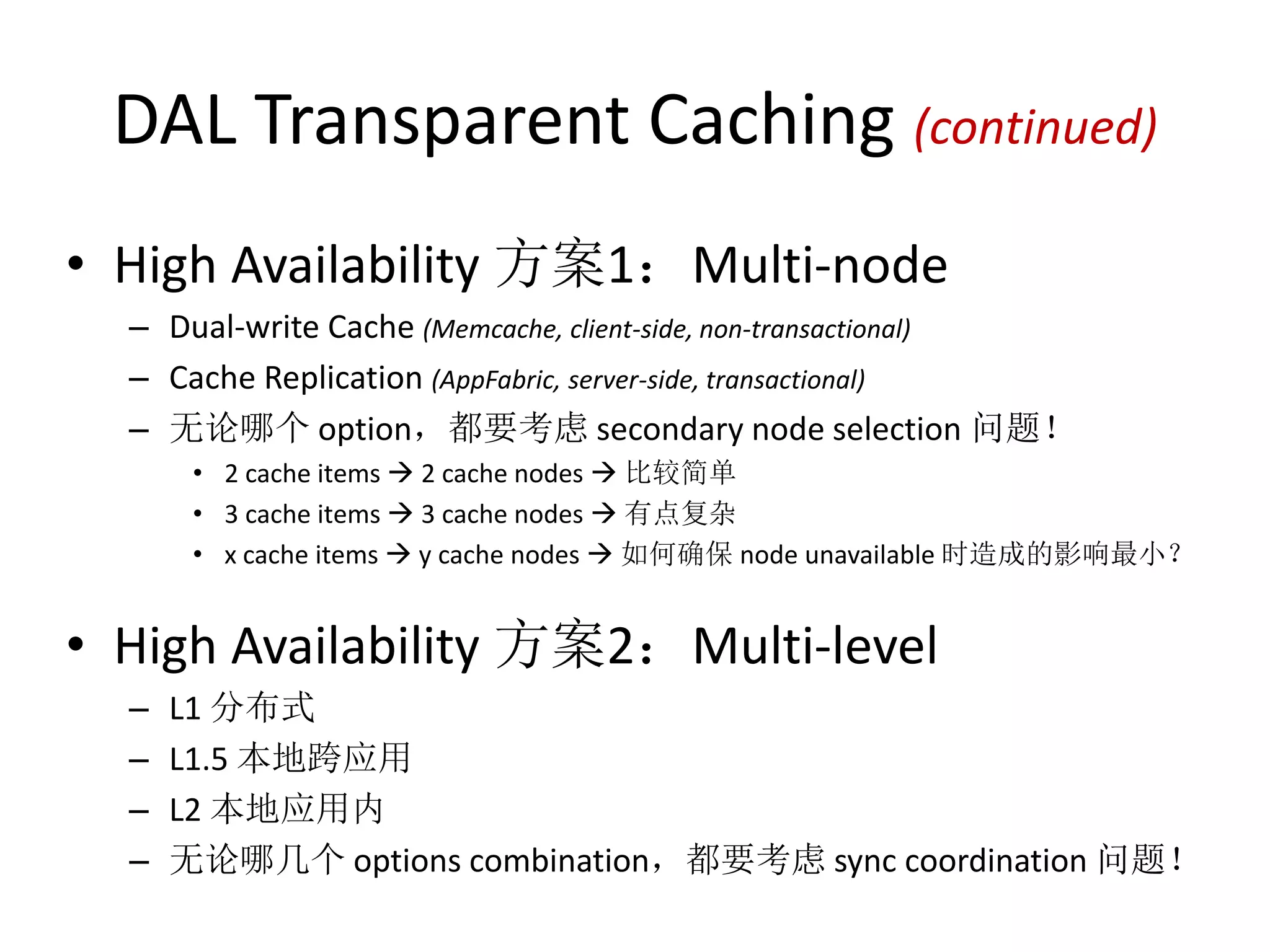
DAL Transparent Caching (continued) 
• High Availability 方案1:Multi-node 
– Dual-write Cache (Memcache, client-side, non-transactional) 
– Cache Replication (AppFabric, server-side, transactional) 
– 无论哪个option,都要考虑secondary node selection 问题! 
• 2 cache items  2 cache nodes  比较简单 
• 3 cache items  3 cache nodes  有点复杂 
• x cache items  y cache nodes  如何确保node unavailable 时造成的影响最小? 
• High Availability 方案2:Multi-level 
– L1 分布式 
– L1.5 本地跨应用 
– L2 本地应用内 
– 无论哪几个options combination,都要考虑sync coordination 问题!
DAL 设计参考 
1、NoSQL 数据库笔谈 
2、James Hamilton
这么多ORMs,众口又难调,如何选择?
1、One Size does NOT Fit ALL ! 
2、ORM Fx + Customized SQL + 其它 
3、DAL 接口+ Base 抽象+ 自定义实现
Demo for【DAL 接口+ Base 抽象+ 
自定义实现】
介绍DDFx 及相关架构
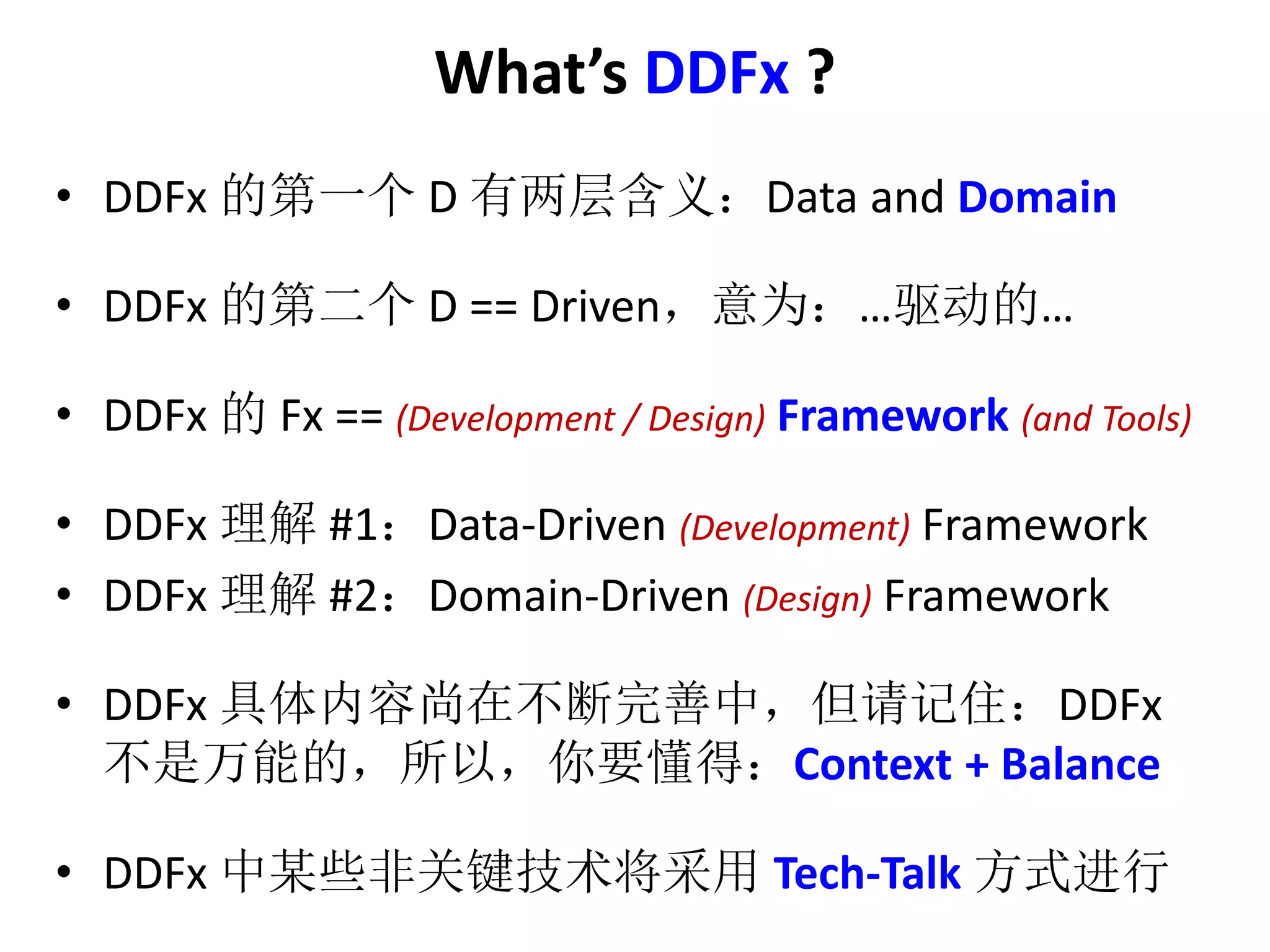
What’s DDFx ? 
• DDFx 的第一个D 有两层含义:Data and Domain 
• DDFx 的第二个D == Driven,意为:…驱动的… 
• DDFx 的Fx == (Development / Design) Framework (and Tools) 
• DDFx 理解#1:Data-Driven (Development) Framework 
• DDFx 理解#2:Domain-Driven (Design) Framework 
• DDFx 具体内容尚在不断完善中,但请记住:DDFx 
不是万能的,所以,你要懂得:Context + Balance 
• DDFx 中某些非关键技术将采用Tech-Talk 方式进行
什么是Domain? 
作为软件方面的专家(架构师、开发人员)和领域专家 
(客户方业务人员、需求分析人员),所有人在一起创建 
领域的模型,这个模型会统一体现两个专业领域的交汇
什么是Data? 
Data Files、Database、Data Service、etc. 
SQL、NoSQL、AWS RDS、SQL Azure、etc.
DDFx 架构
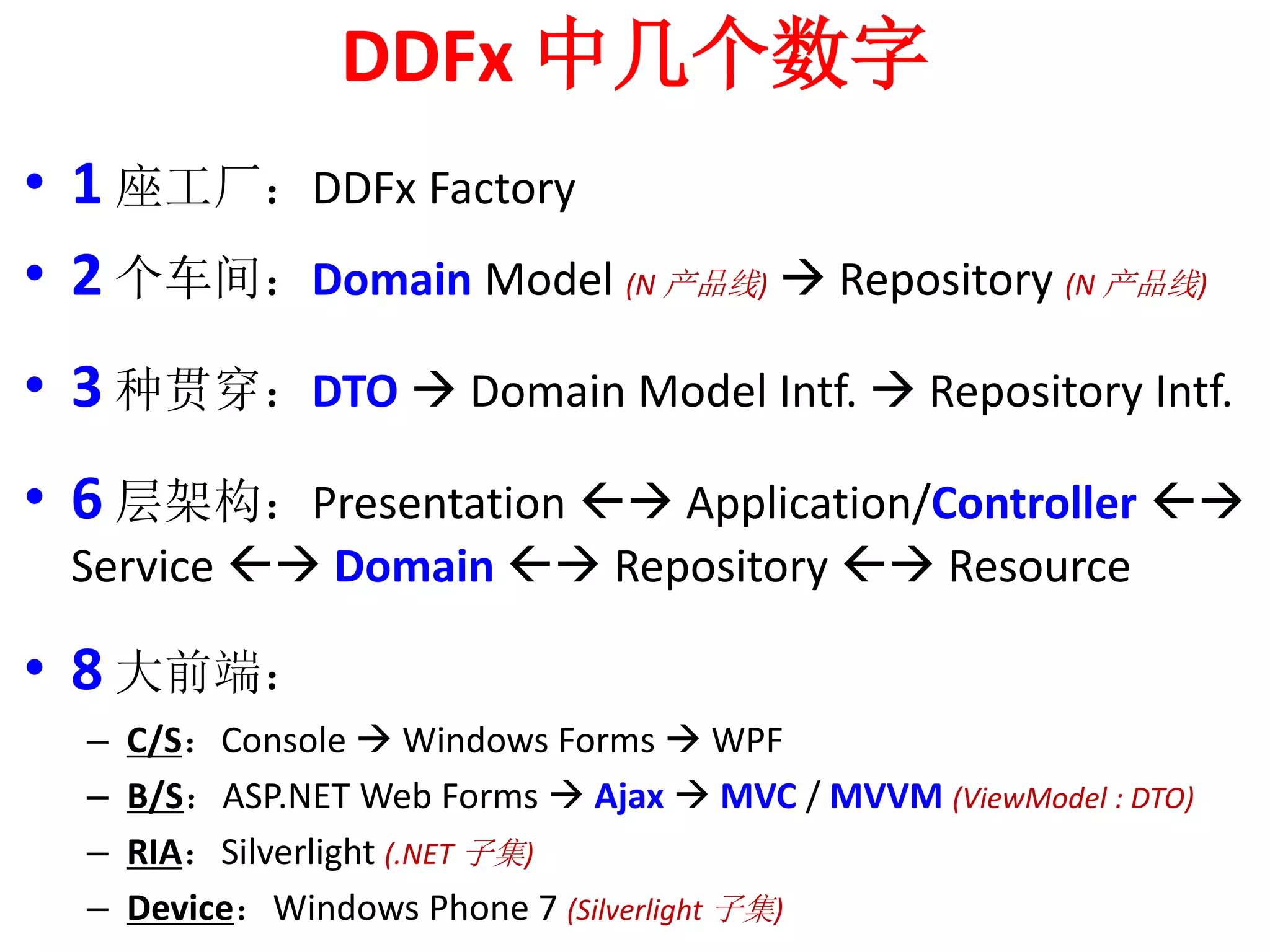
DDFx 中几个数字 
• 1 座工厂:DDFx Factory 
• 2 个车间:Domain Model (N 产品线) 
 Repository (N 产品线) 
• 3 种贯穿:DTO  Domain Model Intf.  Repository Intf. 
• 6 层架构:Presentation  Application/Controller  
Service  Domain  Repository  Resource 
• 8 大前端: 
– C/S:Console  Windows Forms  WPF 
– B/S:ASP.NET Web Forms  Ajax  MVC / MVVM (ViewModel : DTO) 
– RIA:Silverlight (.NET 子集) 
– Device:Windows Phone 7 (Silverlight 子集)
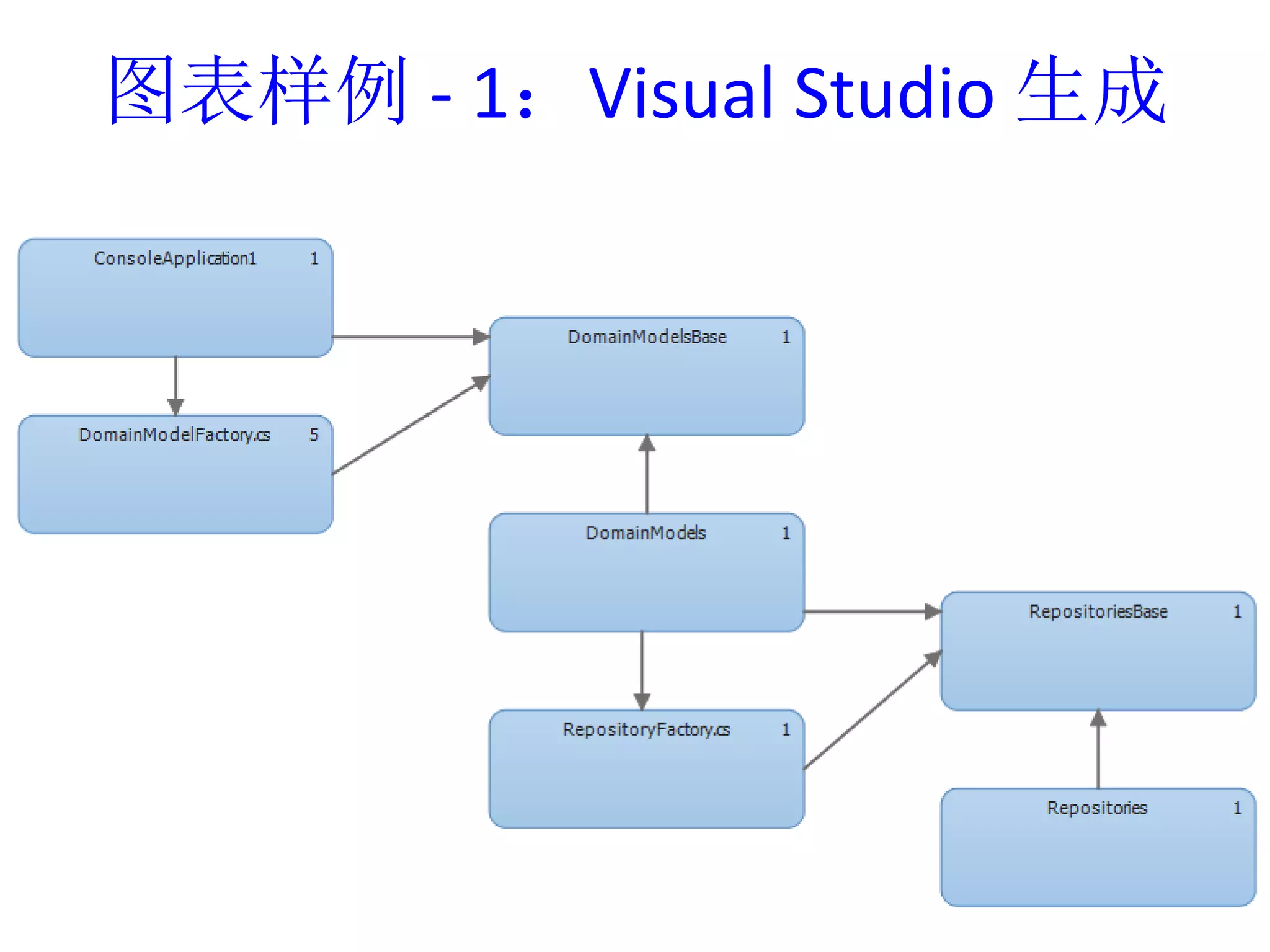
图表样例- 1:Visual Studio 生成
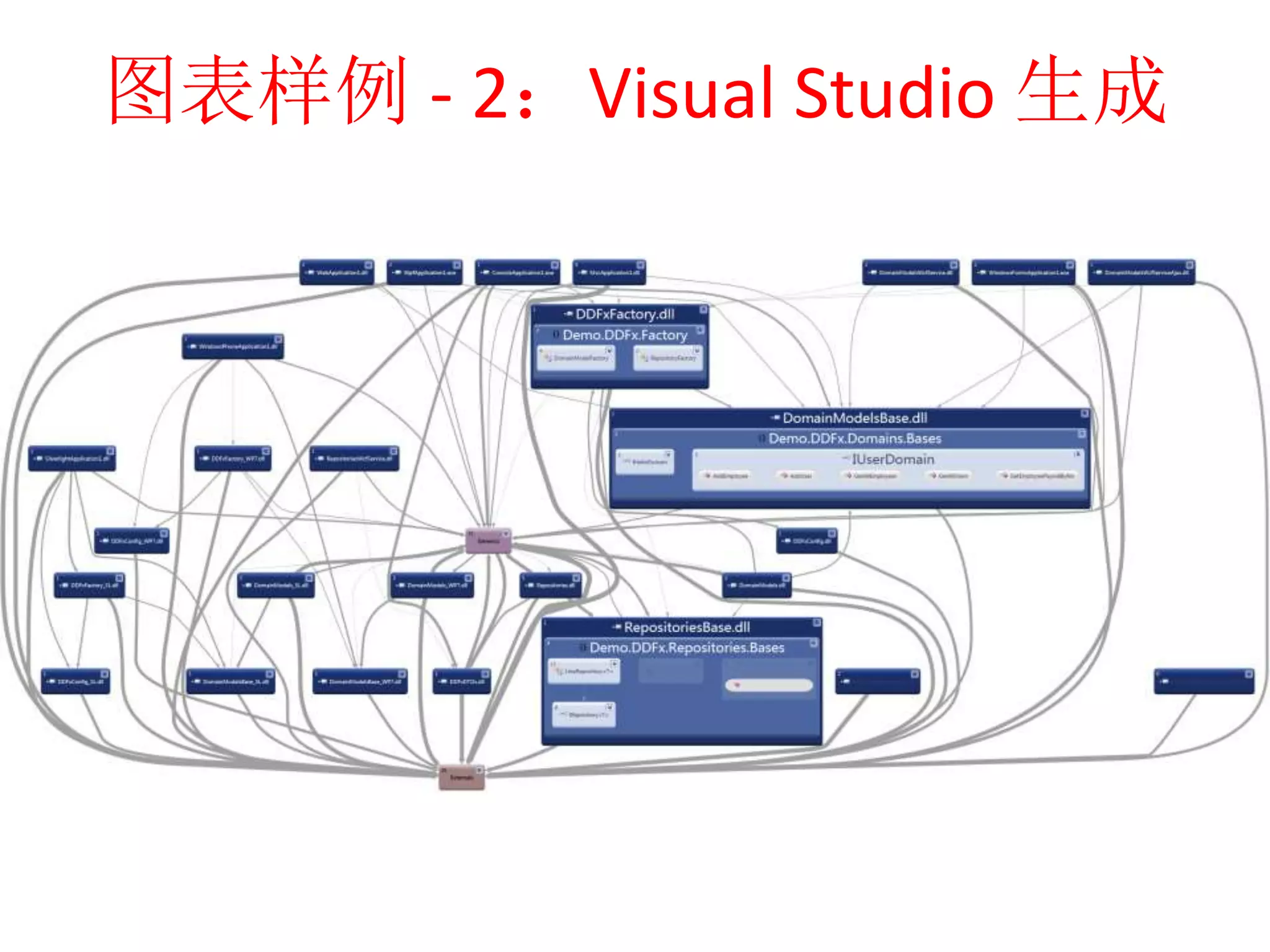
图表样例- 2:Visual Studio 生成
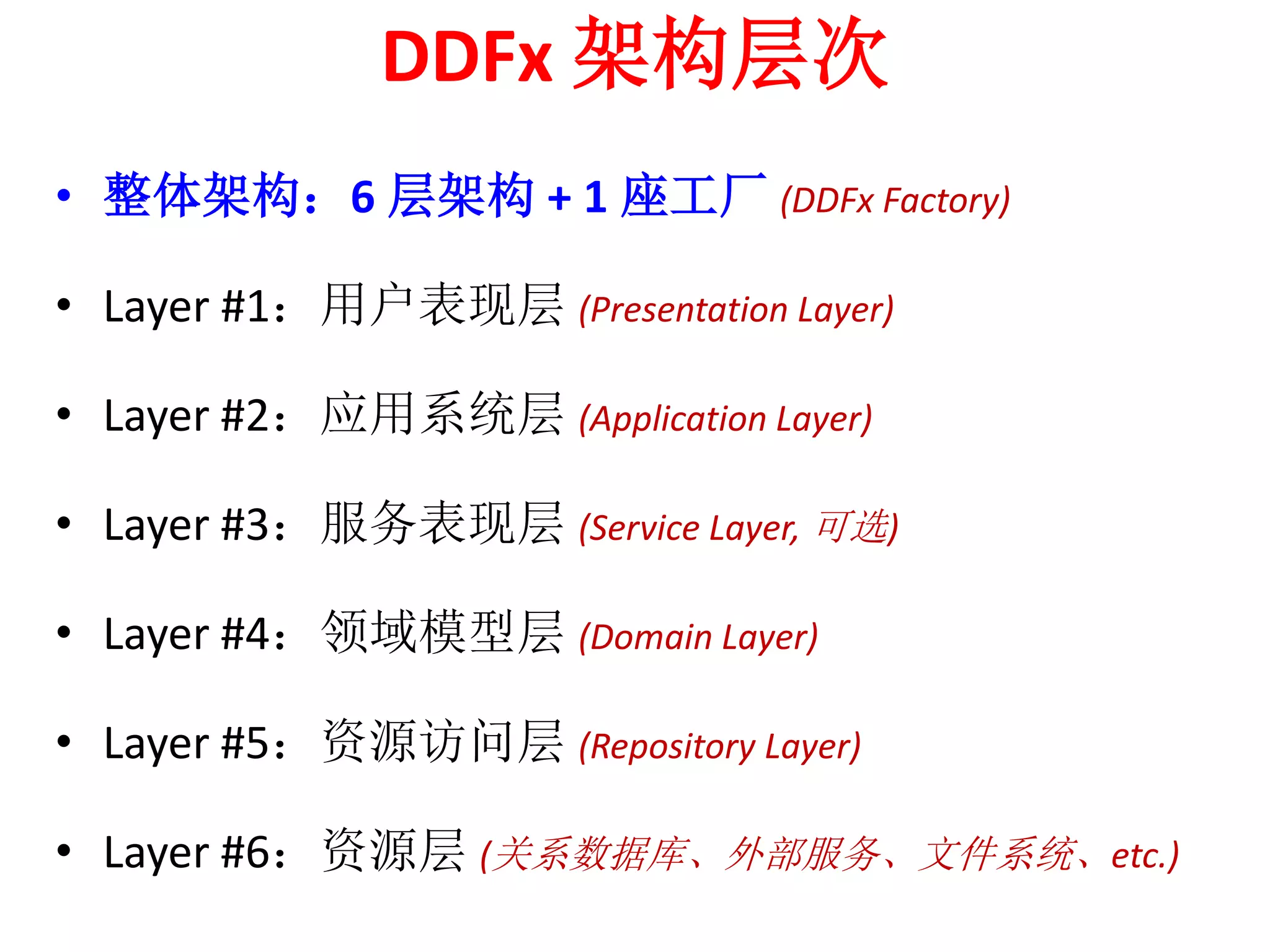
DDFx 架构层次 
• 整体架构:6 层架构+ 1 座工厂(DDFx Factory) 
• Layer #1:用户表现层(Presentation Layer) 
• Layer #2:应用系统层(Application Layer) 
• Layer #3:服务表现层(Service Layer, 可选) 
• Layer #4:领域模型层(Domain Layer) 
• Layer #5:资源访问层(Repository Layer) 
• Layer #6:资源层(关系数据库、外部服务、文件系统、etc.)
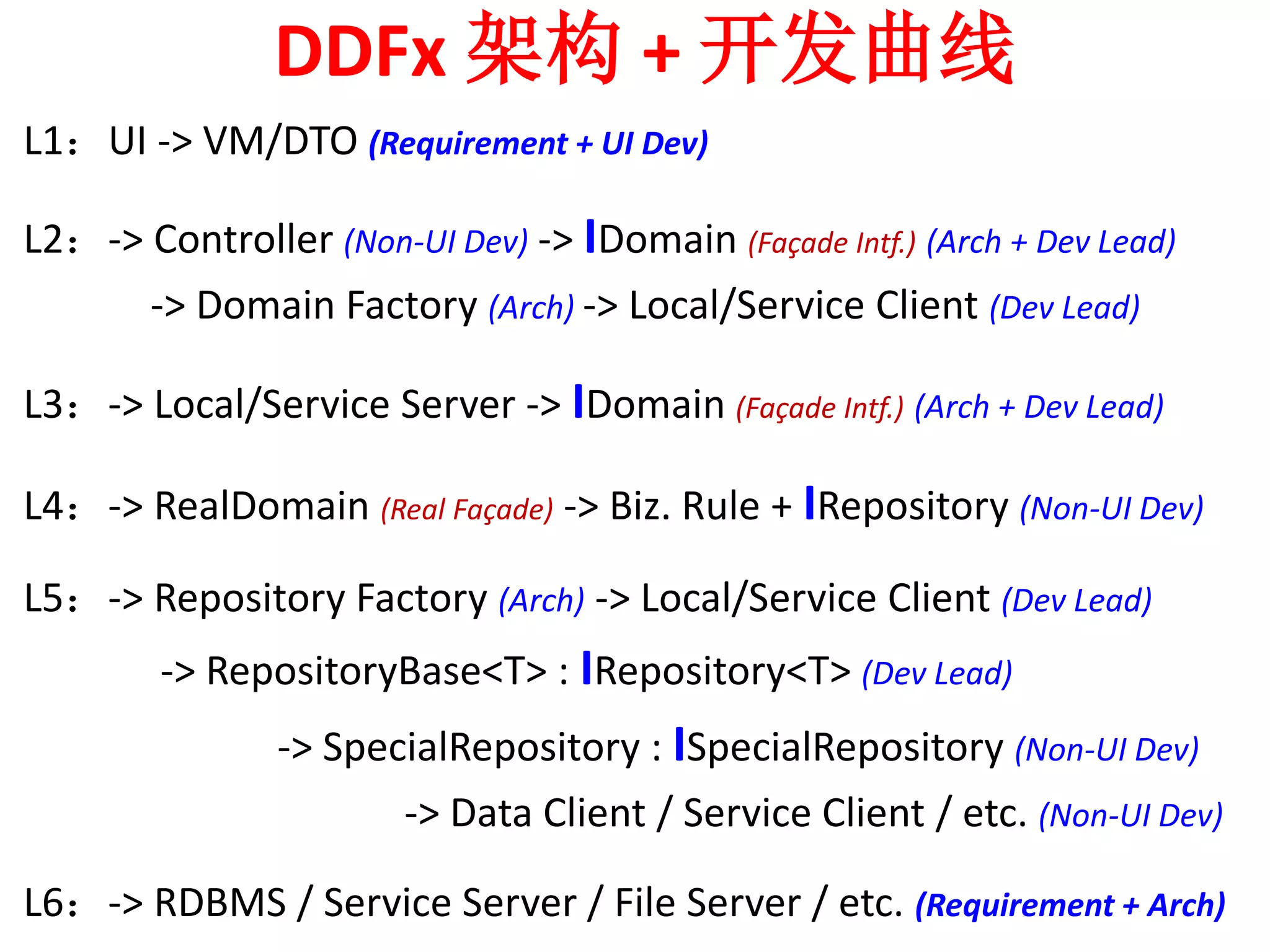
DDFx 架构+ 开发曲线 
L1:UI -> VM/DTO (Requirement + UI Dev) 
L2:-> Controller (Non-UI Dev) -> IDomain (Façade Intf.) (Arch + Dev Lead) 
-> Domain Factory (Arch) -> Local/Service Client (Dev Lead) 
L3:-> Local/Service Server -> IDomain (Façade Intf.) (Arch + Dev Lead) 
L4:-> RealDomain (Real Façade) -> Biz. Rule + IRepository (Non-UI Dev) 
L5:-> Repository Factory (Arch) -> Local/Service Client (Dev Lead) 
-> RepositoryBase<T> : IRepository<T> (Dev Lead) 
-> SpecialRepository : ISpecialRepository (Non-UI Dev) 
-> Data Client / Service Client / etc. (Non-UI Dev) 
L6:-> RDBMS / Service Server / File Server / etc. (Requirement + Arch)
探讨:需求变更导致新增字段, 
你会怎么做?
Q & A

浅谈电商网站数据访问层(DAL)与 ORM 之适用性

  • 1.
  • 2.
    What’s Data ? Data Files、Database、Data Service、etc. SQL、NoSQL、AWS RDS、SQL Azure、etc.
  • 3.
    Why DAL ? 抽象不变的:DRY  Don’t Repeat Yourself 封装变化的:SoC  Separation of Concerns
  • 4.
    DAL 中的不变、变化? 不变的or一致的(核心):Interface、SQL、etc. 变化的- 1:Database、ORM Framework、etc. 变化的- 2:Caching、Logging、Sharding、etc.
  • 5.
    电商网站DAL 特点(SoC) •Simple Scalability  读写分离 DAL R/W Routing • 10x Scalability  DB Sharding  DAL Routing + Aggregation • Multi-targeting Logging  Console/File/Log4Net/EntLib/Common.Logging • Transparent Caching  DAL 支持+ App 慎用 实现难! • Lazy Loading  DAL 支持+ App 慎用 用好难! • 99% Availability  Cache High Availability – 方案1:Dual-write Cache (Memcache) / Cache Replication (AppFabric) – 方案2:Multi-level Cache  L1 分布式+ L1.5 本地跨应用+ L2 本地应用内
  • 6.
    .NET 世界ORM 现状 • 10x Scalability:仅NH/MB 有限支持Sharding – 通过multi-db-session 实现shards 结果聚合、in-memory 结果排序 – NH HQL 不支持Sharding,如:排序,只能通过ICriteria 间接实现 – 长时间未更新,不兼容最新NH,不支持垂直分区及混合分区 • Multi-targeting Logging: – NH/MB 支持最好,L2S 也支持,但种类不丰富,需扩展 – EF 不支持,有开源爱好者提供了实现,较复杂、有风险 • Transparent Caching:此处略去N 字… • Lazy Loading:NH/L2S/EF/MB 都支持 • 99% Availability:此处略去N 字…
  • 7.
    DAL Sharding Demo(ORM Extension) – NHibernate.Shards (ISessionFactory)
  • 8.
    DAL Sharding Demo(ORM Plug-in) – ShardBatis (SQL Interception)
  • 9.
    DAL Sharding Demo(ADO.NET Extension) – Enzo SQL Shard (C# Extension Method)
  • 10.
    DAL Sharding Demo(ADO.NET Provider) – dbShards
  • 11.
    DB Sharding 策略 • Sharding is NOT SILVER BULLET for DB Scale-out • 不适用场景 – 处理事务型应用非常复杂,跨不同DB 事务,很难保证一致性 – 不含Sharding ID 查询较多的场景,即使并行处理,也要全扫描 • 大方向选择(non-global tables) – Sharding on every table  primary separation  child separation – Sharding on every table group (sticky)  primary + all children – Sharding on every table group (non-sticky)  primary + some children • 小策略选择:Sharding ID、Aggregation、etc.
  • 12.
  • 13.
    DB Sharding 风险 • Sharded Data Migration • Sharded Cluster Management • Replication Management • High-availability Management • Load-balancing Co-existence • Sharding Policy Change
  • 14.
    DAL Sharding 难点 • 切片策略 – 精确定位:PK round-robin / PK hashing-modulus / attribute(s)-based – 查询策略:all-shards iteration / 精确定位 – 遍历策略:sequential / parallel • 结果聚合 – 方案1:单库SQL 查询 DAL 中完成聚合(order, group, avg, etc.) – 方案2:跨库union 聚合 RDBMS 直接返回结果 – 方案3:读写分离 多库实时写 同步至单库 单库非实时读 • 基于ORM、自定义实现(ADO.NET)? • 其它:DB Proxy Sharding、In-mem Sharding?
  • 15.
    DAL Sharding 难点(continued) • DB Proxy Sharding:不太适合当前的Ctrip  性能问题、协议实现、etc. • In-mem Sharding – 已在酒店查询服务优化项目架构设计中使用 – 1st-Level Sharding + 2nd-Level Load Balancing  – 产品库可以这么做,订单库能这么做吗?
  • 16.
    DAL Sharding 设计参考 1、eBay Data Access Layer (QCon) 2、DAL Sharding 设计方案
  • 17.
    DAL Transparent Caching • 现状 – NH 二级缓存Provider:NHibernate.Caches.MemCache – MB 二级缓存Module:mybatis-memcached-module – EF:没有内建二级缓存机制,需通过EFCachingProvider 扩展 – L2S:只有一级缓存,没有扩展机制,不推荐用于scale-out 场景 • 难点 – 对Consumer 透明,如Biz Layer 不需要知道缓存的“存在” – 解决Caching Policy 和Data Consistency 间的矛盾与冲突 – 缓存刷新,拉模式or 推模式?实时推or 消息通知? • 其它:Cache Provider 与Cache-ware 区别
  • 18.
    DAL Transparent Caching(continued) • High Availability 方案1:Multi-node – Dual-write Cache (Memcache, client-side, non-transactional) – Cache Replication (AppFabric, server-side, transactional) – 无论哪个option,都要考虑secondary node selection 问题! • 2 cache items  2 cache nodes  比较简单 • 3 cache items  3 cache nodes  有点复杂 • x cache items  y cache nodes  如何确保node unavailable 时造成的影响最小? • High Availability 方案2:Multi-level – L1 分布式 – L1.5 本地跨应用 – L2 本地应用内 – 无论哪几个options combination,都要考虑sync coordination 问题!
  • 19.
    DAL 设计参考 1、NoSQL数据库笔谈 2、James Hamilton
  • 20.
  • 21.
    1、One Size doesNOT Fit ALL ! 2、ORM Fx + Customized SQL + 其它 3、DAL 接口+ Base 抽象+ 自定义实现
  • 22.
    Demo for【DAL 接口+Base 抽象+ 自定义实现】
  • 23.
  • 24.
    What’s DDFx ? • DDFx 的第一个D 有两层含义:Data and Domain • DDFx 的第二个D == Driven,意为:…驱动的… • DDFx 的Fx == (Development / Design) Framework (and Tools) • DDFx 理解#1:Data-Driven (Development) Framework • DDFx 理解#2:Domain-Driven (Design) Framework • DDFx 具体内容尚在不断完善中,但请记住:DDFx 不是万能的,所以,你要懂得:Context + Balance • DDFx 中某些非关键技术将采用Tech-Talk 方式进行
  • 25.
  • 26.
    什么是Data? Data Files、Database、DataService、etc. SQL、NoSQL、AWS RDS、SQL Azure、etc.
  • 27.
  • 28.
    DDFx 中几个数字 •1 座工厂:DDFx Factory • 2 个车间:Domain Model (N 产品线)  Repository (N 产品线) • 3 种贯穿:DTO  Domain Model Intf.  Repository Intf. • 6 层架构:Presentation  Application/Controller  Service  Domain  Repository  Resource • 8 大前端: – C/S:Console  Windows Forms  WPF – B/S:ASP.NET Web Forms  Ajax  MVC / MVVM (ViewModel : DTO) – RIA:Silverlight (.NET 子集) – Device:Windows Phone 7 (Silverlight 子集)
  • 29.
  • 30.
  • 31.
    DDFx 架构层次 •整体架构:6 层架构+ 1 座工厂(DDFx Factory) • Layer #1:用户表现层(Presentation Layer) • Layer #2:应用系统层(Application Layer) • Layer #3:服务表现层(Service Layer, 可选) • Layer #4:领域模型层(Domain Layer) • Layer #5:资源访问层(Repository Layer) • Layer #6:资源层(关系数据库、外部服务、文件系统、etc.)
  • 32.
    DDFx 架构+ 开发曲线 L1:UI -> VM/DTO (Requirement + UI Dev) L2:-> Controller (Non-UI Dev) -> IDomain (Façade Intf.) (Arch + Dev Lead) -> Domain Factory (Arch) -> Local/Service Client (Dev Lead) L3:-> Local/Service Server -> IDomain (Façade Intf.) (Arch + Dev Lead) L4:-> RealDomain (Real Façade) -> Biz. Rule + IRepository (Non-UI Dev) L5:-> Repository Factory (Arch) -> Local/Service Client (Dev Lead) -> RepositoryBase<T> : IRepository<T> (Dev Lead) -> SpecialRepository : ISpecialRepository (Non-UI Dev) -> Data Client / Service Client / etc. (Non-UI Dev) L6:-> RDBMS / Service Server / File Server / etc. (Requirement + Arch)
  • 33.
  • 34.