Where Is Away?
A Travel Diary of Western Mass Waste

                  Amy Donovan
                 Program Director
 Franklin County Solid Waste Management District
                  Greenfield, MA
Overview of presentation

About Franklin County Solid Waste District
Where is “away?”
Recycling in Western Mass
About Commercial Composting (CC): the
climate change and farm connection
CC programs: transfer stations, schools,
businesses
Waste Diversion: Fairs, Festivals, Races
Hazardous Waste
Next steps = more sustainable in 2012
Franklin County Solid Waste
Management District
22 member towns:
• 30 schools - 15 public school compost programs
• 17 transfer stations - 4 municipal compost programs
   • (only 9 in entire state)
  Bernardston                   Leyden
  Buckland                      Montague
  Charlemont                    New Salem (CC since 2009)
  Colrain                       Northfield (CC since 2008)
  Conway                        Orange (CC since 2011)
  Deerfield                     Rowe
  Erving                        Shelburne
  Gill                          Sunderland
  Hawley                        Warwick
  Heath                         Wendell
  Leverett                      Whately (CC since 2003)
                                   1st program in state
Solid Waste District Highlights:

Recycling coordinator for Franklin County
Annual Household Hazardous Waste Day
What Do I Do With…? 350 items listed
   www.franklincountywastedistrict.org
MassRecycle’s Recycler of the Year:
www.massrecycle.org
   Solid Waste District, Municipal Program, 1996
   Jan Ameen, Executive Director, 2005
   Amy Donovan, Program Director, 2011
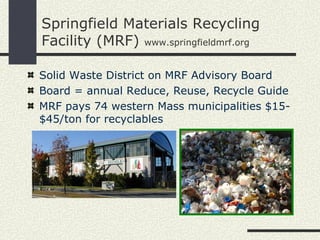
Springfield Materials Recycling
Facility (MRF) www.springfieldmrf.org

Solid Waste District on MRF Advisory Board
Board = annual Reduce, Reuse, Recycle Guide
MRF pays 74 western Mass municipalities $15-
$45/ton for recyclables
Recycling saves space in landfills.


• It’s against the law In Massachusetts to put
recyclable items in the trash.
• Most landfills in area will close in 5 years
• Expensive to open, use, and close
Trash Combustors

Covanta Energy, Springfield/ Agawam
   Waste-To-Energy facility

   Town of Deerfield sends household trash

   Produces 9.4 megawatts (MW) of energy, of
    which 7.5 MW is sold to Northeast Utilities.
   Leftover ash >> landfill

   Emissions: mercury

   State: moratorium on new combustors
Composting and Recycling:

Save space in landfills
Save energy
Save money
Save water
Save natural resources
Create jobs
Slow climate change!
Recycling
Recycle paper:


    (staples, paper clips, notebooks


    Envelopes
    (plastic windows, labels, stamps OK)
Recycle cardboard:


Boxboard: cereal + cracker boxes


Corrugated cardboard (clean pizza boxes OK)
(no waxed cardboard)
DO NOT recycle:
 NO paper products with food on them
 NO paper cups or plates
 NO napkins, paper towels, tissues
 NO egg cartons
 NO hardcover books
 NO copy paper wrappers
 NO PLASTIC BAGS, plastic
 wrappers or packaging!
Our paper recycling is:
Sent to Newark Mills, Fitchburg, MA
78 Western MA communities recycle
32,000 tons a year.
Made into board games and
hard book covers.


Guess what book’s cover was made
entirely from Western MA paper
recycling?......
Recycle metal, glass, and plastic
        containers =
     “Cans and Bottles”

    Empty food and liquids.
     Rinse when possible.
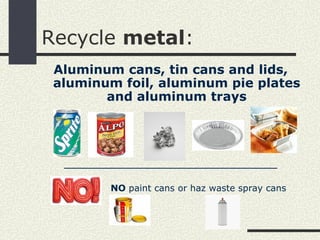
Recycle metal:
 Aluminum cans, tin cans and lids,
 aluminum foil, aluminum pie plates
        and aluminum trays


  ___________________________
        NO paint cans or haz waste spray cans
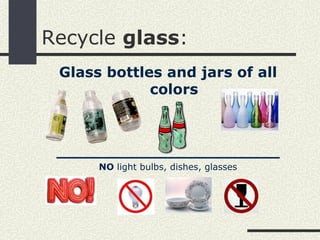
Recycle glass:
 Glass bottles and jars of all
             colors


 ______________________
      NO light bulbs, dishes, glasses
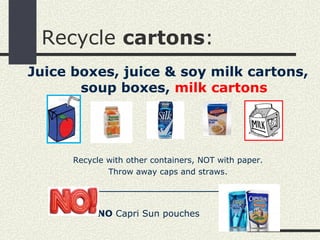
Recycle cartons:
Juice boxes, juice & soy milk cartons,
       soup boxes, milk cartons


      Recycle with other containers, NOT with paper.
              Throw away caps and straws.
    ___________________________

           NO Capri Sun pouches
Recycle plastic:
Plastic bottles,

jars,

tubs,

and jugs

Food, soap, and beverage containers only!
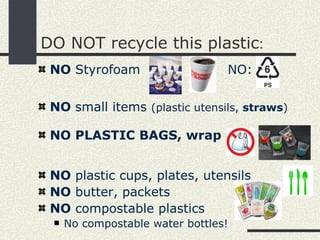
DO NOT recycle this plastic:
 NO Styrofoam                    NO:


 NO small items (plastic utensils, straws)

 NO PLASTIC BAGS, wrap


 NO plastic cups, plates, utensils
 NO butter, packets
 NO compostable plastics
    No compostable water bottles!
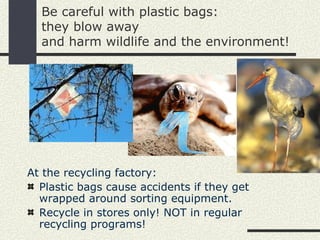
Be careful with plastic bags:
  they blow away
  and harm wildlife and the environment!


At the recycling factory:
  Plastic bags cause accidents if they get
  wrapped around sorting equipment.
  Recycle in stores only! NOT in regular
  recycling programs!
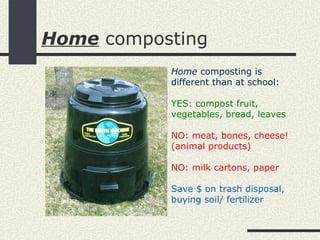
Home composting
           Home composting is
           different than at school:

           YES: compost fruit,
           vegetables, bread, leaves

           NO: meat, bones, cheese!
           (animal products)

           NO: milk cartons, paper

           Save $ on trash disposal,
           buying soil/ fertilizer
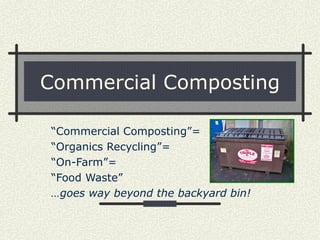
Commercial Composting

“Commercial Composting”=
“Organics Recycling”=
“On-Farm”=
“Food Waste”
…goes way beyond the backyard bin!
Commercial Composting accepts materials
       previously destined for trash = less trash


Acceptable materials:
  All food including items not composted at home:
    Meat, chicken, fish, bones, dairy, fats, oils
         (+ bread, veggies, fruits)

  All paper including non recyclable:
    Paper cups, paper plates, napkins, paper towels, waxed
      cardboard, waxed paper, soiled pizza boxes, soiled paper,
      soiled paper bags, flour/ sugar bags, egg cartons
      Wood: skewers, chopsticks, coffee stirrers, sporks
  “Compostable plastic:” PLA cups, certain bags
  NO plastic, metal, glass, foil, etc.!
Compost is good for plants:
• adds nutrients to soil
• reduces need to water
• replaces chemical fertilizers


                                  Farmland


              Finished
              compost
CC’s benefits to participating
organizations and planet:

Save money on tipping fees:
  Trash: $75/ ton
  Compostables: $45/ ton

Reduce trash dumpster size or reduce pickups and
save on trash disposal /hauling costs
Supports local commercial composting facilities/
farms = local business
Saves space in landfills
Creates valuable soil out of waste
Mitigates climate change!
Composting helps slow
Climate Change

Climate Change is caused by greenhouse gases in
our atmosphere.

                                Greenhouse Gases:
                                Carbon Dioxide
                                Methane
                                Nitrous Oxide
• When food waste (and paper) decay in a landfill, methane is
       The Climate Change
released (due to anaerobic conditions).
       Connection
• Methane is a greenhouse gas 23 times more potent than
carbon dioxide.
• Landfill Gas Recovery not always a solution.


                                  Methane pipe at
                                  a landfill
Why doesn’t composting release methane? Because
oxygen is part of the composting process (aerobic).
There is no oxygen in a landfill (anaerobic).


                             More info:
                             www.cool2012.com
Bear Path Farm, Whately, MA


                              Windrows
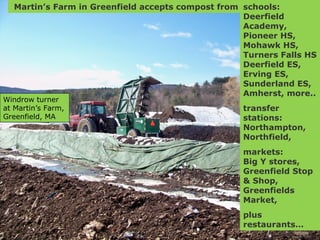
Windrows at Martin’s Farm
Martin’s Farm in Greenfield accepts compost from schools:
                                                    Deerfield
                                                    Academy,
                                                    Pioneer HS,
                                                    Mohawk HS,
                                                    Turners Falls HS
                                                    Deerfield ES,
                                                    Erving ES,
                                                    Sunderland ES,
                                                    Amherst, more..
Windrow turner
at Martin’s Farm,                                   transfer
Greenfield, MA                                      stations:
                                                    Northampton,
                                                    Northfield,
                                                    markets:
                                                    Big Y stores,
                                                    Greenfield Stop
                                                    & Shop,
                                                    Greenfields
                                                    Market,
                                                    plus
                                                    restaurants…
Whately Transfer Station:
first municipal program in the state
Northfield Transfer Station: 2 yd dumpster
Saves town $1,384/ year
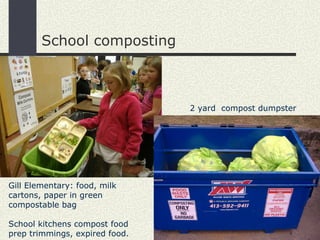
School composting


                                2 yard compost dumpster


Gill Elementary: food, milk
cartons, paper in green
compostable bag

School kitchens compost food
prep trimmings, expired food.
Shelburne Falls
Compost Collaborative

Blue Rock Restaurant, The Baker’s Oven,
Mocha Maya’s, Mo’s Fudge Factor, West End Pub


• Shared compost dumpster
• Cost is shared according to volume
• Food waste, napkins, paper towels, cardboard
Waste Diversion/ Reduction:
   Fairs, Festivals, Races
Solid Waste
District’s
Special Event Bin
Loaner Program


  Pictured: Recycling
  Volunteers at
  Conway Festival of
  the Hills
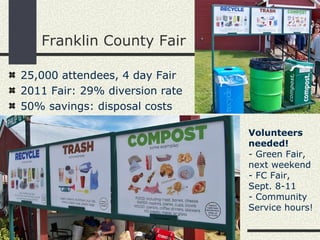
Franklin County Fair

25,000 attendees, 4 day Fair
2011 Fair: 29% diversion rate
50% savings: disposal costs

                                Volunteers
                                needed!
                                - Green Fair,
                                next weekend
                                - FC Fair,
                                Sept. 8-11
                                - Community
                                Service hours!
Household Hazardous Waste

               Any substance labeled:
           CAUSTIC, TOXIC, CORROSIVE,
POISON, FLAMMABLE, WARNING, DANGER, CAUTION
www.franklincountywastedistrict.org/hazardouswaste.html
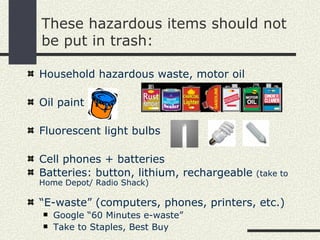
These hazardous items should not
be put in trash:

Household hazardous waste, motor oil

Oil paint

Fluorescent light bulbs

Cell phones + batteries
Batteries: button, lithium, rechargeable   (take to
Home Depot/ Radio Shack)

“E-waste” (computers, phones, printers, etc.)
   Google “60 Minutes e-waste”
   Take to Staples, Best Buy
Mercury Thermostats &
       Thermometers:
          … should never be thrown in the
          trash. They contain mercury,
          which is toxic.

          … can be brought to the Franklin
         County Solid Waste Management
       District office at 50 Miles St. in Greenfield
and be properly disposed of for no charge.
(413-772-2438)

…call your municipality to see if accepted.

Also, CFLs, batteries, cell phones, e-waste….
Next Steps: Increasing
 Sustainability in 2012

2012 Reduce, Reuse Recycle Guide
Educate DA community about composting + recycling
Identify and address gaps in recycling on campus
Recycle batteries, phones, e-waste, CFLs
Reduce disposables, increase reusables
Support Expanded Bottle Bill:
massbottlebill.blogspot.com
Make manufacturers responsible for waste:
   Extended Producer Responsibility (EPR)
    www.productpolicy.org
   Product Stewardship: www.productstewardship.us
Questions?

 Amy Donovan, Program Director
 Franklin County Solid Waste Management District
 Member, Springfield MRF Advisory Board
 50 Miles Street, Greenfield, MA 01301
 (413) 772-2438
 amy@franklincountywastedistrict.org
 www.franklincountywastedistrict.org

Da.04.13.12 2

  • 1.
    Where Is Away? ATravel Diary of Western Mass Waste Amy Donovan Program Director Franklin County Solid Waste Management District Greenfield, MA
  • 2.
    Overview of presentation AboutFranklin County Solid Waste District Where is “away?” Recycling in Western Mass About Commercial Composting (CC): the climate change and farm connection CC programs: transfer stations, schools, businesses Waste Diversion: Fairs, Festivals, Races Hazardous Waste Next steps = more sustainable in 2012
  • 3.
    Franklin County SolidWaste Management District 22 member towns: • 30 schools - 15 public school compost programs • 17 transfer stations - 4 municipal compost programs • (only 9 in entire state) Bernardston Leyden Buckland Montague Charlemont New Salem (CC since 2009) Colrain Northfield (CC since 2008) Conway Orange (CC since 2011) Deerfield Rowe Erving Shelburne Gill Sunderland Hawley Warwick Heath Wendell Leverett Whately (CC since 2003)  1st program in state
  • 4.
    Solid Waste DistrictHighlights: Recycling coordinator for Franklin County Annual Household Hazardous Waste Day What Do I Do With…? 350 items listed  www.franklincountywastedistrict.org MassRecycle’s Recycler of the Year: www.massrecycle.org  Solid Waste District, Municipal Program, 1996  Jan Ameen, Executive Director, 2005  Amy Donovan, Program Director, 2011
  • 5.
    Springfield Materials Recycling Facility(MRF) www.springfieldmrf.org Solid Waste District on MRF Advisory Board Board = annual Reduce, Reuse, Recycle Guide MRF pays 74 western Mass municipalities $15- $45/ton for recyclables
  • 6.
    Recycling saves spacein landfills. • It’s against the law In Massachusetts to put recyclable items in the trash. • Most landfills in area will close in 5 years • Expensive to open, use, and close
  • 7.
    Trash Combustors Covanta Energy,Springfield/ Agawam  Waste-To-Energy facility  Town of Deerfield sends household trash  Produces 9.4 megawatts (MW) of energy, of which 7.5 MW is sold to Northeast Utilities.  Leftover ash >> landfill  Emissions: mercury  State: moratorium on new combustors
  • 8.
    Composting and Recycling: Savespace in landfills Save energy Save money Save water Save natural resources Create jobs Slow climate change!
  • 9.
  • 10.
    Recycle paper: (staples, paper clips, notebooks Envelopes (plastic windows, labels, stamps OK)
  • 11.
    Recycle cardboard: Boxboard: cereal+ cracker boxes Corrugated cardboard (clean pizza boxes OK) (no waxed cardboard)
  • 12.
    DO NOT recycle: NO paper products with food on them NO paper cups or plates NO napkins, paper towels, tissues NO egg cartons NO hardcover books NO copy paper wrappers NO PLASTIC BAGS, plastic wrappers or packaging!
  • 13.
    Our paper recyclingis: Sent to Newark Mills, Fitchburg, MA 78 Western MA communities recycle 32,000 tons a year. Made into board games and hard book covers. Guess what book’s cover was made entirely from Western MA paper recycling?......
  • 15.
    Recycle metal, glass,and plastic containers = “Cans and Bottles” Empty food and liquids. Rinse when possible.
  • 16.
    Recycle metal: Aluminumcans, tin cans and lids, aluminum foil, aluminum pie plates and aluminum trays ___________________________ NO paint cans or haz waste spray cans
  • 17.
    Recycle glass: Glassbottles and jars of all colors ______________________ NO light bulbs, dishes, glasses
  • 18.
    Recycle cartons: Juice boxes,juice & soy milk cartons, soup boxes, milk cartons Recycle with other containers, NOT with paper. Throw away caps and straws. ___________________________ NO Capri Sun pouches
  • 19.
    Recycle plastic: Plastic bottles, jars, tubs, andjugs Food, soap, and beverage containers only!
  • 20.
    DO NOT recyclethis plastic: NO Styrofoam NO: NO small items (plastic utensils, straws) NO PLASTIC BAGS, wrap NO plastic cups, plates, utensils NO butter, packets NO compostable plastics  No compostable water bottles!
  • 21.
    Be careful withplastic bags: they blow away and harm wildlife and the environment! At the recycling factory: Plastic bags cause accidents if they get wrapped around sorting equipment. Recycle in stores only! NOT in regular recycling programs!
  • 22.
    Home composting Home composting is different than at school: YES: compost fruit, vegetables, bread, leaves NO: meat, bones, cheese! (animal products) NO: milk cartons, paper Save $ on trash disposal, buying soil/ fertilizer
  • 23.
    Commercial Composting “Commercial Composting”= “OrganicsRecycling”= “On-Farm”= “Food Waste” …goes way beyond the backyard bin!
  • 24.
    Commercial Composting acceptsmaterials previously destined for trash = less trash Acceptable materials: All food including items not composted at home:  Meat, chicken, fish, bones, dairy, fats, oils  (+ bread, veggies, fruits) All paper including non recyclable:  Paper cups, paper plates, napkins, paper towels, waxed cardboard, waxed paper, soiled pizza boxes, soiled paper, soiled paper bags, flour/ sugar bags, egg cartons  Wood: skewers, chopsticks, coffee stirrers, sporks “Compostable plastic:” PLA cups, certain bags NO plastic, metal, glass, foil, etc.!
  • 25.
    Compost is goodfor plants: • adds nutrients to soil • reduces need to water • replaces chemical fertilizers Farmland Finished compost
  • 27.
    CC’s benefits toparticipating organizations and planet: Save money on tipping fees:  Trash: $75/ ton  Compostables: $45/ ton Reduce trash dumpster size or reduce pickups and save on trash disposal /hauling costs Supports local commercial composting facilities/ farms = local business Saves space in landfills Creates valuable soil out of waste Mitigates climate change!
  • 28.
    Composting helps slow ClimateChange Climate Change is caused by greenhouse gases in our atmosphere. Greenhouse Gases: Carbon Dioxide Methane Nitrous Oxide
  • 29.
    • When foodwaste (and paper) decay in a landfill, methane is The Climate Change released (due to anaerobic conditions). Connection • Methane is a greenhouse gas 23 times more potent than carbon dioxide. • Landfill Gas Recovery not always a solution. Methane pipe at a landfill
  • 30.
    Why doesn’t compostingrelease methane? Because oxygen is part of the composting process (aerobic). There is no oxygen in a landfill (anaerobic). More info: www.cool2012.com
  • 31.
    Bear Path Farm,Whately, MA Windrows
  • 32.
  • 33.
    Martin’s Farm inGreenfield accepts compost from schools: Deerfield Academy, Pioneer HS, Mohawk HS, Turners Falls HS Deerfield ES, Erving ES, Sunderland ES, Amherst, more.. Windrow turner at Martin’s Farm, transfer Greenfield, MA stations: Northampton, Northfield, markets: Big Y stores, Greenfield Stop & Shop, Greenfields Market, plus restaurants…
  • 34.
    Whately Transfer Station: firstmunicipal program in the state
  • 35.
    Northfield Transfer Station:2 yd dumpster Saves town $1,384/ year
  • 36.
    School composting 2 yard compost dumpster Gill Elementary: food, milk cartons, paper in green compostable bag School kitchens compost food prep trimmings, expired food.
  • 37.
    Shelburne Falls Compost Collaborative BlueRock Restaurant, The Baker’s Oven, Mocha Maya’s, Mo’s Fudge Factor, West End Pub • Shared compost dumpster • Cost is shared according to volume • Food waste, napkins, paper towels, cardboard
  • 38.
    Waste Diversion/ Reduction: Fairs, Festivals, Races
  • 39.
    Solid Waste District’s Special EventBin Loaner Program Pictured: Recycling Volunteers at Conway Festival of the Hills
  • 40.
    Franklin County Fair 25,000attendees, 4 day Fair 2011 Fair: 29% diversion rate 50% savings: disposal costs Volunteers needed! - Green Fair, next weekend - FC Fair, Sept. 8-11 - Community Service hours!
  • 41.
    Household Hazardous Waste Any substance labeled: CAUSTIC, TOXIC, CORROSIVE, POISON, FLAMMABLE, WARNING, DANGER, CAUTION www.franklincountywastedistrict.org/hazardouswaste.html
  • 42.
    These hazardous itemsshould not be put in trash: Household hazardous waste, motor oil Oil paint Fluorescent light bulbs Cell phones + batteries Batteries: button, lithium, rechargeable (take to Home Depot/ Radio Shack) “E-waste” (computers, phones, printers, etc.)  Google “60 Minutes e-waste”  Take to Staples, Best Buy
  • 43.
    Mercury Thermostats & Thermometers: … should never be thrown in the trash. They contain mercury, which is toxic. … can be brought to the Franklin County Solid Waste Management District office at 50 Miles St. in Greenfield and be properly disposed of for no charge. (413-772-2438) …call your municipality to see if accepted. Also, CFLs, batteries, cell phones, e-waste….
  • 44.
    Next Steps: Increasing Sustainability in 2012 2012 Reduce, Reuse Recycle Guide Educate DA community about composting + recycling Identify and address gaps in recycling on campus Recycle batteries, phones, e-waste, CFLs Reduce disposables, increase reusables Support Expanded Bottle Bill: massbottlebill.blogspot.com Make manufacturers responsible for waste:  Extended Producer Responsibility (EPR) www.productpolicy.org  Product Stewardship: www.productstewardship.us
  • 45.
    Questions? Amy Donovan,Program Director Franklin County Solid Waste Management District Member, Springfield MRF Advisory Board 50 Miles Street, Greenfield, MA 01301 (413) 772-2438 amy@franklincountywastedistrict.org www.franklincountywastedistrict.org