1| Universidad de La Rioja | 11/07/2014APPLICATION OF OPENSEES IN RBDO OF STRUCTURESOPENSEES DAYS PORTUGAL 2014Luis Celorrio BarraguéDeparmentof MechanicalEngineering–Universidad de La Rioja -Spain
2| Universidad de La Rioja | 11/07/2014 
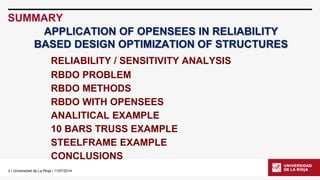
SUMMARY APPLICATION OF OPENSEES IN RELIABILITY BASED DESIGN OPTIMIZATION OF STRUCTURES 
RELIABILITY / SENSITIVITY ANALYSIS 
RBDO PROBLEM 
RBDO METHODS 
RBDO WITH OPENSEES 
ANALITICAL EXAMPLE 
10 BARS TRUSS EXAMPLE 
STEELFRAME EXAMPLE 
CONCLUSIONS
3| Universidad de La Rioja | 11/07/2014 
RELIABILITY / SENSTIVITY ANALYSIS 
•Recently, changes in Reliability Modules of OpenSeeshave been carried out. Also some examples, presentations and videos are available in the OpenSeesInternet site. 
•New commands provide sensitivity of response with respect to parameters. Also, parameters can be used to map probability distributions to uncertain properties. 
•A script-level mechanism for identifying and updating parametershas been added 
•Methods to quantify uncertainty are available in OpenSees. 
FOSM, FORM, SORM, etc. 
Response Sensitivity 
Monte Carlo Simulation (Importance Sampling MCS) 
System Reliability
4 | Universidad de La Rioja | 11/07/2014 
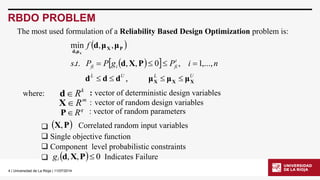
RBDO PROBLEM 
  
    
L U L U 
t 
fi i fi s t P P g P i n 
f 
X X X 
X P 
d,μ 
d d d μ μ μ 
d X P 
d μ μ 
x 
    
    
, 
. . , , 0 , 1,..., 
min , , 
m XR : vector of random design variables 
k dR : vector of deterministic design variables 
q PR : vector of random parameters 
 Single objective function 
 Component level probabilistic constraints 
 gi d,X,P 0 Indicates Failure 
 X,P Correlated random input variables 
where: 
The most used formulation of a Reliability Based Design Optimization problem is:
5| Universidad de La Rioja | 11/07/2014 
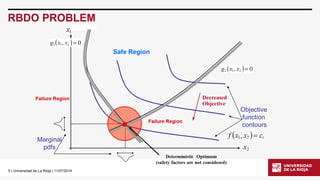
RBDO PROBLEM
6| Universidad de La Rioja | 11/07/2014 
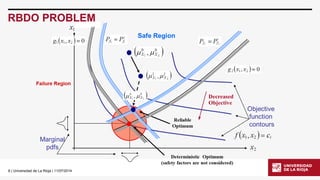
RBDO PROBLEM
7| Universidad de La Rioja | 11/07/2014 
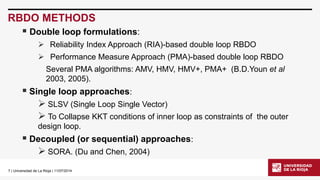
RBDO METHODS 
Double loop formulations: 
Reliability Index Approach (RIA)-based double loop RBDO 
Performance Measure Approach (PMA)-based double loop RBDO 
Several PMA algorithms: AMV, HMV, HMV+, PMA+ (B.D.Younetal2003, 2005). 
Single loop approaches: 
SLSV (Single Loop Single Vector) 
To Collapse KKT conditions of inner loop as constraints of the outer design loop. 
Decoupled (or sequential) approaches: 
SORA. (Du and Chen, 2004)
8| Universidad de La Rioja | 11/07/2014 
RBDO WITH OPENSEES 
•Structural Reliability applications are useful when large structures supporting extreme actions are considered. These extreme actions are wind loads, seismic ground motions or wave loads. 
•Then, nonlinear structural behavior must be considered. Also dynamic analysis is necessary when load are time variant. Because that an advanced finite element analysis software is needed. 
•OpenSeesis a powerful software with advanced structural analysis capabilities. Also reliability and sensibility functions have been recently modified. Because that OpenSeesbecomes a powerful FEA tool. 
•Here some RBDO problems are solved combining some MATLAB functions with the power of OpenSees. These MATLAB functions were originally integrated with FERUM and forming the RBDO –FERUM toolbox. [1] 
[1]L.Celorrio-Barragué,“DevelopmentofaReliability-BasedDesignOptimizationToolboxfortheFERUMSoftware”, 
SUM2012,LNAI7520,pp.273–286,2012.Springer-VerlagBerlinHeidelberg2012
9| Universidad de La Rioja | 11/07/2014 
RBDO WITH OPENSEES 
•RBDO RIA-based double loop method 
•Outer loop or Design Optimization loop is carried out in Matlabusing RBDO- FERUM functions. Reliability analysis is carried out in OpenSeesusing FORM. Writing/reading of files is used. 
Write RVDATA.tcl 
Design Variables, 
푑푖푖=1,…,푛 
Optimization 
Loop 
RBDO-FERUM 
Call !OpenSeesfile.tcl 
Read betas.out 
Readgradbetas.out 
ReadLSFE.out 
OPENSEES 
Reliability 
Loop
10| Universidad de La Rioja | 11/07/2014 
RBDO WITH OPENSEES 
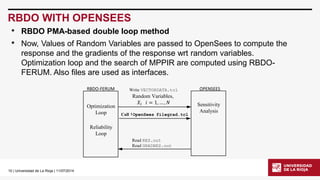
•RBDO PMA-based double loop method 
•Now, Values of Random Variables are passed to OpenSeesto compute the response and the gradients of the response wrtrandom variables. Optimization loop and the search of MPPIR are computed using RBDO- FERUM. Also files are used as interfaces. 
Write VECTORDATA.tcl 
Random Variables, 
푋푖푖=1,…,푁 
Optimization 
Loop 
Sensitivity 
Analysis 
Call !OpenSeesfilegrad.tcl 
Read RES.out 
ReadGRADRES.out 
Reliability 
Loop 
RBDO-FERUM 
OPENSEES
11 | Universidad de La Rioja | 11/07/2014 
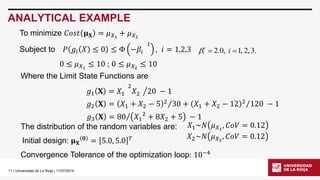
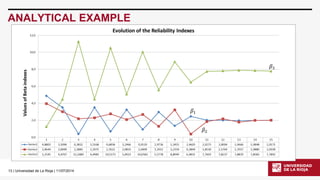
ANALYTICAL EXAMPLE 
 2.0, i 1, 2, 3. t 
i  
To minimize 퐶표푠푡 훍퐗 = 휇푋1 + 휇푋2 
Subject to 푃 푔푖 푋 ≤ 0 ≤ Φ −훽푖 
푡 
, 푖 = 1,2,3 
0 ≤ 휇푋1 ≤ 10 ; 0 ≤ 휇푋2 ≤ 10 
Where the Limit State Functions are 
푔1 퐗 = 푋1 
2 
푋2 20 − 1 
푔2 퐗 = 푋1 + 푋2 − 5 2 30 + 푋1 + 푋2 − 12 2 120 − 1 
푔3 퐗 = 80 푋1 
2 + 8푋2 + 5 − 1 
The distribution of the random variables are: 
Initial design: 훍퐗 
ퟎ = 5.0, 5.0 푇 
Convergence Tolerance of the optimization loop: 10−4 
푋1~푁 휇푋1 , 퐶표푉 = 0.12 
푋2~푁 휇푋2 , 퐶표푉 = 0.12
12| Universidad de La Rioja | 11/07/2014 
ANALYTICAL EXAMPLE 
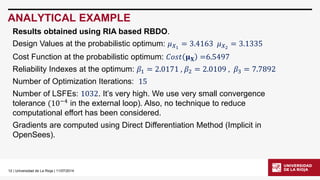
Results obtained using RIA based RBDO. 
Design Values at the probabilistic optimum: 휇푋1=3.4163휇푋2=3.1335 
Cost Function at the probabilistic optimum: 퐶표푠푡훍퐗=6.5497 
Reliability Indexes at the optimum: 훽1=2.0171,훽2=2.0109,훽3=7.7892 
Number of Optimization Iterations: 15 
Number of LSFEs: 1032. It’s very high. We use very small convergence tolerance(10−4in the external loop). Also, no technique to reduce computational effort has been considered. 
Gradients are computed using Direct Differentiation Method (Implicit in OpenSees).
13| Universidad de La Rioja | 11/07/2014 
ANALYTICAL EXAMPLE
14| Universidad de La Rioja | 11/07/2014 
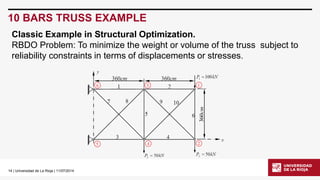
10 BARS TRUSS EXAMPLE 
Classic Example in Structural Optimization. 
RBDO Problem: To minimize the weight or volume of the truss subject to reliability constraints in terms of displacements or stresses.
15 | Universidad de La Rioja | 11/07/2014 
10 BARS TRUSS EXAMPLE 
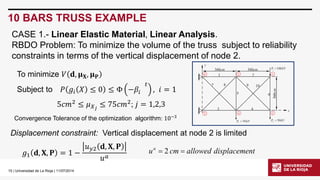
CASE 1.- Linear Elastic Material, Linear Analysis. 
RBDO Problem: To minimize the volume of the truss subject to reliability 
constraints in terms of the vertical displacement of node 2. 
To minimize 푉 퐝, 훍퐗, 훍퐏 
Subject to 푃 푔푖 푋 ≤ 0 ≤ Φ −훽푖 
푡 
, 푖 = 1 
5푐푚2 ≤ 휇푋푗 ≤ 75푐푚2; 푗 = 1,2,3 
Displacement constraint: Vertical displacement at node 2 is limited 
u cm allowed displacement a 푔  2  1 퐝, 퐗, 퐏 = 1 − 
푢푦2 퐝, 퐗, 퐏 
푢푎 
Convergence Tolerance of the optimization algorithm: 10−3
16 | Universidad de La Rioja | 11/07/2014 
10 BARS TRUSS EXAMPLE 
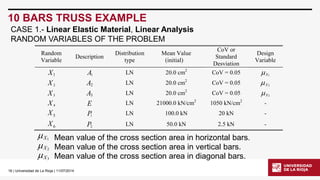
CASE 1.- Linear Elastic Material, Linear Analysis 
RANDOM VARIABLES OF THE PROBLEM 
Random 
Variable 
Description 
Distribution 
type 
Mean Value 
(initial) 
CoV or 
Standard 
Desviation 
Design 
Variable 
1 X 1A LN 20.0 cm2 CoV = 0.05 X1  
2 X A2 LN 20.0 cm2 CoV = 0.05 X2  
3 X A3 LN 20.0 cm2 CoV = 0.05 X3  
4 X E LN 21000.0 kN/cm2 1050 kN/cm2 - 
5 X 1 P LN 100.0 kN 20 kN - 
6 X 2 P LN 50.0 kN 2.5 kN - 
 X1 
 X2 
 X3 
Mean value of the cross section area in horizontal bars. 
Mean value of the cross section area in vertical bars. 
Mean value of the cross section area in diagonal bars.
17| Universidad de La Rioja | 11/07/2014 
10 BARS TRUSS EXAMPLE 
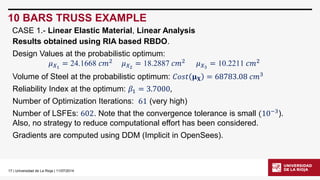
Results obtained using RIA based RBDO. 
Design Values at the probabilistic optimum: 
휇푋1=24.1668푐푚2휇푋2=18.2887푐푚2휇푋3=10.2211푐푚2 
Volume of Steel at the probabilistic optimum: 퐶표푠푡훍퐗=68783.08푐푚3 
Reliability Index at the optimum: 훽1=3.7000, 
Number of Optimization Iterations: 61(very high) 
Number of LSFEs: 602. Note that the convergence tolerance is small(10−3). Also, no strategy to reduce computational effort has been considered. 
Gradients are computed using DDM (Implicit in OpenSees). 
CASE 1.-Linear Elastic Material, Linear Analysis
18| Universidad de La Rioja | 11/07/2014 
10 BARS TRUSS EXAMPLE 
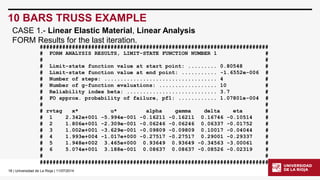
####################################################################### 
# FORM ANALYSIS RESULTS, LIMIT-STATE FUNCTION NUMBER 1 # 
# # 
# Limit-state function value at start point: ......... 0.80548 # 
# Limit-state function value at end point: ........... -1.6552e-006 # 
# Number of steps: ................................... 4 # 
# Number of g-function evaluations: .................. 10 # 
# Reliability index beta: ............................ 3.7 # 
# FO approx. probability of failure, pf1: ............ 1.07801e-004 # 
# # 
# rvtagx* u* alpha gamma delta eta # 
# 1 2.342e+001 -5.994e-001 -0.16211 -0.16211 0.16746 -0.10514 # 
# 2 1.806e+001 -2.309e-001 -0.06246 -0.06246 0.06337 -0.01752 # 
# 3 1.002e+001 -3.629e-001 -0.09809 -0.09809 0.10017 -0.04044 # 
# 4 1.993e+004 -1.017e+000 -0.27517 -0.27517 0.29001 -0.29337 # 
# 5 1.948e+002 3.465e+000 0.93649 0.93649 -0.34563 -3.00061 # 
# 6 5.074e+001 3.188e-001 0.08637 0.08637 -0.08526 -0.02319 # 
# # 
####################################################################### 
CASE 1.-Linear Elastic Material, Linear Analysis 
FORM Results for the last iteration.
19| Universidad de La Rioja | 11/07/2014 
10 BARS TRUSS EXAMPLE 
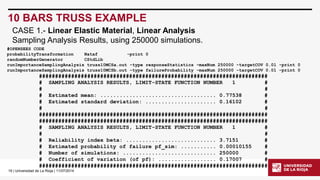
#OPENSEES CODE 
probabilityTransformationNataf-print 0 
randomNumberGeneratorCStdLib 
runImportanceSamplingAnalysistruss10MCSa.out -type responseStatistics-maxNum250000 -targetCOV0.01 -print 0 
runImportanceSamplingAnalysistruss10MCSb.out -type failureProbability-maxNum250000 -targetCOV0.01 -print 0 
####################################################################### 
# SAMPLING ANALYSIS RESULTS, LIMIT-STATE FUNCTION NUMBER 1 # 
# # 
# Estimated mean: .................................... 0.77538 # 
# Estimated standard deviation: ...................... 0.16102 # 
# # 
####################################################################### 
####################################################################### 
# SAMPLING ANALYSIS RESULTS, LIMIT-STATE FUNCTION NUMBER 1 # 
# # 
# Reliability index beta: ............................ 3.7151 # 
# Estimated probability of failure pf_sim: ........... 0.00010155 # 
# Number of simulations: ............................. 250000 # 
# Coefficient of variation (of pf): .................. 0.17007 # 
####################################################################### 
CASE 1.-Linear Elastic Material, Linear Analysis 
Sampling Analysis Results, using 250000 simulations.
20| Universidad de La Rioja | 11/07/2014 
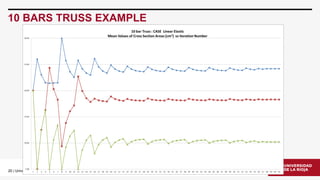
10 BARS TRUSS EXAMPLE
21| Universidad de La Rioja | 11/07/2014 
RBDO 10 BARS TRUSS EXAMPLE 
uniaxialMaterial Hardening1 $E $fy0.0 [expr$b/(1-$b)*$E] 
A random variable is added: fy(elastic limit) ~퐿푁휇=15.5 푘푁푐푚2,퐶표푉=0.05. 
$b is the hardening ratio and is considered determinist: set b 0.02 
CASE 2.-Nonlinear Material, Nonlinear Analysis
22 | Universidad de La Rioja | 11/07/2014 
RBDO 10 BARS TRUSS EXAMPLE 
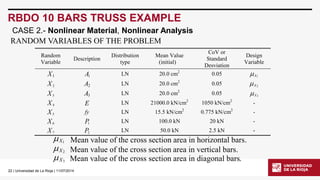
RANDOM VARIABLES OF THE PROBLEM 
Random 
Variable 
Description 
Distribution 
type 
Mean Value 
(initial) 
CoV or 
Standard 
Desviation 
Design 
Variable 
1 X 1A LN 20.0 cm2 0.05 X1  
2 X 2A LN 20.0 cm2 0.05 X2  
3 X A3 LN 20.0 cm2 0.05 X3  
4 X E LN 21000.0 kN/cm2 1050 kN/cm2 - 
5 X fy LN 15.5 kN/cm2 0.775 kN/cm2 - 
6 X 1 P LN 100.0 kN 20 kN - 
7 X 2 P LN 50.0 kN 2.5 kN - 
 X1 
 X2 
 X3 
Mean value of the cross section area in horizontal bars. 
Mean value of the cross section area in vertical bars. 
Mean value of the cross section area in diagonal bars. 
CASE 2.- Nonlinear Material, Nonlinear Analysis
23| Universidad de La Rioja | 11/07/2014 
RBDO 10 BARS TRUSS EXAMPLE 
CASE 2.-Nonlinear Material, Nonlinear Analysis 
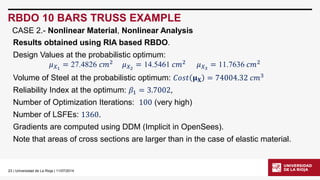
Results obtained using RIA based RBDO. 
Design Values at the probabilistic optimum: 
휇푋1=27.4826푐푚2휇푋2=14.5461푐푚2휇푋3=11.7636푐푚2 
Volume of Steel at the probabilistic optimum: 퐶표푠푡훍퐗=74004.32푐푚3 
Reliability Index at the optimum: 훽1=3.7002, 
Number of Optimization Iterations: 100(very high) 
Number of LSFEs: 1360. 
Gradients are computed using DDM (Implicit in OpenSees). 
Note that areas of cross sections are larger than in the case of elastic material.
24| Universidad de La Rioja | 11/07/2014 
STEELFRAME EXAMPLE 
3 Stories and 3 Bays Steel Frame 
Modified version of the structural model in the file steelframe.tcl[2] downloaded from OpenSeesforum. 
[2]T.HaukaasandM.H.Scott,ShapeSensitivitiesintheReliabilityAnalysisofNonlinearFrameStructures,ComputerandStructures,v.84,15-16,p964-977,2006 
1 2 3 1 1 2 2 5 5 5 4 4 4 1 1 1 1 2 2 2 2
25| Universidad de La Rioja | 11/07/2014 
STEELFRAME EXAMPLE 
3 Stories and 3 Bays Steel Frame 
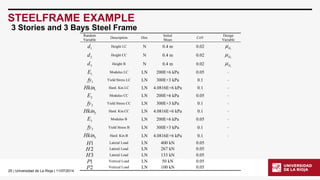
Random Variable Description Dist. Initial Mean CoV Design Variable 1d Height LC N 0.4 m 0.02 1d 2d Height CC N 0.4 m 0.02 2d 3d Height B N 0.4 m 0.02 3d 1E Modulus LC LN 200E+6 kPa 0.05 - 1fy Yield Stress LC LN 300E+3 kPa 0.1 - 1Hkin Hard. Kin.LC LN 4.0816E+6 kPa 0.1 - 2E Modulus CC LN 200E+6 kPa 0.05 - 2fy Yield Stress CC LN 300E+3 kPa 0.1 - 2Hkin Hard. Kin.CC LN 4.0816E+6 kPa 0.1 - 3E Modulus B LN 200E+6 kPa 0.05 - 3fy Yield Stress B LN 300E+3 kPa 0.1 - 3Hkin Hard. Kin.B LN 4.0816E+6 kPa 0.1 - 1H Lateral Load LN 400 kN 0.05 2H Lateral Load LN 267 kN 0.05 3H Lateral Load LN 133 kN 0.05 1P Vertical Load LN 50 kN 0.05 2P Vertical Load LN 100 kN 0.05
26 | Universidad de La Rioja | 11/07/2014 
STEELFRAME EXAMPLE 
3 Stories and 3 Bays Steel Frame 
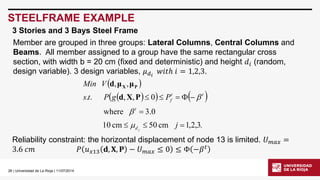
Member are grouped in three groups: Lateral Columns, Central Columns and 
Beams. All member assigned to a group have the same rectangular cross 
section, with width b = 20 cm (fixed and deterministic) and height 푑푖 (random, 
design variable). 3 design variables, 휇푑푖 푤푖푡ℎ 푖 = 1,2,3. 
  
      
j . 
s t P g P 
Min V 
d j 
t 
t t 
f 
10 cm 50 cm 1,2,3 
where 3.0 
. . , , 0 
, , 
   
 
     
 
 
d X P  
d μ μX P 
Reliability constraint: the horizontal displacement of node 13 is limited. 푈푚푎푥 = 
3.6 푐푚 푃 푢푥13 퐝, 퐗, 퐏 − 푈푚푎푥 ≤ 0 ≤ Φ −훽푡
27| Universidad de La Rioja | 11/07/2014 
STEELFRAME EXAMPLE 
Results obtained using PMA –HMV+ based RBDO. 
Design Values at the probabilistic optimum: 
휇푑1=29.5624푐푚휇푑2=49.4783푐푚휇푋3=35.2246푐푚 
Volume of Steel at the probabilistic optimum: 퐶표푠푡훍퐗=3482083.3054푐푚3 
Reliability Index at the optimum: 훽1=3.0025, 
Number of Optimization Iterations: 168(very high) 
Number of LSFEs: 336. Convergence tolerance is small(10−2). 
Gradients are computed using DDM (Implicit in OpenSees). 
Nonlinear Material and Beam-Column elements are considered. However, material works in the linear elastic zone because gradients wrtparameters 푓푦푖,퐻푘푖푛푖are 0. 
3 Stories and 3 Bays Steel Frame
28| Universidad de La Rioja | 11/07/2014 
STEELFRAME EXAMPLE 
Results obtained using PMA –HMV+ based RBDO. (DDM) 
CASE Nonlinear. Now, allowed horizontal displacement at node 13 is 20 cm. 
Mean Values of Horizontal loads H1, H2 and H3 are the double that in the first case. Then, large deformations occur and material works in the plastic zone. 
Response gradients wrtmaterial parameters 푓푦푖,퐻푘푖푛푖are ≠0. 
Design Values at the probabilistic optimum: 
휇푑1=20.8792푐푚휇푑2=34.9506푐푚휇푋3=26.1249푐푚 
Volume of Steel at the probabilistic optimum: 퐶표푠푡훍퐗=2515535.2701푐푚3 
Reliability Index at the optimum: 훽1=3.0025, 
Number of Optimization Iterations: 256(very high). Time: 1 hour. 
Number of LSFEs: 1221. Convergence tolerance is small(10−3). 
3 Stories and 3 Bays Steel Frame
29 | Universidad de La Rioja | 11/07/2014 
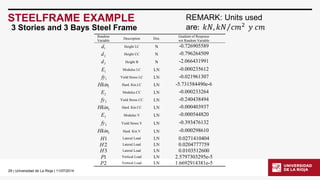
STEELFRAME EXAMPLE 
3 Stories and 3 Bays Steel Frame 
Random 
Variable 
Description Dist. 
Gradient of Response 
wrt Random Variable 
1d Height LC N -0.726905589 
2 d Height CC N -0.796264509 
3 d Height B N -2.066431991 
1 E Modulus LC LN -0.000235612 
1 fy Yield Stress LC LN -0.021961307 
1 Hkin Hard. Kin.LC LN -5.731584490e-6 
2 E Modulus CC LN -0.000233264 
2 fy Yield Stress CC LN -0.240438494 
2 Hkin Hard. Kin.CC LN -0.000403937 
3 E Modulus V LN -0.000544820 
3 fy Yield Stress V LN -0.393476132 
3 Hkin Hard. Kin.V LN -0.000298610 
H1 Lateral Load LN 0.0271410404 
H2 Lateral Load LN 0.0204777759 
H3 Lateral Load LN 0.0103512600 
P1 Vertical Load LN 2.5797303295e-5 
P2 Vertical Load LN 1.6692914381e-5 
REMARK: Units used 
are: 푘푁, 푘푁 푐푚2 푦 푐푚
30| Universidad de La Rioja | 11/07/2014 
STEELFRAME EXAMPLE 
Results obtained using PMA –HMV+ based RBDO.(DDM) WARM-UP = yes 
CASE Nonlinear. Same case than last slide: 푢푥13푎푑푚=20푐푚 
Loads H1, H2 and H3 are the double that in the linear case. 
Design Values at the probabilistic optimum: 
휇푑1=20.8704푐푚휇푑2=34.9277푐푚휇푋3=26.1391푐푚 
Volume of Steel at the probabilistic optimum: 퐶표푠푡훍퐗=2515413.2267푐푚3 
Reliability Index at the optimum: 훽1=3.0025, 
Number of Optimization Iterations: 244(very high). 
Number of LSFEs: 560≪1221. This reduction is motivated by Warm-Up strategy 
Convergence tolerance is small(10−3), 
Warm-Up Tolerance =10−2. 
3 Stories and 3 Bays Steel Frame
31| Universidad de La Rioja | 11/07/2014 
CONCLUSIONS 
Sensitivity and Reliability capabilities of OpenSeescan be combined with an optimization tool, such as Optimization Toolbox of Matlabto carry out RBDO. 
Double loop RBDO methods have been implemented using OpenSeesand Matlab. 
An analytical and two structural examples have been studied. 
Complex problems can be solved thanks to advanced structural analysis algorithms implemented in OpenSees. 
Computational cost is very high and convergence problems can occur, specially when an increased number of random design variables are considered. 
Some special techniques to reduce the computational cost must be added: 
Warm up: to start the MPP search in the MPP of the last Iteration. 
To use deterministic optimum as initial design
32| Universidad de La Rioja | 11/07/2014 
QUESTIONS –COMENTS 
THANK YOU 
luis.celorrio@unirioja.es 
luis.celorrio@gmail.com

Application of OpenSees in Reliability-based Design Optimization of Structures

  • 1.
    1| Universidad deLa Rioja | 11/07/2014APPLICATION OF OPENSEES IN RBDO OF STRUCTURESOPENSEES DAYS PORTUGAL 2014Luis Celorrio BarraguéDeparmentof MechanicalEngineering–Universidad de La Rioja -Spain
  • 2.
    2| Universidad deLa Rioja | 11/07/2014 SUMMARY APPLICATION OF OPENSEES IN RELIABILITY BASED DESIGN OPTIMIZATION OF STRUCTURES RELIABILITY / SENSITIVITY ANALYSIS RBDO PROBLEM RBDO METHODS RBDO WITH OPENSEES ANALITICAL EXAMPLE 10 BARS TRUSS EXAMPLE STEELFRAME EXAMPLE CONCLUSIONS
  • 3.
    3| Universidad deLa Rioja | 11/07/2014 RELIABILITY / SENSTIVITY ANALYSIS •Recently, changes in Reliability Modules of OpenSeeshave been carried out. Also some examples, presentations and videos are available in the OpenSeesInternet site. •New commands provide sensitivity of response with respect to parameters. Also, parameters can be used to map probability distributions to uncertain properties. •A script-level mechanism for identifying and updating parametershas been added •Methods to quantify uncertainty are available in OpenSees. FOSM, FORM, SORM, etc. Response Sensitivity Monte Carlo Simulation (Importance Sampling MCS) System Reliability
  • 4.
    4 | Universidadde La Rioja | 11/07/2014 RBDO PROBLEM       L U L U t fi i fi s t P P g P i n f X X X X P d,μ d d d μ μ μ d X P d μ μ x         , . . , , 0 , 1,..., min , , m XR : vector of random design variables k dR : vector of deterministic design variables q PR : vector of random parameters  Single objective function  Component level probabilistic constraints  gi d,X,P 0 Indicates Failure  X,P Correlated random input variables where: The most used formulation of a Reliability Based Design Optimization problem is:
  • 5.
    5| Universidad deLa Rioja | 11/07/2014 RBDO PROBLEM
  • 6.
    6| Universidad deLa Rioja | 11/07/2014 RBDO PROBLEM
  • 7.
    7| Universidad deLa Rioja | 11/07/2014 RBDO METHODS Double loop formulations: Reliability Index Approach (RIA)-based double loop RBDO Performance Measure Approach (PMA)-based double loop RBDO Several PMA algorithms: AMV, HMV, HMV+, PMA+ (B.D.Younetal2003, 2005). Single loop approaches: SLSV (Single Loop Single Vector) To Collapse KKT conditions of inner loop as constraints of the outer design loop. Decoupled (or sequential) approaches: SORA. (Du and Chen, 2004)
  • 8.
    8| Universidad deLa Rioja | 11/07/2014 RBDO WITH OPENSEES •Structural Reliability applications are useful when large structures supporting extreme actions are considered. These extreme actions are wind loads, seismic ground motions or wave loads. •Then, nonlinear structural behavior must be considered. Also dynamic analysis is necessary when load are time variant. Because that an advanced finite element analysis software is needed. •OpenSeesis a powerful software with advanced structural analysis capabilities. Also reliability and sensibility functions have been recently modified. Because that OpenSeesbecomes a powerful FEA tool. •Here some RBDO problems are solved combining some MATLAB functions with the power of OpenSees. These MATLAB functions were originally integrated with FERUM and forming the RBDO –FERUM toolbox. [1] [1]L.Celorrio-Barragué,“DevelopmentofaReliability-BasedDesignOptimizationToolboxfortheFERUMSoftware”, SUM2012,LNAI7520,pp.273–286,2012.Springer-VerlagBerlinHeidelberg2012
  • 9.
    9| Universidad deLa Rioja | 11/07/2014 RBDO WITH OPENSEES •RBDO RIA-based double loop method •Outer loop or Design Optimization loop is carried out in Matlabusing RBDO- FERUM functions. Reliability analysis is carried out in OpenSeesusing FORM. Writing/reading of files is used. Write RVDATA.tcl Design Variables, 푑푖푖=1,…,푛 Optimization Loop RBDO-FERUM Call !OpenSeesfile.tcl Read betas.out Readgradbetas.out ReadLSFE.out OPENSEES Reliability Loop
  • 10.
    10| Universidad deLa Rioja | 11/07/2014 RBDO WITH OPENSEES •RBDO PMA-based double loop method •Now, Values of Random Variables are passed to OpenSeesto compute the response and the gradients of the response wrtrandom variables. Optimization loop and the search of MPPIR are computed using RBDO- FERUM. Also files are used as interfaces. Write VECTORDATA.tcl Random Variables, 푋푖푖=1,…,푁 Optimization Loop Sensitivity Analysis Call !OpenSeesfilegrad.tcl Read RES.out ReadGRADRES.out Reliability Loop RBDO-FERUM OPENSEES
  • 11.
    11 | Universidadde La Rioja | 11/07/2014 ANALYTICAL EXAMPLE  2.0, i 1, 2, 3. t i  To minimize 퐶표푠푡 훍퐗 = 휇푋1 + 휇푋2 Subject to 푃 푔푖 푋 ≤ 0 ≤ Φ −훽푖 푡 , 푖 = 1,2,3 0 ≤ 휇푋1 ≤ 10 ; 0 ≤ 휇푋2 ≤ 10 Where the Limit State Functions are 푔1 퐗 = 푋1 2 푋2 20 − 1 푔2 퐗 = 푋1 + 푋2 − 5 2 30 + 푋1 + 푋2 − 12 2 120 − 1 푔3 퐗 = 80 푋1 2 + 8푋2 + 5 − 1 The distribution of the random variables are: Initial design: 훍퐗 ퟎ = 5.0, 5.0 푇 Convergence Tolerance of the optimization loop: 10−4 푋1~푁 휇푋1 , 퐶표푉 = 0.12 푋2~푁 휇푋2 , 퐶표푉 = 0.12
  • 12.
    12| Universidad deLa Rioja | 11/07/2014 ANALYTICAL EXAMPLE Results obtained using RIA based RBDO. Design Values at the probabilistic optimum: 휇푋1=3.4163휇푋2=3.1335 Cost Function at the probabilistic optimum: 퐶표푠푡훍퐗=6.5497 Reliability Indexes at the optimum: 훽1=2.0171,훽2=2.0109,훽3=7.7892 Number of Optimization Iterations: 15 Number of LSFEs: 1032. It’s very high. We use very small convergence tolerance(10−4in the external loop). Also, no technique to reduce computational effort has been considered. Gradients are computed using Direct Differentiation Method (Implicit in OpenSees).
  • 13.
    13| Universidad deLa Rioja | 11/07/2014 ANALYTICAL EXAMPLE
  • 14.
    14| Universidad deLa Rioja | 11/07/2014 10 BARS TRUSS EXAMPLE Classic Example in Structural Optimization. RBDO Problem: To minimize the weight or volume of the truss subject to reliability constraints in terms of displacements or stresses.
  • 15.
    15 | Universidadde La Rioja | 11/07/2014 10 BARS TRUSS EXAMPLE CASE 1.- Linear Elastic Material, Linear Analysis. RBDO Problem: To minimize the volume of the truss subject to reliability constraints in terms of the vertical displacement of node 2. To minimize 푉 퐝, 훍퐗, 훍퐏 Subject to 푃 푔푖 푋 ≤ 0 ≤ Φ −훽푖 푡 , 푖 = 1 5푐푚2 ≤ 휇푋푗 ≤ 75푐푚2; 푗 = 1,2,3 Displacement constraint: Vertical displacement at node 2 is limited u cm allowed displacement a 푔  2  1 퐝, 퐗, 퐏 = 1 − 푢푦2 퐝, 퐗, 퐏 푢푎 Convergence Tolerance of the optimization algorithm: 10−3
  • 16.
    16 | Universidadde La Rioja | 11/07/2014 10 BARS TRUSS EXAMPLE CASE 1.- Linear Elastic Material, Linear Analysis RANDOM VARIABLES OF THE PROBLEM Random Variable Description Distribution type Mean Value (initial) CoV or Standard Desviation Design Variable 1 X 1A LN 20.0 cm2 CoV = 0.05 X1  2 X A2 LN 20.0 cm2 CoV = 0.05 X2  3 X A3 LN 20.0 cm2 CoV = 0.05 X3  4 X E LN 21000.0 kN/cm2 1050 kN/cm2 - 5 X 1 P LN 100.0 kN 20 kN - 6 X 2 P LN 50.0 kN 2.5 kN -  X1  X2  X3 Mean value of the cross section area in horizontal bars. Mean value of the cross section area in vertical bars. Mean value of the cross section area in diagonal bars.
  • 17.
    17| Universidad deLa Rioja | 11/07/2014 10 BARS TRUSS EXAMPLE Results obtained using RIA based RBDO. Design Values at the probabilistic optimum: 휇푋1=24.1668푐푚2휇푋2=18.2887푐푚2휇푋3=10.2211푐푚2 Volume of Steel at the probabilistic optimum: 퐶표푠푡훍퐗=68783.08푐푚3 Reliability Index at the optimum: 훽1=3.7000, Number of Optimization Iterations: 61(very high) Number of LSFEs: 602. Note that the convergence tolerance is small(10−3). Also, no strategy to reduce computational effort has been considered. Gradients are computed using DDM (Implicit in OpenSees). CASE 1.-Linear Elastic Material, Linear Analysis
  • 18.
    18| Universidad deLa Rioja | 11/07/2014 10 BARS TRUSS EXAMPLE ####################################################################### # FORM ANALYSIS RESULTS, LIMIT-STATE FUNCTION NUMBER 1 # # # # Limit-state function value at start point: ......... 0.80548 # # Limit-state function value at end point: ........... -1.6552e-006 # # Number of steps: ................................... 4 # # Number of g-function evaluations: .................. 10 # # Reliability index beta: ............................ 3.7 # # FO approx. probability of failure, pf1: ............ 1.07801e-004 # # # # rvtagx* u* alpha gamma delta eta # # 1 2.342e+001 -5.994e-001 -0.16211 -0.16211 0.16746 -0.10514 # # 2 1.806e+001 -2.309e-001 -0.06246 -0.06246 0.06337 -0.01752 # # 3 1.002e+001 -3.629e-001 -0.09809 -0.09809 0.10017 -0.04044 # # 4 1.993e+004 -1.017e+000 -0.27517 -0.27517 0.29001 -0.29337 # # 5 1.948e+002 3.465e+000 0.93649 0.93649 -0.34563 -3.00061 # # 6 5.074e+001 3.188e-001 0.08637 0.08637 -0.08526 -0.02319 # # # ####################################################################### CASE 1.-Linear Elastic Material, Linear Analysis FORM Results for the last iteration.
  • 19.
    19| Universidad deLa Rioja | 11/07/2014 10 BARS TRUSS EXAMPLE #OPENSEES CODE probabilityTransformationNataf-print 0 randomNumberGeneratorCStdLib runImportanceSamplingAnalysistruss10MCSa.out -type responseStatistics-maxNum250000 -targetCOV0.01 -print 0 runImportanceSamplingAnalysistruss10MCSb.out -type failureProbability-maxNum250000 -targetCOV0.01 -print 0 ####################################################################### # SAMPLING ANALYSIS RESULTS, LIMIT-STATE FUNCTION NUMBER 1 # # # # Estimated mean: .................................... 0.77538 # # Estimated standard deviation: ...................... 0.16102 # # # ####################################################################### ####################################################################### # SAMPLING ANALYSIS RESULTS, LIMIT-STATE FUNCTION NUMBER 1 # # # # Reliability index beta: ............................ 3.7151 # # Estimated probability of failure pf_sim: ........... 0.00010155 # # Number of simulations: ............................. 250000 # # Coefficient of variation (of pf): .................. 0.17007 # ####################################################################### CASE 1.-Linear Elastic Material, Linear Analysis Sampling Analysis Results, using 250000 simulations.
  • 20.
    20| Universidad deLa Rioja | 11/07/2014 10 BARS TRUSS EXAMPLE
  • 21.
    21| Universidad deLa Rioja | 11/07/2014 RBDO 10 BARS TRUSS EXAMPLE uniaxialMaterial Hardening1 $E $fy0.0 [expr$b/(1-$b)*$E] A random variable is added: fy(elastic limit) ~퐿푁휇=15.5 푘푁푐푚2,퐶표푉=0.05. $b is the hardening ratio and is considered determinist: set b 0.02 CASE 2.-Nonlinear Material, Nonlinear Analysis
  • 22.
    22 | Universidadde La Rioja | 11/07/2014 RBDO 10 BARS TRUSS EXAMPLE RANDOM VARIABLES OF THE PROBLEM Random Variable Description Distribution type Mean Value (initial) CoV or Standard Desviation Design Variable 1 X 1A LN 20.0 cm2 0.05 X1  2 X 2A LN 20.0 cm2 0.05 X2  3 X A3 LN 20.0 cm2 0.05 X3  4 X E LN 21000.0 kN/cm2 1050 kN/cm2 - 5 X fy LN 15.5 kN/cm2 0.775 kN/cm2 - 6 X 1 P LN 100.0 kN 20 kN - 7 X 2 P LN 50.0 kN 2.5 kN -  X1  X2  X3 Mean value of the cross section area in horizontal bars. Mean value of the cross section area in vertical bars. Mean value of the cross section area in diagonal bars. CASE 2.- Nonlinear Material, Nonlinear Analysis
  • 23.
    23| Universidad deLa Rioja | 11/07/2014 RBDO 10 BARS TRUSS EXAMPLE CASE 2.-Nonlinear Material, Nonlinear Analysis Results obtained using RIA based RBDO. Design Values at the probabilistic optimum: 휇푋1=27.4826푐푚2휇푋2=14.5461푐푚2휇푋3=11.7636푐푚2 Volume of Steel at the probabilistic optimum: 퐶표푠푡훍퐗=74004.32푐푚3 Reliability Index at the optimum: 훽1=3.7002, Number of Optimization Iterations: 100(very high) Number of LSFEs: 1360. Gradients are computed using DDM (Implicit in OpenSees). Note that areas of cross sections are larger than in the case of elastic material.
  • 24.
    24| Universidad deLa Rioja | 11/07/2014 STEELFRAME EXAMPLE 3 Stories and 3 Bays Steel Frame Modified version of the structural model in the file steelframe.tcl[2] downloaded from OpenSeesforum. [2]T.HaukaasandM.H.Scott,ShapeSensitivitiesintheReliabilityAnalysisofNonlinearFrameStructures,ComputerandStructures,v.84,15-16,p964-977,2006 1 2 3 1 1 2 2 5 5 5 4 4 4 1 1 1 1 2 2 2 2
  • 25.
    25| Universidad deLa Rioja | 11/07/2014 STEELFRAME EXAMPLE 3 Stories and 3 Bays Steel Frame Random Variable Description Dist. Initial Mean CoV Design Variable 1d Height LC N 0.4 m 0.02 1d 2d Height CC N 0.4 m 0.02 2d 3d Height B N 0.4 m 0.02 3d 1E Modulus LC LN 200E+6 kPa 0.05 - 1fy Yield Stress LC LN 300E+3 kPa 0.1 - 1Hkin Hard. Kin.LC LN 4.0816E+6 kPa 0.1 - 2E Modulus CC LN 200E+6 kPa 0.05 - 2fy Yield Stress CC LN 300E+3 kPa 0.1 - 2Hkin Hard. Kin.CC LN 4.0816E+6 kPa 0.1 - 3E Modulus B LN 200E+6 kPa 0.05 - 3fy Yield Stress B LN 300E+3 kPa 0.1 - 3Hkin Hard. Kin.B LN 4.0816E+6 kPa 0.1 - 1H Lateral Load LN 400 kN 0.05 2H Lateral Load LN 267 kN 0.05 3H Lateral Load LN 133 kN 0.05 1P Vertical Load LN 50 kN 0.05 2P Vertical Load LN 100 kN 0.05
  • 26.
    26 | Universidadde La Rioja | 11/07/2014 STEELFRAME EXAMPLE 3 Stories and 3 Bays Steel Frame Member are grouped in three groups: Lateral Columns, Central Columns and Beams. All member assigned to a group have the same rectangular cross section, with width b = 20 cm (fixed and deterministic) and height 푑푖 (random, design variable). 3 design variables, 휇푑푖 푤푖푡ℎ 푖 = 1,2,3.         j . s t P g P Min V d j t t t f 10 cm 50 cm 1,2,3 where 3.0 . . , , 0 , ,            d X P  d μ μX P Reliability constraint: the horizontal displacement of node 13 is limited. 푈푚푎푥 = 3.6 푐푚 푃 푢푥13 퐝, 퐗, 퐏 − 푈푚푎푥 ≤ 0 ≤ Φ −훽푡
  • 27.
    27| Universidad deLa Rioja | 11/07/2014 STEELFRAME EXAMPLE Results obtained using PMA –HMV+ based RBDO. Design Values at the probabilistic optimum: 휇푑1=29.5624푐푚휇푑2=49.4783푐푚휇푋3=35.2246푐푚 Volume of Steel at the probabilistic optimum: 퐶표푠푡훍퐗=3482083.3054푐푚3 Reliability Index at the optimum: 훽1=3.0025, Number of Optimization Iterations: 168(very high) Number of LSFEs: 336. Convergence tolerance is small(10−2). Gradients are computed using DDM (Implicit in OpenSees). Nonlinear Material and Beam-Column elements are considered. However, material works in the linear elastic zone because gradients wrtparameters 푓푦푖,퐻푘푖푛푖are 0. 3 Stories and 3 Bays Steel Frame
  • 28.
    28| Universidad deLa Rioja | 11/07/2014 STEELFRAME EXAMPLE Results obtained using PMA –HMV+ based RBDO. (DDM) CASE Nonlinear. Now, allowed horizontal displacement at node 13 is 20 cm. Mean Values of Horizontal loads H1, H2 and H3 are the double that in the first case. Then, large deformations occur and material works in the plastic zone. Response gradients wrtmaterial parameters 푓푦푖,퐻푘푖푛푖are ≠0. Design Values at the probabilistic optimum: 휇푑1=20.8792푐푚휇푑2=34.9506푐푚휇푋3=26.1249푐푚 Volume of Steel at the probabilistic optimum: 퐶표푠푡훍퐗=2515535.2701푐푚3 Reliability Index at the optimum: 훽1=3.0025, Number of Optimization Iterations: 256(very high). Time: 1 hour. Number of LSFEs: 1221. Convergence tolerance is small(10−3). 3 Stories and 3 Bays Steel Frame
  • 29.
    29 | Universidadde La Rioja | 11/07/2014 STEELFRAME EXAMPLE 3 Stories and 3 Bays Steel Frame Random Variable Description Dist. Gradient of Response wrt Random Variable 1d Height LC N -0.726905589 2 d Height CC N -0.796264509 3 d Height B N -2.066431991 1 E Modulus LC LN -0.000235612 1 fy Yield Stress LC LN -0.021961307 1 Hkin Hard. Kin.LC LN -5.731584490e-6 2 E Modulus CC LN -0.000233264 2 fy Yield Stress CC LN -0.240438494 2 Hkin Hard. Kin.CC LN -0.000403937 3 E Modulus V LN -0.000544820 3 fy Yield Stress V LN -0.393476132 3 Hkin Hard. Kin.V LN -0.000298610 H1 Lateral Load LN 0.0271410404 H2 Lateral Load LN 0.0204777759 H3 Lateral Load LN 0.0103512600 P1 Vertical Load LN 2.5797303295e-5 P2 Vertical Load LN 1.6692914381e-5 REMARK: Units used are: 푘푁, 푘푁 푐푚2 푦 푐푚
  • 30.
    30| Universidad deLa Rioja | 11/07/2014 STEELFRAME EXAMPLE Results obtained using PMA –HMV+ based RBDO.(DDM) WARM-UP = yes CASE Nonlinear. Same case than last slide: 푢푥13푎푑푚=20푐푚 Loads H1, H2 and H3 are the double that in the linear case. Design Values at the probabilistic optimum: 휇푑1=20.8704푐푚휇푑2=34.9277푐푚휇푋3=26.1391푐푚 Volume of Steel at the probabilistic optimum: 퐶표푠푡훍퐗=2515413.2267푐푚3 Reliability Index at the optimum: 훽1=3.0025, Number of Optimization Iterations: 244(very high). Number of LSFEs: 560≪1221. This reduction is motivated by Warm-Up strategy Convergence tolerance is small(10−3), Warm-Up Tolerance =10−2. 3 Stories and 3 Bays Steel Frame
  • 31.
    31| Universidad deLa Rioja | 11/07/2014 CONCLUSIONS Sensitivity and Reliability capabilities of OpenSeescan be combined with an optimization tool, such as Optimization Toolbox of Matlabto carry out RBDO. Double loop RBDO methods have been implemented using OpenSeesand Matlab. An analytical and two structural examples have been studied. Complex problems can be solved thanks to advanced structural analysis algorithms implemented in OpenSees. Computational cost is very high and convergence problems can occur, specially when an increased number of random design variables are considered. Some special techniques to reduce the computational cost must be added: Warm up: to start the MPP search in the MPP of the last Iteration. To use deterministic optimum as initial design
  • 32.
    32| Universidad deLa Rioja | 11/07/2014 QUESTIONS –COMENTS THANK YOU luis.celorrio@unirioja.es luis.celorrio@gmail.com