Cytochrome P450 Protocols 3rd Edition Douglas S.
Auld - Downloadable PDF 2025
https://ebookfinal.com/download/cytochrome-p450-protocols-3rd-edition-
douglas-s-auld/
Visit ebookfinal.com today to download the complete set of
ebooks or textbooks
Here are some recommended products that we believe you will be
interested in. You can click the link to download.
The Ubiquitous Roles of Cytochrome P450 Proteins Metal
Ions in Life Sciences 1st Edition Astrid Sigel
https://ebookfinal.com/download/the-ubiquitous-roles-of-
cytochrome-p450-proteins-metal-ions-in-life-sciences-1st-edition-
astrid-sigel/
Adhesion Protein Protocols 3rd Edition Alexandre R.
Gingras
https://ebookfinal.com/download/adhesion-protein-protocols-3rd-
edition-alexandre-r-gingras/
Immunocytochemical Methods and Protocols 3rd Edition
Constance Oliver
https://ebookfinal.com/download/immunocytochemical-methods-and-
protocols-3rd-edition-constance-oliver/
Douglas SBD Dauntless 1st Edition Richard S. Dann
https://ebookfinal.com/download/douglas-sbd-dauntless-1st-edition-
richard-s-dann/
Liposomes Methods and Protocols 3rd Edition Gerard G.M.
D'Souza
https://ebookfinal.com/download/liposomes-methods-and-protocols-3rd-
edition-gerard-g-m-dsouza/
Laboratory atlas of anatomy and physiology 3rd ed Edition
Douglas J Eder
https://ebookfinal.com/download/laboratory-atlas-of-anatomy-and-
physiology-3rd-ed-edition-douglas-j-eder/
Schalm s Veterinary Hematology 6th Edition Douglas J.
Weiss
https://ebookfinal.com/download/schalm-s-veterinary-hematology-6th-
edition-douglas-j-weiss/
Transgenesis Techniques Principles and Protocols 3rd
Edition Leonie Ringrose (Auth.)
https://ebookfinal.com/download/transgenesis-techniques-principles-
and-protocols-3rd-edition-leonie-ringrose-auth/
Basic Cell Culture Protocols 3rd Edition Cheryl D.
Helgason (Auth.)
https://ebookfinal.com/download/basic-cell-culture-protocols-3rd-
edition-cheryl-d-helgason-auth/
Cytochrome P450 Protocols 3rd Edition Douglas S. Auld
Digital Instant Download
Author(s): Douglas S. Auld, Henrike Veith, James J. Cali (auth.), Ian R.
Phillips, Elizabeth A. Shephard, Paul R. Ortiz de Montellano (eds.)
ISBN(s): 9781627033206, 1627033203
Edition: 3
File Details: PDF, 5.17 MB
Year: 2013
Language: english
Cytochrome
P450
Protocols
Ian R. Phillips
Elizabeth A. Shephard
Paul R. Ortiz de Montellano Editors
ThirdEdition
Methods in
Molecular Biology 987
ME T H O D S I N MO L E C U L A R BI O L O G Y ™
Series Editor
John M. Walker
School of Life Sciences
University of Hertfordshire
Hatfield, Hertfordshire, AL10 9AB, UK
For further volumes:
http://www.springer.com/series/7651
Cytochrome P450 Protocols
Third Edition
Edited by
Ian R. Phillips
Division of Biosciences, University College London, London, UK;
School of Biological and Chemical Sciences, Queen Mary,University of London, London, UK
Elizabeth A. Shephard
DepartmentofStructuralandMolecularBiology,UniversityCollegeLondon,London,UK
Paul R. Ortiz de Montellano
DepartmentofPharmaceuticalChemistry,UniversityofCalifornia,SanFrancisco,CA,USA
Editors
Ian R. Phillips
Division of Biosciences
University College London
London, UK
School of Biological and Chemical Sciences
Queen Mary
University of London
London, UK
Elizabeth A. Shephard
Department of Structural and Molecular Biology
University College London
London, UK
Paul R. Ortiz de Montellano
Department of Pharmaceutical Chemistry
University of California
San Francisco, CA, USA
ISSN 1064-3745 ISSN 1940-6029 (electronic)
ISBN 978-1-62703-320-6 978-1-62703-321-3 (eBook)
DOI 10.1007
/978-1-62703-321-3
Springer New York Heidelberg Dordrecht London
Library of Congress Control Number: 2013932010
© Springer Science+Business Media New York 2013
This work is subject to copyright. All rights are reserved by the Publisher, whether the whole or part of the material is
concerned, specifically the rights of translation, reprinting, reuse of illustrations, recitation, broadcasting, reproduction
on microfilms or in any other physical way, and transmission or information storage and retrieval, electronic adaptation,
computer software, or by similar or dissimilar methodology now known or hereafter developed. Exempted from this
legal reservation are brief excerpts in connection with reviews or scholarly analysis or material supplied specifically for
the purpose of being entered and executed on a computer system, for exclusive use by the purchaser of the work.
Duplication of this publication or parts thereof is permitted only under the provisions of the Copyright Law of the
Publisher’s location, in its current version, and permission for use must always be obtained from Springer. Permissions
for use may be obtained through RightsLink at the Copyright Clearance Center. Violations are liable to prosecution
under the respective Copyright Law.
The use of general descriptive names, registered names, trademarks, service marks, etc. in this publication does not
imply, even in the absence of a specific statement, that such names are exempt from the relevant protective laws and
regulations and therefore free for general use.
While the advice and information in this book are believed to be true and accurate at the date of publication, neither
the authors nor the editors nor the publisher can accept any legal responsibility for any errors or omissions that may be
made. The publisher makes no warranty, express or implied, with respect to the material contained herein.
Printed on acid-free paper
Humana Press is a brand of Springer
Springer is part of Springer Science+Business Media (www.springer.com)
v
Preface
Cytochromes P450 (CYPs) comprise a large superfamily of proteins that are of central
importance in the detoxification or activation of a tremendous number of natural and syn-
thetic hydrophobic xenobiotics, including many therapeutic drugs, chemical carcinogens,
and environmental pollutants. Some CYPs catalyze the metabolism of endogenous com-
pounds, particularly the ones involved in signaling. CYPs, therefore, are important in medi-
ating interactions between an organism and its chemical environment and in the regulation
of physiological processes. Many CYPs are inducible by the compounds they metabolize. In
addition, genetic polymorphisms of CYP genes affect expression or activity of the enzymes,
which can result in adverse drug reactions or genetic diseases. Consequently, CYPs are
among the most extensively studied groups of proteins, being investigated by researchers in
fields as diverse as biochemistry, molecular biology, pharmacology, toxicology, environmen-
tal biology, and genetics. The wide range of techniques that have been applied to the CYPs
reflects the diverse backgrounds of the many researchers active in this field.
Previous editions of Cytochrome P450 Protocols contained collections of key “core”
techniques, most of which are still relevant. The emphasis, however, was on methods for
the investigation of individual CYPs and substrates, mostly in an in vitro context. The cur-
rent edition focuses on high-throughput methods for the simultaneous analysis of multiple
CYPs, substrates, or ligands. Although the emphasis is on CYPs of mammalian origin, it
reflects an increasing interest in CYPs of bacterial species. However, most of the methods
described are suitable for the investigation of CYPs from any source. Also included are
chapters on CYP reductase (the redox partner of CYPs) and the flavin-containing monoox-
ygenases (FMOs), another family of proteins that are important in the metabolism of for-
eign chemicals, and that share several substrates in common with the CYPs.
The chapters of this edition of Cytochrome P450 Protocols, although not formally divided
into sections, are grouped loosely according to topic. Included are high-throughput meth-
ods for identification of substrates, ligands, and inhibitors of CYPs; metabolomic and lipi-
domic approaches for identification of endogenous substrates of CYPs (“de-orphanizing”
CYP substrates); reconstitution systems for the incorporation of modified and novel metal-
loporphyrins into CYPs in vivo or for developing nanoparticle bioreactors for biophysical
and mechanistic studies of CYPs and drug-metabolite profiling; high-throughput assays for
measuring the activity of CYPs and for identification of their substrates and adducts; meth-
ods for the generation and quantification of novel CYPs and for identification of their
potential substrates; techniques for phenotyping, genotyping, and identification of tran-
scriptional regulatory sequences; a high-throughput method for the generation of libraries
of redox-self-sufficient CYP biocatalysts; a guide to CYP allele nomenclature; and methods
for the isolation of mouse primary hepatocytes, for the differentiation of a hepatoma cell
line into cells with hepatocyte-like metabolic properties, and for transfection of such cells
with DNA and siRNA constructs to investigate the function and regulation of expression
of CYPs.
Each chapter is written by researchers who have been involved in the development and
application of the particular technique. Protocols are presented in a step-by-step manner,
vi
with extensive cross-references to notes that highlight critical steps, potential problems, and
alternative methods. We hope that this format will enable researchers who have no previous
knowledge of the technique to understand the basis of the method and to perform it
successfully.
We are extremely grateful to all the authors who contributed so generously to this
volume and to John Walker, the series editor of Methods in Molecular Biology, for his advice
and patience.
London, UK Ian R. Phillips
London, UK Elizabeth A. Shephard
San Francisco, CA, USA Paul R. Ortiz de Montellano
Preface
vii
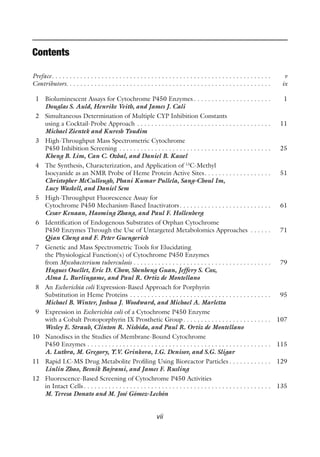
Contents
Preface. . . . . . . . . . . . . . . . . . . . . . . . . . . . . . . . . . . . . . . . . . . . . . . . . . . . . . . . . . . . . . v
Contributors. . . . . . . . . . . . . . . . . . . . . . . . . . . . . . . . . . . . . . . . . . . . . . . . . . . . . . . . . . ix
1 Bioluminescent Assays for Cytochrome P450 Enzymes . . . . . . . . . . . . . . . . . . . . . . 1
Douglas S. Auld, Henrike Veith, and James J. Cali
2 Simultaneous Determination of Multiple CYP Inhibition Constants
using a Cocktail-Probe Approach . . . . . . . . . . . . . . . . . . . . . . . . . . . . . . . . . . . . . . 11
Michael Zientek and Kuresh Youdim
3 High-Throughput Mass Spectrometric Cytochrome
P450 Inhibition Screening . . . . . . . . . . . . . . . . . . . . . . . . . . . . . . . . . . . . . . . . . . . 25
Kheng B. Lim, Can C. Ozbal, and Daniel B. Kassel
4 The Synthesis, Characterization, and Application of 13
C-Methyl
Isocyanide as an NMR Probe of Heme Protein Active Sites. . . . . . . . . . . . . . . . . . . 51
Christopher McCullough, Phani Kumar Pullela, Sang-Choul Im,
Lucy Waskell, and Daniel Sem
5 High-Throughput Fluorescence Assay for
Cytochrome P450 Mechanism-Based Inactivators. . . . . . . . . . . . . . . . . . . . . . . . . . 61
Cesar Kenaan, Haoming Zhang, and Paul F. Hollenberg
6 Identification of Endogenous Substrates of Orphan Cytochrome
P450 Enzymes Through the Use of Untargeted Metabolomics Approaches . . . . . . 71
Qian Cheng and F. Peter Guengerich
7 Genetic and Mass Spectrometric Tools for Elucidating
the Physiological Function(s) of Cytochrome P450 Enzymes
from Mycobacterium tuberculosis . . . . . . . . . . . . . . . . . . . . . . . . . . . . . . . . . . . . . . . 79
Hugues Ouellet, Eric D. Chow, Shenheng Guan, Jeffery S. Cox,
Alma L. Burlingame, and Paul R. Ortiz de Montellano
8 An Escherichia coli Expression-Based Approach for Porphyrin
Substitution in Heme Proteins . . . . . . . . . . . . . . . . . . . . . . . . . . . . . . . . . . . . . . . . 95
Michael B. Winter, Joshua J. Woodward, and Michael A. Marletta
9 Expression in Escherichia coli of a Cytochrome P450 Enzyme
with a Cobalt Protoporphyrin IX Prosthetic Group. . . . . . . . . . . . . . . . . . . . . . . . . 107
Wesley E. Straub, Clinton R. Nishida, and Paul R. Ortiz de Montellano
10 Nanodiscs in the Studies of Membrane-Bound Cytochrome
P450 Enzymes . . . . . . . . . . . . . . . . . . . . . . . . . . . . . . . . . . . . . . . . . . . . . . . . . . . . 115
A. Luthra, M. Gregory, Y.V. Grinkova, I.G. Denisov, and S.G. Sligar
11 Rapid LC-MS Drug Metabolite Profiling Using Bioreactor Particles . . . . . . . . . . . . 129
Linlin Zhao, Besnik Bajrami, and James F. Rusling
12 Fluorescence-Based Screening of Cytochrome P450 Activities
in Intact Cells. . . . . . . . . . . . . . . . . . . . . . . . . . . . . . . . . . . . . . . . . . . . . . . . . . . . . 135
M. Teresa Donato and M. José Gómez-Lechón
viii
13 Screening for Cytochrome P450 Reactivity with a Reporter Enzyme. . . . . . . . . . . . 149
Kersten S. Rabe and Christof M. Niemeyer
14 High-Throughput Fluorescence Assay of Cytochrome P450 3A4 . . . . . . . . . . . . . . 157
Qian Cheng and F. Peter Guengerich
15 Targeted Protein Capture for Analysis of Electrophile-Protein Adducts . . . . . . . . . . 163
Rebecca E. Connor, Simona G. Codreanu, Lawrence J. Marnett,
and Daniel C. Liebler
16 DNA Shuffling of Cytochrome P450 Enzymes . . . . . . . . . . . . . . . . . . . . . . . . . . . . 177
James B.Y.H. Behrendorff, Wayne A. Johnston,
and Elizabeth M.J. Gillam
17 Measurement of P450 Difference Spectra Using Intact Cells. . . . . . . . . . . . . . . . . . 189
Wayne A. Johnston and Elizabeth M.J. Gillam
18 DNA Shuffling of Cytochromes P450 for Indigoid Pigment Production . . . . . . . . . 205
Nedeljka N. Rosic
19 P450 Oxidoreductase: Genotyping, Expression, Purification of Recombinant
Protein, and Activity Assessments of Wild-Type and Mutant Protein . . . . . . . . . . . . 225
Vishal Agrawal and Walter L. Miller
20 LICRED: A Versatile Drop-In Vector for Rapid Generation
of Redox-Self-Sufficient Cytochromes P450 . . . . . . . . . . . . . . . . . . . . . . . . . . . . . . 239
Federico Sabbadin, Gideon Grogan, and Neil C. Bruce
21 Update on Allele Nomenclature for Human Cytochromes P450 and the
Human Cytochrome P450 Allele (CYP-Allele) Nomenclature Database . . . . . . . . . 251
Sarah C. Sim and Magnus Ingelman-Sundberg
22 Simultaneous In Vivo Phenotyping of CYP Enzymes . . . . . . . . . . . . . . . . . . . . . . . 261
Sussan Ghassabian and Michael Murray
23 Detection of Regulatory Polymorphisms: High-Throughput Capillary
DNase I Footprinting . . . . . . . . . . . . . . . . . . . . . . . . . . . . . . . . . . . . . . . . . . . . . . . 269
Matthew Hancock and Elizabeth A. Shephard
24 Isolation of Mouse Hepatocytes . . . . . . . . . . . . . . . . . . . . . . . . . . . . . . . . . . . . . . . 283
Mina Edwards, Lyndsey Houseman, Ian R. Phillips,
and Elizabeth A. Shephard
25 Highly Efficient SiRNA and Gene Transfer into Hepatocyte-Like
HepaRG Cells and Primary Human Hepatocytes: New Means
for Drug Metabolism and Toxicity Studies . . . . . . . . . . . . . . . . . . . . . . . . . . . . . . . 295
Véronique Laurent, Denise Glaise, Tobias Nübel, David Gilot,
Anne Corlu, and Pascal Loyer
Index. . . . . . . . . . . . . . . . . . . . . . . . . . . . . . . . . . . . . . . . . . . . . . . . . . . . . . . . . . . . . . . 315
Contents
ix
Contributors
VISHAL AGRAWAL • Department of Pediatrics, University of California San Francisco,
San Francisco, CA, USA
DOUGLAS S. AULD • Novartis Institutes for Biomedical Research, Cambridge,
MA, USA
BESNIK BAJRAMI • Department of Chemistry, University of Connecticut, Storrs,
CT, USA
JAMES B.Y.H. BEHRENDORFF • Australian Institute for Bioengineering and
Nanotechnology, University of Queensland, Brisbane, Australia
NEIL C. BRUCE • Department of Biology, York University, York, UK
ALMA L. BURLINGAME • Department of Pharmaceutical Chemistry,
University of California, San Francisco, CA, USA
JAMES J. CALI • Promega Corp., Madison, WI, USA
QIAN CHENG • Department of Biochemistry and Center in Molecular Toxicology,
Vanderbilt University School of Medicine, Nashville, TN, USA
ERIC D. CHOW • Department of Microbiology and Immunology, University
of California, San Francisco, CA, USA
SIMONA G. CODREANU • Department of Biochemistry, Vanderbilt University
School of Medicine, Nashville, TN, USA; Jim Ayers Institute for Precancer Detection
and Diagnosis, Vanderbilt University School of Medicine, Nashville, TN, USA
REBECCA E. CONNOR • Department of Biochemistry, Vanderbilt University
School of Medicine, Nashville, TN, USA
ANNE CORLU • Inserm UMR991 Foie, Métabolismes et Cancer, Hôpital Pontchaillou
and Université de Rennes 1, Rennes, France
JEFFERY S. COX • Department of Microbiology and Immunology,
University of California, San Francisco, CA, USA
PAUL R. ORTIZ DE MONTELLANO • Department of Pharmaceutical Chemistry,
University of California, San Francisco, CA, USA
I.G. DENISOV • Department of Biochemistry, University of Illinois, Urbana, IL, USA
M. TERESA DONATO • Departamento de Bioquímica y Biología Molecular, Universidad
de Valencia, Valencia, Spain; CIBERehd, Fondo de Investigaciones Sanitarias,
Barcelona, Spain
MINA EDWARDS • Institute of Structural and Molecular Biology,
University College London, London, UK
SUSSAN GHASSABIAN • Faculty of Pharmacy, University of Sydney, Sydney, NSW,
Australia; Centre for Integrated Preclinical Drug Development,
University of Queensland, Brisbane, Australia
ELIZABETH M.J. GILLAM • School of Chemistry and Molecular Biosciences,
University of Queensland, Brisbane, Australia
DAVID GILOT • CNRS UMR6061, Institut de Génétique et Développement de Rennes,
Université de Rennes 1, Rennes, France
x Contributors
DENISE GLAISE • Inserm UMR991, Foie, Métabolismes et Cancer, Hôpital Pontchaillou
and Université de Rennes 1, Rennes, France
M. JOSÉ GÓMEZ-LECHÓN • IIS Hospital La Fe, Unidad de Hepatología Experimental,
Valencia, Spain; CIBERehd, Fondo de Investigaciones Sanitarias, Barcelona, Spain
M. GREGORY • Department of Biochemistry, University of Illinois, Urbana, IL, USA
Y.V. GRINKOVA • Department of Biochemistry, University of Illinois, Urbana, IL, USA
GIDEON GROGAN • Department of Biology, York University, York, UK
SHENHENG GUAN • Department of Pharmaceutical Chemistry,
University of California, San Francisco, CA, USA
F. PETER GUENGERICH • Department of Biochemistry and Center in Molecular
Toxicology, Vanderbilt University School of Medicine, Nashville, TN, USA
MATTHEW HANCOCK • Institute of Structural and Molecular Biology, University College
London, London, UK
PAUL F. HOLLENBERG • Medical Sciences Research Building III, Department
of Pharmacology, University of Michigan, Ann Arbor, MI, USA
LYNDSEY HOUSEMAN • Institute of Structural and Molecular Biology, University College
London, London, UK
SANG-CHOUL IM • Department of Anesthesiology, University of Michigan and VA
Medical Center, Ann Arbor, MI, USA
MAGNUS INGELMAN-SUNDBERG • Section for Pharmacogenetics, Department of
Physiology and Pharmacology, Karolinska Institute, Stockholm, Sweden
WAYNE A. JOHNSTON • Institute of Molecular Bioscience, University of Queensland,
Brisbane, Australia
DANIEL B. KASSEL • Takeda San Diego Inc., San Diego, CA, USA
CESAR KENAAN • Medical Sciences Research Building III, Department of Pharmacology,
University of Michigan, Ann Arbor, MI, USA
VÉRONIQUE LAURENT • Inserm U 1078, Génétique Moléculaire et Génétique
Epidémiologique, Hôpital Morvan - CHU de Brest, Brest, France; SynNanoVect
Platform, Brest, France
DANIEL C. LIEBLER • Department of Biochemistry, Vanderbilt University School of
Medicine, Nashville, TN, USA; Jim Ayers Institute for Precancer Detection
and Diagnosis, Vanderbilt University School of Medicine, Nashville, TN, USA
KHENG B. LIM • Takeda San Diego Inc., San Diego, CA, USA
PASCAL LOYER • Inserm UMR991 Foie, Métabolismes et Cancer, Hôpital
Pontchaillou and Université de Rennes 1, Rennes, France; SynNanoVect
Platform, Rennes, France
A. LUTHRA • Department of Biochemistry, University of Illinois, Urbana, IL, USA
MICHAEL A. MARLETTA • Department of Chemistry, The Scripps Research Institute,
La Jolla, USA; Department of Chemistry, Department of Molecular
and Cell Biology, California Institute for Quantitative Biosciences, Division
of Physical Biosciences, Lawrence Berkeley National Laboratory, University
of California, Berkeley, CA, USA
LAWRENCE J. MARNETT • Department of Biochemistry, Vanderbilt University School of
Medicine, Nashville, TN, USA; Jim Ayers Institute for Precancer Detection
and Diagnosis, Vanderbilt University School of Medicine, Nashville, TN, USA
xi
Contributors
CHRISTOPHER MCCULLOUGH • Department of Chemistry, Marquette University,
Milwaukee, WI, USA
WALTER L. MILLER • Department of Pediatrics, University of California San Francisco,
San Francisco, CA, USA
MICHAEL MURRAY • Faculty of Pharmacy, University of Sydney, Sydney, NSW,
Australia
CHRISTOF M. NIEMEYER • Karlsruhe Institute of Technologie (KIT), Institute
for Biological Interfaces (IBG-1), Biomolecular Micr- and Nanostructures,
Eggenstein-Leopoldshafen, Germany
CLINTON R. NISHIDA • Department of Pharmaceutical Chemistry,
University of California, San Francisco, CA, USA
TOBIAS NÜBEL • Lonza Cologne GmbH, Nattermannallee, Koeln, Germany
HUGUES OUELLET • Department of Microbiology, University of Texas, El Paso, TX,
USA
CAN C. OZBAL • Agilent Technologies Inc., Wakefield, MA, USA
IAN R. PHILLIPS • School of Biological and Chemical Sciences, Queen Mary,
University of London, London, UK; Division of Biosciences, University College
London, London, UK
PHANI KUMAR PULLELA • Department of Chemistry, Marquette University,
Milwaukee, WI, USA
KERSTEN S. RABE • Fakultät Chemie, Biologisch-Chemische Mikrostrukturtechnik,
Technische Universität Dortmund, Dortmund, Germany; Division of Chemistry
and Chemical Engineering, California Institute of Technology, Pasadena, CA, USA
NEDELJKA N. ROSIC • School of Biological Sciences, University of Queensland, St. Lucia,
QLD, Australia
JAMES F. RUSLING • Department of Chemistry, University of Connecticut, Storrs, CT,
USA; Department of Cell Biology, University of Connecticut Health Center,
Farmington, CT, USA
FEDERICO SABBADIN • Department of Biology, York University, York, UK
DANIEL SEM • Department of Chemistry, Marquette University, Milwaukee, WI, USA;
Department of Pharmaceutical Sciences, Concordia University of Wisconsin–School of
Pharmacy, Mequon, WI, USA
ELIZABETH A. SHEPHARD • Department of Structural and Molecular Biology, University
College London, London, UK
SARAH C. SIM • Section for Pharmacogenetics, Department of Physiology
and Pharmacology, Karolinska Institute, Stockholm, Sweden
S.G. SLIGAR • Department of Biochemistry, Beckman Institute and School of Molecular
and Cellular Biology, University of Illinois, Urbana, IL, USA
WESLEY E. STRAUB • Life Technologies, San Francisco, CA, USA
HENRIKE VEITH • National Center for Advancing Translational Sciences, National
Institutes of Health, Bethesda, MD, USA
LUCY WASKELL • Department of Anesthesiology, University of Michigan and VA
Medical Center, Ann Arbor, MI, USA
MICHAEL B. WINTER • Department of Chemistry, California Institute
for Quantitative Biosciences, University of California, Berkeley, CA, USA
xii Contributors
JOSHUA J. WOODWARD • Department of Chemistry, California Institute for
Quantitative Biosciences, University of California, Berkeley, CA, USA
KURESH YOUDIM • F. Hoffmann-La Roche AG, Basel, Switzerland
HAOMING ZHANG • Medical Sciences Research Building III, Department
of Pharmacology, University of Michigan, Ann Arbor, MI, USA
LINLIN ZHAO • Department of Chemistry, University of Connecticut, Storrs, CT, USA
MICHAEL ZIENTEK • Pfizer Inc., La Jolla, CA, USA
1
Ian R. Phillips et al. (eds.), Cytochrome P450 Protocols, Methods in Molecular Biology, vol. 987,
DOI 10.1007/978-1-62703-321-3_1, © Springer Science+Business Media New York 2013
Chapter 1
Bioluminescent Assays for Cytochrome P450 Enzymes
Douglas S. Auld, Henrike Veith, and James J. Cali
Abstract
The cytochrome P450 (CYP) family contains 57 enzymes in humans. The activity of CYPs against xenobiotics
is a primary consideration in drug optimization efforts. Here we describe a series of bioluminescent assays
that enable the rapid profiling of CYP activity against compound collections. The assays employ a coupled-
enzyme format where firefly luciferase is used to measure CYP enzyme activity through metabolism of
pro-luciferase substrates.
Key words Cytochrome P450, Bioluminescent assays, Enzyme assays
The cytochromes P450 (CYPs) are the main enzymes that metabolize
therapeutic drugs and numerous other xenobiotics (1). Certain
CYP enzymes also play a prominent role in adverse xenobiotic
interactions and are often the underlying reasons for contraindica-
tions found in certain drug combinations. For example, a drug or
food component that inhibits a CYP enzyme can slow the clear-
ance of a co-ingested drug that is metabolized by the same CYP,
leading to drug accumulation beyond the desired dose and even-
tual toxicity. Owing to the prominent role CYP enzymes have in
metabolism and potential adverse outcomes, various CYP probe
substrates have been developed wherein metabolism by a specific
CYP enzyme leads to a fluorescent or bioluminescent signal. These
probe substrates have been used to develop high-throughput assays
to measure CYP activity in the presence and absence of test com-
pounds to identify CYP-enzyme inhibitors (2–5). In such assays
inhibition can arise through a number of modes. Any reduction of
free enzyme in the assay, through a compound acting either as a
competitive substrate or an inhibitor of the probe substrate, will
slow the rate of conversion of the labeled substrate and result in
inhibition. In addition, inhibition can arise in a time-dependent
fashion, which can arise from either slow-binding inhibitors or
1 Introduction
2 Douglas S. Auld et al.
mechanism-based inhibitors where an intermediate of the CYP
reaction irreversibly inhibits the enzyme.
For construction of assays specific for CYP enzymes, probe
substrates have been developed which are selectivity oxidized by
one or more CYP enzymes leading to production of a detectable
product. Various detection methods have been used including mass
spectrometry, absorbance, radioactivity, fluorescence, and biolumi-
nescence (5). Validation data have been shown demonstrating that
these methods can predict in vivo CYP inhibition (6–8). However,
there are substantial differences among these methods in sensitiv-
ity, scalability, ease of use, and vulnerability to test compound
interference (3, 4). Advantages of bioluminescence assays over
fluorescence assays include increased sensitivity (up to three orders
ofmagnitude),andobviatingtheproblemoffluorescent-compound
interference (8). As well, the use of optimized luciferases and detec-
tion reagents, a necessary coupling enzyme used to read out the
bioluminescent signal, can reduce interference of compounds
acting as direct luciferase inhibitors (3, 9). These advantages posi-
tion bioluminescent CYP assays as a good choice for miniaturized
high-throughput applications of CYP enzymes (3).
Bioluminescent CYP assays rely on a series of CYP substrates
that are pro-substrates for a light-generating reaction with firefly
luciferase. For bioluminescent assays, a luciferase pro-substrate is
converted by a CYP enzyme in an initial reaction to a form that
leads to light production using a second reaction mixture contain-
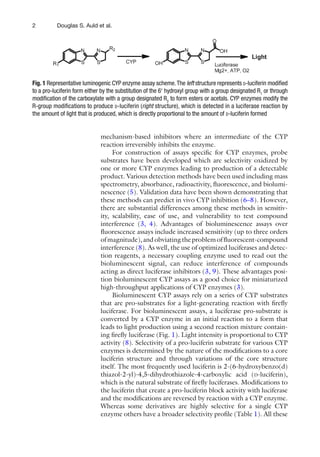
ing firefly luciferase (Fig. 1). Light intensity is proportional to CYP
activity (8). Selectivity of a pro-luciferin substrate for various CYP
enzymes is determined by the nature of the modifications to a core
luciferin structure and through variations of the core structure
itself. The most frequently used luciferin is 2-(6-hydroxybenzo(d)
thiazol-2-yl)-4,5-dihydrothiazole-4-carboxylic acid (D-luciferin),
which is the natural substrate of firefly luciferases. Modifications to
the luciferin that create a pro-luciferin block activity with luciferase
and the modifications are reversed by reaction with a CYP enzyme.
Whereas some derivatives are highly selective for a single CYP
enzyme others have a broader selectivity profile (Table 1). All these
Fig. 1 Representative luminogenic CYP enzyme assay scheme.The left structure represents D-luciferin modified
to a pro-luciferin form either by the substitution of the 6¢ hydroxyl group with a group designated R1
or through
modification of the carboxylate with a group designated R2
to form esters or acetals. CYP enzymes modify the
R-group modifications to produce D-luciferin (right structure), which is detected in a luciferase reaction by
the amount of light that is produced, which is directly proportional to the amount of D-luciferin formed
3
Bioluminescent Assays for Cytochrome P450 Enzymes
substrates are useful for assays containing purified or recombinant
CYPs where only a single species of CYP enzyme is present and,
therefore, cross-reactivity with multiple CYPs is not an issue. The
selective substrates have additional utility when employing liver
microsomes and cultured hepatocytes where multiple species of
CYPs are present and a selective substrate is required to target a
single enzyme (10).
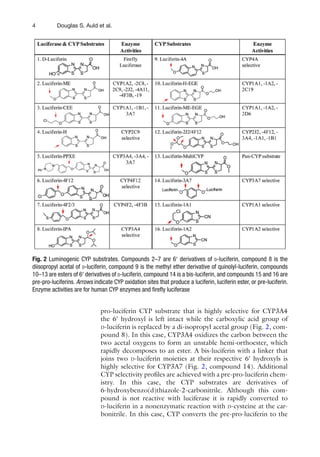
Most pro-luciferin CYP substrates have single modifications to
D-luciferin (Fig. 2, compound 1) at the 6¢ carbon (Fig. 2, com-
pounds 2–7). A variant of the luciferin core structure that substi-
tutes the benzothiazole system with a quinoline unit provides a
unique and selective CYP reactivity profile compared with the
D-luciferin with the same CYP reactive group (Fig. 2, compound
2 compared with compound 9). Additional selectivity profiles are
achieved when a second modification is used to create a carboxyl
ester in place of the carboxylic acid group found in unmodified
D-luciferin (Fig. 2, compounds 10–13). Activation of the pro-
luciferins relies on standard CYP-catalyzed reactions including
aromatic hydroxylations and O-dealkylations typically to generate
a 6¢ hydroxyl required for luciferase activity. The carboxyl esters
require further de-esterification and this is achieved by including a
carboxyl esterase in the second reaction with luciferase. In a unique
2 Materials
2.1 Luciferin
Substrates
Table 1
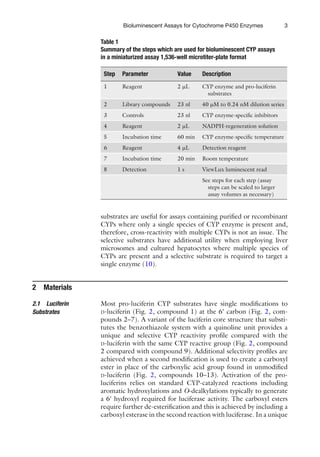
Summary of the steps which are used for bioluminescent CYP assays
in a miniaturized assay 1,536-well microtiter-plate format
Step Parameter Value Description
1 Reagent 2 mL CYP enzyme and pro-luciferin
substrates
2 Library compounds 23 nl 40 mM to 0.24 nM dilution series
3 Controls 23 nl CYP enzyme-specific inhibitors
4 Reagent 2 mL NADPH-regeneration solution
5 Incubation time 60 min CYP enzyme-specific temperature
6 Reagent 4 mL Detection reagent
7 Incubation time 20 min Room temperature
8 Detection 1 s ViewLux luminescent read
See steps for each step (assay
steps can be scaled to larger
assay volumes as necessary)
4 Douglas S. Auld et al.
pro-luciferin CYP substrate that is highly selective for CYP3A4
the 6¢ hydroxyl is left intact while the carboxylic acid group of
D-luciferin is replaced by a di-isopropyl acetal group (Fig. 2, com-
pound 8). In this case, CYP3A4 oxidizes the carbon between the
two acetal oxygens to form an unstable hemi-orthoester, which
rapidly decomposes to an ester. A bis-luciferin with a linker that
joins two D-luciferin moieties at their respective 6¢ hydroxyls is
highly selective for CYP3A7 (Fig. 2, compound 14). Additional
CYP selectivity profiles are achieved with a pre-pro-luciferin chem-
istry. In this case, the CYP substrates are derivatives of
6-hydroxybenzo(d)thiazole-2-carbonitrile. Although this com-
pound is not reactive with luciferase it is rapidly converted to
D-luciferin in a nonenzymatic reaction with D-cysteine at the car-
bonitrile. In this case, CYP converts the pre-pro-luciferin to the
Fig. 2 Luminogenic CYP substrates. Compounds 2–7 are 6¢ derivatives of D-luciferin, compound 8 is the
diisopropyl acetal of D-luciferin, compound 9 is the methyl ether derivative of quinolyl-luciferin, compounds
10–13 are esters of 6¢ derivatives of D-luciferin, compound 14 is a bis-luciferin, and compounds 15 and 16 are
pre-pro-luciferins. Arrows indicate CYP oxidation sites that produce a luciferin, luciferin ester, or pre-luciferin.
Enzyme activities are for human CYP enzymes and firefly luciferase
5
Bioluminescent Assays for Cytochrome P450 Enzymes
pre-luciferin 6-hydroxybenzo(d)thiazole-2-carbonitrile, which
rapidly converts to luciferin in a luciferase reaction mixture that
contains D-cysteine. Un-reacted substrate also reacts with
D-cysteine, but is not detected by luciferase because it remains in
the pro-luciferin form (Fig. 2, compounds 15 and 16).
The luciferase-based P450-Glo™ Screening Systems (Promega,
Madison, WI) for CYP1A2 (V9770), CYP2C9 (V9790), CYP2C19
(V9880), CYP2D6 (V9890), and CYP3A4 using luciferin-PPXE
(V9910). Control compounds which can be employed for assay
validation include furafylline for CYP1A2, sulfaphenazole for
CYP2C9, ketoconazole for CYP2C19, quinidine for CYP2D6,
and ketoconazole for CYP3A4. These can be purchased from
Sigma-Aldrich (St. Louis, MO).
The steps which are used for bioluminescent CYP assays in a
miniaturized assay 1,536-well microtiter-plate format are summa-
rized in Table 1.
1. Keep CYP enzyme and pro-luciferin substrate mixture on ice
while dispensing (see Note 1). The working concentration is 2×
final concentration. Pipette the reaction mixture into white
1,536-well solid-bottom plates using a bottle-valve dispenser
(11) and incubate at the appropriate temperature. The final con-
centrations are CYP1A2 10 nM, 100 mM luciferin-ME as sub-
strate, in 100 mM KPO4
buffer; CYP2C9 10 nM 2C9, 100 mM
Luciferin-H as substrate, in 25 mM KPO4
buffer; CYP2C19
5 nM, 10 mM Luciferin-H EGE as substrate, in 50 mM PO4
buffer; CYP2D6 5 nM final, 30 mM Luciferin-ME EGE as sub-
strate, in 100 mM KPO4
in buffer; and CYP3A4 10 nM final,
25 mM Luciferin-PPXE as substrate.
2. Following addition of enzyme/substrate mix, prepare a con-
trol plate. Controls are furafylline (CYP1A2), sulfaphenazole
(CYP2C9), ketoconazole (CYP2C19 and CYP3A4), and
quinidine (CYP2D6) (see Note 2). The first four columns of
the assay plate are reserved for controls and these are added
from a separate 1,536-well compound plate. For constructing
the control plate, samples in only the first four columns are
prepared as follows: columns 1 and 2, 16-point titrations in
duplicate of the appropriate inhibitor (both beginning at
10 mM in DMSO for all isozymes, except CYP2D6, for which
the starting concentration is 250 mM); column 3, a neutral
control (DMSO vehicle only); and column 4, the appropriate
control inhibitor for the CYP (present at a final concentration
of either 57 mM or 1.4 mM for CYP2D6).
2.2 Reagents for
High-Throughput
Screening
Applications
3 Methods
6 Douglas S. Auld et al.
3. Compound plates containing test samples (in columns 5–48;
columns 1–4 are left empty) and the control plate are then
transferred to the 1,536-well assay plate, using a pin tool (12).
For pin-tool-based compound transfer clean the pins using a
wash sequence: DMSO, iPA, and MeOH, followed by a 3-s
vacuum-drying step.
4. Incubate the enzyme/substrate/compound mixture for
10 min at the respective incubation temperature.
5. To start the reaction, add a NADPH-regeneration solution
containing 1.3 mM NADP+
, 3.3 mM glucose-6-phosphate,
3.3 mM MgCl2
, and glucose-6-phosphate dehydrogenase
(0.4 U/mL) for all isozymes; for CYP3A4, 200 mM KPO4
was
also added. Prepare this reagent at room temperature, but keep
on ice while dispensing into large batches of plates.
6. Next, incubate the plates for 1 h at either room temperature,
for CYP1A2, CYP2D6, and CYP3A4, or at 37°C, for CYP2C9
and CYP2C19.
7. Develop the luminescent signal by adding P450 Glo-Buffer,
for CYP1A2, CYP2C9, and CYP3A4 (Promega), or Luciferin
Detection Buffer, for CYP2C19 and CYP2D6 (Promega) (see
Note 3). The detection reagent contains luciferase and ATP to
generate a luminescent signal. Keep this reagent on ice and
shield from light during dispensing. Addition of this reagent
also stops the P450 reaction.
8. Incubate the plates for another 20 min before reading on a
ViewLux (Perkin Elmer) with 2× binning and an exposure
of 60 s.
9. Data can be reported as %activity relative to controls. If com-
pounds were titrated at multiple concentrations then the con-
centration for 50% inhibition (IC50
) can be calculated following
curve fitting. Typically, inhibition is observed but activation
can also occur (see Note 4). IC50
s derived from the biolumi-
nescent CYP assays described here correlate well with orthog-
onal CYP assay methods, as described in the Introduction,
provided the methods being compared are properly imple-
mented (see Note 5).
1. For preparing the pro-luciferin substrate stocks, luciferin-H
EGE and luciferin-ME EGE are reconstituted in acetonitrile;
other substrates are provided as DMSO stocks. Substrates
stocks can be stored at −20°C or −70°C, protected from
light. This caution about protection from light relates to
storage of the luminogenic substrates only. The time elapsed
4 Notes
7
Bioluminescent Assays for Cytochrome P450 Enzymes
during a typical assay work flow is sufficiently short as to
obviate the need for shielding these samples from light.
Luciferin-PPXE substrate stock must be stored at −70°C.
CYP enzyme stocks should be stored at −70°C. Recombinant
CYP enzymes prepared for step 1 and liver microsomes
should be stored at £−70°C. Storage at >−70°C (e.g., in a
typical −20°C freezer) results in gradual loss of CYP enzyme
activity. The enzymes should be thawed rapidly then placed
on wet ice until ready to initiate reactions. The stability of
CYP enzymes at room temperature or 37°C varies among
enzymes. Among the enzymes discussed here, CYP1A2
appears the least stable and CYP2C9 the most stable.
Recombinant CYP enzymes and liver microsomes are
membrane suspensions rather than soluble enzyme solutions.
Therefore, care must be taken to ensure thorough mixing of
reaction mixtures to avoid settling of the membranes in reac-
tion vessels, which can lead to assay variability.
2. Test compounds should be diluted in DMSO; however,
CYP3A enzymes can be highly sensitive to DMSO, and the
degree of sensitivity can be substrate dependent. None of the
non-CYP3A enzyme assays are affected by DMSO concentra-
tions £1%. The substrate chosen here for CYP3A4 (Luc-PPXE)
has only modest sensitivity to DMSO and the final concentra-
tion of DMSO in the assays described above is 0.5%, which is
acceptable for the CYP3A4/Luc-PPXE 3A system. However,
luciferin-BE, the original luminogenic CYP3A substrate, is
inhibited substantially by DMSO, and DMSO concentrations
should be £0.1% if this substrate is used. None of the CYP
assays are affected by acetonitrile, methanol, or ethanol at
concentrations £1.0%.
3. It is important to match the appropriate luciferase detection
reagent with the specific CYP being assayed, as indicated in
step 7 of the method. The CYP2D6 and CYP2C19 reactions
produce luciferin esters that are not active with luciferase.
Therefore, the reagent called “Luciferin Detection Buffer”
supplied for CYP2C19 and CYP2D6 contains an esterase that
de-esterifies the CYP reaction products. This step is essential
for light generation with luciferase. In contrast, the CYP1A2,
CYP2C9, and CYP3A4 substrates are not esters and the cor-
responding “P450 Glo-Buffer” supplied with these assays does
not contain or require esterase. Promega suggests that the
reconstituted Luciferase Detection Reagent can be stored at
–20°C for up to 3 months and, for convenience, this reagent
can be stored at room temperature (e.g., ~23°C) for 24 h or at
4°C for 1 week without loss of activity. Always avoid multiple
freeze-thaw cycles of reagents.
Another Random Scribd Document
with Unrelated Content
EFFI BRIEST 381 She nodded. " It is as you say, and I must
confess that I have seen nothing in my life that made me feel so
sad. Let us give up entirely our search for rooms. I can't stay here. '
' " And yesterday it seemed to you a Gulf of Naples and everytliing
beautiful you could think of. ' ' " Yes, yesterday." " And today? No
longer a trace of Sorrento? " " Still one trace, but only one. It is
Sorrento on the point of dying." " Very well, then, Effi," said
Innstetten, reaching her his hand. ** I do not want to worry you
with Riigen and so let us give it up. Settled. It is not necessary for us
to tie ourselves up to Stubbenkammer or Sassnitz or farther down
that way. But whither? " ** I suggest that we stay a day longer and
wait for the steamer that comes from Stettin tomorrow on its way to
Copenhagen. It is said to be so pleasurable there and I can't tell you
how I long for something pleasurable. Here I feel as though I could
never laugh again in all my life)|  and had never laughed at all, and
you know how I like to laugh. ' ' Innstetten showed himself full of
sympathy with her state, the more readily, as he considered her
right in many regards. Really everything, though beautiful, was mel^
ancholy. They waited for the Stettin boat and in the very early
morning of the third day they landed in Copenhagen. Two hours
later they were in the Thorwaldsen Museum, and Effi said: " Yes,
Geert, this is beautiful and I am glad we set out for here." Soon
thereafter they went to dinner and at the table made the
acquaintance of a Jutland family, opposite them, whose daughter,
Thora von Penz, was as pretty as a picture and attracted
immediately the attention and admiration of both Innstetten and
Effi. Effi could not stop looking at her large blue eyes and flaxen
blonde hair, and when they left the table an hour and a
382 THE GERMAN CLASSICS half later the Penz family, who
unfortunately had to leave Copenhagen the same day, expressed the
hope that they might have the privilege of entertaining the young
Prussian couple in the near future at Aggerhuus Castle, some two
miles from the Lym-Fiord. The invitation was accepted by the
Innstettens with little hesitation. Thus passed the hours in the hotel.
But that was not yet enough of a good thing for this memorable day,
which Efifi enthusiastically declared ought to be a red-letter day in
the calendar. To fill her measure of happiness to the full the evening
brought a performance at the Tivoli Theatre, an Italian pantomime,
Arlequin and Columbine. She was completely captivated by the little
roguish tricks, and when they returned to their hotel late in the
evening she said : ' ' Do you know, Geert, I now feel that I am
gradually coming to again. I will not even mention beautiful Thora,
but when I consider that this morning Thorwaldsen and this evening
Columbine — ' ' ** Whom at bottom you liked better than
Thorwaldsen — " ** To be frank, yes. I have a natural appreciation
of such things. Our good Kessin was a misfortune for me. Everything
got on my nerves there. Riigen too, almost. I suggest we stay here
in Copenhagen a few days longer, including an excursion to
Fredericksborg and Helsingor, of course, and then go over to
Jutland. I anticipate real pleasure from seeing beautiful Thora again,
and if I were' a man I should fall in love with her." Innstetten
laughed. " You don't know what I am going to do." " I shouldn't
object. That will create a rivalry and I shall show you that I still have
my powers, too." " You don't need to assure me of that." The
journey was made according to this plan. Over in Jutland they went
up the Lym-Fiord as far as Aggerhuus Castle, where they spent three
days with the Penz family, and then returned home, making many
stops on the way, for sojourns of various lengths, in Viborg,
Flensburg, Kiel,
EFFI BRIEST 383 and Hamburg. From Hamburg, which they
liked uncommonly well, they did not go direct to Keith St. in Berlin,
but first to Hohen-Cremmen, where they wished to enjoy a well-
earned rest. For Innstetten it meant but a few days, as his leave of
absence expired, but Effi remained a week longer and declared her
desire not to arrive at home till the 3d of October, their wedding
anniversary. Annie had flourished splendidly in the country air and
Roswitha's plan of having her walk to meet her mother succeeded
perfectly. Briest proved himself an affectionate"^ grandfather,
warned them against too much love, and even more strongly against
too much severity, and was in every way the same as always. But in
reality all his affection was bestowed upon Effi, who occupied his
emotional nature continually, particularly when he was alone with his
wife.i " How do you find Effi? " ^ " Dear and good as ever. We
cannot thank God enough that we have such a lovely daughter. How
thankful she is for everything, and always so happy to be under our
roof tree again." '' Yes," said Briest, *' she has more of this virtue
than I like. To tell the truth, it seems as though this were still her
home. Yet she has her husband and child, and her husband is a
jewel and her child an angel, and still she acts as though Hohen-
Cremmen were her favorite abode, and her|| v^ husband and child
were nothing in comparison with you and'Jv me. She is a splendid
daughter, but she is too much of a daughter to suit me. It worries
me a little bit. She is also unjust to Innstetten. How do matters
really stand between them? " " Why, Briest, what do you mean? " "
Well,. I mean what I mean and you know what, too. Is she happy?
Or is there something or other in the way? From the very beginning
it has seemed to me as though sheii  esteemed him more than she
loved him, and that to my'' /j/> mind is a bad thing. Even love may
not last forever, and^T esteem will certainly not. In fact women
become angry
384 THE GERMAN CLASSICS when they have to esteem a
man; first they become angry, jsthen bored, and in the end they
laugh." ** Have you had any such experience? " ** I will not say
that I have. I did not stand high enough in esteem. But let us not
get wrought up any further. Tell me how matters stand." " Pshaw!
Briest, you always come back to the same things. We have talked
about and exchanged our views on this question more than a dozen
times, and yet you always come back and, in spite of your pretended
omniscience, ask me about it with the most dreadful naivete, as
though my eyes could penetrate any depth. What kind of notions
have you, anyhow, of a young wife, and more especially of your
daughter? Do you think that the whole situation is so plain? Or that I
am an oracle — I can't just recall the name of the person — or that I
hold the truth cut and dried in my hands, when Effi has poured out
her heart to me? — at least what is so designated. For what does
pouring out one's heart mean? After all, the real thing is kept back.
She will take care not to initiate me into her secrets. Be-^ sides, I
don't know from whom she inherited it, but she is — well, she is a
very sly little person and this slyness inM her is the more dangerous
because she is so very lovable." * * So you do admit that — lovable.
And good, too ? ' ' * * Good, too. That is, f utt-ef-^oadiiess^ of
_heart. I am not quite certain about anything further. I believe she
has antf inclination to let matters take their course and to console m
herself with the hope that God will not call her to a very}) strict
account." *' Do you think so? »' '* Yes, I do. Furthermore I think she
has improved in many ways. Her character is what it is, but the
conditions since she moved to Berlin are much more favorable andj
they are becoming more and more devoted to each other. She told
me something to that effect and, what is more convincing to me, I
found it confirmed by what I saw with my own eyes."
EFFI BRIEST 385 " Well, what did she say? " ' * She said : '
Mama, things are going better now. Innstetten was always an
excellent husband, and there are not many like him, but I couldn't
approach him easily, there || was something distant about him. He
was reserved even in his affectionate moments, in fact, more
reserved then than ever. There have been times when I feared hin^"
' * I know, I know. ' ' *' What do you mean, Briest? That I have
feared you, or that you have feared me? I consider the one as
ridiculous as the other." " You were going to tell me about Effi." ' '
Well, then, she confessed to me that this feeling of strangeness had
left her and that had made her very happy. Kessin had not been the
right place for her, the haunted ^ house and the people there, some
too pious, others too dull ; but since she had moved to Berlin she
felt entirely in her place. He was the best man in the world,
somewhat too old for her and too good for her, but she was now '
over the mountain.' She used this expression, which, I admit,
astonished me." " How so? It is not quite up to par, I mean the
expression. But — " " There is something behind it, and she wanted
to give me an inkling." "Do you think so? " " Yes, Briest. You always
seem to think she could never be anything but innocent. But you are
mistaken. She likes I to drift with the waves, and if the wave is good
she is goodk ^ too. Fighting and resisting are not her affair. " /'
Roswitha came in with Annie and interrupted the conversation. This
conversation occurred on the day that Innstetten departed from
Hohen-Cremmen for Berlin, leaving Eflfi behind for at least a w^eek.
He knew she liked nothing better than w^hiling away her time, care-
free, with sweety. dreams, always hearing friendly words and
assurances of// Vol. XII — 25
386 THE GERMAN CLASSICS her loveliness. Indeed that
was the thing wliich pleased, her above everything else, and here
she enjoyed it again to the full and most gratefully, even though
diversions were utterly lacking. Visitors seldom, came, because after
her,^ marriage there was no real attraction, at least for the young/''*
people. * * * On her wedding anniversary, the 3d of October, Effi
was to be back in Berlin. On the evening before, under the pretext
of desiring to pack her things and prepare for the journey, she
retired to her room comparatively early. As a matter of fact, her only
desire was to be alone. Much as she liked to chat, there were times
when she longed for repose. Her rooms were in the upper story on
the side toward the garden. In the smaller one Roswitha was
sleeping with Annie and their door was standing ajar. She herself
walked to and fro in the larger one, which she occupied. The lower
casements of the windows w^ere open and the little white curtains
were blown by the draft and slowly fell over the back of the chair, till
another puff of wind came and raised them again. It was so light
that she could read plainly the titles of the pictures hanging in
narrow gilt frames over the sofa: " The Storming of Diippel, Fort No.
5," and '* King William and Count Bismarck on the Heights of Lipa. '
' Effi shook her head and smiled. ' ' When I come back again I am
going to ask for different pictures ; j]fl don't like such warlike sights."
Then she closed one window and sat down by the other, which she
left open. How she enjoyed the whole scene! Almost behind the
church tower was the moon, which shed its light upon the grassy
plot with the sundial and the heliotrope beds. Everything was
covered with a silvery sheen. Beside the strips of shadow lay white
strips of light, as white as linen on the bleaching ground. Farther on
stood the tall rhubarb plants with their leaves an autumnal yellow,
and she thought of the day, only a little over two years before, when
she had played there with Hulda and the J-aliwke girls.
EFFI BEIEST 387 On that occasion, when the visitor came
she ascended the little stone steps by the bench and an honr later
was betrothed. She arose, went toward the door, and listened.
Roswitha was asleep and Annie also. Suddenly, as the child lay there
before her, a throng of pictures of the days in Kessin came back to
her unbidden. There was the district councillor's dwelling with its
gable, and the veranda with the view of the *' Plantation," and she
was sitting in the rocking chair, rocking. Soon Crampas stepped up to
her to greet her, and then came Rosmtha with the child, and she
took it, held it up, and kissed it. ** That was the first day, there is
where it began." In the midst of her revery she left the room the
two were sleeping in and sat down again at the open mndow and
gazed out into the quiet night. '' I cannot get rid of it," she said. "
But worst of all, and the thing that makes me lose faith in myself —
" Just then the tower clock began to strike and Effi counted the
strokes. ** Ten — Tomorrow at this time I shall be in Berlin. We
shall speak about our wedding anniversary and he will say pleasing
and friendly things to me and perhaps words of affection. I shall sit
there and listen and have a senee-o#-g«i4t4n„my_hearL" She
leaned her head "^ upon her hand and stared silently into the night.
"And have a sense of guilt in my heart," she repeated-x . * * Yes,
the sense is there. But is it a burden upon my heartj^C No. That is
why I am alarmed at myself. The burden there is quite a different
thing — dread, mortal dread, and'* eternal fear that it may some
day be found out. And, besides the diieadj,^hame. I axaashamed of
myself. But 'y( as I do not feel trjje repentance, neither do I
tLue^fihame. I am ashamed only on account of my continual lying
andl| deceiving. It was always my pride that I could not lie and ^
did not need to — lying is so mean, and now I have had to lie all the
time, to him and to everybody, big lies and little lies. Even
Rummschiittel noticed it and shrugged his
388 THE GERMAN CLASSICS shoulders, and who knows
what he thinks of me 1 Certainly not the best things. Yes, dread
tortures me, and shame on account of my life of lies. But not shame
on account of my j guilt — that I do not feel, or at least not truly, or
not enough, and the knowledge that I do not is killing me. If all
women are like this it is terrible, if they are not — which I hope —
then / am in a bad predicament; there is something out of order in
my heart, I lack proper feeling. Old Mr. Niemeyer once told me, in
his best days, when I was still half a child, that proper feeling is the
essential thing, and if we have that the worst cannot befall us, but if
we have it not, we are in eternal danger, and what is called the ,
Devil has sure power over us. For the mercy of God, is this* my
state? " She laid her head upon her arms and wept bitterly. When
she straightened up again, calmed, she gazed out into the garden.
All was so still, and her ear could detect a low sweet sound, as of
falling rain, coming from the plane trees. This continued for a while.
Then from the village street came the sound of a human voice. The
old nightwatchman Kulicke was calling out the hour. When at last he
was silent she heard in the distance the rattling of the passing train,
some two miles away. This noise gradually became fainter and finally
died away entirely — Still the moonlight lay upon the grass plot and
there was still the low sound, as of falling rain upon the plane trees.
But it was only the gentle playing of the night air. CHAPtER XXV [The
following evening Innstetten met Efifi at the station in Berlin and
said he had thought she would not keep her word, as she had not
when she came to Berlin to select their apartment. In a short time
he began to bestir himself to make a place for his wife in Berlin
society. At a small party early in the season he tactlessly tmtted her|
| about Crampas and for days thereafter she felt haunted ^| by the
Major's spirit. But once the Empress had selected her to be a lady of
honor at an important function, and the
EFFI BRIEST 389 :>■■ Emperor had addressed a few
gracious remarks to her at a court ball, the past began to seem to
her a mere dream, and her cheerfulness was restored. After about
seven years in Berlin Dr. Rummschiittel was one day called to see
her for various reasons and prescribed treatment at Schwalbach and
Ems. She was to be accompanied by the wife of Privy jj^ Councillor
Zwicker, who in spite of her forty odd years seemed to need a
protectress more than Effi did. While Roswitha was helping with the
preparations for the journey Effi called her to account for never
going, as a good Catholic should, to a priest to confess her sins,
particu^ larly her great sin, and promised to talk the matter over
with her seriously after returning from Ems.] Chapter XXVI
[Innstetten could see by Effi's letters from Ems that Mrs. Zwicker
was not the right kind of a companion for f / her and he longed for
her to come back to him. As the end of her sojourn at the watering
place approached, preparations were made to welcome her on her
return home. A " W," made of forget-me-nots, was to be hung up
and some verses composed by a friend of the family were to be
spoken by Annie. One day when Annie was returning from school
Roswitha went out to meet her and was challenged by her to a race
up the stairs. When Annie reached the top she stumbled and fell
upon a scraper, cutting an ugly gash in her forehead. Roswitha and
Johanna washed the wound with cold water and decided to tie it up
with tlie long band- 1) age once used to bind the mother's sprained
ankle. In their search for the bandage they broke open the lock to
the sewing table drawers, which they began to empty of their
contents. Among other things they took out a small package of
letters tied up with a red silk cord. Before they had ended the search
Innstetten came home. He examined the wound and sent for Dr.
Rummschiittel. After scolding Annie and telling her what she must do
till her mother came home, he sat down with her to dine and
promised to read her a letter just received from her mother.]
390 THE GERMAN CLASSICS Chapter XXVII For a while
Iimstetten sat at the table with Annie in silence. Finally, when the
stillness became painful to him, he asked her a few questions about
the school superintendent and which teacher she liked best. She
answered rather listlessly, because she felt he was not paying much
attention. The situation was not improved till Johanna whispered to
little Annie, after the second course, that there was something else
to come. And surely enough, good Roswitha, who felt under
obligation to her pet on this unlucky day, had prepared something
extra. She had risen to an omelet with sliced apple filling. The sight
of it made Annie somewhat more talkative. Innstetten's frame of
mind was likewise bettered when the doorbell rang a moment later
and Dr. Rummschiittel entered, quite accidentally. He had just
dropped in, without any suspicion that he had been sent for. He
approved of the compresses. *' Send for some Goulard water and
keep Annie at home tomorrow. Quiet is the best remedy. ' ' Then he
asked further about her Ladyship and what kind of news had been
received from Ems, and said he would come again the next day to
see the patient. When they got up from the table and went into the
adjoining room, where the bandage had been searched for so
zealously, albeit in vain, Annie was again laid upon the sofa, Johanna
came and sat down beside her, while Innstetten began to put back
into the sewing table the countless things that still lay in gay
confusion upon the window sill. Now and then he was at a loss to
know what to do and was obliged to ask. " Where do these letters
belong, Johanna? " " Clear at the bottom," said she, " here in this
drawer." During the question and answer Innstetten examined more
closely than before the little package tied up with a red cord. It
seemed to consist of a number of notes, rather than letters. Bending
it between his thumb and
EFFI BRIEST 391 forefinger, like a pack of cards, he slowly
let the edges slip off one at a time, and a few lines, in reality only
disconnected words, darted past his eyes. It was impossible to
distinguish them clearly, yet it seemed to him as though he had
somewhere seen the handwriting before. Should he look into the
matter? ''Johanna, you might bring us the coffee. Annie will also take
half a cup. The doctor has not forbidden it, and what is not
forbidden is allowed." As he said this he untied the red cord, and
while Johanna was going to the kitchen he quickly ran over the
whole contents of the package. Only two or three letters were
addressed to Mrs. District Councillor von Innstetten." He now
recognized the handwriting; it was that of the Major. Innstetten had
known nothing about a correspondence between Crampas and Effi.
His brain began to grow dizzy. He put the package in his pocket and
returned to his room. ' A few moments later Johanna rapped softly
on his door to let him know that the coffee was served. He
answered, but that was all. Otherwise the silence was complete. Not
until a quarter of an hour later was he heard walking to and fro on
the rug. " I wonder what ails papa? " said Johanna to Annie. *' The
doctor said it was nothing, didn't he?" The walking to and fro in the
adjoining room showed no signs of ending, but Innstetten finally
came out and said: " Johanna, keep an eye on Annie and make her
remain quiet on the sofa. I am going out to walk for an hour or two.
' ' Then he gazed fixedly at the child and left the room. *' Did you
notice, Johanna, how papa looked? " Y| " Yes, Annie. He must have
had a great vexation. He w&s all pale. I never saw him like that."
Hours passed. The sun was already down and only a red glow was
visible above the roofs across the street, when Innstetten came
back. He took Annie's hand and asked her how she was. Then he
ordered Johanna to bring the lamp into his room. The lamp came. In
its green shade
392 THE GERMAN CLASSICS were half-transparent ovals
with photographs, various pictures of his wife that had been made in
Kessin for the other members of the cast when they played Wichert's
A Step out of the Way. Innstetten turned the shade slowly from left
to right and studied each individual picture. Then he gave that up
and, as the air was so sultry, opened the balcony door and finally
took up the package of letters again. He seemed to have picked out
a few and laid them on top the first time he looked them over. These
he now read once more in a half audible voice: *' Come again this
afternoon to the dunes behind the mill. At old Mrs, Adermann's we
can see each other without fear, as the house is far enough off the
road. You must not worry so much about everything. We have our
rights, too. If you will say that to yourself emphatically, I think all
fear will depart from you. Life would not be worth the living if
everything that applies in certain specific cases should be made to
apply in all. All the best things lie beyond that. Learn to enjoy them."
" 'Away from here,' you write, * flight.' Impossible. I cannot leave
my wife in the lurch, in poverty, along with everything else. It is out
of the question, and we must take life lightly, otherwise we are poor
and lost. Light-hearted-|/' ness is our best possession. All is fate ; it
was not so to be. And would you have it otherwise — that we had
never seen each other? " Then came the third letter: ** Be at the
old place again today. How are my days to be spent without you
here in this dreary hole? I am beside myself, and yet thus much of
what you say is right; it is salvation, and w^e must in the end bless
the hand that inflicts this separation on us," Innstetten had hardly
shoved the letters aside when the doorbell rang. In a moment
Johanna announced Privy ^ Councillor Wiillersdorf. Wiillersdorf
entered and saw at a glance that something must have happened. "
Pardon me, Wiillersdorf," said Innstetten, receiving
EFFI BRIEST 393 him, " for having asked you to come at
once to see me. I dislike to disturb anybody in his evening's repose,
most of all a hard-worked department chief. But it could not be
helped. I beg you, make yourself comfortable, and here is a cigar. ' '
Wiillersdorf sat down. Innstetten again walked to and fro and would
gladly have gone on walking, because of his consuming restlessness,
but he saw it would not do. So he took a cigar himself, sat down
face to face with Wiillersdorf, and tried to be calm, '* It is for two
reasons," he began, ** that I have sent for you. Firstly, to deliver a
challenge, and, secondly, to be my second in the encounter itself.
The first is not agreeable and the second still less. And now your
answer? " "You know, Innstetten, I am at your disposal. But before I
know about the case, pardon me the naive question, must it be? We
are beyond the age, you know — you to take a pistol in your hand,
and I to have a share in it. However, do not misunderstand me; this
is not meant to be a refusal. How could I refuse you anything? But
tell me _jiow what it is." " It is a question of a gallant of my wife,
who at the same time was my friend, or almost a friend." Wiillersdorf
looked at Innstetten. " Instetten, that is not possible." " It is more
than possible, it is certain. Eead." Wiillersdorf ran over the letters
hastily. ' ' These are addressed to your wife? " *' Yes. I found them
today in her sewing table." **And who wrote them? " " Major von
Crampas." " So, things that occurred when you were still in Kessin? "
Innstetten nodded.  V** So, it was six years ago, or half a year
longer? " "Yes."
394 THE GERMAN CLASSICS Wiillersdorf kept silent. After a
while Innstetten said : " It almost looks, Wiillersdorf, as though the
six or seven years made an impression on you. There is a theory of
limitation, of course, but I don't know whether we have here a case
to which the theory can be applied." ** I don't know, either," said
Wiillersdorf. ''And I confess frankly, the whole case seems to turn
upon that question." Innstetten looked at him amazed. " You say
that in all seriousness? " " In all seriousness. It is no time for trying
one's skill at pleasantry or dialectic hair-splitting." * ' I am curious to
know what you mean. Tell me frankly what you think about it." **
Innstetten, your situation is awful and your happiness in life is
destroyed. But if you kill the lover your happiness in life is, so to
speak, doubly destroyed, and to your sorrow over a wrong suffered
will be added the sorrow over a wrong done. Everything hinges on
the question, do you feel absolutely compelled to do it! Do you feel
so injured,, insulted, so indignant that one of you must go, either he
or| you! Is that the way the matter stands? " "I don't know." " You
must know." Innstetten sprang up, walked to the window, and
tapped on the panes, full of nervous excitement. Then he turned
quickly, stepped toward Wiillersdorf and said: ** No, that is not the
way the matter stands." " How does it stand then? " *' It amounts to
this — tliat I am unspeakably unhappy. I am morti^edy infamously
deceived^ and vp-t. T h^yp nn *k feeling of hatred or even of thirst
for |-pven^e If I ask v myself * why not ? ' on the spur of the
moment, I am unable to assign any other reason than the
intervening years. People are always talking about inexpiable guilt.
That is i undeniably wrong in the sight of God, but I say it is alsof )(
in the sight of man. I never should have believed that time.
EFFI BRIEST 395 purely as time, could so affect one. Then,
in the second y place, I love my wife, yes, strange to say, I love her
still, |^ y? and dreadful as I consider all that has happened, I am so
completely under the spell of her loveliness, the bright// charm
peculiarly her own, that in spite of myself I feel m^ the innermost
recesses of my heart inclined to forgive, "x^ X Wiillersdorf nodded. *
' I fully understand your attitude, Innstetten, I should probably feel
the same way about it. But if that is your feeling and you say to me :
' I love this ^ woman so much that I can forgive her everything,'
and if we consider, further, that it all happened so long, long ago
that it seems like an event in some other world, why, if that is the
situation, Innstetten, I feel like asking, wherefore all this fuss! " * '
Because it must be, nevertheless. I have thought it over from every
point of view. We are not merely indi-jn viduals, we belong to a
whole, and have always to take the(|) X^ whole into consideration.
We are absolutely dependent. If it were possible to live in solitude I
could let it pass. t z^ should then bear the burden heaped upon
me, though realf happiness would be gone. But so many people are
forced^ to live without real happiness, and I should have to do it/^
too, and I could. We don't need to be happy, least of all| have we
any claim on happiness,! and it is not absolutely f necessary to put
out of existenc^ the one who has takenj our happiness away. We
can let him go, if we desire to live on apart from the world. But in
the social life of the world a certain something has been worked out
that is now in force, and in accordance with the principles of which
we have been accustomed to judge everybody, ourselves as well V/
as others. It,:gould never do to run counter to it. Society ^y^'^
wi)jiJ4despise^randnnEF^gd:T^^ > y and^jiot-^emg^HeloJe^^
into our brains. Pardon me for delivering such a discourse, wTiich
after all is only a repetition of what every man has 'said to himself a
hundred times. But who can say anything now? " Once more then,
no hatred or anything of the
396 THE GERMAN CLASSICS kind, and I do not care to
have blood on my hands for the sake of the happiness taken away
from me. But that social something, let us say, which tyrannizes us,
takes no account | of charm, or love, or limitation, I have no choice.
^ ^Y must" " I don't know, Innstetten." Innstetten smiled. ** You
shall decide yourself, Wiillersdorf . It is now ten o 'clock. Six hours
ago, I will concede, I still had control of the situation, I could do the
one thing or the other, there was still a way out. Not so now; now I
am in a blind alley. You may say, I have nobody to /sblame but
myself; I ought to have guarded and controlledi myself better, ought
to have hid it all in my own heart and' fought it out there. But it
came upon me too suddenly, with too much force, and so I can
hardly reproach myself for not having held my nerves in check more
successfully. v/ I went to your room and wrote you a note and
thereby lost the control of events. From that very moment the secret
of v/ my unhappiness and, what is of greater moment, the smirch "i
on--^_.honor_wasJialf revealed to another, and aTtef the first words
we exchangedEere it was wholly revealed. •
EFFI BRIEST 397 you would or no, and if my wife should
speak of fidelity or should pronounce judgment upon another
woman, as women have a way of doing, I should not know which
way to look. Moreover, if it came to pass that I counseled charitable
consideration in some wholly commonplace affair of honor, *
because of the apparent lack of deception,' or something of the sort,
a smile would pass over your countenance, or at least a twitch
would be noticeable, and in your heart you would say: * poor
Innstetten, he has a real passion for analyzing all insults chemically,
in order to determine their insulting contents, and he never finds the
proper quantity of the suffocating element. He has never yet been
suffocated by an affair.' Am I right, Wiillersdorf, or not! " Wiillersdorf
had ri&en to his feet. " I think it is awful that you should be right,
but you are right. I shall no longer trouble you with my * must it be.'
The world is a simply as it is, and things do not take the course we
desire, fr/ but the one others desire. This talk about the * ordeal,'
with which many pompous orators seek to assure us, is sheer
nonsense, there is nothing in it. On the contrar/jsv. our cult of honor
is idolatry, but we must submit to it sa^ long as the idol is honored."
Innstetten nodded. They remained together a quarter of an hour
longer and it was decided that Wiillersdorf should set out that same
evening. A night train left at twelve. They parted with a brief ** XJil
W£ me€t,.again in Chapter XXVIII According to the agreement
Innstetten set out the following evening. He took the same train
Wiillersdorf had taken the day before and shortly after five o'clock in
the morning was at the station, from which the road branched off to
the left for Kessin. The steamer referred to several times before was
scheduled to leave daily, during the seaX^
398 THE GERMAN CLASSICS son, immediately after the
arrival of this train, and Innstetten heard its first signal for departure
as he reached the bottom step of the stairway leading down the
embankment. The walk to the landing took less than three minutes.
After greeting the captain, who was somewhat embarrassed and
hence must have heard of the whole affair the day before, he took a
seat near the tiller. In a moment the boat pulled away from the foot
bridge; the weather was glorious, the morning sun bright, and but
few passengers on board. Innstetten thought of the day when,
returning here from his wedding tour, he had driven along the shore
of the Kessine with Effi in an open carriage. That was a gray
November day, but his heart was serene. Now it was theti reverse :
all was serene without, and the November day was Ij within. Many,
many a time had he come this way afterward, and the peace
hovering over the fields, the horses in harness pricking up their ears
as he drove by, the men at work, the fertility of the soil — all these
things had done his soul good, and now, in harsh contrast with that,
he was glad when clouds came up and began slightly to overcast the
laughing blue sky. They steamed down the river and soon after they
had passed the splendid sheet of water called the " Broad " the
Kessin church tower hove in sight and a moment later the quay and
the long row of houses with ships and boats in front of them. Soon
they were at the landing. Innstetten bade the captain goodbye and
approached the bridge that had been rolled out to facilitate the
disembarkation. Wiillersdorf was there. The two greeted each other,
without speaking a word at first, and then walked across the levee
to the Hoppensack Hotel, where they sat down under an awning. '*
I took a room here yesterday," said Wiillersdorf, who did not wish to
begin with the essentials. * ' When we consider what a
naiserable^olo Ko«&in is, it is astonishing to find such a good hotel
here. I have no doubt that my friend the head waiter speaks three
languages. Judging by the parting of his hair and his low-cut vest we
can safely
EFFI BRIEST 399 count on four — Jean, please bring us
some coffee and cognac. ' ' Innstetten understood perfectly why
Wiillersdorf assumed this tone, and approved of it, but he could not
quite master his restlessness and kept taking out his watch
involuntarily. '* We have time," said Wiillersdorf. "An hour and a half
yet, or almost. I ordered the carriage at a quarter after eight; we
have not more than ten minutes to drive." " Where? " ** Crampas
first proposed a corner of the woods, just behind the churchyard.
Then he interrupted himself and said : ' No, not there.' Then we
agreed upon a place among the dunes, close by the beach. The
outer dune has a cut through it and one can look out upon the sea."
Innstetten smiled. ** Crampas seems to have selected a beautiful
spot. He always had a way of doing that. How did he behave? " "
Marvelously." " Haughtily? frivolously? " ** Neither the one nor the
other. I confess frankly, Innstetten, it staggered me. When I
mentioned your name he turned as pale as death, but tried hard to
compose himself, and I saw a twitching about the corners of his
mouth. But it was only a moment till he had regained his composure
and after that he was all sorrowful resignation. I am quite certain he
feels that he will not come out of the affair alive, and he doesn't care
to. If I judge him cor-^^/^ rectly he is fond of living and at the
same time indifferent about it. He takes life as it comes and knows
that it amounts to but little." " Who is his second? Or let me say,
rather, whom will he bring along? " " That was what worried him
most after he had recovered himself. He mentioned two or three
noblemen of the vicinity, but dropped their names, saying they were
too old and too pious, and that he would telegraph to Trep 
400 THE GERMAN CLASSICS tow for his friend
Buddenbrook. Buddenbrook came and is a capital man, at once
resolute and childlike. He was unable to calm himself, and paced
back and forth in the greatest excitement. But when I had told him
all he said exactly as you and I: * You are right, it must be.' " The
coffee came. They lighted their cigars and Wiillersdorf again sought
to turn the conversation to more indifferent things. '' I am surprised
that nobody from Kessin has come to greet you. I know you were
very popular. What is the matter with your friend Gieshiibler? "
Innstetten smiled. " You don't know the people here on the coast.
They are half Philistines and half wiseacres, not much to my taste.
But they have one virtue, they are all very mannerly, and none more
so than my old Gieshiibler. Everybody knows, of course, what it is
about, and for that very reason they take pains not to appear
inquisitive." At this moment there came into view to the left a
chaiselike carriage with the top down, which, as it was ahead of
time, drove up very slowly. *' Is that ours? " asked Innstetten. "
Presumably." A moment later the carriage stopped in front of the
hotel and Innstetten and Wiillersdorf arose to their feet. Wiillersdorf
stepped over to the coachman and said: " To the mole." The mole
lay in the wrong direction of the beach, to the right instead of the
left, and the false orders were given merely to avoid any possible
interference. Besides, whether they intended to keep to the right or
to the left after they were beyond the city limits, they had to pass
through the " Plantation " in either case, and so their course led
unavoidably past Innstetten 's old residence. The house seemed
more quiet than formerly. If the rooms on the ground floor looked
rather neglected, what must have been the state upstairs! The
uncanny feeling that Innstetten had so often combatted in Effi, or
had at least laughed at,
EFFI BEIEST 401 now came over him, and he was glad
when they had driven past. " That is where I used to live," he said to
Wiillersdorf. " It looks strange, rather deserted and abandoned." **
It may be. In the city it was called a haunted house and from the
way it stands there today I cannot blame people for thinking so." "
What did they tell about it? " " Oh, stupid nonsense. An old ship's
captain with a granddaughter or a niece, who one fine day
disappeared, and then a Chinaman, who was probably her lover. In
the hall a small shark and a crocodile, both hung up by strings and
always in motion, wonderful to relate, but now is no time for that,
when my head is full of all sorts of other phantoms." *' You forget
that it may all turn out well yet." " It must not. A while ago,
Wiillersdorf, when you were speaking about Crampas, you yourself
spoke differently." Soon thereafter they had passed through the "
Plantation " and the coachman was about to turn to the right toward
the mole. " Drive to the left, rather. The mole can wait. ' ' The
coachman turned to the left into the broad driveway, which ran
behind the men's bathhouse toward the forest. When they were
within three hundred paces of the forest Wiillersdorf ordered the
coachman to stop. Then the two walked through grinding sand down
a rather broad driveway, which here cut at right angles through the
three rows of dunes. All along the sides of the road stood thick
clumps of lyme grass, and around them immortelles and a few
blood-red pinks. Innstetten stooped down and put one of the pinks
in his buttonhole. " The immortelles later." They walked on thus for
five minutes. When they had come to the rather deep depression
which ran along between the two outer rows of dunes they saw their
opponents off to the left, Crampas and Buddenbrook, and with them
good Vol. XII — 26
402 THE GERMAN CLASSICS Dr. Haimemann, who held his
hat in his hand, so that his white hair was waving in the wind.
Innstetten and Wiillersdorf walked up the sand defile; Buddenbrook
came to meet them. They exchanged greetings and then the two
seconds stepped aside for a brief conference. They agreed that the
opponents should advance a tempo and shoot when ten paces
apart. Then Buddenbrook returned to his place. Everything was
attended to quickly, and the shots were fired. Crampas fell.
Innstetten stepped back a few paces and turned his face away from
the scene. Wiillersdorf walked over to Buddenbrook and the two
awaited the decision of the doctor, who shrugged his shoulders. At
the same time Crampas indicated by a motion of his hand that he
wished to say something. Wiillersdorf bowed down to him, nodded
his assent to the few words, which could scarcely be heard as they
came from the lips of the dying man, and then went toward
Innstetten. " Crampas wishes to speak to you, Innstetten. You must
comply with his wish. He hasn't three minutes more to live."
Innstetten walked over to Crampas. " Will you — " were the dying
man's last words. Then a painful, yet almost friendly expression in
his eyes, and^ all was over. / Chapter XXIX In the evening of the
same day Innstetten was back again in Berlin. He had taken the
carriage, which he had left by the crossroad behind the dunes,
directly for the railway station, without returning to Kessin, and had
left to the seconds the duty of reiwrting to the authorities. On the
train he had a compartment to himself, which enabled him to
commune with his own mind and live the event all over again. He
had the same thoughts as two days before, except that they ran in
the opposite direction, beginning with conviction as to his rights and
his duty and ending in
EFFI BRIEST 403 doubt. ' ' Guilt, if it is anything at all, is
not limited by time fj 'and place and cannot pass away in a night.
Guilt requires|r expiation; there is some sense in that. Limitation, on
the other hand, only half satisfies ; it is weak, or at least it is
prosaic." He found comfort in this thought and said to himself over
and over that what had happened was inevit- y able. But the
moment he reached this conclusion he rejected it. " There must be a
limitation; limitation is the only sensible solution. Whether or not it is
prosaic is/y immaterial. What is sensible is usually prosaic. I am now
forty-five. If I had found the letters twenty-five years later I should
have been seventy . Then Wiillersdorf would have said: * Innstetten,
don't be a fool.' And if Wiillersdorf"^ didn't say it, Buddenbrook
would, and if he didn't, either, I myself should. That is clear. When
we carry a thing to . extremes we carry it too far and make
ourselves ridiculous. No doubt about it. But where does it begin I
AVhere is the limit? Within ten years a duel is required and we call
it~~ an affair of honor. After eleven years, or perhaps ten and a half,
we call it nonsense. The limit, the limit. AVhere is j /^ it? Was it
reached? Was it passed? When I recall his- — last look, resigned and
yet smiling in his misery, that look said: 'Innstetten, this is stickling
for principle. You[| might have spared me this, and yourself, too. '
Perhaps he . was right. I hear some such voice in my soul. Now if I
had been full of deadly hatred, if a deep feeling of revenge had
found a place in my heart — Revenge is not a thing of jj) beauty, but
a human trait and has naturally a human right'* to exist. But this
atfair was all for the sake of an idea, ^~ conception, was artificial,
half comedy. And now I musf^ v^-W continue this comedy, must
send Effi away and ruin her, and// myself, too — I ought to have
burned the letters, and th world should never have been permitted
to hear abou them. And then when she came, free from suspicion, I
ought to have said to her: * Here is your place,' and ought to have
parted from her inwardly, not before the eyes of the world. There
are so many marriages that are not f
404 THE GERMAN CLASSICS marriages. Then happiness
would have been gone, but I should not have had the eye staring at
me with its search^ ing look and its mild, though mute, accusation."
Shortly before ten o'clock Innstetten alighted in front of his
residence. He climbed the stairs and rang the bell. Johanna came
and opened the door. " How is Annie? " << Very well, your Lordship.
She is not yet asleep — If your Lordship — " ' ' No, no, it would
merely excite her. It would be better to wait till morning to see her.
Bring me a glass of tea, Johanna. Who has been here? " " Nobody
but the doctor." Innstetten was again alone. He walked to and fro as
he loved to do. ** They know all about it. Roswitha is stupid, but
Johanna is a clever person. If they don't know accurate details, they
have made up a story to suit themselves and so they know anyhow.
It is remarkable how many V things become indications and the
basis for tales, as though the whole world had been present. ' '
Johanna brought the tea, and Innstetten drank it. He was tired to
death from the overexertion and went to sleep. The next morning he
was up in good season. He saw Annie, spoke a few words with her,
praised her for being a good patient, and then went to the Ministry
to make a / report to his cliief of all that had happened. The minister
was very gracious. ** Yes, Innstetten, happy is the man who comes
out of all that life may bring to us whole. It y has gone hard with
you." He approved all that had taken place and left the rest to
Innstetten. It was late in the afternoon when Innstetten returned
home and found there a few lines from Wiillersdorf. " Returned this
morning. A world of experiences — painful, touching — Gieshiibler
particularly. The most amiable humpback I ever saw. About you he
did not say so very much, but the wife, the wife ! He could not calm
himself and finally the little man broke out in tears. What strange
EFFI BRIEST 405 things happen ! It would be better if we
had more Gies- < ^ hiiblers. But there are more of the other sort —
Then the scene at the home of the major — dreadful. Excuse me
from speaking about it. I have learned once more to be on my
guard. I shall see you tomorrow. Yours, W." Innstetten was
completely staggered when he read the note. He sat down and
wrote a few words in reply. When he had finished he rang the bell. "
Johanna, put these letters in the box." Johanna took the letters and
was on the point of going, r ^ "And then, Johanna, one thing more.
My wife is not*/' coming back. You will hear from others why, Annie
must N^ not know anything about it, at least not now. The poor
child. You must break the news to her gradually that she "^ ;>( has
no mother any more. I can't do it. But be wise about it, and don't let
Roswitha spoil it all." Johanna stood there a moment quite stupefied,
and then w^ent up to Innstetten and kissed his hand. By the time
she had reached the kitchen her heart was overflowing with pride
and superiority, indeed almost with happiness. His Lordship had not
only told her everything, he had even added the final injunction, "
and don't let Roswitha spoil it all." That was the most important
point. And although she had a kindly feeling and even sympathy for
her mistress, nevertheless the thing that above all else occupied her
was the triumph of a certain intimate relationyy to her gracious
master. Under ordinary conditions it would have been easy for her to
display and assert this triumph, but today it so happened that her
rival, without having been made a confidante, was nevertheless
destined to appear the better informed of the two. Just about at the
same time as the above conversation was taking place the porter
had called Roswitha into his little lodge downstairs and handed her
as she entered a newspaper to read. " There, Roswitha, is
something that will interest you. You can bring it back to me later. It
is only the Foreigners' Gazette, but Lena has
Welcome to our website – the ideal destination for book lovers and
knowledge seekers. With a mission to inspire endlessly, we offer a
vast collection of books, ranging from classic literary works to
specialized publications, self-development books, and children's
literature. Each book is a new journey of discovery, expanding
knowledge and enriching the soul of the reade
Our website is not just a platform for buying books, but a bridge
connecting readers to the timeless values of culture and wisdom. With
an elegant, user-friendly interface and an intelligent search system,
we are committed to providing a quick and convenient shopping
experience. Additionally, our special promotions and home delivery
services ensure that you save time and fully enjoy the joy of reading.
Let us accompany you on the journey of exploring knowledge and
personal growth!
ebookfinal.com


Cytochrome P450 Protocols 3rd Edition Douglas S. Auld

  • 1.
    Cytochrome P450 Protocols3rd Edition Douglas S. Auld - Downloadable PDF 2025 https://ebookfinal.com/download/cytochrome-p450-protocols-3rd-edition- douglas-s-auld/ Visit ebookfinal.com today to download the complete set of ebooks or textbooks
  • 2.
    Here are somerecommended products that we believe you will be interested in. You can click the link to download. The Ubiquitous Roles of Cytochrome P450 Proteins Metal Ions in Life Sciences 1st Edition Astrid Sigel https://ebookfinal.com/download/the-ubiquitous-roles-of- cytochrome-p450-proteins-metal-ions-in-life-sciences-1st-edition- astrid-sigel/ Adhesion Protein Protocols 3rd Edition Alexandre R. Gingras https://ebookfinal.com/download/adhesion-protein-protocols-3rd- edition-alexandre-r-gingras/ Immunocytochemical Methods and Protocols 3rd Edition Constance Oliver https://ebookfinal.com/download/immunocytochemical-methods-and- protocols-3rd-edition-constance-oliver/ Douglas SBD Dauntless 1st Edition Richard S. Dann https://ebookfinal.com/download/douglas-sbd-dauntless-1st-edition- richard-s-dann/
  • 3.
    Liposomes Methods andProtocols 3rd Edition Gerard G.M. D'Souza https://ebookfinal.com/download/liposomes-methods-and-protocols-3rd- edition-gerard-g-m-dsouza/ Laboratory atlas of anatomy and physiology 3rd ed Edition Douglas J Eder https://ebookfinal.com/download/laboratory-atlas-of-anatomy-and- physiology-3rd-ed-edition-douglas-j-eder/ Schalm s Veterinary Hematology 6th Edition Douglas J. Weiss https://ebookfinal.com/download/schalm-s-veterinary-hematology-6th- edition-douglas-j-weiss/ Transgenesis Techniques Principles and Protocols 3rd Edition Leonie Ringrose (Auth.) https://ebookfinal.com/download/transgenesis-techniques-principles- and-protocols-3rd-edition-leonie-ringrose-auth/ Basic Cell Culture Protocols 3rd Edition Cheryl D. Helgason (Auth.) https://ebookfinal.com/download/basic-cell-culture-protocols-3rd- edition-cheryl-d-helgason-auth/
  • 5.
    Cytochrome P450 Protocols3rd Edition Douglas S. Auld Digital Instant Download Author(s): Douglas S. Auld, Henrike Veith, James J. Cali (auth.), Ian R. Phillips, Elizabeth A. Shephard, Paul R. Ortiz de Montellano (eds.) ISBN(s): 9781627033206, 1627033203 Edition: 3 File Details: PDF, 5.17 MB Year: 2013 Language: english
  • 6.
    Cytochrome P450 Protocols Ian R. Phillips ElizabethA. Shephard Paul R. Ortiz de Montellano Editors ThirdEdition Methods in Molecular Biology 987
  • 7.
    ME T HO D S I N MO L E C U L A R BI O L O G Y ™ Series Editor John M. Walker School of Life Sciences University of Hertfordshire Hatfield, Hertfordshire, AL10 9AB, UK For further volumes: http://www.springer.com/series/7651
  • 9.
    Cytochrome P450 Protocols ThirdEdition Edited by Ian R. Phillips Division of Biosciences, University College London, London, UK; School of Biological and Chemical Sciences, Queen Mary,University of London, London, UK Elizabeth A. Shephard DepartmentofStructuralandMolecularBiology,UniversityCollegeLondon,London,UK Paul R. Ortiz de Montellano DepartmentofPharmaceuticalChemistry,UniversityofCalifornia,SanFrancisco,CA,USA
  • 10.
    Editors Ian R. Phillips Divisionof Biosciences University College London London, UK School of Biological and Chemical Sciences Queen Mary University of London London, UK Elizabeth A. Shephard Department of Structural and Molecular Biology University College London London, UK Paul R. Ortiz de Montellano Department of Pharmaceutical Chemistry University of California San Francisco, CA, USA ISSN 1064-3745 ISSN 1940-6029 (electronic) ISBN 978-1-62703-320-6 978-1-62703-321-3 (eBook) DOI 10.1007 /978-1-62703-321-3 Springer New York Heidelberg Dordrecht London Library of Congress Control Number: 2013932010 © Springer Science+Business Media New York 2013 This work is subject to copyright. All rights are reserved by the Publisher, whether the whole or part of the material is concerned, specifically the rights of translation, reprinting, reuse of illustrations, recitation, broadcasting, reproduction on microfilms or in any other physical way, and transmission or information storage and retrieval, electronic adaptation, computer software, or by similar or dissimilar methodology now known or hereafter developed. Exempted from this legal reservation are brief excerpts in connection with reviews or scholarly analysis or material supplied specifically for the purpose of being entered and executed on a computer system, for exclusive use by the purchaser of the work. Duplication of this publication or parts thereof is permitted only under the provisions of the Copyright Law of the Publisher’s location, in its current version, and permission for use must always be obtained from Springer. Permissions for use may be obtained through RightsLink at the Copyright Clearance Center. Violations are liable to prosecution under the respective Copyright Law. The use of general descriptive names, registered names, trademarks, service marks, etc. in this publication does not imply, even in the absence of a specific statement, that such names are exempt from the relevant protective laws and regulations and therefore free for general use. While the advice and information in this book are believed to be true and accurate at the date of publication, neither the authors nor the editors nor the publisher can accept any legal responsibility for any errors or omissions that may be made. The publisher makes no warranty, express or implied, with respect to the material contained herein. Printed on acid-free paper Humana Press is a brand of Springer Springer is part of Springer Science+Business Media (www.springer.com)
  • 11.
    v Preface Cytochromes P450 (CYPs)comprise a large superfamily of proteins that are of central importance in the detoxification or activation of a tremendous number of natural and syn- thetic hydrophobic xenobiotics, including many therapeutic drugs, chemical carcinogens, and environmental pollutants. Some CYPs catalyze the metabolism of endogenous com- pounds, particularly the ones involved in signaling. CYPs, therefore, are important in medi- ating interactions between an organism and its chemical environment and in the regulation of physiological processes. Many CYPs are inducible by the compounds they metabolize. In addition, genetic polymorphisms of CYP genes affect expression or activity of the enzymes, which can result in adverse drug reactions or genetic diseases. Consequently, CYPs are among the most extensively studied groups of proteins, being investigated by researchers in fields as diverse as biochemistry, molecular biology, pharmacology, toxicology, environmen- tal biology, and genetics. The wide range of techniques that have been applied to the CYPs reflects the diverse backgrounds of the many researchers active in this field. Previous editions of Cytochrome P450 Protocols contained collections of key “core” techniques, most of which are still relevant. The emphasis, however, was on methods for the investigation of individual CYPs and substrates, mostly in an in vitro context. The cur- rent edition focuses on high-throughput methods for the simultaneous analysis of multiple CYPs, substrates, or ligands. Although the emphasis is on CYPs of mammalian origin, it reflects an increasing interest in CYPs of bacterial species. However, most of the methods described are suitable for the investigation of CYPs from any source. Also included are chapters on CYP reductase (the redox partner of CYPs) and the flavin-containing monoox- ygenases (FMOs), another family of proteins that are important in the metabolism of for- eign chemicals, and that share several substrates in common with the CYPs. The chapters of this edition of Cytochrome P450 Protocols, although not formally divided into sections, are grouped loosely according to topic. Included are high-throughput meth- ods for identification of substrates, ligands, and inhibitors of CYPs; metabolomic and lipi- domic approaches for identification of endogenous substrates of CYPs (“de-orphanizing” CYP substrates); reconstitution systems for the incorporation of modified and novel metal- loporphyrins into CYPs in vivo or for developing nanoparticle bioreactors for biophysical and mechanistic studies of CYPs and drug-metabolite profiling; high-throughput assays for measuring the activity of CYPs and for identification of their substrates and adducts; meth- ods for the generation and quantification of novel CYPs and for identification of their potential substrates; techniques for phenotyping, genotyping, and identification of tran- scriptional regulatory sequences; a high-throughput method for the generation of libraries of redox-self-sufficient CYP biocatalysts; a guide to CYP allele nomenclature; and methods for the isolation of mouse primary hepatocytes, for the differentiation of a hepatoma cell line into cells with hepatocyte-like metabolic properties, and for transfection of such cells with DNA and siRNA constructs to investigate the function and regulation of expression of CYPs. Each chapter is written by researchers who have been involved in the development and application of the particular technique. Protocols are presented in a step-by-step manner,
  • 12.
    vi with extensive cross-referencesto notes that highlight critical steps, potential problems, and alternative methods. We hope that this format will enable researchers who have no previous knowledge of the technique to understand the basis of the method and to perform it successfully. We are extremely grateful to all the authors who contributed so generously to this volume and to John Walker, the series editor of Methods in Molecular Biology, for his advice and patience. London, UK Ian R. Phillips London, UK Elizabeth A. Shephard San Francisco, CA, USA Paul R. Ortiz de Montellano Preface
  • 13.
    vii Contents Preface. . .. . . . . . . . . . . . . . . . . . . . . . . . . . . . . . . . . . . . . . . . . . . . . . . . . . . . . . . . . . . v Contributors. . . . . . . . . . . . . . . . . . . . . . . . . . . . . . . . . . . . . . . . . . . . . . . . . . . . . . . . . . ix 1 Bioluminescent Assays for Cytochrome P450 Enzymes . . . . . . . . . . . . . . . . . . . . . . 1 Douglas S. Auld, Henrike Veith, and James J. Cali 2 Simultaneous Determination of Multiple CYP Inhibition Constants using a Cocktail-Probe Approach . . . . . . . . . . . . . . . . . . . . . . . . . . . . . . . . . . . . . . 11 Michael Zientek and Kuresh Youdim 3 High-Throughput Mass Spectrometric Cytochrome P450 Inhibition Screening . . . . . . . . . . . . . . . . . . . . . . . . . . . . . . . . . . . . . . . . . . . 25 Kheng B. Lim, Can C. Ozbal, and Daniel B. Kassel 4 The Synthesis, Characterization, and Application of 13 C-Methyl Isocyanide as an NMR Probe of Heme Protein Active Sites. . . . . . . . . . . . . . . . . . . 51 Christopher McCullough, Phani Kumar Pullela, Sang-Choul Im, Lucy Waskell, and Daniel Sem 5 High-Throughput Fluorescence Assay for Cytochrome P450 Mechanism-Based Inactivators. . . . . . . . . . . . . . . . . . . . . . . . . . 61 Cesar Kenaan, Haoming Zhang, and Paul F. Hollenberg 6 Identification of Endogenous Substrates of Orphan Cytochrome P450 Enzymes Through the Use of Untargeted Metabolomics Approaches . . . . . . 71 Qian Cheng and F. Peter Guengerich 7 Genetic and Mass Spectrometric Tools for Elucidating the Physiological Function(s) of Cytochrome P450 Enzymes from Mycobacterium tuberculosis . . . . . . . . . . . . . . . . . . . . . . . . . . . . . . . . . . . . . . . 79 Hugues Ouellet, Eric D. Chow, Shenheng Guan, Jeffery S. Cox, Alma L. Burlingame, and Paul R. Ortiz de Montellano 8 An Escherichia coli Expression-Based Approach for Porphyrin Substitution in Heme Proteins . . . . . . . . . . . . . . . . . . . . . . . . . . . . . . . . . . . . . . . . 95 Michael B. Winter, Joshua J. Woodward, and Michael A. Marletta 9 Expression in Escherichia coli of a Cytochrome P450 Enzyme with a Cobalt Protoporphyrin IX Prosthetic Group. . . . . . . . . . . . . . . . . . . . . . . . . 107 Wesley E. Straub, Clinton R. Nishida, and Paul R. Ortiz de Montellano 10 Nanodiscs in the Studies of Membrane-Bound Cytochrome P450 Enzymes . . . . . . . . . . . . . . . . . . . . . . . . . . . . . . . . . . . . . . . . . . . . . . . . . . . . 115 A. Luthra, M. Gregory, Y.V. Grinkova, I.G. Denisov, and S.G. Sligar 11 Rapid LC-MS Drug Metabolite Profiling Using Bioreactor Particles . . . . . . . . . . . . 129 Linlin Zhao, Besnik Bajrami, and James F. Rusling 12 Fluorescence-Based Screening of Cytochrome P450 Activities in Intact Cells. . . . . . . . . . . . . . . . . . . . . . . . . . . . . . . . . . . . . . . . . . . . . . . . . . . . . 135 M. Teresa Donato and M. José Gómez-Lechón
  • 14.
    viii 13 Screening forCytochrome P450 Reactivity with a Reporter Enzyme. . . . . . . . . . . . 149 Kersten S. Rabe and Christof M. Niemeyer 14 High-Throughput Fluorescence Assay of Cytochrome P450 3A4 . . . . . . . . . . . . . . 157 Qian Cheng and F. Peter Guengerich 15 Targeted Protein Capture for Analysis of Electrophile-Protein Adducts . . . . . . . . . . 163 Rebecca E. Connor, Simona G. Codreanu, Lawrence J. Marnett, and Daniel C. Liebler 16 DNA Shuffling of Cytochrome P450 Enzymes . . . . . . . . . . . . . . . . . . . . . . . . . . . . 177 James B.Y.H. Behrendorff, Wayne A. Johnston, and Elizabeth M.J. Gillam 17 Measurement of P450 Difference Spectra Using Intact Cells. . . . . . . . . . . . . . . . . . 189 Wayne A. Johnston and Elizabeth M.J. Gillam 18 DNA Shuffling of Cytochromes P450 for Indigoid Pigment Production . . . . . . . . . 205 Nedeljka N. Rosic 19 P450 Oxidoreductase: Genotyping, Expression, Purification of Recombinant Protein, and Activity Assessments of Wild-Type and Mutant Protein . . . . . . . . . . . . 225 Vishal Agrawal and Walter L. Miller 20 LICRED: A Versatile Drop-In Vector for Rapid Generation of Redox-Self-Sufficient Cytochromes P450 . . . . . . . . . . . . . . . . . . . . . . . . . . . . . . 239 Federico Sabbadin, Gideon Grogan, and Neil C. Bruce 21 Update on Allele Nomenclature for Human Cytochromes P450 and the Human Cytochrome P450 Allele (CYP-Allele) Nomenclature Database . . . . . . . . . 251 Sarah C. Sim and Magnus Ingelman-Sundberg 22 Simultaneous In Vivo Phenotyping of CYP Enzymes . . . . . . . . . . . . . . . . . . . . . . . 261 Sussan Ghassabian and Michael Murray 23 Detection of Regulatory Polymorphisms: High-Throughput Capillary DNase I Footprinting . . . . . . . . . . . . . . . . . . . . . . . . . . . . . . . . . . . . . . . . . . . . . . . 269 Matthew Hancock and Elizabeth A. Shephard 24 Isolation of Mouse Hepatocytes . . . . . . . . . . . . . . . . . . . . . . . . . . . . . . . . . . . . . . . 283 Mina Edwards, Lyndsey Houseman, Ian R. Phillips, and Elizabeth A. Shephard 25 Highly Efficient SiRNA and Gene Transfer into Hepatocyte-Like HepaRG Cells and Primary Human Hepatocytes: New Means for Drug Metabolism and Toxicity Studies . . . . . . . . . . . . . . . . . . . . . . . . . . . . . . . 295 Véronique Laurent, Denise Glaise, Tobias Nübel, David Gilot, Anne Corlu, and Pascal Loyer Index. . . . . . . . . . . . . . . . . . . . . . . . . . . . . . . . . . . . . . . . . . . . . . . . . . . . . . . . . . . . . . . 315 Contents
  • 15.
    ix Contributors VISHAL AGRAWAL •Department of Pediatrics, University of California San Francisco, San Francisco, CA, USA DOUGLAS S. AULD • Novartis Institutes for Biomedical Research, Cambridge, MA, USA BESNIK BAJRAMI • Department of Chemistry, University of Connecticut, Storrs, CT, USA JAMES B.Y.H. BEHRENDORFF • Australian Institute for Bioengineering and Nanotechnology, University of Queensland, Brisbane, Australia NEIL C. BRUCE • Department of Biology, York University, York, UK ALMA L. BURLINGAME • Department of Pharmaceutical Chemistry, University of California, San Francisco, CA, USA JAMES J. CALI • Promega Corp., Madison, WI, USA QIAN CHENG • Department of Biochemistry and Center in Molecular Toxicology, Vanderbilt University School of Medicine, Nashville, TN, USA ERIC D. CHOW • Department of Microbiology and Immunology, University of California, San Francisco, CA, USA SIMONA G. CODREANU • Department of Biochemistry, Vanderbilt University School of Medicine, Nashville, TN, USA; Jim Ayers Institute for Precancer Detection and Diagnosis, Vanderbilt University School of Medicine, Nashville, TN, USA REBECCA E. CONNOR • Department of Biochemistry, Vanderbilt University School of Medicine, Nashville, TN, USA ANNE CORLU • Inserm UMR991 Foie, Métabolismes et Cancer, Hôpital Pontchaillou and Université de Rennes 1, Rennes, France JEFFERY S. COX • Department of Microbiology and Immunology, University of California, San Francisco, CA, USA PAUL R. ORTIZ DE MONTELLANO • Department of Pharmaceutical Chemistry, University of California, San Francisco, CA, USA I.G. DENISOV • Department of Biochemistry, University of Illinois, Urbana, IL, USA M. TERESA DONATO • Departamento de Bioquímica y Biología Molecular, Universidad de Valencia, Valencia, Spain; CIBERehd, Fondo de Investigaciones Sanitarias, Barcelona, Spain MINA EDWARDS • Institute of Structural and Molecular Biology, University College London, London, UK SUSSAN GHASSABIAN • Faculty of Pharmacy, University of Sydney, Sydney, NSW, Australia; Centre for Integrated Preclinical Drug Development, University of Queensland, Brisbane, Australia ELIZABETH M.J. GILLAM • School of Chemistry and Molecular Biosciences, University of Queensland, Brisbane, Australia DAVID GILOT • CNRS UMR6061, Institut de Génétique et Développement de Rennes, Université de Rennes 1, Rennes, France
  • 16.
    x Contributors DENISE GLAISE• Inserm UMR991, Foie, Métabolismes et Cancer, Hôpital Pontchaillou and Université de Rennes 1, Rennes, France M. JOSÉ GÓMEZ-LECHÓN • IIS Hospital La Fe, Unidad de Hepatología Experimental, Valencia, Spain; CIBERehd, Fondo de Investigaciones Sanitarias, Barcelona, Spain M. GREGORY • Department of Biochemistry, University of Illinois, Urbana, IL, USA Y.V. GRINKOVA • Department of Biochemistry, University of Illinois, Urbana, IL, USA GIDEON GROGAN • Department of Biology, York University, York, UK SHENHENG GUAN • Department of Pharmaceutical Chemistry, University of California, San Francisco, CA, USA F. PETER GUENGERICH • Department of Biochemistry and Center in Molecular Toxicology, Vanderbilt University School of Medicine, Nashville, TN, USA MATTHEW HANCOCK • Institute of Structural and Molecular Biology, University College London, London, UK PAUL F. HOLLENBERG • Medical Sciences Research Building III, Department of Pharmacology, University of Michigan, Ann Arbor, MI, USA LYNDSEY HOUSEMAN • Institute of Structural and Molecular Biology, University College London, London, UK SANG-CHOUL IM • Department of Anesthesiology, University of Michigan and VA Medical Center, Ann Arbor, MI, USA MAGNUS INGELMAN-SUNDBERG • Section for Pharmacogenetics, Department of Physiology and Pharmacology, Karolinska Institute, Stockholm, Sweden WAYNE A. JOHNSTON • Institute of Molecular Bioscience, University of Queensland, Brisbane, Australia DANIEL B. KASSEL • Takeda San Diego Inc., San Diego, CA, USA CESAR KENAAN • Medical Sciences Research Building III, Department of Pharmacology, University of Michigan, Ann Arbor, MI, USA VÉRONIQUE LAURENT • Inserm U 1078, Génétique Moléculaire et Génétique Epidémiologique, Hôpital Morvan - CHU de Brest, Brest, France; SynNanoVect Platform, Brest, France DANIEL C. LIEBLER • Department of Biochemistry, Vanderbilt University School of Medicine, Nashville, TN, USA; Jim Ayers Institute for Precancer Detection and Diagnosis, Vanderbilt University School of Medicine, Nashville, TN, USA KHENG B. LIM • Takeda San Diego Inc., San Diego, CA, USA PASCAL LOYER • Inserm UMR991 Foie, Métabolismes et Cancer, Hôpital Pontchaillou and Université de Rennes 1, Rennes, France; SynNanoVect Platform, Rennes, France A. LUTHRA • Department of Biochemistry, University of Illinois, Urbana, IL, USA MICHAEL A. MARLETTA • Department of Chemistry, The Scripps Research Institute, La Jolla, USA; Department of Chemistry, Department of Molecular and Cell Biology, California Institute for Quantitative Biosciences, Division of Physical Biosciences, Lawrence Berkeley National Laboratory, University of California, Berkeley, CA, USA LAWRENCE J. MARNETT • Department of Biochemistry, Vanderbilt University School of Medicine, Nashville, TN, USA; Jim Ayers Institute for Precancer Detection and Diagnosis, Vanderbilt University School of Medicine, Nashville, TN, USA
  • 17.
    xi Contributors CHRISTOPHER MCCULLOUGH •Department of Chemistry, Marquette University, Milwaukee, WI, USA WALTER L. MILLER • Department of Pediatrics, University of California San Francisco, San Francisco, CA, USA MICHAEL MURRAY • Faculty of Pharmacy, University of Sydney, Sydney, NSW, Australia CHRISTOF M. NIEMEYER • Karlsruhe Institute of Technologie (KIT), Institute for Biological Interfaces (IBG-1), Biomolecular Micr- and Nanostructures, Eggenstein-Leopoldshafen, Germany CLINTON R. NISHIDA • Department of Pharmaceutical Chemistry, University of California, San Francisco, CA, USA TOBIAS NÜBEL • Lonza Cologne GmbH, Nattermannallee, Koeln, Germany HUGUES OUELLET • Department of Microbiology, University of Texas, El Paso, TX, USA CAN C. OZBAL • Agilent Technologies Inc., Wakefield, MA, USA IAN R. PHILLIPS • School of Biological and Chemical Sciences, Queen Mary, University of London, London, UK; Division of Biosciences, University College London, London, UK PHANI KUMAR PULLELA • Department of Chemistry, Marquette University, Milwaukee, WI, USA KERSTEN S. RABE • Fakultät Chemie, Biologisch-Chemische Mikrostrukturtechnik, Technische Universität Dortmund, Dortmund, Germany; Division of Chemistry and Chemical Engineering, California Institute of Technology, Pasadena, CA, USA NEDELJKA N. ROSIC • School of Biological Sciences, University of Queensland, St. Lucia, QLD, Australia JAMES F. RUSLING • Department of Chemistry, University of Connecticut, Storrs, CT, USA; Department of Cell Biology, University of Connecticut Health Center, Farmington, CT, USA FEDERICO SABBADIN • Department of Biology, York University, York, UK DANIEL SEM • Department of Chemistry, Marquette University, Milwaukee, WI, USA; Department of Pharmaceutical Sciences, Concordia University of Wisconsin–School of Pharmacy, Mequon, WI, USA ELIZABETH A. SHEPHARD • Department of Structural and Molecular Biology, University College London, London, UK SARAH C. SIM • Section for Pharmacogenetics, Department of Physiology and Pharmacology, Karolinska Institute, Stockholm, Sweden S.G. SLIGAR • Department of Biochemistry, Beckman Institute and School of Molecular and Cellular Biology, University of Illinois, Urbana, IL, USA WESLEY E. STRAUB • Life Technologies, San Francisco, CA, USA HENRIKE VEITH • National Center for Advancing Translational Sciences, National Institutes of Health, Bethesda, MD, USA LUCY WASKELL • Department of Anesthesiology, University of Michigan and VA Medical Center, Ann Arbor, MI, USA MICHAEL B. WINTER • Department of Chemistry, California Institute for Quantitative Biosciences, University of California, Berkeley, CA, USA
  • 18.
    xii Contributors JOSHUA J.WOODWARD • Department of Chemistry, California Institute for Quantitative Biosciences, University of California, Berkeley, CA, USA KURESH YOUDIM • F. Hoffmann-La Roche AG, Basel, Switzerland HAOMING ZHANG • Medical Sciences Research Building III, Department of Pharmacology, University of Michigan, Ann Arbor, MI, USA LINLIN ZHAO • Department of Chemistry, University of Connecticut, Storrs, CT, USA MICHAEL ZIENTEK • Pfizer Inc., La Jolla, CA, USA
  • 19.
    1 Ian R. Phillipset al. (eds.), Cytochrome P450 Protocols, Methods in Molecular Biology, vol. 987, DOI 10.1007/978-1-62703-321-3_1, © Springer Science+Business Media New York 2013 Chapter 1 Bioluminescent Assays for Cytochrome P450 Enzymes Douglas S. Auld, Henrike Veith, and James J. Cali Abstract The cytochrome P450 (CYP) family contains 57 enzymes in humans. The activity of CYPs against xenobiotics is a primary consideration in drug optimization efforts. Here we describe a series of bioluminescent assays that enable the rapid profiling of CYP activity against compound collections. The assays employ a coupled- enzyme format where firefly luciferase is used to measure CYP enzyme activity through metabolism of pro-luciferase substrates. Key words Cytochrome P450, Bioluminescent assays, Enzyme assays The cytochromes P450 (CYPs) are the main enzymes that metabolize therapeutic drugs and numerous other xenobiotics (1). Certain CYP enzymes also play a prominent role in adverse xenobiotic interactions and are often the underlying reasons for contraindica- tions found in certain drug combinations. For example, a drug or food component that inhibits a CYP enzyme can slow the clear- ance of a co-ingested drug that is metabolized by the same CYP, leading to drug accumulation beyond the desired dose and even- tual toxicity. Owing to the prominent role CYP enzymes have in metabolism and potential adverse outcomes, various CYP probe substrates have been developed wherein metabolism by a specific CYP enzyme leads to a fluorescent or bioluminescent signal. These probe substrates have been used to develop high-throughput assays to measure CYP activity in the presence and absence of test com- pounds to identify CYP-enzyme inhibitors (2–5). In such assays inhibition can arise through a number of modes. Any reduction of free enzyme in the assay, through a compound acting either as a competitive substrate or an inhibitor of the probe substrate, will slow the rate of conversion of the labeled substrate and result in inhibition. In addition, inhibition can arise in a time-dependent fashion, which can arise from either slow-binding inhibitors or 1 Introduction
  • 20.
    2 Douglas S.Auld et al. mechanism-based inhibitors where an intermediate of the CYP reaction irreversibly inhibits the enzyme. For construction of assays specific for CYP enzymes, probe substrates have been developed which are selectivity oxidized by one or more CYP enzymes leading to production of a detectable product. Various detection methods have been used including mass spectrometry, absorbance, radioactivity, fluorescence, and biolumi- nescence (5). Validation data have been shown demonstrating that these methods can predict in vivo CYP inhibition (6–8). However, there are substantial differences among these methods in sensitiv- ity, scalability, ease of use, and vulnerability to test compound interference (3, 4). Advantages of bioluminescence assays over fluorescence assays include increased sensitivity (up to three orders ofmagnitude),andobviatingtheproblemoffluorescent-compound interference (8). As well, the use of optimized luciferases and detec- tion reagents, a necessary coupling enzyme used to read out the bioluminescent signal, can reduce interference of compounds acting as direct luciferase inhibitors (3, 9). These advantages posi- tion bioluminescent CYP assays as a good choice for miniaturized high-throughput applications of CYP enzymes (3). Bioluminescent CYP assays rely on a series of CYP substrates that are pro-substrates for a light-generating reaction with firefly luciferase. For bioluminescent assays, a luciferase pro-substrate is converted by a CYP enzyme in an initial reaction to a form that leads to light production using a second reaction mixture contain- ing firefly luciferase (Fig. 1). Light intensity is proportional to CYP activity (8). Selectivity of a pro-luciferin substrate for various CYP enzymes is determined by the nature of the modifications to a core luciferin structure and through variations of the core structure itself. The most frequently used luciferin is 2-(6-hydroxybenzo(d) thiazol-2-yl)-4,5-dihydrothiazole-4-carboxylic acid (D-luciferin), which is the natural substrate of firefly luciferases. Modifications to the luciferin that create a pro-luciferin block activity with luciferase and the modifications are reversed by reaction with a CYP enzyme. Whereas some derivatives are highly selective for a single CYP enzyme others have a broader selectivity profile (Table 1). All these Fig. 1 Representative luminogenic CYP enzyme assay scheme.The left structure represents D-luciferin modified to a pro-luciferin form either by the substitution of the 6¢ hydroxyl group with a group designated R1 or through modification of the carboxylate with a group designated R2 to form esters or acetals. CYP enzymes modify the R-group modifications to produce D-luciferin (right structure), which is detected in a luciferase reaction by the amount of light that is produced, which is directly proportional to the amount of D-luciferin formed
  • 21.
    3 Bioluminescent Assays forCytochrome P450 Enzymes substrates are useful for assays containing purified or recombinant CYPs where only a single species of CYP enzyme is present and, therefore, cross-reactivity with multiple CYPs is not an issue. The selective substrates have additional utility when employing liver microsomes and cultured hepatocytes where multiple species of CYPs are present and a selective substrate is required to target a single enzyme (10). Most pro-luciferin CYP substrates have single modifications to D-luciferin (Fig. 2, compound 1) at the 6¢ carbon (Fig. 2, com- pounds 2–7). A variant of the luciferin core structure that substi- tutes the benzothiazole system with a quinoline unit provides a unique and selective CYP reactivity profile compared with the D-luciferin with the same CYP reactive group (Fig. 2, compound 2 compared with compound 9). Additional selectivity profiles are achieved when a second modification is used to create a carboxyl ester in place of the carboxylic acid group found in unmodified D-luciferin (Fig. 2, compounds 10–13). Activation of the pro- luciferins relies on standard CYP-catalyzed reactions including aromatic hydroxylations and O-dealkylations typically to generate a 6¢ hydroxyl required for luciferase activity. The carboxyl esters require further de-esterification and this is achieved by including a carboxyl esterase in the second reaction with luciferase. In a unique 2 Materials 2.1 Luciferin Substrates Table 1 Summary of the steps which are used for bioluminescent CYP assays in a miniaturized assay 1,536-well microtiter-plate format Step Parameter Value Description 1 Reagent 2 mL CYP enzyme and pro-luciferin substrates 2 Library compounds 23 nl 40 mM to 0.24 nM dilution series 3 Controls 23 nl CYP enzyme-specific inhibitors 4 Reagent 2 mL NADPH-regeneration solution 5 Incubation time 60 min CYP enzyme-specific temperature 6 Reagent 4 mL Detection reagent 7 Incubation time 20 min Room temperature 8 Detection 1 s ViewLux luminescent read See steps for each step (assay steps can be scaled to larger assay volumes as necessary)
  • 22.
    4 Douglas S.Auld et al. pro-luciferin CYP substrate that is highly selective for CYP3A4 the 6¢ hydroxyl is left intact while the carboxylic acid group of D-luciferin is replaced by a di-isopropyl acetal group (Fig. 2, com- pound 8). In this case, CYP3A4 oxidizes the carbon between the two acetal oxygens to form an unstable hemi-orthoester, which rapidly decomposes to an ester. A bis-luciferin with a linker that joins two D-luciferin moieties at their respective 6¢ hydroxyls is highly selective for CYP3A7 (Fig. 2, compound 14). Additional CYP selectivity profiles are achieved with a pre-pro-luciferin chem- istry. In this case, the CYP substrates are derivatives of 6-hydroxybenzo(d)thiazole-2-carbonitrile. Although this com- pound is not reactive with luciferase it is rapidly converted to D-luciferin in a nonenzymatic reaction with D-cysteine at the car- bonitrile. In this case, CYP converts the pre-pro-luciferin to the Fig. 2 Luminogenic CYP substrates. Compounds 2–7 are 6¢ derivatives of D-luciferin, compound 8 is the diisopropyl acetal of D-luciferin, compound 9 is the methyl ether derivative of quinolyl-luciferin, compounds 10–13 are esters of 6¢ derivatives of D-luciferin, compound 14 is a bis-luciferin, and compounds 15 and 16 are pre-pro-luciferins. Arrows indicate CYP oxidation sites that produce a luciferin, luciferin ester, or pre-luciferin. Enzyme activities are for human CYP enzymes and firefly luciferase
  • 23.
    5 Bioluminescent Assays forCytochrome P450 Enzymes pre-luciferin 6-hydroxybenzo(d)thiazole-2-carbonitrile, which rapidly converts to luciferin in a luciferase reaction mixture that contains D-cysteine. Un-reacted substrate also reacts with D-cysteine, but is not detected by luciferase because it remains in the pro-luciferin form (Fig. 2, compounds 15 and 16). The luciferase-based P450-Glo™ Screening Systems (Promega, Madison, WI) for CYP1A2 (V9770), CYP2C9 (V9790), CYP2C19 (V9880), CYP2D6 (V9890), and CYP3A4 using luciferin-PPXE (V9910). Control compounds which can be employed for assay validation include furafylline for CYP1A2, sulfaphenazole for CYP2C9, ketoconazole for CYP2C19, quinidine for CYP2D6, and ketoconazole for CYP3A4. These can be purchased from Sigma-Aldrich (St. Louis, MO). The steps which are used for bioluminescent CYP assays in a miniaturized assay 1,536-well microtiter-plate format are summa- rized in Table 1. 1. Keep CYP enzyme and pro-luciferin substrate mixture on ice while dispensing (see Note 1). The working concentration is 2× final concentration. Pipette the reaction mixture into white 1,536-well solid-bottom plates using a bottle-valve dispenser (11) and incubate at the appropriate temperature. The final con- centrations are CYP1A2 10 nM, 100 mM luciferin-ME as sub- strate, in 100 mM KPO4 buffer; CYP2C9 10 nM 2C9, 100 mM Luciferin-H as substrate, in 25 mM KPO4 buffer; CYP2C19 5 nM, 10 mM Luciferin-H EGE as substrate, in 50 mM PO4 buffer; CYP2D6 5 nM final, 30 mM Luciferin-ME EGE as sub- strate, in 100 mM KPO4 in buffer; and CYP3A4 10 nM final, 25 mM Luciferin-PPXE as substrate. 2. Following addition of enzyme/substrate mix, prepare a con- trol plate. Controls are furafylline (CYP1A2), sulfaphenazole (CYP2C9), ketoconazole (CYP2C19 and CYP3A4), and quinidine (CYP2D6) (see Note 2). The first four columns of the assay plate are reserved for controls and these are added from a separate 1,536-well compound plate. For constructing the control plate, samples in only the first four columns are prepared as follows: columns 1 and 2, 16-point titrations in duplicate of the appropriate inhibitor (both beginning at 10 mM in DMSO for all isozymes, except CYP2D6, for which the starting concentration is 250 mM); column 3, a neutral control (DMSO vehicle only); and column 4, the appropriate control inhibitor for the CYP (present at a final concentration of either 57 mM or 1.4 mM for CYP2D6). 2.2 Reagents for High-Throughput Screening Applications 3 Methods
  • 24.
    6 Douglas S.Auld et al. 3. Compound plates containing test samples (in columns 5–48; columns 1–4 are left empty) and the control plate are then transferred to the 1,536-well assay plate, using a pin tool (12). For pin-tool-based compound transfer clean the pins using a wash sequence: DMSO, iPA, and MeOH, followed by a 3-s vacuum-drying step. 4. Incubate the enzyme/substrate/compound mixture for 10 min at the respective incubation temperature. 5. To start the reaction, add a NADPH-regeneration solution containing 1.3 mM NADP+ , 3.3 mM glucose-6-phosphate, 3.3 mM MgCl2 , and glucose-6-phosphate dehydrogenase (0.4 U/mL) for all isozymes; for CYP3A4, 200 mM KPO4 was also added. Prepare this reagent at room temperature, but keep on ice while dispensing into large batches of plates. 6. Next, incubate the plates for 1 h at either room temperature, for CYP1A2, CYP2D6, and CYP3A4, or at 37°C, for CYP2C9 and CYP2C19. 7. Develop the luminescent signal by adding P450 Glo-Buffer, for CYP1A2, CYP2C9, and CYP3A4 (Promega), or Luciferin Detection Buffer, for CYP2C19 and CYP2D6 (Promega) (see Note 3). The detection reagent contains luciferase and ATP to generate a luminescent signal. Keep this reagent on ice and shield from light during dispensing. Addition of this reagent also stops the P450 reaction. 8. Incubate the plates for another 20 min before reading on a ViewLux (Perkin Elmer) with 2× binning and an exposure of 60 s. 9. Data can be reported as %activity relative to controls. If com- pounds were titrated at multiple concentrations then the con- centration for 50% inhibition (IC50 ) can be calculated following curve fitting. Typically, inhibition is observed but activation can also occur (see Note 4). IC50 s derived from the biolumi- nescent CYP assays described here correlate well with orthog- onal CYP assay methods, as described in the Introduction, provided the methods being compared are properly imple- mented (see Note 5). 1. For preparing the pro-luciferin substrate stocks, luciferin-H EGE and luciferin-ME EGE are reconstituted in acetonitrile; other substrates are provided as DMSO stocks. Substrates stocks can be stored at −20°C or −70°C, protected from light. This caution about protection from light relates to storage of the luminogenic substrates only. The time elapsed 4 Notes
  • 25.
    7 Bioluminescent Assays forCytochrome P450 Enzymes during a typical assay work flow is sufficiently short as to obviate the need for shielding these samples from light. Luciferin-PPXE substrate stock must be stored at −70°C. CYP enzyme stocks should be stored at −70°C. Recombinant CYP enzymes prepared for step 1 and liver microsomes should be stored at £−70°C. Storage at >−70°C (e.g., in a typical −20°C freezer) results in gradual loss of CYP enzyme activity. The enzymes should be thawed rapidly then placed on wet ice until ready to initiate reactions. The stability of CYP enzymes at room temperature or 37°C varies among enzymes. Among the enzymes discussed here, CYP1A2 appears the least stable and CYP2C9 the most stable. Recombinant CYP enzymes and liver microsomes are membrane suspensions rather than soluble enzyme solutions. Therefore, care must be taken to ensure thorough mixing of reaction mixtures to avoid settling of the membranes in reac- tion vessels, which can lead to assay variability. 2. Test compounds should be diluted in DMSO; however, CYP3A enzymes can be highly sensitive to DMSO, and the degree of sensitivity can be substrate dependent. None of the non-CYP3A enzyme assays are affected by DMSO concentra- tions £1%. The substrate chosen here for CYP3A4 (Luc-PPXE) has only modest sensitivity to DMSO and the final concentra- tion of DMSO in the assays described above is 0.5%, which is acceptable for the CYP3A4/Luc-PPXE 3A system. However, luciferin-BE, the original luminogenic CYP3A substrate, is inhibited substantially by DMSO, and DMSO concentrations should be £0.1% if this substrate is used. None of the CYP assays are affected by acetonitrile, methanol, or ethanol at concentrations £1.0%. 3. It is important to match the appropriate luciferase detection reagent with the specific CYP being assayed, as indicated in step 7 of the method. The CYP2D6 and CYP2C19 reactions produce luciferin esters that are not active with luciferase. Therefore, the reagent called “Luciferin Detection Buffer” supplied for CYP2C19 and CYP2D6 contains an esterase that de-esterifies the CYP reaction products. This step is essential for light generation with luciferase. In contrast, the CYP1A2, CYP2C9, and CYP3A4 substrates are not esters and the cor- responding “P450 Glo-Buffer” supplied with these assays does not contain or require esterase. Promega suggests that the reconstituted Luciferase Detection Reagent can be stored at –20°C for up to 3 months and, for convenience, this reagent can be stored at room temperature (e.g., ~23°C) for 24 h or at 4°C for 1 week without loss of activity. Always avoid multiple freeze-thaw cycles of reagents.
  • 26.
    Another Random ScribdDocument with Unrelated Content
  • 27.
    EFFI BRIEST 381She nodded. " It is as you say, and I must confess that I have seen nothing in my life that made me feel so sad. Let us give up entirely our search for rooms. I can't stay here. ' ' " And yesterday it seemed to you a Gulf of Naples and everytliing beautiful you could think of. ' ' " Yes, yesterday." " And today? No longer a trace of Sorrento? " " Still one trace, but only one. It is Sorrento on the point of dying." " Very well, then, Effi," said Innstetten, reaching her his hand. ** I do not want to worry you with Riigen and so let us give it up. Settled. It is not necessary for us to tie ourselves up to Stubbenkammer or Sassnitz or farther down that way. But whither? " ** I suggest that we stay a day longer and wait for the steamer that comes from Stettin tomorrow on its way to Copenhagen. It is said to be so pleasurable there and I can't tell you how I long for something pleasurable. Here I feel as though I could never laugh again in all my life)| and had never laughed at all, and you know how I like to laugh. ' ' Innstetten showed himself full of sympathy with her state, the more readily, as he considered her right in many regards. Really everything, though beautiful, was mel^ ancholy. They waited for the Stettin boat and in the very early morning of the third day they landed in Copenhagen. Two hours later they were in the Thorwaldsen Museum, and Effi said: " Yes, Geert, this is beautiful and I am glad we set out for here." Soon thereafter they went to dinner and at the table made the acquaintance of a Jutland family, opposite them, whose daughter, Thora von Penz, was as pretty as a picture and attracted immediately the attention and admiration of both Innstetten and Effi. Effi could not stop looking at her large blue eyes and flaxen blonde hair, and when they left the table an hour and a
  • 28.
    382 THE GERMANCLASSICS half later the Penz family, who unfortunately had to leave Copenhagen the same day, expressed the hope that they might have the privilege of entertaining the young Prussian couple in the near future at Aggerhuus Castle, some two miles from the Lym-Fiord. The invitation was accepted by the Innstettens with little hesitation. Thus passed the hours in the hotel. But that was not yet enough of a good thing for this memorable day, which Efifi enthusiastically declared ought to be a red-letter day in the calendar. To fill her measure of happiness to the full the evening brought a performance at the Tivoli Theatre, an Italian pantomime, Arlequin and Columbine. She was completely captivated by the little roguish tricks, and when they returned to their hotel late in the evening she said : ' ' Do you know, Geert, I now feel that I am gradually coming to again. I will not even mention beautiful Thora, but when I consider that this morning Thorwaldsen and this evening Columbine — ' ' ** Whom at bottom you liked better than Thorwaldsen — " ** To be frank, yes. I have a natural appreciation of such things. Our good Kessin was a misfortune for me. Everything got on my nerves there. Riigen too, almost. I suggest we stay here in Copenhagen a few days longer, including an excursion to Fredericksborg and Helsingor, of course, and then go over to Jutland. I anticipate real pleasure from seeing beautiful Thora again, and if I were' a man I should fall in love with her." Innstetten laughed. " You don't know what I am going to do." " I shouldn't object. That will create a rivalry and I shall show you that I still have my powers, too." " You don't need to assure me of that." The journey was made according to this plan. Over in Jutland they went up the Lym-Fiord as far as Aggerhuus Castle, where they spent three days with the Penz family, and then returned home, making many stops on the way, for sojourns of various lengths, in Viborg, Flensburg, Kiel,
  • 29.
    EFFI BRIEST 383and Hamburg. From Hamburg, which they liked uncommonly well, they did not go direct to Keith St. in Berlin, but first to Hohen-Cremmen, where they wished to enjoy a well- earned rest. For Innstetten it meant but a few days, as his leave of absence expired, but Effi remained a week longer and declared her desire not to arrive at home till the 3d of October, their wedding anniversary. Annie had flourished splendidly in the country air and Roswitha's plan of having her walk to meet her mother succeeded perfectly. Briest proved himself an affectionate"^ grandfather, warned them against too much love, and even more strongly against too much severity, and was in every way the same as always. But in reality all his affection was bestowed upon Effi, who occupied his emotional nature continually, particularly when he was alone with his wife.i " How do you find Effi? " ^ " Dear and good as ever. We cannot thank God enough that we have such a lovely daughter. How thankful she is for everything, and always so happy to be under our roof tree again." '' Yes," said Briest, *' she has more of this virtue than I like. To tell the truth, it seems as though this were still her home. Yet she has her husband and child, and her husband is a jewel and her child an angel, and still she acts as though Hohen- Cremmen were her favorite abode, and her|| v^ husband and child were nothing in comparison with you and'Jv me. She is a splendid daughter, but she is too much of a daughter to suit me. It worries me a little bit. She is also unjust to Innstetten. How do matters really stand between them? " " Why, Briest, what do you mean? " " Well,. I mean what I mean and you know what, too. Is she happy? Or is there something or other in the way? From the very beginning it has seemed to me as though sheii esteemed him more than she loved him, and that to my'' /j/> mind is a bad thing. Even love may not last forever, and^T esteem will certainly not. In fact women become angry
  • 30.
    384 THE GERMANCLASSICS when they have to esteem a man; first they become angry, jsthen bored, and in the end they laugh." ** Have you had any such experience? " ** I will not say that I have. I did not stand high enough in esteem. But let us not get wrought up any further. Tell me how matters stand." " Pshaw! Briest, you always come back to the same things. We have talked about and exchanged our views on this question more than a dozen times, and yet you always come back and, in spite of your pretended omniscience, ask me about it with the most dreadful naivete, as though my eyes could penetrate any depth. What kind of notions have you, anyhow, of a young wife, and more especially of your daughter? Do you think that the whole situation is so plain? Or that I am an oracle — I can't just recall the name of the person — or that I hold the truth cut and dried in my hands, when Effi has poured out her heart to me? — at least what is so designated. For what does pouring out one's heart mean? After all, the real thing is kept back. She will take care not to initiate me into her secrets. Be-^ sides, I don't know from whom she inherited it, but she is — well, she is a very sly little person and this slyness inM her is the more dangerous because she is so very lovable." * * So you do admit that — lovable. And good, too ? ' ' * * Good, too. That is, f utt-ef-^oadiiess^ of _heart. I am not quite certain about anything further. I believe she has antf inclination to let matters take their course and to console m herself with the hope that God will not call her to a very}) strict account." *' Do you think so? »' '* Yes, I do. Furthermore I think she has improved in many ways. Her character is what it is, but the conditions since she moved to Berlin are much more favorable andj they are becoming more and more devoted to each other. She told me something to that effect and, what is more convincing to me, I found it confirmed by what I saw with my own eyes."
  • 31.
    EFFI BRIEST 385" Well, what did she say? " ' * She said : ' Mama, things are going better now. Innstetten was always an excellent husband, and there are not many like him, but I couldn't approach him easily, there || was something distant about him. He was reserved even in his affectionate moments, in fact, more reserved then than ever. There have been times when I feared hin^" ' * I know, I know. ' ' *' What do you mean, Briest? That I have feared you, or that you have feared me? I consider the one as ridiculous as the other." " You were going to tell me about Effi." ' ' Well, then, she confessed to me that this feeling of strangeness had left her and that had made her very happy. Kessin had not been the right place for her, the haunted ^ house and the people there, some too pious, others too dull ; but since she had moved to Berlin she felt entirely in her place. He was the best man in the world, somewhat too old for her and too good for her, but she was now ' over the mountain.' She used this expression, which, I admit, astonished me." " How so? It is not quite up to par, I mean the expression. But — " " There is something behind it, and she wanted to give me an inkling." "Do you think so? " " Yes, Briest. You always seem to think she could never be anything but innocent. But you are mistaken. She likes I to drift with the waves, and if the wave is good she is goodk ^ too. Fighting and resisting are not her affair. " /' Roswitha came in with Annie and interrupted the conversation. This conversation occurred on the day that Innstetten departed from Hohen-Cremmen for Berlin, leaving Eflfi behind for at least a w^eek. He knew she liked nothing better than w^hiling away her time, care- free, with sweety. dreams, always hearing friendly words and assurances of// Vol. XII — 25
  • 32.
    386 THE GERMANCLASSICS her loveliness. Indeed that was the thing wliich pleased, her above everything else, and here she enjoyed it again to the full and most gratefully, even though diversions were utterly lacking. Visitors seldom, came, because after her,^ marriage there was no real attraction, at least for the young/''* people. * * * On her wedding anniversary, the 3d of October, Effi was to be back in Berlin. On the evening before, under the pretext of desiring to pack her things and prepare for the journey, she retired to her room comparatively early. As a matter of fact, her only desire was to be alone. Much as she liked to chat, there were times when she longed for repose. Her rooms were in the upper story on the side toward the garden. In the smaller one Roswitha was sleeping with Annie and their door was standing ajar. She herself walked to and fro in the larger one, which she occupied. The lower casements of the windows w^ere open and the little white curtains were blown by the draft and slowly fell over the back of the chair, till another puff of wind came and raised them again. It was so light that she could read plainly the titles of the pictures hanging in narrow gilt frames over the sofa: " The Storming of Diippel, Fort No. 5," and '* King William and Count Bismarck on the Heights of Lipa. ' ' Effi shook her head and smiled. ' ' When I come back again I am going to ask for different pictures ; j]fl don't like such warlike sights." Then she closed one window and sat down by the other, which she left open. How she enjoyed the whole scene! Almost behind the church tower was the moon, which shed its light upon the grassy plot with the sundial and the heliotrope beds. Everything was covered with a silvery sheen. Beside the strips of shadow lay white strips of light, as white as linen on the bleaching ground. Farther on stood the tall rhubarb plants with their leaves an autumnal yellow, and she thought of the day, only a little over two years before, when she had played there with Hulda and the J-aliwke girls.
  • 33.
    EFFI BEIEST 387On that occasion, when the visitor came she ascended the little stone steps by the bench and an honr later was betrothed. She arose, went toward the door, and listened. Roswitha was asleep and Annie also. Suddenly, as the child lay there before her, a throng of pictures of the days in Kessin came back to her unbidden. There was the district councillor's dwelling with its gable, and the veranda with the view of the *' Plantation," and she was sitting in the rocking chair, rocking. Soon Crampas stepped up to her to greet her, and then came Rosmtha with the child, and she took it, held it up, and kissed it. ** That was the first day, there is where it began." In the midst of her revery she left the room the two were sleeping in and sat down again at the open mndow and gazed out into the quiet night. '' I cannot get rid of it," she said. " But worst of all, and the thing that makes me lose faith in myself — " Just then the tower clock began to strike and Effi counted the strokes. ** Ten — Tomorrow at this time I shall be in Berlin. We shall speak about our wedding anniversary and he will say pleasing and friendly things to me and perhaps words of affection. I shall sit there and listen and have a senee-o#-g«i4t4n„my_hearL" She leaned her head "^ upon her hand and stared silently into the night. "And have a sense of guilt in my heart," she repeated-x . * * Yes, the sense is there. But is it a burden upon my heartj^C No. That is why I am alarmed at myself. The burden there is quite a different thing — dread, mortal dread, and'* eternal fear that it may some day be found out. And, besides the diieadj,^hame. I axaashamed of myself. But 'y( as I do not feel trjje repentance, neither do I tLue^fihame. I am ashamed only on account of my continual lying andl| deceiving. It was always my pride that I could not lie and ^ did not need to — lying is so mean, and now I have had to lie all the time, to him and to everybody, big lies and little lies. Even Rummschiittel noticed it and shrugged his
  • 34.
    388 THE GERMANCLASSICS shoulders, and who knows what he thinks of me 1 Certainly not the best things. Yes, dread tortures me, and shame on account of my life of lies. But not shame on account of my j guilt — that I do not feel, or at least not truly, or not enough, and the knowledge that I do not is killing me. If all women are like this it is terrible, if they are not — which I hope — then / am in a bad predicament; there is something out of order in my heart, I lack proper feeling. Old Mr. Niemeyer once told me, in his best days, when I was still half a child, that proper feeling is the essential thing, and if we have that the worst cannot befall us, but if we have it not, we are in eternal danger, and what is called the , Devil has sure power over us. For the mercy of God, is this* my state? " She laid her head upon her arms and wept bitterly. When she straightened up again, calmed, she gazed out into the garden. All was so still, and her ear could detect a low sweet sound, as of falling rain, coming from the plane trees. This continued for a while. Then from the village street came the sound of a human voice. The old nightwatchman Kulicke was calling out the hour. When at last he was silent she heard in the distance the rattling of the passing train, some two miles away. This noise gradually became fainter and finally died away entirely — Still the moonlight lay upon the grass plot and there was still the low sound, as of falling rain upon the plane trees. But it was only the gentle playing of the night air. CHAPtER XXV [The following evening Innstetten met Efifi at the station in Berlin and said he had thought she would not keep her word, as she had not when she came to Berlin to select their apartment. In a short time he began to bestir himself to make a place for his wife in Berlin society. At a small party early in the season he tactlessly tmtted her| | about Crampas and for days thereafter she felt haunted ^| by the Major's spirit. But once the Empress had selected her to be a lady of honor at an important function, and the
  • 35.
    EFFI BRIEST 389:>■■ Emperor had addressed a few gracious remarks to her at a court ball, the past began to seem to her a mere dream, and her cheerfulness was restored. After about seven years in Berlin Dr. Rummschiittel was one day called to see her for various reasons and prescribed treatment at Schwalbach and Ems. She was to be accompanied by the wife of Privy jj^ Councillor Zwicker, who in spite of her forty odd years seemed to need a protectress more than Effi did. While Roswitha was helping with the preparations for the journey Effi called her to account for never going, as a good Catholic should, to a priest to confess her sins, particu^ larly her great sin, and promised to talk the matter over with her seriously after returning from Ems.] Chapter XXVI [Innstetten could see by Effi's letters from Ems that Mrs. Zwicker was not the right kind of a companion for f / her and he longed for her to come back to him. As the end of her sojourn at the watering place approached, preparations were made to welcome her on her return home. A " W," made of forget-me-nots, was to be hung up and some verses composed by a friend of the family were to be spoken by Annie. One day when Annie was returning from school Roswitha went out to meet her and was challenged by her to a race up the stairs. When Annie reached the top she stumbled and fell upon a scraper, cutting an ugly gash in her forehead. Roswitha and Johanna washed the wound with cold water and decided to tie it up with tlie long band- 1) age once used to bind the mother's sprained ankle. In their search for the bandage they broke open the lock to the sewing table drawers, which they began to empty of their contents. Among other things they took out a small package of letters tied up with a red silk cord. Before they had ended the search Innstetten came home. He examined the wound and sent for Dr. Rummschiittel. After scolding Annie and telling her what she must do till her mother came home, he sat down with her to dine and promised to read her a letter just received from her mother.]
  • 36.
    390 THE GERMANCLASSICS Chapter XXVII For a while Iimstetten sat at the table with Annie in silence. Finally, when the stillness became painful to him, he asked her a few questions about the school superintendent and which teacher she liked best. She answered rather listlessly, because she felt he was not paying much attention. The situation was not improved till Johanna whispered to little Annie, after the second course, that there was something else to come. And surely enough, good Roswitha, who felt under obligation to her pet on this unlucky day, had prepared something extra. She had risen to an omelet with sliced apple filling. The sight of it made Annie somewhat more talkative. Innstetten's frame of mind was likewise bettered when the doorbell rang a moment later and Dr. Rummschiittel entered, quite accidentally. He had just dropped in, without any suspicion that he had been sent for. He approved of the compresses. *' Send for some Goulard water and keep Annie at home tomorrow. Quiet is the best remedy. ' ' Then he asked further about her Ladyship and what kind of news had been received from Ems, and said he would come again the next day to see the patient. When they got up from the table and went into the adjoining room, where the bandage had been searched for so zealously, albeit in vain, Annie was again laid upon the sofa, Johanna came and sat down beside her, while Innstetten began to put back into the sewing table the countless things that still lay in gay confusion upon the window sill. Now and then he was at a loss to know what to do and was obliged to ask. " Where do these letters belong, Johanna? " " Clear at the bottom," said she, " here in this drawer." During the question and answer Innstetten examined more closely than before the little package tied up with a red cord. It seemed to consist of a number of notes, rather than letters. Bending it between his thumb and
  • 37.
    EFFI BRIEST 391forefinger, like a pack of cards, he slowly let the edges slip off one at a time, and a few lines, in reality only disconnected words, darted past his eyes. It was impossible to distinguish them clearly, yet it seemed to him as though he had somewhere seen the handwriting before. Should he look into the matter? ''Johanna, you might bring us the coffee. Annie will also take half a cup. The doctor has not forbidden it, and what is not forbidden is allowed." As he said this he untied the red cord, and while Johanna was going to the kitchen he quickly ran over the whole contents of the package. Only two or three letters were addressed to Mrs. District Councillor von Innstetten." He now recognized the handwriting; it was that of the Major. Innstetten had known nothing about a correspondence between Crampas and Effi. His brain began to grow dizzy. He put the package in his pocket and returned to his room. ' A few moments later Johanna rapped softly on his door to let him know that the coffee was served. He answered, but that was all. Otherwise the silence was complete. Not until a quarter of an hour later was he heard walking to and fro on the rug. " I wonder what ails papa? " said Johanna to Annie. *' The doctor said it was nothing, didn't he?" The walking to and fro in the adjoining room showed no signs of ending, but Innstetten finally came out and said: " Johanna, keep an eye on Annie and make her remain quiet on the sofa. I am going out to walk for an hour or two. ' ' Then he gazed fixedly at the child and left the room. *' Did you notice, Johanna, how papa looked? " Y| " Yes, Annie. He must have had a great vexation. He w&s all pale. I never saw him like that." Hours passed. The sun was already down and only a red glow was visible above the roofs across the street, when Innstetten came back. He took Annie's hand and asked her how she was. Then he ordered Johanna to bring the lamp into his room. The lamp came. In its green shade
  • 38.
    392 THE GERMANCLASSICS were half-transparent ovals with photographs, various pictures of his wife that had been made in Kessin for the other members of the cast when they played Wichert's A Step out of the Way. Innstetten turned the shade slowly from left to right and studied each individual picture. Then he gave that up and, as the air was so sultry, opened the balcony door and finally took up the package of letters again. He seemed to have picked out a few and laid them on top the first time he looked them over. These he now read once more in a half audible voice: *' Come again this afternoon to the dunes behind the mill. At old Mrs, Adermann's we can see each other without fear, as the house is far enough off the road. You must not worry so much about everything. We have our rights, too. If you will say that to yourself emphatically, I think all fear will depart from you. Life would not be worth the living if everything that applies in certain specific cases should be made to apply in all. All the best things lie beyond that. Learn to enjoy them." " 'Away from here,' you write, * flight.' Impossible. I cannot leave my wife in the lurch, in poverty, along with everything else. It is out of the question, and we must take life lightly, otherwise we are poor and lost. Light-hearted-|/' ness is our best possession. All is fate ; it was not so to be. And would you have it otherwise — that we had never seen each other? " Then came the third letter: ** Be at the old place again today. How are my days to be spent without you here in this dreary hole? I am beside myself, and yet thus much of what you say is right; it is salvation, and w^e must in the end bless the hand that inflicts this separation on us," Innstetten had hardly shoved the letters aside when the doorbell rang. In a moment Johanna announced Privy ^ Councillor Wiillersdorf. Wiillersdorf entered and saw at a glance that something must have happened. " Pardon me, Wiillersdorf," said Innstetten, receiving
  • 39.
    EFFI BRIEST 393him, " for having asked you to come at once to see me. I dislike to disturb anybody in his evening's repose, most of all a hard-worked department chief. But it could not be helped. I beg you, make yourself comfortable, and here is a cigar. ' ' Wiillersdorf sat down. Innstetten again walked to and fro and would gladly have gone on walking, because of his consuming restlessness, but he saw it would not do. So he took a cigar himself, sat down face to face with Wiillersdorf, and tried to be calm, '* It is for two reasons," he began, ** that I have sent for you. Firstly, to deliver a challenge, and, secondly, to be my second in the encounter itself. The first is not agreeable and the second still less. And now your answer? " "You know, Innstetten, I am at your disposal. But before I know about the case, pardon me the naive question, must it be? We are beyond the age, you know — you to take a pistol in your hand, and I to have a share in it. However, do not misunderstand me; this is not meant to be a refusal. How could I refuse you anything? But tell me _jiow what it is." " It is a question of a gallant of my wife, who at the same time was my friend, or almost a friend." Wiillersdorf looked at Innstetten. " Instetten, that is not possible." " It is more than possible, it is certain. Eead." Wiillersdorf ran over the letters hastily. ' ' These are addressed to your wife? " *' Yes. I found them today in her sewing table." **And who wrote them? " " Major von Crampas." " So, things that occurred when you were still in Kessin? " Innstetten nodded. V** So, it was six years ago, or half a year longer? " "Yes."
  • 40.
    394 THE GERMANCLASSICS Wiillersdorf kept silent. After a while Innstetten said : " It almost looks, Wiillersdorf, as though the six or seven years made an impression on you. There is a theory of limitation, of course, but I don't know whether we have here a case to which the theory can be applied." ** I don't know, either," said Wiillersdorf. ''And I confess frankly, the whole case seems to turn upon that question." Innstetten looked at him amazed. " You say that in all seriousness? " " In all seriousness. It is no time for trying one's skill at pleasantry or dialectic hair-splitting." * ' I am curious to know what you mean. Tell me frankly what you think about it." ** Innstetten, your situation is awful and your happiness in life is destroyed. But if you kill the lover your happiness in life is, so to speak, doubly destroyed, and to your sorrow over a wrong suffered will be added the sorrow over a wrong done. Everything hinges on the question, do you feel absolutely compelled to do it! Do you feel so injured,, insulted, so indignant that one of you must go, either he or| you! Is that the way the matter stands? " "I don't know." " You must know." Innstetten sprang up, walked to the window, and tapped on the panes, full of nervous excitement. Then he turned quickly, stepped toward Wiillersdorf and said: ** No, that is not the way the matter stands." " How does it stand then? " *' It amounts to this — tliat I am unspeakably unhappy. I am morti^edy infamously deceived^ and vp-t. T h^yp nn *k feeling of hatred or even of thirst for |-pven^e If I ask v myself * why not ? ' on the spur of the moment, I am unable to assign any other reason than the intervening years. People are always talking about inexpiable guilt. That is i undeniably wrong in the sight of God, but I say it is alsof )( in the sight of man. I never should have believed that time.
  • 41.
    EFFI BRIEST 395purely as time, could so affect one. Then, in the second y place, I love my wife, yes, strange to say, I love her still, |^ y? and dreadful as I consider all that has happened, I am so completely under the spell of her loveliness, the bright// charm peculiarly her own, that in spite of myself I feel m^ the innermost recesses of my heart inclined to forgive, "x^ X Wiillersdorf nodded. * ' I fully understand your attitude, Innstetten, I should probably feel the same way about it. But if that is your feeling and you say to me : ' I love this ^ woman so much that I can forgive her everything,' and if we consider, further, that it all happened so long, long ago that it seems like an event in some other world, why, if that is the situation, Innstetten, I feel like asking, wherefore all this fuss! " * ' Because it must be, nevertheless. I have thought it over from every point of view. We are not merely indi-jn viduals, we belong to a whole, and have always to take the(|) X^ whole into consideration. We are absolutely dependent. If it were possible to live in solitude I could let it pass. t z^ should then bear the burden heaped upon me, though realf happiness would be gone. But so many people are forced^ to live without real happiness, and I should have to do it/^ too, and I could. We don't need to be happy, least of all| have we any claim on happiness,! and it is not absolutely f necessary to put out of existenc^ the one who has takenj our happiness away. We can let him go, if we desire to live on apart from the world. But in the social life of the world a certain something has been worked out that is now in force, and in accordance with the principles of which we have been accustomed to judge everybody, ourselves as well V/ as others. It,:gould never do to run counter to it. Society ^y^'^ wi)jiJ4despise^randnnEF^gd:T^^ > y and^jiot-^emg^HeloJe^^ into our brains. Pardon me for delivering such a discourse, wTiich after all is only a repetition of what every man has 'said to himself a hundred times. But who can say anything now? " Once more then, no hatred or anything of the
  • 42.
    396 THE GERMANCLASSICS kind, and I do not care to have blood on my hands for the sake of the happiness taken away from me. But that social something, let us say, which tyrannizes us, takes no account | of charm, or love, or limitation, I have no choice. ^ ^Y must" " I don't know, Innstetten." Innstetten smiled. ** You shall decide yourself, Wiillersdorf . It is now ten o 'clock. Six hours ago, I will concede, I still had control of the situation, I could do the one thing or the other, there was still a way out. Not so now; now I am in a blind alley. You may say, I have nobody to /sblame but myself; I ought to have guarded and controlledi myself better, ought to have hid it all in my own heart and' fought it out there. But it came upon me too suddenly, with too much force, and so I can hardly reproach myself for not having held my nerves in check more successfully. v/ I went to your room and wrote you a note and thereby lost the control of events. From that very moment the secret of v/ my unhappiness and, what is of greater moment, the smirch "i on--^_.honor_wasJialf revealed to another, and aTtef the first words we exchangedEere it was wholly revealed. •
  • 43.
    EFFI BRIEST 397you would or no, and if my wife should speak of fidelity or should pronounce judgment upon another woman, as women have a way of doing, I should not know which way to look. Moreover, if it came to pass that I counseled charitable consideration in some wholly commonplace affair of honor, * because of the apparent lack of deception,' or something of the sort, a smile would pass over your countenance, or at least a twitch would be noticeable, and in your heart you would say: * poor Innstetten, he has a real passion for analyzing all insults chemically, in order to determine their insulting contents, and he never finds the proper quantity of the suffocating element. He has never yet been suffocated by an affair.' Am I right, Wiillersdorf, or not! " Wiillersdorf had ri&en to his feet. " I think it is awful that you should be right, but you are right. I shall no longer trouble you with my * must it be.' The world is a simply as it is, and things do not take the course we desire, fr/ but the one others desire. This talk about the * ordeal,' with which many pompous orators seek to assure us, is sheer nonsense, there is nothing in it. On the contrar/jsv. our cult of honor is idolatry, but we must submit to it sa^ long as the idol is honored." Innstetten nodded. They remained together a quarter of an hour longer and it was decided that Wiillersdorf should set out that same evening. A night train left at twelve. They parted with a brief ** XJil W£ me€t,.again in Chapter XXVIII According to the agreement Innstetten set out the following evening. He took the same train Wiillersdorf had taken the day before and shortly after five o'clock in the morning was at the station, from which the road branched off to the left for Kessin. The steamer referred to several times before was scheduled to leave daily, during the seaX^
  • 44.
    398 THE GERMANCLASSICS son, immediately after the arrival of this train, and Innstetten heard its first signal for departure as he reached the bottom step of the stairway leading down the embankment. The walk to the landing took less than three minutes. After greeting the captain, who was somewhat embarrassed and hence must have heard of the whole affair the day before, he took a seat near the tiller. In a moment the boat pulled away from the foot bridge; the weather was glorious, the morning sun bright, and but few passengers on board. Innstetten thought of the day when, returning here from his wedding tour, he had driven along the shore of the Kessine with Effi in an open carriage. That was a gray November day, but his heart was serene. Now it was theti reverse : all was serene without, and the November day was Ij within. Many, many a time had he come this way afterward, and the peace hovering over the fields, the horses in harness pricking up their ears as he drove by, the men at work, the fertility of the soil — all these things had done his soul good, and now, in harsh contrast with that, he was glad when clouds came up and began slightly to overcast the laughing blue sky. They steamed down the river and soon after they had passed the splendid sheet of water called the " Broad " the Kessin church tower hove in sight and a moment later the quay and the long row of houses with ships and boats in front of them. Soon they were at the landing. Innstetten bade the captain goodbye and approached the bridge that had been rolled out to facilitate the disembarkation. Wiillersdorf was there. The two greeted each other, without speaking a word at first, and then walked across the levee to the Hoppensack Hotel, where they sat down under an awning. '* I took a room here yesterday," said Wiillersdorf, who did not wish to begin with the essentials. * ' When we consider what a naiserable^olo Ko«&in is, it is astonishing to find such a good hotel here. I have no doubt that my friend the head waiter speaks three languages. Judging by the parting of his hair and his low-cut vest we can safely
  • 45.
    EFFI BRIEST 399count on four — Jean, please bring us some coffee and cognac. ' ' Innstetten understood perfectly why Wiillersdorf assumed this tone, and approved of it, but he could not quite master his restlessness and kept taking out his watch involuntarily. '* We have time," said Wiillersdorf. "An hour and a half yet, or almost. I ordered the carriage at a quarter after eight; we have not more than ten minutes to drive." " Where? " ** Crampas first proposed a corner of the woods, just behind the churchyard. Then he interrupted himself and said : ' No, not there.' Then we agreed upon a place among the dunes, close by the beach. The outer dune has a cut through it and one can look out upon the sea." Innstetten smiled. ** Crampas seems to have selected a beautiful spot. He always had a way of doing that. How did he behave? " " Marvelously." " Haughtily? frivolously? " ** Neither the one nor the other. I confess frankly, Innstetten, it staggered me. When I mentioned your name he turned as pale as death, but tried hard to compose himself, and I saw a twitching about the corners of his mouth. But it was only a moment till he had regained his composure and after that he was all sorrowful resignation. I am quite certain he feels that he will not come out of the affair alive, and he doesn't care to. If I judge him cor-^^/^ rectly he is fond of living and at the same time indifferent about it. He takes life as it comes and knows that it amounts to but little." " Who is his second? Or let me say, rather, whom will he bring along? " " That was what worried him most after he had recovered himself. He mentioned two or three noblemen of the vicinity, but dropped their names, saying they were too old and too pious, and that he would telegraph to Trep 
  • 46.
    400 THE GERMANCLASSICS tow for his friend Buddenbrook. Buddenbrook came and is a capital man, at once resolute and childlike. He was unable to calm himself, and paced back and forth in the greatest excitement. But when I had told him all he said exactly as you and I: * You are right, it must be.' " The coffee came. They lighted their cigars and Wiillersdorf again sought to turn the conversation to more indifferent things. '' I am surprised that nobody from Kessin has come to greet you. I know you were very popular. What is the matter with your friend Gieshiibler? " Innstetten smiled. " You don't know the people here on the coast. They are half Philistines and half wiseacres, not much to my taste. But they have one virtue, they are all very mannerly, and none more so than my old Gieshiibler. Everybody knows, of course, what it is about, and for that very reason they take pains not to appear inquisitive." At this moment there came into view to the left a chaiselike carriage with the top down, which, as it was ahead of time, drove up very slowly. *' Is that ours? " asked Innstetten. " Presumably." A moment later the carriage stopped in front of the hotel and Innstetten and Wiillersdorf arose to their feet. Wiillersdorf stepped over to the coachman and said: " To the mole." The mole lay in the wrong direction of the beach, to the right instead of the left, and the false orders were given merely to avoid any possible interference. Besides, whether they intended to keep to the right or to the left after they were beyond the city limits, they had to pass through the " Plantation " in either case, and so their course led unavoidably past Innstetten 's old residence. The house seemed more quiet than formerly. If the rooms on the ground floor looked rather neglected, what must have been the state upstairs! The uncanny feeling that Innstetten had so often combatted in Effi, or had at least laughed at,
  • 47.
    EFFI BEIEST 401now came over him, and he was glad when they had driven past. " That is where I used to live," he said to Wiillersdorf. " It looks strange, rather deserted and abandoned." ** It may be. In the city it was called a haunted house and from the way it stands there today I cannot blame people for thinking so." " What did they tell about it? " " Oh, stupid nonsense. An old ship's captain with a granddaughter or a niece, who one fine day disappeared, and then a Chinaman, who was probably her lover. In the hall a small shark and a crocodile, both hung up by strings and always in motion, wonderful to relate, but now is no time for that, when my head is full of all sorts of other phantoms." *' You forget that it may all turn out well yet." " It must not. A while ago, Wiillersdorf, when you were speaking about Crampas, you yourself spoke differently." Soon thereafter they had passed through the " Plantation " and the coachman was about to turn to the right toward the mole. " Drive to the left, rather. The mole can wait. ' ' The coachman turned to the left into the broad driveway, which ran behind the men's bathhouse toward the forest. When they were within three hundred paces of the forest Wiillersdorf ordered the coachman to stop. Then the two walked through grinding sand down a rather broad driveway, which here cut at right angles through the three rows of dunes. All along the sides of the road stood thick clumps of lyme grass, and around them immortelles and a few blood-red pinks. Innstetten stooped down and put one of the pinks in his buttonhole. " The immortelles later." They walked on thus for five minutes. When they had come to the rather deep depression which ran along between the two outer rows of dunes they saw their opponents off to the left, Crampas and Buddenbrook, and with them good Vol. XII — 26
  • 48.
    402 THE GERMANCLASSICS Dr. Haimemann, who held his hat in his hand, so that his white hair was waving in the wind. Innstetten and Wiillersdorf walked up the sand defile; Buddenbrook came to meet them. They exchanged greetings and then the two seconds stepped aside for a brief conference. They agreed that the opponents should advance a tempo and shoot when ten paces apart. Then Buddenbrook returned to his place. Everything was attended to quickly, and the shots were fired. Crampas fell. Innstetten stepped back a few paces and turned his face away from the scene. Wiillersdorf walked over to Buddenbrook and the two awaited the decision of the doctor, who shrugged his shoulders. At the same time Crampas indicated by a motion of his hand that he wished to say something. Wiillersdorf bowed down to him, nodded his assent to the few words, which could scarcely be heard as they came from the lips of the dying man, and then went toward Innstetten. " Crampas wishes to speak to you, Innstetten. You must comply with his wish. He hasn't three minutes more to live." Innstetten walked over to Crampas. " Will you — " were the dying man's last words. Then a painful, yet almost friendly expression in his eyes, and^ all was over. / Chapter XXIX In the evening of the same day Innstetten was back again in Berlin. He had taken the carriage, which he had left by the crossroad behind the dunes, directly for the railway station, without returning to Kessin, and had left to the seconds the duty of reiwrting to the authorities. On the train he had a compartment to himself, which enabled him to commune with his own mind and live the event all over again. He had the same thoughts as two days before, except that they ran in the opposite direction, beginning with conviction as to his rights and his duty and ending in
  • 49.
    EFFI BRIEST 403doubt. ' ' Guilt, if it is anything at all, is not limited by time fj 'and place and cannot pass away in a night. Guilt requires|r expiation; there is some sense in that. Limitation, on the other hand, only half satisfies ; it is weak, or at least it is prosaic." He found comfort in this thought and said to himself over and over that what had happened was inevit- y able. But the moment he reached this conclusion he rejected it. " There must be a limitation; limitation is the only sensible solution. Whether or not it is prosaic is/y immaterial. What is sensible is usually prosaic. I am now forty-five. If I had found the letters twenty-five years later I should have been seventy . Then Wiillersdorf would have said: * Innstetten, don't be a fool.' And if Wiillersdorf"^ didn't say it, Buddenbrook would, and if he didn't, either, I myself should. That is clear. When we carry a thing to . extremes we carry it too far and make ourselves ridiculous. No doubt about it. But where does it begin I AVhere is the limit? Within ten years a duel is required and we call it~~ an affair of honor. After eleven years, or perhaps ten and a half, we call it nonsense. The limit, the limit. AVhere is j /^ it? Was it reached? Was it passed? When I recall his- — last look, resigned and yet smiling in his misery, that look said: 'Innstetten, this is stickling for principle. You[| might have spared me this, and yourself, too. ' Perhaps he . was right. I hear some such voice in my soul. Now if I had been full of deadly hatred, if a deep feeling of revenge had found a place in my heart — Revenge is not a thing of jj) beauty, but a human trait and has naturally a human right'* to exist. But this atfair was all for the sake of an idea, ^~ conception, was artificial, half comedy. And now I musf^ v^-W continue this comedy, must send Effi away and ruin her, and// myself, too — I ought to have burned the letters, and th world should never have been permitted to hear abou them. And then when she came, free from suspicion, I ought to have said to her: * Here is your place,' and ought to have parted from her inwardly, not before the eyes of the world. There are so many marriages that are not f
  • 50.
    404 THE GERMANCLASSICS marriages. Then happiness would have been gone, but I should not have had the eye staring at me with its search^ ing look and its mild, though mute, accusation." Shortly before ten o'clock Innstetten alighted in front of his residence. He climbed the stairs and rang the bell. Johanna came and opened the door. " How is Annie? " << Very well, your Lordship. She is not yet asleep — If your Lordship — " ' ' No, no, it would merely excite her. It would be better to wait till morning to see her. Bring me a glass of tea, Johanna. Who has been here? " " Nobody but the doctor." Innstetten was again alone. He walked to and fro as he loved to do. ** They know all about it. Roswitha is stupid, but Johanna is a clever person. If they don't know accurate details, they have made up a story to suit themselves and so they know anyhow. It is remarkable how many V things become indications and the basis for tales, as though the whole world had been present. ' ' Johanna brought the tea, and Innstetten drank it. He was tired to death from the overexertion and went to sleep. The next morning he was up in good season. He saw Annie, spoke a few words with her, praised her for being a good patient, and then went to the Ministry to make a / report to his cliief of all that had happened. The minister was very gracious. ** Yes, Innstetten, happy is the man who comes out of all that life may bring to us whole. It y has gone hard with you." He approved all that had taken place and left the rest to Innstetten. It was late in the afternoon when Innstetten returned home and found there a few lines from Wiillersdorf. " Returned this morning. A world of experiences — painful, touching — Gieshiibler particularly. The most amiable humpback I ever saw. About you he did not say so very much, but the wife, the wife ! He could not calm himself and finally the little man broke out in tears. What strange
  • 51.
    EFFI BRIEST 405things happen ! It would be better if we had more Gies- < ^ hiiblers. But there are more of the other sort — Then the scene at the home of the major — dreadful. Excuse me from speaking about it. I have learned once more to be on my guard. I shall see you tomorrow. Yours, W." Innstetten was completely staggered when he read the note. He sat down and wrote a few words in reply. When he had finished he rang the bell. " Johanna, put these letters in the box." Johanna took the letters and was on the point of going, r ^ "And then, Johanna, one thing more. My wife is not*/' coming back. You will hear from others why, Annie must N^ not know anything about it, at least not now. The poor child. You must break the news to her gradually that she "^ ;>( has no mother any more. I can't do it. But be wise about it, and don't let Roswitha spoil it all." Johanna stood there a moment quite stupefied, and then w^ent up to Innstetten and kissed his hand. By the time she had reached the kitchen her heart was overflowing with pride and superiority, indeed almost with happiness. His Lordship had not only told her everything, he had even added the final injunction, " and don't let Roswitha spoil it all." That was the most important point. And although she had a kindly feeling and even sympathy for her mistress, nevertheless the thing that above all else occupied her was the triumph of a certain intimate relationyy to her gracious master. Under ordinary conditions it would have been easy for her to display and assert this triumph, but today it so happened that her rival, without having been made a confidante, was nevertheless destined to appear the better informed of the two. Just about at the same time as the above conversation was taking place the porter had called Roswitha into his little lodge downstairs and handed her as she entered a newspaper to read. " There, Roswitha, is something that will interest you. You can bring it back to me later. It is only the Foreigners' Gazette, but Lena has
  • 52.
    Welcome to ourwebsite – the ideal destination for book lovers and knowledge seekers. With a mission to inspire endlessly, we offer a vast collection of books, ranging from classic literary works to specialized publications, self-development books, and children's literature. Each book is a new journey of discovery, expanding knowledge and enriching the soul of the reade Our website is not just a platform for buying books, but a bridge connecting readers to the timeless values of culture and wisdom. With an elegant, user-friendly interface and an intelligent search system, we are committed to providing a quick and convenient shopping experience. Additionally, our special promotions and home delivery services ensure that you save time and fully enjoy the joy of reading. Let us accompany you on the journey of exploring knowledge and personal growth! ebookfinal.com