Cytochrome P450 Protocols 3rd Edition Douglas S. Auld
Cytochrome P450 Protocols 3rd Edition Douglas S. Auld
Cytochrome P450 Protocols 3rd Edition Douglas S. Auld
Cytochrome P450 Protocols 3rd Edition Douglas S. Auld
Cytochrome P450 Protocols 3rd Edition Douglas S. Auld
1.
Cytochrome P450 Protocols3rd Edition Douglas S.
Auld download pdf
https://ebookfinal.com/download/cytochrome-p450-protocols-3rd-edition-
douglas-s-auld/
Visit ebookfinal.com today to download the complete set of
ebook or textbook!
2.
Here are somerecommended products that we believe you will be
interested in. You can click the link to download.
The Ubiquitous Roles of Cytochrome P450 Proteins Metal
Ions in Life Sciences 1st Edition Astrid Sigel
https://ebookfinal.com/download/the-ubiquitous-roles-of-
cytochrome-p450-proteins-metal-ions-in-life-sciences-1st-edition-
astrid-sigel/
Adhesion Protein Protocols 3rd Edition Alexandre R.
Gingras
https://ebookfinal.com/download/adhesion-protein-protocols-3rd-
edition-alexandre-r-gingras/
Immunocytochemical Methods and Protocols 3rd Edition
Constance Oliver
https://ebookfinal.com/download/immunocytochemical-methods-and-
protocols-3rd-edition-constance-oliver/
Douglas SBD Dauntless 1st Edition Richard S. Dann
https://ebookfinal.com/download/douglas-sbd-dauntless-1st-edition-
richard-s-dann/
3.
Liposomes Methods andProtocols 3rd Edition Gerard G.M.
D'Souza
https://ebookfinal.com/download/liposomes-methods-and-protocols-3rd-
edition-gerard-g-m-dsouza/
Laboratory atlas of anatomy and physiology 3rd ed Edition
Douglas J Eder
https://ebookfinal.com/download/laboratory-atlas-of-anatomy-and-
physiology-3rd-ed-edition-douglas-j-eder/
Schalm s Veterinary Hematology 6th Edition Douglas J.
Weiss
https://ebookfinal.com/download/schalm-s-veterinary-hematology-6th-
edition-douglas-j-weiss/
Transgenesis Techniques Principles and Protocols 3rd
Edition Leonie Ringrose (Auth.)
https://ebookfinal.com/download/transgenesis-techniques-principles-
and-protocols-3rd-edition-leonie-ringrose-auth/
Basic Cell Culture Protocols 3rd Edition Cheryl D.
Helgason (Auth.)
https://ebookfinal.com/download/basic-cell-culture-protocols-3rd-
edition-cheryl-d-helgason-auth/
5.
Cytochrome P450 Protocols3rd Edition Douglas S. Auld
Digital Instant Download
Author(s): Douglas S. Auld, Henrike Veith, James J. Cali (auth.), Ian R.
Phillips, Elizabeth A. Shephard, Paul R. Ortiz de Montellano (eds.)
ISBN(s): 9781627033206, 1627033203
Edition: 3
File Details: PDF, 5.17 MB
Year: 2013
Language: english
ME T HO D S I N MO L E C U L A R BI O L O G Y ™
Series Editor
John M. Walker
School of Life Sciences
University of Hertfordshire
Hatfield, Hertfordshire, AL10 9AB, UK
For further volumes:
http://www.springer.com/series/7651
9.
Cytochrome P450 Protocols
ThirdEdition
Edited by
Ian R. Phillips
Division of Biosciences, University College London, London, UK;
School of Biological and Chemical Sciences, Queen Mary,University of London, London, UK
Elizabeth A. Shephard
DepartmentofStructuralandMolecularBiology,UniversityCollegeLondon,London,UK
Paul R. Ortiz de Montellano
DepartmentofPharmaceuticalChemistry,UniversityofCalifornia,SanFrancisco,CA,USA
v
Preface
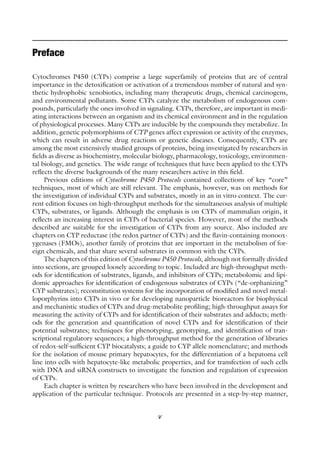
Cytochromes P450 (CYPs)comprise a large superfamily of proteins that are of central
importance in the detoxification or activation of a tremendous number of natural and syn-
thetic hydrophobic xenobiotics, including many therapeutic drugs, chemical carcinogens,
and environmental pollutants. Some CYPs catalyze the metabolism of endogenous com-
pounds, particularly the ones involved in signaling. CYPs, therefore, are important in medi-
ating interactions between an organism and its chemical environment and in the regulation
of physiological processes. Many CYPs are inducible by the compounds they metabolize. In
addition, genetic polymorphisms of CYP genes affect expression or activity of the enzymes,
which can result in adverse drug reactions or genetic diseases. Consequently, CYPs are
among the most extensively studied groups of proteins, being investigated by researchers in
fields as diverse as biochemistry, molecular biology, pharmacology, toxicology, environmen-
tal biology, and genetics. The wide range of techniques that have been applied to the CYPs
reflects the diverse backgrounds of the many researchers active in this field.
Previous editions of Cytochrome P450 Protocols contained collections of key “core”
techniques, most of which are still relevant. The emphasis, however, was on methods for
the investigation of individual CYPs and substrates, mostly in an in vitro context. The cur-
rent edition focuses on high-throughput methods for the simultaneous analysis of multiple
CYPs, substrates, or ligands. Although the emphasis is on CYPs of mammalian origin, it
reflects an increasing interest in CYPs of bacterial species. However, most of the methods
described are suitable for the investigation of CYPs from any source. Also included are
chapters on CYP reductase (the redox partner of CYPs) and the flavin-containing monoox-
ygenases (FMOs), another family of proteins that are important in the metabolism of for-
eign chemicals, and that share several substrates in common with the CYPs.
The chapters of this edition of Cytochrome P450 Protocols, although not formally divided
into sections, are grouped loosely according to topic. Included are high-throughput meth-
ods for identification of substrates, ligands, and inhibitors of CYPs; metabolomic and lipi-
domic approaches for identification of endogenous substrates of CYPs (“de-orphanizing”
CYP substrates); reconstitution systems for the incorporation of modified and novel metal-
loporphyrins into CYPs in vivo or for developing nanoparticle bioreactors for biophysical
and mechanistic studies of CYPs and drug-metabolite profiling; high-throughput assays for
measuring the activity of CYPs and for identification of their substrates and adducts; meth-
ods for the generation and quantification of novel CYPs and for identification of their
potential substrates; techniques for phenotyping, genotyping, and identification of tran-
scriptional regulatory sequences; a high-throughput method for the generation of libraries
of redox-self-sufficient CYP biocatalysts; a guide to CYP allele nomenclature; and methods
for the isolation of mouse primary hepatocytes, for the differentiation of a hepatoma cell
line into cells with hepatocyte-like metabolic properties, and for transfection of such cells
with DNA and siRNA constructs to investigate the function and regulation of expression
of CYPs.
Each chapter is written by researchers who have been involved in the development and
application of the particular technique. Protocols are presented in a step-by-step manner,
12.
vi
with extensive cross-referencesto notes that highlight critical steps, potential problems, and
alternative methods. We hope that this format will enable researchers who have no previous
knowledge of the technique to understand the basis of the method and to perform it
successfully.
We are extremely grateful to all the authors who contributed so generously to this
volume and to John Walker, the series editor of Methods in Molecular Biology, for his advice
and patience.
London, UK Ian R. Phillips
London, UK Elizabeth A. Shephard
San Francisco, CA, USA Paul R. Ortiz de Montellano
Preface
13.
vii
Contents
Preface. . .. . . . . . . . . . . . . . . . . . . . . . . . . . . . . . . . . . . . . . . . . . . . . . . . . . . . . . . . . . . v
Contributors. . . . . . . . . . . . . . . . . . . . . . . . . . . . . . . . . . . . . . . . . . . . . . . . . . . . . . . . . . ix
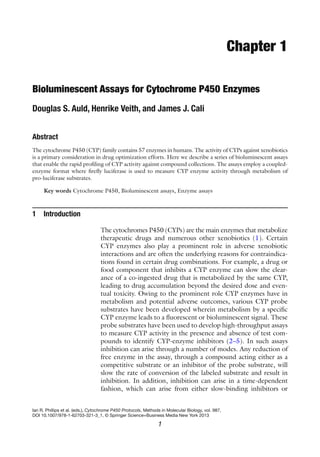
1 Bioluminescent Assays for Cytochrome P450 Enzymes . . . . . . . . . . . . . . . . . . . . . . 1
Douglas S. Auld, Henrike Veith, and James J. Cali
2 Simultaneous Determination of Multiple CYP Inhibition Constants
using a Cocktail-Probe Approach . . . . . . . . . . . . . . . . . . . . . . . . . . . . . . . . . . . . . . 11
Michael Zientek and Kuresh Youdim
3 High-Throughput Mass Spectrometric Cytochrome
P450 Inhibition Screening . . . . . . . . . . . . . . . . . . . . . . . . . . . . . . . . . . . . . . . . . . . 25
Kheng B. Lim, Can C. Ozbal, and Daniel B. Kassel
4 The Synthesis, Characterization, and Application of 13
C-Methyl
Isocyanide as an NMR Probe of Heme Protein Active Sites. . . . . . . . . . . . . . . . . . . 51
Christopher McCullough, Phani Kumar Pullela, Sang-Choul Im,
Lucy Waskell, and Daniel Sem
5 High-Throughput Fluorescence Assay for
Cytochrome P450 Mechanism-Based Inactivators. . . . . . . . . . . . . . . . . . . . . . . . . . 61
Cesar Kenaan, Haoming Zhang, and Paul F. Hollenberg
6 Identification of Endogenous Substrates of Orphan Cytochrome
P450 Enzymes Through the Use of Untargeted Metabolomics Approaches . . . . . . 71
Qian Cheng and F. Peter Guengerich
7 Genetic and Mass Spectrometric Tools for Elucidating
the Physiological Function(s) of Cytochrome P450 Enzymes
from Mycobacterium tuberculosis . . . . . . . . . . . . . . . . . . . . . . . . . . . . . . . . . . . . . . . 79
Hugues Ouellet, Eric D. Chow, Shenheng Guan, Jeffery S. Cox,
Alma L. Burlingame, and Paul R. Ortiz de Montellano
8 An Escherichia coli Expression-Based Approach for Porphyrin
Substitution in Heme Proteins . . . . . . . . . . . . . . . . . . . . . . . . . . . . . . . . . . . . . . . . 95
Michael B. Winter, Joshua J. Woodward, and Michael A. Marletta
9 Expression in Escherichia coli of a Cytochrome P450 Enzyme
with a Cobalt Protoporphyrin IX Prosthetic Group. . . . . . . . . . . . . . . . . . . . . . . . . 107
Wesley E. Straub, Clinton R. Nishida, and Paul R. Ortiz de Montellano
10 Nanodiscs in the Studies of Membrane-Bound Cytochrome
P450 Enzymes . . . . . . . . . . . . . . . . . . . . . . . . . . . . . . . . . . . . . . . . . . . . . . . . . . . . 115
A. Luthra, M. Gregory, Y.V. Grinkova, I.G. Denisov, and S.G. Sligar
11 Rapid LC-MS Drug Metabolite Profiling Using Bioreactor Particles . . . . . . . . . . . . 129
Linlin Zhao, Besnik Bajrami, and James F. Rusling
12 Fluorescence-Based Screening of Cytochrome P450 Activities
in Intact Cells. . . . . . . . . . . . . . . . . . . . . . . . . . . . . . . . . . . . . . . . . . . . . . . . . . . . . 135
M. Teresa Donato and M. José Gómez-Lechón
14.
viii
13 Screening forCytochrome P450 Reactivity with a Reporter Enzyme. . . . . . . . . . . . 149
Kersten S. Rabe and Christof M. Niemeyer
14 High-Throughput Fluorescence Assay of Cytochrome P450 3A4 . . . . . . . . . . . . . . 157
Qian Cheng and F. Peter Guengerich
15 Targeted Protein Capture for Analysis of Electrophile-Protein Adducts . . . . . . . . . . 163
Rebecca E. Connor, Simona G. Codreanu, Lawrence J. Marnett,
and Daniel C. Liebler
16 DNA Shuffling of Cytochrome P450 Enzymes . . . . . . . . . . . . . . . . . . . . . . . . . . . . 177
James B.Y.H. Behrendorff, Wayne A. Johnston,
and Elizabeth M.J. Gillam
17 Measurement of P450 Difference Spectra Using Intact Cells. . . . . . . . . . . . . . . . . . 189
Wayne A. Johnston and Elizabeth M.J. Gillam
18 DNA Shuffling of Cytochromes P450 for Indigoid Pigment Production . . . . . . . . . 205
Nedeljka N. Rosic
19 P450 Oxidoreductase: Genotyping, Expression, Purification of Recombinant
Protein, and Activity Assessments of Wild-Type and Mutant Protein . . . . . . . . . . . . 225
Vishal Agrawal and Walter L. Miller
20 LICRED: A Versatile Drop-In Vector for Rapid Generation
of Redox-Self-Sufficient Cytochromes P450 . . . . . . . . . . . . . . . . . . . . . . . . . . . . . . 239
Federico Sabbadin, Gideon Grogan, and Neil C. Bruce
21 Update on Allele Nomenclature for Human Cytochromes P450 and the
Human Cytochrome P450 Allele (CYP-Allele) Nomenclature Database . . . . . . . . . 251
Sarah C. Sim and Magnus Ingelman-Sundberg
22 Simultaneous In Vivo Phenotyping of CYP Enzymes . . . . . . . . . . . . . . . . . . . . . . . 261
Sussan Ghassabian and Michael Murray
23 Detection of Regulatory Polymorphisms: High-Throughput Capillary
DNase I Footprinting . . . . . . . . . . . . . . . . . . . . . . . . . . . . . . . . . . . . . . . . . . . . . . . 269
Matthew Hancock and Elizabeth A. Shephard
24 Isolation of Mouse Hepatocytes . . . . . . . . . . . . . . . . . . . . . . . . . . . . . . . . . . . . . . . 283
Mina Edwards, Lyndsey Houseman, Ian R. Phillips,
and Elizabeth A. Shephard
25 Highly Efficient SiRNA and Gene Transfer into Hepatocyte-Like
HepaRG Cells and Primary Human Hepatocytes: New Means
for Drug Metabolism and Toxicity Studies . . . . . . . . . . . . . . . . . . . . . . . . . . . . . . . 295
Véronique Laurent, Denise Glaise, Tobias Nübel, David Gilot,
Anne Corlu, and Pascal Loyer
Index. . . . . . . . . . . . . . . . . . . . . . . . . . . . . . . . . . . . . . . . . . . . . . . . . . . . . . . . . . . . . . . 315
Contents
15.
ix
Contributors
VISHAL AGRAWAL •Department of Pediatrics, University of California San Francisco,
San Francisco, CA, USA
DOUGLAS S. AULD • Novartis Institutes for Biomedical Research, Cambridge,
MA, USA
BESNIK BAJRAMI • Department of Chemistry, University of Connecticut, Storrs,
CT, USA
JAMES B.Y.H. BEHRENDORFF • Australian Institute for Bioengineering and
Nanotechnology, University of Queensland, Brisbane, Australia
NEIL C. BRUCE • Department of Biology, York University, York, UK
ALMA L. BURLINGAME • Department of Pharmaceutical Chemistry,
University of California, San Francisco, CA, USA
JAMES J. CALI • Promega Corp., Madison, WI, USA
QIAN CHENG • Department of Biochemistry and Center in Molecular Toxicology,
Vanderbilt University School of Medicine, Nashville, TN, USA
ERIC D. CHOW • Department of Microbiology and Immunology, University
of California, San Francisco, CA, USA
SIMONA G. CODREANU • Department of Biochemistry, Vanderbilt University
School of Medicine, Nashville, TN, USA; Jim Ayers Institute for Precancer Detection
and Diagnosis, Vanderbilt University School of Medicine, Nashville, TN, USA
REBECCA E. CONNOR • Department of Biochemistry, Vanderbilt University
School of Medicine, Nashville, TN, USA
ANNE CORLU • Inserm UMR991 Foie, Métabolismes et Cancer, Hôpital Pontchaillou
and Université de Rennes 1, Rennes, France
JEFFERY S. COX • Department of Microbiology and Immunology,
University of California, San Francisco, CA, USA
PAUL R. ORTIZ DE MONTELLANO • Department of Pharmaceutical Chemistry,
University of California, San Francisco, CA, USA
I.G. DENISOV • Department of Biochemistry, University of Illinois, Urbana, IL, USA
M. TERESA DONATO • Departamento de Bioquímica y Biología Molecular, Universidad
de Valencia, Valencia, Spain; CIBERehd, Fondo de Investigaciones Sanitarias,
Barcelona, Spain
MINA EDWARDS • Institute of Structural and Molecular Biology,
University College London, London, UK
SUSSAN GHASSABIAN • Faculty of Pharmacy, University of Sydney, Sydney, NSW,
Australia; Centre for Integrated Preclinical Drug Development,
University of Queensland, Brisbane, Australia
ELIZABETH M.J. GILLAM • School of Chemistry and Molecular Biosciences,
University of Queensland, Brisbane, Australia
DAVID GILOT • CNRS UMR6061, Institut de Génétique et Développement de Rennes,
Université de Rennes 1, Rennes, France
16.
x Contributors
DENISE GLAISE• Inserm UMR991, Foie, Métabolismes et Cancer, Hôpital Pontchaillou
and Université de Rennes 1, Rennes, France
M. JOSÉ GÓMEZ-LECHÓN • IIS Hospital La Fe, Unidad de Hepatología Experimental,
Valencia, Spain; CIBERehd, Fondo de Investigaciones Sanitarias, Barcelona, Spain
M. GREGORY • Department of Biochemistry, University of Illinois, Urbana, IL, USA
Y.V. GRINKOVA • Department of Biochemistry, University of Illinois, Urbana, IL, USA
GIDEON GROGAN • Department of Biology, York University, York, UK
SHENHENG GUAN • Department of Pharmaceutical Chemistry,
University of California, San Francisco, CA, USA
F. PETER GUENGERICH • Department of Biochemistry and Center in Molecular
Toxicology, Vanderbilt University School of Medicine, Nashville, TN, USA
MATTHEW HANCOCK • Institute of Structural and Molecular Biology, University College
London, London, UK
PAUL F. HOLLENBERG • Medical Sciences Research Building III, Department
of Pharmacology, University of Michigan, Ann Arbor, MI, USA
LYNDSEY HOUSEMAN • Institute of Structural and Molecular Biology, University College
London, London, UK
SANG-CHOUL IM • Department of Anesthesiology, University of Michigan and VA
Medical Center, Ann Arbor, MI, USA
MAGNUS INGELMAN-SUNDBERG • Section for Pharmacogenetics, Department of
Physiology and Pharmacology, Karolinska Institute, Stockholm, Sweden
WAYNE A. JOHNSTON • Institute of Molecular Bioscience, University of Queensland,
Brisbane, Australia
DANIEL B. KASSEL • Takeda San Diego Inc., San Diego, CA, USA
CESAR KENAAN • Medical Sciences Research Building III, Department of Pharmacology,
University of Michigan, Ann Arbor, MI, USA
VÉRONIQUE LAURENT • Inserm U 1078, Génétique Moléculaire et Génétique
Epidémiologique, Hôpital Morvan - CHU de Brest, Brest, France; SynNanoVect
Platform, Brest, France
DANIEL C. LIEBLER • Department of Biochemistry, Vanderbilt University School of
Medicine, Nashville, TN, USA; Jim Ayers Institute for Precancer Detection
and Diagnosis, Vanderbilt University School of Medicine, Nashville, TN, USA
KHENG B. LIM • Takeda San Diego Inc., San Diego, CA, USA
PASCAL LOYER • Inserm UMR991 Foie, Métabolismes et Cancer, Hôpital
Pontchaillou and Université de Rennes 1, Rennes, France; SynNanoVect
Platform, Rennes, France
A. LUTHRA • Department of Biochemistry, University of Illinois, Urbana, IL, USA
MICHAEL A. MARLETTA • Department of Chemistry, The Scripps Research Institute,
La Jolla, USA; Department of Chemistry, Department of Molecular
and Cell Biology, California Institute for Quantitative Biosciences, Division
of Physical Biosciences, Lawrence Berkeley National Laboratory, University
of California, Berkeley, CA, USA
LAWRENCE J. MARNETT • Department of Biochemistry, Vanderbilt University School of
Medicine, Nashville, TN, USA; Jim Ayers Institute for Precancer Detection
and Diagnosis, Vanderbilt University School of Medicine, Nashville, TN, USA
17.
xi
Contributors
CHRISTOPHER MCCULLOUGH •Department of Chemistry, Marquette University,
Milwaukee, WI, USA
WALTER L. MILLER • Department of Pediatrics, University of California San Francisco,
San Francisco, CA, USA
MICHAEL MURRAY • Faculty of Pharmacy, University of Sydney, Sydney, NSW,
Australia
CHRISTOF M. NIEMEYER • Karlsruhe Institute of Technologie (KIT), Institute
for Biological Interfaces (IBG-1), Biomolecular Micr- and Nanostructures,
Eggenstein-Leopoldshafen, Germany
CLINTON R. NISHIDA • Department of Pharmaceutical Chemistry,
University of California, San Francisco, CA, USA
TOBIAS NÜBEL • Lonza Cologne GmbH, Nattermannallee, Koeln, Germany
HUGUES OUELLET • Department of Microbiology, University of Texas, El Paso, TX,
USA
CAN C. OZBAL • Agilent Technologies Inc., Wakefield, MA, USA
IAN R. PHILLIPS • School of Biological and Chemical Sciences, Queen Mary,
University of London, London, UK; Division of Biosciences, University College
London, London, UK
PHANI KUMAR PULLELA • Department of Chemistry, Marquette University,
Milwaukee, WI, USA
KERSTEN S. RABE • Fakultät Chemie, Biologisch-Chemische Mikrostrukturtechnik,
Technische Universität Dortmund, Dortmund, Germany; Division of Chemistry
and Chemical Engineering, California Institute of Technology, Pasadena, CA, USA
NEDELJKA N. ROSIC • School of Biological Sciences, University of Queensland, St. Lucia,
QLD, Australia
JAMES F. RUSLING • Department of Chemistry, University of Connecticut, Storrs, CT,
USA; Department of Cell Biology, University of Connecticut Health Center,
Farmington, CT, USA
FEDERICO SABBADIN • Department of Biology, York University, York, UK
DANIEL SEM • Department of Chemistry, Marquette University, Milwaukee, WI, USA;
Department of Pharmaceutical Sciences, Concordia University of Wisconsin–School of
Pharmacy, Mequon, WI, USA
ELIZABETH A. SHEPHARD • Department of Structural and Molecular Biology, University
College London, London, UK
SARAH C. SIM • Section for Pharmacogenetics, Department of Physiology
and Pharmacology, Karolinska Institute, Stockholm, Sweden
S.G. SLIGAR • Department of Biochemistry, Beckman Institute and School of Molecular
and Cellular Biology, University of Illinois, Urbana, IL, USA
WESLEY E. STRAUB • Life Technologies, San Francisco, CA, USA
HENRIKE VEITH • National Center for Advancing Translational Sciences, National
Institutes of Health, Bethesda, MD, USA
LUCY WASKELL • Department of Anesthesiology, University of Michigan and VA
Medical Center, Ann Arbor, MI, USA
MICHAEL B. WINTER • Department of Chemistry, California Institute
for Quantitative Biosciences, University of California, Berkeley, CA, USA
18.
xii Contributors
JOSHUA J.WOODWARD • Department of Chemistry, California Institute for
Quantitative Biosciences, University of California, Berkeley, CA, USA
KURESH YOUDIM • F. Hoffmann-La Roche AG, Basel, Switzerland
HAOMING ZHANG • Medical Sciences Research Building III, Department
of Pharmacology, University of Michigan, Ann Arbor, MI, USA
LINLIN ZHAO • Department of Chemistry, University of Connecticut, Storrs, CT, USA
MICHAEL ZIENTEK • Pfizer Inc., La Jolla, CA, USA
2 Douglas S.Auld et al.
mechanism-based inhibitors where an intermediate of the CYP
reaction irreversibly inhibits the enzyme.
For construction of assays specific for CYP enzymes, probe
substrates have been developed which are selectivity oxidized by
one or more CYP enzymes leading to production of a detectable
product. Various detection methods have been used including mass
spectrometry, absorbance, radioactivity, fluorescence, and biolumi-
nescence (5). Validation data have been shown demonstrating that
these methods can predict in vivo CYP inhibition (6–8). However,
there are substantial differences among these methods in sensitiv-
ity, scalability, ease of use, and vulnerability to test compound
interference (3, 4). Advantages of bioluminescence assays over
fluorescence assays include increased sensitivity (up to three orders
ofmagnitude),andobviatingtheproblemoffluorescent-compound
interference (8). As well, the use of optimized luciferases and detec-
tion reagents, a necessary coupling enzyme used to read out the
bioluminescent signal, can reduce interference of compounds
acting as direct luciferase inhibitors (3, 9). These advantages posi-
tion bioluminescent CYP assays as a good choice for miniaturized
high-throughput applications of CYP enzymes (3).
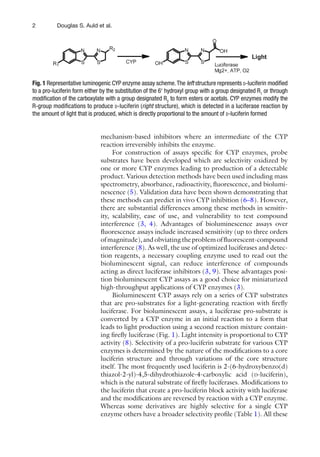
Bioluminescent CYP assays rely on a series of CYP substrates
that are pro-substrates for a light-generating reaction with firefly
luciferase. For bioluminescent assays, a luciferase pro-substrate is
converted by a CYP enzyme in an initial reaction to a form that
leads to light production using a second reaction mixture contain-
ing firefly luciferase (Fig. 1). Light intensity is proportional to CYP
activity (8). Selectivity of a pro-luciferin substrate for various CYP
enzymes is determined by the nature of the modifications to a core
luciferin structure and through variations of the core structure
itself. The most frequently used luciferin is 2-(6-hydroxybenzo(d)
thiazol-2-yl)-4,5-dihydrothiazole-4-carboxylic acid (D-luciferin),
which is the natural substrate of firefly luciferases. Modifications to
the luciferin that create a pro-luciferin block activity with luciferase
and the modifications are reversed by reaction with a CYP enzyme.
Whereas some derivatives are highly selective for a single CYP
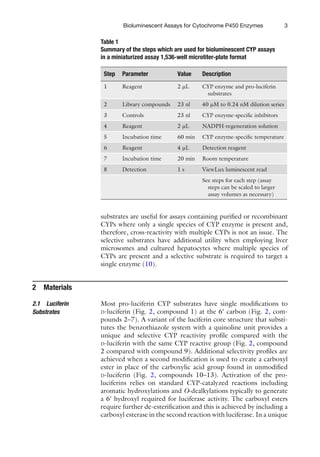
enzyme others have a broader selectivity profile (Table 1). All these
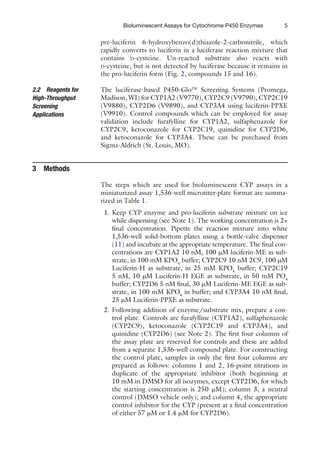
Fig. 1 Representative luminogenic CYP enzyme assay scheme.The left structure represents D-luciferin modified
to a pro-luciferin form either by the substitution of the 6¢ hydroxyl group with a group designated R1
or through
modification of the carboxylate with a group designated R2
to form esters or acetals. CYP enzymes modify the
R-group modifications to produce D-luciferin (right structure), which is detected in a luciferase reaction by
the amount of light that is produced, which is directly proportional to the amount of D-luciferin formed
21.
3
Bioluminescent Assays forCytochrome P450 Enzymes
substrates are useful for assays containing purified or recombinant
CYPs where only a single species of CYP enzyme is present and,
therefore, cross-reactivity with multiple CYPs is not an issue. The
selective substrates have additional utility when employing liver
microsomes and cultured hepatocytes where multiple species of
CYPs are present and a selective substrate is required to target a
single enzyme (10).
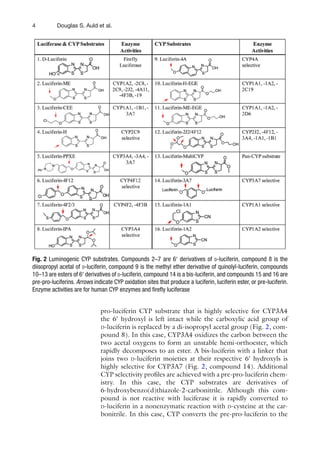
Most pro-luciferin CYP substrates have single modifications to
D-luciferin (Fig. 2, compound 1) at the 6¢ carbon (Fig. 2, com-
pounds 2–7). A variant of the luciferin core structure that substi-
tutes the benzothiazole system with a quinoline unit provides a
unique and selective CYP reactivity profile compared with the
D-luciferin with the same CYP reactive group (Fig. 2, compound
2 compared with compound 9). Additional selectivity profiles are
achieved when a second modification is used to create a carboxyl
ester in place of the carboxylic acid group found in unmodified
D-luciferin (Fig. 2, compounds 10–13). Activation of the pro-
luciferins relies on standard CYP-catalyzed reactions including
aromatic hydroxylations and O-dealkylations typically to generate
a 6¢ hydroxyl required for luciferase activity. The carboxyl esters
require further de-esterification and this is achieved by including a
carboxyl esterase in the second reaction with luciferase. In a unique
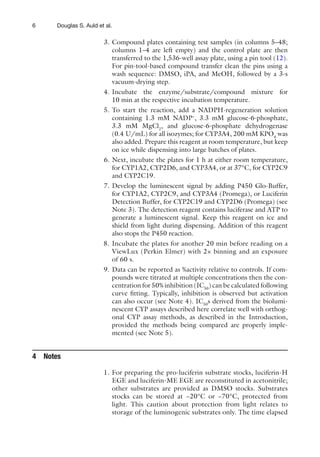
2 Materials
2.1 Luciferin
Substrates
Table 1
Summary of the steps which are used for bioluminescent CYP assays
in a miniaturized assay 1,536-well microtiter-plate format
Step Parameter Value Description
1 Reagent 2 mL CYP enzyme and pro-luciferin
substrates
2 Library compounds 23 nl 40 mM to 0.24 nM dilution series
3 Controls 23 nl CYP enzyme-specific inhibitors
4 Reagent 2 mL NADPH-regeneration solution
5 Incubation time 60 min CYP enzyme-specific temperature
6 Reagent 4 mL Detection reagent
7 Incubation time 20 min Room temperature
8 Detection 1 s ViewLux luminescent read
See steps for each step (assay
steps can be scaled to larger
assay volumes as necessary)
22.
4 Douglas S.Auld et al.
pro-luciferin CYP substrate that is highly selective for CYP3A4
the 6¢ hydroxyl is left intact while the carboxylic acid group of
D-luciferin is replaced by a di-isopropyl acetal group (Fig. 2, com-
pound 8). In this case, CYP3A4 oxidizes the carbon between the
two acetal oxygens to form an unstable hemi-orthoester, which
rapidly decomposes to an ester. A bis-luciferin with a linker that
joins two D-luciferin moieties at their respective 6¢ hydroxyls is
highly selective for CYP3A7 (Fig. 2, compound 14). Additional
CYP selectivity profiles are achieved with a pre-pro-luciferin chem-
istry. In this case, the CYP substrates are derivatives of
6-hydroxybenzo(d)thiazole-2-carbonitrile. Although this com-
pound is not reactive with luciferase it is rapidly converted to
D-luciferin in a nonenzymatic reaction with D-cysteine at the car-
bonitrile. In this case, CYP converts the pre-pro-luciferin to the
Fig. 2 Luminogenic CYP substrates. Compounds 2–7 are 6¢ derivatives of D-luciferin, compound 8 is the
diisopropyl acetal of D-luciferin, compound 9 is the methyl ether derivative of quinolyl-luciferin, compounds
10–13 are esters of 6¢ derivatives of D-luciferin, compound 14 is a bis-luciferin, and compounds 15 and 16 are
pre-pro-luciferins. Arrows indicate CYP oxidation sites that produce a luciferin, luciferin ester, or pre-luciferin.
Enzyme activities are for human CYP enzymes and firefly luciferase
23.
5
Bioluminescent Assays forCytochrome P450 Enzymes
pre-luciferin 6-hydroxybenzo(d)thiazole-2-carbonitrile, which
rapidly converts to luciferin in a luciferase reaction mixture that
contains D-cysteine. Un-reacted substrate also reacts with
D-cysteine, but is not detected by luciferase because it remains in
the pro-luciferin form (Fig. 2, compounds 15 and 16).
The luciferase-based P450-Glo™ Screening Systems (Promega,
Madison, WI) for CYP1A2 (V9770), CYP2C9 (V9790), CYP2C19
(V9880), CYP2D6 (V9890), and CYP3A4 using luciferin-PPXE
(V9910). Control compounds which can be employed for assay
validation include furafylline for CYP1A2, sulfaphenazole for
CYP2C9, ketoconazole for CYP2C19, quinidine for CYP2D6,
and ketoconazole for CYP3A4. These can be purchased from
Sigma-Aldrich (St. Louis, MO).
The steps which are used for bioluminescent CYP assays in a
miniaturized assay 1,536-well microtiter-plate format are summa-
rized in Table 1.
1. Keep CYP enzyme and pro-luciferin substrate mixture on ice
while dispensing (see Note 1). The working concentration is 2×
final concentration. Pipette the reaction mixture into white
1,536-well solid-bottom plates using a bottle-valve dispenser
(11) and incubate at the appropriate temperature. The final con-
centrations are CYP1A2 10 nM, 100 mM luciferin-ME as sub-
strate, in 100 mM KPO4
buffer; CYP2C9 10 nM 2C9, 100 mM
Luciferin-H as substrate, in 25 mM KPO4
buffer; CYP2C19
5 nM, 10 mM Luciferin-H EGE as substrate, in 50 mM PO4
buffer; CYP2D6 5 nM final, 30 mM Luciferin-ME EGE as sub-
strate, in 100 mM KPO4
in buffer; and CYP3A4 10 nM final,
25 mM Luciferin-PPXE as substrate.
2. Following addition of enzyme/substrate mix, prepare a con-
trol plate. Controls are furafylline (CYP1A2), sulfaphenazole
(CYP2C9), ketoconazole (CYP2C19 and CYP3A4), and
quinidine (CYP2D6) (see Note 2). The first four columns of
the assay plate are reserved for controls and these are added
from a separate 1,536-well compound plate. For constructing
the control plate, samples in only the first four columns are
prepared as follows: columns 1 and 2, 16-point titrations in
duplicate of the appropriate inhibitor (both beginning at
10 mM in DMSO for all isozymes, except CYP2D6, for which
the starting concentration is 250 mM); column 3, a neutral
control (DMSO vehicle only); and column 4, the appropriate
control inhibitor for the CYP (present at a final concentration
of either 57 mM or 1.4 mM for CYP2D6).
2.2 Reagents for
High-Throughput
Screening
Applications
3 Methods
24.
6 Douglas S.Auld et al.
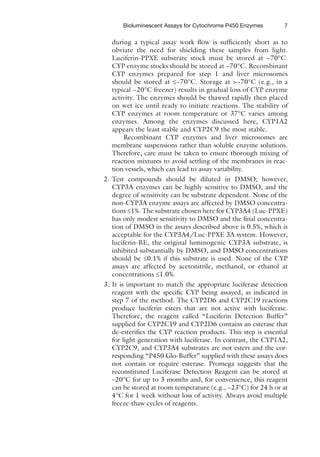
3. Compound plates containing test samples (in columns 5–48;
columns 1–4 are left empty) and the control plate are then
transferred to the 1,536-well assay plate, using a pin tool (12).
For pin-tool-based compound transfer clean the pins using a
wash sequence: DMSO, iPA, and MeOH, followed by a 3-s
vacuum-drying step.
4. Incubate the enzyme/substrate/compound mixture for
10 min at the respective incubation temperature.
5. To start the reaction, add a NADPH-regeneration solution
containing 1.3 mM NADP+
, 3.3 mM glucose-6-phosphate,
3.3 mM MgCl2
, and glucose-6-phosphate dehydrogenase
(0.4 U/mL) for all isozymes; for CYP3A4, 200 mM KPO4
was
also added. Prepare this reagent at room temperature, but keep
on ice while dispensing into large batches of plates.
6. Next, incubate the plates for 1 h at either room temperature,
for CYP1A2, CYP2D6, and CYP3A4, or at 37°C, for CYP2C9
and CYP2C19.
7. Develop the luminescent signal by adding P450 Glo-Buffer,
for CYP1A2, CYP2C9, and CYP3A4 (Promega), or Luciferin
Detection Buffer, for CYP2C19 and CYP2D6 (Promega) (see
Note 3). The detection reagent contains luciferase and ATP to
generate a luminescent signal. Keep this reagent on ice and
shield from light during dispensing. Addition of this reagent
also stops the P450 reaction.
8. Incubate the plates for another 20 min before reading on a
ViewLux (Perkin Elmer) with 2× binning and an exposure
of 60 s.
9. Data can be reported as %activity relative to controls. If com-
pounds were titrated at multiple concentrations then the con-
centration for 50% inhibition (IC50
) can be calculated following
curve fitting. Typically, inhibition is observed but activation
can also occur (see Note 4). IC50
s derived from the biolumi-
nescent CYP assays described here correlate well with orthog-
onal CYP assay methods, as described in the Introduction,
provided the methods being compared are properly imple-
mented (see Note 5).
1. For preparing the pro-luciferin substrate stocks, luciferin-H
EGE and luciferin-ME EGE are reconstituted in acetonitrile;
other substrates are provided as DMSO stocks. Substrates
stocks can be stored at −20°C or −70°C, protected from
light. This caution about protection from light relates to
storage of the luminogenic substrates only. The time elapsed
4 Notes
25.
7
Bioluminescent Assays forCytochrome P450 Enzymes
during a typical assay work flow is sufficiently short as to
obviate the need for shielding these samples from light.
Luciferin-PPXE substrate stock must be stored at −70°C.
CYP enzyme stocks should be stored at −70°C. Recombinant
CYP enzymes prepared for step 1 and liver microsomes
should be stored at £−70°C. Storage at >−70°C (e.g., in a
typical −20°C freezer) results in gradual loss of CYP enzyme
activity. The enzymes should be thawed rapidly then placed
on wet ice until ready to initiate reactions. The stability of
CYP enzymes at room temperature or 37°C varies among
enzymes. Among the enzymes discussed here, CYP1A2
appears the least stable and CYP2C9 the most stable.
Recombinant CYP enzymes and liver microsomes are
membrane suspensions rather than soluble enzyme solutions.
Therefore, care must be taken to ensure thorough mixing of
reaction mixtures to avoid settling of the membranes in reac-
tion vessels, which can lead to assay variability.
2. Test compounds should be diluted in DMSO; however,
CYP3A enzymes can be highly sensitive to DMSO, and the
degree of sensitivity can be substrate dependent. None of the
non-CYP3A enzyme assays are affected by DMSO concentra-
tions £1%. The substrate chosen here for CYP3A4 (Luc-PPXE)
has only modest sensitivity to DMSO and the final concentra-
tion of DMSO in the assays described above is 0.5%, which is
acceptable for the CYP3A4/Luc-PPXE 3A system. However,
luciferin-BE, the original luminogenic CYP3A substrate, is
inhibited substantially by DMSO, and DMSO concentrations
should be £0.1% if this substrate is used. None of the CYP
assays are affected by acetonitrile, methanol, or ethanol at
concentrations £1.0%.
3. It is important to match the appropriate luciferase detection
reagent with the specific CYP being assayed, as indicated in
step 7 of the method. The CYP2D6 and CYP2C19 reactions
produce luciferin esters that are not active with luciferase.
Therefore, the reagent called “Luciferin Detection Buffer”
supplied for CYP2C19 and CYP2D6 contains an esterase that
de-esterifies the CYP reaction products. This step is essential
for light generation with luciferase. In contrast, the CYP1A2,
CYP2C9, and CYP3A4 substrates are not esters and the cor-
responding “P450 Glo-Buffer” supplied with these assays does
not contain or require esterase. Promega suggests that the
reconstituted Luciferase Detection Reagent can be stored at
–20°C for up to 3 months and, for convenience, this reagent
can be stored at room temperature (e.g., ~23°C) for 24 h or at
4°C for 1 week without loss of activity. Always avoid multiple
freeze-thaw cycles of reagents.
This ebook isfor the use of anyone anywhere in the United
States and most other parts of the world at no cost and with
almost no restrictions whatsoever. You may copy it, give it away
or re-use it under the terms of the Project Gutenberg License
included with this ebook or online at www.gutenberg.org. If you
are not located in the United States, you will have to check the
laws of the country where you are located before using this
eBook.
Title: Graham's Magazine, Vol. XXI, No. 6, December 1842
Author: Various
Editor: George R. Graham
Rufus W. Griswold
Release date: May 8, 2022 [eBook #68027]
Most recently updated: November 24, 2022
Language: English
Original publication: United States: George R. Graham, 1842
Credits: Mardi Desjardins & the online Distributed Proofreaders
Canada team at https://www.pgdpcanada.net from
page images generously made available by the
Internet Archive
*** START OF THE PROJECT GUTENBERG EBOOK GRAHAM'S
MAGAZINE, VOL. XXI, NO. 6, DECEMBER 1842 ***
31.
GRAHAM’S MAGAZINE.
Vol. XXI.December, 1842 No. 6.
Contents
Fiction and Literature
Richard Dale
The Widow of Newbury
Malina Gray
Truth
The Persecutor’s Daughter
A Race for a Sweetheart
Harry Cavendish
The Ladies’ Library
The Hasty Marriage
Review Of New Books
Editor’s Table
Poetry
The Serenade
Sonnets
Sonnet
Noon
True Affection
The Farewell
The Holynights
The Pastor’s Visit
To the Night-Wind in Autumn
Transcriber’s Notes can be found at the end of this eBook.
32.
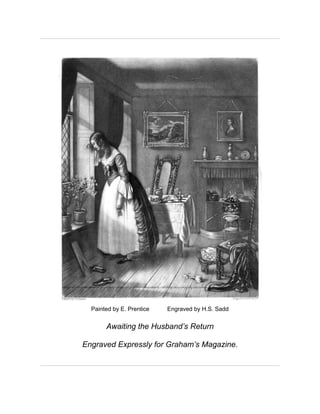
Painted by E.Prentice Engraved by H.S. Sadd
Awaiting the Husband’s Return
Engraved Expressly for Graham’s Magazine.
33.
GRAHAM’S MAGAZINE.
Vol. XXI.PHILADELPHIA: DECEMBER, 1842.
No. 6.
RICHARD DALE.
———
BY J. FENIMORE COOPER, AUTHOR OF “THE SPY,” “THE PIONEERS,” ETC.
———
Among the many brave men who early contributed to render the
navy of the republic popular and respectable, the gallant seaman
whose name is placed at the head of this article is entitled to a
conspicuous place; equally on account of his services, his
professional skill, and his personal merit. Although his connection
with the marine, created under the constitution of 1789, was of short
continuance, it left a durable impression on the service; and, if we
look back to the dark period of the Revolution, we find him
contending in some of the fiercest combats of the period, always with
heroism, and not unfrequently with success. Circumstances, too,
have connected his renown with one of the most remarkable naval
battles on record; a distinction of itself which fully entitles him to a
high place among those who have fought and bled for the
independence of their country, in stations of subordinate authority.
Richard Dale was born in the colony of Virginia, on the 6th
November, 1756. His birthplace was in the county of Norfolk, and not
distant from the well known port of the same name. His parents were
native Americans, of respectable standing, though of rather reduced
circumstances. His father, dying early, left a widow with five children,
of whom the subject of this memoir was the eldest. Some time after
34.
the death ofhis father, his mother contracted a second marriage with
a gentleman of the name of Cooper, among the issue of which were
two well known ship-masters of Philadelphia.
Young Dale manifested an inclination for the sea at a very early
period of life. The distrust of a parental control that has no foundation
in nature, and which is apt to be regarded with jealousy, stimulated if
it did not quicken this desire, and we find him at the tender age of
twelve, or in 1768, making a voyage between Norfolk and Liverpool,
in a vessel commanded by one of his own uncles. On his return
home, he appears to have passed nearly a twelve-month on shore;
but his desire to become a sailor still continuing, in the spring of
1770 he was regularly apprenticed to a respectable merchant and
ship-owner, of the borough of Norfolk, named Newton. From this
moment his fortune in life was cast, and he continued devotedly
employed in the profession until his enterprise, prudence and
gallantry enabled him finally to retire with credit, an unblemished
name, and a competency.
During his apprenticeship, Dale appears to have been, most of
the time, employed in the West India trade. Every sailor has his
chances and hair-breadth escapes, and our young mariner met with
two, at that period of his life, which may be thought worthy of notice.
On one occasion he fell from the spars stowed on the belfry into the
vessel’s hold, hitting the kelson, a distance of near twenty feet;
escaping, however, without material injury. A much greater risk was
incurred on another. While the vessel to which he belonged was
running off the wind, with a stiff breeze, Dale was accidentally
knocked overboard by the jib sheets, and was not picked up without
great difficulty. He was an hour in the water, sustaining himself by
swimming, and he ever spoke of the incident as one of more peril
than any other in a perilous career.
When nineteen, or in 1775, Dale had risen to the station of chief
mate on board a large brig belonging to his owner. In this situation
he appears to have remained industriously engaged during the few
first months of the struggle for independence; the active warfare not
having yet extended itself as far south as his part of the country.
Early in 1776, however, the aspect of things began to change, and it
35.
is probable thatthe interruption to commerce rendered him the
master of his own movements.
Virginia, in common with most of the larger and more maritime
colonies, had a sort of marine of its own; more especially anterior to
the Declaration of Independence. It consisted principally of bay craft,
and was employed in the extensive estuaries and rivers of that
commonwealth. On board of one of these light cruisers Dale was
entered as a lieutenant, in the early part of the memorable year
1776. While in this service, he was sent a short distance for some
guns, in a river craft; but falling in with a tender of the Liverpool
frigate, which ship was then cruising on the Cape Henry station, he
was captured and carried into Norfolk. These tenders were usually
smart little cruisers, another, belonging to the same frigate, having
been taken shortly before, by the U. S. brig Lexington, after a sharp
and bloody conflict. Resistance in the case of Dale was
consequently out of the question, his capture having been altogether
a matter of course.
On reaching Norfolk, our young officer was thrown on board a
prison-ship. Here he found himself in the midst of those whom it was
the fashion to call “loyal subjects.” Many of them were his old school-
mates and friends. Among the latter was a young man of the name
of Bridges Gutteridge, a sailor like himself, and one who possessed
his entire confidence. Mr. Gutteridge, who it is believed subsequently
took part with his countrymen himself, was then employed by the
British, in the waters of the Chesapeake, actually commanding a
tender in their service. The quarrel was still recent; and honorable,
as well as honest men, under the opinions which prevailed in that
day, might well be divided as to its merits. Mr. Gutteridge had
persuaded himself he was pursuing the proper course. Entertaining
such opinions, he earnestly set about the attempt of making a
convert of his captured friend. The usual arguments, touching the
sacred rights of the king—himself merely a legalized usurper, by the
way, if any validity is to be given to the claims of hereditary right to
the crown—and the desperate nature of the “rebel cause,” were
freely and strenuously used, until Dale began to waver in his faith. In
the end, he yielded and consented to accompany his friend in a
cruise against the vessels of the state. This occurred in the month of
36.
May, and, hostilitiesbeginning now to be active, the tender soon fell
in with a party of Americans, in some pilot boats, that were employed
in the Rappahannock. A warm engagement ensued, in which the
tender was compelled to run, after meeting with a heavy loss. It was
a rude initiation into the mysteries of war, the fighting being of a
desperate, and almost of a personal character. This was one of
those combats that often occurred about this period, and in those
waters, most of them being close and sanguinary.
In this affair, Dale received a severe wound, having been hit in
the head by a musket ball; with this wound he was confined several
weeks at Norfolk, during which time he had abundance of leisure to
reflect on the false step into which he had been persuaded, and to
form certain healthful resolutions for the future. To use his own
words, in speaking of this error of his early life, he determined “never
again to put himself in the way of the bullets of his own country.” This
resolution, however, it was necessary to conceal, if he would escape
the horrors of a prison-ship, and he “bided his time,” fully determined
to take service again under the American flag, at the first fitting
opportunity.
In the peculiar state of the two countries at the time, and with the
doubtful and contested morality of the misunderstanding, there was
nothing extraordinary in this incident. Similar circumstances occurred
to many men, who, with the best intentions and purest motives, saw,
or fancied they saw, reasons for changing sides in what, in their
eyes, was strictly a family quarrel. In the case of Dale, however, the
feature most worthy of comment was the singleness of mind and
simple integrity with which he used to confess his own error, together
with the manner in which he finally became a convert to the true
political faith. No narrative of the life of this respectable seaman
would be complete, without including this temporary wavering of
purpose; nor would any delineation of his character be just, that did
not point out the candor and sincerity with which he, in after life,
admitted his fault.
Dale was only in his twentieth year when he received this
instructive lesson from the “bullets of his countrymen.” From that
time, he took good care not to place himself again in their way,
37.
going, in Juneor July, to Bermuda, on a more peaceable expedition,
in company with William Gutteridge, a relative of his beguiling friend.
On the return passage, the vessel was captured by the Lexington,
the brig just mentioned, then a successful cruiser, under the orders
of Capt. John Barry; an officer who subsequently died at the head of
the service. This occurred just after the Declaration of
Independence, and Dale immediately offered himself as a volunteer
under the national flag. He was received and rated as a midshipman
within a few hours of his capture. This was the commencement of
Dale’s service in the regular navy of his native country. It was also
the commencement of his acquaintance with the distinguished
commander of the Lexington, whose friendship and respect he
enjoyed down to the day of the latter’s death. While the brig was out,
our midshipman had another narrow escape from death, having,
together with several others, been struck senseless by lightning
during a severe thunder storm.
Barry made the capture just mentioned near the end of his cruise,
and he soon after went into Philadelphia, which place Dale now saw
for the first time. Here Barry left the Lexington to take command of
the Effingham 28, a ship that never got to sea, leaving our new
midshipman in the brig. Capt. Hallock was Barry’s successor, and he
soon rated Dale, by this time an active and skilful seaman, a
master’s mate. Early in the autumn, the Lexington sailed for Cape
François, on special duty. On her return, in the month of December,
she fell in with the Pearl frigate,[1]
and was captured without
resistance, carrying an armament of only a few fours.
As it was blowing very fresh at the moment this capture was
made, the Pearl took out of the prize four or five officers, threw a
small crew on board, and directed the brig to follow her. By some
accounts Dale was left in the Lexington, while by others he was not.
A succinct history of the events of his life, written by a connection
under his own eye, and which is now before us, gives the latter
version of the affair, and is probably the true one. At all events, the
remaining officers and crew of the Lexington rose upon the captors
in the course of the night, retook the brig, and carried her into
Baltimore.[2]
38.
The English landedseveral of their prisoners on Cape Henlopen,
in January, 1777, under some arrangement that cannot now be
explained, though probably it was connected with an exchange for
the men taken and carried away in the prize. Among these was Dale,
who made the best of his way to Philadelphia, when he received
orders to proceed to Baltimore; which he obeyed, and rejoined his
brig, the command of which had now been transferred to Capt.
Henry Johnston.
The next service on which the Lexington was employed was in
the European seas. In March, she sailed from Baltimore for
Bordeaux, with despatches. On her arrival, this brig was attached to
a small squadron under the orders of Capt. Lambert Wickes, who
was in the Reprisal 16, having under his command also the Dolphin
10, Capt. Samuel Nicholson. This force of little vessels accomplished
a bold and destructive cruise, making the entire circuit of Ireland,
though it was eventually chased into a French port by a line-of-battle
ship. Its object was the interception of certain linen-ships, which it
missed; its success, however, in the main, was such as to excite
great alarm among the English merchants, and to produce warm
remonstrances to France, from their government.
At this time France was not at war with England, although she
secretly favored and aided the cause of the revolted colonies. The
appearance of American cruisers in the narrow seas, however, gave
rise to so many complaints, as to induce the French government, in
preference to pushing matters to extremities, temporarily to
sequester the vessels. The Lexington was included in this measure,
having been detained in port more than two months; or, until security
was given that she would quit the European seas. This was done,
and the brig got to sea again on the 18th September, 1777.[3]
It is probable that the recent difficulties had some effect on the
amount of the military stores on board all three of the American
vessels. At all events, it is certain that the Lexington sailed with a
short supply of both powder and shot, particularly of the latter. The
very next day she made an English cutter lying-to, which was
approached with a confidence that could only have proceeded from
a mistake as to her character. This cutter proved to be a man-of-war,
39.
called the Alert,commanded by Lieutenant, afterward Admiral
Bazely, having a strong crew on board, and an armament of ten
sixes.
In the action that ensued, and which was particularly well fought
on the part of the enemy, the Americans were, in a measure, taken
by surprise. So little were the latter prepared for the conflict, that not
a match was ready when the engagement commenced, and several
broadsides were fired by discharging muskets at the vents of the
guns. The firing killed the wind, and there being considerable sea on,
the engagement became very protracted, during which the Lexington
expended most of her ammunition.
After a cannonading of two hours, believing his antagonist to be
too much crippled to follow, and aware of his own inability to
continue the action much longer, Capt. Johnston made sail, and left
the cutter, under favor of a breeze that just then sprung up. The
Lexington left the Alert rapidly at first, but the latter having bent new
sails, and being the faster vessel, in the course of three or four hours
succeeded in getting alongside again, and of renewing the
engagement. This second struggle lasted an hour, the fighting being
principally on one side. After the Lexington had thrown her last shot,
had broken up and used all the iron that could be made available as
substitutes, and had three of her officers and several of her men
slain, besides many wounded, Capt. Johnston struck his colors. The
first lieutenant, marine officer, and master of the Lexington were
among the slain.
By this accident Dale became a prisoner for the third time. This
occurred when he wanted just fifty days of being twenty-one years
old. On this occasion, however, he escaped unhurt, though the
combat had been both fierce and sanguinary. The prize was taken
into Plymouth, and her officers, after undergoing a severe
examination, in order to ascertain their birthplaces, were all thrown
into Mill Prison, on a charge of high treason. Here they found the
common men; the whole being doomed to a rigorous and painful
confinement.
Either from policy or cupidity, the treatment received by the
Americans, in this particular prison, was of a cruel and oppressive
40.
character. There isno apology for excessive rigor, or, indeed, for any
constraint beyond that which is necessary to security, toward an
uncondemned man. Viewed as mere prisoners of war, the
Americans might claim the usual indulgence; viewed as subjects still
to be tried, they were rightfully included in that healthful maxim of the
law, which assumes that all are innocent until they are proved to be
guilty. So severe were the privations of the Americans on this
occasion, however, that, in pure hunger, they caught a stray dog one
day, skinned, cooked and ate him, to satisfy their cravings for food.
Their situation at length attracted the attention of the liberal;
statements of their wants were laid before the public, and an appeal
was made to the humanity of the English nation. This is always an
efficient mode of obtaining assistance, and the large sum of sixteen
thousand pounds was soon raised; thereby relieving the wants of the
sufferers, and effectually effacing the stain from the national
escutcheon; by demonstrating that the sufferers found a generous
sympathy in the breasts of the public. But man requires more than
food and warmth. Although suffering no longer from actual want and
brutal maltreatment, Dale and his companions pined for liberty—to
be once more fighting the battles of their country. Seeing no hopes of
an exchange, a large party of the prisoners determined to make an
attempt at escape. A suitable place was selected, and a hole under a
wall was commenced. The work required secrecy and time. The
earth was removed, little by little, in the pockets of the captives, care
being had to conceal the place, until a hole of sufficient size was
made to permit the body of a man to pass through. It was a tedious
process, for the only opportunity which occurred to empty their
pockets, was while the Americans were exercising on the walls of
their prison, for a short period of each day. By patience and
perseverance they accomplished their purpose, however, every hour
dreading exposure and defeat.
When all was ready, Capt. Johnston, most of his officers, and
several of his crew, or, as many as were in the secret, passed
through the hole, and escaped. This was in February, 1778. The
party wandered about the country in company, and by night, for more
than a week; suffering all sorts of privations, until it was resolved to
take the wiser course of separating. Dale, accompanied by one
41.
other, found hisway to London, hotly pursued. At one time the two
lay concealed under some straw in an out-house, while the premises
were searched by those who were in quest of them. On reaching
London, Dale and his companion immediately got on board a vessel
about to sail for Dunkirk. A press-gang unluckily took this craft in its
rounds, and suspecting the true objects of the fugitives, they were
arrested, and, their characters being ascertained, they were sent
back to Mill Prison in disgrace.
This was the commencement of a captivity far more tedious than
the former. In the first place they were condemned to forty days’
confinement in the black hole, as the punishment for the late escape;
and, released from this durance, they were deprived of many of their
former indulgences. Dale himself took his revenge in singing “rebel
songs,” and paid a second visit to the black hole, as the penalty. This
state of things, with alternations of favor and punishment, continued
quite a year, when Dale, singly, succeeded in again effecting his
great object of getting free.
The mode in which this second escape was made is known, but
the manner by which he procured the means he refused to his dying
day to disclose. At all events, he obtained a full suit of British
uniform, attired in which, and seizing a favorable moment, he boldly
walked past all the sentinels, and got off. That some one was
connected with his escape who might suffer by his revelations is
almost certain; and it is a trait in his character worthy of notice, that
he kept this secret, with scrupulous fidelity, for forty-seven years. It is
not known that he ever divulged it even to any individual of his own
family.
Rendered wary by experience, Dale now proceeded with great
address and caution. He probably had money, as well as clothes. At
all events, he went to London, found means to procure a passport,
and left the country for France, unsuspected and undetected. On
reaching a friendly soil, he hastened to l’Orient, and joined the force
then equipping under Paul Jones, in his old rank of a master’s mate.
Here he was actively employed for some months, affording the
commodore an opportunity to ascertain his true merits, when they
met with something like their just reward. As Dale was now near
42.
twenty-three, and anaccomplished seaman, Jones, after trying
several less competent persons, procured a commission for him
from the commissioners, and made him the first lieutenant of his own
ship, the justly celebrated Bon Homme Richard.
It is not our intention, in this article, to enter any farther into the
incidents of this well known cruise, than is necessary to complete the
present subject. Dale does not appear in any prominent situation,
though always discharging the duties of his responsible station, with
skill and credit, until the squadron appeared off Leith, with the
intention of seizing that town—the port of Edinburgh—and of laying it
under contribution. On this occasion, our lieutenant was selected to
command the boats that were to land, a high compliment to so
young a man, as coming from one of the character of Paul Jones.
Every thing was ready, Dale had received his final orders, and was in
the very act of proceeding to the ship’s side to enter his boat, when a
heavy squall struck the vessels, and induced an order for the men to
come on deck, and assist in shortening sail. The vessels were
compelled to bear up before it, to save their spars; this carried them
out of the firth; and, a gale succeeding, the enterprise was
necessarily abandoned. This gale proved so heavy, that one of the
prizes actually foundered.
This attempt of Jones, while it is admitted to have greatly alarmed
the coast, has often been pronounced rash and inconsiderate. Such
was not the opinion of Dale. A man of singular moderation in his
modes of thinking, and totally without bravado, it was his conviction
that the effort would have been crowned with success. He assured
the writer, years after the occurrence, that he was about to embark in
the expedition with feelings of high confidence, and that he believed
nothing but the inopportune intervention of the squall stood between
Jones and a triumphant coup de main.
A few days later, Jones made a secret proposal to his officers,
which some affirm was to burn the shipping at North Shields, but
which the commanders of two of his vessels strenuously opposed, in
consequence of which the project was abandoned. The commodore
himself, in speaking of the manner in which this and other similar
propositions were received by his subordinates, extolled the ardor
43.
invariably manifested bythe young men, among whom Dale was one
of the foremost. Had it rested with them, the attempts at least would
all have been made.
On the 19th September occurred the celebrated battle between
the Serapis and the Bon Homme Richard. As the proper place to
enter fully into the details of that murderous combat will be in the
biography of Jones, we shall confine ourselves at present to
incidents with which the subject of this memoir was more
immediately connected.
The Bon Homme Richard had finally sailed on this cruise with
only two proper sea-lieutenants on board her. There was a third
officer of the name of Lunt, who has been indifferently called a
lieutenant and the sailing-master, but who properly filled the latter
station. This gentleman had separated from the ship in a fog, on the
coast of Ireland, while in the pursuit of some deserters, and never
rejoined the squadron. Another person of the same name, and
believed to be the brother of the master, was the second lieutenant.
He was sent in a pilot-boat, accompanied by a midshipman and
several men, to capture a vessel in sight, before Jones made the
Baltic fleet coming round Flamborough Head. This party was not
able to return to the Bon Homme Richard, until after the battle had
terminated. In consequence of these two circumstances, each so
novel in itself, the American frigate fought this bloody and arduous
combat with only one officer on board her, of the rank of a sea-
lieutenant, who was Dale. This is the reason why the latter is so
often mentioned as the lieutenant of the Bon Homme Richard, during
that memorable fight. The fact rendered his duties more arduous and
diversified, and entitles him to the greater credit for their proper
performance.
Dale was stationed on the gun-deck, where of course he
commanded in chief, though it appears that his proper personal
division was the forward guns. Until the ships got foul of each other,
this brought him particularly into the hottest of the work; the Serapis
keeping much on the bows, or ahead of the Bon Homme Richard. It
is known that Jones was much pleased with his deportment, which,
in truth, was every way worthy of his own. When the alarm was given
44.
that the shipwas sinking, Dale went below himself to ascertain the
real state of the water, and his confident and fearless report cheered
the men to renewed exertions. Shortly after, the supply of powder
was stopped, when our lieutenant again quitted his quarters to
inquire into the cause. On reaching the magazine passage he was
told by the sentinels that they had closed the ingress, on account of
a great number of strange and foreign faces that they saw around
them. On further inquiry, Dale discovered that the master at arms, of
his own head, had let loose all the prisoners—more than a hundred
in number—under the belief that the ship was sinking. Dale soon
saw the danger which might ensue, but finding the English much
alarmed at the supposed condition of the ship, he succeeded in
mustering them, and setting them at work at the pumps, where, by
their exertions, they probably prevented the apprehended calamity.
For some time, at the close of the action, all his guns being rendered
useless, Dale was employed principally in this important service.
There is no question that without some such succor, the Richard
would have gone down much earlier than she did. It is a singular
feature of this every-way extraordinary battle, that here were
Englishmen, zealously employed in aiding the efforts of their
enemies, under the cool control of a collected and observant officer.
At length the cheerful intelligence was received that the enemy
had struck. Dale went on deck, and immediately demanded Jones’
permission to take possession of the prize. It was granted, and had
he never manifested any other act of personal intrepidity, his
promptitude on this occasion, and the manner in which he went to
work, to attain his purpose, would have shown him to be a man
above personal considerations, when duty or honor pointed out his
course. The main-yard of the Serapis was hanging a-cock-bill, over
the side of the American ship. The brace was shot away, and the
pendant hung within reach. Seizing the latter, Dale literally swung
himself off, and alighted alone on the quarter-deck of the Serapis.
Here he found no one but the brave Pierson, who had struck his own
flag; but the men below were still ignorant of the act. We may form
an opinion of the risk that the young man ran, in thus boarding his
enemy at night, and in the confusion of such a combat, for the
English were still firing below, by the fact that Mr. Mayrant, a young
45.
man of SouthCarolina, and a midshipman of the Bon Homme
Richard, who led a party after the lieutenant, was actually run
through the thigh by a boarding pike, and by the hands of a man in
the waist below.
The first act of Dale, on getting on the quarter deck of the
Serapis, was to direct her captain to go on board the American ship.
While thus employed, the English first lieutenant came up from
below, and finding that the Americans had ceased their fire, he
demanded if they had struck. “No, sir,” answered Dale, “it is this ship
that has struck, and you are my prisoner.” An appeal to Capt.
Pierson confirming this, the English lieutenant offered to go below
and silence the remaining guns of the Serapis. To this Dale objected,
and had both the officers passed on board the Bon Homme Richard.
In a short time, the English below were sent from their guns, and full
possession was obtained of the prize.
As more men were soon sent from the Bon Homme Richard, the
two ships were now separated, the Richard making sail, and Jones
ordering Dale to follow with the prize. A sense of fatigue had come
over the latter, in consequence of the reaction of so much excitement
and so great exertions, and he took a seat on the binnacle. Here he
issued an order to brace the head yards aback, and to put the helm
down. Wondering that the ship did not pay off, he directed that the
wheel-ropes should be examined. It was reported that they were not
injured, and that the helm was hard down. Astonished to find the
ship immovable under such circumstances, there being a light
breeze, Dale sprang upon his feet, and then discovered, for the first
time, that he had been severely wounded, by a splinter, in the foot
and ankle. The hurt, now that he was no longer sustained by the
excitement of battle, deprived him of the use of his leg, and he fell.
Just at this moment, Mr. Lunt, the officer who had been absent in the
pilot-boat, reached the Richard, and Dale was forced to give up to
him the command of the prize. The cause of the Serapis’ not minding
her helm was the fact that Capt. Pierson had dropped an anchor
under foot when the two ships got foul; a circumstance of which the
Americans were ignorant until this moment.
46.
Dale was sometime laid up with his wound, but he remained with
Jones in his old station of first lieutenant, accompanying that officer,
in the Alliance, from the Texel to l’Orient. In the controversy which
ensued between the commodore and Landais, our lieutenant took
sides warmly with the first, and even offered to head a party to
recover the Alliance, by force. This measure not being resorted to,
he remained with Jones, and finally sailed with him for America, as
his first lieutenant, in the Ariel 20, a ship lent to the Americans, by
the King of France.
The Ariel quitted port in October, 1780, but encountered a
tremendous gale of wind off the Penmarks. Losing her masts, she
was compelled to return to refit. On this occasion Dale, in his
responsible situation of first lieutenant, showed all the coolness of
his character, and the resources of a thorough seaman. The tempest
was almost a hurricane, and of extraordinary violence. The Ariel
sailed a second time about the commencement of the year 1781,
and reached Philadelphia on the 18th February. During the passage
home, she had a short action, in the night, with a heavy British letter-
of-marque, that gave her name as the Triumph; and which ship is
said to have struck, but to have made her escape by treachery.
Jones, who was greedy of glory, even fancied that his enemy was a
vessel of war, and that he had captured a vessel of at least equal
force. This was not Dale’s impression. He spoke of the affair to the
writer of this article, as one of no great moment, even questioning
whether their antagonist struck at all; giving it as his belief she was a
quick-working and fast-sailing letter-of-marque. He distinctly stated
that she got off by out-manœuvring the Ariel, which vessel was badly
manned, and had an exceedingly mixed and disaffected crew. It is
worthy of remark that, while two articles, enumerating the services of
Dale, have been written by gentlemen connected with himself, and
possessing his confidence, neither mentions this affair; a proof, in
itself, that Dale considered it one of little moment.
The account which Dale always gave of the meeting between the
Ariel and Triumph—admitting such to have been the name of the
English ship—so different from that which has found its way into
various publications, on the representation of other actors in that
affair, is illustrative of the character of the man. Simple of mind,
47.
Welcome to ourwebsite – the ideal destination for book lovers and
knowledge seekers. With a mission to inspire endlessly, we offer a
vast collection of books, ranging from classic literary works to
specialized publications, self-development books, and children's
literature. Each book is a new journey of discovery, expanding
knowledge and enriching the soul of the reade
Our website is not just a platform for buying books, but a bridge
connecting readers to the timeless values of culture and wisdom. With
an elegant, user-friendly interface and an intelligent search system,
we are committed to providing a quick and convenient shopping
experience. Additionally, our special promotions and home delivery
services ensure that you save time and fully enjoy the joy of reading.
Let us accompany you on the journey of exploring knowledge and
personal growth!
ebookfinal.com















![This ebook is for the use of anyone anywhere in the United
States and most other parts of the world at no cost and with
almost no restrictions whatsoever. You may copy it, give it away
or re-use it under the terms of the Project Gutenberg License
included with this ebook or online at www.gutenberg.org. If you
are not located in the United States, you will have to check the
laws of the country where you are located before using this
eBook.
Title: Graham's Magazine, Vol. XXI, No. 6, December 1842
Author: Various
Editor: George R. Graham
Rufus W. Griswold
Release date: May 8, 2022 [eBook #68027]
Most recently updated: November 24, 2022
Language: English
Original publication: United States: George R. Graham, 1842
Credits: Mardi Desjardins & the online Distributed Proofreaders
Canada team at https://www.pgdpcanada.net from
page images generously made available by the
Internet Archive
*** START OF THE PROJECT GUTENBERG EBOOK GRAHAM'S
MAGAZINE, VOL. XXI, NO. 6, DECEMBER 1842 ***](https://image.slidesharecdn.com/79435-250708182207-439425a8/85/Cytochrome-P450-Protocols-3rd-Edition-Douglas-S-Auld-30-320.jpg)

![going, in June or July, to Bermuda, on a more peaceable expedition,
in company with William Gutteridge, a relative of his beguiling friend.
On the return passage, the vessel was captured by the Lexington,
the brig just mentioned, then a successful cruiser, under the orders
of Capt. John Barry; an officer who subsequently died at the head of
the service. This occurred just after the Declaration of
Independence, and Dale immediately offered himself as a volunteer
under the national flag. He was received and rated as a midshipman
within a few hours of his capture. This was the commencement of
Dale’s service in the regular navy of his native country. It was also
the commencement of his acquaintance with the distinguished
commander of the Lexington, whose friendship and respect he
enjoyed down to the day of the latter’s death. While the brig was out,
our midshipman had another narrow escape from death, having,
together with several others, been struck senseless by lightning
during a severe thunder storm.
Barry made the capture just mentioned near the end of his cruise,
and he soon after went into Philadelphia, which place Dale now saw
for the first time. Here Barry left the Lexington to take command of
the Effingham 28, a ship that never got to sea, leaving our new
midshipman in the brig. Capt. Hallock was Barry’s successor, and he
soon rated Dale, by this time an active and skilful seaman, a
master’s mate. Early in the autumn, the Lexington sailed for Cape
François, on special duty. On her return, in the month of December,
she fell in with the Pearl frigate,[1]
and was captured without
resistance, carrying an armament of only a few fours.
As it was blowing very fresh at the moment this capture was
made, the Pearl took out of the prize four or five officers, threw a
small crew on board, and directed the brig to follow her. By some
accounts Dale was left in the Lexington, while by others he was not.
A succinct history of the events of his life, written by a connection
under his own eye, and which is now before us, gives the latter
version of the affair, and is probably the true one. At all events, the
remaining officers and crew of the Lexington rose upon the captors
in the course of the night, retook the brig, and carried her into
Baltimore.[2]](https://image.slidesharecdn.com/79435-250708182207-439425a8/85/Cytochrome-P450-Protocols-3rd-Edition-Douglas-S-Auld-37-320.jpg)
![The English landed several of their prisoners on Cape Henlopen,
in January, 1777, under some arrangement that cannot now be
explained, though probably it was connected with an exchange for
the men taken and carried away in the prize. Among these was Dale,
who made the best of his way to Philadelphia, when he received
orders to proceed to Baltimore; which he obeyed, and rejoined his
brig, the command of which had now been transferred to Capt.
Henry Johnston.
The next service on which the Lexington was employed was in
the European seas. In March, she sailed from Baltimore for
Bordeaux, with despatches. On her arrival, this brig was attached to
a small squadron under the orders of Capt. Lambert Wickes, who
was in the Reprisal 16, having under his command also the Dolphin
10, Capt. Samuel Nicholson. This force of little vessels accomplished
a bold and destructive cruise, making the entire circuit of Ireland,
though it was eventually chased into a French port by a line-of-battle
ship. Its object was the interception of certain linen-ships, which it
missed; its success, however, in the main, was such as to excite
great alarm among the English merchants, and to produce warm
remonstrances to France, from their government.
At this time France was not at war with England, although she
secretly favored and aided the cause of the revolted colonies. The
appearance of American cruisers in the narrow seas, however, gave
rise to so many complaints, as to induce the French government, in
preference to pushing matters to extremities, temporarily to
sequester the vessels. The Lexington was included in this measure,
having been detained in port more than two months; or, until security
was given that she would quit the European seas. This was done,
and the brig got to sea again on the 18th September, 1777.[3]
It is probable that the recent difficulties had some effect on the
amount of the military stores on board all three of the American
vessels. At all events, it is certain that the Lexington sailed with a
short supply of both powder and shot, particularly of the latter. The
very next day she made an English cutter lying-to, which was
approached with a confidence that could only have proceeded from
a mistake as to her character. This cutter proved to be a man-of-war,](https://image.slidesharecdn.com/79435-250708182207-439425a8/85/Cytochrome-P450-Protocols-3rd-Edition-Douglas-S-Auld-38-320.jpg)