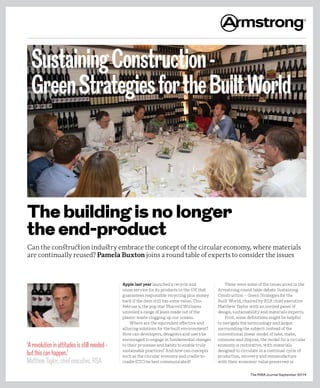
‘Arevolutioninattitudesisstillneeded-
butthiscanhappen.’
MatthewTaylor,chiefexecutive,RSA
The building is no longer
the end-product
Can the construction industry embrace the concept of the circular economy, where materials
are continually reused? Pamela Buxton joins a round table of experts to consider the issues
The RIBA Journal September 2014
Apple last year launched a recycle and
reuse service for its products in the UK that
guarantees responsible recycling plus money
back if the item still has some value. This
February, the pop star Pharrell Williams
unveiled a range of jeans made out of the
plastic waste clogging up our oceans.
Where are the equivalent effective and
alluring solutions for the built environment?
How can developers, designers and users be
encouraged to engage in fundamental changes
to their processes and habits to enable truly
sustainable practices? And how can concepts
such as the circular economy and cradle-to-
cradle (C2C) be best communicated?
These were some of the issues aired in the
Armstrong round table debate Sustaining
Construction – Green Strategies for the
Built World, chaired by RSA chief executive
Matthew Taylor with an invited panel of
design, sustainability and materials experts.
First, some definitions might be helpful
to navigate the terminology and jargon
surrounding the subject: instead of the
conventional linear model of take, make,
consume and dispose, the model for a circular
economy is restorative, with materials
designed to circulate in a continual cycle of
production, recovery and remanufacture
with their economic value preserved or
SustainingConstruction-
GreenStrategiesfortheBuiltWorld
enhanced. Cradle-to-cradle (C2C) design can
be thought of as the practical application of
this concept, a method of supporting design
that has a positive effect on the environment
and society. In doing so, it embraces the
design of products that can be recycled, uses
increasing amounts of renewable energy and
embraces local diversity.
These are complex issues, not helped by
the profusion of green accreditation schemes
and all-round greenwash that muddy the
waters when it comes to thinking of what
constitutes a ‘good’ sustainable product.
There are more than 100 self-certification and
labelling schemes on the market according
to Jeremy Sumeray, who is leading the
C2C programme at Armstrong, which has
pioneered ceiling recycling. The variety of
labelling schemes makes it much harder for
specifiers to make informed choices. C2C has
the advantage, however, of being a relatively
easy and engaging concept to convey, which
appeals to specifiers’ and users’ personal
values as a pathway to good. It also, he said,
‘fundamentally forces us to think about what
and why we’re designing’.
Clash of concepts
Sometimes circularity and some aspects
of sustainability, such as adaptability,
can appear to clash, according to Sophie
Thomas, project leader of the RSA’s recent
The Great Recovery Project. This identified
four different design models for the circular
economy: designing for longevity; leasing;
reuse in manufacture; and material recovery.
‘Do you design space for adaptability and
longevity, or for recycling?’ she asked.
But there does appear to be a sea change
in attitudes away from the linear model of
production, as demonstrated by firms such as
Apple, according to Duncan Baker-Brown.
‘That’s what we should be doing with our
buildings,’ he said. ‘More and more people
understand we’re in a linear model and need
to do something about it.’ But he remains
concerned at the high level of building
demolition rather than reuse.
Baker-Brown has recently, with students
from the University of Brighton, designed the
Waste House, the first permanent building to
be designed from waste, including discarded
plastic from construction sites.
‘I say there is no such thing as waste, just
things that are in the wrong place,’ he said.
‘The clever money is on avoiding buying new
stuff and avoiding throwing things away.’
The very nature of most buildings is a
Armstrong Ceilings
Sustaining Construction Round Table
2
The RIBA Journal September 2014
‘Thereisnosuch
thingaswaste,just
thingsthatarein
thewrongplace‘
Duncan
BakerBrown,
directorBBM
SustainableDesign
‘Willbuildingcomponentrecyclingleadto
theadoptionofaradicallydifferent,more
magpie,aesthetic?’
CanyAsh,founderpartner,
AshSakulaArchitects
‘Werelyongovernmenttoo
muchtoleadtheway.
Theanswerisinourhands’
JeremySumeray,senior
segmentmanager,
sustainability,Armstrong
BuildingProducts
Couldtechnologybe harnessedto
makeC2Cconceptsappealingin
anon-technicalwaytothosewho
occupythebuildings?
RichardFrancis,director,
MonomoyCompany
‘Weneedtodesign
backwardsand
learntospeakthe
samelanguageas
thoserecycling
buildingparts’
Vincentvan der
Meulen,partner
Kraaijvanger
3
The RIBA Journal September 2014
challenge for C2C processes. ‘Buildings are
very complex, with thousands of component
products, and materials with different
lifespans, different ownership rules, different
warranties,’ said Nitesh Magdani of BAM.
Simplicity of design is to be applauded.
‘There’s a lot to be said for keeping things
simple on all levels,’ said BDP’s David Cash,
who like Baker-Brown also called for a greater
emphasis on building reuse.
C2C will require a complete rethink in
how designers and architects design, since
the building or object is no longer the end
product. Instead, there is no end product,
rather a continual loop of use, reclaim and
reuse. It’s clear that far more thought needs to
go into designing for disassembly, whether for
a fridge or an office block. Clearly designers
are going to have to engage far more with the
nitty gritty and, as Cany Ash puts it, with the
mundane.
The RSA’s Sophie Thomas evocatively
described visiting a fridge recycling plant
and wishing the designers were there to
witness the huge physical efforts needed to
disassemble their fridges – some as little as six
months old – into components and materials
that could be fed back into the design process.
Vincent van der Meulen, who is at the
forefront of C2C in the Netherlands, talked
about the need to design ‘backwards’ with
disassembly and reuse in mind, and for
architects to learn how to speak the same
language as those who end up dealing with
reusing the building parts.
Problems of identification
Several participants raised the issue of
identification when it comes to dealing with
building materials and components after
their first use is over.
‘A major problem is knowing what’s
in a building so that you can know what
the material is and what grade it is,’ said
materials expert Ian Hunter.
Better identification would facilitate more
efficient reuse, he argued, especially if you
want the material to retain its value.
Sophie Thomas raised the idea of a
‘reverse BIM’ with digitally coded materials
so that 50 years or so later, people would be
able to understand what they were dealing
with. Duncan Baker-Brown agreed that this
barcode approach would be particularly
helpful for retrofits.
‘We need to not see the building as a
monolith but [instead] understand the layers
behind it,’ he said. He also favoured the use
Itisimperativeto
challengetheidea
thatsustainable
buildings
necessarilyrequire
morecapitalcost
DavidCash,
chairman,BDP
Buildingsareverycomplex,with
thousandsofcomponentproducts,
andmaterialswithdifferentlifespans,
differentownershiprules,different
warranties
NiteshMagdani,
sustainabilitydirector,BAM
‘Doyoudesignspaceforadaptabilityand
longevity,orforrecycling?’
SophieThomas,co-director,RSA
‘Amajorproblemis
knowingwhat’sina
buildingsothatyou
canknowwhatthe
materialisandwhat
gradeitis’
IanHunter,
director,
MaterialsCouncil
‘Industryand
governmentdon’thave
theseconversations
[aboutinvestment
andinnovationin
sustainability]’
NeelumMohammed,
seniorsustainability
consultant,CBRE
Armstrong Ceilings
Sustaining Construction Round Table
4
The RIBA Journal September 2014
of ‘ReIY’ type networks to find new homes
for building materials – even more vital now
timber can no longer be consigned to landfill.
Another important strategy raised
for C2C was the potential of designing for
leasing, where manufacturers take back their
products at the end of their lifespan. These
already include carpet tile manufacturers,
which offer customers a leasing option and
recycling the product at the end of its life.
Matthew Taylor asked what business
models would encourage more sustainable
practices, and wondered whether a top-down
approach was the answer.
Jeremy Sumeray advocated a ‘one mind at
a time’ step-by-step approach with leadership
from within the business, though not
necessarily from the very top. Though slow,
this can be a really powerful way of altering
practices at a time when, he said, the market
is looking for things to change.
It is also imperative, said BDP’s David
Cash, to challenge the idea that sustainable
buildings necessarily require more capital
cost. To the contrary, agreed Jeremy Sumeray,
low-impact materials can often be low cost.
And the more we learn how to reuse, the less
new raw materials we’ll need to buy, said
Duncan Baker-Brown.
Cany Ash commented that the design
community had less power than it used
to in the procurement process. Architects
certainly do have to work hard to convince
clients of the merits of a more sustainable
design, as Vincent van der Meulen related,
describing a project where he managed to
reinstate sustainability elements that had
previously been cut, by making a business
case of the savings these measures would
bring over 40 years.
Government’s role
What of the government’s role in promoting
more sustainable processes? Several of
the participants felt there had been a
backtracking and loss of momentum in the
last few years in terms of investment and
innovation in sustainability.
‘Industry and government don’t have
those conversations,’ said CBRE’s Neelum
Mohammed. ‘The confidence has gone.’
BDP’s David Cash felt that if the voting
public wanted to see sustainability high on
the political agenda, then it would happen.
But Matthew Taylor felt the public didn’t want
too much noise about sustainability – they
just wanted the government to get on with it.
Richard Francis of Monomoy Company
wondered if technology could be harnessed
to make C2C concepts appealing in a
non-technical way to those who occupy
the buildings, perhaps by using digital
technology to map internal spaces and their
sustainability credentials.
Sumeray generally felt that it was up to
business to take the lead and work harder to
promote C2C.
‘We rely on government too much to
lead the way. The answer is in our hands…
If we could see more leadership in the UK
on developing the circular economy and
circularity, it would bring some momentum,’
he said.
It’s clear that a revolution in attitudes is
still needed. But this can happen, as proved
by the recent legislation and shift in mindset
towards smoking, said Matthew Taylor.
Maybe the answer, he speculated, is a
combination of many approaches rather
than one, in order to facilitate the massive
change in thinking needed to encourage
more circular practices – not only top-down
regulation but innovation and creativity and
a philosophical change that can win over both
hearts and minds.
Perhaps the last word should go to Duncan
Baker-Brown, who quoted US sustainability
expert Neil Chambers: ‘If people say
[sustainability] will cost more, get them to try
harder. And if they can’t, get someone who
can… There are people who know how to do
it and people who don’t. The ones who know
will be the ones making the money.’
PARTICIPANTS:
Matthew Taylor, chief executive, RSA (chair)
Jeremy Sumeray, senior segment manager,
sustainability, Armstrong Building Products
Neelum Mohammed, senior sustainability
consultant, CBRE
Cany Ash, founder partner, Ash Sakula
Architects
David Cash, chairman, BDP
Vincent van der Meulen, partner
Kraaijvanger
Richard Francis, director, Monomoy
Company
Duncan Baker Brown, director BBM
Sustainable Design
Nitesh Magdani, sustainability director,
BAM
Ian Hunter, director, Materials Council
Sophie Thomas, co-director, RSA
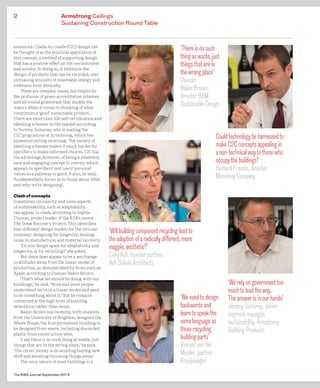
Left The panel chew the cud of
sustainable futures beside the ‘green wall’
at Clerkenwell’s Portal restaurant.

Cyclisch bouwen

  • 1.
    ‘Arevolutioninattitudesisstillneeded- butthiscanhappen.’ MatthewTaylor,chiefexecutive,RSA The building isno longer the end-product Can the construction industry embrace the concept of the circular economy, where materials are continually reused? Pamela Buxton joins a round table of experts to consider the issues The RIBA Journal September 2014 Apple last year launched a recycle and reuse service for its products in the UK that guarantees responsible recycling plus money back if the item still has some value. This February, the pop star Pharrell Williams unveiled a range of jeans made out of the plastic waste clogging up our oceans. Where are the equivalent effective and alluring solutions for the built environment? How can developers, designers and users be encouraged to engage in fundamental changes to their processes and habits to enable truly sustainable practices? And how can concepts such as the circular economy and cradle-to- cradle (C2C) be best communicated? These were some of the issues aired in the Armstrong round table debate Sustaining Construction – Green Strategies for the Built World, chaired by RSA chief executive Matthew Taylor with an invited panel of design, sustainability and materials experts. First, some definitions might be helpful to navigate the terminology and jargon surrounding the subject: instead of the conventional linear model of take, make, consume and dispose, the model for a circular economy is restorative, with materials designed to circulate in a continual cycle of production, recovery and remanufacture with their economic value preserved or SustainingConstruction- GreenStrategiesfortheBuiltWorld
  • 2.
    enhanced. Cradle-to-cradle (C2C)design can be thought of as the practical application of this concept, a method of supporting design that has a positive effect on the environment and society. In doing so, it embraces the design of products that can be recycled, uses increasing amounts of renewable energy and embraces local diversity. These are complex issues, not helped by the profusion of green accreditation schemes and all-round greenwash that muddy the waters when it comes to thinking of what constitutes a ‘good’ sustainable product. There are more than 100 self-certification and labelling schemes on the market according to Jeremy Sumeray, who is leading the C2C programme at Armstrong, which has pioneered ceiling recycling. The variety of labelling schemes makes it much harder for specifiers to make informed choices. C2C has the advantage, however, of being a relatively easy and engaging concept to convey, which appeals to specifiers’ and users’ personal values as a pathway to good. It also, he said, ‘fundamentally forces us to think about what and why we’re designing’. Clash of concepts Sometimes circularity and some aspects of sustainability, such as adaptability, can appear to clash, according to Sophie Thomas, project leader of the RSA’s recent The Great Recovery Project. This identified four different design models for the circular economy: designing for longevity; leasing; reuse in manufacture; and material recovery. ‘Do you design space for adaptability and longevity, or for recycling?’ she asked. But there does appear to be a sea change in attitudes away from the linear model of production, as demonstrated by firms such as Apple, according to Duncan Baker-Brown. ‘That’s what we should be doing with our buildings,’ he said. ‘More and more people understand we’re in a linear model and need to do something about it.’ But he remains concerned at the high level of building demolition rather than reuse. Baker-Brown has recently, with students from the University of Brighton, designed the Waste House, the first permanent building to be designed from waste, including discarded plastic from construction sites. ‘I say there is no such thing as waste, just things that are in the wrong place,’ he said. ‘The clever money is on avoiding buying new stuff and avoiding throwing things away.’ The very nature of most buildings is a Armstrong Ceilings Sustaining Construction Round Table 2 The RIBA Journal September 2014 ‘Thereisnosuch thingaswaste,just thingsthatarein thewrongplace‘ Duncan BakerBrown, directorBBM SustainableDesign ‘Willbuildingcomponentrecyclingleadto theadoptionofaradicallydifferent,more magpie,aesthetic?’ CanyAsh,founderpartner, AshSakulaArchitects ‘Werelyongovernmenttoo muchtoleadtheway. Theanswerisinourhands’ JeremySumeray,senior segmentmanager, sustainability,Armstrong BuildingProducts Couldtechnologybe harnessedto makeC2Cconceptsappealingin anon-technicalwaytothosewho occupythebuildings? RichardFrancis,director, MonomoyCompany ‘Weneedtodesign backwardsand learntospeakthe samelanguageas thoserecycling buildingparts’ Vincentvan der Meulen,partner Kraaijvanger
  • 3.
    3 The RIBA JournalSeptember 2014 challenge for C2C processes. ‘Buildings are very complex, with thousands of component products, and materials with different lifespans, different ownership rules, different warranties,’ said Nitesh Magdani of BAM. Simplicity of design is to be applauded. ‘There’s a lot to be said for keeping things simple on all levels,’ said BDP’s David Cash, who like Baker-Brown also called for a greater emphasis on building reuse. C2C will require a complete rethink in how designers and architects design, since the building or object is no longer the end product. Instead, there is no end product, rather a continual loop of use, reclaim and reuse. It’s clear that far more thought needs to go into designing for disassembly, whether for a fridge or an office block. Clearly designers are going to have to engage far more with the nitty gritty and, as Cany Ash puts it, with the mundane. The RSA’s Sophie Thomas evocatively described visiting a fridge recycling plant and wishing the designers were there to witness the huge physical efforts needed to disassemble their fridges – some as little as six months old – into components and materials that could be fed back into the design process. Vincent van der Meulen, who is at the forefront of C2C in the Netherlands, talked about the need to design ‘backwards’ with disassembly and reuse in mind, and for architects to learn how to speak the same language as those who end up dealing with reusing the building parts. Problems of identification Several participants raised the issue of identification when it comes to dealing with building materials and components after their first use is over. ‘A major problem is knowing what’s in a building so that you can know what the material is and what grade it is,’ said materials expert Ian Hunter. Better identification would facilitate more efficient reuse, he argued, especially if you want the material to retain its value. Sophie Thomas raised the idea of a ‘reverse BIM’ with digitally coded materials so that 50 years or so later, people would be able to understand what they were dealing with. Duncan Baker-Brown agreed that this barcode approach would be particularly helpful for retrofits. ‘We need to not see the building as a monolith but [instead] understand the layers behind it,’ he said. He also favoured the use Itisimperativeto challengetheidea thatsustainable buildings necessarilyrequire morecapitalcost DavidCash, chairman,BDP Buildingsareverycomplex,with thousandsofcomponentproducts, andmaterialswithdifferentlifespans, differentownershiprules,different warranties NiteshMagdani, sustainabilitydirector,BAM ‘Doyoudesignspaceforadaptabilityand longevity,orforrecycling?’ SophieThomas,co-director,RSA ‘Amajorproblemis knowingwhat’sina buildingsothatyou canknowwhatthe materialisandwhat gradeitis’ IanHunter, director, MaterialsCouncil ‘Industryand governmentdon’thave theseconversations [aboutinvestment andinnovationin sustainability]’ NeelumMohammed, seniorsustainability consultant,CBRE
  • 4.
    Armstrong Ceilings Sustaining ConstructionRound Table 4 The RIBA Journal September 2014 of ‘ReIY’ type networks to find new homes for building materials – even more vital now timber can no longer be consigned to landfill. Another important strategy raised for C2C was the potential of designing for leasing, where manufacturers take back their products at the end of their lifespan. These already include carpet tile manufacturers, which offer customers a leasing option and recycling the product at the end of its life. Matthew Taylor asked what business models would encourage more sustainable practices, and wondered whether a top-down approach was the answer. Jeremy Sumeray advocated a ‘one mind at a time’ step-by-step approach with leadership from within the business, though not necessarily from the very top. Though slow, this can be a really powerful way of altering practices at a time when, he said, the market is looking for things to change. It is also imperative, said BDP’s David Cash, to challenge the idea that sustainable buildings necessarily require more capital cost. To the contrary, agreed Jeremy Sumeray, low-impact materials can often be low cost. And the more we learn how to reuse, the less new raw materials we’ll need to buy, said Duncan Baker-Brown. Cany Ash commented that the design community had less power than it used to in the procurement process. Architects certainly do have to work hard to convince clients of the merits of a more sustainable design, as Vincent van der Meulen related, describing a project where he managed to reinstate sustainability elements that had previously been cut, by making a business case of the savings these measures would bring over 40 years. Government’s role What of the government’s role in promoting more sustainable processes? Several of the participants felt there had been a backtracking and loss of momentum in the last few years in terms of investment and innovation in sustainability. ‘Industry and government don’t have those conversations,’ said CBRE’s Neelum Mohammed. ‘The confidence has gone.’ BDP’s David Cash felt that if the voting public wanted to see sustainability high on the political agenda, then it would happen. But Matthew Taylor felt the public didn’t want too much noise about sustainability – they just wanted the government to get on with it. Richard Francis of Monomoy Company wondered if technology could be harnessed to make C2C concepts appealing in a non-technical way to those who occupy the buildings, perhaps by using digital technology to map internal spaces and their sustainability credentials. Sumeray generally felt that it was up to business to take the lead and work harder to promote C2C. ‘We rely on government too much to lead the way. The answer is in our hands… If we could see more leadership in the UK on developing the circular economy and circularity, it would bring some momentum,’ he said. It’s clear that a revolution in attitudes is still needed. But this can happen, as proved by the recent legislation and shift in mindset towards smoking, said Matthew Taylor. Maybe the answer, he speculated, is a combination of many approaches rather than one, in order to facilitate the massive change in thinking needed to encourage more circular practices – not only top-down regulation but innovation and creativity and a philosophical change that can win over both hearts and minds. Perhaps the last word should go to Duncan Baker-Brown, who quoted US sustainability expert Neil Chambers: ‘If people say [sustainability] will cost more, get them to try harder. And if they can’t, get someone who can… There are people who know how to do it and people who don’t. The ones who know will be the ones making the money.’ PARTICIPANTS: Matthew Taylor, chief executive, RSA (chair) Jeremy Sumeray, senior segment manager, sustainability, Armstrong Building Products Neelum Mohammed, senior sustainability consultant, CBRE Cany Ash, founder partner, Ash Sakula Architects David Cash, chairman, BDP Vincent van der Meulen, partner Kraaijvanger Richard Francis, director, Monomoy Company Duncan Baker Brown, director BBM Sustainable Design Nitesh Magdani, sustainability director, BAM Ian Hunter, director, Materials Council Sophie Thomas, co-director, RSA Left The panel chew the cud of sustainable futures beside the ‘green wall’ at Clerkenwell’s Portal restaurant.