CycleTel™ in India: From
Proof-of-Concept to
Deployment
  Meredith Puleio & Victoria Jennings
  Institute for Reproductive Health,
  Georgetown University

  mHealth Working Group Meeting
  January 18, 2011
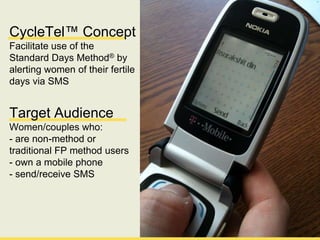
CycleTel™ Concept
Facilitate use of the
Standard Days Method® by
alerting women of their fertile
days via SMS


Target Audience
Women/couples who:
- are non-method or
traditional FP method users
- own a mobile phone
- send/receive SMS
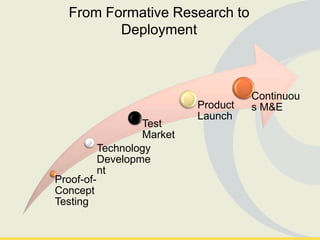
From Formative Research to
          Deployment


                                       Continuou
                             Product   s M&E
                             Launch
                    Test
                    Market
            Technology
            Developme
            nt
Proof-of-
Concept
Testing
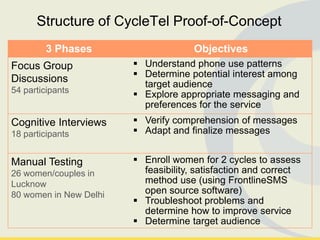
Structure of CycleTel Proof-of-Concept
        3 Phases                      Objectives
Focus Group              Understand phone use patterns
                         Determine potential interest among
Discussions               target audience
54 participants          Explore appropriate messaging and
                          preferences for the service
Cognitive Interviews     Verify comprehension of messages
18 participants          Adapt and finalize messages


Manual Testing           Enroll women for 2 cycles to assess
26 women/couples in       feasibility, satisfaction and correct
Lucknow                   method use (using FrontlineSMS
80 women in New Delhi     open source software)
                         Troubleshoot problems and
                          determine how to improve service
                         Determine target audience
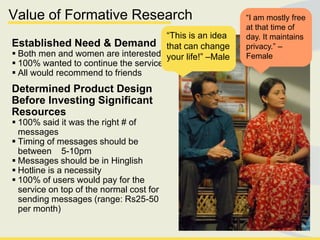
Value of Formative Research                              ―I am mostly free
                                                         at that time of
                                      ―This is an idea   day. It maintains
Established Need & Demand that can change                privacy.‖ –
 Both men and women are interested your life!‖ –Male    Female
 100% wanted to continue the service
 All would recommend to friends
Determined Product Design
Before Investing Significant
Resources
 100% said it was the right # of
  messages
 Timing of messages should be
  between 5-10pm
 Messages should be in Hinglish
 Hotline is a necessity
 100% of users would pay for the
  service on top of the normal cost for
  sending messages (range: Rs25-50
  per month)
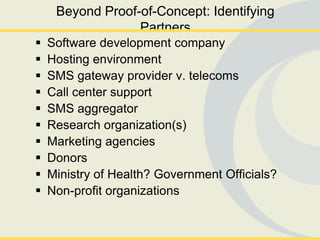
Beyond Proof-of-Concept: Identifying
                  Partners
   Software development company
   Hosting environment
   SMS gateway provider v. telecoms
   Call center support
   SMS aggregator
   Research organization(s)
   Marketing agencies
   Donors
   Ministry of Health? Government Officials?
   Non-profit organizations
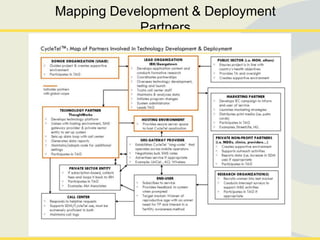
Mapping Development & Deployment
            Partners
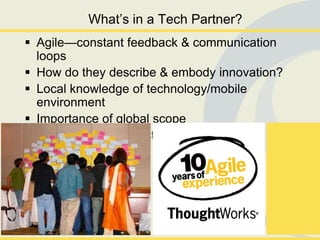
What’s in a Tech Partner?
 Agile—constant feedback & communication
  loops
 How do they describe & embody innovation?
 Local knowledge of technology/mobile
  environment
 Importance of global scope
 Social impact interest
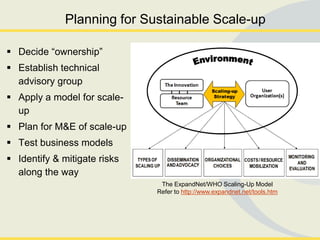
Planning for Sustainable Scale-up

 Decide ―ownership‖
 Establish technical
  advisory group
 Apply a model for scale-
  up
 Plan for M&E of scale-up
 Test business models
 Identify & mitigate risks
  along the way
                               The ExpandNet/WHO Scaling-Up Model
                              Refer to http://www.expandnet.net/tools.htm
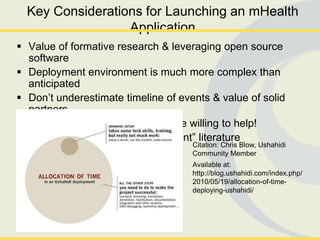
Key Considerations for Launching an mHealth
                  Application
 Value of formative research & leveraging open source
  software
 Deployment environment is much more complex than
  anticipated
 Don’t underestimate timeline of events & value of solid
  partners
 Plan, talk, listen, plan: People are willing to help!
 Look to ―new product development‖ literature
                                     Citation: Chris Blow, Ushahidi
                                     Community Member
                                     Available at:
                                     http://blog.ushahidi.com/index.php/
                                     2010/05/19/allocation-of-time-
                                     deploying-ushahidi/
Thoughts? Ideas? Email
mp447@georgetown.ed
          u

CycleTel™ in India: From Proof-of-Concept to Deployment

  • 1.
    CycleTel™ in India:From Proof-of-Concept to Deployment Meredith Puleio & Victoria Jennings Institute for Reproductive Health, Georgetown University mHealth Working Group Meeting January 18, 2011
  • 2.
    CycleTel™ Concept Facilitate useof the Standard Days Method® by alerting women of their fertile days via SMS Target Audience Women/couples who: - are non-method or traditional FP method users - own a mobile phone - send/receive SMS
  • 3.
    From Formative Researchto Deployment Continuou Product s M&E Launch Test Market Technology Developme nt Proof-of- Concept Testing
  • 4.
    Structure of CycleTelProof-of-Concept 3 Phases Objectives Focus Group  Understand phone use patterns  Determine potential interest among Discussions target audience 54 participants  Explore appropriate messaging and preferences for the service Cognitive Interviews  Verify comprehension of messages 18 participants  Adapt and finalize messages Manual Testing  Enroll women for 2 cycles to assess 26 women/couples in feasibility, satisfaction and correct Lucknow method use (using FrontlineSMS 80 women in New Delhi open source software)  Troubleshoot problems and determine how to improve service  Determine target audience
  • 5.
    Value of FormativeResearch ―I am mostly free at that time of ―This is an idea day. It maintains Established Need & Demand that can change privacy.‖ –  Both men and women are interested your life!‖ –Male Female  100% wanted to continue the service  All would recommend to friends Determined Product Design Before Investing Significant Resources  100% said it was the right # of messages  Timing of messages should be between 5-10pm  Messages should be in Hinglish  Hotline is a necessity  100% of users would pay for the service on top of the normal cost for sending messages (range: Rs25-50 per month)
  • 6.
    Beyond Proof-of-Concept: Identifying Partners  Software development company  Hosting environment  SMS gateway provider v. telecoms  Call center support  SMS aggregator  Research organization(s)  Marketing agencies  Donors  Ministry of Health? Government Officials?  Non-profit organizations
  • 7.
    Mapping Development &Deployment Partners
  • 8.
    What’s in aTech Partner?  Agile—constant feedback & communication loops  How do they describe & embody innovation?  Local knowledge of technology/mobile environment  Importance of global scope  Social impact interest
  • 9.
    Planning for SustainableScale-up  Decide ―ownership‖  Establish technical advisory group  Apply a model for scale- up  Plan for M&E of scale-up  Test business models  Identify & mitigate risks along the way The ExpandNet/WHO Scaling-Up Model Refer to http://www.expandnet.net/tools.htm
  • 10.
    Key Considerations forLaunching an mHealth Application  Value of formative research & leveraging open source software  Deployment environment is much more complex than anticipated  Don’t underestimate timeline of events & value of solid partners  Plan, talk, listen, plan: People are willing to help!  Look to ―new product development‖ literature Citation: Chris Blow, Ushahidi Community Member Available at: http://blog.ushahidi.com/index.php/ 2010/05/19/allocation-of-time- deploying-ushahidi/
  • 11.