Table of Contents
1. Introduction .......................... 1
2. Model Architecture .......................... 2
Hidden2.1 Domains, Objectives, and Practices .......................... 3
Hidden2.2 Maturity Indicator Levels .......................... 7
Hidden2.3 Maturity Indicator Level Scoring .......................... 8
3. Summary of Self-Evaluation Results .......................... 9
Hidden3.1 MIL Achievement by Domain .......................... 9
Hidden3.2 Practice Implementation by Domain .......................... 10
Hidden3.3 Implementation of Management Activities across Domains .......................... 12
4. Detailed Self-Evaluation Results .......................... 14
Hidden4.1 Asset, Change, and Configuration Management (ASSET) .......................... 15
Hidden4.2 Threat and Vulnerability Management (THREAT) .......................... 21
Hidden4.3 Risk Management (RISK) .......................... 27
Hidden4.4 Identity and Access Management (ACCESS) .......................... 34
Hidden4.5 Situational Awareness (SITUATION) .......................... 41
Hidden4.6 Event and Incident Response, Continuity of Operations (RESPONSE) .......................... 47
Hidden4.7 Third-Party Risk Management (THIRD-PARTIES) .......................... 56
Hidden4.8 Workforce Management (WORKFORCE) .......................... 61
Hidden4.9 Cybersecurity Architecture (ARCHITECTURE) .......................... 67
Hidden4.10 Cybersecurity Program Management (PROGRAM) .......................... 78
5. Using the Self-Evaluation Results .......................... 83
6. Self-Evaluation Notes .......................... 85
7. List of Partially Implemented and Not Implemented Practices .......................... 87
Table of Contents
i
Notification
This report is provided “as is” for informational purposes only. The Department of Energy (DOE) does
not provide any warranties of any kind regarding any information contained within. In no event shall the
United States Government or its contractors or subcontractors be liable for any damages, including, but
not limited to, direct, indirect, special, or consequential damages and including damages based on any
negligence of the United States Government or its contractors or subcontractors, arising out of,
resulting from, or in any way connected with this report, whether or not based upon warranty, contract,
tort, or otherwise, whether or not injury was sustained from, or arose out of the results of, or reliance
upon the report.
DOE does not endorse any commercial product or service, including the subject of the analysis in this
report. Any reference to specific commercial products, processes, or services by service mark,
trademark, manufacturer, or otherwise, does not constitute or imply their endorsement,
recommendation, or favoring by the agencies.
The display of the DOE official seal or other visual identities on this report shall not be interpreted to
provide the recipient organization authorization to use the official seal, insignia, or other visual identities
of the Department. The DOE seal, insignia, or other visual identities shall not be used in any manner to
imply endorsement of any commercial product or activity by DOE or the United States Government. Use
of the DOE seal without proper authorization violates federal law (e.g., 18 U.S.C. §§ 506, 701, 1017), and
is against DOE policies governing usage of its seal.
Notification
ii
1. Introduction
The Cybersecurity Capability Maturity Model (C2M2) can help organizations of all sectors, types, and
sizes to evaluate and make improvements to their cybersecurity programs and strengthen their
operational resilience. This report presents the results of a C2M2 self-evaluation. The results included in
this report may be used to measure and improve an existing cybersecurity program. It also may serve as
an input for other activities, such as informing cybersecurity risk managers about the controls in place
to mitigate cybersecurity risks within an organization.
The results presented in this report are based on participant responses describing the degree to which
C2M2 practices are implemented. This report may include sensitive information and should be
protected accordingly.
The scope defined for this self-evaluation includes the following:
SCOPE:
No Information Entered
SELF-EVALUATION DATE(S):
No Information Entered
ADDITIONAL NOTES:
No Information Entered
This report was generated by the C2M2 HTML-Based Tool Version 2.1 on Friday, January 27, 2023 at
14:24:33.
Introduction
1
2. Model Architecture
The model is organized into 10 domains. Each domain is a logical grouping of cybersecurity practices.
The practices within a domain are grouped by objective—target achievements that support the domain.
Within each objective, the practices are ordered by maturity indicator levels (MILs).
The following sections include additional information about the domains and the MILs.
Model Architecture
2
2.1 Domains, Objectives, and Practices
The C2M2 includes 356 cybersecurity practices, which are grouped into 10 domains. These practices
represent the activities an organization can perform to establish and mature capability in the domain.
For example, the Asset, Change, and Configuration Management domain is a group of practices that an
organization can perform to establish and mature asset management, change management, and
configuration management capabilities.
The practices within each domain are organized into objectives, which represent achievements that
support the domain. For example, the Asset, Change, and Configuration Management domain comprises
five objectives:
Manage IT and OT Asset Inventory
1.
Manage Information Asset Inventory
2.
Manage IT and OT Asset Configurations
3.
Manage Changes to IT and OT Assets
4.
Management Activities for the ASSET domain
5.
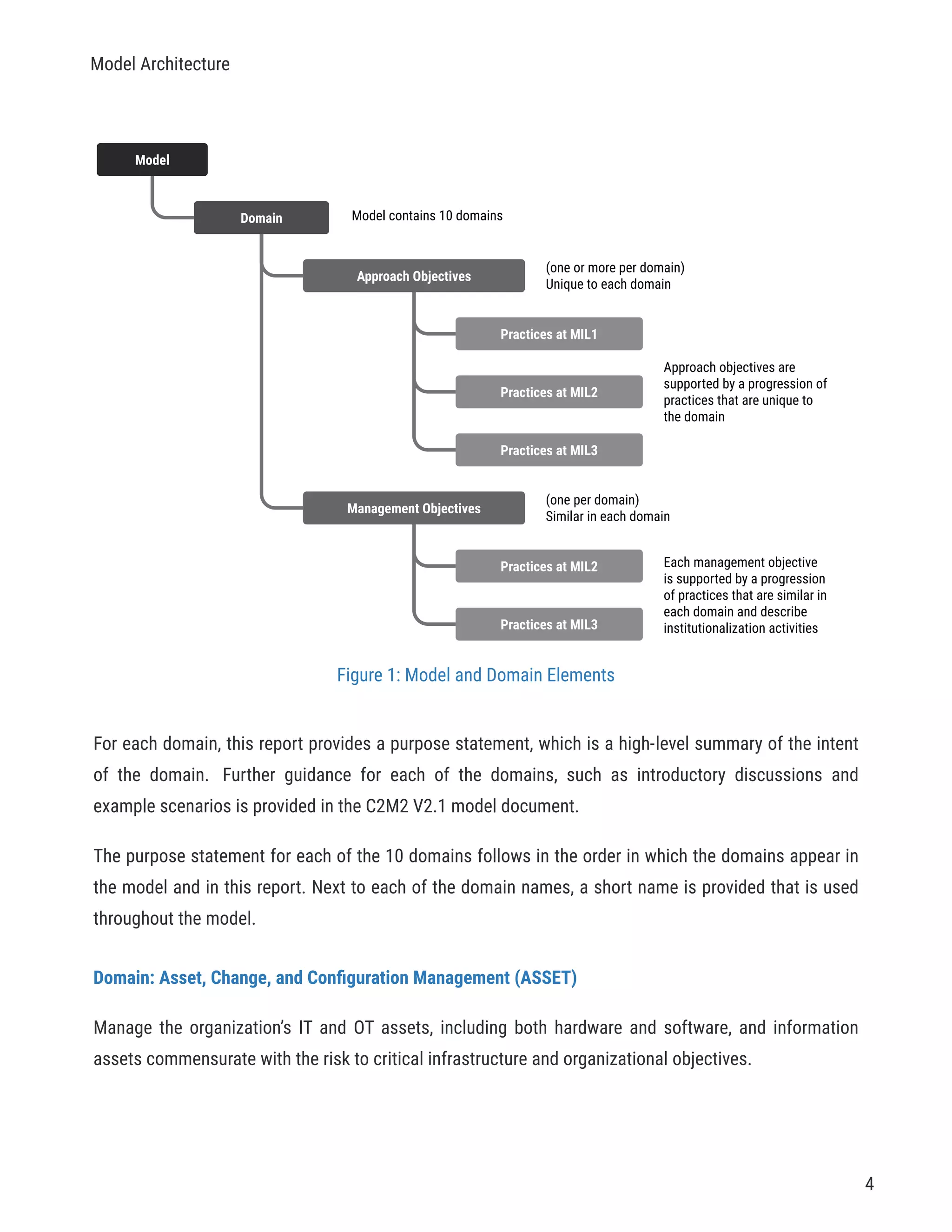
Each of the objectives in a domain comprises a set of practices, which are ordered by MIL. Figure 1
summarizes the elements of each domain.
Model Architecture
3
Model
Domain
Approach Objectives
Practices at MIL1
Practices at MIL2
Practices at MIL3
Management Objectives
Practices at MIL2
Practices at MIL3
Model contains 10 domains
(one or more per domain)
Unique to each domain
Approach objectives are
supported by a progression of
practices that are unique to
the domain
(one per domain)
Similar in each domain
Each management objective
is supported by a progression
of practices that are similar in
each domain and describe
institutionalization activities
Figure 1: Model and Domain Elements
For each domain, this report provides a purpose statement, which is a high-level summary of the intent
of the domain. Further guidance for each of the domains, such as introductory discussions and
example scenarios is provided in the C2M2 V2.1 model document.
The purpose statement for each of the 10 domains follows in the order in which the domains appear in
the model and in this report. Next to each of the domain names, a short name is provided that is used
throughout the model.
Domain: Asset, Change, and Configuration Management (ASSET)
Manage the organization’s IT and OT assets, including both hardware and software, and information
assets commensurate with the risk to critical infrastructure and organizational objectives.
Model Architecture
4
Domain: Threat and Vulnerability Management (THREAT)
Establish and maintain plans, procedures, and technologies to detect, identify, analyze, manage, and
respond to cybersecurity threats and vulnerabilities, commensurate with the risk to the organization’s
infrastructure (such as critical, IT, and operational) and organizational objectives.
Domain: Risk Management (RISK)
Establish, operate, and maintain an enterprise cyber risk management program to identify, analyze, and
respond to cyber risk the organization is subject to, including its business units, subsidiaries, related
interconnected infrastructure, and stakeholders.
Domain: Identity and Access Management (ACCESS)
Create and manage identities for entities that may be granted logical or physical access to the
organization’s assets. Control access to the organization’s assets, commensurate with the risk to critical
infrastructure and organizational objectives.
Domain: Situational Awareness (SITUATION)
Establish and maintain activities and technologies to collect, monitor, analyze, alarm, report, and use
operational, security, and threat information, including status and summary information from the other
model domains, to establish situational awareness for both the organization’s operational state and
cybersecurity state.
Domain: Event and Incident Response, Continuity of Operations (RESPONSE)
Establish and maintain plans, procedures, and technologies to detect, analyze, mitigate, respond to, and
recover from cybersecurity events and incidents and to sustain operations during cybersecurity
incidents, commensurate with the risk to critical infrastructure and organizational objectives.
Domain: Third-Party Risk Management (THIRD-PARTIES)
Establish and maintain controls to manage the cyber risks arising from suppliers and other third parties,
Model Architecture
5
commensurate with the risk to critical infrastructure and organizational objectives.
Domain: Workforce Management (WORKFORCE)
Establish and maintain plans, procedures, technologies, and controls to create a culture of cybersecurity
and to ensure the ongoing suitability and competence of personnel, commensurate with the risk to
critical infrastructure and organizational objectives.
Domain: Cybersecurity Architecture (ARCHITECTURE)
Establish and maintain the structure and behavior of the organization’s cybersecurity architecture,
including controls, processes, technologies, and other elements, commensurate with the risk to critical
infrastructure and organizational objectives.
Domain: Cybersecurity Program Management (PROGRAM)
Establish and maintain an enterprise cybersecurity program that provides governance, strategic
planning, and sponsorship for the organization’s cybersecurity activities in a manner that aligns
cybersecurity objectives with both the organization’s strategic objectives and the risk to critical
infrastructure.
For a more in-depth description of the C2M2 domains, refer to the C2M2 V2.1 model document available
here: https://energy.gov/C2M2 .
Model Architecture
6
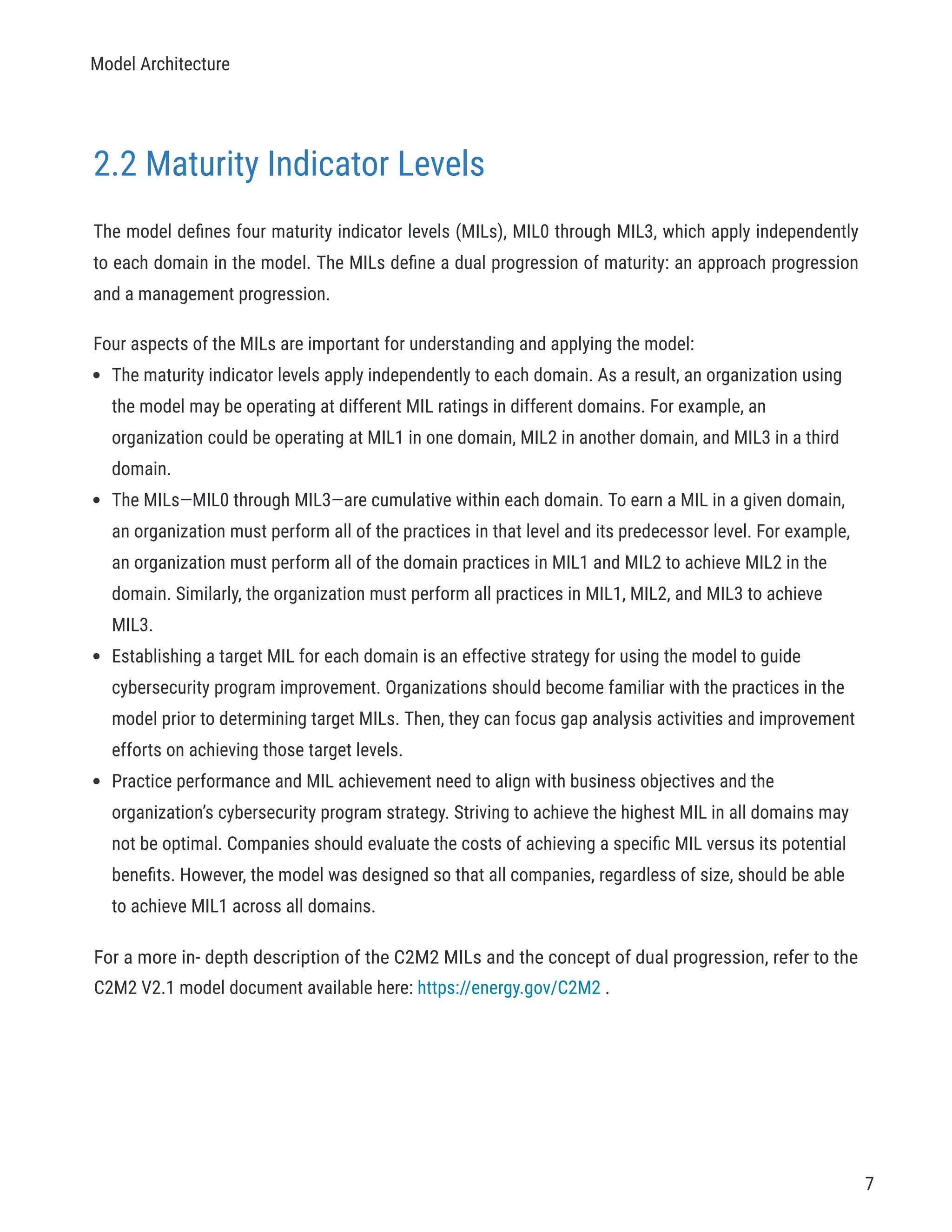
2.2 Maturity Indicator Levels
The model defines four maturity indicator levels (MILs), MIL0 through MIL3, which apply independently
to each domain in the model. The MILs define a dual progression of maturity: an approach progression
and a management progression.
Four aspects of the MILs are important for understanding and applying the model:
The maturity indicator levels apply independently to each domain. As a result, an organization using
the model may be operating at different MIL ratings in different domains. For example, an
organization could be operating at MIL1 in one domain, MIL2 in another domain, and MIL3 in a third
domain.
The MILs—MIL0 through MIL3—are cumulative within each domain. To earn a MIL in a given domain,
an organization must perform all of the practices in that level and its predecessor level. For example,
an organization must perform all of the domain practices in MIL1 and MIL2 to achieve MIL2 in the
domain. Similarly, the organization must perform all practices in MIL1, MIL2, and MIL3 to achieve
MIL3.
Establishing a target MIL for each domain is an effective strategy for using the model to guide
cybersecurity program improvement. Organizations should become familiar with the practices in the
model prior to determining target MILs. Then, they can focus gap analysis activities and improvement
efforts on achieving those target levels.
Practice performance and MIL achievement need to align with business objectives and the
organization’s cybersecurity program strategy. Striving to achieve the highest MIL in all domains may
not be optimal. Companies should evaluate the costs of achieving a specific MIL versus its potential
benefits. However, the model was designed so that all companies, regardless of size, should be able
to achieve MIL1 across all domains.
For a more in- depth description of the C2M2 MILs and the concept of dual progression, refer to the
C2M2 V2.1 model document available here: https://energy.gov/C2M2 .
Model Architecture
7
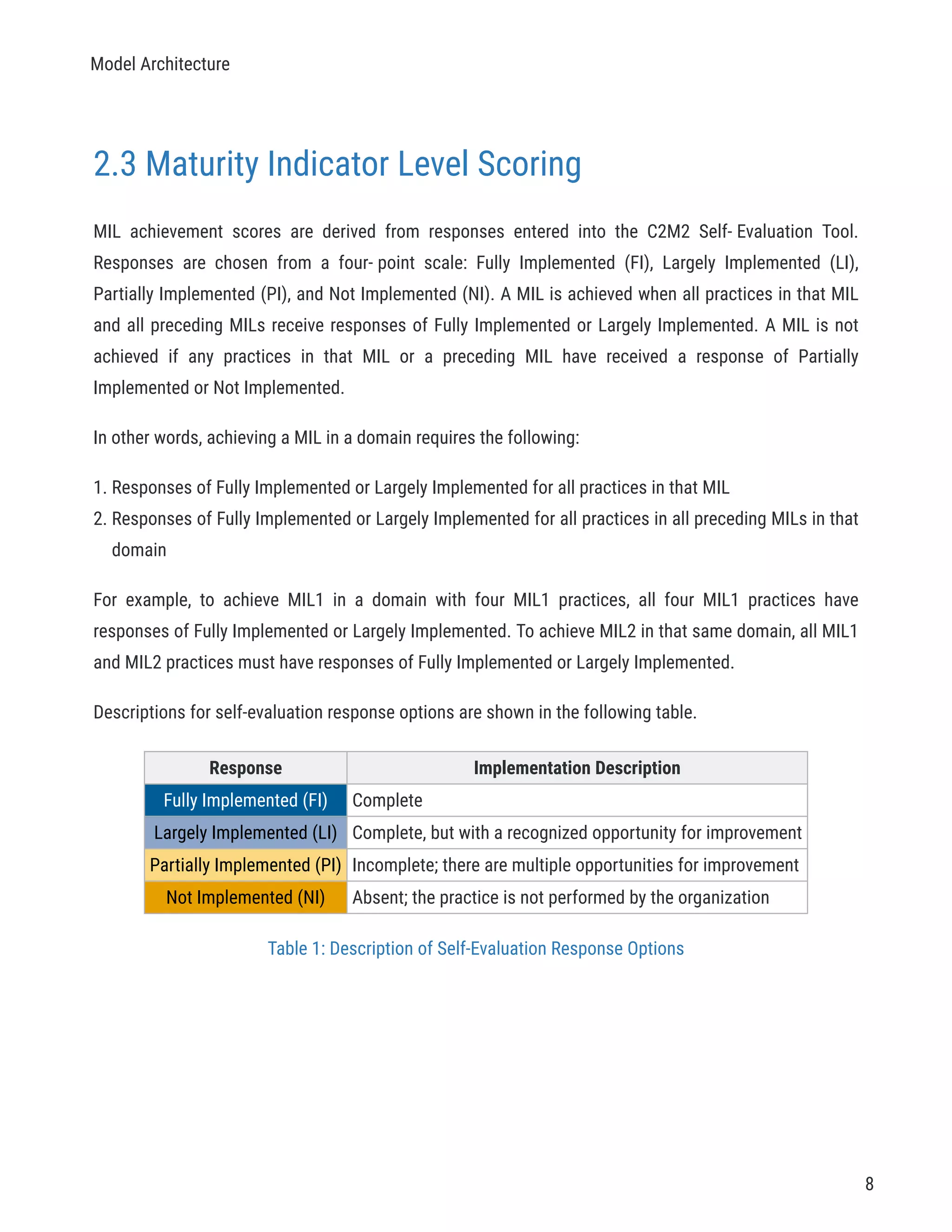
2.3 Maturity Indicator Level Scoring
MIL achievement scores are derived from responses entered into the C2M2 Self- Evaluation Tool.
Responses are chosen from a four- point scale: Fully Implemented (FI), Largely Implemented (LI),
Partially Implemented (PI), and Not Implemented (NI). A MIL is achieved when all practices in that MIL
and all preceding MILs receive responses of Fully Implemented or Largely Implemented. A MIL is not
achieved if any practices in that MIL or a preceding MIL have received a response of Partially
Implemented or Not Implemented.
In other words, achieving a MIL in a domain requires the following:
Responses of Fully Implemented or Largely Implemented for all practices in that MIL
1.
Responses of Fully Implemented or Largely Implemented for all practices in all preceding MILs in that
2.
domain
For example, to achieve MIL1 in a domain with four MIL1 practices, all four MIL1 practices have
responses of Fully Implemented or Largely Implemented. To achieve MIL2 in that same domain, all MIL1
and MIL2 practices must have responses of Fully Implemented or Largely Implemented.
Descriptions for self-evaluation response options are shown in the following table.
Response Implementation Description
Fully Implemented (FI) Complete
Largely Implemented (LI) Complete, but with a recognized opportunity for improvement
Partially Implemented (PI) Incomplete; there are multiple opportunities for improvement
Not Implemented (NI) Absent; the practice is not performed by the organization
Table 1: Description of Self-Evaluation Response Options
Model Architecture
8
3. Summary of Self-Evaluation Results
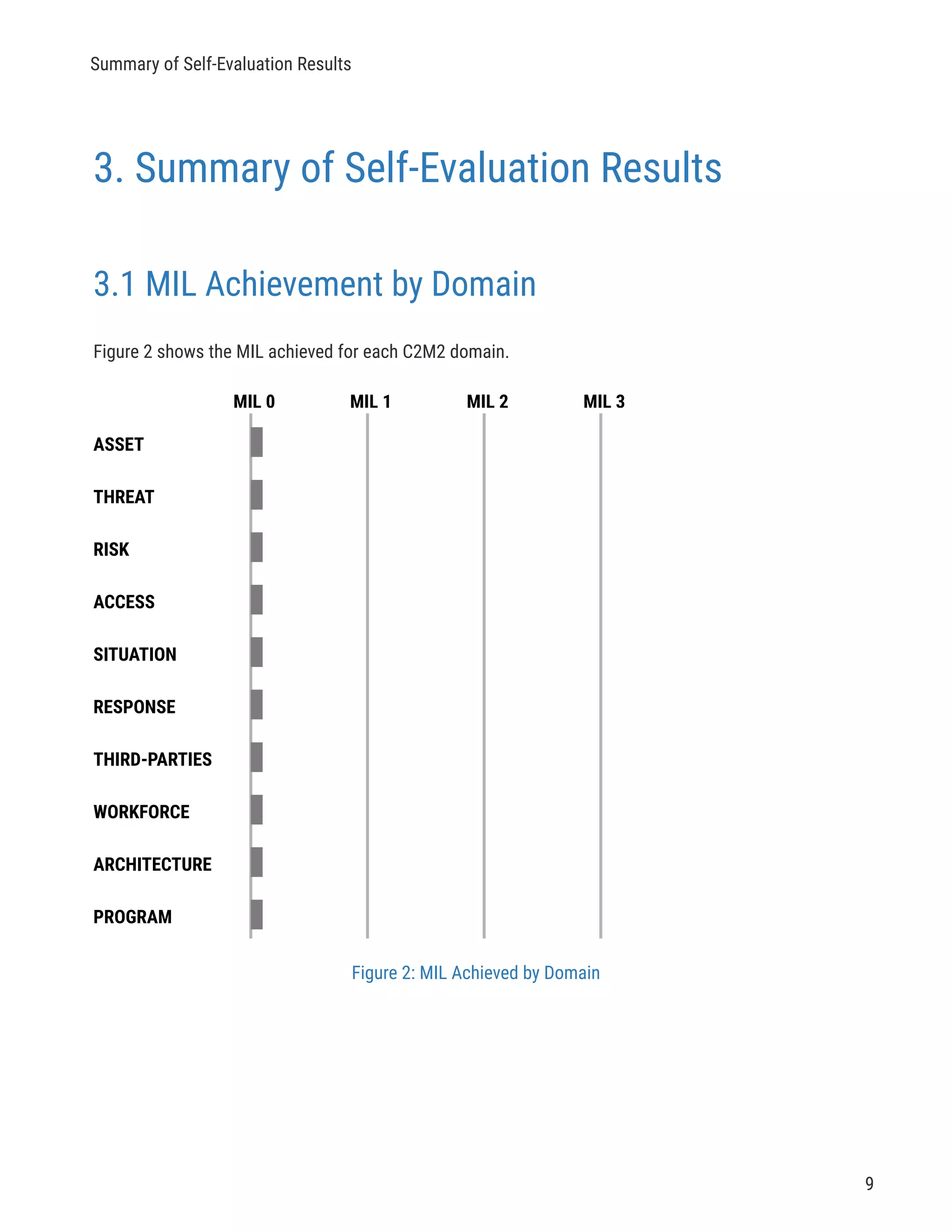
3.1 MIL Achievement by Domain
Figure 2 shows the MIL achieved for each C2M2 domain.
MIL 0 MIL 1 MIL 2 MIL 3
ASSET
THREAT
RISK
ACCESS
SITUATION
RESPONSE
THIRD-PARTIES
WORKFORCE
ARCHITECTURE
PROGRAM
Figure 2: MIL Achieved by Domain
Summary of Self-Evaluation Results
9
3.2 Practice Implementation by Domain
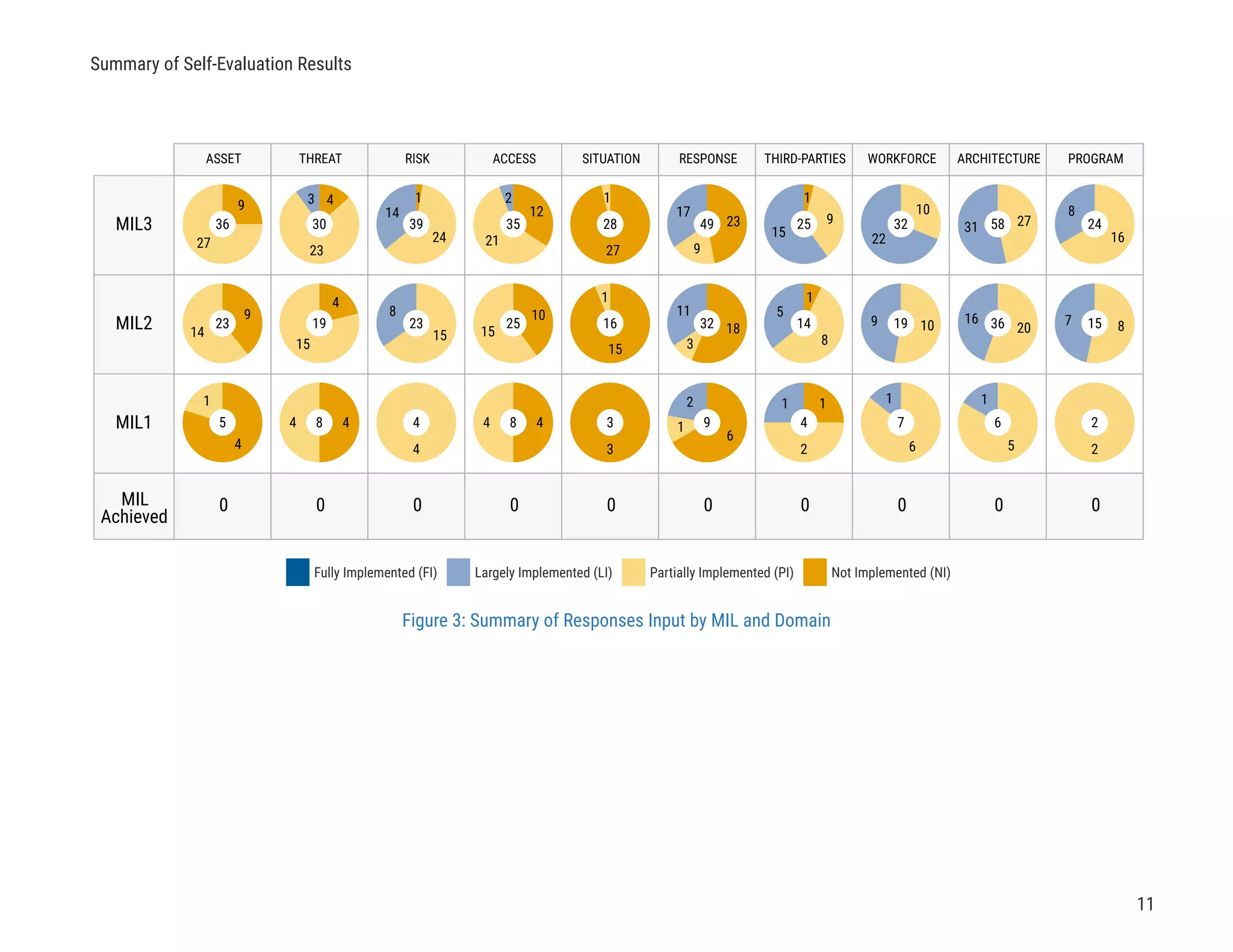
Figure 3 shows summarized implementation level responses for each C2M2 practice, grouped by
domain. The MIL achieved for each domain is listed at the bottom of the figure. A MIL is achieved when
all practices in that MIL and all preceding MILs receive responses of Fully Implemented or Largely
Implemented. A high- level understanding of the organization’s self- evaluation results can be gained
from this figure and may be useful when evaluating areas for future improvement.
The number in the center of each donut chart represents the cumulative number of practices in that MIL
for that domain. Refer to Section 4.2 of the C2M2 V2.1 model document for a description of how MIL
achievement is determined.
Summary of Self-Evaluation Results
10
ASSET THREAT RISK ACCESS SITUATION RESPONSE THIRD-PARTIES WORKFORCE ARCHITECTURE PROGRAM
MIL3
9
27
36
4
23
3
30
1
24
14
39
12
21
2
35
27
1
28 23
9
17
49
1
9
15
25
10
22
32 27
31 58
16
8
24
MIL2
9
14
23
4
15
19
15
8
23
10
15
25
15
1
16 18
3
11
32
1
8
5
14 10
9 19 20
16 36 8
7 15
MIL1
4
1
5 4
4 8
4
4 4
4 8
3
3
6
1
2
9
1
2
1
4
6
1
7
5
1
6
2
2
MIL
Achieved
0 0 0 0 0 0 0 0 0 0
Fully Implemented (FI) Largely Implemented (LI) Partially Implemented (PI) Not Implemented (NI)
Figure 3: Summary of Responses Input by MIL and Domain
Summary of Self-Evaluation Results
11
3.3 Implementation of Management Activities across
Domains
The final objective of each C2M2 domain includes practices focused on cybersecurity management
activities. These practices focus on the extent to which cybersecurity practices are institutionalized, or
ingrained, in the organization’s operations. The more deeply ingrained an activity, the more likely it is
that the organization will continue to perform the activity over time; the activity will be retained under
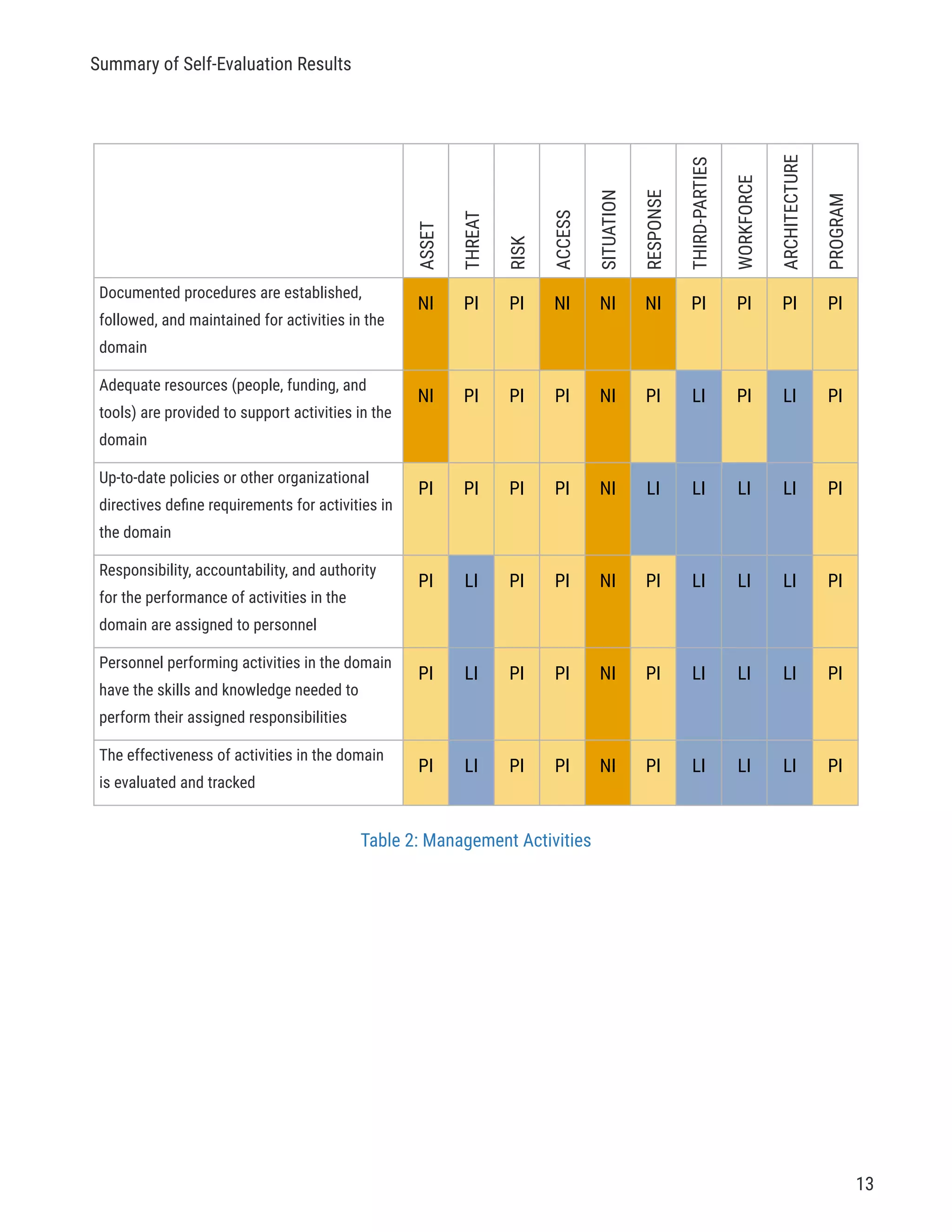
times of stress; and the outcomes of the activity will be consistent, repeatable, and of high quality. Table
2 provides a high-level overview of implementation of the Management Activities practices from two
perspectives: 1) implementation of all Management Activities within each domain and 2)
implementation of each Management Activities practice across the ten C2M2 domains.
Summary of Self-Evaluation Results
12
ASSET
THREAT
RISK
ACCESS
SITUATION
RESPONSE
THIRD-PARTIES
WORKFORCE
ARCHITECTURE
PROGRAM
Documented procedures are established,
followed, and maintained for activities in the
domain
NI PI PI NI NI NI PI PI PI PI
Adequate resources (people, funding, and
tools) are provided to support activities in the
domain
NI PI PI PI NI PI LI PI LI PI
Up-to-date policies or other organizational
directives define requirements for activities in
the domain
PI PI PI PI NI LI LI LI LI PI
Responsibility, accountability, and authority
for the performance of activities in the
domain are assigned to personnel
PI LI PI PI NI PI LI LI LI PI
Personnel performing activities in the domain
have the skills and knowledge needed to
perform their assigned responsibilities
PI LI PI PI NI PI LI LI LI PI
The effectiveness of activities in the domain
is evaluated and tracked
PI LI PI PI NI PI LI LI LI PI
Table 2: Management Activities
Summary of Self-Evaluation Results
13
4. Detailed Self-Evaluation Results
This section provides the level of implementation (i.e., Fully Implemented, Largely Implemented,
Partially Implemented, and Not Implemented) input to the self-evaluation tool for each C2M2 practice by
domain, objective, and MIL. See Section 2.3 Maturity Indicator Level Scoring for a detailed explanation
of the scoring process and Section 5 Using the Model for further detail regarding self-evaluation results.
Detailed Self-Evaluation Results
14
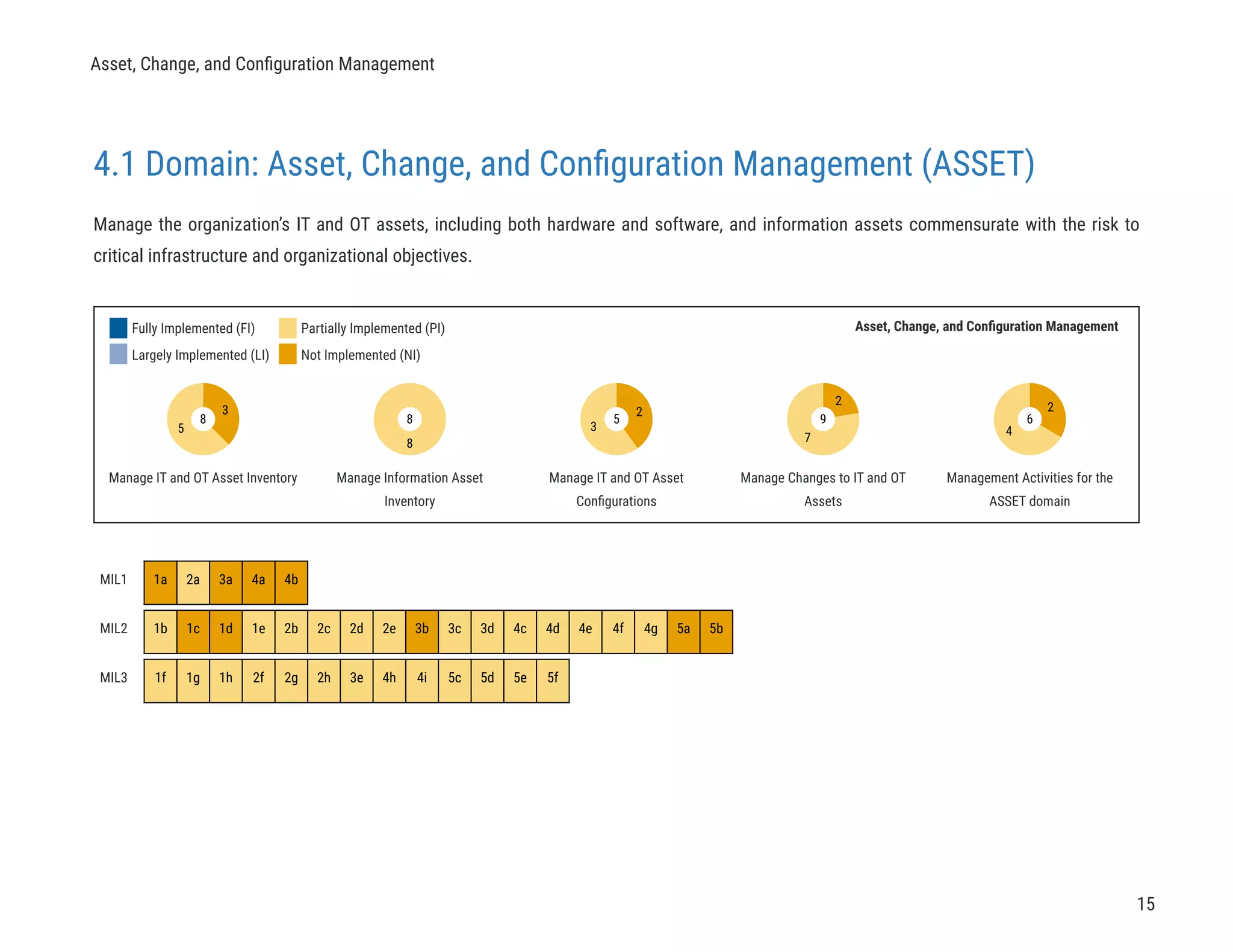
4.1 Domain: Asset, Change, and Configuration Management (ASSET)
Manage the organization’s IT and OT assets, including both hardware and software, and information assets commensurate with the risk to
critical infrastructure and organizational objectives.
Fully Implemented (FI) Partially Implemented (PI)
Largely Implemented (LI) Not Implemented (NI)
Asset, Change, and Configuration Management
3
5
8
8
8
2
3
5
2
7
9
2
4
6
Manage IT and OT Asset Inventory Manage Information Asset
Inventory
Manage IT and OT Asset
Configurations
Manage Changes to IT and OT
Assets
Management Activities for the
ASSET domain
MIL1 1a 2a 3a 4a 4b
MIL2 1b 1c 1d 1e 2b 2c 2d 2e 3b 3c 3d 4c 4d 4e 4f 4g 5a 5b
MIL3 1f 1g 1h 2f 2g 2h 3e 4h 4i 5c 5d 5e 5f
Asset, Change, and Configuration Management
15
Objective 1: Manage IT and OT Asset Inventory
MIL ID Practice Statement Response
MIL1 ASSET-1a
IT and OT assets that are important to the delivery of the function are
inventoried, at least in an ad hoc manner
NI
MIL2 ASSET-1b
The IT and OT asset inventory includes assets within the function that
may be leveraged to achieve a threat objective
PI
MIL2 ASSET-1c
Inventoried IT and OT assets are prioritized based on defined criteria
that include importance to the delivery of the function
NI
MIL2 ASSET-1d
Prioritization criteria include consideration of the degree to which an
asset within the function may be leveraged to achieve a threat
objective
NI
MIL2 ASSET-1e
The IT and OT inventory includes attributes that support cybersecurity
activities (for example, location, asset priority, asset owner, operating
system and firmware versions)
PI
MIL3 ASSET-1f
The IT and OT asset inventory is complete (the inventory includes all
assets within the function)
PI
MIL3 ASSET-1g
The IT and OT asset inventory is current, that is, it is updated
periodically and according to defined triggers, such as system
changes
PI
MIL3 ASSET-1h
Data is destroyed or securely removed from IT and OT assets prior to
redeployment and at end of life
PI
Asset, Change, and Configuration Management
16
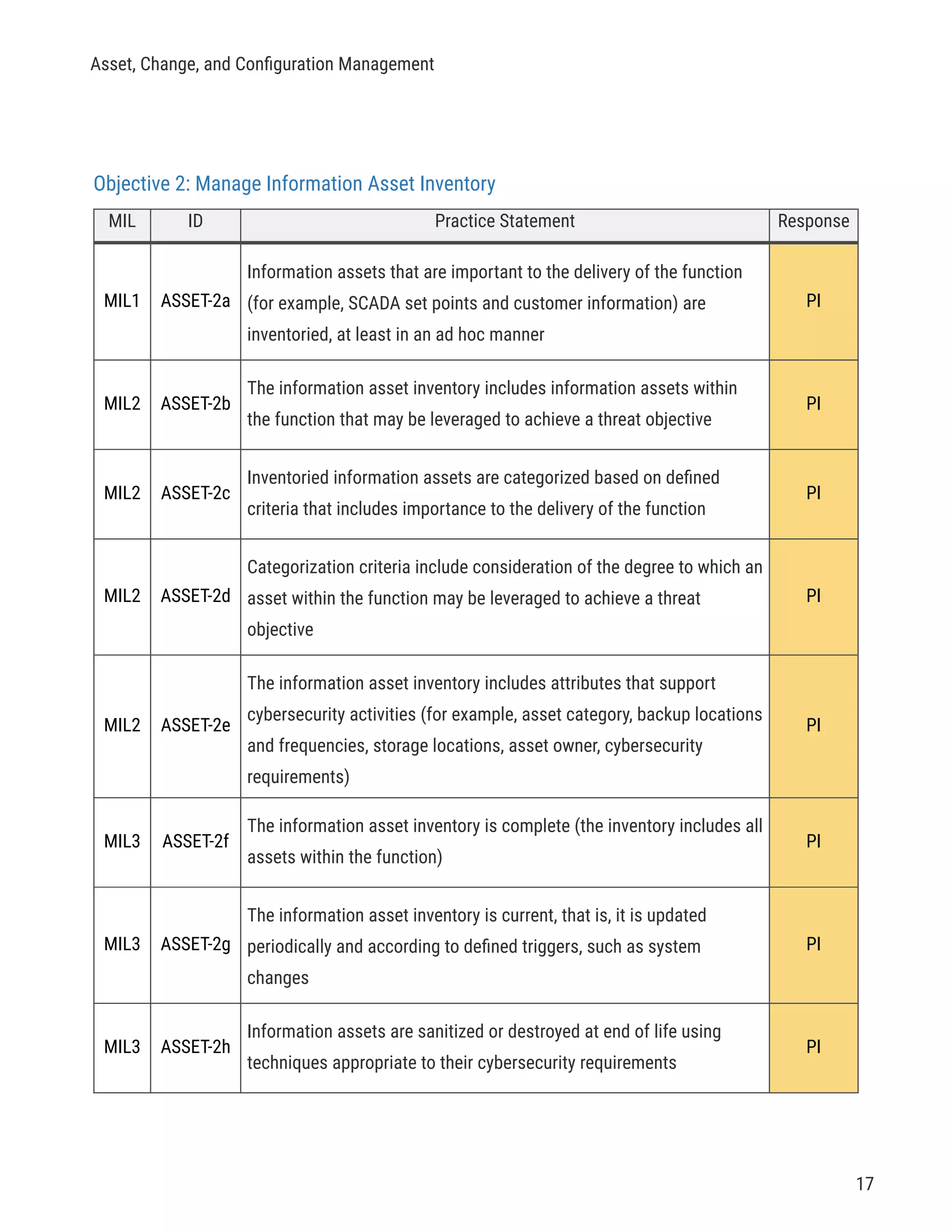
Objective 2: Manage Information Asset Inventory
MIL ID Practice Statement Response
MIL1 ASSET-2a
Information assets that are important to the delivery of the function
(for example, SCADA set points and customer information) are
inventoried, at least in an ad hoc manner
PI
MIL2 ASSET-2b
The information asset inventory includes information assets within
the function that may be leveraged to achieve a threat objective
PI
MIL2 ASSET-2c
Inventoried information assets are categorized based on defined
criteria that includes importance to the delivery of the function
PI
MIL2 ASSET-2d
Categorization criteria include consideration of the degree to which an
asset within the function may be leveraged to achieve a threat
objective
PI
MIL2 ASSET-2e
The information asset inventory includes attributes that support
cybersecurity activities (for example, asset category, backup locations
and frequencies, storage locations, asset owner, cybersecurity
requirements)
PI
MIL3 ASSET-2f
The information asset inventory is complete (the inventory includes all
assets within the function)
PI
MIL3 ASSET-2g
The information asset inventory is current, that is, it is updated
periodically and according to defined triggers, such as system
changes
PI
MIL3 ASSET-2h
Information assets are sanitized or destroyed at end of life using
techniques appropriate to their cybersecurity requirements
PI
Asset, Change, and Configuration Management
17
Objective 3: Manage IT and OT Asset Configurations
MIL ID Practice Statement Response
MIL1 ASSET-3a Configuration baselines are established, at least in an ad hoc manner NI
MIL2 ASSET-3b
Configuration baselines are used to configure assets at deployment
and restoration
NI
MIL2 ASSET-3c
Configuration baselines incorporate applicable requirements from the
cybersecurity architecture (ARCHITECTURE-1f)
PI
MIL2 ASSET-3d
Configuration baselines are reviewed and updated periodically and
according to defined triggers, such as system changes and changes
to the cybersecurity architecture
PI
MIL3 ASSET-3e
Asset configurations are monitored for consistency with baselines
throughout the assets’ lifecycles
PI
Asset, Change, and Configuration Management
18
Objective 4: Manage Changes to IT and OT Assets
MIL ID Practice Statement Response
MIL1 ASSET-4a
Changes to assets are evaluated and approved before being
implemented, at least in an ad hoc manner
NI
MIL1 ASSET-4b Changes to assets are documented, at least in an ad hoc manner NI
MIL2 ASSET-4c
Documentation requirements for asset changes are established and
maintained
PI
MIL2 ASSET-4d Changes to higher priority assets are tested prior to being deployed PI
MIL2 ASSET-4e Changes and updates are implemented in a secure manner PI
MIL2 ASSET-4f
The capability to reverse changes is established and maintained for
assets that are important to the delivery of the function
PI
MIL2 ASSET-4g
Change management practices address the full lifecycle of assets (for
example, acquisition, deployment, operation, and retirement)
PI
MIL3 ASSET-4h
Changes to higher priority assets are tested for cybersecurity impact
prior to being deployed
PI
MIL3 ASSET-4i
Change logs include information about modifications that impact the
cybersecurity requirements of assets
PI
Asset, Change, and Configuration Management
19
Objective 5: Management Activities for the ASSET domain
MIL ID Practice Statement Response
MIL2 ASSET-5a
Documented procedures are established, followed, and maintained for
activities in the ASSET domain
NI
MIL2 ASSET-5b
Adequate resources (people, funding, and tools) are provided to
support activities in the ASSET domain
NI
MIL3 ASSET-5c
Up-to-date policies or other organizational directives define
requirements for activities in the ASSET domain
PI
MIL3 ASSET-5d
Responsibility, accountability, and authority for the performance of
activities in the ASSET domain are assigned to personnel
PI
MIL3 ASSET-5e
Personnel performing activities in the ASSET domain have the skills
and knowledge needed to perform their assigned responsibilities
PI
MIL3 ASSET-5f
The effectiveness of activities in the ASSET domain is evaluated and
tracked
PI
Asset, Change, and Configuration Management
20
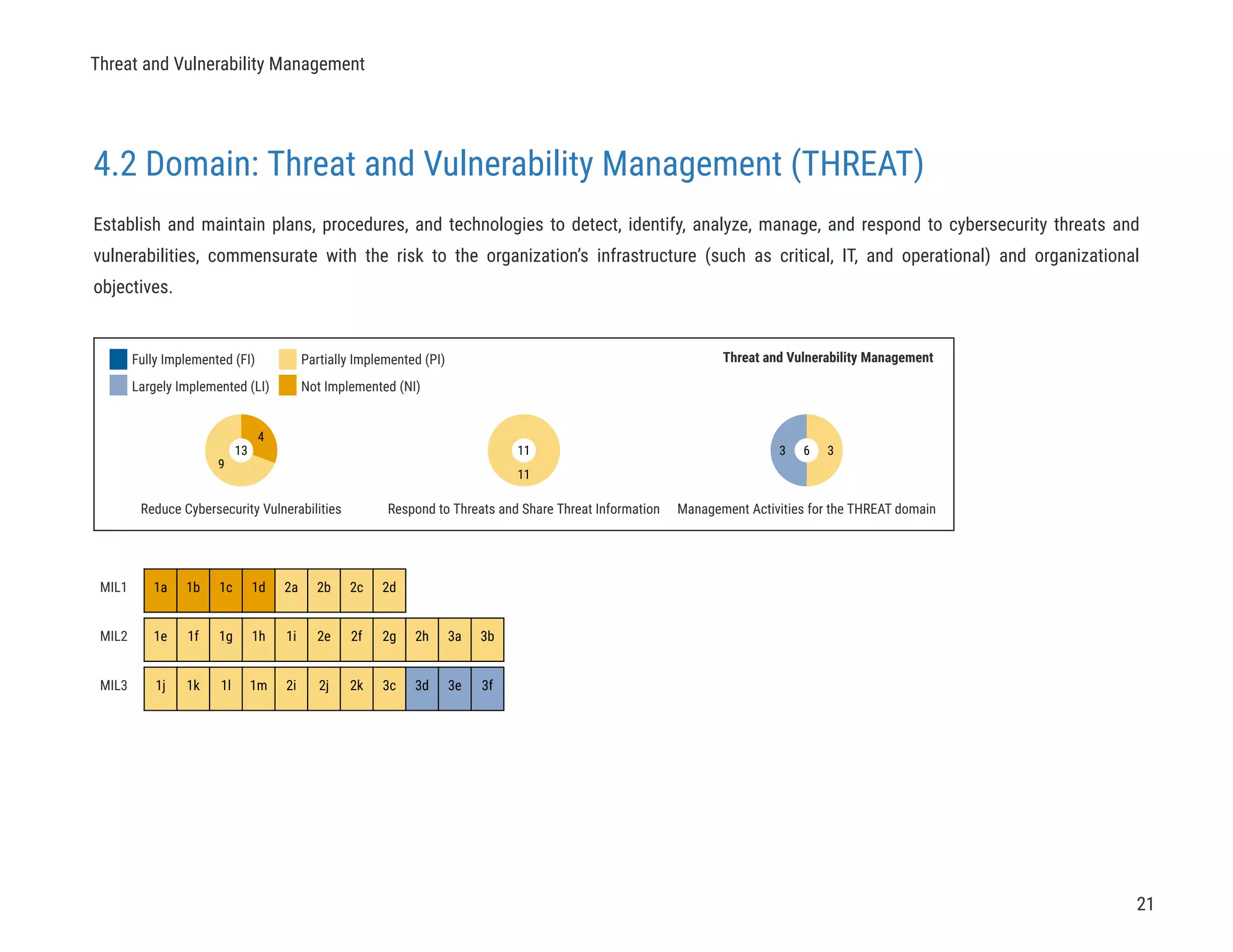
4.2 Domain: Threat and Vulnerability Management (THREAT)
Establish and maintain plans, procedures, and technologies to detect, identify, analyze, manage, and respond to cybersecurity threats and
vulnerabilities, commensurate with the risk to the organization’s infrastructure (such as critical, IT, and operational) and organizational
objectives.
Fully Implemented (FI) Partially Implemented (PI)
Largely Implemented (LI) Not Implemented (NI)
Threat and Vulnerability Management
4
9
13
11
11 3
3 6
Reduce Cybersecurity Vulnerabilities Respond to Threats and Share Threat Information Management Activities for the THREAT domain
MIL1 1a 1b 1c 1d 2a 2b 2c 2d
MIL2 1e 1f 1g 1h 1i 2e 2f 2g 2h 3a 3b
MIL3 1j 1k 1l 1m 2i 2j 2k 3c 3d 3e 3f
Threat and Vulnerability Management
21
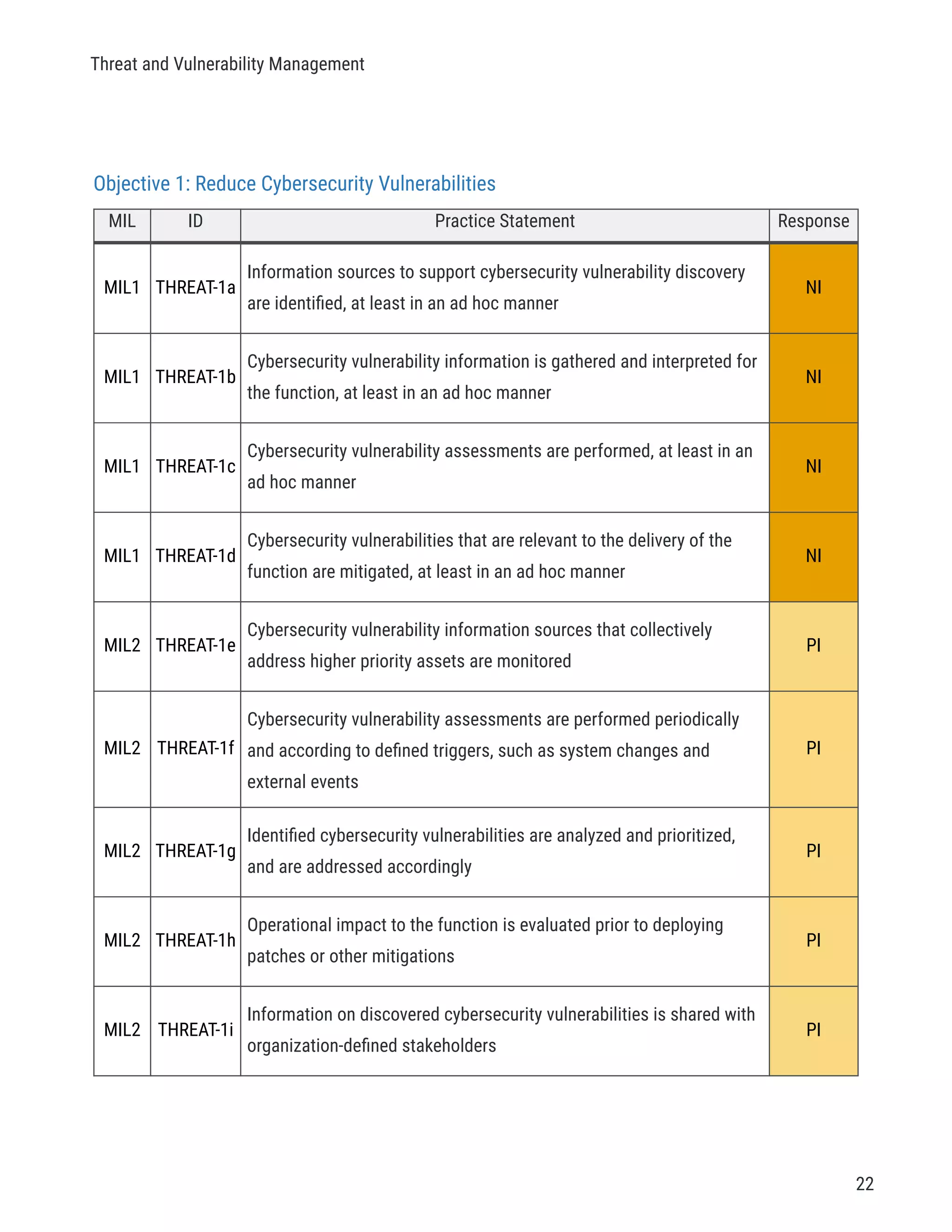
Objective 1: Reduce Cybersecurity Vulnerabilities
MIL ID Practice Statement Response
MIL1 THREAT-1a
Information sources to support cybersecurity vulnerability discovery
are identified, at least in an ad hoc manner
NI
MIL1 THREAT-1b
Cybersecurity vulnerability information is gathered and interpreted for
the function, at least in an ad hoc manner
NI
MIL1 THREAT-1c
Cybersecurity vulnerability assessments are performed, at least in an
ad hoc manner
NI
MIL1 THREAT-1d
Cybersecurity vulnerabilities that are relevant to the delivery of the
function are mitigated, at least in an ad hoc manner
NI
MIL2 THREAT-1e
Cybersecurity vulnerability information sources that collectively
address higher priority assets are monitored
PI
MIL2 THREAT-1f
Cybersecurity vulnerability assessments are performed periodically
and according to defined triggers, such as system changes and
external events
PI
MIL2 THREAT-1g
Identified cybersecurity vulnerabilities are analyzed and prioritized,
and are addressed accordingly
PI
MIL2 THREAT-1h
Operational impact to the function is evaluated prior to deploying
patches or other mitigations
PI
MIL2 THREAT-1i
Information on discovered cybersecurity vulnerabilities is shared with
organization-defined stakeholders
PI
Threat and Vulnerability Management
22
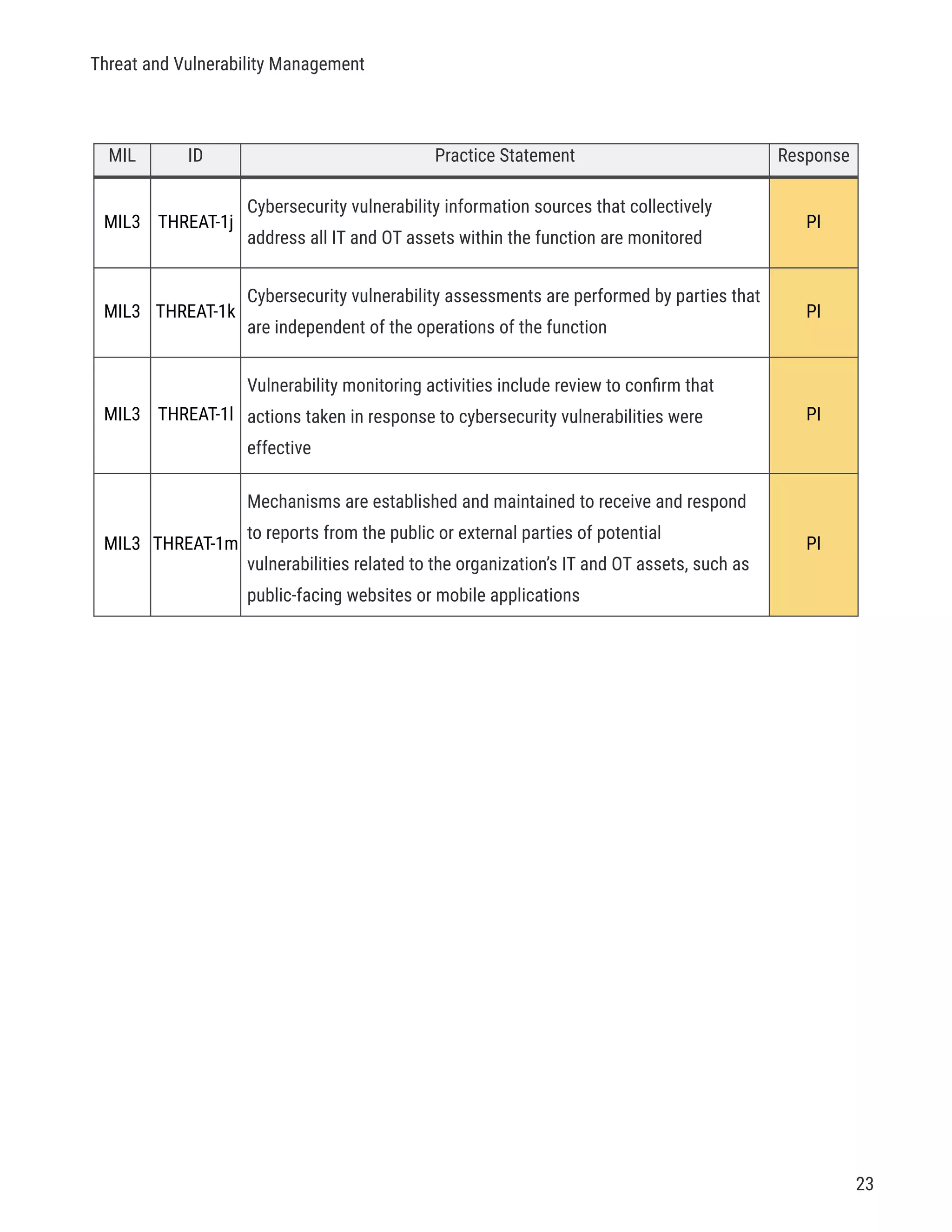
MIL ID Practice Statement Response
MIL3 THREAT-1j
Cybersecurity vulnerability information sources that collectively
address all IT and OT assets within the function are monitored
PI
MIL3 THREAT-1k
Cybersecurity vulnerability assessments are performed by parties that
are independent of the operations of the function
PI
MIL3 THREAT-1l
Vulnerability monitoring activities include review to confirm that
actions taken in response to cybersecurity vulnerabilities were
effective
PI
MIL3 THREAT-1m
Mechanisms are established and maintained to receive and respond
to reports from the public or external parties of potential
vulnerabilities related to the organization’s IT and OT assets, such as
public-facing websites or mobile applications
PI
Threat and Vulnerability Management
23
Objective 2: Respond to Threats and Share Threat Information
MIL ID Practice Statement Response
MIL1 THREAT-2a
Internal and external information sources to support threat
management activities are identified, at least in an ad hoc manner
PI
MIL1 THREAT-2b
Information about cybersecurity threats is gathered and interpreted
for the function, at least in an ad hoc manner
PI
MIL1 THREAT-2c
Threat objectives for the function are identified, at least in an ad hoc
manner
PI
MIL1 THREAT-2d
Threats that are relevant to the delivery of the function are addressed,
at least in an ad hoc manner
PI
MIL2 THREAT-2e
A threat profile for the function is established that includes threat
objectives and additional threat characteristics (for example, threat
actor types, motives, capabilities, and targets)
PI
MIL2 THREAT-2f
Threat information sources that collectively address all components
of the threat profile are prioritized and monitored
PI
MIL2 THREAT-2g
Identified threats are analyzed and prioritized and are addressed
accordingly
PI
MIL2 THREAT-2h
Threat information is exchanged with stakeholders (for example,
executives, operations staff, government, connected organizations,
vendors, sector organizations, regulators, Information Sharing and
Analysis Centers [ISACs])
PI
Threat and Vulnerability Management
24
MIL ID Practice Statement Response
MIL3 THREAT-2i
The threat profile for the function is updated periodically and
according to defined triggers, such as system changes and external
events
PI
MIL3 THREAT-2j
Threat monitoring and response activities leverage and trigger
predefined states of operation (SITUATION-3g)
PI
MIL3 THREAT-2k
Secure, near-real-time methods are used for receiving and sharing
threat information to enable rapid analysis and action
PI
Threat and Vulnerability Management
25
Objective 3: Management Activities for the THREAT domain
MIL ID Practice Statement Response
MIL2 THREAT-3a
Documented procedures are established, followed, and maintained for
activities in the THREAT domain
PI
MIL2 THREAT-3b
Adequate resources (people, funding, and tools) are provided to
support activities in the THREAT domain
PI
MIL3 THREAT-3c
Up-to-date policies or other organizational directives define
requirements for activities in the THREAT domain
PI
MIL3 THREAT-3d
Responsibility, accountability, and authority for the performance of
activities in the THREAT domain are assigned to personnel
LI
MIL3 THREAT-3e
Personnel performing activities in the THREAT domain have the skills
and knowledge needed to perform their assigned responsibilities
LI
MIL3 THREAT-3f
The effectiveness of activities in the THREAT domain is evaluated and
tracked
LI
Threat and Vulnerability Management
26
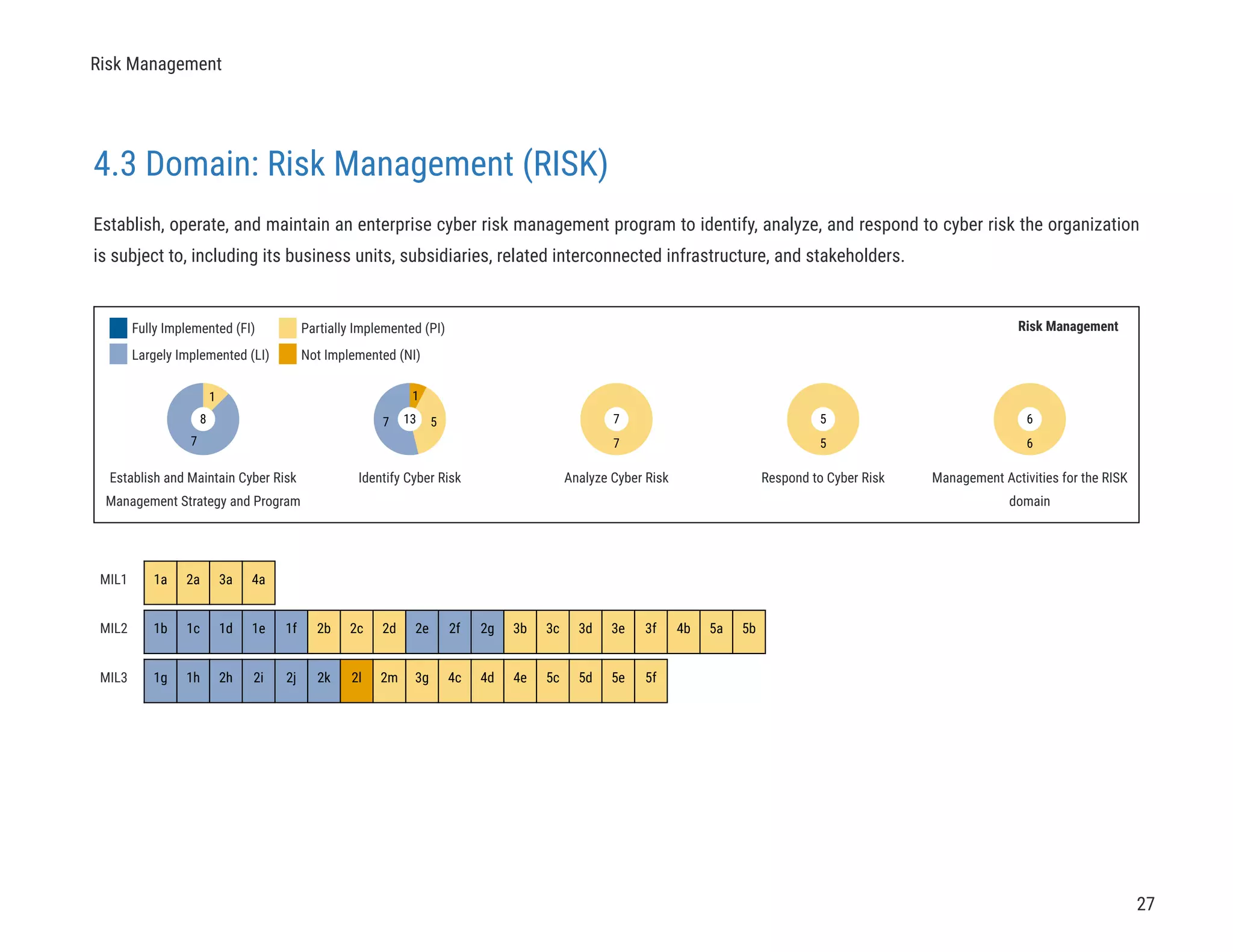
4.3 Domain: Risk Management (RISK)
Establish, operate, and maintain an enterprise cyber risk management program to identify, analyze, and respond to cyber risk the organization
is subject to, including its business units, subsidiaries, related interconnected infrastructure, and stakeholders.
Fully Implemented (FI) Partially Implemented (PI)
Largely Implemented (LI) Not Implemented (NI)
Risk Management
1
7
8
1
5
7 13
7
7
5
5
6
6
Establish and Maintain Cyber Risk
Management Strategy and Program
Identify Cyber Risk Analyze Cyber Risk Respond to Cyber Risk Management Activities for the RISK
domain
MIL1 1a 2a 3a 4a
MIL2 1b 1c 1d 1e 1f 2b 2c 2d 2e 2f 2g 3b 3c 3d 3e 3f 4b 5a 5b
MIL3 1g 1h 2h 2i 2j 2k 2l 2m 3g 4c 4d 4e 5c 5d 5e 5f
Risk Management
27
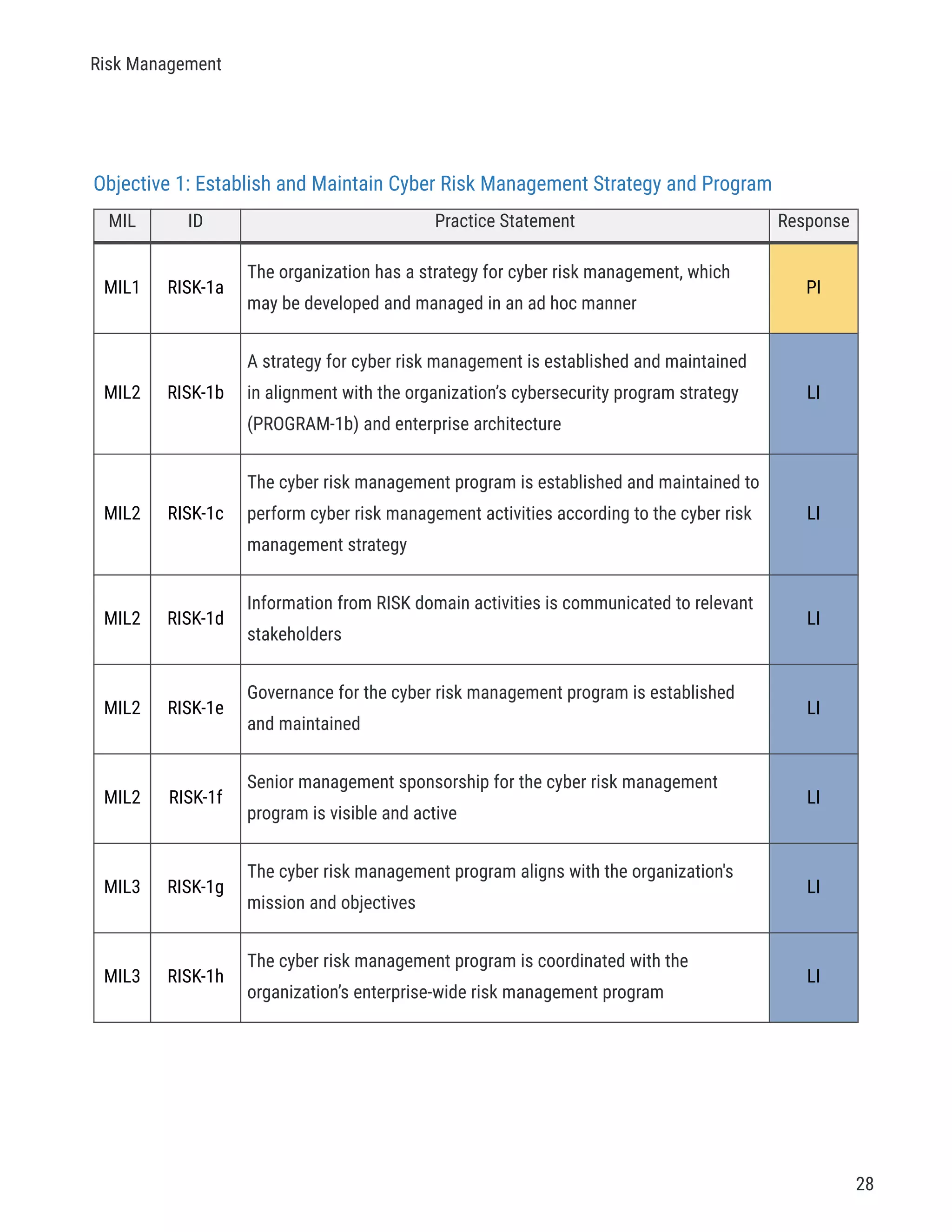
Objective 1: Establish and Maintain Cyber Risk Management Strategy and Program
MIL ID Practice Statement Response
MIL1 RISK-1a
The organization has a strategy for cyber risk management, which
may be developed and managed in an ad hoc manner
PI
MIL2 RISK-1b
A strategy for cyber risk management is established and maintained
in alignment with the organization’s cybersecurity program strategy
(PROGRAM-1b) and enterprise architecture
LI
MIL2 RISK-1c
The cyber risk management program is established and maintained to
perform cyber risk management activities according to the cyber risk
management strategy
LI
MIL2 RISK-1d
Information from RISK domain activities is communicated to relevant
stakeholders
LI
MIL2 RISK-1e
Governance for the cyber risk management program is established
and maintained
LI
MIL2 RISK-1f
Senior management sponsorship for the cyber risk management
program is visible and active
LI
MIL3 RISK-1g
The cyber risk management program aligns with the organization's
mission and objectives
LI
MIL3 RISK-1h
The cyber risk management program is coordinated with the
organization’s enterprise-wide risk management program
LI
Risk Management
28
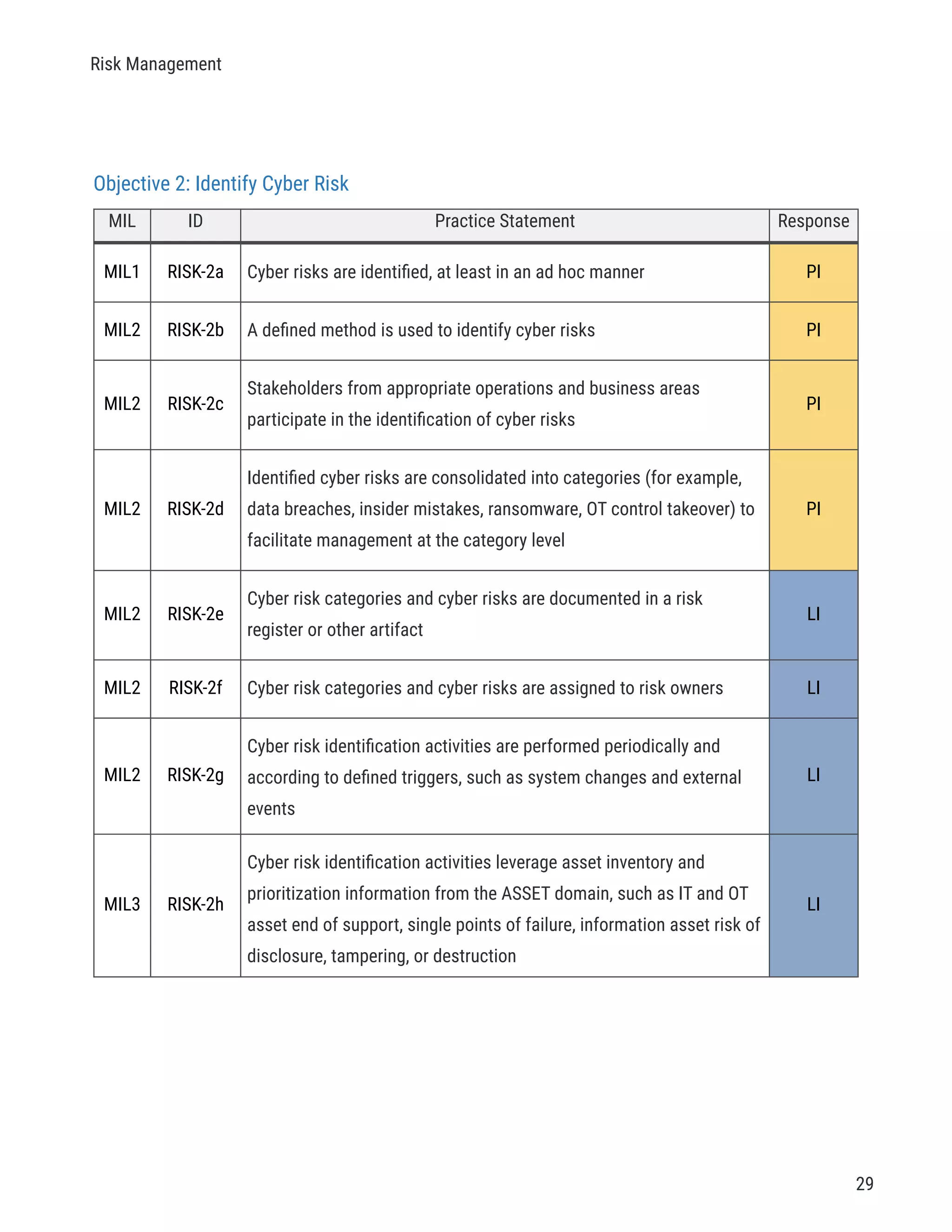
Objective 2: Identify Cyber Risk
MIL ID Practice Statement Response
MIL1 RISK-2a Cyber risks are identified, at least in an ad hoc manner PI
MIL2 RISK-2b A defined method is used to identify cyber risks PI
MIL2 RISK-2c
Stakeholders from appropriate operations and business areas
participate in the identification of cyber risks
PI
MIL2 RISK-2d
Identified cyber risks are consolidated into categories (for example,
data breaches, insider mistakes, ransomware, OT control takeover) to
facilitate management at the category level
PI
MIL2 RISK-2e
Cyber risk categories and cyber risks are documented in a risk
register or other artifact
LI
MIL2 RISK-2f Cyber risk categories and cyber risks are assigned to risk owners LI
MIL2 RISK-2g
Cyber risk identification activities are performed periodically and
according to defined triggers, such as system changes and external
events
LI
MIL3 RISK-2h
Cyber risk identification activities leverage asset inventory and
prioritization information from the ASSET domain, such as IT and OT
asset end of support, single points of failure, information asset risk of
disclosure, tampering, or destruction
LI
Risk Management
29
MIL ID Practice Statement Response
MIL3 RISK-2i
Vulnerability management information from THREAT domain activities
is used to update cyber risks and identify new risks (such as risks
arising from vulnerabilities that pose an ongoing risk to the
organization or newly identified vulnerabilities)
LI
MIL3 RISK-2j
Threat management information from THREAT domain activities is
used to update cyber risks and identify new risks
LI
MIL3 RISK-2k
Information from THIRD-PARTIES domain activities is used to update
cyber risks and identify new risks
LI
MIL3 RISK-2l
Information from ARCHITECTURE domain activities (such as
unmitigated architectural conformance gaps) is used to update cyber
risks and identify new risks
NI
MIL3 RISK-2m
Cyber risk identification considers risks that may arise from or affect
critical infrastructure or other interdependent organizations
PI
Risk Management
30
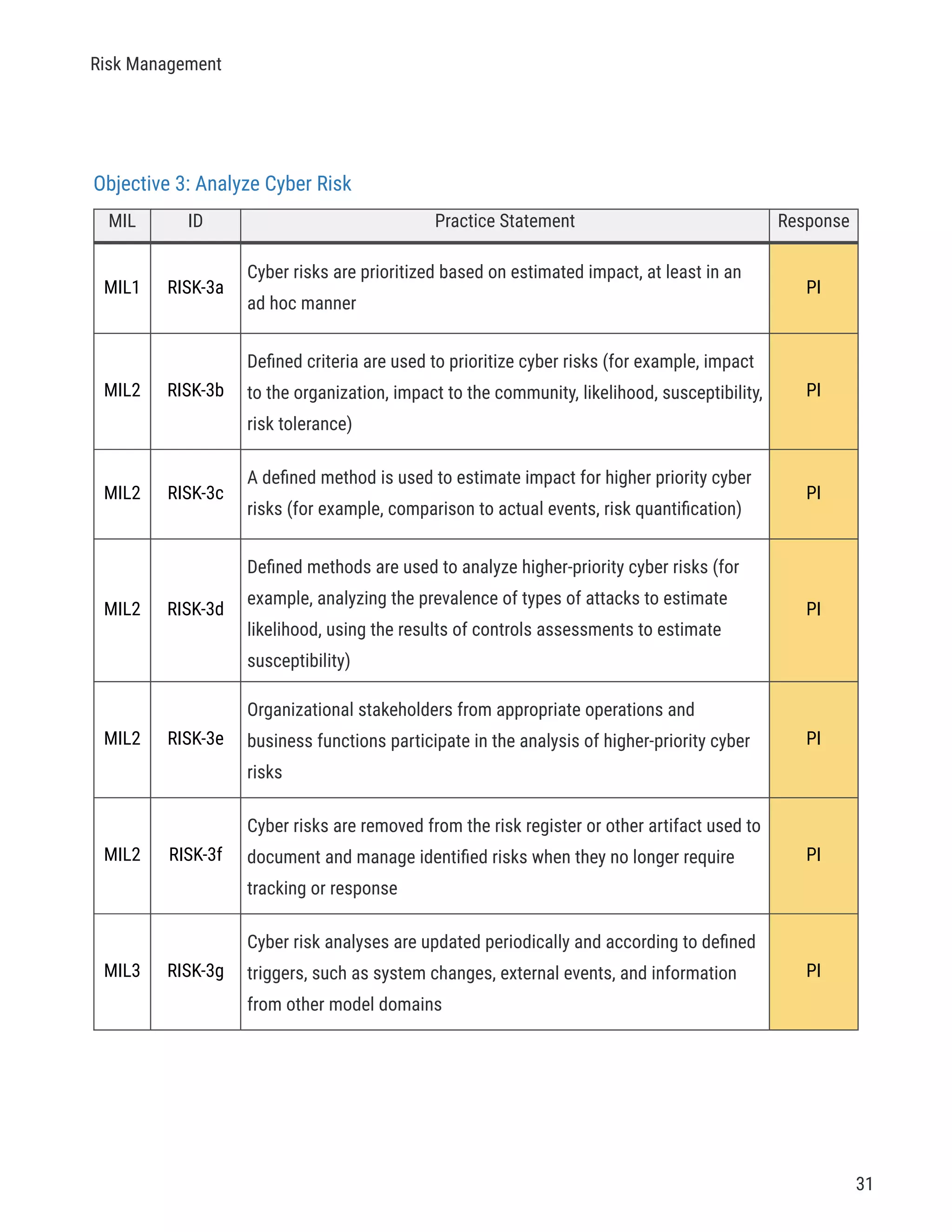
Objective 3: Analyze Cyber Risk
MIL ID Practice Statement Response
MIL1 RISK-3a
Cyber risks are prioritized based on estimated impact, at least in an
ad hoc manner
PI
MIL2 RISK-3b
Defined criteria are used to prioritize cyber risks (for example, impact
to the organization, impact to the community, likelihood, susceptibility,
risk tolerance)
PI
MIL2 RISK-3c
A defined method is used to estimate impact for higher priority cyber
risks (for example, comparison to actual events, risk quantification)
PI
MIL2 RISK-3d
Defined methods are used to analyze higher-priority cyber risks (for
example, analyzing the prevalence of types of attacks to estimate
likelihood, using the results of controls assessments to estimate
susceptibility)
PI
MIL2 RISK-3e
Organizational stakeholders from appropriate operations and
business functions participate in the analysis of higher-priority cyber
risks
PI
MIL2 RISK-3f
Cyber risks are removed from the risk register or other artifact used to
document and manage identified risks when they no longer require
tracking or response
PI
MIL3 RISK-3g
Cyber risk analyses are updated periodically and according to defined
triggers, such as system changes, external events, and information
from other model domains
PI
Risk Management
31
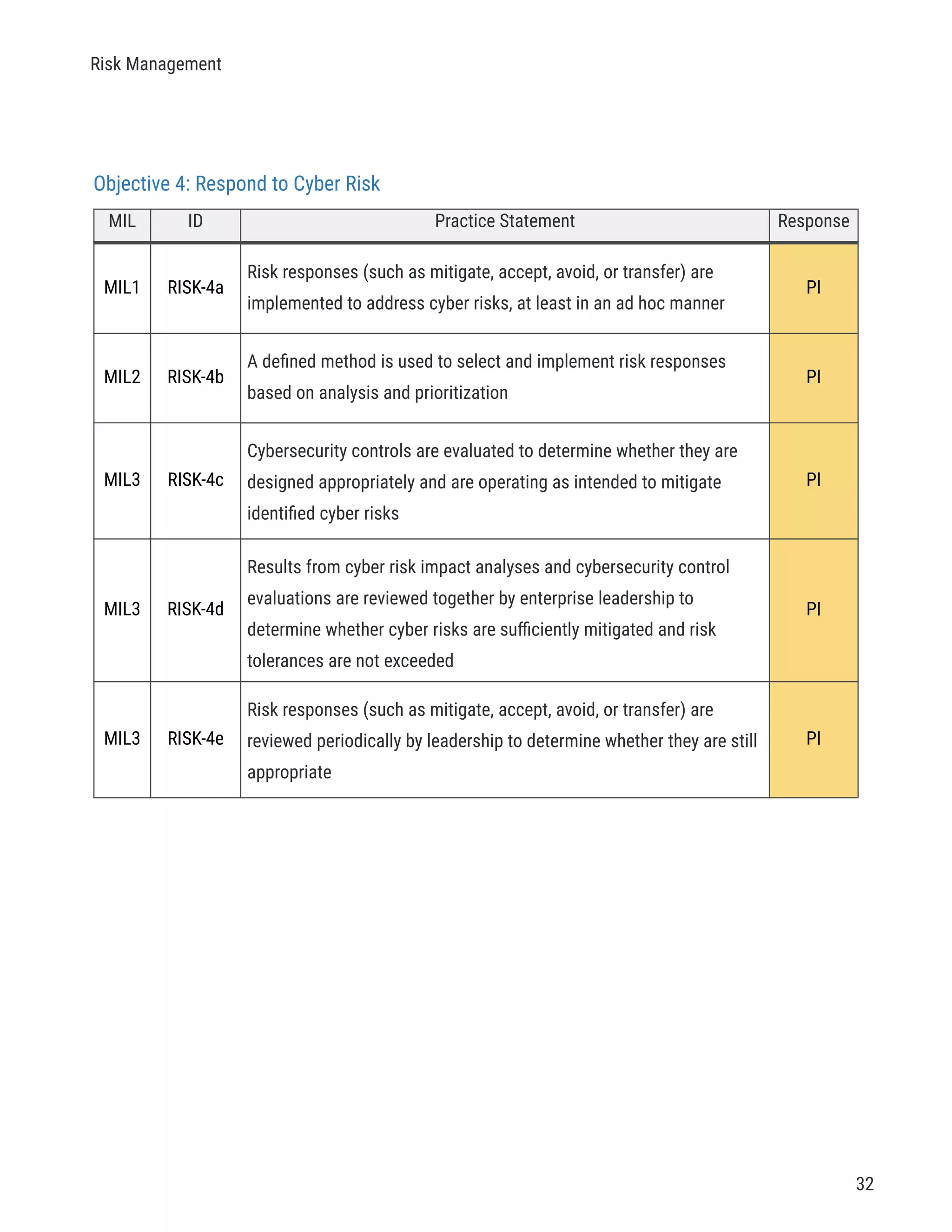
Objective 4: Respond to Cyber Risk
MIL ID Practice Statement Response
MIL1 RISK-4a
Risk responses (such as mitigate, accept, avoid, or transfer) are
implemented to address cyber risks, at least in an ad hoc manner
PI
MIL2 RISK-4b
A defined method is used to select and implement risk responses
based on analysis and prioritization
PI
MIL3 RISK-4c
Cybersecurity controls are evaluated to determine whether they are
designed appropriately and are operating as intended to mitigate
identified cyber risks
PI
MIL3 RISK-4d
Results from cyber risk impact analyses and cybersecurity control
evaluations are reviewed together by enterprise leadership to
determine whether cyber risks are sufficiently mitigated and risk
tolerances are not exceeded
PI
MIL3 RISK-4e
Risk responses (such as mitigate, accept, avoid, or transfer) are
reviewed periodically by leadership to determine whether they are still
appropriate
PI
Risk Management
32
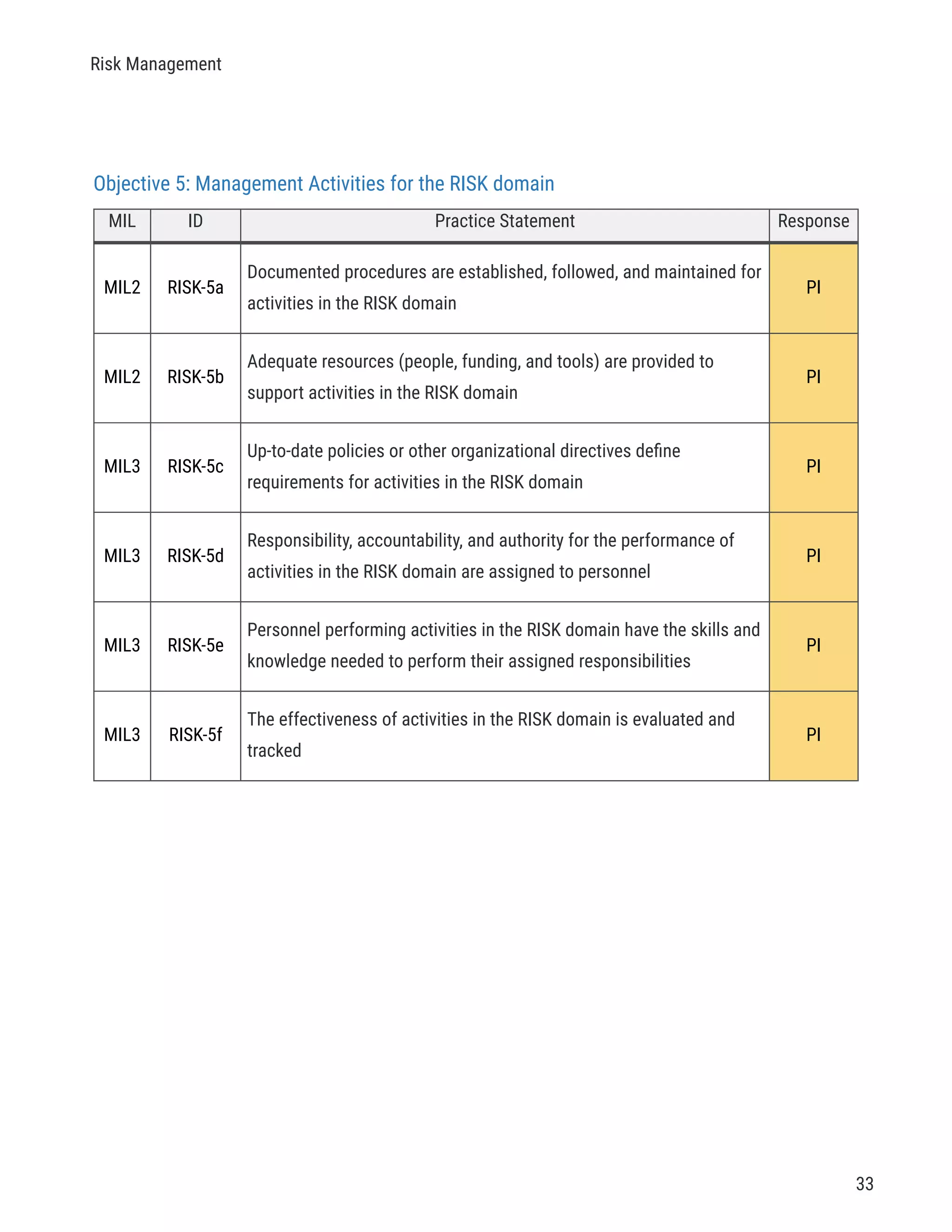
Objective 5: Management Activities for the RISK domain
MIL ID Practice Statement Response
MIL2 RISK-5a
Documented procedures are established, followed, and maintained for
activities in the RISK domain
PI
MIL2 RISK-5b
Adequate resources (people, funding, and tools) are provided to
support activities in the RISK domain
PI
MIL3 RISK-5c
Up-to-date policies or other organizational directives define
requirements for activities in the RISK domain
PI
MIL3 RISK-5d
Responsibility, accountability, and authority for the performance of
activities in the RISK domain are assigned to personnel
PI
MIL3 RISK-5e
Personnel performing activities in the RISK domain have the skills and
knowledge needed to perform their assigned responsibilities
PI
MIL3 RISK-5f
The effectiveness of activities in the RISK domain is evaluated and
tracked
PI
Risk Management
33
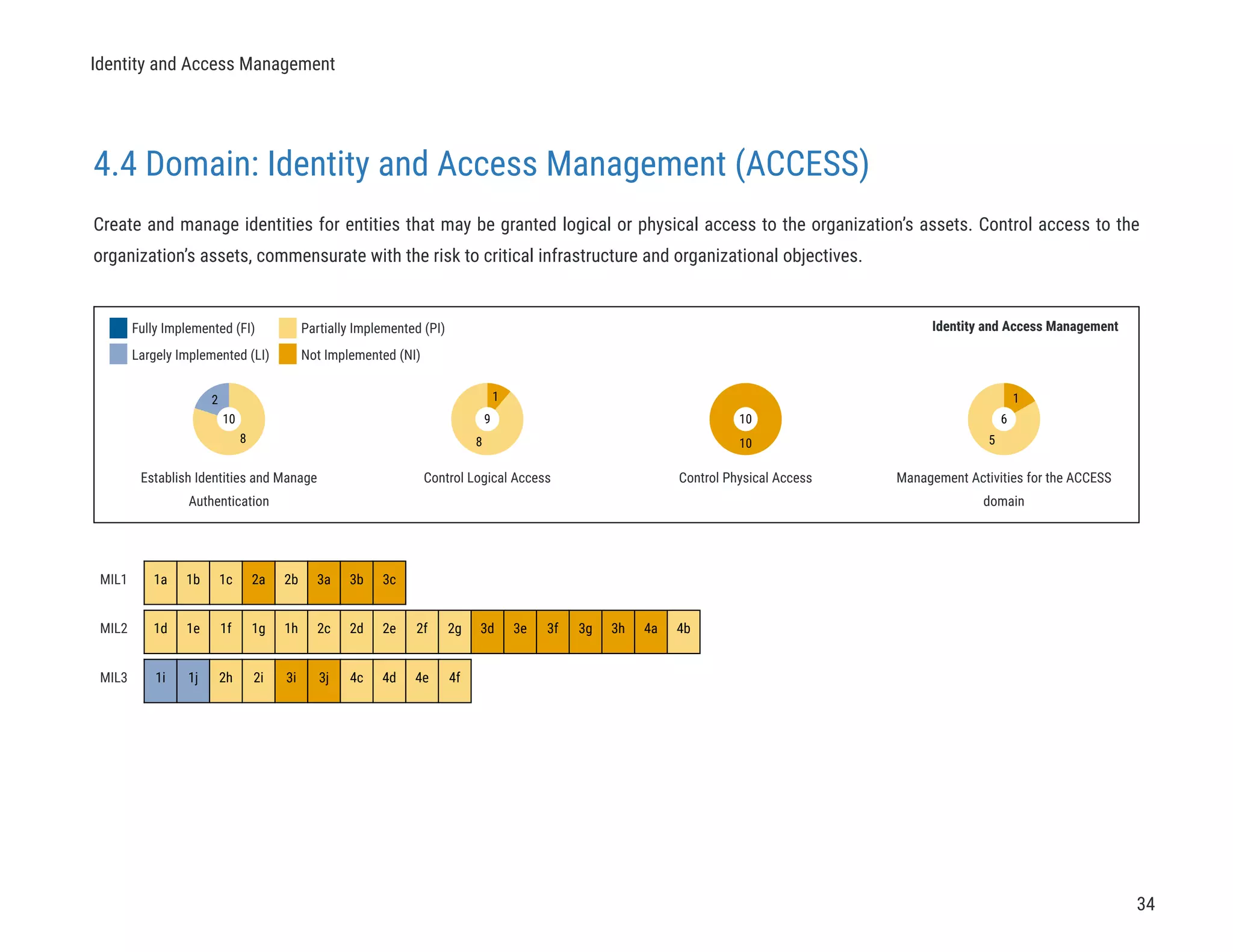
4.4 Domain: Identity and Access Management (ACCESS)
Create and manage identities for entities that may be granted logical or physical access to the organization’s assets. Control access to the
organization’s assets, commensurate with the risk to critical infrastructure and organizational objectives.
Fully Implemented (FI) Partially Implemented (PI)
Largely Implemented (LI) Not Implemented (NI)
Identity and Access Management
8
2
10
1
8
9
10
10
1
5
6
Establish Identities and Manage
Authentication
Control Logical Access Control Physical Access Management Activities for the ACCESS
domain
MIL1 1a 1b 1c 2a 2b 3a 3b 3c
MIL2 1d 1e 1f 1g 1h 2c 2d 2e 2f 2g 3d 3e 3f 3g 3h 4a 4b
MIL3 1i 1j 2h 2i 3i 3j 4c 4d 4e 4f
Identity and Access Management
34
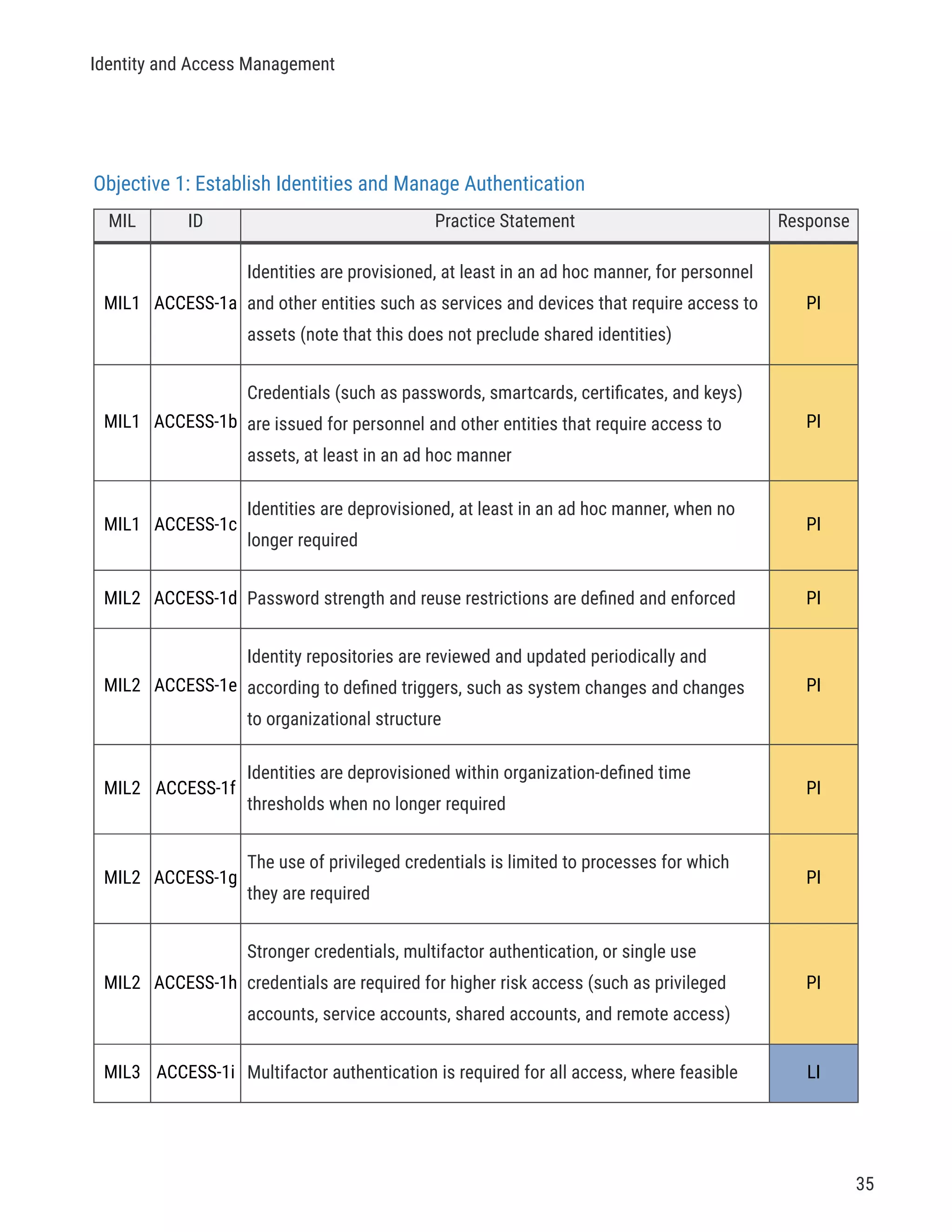
Objective 1: Establish Identities and Manage Authentication
MIL ID Practice Statement Response
MIL1 ACCESS-1a
Identities are provisioned, at least in an ad hoc manner, for personnel
and other entities such as services and devices that require access to
assets (note that this does not preclude shared identities)
PI
MIL1 ACCESS-1b
Credentials (such as passwords, smartcards, certificates, and keys)
are issued for personnel and other entities that require access to
assets, at least in an ad hoc manner
PI
MIL1 ACCESS-1c
Identities are deprovisioned, at least in an ad hoc manner, when no
longer required
PI
MIL2 ACCESS-1d Password strength and reuse restrictions are defined and enforced PI
MIL2 ACCESS-1e
Identity repositories are reviewed and updated periodically and
according to defined triggers, such as system changes and changes
to organizational structure
PI
MIL2 ACCESS-1f
Identities are deprovisioned within organization-defined time
thresholds when no longer required
PI
MIL2 ACCESS-1g
The use of privileged credentials is limited to processes for which
they are required
PI
MIL2 ACCESS-1h
Stronger credentials, multifactor authentication, or single use
credentials are required for higher risk access (such as privileged
accounts, service accounts, shared accounts, and remote access)
PI
MIL3 ACCESS-1i Multifactor authentication is required for all access, where feasible LI
Identity and Access Management
35
MIL ID Practice Statement Response
MIL3 ACCESS-1j
Identities are disabled after a defined period of inactivity, where
feasible
LI
Identity and Access Management
36
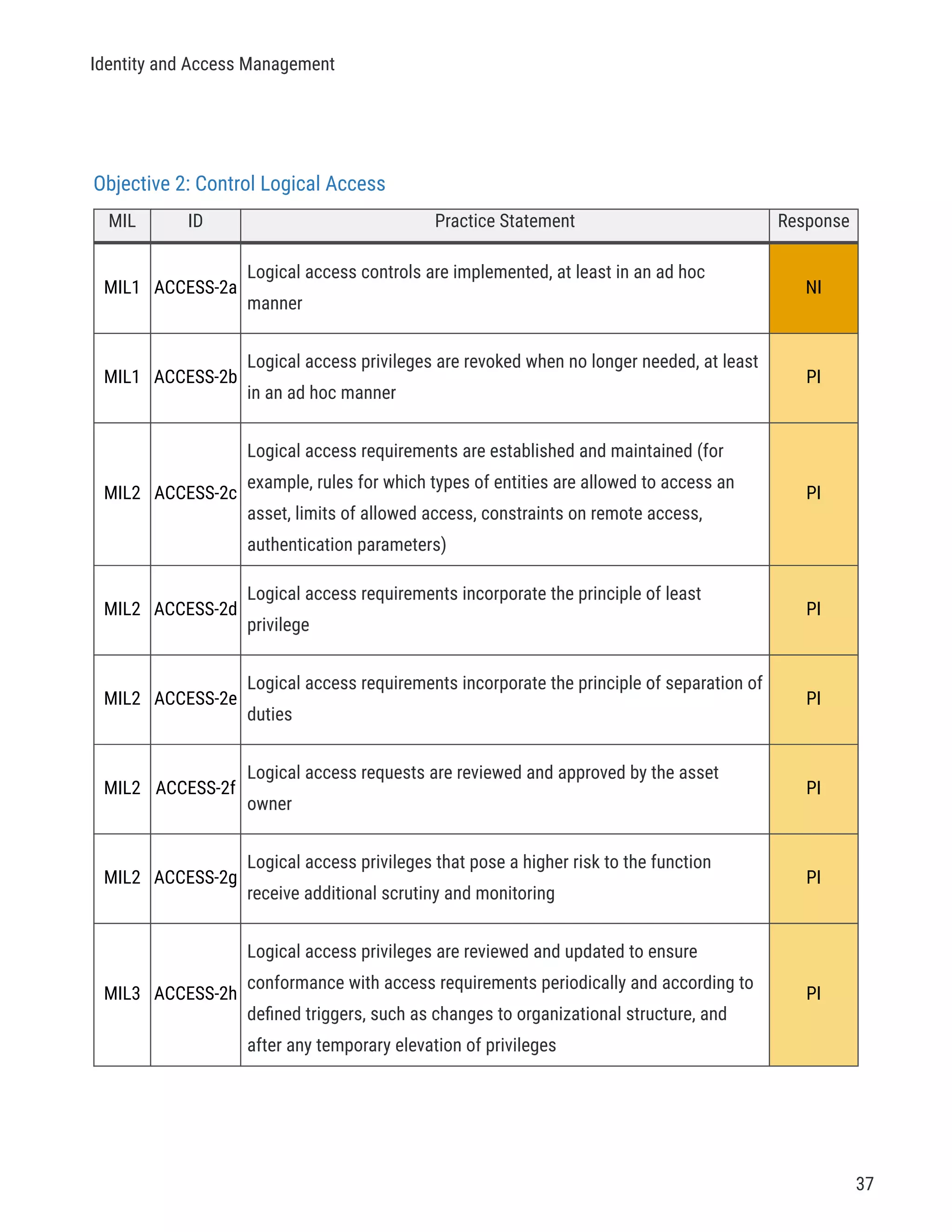
Objective 2: Control Logical Access
MIL ID Practice Statement Response
MIL1 ACCESS-2a
Logical access controls are implemented, at least in an ad hoc
manner
NI
MIL1 ACCESS-2b
Logical access privileges are revoked when no longer needed, at least
in an ad hoc manner
PI
MIL2 ACCESS-2c
Logical access requirements are established and maintained (for
example, rules for which types of entities are allowed to access an
asset, limits of allowed access, constraints on remote access,
authentication parameters)
PI
MIL2 ACCESS-2d
Logical access requirements incorporate the principle of least
privilege
PI
MIL2 ACCESS-2e
Logical access requirements incorporate the principle of separation of
duties
PI
MIL2 ACCESS-2f
Logical access requests are reviewed and approved by the asset
owner
PI
MIL2 ACCESS-2g
Logical access privileges that pose a higher risk to the function
receive additional scrutiny and monitoring
PI
MIL3 ACCESS-2h
Logical access privileges are reviewed and updated to ensure
conformance with access requirements periodically and according to
defined triggers, such as changes to organizational structure, and
after any temporary elevation of privileges
PI
Identity and Access Management
37
MIL ID Practice Statement Response
MIL3 ACCESS-2i
Anomalous logical access attempts are monitored as indicators of
cybersecurity events
PI
Identity and Access Management
38
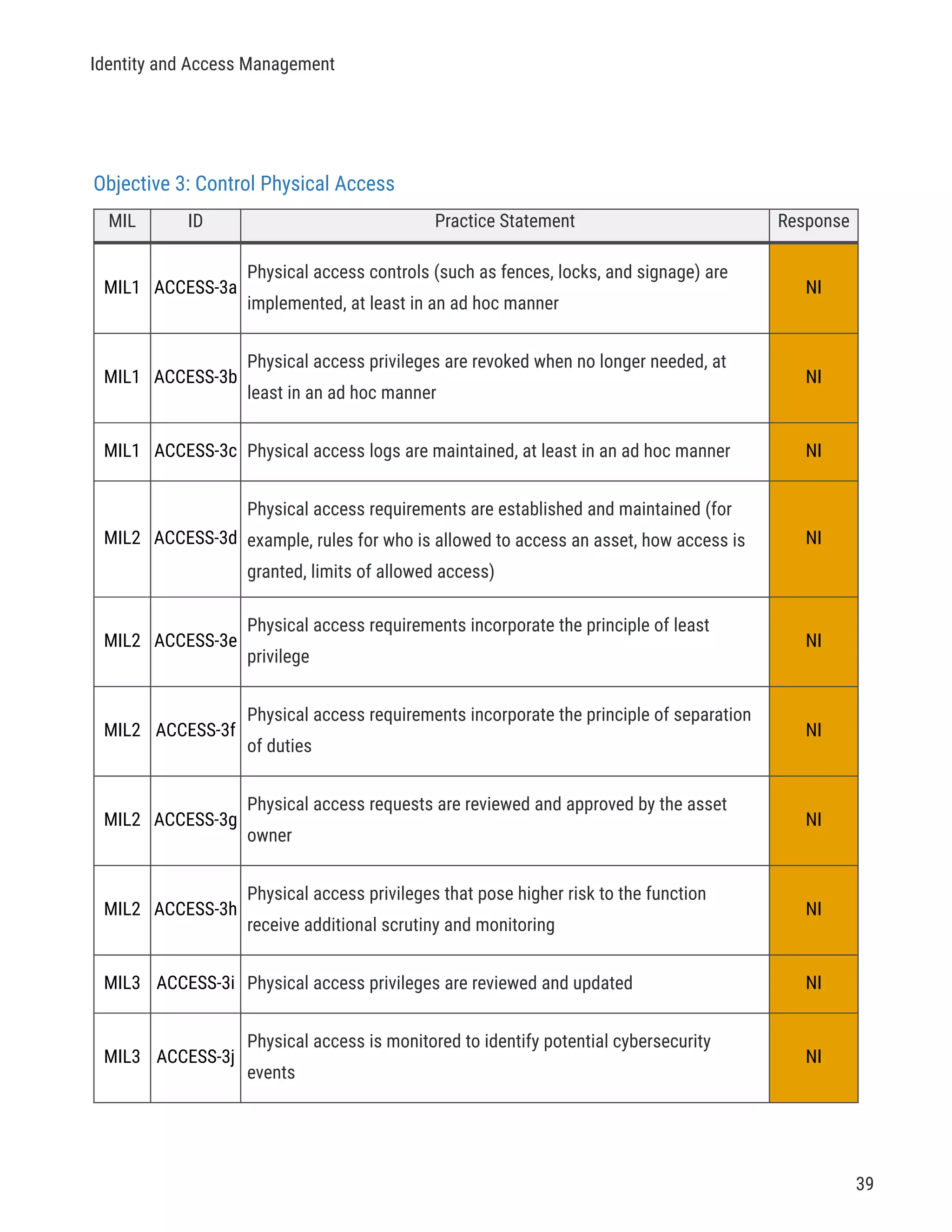
Objective 3: Control Physical Access
MIL ID Practice Statement Response
MIL1 ACCESS-3a
Physical access controls (such as fences, locks, and signage) are
implemented, at least in an ad hoc manner
NI
MIL1 ACCESS-3b
Physical access privileges are revoked when no longer needed, at
least in an ad hoc manner
NI
MIL1 ACCESS-3c Physical access logs are maintained, at least in an ad hoc manner NI
MIL2 ACCESS-3d
Physical access requirements are established and maintained (for
example, rules for who is allowed to access an asset, how access is
granted, limits of allowed access)
NI
MIL2 ACCESS-3e
Physical access requirements incorporate the principle of least
privilege
NI
MIL2 ACCESS-3f
Physical access requirements incorporate the principle of separation
of duties
NI
MIL2 ACCESS-3g
Physical access requests are reviewed and approved by the asset
owner
NI
MIL2 ACCESS-3h
Physical access privileges that pose higher risk to the function
receive additional scrutiny and monitoring
NI
MIL3 ACCESS-3i Physical access privileges are reviewed and updated NI
MIL3 ACCESS-3j
Physical access is monitored to identify potential cybersecurity
events
NI
Identity and Access Management
39
Objective 4: Management Activities for the ACCESS domain
MIL ID Practice Statement Response
MIL2 ACCESS-4a
Documented procedures are established, followed, and maintained for
activities in the ACCESS domain
NI
MIL2 ACCESS-4b
Adequate resources (people, funding, and tools) are provided to
support activities in the ACCESS domain
PI
MIL3 ACCESS-4c
Up-to-date policies or other organizational directives define
requirements for activities in the ACCESS domain
PI
MIL3 ACCESS-4d
Responsibility, accountability, and authority for the performance of
activities in the ACCESS domain are assigned to personnel
PI
MIL3 ACCESS-4e
Personnel performing activities in the ACCESS domain have the skills
and knowledge needed to perform their assigned responsibilities
PI
MIL3 ACCESS-4f
The effectiveness of activities in the ACCESS domain is evaluated and
tracked
PI
Identity and Access Management
40
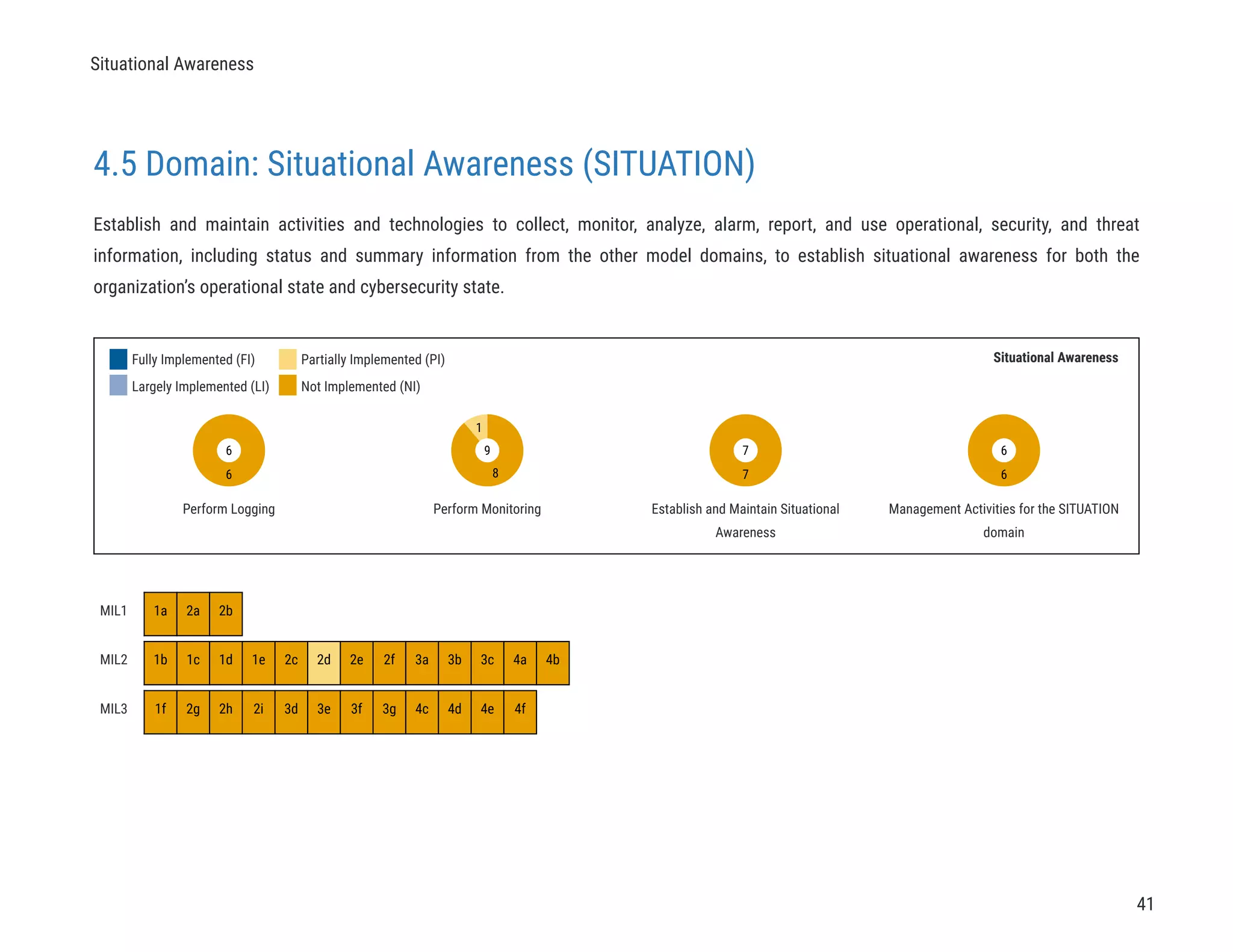
4.5 Domain: Situational Awareness (SITUATION)
Establish and maintain activities and technologies to collect, monitor, analyze, alarm, report, and use operational, security, and threat
information, including status and summary information from the other model domains, to establish situational awareness for both the
organization’s operational state and cybersecurity state.
Fully Implemented (FI) Partially Implemented (PI)
Largely Implemented (LI) Not Implemented (NI)
Situational Awareness
6
6
8
1
9
7
7
6
6
Perform Logging Perform Monitoring Establish and Maintain Situational
Awareness
Management Activities for the SITUATION
domain
MIL1 1a 2a 2b
MIL2 1b 1c 1d 1e 2c 2d 2e 2f 3a 3b 3c 4a 4b
MIL3 1f 2g 2h 2i 3d 3e 3f 3g 4c 4d 4e 4f
Situational Awareness
41
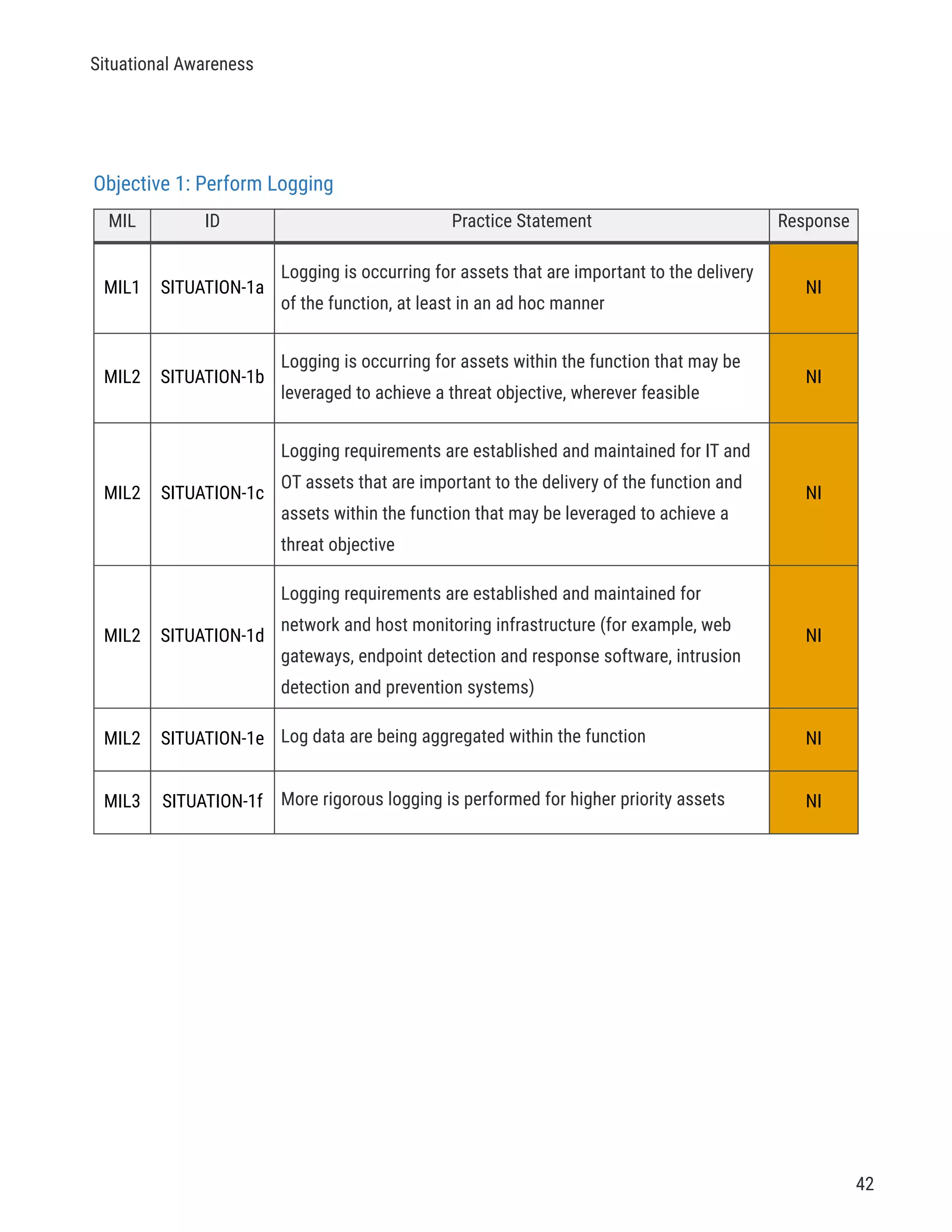
Objective 1: Perform Logging
MIL ID Practice Statement Response
MIL1 SITUATION-1a
Logging is occurring for assets that are important to the delivery
of the function, at least in an ad hoc manner
NI
MIL2 SITUATION-1b
Logging is occurring for assets within the function that may be
leveraged to achieve a threat objective, wherever feasible
NI
MIL2 SITUATION-1c
Logging requirements are established and maintained for IT and
OT assets that are important to the delivery of the function and
assets within the function that may be leveraged to achieve a
threat objective
NI
MIL2 SITUATION-1d
Logging requirements are established and maintained for
network and host monitoring infrastructure (for example, web
gateways, endpoint detection and response software, intrusion
detection and prevention systems)
NI
MIL2 SITUATION-1e Log data are being aggregated within the function NI
MIL3 SITUATION-1f More rigorous logging is performed for higher priority assets NI
Situational Awareness
42
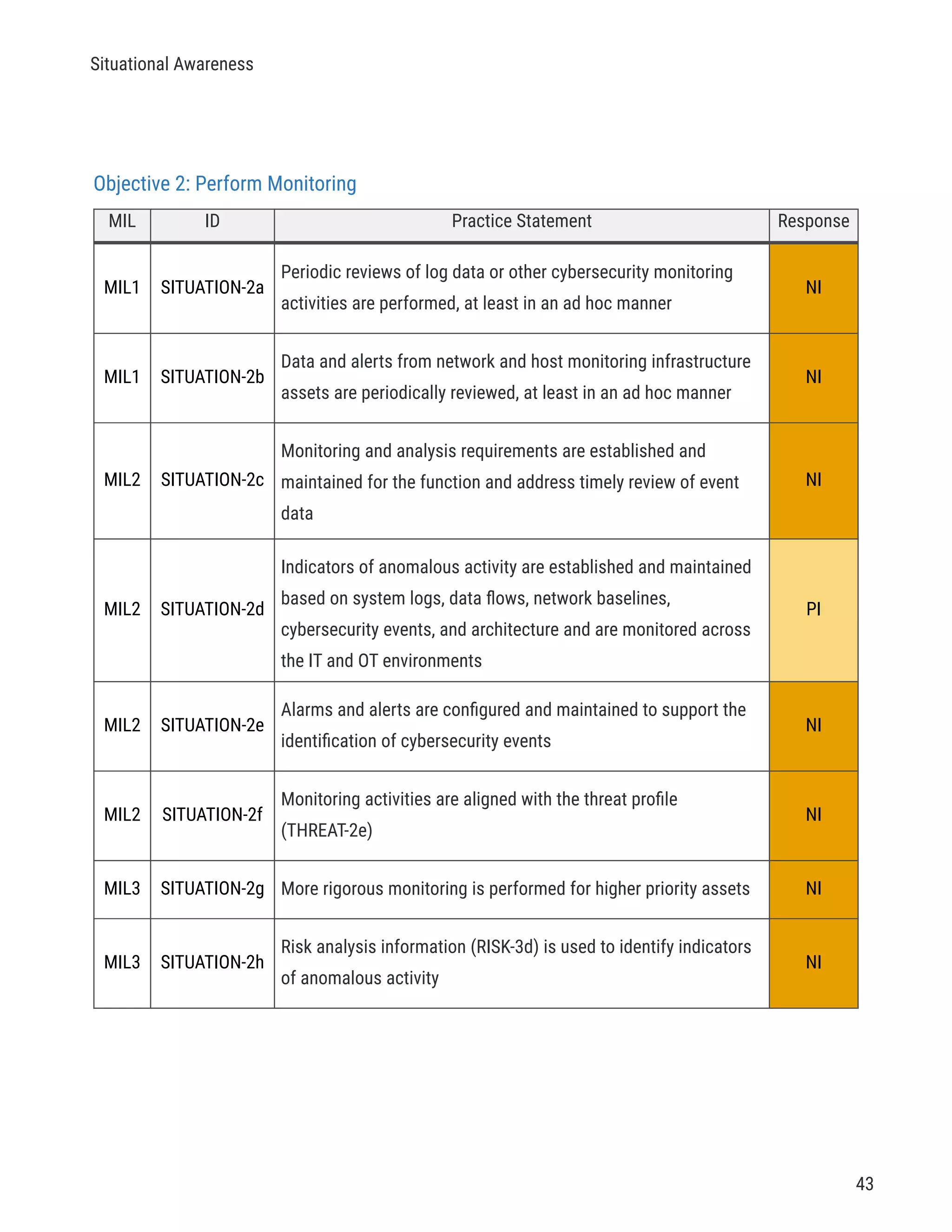
Objective 2: Perform Monitoring
MIL ID Practice Statement Response
MIL1 SITUATION-2a
Periodic reviews of log data or other cybersecurity monitoring
activities are performed, at least in an ad hoc manner
NI
MIL1 SITUATION-2b
Data and alerts from network and host monitoring infrastructure
assets are periodically reviewed, at least in an ad hoc manner
NI
MIL2 SITUATION-2c
Monitoring and analysis requirements are established and
maintained for the function and address timely review of event
data
NI
MIL2 SITUATION-2d
Indicators of anomalous activity are established and maintained
based on system logs, data flows, network baselines,
cybersecurity events, and architecture and are monitored across
the IT and OT environments
PI
MIL2 SITUATION-2e
Alarms and alerts are configured and maintained to support the
identification of cybersecurity events
NI
MIL2 SITUATION-2f
Monitoring activities are aligned with the threat profile
(THREAT-2e)
NI
MIL3 SITUATION-2g More rigorous monitoring is performed for higher priority assets NI
MIL3 SITUATION-2h
Risk analysis information (RISK-3d) is used to identify indicators
of anomalous activity
NI
Situational Awareness
43
MIL ID Practice Statement Response
MIL3 SITUATION-2i
Indicators of anomalous activity are evaluated and updated
periodically and according to defined triggers, such as system
changes and external events
NI
Situational Awareness
44
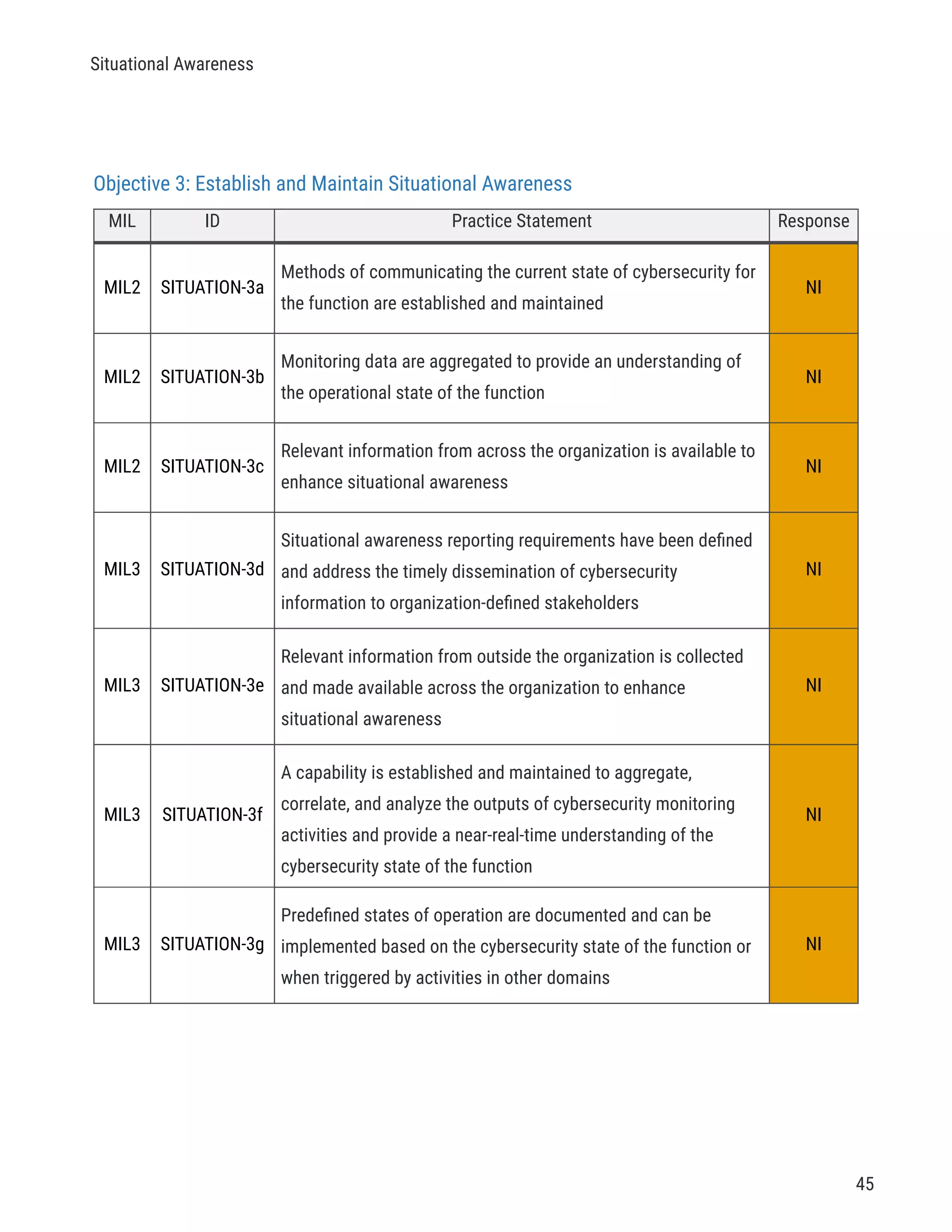
Objective 3: Establish and Maintain Situational Awareness
MIL ID Practice Statement Response
MIL2 SITUATION-3a
Methods of communicating the current state of cybersecurity for
the function are established and maintained
NI
MIL2 SITUATION-3b
Monitoring data are aggregated to provide an understanding of
the operational state of the function
NI
MIL2 SITUATION-3c
Relevant information from across the organization is available to
enhance situational awareness
NI
MIL3 SITUATION-3d
Situational awareness reporting requirements have been defined
and address the timely dissemination of cybersecurity
information to organization-defined stakeholders
NI
MIL3 SITUATION-3e
Relevant information from outside the organization is collected
and made available across the organization to enhance
situational awareness
NI
MIL3 SITUATION-3f
A capability is established and maintained to aggregate,
correlate, and analyze the outputs of cybersecurity monitoring
activities and provide a near-real-time understanding of the
cybersecurity state of the function
NI
MIL3 SITUATION-3g
Predefined states of operation are documented and can be
implemented based on the cybersecurity state of the function or
when triggered by activities in other domains
NI
Situational Awareness
45
Objective 4: Management Activities for the SITUATION domain
MIL ID Practice Statement Response
MIL2 SITUATION-4a
Documented procedures are established, followed, and
maintained for activities in the SITUATION domain
NI
MIL2 SITUATION-4b
Adequate resources (people, funding, and tools) are provided to
support activities in the SITUATION domain
NI
MIL3 SITUATION-4c
Up-to-date policies or other organizational directives define
requirements for activities in the SITUATION domain
NI
MIL3 SITUATION-4d
Responsibility, accountability, and authority for the performance
of activities in the SITUATION domain are assigned to personnel
NI
MIL3 SITUATION-4e
Personnel performing activities in the SITUATION domain have
the skills and knowledge needed to perform their assigned
responsibilities
NI
MIL3 SITUATION-4f
The effectiveness of activities in the SITUATION domain is
evaluated and tracked
NI
Situational Awareness
46
4.6 Domain: Event and Incident Response, Continuity of Operations
(RESPONSE)
Establish and maintain plans, procedures, and technologies to detect, analyze, mitigate, respond to, and recover from cybersecurity events and
incidents and to sustain operations during cybersecurity incidents, commensurate with the risk to critical infrastructure and organizational
objectives.
Fully Implemented (FI) Partially Implemented (PI)
Largely Implemented (LI) Not Implemented (NI)
Event and Incident Response, Continuity of Operations
5
1
6
9
9
8
1
3
12
3
13
16
1
4
1
6
Detect Cybersecurity Events Analyze Cybersecurity Events and
Declare Incidents
Respond to Cybersecurity Incidents Address Cybersecurity in Continuity
of Operations
Management Activities for the
RESPONSE domain
MIL1 1a 2a 2b 3a 3b 3c 4a 4b 4c
MIL2 1b 1c 2c 2d 2e 2f 2g 3d 3e 3f 3g 3h 4d 4e 4f 4g 4h 4i 4j 4k 4l 5a 5b
MIL3 1d 1e 1f 2h 2i 3i 3j 3k 3l 4m 4n 4o 4p 5c 5d 5e 5f
Event and Incident Response, Continuity of Operations
47
Objective 1: Detect Cybersecurity Events
MIL ID Practice Statement Response
MIL1 RESPONSE-1a
Detected cybersecurity events are reported to a specified person
or role and documented, at least in an ad hoc manner
NI
MIL2 RESPONSE-1b
Criteria are established for cybersecurity event detection (for
example, what constitutes a cybersecurity event, where to look
for cybersecurity events)
PI
MIL2 RESPONSE-1c
Cybersecurity events are documented based on the established
criteria
NI
MIL3 RESPONSE-1d
Event information is correlated to support incident analysis by
identifying patterns, trends, and other common features
NI
MIL3 RESPONSE-1e
Cybersecurity event detection activities are adjusted based on
identified risks and the organization’s threat profile (THREAT-2e)
NI
MIL3 RESPONSE-1f
Situational awareness for the function is monitored to support
the identification of cybersecurity events
NI
Event and Incident Response, Continuity of Operations
48
Objective 2: Analyze Cybersecurity Events and Declare Incidents
MIL ID Practice Statement Response
MIL1 RESPONSE-2a
Criteria for declaring cybersecurity incidents are established, at
least in an ad hoc manner
NI
MIL1 RESPONSE-2b
Cybersecurity events are analyzed to support the declaration of
cybersecurity incidents, at least in an ad hoc manner
NI
MIL2 RESPONSE-2c
Cybersecurity incident declaration criteria are formally
established based on potential impact to the function
NI
MIL2 RESPONSE-2d
Cybersecurity events are declared to be incidents based on
established criteria
NI
MIL2 RESPONSE-2e
Cybersecurity incident declaration criteria are updated
periodically and according to defined triggers, such as
organizational changes, lessons learned from plan execution, or
newly identified threats
NI
MIL2 RESPONSE-2f
There is a repository where cybersecurity events and incidents
are documented and tracked to closure
NI
MIL2 RESPONSE-2g
Internal and external stakeholders (for example, executives,
attorneys, government agencies, connected organizations,
vendors, sector organizations, regulators) are identified and
notified of incidents based on situational awareness reporting
requirements (SITUATION-3d)
NI
MIL3 RESPONSE-2h
Criteria for cybersecurity incident declaration are aligned with
cyber risk prioritization criteria (RISK-3b)
NI
Event and Incident Response, Continuity of Operations
49
MIL ID Practice Statement Response
MIL3 RESPONSE-2i
Cybersecurity incidents are correlated to identify patterns, trends,
and other common features across multiple incidents
NI
Event and Incident Response, Continuity of Operations
50
Objective 3: Respond to Cybersecurity Incidents
MIL ID Practice Statement Response
MIL1 RESPONSE-3a
Cybersecurity incident response personnel are identified and
roles are assigned, at least in an ad hoc manner
NI
MIL1 RESPONSE-3b
Responses to cybersecurity incidents are executed, at least in an
ad hoc manner, to limit impact to the function and restore normal
operations
NI
MIL1 RESPONSE-3c
Reporting of incidents is performed (for example, internal
reporting, ICS-CERT, relevant ISACs), at least in an ad hoc manner
NI
MIL2 RESPONSE-3d
Cybersecurity incident response plans that address all phases of
the incident life cycle are established and maintained
NI
MIL2 RESPONSE-3e
Cybersecurity incident response is executed according to defined
plans and procedures
NI
MIL2 RESPONSE-3f
Cybersecurity incident response plans include a communications
plan for internal and external stakeholders
NI
MIL2 RESPONSE-3g
Cybersecurity incident response plan exercises are conducted
periodically and according to defined triggers, such as system
changes and external events
NI
MIL2 RESPONSE-3h
Cybersecurity incident lessons-learned activities are performed
and corrective actions are taken, including updates to the
incident response plan
NI
Event and Incident Response, Continuity of Operations
51
MIL ID Practice Statement Response
MIL3 RESPONSE-3i
Cybersecurity incident root-cause analysis is performed and
corrective actions are taken, including updates to the incident
response plan
PI
MIL3 RESPONSE-3j
Cybersecurity incident responses are coordinated with vendors,
law enforcement, and other external entities as appropriate,
including support for evidence collection and preservation
LI
MIL3 RESPONSE-3k
Cybersecurity incident response personnel participate in joint
cybersecurity exercises with other organizations
LI
MIL3 RESPONSE-3l
Cybersecurity incident responses leverage and trigger predefined
states of operation (SITUATION-3g)
LI
Event and Incident Response, Continuity of Operations
52
Objective 4: Address Cybersecurity in Continuity of Operations
MIL ID Practice Statement Response
MIL1 RESPONSE-4a
Continuity plans are developed to sustain and restore operation
of the function if a cybersecurity event or incident occurs, at least
in an ad hoc manner
PI
MIL1 RESPONSE-4b
Data backups are available and tested, at least in an ad hoc
manner
LI
MIL1 RESPONSE-4c
IT and OT assets requiring spares are identified, at least in an ad
hoc manner
LI
MIL2 RESPONSE-4d
Continuity plans address potential impacts from cybersecurity
incidents
LI
MIL2 RESPONSE-4e
The assets and activities necessary to sustain minimum
operations of the function are identified and documented in
continuity plans
LI
MIL2 RESPONSE-4f
Continuity plans address IT, OT, and information assets that are
important to the delivery of the function, including the availability
of backup data and replacement, redundant, and spare IT and OT
assets
LI
MIL2 RESPONSE-4g
Recovery time objectives (RTOs) and recovery point objectives
(RPOs) for assets that are important to the delivery of the
function are incorporated into continuity plans
LI
Event and Incident Response, Continuity of Operations
53
MIL ID Practice Statement Response
MIL2 RESPONSE-4h
Cybersecurity incident criteria that trigger the execution of
continuity plans are established and communicated to incident
response and continuity management personnel
LI
MIL2 RESPONSE-4i
Continuity plans are tested through evaluations and exercises
periodically and according to defined triggers, such as system
changes and external events
LI
MIL2 RESPONSE-4j
Cybersecurity controls protecting backup data are equivalent to
or more rigorous than controls protecting source data
LI
MIL2 RESPONSE-4k
Data backups are logically or physically separated from source
data
LI
MIL2 RESPONSE-4l Spares for selected IT and OT assets are available LI
MIL3 RESPONSE-4m
Continuity plans are aligned with identified risks and the
organization’s threat profile (THREAT-2e) to ensure coverage of
identified risk categories and threats
LI
MIL3 RESPONSE-4n Continuity plan exercises address higher priority risks LI
MIL3 RESPONSE-4o
The results of continuity plan testing or activation are compared
to recovery objectives, and plans are improved accordingly
PI
MIL3 RESPONSE-4p Continuity plans are periodically reviewed and updated PI
Event and Incident Response, Continuity of Operations
54
Objective 5: Management Activities for the RESPONSE domain
MIL ID Practice Statement Response
MIL2 RESPONSE-5a
Documented procedures are established, followed, and
maintained for activities in the RESPONSE domain
NI
MIL2 RESPONSE-5b
Adequate resources (people, funding, and tools) are provided to
support activities in the RESPONSE domain
PI
MIL3 RESPONSE-5c
Up-to-date policies or other organizational directives define
requirements for activities in the RESPONSE domain
LI
MIL3 RESPONSE-5d
Responsibility, accountability, and authority for the performance
of activities in the RESPONSE domain are assigned to personnel
PI
MIL3 RESPONSE-5e
Personnel performing activities in the RESPONSE domain have
the skills and knowledge needed to perform their assigned
responsibilities
PI
MIL3 RESPONSE-5f
The effectiveness of activities in the RESPONSE domain is
evaluated and tracked
PI
Event and Incident Response, Continuity of Operations
55
4.7 Domain: Third-Party Risk Management (THIRD-PARTIES)
Establish and maintain controls to manage the cyber risks arising from suppliers and other third parties, commensurate with the risk to critical
infrastructure and organizational objectives.
Fully Implemented (FI) Partially Implemented (PI)
Largely Implemented (LI) Not Implemented (NI)
Third-Party Risk Management
6
6
1
2
10
13
1
5
6
Identify and Prioritize Third Parties Manage Third-Party Risk Management Activities for the THIRD-PARTIES domain
MIL1 1a 1b 2a 2b
MIL2 1c 1d 1e 2c 2d 2e 2f 2g 3a 3b
MIL3 1f 2h 2i 2j 2k 2l 2m 3c 3d 3e 3f
Third-Party Risk Management
56
Objective 1: Identify and Prioritize Third Parties
MIL ID Practice Statement Response
MIL1 THIRD-PARTIES-1a
Important IT and OT third-party dependencies are identified
(that is, internal and external parties on which the delivery of
the function depends, including operating partners), at least
in an ad hoc manner
PI
MIL1 THIRD-PARTIES-1b
Third parties that have access to, control of, or custody of
any IT, OT, or information assets that are important to the
delivery of the function are identified, at least in an ad hoc
manner
PI
MIL2 THIRD-PARTIES-1c
A defined method is followed to identify risks arising from
suppliers and other third parties
PI
MIL2 THIRD-PARTIES-1d
Third parties are prioritized according to established criteria
(for example, importance to the delivery of the function,
impact of a compromise or disruption, ability to negotiate
cybersecurity requirements within contracts)
PI
MIL2 THIRD-PARTIES-1e
Escalated prioritization is assigned to suppliers and other
third parties whose compromise or disruption could cause
significant consequences (for example, single-source
suppliers, suppliers with privileged access)
PI
MIL3 THIRD-PARTIES-1f
Prioritization of suppliers and other third parties is updated
periodically and according to defined triggers, such as
system changes and external events
PI
Third-Party Risk Management
57
Objective 2: Manage Third-Party Risk
MIL ID Practice Statement Response
MIL1 THIRD-PARTIES-2a
The selection of suppliers and other third parties includes
consideration of their cybersecurity qualifications, at least in
an ad hoc manner
NI
MIL1 THIRD-PARTIES-2b
The selection of products and services includes
consideration of their cybersecurity capabilities, at least in
an ad hoc manner
LI
MIL2 THIRD-PARTIES-2c
A defined method is followed to identify cybersecurity
requirements and implement associated controls that
protect against the risks arising from suppliers and other
third parties
LI
MIL2 THIRD-PARTIES-2d
A defined method is followed to evaluate and select
suppliers and other third parties
LI
MIL2 THIRD-PARTIES-2e
More rigorous cybersecurity controls are implemented for
higher priority suppliers and other third parties
PI
MIL2 THIRD-PARTIES-2f
Cybersecurity requirements (for example, vulnerability
notification, incident-related SLA requirements) are
formalized in agreements with suppliers and other third
parties
PI
MIL2 THIRD-PARTIES-2g
Suppliers and other third parties periodically attest to their
ability to meet cybersecurity requirements
LI
Third-Party Risk Management
58
MIL ID Practice Statement Response
MIL3 THIRD-PARTIES-2h
Cybersecurity requirements for suppliers and other third
parties include secure software and secure product
development requirements where appropriate
LI
MIL3 THIRD-PARTIES-2i
Selection criteria for products include consideration of end-
of-life and end-of-support timelines
LI
MIL3 THIRD-PARTIES-2j
Selection criteria include consideration of safeguards
against counterfeit or compromised software, hardware, and
services
LI
MIL3 THIRD-PARTIES-2k
Selection criteria for higher priority assets include evaluation
of bills of material for key asset elements, such as hardware
and software
LI
MIL3 THIRD-PARTIES-2l
Selection criteria for higher priority assets include evaluation
of any associated third-party hosting environments and
source data
LI
MIL3 THIRD-PARTIES-2m
Acceptance testing of procured assets includes
consideration of cybersecurity requirements
LI
Third-Party Risk Management
59
Objective 3: Management Activities for the THIRD-PARTIES domain
MIL ID Practice Statement Response
MIL2 THIRD-PARTIES-3a
Documented procedures are established, followed, and
maintained for activities in the THIRD-PARTIES domain
PI
MIL2 THIRD-PARTIES-3b
Adequate resources (people, funding, and tools) are
provided to support activities in the THIRD-PARTIES domain
LI
MIL3 THIRD-PARTIES-3c
Up-to-date policies or other organizational directives define
requirements for activities in the THIRD-PARTIES domain
LI
MIL3 THIRD-PARTIES-3d
Responsibility, accountability, and authority for the
performance of activities in the THIRD-PARTIES domain are
assigned to personnel
LI
MIL3 THIRD-PARTIES-3e
Personnel performing activities in the THIRD-PARTIES
domain have the skills and knowledge needed to perform
their assigned responsibilities
LI
MIL3 THIRD-PARTIES-3f
The effectiveness of activities in the THIRD-PARTIES domain
is evaluated and tracked
LI
Third-Party Risk Management
60
4.8 Domain: Workforce Management (WORKFORCE)
Establish and maintain plans, procedures, technologies, and controls to create a culture of cybersecurity and to ensure the ongoing suitability
and competence of personnel, commensurate with the risk to critical infrastructure and organizational objectives.
Fully Implemented (FI) Partially Implemented (PI)
Largely Implemented (LI) Not Implemented (NI)
Workforce Management
2
5
7
1
6
7 3
3 6
2
4
6
2
4
6
Implement Workforce Controls Increase Cybersecurity Awareness Assign Cybersecurity
Responsibilities
Develop Cybersecurity Workforce Management Activities for the
WORKFORCE domain
MIL1 1a 1b 2a 3a 3b 4a 4b
MIL2 1c 1d 1e 2b 2c 2d 3c 3d 4c 4d 5a 5b
MIL3 1f 1g 2e 2f 2g 3e 3f 4e 4f 5c 5d 5e 5f
Workforce Management
61
Objective 1: Implement Workforce Controls
MIL ID Practice Statement Response
MIL1 WORKFORCE-1a
Personnel vetting (for example, background checks, drug tests)
is performed upon hire, at least in an ad hoc manner
PI
MIL1 WORKFORCE-1b
Personnel separation procedures address cybersecurity, at
least in an ad hoc manner
PI
MIL2 WORKFORCE-1c
Personnel vetting is performed at hire and periodically for
positions that have access to assets that are important to the
delivery of the function
LI
MIL2 WORKFORCE-1d
Personnel separation and transfer procedures address
cybersecurity, including supplementary vetting as appropriate
LI
MIL2 WORKFORCE-1e
Personnel are made aware of their responsibilities for
protection and acceptable use of IT, OT, and information assets
LI
MIL3 WORKFORCE-1f
Vetting is performed for all positions (including employees,
vendors, and contractors) at a level commensurate with
position risk
LI
MIL3 WORKFORCE-1g
A formal accountability process that includes disciplinary
actions is implemented for personnel who fail to comply with
established security policies and procedures
LI
Workforce Management
62
Objective 2: Increase Cybersecurity Awareness
MIL ID Practice Statement Response
MIL1 WORKFORCE-2a
Cybersecurity awareness activities occur, at least in an ad hoc
manner
PI
MIL2 WORKFORCE-2b
Cybersecurity awareness objectives are established and
maintained
LI
MIL2 WORKFORCE-2c
Cybersecurity awareness objectives are aligned with the
defined threat profile (THREAT-2e)
LI
MIL2 WORKFORCE-2d Cybersecurity awareness activities are conducted periodically LI
MIL3 WORKFORCE-2e Cybersecurity awareness activities are tailored to job role LI
MIL3 WORKFORCE-2f
Cybersecurity awareness activities address predefined states
of operation (SITUATION-3g)
LI
MIL3 WORKFORCE-2g
The effectiveness of cybersecurity awareness activities is
evaluated periodically and according to defined triggers, such
as system changes and external events, and improvements are
made as appropriate
LI
Workforce Management
63
Objective 3: Assign Cybersecurity Responsibilities
MIL ID Practice Statement Response
MIL1 WORKFORCE-3a
Cybersecurity responsibilities for the function are identified, at
least in an ad hoc manner
PI
MIL1 WORKFORCE-3b
Cybersecurity responsibilities are assigned to specific people,
at least in an ad hoc manner
LI
MIL2 WORKFORCE-3c
Cybersecurity responsibilities are assigned to specific roles,
including external service providers
PI
MIL2 WORKFORCE-3d Cybersecurity responsibilities are documented PI
MIL3 WORKFORCE-3e
Cybersecurity responsibilities and job requirements are
reviewed and updated periodically and according to defined
triggers, such as system changes and changes to
organizational structure
LI
MIL3 WORKFORCE-3f
Assigned cybersecurity responsibilities are managed to ensure
adequacy and redundancy of coverage, including succession
planning
LI
Workforce Management
64
Objective 4: Develop Cybersecurity Workforce
MIL ID Practice Statement Response
MIL1 WORKFORCE-4a
Cybersecurity training is made available to personnel with
assigned cybersecurity responsibilities, at least in an ad hoc
manner
PI
MIL1 WORKFORCE-4b
Cybersecurity knowledge, skill, and ability requirements and
gaps are identified for both current and future operational
needs, at least in an ad hoc manner
PI
MIL2 WORKFORCE-4c
Identified cybersecurity knowledge, skill, and ability gaps are
addressed through training, recruiting, and retention efforts
LI
MIL2 WORKFORCE-4d
Cybersecurity training is provided as a prerequisite to granting
access to assets that are important to the delivery of the
function
LI
MIL3 WORKFORCE-4e
The effectiveness of training programs is evaluated
periodically, and improvements are made as appropriate
LI
MIL3 WORKFORCE-4f
Training programs include continuing education and
professional development opportunities for personnel with
significant cybersecurity responsibilities
LI
Workforce Management
65
Objective 5: Management Activities for the WORKFORCE domain
MIL ID Practice Statement Response
MIL2 WORKFORCE-5a
Documented procedures are established, followed, and
maintained for activities in the WORKFORCE domain
PI
MIL2 WORKFORCE-5b
Adequate resources (people, funding, and tools) are provided to
support activities in the WORKFORCE domain
PI
MIL3 WORKFORCE-5c
Up-to-date policies or other organizational directives define
requirements for activities in the WORKFORCE domain
LI
MIL3 WORKFORCE-5d
Responsibility, accountability, and authority for the
performance of activities in the WORKFORCE domain are
assigned to personnel
LI
MIL3 WORKFORCE-5e
Personnel performing activities in the WORKFORCE domain
have the skills and knowledge needed to perform their
assigned responsibilities
LI
MIL3 WORKFORCE-5f
The effectiveness of activities in the WORKFORCE domain is
evaluated and tracked
LI
Workforce Management
66
4.9 Domain: Cybersecurity Architecture (ARCHITECTURE)
Establish and maintain the structure and behavior of the organization’s cybersecurity architecture, including controls, processes, technologies,
and other elements, commensurate with the risk to critical infrastructure and organizational objectives.
Fully Implemented (FI) Partially Implemented (PI)
Largely Implemented (LI) Not Implemented (NI)
Cybersecurity Architecture
2
9
11
1
11
12
10
3
13
8
8
5
3
8
1
5
6
Establish and Maintain
Cybersecurity Architecture
Strategy and Program
Implement Network
Protections as an Element of
the Cybersecurity
Architecture
Implement IT and OT Asset
Security as an Element of the
Cybersecurity Architecture
Implement Software Security
as an Element of the
Cybersecurity Architecture
Implement Data Security as
an Element of the
Cybersecurity Architecture
Management Activities for
the ARCHITECTURE domain
MIL1 1a 2a 2b 3a 3b 5a
MIL2 1b 1c 1d 1e 1f 1g 2c 2d 2e 2f 2g 3c 3d 3e 3f 3g 3h 3i 3j 3k 4a 4b 4c 5b 5c 5d 5e 5f 6a 6b
MIL3 1h 1i 1j 1k 2h 2i 2j 2k 2l 3l 3m 4d 4e 4f 4g 4h 5g 5h 6c 6d 6e 6f
Cybersecurity Architecture
67
Objective 1: Establish and Maintain Cybersecurity Architecture Strategy and Program
MIL ID Practice Statement Response
MIL1 ARCHITECTURE-1a
The organization has a strategy for cybersecurity
architecture, which may be developed and managed in an ad
hoc manner
PI
MIL2 ARCHITECTURE-1b
A strategy for cybersecurity architecture is established and
maintained in alignment with the organization’s
cybersecurity program strategy (PROGRAM-1b) and
enterprise architecture
PI
MIL2 ARCHITECTURE-1c
A documented cybersecurity architecture is established and
maintained that includes IT and OT systems and networks
and aligns with system and asset categorization and
prioritization
LI
MIL2 ARCHITECTURE-1d
Governance for cybersecurity architecture (such as an
architecture review process) is established and maintained
that includes provisions for periodic architectural reviews
and an exceptions process
LI
MIL2 ARCHITECTURE-1e
Senior management sponsorship for the cybersecurity
architecture program is visible and active
LI
MIL2 ARCHITECTURE-1f
The cybersecurity architecture establishes and maintains
cybersecurity requirements for the organization’s assets
LI
MIL2 ARCHITECTURE-1g
Cybersecurity controls are selected and implemented to
meet cybersecurity requirements
LI
Cybersecurity Architecture
68
MIL ID Practice Statement Response
MIL3 ARCHITECTURE-1h
The cybersecurity architecture strategy and program are
aligned with the organization’s enterprise architecture
strategy and program
LI
MIL3 ARCHITECTURE-1i
Conformance of the organization’s systems and networks to
the cybersecurity architecture is evaluated periodically and
according to defined triggers, such as system changes and
external events
LI
MIL3 ARCHITECTURE-1j
The cybersecurity architecture is guided by the
organization’s risk analysis information (RISK-3d) and threat
profile (THREAT-2e)
LI
MIL3 ARCHITECTURE-1k
The cybersecurity architecture addresses predefined states
of operation (SITUATION-3g)
LI
Cybersecurity Architecture
69
Objective 2: Implement Network Protections as an Element of the Cybersecurity Architecture
MIL ID Practice Statement Response
MIL1 ARCHITECTURE-2a
Network protections are implemented, at least in an ad hoc
manner
PI
MIL1 ARCHITECTURE-2b
The organization’s IT systems are separated from OT
systems through segmentation, either through physical
means or logical means, at least in an ad hoc manner
LI
MIL2 ARCHITECTURE-2c
Network protections are defined and enforced for selected
asset types according to asset risk and priority (for example,
internal assets, perimeter assets, assets connected to the
organization’s Wi-Fi, cloud assets, remote access, and
externally owned devices)
LI
MIL2 ARCHITECTURE-2d
Assets that are important to the delivery of the function are
logically or physically segmented into distinct security zones
based on asset cybersecurity requirements
LI
MIL2 ARCHITECTURE-2e
Network protections incorporate the principles of least
privilege and least functionality
LI
MIL2 ARCHITECTURE-2f
Network protections include monitoring, analysis, and
control of network traffic for selected security zones (for
example, firewalls, allowlisting, intrusion detection and
prevention systems [IDPS])
LI
MIL2 ARCHITECTURE-2g
Web traffic and email are monitored, analyzed, and
controlled (for example, malicious link blocking, suspicious
download blocking, email authentication techniques, IP
address blocking)
LI
Cybersecurity Architecture
70
MIL ID Practice Statement Response
MIL3 ARCHITECTURE-2h
All assets are segmented into distinct security zones based
on cybersecurity requirements
LI
MIL3 ARCHITECTURE-2i
Separate networks are implemented, where warranted, that
logically or physically segment assets into security zones
with independent authentication
LI
MIL3 ARCHITECTURE-2j
OT systems are operationally independent from IT systems
so that OT operations can be sustained during an outage of
IT systems
LI
MIL3 ARCHITECTURE-2k
Device connections to the network are controlled to ensure
that only authorized devices can connect (for example,
network access control [NAC])
LI
MIL3 ARCHITECTURE-2l
The cybersecurity architecture enables the isolation of
compromised assets
LI
Cybersecurity Architecture
71
Objective 3: Implement IT and OT Asset Security as an Element of the Cybersecurity
Architecture
MIL ID Practice Statement Response
MIL1 ARCHITECTURE-3a
Logical and physical access controls are implemented to
protect assets that are important to the delivery of the
function, where feasible, at least in an ad hoc manner
PI
MIL1 ARCHITECTURE-3b
Endpoint protections (such as secure configuration, security
applications, and host monitoring) are implemented to
protect assets that are important to the delivery of the
function, where feasible, at least in an ad hoc manner
PI
MIL2 ARCHITECTURE-3c
The principle of least privilege (for example, limiting
administrative access for users and service accounts) is
enforced
LI
MIL2 ARCHITECTURE-3d
The principle of least functionality (for example, limiting
services, limiting applications, limiting ports, limiting
connected devices) is enforced
LI
MIL2 ARCHITECTURE-3e
Secure configurations are established and maintained as
part of the asset deployment process where feasible
LI
MIL2 ARCHITECTURE-3f
Security applications are required as an element of device
configuration where feasible (for example, endpoint
detection and response, host-based firewalls)
PI
MIL2 ARCHITECTURE-3g
The use of removeable media is controlled (for example,
limiting the use of USB devices, managing external hard
drives)
PI
Cybersecurity Architecture
72
MIL ID Practice Statement Response
MIL2 ARCHITECTURE-3h
Cybersecurity controls are implemented for all assets within
the function either at the asset level or as compensating
controls where asset-level controls are not feasible
PI
MIL2 ARCHITECTURE-3i
Maintenance and capacity management activities are
performed for all assets within the function
PI
MIL2 ARCHITECTURE-3j
The physical operating environment is controlled to protect
the operation of assets within the function
PI
MIL2 ARCHITECTURE-3k
More rigorous cybersecurity controls are implemented for
higher priority assets
PI
MIL3 ARCHITECTURE-3l
Configuration of and changes to firmware are controlled
throughout the asset lifecycle
PI
MIL3 ARCHITECTURE-3m
Controls (such as allowlists, blocklists, and configuration
settings) are implemented to prevent the execution of
unauthorized code
PI
Cybersecurity Architecture
73
Objective 4: Implement Software Security as an Element of the Cybersecurity Architecture
MIL ID Practice Statement Response
MIL2 ARCHITECTURE-4a
Software developed in-house for deployment on higher
priority assets is developed using secure software
development practices
PI
MIL2 ARCHITECTURE-4b
The selection of procured software for deployment on higher
priority assets includes consideration of the vendor’s secure
software development practices
PI
MIL2 ARCHITECTURE-4c
Secure software configurations are required as part of the
software deployment process for both procured software
and software developed in-house
PI
MIL3 ARCHITECTURE-4d
All software developed in-house is developed using secure
software development practices
PI
MIL3 ARCHITECTURE-4e
The selection of all procured software includes
consideration of the vendor’s secure software development
practices
PI
MIL3 ARCHITECTURE-4f
The architecture review process evaluates the security of
new and revised applications prior to deployment
PI
MIL3 ARCHITECTURE-4g
The authenticity of all software and firmware is validated
prior to deployment
PI
Cybersecurity Architecture
74
MIL ID Practice Statement Response
MIL3 ARCHITECTURE-4h
Security testing (for example, static testing, dynamic testing,
fuzz testing, penetration testing) is performed for in-house-
developed and in-house-tailored applications periodically
and according to defined triggers, such as system changes
and external events
PI
Cybersecurity Architecture
75
Objective 5: Implement Data Security as an Element of the Cybersecurity Architecture
MIL ID Practice Statement Response
MIL1 ARCHITECTURE-5a
Sensitive data is protected at rest, at least in an ad hoc
manner
PI
MIL2 ARCHITECTURE-5b All data at rest is protected for selected data categories PI
MIL2 ARCHITECTURE-5c All data in transit is protected for selected data categories PI
MIL2 ARCHITECTURE-5d
Cryptographic controls are implemented for data at rest and
data in transit for selected data categories
PI
MIL2 ARCHITECTURE-5e
Key management infrastructure (that is, key generation, key
storage, key destruction, key update, and key revocation) is
implemented to support cryptographic controls
PI
MIL2 ARCHITECTURE-5f
Controls to restrict the exfiltration of data (for example, data
loss prevention tools) are implemented
LI
MIL3 ARCHITECTURE-5g
The cybersecurity architecture includes protections (such as
full disk encryption) for data that is stored on assets that
may be lost or stolen
LI
MIL3 ARCHITECTURE-5h
The cybersecurity architecture includes protections against
unauthorized changes to software, firmware, and data
LI
Cybersecurity Architecture
76
Objective 6: Management Activities for the ARCHITECTURE domain
MIL ID Practice Statement Response
MIL2 ARCHITECTURE-6a
Documented procedures are established, followed, and
maintained for activities in the ARCHITECTURE domain
PI
MIL2 ARCHITECTURE-6b
Adequate resources (people, funding, and tools) are
provided to support activities in the ARCHITECTURE domain
LI
MIL3 ARCHITECTURE-6c
Up-to-date policies or other organizational directives define
requirements for activities in the ARCHITECTURE domain
LI
MIL3 ARCHITECTURE-6d
Responsibility, accountability, and authority for the
performance of activities in the ARCHITECTURE domain are
assigned to personnel
LI
MIL3 ARCHITECTURE-6e
Personnel performing activities in the ARCHITECTURE
domain have the skills and knowledge needed to perform
their assigned responsibilities
LI
MIL3 ARCHITECTURE-6f
The effectiveness of activities in the ARCHITECTURE domain
is evaluated and tracked
LI
Cybersecurity Architecture
77
4.10 Domain: Cybersecurity Program Management (PROGRAM)
Establish and maintain an enterprise cybersecurity program that provides governance, strategic planning, and sponsorship for the
organization’s cybersecurity activities in a manner that aligns cybersecurity objectives with both the organization’s strategic objectives and the
risk to critical infrastructure.
Fully Implemented (FI) Partially Implemented (PI)
Largely Implemented (LI) Not Implemented (NI)
Cybersecurity Program Management
2
6
8
8
2
10
6
6
Establish Cybersecurity Program Strategy Establish and Maintain Cybersecurity Program Management Activities for the PROGRAM domain
MIL1 1a 2a
MIL2 1b 1c 1d 1e 1f 1g 2b 2c 2d 2e 2f 3a 3b
MIL3 1h 2g 2h 2i 2j 3c 3d 3e 3f
Cybersecurity Program Management
78
Objective 1: Establish Cybersecurity Program Strategy
MIL ID Practice Statement Response
MIL1 PROGRAM-1a
The organization has a cybersecurity program strategy, which
may be developed and managed in an ad hoc manner
PI
MIL2 PROGRAM-1b
The cybersecurity program strategy defines goals and objectives
for the organization’s cybersecurity activities
LI
MIL2 PROGRAM-1c
The cybersecurity program strategy and priorities are
documented and aligned with the organization’s mission,
strategic objectives, and risk to critical infrastructure
LI
MIL2 PROGRAM-1d
The cybersecurity program strategy defines the organization’s
approach to provide program oversight and governance for
cybersecurity activities
LI
MIL2 PROGRAM-1e
The cybersecurity program strategy defines the structure and
organization of the cybersecurity program
LI
MIL2 PROGRAM-1f
The cybersecurity program strategy identifies standards and
guidelines intended to be followed by the program
LI
MIL2 PROGRAM-1g
The cybersecurity program strategy identifies any applicable
compliance requirements that must be satisfied by the program
(for example, NERC CIP, TSA Pipeline Security Guidelines, PCI
DSS, ISO, DoD CMMC)
PI
MIL3 PROGRAM-1h
The cybersecurity program strategy is updated periodically and
according to defined triggers, such as business changes,
changes in the operating environment, and changes in the threat
profile (THREAT-2e)
LI
Cybersecurity Program Management
79
Objective 2: Establish and Maintain Cybersecurity Program
MIL ID Practice Statement Response
MIL1 PROGRAM-2a
Senior management with proper authority provides support for
the cybersecurity program, at least in an ad hoc manner
PI
MIL2 PROGRAM-2b
The cybersecurity program is established according to the
cybersecurity program strategy
PI
MIL2 PROGRAM-2c
Senior management sponsorship for the cybersecurity program is
visible and active
LI
MIL2 PROGRAM-2d
Senior management sponsorship is provided for the
development, maintenance, and enforcement of cybersecurity
policies
LI
MIL2 PROGRAM-2e
Responsibility for the cybersecurity program is assigned to a role
with sufficient authority
PI
MIL2 PROGRAM-2f
Stakeholders for cybersecurity program management activities
are identified and involved
PI
MIL3 PROGRAM-2g
Cybersecurity program activities are periodically reviewed to
ensure that they align with the cybersecurity program strategy
PI
MIL3 PROGRAM-2h
Cybersecurity activities are independently reviewed to ensure
conformance with cybersecurity policies and procedures,
periodically and according to defined triggers, such as process
changes
PI
Cybersecurity Program Management
80
MIL ID Practice Statement Response
MIL3 PROGRAM-2i
The cybersecurity program addresses and enables the
achievement of legal and regulatory compliance, as appropriate
PI
MIL3 PROGRAM-2j
The organization collaborates with external entities to contribute
to the development and implementation of cybersecurity
standards, guidelines, leading practices, lessons learned, and
emerging technologies
PI
Cybersecurity Program Management
81
Objective 3: Management Activities for the PROGRAM domain
MIL ID Practice Statement Response
MIL2 PROGRAM-3a
Documented procedures are established, followed, and
maintained for activities in the PROGRAM domain
PI
MIL2 PROGRAM-3b
Adequate resources (people, funding, and tools) are provided to
support activities in the PROGRAM domain
PI
MIL3 PROGRAM-3c
Up-to-date policies or other organizational directives define
requirements for activities in the PROGRAM domain
PI
MIL3 PROGRAM-3d
Responsibility, accountability, and authority for the performance
of activities in the PROGRAM domain are assigned to personnel
PI
MIL3 PROGRAM-3e
Personnel performing activities in the PROGRAM domain have
the skills and knowledge needed to perform their assigned
responsibilities
PI
MIL3 PROGRAM-3f
The effectiveness of activities in the PROGRAM domain is
evaluated and tracked
PI
Cybersecurity Program Management
82
5. Using the Self-Evaluation Results
The C2M2 is meant to be used by an organization to evaluate its cybersecurity capabilities consistently,
to communicate its capability levels in meaningful terms, and to inform the prioritization of its
cybersecurity investments. Figure 4 summarizes a potential approach for using the model. An
organization performs a self-evaluation against the model, uses that self-evaluation to identify gaps in
capability, prioritizes those gaps and develops plans to address them, and finally implements plans to
address the gaps. As plans are implemented, business objectives change, and the risk environment
evolves, the process is repeated. This section offers a brief overview of how to use the self-evaluation
results in this approach. For a more detailed review of these steps and additional guidance, see the
"Using the Model" section of the C2M2 V2.1 model document available here: https://energy.gov/C2M2 .
Implement
Plans
Perform a
Self-
Evaluation
Analyze
Identified
Gaps
Prioritize
and Plan
Figure 4: Proposed Approach for Using the Model
This report summarizes the results of the organization’s self-evaluation conducted in Step 1, Perform a
Using the Model
83
Self-Evaluation.
It provides a point-in-time view of the cybersecurity posture of the in-scope function. Self-evaluation
workshop participants should review this report and collectively address, and any discrepancies or
questions before the next step.
In Step 2, Analyze Identified Gaps, the organization identifies gaps in the performance of model
practices by examining the self-evaluation results against its target profile — the desired profile that
represents the organization’s target MIL rating for each domain in the model. Organizations using the
model for the first time may identify the target profile after performing a self-evaluation, while others
often identify a target profile before conducting a self-evaluation. For more information on setting
targets, see Appendix D, "Setting Targets" in the C2M2 Self-Evaluation Guide available here:
https://energy.gov/C2M2 .
In Step 3, Prioritize and Plan, the organization uses the gap analysis to prioritize the actions needed to
fully implement the practices in the target profile. A cost- benefit analysis may help to inform the
prioritization of actions needed. The organization should then develop a plan to address the selected
gaps and assign ownership of the plan to an individual with sufficient authority to oversee
implementation.
Regular reviews by organizational leadership should be conducted to evaluate status, clear obstacles,
and identify any necessary course corrections as implementation progresses.
In Step 4, Implement Plans and Periodically Reevaluate, plans developed in the previous step should be
implemented to address the identified gaps. Subsequent model self-evaluations are particularly useful
in tracking implementation and should be conducted periodically to ensure that desired progress is
achieved. Reevaluations should also be considered in response to major changes in business,
technology, market, or threat environments to ensure that the current profile matches the organization’s
desired state.
Using the Model
84
6. Self-Evaluation Notes
This section lists all practices for which notes were captured during the self-evaluation, regardless of
implementation status. Reviewing the notes may provide the rationale for the selection of an
implementation response during the completion of the self-evaluation. The tables in this section are
ordered by model practice identifier.
Domain: Asset, Change, and Configuration Management (ASSET)
ID MIL Practice Response Self-Evaluation Notes
Domain: Threat and Vulnerability Management (THREAT)
ID MIL Practice Response Self-Evaluation Notes
Domain: Risk Management (RISK)
ID MIL Practice Response Self-Evaluation Notes
Domain: Identity and Access Management (ACCESS)
ID MIL Practice Response Self-Evaluation Notes
Domain: Situational Awareness (SITUATION)
ID MIL Practice Response Self-Evaluation Notes
Domain: Event and Incident Response, Continuity of Operations
(RESPONSE)
ID MIL Practice Response Self-Evaluation Notes
Self-Evaluation Notes
85
Domain: Third-Party Risk Management (THIRD-PARTIES)
ID MIL Practice Response Self-Evaluation Notes
Domain: Workforce Management (WORKFORCE)
ID MIL Practice Response Self-Evaluation Notes
Domain: Cybersecurity Architecture (ARCHITECTURE)
ID MIL Practice Response Self-Evaluation Notes
Domain: Cybersecurity Program Management (PROGRAM)
ID MIL Practice Response Self-Evaluation Notes
Self-Evaluation Notes
86
7. List of Partially Implemented and Not
Implemented Practices
Practices that received a response of Partially Implemented or Not Implemented are consolidated in this
section and shown with any notes captured during the self-evaluation. If an organization is targeting a
MIL in a specific domain, these tables will highlight the practices the organization must prioritize to
achieve the target MIL.
The tables in this section are ordered first by MIL, then further ordered by the implementation response
for practices at that MIL, with Partially Implemented practices followed by Not Implemented practices.
This highlights the practices that may be the focus of improvement efforts to reach a MIL target in each
domain.
Domain: Asset, Change, and Configuration Management (ASSET)
MIL Response ID Practice Self-Evaluation Notes
1 Partially
Implemented
(PI)
ASSET-2a Information assets that are
important to the delivery of the
function (for example, SCADA
set points and customer
information) are inventoried, at
least in an ad hoc manner
Not
Implemented
(NI)
ASSET-1a IT and OT assets that are
important to the delivery of the
function are inventoried, at
least in an ad hoc manner
ASSET-3a Configuration baselines are
established, at least in an ad
List of Partially Implemented and Not Implemented Practices
87
MIL Response ID Practice Self-Evaluation Notes
hoc manner
ASSET-4a Changes to assets are
evaluated and approved before
being implemented, at least in
an ad hoc manner
ASSET-4b Changes to assets are
documented, at least in an ad
hoc manner
2 Partially
Implemented
(PI)
ASSET-1b The IT and OT asset inventory
includes assets within the
function that may be leveraged
to achieve a threat objective
ASSET-1e The IT and OT inventory
includes attributes that
support cybersecurity
activities (for example,
location, asset priority, asset
owner, operating system and
firmware versions)
ASSET-2b The information asset
inventory includes information
assets within the function that
may be leveraged to achieve a
threat objective
ASSET-2c Inventoried information assets
are categorized based on
defined criteria that includes
List of Partially Implemented and Not Implemented Practices
88
MIL Response ID Practice Self-Evaluation Notes
importance to the delivery of
the function
ASSET-2d Categorization criteria include
consideration of the degree to
which an asset within the
function may be leveraged to
achieve a threat objective
ASSET-2e The information asset
inventory includes attributes
that support cybersecurity
activities (for example, asset
category, backup locations and
frequencies, storage locations,
asset owner, cybersecurity
requirements)
ASSET-3c Configuration baselines
incorporate applicable
requirements from the
cybersecurity architecture
(ARCHITECTURE-1f)
ASSET-3d Configuration baselines are
reviewed and updated
periodically and according to
defined triggers, such as
system changes and changes
to the cybersecurity
architecture
List of Partially Implemented and Not Implemented Practices
89
MIL Response ID Practice Self-Evaluation Notes
ASSET-4c Documentation requirements
for asset changes are
established and maintained
ASSET-4d Changes to higher priority
assets are tested prior to being
deployed
ASSET-4e Changes and updates are
implemented in a secure
manner
ASSET-4f The capability to reverse
changes is established and
maintained for assets that are
important to the delivery of the
function
ASSET-4g Change management practices
address the full lifecycle of
assets (for example,
acquisition, deployment,
operation, and retirement)
Not
Implemented
(NI)
ASSET-1c Inventoried IT and OT assets
are prioritized based on
defined criteria that include
importance to the delivery of
the function
ASSET-1d Prioritization criteria include
consideration of the degree to
which an asset within the
List of Partially Implemented and Not Implemented Practices
90
MIL Response ID Practice Self-Evaluation Notes
function may be leveraged to
achieve a threat objective
ASSET-3b Configuration baselines are
used to configure assets at
deployment and restoration
ASSET-5a Documented procedures are
established, followed, and
maintained for activities in the
ASSET domain
ASSET-5b Adequate resources (people,
funding, and tools) are
provided to support activities
in the ASSET domain
3 Partially
Implemented
(PI)
ASSET-1f The IT and OT asset inventory
is complete (the inventory
includes all assets within the
function)
ASSET-1g The IT and OT asset inventory
is current, that is, it is updated
periodically and according to
defined triggers, such as
system changes
ASSET-1h Data is destroyed or securely
removed from IT and OT
assets prior to redeployment
and at end of life
ASSET-2f The information asset
List of Partially Implemented and Not Implemented Practices
91
MIL Response ID Practice Self-Evaluation Notes
inventory is complete (the
inventory includes all assets
within the function)
ASSET-2g The information asset
inventory is current, that is, it
is updated periodically and
according to defined triggers,
such as system changes
ASSET-2h Information assets are
sanitized or destroyed at end
of life using techniques
appropriate to their
cybersecurity requirements
ASSET-3e Asset configurations are
monitored for consistency with
baselines throughout the
assets’ lifecycles
ASSET-4h Changes to higher priority
assets are tested for
cybersecurity impact prior to
being deployed
ASSET-4i Change logs include
information about
modifications that impact the
cybersecurity requirements of
assets
ASSET-5c Up-to-date policies or other
List of Partially Implemented and Not Implemented Practices
92
MIL Response ID Practice Self-Evaluation Notes
organizational directives
define requirements for
activities in the ASSET domain
ASSET-5d Responsibility, accountability,
and authority for the
performance of activities in
the ASSET domain are
assigned to personnel
ASSET-5e Personnel performing
activities in the ASSET domain
have the skills and knowledge
needed to perform their
assigned responsibilities
ASSET-5f The effectiveness of activities
in the ASSET domain is
evaluated and tracked
Domain: Threat and Vulnerability Management (THREAT)
MIL Response ID Practice Self-Evaluation Notes
1 Partially
Implemented
(PI)
THREAT-2a Internal and external
information sources to support
threat management activities
are identified, at least in an ad
hoc manner
THREAT-2b Information about
cybersecurity threats is
List of Partially Implemented and Not Implemented Practices
93
MIL Response ID Practice Self-Evaluation Notes
gathered and interpreted for
the function, at least in an ad
hoc manner
THREAT-2c Threat objectives for the
function are identified, at least
in an ad hoc manner
THREAT-2d Threats that are relevant to the
delivery of the function are
addressed, at least in an ad
hoc manner
Not
Implemented
(NI)
THREAT-1a Information sources to support
cybersecurity vulnerability
discovery are identified, at
least in an ad hoc manner
THREAT-1b Cybersecurity vulnerability
information is gathered and
interpreted for the function, at
least in an ad hoc manner
THREAT-1c Cybersecurity vulnerability
assessments are performed, at
least in an ad hoc manner
THREAT-1d Cybersecurity vulnerabilities
that are relevant to the delivery
of the function are mitigated,
at least in an ad hoc manner
2 Partially
Implemented
THREAT-1e Cybersecurity vulnerability
information sources that
List of Partially Implemented and Not Implemented Practices
94
MIL Response ID Practice Self-Evaluation Notes
(PI) collectively address higher
priority assets are monitored
THREAT-1f Cybersecurity vulnerability
assessments are performed
periodically and according to
defined triggers, such as
system changes and external
events
THREAT-1g Identified cybersecurity
vulnerabilities are analyzed
and prioritized, and are
addressed accordingly
THREAT-1h Operational impact to the
function is evaluated prior to
deploying patches or other
mitigations
THREAT-1i Information on discovered
cybersecurity vulnerabilities is
shared with organization-
defined stakeholders
THREAT-2e A threat profile for the function
is established that includes
threat objectives and
additional threat
characteristics (for example,
threat actor types, motives,
capabilities, and targets)
List of Partially Implemented and Not Implemented Practices
95
MIL Response ID Practice Self-Evaluation Notes
THREAT-2f Threat information sources
that collectively address all
components of the threat
profile are prioritized and
monitored
THREAT-2g Identified threats are analyzed
and prioritized and are
addressed accordingly
THREAT-2h Threat information is
exchanged with stakeholders
(for example, executives,
operations staff, government,
connected organizations,
vendors, sector organizations,
regulators, Information Sharing
and Analysis Centers [ISACs])
THREAT-3a Documented procedures are
established, followed, and
maintained for activities in the
THREAT domain
THREAT-3b Adequate resources (people,
funding, and tools) are
provided to support activities
in the THREAT domain
3 Partially
Implemented
(PI)
THREAT-1j Cybersecurity vulnerability
information sources that
collectively address all IT and
List of Partially Implemented and Not Implemented Practices
96
MIL Response ID Practice Self-Evaluation Notes
OT assets within the function
are monitored
THREAT-1k Cybersecurity vulnerability
assessments are performed by
parties that are independent of
the operations of the function
THREAT-1l Vulnerability monitoring
activities include review to
confirm that actions taken in
response to cybersecurity
vulnerabilities were effective
THREAT-1m Mechanisms are established
and maintained to receive and
respond to reports from the
public or external parties of
potential vulnerabilities related
to the organization’s IT and OT
assets, such as public-facing
websites or mobile
applications
THREAT-2i The threat profile for the
function is updated
periodically and according to
defined triggers, such as
system changes and external
events
THREAT-2j Threat monitoring and
List of Partially Implemented and Not Implemented Practices
97
MIL Response ID Practice Self-Evaluation Notes
response activities leverage
and trigger predefined states
of operation (SITUATION-3g)
THREAT-2k Secure, near-real-time methods
are used for receiving and
sharing threat information to
enable rapid analysis and
action
THREAT-3c Up-to-date policies or other
organizational directives
define requirements for
activities in the THREAT
domain
Domain: Risk Management (RISK)
MIL Response ID Practice Self-Evaluation Notes
1 Partially
Implemented
(PI)
RISK-1a The organization has a
strategy for cyber risk
management, which may be
developed and managed in an
ad hoc manner
RISK-2a Cyber risks are identified, at
least in an ad hoc manner
RISK-3a Cyber risks are prioritized
based on estimated impact, at
least in an ad hoc manner
List of Partially Implemented and Not Implemented Practices
98
MIL Response ID Practice Self-Evaluation Notes
RISK-4a Risk responses (such as
mitigate, accept, avoid, or
transfer) are implemented to
address cyber risks, at least in
an ad hoc manner
2 Partially
Implemented
(PI)
RISK-2b A defined method is used to
identify cyber risks
RISK-2c Stakeholders from appropriate
operations and business areas
participate in the identification
of cyber risks
RISK-2d Identified cyber risks are
consolidated into categories
(for example, data breaches,
insider mistakes, ransomware,
OT control takeover) to
facilitate management at the
category level
RISK-3b Defined criteria are used to
prioritize cyber risks (for
example, impact to the
organization, impact to the
community, likelihood,
susceptibility, risk tolerance)
RISK-3c A defined method is used to
estimate impact for higher
priority cyber risks (for
List of Partially Implemented and Not Implemented Practices
99
MIL Response ID Practice Self-Evaluation Notes
example, comparison to actual
events, risk quantification)
RISK-3d Defined methods are used to
analyze higher-priority cyber
risks (for example, analyzing
the prevalence of types of
attacks to estimate likelihood,
using the results of controls
assessments to estimate
susceptibility)
RISK-3e Organizational stakeholders
from appropriate operations
and business functions
participate in the analysis of
higher-priority cyber risks
RISK-3f Cyber risks are removed from
the risk register or other
artifact used to document and
manage identified risks when
they no longer require tracking
or response
RISK-4b A defined method is used to
select and implement risk
responses based on analysis
and prioritization
RISK-5a Documented procedures are
established, followed, and
List of Partially Implemented and Not Implemented Practices
100
MIL Response ID Practice Self-Evaluation Notes
maintained for activities in the
RISK domain
RISK-5b Adequate resources (people,
funding, and tools) are
provided to support activities
in the RISK domain
3 Partially
Implemented
(PI)
RISK-2m Cyber risk identification
considers risks that may arise
from or affect critical
infrastructure or other
interdependent organizations
RISK-3g Cyber risk analyses are
updated periodically and
according to defined triggers,
such as system changes,
external events, and
information from other model
domains
RISK-4c Cybersecurity controls are
evaluated to determine
whether they are designed
appropriately and are
operating as intended to
mitigate identified cyber risks
RISK-4d Results from cyber risk impact
analyses and cybersecurity
control evaluations are
List of Partially Implemented and Not Implemented Practices
101
MIL Response ID Practice Self-Evaluation Notes
reviewed together by
enterprise leadership to
determine whether cyber risks
are sufficiently mitigated and
risk tolerances are not
exceeded
RISK-4e Risk responses (such as
mitigate, accept, avoid, or
transfer) are reviewed
periodically by leadership to
determine whether they are
still appropriate
RISK-5c Up-to-date policies or other
organizational directives
define requirements for
activities in the RISK domain
RISK-5d Responsibility, accountability,
and authority for the
performance of activities in
the RISK domain are assigned
to personnel
RISK-5e Personnel performing
activities in the RISK domain
have the skills and knowledge
needed to perform their
assigned responsibilities
RISK-5f The effectiveness of activities
List of Partially Implemented and Not Implemented Practices
102
MIL Response ID Practice Self-Evaluation Notes
in the RISK domain is
evaluated and tracked
Not
Implemented
(NI)
RISK-2l Information from
ARCHITECTURE domain
activities (such as unmitigated
architectural conformance
gaps) is used to update cyber
risks and identify new risks
Domain: Identity and Access Management (ACCESS)
MIL Response ID Practice Self-Evaluation Notes
1 Partially
Implemented
(PI)
ACCESS-1a Identities are provisioned, at
least in an ad hoc manner, for
personnel and other entities
such as services and devices
that require access to assets
(note that this does not
preclude shared identities)
ACCESS-1b Credentials (such as
passwords, smartcards,
certificates, and keys) are
issued for personnel and other
entities that require access to
assets, at least in an ad hoc
manner
ACCESS-1c Identities are deprovisioned, at
List of Partially Implemented and Not Implemented Practices
103
MIL Response ID Practice Self-Evaluation Notes
least in an ad hoc manner,
when no longer required
ACCESS-2b Logical access privileges are
revoked when no longer
needed, at least in an ad hoc
manner
Not
Implemented
(NI)
ACCESS-2a Logical access controls are
implemented, at least in an ad
hoc manner
ACCESS-3a Physical access controls (such
as fences, locks, and signage)
are implemented, at least in an
ad hoc manner
ACCESS-3b Physical access privileges are
revoked when no longer
needed, at least in an ad hoc
manner
ACCESS-3c Physical access logs are
maintained, at least in an ad
hoc manner
2 Partially
Implemented
(PI)
ACCESS-1d Password strength and reuse
restrictions are defined and
enforced
ACCESS-1e Identity repositories are
reviewed and updated
periodically and according to
defined triggers, such as
List of Partially Implemented and Not Implemented Practices
104
MIL Response ID Practice Self-Evaluation Notes
system changes and changes
to organizational structure
ACCESS-1f Identities are deprovisioned
within organization-defined
time thresholds when no
longer required
ACCESS-1g The use of privileged
credentials is limited to
processes for which they are
required
ACCESS-1h Stronger credentials,
multifactor authentication, or
single use credentials are
required for higher risk access
(such as privileged accounts,
service accounts, shared
accounts, and remote access)
ACCESS-2c Logical access requirements
are established and
maintained (for example, rules
for which types of entities are
allowed to access an asset,
limits of allowed access,
constraints on remote access,
authentication parameters)
ACCESS-2d Logical access requirements
incorporate the principle of
List of Partially Implemented and Not Implemented Practices
105
MIL Response ID Practice Self-Evaluation Notes
least privilege
ACCESS-2e Logical access requirements
incorporate the principle of
separation of duties
ACCESS-2f Logical access requests are
reviewed and approved by the
asset owner
ACCESS-2g Logical access privileges that
pose a higher risk to the
function receive additional
scrutiny and monitoring
ACCESS-4b Adequate resources (people,
funding, and tools) are
provided to support activities
in the ACCESS domain
Not
Implemented
(NI)
ACCESS-3d Physical access requirements
are established and
maintained (for example, rules
for who is allowed to access
an asset, how access is
granted, limits of allowed
access)
ACCESS-3e Physical access requirements
incorporate the principle of
least privilege
ACCESS-3f Physical access requirements
incorporate the principle of
List of Partially Implemented and Not Implemented Practices
106
MIL Response ID Practice Self-Evaluation Notes
separation of duties
ACCESS-3g Physical access requests are
reviewed and approved by the
asset owner
ACCESS-3h Physical access privileges that
pose higher risk to the function
receive additional scrutiny and
monitoring
ACCESS-4a Documented procedures are
established, followed, and
maintained for activities in the
ACCESS domain
3 Partially
Implemented
(PI)
ACCESS-2h Logical access privileges are
reviewed and updated to
ensure conformance with
access requirements
periodically and according to
defined triggers, such as
changes to organizational
structure, and after any
temporary elevation of
privileges
ACCESS-2i Anomalous logical access
attempts are monitored as
indicators of cybersecurity
events
ACCESS-4c Up-to-date policies or other
List of Partially Implemented and Not Implemented Practices
107
MIL Response ID Practice Self-Evaluation Notes
organizational directives
define requirements for
activities in the ACCESS
domain
ACCESS-4d Responsibility, accountability,
and authority for the
performance of activities in
the ACCESS domain are
assigned to personnel
ACCESS-4e Personnel performing
activities in the ACCESS
domain have the skills and
knowledge needed to perform
their assigned responsibilities
ACCESS-4f The effectiveness of activities
in the ACCESS domain is
evaluated and tracked
Not
Implemented
(NI)
ACCESS-3i Physical access privileges are
reviewed and updated
ACCESS-3j Physical access is monitored
to identify potential
cybersecurity events
Domain: Situational Awareness (SITUATION)
MIL Response ID Practice Self-Evaluation Notes
1 Not SITUATION- Logging is occurring for assets
List of Partially Implemented and Not Implemented Practices
108
MIL Response ID Practice Self-Evaluation Notes
Implemented
(NI)
1a that are important to the
delivery of the function, at
least in an ad hoc manner
SITUATION-
2a
Periodic reviews of log data or
other cybersecurity monitoring
activities are performed, at
least in an ad hoc manner
SITUATION-
2b
Data and alerts from network
and host monitoring
infrastructure assets are
periodically reviewed, at least
in an ad hoc manner
2 Partially
Implemented
(PI)
SITUATION-
2d
Indicators of anomalous
activity are established and
maintained based on system
logs, data flows, network
baselines, cybersecurity
events, and architecture and
are monitored across the IT
and OT environments
Not
Implemented
(NI)
SITUATION-
1b
Logging is occurring for assets
within the function that may be
leveraged to achieve a threat
objective, wherever feasible
SITUATION-
1c
Logging requirements are
established and maintained for
IT and OT assets that are
List of Partially Implemented and Not Implemented Practices
109
MIL Response ID Practice Self-Evaluation Notes
important to the delivery of the
function and assets within the
function that may be leveraged
to achieve a threat objective
SITUATION-
1d
Logging requirements are
established and maintained for
network and host monitoring
infrastructure (for example,
web gateways, endpoint
detection and response
software, intrusion detection
and prevention systems)
SITUATION-
1e
Log data are being aggregated
within the function
SITUATION-
2c
Monitoring and analysis
requirements are established
and maintained for the
function and address timely
review of event data
SITUATION-
2e
Alarms and alerts are
configured and maintained to
support the identification of
cybersecurity events
SITUATION-
2f
Monitoring activities are
aligned with the threat profile
(THREAT-2e)
SITUATION- Methods of communicating
List of Partially Implemented and Not Implemented Practices
110
MIL Response ID Practice Self-Evaluation Notes
3a the current state of
cybersecurity for the function
are established and
maintained
SITUATION-
3b
Monitoring data are
aggregated to provide an
understanding of the
operational state of the
function
SITUATION-
3c
Relevant information from
across the organization is
available to enhance
situational awareness
SITUATION-
4a
Documented procedures are
established, followed, and
maintained for activities in the
SITUATION domain
SITUATION-
4b
Adequate resources (people,
funding, and tools) are
provided to support activities
in the SITUATION domain
3 Not
Implemented
(NI)
SITUATION-
1f
More rigorous logging is
performed for higher priority
assets
SITUATION-
2g
More rigorous monitoring is
performed for higher priority
assets
List of Partially Implemented and Not Implemented Practices
111
MIL Response ID Practice Self-Evaluation Notes
SITUATION-
2h
Risk analysis information
(RISK-3d) is used to identify
indicators of anomalous
activity
SITUATION-2
i
Indicators of anomalous
activity are evaluated and
updated periodically and
according to defined triggers,
such as system changes and
external events
SITUATION-
3d
Situational awareness
reporting requirements have
been defined and address the
timely dissemination of
cybersecurity information to
organization-defined
stakeholders
SITUATION-
3e
Relevant information from
outside the organization is
collected and made available
across the organization to
enhance situational awareness
SITUATION-
3f
A capability is established and
maintained to aggregate,
correlate, and analyze the
outputs of cybersecurity
monitoring activities and
provide a near-real-time
List of Partially Implemented and Not Implemented Practices
112
MIL Response ID Practice Self-Evaluation Notes
understanding of the
cybersecurity state of the
function
SITUATION-
3g
Predefined states of operation
are documented and can be
implemented based on the
cybersecurity state of the
function or when triggered by
activities in other domains
SITUATION-
4c
Up-to-date policies or other
organizational directives
define requirements for
activities in the SITUATION
domain
SITUATION-
4d
Responsibility, accountability,
and authority for the
performance of activities in
the SITUATION domain are
assigned to personnel
SITUATION-
4e
Personnel performing
activities in the SITUATION
domain have the skills and
knowledge needed to perform
their assigned responsibilities
SITUATION-
4f
The effectiveness of activities
in the SITUATION domain is
evaluated and tracked
List of Partially Implemented and Not Implemented Practices
113
Domain: Event and Incident Response, Continuity of Operations
(RESPONSE)
MIL Response ID Practice Self-Evaluation Notes
1 Partially
Implemented
(PI)
RESPONSE-
4a
Continuity plans are developed
to sustain and restore
operation of the function if a
cybersecurity event or incident
occurs, at least in an ad hoc
manner
Not
Implemented
(NI)
RESPONSE-
1a
Detected cybersecurity events
are reported to a specified
person or role and
documented, at least in an ad
hoc manner
RESPONSE-
2a
Criteria for declaring
cybersecurity incidents are
established, at least in an ad
hoc manner
RESPONSE-
2b
Cybersecurity events are
analyzed to support the
declaration of cybersecurity
incidents, at least in an ad hoc
manner
RESPONSE-
3a
Cybersecurity incident
response personnel are
identified and roles are
assigned, at least in an ad hoc
manner
List of Partially Implemented and Not Implemented Practices
114
MIL Response ID Practice Self-Evaluation Notes
RESPONSE-
3b
Responses to cybersecurity
incidents are executed, at least
in an ad hoc manner, to limit
impact to the function and
restore normal operations
RESPONSE-
3c
Reporting of incidents is
performed (for example,
internal reporting, ICS-CERT,
relevant ISACs), at least in an
ad hoc manner
2 Partially
Implemented
(PI)
RESPONSE-
1b
Criteria are established for
cybersecurity event detection
(for example, what constitutes
a cybersecurity event, where to
look for cybersecurity events)
RESPONSE-
5b
Adequate resources (people,
funding, and tools) are
provided to support activities
in the RESPONSE domain
Not
Implemented
(NI)
RESPONSE-
1c
Cybersecurity events are
documented based on the
established criteria
RESPONSE-
2c
Cybersecurity incident
declaration criteria are
formally established based on
potential impact to the
function
List of Partially Implemented and Not Implemented Practices
115
MIL Response ID Practice Self-Evaluation Notes
RESPONSE-
2d
Cybersecurity events are
declared to be incidents based
on established criteria
RESPONSE-
2e
Cybersecurity incident
declaration criteria are
updated periodically and
according to defined triggers,
such as organizational
changes, lessons learned from
plan execution, or newly
identified threats
RESPONSE-
2f
There is a repository where
cybersecurity events and
incidents are documented and
tracked to closure
RESPONSE-
2g
Internal and external
stakeholders (for example,
executives, attorneys,
government agencies,
connected organizations,
vendors, sector organizations,
regulators) are identified and
notified of incidents based on
situational awareness
reporting requirements
(SITUATION-3d)
RESPONSE-
3d
Cybersecurity incident
response plans that address
List of Partially Implemented and Not Implemented Practices
116
MIL Response ID Practice Self-Evaluation Notes
all phases of the incident life
cycle are established and
maintained
RESPONSE-
3e
Cybersecurity incident
response is executed
according to defined plans and
procedures
RESPONSE-
3f
Cybersecurity incident
response plans include a
communications plan for
internal and external
stakeholders
RESPONSE-
3g
Cybersecurity incident
response plan exercises are
conducted periodically and
according to defined triggers,
such as system changes and
external events
RESPONSE-
3h
Cybersecurity incident lessons-
learned activities are
performed and corrective
actions are taken, including
updates to the incident
response plan
RESPONSE-
5a
Documented procedures are
established, followed, and
maintained for activities in the
List of Partially Implemented and Not Implemented Practices
117
MIL Response ID Practice Self-Evaluation Notes
RESPONSE domain
3 Partially
Implemented
(PI)
RESPONSE-3
i
Cybersecurity incident root-
cause analysis is performed
and corrective actions are
taken, including updates to the
incident response plan
RESPONSE-
4o
The results of continuity plan
testing or activation are
compared to recovery
objectives, and plans are
improved accordingly
RESPONSE-
4p
Continuity plans are
periodically reviewed and
updated
RESPONSE-
5d
Responsibility, accountability,
and authority for the
performance of activities in
the RESPONSE domain are
assigned to personnel
RESPONSE-
5e
Personnel performing
activities in the RESPONSE
domain have the skills and
knowledge needed to perform
their assigned responsibilities
RESPONSE-
5f
The effectiveness of activities
in the RESPONSE domain is
evaluated and tracked
List of Partially Implemented and Not Implemented Practices
118
MIL Response ID Practice Self-Evaluation Notes
Not
Implemented
(NI)
RESPONSE-
1d
Event information is correlated
to support incident analysis by
identifying patterns, trends,
and other common features
RESPONSE-
1e
Cybersecurity event detection
activities are adjusted based
on identified risks and the
organization’s threat profile
(THREAT-2e)
RESPONSE-
1f
Situational awareness for the
function is monitored to
support the identification of
cybersecurity events
RESPONSE-
2h
Criteria for cybersecurity
incident declaration are
aligned with cyber risk
prioritization criteria (RISK-3b)
RESPONSE-2
i
Cybersecurity incidents are
correlated to identify patterns,
trends, and other common
features across multiple
incidents
Domain: Third-Party Risk Management (THIRD-PARTIES)
MIL Response ID Practice Self-Evaluation Notes
1 Partially THIRD- Important IT and OT third-party
List of Partially Implemented and Not Implemented Practices
119
MIL Response ID Practice Self-Evaluation Notes
Implemented
(PI)
PARTIES-1a dependencies are identified
(that is, internal and external
parties on which the delivery
of the function depends,
including operating partners),
at least in an ad hoc manner
THIRD-
PARTIES-1b
Third parties that have access
to, control of, or custody of any
IT, OT, or information assets
that are important to the
delivery of the function are
identified, at least in an ad hoc
manner
Not
Implemented
(NI)
THIRD-
PARTIES-2a
The selection of suppliers and
other third parties includes
consideration of their
cybersecurity qualifications, at
least in an ad hoc manner
2 Partially
Implemented
(PI)
THIRD-
PARTIES-1c
A defined method is followed
to identify risks arising from
suppliers and other third
parties
THIRD-
PARTIES-1d
Third parties are prioritized
according to established
criteria (for example,
importance to the delivery of
the function, impact of a
compromise or disruption,
List of Partially Implemented and Not Implemented Practices
120
MIL Response ID Practice Self-Evaluation Notes
ability to negotiate
cybersecurity requirements
within contracts)
THIRD-
PARTIES-1e
Escalated prioritization is
assigned to suppliers and
other third parties whose
compromise or disruption
could cause significant
consequences (for example,
single-source suppliers,
suppliers with privileged
access)
THIRD-
PARTIES-2e
More rigorous cybersecurity
controls are implemented for
higher priority suppliers and
other third parties
THIRD-
PARTIES-2f
Cybersecurity requirements
(for example, vulnerability
notification, incident-related
SLA requirements) are
formalized in agreements with
suppliers and other third
parties
THIRD-
PARTIES-3a
Documented procedures are
established, followed, and
maintained for activities in the
THIRD-PARTIES domain
List of Partially Implemented and Not Implemented Practices
121
MIL Response ID Practice Self-Evaluation Notes
3 Partially
Implemented
(PI)
THIRD-
PARTIES-1f
Prioritization of suppliers and
other third parties is updated
periodically and according to
defined triggers, such as
system changes and external
events
Domain: Workforce Management (WORKFORCE)
MIL Response ID Practice Self-Evaluation Notes
1 Partially
Implemented
(PI)
WORKFORCE
-1a
Personnel vetting (for
example, background checks,
drug tests) is performed upon
hire, at least in an ad hoc
manner
WORKFORCE
-1b
Personnel separation
procedures address
cybersecurity, at least in an ad
hoc manner
WORKFORCE
-2a
Cybersecurity awareness
activities occur, at least in an
ad hoc manner
WORKFORCE
-3a
Cybersecurity responsibilities
for the function are identified,
at least in an ad hoc manner
WORKFORCE
-4a
Cybersecurity training is made
available to personnel with
List of Partially Implemented and Not Implemented Practices
122
MIL Response ID Practice Self-Evaluation Notes
assigned cybersecurity
responsibilities, at least in an
ad hoc manner
WORKFORCE
-4b
Cybersecurity knowledge, skill,
and ability requirements and
gaps are identified for both
current and future operational
needs, at least in an ad hoc
manner
2 Partially
Implemented
(PI)
WORKFORCE
-3c
Cybersecurity responsibilities
are assigned to specific roles,
including external service
providers
WORKFORCE
-3d
Cybersecurity responsibilities
are documented
WORKFORCE
-5a
Documented procedures are
established, followed, and
maintained for activities in the
WORKFORCE domain
WORKFORCE
-5b
Adequate resources (people,
funding, and tools) are
provided to support activities
in the WORKFORCE domain
Domain: Cybersecurity Architecture (ARCHITECTURE)
MIL Response ID Practice Self-Evaluation Notes
List of Partially Implemented and Not Implemented Practices
123
MIL Response ID Practice Self-Evaluation Notes
1 Partially
Implemented
(PI)
ARCHITECT
URE-1a
The organization has a
strategy for cybersecurity
architecture, which may be
developed and managed in an
ad hoc manner
ARCHITECT
URE-2a
Network protections are
implemented, at least in an ad
hoc manner
ARCHITECT
URE-3a
Logical and physical access
controls are implemented to
protect assets that are
important to the delivery of the
function, where feasible, at
least in an ad hoc manner
ARCHITECT
URE-3b
Endpoint protections (such as
secure configuration, security
applications, and host
monitoring) are implemented
to protect assets that are
important to the delivery of the
function, where feasible, at
least in an ad hoc manner
ARCHITECT
URE-5a
Sensitive data is protected at
rest, at least in an ad hoc
manner
2 Partially
Implemented
ARCHITECT
URE-1b
A strategy for cybersecurity
architecture is established and
List of Partially Implemented and Not Implemented Practices
124
MIL Response ID Practice Self-Evaluation Notes
(PI) maintained in alignment with
the organization’s
cybersecurity program strategy
(PROGRAM-1b) and enterprise
architecture
ARCHITECTU
RE-3f
Security applications are
required as an element of
device configuration where
feasible (for example, endpoint
detection and response, host-
based firewalls)
ARCHITECT
URE-3g
The use of removeable media
is controlled (for example,
limiting the use of USB
devices, managing external
hard drives)
ARCHITECT
URE-3h
Cybersecurity controls are
implemented for all assets
within the function either at
the asset level or as
compensating controls where
asset-level controls are not
feasible
ARCHITECTU
RE-3i
Maintenance and capacity
management activities are
performed for all assets within
the function
List of Partially Implemented and Not Implemented Practices
125
MIL Response ID Practice Self-Evaluation Notes
ARCHITECTU
RE-3j
The physical operating
environment is controlled to
protect the operation of assets
within the function
ARCHITECT
URE-3k
More rigorous cybersecurity
controls are implemented for
higher priority assets
ARCHITECT
URE-4a
Software developed in-house
for deployment on higher
priority assets is developed
using secure software
development practices
ARCHITECT
URE-4b
The selection of procured
software for deployment on
higher priority assets includes
consideration of the vendor’s
secure software development
practices
ARCHITECT
URE-4c
Secure software configurations
are required as part of the
software deployment process
for both procured software and
software developed in-house
ARCHITECT
URE-5b
All data at rest is protected for
selected data categories
ARCHITECT
URE-5c
All data in transit is protected
for selected data categories
List of Partially Implemented and Not Implemented Practices
126
MIL Response ID Practice Self-Evaluation Notes
ARCHITECT
URE-5d
Cryptographic controls are
implemented for data at rest
and data in transit for selected
data categories
ARCHITECT
URE-5e
Key management
infrastructure (that is, key
generation, key storage, key
destruction, key update, and
key revocation) is
implemented to support
cryptographic controls
ARCHITECT
URE-6a
Documented procedures are
established, followed, and
maintained for activities in the
ARCHITECTURE domain
3 Partially
Implemented
(PI)
ARCHITECTU
RE-3l
Configuration of and changes
to firmware are controlled
throughout the asset lifecycle
ARCHITECT
URE-3m
Controls (such as allowlists,
blocklists, and configuration
settings) are implemented to
prevent the execution of
unauthorized code
ARCHITECT
URE-4d
All software developed in-
house is developed using
secure software development
practices
List of Partially Implemented and Not Implemented Practices
127
MIL Response ID Practice Self-Evaluation Notes
ARCHITECT
URE-4e
The selection of all procured
software includes
consideration of the vendor’s
secure software development
practices
ARCHITECTU
RE-4f
The architecture review
process evaluates the security
of new and revised
applications prior to
deployment
ARCHITECT
URE-4g
The authenticity of all software
and firmware is validated prior
to deployment
ARCHITECT
URE-4h
Security testing (for example,
static testing, dynamic testing,
fuzz testing, penetration
testing) is performed for in-
house-developed and in-house-
tailored applications
periodically and according to
defined triggers, such as
system changes and external
events
Domain: Cybersecurity Program Management (PROGRAM)
MIL Response ID Practice Self-Evaluation Notes
List of Partially Implemented and Not Implemented Practices
128
MIL Response ID Practice Self-Evaluation Notes
1 Partially
Implemented
(PI)
PROGRAM-1
a
The organization has a
cybersecurity program
strategy, which may be
developed and managed in an
ad hoc manner
PROGRAM-2
a
Senior management with
proper authority provides
support for the cybersecurity
program, at least in an ad hoc
manner
2 Partially
Implemented
(PI)
PROGRAM-1
g
The cybersecurity program
strategy identifies any
applicable compliance
requirements that must be
satisfied by the program (for
example, NERC CIP, TSA
Pipeline Security Guidelines,
PCI DSS, ISO, DoD CMMC)
PROGRAM-2
b
The cybersecurity program is
established according to the
cybersecurity program strategy
PROGRAM-2
e
Responsibility for the
cybersecurity program is
assigned to a role with
sufficient authority
PROGRAM-2
f
Stakeholders for cybersecurity
program management
List of Partially Implemented and Not Implemented Practices
129
MIL Response ID Practice Self-Evaluation Notes
activities are identified and
involved
PROGRAM-3
a
Documented procedures are
established, followed, and
maintained for activities in the
PROGRAM domain
PROGRAM-3
b
Adequate resources (people,
funding, and tools) are
provided to support activities
in the PROGRAM domain
3 Partially
Implemented
(PI)
PROGRAM-2
g
Cybersecurity program
activities are periodically
reviewed to ensure that they
align with the cybersecurity
program strategy
PROGRAM-2
h
Cybersecurity activities are
independently reviewed to
ensure conformance with
cybersecurity policies and
procedures, periodically and
according to defined triggers,
such as process changes
PROGRAM-2
i
The cybersecurity program
addresses and enables the
achievement of legal and
regulatory compliance, as
appropriate
List of Partially Implemented and Not Implemented Practices
130
MIL Response ID Practice Self-Evaluation Notes
PROGRAM-2
j
The organization collaborates
with external entities to
contribute to the development
and implementation of
cybersecurity standards,
guidelines, leading practices,
lessons learned, and emerging
technologies
PROGRAM-3
c
Up-to-date policies or other
organizational directives
define requirements for
activities in the PROGRAM
domain
PROGRAM-3
d
Responsibility, accountability,
and authority for the
performance of activities in
the PROGRAM domain are
assigned to personnel
PROGRAM-3
e
Personnel performing
activities in the PROGRAM
domain have the skills and
knowledge needed to perform
their assigned responsibilities
PROGRAM-3
f
The effectiveness of activities
in the PROGRAM domain is
evaluated and tracked
List of Partially Implemented and Not Implemented Practices
131

Cybersecurity Capability Maturity Model Self-Evaluation Report Jan 27 2023.pdf

  • 2.
    Table of Contents 1.Introduction .......................... 1 2. Model Architecture .......................... 2 Hidden2.1 Domains, Objectives, and Practices .......................... 3 Hidden2.2 Maturity Indicator Levels .......................... 7 Hidden2.3 Maturity Indicator Level Scoring .......................... 8 3. Summary of Self-Evaluation Results .......................... 9 Hidden3.1 MIL Achievement by Domain .......................... 9 Hidden3.2 Practice Implementation by Domain .......................... 10 Hidden3.3 Implementation of Management Activities across Domains .......................... 12 4. Detailed Self-Evaluation Results .......................... 14 Hidden4.1 Asset, Change, and Configuration Management (ASSET) .......................... 15 Hidden4.2 Threat and Vulnerability Management (THREAT) .......................... 21 Hidden4.3 Risk Management (RISK) .......................... 27 Hidden4.4 Identity and Access Management (ACCESS) .......................... 34 Hidden4.5 Situational Awareness (SITUATION) .......................... 41 Hidden4.6 Event and Incident Response, Continuity of Operations (RESPONSE) .......................... 47 Hidden4.7 Third-Party Risk Management (THIRD-PARTIES) .......................... 56 Hidden4.8 Workforce Management (WORKFORCE) .......................... 61 Hidden4.9 Cybersecurity Architecture (ARCHITECTURE) .......................... 67 Hidden4.10 Cybersecurity Program Management (PROGRAM) .......................... 78 5. Using the Self-Evaluation Results .......................... 83 6. Self-Evaluation Notes .......................... 85 7. List of Partially Implemented and Not Implemented Practices .......................... 87 Table of Contents i
  • 3.
    Notification This report isprovided “as is” for informational purposes only. The Department of Energy (DOE) does not provide any warranties of any kind regarding any information contained within. In no event shall the United States Government or its contractors or subcontractors be liable for any damages, including, but not limited to, direct, indirect, special, or consequential damages and including damages based on any negligence of the United States Government or its contractors or subcontractors, arising out of, resulting from, or in any way connected with this report, whether or not based upon warranty, contract, tort, or otherwise, whether or not injury was sustained from, or arose out of the results of, or reliance upon the report. DOE does not endorse any commercial product or service, including the subject of the analysis in this report. Any reference to specific commercial products, processes, or services by service mark, trademark, manufacturer, or otherwise, does not constitute or imply their endorsement, recommendation, or favoring by the agencies. The display of the DOE official seal or other visual identities on this report shall not be interpreted to provide the recipient organization authorization to use the official seal, insignia, or other visual identities of the Department. The DOE seal, insignia, or other visual identities shall not be used in any manner to imply endorsement of any commercial product or activity by DOE or the United States Government. Use of the DOE seal without proper authorization violates federal law (e.g., 18 U.S.C. §§ 506, 701, 1017), and is against DOE policies governing usage of its seal. Notification ii
  • 4.
    1. Introduction The CybersecurityCapability Maturity Model (C2M2) can help organizations of all sectors, types, and sizes to evaluate and make improvements to their cybersecurity programs and strengthen their operational resilience. This report presents the results of a C2M2 self-evaluation. The results included in this report may be used to measure and improve an existing cybersecurity program. It also may serve as an input for other activities, such as informing cybersecurity risk managers about the controls in place to mitigate cybersecurity risks within an organization. The results presented in this report are based on participant responses describing the degree to which C2M2 practices are implemented. This report may include sensitive information and should be protected accordingly. The scope defined for this self-evaluation includes the following: SCOPE: No Information Entered SELF-EVALUATION DATE(S): No Information Entered ADDITIONAL NOTES: No Information Entered This report was generated by the C2M2 HTML-Based Tool Version 2.1 on Friday, January 27, 2023 at 14:24:33. Introduction 1
  • 5.
    2. Model Architecture Themodel is organized into 10 domains. Each domain is a logical grouping of cybersecurity practices. The practices within a domain are grouped by objective—target achievements that support the domain. Within each objective, the practices are ordered by maturity indicator levels (MILs). The following sections include additional information about the domains and the MILs. Model Architecture 2
  • 6.
    2.1 Domains, Objectives,and Practices The C2M2 includes 356 cybersecurity practices, which are grouped into 10 domains. These practices represent the activities an organization can perform to establish and mature capability in the domain. For example, the Asset, Change, and Configuration Management domain is a group of practices that an organization can perform to establish and mature asset management, change management, and configuration management capabilities. The practices within each domain are organized into objectives, which represent achievements that support the domain. For example, the Asset, Change, and Configuration Management domain comprises five objectives: Manage IT and OT Asset Inventory 1. Manage Information Asset Inventory 2. Manage IT and OT Asset Configurations 3. Manage Changes to IT and OT Assets 4. Management Activities for the ASSET domain 5. Each of the objectives in a domain comprises a set of practices, which are ordered by MIL. Figure 1 summarizes the elements of each domain. Model Architecture 3
  • 7.
    Model Domain Approach Objectives Practices atMIL1 Practices at MIL2 Practices at MIL3 Management Objectives Practices at MIL2 Practices at MIL3 Model contains 10 domains (one or more per domain) Unique to each domain Approach objectives are supported by a progression of practices that are unique to the domain (one per domain) Similar in each domain Each management objective is supported by a progression of practices that are similar in each domain and describe institutionalization activities Figure 1: Model and Domain Elements For each domain, this report provides a purpose statement, which is a high-level summary of the intent of the domain. Further guidance for each of the domains, such as introductory discussions and example scenarios is provided in the C2M2 V2.1 model document. The purpose statement for each of the 10 domains follows in the order in which the domains appear in the model and in this report. Next to each of the domain names, a short name is provided that is used throughout the model. Domain: Asset, Change, and Configuration Management (ASSET) Manage the organization’s IT and OT assets, including both hardware and software, and information assets commensurate with the risk to critical infrastructure and organizational objectives. Model Architecture 4
  • 8.
    Domain: Threat andVulnerability Management (THREAT) Establish and maintain plans, procedures, and technologies to detect, identify, analyze, manage, and respond to cybersecurity threats and vulnerabilities, commensurate with the risk to the organization’s infrastructure (such as critical, IT, and operational) and organizational objectives. Domain: Risk Management (RISK) Establish, operate, and maintain an enterprise cyber risk management program to identify, analyze, and respond to cyber risk the organization is subject to, including its business units, subsidiaries, related interconnected infrastructure, and stakeholders. Domain: Identity and Access Management (ACCESS) Create and manage identities for entities that may be granted logical or physical access to the organization’s assets. Control access to the organization’s assets, commensurate with the risk to critical infrastructure and organizational objectives. Domain: Situational Awareness (SITUATION) Establish and maintain activities and technologies to collect, monitor, analyze, alarm, report, and use operational, security, and threat information, including status and summary information from the other model domains, to establish situational awareness for both the organization’s operational state and cybersecurity state. Domain: Event and Incident Response, Continuity of Operations (RESPONSE) Establish and maintain plans, procedures, and technologies to detect, analyze, mitigate, respond to, and recover from cybersecurity events and incidents and to sustain operations during cybersecurity incidents, commensurate with the risk to critical infrastructure and organizational objectives. Domain: Third-Party Risk Management (THIRD-PARTIES) Establish and maintain controls to manage the cyber risks arising from suppliers and other third parties, Model Architecture 5
  • 9.
    commensurate with therisk to critical infrastructure and organizational objectives. Domain: Workforce Management (WORKFORCE) Establish and maintain plans, procedures, technologies, and controls to create a culture of cybersecurity and to ensure the ongoing suitability and competence of personnel, commensurate with the risk to critical infrastructure and organizational objectives. Domain: Cybersecurity Architecture (ARCHITECTURE) Establish and maintain the structure and behavior of the organization’s cybersecurity architecture, including controls, processes, technologies, and other elements, commensurate with the risk to critical infrastructure and organizational objectives. Domain: Cybersecurity Program Management (PROGRAM) Establish and maintain an enterprise cybersecurity program that provides governance, strategic planning, and sponsorship for the organization’s cybersecurity activities in a manner that aligns cybersecurity objectives with both the organization’s strategic objectives and the risk to critical infrastructure. For a more in-depth description of the C2M2 domains, refer to the C2M2 V2.1 model document available here: https://energy.gov/C2M2 . Model Architecture 6
  • 10.
    2.2 Maturity IndicatorLevels The model defines four maturity indicator levels (MILs), MIL0 through MIL3, which apply independently to each domain in the model. The MILs define a dual progression of maturity: an approach progression and a management progression. Four aspects of the MILs are important for understanding and applying the model: The maturity indicator levels apply independently to each domain. As a result, an organization using the model may be operating at different MIL ratings in different domains. For example, an organization could be operating at MIL1 in one domain, MIL2 in another domain, and MIL3 in a third domain. The MILs—MIL0 through MIL3—are cumulative within each domain. To earn a MIL in a given domain, an organization must perform all of the practices in that level and its predecessor level. For example, an organization must perform all of the domain practices in MIL1 and MIL2 to achieve MIL2 in the domain. Similarly, the organization must perform all practices in MIL1, MIL2, and MIL3 to achieve MIL3. Establishing a target MIL for each domain is an effective strategy for using the model to guide cybersecurity program improvement. Organizations should become familiar with the practices in the model prior to determining target MILs. Then, they can focus gap analysis activities and improvement efforts on achieving those target levels. Practice performance and MIL achievement need to align with business objectives and the organization’s cybersecurity program strategy. Striving to achieve the highest MIL in all domains may not be optimal. Companies should evaluate the costs of achieving a specific MIL versus its potential benefits. However, the model was designed so that all companies, regardless of size, should be able to achieve MIL1 across all domains. For a more in- depth description of the C2M2 MILs and the concept of dual progression, refer to the C2M2 V2.1 model document available here: https://energy.gov/C2M2 . Model Architecture 7
  • 11.
    2.3 Maturity IndicatorLevel Scoring MIL achievement scores are derived from responses entered into the C2M2 Self- Evaluation Tool. Responses are chosen from a four- point scale: Fully Implemented (FI), Largely Implemented (LI), Partially Implemented (PI), and Not Implemented (NI). A MIL is achieved when all practices in that MIL and all preceding MILs receive responses of Fully Implemented or Largely Implemented. A MIL is not achieved if any practices in that MIL or a preceding MIL have received a response of Partially Implemented or Not Implemented. In other words, achieving a MIL in a domain requires the following: Responses of Fully Implemented or Largely Implemented for all practices in that MIL 1. Responses of Fully Implemented or Largely Implemented for all practices in all preceding MILs in that 2. domain For example, to achieve MIL1 in a domain with four MIL1 practices, all four MIL1 practices have responses of Fully Implemented or Largely Implemented. To achieve MIL2 in that same domain, all MIL1 and MIL2 practices must have responses of Fully Implemented or Largely Implemented. Descriptions for self-evaluation response options are shown in the following table. Response Implementation Description Fully Implemented (FI) Complete Largely Implemented (LI) Complete, but with a recognized opportunity for improvement Partially Implemented (PI) Incomplete; there are multiple opportunities for improvement Not Implemented (NI) Absent; the practice is not performed by the organization Table 1: Description of Self-Evaluation Response Options Model Architecture 8
  • 12.
    3. Summary ofSelf-Evaluation Results 3.1 MIL Achievement by Domain Figure 2 shows the MIL achieved for each C2M2 domain. MIL 0 MIL 1 MIL 2 MIL 3 ASSET THREAT RISK ACCESS SITUATION RESPONSE THIRD-PARTIES WORKFORCE ARCHITECTURE PROGRAM Figure 2: MIL Achieved by Domain Summary of Self-Evaluation Results 9
  • 13.
    3.2 Practice Implementationby Domain Figure 3 shows summarized implementation level responses for each C2M2 practice, grouped by domain. The MIL achieved for each domain is listed at the bottom of the figure. A MIL is achieved when all practices in that MIL and all preceding MILs receive responses of Fully Implemented or Largely Implemented. A high- level understanding of the organization’s self- evaluation results can be gained from this figure and may be useful when evaluating areas for future improvement. The number in the center of each donut chart represents the cumulative number of practices in that MIL for that domain. Refer to Section 4.2 of the C2M2 V2.1 model document for a description of how MIL achievement is determined. Summary of Self-Evaluation Results 10
  • 14.
    ASSET THREAT RISKACCESS SITUATION RESPONSE THIRD-PARTIES WORKFORCE ARCHITECTURE PROGRAM MIL3 9 27 36 4 23 3 30 1 24 14 39 12 21 2 35 27 1 28 23 9 17 49 1 9 15 25 10 22 32 27 31 58 16 8 24 MIL2 9 14 23 4 15 19 15 8 23 10 15 25 15 1 16 18 3 11 32 1 8 5 14 10 9 19 20 16 36 8 7 15 MIL1 4 1 5 4 4 8 4 4 4 4 8 3 3 6 1 2 9 1 2 1 4 6 1 7 5 1 6 2 2 MIL Achieved 0 0 0 0 0 0 0 0 0 0 Fully Implemented (FI) Largely Implemented (LI) Partially Implemented (PI) Not Implemented (NI) Figure 3: Summary of Responses Input by MIL and Domain Summary of Self-Evaluation Results 11
  • 15.
    3.3 Implementation ofManagement Activities across Domains The final objective of each C2M2 domain includes practices focused on cybersecurity management activities. These practices focus on the extent to which cybersecurity practices are institutionalized, or ingrained, in the organization’s operations. The more deeply ingrained an activity, the more likely it is that the organization will continue to perform the activity over time; the activity will be retained under times of stress; and the outcomes of the activity will be consistent, repeatable, and of high quality. Table 2 provides a high-level overview of implementation of the Management Activities practices from two perspectives: 1) implementation of all Management Activities within each domain and 2) implementation of each Management Activities practice across the ten C2M2 domains. Summary of Self-Evaluation Results 12
  • 16.
    ASSET THREAT RISK ACCESS SITUATION RESPONSE THIRD-PARTIES WORKFORCE ARCHITECTURE PROGRAM Documented procedures areestablished, followed, and maintained for activities in the domain NI PI PI NI NI NI PI PI PI PI Adequate resources (people, funding, and tools) are provided to support activities in the domain NI PI PI PI NI PI LI PI LI PI Up-to-date policies or other organizational directives define requirements for activities in the domain PI PI PI PI NI LI LI LI LI PI Responsibility, accountability, and authority for the performance of activities in the domain are assigned to personnel PI LI PI PI NI PI LI LI LI PI Personnel performing activities in the domain have the skills and knowledge needed to perform their assigned responsibilities PI LI PI PI NI PI LI LI LI PI The effectiveness of activities in the domain is evaluated and tracked PI LI PI PI NI PI LI LI LI PI Table 2: Management Activities Summary of Self-Evaluation Results 13
  • 17.
    4. Detailed Self-EvaluationResults This section provides the level of implementation (i.e., Fully Implemented, Largely Implemented, Partially Implemented, and Not Implemented) input to the self-evaluation tool for each C2M2 practice by domain, objective, and MIL. See Section 2.3 Maturity Indicator Level Scoring for a detailed explanation of the scoring process and Section 5 Using the Model for further detail regarding self-evaluation results. Detailed Self-Evaluation Results 14
  • 18.
    4.1 Domain: Asset,Change, and Configuration Management (ASSET) Manage the organization’s IT and OT assets, including both hardware and software, and information assets commensurate with the risk to critical infrastructure and organizational objectives. Fully Implemented (FI) Partially Implemented (PI) Largely Implemented (LI) Not Implemented (NI) Asset, Change, and Configuration Management 3 5 8 8 8 2 3 5 2 7 9 2 4 6 Manage IT and OT Asset Inventory Manage Information Asset Inventory Manage IT and OT Asset Configurations Manage Changes to IT and OT Assets Management Activities for the ASSET domain MIL1 1a 2a 3a 4a 4b MIL2 1b 1c 1d 1e 2b 2c 2d 2e 3b 3c 3d 4c 4d 4e 4f 4g 5a 5b MIL3 1f 1g 1h 2f 2g 2h 3e 4h 4i 5c 5d 5e 5f Asset, Change, and Configuration Management 15
  • 19.
    Objective 1: ManageIT and OT Asset Inventory MIL ID Practice Statement Response MIL1 ASSET-1a IT and OT assets that are important to the delivery of the function are inventoried, at least in an ad hoc manner NI MIL2 ASSET-1b The IT and OT asset inventory includes assets within the function that may be leveraged to achieve a threat objective PI MIL2 ASSET-1c Inventoried IT and OT assets are prioritized based on defined criteria that include importance to the delivery of the function NI MIL2 ASSET-1d Prioritization criteria include consideration of the degree to which an asset within the function may be leveraged to achieve a threat objective NI MIL2 ASSET-1e The IT and OT inventory includes attributes that support cybersecurity activities (for example, location, asset priority, asset owner, operating system and firmware versions) PI MIL3 ASSET-1f The IT and OT asset inventory is complete (the inventory includes all assets within the function) PI MIL3 ASSET-1g The IT and OT asset inventory is current, that is, it is updated periodically and according to defined triggers, such as system changes PI MIL3 ASSET-1h Data is destroyed or securely removed from IT and OT assets prior to redeployment and at end of life PI Asset, Change, and Configuration Management 16
  • 20.
    Objective 2: ManageInformation Asset Inventory MIL ID Practice Statement Response MIL1 ASSET-2a Information assets that are important to the delivery of the function (for example, SCADA set points and customer information) are inventoried, at least in an ad hoc manner PI MIL2 ASSET-2b The information asset inventory includes information assets within the function that may be leveraged to achieve a threat objective PI MIL2 ASSET-2c Inventoried information assets are categorized based on defined criteria that includes importance to the delivery of the function PI MIL2 ASSET-2d Categorization criteria include consideration of the degree to which an asset within the function may be leveraged to achieve a threat objective PI MIL2 ASSET-2e The information asset inventory includes attributes that support cybersecurity activities (for example, asset category, backup locations and frequencies, storage locations, asset owner, cybersecurity requirements) PI MIL3 ASSET-2f The information asset inventory is complete (the inventory includes all assets within the function) PI MIL3 ASSET-2g The information asset inventory is current, that is, it is updated periodically and according to defined triggers, such as system changes PI MIL3 ASSET-2h Information assets are sanitized or destroyed at end of life using techniques appropriate to their cybersecurity requirements PI Asset, Change, and Configuration Management 17
  • 21.
    Objective 3: ManageIT and OT Asset Configurations MIL ID Practice Statement Response MIL1 ASSET-3a Configuration baselines are established, at least in an ad hoc manner NI MIL2 ASSET-3b Configuration baselines are used to configure assets at deployment and restoration NI MIL2 ASSET-3c Configuration baselines incorporate applicable requirements from the cybersecurity architecture (ARCHITECTURE-1f) PI MIL2 ASSET-3d Configuration baselines are reviewed and updated periodically and according to defined triggers, such as system changes and changes to the cybersecurity architecture PI MIL3 ASSET-3e Asset configurations are monitored for consistency with baselines throughout the assets’ lifecycles PI Asset, Change, and Configuration Management 18
  • 22.
    Objective 4: ManageChanges to IT and OT Assets MIL ID Practice Statement Response MIL1 ASSET-4a Changes to assets are evaluated and approved before being implemented, at least in an ad hoc manner NI MIL1 ASSET-4b Changes to assets are documented, at least in an ad hoc manner NI MIL2 ASSET-4c Documentation requirements for asset changes are established and maintained PI MIL2 ASSET-4d Changes to higher priority assets are tested prior to being deployed PI MIL2 ASSET-4e Changes and updates are implemented in a secure manner PI MIL2 ASSET-4f The capability to reverse changes is established and maintained for assets that are important to the delivery of the function PI MIL2 ASSET-4g Change management practices address the full lifecycle of assets (for example, acquisition, deployment, operation, and retirement) PI MIL3 ASSET-4h Changes to higher priority assets are tested for cybersecurity impact prior to being deployed PI MIL3 ASSET-4i Change logs include information about modifications that impact the cybersecurity requirements of assets PI Asset, Change, and Configuration Management 19
  • 23.
    Objective 5: ManagementActivities for the ASSET domain MIL ID Practice Statement Response MIL2 ASSET-5a Documented procedures are established, followed, and maintained for activities in the ASSET domain NI MIL2 ASSET-5b Adequate resources (people, funding, and tools) are provided to support activities in the ASSET domain NI MIL3 ASSET-5c Up-to-date policies or other organizational directives define requirements for activities in the ASSET domain PI MIL3 ASSET-5d Responsibility, accountability, and authority for the performance of activities in the ASSET domain are assigned to personnel PI MIL3 ASSET-5e Personnel performing activities in the ASSET domain have the skills and knowledge needed to perform their assigned responsibilities PI MIL3 ASSET-5f The effectiveness of activities in the ASSET domain is evaluated and tracked PI Asset, Change, and Configuration Management 20
  • 24.
    4.2 Domain: Threatand Vulnerability Management (THREAT) Establish and maintain plans, procedures, and technologies to detect, identify, analyze, manage, and respond to cybersecurity threats and vulnerabilities, commensurate with the risk to the organization’s infrastructure (such as critical, IT, and operational) and organizational objectives. Fully Implemented (FI) Partially Implemented (PI) Largely Implemented (LI) Not Implemented (NI) Threat and Vulnerability Management 4 9 13 11 11 3 3 6 Reduce Cybersecurity Vulnerabilities Respond to Threats and Share Threat Information Management Activities for the THREAT domain MIL1 1a 1b 1c 1d 2a 2b 2c 2d MIL2 1e 1f 1g 1h 1i 2e 2f 2g 2h 3a 3b MIL3 1j 1k 1l 1m 2i 2j 2k 3c 3d 3e 3f Threat and Vulnerability Management 21
  • 25.
    Objective 1: ReduceCybersecurity Vulnerabilities MIL ID Practice Statement Response MIL1 THREAT-1a Information sources to support cybersecurity vulnerability discovery are identified, at least in an ad hoc manner NI MIL1 THREAT-1b Cybersecurity vulnerability information is gathered and interpreted for the function, at least in an ad hoc manner NI MIL1 THREAT-1c Cybersecurity vulnerability assessments are performed, at least in an ad hoc manner NI MIL1 THREAT-1d Cybersecurity vulnerabilities that are relevant to the delivery of the function are mitigated, at least in an ad hoc manner NI MIL2 THREAT-1e Cybersecurity vulnerability information sources that collectively address higher priority assets are monitored PI MIL2 THREAT-1f Cybersecurity vulnerability assessments are performed periodically and according to defined triggers, such as system changes and external events PI MIL2 THREAT-1g Identified cybersecurity vulnerabilities are analyzed and prioritized, and are addressed accordingly PI MIL2 THREAT-1h Operational impact to the function is evaluated prior to deploying patches or other mitigations PI MIL2 THREAT-1i Information on discovered cybersecurity vulnerabilities is shared with organization-defined stakeholders PI Threat and Vulnerability Management 22
  • 26.
    MIL ID PracticeStatement Response MIL3 THREAT-1j Cybersecurity vulnerability information sources that collectively address all IT and OT assets within the function are monitored PI MIL3 THREAT-1k Cybersecurity vulnerability assessments are performed by parties that are independent of the operations of the function PI MIL3 THREAT-1l Vulnerability monitoring activities include review to confirm that actions taken in response to cybersecurity vulnerabilities were effective PI MIL3 THREAT-1m Mechanisms are established and maintained to receive and respond to reports from the public or external parties of potential vulnerabilities related to the organization’s IT and OT assets, such as public-facing websites or mobile applications PI Threat and Vulnerability Management 23
  • 27.
    Objective 2: Respondto Threats and Share Threat Information MIL ID Practice Statement Response MIL1 THREAT-2a Internal and external information sources to support threat management activities are identified, at least in an ad hoc manner PI MIL1 THREAT-2b Information about cybersecurity threats is gathered and interpreted for the function, at least in an ad hoc manner PI MIL1 THREAT-2c Threat objectives for the function are identified, at least in an ad hoc manner PI MIL1 THREAT-2d Threats that are relevant to the delivery of the function are addressed, at least in an ad hoc manner PI MIL2 THREAT-2e A threat profile for the function is established that includes threat objectives and additional threat characteristics (for example, threat actor types, motives, capabilities, and targets) PI MIL2 THREAT-2f Threat information sources that collectively address all components of the threat profile are prioritized and monitored PI MIL2 THREAT-2g Identified threats are analyzed and prioritized and are addressed accordingly PI MIL2 THREAT-2h Threat information is exchanged with stakeholders (for example, executives, operations staff, government, connected organizations, vendors, sector organizations, regulators, Information Sharing and Analysis Centers [ISACs]) PI Threat and Vulnerability Management 24
  • 28.
    MIL ID PracticeStatement Response MIL3 THREAT-2i The threat profile for the function is updated periodically and according to defined triggers, such as system changes and external events PI MIL3 THREAT-2j Threat monitoring and response activities leverage and trigger predefined states of operation (SITUATION-3g) PI MIL3 THREAT-2k Secure, near-real-time methods are used for receiving and sharing threat information to enable rapid analysis and action PI Threat and Vulnerability Management 25
  • 29.
    Objective 3: ManagementActivities for the THREAT domain MIL ID Practice Statement Response MIL2 THREAT-3a Documented procedures are established, followed, and maintained for activities in the THREAT domain PI MIL2 THREAT-3b Adequate resources (people, funding, and tools) are provided to support activities in the THREAT domain PI MIL3 THREAT-3c Up-to-date policies or other organizational directives define requirements for activities in the THREAT domain PI MIL3 THREAT-3d Responsibility, accountability, and authority for the performance of activities in the THREAT domain are assigned to personnel LI MIL3 THREAT-3e Personnel performing activities in the THREAT domain have the skills and knowledge needed to perform their assigned responsibilities LI MIL3 THREAT-3f The effectiveness of activities in the THREAT domain is evaluated and tracked LI Threat and Vulnerability Management 26
  • 30.
    4.3 Domain: RiskManagement (RISK) Establish, operate, and maintain an enterprise cyber risk management program to identify, analyze, and respond to cyber risk the organization is subject to, including its business units, subsidiaries, related interconnected infrastructure, and stakeholders. Fully Implemented (FI) Partially Implemented (PI) Largely Implemented (LI) Not Implemented (NI) Risk Management 1 7 8 1 5 7 13 7 7 5 5 6 6 Establish and Maintain Cyber Risk Management Strategy and Program Identify Cyber Risk Analyze Cyber Risk Respond to Cyber Risk Management Activities for the RISK domain MIL1 1a 2a 3a 4a MIL2 1b 1c 1d 1e 1f 2b 2c 2d 2e 2f 2g 3b 3c 3d 3e 3f 4b 5a 5b MIL3 1g 1h 2h 2i 2j 2k 2l 2m 3g 4c 4d 4e 5c 5d 5e 5f Risk Management 27
  • 31.
    Objective 1: Establishand Maintain Cyber Risk Management Strategy and Program MIL ID Practice Statement Response MIL1 RISK-1a The organization has a strategy for cyber risk management, which may be developed and managed in an ad hoc manner PI MIL2 RISK-1b A strategy for cyber risk management is established and maintained in alignment with the organization’s cybersecurity program strategy (PROGRAM-1b) and enterprise architecture LI MIL2 RISK-1c The cyber risk management program is established and maintained to perform cyber risk management activities according to the cyber risk management strategy LI MIL2 RISK-1d Information from RISK domain activities is communicated to relevant stakeholders LI MIL2 RISK-1e Governance for the cyber risk management program is established and maintained LI MIL2 RISK-1f Senior management sponsorship for the cyber risk management program is visible and active LI MIL3 RISK-1g The cyber risk management program aligns with the organization's mission and objectives LI MIL3 RISK-1h The cyber risk management program is coordinated with the organization’s enterprise-wide risk management program LI Risk Management 28
  • 32.
    Objective 2: IdentifyCyber Risk MIL ID Practice Statement Response MIL1 RISK-2a Cyber risks are identified, at least in an ad hoc manner PI MIL2 RISK-2b A defined method is used to identify cyber risks PI MIL2 RISK-2c Stakeholders from appropriate operations and business areas participate in the identification of cyber risks PI MIL2 RISK-2d Identified cyber risks are consolidated into categories (for example, data breaches, insider mistakes, ransomware, OT control takeover) to facilitate management at the category level PI MIL2 RISK-2e Cyber risk categories and cyber risks are documented in a risk register or other artifact LI MIL2 RISK-2f Cyber risk categories and cyber risks are assigned to risk owners LI MIL2 RISK-2g Cyber risk identification activities are performed periodically and according to defined triggers, such as system changes and external events LI MIL3 RISK-2h Cyber risk identification activities leverage asset inventory and prioritization information from the ASSET domain, such as IT and OT asset end of support, single points of failure, information asset risk of disclosure, tampering, or destruction LI Risk Management 29
  • 33.
    MIL ID PracticeStatement Response MIL3 RISK-2i Vulnerability management information from THREAT domain activities is used to update cyber risks and identify new risks (such as risks arising from vulnerabilities that pose an ongoing risk to the organization or newly identified vulnerabilities) LI MIL3 RISK-2j Threat management information from THREAT domain activities is used to update cyber risks and identify new risks LI MIL3 RISK-2k Information from THIRD-PARTIES domain activities is used to update cyber risks and identify new risks LI MIL3 RISK-2l Information from ARCHITECTURE domain activities (such as unmitigated architectural conformance gaps) is used to update cyber risks and identify new risks NI MIL3 RISK-2m Cyber risk identification considers risks that may arise from or affect critical infrastructure or other interdependent organizations PI Risk Management 30
  • 34.
    Objective 3: AnalyzeCyber Risk MIL ID Practice Statement Response MIL1 RISK-3a Cyber risks are prioritized based on estimated impact, at least in an ad hoc manner PI MIL2 RISK-3b Defined criteria are used to prioritize cyber risks (for example, impact to the organization, impact to the community, likelihood, susceptibility, risk tolerance) PI MIL2 RISK-3c A defined method is used to estimate impact for higher priority cyber risks (for example, comparison to actual events, risk quantification) PI MIL2 RISK-3d Defined methods are used to analyze higher-priority cyber risks (for example, analyzing the prevalence of types of attacks to estimate likelihood, using the results of controls assessments to estimate susceptibility) PI MIL2 RISK-3e Organizational stakeholders from appropriate operations and business functions participate in the analysis of higher-priority cyber risks PI MIL2 RISK-3f Cyber risks are removed from the risk register or other artifact used to document and manage identified risks when they no longer require tracking or response PI MIL3 RISK-3g Cyber risk analyses are updated periodically and according to defined triggers, such as system changes, external events, and information from other model domains PI Risk Management 31
  • 35.
    Objective 4: Respondto Cyber Risk MIL ID Practice Statement Response MIL1 RISK-4a Risk responses (such as mitigate, accept, avoid, or transfer) are implemented to address cyber risks, at least in an ad hoc manner PI MIL2 RISK-4b A defined method is used to select and implement risk responses based on analysis and prioritization PI MIL3 RISK-4c Cybersecurity controls are evaluated to determine whether they are designed appropriately and are operating as intended to mitigate identified cyber risks PI MIL3 RISK-4d Results from cyber risk impact analyses and cybersecurity control evaluations are reviewed together by enterprise leadership to determine whether cyber risks are sufficiently mitigated and risk tolerances are not exceeded PI MIL3 RISK-4e Risk responses (such as mitigate, accept, avoid, or transfer) are reviewed periodically by leadership to determine whether they are still appropriate PI Risk Management 32
  • 36.
    Objective 5: ManagementActivities for the RISK domain MIL ID Practice Statement Response MIL2 RISK-5a Documented procedures are established, followed, and maintained for activities in the RISK domain PI MIL2 RISK-5b Adequate resources (people, funding, and tools) are provided to support activities in the RISK domain PI MIL3 RISK-5c Up-to-date policies or other organizational directives define requirements for activities in the RISK domain PI MIL3 RISK-5d Responsibility, accountability, and authority for the performance of activities in the RISK domain are assigned to personnel PI MIL3 RISK-5e Personnel performing activities in the RISK domain have the skills and knowledge needed to perform their assigned responsibilities PI MIL3 RISK-5f The effectiveness of activities in the RISK domain is evaluated and tracked PI Risk Management 33
  • 37.
    4.4 Domain: Identityand Access Management (ACCESS) Create and manage identities for entities that may be granted logical or physical access to the organization’s assets. Control access to the organization’s assets, commensurate with the risk to critical infrastructure and organizational objectives. Fully Implemented (FI) Partially Implemented (PI) Largely Implemented (LI) Not Implemented (NI) Identity and Access Management 8 2 10 1 8 9 10 10 1 5 6 Establish Identities and Manage Authentication Control Logical Access Control Physical Access Management Activities for the ACCESS domain MIL1 1a 1b 1c 2a 2b 3a 3b 3c MIL2 1d 1e 1f 1g 1h 2c 2d 2e 2f 2g 3d 3e 3f 3g 3h 4a 4b MIL3 1i 1j 2h 2i 3i 3j 4c 4d 4e 4f Identity and Access Management 34
  • 38.
    Objective 1: EstablishIdentities and Manage Authentication MIL ID Practice Statement Response MIL1 ACCESS-1a Identities are provisioned, at least in an ad hoc manner, for personnel and other entities such as services and devices that require access to assets (note that this does not preclude shared identities) PI MIL1 ACCESS-1b Credentials (such as passwords, smartcards, certificates, and keys) are issued for personnel and other entities that require access to assets, at least in an ad hoc manner PI MIL1 ACCESS-1c Identities are deprovisioned, at least in an ad hoc manner, when no longer required PI MIL2 ACCESS-1d Password strength and reuse restrictions are defined and enforced PI MIL2 ACCESS-1e Identity repositories are reviewed and updated periodically and according to defined triggers, such as system changes and changes to organizational structure PI MIL2 ACCESS-1f Identities are deprovisioned within organization-defined time thresholds when no longer required PI MIL2 ACCESS-1g The use of privileged credentials is limited to processes for which they are required PI MIL2 ACCESS-1h Stronger credentials, multifactor authentication, or single use credentials are required for higher risk access (such as privileged accounts, service accounts, shared accounts, and remote access) PI MIL3 ACCESS-1i Multifactor authentication is required for all access, where feasible LI Identity and Access Management 35
  • 39.
    MIL ID PracticeStatement Response MIL3 ACCESS-1j Identities are disabled after a defined period of inactivity, where feasible LI Identity and Access Management 36
  • 40.
    Objective 2: ControlLogical Access MIL ID Practice Statement Response MIL1 ACCESS-2a Logical access controls are implemented, at least in an ad hoc manner NI MIL1 ACCESS-2b Logical access privileges are revoked when no longer needed, at least in an ad hoc manner PI MIL2 ACCESS-2c Logical access requirements are established and maintained (for example, rules for which types of entities are allowed to access an asset, limits of allowed access, constraints on remote access, authentication parameters) PI MIL2 ACCESS-2d Logical access requirements incorporate the principle of least privilege PI MIL2 ACCESS-2e Logical access requirements incorporate the principle of separation of duties PI MIL2 ACCESS-2f Logical access requests are reviewed and approved by the asset owner PI MIL2 ACCESS-2g Logical access privileges that pose a higher risk to the function receive additional scrutiny and monitoring PI MIL3 ACCESS-2h Logical access privileges are reviewed and updated to ensure conformance with access requirements periodically and according to defined triggers, such as changes to organizational structure, and after any temporary elevation of privileges PI Identity and Access Management 37
  • 41.
    MIL ID PracticeStatement Response MIL3 ACCESS-2i Anomalous logical access attempts are monitored as indicators of cybersecurity events PI Identity and Access Management 38
  • 42.
    Objective 3: ControlPhysical Access MIL ID Practice Statement Response MIL1 ACCESS-3a Physical access controls (such as fences, locks, and signage) are implemented, at least in an ad hoc manner NI MIL1 ACCESS-3b Physical access privileges are revoked when no longer needed, at least in an ad hoc manner NI MIL1 ACCESS-3c Physical access logs are maintained, at least in an ad hoc manner NI MIL2 ACCESS-3d Physical access requirements are established and maintained (for example, rules for who is allowed to access an asset, how access is granted, limits of allowed access) NI MIL2 ACCESS-3e Physical access requirements incorporate the principle of least privilege NI MIL2 ACCESS-3f Physical access requirements incorporate the principle of separation of duties NI MIL2 ACCESS-3g Physical access requests are reviewed and approved by the asset owner NI MIL2 ACCESS-3h Physical access privileges that pose higher risk to the function receive additional scrutiny and monitoring NI MIL3 ACCESS-3i Physical access privileges are reviewed and updated NI MIL3 ACCESS-3j Physical access is monitored to identify potential cybersecurity events NI Identity and Access Management 39
  • 43.
    Objective 4: ManagementActivities for the ACCESS domain MIL ID Practice Statement Response MIL2 ACCESS-4a Documented procedures are established, followed, and maintained for activities in the ACCESS domain NI MIL2 ACCESS-4b Adequate resources (people, funding, and tools) are provided to support activities in the ACCESS domain PI MIL3 ACCESS-4c Up-to-date policies or other organizational directives define requirements for activities in the ACCESS domain PI MIL3 ACCESS-4d Responsibility, accountability, and authority for the performance of activities in the ACCESS domain are assigned to personnel PI MIL3 ACCESS-4e Personnel performing activities in the ACCESS domain have the skills and knowledge needed to perform their assigned responsibilities PI MIL3 ACCESS-4f The effectiveness of activities in the ACCESS domain is evaluated and tracked PI Identity and Access Management 40
  • 44.
    4.5 Domain: SituationalAwareness (SITUATION) Establish and maintain activities and technologies to collect, monitor, analyze, alarm, report, and use operational, security, and threat information, including status and summary information from the other model domains, to establish situational awareness for both the organization’s operational state and cybersecurity state. Fully Implemented (FI) Partially Implemented (PI) Largely Implemented (LI) Not Implemented (NI) Situational Awareness 6 6 8 1 9 7 7 6 6 Perform Logging Perform Monitoring Establish and Maintain Situational Awareness Management Activities for the SITUATION domain MIL1 1a 2a 2b MIL2 1b 1c 1d 1e 2c 2d 2e 2f 3a 3b 3c 4a 4b MIL3 1f 2g 2h 2i 3d 3e 3f 3g 4c 4d 4e 4f Situational Awareness 41
  • 45.
    Objective 1: PerformLogging MIL ID Practice Statement Response MIL1 SITUATION-1a Logging is occurring for assets that are important to the delivery of the function, at least in an ad hoc manner NI MIL2 SITUATION-1b Logging is occurring for assets within the function that may be leveraged to achieve a threat objective, wherever feasible NI MIL2 SITUATION-1c Logging requirements are established and maintained for IT and OT assets that are important to the delivery of the function and assets within the function that may be leveraged to achieve a threat objective NI MIL2 SITUATION-1d Logging requirements are established and maintained for network and host monitoring infrastructure (for example, web gateways, endpoint detection and response software, intrusion detection and prevention systems) NI MIL2 SITUATION-1e Log data are being aggregated within the function NI MIL3 SITUATION-1f More rigorous logging is performed for higher priority assets NI Situational Awareness 42
  • 46.
    Objective 2: PerformMonitoring MIL ID Practice Statement Response MIL1 SITUATION-2a Periodic reviews of log data or other cybersecurity monitoring activities are performed, at least in an ad hoc manner NI MIL1 SITUATION-2b Data and alerts from network and host monitoring infrastructure assets are periodically reviewed, at least in an ad hoc manner NI MIL2 SITUATION-2c Monitoring and analysis requirements are established and maintained for the function and address timely review of event data NI MIL2 SITUATION-2d Indicators of anomalous activity are established and maintained based on system logs, data flows, network baselines, cybersecurity events, and architecture and are monitored across the IT and OT environments PI MIL2 SITUATION-2e Alarms and alerts are configured and maintained to support the identification of cybersecurity events NI MIL2 SITUATION-2f Monitoring activities are aligned with the threat profile (THREAT-2e) NI MIL3 SITUATION-2g More rigorous monitoring is performed for higher priority assets NI MIL3 SITUATION-2h Risk analysis information (RISK-3d) is used to identify indicators of anomalous activity NI Situational Awareness 43
  • 47.
    MIL ID PracticeStatement Response MIL3 SITUATION-2i Indicators of anomalous activity are evaluated and updated periodically and according to defined triggers, such as system changes and external events NI Situational Awareness 44
  • 48.
    Objective 3: Establishand Maintain Situational Awareness MIL ID Practice Statement Response MIL2 SITUATION-3a Methods of communicating the current state of cybersecurity for the function are established and maintained NI MIL2 SITUATION-3b Monitoring data are aggregated to provide an understanding of the operational state of the function NI MIL2 SITUATION-3c Relevant information from across the organization is available to enhance situational awareness NI MIL3 SITUATION-3d Situational awareness reporting requirements have been defined and address the timely dissemination of cybersecurity information to organization-defined stakeholders NI MIL3 SITUATION-3e Relevant information from outside the organization is collected and made available across the organization to enhance situational awareness NI MIL3 SITUATION-3f A capability is established and maintained to aggregate, correlate, and analyze the outputs of cybersecurity monitoring activities and provide a near-real-time understanding of the cybersecurity state of the function NI MIL3 SITUATION-3g Predefined states of operation are documented and can be implemented based on the cybersecurity state of the function or when triggered by activities in other domains NI Situational Awareness 45
  • 49.
    Objective 4: ManagementActivities for the SITUATION domain MIL ID Practice Statement Response MIL2 SITUATION-4a Documented procedures are established, followed, and maintained for activities in the SITUATION domain NI MIL2 SITUATION-4b Adequate resources (people, funding, and tools) are provided to support activities in the SITUATION domain NI MIL3 SITUATION-4c Up-to-date policies or other organizational directives define requirements for activities in the SITUATION domain NI MIL3 SITUATION-4d Responsibility, accountability, and authority for the performance of activities in the SITUATION domain are assigned to personnel NI MIL3 SITUATION-4e Personnel performing activities in the SITUATION domain have the skills and knowledge needed to perform their assigned responsibilities NI MIL3 SITUATION-4f The effectiveness of activities in the SITUATION domain is evaluated and tracked NI Situational Awareness 46
  • 50.
    4.6 Domain: Eventand Incident Response, Continuity of Operations (RESPONSE) Establish and maintain plans, procedures, and technologies to detect, analyze, mitigate, respond to, and recover from cybersecurity events and incidents and to sustain operations during cybersecurity incidents, commensurate with the risk to critical infrastructure and organizational objectives. Fully Implemented (FI) Partially Implemented (PI) Largely Implemented (LI) Not Implemented (NI) Event and Incident Response, Continuity of Operations 5 1 6 9 9 8 1 3 12 3 13 16 1 4 1 6 Detect Cybersecurity Events Analyze Cybersecurity Events and Declare Incidents Respond to Cybersecurity Incidents Address Cybersecurity in Continuity of Operations Management Activities for the RESPONSE domain MIL1 1a 2a 2b 3a 3b 3c 4a 4b 4c MIL2 1b 1c 2c 2d 2e 2f 2g 3d 3e 3f 3g 3h 4d 4e 4f 4g 4h 4i 4j 4k 4l 5a 5b MIL3 1d 1e 1f 2h 2i 3i 3j 3k 3l 4m 4n 4o 4p 5c 5d 5e 5f Event and Incident Response, Continuity of Operations 47
  • 51.
    Objective 1: DetectCybersecurity Events MIL ID Practice Statement Response MIL1 RESPONSE-1a Detected cybersecurity events are reported to a specified person or role and documented, at least in an ad hoc manner NI MIL2 RESPONSE-1b Criteria are established for cybersecurity event detection (for example, what constitutes a cybersecurity event, where to look for cybersecurity events) PI MIL2 RESPONSE-1c Cybersecurity events are documented based on the established criteria NI MIL3 RESPONSE-1d Event information is correlated to support incident analysis by identifying patterns, trends, and other common features NI MIL3 RESPONSE-1e Cybersecurity event detection activities are adjusted based on identified risks and the organization’s threat profile (THREAT-2e) NI MIL3 RESPONSE-1f Situational awareness for the function is monitored to support the identification of cybersecurity events NI Event and Incident Response, Continuity of Operations 48
  • 52.
    Objective 2: AnalyzeCybersecurity Events and Declare Incidents MIL ID Practice Statement Response MIL1 RESPONSE-2a Criteria for declaring cybersecurity incidents are established, at least in an ad hoc manner NI MIL1 RESPONSE-2b Cybersecurity events are analyzed to support the declaration of cybersecurity incidents, at least in an ad hoc manner NI MIL2 RESPONSE-2c Cybersecurity incident declaration criteria are formally established based on potential impact to the function NI MIL2 RESPONSE-2d Cybersecurity events are declared to be incidents based on established criteria NI MIL2 RESPONSE-2e Cybersecurity incident declaration criteria are updated periodically and according to defined triggers, such as organizational changes, lessons learned from plan execution, or newly identified threats NI MIL2 RESPONSE-2f There is a repository where cybersecurity events and incidents are documented and tracked to closure NI MIL2 RESPONSE-2g Internal and external stakeholders (for example, executives, attorneys, government agencies, connected organizations, vendors, sector organizations, regulators) are identified and notified of incidents based on situational awareness reporting requirements (SITUATION-3d) NI MIL3 RESPONSE-2h Criteria for cybersecurity incident declaration are aligned with cyber risk prioritization criteria (RISK-3b) NI Event and Incident Response, Continuity of Operations 49
  • 53.
    MIL ID PracticeStatement Response MIL3 RESPONSE-2i Cybersecurity incidents are correlated to identify patterns, trends, and other common features across multiple incidents NI Event and Incident Response, Continuity of Operations 50
  • 54.
    Objective 3: Respondto Cybersecurity Incidents MIL ID Practice Statement Response MIL1 RESPONSE-3a Cybersecurity incident response personnel are identified and roles are assigned, at least in an ad hoc manner NI MIL1 RESPONSE-3b Responses to cybersecurity incidents are executed, at least in an ad hoc manner, to limit impact to the function and restore normal operations NI MIL1 RESPONSE-3c Reporting of incidents is performed (for example, internal reporting, ICS-CERT, relevant ISACs), at least in an ad hoc manner NI MIL2 RESPONSE-3d Cybersecurity incident response plans that address all phases of the incident life cycle are established and maintained NI MIL2 RESPONSE-3e Cybersecurity incident response is executed according to defined plans and procedures NI MIL2 RESPONSE-3f Cybersecurity incident response plans include a communications plan for internal and external stakeholders NI MIL2 RESPONSE-3g Cybersecurity incident response plan exercises are conducted periodically and according to defined triggers, such as system changes and external events NI MIL2 RESPONSE-3h Cybersecurity incident lessons-learned activities are performed and corrective actions are taken, including updates to the incident response plan NI Event and Incident Response, Continuity of Operations 51
  • 55.
    MIL ID PracticeStatement Response MIL3 RESPONSE-3i Cybersecurity incident root-cause analysis is performed and corrective actions are taken, including updates to the incident response plan PI MIL3 RESPONSE-3j Cybersecurity incident responses are coordinated with vendors, law enforcement, and other external entities as appropriate, including support for evidence collection and preservation LI MIL3 RESPONSE-3k Cybersecurity incident response personnel participate in joint cybersecurity exercises with other organizations LI MIL3 RESPONSE-3l Cybersecurity incident responses leverage and trigger predefined states of operation (SITUATION-3g) LI Event and Incident Response, Continuity of Operations 52
  • 56.
    Objective 4: AddressCybersecurity in Continuity of Operations MIL ID Practice Statement Response MIL1 RESPONSE-4a Continuity plans are developed to sustain and restore operation of the function if a cybersecurity event or incident occurs, at least in an ad hoc manner PI MIL1 RESPONSE-4b Data backups are available and tested, at least in an ad hoc manner LI MIL1 RESPONSE-4c IT and OT assets requiring spares are identified, at least in an ad hoc manner LI MIL2 RESPONSE-4d Continuity plans address potential impacts from cybersecurity incidents LI MIL2 RESPONSE-4e The assets and activities necessary to sustain minimum operations of the function are identified and documented in continuity plans LI MIL2 RESPONSE-4f Continuity plans address IT, OT, and information assets that are important to the delivery of the function, including the availability of backup data and replacement, redundant, and spare IT and OT assets LI MIL2 RESPONSE-4g Recovery time objectives (RTOs) and recovery point objectives (RPOs) for assets that are important to the delivery of the function are incorporated into continuity plans LI Event and Incident Response, Continuity of Operations 53
  • 57.
    MIL ID PracticeStatement Response MIL2 RESPONSE-4h Cybersecurity incident criteria that trigger the execution of continuity plans are established and communicated to incident response and continuity management personnel LI MIL2 RESPONSE-4i Continuity plans are tested through evaluations and exercises periodically and according to defined triggers, such as system changes and external events LI MIL2 RESPONSE-4j Cybersecurity controls protecting backup data are equivalent to or more rigorous than controls protecting source data LI MIL2 RESPONSE-4k Data backups are logically or physically separated from source data LI MIL2 RESPONSE-4l Spares for selected IT and OT assets are available LI MIL3 RESPONSE-4m Continuity plans are aligned with identified risks and the organization’s threat profile (THREAT-2e) to ensure coverage of identified risk categories and threats LI MIL3 RESPONSE-4n Continuity plan exercises address higher priority risks LI MIL3 RESPONSE-4o The results of continuity plan testing or activation are compared to recovery objectives, and plans are improved accordingly PI MIL3 RESPONSE-4p Continuity plans are periodically reviewed and updated PI Event and Incident Response, Continuity of Operations 54
  • 58.
    Objective 5: ManagementActivities for the RESPONSE domain MIL ID Practice Statement Response MIL2 RESPONSE-5a Documented procedures are established, followed, and maintained for activities in the RESPONSE domain NI MIL2 RESPONSE-5b Adequate resources (people, funding, and tools) are provided to support activities in the RESPONSE domain PI MIL3 RESPONSE-5c Up-to-date policies or other organizational directives define requirements for activities in the RESPONSE domain LI MIL3 RESPONSE-5d Responsibility, accountability, and authority for the performance of activities in the RESPONSE domain are assigned to personnel PI MIL3 RESPONSE-5e Personnel performing activities in the RESPONSE domain have the skills and knowledge needed to perform their assigned responsibilities PI MIL3 RESPONSE-5f The effectiveness of activities in the RESPONSE domain is evaluated and tracked PI Event and Incident Response, Continuity of Operations 55
  • 59.
    4.7 Domain: Third-PartyRisk Management (THIRD-PARTIES) Establish and maintain controls to manage the cyber risks arising from suppliers and other third parties, commensurate with the risk to critical infrastructure and organizational objectives. Fully Implemented (FI) Partially Implemented (PI) Largely Implemented (LI) Not Implemented (NI) Third-Party Risk Management 6 6 1 2 10 13 1 5 6 Identify and Prioritize Third Parties Manage Third-Party Risk Management Activities for the THIRD-PARTIES domain MIL1 1a 1b 2a 2b MIL2 1c 1d 1e 2c 2d 2e 2f 2g 3a 3b MIL3 1f 2h 2i 2j 2k 2l 2m 3c 3d 3e 3f Third-Party Risk Management 56
  • 60.
    Objective 1: Identifyand Prioritize Third Parties MIL ID Practice Statement Response MIL1 THIRD-PARTIES-1a Important IT and OT third-party dependencies are identified (that is, internal and external parties on which the delivery of the function depends, including operating partners), at least in an ad hoc manner PI MIL1 THIRD-PARTIES-1b Third parties that have access to, control of, or custody of any IT, OT, or information assets that are important to the delivery of the function are identified, at least in an ad hoc manner PI MIL2 THIRD-PARTIES-1c A defined method is followed to identify risks arising from suppliers and other third parties PI MIL2 THIRD-PARTIES-1d Third parties are prioritized according to established criteria (for example, importance to the delivery of the function, impact of a compromise or disruption, ability to negotiate cybersecurity requirements within contracts) PI MIL2 THIRD-PARTIES-1e Escalated prioritization is assigned to suppliers and other third parties whose compromise or disruption could cause significant consequences (for example, single-source suppliers, suppliers with privileged access) PI MIL3 THIRD-PARTIES-1f Prioritization of suppliers and other third parties is updated periodically and according to defined triggers, such as system changes and external events PI Third-Party Risk Management 57
  • 61.
    Objective 2: ManageThird-Party Risk MIL ID Practice Statement Response MIL1 THIRD-PARTIES-2a The selection of suppliers and other third parties includes consideration of their cybersecurity qualifications, at least in an ad hoc manner NI MIL1 THIRD-PARTIES-2b The selection of products and services includes consideration of their cybersecurity capabilities, at least in an ad hoc manner LI MIL2 THIRD-PARTIES-2c A defined method is followed to identify cybersecurity requirements and implement associated controls that protect against the risks arising from suppliers and other third parties LI MIL2 THIRD-PARTIES-2d A defined method is followed to evaluate and select suppliers and other third parties LI MIL2 THIRD-PARTIES-2e More rigorous cybersecurity controls are implemented for higher priority suppliers and other third parties PI MIL2 THIRD-PARTIES-2f Cybersecurity requirements (for example, vulnerability notification, incident-related SLA requirements) are formalized in agreements with suppliers and other third parties PI MIL2 THIRD-PARTIES-2g Suppliers and other third parties periodically attest to their ability to meet cybersecurity requirements LI Third-Party Risk Management 58
  • 62.
    MIL ID PracticeStatement Response MIL3 THIRD-PARTIES-2h Cybersecurity requirements for suppliers and other third parties include secure software and secure product development requirements where appropriate LI MIL3 THIRD-PARTIES-2i Selection criteria for products include consideration of end- of-life and end-of-support timelines LI MIL3 THIRD-PARTIES-2j Selection criteria include consideration of safeguards against counterfeit or compromised software, hardware, and services LI MIL3 THIRD-PARTIES-2k Selection criteria for higher priority assets include evaluation of bills of material for key asset elements, such as hardware and software LI MIL3 THIRD-PARTIES-2l Selection criteria for higher priority assets include evaluation of any associated third-party hosting environments and source data LI MIL3 THIRD-PARTIES-2m Acceptance testing of procured assets includes consideration of cybersecurity requirements LI Third-Party Risk Management 59
  • 63.
    Objective 3: ManagementActivities for the THIRD-PARTIES domain MIL ID Practice Statement Response MIL2 THIRD-PARTIES-3a Documented procedures are established, followed, and maintained for activities in the THIRD-PARTIES domain PI MIL2 THIRD-PARTIES-3b Adequate resources (people, funding, and tools) are provided to support activities in the THIRD-PARTIES domain LI MIL3 THIRD-PARTIES-3c Up-to-date policies or other organizational directives define requirements for activities in the THIRD-PARTIES domain LI MIL3 THIRD-PARTIES-3d Responsibility, accountability, and authority for the performance of activities in the THIRD-PARTIES domain are assigned to personnel LI MIL3 THIRD-PARTIES-3e Personnel performing activities in the THIRD-PARTIES domain have the skills and knowledge needed to perform their assigned responsibilities LI MIL3 THIRD-PARTIES-3f The effectiveness of activities in the THIRD-PARTIES domain is evaluated and tracked LI Third-Party Risk Management 60
  • 64.
    4.8 Domain: WorkforceManagement (WORKFORCE) Establish and maintain plans, procedures, technologies, and controls to create a culture of cybersecurity and to ensure the ongoing suitability and competence of personnel, commensurate with the risk to critical infrastructure and organizational objectives. Fully Implemented (FI) Partially Implemented (PI) Largely Implemented (LI) Not Implemented (NI) Workforce Management 2 5 7 1 6 7 3 3 6 2 4 6 2 4 6 Implement Workforce Controls Increase Cybersecurity Awareness Assign Cybersecurity Responsibilities Develop Cybersecurity Workforce Management Activities for the WORKFORCE domain MIL1 1a 1b 2a 3a 3b 4a 4b MIL2 1c 1d 1e 2b 2c 2d 3c 3d 4c 4d 5a 5b MIL3 1f 1g 2e 2f 2g 3e 3f 4e 4f 5c 5d 5e 5f Workforce Management 61
  • 65.
    Objective 1: ImplementWorkforce Controls MIL ID Practice Statement Response MIL1 WORKFORCE-1a Personnel vetting (for example, background checks, drug tests) is performed upon hire, at least in an ad hoc manner PI MIL1 WORKFORCE-1b Personnel separation procedures address cybersecurity, at least in an ad hoc manner PI MIL2 WORKFORCE-1c Personnel vetting is performed at hire and periodically for positions that have access to assets that are important to the delivery of the function LI MIL2 WORKFORCE-1d Personnel separation and transfer procedures address cybersecurity, including supplementary vetting as appropriate LI MIL2 WORKFORCE-1e Personnel are made aware of their responsibilities for protection and acceptable use of IT, OT, and information assets LI MIL3 WORKFORCE-1f Vetting is performed for all positions (including employees, vendors, and contractors) at a level commensurate with position risk LI MIL3 WORKFORCE-1g A formal accountability process that includes disciplinary actions is implemented for personnel who fail to comply with established security policies and procedures LI Workforce Management 62
  • 66.
    Objective 2: IncreaseCybersecurity Awareness MIL ID Practice Statement Response MIL1 WORKFORCE-2a Cybersecurity awareness activities occur, at least in an ad hoc manner PI MIL2 WORKFORCE-2b Cybersecurity awareness objectives are established and maintained LI MIL2 WORKFORCE-2c Cybersecurity awareness objectives are aligned with the defined threat profile (THREAT-2e) LI MIL2 WORKFORCE-2d Cybersecurity awareness activities are conducted periodically LI MIL3 WORKFORCE-2e Cybersecurity awareness activities are tailored to job role LI MIL3 WORKFORCE-2f Cybersecurity awareness activities address predefined states of operation (SITUATION-3g) LI MIL3 WORKFORCE-2g The effectiveness of cybersecurity awareness activities is evaluated periodically and according to defined triggers, such as system changes and external events, and improvements are made as appropriate LI Workforce Management 63
  • 67.
    Objective 3: AssignCybersecurity Responsibilities MIL ID Practice Statement Response MIL1 WORKFORCE-3a Cybersecurity responsibilities for the function are identified, at least in an ad hoc manner PI MIL1 WORKFORCE-3b Cybersecurity responsibilities are assigned to specific people, at least in an ad hoc manner LI MIL2 WORKFORCE-3c Cybersecurity responsibilities are assigned to specific roles, including external service providers PI MIL2 WORKFORCE-3d Cybersecurity responsibilities are documented PI MIL3 WORKFORCE-3e Cybersecurity responsibilities and job requirements are reviewed and updated periodically and according to defined triggers, such as system changes and changes to organizational structure LI MIL3 WORKFORCE-3f Assigned cybersecurity responsibilities are managed to ensure adequacy and redundancy of coverage, including succession planning LI Workforce Management 64
  • 68.
    Objective 4: DevelopCybersecurity Workforce MIL ID Practice Statement Response MIL1 WORKFORCE-4a Cybersecurity training is made available to personnel with assigned cybersecurity responsibilities, at least in an ad hoc manner PI MIL1 WORKFORCE-4b Cybersecurity knowledge, skill, and ability requirements and gaps are identified for both current and future operational needs, at least in an ad hoc manner PI MIL2 WORKFORCE-4c Identified cybersecurity knowledge, skill, and ability gaps are addressed through training, recruiting, and retention efforts LI MIL2 WORKFORCE-4d Cybersecurity training is provided as a prerequisite to granting access to assets that are important to the delivery of the function LI MIL3 WORKFORCE-4e The effectiveness of training programs is evaluated periodically, and improvements are made as appropriate LI MIL3 WORKFORCE-4f Training programs include continuing education and professional development opportunities for personnel with significant cybersecurity responsibilities LI Workforce Management 65
  • 69.
    Objective 5: ManagementActivities for the WORKFORCE domain MIL ID Practice Statement Response MIL2 WORKFORCE-5a Documented procedures are established, followed, and maintained for activities in the WORKFORCE domain PI MIL2 WORKFORCE-5b Adequate resources (people, funding, and tools) are provided to support activities in the WORKFORCE domain PI MIL3 WORKFORCE-5c Up-to-date policies or other organizational directives define requirements for activities in the WORKFORCE domain LI MIL3 WORKFORCE-5d Responsibility, accountability, and authority for the performance of activities in the WORKFORCE domain are assigned to personnel LI MIL3 WORKFORCE-5e Personnel performing activities in the WORKFORCE domain have the skills and knowledge needed to perform their assigned responsibilities LI MIL3 WORKFORCE-5f The effectiveness of activities in the WORKFORCE domain is evaluated and tracked LI Workforce Management 66
  • 70.
    4.9 Domain: CybersecurityArchitecture (ARCHITECTURE) Establish and maintain the structure and behavior of the organization’s cybersecurity architecture, including controls, processes, technologies, and other elements, commensurate with the risk to critical infrastructure and organizational objectives. Fully Implemented (FI) Partially Implemented (PI) Largely Implemented (LI) Not Implemented (NI) Cybersecurity Architecture 2 9 11 1 11 12 10 3 13 8 8 5 3 8 1 5 6 Establish and Maintain Cybersecurity Architecture Strategy and Program Implement Network Protections as an Element of the Cybersecurity Architecture Implement IT and OT Asset Security as an Element of the Cybersecurity Architecture Implement Software Security as an Element of the Cybersecurity Architecture Implement Data Security as an Element of the Cybersecurity Architecture Management Activities for the ARCHITECTURE domain MIL1 1a 2a 2b 3a 3b 5a MIL2 1b 1c 1d 1e 1f 1g 2c 2d 2e 2f 2g 3c 3d 3e 3f 3g 3h 3i 3j 3k 4a 4b 4c 5b 5c 5d 5e 5f 6a 6b MIL3 1h 1i 1j 1k 2h 2i 2j 2k 2l 3l 3m 4d 4e 4f 4g 4h 5g 5h 6c 6d 6e 6f Cybersecurity Architecture 67
  • 71.
    Objective 1: Establishand Maintain Cybersecurity Architecture Strategy and Program MIL ID Practice Statement Response MIL1 ARCHITECTURE-1a The organization has a strategy for cybersecurity architecture, which may be developed and managed in an ad hoc manner PI MIL2 ARCHITECTURE-1b A strategy for cybersecurity architecture is established and maintained in alignment with the organization’s cybersecurity program strategy (PROGRAM-1b) and enterprise architecture PI MIL2 ARCHITECTURE-1c A documented cybersecurity architecture is established and maintained that includes IT and OT systems and networks and aligns with system and asset categorization and prioritization LI MIL2 ARCHITECTURE-1d Governance for cybersecurity architecture (such as an architecture review process) is established and maintained that includes provisions for periodic architectural reviews and an exceptions process LI MIL2 ARCHITECTURE-1e Senior management sponsorship for the cybersecurity architecture program is visible and active LI MIL2 ARCHITECTURE-1f The cybersecurity architecture establishes and maintains cybersecurity requirements for the organization’s assets LI MIL2 ARCHITECTURE-1g Cybersecurity controls are selected and implemented to meet cybersecurity requirements LI Cybersecurity Architecture 68
  • 72.
    MIL ID PracticeStatement Response MIL3 ARCHITECTURE-1h The cybersecurity architecture strategy and program are aligned with the organization’s enterprise architecture strategy and program LI MIL3 ARCHITECTURE-1i Conformance of the organization’s systems and networks to the cybersecurity architecture is evaluated periodically and according to defined triggers, such as system changes and external events LI MIL3 ARCHITECTURE-1j The cybersecurity architecture is guided by the organization’s risk analysis information (RISK-3d) and threat profile (THREAT-2e) LI MIL3 ARCHITECTURE-1k The cybersecurity architecture addresses predefined states of operation (SITUATION-3g) LI Cybersecurity Architecture 69
  • 73.
    Objective 2: ImplementNetwork Protections as an Element of the Cybersecurity Architecture MIL ID Practice Statement Response MIL1 ARCHITECTURE-2a Network protections are implemented, at least in an ad hoc manner PI MIL1 ARCHITECTURE-2b The organization’s IT systems are separated from OT systems through segmentation, either through physical means or logical means, at least in an ad hoc manner LI MIL2 ARCHITECTURE-2c Network protections are defined and enforced for selected asset types according to asset risk and priority (for example, internal assets, perimeter assets, assets connected to the organization’s Wi-Fi, cloud assets, remote access, and externally owned devices) LI MIL2 ARCHITECTURE-2d Assets that are important to the delivery of the function are logically or physically segmented into distinct security zones based on asset cybersecurity requirements LI MIL2 ARCHITECTURE-2e Network protections incorporate the principles of least privilege and least functionality LI MIL2 ARCHITECTURE-2f Network protections include monitoring, analysis, and control of network traffic for selected security zones (for example, firewalls, allowlisting, intrusion detection and prevention systems [IDPS]) LI MIL2 ARCHITECTURE-2g Web traffic and email are monitored, analyzed, and controlled (for example, malicious link blocking, suspicious download blocking, email authentication techniques, IP address blocking) LI Cybersecurity Architecture 70
  • 74.
    MIL ID PracticeStatement Response MIL3 ARCHITECTURE-2h All assets are segmented into distinct security zones based on cybersecurity requirements LI MIL3 ARCHITECTURE-2i Separate networks are implemented, where warranted, that logically or physically segment assets into security zones with independent authentication LI MIL3 ARCHITECTURE-2j OT systems are operationally independent from IT systems so that OT operations can be sustained during an outage of IT systems LI MIL3 ARCHITECTURE-2k Device connections to the network are controlled to ensure that only authorized devices can connect (for example, network access control [NAC]) LI MIL3 ARCHITECTURE-2l The cybersecurity architecture enables the isolation of compromised assets LI Cybersecurity Architecture 71
  • 75.
    Objective 3: ImplementIT and OT Asset Security as an Element of the Cybersecurity Architecture MIL ID Practice Statement Response MIL1 ARCHITECTURE-3a Logical and physical access controls are implemented to protect assets that are important to the delivery of the function, where feasible, at least in an ad hoc manner PI MIL1 ARCHITECTURE-3b Endpoint protections (such as secure configuration, security applications, and host monitoring) are implemented to protect assets that are important to the delivery of the function, where feasible, at least in an ad hoc manner PI MIL2 ARCHITECTURE-3c The principle of least privilege (for example, limiting administrative access for users and service accounts) is enforced LI MIL2 ARCHITECTURE-3d The principle of least functionality (for example, limiting services, limiting applications, limiting ports, limiting connected devices) is enforced LI MIL2 ARCHITECTURE-3e Secure configurations are established and maintained as part of the asset deployment process where feasible LI MIL2 ARCHITECTURE-3f Security applications are required as an element of device configuration where feasible (for example, endpoint detection and response, host-based firewalls) PI MIL2 ARCHITECTURE-3g The use of removeable media is controlled (for example, limiting the use of USB devices, managing external hard drives) PI Cybersecurity Architecture 72
  • 76.
    MIL ID PracticeStatement Response MIL2 ARCHITECTURE-3h Cybersecurity controls are implemented for all assets within the function either at the asset level or as compensating controls where asset-level controls are not feasible PI MIL2 ARCHITECTURE-3i Maintenance and capacity management activities are performed for all assets within the function PI MIL2 ARCHITECTURE-3j The physical operating environment is controlled to protect the operation of assets within the function PI MIL2 ARCHITECTURE-3k More rigorous cybersecurity controls are implemented for higher priority assets PI MIL3 ARCHITECTURE-3l Configuration of and changes to firmware are controlled throughout the asset lifecycle PI MIL3 ARCHITECTURE-3m Controls (such as allowlists, blocklists, and configuration settings) are implemented to prevent the execution of unauthorized code PI Cybersecurity Architecture 73
  • 77.
    Objective 4: ImplementSoftware Security as an Element of the Cybersecurity Architecture MIL ID Practice Statement Response MIL2 ARCHITECTURE-4a Software developed in-house for deployment on higher priority assets is developed using secure software development practices PI MIL2 ARCHITECTURE-4b The selection of procured software for deployment on higher priority assets includes consideration of the vendor’s secure software development practices PI MIL2 ARCHITECTURE-4c Secure software configurations are required as part of the software deployment process for both procured software and software developed in-house PI MIL3 ARCHITECTURE-4d All software developed in-house is developed using secure software development practices PI MIL3 ARCHITECTURE-4e The selection of all procured software includes consideration of the vendor’s secure software development practices PI MIL3 ARCHITECTURE-4f The architecture review process evaluates the security of new and revised applications prior to deployment PI MIL3 ARCHITECTURE-4g The authenticity of all software and firmware is validated prior to deployment PI Cybersecurity Architecture 74
  • 78.
    MIL ID PracticeStatement Response MIL3 ARCHITECTURE-4h Security testing (for example, static testing, dynamic testing, fuzz testing, penetration testing) is performed for in-house- developed and in-house-tailored applications periodically and according to defined triggers, such as system changes and external events PI Cybersecurity Architecture 75
  • 79.
    Objective 5: ImplementData Security as an Element of the Cybersecurity Architecture MIL ID Practice Statement Response MIL1 ARCHITECTURE-5a Sensitive data is protected at rest, at least in an ad hoc manner PI MIL2 ARCHITECTURE-5b All data at rest is protected for selected data categories PI MIL2 ARCHITECTURE-5c All data in transit is protected for selected data categories PI MIL2 ARCHITECTURE-5d Cryptographic controls are implemented for data at rest and data in transit for selected data categories PI MIL2 ARCHITECTURE-5e Key management infrastructure (that is, key generation, key storage, key destruction, key update, and key revocation) is implemented to support cryptographic controls PI MIL2 ARCHITECTURE-5f Controls to restrict the exfiltration of data (for example, data loss prevention tools) are implemented LI MIL3 ARCHITECTURE-5g The cybersecurity architecture includes protections (such as full disk encryption) for data that is stored on assets that may be lost or stolen LI MIL3 ARCHITECTURE-5h The cybersecurity architecture includes protections against unauthorized changes to software, firmware, and data LI Cybersecurity Architecture 76
  • 80.
    Objective 6: ManagementActivities for the ARCHITECTURE domain MIL ID Practice Statement Response MIL2 ARCHITECTURE-6a Documented procedures are established, followed, and maintained for activities in the ARCHITECTURE domain PI MIL2 ARCHITECTURE-6b Adequate resources (people, funding, and tools) are provided to support activities in the ARCHITECTURE domain LI MIL3 ARCHITECTURE-6c Up-to-date policies or other organizational directives define requirements for activities in the ARCHITECTURE domain LI MIL3 ARCHITECTURE-6d Responsibility, accountability, and authority for the performance of activities in the ARCHITECTURE domain are assigned to personnel LI MIL3 ARCHITECTURE-6e Personnel performing activities in the ARCHITECTURE domain have the skills and knowledge needed to perform their assigned responsibilities LI MIL3 ARCHITECTURE-6f The effectiveness of activities in the ARCHITECTURE domain is evaluated and tracked LI Cybersecurity Architecture 77
  • 81.
    4.10 Domain: CybersecurityProgram Management (PROGRAM) Establish and maintain an enterprise cybersecurity program that provides governance, strategic planning, and sponsorship for the organization’s cybersecurity activities in a manner that aligns cybersecurity objectives with both the organization’s strategic objectives and the risk to critical infrastructure. Fully Implemented (FI) Partially Implemented (PI) Largely Implemented (LI) Not Implemented (NI) Cybersecurity Program Management 2 6 8 8 2 10 6 6 Establish Cybersecurity Program Strategy Establish and Maintain Cybersecurity Program Management Activities for the PROGRAM domain MIL1 1a 2a MIL2 1b 1c 1d 1e 1f 1g 2b 2c 2d 2e 2f 3a 3b MIL3 1h 2g 2h 2i 2j 3c 3d 3e 3f Cybersecurity Program Management 78
  • 82.
    Objective 1: EstablishCybersecurity Program Strategy MIL ID Practice Statement Response MIL1 PROGRAM-1a The organization has a cybersecurity program strategy, which may be developed and managed in an ad hoc manner PI MIL2 PROGRAM-1b The cybersecurity program strategy defines goals and objectives for the organization’s cybersecurity activities LI MIL2 PROGRAM-1c The cybersecurity program strategy and priorities are documented and aligned with the organization’s mission, strategic objectives, and risk to critical infrastructure LI MIL2 PROGRAM-1d The cybersecurity program strategy defines the organization’s approach to provide program oversight and governance for cybersecurity activities LI MIL2 PROGRAM-1e The cybersecurity program strategy defines the structure and organization of the cybersecurity program LI MIL2 PROGRAM-1f The cybersecurity program strategy identifies standards and guidelines intended to be followed by the program LI MIL2 PROGRAM-1g The cybersecurity program strategy identifies any applicable compliance requirements that must be satisfied by the program (for example, NERC CIP, TSA Pipeline Security Guidelines, PCI DSS, ISO, DoD CMMC) PI MIL3 PROGRAM-1h The cybersecurity program strategy is updated periodically and according to defined triggers, such as business changes, changes in the operating environment, and changes in the threat profile (THREAT-2e) LI Cybersecurity Program Management 79
  • 83.
    Objective 2: Establishand Maintain Cybersecurity Program MIL ID Practice Statement Response MIL1 PROGRAM-2a Senior management with proper authority provides support for the cybersecurity program, at least in an ad hoc manner PI MIL2 PROGRAM-2b The cybersecurity program is established according to the cybersecurity program strategy PI MIL2 PROGRAM-2c Senior management sponsorship for the cybersecurity program is visible and active LI MIL2 PROGRAM-2d Senior management sponsorship is provided for the development, maintenance, and enforcement of cybersecurity policies LI MIL2 PROGRAM-2e Responsibility for the cybersecurity program is assigned to a role with sufficient authority PI MIL2 PROGRAM-2f Stakeholders for cybersecurity program management activities are identified and involved PI MIL3 PROGRAM-2g Cybersecurity program activities are periodically reviewed to ensure that they align with the cybersecurity program strategy PI MIL3 PROGRAM-2h Cybersecurity activities are independently reviewed to ensure conformance with cybersecurity policies and procedures, periodically and according to defined triggers, such as process changes PI Cybersecurity Program Management 80
  • 84.
    MIL ID PracticeStatement Response MIL3 PROGRAM-2i The cybersecurity program addresses and enables the achievement of legal and regulatory compliance, as appropriate PI MIL3 PROGRAM-2j The organization collaborates with external entities to contribute to the development and implementation of cybersecurity standards, guidelines, leading practices, lessons learned, and emerging technologies PI Cybersecurity Program Management 81
  • 85.
    Objective 3: ManagementActivities for the PROGRAM domain MIL ID Practice Statement Response MIL2 PROGRAM-3a Documented procedures are established, followed, and maintained for activities in the PROGRAM domain PI MIL2 PROGRAM-3b Adequate resources (people, funding, and tools) are provided to support activities in the PROGRAM domain PI MIL3 PROGRAM-3c Up-to-date policies or other organizational directives define requirements for activities in the PROGRAM domain PI MIL3 PROGRAM-3d Responsibility, accountability, and authority for the performance of activities in the PROGRAM domain are assigned to personnel PI MIL3 PROGRAM-3e Personnel performing activities in the PROGRAM domain have the skills and knowledge needed to perform their assigned responsibilities PI MIL3 PROGRAM-3f The effectiveness of activities in the PROGRAM domain is evaluated and tracked PI Cybersecurity Program Management 82
  • 86.
    5. Using theSelf-Evaluation Results The C2M2 is meant to be used by an organization to evaluate its cybersecurity capabilities consistently, to communicate its capability levels in meaningful terms, and to inform the prioritization of its cybersecurity investments. Figure 4 summarizes a potential approach for using the model. An organization performs a self-evaluation against the model, uses that self-evaluation to identify gaps in capability, prioritizes those gaps and develops plans to address them, and finally implements plans to address the gaps. As plans are implemented, business objectives change, and the risk environment evolves, the process is repeated. This section offers a brief overview of how to use the self-evaluation results in this approach. For a more detailed review of these steps and additional guidance, see the "Using the Model" section of the C2M2 V2.1 model document available here: https://energy.gov/C2M2 . Implement Plans Perform a Self- Evaluation Analyze Identified Gaps Prioritize and Plan Figure 4: Proposed Approach for Using the Model This report summarizes the results of the organization’s self-evaluation conducted in Step 1, Perform a Using the Model 83
  • 87.
    Self-Evaluation. It provides apoint-in-time view of the cybersecurity posture of the in-scope function. Self-evaluation workshop participants should review this report and collectively address, and any discrepancies or questions before the next step. In Step 2, Analyze Identified Gaps, the organization identifies gaps in the performance of model practices by examining the self-evaluation results against its target profile — the desired profile that represents the organization’s target MIL rating for each domain in the model. Organizations using the model for the first time may identify the target profile after performing a self-evaluation, while others often identify a target profile before conducting a self-evaluation. For more information on setting targets, see Appendix D, "Setting Targets" in the C2M2 Self-Evaluation Guide available here: https://energy.gov/C2M2 . In Step 3, Prioritize and Plan, the organization uses the gap analysis to prioritize the actions needed to fully implement the practices in the target profile. A cost- benefit analysis may help to inform the prioritization of actions needed. The organization should then develop a plan to address the selected gaps and assign ownership of the plan to an individual with sufficient authority to oversee implementation. Regular reviews by organizational leadership should be conducted to evaluate status, clear obstacles, and identify any necessary course corrections as implementation progresses. In Step 4, Implement Plans and Periodically Reevaluate, plans developed in the previous step should be implemented to address the identified gaps. Subsequent model self-evaluations are particularly useful in tracking implementation and should be conducted periodically to ensure that desired progress is achieved. Reevaluations should also be considered in response to major changes in business, technology, market, or threat environments to ensure that the current profile matches the organization’s desired state. Using the Model 84
  • 88.
    6. Self-Evaluation Notes Thissection lists all practices for which notes were captured during the self-evaluation, regardless of implementation status. Reviewing the notes may provide the rationale for the selection of an implementation response during the completion of the self-evaluation. The tables in this section are ordered by model practice identifier. Domain: Asset, Change, and Configuration Management (ASSET) ID MIL Practice Response Self-Evaluation Notes Domain: Threat and Vulnerability Management (THREAT) ID MIL Practice Response Self-Evaluation Notes Domain: Risk Management (RISK) ID MIL Practice Response Self-Evaluation Notes Domain: Identity and Access Management (ACCESS) ID MIL Practice Response Self-Evaluation Notes Domain: Situational Awareness (SITUATION) ID MIL Practice Response Self-Evaluation Notes Domain: Event and Incident Response, Continuity of Operations (RESPONSE) ID MIL Practice Response Self-Evaluation Notes Self-Evaluation Notes 85
  • 89.
    Domain: Third-Party RiskManagement (THIRD-PARTIES) ID MIL Practice Response Self-Evaluation Notes Domain: Workforce Management (WORKFORCE) ID MIL Practice Response Self-Evaluation Notes Domain: Cybersecurity Architecture (ARCHITECTURE) ID MIL Practice Response Self-Evaluation Notes Domain: Cybersecurity Program Management (PROGRAM) ID MIL Practice Response Self-Evaluation Notes Self-Evaluation Notes 86
  • 90.
    7. List ofPartially Implemented and Not Implemented Practices Practices that received a response of Partially Implemented or Not Implemented are consolidated in this section and shown with any notes captured during the self-evaluation. If an organization is targeting a MIL in a specific domain, these tables will highlight the practices the organization must prioritize to achieve the target MIL. The tables in this section are ordered first by MIL, then further ordered by the implementation response for practices at that MIL, with Partially Implemented practices followed by Not Implemented practices. This highlights the practices that may be the focus of improvement efforts to reach a MIL target in each domain. Domain: Asset, Change, and Configuration Management (ASSET) MIL Response ID Practice Self-Evaluation Notes 1 Partially Implemented (PI) ASSET-2a Information assets that are important to the delivery of the function (for example, SCADA set points and customer information) are inventoried, at least in an ad hoc manner Not Implemented (NI) ASSET-1a IT and OT assets that are important to the delivery of the function are inventoried, at least in an ad hoc manner ASSET-3a Configuration baselines are established, at least in an ad List of Partially Implemented and Not Implemented Practices 87
  • 91.
    MIL Response IDPractice Self-Evaluation Notes hoc manner ASSET-4a Changes to assets are evaluated and approved before being implemented, at least in an ad hoc manner ASSET-4b Changes to assets are documented, at least in an ad hoc manner 2 Partially Implemented (PI) ASSET-1b The IT and OT asset inventory includes assets within the function that may be leveraged to achieve a threat objective ASSET-1e The IT and OT inventory includes attributes that support cybersecurity activities (for example, location, asset priority, asset owner, operating system and firmware versions) ASSET-2b The information asset inventory includes information assets within the function that may be leveraged to achieve a threat objective ASSET-2c Inventoried information assets are categorized based on defined criteria that includes List of Partially Implemented and Not Implemented Practices 88
  • 92.
    MIL Response IDPractice Self-Evaluation Notes importance to the delivery of the function ASSET-2d Categorization criteria include consideration of the degree to which an asset within the function may be leveraged to achieve a threat objective ASSET-2e The information asset inventory includes attributes that support cybersecurity activities (for example, asset category, backup locations and frequencies, storage locations, asset owner, cybersecurity requirements) ASSET-3c Configuration baselines incorporate applicable requirements from the cybersecurity architecture (ARCHITECTURE-1f) ASSET-3d Configuration baselines are reviewed and updated periodically and according to defined triggers, such as system changes and changes to the cybersecurity architecture List of Partially Implemented and Not Implemented Practices 89
  • 93.
    MIL Response IDPractice Self-Evaluation Notes ASSET-4c Documentation requirements for asset changes are established and maintained ASSET-4d Changes to higher priority assets are tested prior to being deployed ASSET-4e Changes and updates are implemented in a secure manner ASSET-4f The capability to reverse changes is established and maintained for assets that are important to the delivery of the function ASSET-4g Change management practices address the full lifecycle of assets (for example, acquisition, deployment, operation, and retirement) Not Implemented (NI) ASSET-1c Inventoried IT and OT assets are prioritized based on defined criteria that include importance to the delivery of the function ASSET-1d Prioritization criteria include consideration of the degree to which an asset within the List of Partially Implemented and Not Implemented Practices 90
  • 94.
    MIL Response IDPractice Self-Evaluation Notes function may be leveraged to achieve a threat objective ASSET-3b Configuration baselines are used to configure assets at deployment and restoration ASSET-5a Documented procedures are established, followed, and maintained for activities in the ASSET domain ASSET-5b Adequate resources (people, funding, and tools) are provided to support activities in the ASSET domain 3 Partially Implemented (PI) ASSET-1f The IT and OT asset inventory is complete (the inventory includes all assets within the function) ASSET-1g The IT and OT asset inventory is current, that is, it is updated periodically and according to defined triggers, such as system changes ASSET-1h Data is destroyed or securely removed from IT and OT assets prior to redeployment and at end of life ASSET-2f The information asset List of Partially Implemented and Not Implemented Practices 91
  • 95.
    MIL Response IDPractice Self-Evaluation Notes inventory is complete (the inventory includes all assets within the function) ASSET-2g The information asset inventory is current, that is, it is updated periodically and according to defined triggers, such as system changes ASSET-2h Information assets are sanitized or destroyed at end of life using techniques appropriate to their cybersecurity requirements ASSET-3e Asset configurations are monitored for consistency with baselines throughout the assets’ lifecycles ASSET-4h Changes to higher priority assets are tested for cybersecurity impact prior to being deployed ASSET-4i Change logs include information about modifications that impact the cybersecurity requirements of assets ASSET-5c Up-to-date policies or other List of Partially Implemented and Not Implemented Practices 92
  • 96.
    MIL Response IDPractice Self-Evaluation Notes organizational directives define requirements for activities in the ASSET domain ASSET-5d Responsibility, accountability, and authority for the performance of activities in the ASSET domain are assigned to personnel ASSET-5e Personnel performing activities in the ASSET domain have the skills and knowledge needed to perform their assigned responsibilities ASSET-5f The effectiveness of activities in the ASSET domain is evaluated and tracked Domain: Threat and Vulnerability Management (THREAT) MIL Response ID Practice Self-Evaluation Notes 1 Partially Implemented (PI) THREAT-2a Internal and external information sources to support threat management activities are identified, at least in an ad hoc manner THREAT-2b Information about cybersecurity threats is List of Partially Implemented and Not Implemented Practices 93
  • 97.
    MIL Response IDPractice Self-Evaluation Notes gathered and interpreted for the function, at least in an ad hoc manner THREAT-2c Threat objectives for the function are identified, at least in an ad hoc manner THREAT-2d Threats that are relevant to the delivery of the function are addressed, at least in an ad hoc manner Not Implemented (NI) THREAT-1a Information sources to support cybersecurity vulnerability discovery are identified, at least in an ad hoc manner THREAT-1b Cybersecurity vulnerability information is gathered and interpreted for the function, at least in an ad hoc manner THREAT-1c Cybersecurity vulnerability assessments are performed, at least in an ad hoc manner THREAT-1d Cybersecurity vulnerabilities that are relevant to the delivery of the function are mitigated, at least in an ad hoc manner 2 Partially Implemented THREAT-1e Cybersecurity vulnerability information sources that List of Partially Implemented and Not Implemented Practices 94
  • 98.
    MIL Response IDPractice Self-Evaluation Notes (PI) collectively address higher priority assets are monitored THREAT-1f Cybersecurity vulnerability assessments are performed periodically and according to defined triggers, such as system changes and external events THREAT-1g Identified cybersecurity vulnerabilities are analyzed and prioritized, and are addressed accordingly THREAT-1h Operational impact to the function is evaluated prior to deploying patches or other mitigations THREAT-1i Information on discovered cybersecurity vulnerabilities is shared with organization- defined stakeholders THREAT-2e A threat profile for the function is established that includes threat objectives and additional threat characteristics (for example, threat actor types, motives, capabilities, and targets) List of Partially Implemented and Not Implemented Practices 95
  • 99.
    MIL Response IDPractice Self-Evaluation Notes THREAT-2f Threat information sources that collectively address all components of the threat profile are prioritized and monitored THREAT-2g Identified threats are analyzed and prioritized and are addressed accordingly THREAT-2h Threat information is exchanged with stakeholders (for example, executives, operations staff, government, connected organizations, vendors, sector organizations, regulators, Information Sharing and Analysis Centers [ISACs]) THREAT-3a Documented procedures are established, followed, and maintained for activities in the THREAT domain THREAT-3b Adequate resources (people, funding, and tools) are provided to support activities in the THREAT domain 3 Partially Implemented (PI) THREAT-1j Cybersecurity vulnerability information sources that collectively address all IT and List of Partially Implemented and Not Implemented Practices 96
  • 100.
    MIL Response IDPractice Self-Evaluation Notes OT assets within the function are monitored THREAT-1k Cybersecurity vulnerability assessments are performed by parties that are independent of the operations of the function THREAT-1l Vulnerability monitoring activities include review to confirm that actions taken in response to cybersecurity vulnerabilities were effective THREAT-1m Mechanisms are established and maintained to receive and respond to reports from the public or external parties of potential vulnerabilities related to the organization’s IT and OT assets, such as public-facing websites or mobile applications THREAT-2i The threat profile for the function is updated periodically and according to defined triggers, such as system changes and external events THREAT-2j Threat monitoring and List of Partially Implemented and Not Implemented Practices 97
  • 101.
    MIL Response IDPractice Self-Evaluation Notes response activities leverage and trigger predefined states of operation (SITUATION-3g) THREAT-2k Secure, near-real-time methods are used for receiving and sharing threat information to enable rapid analysis and action THREAT-3c Up-to-date policies or other organizational directives define requirements for activities in the THREAT domain Domain: Risk Management (RISK) MIL Response ID Practice Self-Evaluation Notes 1 Partially Implemented (PI) RISK-1a The organization has a strategy for cyber risk management, which may be developed and managed in an ad hoc manner RISK-2a Cyber risks are identified, at least in an ad hoc manner RISK-3a Cyber risks are prioritized based on estimated impact, at least in an ad hoc manner List of Partially Implemented and Not Implemented Practices 98
  • 102.
    MIL Response IDPractice Self-Evaluation Notes RISK-4a Risk responses (such as mitigate, accept, avoid, or transfer) are implemented to address cyber risks, at least in an ad hoc manner 2 Partially Implemented (PI) RISK-2b A defined method is used to identify cyber risks RISK-2c Stakeholders from appropriate operations and business areas participate in the identification of cyber risks RISK-2d Identified cyber risks are consolidated into categories (for example, data breaches, insider mistakes, ransomware, OT control takeover) to facilitate management at the category level RISK-3b Defined criteria are used to prioritize cyber risks (for example, impact to the organization, impact to the community, likelihood, susceptibility, risk tolerance) RISK-3c A defined method is used to estimate impact for higher priority cyber risks (for List of Partially Implemented and Not Implemented Practices 99
  • 103.
    MIL Response IDPractice Self-Evaluation Notes example, comparison to actual events, risk quantification) RISK-3d Defined methods are used to analyze higher-priority cyber risks (for example, analyzing the prevalence of types of attacks to estimate likelihood, using the results of controls assessments to estimate susceptibility) RISK-3e Organizational stakeholders from appropriate operations and business functions participate in the analysis of higher-priority cyber risks RISK-3f Cyber risks are removed from the risk register or other artifact used to document and manage identified risks when they no longer require tracking or response RISK-4b A defined method is used to select and implement risk responses based on analysis and prioritization RISK-5a Documented procedures are established, followed, and List of Partially Implemented and Not Implemented Practices 100
  • 104.
    MIL Response IDPractice Self-Evaluation Notes maintained for activities in the RISK domain RISK-5b Adequate resources (people, funding, and tools) are provided to support activities in the RISK domain 3 Partially Implemented (PI) RISK-2m Cyber risk identification considers risks that may arise from or affect critical infrastructure or other interdependent organizations RISK-3g Cyber risk analyses are updated periodically and according to defined triggers, such as system changes, external events, and information from other model domains RISK-4c Cybersecurity controls are evaluated to determine whether they are designed appropriately and are operating as intended to mitigate identified cyber risks RISK-4d Results from cyber risk impact analyses and cybersecurity control evaluations are List of Partially Implemented and Not Implemented Practices 101
  • 105.
    MIL Response IDPractice Self-Evaluation Notes reviewed together by enterprise leadership to determine whether cyber risks are sufficiently mitigated and risk tolerances are not exceeded RISK-4e Risk responses (such as mitigate, accept, avoid, or transfer) are reviewed periodically by leadership to determine whether they are still appropriate RISK-5c Up-to-date policies or other organizational directives define requirements for activities in the RISK domain RISK-5d Responsibility, accountability, and authority for the performance of activities in the RISK domain are assigned to personnel RISK-5e Personnel performing activities in the RISK domain have the skills and knowledge needed to perform their assigned responsibilities RISK-5f The effectiveness of activities List of Partially Implemented and Not Implemented Practices 102
  • 106.
    MIL Response IDPractice Self-Evaluation Notes in the RISK domain is evaluated and tracked Not Implemented (NI) RISK-2l Information from ARCHITECTURE domain activities (such as unmitigated architectural conformance gaps) is used to update cyber risks and identify new risks Domain: Identity and Access Management (ACCESS) MIL Response ID Practice Self-Evaluation Notes 1 Partially Implemented (PI) ACCESS-1a Identities are provisioned, at least in an ad hoc manner, for personnel and other entities such as services and devices that require access to assets (note that this does not preclude shared identities) ACCESS-1b Credentials (such as passwords, smartcards, certificates, and keys) are issued for personnel and other entities that require access to assets, at least in an ad hoc manner ACCESS-1c Identities are deprovisioned, at List of Partially Implemented and Not Implemented Practices 103
  • 107.
    MIL Response IDPractice Self-Evaluation Notes least in an ad hoc manner, when no longer required ACCESS-2b Logical access privileges are revoked when no longer needed, at least in an ad hoc manner Not Implemented (NI) ACCESS-2a Logical access controls are implemented, at least in an ad hoc manner ACCESS-3a Physical access controls (such as fences, locks, and signage) are implemented, at least in an ad hoc manner ACCESS-3b Physical access privileges are revoked when no longer needed, at least in an ad hoc manner ACCESS-3c Physical access logs are maintained, at least in an ad hoc manner 2 Partially Implemented (PI) ACCESS-1d Password strength and reuse restrictions are defined and enforced ACCESS-1e Identity repositories are reviewed and updated periodically and according to defined triggers, such as List of Partially Implemented and Not Implemented Practices 104
  • 108.
    MIL Response IDPractice Self-Evaluation Notes system changes and changes to organizational structure ACCESS-1f Identities are deprovisioned within organization-defined time thresholds when no longer required ACCESS-1g The use of privileged credentials is limited to processes for which they are required ACCESS-1h Stronger credentials, multifactor authentication, or single use credentials are required for higher risk access (such as privileged accounts, service accounts, shared accounts, and remote access) ACCESS-2c Logical access requirements are established and maintained (for example, rules for which types of entities are allowed to access an asset, limits of allowed access, constraints on remote access, authentication parameters) ACCESS-2d Logical access requirements incorporate the principle of List of Partially Implemented and Not Implemented Practices 105
  • 109.
    MIL Response IDPractice Self-Evaluation Notes least privilege ACCESS-2e Logical access requirements incorporate the principle of separation of duties ACCESS-2f Logical access requests are reviewed and approved by the asset owner ACCESS-2g Logical access privileges that pose a higher risk to the function receive additional scrutiny and monitoring ACCESS-4b Adequate resources (people, funding, and tools) are provided to support activities in the ACCESS domain Not Implemented (NI) ACCESS-3d Physical access requirements are established and maintained (for example, rules for who is allowed to access an asset, how access is granted, limits of allowed access) ACCESS-3e Physical access requirements incorporate the principle of least privilege ACCESS-3f Physical access requirements incorporate the principle of List of Partially Implemented and Not Implemented Practices 106
  • 110.
    MIL Response IDPractice Self-Evaluation Notes separation of duties ACCESS-3g Physical access requests are reviewed and approved by the asset owner ACCESS-3h Physical access privileges that pose higher risk to the function receive additional scrutiny and monitoring ACCESS-4a Documented procedures are established, followed, and maintained for activities in the ACCESS domain 3 Partially Implemented (PI) ACCESS-2h Logical access privileges are reviewed and updated to ensure conformance with access requirements periodically and according to defined triggers, such as changes to organizational structure, and after any temporary elevation of privileges ACCESS-2i Anomalous logical access attempts are monitored as indicators of cybersecurity events ACCESS-4c Up-to-date policies or other List of Partially Implemented and Not Implemented Practices 107
  • 111.
    MIL Response IDPractice Self-Evaluation Notes organizational directives define requirements for activities in the ACCESS domain ACCESS-4d Responsibility, accountability, and authority for the performance of activities in the ACCESS domain are assigned to personnel ACCESS-4e Personnel performing activities in the ACCESS domain have the skills and knowledge needed to perform their assigned responsibilities ACCESS-4f The effectiveness of activities in the ACCESS domain is evaluated and tracked Not Implemented (NI) ACCESS-3i Physical access privileges are reviewed and updated ACCESS-3j Physical access is monitored to identify potential cybersecurity events Domain: Situational Awareness (SITUATION) MIL Response ID Practice Self-Evaluation Notes 1 Not SITUATION- Logging is occurring for assets List of Partially Implemented and Not Implemented Practices 108
  • 112.
    MIL Response IDPractice Self-Evaluation Notes Implemented (NI) 1a that are important to the delivery of the function, at least in an ad hoc manner SITUATION- 2a Periodic reviews of log data or other cybersecurity monitoring activities are performed, at least in an ad hoc manner SITUATION- 2b Data and alerts from network and host monitoring infrastructure assets are periodically reviewed, at least in an ad hoc manner 2 Partially Implemented (PI) SITUATION- 2d Indicators of anomalous activity are established and maintained based on system logs, data flows, network baselines, cybersecurity events, and architecture and are monitored across the IT and OT environments Not Implemented (NI) SITUATION- 1b Logging is occurring for assets within the function that may be leveraged to achieve a threat objective, wherever feasible SITUATION- 1c Logging requirements are established and maintained for IT and OT assets that are List of Partially Implemented and Not Implemented Practices 109
  • 113.
    MIL Response IDPractice Self-Evaluation Notes important to the delivery of the function and assets within the function that may be leveraged to achieve a threat objective SITUATION- 1d Logging requirements are established and maintained for network and host monitoring infrastructure (for example, web gateways, endpoint detection and response software, intrusion detection and prevention systems) SITUATION- 1e Log data are being aggregated within the function SITUATION- 2c Monitoring and analysis requirements are established and maintained for the function and address timely review of event data SITUATION- 2e Alarms and alerts are configured and maintained to support the identification of cybersecurity events SITUATION- 2f Monitoring activities are aligned with the threat profile (THREAT-2e) SITUATION- Methods of communicating List of Partially Implemented and Not Implemented Practices 110
  • 114.
    MIL Response IDPractice Self-Evaluation Notes 3a the current state of cybersecurity for the function are established and maintained SITUATION- 3b Monitoring data are aggregated to provide an understanding of the operational state of the function SITUATION- 3c Relevant information from across the organization is available to enhance situational awareness SITUATION- 4a Documented procedures are established, followed, and maintained for activities in the SITUATION domain SITUATION- 4b Adequate resources (people, funding, and tools) are provided to support activities in the SITUATION domain 3 Not Implemented (NI) SITUATION- 1f More rigorous logging is performed for higher priority assets SITUATION- 2g More rigorous monitoring is performed for higher priority assets List of Partially Implemented and Not Implemented Practices 111
  • 115.
    MIL Response IDPractice Self-Evaluation Notes SITUATION- 2h Risk analysis information (RISK-3d) is used to identify indicators of anomalous activity SITUATION-2 i Indicators of anomalous activity are evaluated and updated periodically and according to defined triggers, such as system changes and external events SITUATION- 3d Situational awareness reporting requirements have been defined and address the timely dissemination of cybersecurity information to organization-defined stakeholders SITUATION- 3e Relevant information from outside the organization is collected and made available across the organization to enhance situational awareness SITUATION- 3f A capability is established and maintained to aggregate, correlate, and analyze the outputs of cybersecurity monitoring activities and provide a near-real-time List of Partially Implemented and Not Implemented Practices 112
  • 116.
    MIL Response IDPractice Self-Evaluation Notes understanding of the cybersecurity state of the function SITUATION- 3g Predefined states of operation are documented and can be implemented based on the cybersecurity state of the function or when triggered by activities in other domains SITUATION- 4c Up-to-date policies or other organizational directives define requirements for activities in the SITUATION domain SITUATION- 4d Responsibility, accountability, and authority for the performance of activities in the SITUATION domain are assigned to personnel SITUATION- 4e Personnel performing activities in the SITUATION domain have the skills and knowledge needed to perform their assigned responsibilities SITUATION- 4f The effectiveness of activities in the SITUATION domain is evaluated and tracked List of Partially Implemented and Not Implemented Practices 113
  • 117.
    Domain: Event andIncident Response, Continuity of Operations (RESPONSE) MIL Response ID Practice Self-Evaluation Notes 1 Partially Implemented (PI) RESPONSE- 4a Continuity plans are developed to sustain and restore operation of the function if a cybersecurity event or incident occurs, at least in an ad hoc manner Not Implemented (NI) RESPONSE- 1a Detected cybersecurity events are reported to a specified person or role and documented, at least in an ad hoc manner RESPONSE- 2a Criteria for declaring cybersecurity incidents are established, at least in an ad hoc manner RESPONSE- 2b Cybersecurity events are analyzed to support the declaration of cybersecurity incidents, at least in an ad hoc manner RESPONSE- 3a Cybersecurity incident response personnel are identified and roles are assigned, at least in an ad hoc manner List of Partially Implemented and Not Implemented Practices 114
  • 118.
    MIL Response IDPractice Self-Evaluation Notes RESPONSE- 3b Responses to cybersecurity incidents are executed, at least in an ad hoc manner, to limit impact to the function and restore normal operations RESPONSE- 3c Reporting of incidents is performed (for example, internal reporting, ICS-CERT, relevant ISACs), at least in an ad hoc manner 2 Partially Implemented (PI) RESPONSE- 1b Criteria are established for cybersecurity event detection (for example, what constitutes a cybersecurity event, where to look for cybersecurity events) RESPONSE- 5b Adequate resources (people, funding, and tools) are provided to support activities in the RESPONSE domain Not Implemented (NI) RESPONSE- 1c Cybersecurity events are documented based on the established criteria RESPONSE- 2c Cybersecurity incident declaration criteria are formally established based on potential impact to the function List of Partially Implemented and Not Implemented Practices 115
  • 119.
    MIL Response IDPractice Self-Evaluation Notes RESPONSE- 2d Cybersecurity events are declared to be incidents based on established criteria RESPONSE- 2e Cybersecurity incident declaration criteria are updated periodically and according to defined triggers, such as organizational changes, lessons learned from plan execution, or newly identified threats RESPONSE- 2f There is a repository where cybersecurity events and incidents are documented and tracked to closure RESPONSE- 2g Internal and external stakeholders (for example, executives, attorneys, government agencies, connected organizations, vendors, sector organizations, regulators) are identified and notified of incidents based on situational awareness reporting requirements (SITUATION-3d) RESPONSE- 3d Cybersecurity incident response plans that address List of Partially Implemented and Not Implemented Practices 116
  • 120.
    MIL Response IDPractice Self-Evaluation Notes all phases of the incident life cycle are established and maintained RESPONSE- 3e Cybersecurity incident response is executed according to defined plans and procedures RESPONSE- 3f Cybersecurity incident response plans include a communications plan for internal and external stakeholders RESPONSE- 3g Cybersecurity incident response plan exercises are conducted periodically and according to defined triggers, such as system changes and external events RESPONSE- 3h Cybersecurity incident lessons- learned activities are performed and corrective actions are taken, including updates to the incident response plan RESPONSE- 5a Documented procedures are established, followed, and maintained for activities in the List of Partially Implemented and Not Implemented Practices 117
  • 121.
    MIL Response IDPractice Self-Evaluation Notes RESPONSE domain 3 Partially Implemented (PI) RESPONSE-3 i Cybersecurity incident root- cause analysis is performed and corrective actions are taken, including updates to the incident response plan RESPONSE- 4o The results of continuity plan testing or activation are compared to recovery objectives, and plans are improved accordingly RESPONSE- 4p Continuity plans are periodically reviewed and updated RESPONSE- 5d Responsibility, accountability, and authority for the performance of activities in the RESPONSE domain are assigned to personnel RESPONSE- 5e Personnel performing activities in the RESPONSE domain have the skills and knowledge needed to perform their assigned responsibilities RESPONSE- 5f The effectiveness of activities in the RESPONSE domain is evaluated and tracked List of Partially Implemented and Not Implemented Practices 118
  • 122.
    MIL Response IDPractice Self-Evaluation Notes Not Implemented (NI) RESPONSE- 1d Event information is correlated to support incident analysis by identifying patterns, trends, and other common features RESPONSE- 1e Cybersecurity event detection activities are adjusted based on identified risks and the organization’s threat profile (THREAT-2e) RESPONSE- 1f Situational awareness for the function is monitored to support the identification of cybersecurity events RESPONSE- 2h Criteria for cybersecurity incident declaration are aligned with cyber risk prioritization criteria (RISK-3b) RESPONSE-2 i Cybersecurity incidents are correlated to identify patterns, trends, and other common features across multiple incidents Domain: Third-Party Risk Management (THIRD-PARTIES) MIL Response ID Practice Self-Evaluation Notes 1 Partially THIRD- Important IT and OT third-party List of Partially Implemented and Not Implemented Practices 119
  • 123.
    MIL Response IDPractice Self-Evaluation Notes Implemented (PI) PARTIES-1a dependencies are identified (that is, internal and external parties on which the delivery of the function depends, including operating partners), at least in an ad hoc manner THIRD- PARTIES-1b Third parties that have access to, control of, or custody of any IT, OT, or information assets that are important to the delivery of the function are identified, at least in an ad hoc manner Not Implemented (NI) THIRD- PARTIES-2a The selection of suppliers and other third parties includes consideration of their cybersecurity qualifications, at least in an ad hoc manner 2 Partially Implemented (PI) THIRD- PARTIES-1c A defined method is followed to identify risks arising from suppliers and other third parties THIRD- PARTIES-1d Third parties are prioritized according to established criteria (for example, importance to the delivery of the function, impact of a compromise or disruption, List of Partially Implemented and Not Implemented Practices 120
  • 124.
    MIL Response IDPractice Self-Evaluation Notes ability to negotiate cybersecurity requirements within contracts) THIRD- PARTIES-1e Escalated prioritization is assigned to suppliers and other third parties whose compromise or disruption could cause significant consequences (for example, single-source suppliers, suppliers with privileged access) THIRD- PARTIES-2e More rigorous cybersecurity controls are implemented for higher priority suppliers and other third parties THIRD- PARTIES-2f Cybersecurity requirements (for example, vulnerability notification, incident-related SLA requirements) are formalized in agreements with suppliers and other third parties THIRD- PARTIES-3a Documented procedures are established, followed, and maintained for activities in the THIRD-PARTIES domain List of Partially Implemented and Not Implemented Practices 121
  • 125.
    MIL Response IDPractice Self-Evaluation Notes 3 Partially Implemented (PI) THIRD- PARTIES-1f Prioritization of suppliers and other third parties is updated periodically and according to defined triggers, such as system changes and external events Domain: Workforce Management (WORKFORCE) MIL Response ID Practice Self-Evaluation Notes 1 Partially Implemented (PI) WORKFORCE -1a Personnel vetting (for example, background checks, drug tests) is performed upon hire, at least in an ad hoc manner WORKFORCE -1b Personnel separation procedures address cybersecurity, at least in an ad hoc manner WORKFORCE -2a Cybersecurity awareness activities occur, at least in an ad hoc manner WORKFORCE -3a Cybersecurity responsibilities for the function are identified, at least in an ad hoc manner WORKFORCE -4a Cybersecurity training is made available to personnel with List of Partially Implemented and Not Implemented Practices 122
  • 126.
    MIL Response IDPractice Self-Evaluation Notes assigned cybersecurity responsibilities, at least in an ad hoc manner WORKFORCE -4b Cybersecurity knowledge, skill, and ability requirements and gaps are identified for both current and future operational needs, at least in an ad hoc manner 2 Partially Implemented (PI) WORKFORCE -3c Cybersecurity responsibilities are assigned to specific roles, including external service providers WORKFORCE -3d Cybersecurity responsibilities are documented WORKFORCE -5a Documented procedures are established, followed, and maintained for activities in the WORKFORCE domain WORKFORCE -5b Adequate resources (people, funding, and tools) are provided to support activities in the WORKFORCE domain Domain: Cybersecurity Architecture (ARCHITECTURE) MIL Response ID Practice Self-Evaluation Notes List of Partially Implemented and Not Implemented Practices 123
  • 127.
    MIL Response IDPractice Self-Evaluation Notes 1 Partially Implemented (PI) ARCHITECT URE-1a The organization has a strategy for cybersecurity architecture, which may be developed and managed in an ad hoc manner ARCHITECT URE-2a Network protections are implemented, at least in an ad hoc manner ARCHITECT URE-3a Logical and physical access controls are implemented to protect assets that are important to the delivery of the function, where feasible, at least in an ad hoc manner ARCHITECT URE-3b Endpoint protections (such as secure configuration, security applications, and host monitoring) are implemented to protect assets that are important to the delivery of the function, where feasible, at least in an ad hoc manner ARCHITECT URE-5a Sensitive data is protected at rest, at least in an ad hoc manner 2 Partially Implemented ARCHITECT URE-1b A strategy for cybersecurity architecture is established and List of Partially Implemented and Not Implemented Practices 124
  • 128.
    MIL Response IDPractice Self-Evaluation Notes (PI) maintained in alignment with the organization’s cybersecurity program strategy (PROGRAM-1b) and enterprise architecture ARCHITECTU RE-3f Security applications are required as an element of device configuration where feasible (for example, endpoint detection and response, host- based firewalls) ARCHITECT URE-3g The use of removeable media is controlled (for example, limiting the use of USB devices, managing external hard drives) ARCHITECT URE-3h Cybersecurity controls are implemented for all assets within the function either at the asset level or as compensating controls where asset-level controls are not feasible ARCHITECTU RE-3i Maintenance and capacity management activities are performed for all assets within the function List of Partially Implemented and Not Implemented Practices 125
  • 129.
    MIL Response IDPractice Self-Evaluation Notes ARCHITECTU RE-3j The physical operating environment is controlled to protect the operation of assets within the function ARCHITECT URE-3k More rigorous cybersecurity controls are implemented for higher priority assets ARCHITECT URE-4a Software developed in-house for deployment on higher priority assets is developed using secure software development practices ARCHITECT URE-4b The selection of procured software for deployment on higher priority assets includes consideration of the vendor’s secure software development practices ARCHITECT URE-4c Secure software configurations are required as part of the software deployment process for both procured software and software developed in-house ARCHITECT URE-5b All data at rest is protected for selected data categories ARCHITECT URE-5c All data in transit is protected for selected data categories List of Partially Implemented and Not Implemented Practices 126
  • 130.
    MIL Response IDPractice Self-Evaluation Notes ARCHITECT URE-5d Cryptographic controls are implemented for data at rest and data in transit for selected data categories ARCHITECT URE-5e Key management infrastructure (that is, key generation, key storage, key destruction, key update, and key revocation) is implemented to support cryptographic controls ARCHITECT URE-6a Documented procedures are established, followed, and maintained for activities in the ARCHITECTURE domain 3 Partially Implemented (PI) ARCHITECTU RE-3l Configuration of and changes to firmware are controlled throughout the asset lifecycle ARCHITECT URE-3m Controls (such as allowlists, blocklists, and configuration settings) are implemented to prevent the execution of unauthorized code ARCHITECT URE-4d All software developed in- house is developed using secure software development practices List of Partially Implemented and Not Implemented Practices 127
  • 131.
    MIL Response IDPractice Self-Evaluation Notes ARCHITECT URE-4e The selection of all procured software includes consideration of the vendor’s secure software development practices ARCHITECTU RE-4f The architecture review process evaluates the security of new and revised applications prior to deployment ARCHITECT URE-4g The authenticity of all software and firmware is validated prior to deployment ARCHITECT URE-4h Security testing (for example, static testing, dynamic testing, fuzz testing, penetration testing) is performed for in- house-developed and in-house- tailored applications periodically and according to defined triggers, such as system changes and external events Domain: Cybersecurity Program Management (PROGRAM) MIL Response ID Practice Self-Evaluation Notes List of Partially Implemented and Not Implemented Practices 128
  • 132.
    MIL Response IDPractice Self-Evaluation Notes 1 Partially Implemented (PI) PROGRAM-1 a The organization has a cybersecurity program strategy, which may be developed and managed in an ad hoc manner PROGRAM-2 a Senior management with proper authority provides support for the cybersecurity program, at least in an ad hoc manner 2 Partially Implemented (PI) PROGRAM-1 g The cybersecurity program strategy identifies any applicable compliance requirements that must be satisfied by the program (for example, NERC CIP, TSA Pipeline Security Guidelines, PCI DSS, ISO, DoD CMMC) PROGRAM-2 b The cybersecurity program is established according to the cybersecurity program strategy PROGRAM-2 e Responsibility for the cybersecurity program is assigned to a role with sufficient authority PROGRAM-2 f Stakeholders for cybersecurity program management List of Partially Implemented and Not Implemented Practices 129
  • 133.
    MIL Response IDPractice Self-Evaluation Notes activities are identified and involved PROGRAM-3 a Documented procedures are established, followed, and maintained for activities in the PROGRAM domain PROGRAM-3 b Adequate resources (people, funding, and tools) are provided to support activities in the PROGRAM domain 3 Partially Implemented (PI) PROGRAM-2 g Cybersecurity program activities are periodically reviewed to ensure that they align with the cybersecurity program strategy PROGRAM-2 h Cybersecurity activities are independently reviewed to ensure conformance with cybersecurity policies and procedures, periodically and according to defined triggers, such as process changes PROGRAM-2 i The cybersecurity program addresses and enables the achievement of legal and regulatory compliance, as appropriate List of Partially Implemented and Not Implemented Practices 130
  • 134.
    MIL Response IDPractice Self-Evaluation Notes PROGRAM-2 j The organization collaborates with external entities to contribute to the development and implementation of cybersecurity standards, guidelines, leading practices, lessons learned, and emerging technologies PROGRAM-3 c Up-to-date policies or other organizational directives define requirements for activities in the PROGRAM domain PROGRAM-3 d Responsibility, accountability, and authority for the performance of activities in the PROGRAM domain are assigned to personnel PROGRAM-3 e Personnel performing activities in the PROGRAM domain have the skills and knowledge needed to perform their assigned responsibilities PROGRAM-3 f The effectiveness of activities in the PROGRAM domain is evaluated and tracked List of Partially Implemented and Not Implemented Practices 131