Cybersecurity
And its Importance in digital era
Submitted by-
Jasmeen Kaur
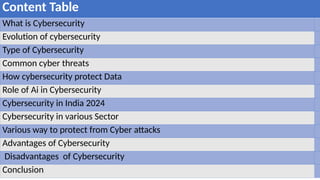
Content Table
What is Cybersecurity
Evolution of cybersecurity
Type of Cybersecurity
Common cyber threats
How cybersecurity protect Data
Role of Ai in Cybersecurity
Cybersecurity in India 2024
Cybersecurity in various Sector
Various way to protect from Cyber attacks
Advantages of Cybersecurity
Disadvantages of Cybersecurity
Conclusion
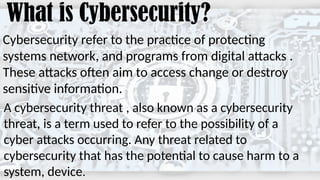
What is Cybersecurity?
Cybersecurity refer to the practice of protecting
systems network, and programs from digital attacks .
These attacks often aim to access change or destroy
sensitive information.
A cybersecurity threat , also known as a cybersecurity
threat, is a term used to refer to the possibility of a
cyber attacks occurring. Any threat related to
cybersecurity that has the potential to cause harm to a
system, device.
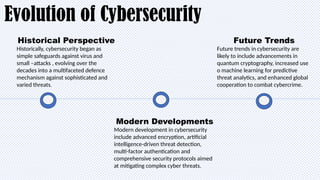
Evolution of Cybersecurity
Historical Perspective
Historically, cybersecurity began as
simple safeguards against virus and
small –attacks , evolving over the
decades into a multifaceted defence
mechanism against sophisticated and
varied threats.
Modern Developments
Modern development in cybersecurity
include advanced encryption, artificial
intelligence-driven threat detection,
multi-factor authentication and
comprehensive security protocols aimed
at mitigating complex cyber threats.
Future Trends
Future trends in cybersecurity are
likely to include advancements in
quantum cryptography, increased use
o machine learning for predictive
threat analytics, and enhanced global
cooperation to combat cybercrime.
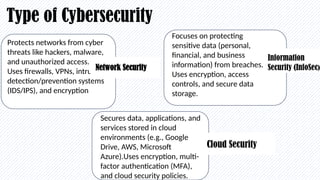
Type of Cybersecurity
jj
Protects networks from cyber
threats like hackers, malware,
and unauthorized access.
Uses firewalls, VPNs, intrusion
detection/prevention systems
(IDS/IPS), and encryption
Network Security
knk
Focuses on protecting sensitive data
(personal, financial, and business
information) from breaches.Uses
encryption, access controls, and secure
data storage.
Focuses on protecting
sensitive data (personal,
financial, and business
information) from breaches.
Uses encryption, access
controls, and secure data
storage.
Information
Security (InfoSec)
Secures data, applications, and
services stored in cloud
environments (e.g., Google
Drive, AWS, Microsoft
Azure).Uses encryption, multi-
factor authentication (MFA),
and cloud security policies.
Cloud Security
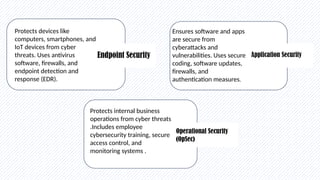
Endpoint Security
Operational Security
(OpSec)
Protects internal business
operations from cyber threats
.Includes employee
cybersecurity training, secure
access control, and
monitoring systems .
Application Security
Protects devices like
computers, smartphones, and
IoT devices from cyber
threats. Uses antivirus
software, firewalls, and
endpoint detection and
response (EDR).
Ensures software and apps
are secure from
cyberattacks and
vulnerabilities. Uses secure
coding, software updates,
firewalls, and
authentication measures.
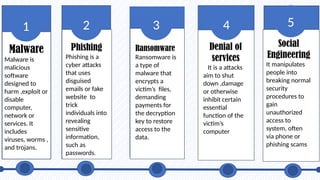
Common Cyber
Threats
tMMgghvhvses44
646guhu
1
kkijgugjg So
De
nhkn
3 4
2 5
Malware
Malware is
malicious
software
designed to
harm ,exploit or
disable
computer,
network or
services. It
includes
viruses, worms ,
and trojans.
Phishing
Phishing is a
cyber attacks
that uses
disguised
emails or fake
website to
trick
individuals into
revealing
sensitive
information,
such as
passwords.
Ransomware
Ransomware is
a type of
malware that
encrypts a
victim’s files,
demanding
payments for
the decryption
key to restore
access to the
data.
Denial of
services
It is a attacks
aim to shut
down ,damage
or otherwise
inhibit certain
essential
function of the
victim’s
computer
Social
Engineering
It manipulates
people into
breaking normal
security
procedures to
gain
unauthorized
access to
system, often
via phone or
phishing scams
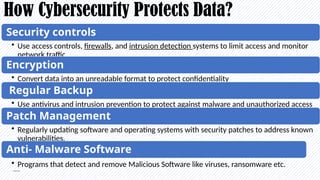
How Cybersecurity Protects Data?
Security controls
• Use access controls, firewalls, and intrusion detection systems to limit access and monitor
network traffic
Encryption
• Convert data into an unreadable format to protect confidentiality
Regular Backup
• Use antivirus and intrusion prevention to protect against malware and unauthorized access
Patch Management
• Regularly updating software and operating systems with security patches to address known
vulnerabilities.
Anti- Malware Software
• Programs that detect and remove Malicious Software like viruses, ransomware etc.
• mlmlmmmm
Role of Ai in Cybersecurity
Predictive Analysis
AI and Machine learning will forecast and prevent cyber threats by analyzing
patterns and historical data.
Automated Threat Detection
AI can automate response to cyber threat, reducing response time and minimizing
damage .
Enhanced Phishing and Malware Detection
AI can detect phishing emails by analyzing email content , sender behavior .
AI – Powered Cybersecurity Automation
AI reduces the workload on cybersecurity teams by handling routine security
tasks.
Cyberattacks in India 2024
• In 2024, India was the second most targeted country in the world for
cyber attacks, according to cloud SEK.
• According to data from 2024, India experienced a significant surge in
cyber attacks, with major incidents like data breaches affecting BSNL ,
Angel one .
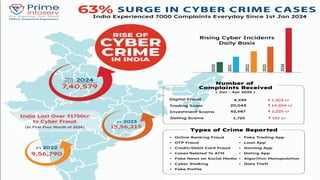
• In the first four months of 2024, over 740,000 complaints were filed on
the National Cyber Crime Reporting Portal.
• Top cyber crimes Phishing , Ransomware attacks, Identify theft, Online
scams and Data breaches.
• States with the most cyber crime Telangana, Karnataka, and Maharashtra.
Cybersecurity in Finance
T kojjij
Threat Landscape
The financial sector faces a
diverse range of
cybersecurity threats
including phishing,
ransomware and insider
threats. These can result in
significant financial losses
and breach of sensitive
data.
Sector –Specific
Strategies
Finance-specific
cybersecurity strategies
involve robust encryption
methods, continuous
monitoring of transaction,
and multi-factor
authentication to safeguard
against potential breaches.
Cybersecurity in Healthcare
Risks to patient Data
Healthcare cybersecurity risks include
unauthorized access to electronic health records
(EHRs),ransomware attacks, and data breaches,
which can jeopardize patient privacy and safety.
Protective Measures
Protective measures in healthcare include the
implementation of robust access controls
encryption of patient data, routine security
assessments and staff training on cybersecurity
best practices.
Cybersecurity in Government
Threats to National Security
Cyber threats to national
security can range from
espionage , data breaches,
and attacks on critical
infrastructure to
disinformation campaigns
aimed at destabilizing
governments operation .
Government Initiatives and
policies
Governments implements various
cybersecurity initiatives such as
establishing national cybersecurity
centers, enacting comprehensive
polices , and international
cooperation to enhance national
cybersecurity resilience.
Why it is important in digital era?
Protection of
personal
information
Preventing
Financial Loss
Safeguard
National
security
Maintaining
Trust and
Reputation
Preventing
Cybercrime
Growth
Protection
of
Business
Advantages of Cybersecurity
Defend us from critical attacks
Browse the safe website
Internet security process all the incoming and outgoing
data on our computer
Security will defend from hacks and virus.
Disadvantages of cybersecurity
Cybersecurity can be complex,
especially for those who aren't tech
–savvy.
Cybersecurity measures may be
inconvenient for some users.
Cybersecurity measures may be
compatible with all systems
It Can be risky
Various ways to protect from Cyber attacks
Use Antivirus software
Insert Firewalls
Uninstall unnecessary software
Maintain backup
Check security setting
Never gives your full name or address to
strangers
Learn more about the internet privacy
Don’t use same password fir multiple services
Career in Cybersecurity
• As the cyber threat land scape continues to grow and
emerging threats such as the internet of things require
hardware and software skills . It is estimated that there are 1
million unfilled cybersecurity job world wide. It professionals
and other computer specialist are needed in security job.
• JOBS like
CISO(Chief information security office)
Security Engineer
Architect Analyst
Conclusion
•In conclusion, cybersecurity is an indispensable element
in the digital age, acting as a critical defense mechanism
for individuals, businesses, and governments to
safeguard sensitive data, maintain operational
continuity, and preserve trust online; as our reliance on
digital systems grows, so does the need to prioritize
robust cybersecurity measures to mitigate the risks of
cyber threats and ensure a secure digital landscape for
all.
cybersecurity  and  its importance in digital era

cybersecurity and its importance in digital era

  • 1.
    Cybersecurity And its Importancein digital era Submitted by- Jasmeen Kaur
  • 2.
    Content Table What isCybersecurity Evolution of cybersecurity Type of Cybersecurity Common cyber threats How cybersecurity protect Data Role of Ai in Cybersecurity Cybersecurity in India 2024 Cybersecurity in various Sector Various way to protect from Cyber attacks Advantages of Cybersecurity Disadvantages of Cybersecurity Conclusion
  • 3.
    What is Cybersecurity? Cybersecurityrefer to the practice of protecting systems network, and programs from digital attacks . These attacks often aim to access change or destroy sensitive information. A cybersecurity threat , also known as a cybersecurity threat, is a term used to refer to the possibility of a cyber attacks occurring. Any threat related to cybersecurity that has the potential to cause harm to a system, device.
  • 4.
    Evolution of Cybersecurity HistoricalPerspective Historically, cybersecurity began as simple safeguards against virus and small –attacks , evolving over the decades into a multifaceted defence mechanism against sophisticated and varied threats. Modern Developments Modern development in cybersecurity include advanced encryption, artificial intelligence-driven threat detection, multi-factor authentication and comprehensive security protocols aimed at mitigating complex cyber threats. Future Trends Future trends in cybersecurity are likely to include advancements in quantum cryptography, increased use o machine learning for predictive threat analytics, and enhanced global cooperation to combat cybercrime.
  • 5.
    Type of Cybersecurity jj Protectsnetworks from cyber threats like hackers, malware, and unauthorized access. Uses firewalls, VPNs, intrusion detection/prevention systems (IDS/IPS), and encryption Network Security knk Focuses on protecting sensitive data (personal, financial, and business information) from breaches.Uses encryption, access controls, and secure data storage. Focuses on protecting sensitive data (personal, financial, and business information) from breaches. Uses encryption, access controls, and secure data storage. Information Security (InfoSec) Secures data, applications, and services stored in cloud environments (e.g., Google Drive, AWS, Microsoft Azure).Uses encryption, multi- factor authentication (MFA), and cloud security policies. Cloud Security
  • 6.
    Endpoint Security Operational Security (OpSec) Protectsinternal business operations from cyber threats .Includes employee cybersecurity training, secure access control, and monitoring systems . Application Security Protects devices like computers, smartphones, and IoT devices from cyber threats. Uses antivirus software, firewalls, and endpoint detection and response (EDR). Ensures software and apps are secure from cyberattacks and vulnerabilities. Uses secure coding, software updates, firewalls, and authentication measures.
  • 7.
  • 8.
    tMMgghvhvses44 646guhu 1 kkijgugjg So De nhkn 3 4 25 Malware Malware is malicious software designed to harm ,exploit or disable computer, network or services. It includes viruses, worms , and trojans. Phishing Phishing is a cyber attacks that uses disguised emails or fake website to trick individuals into revealing sensitive information, such as passwords. Ransomware Ransomware is a type of malware that encrypts a victim’s files, demanding payments for the decryption key to restore access to the data. Denial of services It is a attacks aim to shut down ,damage or otherwise inhibit certain essential function of the victim’s computer Social Engineering It manipulates people into breaking normal security procedures to gain unauthorized access to system, often via phone or phishing scams
  • 9.
    How Cybersecurity ProtectsData? Security controls • Use access controls, firewalls, and intrusion detection systems to limit access and monitor network traffic Encryption • Convert data into an unreadable format to protect confidentiality Regular Backup • Use antivirus and intrusion prevention to protect against malware and unauthorized access Patch Management • Regularly updating software and operating systems with security patches to address known vulnerabilities. Anti- Malware Software • Programs that detect and remove Malicious Software like viruses, ransomware etc. • mlmlmmmm
  • 10.
    Role of Aiin Cybersecurity Predictive Analysis AI and Machine learning will forecast and prevent cyber threats by analyzing patterns and historical data. Automated Threat Detection AI can automate response to cyber threat, reducing response time and minimizing damage . Enhanced Phishing and Malware Detection AI can detect phishing emails by analyzing email content , sender behavior . AI – Powered Cybersecurity Automation AI reduces the workload on cybersecurity teams by handling routine security tasks.
  • 11.
    Cyberattacks in India2024 • In 2024, India was the second most targeted country in the world for cyber attacks, according to cloud SEK. • According to data from 2024, India experienced a significant surge in cyber attacks, with major incidents like data breaches affecting BSNL , Angel one . • In the first four months of 2024, over 740,000 complaints were filed on the National Cyber Crime Reporting Portal. • Top cyber crimes Phishing , Ransomware attacks, Identify theft, Online scams and Data breaches. • States with the most cyber crime Telangana, Karnataka, and Maharashtra.
  • 13.
    Cybersecurity in Finance Tkojjij Threat Landscape The financial sector faces a diverse range of cybersecurity threats including phishing, ransomware and insider threats. These can result in significant financial losses and breach of sensitive data. Sector –Specific Strategies Finance-specific cybersecurity strategies involve robust encryption methods, continuous monitoring of transaction, and multi-factor authentication to safeguard against potential breaches.
  • 14.
    Cybersecurity in Healthcare Risksto patient Data Healthcare cybersecurity risks include unauthorized access to electronic health records (EHRs),ransomware attacks, and data breaches, which can jeopardize patient privacy and safety. Protective Measures Protective measures in healthcare include the implementation of robust access controls encryption of patient data, routine security assessments and staff training on cybersecurity best practices.
  • 15.
    Cybersecurity in Government Threatsto National Security Cyber threats to national security can range from espionage , data breaches, and attacks on critical infrastructure to disinformation campaigns aimed at destabilizing governments operation . Government Initiatives and policies Governments implements various cybersecurity initiatives such as establishing national cybersecurity centers, enacting comprehensive polices , and international cooperation to enhance national cybersecurity resilience.
  • 16.
    Why it isimportant in digital era? Protection of personal information Preventing Financial Loss Safeguard National security Maintaining Trust and Reputation Preventing Cybercrime Growth Protection of Business
  • 17.
    Advantages of Cybersecurity Defendus from critical attacks Browse the safe website Internet security process all the incoming and outgoing data on our computer Security will defend from hacks and virus.
  • 18.
    Disadvantages of cybersecurity Cybersecuritycan be complex, especially for those who aren't tech –savvy. Cybersecurity measures may be inconvenient for some users. Cybersecurity measures may be compatible with all systems It Can be risky
  • 19.
    Various ways toprotect from Cyber attacks Use Antivirus software Insert Firewalls Uninstall unnecessary software Maintain backup Check security setting Never gives your full name or address to strangers Learn more about the internet privacy Don’t use same password fir multiple services
  • 20.
    Career in Cybersecurity •As the cyber threat land scape continues to grow and emerging threats such as the internet of things require hardware and software skills . It is estimated that there are 1 million unfilled cybersecurity job world wide. It professionals and other computer specialist are needed in security job. • JOBS like CISO(Chief information security office) Security Engineer Architect Analyst
  • 21.
    Conclusion •In conclusion, cybersecurityis an indispensable element in the digital age, acting as a critical defense mechanism for individuals, businesses, and governments to safeguard sensitive data, maintain operational continuity, and preserve trust online; as our reliance on digital systems grows, so does the need to prioritize robust cybersecurity measures to mitigate the risks of cyber threats and ensure a secure digital landscape for all.