CYBER SECURITY: INTHE
DIGITAL AGE.
A Technical Overview by Mitali Sharma
Roll No - 22829
TITLE:
2.
INTRODUCTIO
N
We live inan era where almost every aspect of life — from
communication and banking to healthcare and education — relies
on digital technology. While this transformation has brought
immense convenience and connectivity, it has also introduced new
vulnerabilities. Cyber security in the digital age is not just a technical
necessity but a fundamental requirement to protect individuals,
organizations, and nations from evolving cyber threats. As cyber
attacks grow more sophisticated, understanding and implementing
robust cyber security measures has become essential to ensure
privacy, data integrity, and digital trust.
3.
CHARACTERISTICS OF
THE DIGITALAGE
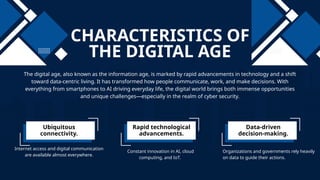
The digital age, also known as the information age, is marked by rapid advancements in technology and a shift
toward data-centric living. It has transformed how people communicate, work, and make decisions. With
everything from smartphones to AI driving everyday life, the digital world brings both immense opportunities
and unique challenges—especially in the realm of cyber security.
Ubiquitous
connectivity.
Rapid technological
advancements.
Data-driven
decision-making.
Internet access and digital communication
are available almost everywhere.
Organizations and governments rely heavily
on data to guide their actions.
Constant innovation in AI, cloud
computing, and IoT.
4.
TYPES OF CYBER
THREATS
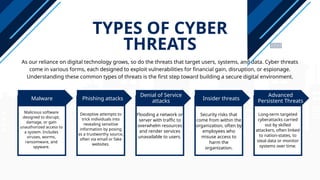
Asour reliance on digital technology grows, so do the threats that target users, systems, and data. Cyber threats
come in various forms, each designed to exploit vulnerabilities for financial gain, disruption, or espionage.
Understanding these common types of threats is the first step toward building a secure digital environment.
Malware Phishing attacks
Denial of Service
attacks Insider threats
Advanced
Persistent Threats
Malicious software
designed to disrupt,
damage, or gain
unauthorized access to
a system. Includes
viruses, worms,
ransomware, and
spyware.
Deceptive attempts to
trick individuals into
revealing sensitive
information by posing
as a trustworthy source,
often via email or fake
websites.
Flooding a network or
server with traffic to
overwhelm resources
and render services
unavailable to users.
Security risks that
come from within the
organization, often by
employees who
misuse access to
harm the
organization.
Long-term targeted
cyberattacks carried
out by skilled
attackers, often linked
to nation-states, to
steal data or monitor
systems over time.
5.
COMMON
VULNERABILITI
ES
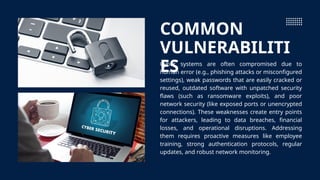
Cyber systems areoften compromised due to
human error (e.g., phishing attacks or misconfigured
settings), weak passwords that are easily cracked or
reused, outdated software with unpatched security
flaws (such as ransomware exploits), and poor
network security (like exposed ports or unencrypted
connections). These weaknesses create entry points
for attackers, leading to data breaches, financial
losses, and operational disruptions. Addressing
them requires proactive measures like employee
training, strong authentication protocols, regular
updates, and robust network monitoring.
6.
THE IMPACT OF
CYBERATTACKS
Financial
losses.
Reputational
damage.
Legal
consequences.
Operational
disruptions.
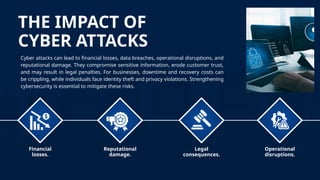
Cyber attacks can lead to financial losses, data breaches, operational disruptions, and
reputational damage. They compromise sensitive information, erode customer trust,
and may result in legal penalties. For businesses, downtime and recovery costs can
be crippling, while individuals face identity theft and privacy violations. Strengthening
cybersecurity is essential to mitigate these risks.
7.
KEY PRINCIPLES
OF CYBER
SECURITY
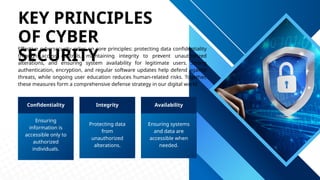
Effectivecybersecurity relies on core principles: protecting data confidentiality
through access controls, maintaining integrity to prevent unauthorized
alterations, and ensuring system availability for legitimate users. Strong
authentication, encryption, and regular software updates help defend against
threats, while ongoing user education reduces human-related risks. Together,
these measures form a comprehensive defense strategy in our digital world
Confidentiality Integrity Availability
Ensuring
information is
accessible only to
authorized
individuals.
Protecting data
from
unauthorized
alterations.
Ensuring systems
and data are
accessible when
needed.
8.
BEST PRACTICES FOR
INDIVIDUALS
1.UseStrong Passwords
⚬ Create complex, unique passwords for each account.
⚬ Enable multi-factor authentication (MFA) for added security.
2.Update Regularly
⚬ Keep devices, apps, and software patched to fix vulnerabilities.
3.Beware of Phishing
⚬ Avoid clicking suspicious links or sharing personal info in unsolicited
emails/messages.
4.Secure Networks
⚬ Use a VPN on public Wi-Fi and enable WPA3 encryption at home.
5.Backup Data
⚬ Maintain offline/cloud backups to recover from ransomware or device failure.
6.Limit Sharing
⚬ Restrict personal info on social media to reduce social engineering risks.
9.
CYBER SECURITY FOR
ORGANIZATIONS
•Risk Management: Regular audits, clear policies, and
incident plans
• Human Firewall: Ongoing training and phishing simulations
• Network Security: Firewalls, IDS/IPS, VPNs, zero-trust
• Data Protection: Encryption + strict access controls
• Endpoint Safety: Advanced antivirus, MDM for BYOD
• 24/7 Vigilance: SOC monitoring + real-time response
• Compliance: Meet GDPR/HIPAA standards + third-party
audits
10.
EMERGING TRENDS INCYBER
SECURITY
1.AI-Powered Threats: Attackers use AI for advanced attacks; defenders
deploy AI for detection.
2.Quantum Risks: Future threat to encryption; quantum-resistant
solutions in development.
3.Ransomware 2.0: Triple extortion (encryption, data theft, DDoS)
targeting critical systems.
4.Cloud Security: Zero-trust models for hybrid work; securing
serverless/containers.
5.IoT Challenges: 5G expands attack surface; demands standardized
protocols.
6.Supply Chain Risks: Weak software dependencies; SBOM adoption
rising.
7.Biometric Threats: Deepfake bypasses; countered by multi-modal
systems.
8.Regulatory Shift: Tighter data laws; cybersecurity insurance mandates.
11.
ROLE OF
GOVERNMENTS AND
REGULATIONS
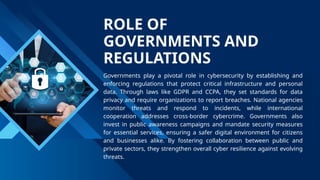
Governmentsplay a pivotal role in cybersecurity by establishing and
enforcing regulations that protect critical infrastructure and personal
data. Through laws like GDPR and CCPA, they set standards for data
privacy and require organizations to report breaches. National agencies
monitor threats and respond to incidents, while international
cooperation addresses cross-border cybercrime. Governments also
invest in public awareness campaigns and mandate security measures
for essential services, ensuring a safer digital environment for citizens
and businesses alike. By fostering collaboration between public and
private sectors, they strengthen overall cyber resilience against evolving
threats.
12.
CYBER SECURITY
CHALLENGES
The evolvingdigital landscape presents growing cybersecurity challenges, including:
1.Sophisticated Threats – AI-powered attacks, zero-day exploits, and advanced
ransomware.
2.Human Factor – Social engineering, insider threats, and lack of awareness.
3.Expanding Attack Surface – Cloud vulnerabilities, IoT devices, and remote work
risks.
4.Resource Constraints – Small businesses lacking budgets for robust security.
5.Regulatory Complexity – Compliance with varying global data protection laws.
6.Supply Chain Risks – Third-party vendor breaches and software dependencies.
13.
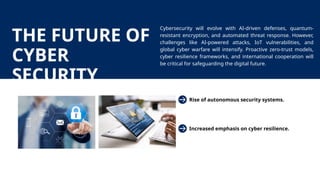
THE FUTURE OF
CYBER
SECURITY
Riseof autonomous security systems.
Increased emphasis on cyber resilience.
Cybersecurity will evolve with AI-driven defenses, quantum-
resistant encryption, and automated threat response. However,
challenges like AI-powered attacks, IoT vulnerabilities, and
global cyber warfare will intensify. Proactive zero-trust models,
cyber resilience frameworks, and international cooperation will
be critical for safeguarding the digital future.
14.
CONCLUSIO
N
Cybersecurity is ashared responsibility requiring vigilance
from individuals, organizations, and governments. As
threats grow more sophisticated, adopting proactive
measures, emerging technologies, and global collaboration
will be key to building a secure digital future. Stay informed,
stay prepared, and prioritize cybersecurity at every level to
mitigate risks and protect critical assets.
A collective effort today ensures a safer tomorrow.



![CYBERSECURITYcoll[1].pptx](https://cdn.slidesharecdn.com/ss_thumbnails/cybersecuritycoll1-231207002815-f4e5387d-thumbnail.jpg?width=640&height=640&fit=bounds)


