Cyberbullying
Online aggressor/targets, aggressors, and targets: a
comparison of associated youth characteristics
Daniel Goodman
Varnika Aggarwal
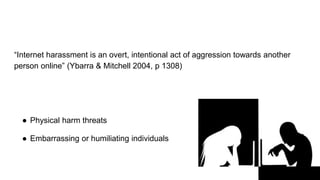
“Internet harassment is an overt, intentional act of aggression towards another
person online” (Ybarra & Mitchell 2004, p 1308)
● Physical harm threats
● Embarrassing or humiliating individuals
Statistics
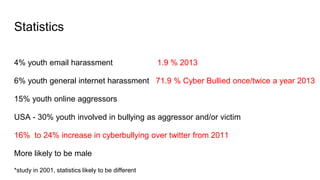
4% youth email harassment 1.9 % 2013
6% youth general internet harassment 71.9 % Cyber Bullied once/twice a year 2013
15% youth online aggressors
USA - 30% youth involved in bullying as aggressor and/or victim
16% to 24% increase in cyberbullying over twitter from 2011
More likely to be male
*study in 2001, statistics likely to be different
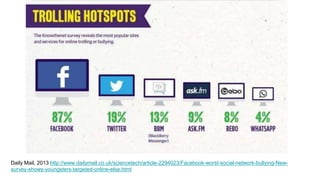
Daily Mail, 2013 http://www.dailymail.co.uk/sciencetech/article-2294023/Facebook-worst-social-network-bullying-New-
survey-shows-youngsters-targeted-online-else.html
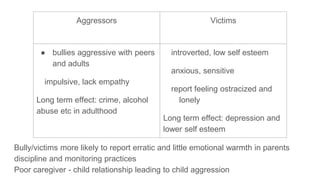
Bully/victims more likely to report erratic and little emotional warmth in parents
discipline and monitoring practices
Poor caregiver - child relationship leading to child aggression
Aggressors Victims
● bullies aggressive with peers
and adults
impulsive, lack empathy
Long term effect: crime, alcohol
abuse etc in adulthood
introverted, low self esteem
anxious, sensitive
report feeling ostracized and
lonely
Long term effect: depression and
lower self esteem
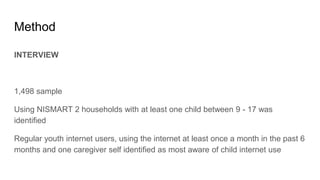
Method
INTERVIEW
1,498 sample
Using NISMART 2 households with at least one child between 9 - 17 was
identified
Regular youth internet users, using the internet at least once a month in the past 6
months and one caregiver self identified as most aware of child internet use
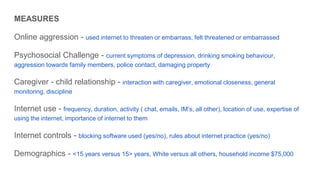
MEASURES
Online aggression - used internet to threaten or embarrass, felt threatened or embarrassed
Psychosocial Challenge - current symptoms of depression, drinking smoking behaviour,
aggression towards family members, police contact, damaging property
Caregiver - child relationship - interaction with caregiver, emotional closeness, general
monitoring, discipline
Internet use - frequency, duration, activity ( chat, emails, IM’s, all other), location of use, expertise of
using the internet, importance of internet to them
Internet controls - blocking software used (yes/no), rules about internet practice (yes/no)
Demographics - <15 years versus 15> years, White versus all others, household income $75,000
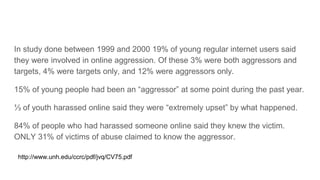
In study done between 1999 and 2000 19% of young regular internet users said
they were involved in online aggression. Of these 3% were both aggressors and
targets, 4% were targets only, and 12% were aggressors only.
15% of young people had been an “aggressor” at some point during the past year.
⅓ of youth harassed online said they were “extremely upset” by what happened.
84% of people who had harassed someone online said they knew the victim.
ONLY 31% of victims of abuse claimed to know the aggressor.
http://www.unh.edu/ccrc/pdf/jvq/CV75.pdf
For many kids harassment online is an extension of bullying at school - they feel
no respite, even when they are at home.
For some who are bullied at school, the internet is a place to assert dominance
where they cannot in real life.
People feel it is easier to bully people online partly because they can be
ANONYMOUS, so they can get away with more without fear of repercussion.
http://www.unh.edu/ccrc/pdf/jvq/CV75.pdf
LIMITATIONS OF DATA
It is hard to tell the severity or frequency of online abuse based on this survey.
A lot of online abuse is not done on a public forum - so it can be hard to accurately
assess how much of it is going on.
The data was taken over 15 years ago - there is obviously much more activity
online now.
Data shows online harassment is much more prevalent today.
http://www.unh.edu/ccrc/pdf/jvq/CV75.pdf
IMPLICATIONS OF DATA
Those who are not just the bully of the victim online, but both, are far more likely
than either group alone to have psychosocial problems.
The American Academy of Pediatrics recommends that parents monitor and are
involved in their children’s internet use. However, data suggests that household
rules on internet use and the blocking of software doesn’t have much effect on the
rate of cyberbullying going on. It is more important that the children have healthy
relationships with their parents.
In fact, parental monitoring is generally high among harassment victims.
It may be a good idea for children to be taught appropriate internet use at school
from a young age.
References
GAYLE, DAMIEN.D.G.2013. http://www.dailymail.co.uk/sciencetech/article-2294023/Facebook-worst-
social-network-bullying-New-survey-shows-youngsters-targeted-online-else.html.11/2015.
Pew Research center.2013. http://www.pewinternet.org/2013/05/21/teens-social-media-and-
privacy/.11/2015
National center for education statistics. 2013. http://nces.ed.gov/pubs2013/2013329.pdf. 11/2015
Ybarra, M. L. & Mitchell, K. J. (2004). Online aggressor/targets, aggressors, and targets: a comparison of
associated youth characteristics. Journal of child psychology and psychiatry, 45(7), 1308-1316

Cyberbullying

  • 1.
    Cyberbullying Online aggressor/targets, aggressors,and targets: a comparison of associated youth characteristics Daniel Goodman Varnika Aggarwal
  • 2.
    “Internet harassment isan overt, intentional act of aggression towards another person online” (Ybarra & Mitchell 2004, p 1308) ● Physical harm threats ● Embarrassing or humiliating individuals
  • 3.
    Statistics 4% youth emailharassment 1.9 % 2013 6% youth general internet harassment 71.9 % Cyber Bullied once/twice a year 2013 15% youth online aggressors USA - 30% youth involved in bullying as aggressor and/or victim 16% to 24% increase in cyberbullying over twitter from 2011 More likely to be male *study in 2001, statistics likely to be different
  • 4.
    Daily Mail, 2013http://www.dailymail.co.uk/sciencetech/article-2294023/Facebook-worst-social-network-bullying-New- survey-shows-youngsters-targeted-online-else.html
  • 5.
    Bully/victims more likelyto report erratic and little emotional warmth in parents discipline and monitoring practices Poor caregiver - child relationship leading to child aggression Aggressors Victims ● bullies aggressive with peers and adults impulsive, lack empathy Long term effect: crime, alcohol abuse etc in adulthood introverted, low self esteem anxious, sensitive report feeling ostracized and lonely Long term effect: depression and lower self esteem
  • 6.
    Method INTERVIEW 1,498 sample Using NISMART2 households with at least one child between 9 - 17 was identified Regular youth internet users, using the internet at least once a month in the past 6 months and one caregiver self identified as most aware of child internet use
  • 7.
    MEASURES Online aggression -used internet to threaten or embarrass, felt threatened or embarrassed Psychosocial Challenge - current symptoms of depression, drinking smoking behaviour, aggression towards family members, police contact, damaging property Caregiver - child relationship - interaction with caregiver, emotional closeness, general monitoring, discipline Internet use - frequency, duration, activity ( chat, emails, IM’s, all other), location of use, expertise of using the internet, importance of internet to them Internet controls - blocking software used (yes/no), rules about internet practice (yes/no) Demographics - <15 years versus 15> years, White versus all others, household income $75,000
  • 8.
    In study donebetween 1999 and 2000 19% of young regular internet users said they were involved in online aggression. Of these 3% were both aggressors and targets, 4% were targets only, and 12% were aggressors only. 15% of young people had been an “aggressor” at some point during the past year. ⅓ of youth harassed online said they were “extremely upset” by what happened. 84% of people who had harassed someone online said they knew the victim. ONLY 31% of victims of abuse claimed to know the aggressor. http://www.unh.edu/ccrc/pdf/jvq/CV75.pdf
  • 9.
    For many kidsharassment online is an extension of bullying at school - they feel no respite, even when they are at home. For some who are bullied at school, the internet is a place to assert dominance where they cannot in real life. People feel it is easier to bully people online partly because they can be ANONYMOUS, so they can get away with more without fear of repercussion. http://www.unh.edu/ccrc/pdf/jvq/CV75.pdf
  • 10.
    LIMITATIONS OF DATA Itis hard to tell the severity or frequency of online abuse based on this survey. A lot of online abuse is not done on a public forum - so it can be hard to accurately assess how much of it is going on. The data was taken over 15 years ago - there is obviously much more activity online now. Data shows online harassment is much more prevalent today. http://www.unh.edu/ccrc/pdf/jvq/CV75.pdf
  • 11.
    IMPLICATIONS OF DATA Thosewho are not just the bully of the victim online, but both, are far more likely than either group alone to have psychosocial problems. The American Academy of Pediatrics recommends that parents monitor and are involved in their children’s internet use. However, data suggests that household rules on internet use and the blocking of software doesn’t have much effect on the rate of cyberbullying going on. It is more important that the children have healthy relationships with their parents. In fact, parental monitoring is generally high among harassment victims. It may be a good idea for children to be taught appropriate internet use at school from a young age.
  • 12.
    References GAYLE, DAMIEN.D.G.2013. http://www.dailymail.co.uk/sciencetech/article-2294023/Facebook-worst- social-network-bullying-New-survey-shows-youngsters-targeted-online-else.html.11/2015. PewResearch center.2013. http://www.pewinternet.org/2013/05/21/teens-social-media-and- privacy/.11/2015 National center for education statistics. 2013. http://nces.ed.gov/pubs2013/2013329.pdf. 11/2015 Ybarra, M. L. & Mitchell, K. J. (2004). Online aggressor/targets, aggressors, and targets: a comparison of associated youth characteristics. Journal of child psychology and psychiatry, 45(7), 1308-1316