Computer Security Innovation 
IMHO 
Presented for your consideration by: Fred Seigneur 
Copies of the Power Point file are available at: 
wfredsr@SecureComputingInnovationForum.org
2014 Cybersecurity Innovation 
Forum 
 In January 2014, I attended the 2014 
Cybersecurity Innovation Forum, in 
Baltimore. 
 One reason I attended was that I was 
impressed with the Forum’s stated vision.
2014 Cybersecurity Innovation 
Forum – Background and Vision 
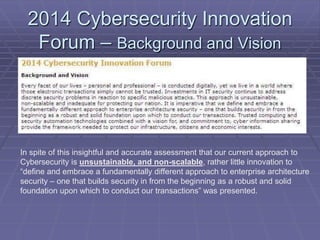
In spite of this insightful and accurate assessment that our current approach to 
Cybersecurity is unsustainable, and non-scalable, rather little innovation to 
“define and embrace a fundamentally different approach to enterprise architecture 
security – one that builds security in from the beginning as a robust and solid 
foundation upon which to conduct our transactions” was presented.
Foundational Weaknesses 
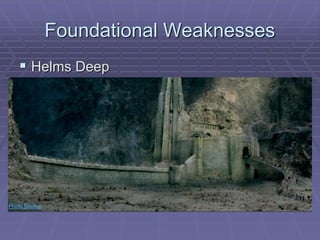
 Helms Deep 
Photo Source
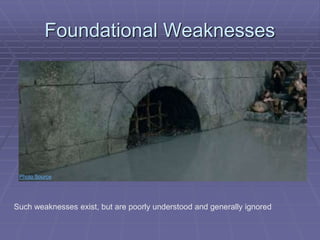
Foundational Weaknesses 
Photo Source 
Such weaknesses exist, but are poorly understood and generally ignored
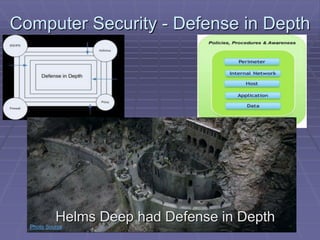
Computer Security - Defense in Depth 
Helms Deep had Defense in Depth 
Photo Source
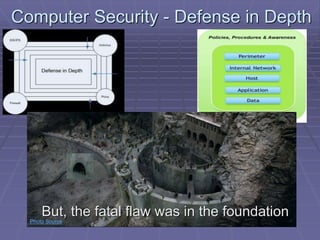
Computer Security - Defense in Depth 
But, the fatal flaw was in the foundation 
Photo Source
The Root(s) of the Problem 
 Today’s Operating Systems are not secure 
and are too complex to secure by retrofit. 
 Few Operating Systems or Applications 
are rugged. 
 Don’t verify inputs. 
 Crash leaving attack vectors for malicious 
code. 
 Most current security “solutions” are 
“Band-Aid” approaches.
Operating Systems and Applications 
Lack a Basic Immune System 
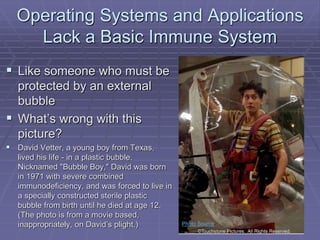
 Like someone who must be 
protected by an external 
bubble 
 What’s wrong with this 
picture? 
 David Vetter, a young boy from Texas, 
lived his life - in a plastic bubble. 
Nicknamed "Bubble Boy," David was born 
in 1971 with severe combined 
immunodeficiency, and was forced to live in 
a specially constructed sterile plastic 
bubble from birth until he died at age 12. 
(The photo is from a movie based, 
inappropriately, on David’s plight.) Photo Source
Foundational Immune System Deficiencies 
 Two very serious foundational software 
problems 
 Operating Systems 
 Applications Software 
 Both of these have the same root cause 
 Software Developers do not write robust 
code. Why? 
 They don’t know how 
 They don’t know why it’s important 
 They did not learn how, or why it’s so critical
Foundational Immune 
Deficiencies (Cont.) 
 Two very serious foundational 
educational problems 
 Software developers have NOT been 
taught why or how to write robust and 
defensive code. 
 Many CS Professors don’t know how to 
write robust and defensive code, or why it 
is necessary to teach it.
Long Term Solutions 
 Better Education 
 Better Computer Security Education 
 Better CS and Engineering Education 
 Include Basic Computer Security Education 
Thread in Virtually All University/College 
Departments 
 Create Demand for Foundational Security 
Solutions 
 IT Procurement Authorities & Staff 
 Users 
 University/College Accreditation Authorities
How Can This be Done? 
 Some Universities understand these 
issues 
 A few Educational Institutions have 
realized that they can differentiate 
themselves in the educational market by 
implementing steps such as those above.
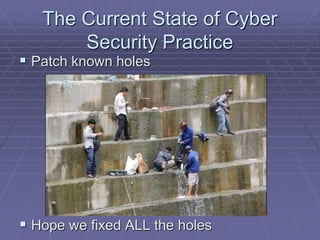
The Current State of Cyber 
Security Practice 
 Patch known holes 
 Hope we fixed ALL the holes
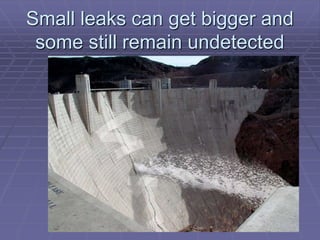
Small leaks can get bigger and 
some still remain undetected
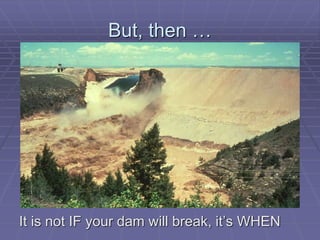
But, then … 
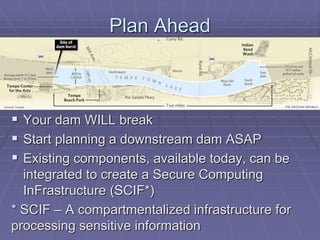
It is not IF your dam will break, it’s WHEN
Plan Ahead 
 Your dam WILL break 
 Start planning a downstream dam ASAP 
 Existing components, available today, can be 
integrated to create a Secure Computing 
InFrastructure (SCIF*) 
* SCIF – A compartmentalized infrastructure for 
processing sensitive information
Secure Computing Infrastructure (SCIF) 
 The SCIF can be used in an embedded system (such as IoT , Smart 
Grid, SDN White Box Switches) or as an SDN Controller and executes 
Erlang functions as transactions. One envisioned SCIF application is 
as a Secure Network Interface Function (SNIF), which can be used to 
authenticate inputs to and outputs from a secure enclave. With two or 
more SCIF boards in a system, fault tolerance is supported using 
Erlang fault tolerance. 
 A Trusted SCIF Interactive Development Environment (SIDE) for SCIF 
applications, based on SysML and a SCIF Management System (SMS) 
for Administration of the SCIF and SNIF are supported via Erlang 
running on a virtualized instance of Linux, atop seL4 and will be fault 
tolerant, using Erlang's inherent fault tolerance capabilities 
 The SCIF architecture can be used to host other Linux applications in a 
more trusted and fault tolerant environment than with off the shelf 
Linux. 
 Block diagrams for the SCIF hardware and software follow.
Recent Progress 
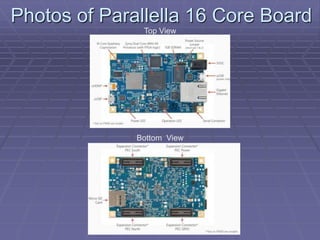
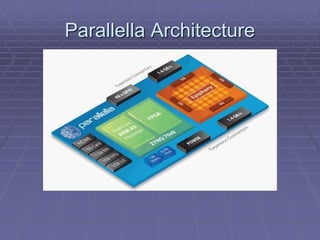
 The Parallella board seems ideally suited for the SCIF 
prototype. 
 The Erlang Virtual Machine runs on the Adaptiva 
Epiphany chip. 
 The secure seL4 microkernel runs on the ARM Cortex 
A9 in the XILINX ZYNQ portion of the Parallella along 
with drivers, TCP/IP protocol processing and the 
Secure Network Interface Function. 
 A SCIF is used to 
 Applications run securely on the Epiphany in Erlang, a 
functional programming language that supports soft 
real-time, like a Software Defined Networking (SDN) 
controller
Photos of Parallella 16 Core Board 
Top View 
Bottom View
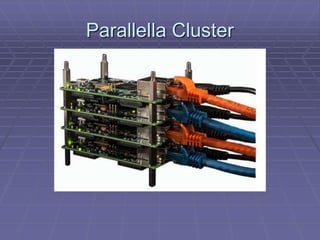
Parallella Cluster
Parallella Architecture
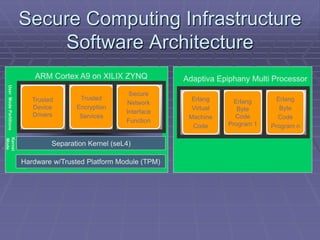
Secure Computing Infrastructure 
Software Architecture 
User Mode Partitions 
ARM Cortex A9 on XILIX ZYNQ Adaptiva Epiphany Multi Processor 
Trusted 
Device 
Drivers 
Separation Kernel (seL4) 
Hardware w/Trusted Platform Module (TPM) 
Kernel 
Mode 
Trusted 
Encryption 
Services 
Secure 
Network 
Interface 
Function 
Erlang 
Virtual 
Machine 
Code 
Erlang 
Byte 
Code 
Program 1 
Erlang 
Byte 
Code 
Program n
Phased Integration Plan 
 Phase I - Proof of Concept/Prototype 
Demonstration 
 Phase II - Field Trials 
Visit our LinkedIn group, the 
Secure Computing Infrastructure Foundation

Cyber security innovation imho v5

  • 1.
    Computer Security Innovation IMHO Presented for your consideration by: Fred Seigneur Copies of the Power Point file are available at: wfredsr@SecureComputingInnovationForum.org
  • 2.
    2014 Cybersecurity Innovation Forum  In January 2014, I attended the 2014 Cybersecurity Innovation Forum, in Baltimore.  One reason I attended was that I was impressed with the Forum’s stated vision.
  • 3.
    2014 Cybersecurity Innovation Forum – Background and Vision In spite of this insightful and accurate assessment that our current approach to Cybersecurity is unsustainable, and non-scalable, rather little innovation to “define and embrace a fundamentally different approach to enterprise architecture security – one that builds security in from the beginning as a robust and solid foundation upon which to conduct our transactions” was presented.
  • 4.
    Foundational Weaknesses Helms Deep Photo Source
  • 5.
    Foundational Weaknesses PhotoSource Such weaknesses exist, but are poorly understood and generally ignored
  • 6.
    Computer Security -Defense in Depth Helms Deep had Defense in Depth Photo Source
  • 7.
    Computer Security -Defense in Depth But, the fatal flaw was in the foundation Photo Source
  • 8.
    The Root(s) ofthe Problem  Today’s Operating Systems are not secure and are too complex to secure by retrofit.  Few Operating Systems or Applications are rugged.  Don’t verify inputs.  Crash leaving attack vectors for malicious code.  Most current security “solutions” are “Band-Aid” approaches.
  • 9.
    Operating Systems andApplications Lack a Basic Immune System  Like someone who must be protected by an external bubble  What’s wrong with this picture?  David Vetter, a young boy from Texas, lived his life - in a plastic bubble. Nicknamed "Bubble Boy," David was born in 1971 with severe combined immunodeficiency, and was forced to live in a specially constructed sterile plastic bubble from birth until he died at age 12. (The photo is from a movie based, inappropriately, on David’s plight.) Photo Source
  • 10.
    Foundational Immune SystemDeficiencies  Two very serious foundational software problems  Operating Systems  Applications Software  Both of these have the same root cause  Software Developers do not write robust code. Why?  They don’t know how  They don’t know why it’s important  They did not learn how, or why it’s so critical
  • 11.
    Foundational Immune Deficiencies(Cont.)  Two very serious foundational educational problems  Software developers have NOT been taught why or how to write robust and defensive code.  Many CS Professors don’t know how to write robust and defensive code, or why it is necessary to teach it.
  • 12.
    Long Term Solutions  Better Education  Better Computer Security Education  Better CS and Engineering Education  Include Basic Computer Security Education Thread in Virtually All University/College Departments  Create Demand for Foundational Security Solutions  IT Procurement Authorities & Staff  Users  University/College Accreditation Authorities
  • 13.
    How Can Thisbe Done?  Some Universities understand these issues  A few Educational Institutions have realized that they can differentiate themselves in the educational market by implementing steps such as those above.
  • 14.
    The Current Stateof Cyber Security Practice  Patch known holes  Hope we fixed ALL the holes
  • 15.
    Small leaks canget bigger and some still remain undetected
  • 16.
    But, then … It is not IF your dam will break, it’s WHEN
  • 17.
    Plan Ahead Your dam WILL break  Start planning a downstream dam ASAP  Existing components, available today, can be integrated to create a Secure Computing InFrastructure (SCIF*) * SCIF – A compartmentalized infrastructure for processing sensitive information
  • 18.
    Secure Computing Infrastructure(SCIF)  The SCIF can be used in an embedded system (such as IoT , Smart Grid, SDN White Box Switches) or as an SDN Controller and executes Erlang functions as transactions. One envisioned SCIF application is as a Secure Network Interface Function (SNIF), which can be used to authenticate inputs to and outputs from a secure enclave. With two or more SCIF boards in a system, fault tolerance is supported using Erlang fault tolerance.  A Trusted SCIF Interactive Development Environment (SIDE) for SCIF applications, based on SysML and a SCIF Management System (SMS) for Administration of the SCIF and SNIF are supported via Erlang running on a virtualized instance of Linux, atop seL4 and will be fault tolerant, using Erlang's inherent fault tolerance capabilities  The SCIF architecture can be used to host other Linux applications in a more trusted and fault tolerant environment than with off the shelf Linux.  Block diagrams for the SCIF hardware and software follow.
  • 19.
    Recent Progress The Parallella board seems ideally suited for the SCIF prototype.  The Erlang Virtual Machine runs on the Adaptiva Epiphany chip.  The secure seL4 microkernel runs on the ARM Cortex A9 in the XILINX ZYNQ portion of the Parallella along with drivers, TCP/IP protocol processing and the Secure Network Interface Function.  A SCIF is used to  Applications run securely on the Epiphany in Erlang, a functional programming language that supports soft real-time, like a Software Defined Networking (SDN) controller
  • 20.
    Photos of Parallella16 Core Board Top View Bottom View
  • 21.
  • 22.
  • 23.
    Secure Computing Infrastructure Software Architecture User Mode Partitions ARM Cortex A9 on XILIX ZYNQ Adaptiva Epiphany Multi Processor Trusted Device Drivers Separation Kernel (seL4) Hardware w/Trusted Platform Module (TPM) Kernel Mode Trusted Encryption Services Secure Network Interface Function Erlang Virtual Machine Code Erlang Byte Code Program 1 Erlang Byte Code Program n
  • 24.
    Phased Integration Plan  Phase I - Proof of Concept/Prototype Demonstration  Phase II - Field Trials Visit our LinkedIn group, the Secure Computing Infrastructure Foundation