Cyber Forensics: The Most Definitive
Guide
Why Cyber Forensics Matters Today
In 2024, the world witnessed unprecedented cyberattacks, ransomware crippling hospitals,
phishing campaigns targeting governments, and financial fraud rings operating across
continents. Behind every digital crime lies one constant: evidence.
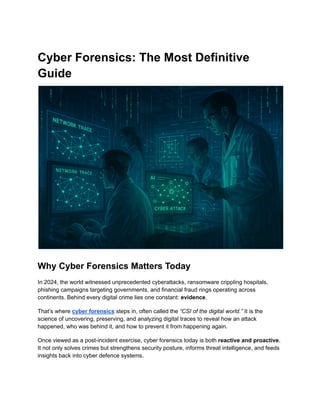
That’s where cyber forensics steps in, often called the “CSI of the digital world.” It is the
science of uncovering, preserving, and analyzing digital traces to reveal how an attack
happened, who was behind it, and how to prevent it from happening again.
Once viewed as a post-incident exercise, cyber forensics today is both reactive and proactive.
It not only solves crimes but strengthens security posture, informs threat intelligence, and feeds
insights back into cyber defence systems.
In a world where every byte can be a clue, cyber forensics is no longer optional, it’s a
national security imperative.
What Is Cyber Forensics?
Cyber forensics (a subset of digital forensics) involves collecting and analyzing evidence from
computers, mobile devices, networks, and cloud environments to reconstruct a digital event.
It focuses on three principles:
●​ Accuracy: capturing the digital trail without alteration.​
●​ Preservation: ensuring evidence remains legally admissible.​
●​ Actionability: providing investigators and courts with credible insights.​
From tracing ransomware payments to analyzing insider data theft, cyber forensics bridges law
enforcement, cybersecurity, and legal compliance.
Key Roles and Applications
●​ Cybercrime Investigation: Tracing phishing, ransomware, and fraud networks.​
●​ Incident Response: Determining breach vectors and mitigating damage.​
●​ Regulatory Compliance: Producing court-ready forensic reports.​
●​ Insider Threat Analysis: Detecting unauthorized access or data misuse.​
●​ National Security: Supporting counter-espionage and cyber warfare cases.​
In essence, cyber forensics investigates the past, secures the present, and protects the future.
Types of Cyber Forensics
1️⃣ Network Forensics – Analyzes traffic to detect intrusions or data theft.​
2️⃣ Malware Forensics – Dissects malicious code to identify attackers.​
3️⃣ Email & Communication Forensics – Tracks phishing and insider activity.​
4️⃣ Mobile Forensics – Extracts evidence from smartphones and IoT devices.​
5️⃣ Cloud Forensics – Investigates data breaches in distributed environments.​
6️⃣ Memory & System Forensics – Captures volatile data and detects rootkits.
Tools & Technologies Powering Modern Forensics
●​ RapiDFIR: Forensic case management and evidence preservation.​
●​ Intelelinx: Link analysis and CDR mapping for digital investigations.​
●​ Innsight: OSINT integration for correlating dark web and social signals.​
●​ AI Vision: AI-powered video and image analytics for forensic validation.​
AI now enhances forensics by automating anomaly detection, log correlation, and pattern
recognition, reducing analysis time from weeks to hours.
Cyber Forensics and Information Security
Cyber forensics complements cybersecurity, turning every breach into a learning opportunity.​
It builds audit trails for compliance, strengthens incident response, and supports national
defence by attributing state-sponsored attacks.
When integrated with security frameworks, forensics transforms reactive investigation into
intelligence-led defence.
Conclusion
Cyber forensics is no longer about recovering deleted files, it’s about connecting digital dots
that protect economies, enterprises, and nations.
By combining forensic software, link analysis, OSINT, and AI-driven insights, agencies can shift
from reaction to prediction, ensuring that no digital trace goes unnoticed.
⚙️Request a Demo
See how Innefu’s RapiDFIR, Intelelinx, Innsight, and AI Vision empower agencies to
investigate faster, strengthen defences, and deliver justice in the digital age.

Cyber Forensics: The Most Definitive Guide

  • 1.
    Cyber Forensics: TheMost Definitive Guide Why Cyber Forensics Matters Today In 2024, the world witnessed unprecedented cyberattacks, ransomware crippling hospitals, phishing campaigns targeting governments, and financial fraud rings operating across continents. Behind every digital crime lies one constant: evidence. That’s where cyber forensics steps in, often called the “CSI of the digital world.” It is the science of uncovering, preserving, and analyzing digital traces to reveal how an attack happened, who was behind it, and how to prevent it from happening again. Once viewed as a post-incident exercise, cyber forensics today is both reactive and proactive. It not only solves crimes but strengthens security posture, informs threat intelligence, and feeds insights back into cyber defence systems.
  • 2.
    In a worldwhere every byte can be a clue, cyber forensics is no longer optional, it’s a national security imperative. What Is Cyber Forensics? Cyber forensics (a subset of digital forensics) involves collecting and analyzing evidence from computers, mobile devices, networks, and cloud environments to reconstruct a digital event. It focuses on three principles: ●​ Accuracy: capturing the digital trail without alteration.​ ●​ Preservation: ensuring evidence remains legally admissible.​ ●​ Actionability: providing investigators and courts with credible insights.​ From tracing ransomware payments to analyzing insider data theft, cyber forensics bridges law enforcement, cybersecurity, and legal compliance. Key Roles and Applications ●​ Cybercrime Investigation: Tracing phishing, ransomware, and fraud networks.​ ●​ Incident Response: Determining breach vectors and mitigating damage.​ ●​ Regulatory Compliance: Producing court-ready forensic reports.​ ●​ Insider Threat Analysis: Detecting unauthorized access or data misuse.​ ●​ National Security: Supporting counter-espionage and cyber warfare cases.​ In essence, cyber forensics investigates the past, secures the present, and protects the future. Types of Cyber Forensics
  • 3.
    1️⃣ Network Forensics– Analyzes traffic to detect intrusions or data theft.​ 2️⃣ Malware Forensics – Dissects malicious code to identify attackers.​ 3️⃣ Email & Communication Forensics – Tracks phishing and insider activity.​ 4️⃣ Mobile Forensics – Extracts evidence from smartphones and IoT devices.​ 5️⃣ Cloud Forensics – Investigates data breaches in distributed environments.​ 6️⃣ Memory & System Forensics – Captures volatile data and detects rootkits. Tools & Technologies Powering Modern Forensics ●​ RapiDFIR: Forensic case management and evidence preservation.​ ●​ Intelelinx: Link analysis and CDR mapping for digital investigations.​ ●​ Innsight: OSINT integration for correlating dark web and social signals.​ ●​ AI Vision: AI-powered video and image analytics for forensic validation.​ AI now enhances forensics by automating anomaly detection, log correlation, and pattern recognition, reducing analysis time from weeks to hours. Cyber Forensics and Information Security Cyber forensics complements cybersecurity, turning every breach into a learning opportunity.​ It builds audit trails for compliance, strengthens incident response, and supports national defence by attributing state-sponsored attacks. When integrated with security frameworks, forensics transforms reactive investigation into intelligence-led defence. Conclusion Cyber forensics is no longer about recovering deleted files, it’s about connecting digital dots that protect economies, enterprises, and nations. By combining forensic software, link analysis, OSINT, and AI-driven insights, agencies can shift from reaction to prediction, ensuring that no digital trace goes unnoticed.
  • 4.
    ⚙️Request a Demo Seehow Innefu’s RapiDFIR, Intelelinx, Innsight, and AI Vision empower agencies to investigate faster, strengthen defences, and deliver justice in the digital age.