CWNP CSAE-101 Certification
Study Guide with Practice
Questions & Exam Tips
Practice Questions, Exam Objectives, and Expert Study Tips for CSAE-
101
www.NWExam.com
This comprehensive CSAE-101 study guide helps IT professionals prepare for
the CWNP Security Administrator and Engineer exam. Covering Zero Trust
architecture, vendor assessments, honeypots, access controls, threat modeling,
and secure change management, it provides detailed exam topics, practice
questions, and expert tips to achieve certification success. Designed for focused
preparation, this guide ensures familiarity with exam structure and key
security concepts.
PDF
CSAE-101 Security Administrator and Engineer Sample Questions 1
CWNP Security Administrator and Engineer
CSAE-101 Certification Study Guide
CWNP CSAE-101 Certification Exam Details
CWNP CSAE-101 certifications are globally accepted and add significant value to any
IT professional. The certification gives you a profound understanding of all the workings
of the network models and the devices that are utilized with it. NWExam.com is proud to
provide you with the best CWNP Exam Guides.
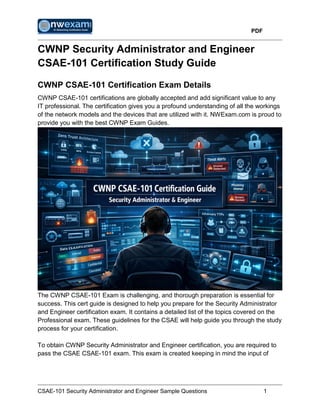
The CWNP CSAE-101 Exam is challenging, and thorough preparation is essential for
success. This cert guide is designed to help you prepare for the Security Administrator
and Engineer certification exam. It contains a detailed list of the topics covered on the
Professional exam. These guidelines for the CSAE will help guide you through the study
process for your certification.
To obtain CWNP Security Administrator and Engineer certification, you are required to
pass the CSAE CSAE-101 exam. This exam is created keeping in mind the input of
PDF
CSAE-101 Security Administrator and Engineer Sample Questions 2
professionals in the industry and reveals how CWNP products are used in
organizations across the world.
CSAE-101 CWNP Security Administrator and Engineer Exam
Summary
● Exam Name: CWNP Security Administrator and Engineer
● Exam Code: CSAE-101
● Exam Price: $399 USD
● Duration: 100 minutes
● Number of Questions: 40
● Passing Score: 70%
● Exam Registration: Prometric
● Recommended Practice: CWNP Certified Security Administrator and
Engineer Practice Test
Topics covered in the CWNP Security Administrator and
Engineer CSAE-101 Exam
Section Weight Objectives
Security
Concepts and
Terminology
15%
- Understand and evaluate security controls
 Security control categories and types
- Technical controls
- Managerial controls
- Operational controls
- Physical controls
 Defense-in-depth strategies
 Control effectiveness measurement and validation
 Gap analysis and remediation planning
- Explain how the following core security principles apply to
enterprise environments
 CIA triad implementation (Confidentiality, Integrity,
Availability)
 Non-repudiation mechanisms
 AAA framework deployment (Authentication,
Authorization, Accounting)
 Zero Trust architecture
PDF
CSAE-101 Security Administrator and Engineer Sample Questions 3
Section Weight Objectives
 Control plane and data plane security
 Policy-driven access control systems
 Policy enforcement points
- Describe and distinguish among these physical security
systems
 Access control systems and badge management
 Video surveillance systems (CCTV, IP cameras)
 Environmental controls (HVAC, fire suppression)
 Physical intrusion detection sensors
 Lighting and perimeter security
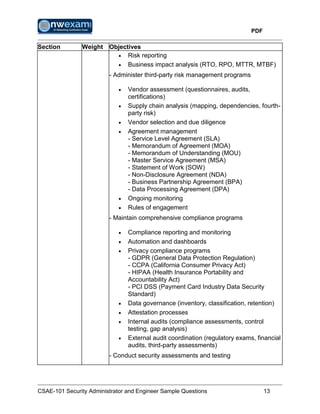
 Security guard operations and integration
- Describe and distinguish among these deception and
disruption technologies
 Honeypot deployment and management
 Honeynet architecture design
 Honeyfile and honeytoken strategies
 Integration with threat intelligence platforms
 Deception technology for threat detection
- Explain these cryptographic solutions and the roles they play
in enterprise security
 PKI infrastructure deployment and management
 Certificate lifecycle management (issuance, renewal,
revocation)
 Encryption implementation
- Full-disk encryption
- Partition encryption
- File encryption
- Volume encryption
- Database encryption
- Transport encryption
 Key management systems and HSM integration
 Digital signatures and key stretching
 Hashing and salting techniques
 Blockchain and open public ledger technologies
 Certificate management
PDF
CSAE-101 Security Administrator and Engineer Sample Questions 4
Section Weight Objectives
- Certificate Authority (CA)
- Certificate Revocation List (CRL)
- Online Certificate Status Protocol (OCSP)
- Certificate Signing Request (CSR) generation
- Understand how to apply change management processes
for security
 Security-focused change approval workflows
 Impact analysis and risk assessment for changes
 Backout plans and rollback procedures
 Configuration management and version control
 Documentation standards for security changes
 Stakeholder management in change processes
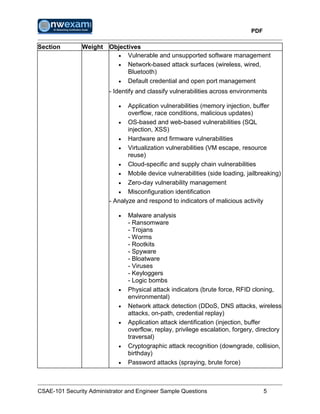
Threats and
Vulnerabilities
15%
- Analyze threat actors, attributes, and motivations
 Threat actor types
- Nation-state actors
- Organized crime
- Hacktivists
- Insider threats
- Shadow IT
 Threat actor attribution and profiling
 Actor attributes (internal/external, resources/funding,
sophistication level)
 Motivations (data exfiltration, espionage, financial gain,
disruption, war)
 Attack vector analysis across multiple surfaces
 TTPs (tactics, techniques, and procedures) mapping to
MITRE ATT&CK
- Assess and mitigate attack vectors and surfaces
 Message-based attacks (email, SMS, instant
messaging)
 Image-based and file-based attack vectors
 Voice call and removable device threats
 Social engineering campaigns (phishing, vishing,
smishing, pretexting, watering hole)
 Supply chain attacks (MSPs, vendors, suppliers)
PDF
CSAE-101 Security Administrator and Engineer Sample Questions 5
Section Weight Objectives
 Vulnerable and unsupported software management
 Network-based attack surfaces (wireless, wired,
Bluetooth)
 Default credential and open port management
- Identify and classify vulnerabilities across environments
 Application vulnerabilities (memory injection, buffer
overflow, race conditions, malicious updates)
 OS-based and web-based vulnerabilities (SQL
injection, XSS)
 Hardware and firmware vulnerabilities
 Virtualization vulnerabilities (VM escape, resource
reuse)
 Cloud-specific and supply chain vulnerabilities
 Mobile device vulnerabilities (side loading, jailbreaking)
 Zero-day vulnerability management
 Misconfiguration identification
- Analyze and respond to indicators of malicious activity
 Malware analysis
- Ransomware
- Trojans
- Worms
- Rootkits
- Spyware
- Bloatware
- Viruses
- Keyloggers
- Logic bombs
 Physical attack indicators (brute force, RFID cloning,
environmental)
 Network attack detection (DDoS, DNS attacks, wireless
attacks, on-path, credential replay)
 Application attack identification (injection, buffer
overflow, replay, privilege escalation, forgery, directory
traversal)
 Cryptographic attack recognition (downgrade, collision,
birthday)
 Password attacks (spraying, brute force)
PDF
CSAE-101 Security Administrator and Engineer Sample Questions 6
Section Weight Objectives
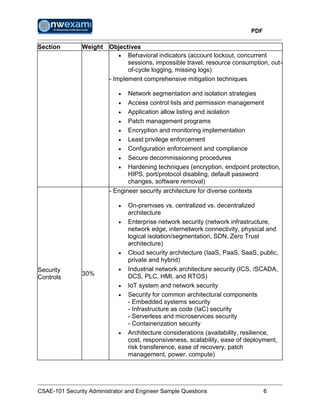
 Behavioral indicators (account lockout, concurrent
sessions, impossible travel, resource consumption, out-
of-cycle logging, missing logs)
- Implement comprehensive mitigation techniques
 Network segmentation and isolation strategies
 Access control lists and permission management
 Application allow listing and isolation
 Patch management programs
 Encryption and monitoring implementation
 Least privilege enforcement
 Configuration enforcement and compliance
 Secure decommissioning procedures
 Hardening techniques (encryption, endpoint protection,
HIPS, port/protocol disabling, default password
changes, software removal)
Security
Controls
30%
- Engineer security architecture for diverse contexts
 On-premises vs. centralized vs. decentralized
architecture
 Enterprise network security (network infrastructure,
network edge, internetwork connectivity, physical and
logical isolation/segmentation, SDN, Zero Trust
architecture)
 Cloud security architecture (IaaS, PaaS, SaaS, public,
private and hybrid)
 Industrial network architecture security (ICS, /SCADA,
DCS, PLC, HMI, and RTOS)
 IoT system and network security
 Security for common architectural components
- Embedded systems security
- Infrastructure as code (IaC) security
- Serverless and microservices security
- Containerization security
 Architecture considerations (availability, resilience,
cost, responsiveness, scalability, ease of deployment,
risk transference, ease of recovery, patch
management, power, compute)
PDF
CSAE-101 Security Administrator and Engineer Sample Questions 7
Section Weight Objectives
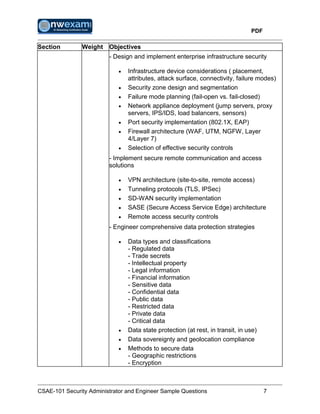
- Design and implement enterprise infrastructure security
 Infrastructure device considerations ( placement,
attributes, attack surface, connectivity, failure modes)
 Security zone design and segmentation
 Failure mode planning (fail-open vs. fail-closed)
 Network appliance deployment (jump servers, proxy
servers, IPS/IDS, load balancers, sensors)
 Port security implementation (802.1X, EAP)
 Firewall architecture (WAF, UTM, NGFW, Layer
4/Layer 7)
 Selection of effective security controls
- Implement secure remote communication and access
solutions
 VPN architecture (site-to-site, remote access)
 Tunneling protocols (TLS, IPSec)
 SD-WAN security implementation
 SASE (Secure Access Service Edge) architecture
 Remote access security controls
- Engineer comprehensive data protection strategies
 Data types and classifications
- Regulated data
- Trade secrets
- Intellectual property
- Legal information
- Financial information
- Sensitive data
- Confidential data
- Public data
- Restricted data
- Private data
- Critical data
 Data state protection (at rest, in transit, in use)
 Data sovereignty and geolocation compliance
 Methods to secure data
- Geographic restrictions
- Encryption
PDF
CSAE-101 Security Administrator and Engineer Sample Questions 8
Section Weight Objectives
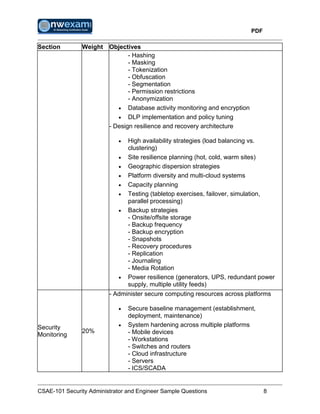
- Hashing
- Masking
- Tokenization
- Obfuscation
- Segmentation
- Permission restrictions
- Anonymization
 Database activity monitoring and encryption
 DLP implementation and policy tuning
- Design resilience and recovery architecture
 High availability strategies (load balancing vs.
clustering)
 Site resilience planning (hot, cold, warm sites)
 Geographic dispersion strategies
 Platform diversity and multi-cloud systems
 Capacity planning
 Testing (tabletop exercises, failover, simulation,
parallel processing)
 Backup strategies
- Onsite/offsite storage
- Backup frequency
- Backup encryption
- Snapshots
- Recovery procedures
- Replication
- Journaling
- Media Rotation
 Power resilience (generators, UPS, redundant power
supply, multiple utility feeds)
Security
Monitoring
20%
- Administer secure computing resources across platforms
 Secure baseline management (establishment,
deployment, maintenance)
 System hardening across multiple platforms
- Mobile devices
- Workstations
- Switches and routers
- Cloud infrastructure
- Servers
- ICS/SCADA
PDF
CSAE-101 Security Administrator and Engineer Sample Questions 9
Section Weight Objectives
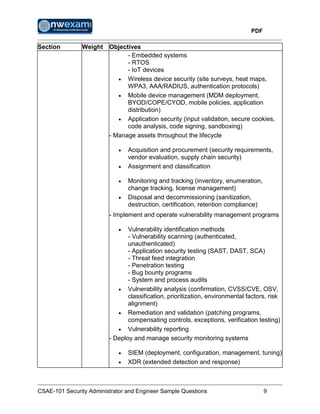
- Embedded systems
- RTOS
- IoT devices
 Wireless device security (site surveys, heat maps,
WPA3, AAA/RADIUS, authentication protocols)
 Mobile device management (MDM deployment,
BYOD/COPE/CYOD, mobile policies, application
distribution)
 Application security (input validation, secure cookies,
code analysis, code signing, sandboxing)
- Manage assets throughout the lifecycle
 Acquisition and procurement (security requirements,
vendor evaluation, supply chain security)
 Assignment and classification
 Monitoring and tracking (inventory, enumeration,
change tracking, license management)
 Disposal and decommissioning (sanitization,
destruction, certification, retention compliance)
- Implement and operate vulnerability management programs
 Vulnerability identification methods
- Vulnerability scanning (authenticated,
unauthenticated)
- Application security testing (SAST, DAST, SCA)
- Threat feed integration
- Penetration testing
- Bug bounty programs
- System and process audits
 Vulnerability analysis (confirmation, CVSS/CVE, OSV,
classification, prioritization, environmental factors, risk
alignment)
 Remediation and validation (patching programs,
compensating controls, exceptions, verification testing)
 Vulnerability reporting
- Deploy and manage security monitoring systems
 SIEM (deployment, configuration, management, tuning)
 XDR (extended detection and response)
PDF
CSAE-101 Security Administrator and Engineer Sample Questions 10
Section Weight Objectives
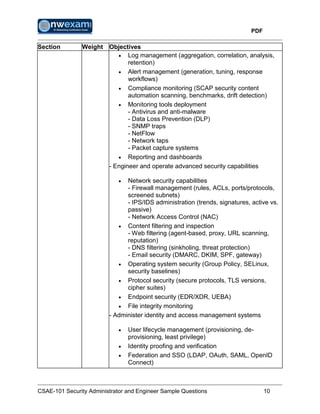
 Log management (aggregation, correlation, analysis,
retention)
 Alert management (generation, tuning, response
workflows)
 Compliance monitoring (SCAP security content
automation scanning, benchmarks, drift detection)
 Monitoring tools deployment
- Antivirus and anti-malware
- Data Loss Prevention (DLP)
- SNMP traps
- NetFlow
- Network taps
- Packet capture systems
 Reporting and dashboards
- Engineer and operate advanced security capabilities
 Network security capabilities
- Firewall management (rules, ACLs, ports/protocols,
screened subnets)
- IPS/IDS administration (trends, signatures, active vs.
passive)
- Network Access Control (NAC)
 Content filtering and inspection
- Web filtering (agent-based, proxy, URL scanning,
reputation)
- DNS filtering (sinkholing, threat protection)
- Email security (DMARC, DKIM, SPF, gateway)
 Operating system security (Group Policy, SELinux,
security baselines)
 Protocol security (secure protocols, TLS versions,
cipher suites)
 Endpoint security (EDR/XDR, UEBA)
 File integrity monitoring
- Administer identity and access management systems
 User lifecycle management (provisioning, de-
provisioning, least privilege)
 Identity proofing and verification
 Federation and SSO (LDAP, OAuth, SAML, OpenID
Connect)
PDF
CSAE-101 Security Administrator and Engineer Sample Questions 11
Section Weight Objectives
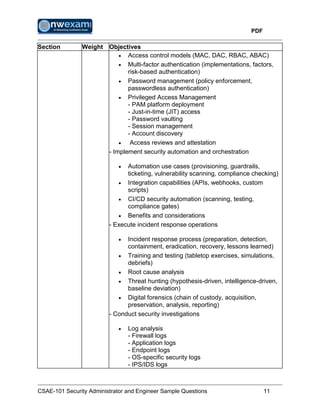
 Access control models (MAC, DAC, RBAC, ABAC)
 Multi-factor authentication (implementations, factors,
risk-based authentication)
 Password management (policy enforcement,
passwordless authentication)
 Privileged Access Management
- PAM platform deployment
- Just-in-time (JIT) access
- Password vaulting
- Session management
- Account discovery
 Access reviews and attestation
- Implement security automation and orchestration
 Automation use cases (provisioning, guardrails,
ticketing, vulnerability scanning, compliance checking)
 Integration capabilities (APIs, webhooks, custom
scripts)
 CI/CD security automation (scanning, testing,
compliance gates)
 Benefits and considerations
- Execute incident response operations
 Incident response process (preparation, detection,
containment, eradication, recovery, lessons learned)
 Training and testing (tabletop exercises, simulations,
debriefs)
 Root cause analysis
 Threat hunting (hypothesis-driven, intelligence-driven,
baseline deviation)
 Digital forensics (chain of custody, acquisition,
preservation, analysis, reporting)
- Conduct security investigations
 Log analysis
- Firewall logs
- Application logs
- Endpoint logs
- OS-specific security logs
- IPS/IDS logs
PDF
CSAE-101 Security Administrator and Engineer Sample Questions 12
Section Weight Objectives
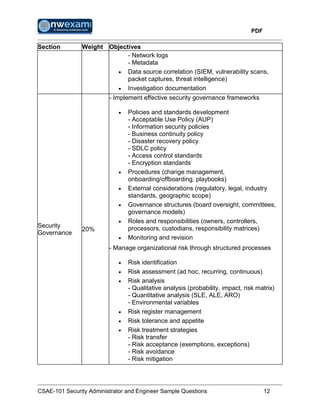
- Network logs
- Metadata
 Data source correlation (SIEM, vulnerability scans,
packet captures, threat intelligence)
 Investigation documentation
Security
Governance
20%
- Implement effective security governance frameworks
 Policies and standards development
- Acceptable Use Policy (AUP)
- Information security policies
- Business continuity policy
- Disaster recovery policy
- SDLC policy
- Access control standards
- Encryption standards
 Procedures (change management,
onboarding/offboarding, playbooks)
 External considerations (regulatory, legal, industry
standards, geographic scope)
 Governance structures (board oversight, committees,
governance models)
 Roles and responsibilities (owners, controllers,
processors, custodians, responsibility matrices)
 Monitoring and revision
- Manage organizational risk through structured processes
 Risk identification
 Risk assessment (ad hoc, recurring, continuous)
 Risk analysis
- Qualitative analysis (probability, impact, risk matrix)
- Quantitative analysis (SLE, ALE, ARO)
- Environmental variables
 Risk register management
 Risk tolerance and appetite
 Risk treatment strategies
- Risk transfer
- Risk acceptance (exemptions, exceptions)
- Risk avoidance
- Risk mitigation
PDF
CSAE-101 Security Administrator and Engineer Sample Questions 13
Section Weight Objectives
 Risk reporting
 Business impact analysis (RTO, RPO, MTTR, MTBF)
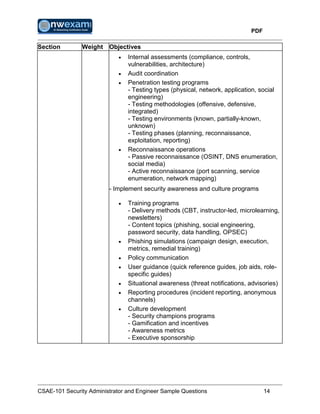
- Administer third-party risk management programs
 Vendor assessment (questionnaires, audits,
certifications)
 Supply chain analysis (mapping, dependencies, fourth-
party risk)
 Vendor selection and due diligence
 Agreement management
- Service Level Agreement (SLA)
- Memorandum of Agreement (MOA)
- Memorandum of Understanding (MOU)
- Master Service Agreement (MSA)
- Statement of Work (SOW)
- Non-Disclosure Agreement (NDA)
- Business Partnership Agreement (BPA)
- Data Processing Agreement (DPA)
 Ongoing monitoring
 Rules of engagement
- Maintain comprehensive compliance programs
 Compliance reporting and monitoring
 Automation and dashboards
 Privacy compliance programs
- GDPR (General Data Protection Regulation)
- CCPA (California Consumer Privacy Act)
- HIPAA (Health Insurance Portability and
Accountability Act)
- PCI DSS (Payment Card Industry Data Security
Standard)
 Data governance (inventory, classification, retention)
 Attestation processes
 Internal audits (compliance assessments, control
testing, gap analysis)
 External audit coordination (regulatory exams, financial
audits, third-party assessments)
- Conduct security assessments and testing
PDF
CSAE-101 Security Administrator and Engineer Sample Questions 14
Section Weight Objectives
 Internal assessments (compliance, controls,
vulnerabilities, architecture)
 Audit coordination
 Penetration testing programs
- Testing types (physical, network, application, social
engineering)
- Testing methodologies (offensive, defensive,
integrated)
- Testing environments (known, partially-known,
unknown)
- Testing phases (planning, reconnaissance,
exploitation, reporting)
 Reconnaissance operations
- Passive reconnaissance (OSINT, DNS enumeration,
social media)
- Active reconnaissance (port scanning, service
enumeration, network mapping)
- Implement security awareness and culture programs
 Training programs
- Delivery methods (CBT, instructor-led, microlearning,
newsletters)
- Content topics (phishing, social engineering,
password security, data handling, OPSEC)
 Phishing simulations (campaign design, execution,
metrics, remedial training)
 Policy communication
 User guidance (quick reference guides, job aids, role-
specific guides)
 Situational awareness (threat notifications, advisories)
 Reporting procedures (incident reporting, anonymous
channels)
 Culture development
- Security champions programs
- Gamification and incentives
- Awareness metrics
- Executive sponsorship
PDF
CSAE-101 Security Administrator and Engineer Sample Questions 15
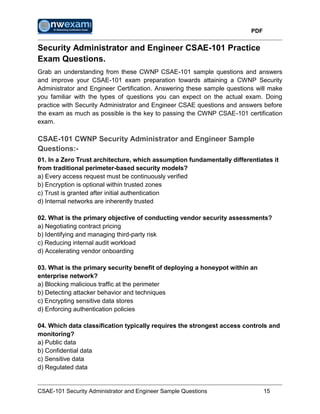
Security Administrator and Engineer CSAE-101 Practice
Exam Questions.
Grab an understanding from these CWNP CSAE-101 sample questions and answers
and improve your CSAE-101 exam preparation towards attaining a CWNP Security
Administrator and Engineer Certification. Answering these sample questions will make
you familiar with the types of questions you can expect on the actual exam. Doing
practice with Security Administrator and Engineer CSAE questions and answers before
the exam as much as possible is the key to passing the CWNP CSAE-101 certification
exam.
CSAE-101 CWNP Security Administrator and Engineer Sample
Questions:-
01. In a Zero Trust architecture, which assumption fundamentally differentiates it
from traditional perimeter-based security models?
a) Every access request must be continuously verified
b) Encryption is optional within trusted zones
c) Trust is granted after initial authentication
d) Internal networks are inherently trusted
02. What is the primary objective of conducting vendor security assessments?
a) Negotiating contract pricing
b) Identifying and managing third-party risk
c) Reducing internal audit workload
d) Accelerating vendor onboarding
03. What is the primary security benefit of deploying a honeypot within an
enterprise network?
a) Blocking malicious traffic at the perimeter
b) Detecting attacker behavior and techniques
c) Encrypting sensitive data stores
d) Enforcing authentication policies
04. Which data classification typically requires the strongest access controls and
monitoring?
a) Public data
b) Confidential data
c) Sensitive data
d) Regulated data
PDF
CSAE-101 Security Administrator and Engineer Sample Questions 16
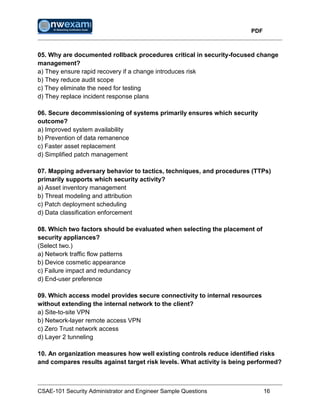
05. Why are documented rollback procedures critical in security-focused change
management?
a) They ensure rapid recovery if a change introduces risk
b) They reduce audit scope
c) They eliminate the need for testing
d) They replace incident response plans
06. Secure decommissioning of systems primarily ensures which security
outcome?
a) Improved system availability
b) Prevention of data remanence
c) Faster asset replacement
d) Simplified patch management
07. Mapping adversary behavior to tactics, techniques, and procedures (TTPs)
primarily supports which security activity?
a) Asset inventory management
b) Threat modeling and attribution
c) Patch deployment scheduling
d) Data classification enforcement
08. Which two factors should be evaluated when selecting the placement of
security appliances?
(Select two.)
a) Network traffic flow patterns
b) Device cosmetic appearance
c) Failure impact and redundancy
d) End-user preference
09. Which access model provides secure connectivity to internal resources
without extending the internal network to the client?
a) Site-to-site VPN
b) Network-layer remote access VPN
c) Zero Trust network access
d) Layer 2 tunneling
10. An organization measures how well existing controls reduce identified risks
and compares results against target risk levels. What activity is being performed?
PDF
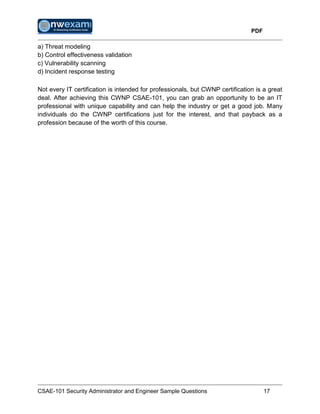
CSAE-101 Security Administrator and Engineer Sample Questions 17
a) Threat modeling
b) Control effectiveness validation
c) Vulnerability scanning
d) Incident response testing
Not every IT certification is intended for professionals, but CWNP certification is a great
deal. After achieving this CWNP CSAE-101, you can grab an opportunity to be an IT
professional with unique capability and can help the industry or get a good job. Many
individuals do the CWNP certifications just for the interest, and that payback as a
profession because of the worth of this course.

CWNP CSAE-101 Certification Study Guide with Practice Questions & Exam Tips

  • 1.
    CWNP CSAE-101 Certification StudyGuide with Practice Questions & Exam Tips Practice Questions, Exam Objectives, and Expert Study Tips for CSAE- 101 www.NWExam.com This comprehensive CSAE-101 study guide helps IT professionals prepare for the CWNP Security Administrator and Engineer exam. Covering Zero Trust architecture, vendor assessments, honeypots, access controls, threat modeling, and secure change management, it provides detailed exam topics, practice questions, and expert tips to achieve certification success. Designed for focused preparation, this guide ensures familiarity with exam structure and key security concepts.
  • 2.
    PDF CSAE-101 Security Administratorand Engineer Sample Questions 1 CWNP Security Administrator and Engineer CSAE-101 Certification Study Guide CWNP CSAE-101 Certification Exam Details CWNP CSAE-101 certifications are globally accepted and add significant value to any IT professional. The certification gives you a profound understanding of all the workings of the network models and the devices that are utilized with it. NWExam.com is proud to provide you with the best CWNP Exam Guides. The CWNP CSAE-101 Exam is challenging, and thorough preparation is essential for success. This cert guide is designed to help you prepare for the Security Administrator and Engineer certification exam. It contains a detailed list of the topics covered on the Professional exam. These guidelines for the CSAE will help guide you through the study process for your certification. To obtain CWNP Security Administrator and Engineer certification, you are required to pass the CSAE CSAE-101 exam. This exam is created keeping in mind the input of
  • 3.
    PDF CSAE-101 Security Administratorand Engineer Sample Questions 2 professionals in the industry and reveals how CWNP products are used in organizations across the world. CSAE-101 CWNP Security Administrator and Engineer Exam Summary ● Exam Name: CWNP Security Administrator and Engineer ● Exam Code: CSAE-101 ● Exam Price: $399 USD ● Duration: 100 minutes ● Number of Questions: 40 ● Passing Score: 70% ● Exam Registration: Prometric ● Recommended Practice: CWNP Certified Security Administrator and Engineer Practice Test Topics covered in the CWNP Security Administrator and Engineer CSAE-101 Exam Section Weight Objectives Security Concepts and Terminology 15% - Understand and evaluate security controls  Security control categories and types - Technical controls - Managerial controls - Operational controls - Physical controls  Defense-in-depth strategies  Control effectiveness measurement and validation  Gap analysis and remediation planning - Explain how the following core security principles apply to enterprise environments  CIA triad implementation (Confidentiality, Integrity, Availability)  Non-repudiation mechanisms  AAA framework deployment (Authentication, Authorization, Accounting)  Zero Trust architecture
  • 4.
    PDF CSAE-101 Security Administratorand Engineer Sample Questions 3 Section Weight Objectives  Control plane and data plane security  Policy-driven access control systems  Policy enforcement points - Describe and distinguish among these physical security systems  Access control systems and badge management  Video surveillance systems (CCTV, IP cameras)  Environmental controls (HVAC, fire suppression)  Physical intrusion detection sensors  Lighting and perimeter security  Security guard operations and integration - Describe and distinguish among these deception and disruption technologies  Honeypot deployment and management  Honeynet architecture design  Honeyfile and honeytoken strategies  Integration with threat intelligence platforms  Deception technology for threat detection - Explain these cryptographic solutions and the roles they play in enterprise security  PKI infrastructure deployment and management  Certificate lifecycle management (issuance, renewal, revocation)  Encryption implementation - Full-disk encryption - Partition encryption - File encryption - Volume encryption - Database encryption - Transport encryption  Key management systems and HSM integration  Digital signatures and key stretching  Hashing and salting techniques  Blockchain and open public ledger technologies  Certificate management
  • 5.
    PDF CSAE-101 Security Administratorand Engineer Sample Questions 4 Section Weight Objectives - Certificate Authority (CA) - Certificate Revocation List (CRL) - Online Certificate Status Protocol (OCSP) - Certificate Signing Request (CSR) generation - Understand how to apply change management processes for security  Security-focused change approval workflows  Impact analysis and risk assessment for changes  Backout plans and rollback procedures  Configuration management and version control  Documentation standards for security changes  Stakeholder management in change processes Threats and Vulnerabilities 15% - Analyze threat actors, attributes, and motivations  Threat actor types - Nation-state actors - Organized crime - Hacktivists - Insider threats - Shadow IT  Threat actor attribution and profiling  Actor attributes (internal/external, resources/funding, sophistication level)  Motivations (data exfiltration, espionage, financial gain, disruption, war)  Attack vector analysis across multiple surfaces  TTPs (tactics, techniques, and procedures) mapping to MITRE ATT&CK - Assess and mitigate attack vectors and surfaces  Message-based attacks (email, SMS, instant messaging)  Image-based and file-based attack vectors  Voice call and removable device threats  Social engineering campaigns (phishing, vishing, smishing, pretexting, watering hole)  Supply chain attacks (MSPs, vendors, suppliers)
  • 6.
    PDF CSAE-101 Security Administratorand Engineer Sample Questions 5 Section Weight Objectives  Vulnerable and unsupported software management  Network-based attack surfaces (wireless, wired, Bluetooth)  Default credential and open port management - Identify and classify vulnerabilities across environments  Application vulnerabilities (memory injection, buffer overflow, race conditions, malicious updates)  OS-based and web-based vulnerabilities (SQL injection, XSS)  Hardware and firmware vulnerabilities  Virtualization vulnerabilities (VM escape, resource reuse)  Cloud-specific and supply chain vulnerabilities  Mobile device vulnerabilities (side loading, jailbreaking)  Zero-day vulnerability management  Misconfiguration identification - Analyze and respond to indicators of malicious activity  Malware analysis - Ransomware - Trojans - Worms - Rootkits - Spyware - Bloatware - Viruses - Keyloggers - Logic bombs  Physical attack indicators (brute force, RFID cloning, environmental)  Network attack detection (DDoS, DNS attacks, wireless attacks, on-path, credential replay)  Application attack identification (injection, buffer overflow, replay, privilege escalation, forgery, directory traversal)  Cryptographic attack recognition (downgrade, collision, birthday)  Password attacks (spraying, brute force)
  • 7.
    PDF CSAE-101 Security Administratorand Engineer Sample Questions 6 Section Weight Objectives  Behavioral indicators (account lockout, concurrent sessions, impossible travel, resource consumption, out- of-cycle logging, missing logs) - Implement comprehensive mitigation techniques  Network segmentation and isolation strategies  Access control lists and permission management  Application allow listing and isolation  Patch management programs  Encryption and monitoring implementation  Least privilege enforcement  Configuration enforcement and compliance  Secure decommissioning procedures  Hardening techniques (encryption, endpoint protection, HIPS, port/protocol disabling, default password changes, software removal) Security Controls 30% - Engineer security architecture for diverse contexts  On-premises vs. centralized vs. decentralized architecture  Enterprise network security (network infrastructure, network edge, internetwork connectivity, physical and logical isolation/segmentation, SDN, Zero Trust architecture)  Cloud security architecture (IaaS, PaaS, SaaS, public, private and hybrid)  Industrial network architecture security (ICS, /SCADA, DCS, PLC, HMI, and RTOS)  IoT system and network security  Security for common architectural components - Embedded systems security - Infrastructure as code (IaC) security - Serverless and microservices security - Containerization security  Architecture considerations (availability, resilience, cost, responsiveness, scalability, ease of deployment, risk transference, ease of recovery, patch management, power, compute)
  • 8.
    PDF CSAE-101 Security Administratorand Engineer Sample Questions 7 Section Weight Objectives - Design and implement enterprise infrastructure security  Infrastructure device considerations ( placement, attributes, attack surface, connectivity, failure modes)  Security zone design and segmentation  Failure mode planning (fail-open vs. fail-closed)  Network appliance deployment (jump servers, proxy servers, IPS/IDS, load balancers, sensors)  Port security implementation (802.1X, EAP)  Firewall architecture (WAF, UTM, NGFW, Layer 4/Layer 7)  Selection of effective security controls - Implement secure remote communication and access solutions  VPN architecture (site-to-site, remote access)  Tunneling protocols (TLS, IPSec)  SD-WAN security implementation  SASE (Secure Access Service Edge) architecture  Remote access security controls - Engineer comprehensive data protection strategies  Data types and classifications - Regulated data - Trade secrets - Intellectual property - Legal information - Financial information - Sensitive data - Confidential data - Public data - Restricted data - Private data - Critical data  Data state protection (at rest, in transit, in use)  Data sovereignty and geolocation compliance  Methods to secure data - Geographic restrictions - Encryption
  • 9.
    PDF CSAE-101 Security Administratorand Engineer Sample Questions 8 Section Weight Objectives - Hashing - Masking - Tokenization - Obfuscation - Segmentation - Permission restrictions - Anonymization  Database activity monitoring and encryption  DLP implementation and policy tuning - Design resilience and recovery architecture  High availability strategies (load balancing vs. clustering)  Site resilience planning (hot, cold, warm sites)  Geographic dispersion strategies  Platform diversity and multi-cloud systems  Capacity planning  Testing (tabletop exercises, failover, simulation, parallel processing)  Backup strategies - Onsite/offsite storage - Backup frequency - Backup encryption - Snapshots - Recovery procedures - Replication - Journaling - Media Rotation  Power resilience (generators, UPS, redundant power supply, multiple utility feeds) Security Monitoring 20% - Administer secure computing resources across platforms  Secure baseline management (establishment, deployment, maintenance)  System hardening across multiple platforms - Mobile devices - Workstations - Switches and routers - Cloud infrastructure - Servers - ICS/SCADA
  • 10.
    PDF CSAE-101 Security Administratorand Engineer Sample Questions 9 Section Weight Objectives - Embedded systems - RTOS - IoT devices  Wireless device security (site surveys, heat maps, WPA3, AAA/RADIUS, authentication protocols)  Mobile device management (MDM deployment, BYOD/COPE/CYOD, mobile policies, application distribution)  Application security (input validation, secure cookies, code analysis, code signing, sandboxing) - Manage assets throughout the lifecycle  Acquisition and procurement (security requirements, vendor evaluation, supply chain security)  Assignment and classification  Monitoring and tracking (inventory, enumeration, change tracking, license management)  Disposal and decommissioning (sanitization, destruction, certification, retention compliance) - Implement and operate vulnerability management programs  Vulnerability identification methods - Vulnerability scanning (authenticated, unauthenticated) - Application security testing (SAST, DAST, SCA) - Threat feed integration - Penetration testing - Bug bounty programs - System and process audits  Vulnerability analysis (confirmation, CVSS/CVE, OSV, classification, prioritization, environmental factors, risk alignment)  Remediation and validation (patching programs, compensating controls, exceptions, verification testing)  Vulnerability reporting - Deploy and manage security monitoring systems  SIEM (deployment, configuration, management, tuning)  XDR (extended detection and response)
  • 11.
    PDF CSAE-101 Security Administratorand Engineer Sample Questions 10 Section Weight Objectives  Log management (aggregation, correlation, analysis, retention)  Alert management (generation, tuning, response workflows)  Compliance monitoring (SCAP security content automation scanning, benchmarks, drift detection)  Monitoring tools deployment - Antivirus and anti-malware - Data Loss Prevention (DLP) - SNMP traps - NetFlow - Network taps - Packet capture systems  Reporting and dashboards - Engineer and operate advanced security capabilities  Network security capabilities - Firewall management (rules, ACLs, ports/protocols, screened subnets) - IPS/IDS administration (trends, signatures, active vs. passive) - Network Access Control (NAC)  Content filtering and inspection - Web filtering (agent-based, proxy, URL scanning, reputation) - DNS filtering (sinkholing, threat protection) - Email security (DMARC, DKIM, SPF, gateway)  Operating system security (Group Policy, SELinux, security baselines)  Protocol security (secure protocols, TLS versions, cipher suites)  Endpoint security (EDR/XDR, UEBA)  File integrity monitoring - Administer identity and access management systems  User lifecycle management (provisioning, de- provisioning, least privilege)  Identity proofing and verification  Federation and SSO (LDAP, OAuth, SAML, OpenID Connect)
  • 12.
    PDF CSAE-101 Security Administratorand Engineer Sample Questions 11 Section Weight Objectives  Access control models (MAC, DAC, RBAC, ABAC)  Multi-factor authentication (implementations, factors, risk-based authentication)  Password management (policy enforcement, passwordless authentication)  Privileged Access Management - PAM platform deployment - Just-in-time (JIT) access - Password vaulting - Session management - Account discovery  Access reviews and attestation - Implement security automation and orchestration  Automation use cases (provisioning, guardrails, ticketing, vulnerability scanning, compliance checking)  Integration capabilities (APIs, webhooks, custom scripts)  CI/CD security automation (scanning, testing, compliance gates)  Benefits and considerations - Execute incident response operations  Incident response process (preparation, detection, containment, eradication, recovery, lessons learned)  Training and testing (tabletop exercises, simulations, debriefs)  Root cause analysis  Threat hunting (hypothesis-driven, intelligence-driven, baseline deviation)  Digital forensics (chain of custody, acquisition, preservation, analysis, reporting) - Conduct security investigations  Log analysis - Firewall logs - Application logs - Endpoint logs - OS-specific security logs - IPS/IDS logs
  • 13.
    PDF CSAE-101 Security Administratorand Engineer Sample Questions 12 Section Weight Objectives - Network logs - Metadata  Data source correlation (SIEM, vulnerability scans, packet captures, threat intelligence)  Investigation documentation Security Governance 20% - Implement effective security governance frameworks  Policies and standards development - Acceptable Use Policy (AUP) - Information security policies - Business continuity policy - Disaster recovery policy - SDLC policy - Access control standards - Encryption standards  Procedures (change management, onboarding/offboarding, playbooks)  External considerations (regulatory, legal, industry standards, geographic scope)  Governance structures (board oversight, committees, governance models)  Roles and responsibilities (owners, controllers, processors, custodians, responsibility matrices)  Monitoring and revision - Manage organizational risk through structured processes  Risk identification  Risk assessment (ad hoc, recurring, continuous)  Risk analysis - Qualitative analysis (probability, impact, risk matrix) - Quantitative analysis (SLE, ALE, ARO) - Environmental variables  Risk register management  Risk tolerance and appetite  Risk treatment strategies - Risk transfer - Risk acceptance (exemptions, exceptions) - Risk avoidance - Risk mitigation
  • 14.
    PDF CSAE-101 Security Administratorand Engineer Sample Questions 13 Section Weight Objectives  Risk reporting  Business impact analysis (RTO, RPO, MTTR, MTBF) - Administer third-party risk management programs  Vendor assessment (questionnaires, audits, certifications)  Supply chain analysis (mapping, dependencies, fourth- party risk)  Vendor selection and due diligence  Agreement management - Service Level Agreement (SLA) - Memorandum of Agreement (MOA) - Memorandum of Understanding (MOU) - Master Service Agreement (MSA) - Statement of Work (SOW) - Non-Disclosure Agreement (NDA) - Business Partnership Agreement (BPA) - Data Processing Agreement (DPA)  Ongoing monitoring  Rules of engagement - Maintain comprehensive compliance programs  Compliance reporting and monitoring  Automation and dashboards  Privacy compliance programs - GDPR (General Data Protection Regulation) - CCPA (California Consumer Privacy Act) - HIPAA (Health Insurance Portability and Accountability Act) - PCI DSS (Payment Card Industry Data Security Standard)  Data governance (inventory, classification, retention)  Attestation processes  Internal audits (compliance assessments, control testing, gap analysis)  External audit coordination (regulatory exams, financial audits, third-party assessments) - Conduct security assessments and testing
  • 15.
    PDF CSAE-101 Security Administratorand Engineer Sample Questions 14 Section Weight Objectives  Internal assessments (compliance, controls, vulnerabilities, architecture)  Audit coordination  Penetration testing programs - Testing types (physical, network, application, social engineering) - Testing methodologies (offensive, defensive, integrated) - Testing environments (known, partially-known, unknown) - Testing phases (planning, reconnaissance, exploitation, reporting)  Reconnaissance operations - Passive reconnaissance (OSINT, DNS enumeration, social media) - Active reconnaissance (port scanning, service enumeration, network mapping) - Implement security awareness and culture programs  Training programs - Delivery methods (CBT, instructor-led, microlearning, newsletters) - Content topics (phishing, social engineering, password security, data handling, OPSEC)  Phishing simulations (campaign design, execution, metrics, remedial training)  Policy communication  User guidance (quick reference guides, job aids, role- specific guides)  Situational awareness (threat notifications, advisories)  Reporting procedures (incident reporting, anonymous channels)  Culture development - Security champions programs - Gamification and incentives - Awareness metrics - Executive sponsorship
  • 16.
    PDF CSAE-101 Security Administratorand Engineer Sample Questions 15 Security Administrator and Engineer CSAE-101 Practice Exam Questions. Grab an understanding from these CWNP CSAE-101 sample questions and answers and improve your CSAE-101 exam preparation towards attaining a CWNP Security Administrator and Engineer Certification. Answering these sample questions will make you familiar with the types of questions you can expect on the actual exam. Doing practice with Security Administrator and Engineer CSAE questions and answers before the exam as much as possible is the key to passing the CWNP CSAE-101 certification exam. CSAE-101 CWNP Security Administrator and Engineer Sample Questions:- 01. In a Zero Trust architecture, which assumption fundamentally differentiates it from traditional perimeter-based security models? a) Every access request must be continuously verified b) Encryption is optional within trusted zones c) Trust is granted after initial authentication d) Internal networks are inherently trusted 02. What is the primary objective of conducting vendor security assessments? a) Negotiating contract pricing b) Identifying and managing third-party risk c) Reducing internal audit workload d) Accelerating vendor onboarding 03. What is the primary security benefit of deploying a honeypot within an enterprise network? a) Blocking malicious traffic at the perimeter b) Detecting attacker behavior and techniques c) Encrypting sensitive data stores d) Enforcing authentication policies 04. Which data classification typically requires the strongest access controls and monitoring? a) Public data b) Confidential data c) Sensitive data d) Regulated data
  • 17.
    PDF CSAE-101 Security Administratorand Engineer Sample Questions 16 05. Why are documented rollback procedures critical in security-focused change management? a) They ensure rapid recovery if a change introduces risk b) They reduce audit scope c) They eliminate the need for testing d) They replace incident response plans 06. Secure decommissioning of systems primarily ensures which security outcome? a) Improved system availability b) Prevention of data remanence c) Faster asset replacement d) Simplified patch management 07. Mapping adversary behavior to tactics, techniques, and procedures (TTPs) primarily supports which security activity? a) Asset inventory management b) Threat modeling and attribution c) Patch deployment scheduling d) Data classification enforcement 08. Which two factors should be evaluated when selecting the placement of security appliances? (Select two.) a) Network traffic flow patterns b) Device cosmetic appearance c) Failure impact and redundancy d) End-user preference 09. Which access model provides secure connectivity to internal resources without extending the internal network to the client? a) Site-to-site VPN b) Network-layer remote access VPN c) Zero Trust network access d) Layer 2 tunneling 10. An organization measures how well existing controls reduce identified risks and compares results against target risk levels. What activity is being performed?
  • 18.
    PDF CSAE-101 Security Administratorand Engineer Sample Questions 17 a) Threat modeling b) Control effectiveness validation c) Vulnerability scanning d) Incident response testing Not every IT certification is intended for professionals, but CWNP certification is a great deal. After achieving this CWNP CSAE-101, you can grab an opportunity to be an IT professional with unique capability and can help the industry or get a good job. Many individuals do the CWNP certifications just for the interest, and that payback as a profession because of the worth of this course.