Cisco 810-110 Certification Study Guide | Exam Prep & Practice Questions
Prepare for the Cisco AI Technical Practitioner 810-110 exam with this complete study guide covering AI basics, generative AI, security, and practice questions.
Cisco 810-110 Certification Study Guide | Exam Prep & Practice Questions
1.
Cisco 810-110 Certification
StudyGuide | Exam Prep &
Practice Questions
Exam Preparation Tips and Recommended Study Resources
www.NWExam.com
The Cisco AI Technical Practitioner 810-110 Certification Study Guide is
designed to help professionals prepare effectively for the AITECH exam. This
guide covers core AI concepts, generative AI fundamentals, data preparation,
prompt engineering, security, ethics, and real-world Cisco AI use cases. It
provides a structured overview of exam objectives, key topics, and practice-
style questions aligned with the latest Cisco exam blueprint. Ideal for IT
professionals and beginners in AI, this study guide supports skill development
and exam readiness for earning the globally recognized Cisco AI Technical
Practitioner certification.
2.
PDF
810-110 AI TechnicalPractitioner Sample Questions 1
Cisco AI Technical Practitioner 810-110
Certification Study Guide
Cisco 810-110 Certification Exam Details
Cisco 810-110 certifications are globally accepted and add significant value to any IT
professional. The certification gives you a profound understanding of all the workings of
the network models and the devices that are utilized with it. NWExam.com is proud to
provide you with the best Cisco Exam Guides.
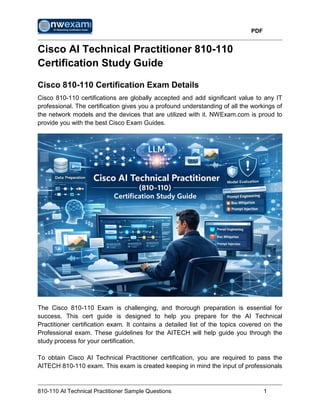
The Cisco 810-110 Exam is challenging, and thorough preparation is essential for
success. This cert guide is designed to help you prepare for the AI Technical
Practitioner certification exam. It contains a detailed list of the topics covered on the
Professional exam. These guidelines for the AITECH will help guide you through the
study process for your certification.
To obtain Cisco AI Technical Practitioner certification, you are required to pass the
AITECH 810-110 exam. This exam is created keeping in mind the input of professionals
3.
PDF
810-110 AI TechnicalPractitioner Sample Questions 2
in the industry and reveals how Cisco products are used in organizations across the
world.
810-110 Cisco AI Technical Practitioner Exam Summary
● Exam Name: Cisco AI Technical Practitioner
● Exam Code: 810-110
● Exam Price: $150 USD
● Duration: 60 minutes
● Number of Questions: 40-60
● Passing Score: Variable (750-850 / 1000 Approx.)
● Exam Registration: PEARSON VUE
● Recommended Practice: Cisco AI Technical Practitioner Practice Test
● Recommended Training: Cisco AI Technical Practitioner | AITECH
Topics covered in the Cisco AI Technical Practitioner 810-110
Exam
Section Weight Objectives
Generative AI
Models
20%
- Describe major generative AI model families (e.g., LLMs,
diffusion models) and common use cases (text
summarization, content creation, code generation)
- Compare model hosting options (cloud-hosted vs locally
hosted) and their trade-offs (cost, latency, privacy,
scalability)
- Explain role of context windows, token limits and
response management
- Understand model selection in AI model hubs and
repositories for appropriate use-cases (e.g., reasoning,
multimodality)
- Describe Retrieval Augmented Generation (RAG) and
role of embeddings and vector databases
Prompt
Engineering
15%
- Understand prompt engineering principles and patterns
(roles, instructions, constraints)
- Explain prompting techniques (iterative/sequential,
chained, few-shot) and structures for text, image and audio
generation
- Describe prompt injection attack types
- Explain defensive prompting and mitigation strategies for
AI-generated errors (e.g., hallucinations)
Ethics and
Security
15%
- Explain responsible AI principles (fairness, transparency,
accountability, bias mitigation, safety)
4.
PDF
810-110 AI TechnicalPractitioner Sample Questions 3
Section Weight Objectives
- Describe approaches to protect corporate data privacy
and security in AI systems
- Explain AI-specific security threats and risks, including
misinformation
- Explain AI governance considerations (policy, risk
management, compliance)
Data Research
and Analysis
10%
- Explain AI’s role in exploratory data analysis (EDA)
- Describe automated data preparation tasks (quality
checks, formatting, transformation, cleaning)
- Explain the ethical and privacy considerations in AI-
assisted data analysis, including controls to prevent data
exposure
- Describe techniques for AI-assisted research, ideation,
and content drafting
Development and
Workflow
Automation
20%
- Describe AI's role across the software development
lifecycle (requirements, prototyping, implementation,
testing, deployment)
- Describe the AI capabilities for code generation and rapid
prototyping
- Explain AI workflow design and monitoring principles
- Describe how token usage and context-window
management affect prototyping cost, latency, and output
quality
- Explain how AI improves code quality (debugging
assistance, error handling, documentation)
Agentic AI 20%
- Differentiate Agentic AI from Generative AI use cases
- Explain AI agent design principles, autonomous
capabilities, and orchestration
- Describe Model Context Protocol (MCP) framework
primitives in context of agentic AI
- Explain human-in-the-loop (HITL) strategies
- Describe data transformation and mapping within AI
Agents
AI Technical Practitioner 810-110 Practice Exam Questions.
Grab an understanding from these Cisco 810-110 sample questions and answers and
improve your 810-110 exam preparation towards attaining a Cisco AI Technical
Practitioner Certification. Answering these sample questions will make you familiar with
the types of questions you can expect on the actual exam. Doing practice with AI
Technical Practitioner AITECH questions and answers before the exam as much as
possible is the key to passing the Cisco 810-110 certification exam.
5.
PDF
810-110 AI TechnicalPractitioner Sample Questions 4
810-110 Cisco AI Technical Practitioner Sample Questions:-
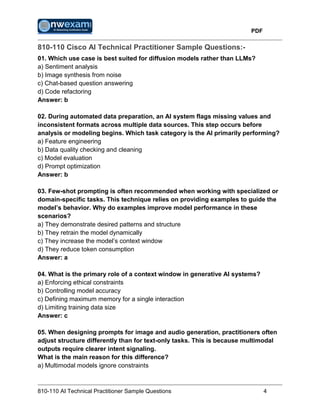
01. Which use case is best suited for diffusion models rather than LLMs?
a) Sentiment analysis
b) Image synthesis from noise
c) Chat-based question answering
d) Code refactoring
Answer: b
02. During automated data preparation, an AI system flags missing values and
inconsistent formats across multiple data sources. This step occurs before
analysis or modeling begins. Which task category is the AI primarily performing?
a) Feature engineering
b) Data quality checking and cleaning
c) Model evaluation
d) Prompt optimization
Answer: b
03. Few-shot prompting is often recommended when working with specialized or
domain-specific tasks. This technique relies on providing examples to guide the
model’s behavior. Why do examples improve model performance in these
scenarios?
a) They demonstrate desired patterns and structure
b) They retrain the model dynamically
c) They increase the model’s context window
d) They reduce token consumption
Answer: a
04. What is the primary role of a context window in generative AI systems?
a) Enforcing ethical constraints
b) Controlling model accuracy
c) Defining maximum memory for a single interaction
d) Limiting training data size
Answer: c
05. When designing prompts for image and audio generation, practitioners often
adjust structure differently than for text-only tasks. This is because multimodal
outputs require clearer intent signaling.
What is the main reason for this difference?
a) Multimodal models ignore constraints
6.
PDF
810-110 AI TechnicalPractitioner Sample Questions 5
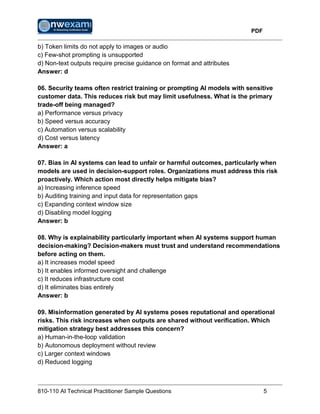
b) Token limits do not apply to images or audio
c) Few-shot prompting is unsupported
d) Non-text outputs require precise guidance on format and attributes
Answer: d
06. Security teams often restrict training or prompting AI models with sensitive
customer data. This reduces risk but may limit usefulness. What is the primary
trade-off being managed?
a) Performance versus privacy
b) Speed versus accuracy
c) Automation versus scalability
d) Cost versus latency
Answer: a
07. Bias in AI systems can lead to unfair or harmful outcomes, particularly when
models are used in decision-support roles. Organizations must address this risk
proactively. Which action most directly helps mitigate bias?
a) Increasing inference speed
b) Auditing training and input data for representation gaps
c) Expanding context window size
d) Disabling model logging
Answer: b
08. Why is explainability particularly important when AI systems support human
decision-making? Decision-makers must trust and understand recommendations
before acting on them.
a) It increases model speed
b) It enables informed oversight and challenge
c) It reduces infrastructure cost
d) It eliminates bias entirely
Answer: b
09. Misinformation generated by AI systems poses reputational and operational
risks. This risk increases when outputs are shared without verification. Which
mitigation strategy best addresses this concern?
a) Human-in-the-loop validation
b) Autonomous deployment without review
c) Larger context windows
d) Reduced logging
7.
PDF
810-110 AI TechnicalPractitioner Sample Questions 6
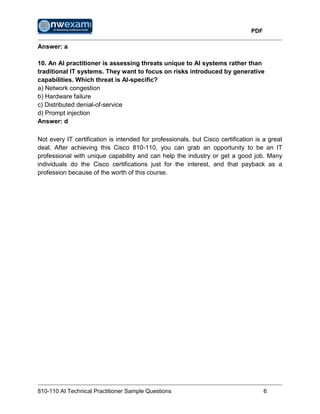
Answer: a
10. An AI practitioner is assessing threats unique to AI systems rather than
traditional IT systems. They want to focus on risks introduced by generative
capabilities. Which threat is AI-specific?
a) Network congestion
b) Hardware failure
c) Distributed denial-of-service
d) Prompt injection
Answer: d
Not every IT certification is intended for professionals, but Cisco certification is a great
deal. After achieving this Cisco 810-110, you can grab an opportunity to be an IT
professional with unique capability and can help the industry or get a good job. Many
individuals do the Cisco certifications just for the interest, and that payback as a
profession because of the worth of this course.



![[DSC Europe 25] Marcos Heidemann - Beyond the Hype: Making AI Coding Assistan...](https://cdn.slidesharecdn.com/ss_thumbnails/eexkhvldrjsopspdjbur-marcos-heidemann-beyond-the-hype-getting-real-value-out-of-ai-assisted-coding-260121115910-7e9d41ec-thumbnail.jpg?width=640&height=640&fit=bounds)


