Customer LoyaltyAravind.T.S
www.aravindts.com
“Not all customers were created equal”
www.aravindts.com
Customer Loyalty Programmes
u The systematic collection of customer data in return for rewards or
benefits, often used to give customer additional privileges or
services to best/loyalcustomers
www.aravindts.com
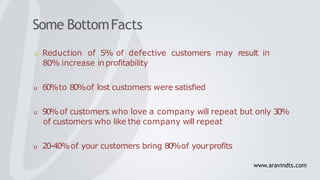
Some BottomFacts
u Reduction of 5% of defective customers may result in
80% increase inprofitability
u 60%to 80%of lost customers were satisfied
u 90%of customers who love a company will repeat but only 30%
of customers who like the company will repeat
u 20-40%of your customers bring 80%of yourprofits
www.aravindts.com
}It costs a business about 5-10 times more to acquire a new
customer
} Current customers of yours spend 67%more than a new one
} According to the 2011 Colloquy Customer Loyalty Census, of the
$48 billion worth of perceived value in reward points and miles
distributed by American businesses annually, one-third goes
unredeemed by consumer
www.aravindts.com
Types of LoyalCustomers
High
loyal
Latent
loyal
Spurious
loyal
Low
loyal
+
+ -
-
Frequency of Purchases
Attachment
www.aravindts.com
Need For LoyaltyProgrammes
•Reward them for beingspecial
•Create jump inenrolments
•Create interest for currentmembers
•New members getting attracted to
new offers
www.aravindts.com
Loyalty ProgrammeOptions
Points
Discount
Rebate
Privilege
www.aravindts.com
Setting Up LoyaltyProgramme
proposed by MARITZ
www.aravindts.com
Step 1: Loyalty SituationAnalysis
u What ismy company’s long-termvision?
u What are our business goals and objectives?
u How do we conduct business (operationally) and how do we generate
profits?
u How do we capture customer data, and what data do we currently
capture?
u What are the market conditions that could affect my loyalty program,
including industry and competitor-related issues?
u How much brand recognition do we have in the market, and what type
of brand positioning do we promote?
u How many lines of businesses do I have, and how do they vary in
regards to business model, offerings, programs, and target customers?
www.aravindts.com
Step 2: Data Gathering & Gap Analysis
u Data capture will include:
u Customer demographics, purchasing/activitylevels
u How you segment customers and/or score their activities
u How you analyze profits, and any recency, frequency, and
monetary (RFM) value models you have built along various
lines of business.
u It may include communication channels, product profit
margins, channels of purchase
www.aravindts.com
Step 3: Earnings Overview
u Identifying customers and lines of business that show
greater promise to generate the best profits
u An RFM earnings model would likely include:
u Recency of purchases
u Number of purchases
u The overall margins of specific products purchased
www.aravindts.com
Step 4:Potential Program Impact
u Identify potential cross-sell/up-sell, segment migration,
retention, and customer acquisition opportunities
www.aravindts.com
Step 5:Loyalty Program Design
u Design a program that will include the structure, payout
levels, and reward recommendations that will drive the
desired behaviors of your best customer
u Essential loyalty reward programcharacteristics
u Quality offering, cash value, perceived value,
aspirational value, redemption choice, convenience,
relevance, unique,communication
www.aravindts.com
Step 6: Estimate Your Program Investment
•Costs of research
•Advertisements
•Promotions
•Admin Cost
,operations, project
www.aravindts.com
Step 7: ROIModel
u Measuring ROI should be an ongoing process, to ensure
your loyalty program is rewarding profitable behavior
u Projected incremental profit generated by the
recommended program
u Profit by line ofbusiness
u Profit detail bysegment
u Your financial liability, with breakage (points never
redeemed by customer)
www.aravindts.com
Step 8:Testthe program
u Test it with a select number of existing customers and/or
focus groups
u Test phase allows
to
test your introduction method,
reward mix, payout structure, and communication
schedule and vehicles
www.aravindts.com
Factors AffectingSuccess
www.aravindts.com
6POS SystemsWith LoyaltyProgram
Integration
ERPLY
Square
Shopkeep
Revel Systems
Registroid
RetailEdge
www.aravindts.com
Traditional Loyalty
Programs
Vs
Modern Rewards
Programs
www.aravindts.com
Plastic Reward Cards vsMobilePhones
u Most loyalty programs require the business to print thousands of
plastic loyalty cards. This means the business must spend hundreds
or even thousands of dollars in upfront cost to launch their loyalty
program.
u Check-in based loyalty programs utilize guests’ mobile phones as
their loyalty cards, enabling guests to “check-in” anytime they’re at
your venue. Because you are utilizing your patrons’ phones as their
loyalty card, the start-up cost to launch a loyalty program is
dramatically reduced.
www.aravindts.com
POS vs Online Dashboard
u Most traditional, card-based loyalty programs are connected to a
point-of-sale system installed at each store. These POS systems
enable each business to track customers’ rewards points. However,
these POS systems cost thousands of dollars to buy and maintain,
further increasing the cost of operating a loyalty program.
u Most check-in based loyalty programs are packaged with an online
dashboard that your business can access to update its loyalty
program and view reports on customer visits and rewards. These
dashboards are typically provided for free or for a minimal cost for
more advanced programs.
www.aravindts.com
Printable Coupons vs MobileCoupons
u Oftentimes, traditional loyalty programs deliver coupons and rewards
via a mailed coupon or through an email that the guest must print
out. These rewards require the guest to remember to save the
coupon and bring it with them when they next visit your store.
u Check-in based programs, which are typically tied to a guest’s
mobile phone, deliver coupons and rewards directly to your guests
phones. This provides guests with a 24/7 link to your business and
enables them to redeem their rewards whenever they have their
phone.
www.aravindts.com
Social Media Integration
u Traditional loyalty programs are stuck in a silo. Only your business
knows when a guest earns a reward or visits your business.
u Check-in programs are social by nature. When your guests check-
in, they tell all of their friends they are visiting your business and
provide an inherent recommendation. This is a huge benefit to
businesses looking to expand their reach to new customers. Check-
ins on social networks like Foursquare and Facebook Places increase
your social media presence and help new customers discover your
business.
www.aravindts.com
Golden rules of loyalty program
u Identify type ofbenefits
u Design programmes based on customer needs and aspirations
u Keep programmes fresh and updated
u Use technology to personalize benefits
u Seek constant feedback
u Reinvest regularly inrefinement
www.aravindts.com
Mobile Customer Loyalty Programs
www.aravindts.com
Opt-in Programs
Customers provide information about their preferences, likes,
dislikes, demographics, etc. and in return receive permission
based targeted and relevant messages of promotions/ deals/
events.
www.aravindts.com
LoyaltyRewards
the best• Opt-in loyalty programs gives customers access to
offers/deals on products that interest them via mobile.
• Retailers can proactively send offers/incentives to the customer’s
mobile device - thus eliminating the need for membership cards.
• Mobilizing the physical card means - retailers can add location
based offers, customized coupons and a quick check-out
experience.
A loyalty reward mobile program can alert a
customer to any special offers when he checks-in
www.aravindts.com
Mobile Coupons
Mobile coupons add interactivity, location and
real-time attributes to the traditional coupon. So
companies use mobile coupons in different ways.
Real-time redemption at the point of sale
where a customer gets a future coupon in
real-time.
www.aravindts.com
Cross selling -Cross-company programs
u Cross-selling is the action or practice of selling among or
between established clients, markets, traders, etc. or the
action or practice of selling an additional product or
service to anexisting customer
u Unlike the acquiring of new business, cross-selling
involves an element of risk that existing relationships with
the client could be disrupted
u For that reason, it is important to ensure that the
additional product or service being sold to the client or
clients enhances the value the client or clients get from
the organization
www.aravindts.com
Example
u HiDesign giving away Promenade Discount for Gold Cards
u Payback Cards
www.aravindts.com
u Upselling is a sales technique whereby a seller induces
the customer to purchase more expensive items,
upgrades, or other add-ons in an attempt to make a
more profitable sale.
u Upselling usually involves marketing more profitable
services or products but can also be simply exposing
the customer to other options that were perhaps not
consideredpreviously.
Upselling
www.aravindts.com
Examples
u Mercedes –Benz Loyalty Program
www.aravindts.com
Co-creation Programmes
u Co-creation is the practice of product or service
development that is collaboratively executed by
developers andstakeholders together
u Starbucks has received over 67,500 responses for
their co-creation programme
u Food and Beverage ideas – new product and
product improvement
u Experience ideas –ordering andstore atmosphere
u Involvement ideas – community and social
responsibility
www.aravindts.com
Brand Communities
} Group of individuals united through
the consumption of your products
◦ Harley-Davidson’s “HOGs”
◦ Club Med’s“Gracious Members”
} Characteristics
◦ Communality –help and expect help
from others
◦ Brandfests are used to share history
◦ Keep consuming tostay connected
www.aravindts.com
Building a Community
Community
1. Use a newsletter to share news about customers
2. Develop an online forum for customers to stay in touch
3. Organize annual events “by invitation” for VIP customers
4. Facilitate picture/ story sharing
5. Help customers help each other
6. Give a name to the community
www.aravindts.com
www.aravindts.com
Loyalty Programme Promotion
u Geo marketing
www.aravindts.com
Events
www.aravindts.com
Regular Communication
u Weekly emails with differentthemes
u Personalized
u Rotating offers
www.aravindts.com
www.aravindts.com
www.aravindts.com
www.aravindts.com
www.aravindts.com
www.aravindts.com
www.aravindts.com
TESCO
www.aravindts.com
u The Tesco Loyalty Card is one of the most exciting and interesting marketing tales of this
generation. Tesco’s have gained the reputation as sophisticated loyalty scheme
marketers
u In1995 Tesco introduced their Tesco Club card
u The Tesco Club card has become the world’s most successful retail loyalty
scheme
u Tesco Clubcard holders benefit when shopping at Tesco as they receive 1 point
for every £1 they spend, and double points on special offers
www.aravindts.com
u These points are stored and built up and 4 times a year the
holder receives vouchers to the value of points they have saved
u Vouchers can be spent in store on shopping or used on Club card Deals where
they are worth 4 times the value
u They are also entitled to free access to the Clubcard clubs which include: wine,
baby and toddler, healthy food, food and Christmas clubs
u There are over 150 loyalty schemes within the UK, which equates to the
circulation ofover 40 million cards
www.aravindts.com
Case Study :Cashing Inon CustomerLoyalty
www.aravindts.com
u Casino company Harrah's Entertainment Inc. has had great success in targeting "low-
rollers" in recent years
u By 2002, the company posted more than $4 billion in revenue, $235 million in net
income and a streak of 16 straight quarters of "same-store" revenue growth
u In 1997, it implemented a loyalty program called Total Gold, which was a
frequent-player program
u Total Gold player cards recorded customer activity at various points of sale-
including slot machines, restaurants, and shops. Soon, the database contained
millions of transactions and valuable information about customer preferences
and spendinghabit
www.aravindts.com
u Statistical analysis revealed that the best customers were not the "high- rollers"
so coveted by the rest of the industry.
u In fact, the best customers turned out to be slot-playing middle-aged
folks or retired teachers, bankers, and doctors with time and
discretionary income.
u They did not necessarily stay at a hotel, but often visited a casino just for
the evening.
u Surveys of these customers told Harrah's that they visited casinos primarily
because of the intense anticipation and excitement of gambling itself.www.aravindts.com
u It developed quantitative models to predict lifetime value of these customers and
used them to centre marketing and service-delivery programs on increasing
customer loyalty
u In an indication of success in capturing greater wallet-share, the programs
dramatically increased the amount of cross-market (multiple property)
play. This grew from 13 percent in 1997 to 23 percent in 2000.
www.aravindts.com
THANKYOU

Customer loyality in service

  • 1.
  • 2.
    “Not all customerswere created equal” www.aravindts.com
  • 3.
    Customer Loyalty Programmes uThe systematic collection of customer data in return for rewards or benefits, often used to give customer additional privileges or services to best/loyalcustomers www.aravindts.com
  • 4.
    Some BottomFacts u Reductionof 5% of defective customers may result in 80% increase inprofitability u 60%to 80%of lost customers were satisfied u 90%of customers who love a company will repeat but only 30% of customers who like the company will repeat u 20-40%of your customers bring 80%of yourprofits www.aravindts.com
  • 5.
    }It costs abusiness about 5-10 times more to acquire a new customer } Current customers of yours spend 67%more than a new one } According to the 2011 Colloquy Customer Loyalty Census, of the $48 billion worth of perceived value in reward points and miles distributed by American businesses annually, one-third goes unredeemed by consumer www.aravindts.com
  • 6.
    Types of LoyalCustomers High loyal Latent loyal Spurious loyal Low loyal + +- - Frequency of Purchases Attachment www.aravindts.com
  • 7.
    Need For LoyaltyProgrammes •Rewardthem for beingspecial •Create jump inenrolments •Create interest for currentmembers •New members getting attracted to new offers www.aravindts.com
  • 8.
  • 9.
    Setting Up LoyaltyProgramme proposedby MARITZ www.aravindts.com
  • 10.
    Step 1: LoyaltySituationAnalysis u What ismy company’s long-termvision? u What are our business goals and objectives? u How do we conduct business (operationally) and how do we generate profits? u How do we capture customer data, and what data do we currently capture? u What are the market conditions that could affect my loyalty program, including industry and competitor-related issues? u How much brand recognition do we have in the market, and what type of brand positioning do we promote? u How many lines of businesses do I have, and how do they vary in regards to business model, offerings, programs, and target customers? www.aravindts.com
  • 11.
    Step 2: DataGathering & Gap Analysis u Data capture will include: u Customer demographics, purchasing/activitylevels u How you segment customers and/or score their activities u How you analyze profits, and any recency, frequency, and monetary (RFM) value models you have built along various lines of business. u It may include communication channels, product profit margins, channels of purchase www.aravindts.com
  • 12.
    Step 3: EarningsOverview u Identifying customers and lines of business that show greater promise to generate the best profits u An RFM earnings model would likely include: u Recency of purchases u Number of purchases u The overall margins of specific products purchased www.aravindts.com
  • 13.
    Step 4:Potential ProgramImpact u Identify potential cross-sell/up-sell, segment migration, retention, and customer acquisition opportunities www.aravindts.com
  • 14.
    Step 5:Loyalty ProgramDesign u Design a program that will include the structure, payout levels, and reward recommendations that will drive the desired behaviors of your best customer u Essential loyalty reward programcharacteristics u Quality offering, cash value, perceived value, aspirational value, redemption choice, convenience, relevance, unique,communication www.aravindts.com
  • 15.
    Step 6: EstimateYour Program Investment •Costs of research •Advertisements •Promotions •Admin Cost ,operations, project www.aravindts.com
  • 16.
    Step 7: ROIModel uMeasuring ROI should be an ongoing process, to ensure your loyalty program is rewarding profitable behavior u Projected incremental profit generated by the recommended program u Profit by line ofbusiness u Profit detail bysegment u Your financial liability, with breakage (points never redeemed by customer) www.aravindts.com
  • 17.
    Step 8:Testthe program uTest it with a select number of existing customers and/or focus groups u Test phase allows to test your introduction method, reward mix, payout structure, and communication schedule and vehicles www.aravindts.com
  • 18.
  • 19.
    6POS SystemsWith LoyaltyProgram Integration ERPLY Square Shopkeep RevelSystems Registroid RetailEdge www.aravindts.com
  • 20.
  • 21.
    Plastic Reward CardsvsMobilePhones u Most loyalty programs require the business to print thousands of plastic loyalty cards. This means the business must spend hundreds or even thousands of dollars in upfront cost to launch their loyalty program. u Check-in based loyalty programs utilize guests’ mobile phones as their loyalty cards, enabling guests to “check-in” anytime they’re at your venue. Because you are utilizing your patrons’ phones as their loyalty card, the start-up cost to launch a loyalty program is dramatically reduced. www.aravindts.com
  • 22.
    POS vs OnlineDashboard u Most traditional, card-based loyalty programs are connected to a point-of-sale system installed at each store. These POS systems enable each business to track customers’ rewards points. However, these POS systems cost thousands of dollars to buy and maintain, further increasing the cost of operating a loyalty program. u Most check-in based loyalty programs are packaged with an online dashboard that your business can access to update its loyalty program and view reports on customer visits and rewards. These dashboards are typically provided for free or for a minimal cost for more advanced programs. www.aravindts.com
  • 23.
    Printable Coupons vsMobileCoupons u Oftentimes, traditional loyalty programs deliver coupons and rewards via a mailed coupon or through an email that the guest must print out. These rewards require the guest to remember to save the coupon and bring it with them when they next visit your store. u Check-in based programs, which are typically tied to a guest’s mobile phone, deliver coupons and rewards directly to your guests phones. This provides guests with a 24/7 link to your business and enables them to redeem their rewards whenever they have their phone. www.aravindts.com
  • 24.
    Social Media Integration uTraditional loyalty programs are stuck in a silo. Only your business knows when a guest earns a reward or visits your business. u Check-in programs are social by nature. When your guests check- in, they tell all of their friends they are visiting your business and provide an inherent recommendation. This is a huge benefit to businesses looking to expand their reach to new customers. Check- ins on social networks like Foursquare and Facebook Places increase your social media presence and help new customers discover your business. www.aravindts.com
  • 25.
    Golden rules ofloyalty program u Identify type ofbenefits u Design programmes based on customer needs and aspirations u Keep programmes fresh and updated u Use technology to personalize benefits u Seek constant feedback u Reinvest regularly inrefinement www.aravindts.com
  • 26.
    Mobile Customer LoyaltyPrograms www.aravindts.com
  • 27.
    Opt-in Programs Customers provideinformation about their preferences, likes, dislikes, demographics, etc. and in return receive permission based targeted and relevant messages of promotions/ deals/ events. www.aravindts.com
  • 28.
    LoyaltyRewards the best• Opt-inloyalty programs gives customers access to offers/deals on products that interest them via mobile. • Retailers can proactively send offers/incentives to the customer’s mobile device - thus eliminating the need for membership cards. • Mobilizing the physical card means - retailers can add location based offers, customized coupons and a quick check-out experience. A loyalty reward mobile program can alert a customer to any special offers when he checks-in www.aravindts.com
  • 29.
    Mobile Coupons Mobile couponsadd interactivity, location and real-time attributes to the traditional coupon. So companies use mobile coupons in different ways. Real-time redemption at the point of sale where a customer gets a future coupon in real-time. www.aravindts.com
  • 30.
    Cross selling -Cross-companyprograms u Cross-selling is the action or practice of selling among or between established clients, markets, traders, etc. or the action or practice of selling an additional product or service to anexisting customer u Unlike the acquiring of new business, cross-selling involves an element of risk that existing relationships with the client could be disrupted u For that reason, it is important to ensure that the additional product or service being sold to the client or clients enhances the value the client or clients get from the organization www.aravindts.com
  • 31.
    Example u HiDesign givingaway Promenade Discount for Gold Cards u Payback Cards www.aravindts.com
  • 32.
    u Upselling isa sales technique whereby a seller induces the customer to purchase more expensive items, upgrades, or other add-ons in an attempt to make a more profitable sale. u Upselling usually involves marketing more profitable services or products but can also be simply exposing the customer to other options that were perhaps not consideredpreviously. Upselling www.aravindts.com
  • 33.
    Examples u Mercedes –BenzLoyalty Program www.aravindts.com
  • 34.
    Co-creation Programmes u Co-creationis the practice of product or service development that is collaboratively executed by developers andstakeholders together u Starbucks has received over 67,500 responses for their co-creation programme u Food and Beverage ideas – new product and product improvement u Experience ideas –ordering andstore atmosphere u Involvement ideas – community and social responsibility www.aravindts.com
  • 35.
    Brand Communities } Groupof individuals united through the consumption of your products ◦ Harley-Davidson’s “HOGs” ◦ Club Med’s“Gracious Members” } Characteristics ◦ Communality –help and expect help from others ◦ Brandfests are used to share history ◦ Keep consuming tostay connected www.aravindts.com
  • 36.
    Building a Community Community 1.Use a newsletter to share news about customers 2. Develop an online forum for customers to stay in touch 3. Organize annual events “by invitation” for VIP customers 4. Facilitate picture/ story sharing 5. Help customers help each other 6. Give a name to the community www.aravindts.com
  • 37.
  • 38.
    Loyalty Programme Promotion uGeo marketing www.aravindts.com
  • 39.
  • 40.
    Regular Communication u Weeklyemails with differentthemes u Personalized u Rotating offers www.aravindts.com
  • 41.
  • 42.
  • 43.
  • 44.
  • 45.
  • 46.
  • 48.
  • 49.
    u The TescoLoyalty Card is one of the most exciting and interesting marketing tales of this generation. Tesco’s have gained the reputation as sophisticated loyalty scheme marketers u In1995 Tesco introduced their Tesco Club card u The Tesco Club card has become the world’s most successful retail loyalty scheme u Tesco Clubcard holders benefit when shopping at Tesco as they receive 1 point for every £1 they spend, and double points on special offers www.aravindts.com
  • 50.
    u These pointsare stored and built up and 4 times a year the holder receives vouchers to the value of points they have saved u Vouchers can be spent in store on shopping or used on Club card Deals where they are worth 4 times the value u They are also entitled to free access to the Clubcard clubs which include: wine, baby and toddler, healthy food, food and Christmas clubs u There are over 150 loyalty schemes within the UK, which equates to the circulation ofover 40 million cards www.aravindts.com
  • 51.
    Case Study :CashingInon CustomerLoyalty www.aravindts.com
  • 52.
    u Casino companyHarrah's Entertainment Inc. has had great success in targeting "low- rollers" in recent years u By 2002, the company posted more than $4 billion in revenue, $235 million in net income and a streak of 16 straight quarters of "same-store" revenue growth u In 1997, it implemented a loyalty program called Total Gold, which was a frequent-player program u Total Gold player cards recorded customer activity at various points of sale- including slot machines, restaurants, and shops. Soon, the database contained millions of transactions and valuable information about customer preferences and spendinghabit www.aravindts.com
  • 53.
    u Statistical analysisrevealed that the best customers were not the "high- rollers" so coveted by the rest of the industry. u In fact, the best customers turned out to be slot-playing middle-aged folks or retired teachers, bankers, and doctors with time and discretionary income. u They did not necessarily stay at a hotel, but often visited a casino just for the evening. u Surveys of these customers told Harrah's that they visited casinos primarily because of the intense anticipation and excitement of gambling itself.www.aravindts.com
  • 54.
    u It developedquantitative models to predict lifetime value of these customers and used them to centre marketing and service-delivery programs on increasing customer loyalty u In an indication of success in capturing greater wallet-share, the programs dramatically increased the amount of cross-market (multiple property) play. This grew from 13 percent in 1997 to 23 percent in 2000. www.aravindts.com
  • 55.