Current Affairs
    These are different to
   documentaries and are
journalist based programmes
 that aim to address news in
         more depth.
Differences between
   documentaries and
       current affairs
• The pressure of deadlines doesn’t apply to
  documentaries.
• Documentaries can take months to make
  whereas current affairs have to be up to
  date.
Structuring a
        documentary
• They rely heavily on traditional
  conventions of narratives
• In other words there is a definite start,
  middle and end
• They have strong focus on character and
  conflict
• Other conventions of narrative forms are
  also used such as music, special setting
  and special lighting also
The beginning
• The central question can be posed at the
  beginning in an intriguing way
• Alternatively the most dramatic piece of
  action footage can be there or interview
  cuts in conflict with each other can get the
  audiences attention at the start.
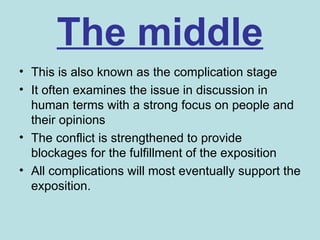
The middle
• This is also known as the complication stage
• It often examines the issue in discussion in
  human terms with a strong focus on people and
  their opinions
• The conflict is strengthened to provide
  blockages for the fulfillment of the exposition
• All complications will most eventually support the
  exposition.
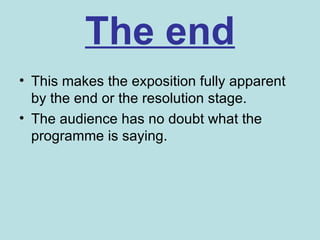
The end
• This makes the exposition fully apparent
  by the end or the resolution stage.
• The audience has no doubt what the
  programme is saying.
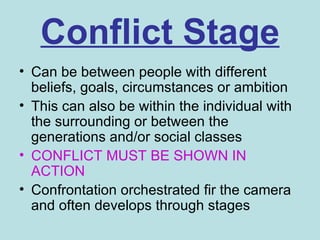
Conflict Stage
• Can be between people with different
  beliefs, goals, circumstances or ambition
• This can also be within the individual with
  the surrounding or between the
  generations and/or social classes
• CONFLICT MUST BE SHOWN IN
  ACTION
• Confrontation orchestrated fir the camera
  and often develops through stages
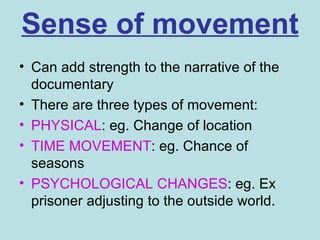
Sense of movement
• Can add strength to the narrative of the
  documentary
• There are three types of movement:
• PHYSICAL: eg. Change of location
• TIME MOVEMENT: eg. Chance of
  seasons
• PSYCHOLOGICAL CHANGES: eg. Ex
  prisoner adjusting to the outside world.
Music and sound
       effects
• Sound is effective in producing an
  emotional reaction and response from the
  audience
Lighting
• To achieve realism and authenticity good
  lighting is essential and key
• Professional lighting can give the game
  away and take away from the realism
Construction of
        reality
• When you watch a documentary you need
  to ask not just what you are being shown
  but what you aren't being shown.
• This could be due to bias or preference
  along with a selection and rejection of
  information also known as gate keeping.
Visuals
• What we see on the screen is the visuals
  and includes archive footage
• Stock materials are used to support the
  intended meaning
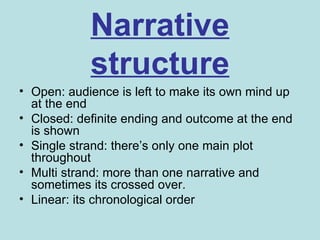
Narrative
            structure
• Open: audience is left to make its own mind up
  at the end
• Closed: definite ending and outcome at the end
  is shown
• Single strand: there’s only one main plot
  throughout
• Multi strand: more than one narrative and
  sometimes its crossed over.
• Linear: its chronological order
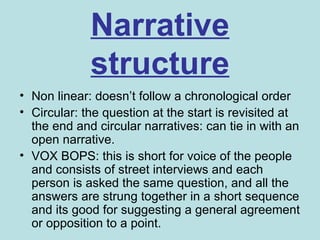
Narrative
             structure
• Non linear: doesn’t follow a chronological order
• Circular: the question at the start is revisited at
  the end and circular narratives: can tie in with an
  open narrative.
• VOX BOPS: this is short for voice of the people
  and consists of street interviews and each
  person is asked the same question, and all the
  answers are strung together in a short sequence
  and its good for suggesting a general agreement
  or opposition to a point.

Current affairs

  • 1.
    Current Affairs These are different to documentaries and are journalist based programmes that aim to address news in more depth.
  • 2.
    Differences between documentaries and current affairs • The pressure of deadlines doesn’t apply to documentaries. • Documentaries can take months to make whereas current affairs have to be up to date.
  • 3.
    Structuring a documentary • They rely heavily on traditional conventions of narratives • In other words there is a definite start, middle and end • They have strong focus on character and conflict • Other conventions of narrative forms are also used such as music, special setting and special lighting also
  • 4.
    The beginning • Thecentral question can be posed at the beginning in an intriguing way • Alternatively the most dramatic piece of action footage can be there or interview cuts in conflict with each other can get the audiences attention at the start.
  • 5.
    The middle • Thisis also known as the complication stage • It often examines the issue in discussion in human terms with a strong focus on people and their opinions • The conflict is strengthened to provide blockages for the fulfillment of the exposition • All complications will most eventually support the exposition.
  • 6.
    The end • Thismakes the exposition fully apparent by the end or the resolution stage. • The audience has no doubt what the programme is saying.
  • 7.
    Conflict Stage • Canbe between people with different beliefs, goals, circumstances or ambition • This can also be within the individual with the surrounding or between the generations and/or social classes • CONFLICT MUST BE SHOWN IN ACTION • Confrontation orchestrated fir the camera and often develops through stages
  • 8.
    Sense of movement •Can add strength to the narrative of the documentary • There are three types of movement: • PHYSICAL: eg. Change of location • TIME MOVEMENT: eg. Chance of seasons • PSYCHOLOGICAL CHANGES: eg. Ex prisoner adjusting to the outside world.
  • 9.
    Music and sound effects • Sound is effective in producing an emotional reaction and response from the audience
  • 10.
    Lighting • To achieverealism and authenticity good lighting is essential and key • Professional lighting can give the game away and take away from the realism
  • 11.
    Construction of reality • When you watch a documentary you need to ask not just what you are being shown but what you aren't being shown. • This could be due to bias or preference along with a selection and rejection of information also known as gate keeping.
  • 12.
    Visuals • What wesee on the screen is the visuals and includes archive footage • Stock materials are used to support the intended meaning
  • 13.
    Narrative structure • Open: audience is left to make its own mind up at the end • Closed: definite ending and outcome at the end is shown • Single strand: there’s only one main plot throughout • Multi strand: more than one narrative and sometimes its crossed over. • Linear: its chronological order
  • 14.
    Narrative structure • Non linear: doesn’t follow a chronological order • Circular: the question at the start is revisited at the end and circular narratives: can tie in with an open narrative. • VOX BOPS: this is short for voice of the people and consists of street interviews and each person is asked the same question, and all the answers are strung together in a short sequence and its good for suggesting a general agreement or opposition to a point.