
CULTURAL POETICS
OR
NEW HISTORICISM

• During the 1940s, 1950s, and 1960s, New Criticism
was the dominant approach to literary analysis.
• New Criticism regards a literary text as an artifact with an
existence of its own, independent of and not necessarily
related to its author, its readers, the historical time it
depicts, or the historical period in which it was
written.
• A text's meaning emerges when readers scrutinize the text
alone.
NEW CRITICISM

• For the New Critics, a literary text is highly structured
and contains its meaning within itself.
• Such an analysis, say the New Critics, is particularly
rewarding because literature offers us a unique kind
of knowledge and presents us with the deepest truths
related to humanity, truths that science is unable to
disclose.

• What New Criticism did not provide for Greenblatt and
other critics was an attempt to understand literature from a
historical perspective. In a New Critical analysis, the text
was what mattered, not its historical context.
• In addition, Greenblatt believed that questions concerning
the nature and definition of literature were not
encouraged.

* This view assumes that historians can write
objectively about any given historical time period,
person, event, or text and are able definitively to
state the objective truth about that person, era,
occurrence, or text.
OLD HISTORICISM

That historians can articulate a unified and internally
consistent worldview of any given people, country, or era
and can reconstruct an accurate and objective picture of
any historical event are key assumptions that Cultural
Poetics or New Historicism challenges.
NEW HISTORICISM

Appearing as an alternate approach to textual
interpretation in the 1970s and early 1980s, Cultural
Poetics—often called New Historicism in America and
Cultural Materialism in Great Britain—declares that all
history is subjective, written by people whose personal
biases affect their interpretation of the past.

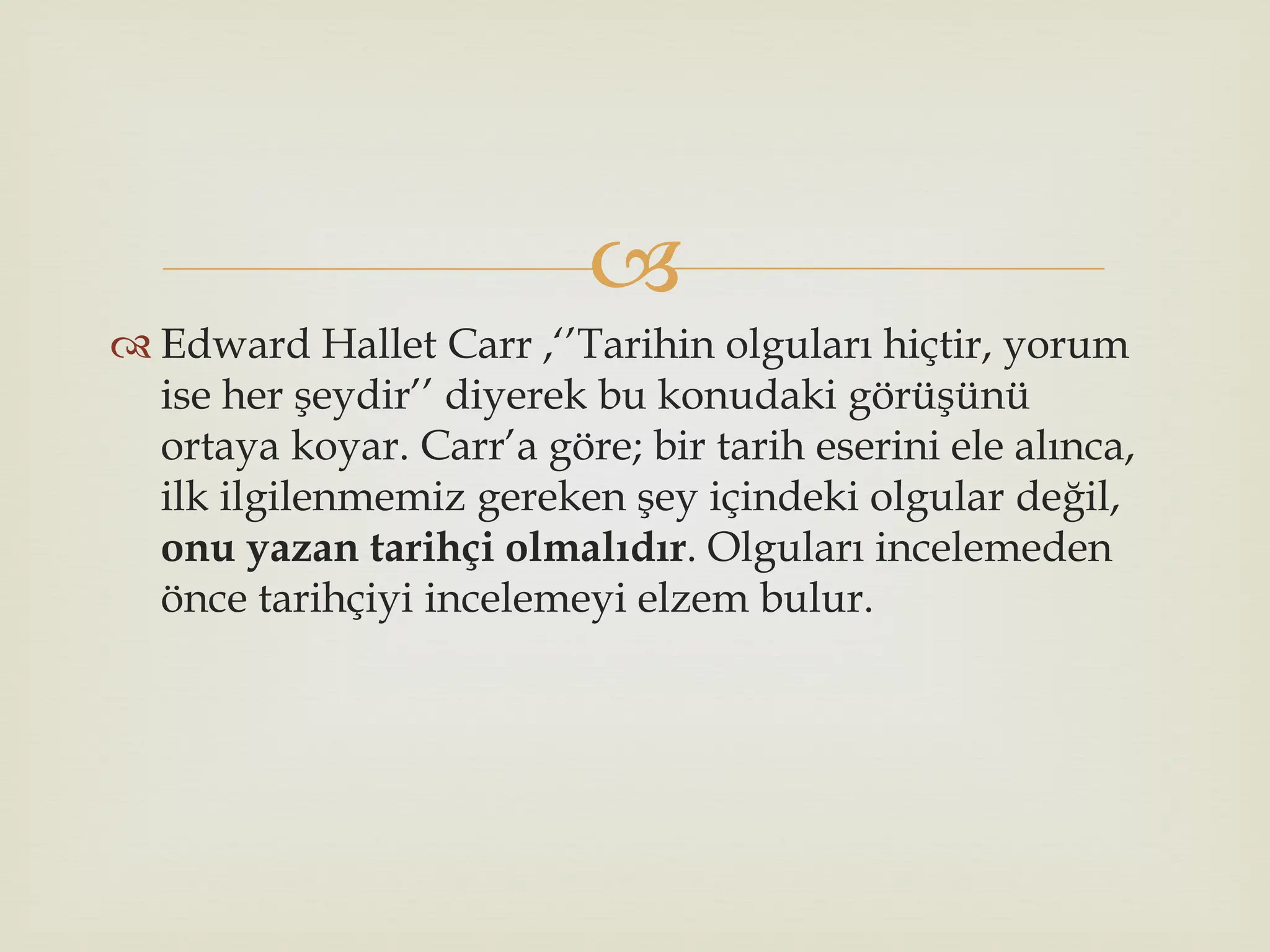
 Edward Hallet Carr ,‘’Tarihin olguları hiçtir, yorum
ise her şeydir’’ diyerek bu konudaki görüşünü
ortaya koyar. Carr’a göre; bir tarih eserini ele alınca,
ilk ilgilenmemiz gereken şey içindeki olgular değil,
onu yazan tarihçi olmalıdır. Olguları incelemeden
önce tarihçiyi incelemeyi elzem bulur.

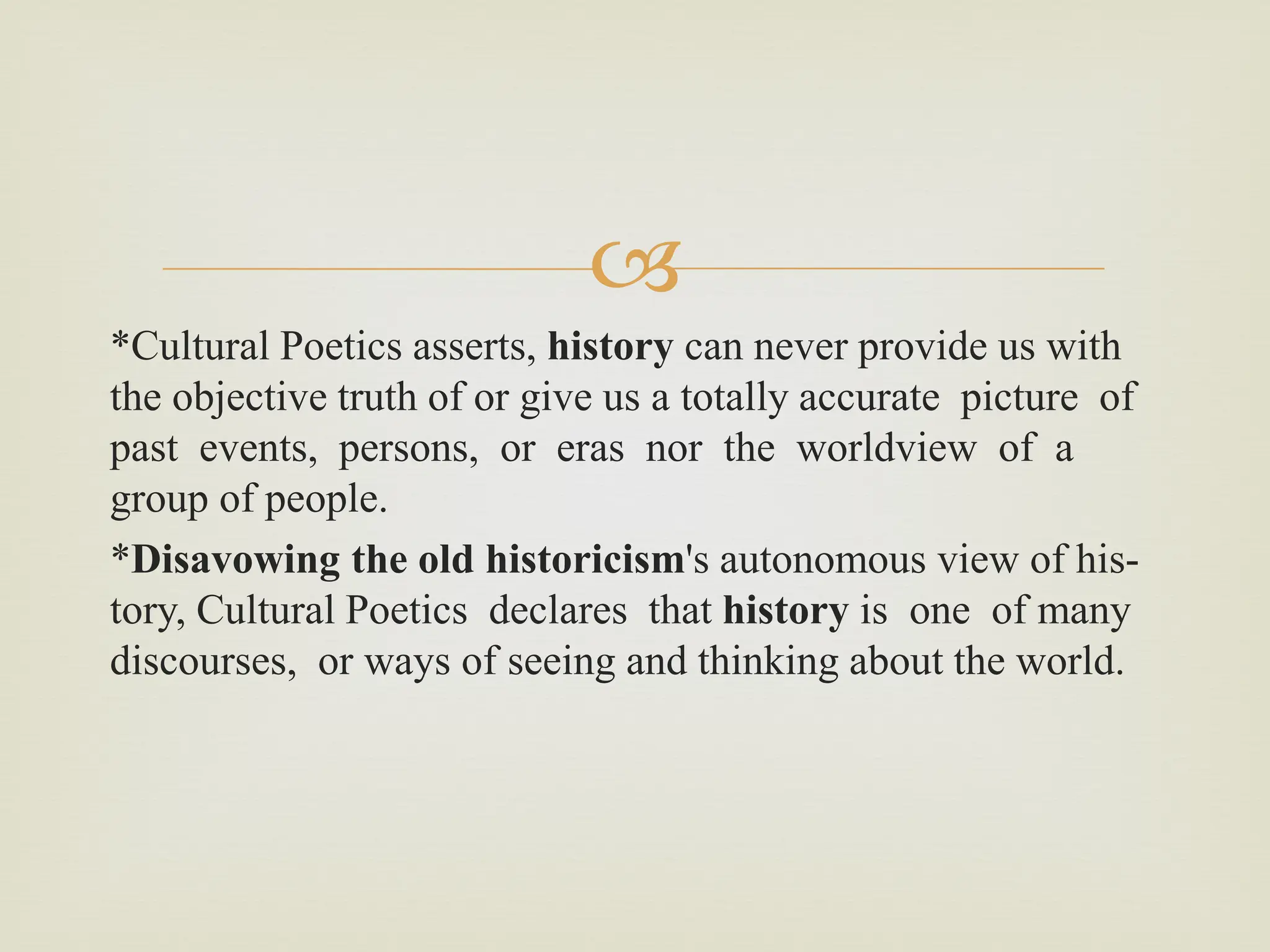
*Cultural Poetics asserts, history can never provide us with
the objective truth of or give us a totally accurate picture of
past events, persons, or eras nor the worldview of a
group of people.
*Disavowing the old historicism's autonomous view of his-
tory, Cultural Poetics declares that history is one of many
discourses, or ways of seeing and thinking about the world.

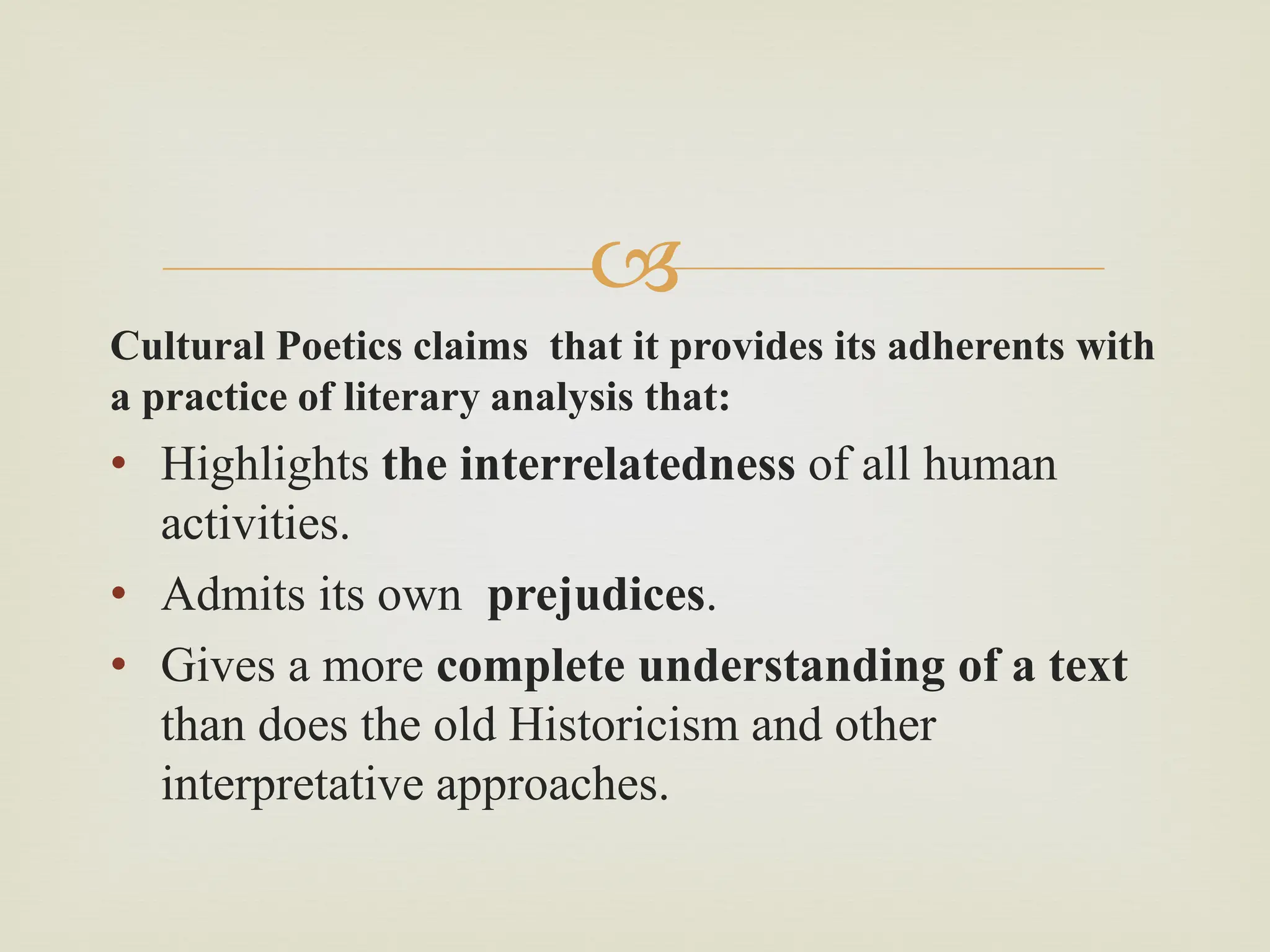
Cultural Poetics claims that it provides its adherents with
a practice of literary analysis that:
• Highlights the interrelatedness of all human
activities.
• Admits its own prejudices.
• Gives a more complete understanding of a text
than does the old Historicism and other
interpretative approaches.

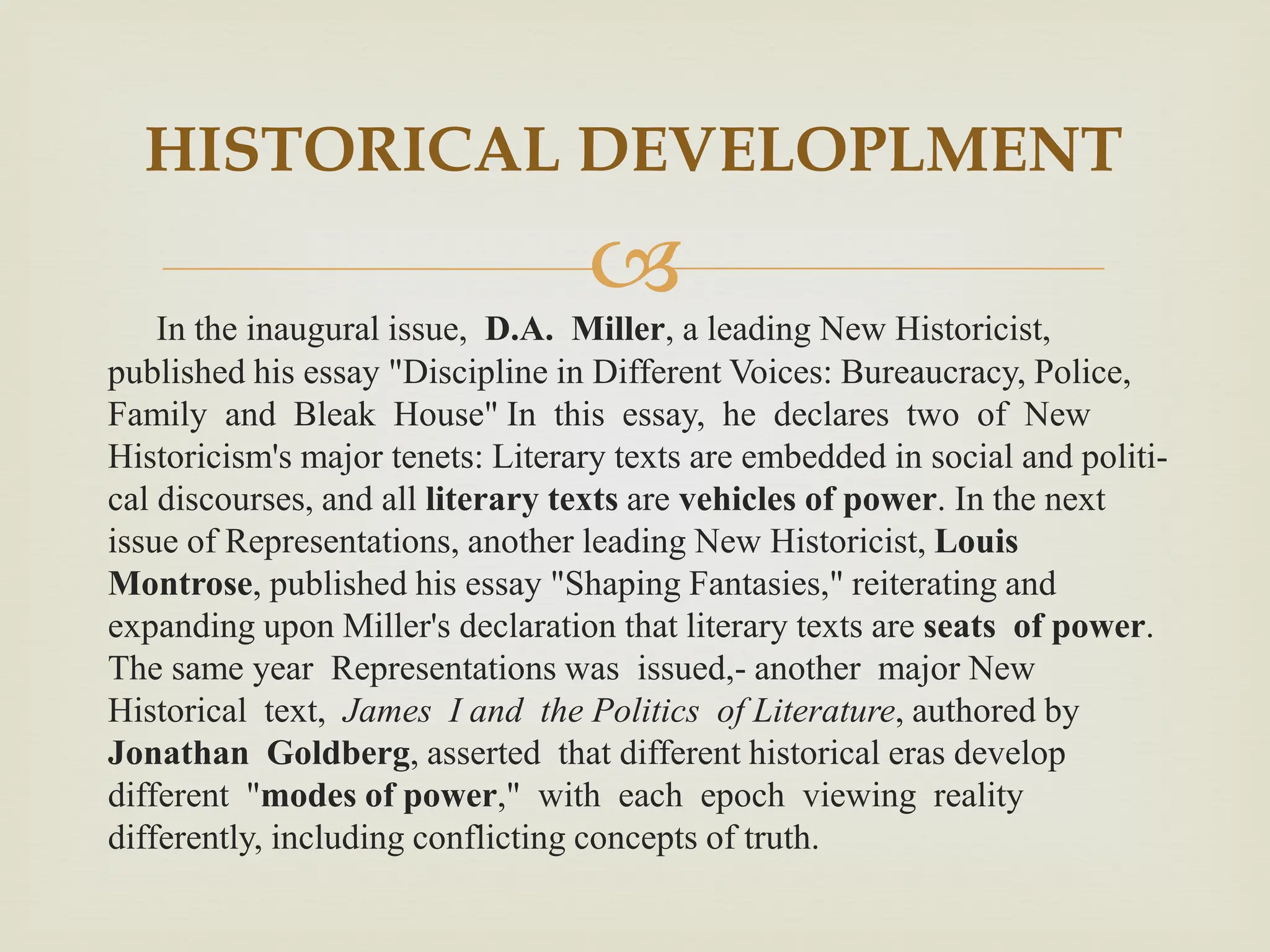
In the inaugural issue, D.A. Miller, a leading New Historicist,
published his essay "Discipline in Different Voices: Bureaucracy, Police,
Family and Bleak House" In this essay, he declares two of New
Historicism's major tenets: Literary texts are embedded in social and politi-
cal discourses, and all literary texts are vehicles of power. In the next
issue of Representations, another leading New Historicist, Louis
Montrose, published his essay "Shaping Fantasies," reiterating and
expanding upon Miller's declaration that literary texts are seats of power.
The same year Representations was issued,- another major New
Historical text, James I and the Politics of Literature, authored by
Jonathan Goldberg, asserted that different historical eras develop
different "modes of power," with each epoch viewing reality
differently, including conflicting concepts of truth.
HISTORICAL DEVELOPLMENT

New Historicists claim, literature should be read in
relation to culture, history, society, and other factors that
help determine a text's meaning.

In his article «Towards a Poetics of Culture.(1987)»
Greenblatt asserts that art and society are interrelated, but
no scholar can use just one theoretical stance (or school
of criticism) to discover this complex web of
interrelationships. New Historicism should therefore be
viewed as a reading practice, says Greenblatt, not a
school of criticism, because when texts and their
relationship to society are investigated, an array of often
conflicting social and literary patterns evolves that
demonstrate how art affects society and how society
affects art.

* How literature was formed, whose interest it serves, and
what the term literature really means. Do contemporary
issues and the cultural milieu (environment) of the times
operate together to create literature, they wondered, or is
literature an art form that will always be with us?

Deconstruction, Marxism, Feminism, and Lacanian
psychoanalysis began to challenge the assumptions of New
Criticism. Rejecting New Criticism's claim that the
meaning of a text can be found mainly in the text,
poststructural theorists had been developing a variety of
theoretical positions about the nature of the reading process,
the part the reader plays in that process, and the definition of
a text or the actual work of art. Among these multitude
voices, Cultural Poetics arose.

From the Marxist scholars—Georg Lukacs, Walter
Benjamin, Raymond Williams, and others—they learned that
history is shaped by the people who live it, and they accepted
the Marxist idea of the interconnectedness of all life. They
also believed that what we do with our hands and how we
make our money do affect how and what we think.

Unlike many of the poststructuralist theories—especially
deconstruction—Cultural Poetics struggled to find a way out of
undecidability, or aporia, about the nature of reality and the interpretation
of a text. Although not denying that many factors affect the writing, the
production, and the publication of texts, New Historicists sought to move
beyond undecidability rather than simply asserting that a text has many
possible meanings. In doing so, they challenged the assumptions of the old
historicism, which presupposed historians could actually write an objective
history of any situation. In addition, they redefined the meaning of a text
and asserted that all critics must acknowledge and openly declare their
own biases.

• Throughout the 1980s and 1990s, critics such as
Catherine Gallagher, Jonathan Dollimore, Jerome
McGann, Stephen Greenblatt, to name a few, voiced their
concerns that the study of literature and its relationship to
history has been too narrow.
• Viewing a text as culture in action, these critics blur
the distinction between an artistic production and any
other kind of social production or event.

Cultural Poetics:
1) Cultural Materialism.
2) New Historicism.

* Call for a reawakening of our historical consciousness.
* Declare that history and literature must be seen as
disciplines to be analyzed together.
* Place all texts in their appropriate contexts.
* Believe that while we are researching and learning about
different societies that provide the historical context for
various texts, we are simultaneously learning about
ourselves, our own habits, and our own beliefs.
Cultural Materialism
New Historicism

• Marxist in its theories and political and cultural in
its aims.
• Believing that literature can serve as an agent of
change, cultural materialists declare that a culture's
hegemony is unstable.
CULTURAL MATERIALISM

• New Historicism is the name given to the
American branch of Cultural Poetics.
• One of its originating voices, Greenblatt, along
with a host of other scholars, believes that one's
culture permeates both texts and critics.
NEW HISTORICISM

Because all critics are influenced by
their culture, New Historicists believe
that none of us can escape public and
private cultural influences.

Like other poststructuralist practices,
Cultural Poetics begins by challenging the
long-held belief that a text is an
autonomous work of art that contains all
elements necessary to arrive at a
supposedly correct interpretation.

Unlike the old historicism, this New Historicism, or
Cultural Poetics, asserts that an intricate connection exists
between an aesthetic object—a text or any work of art—and
society, while denying that a text can be evaluated in
isolation from its cultural context.

We must know, it declares, the societal
concerns of the author, of the historical times
evidenced in the work, and of other cultural
elements exhibited in the text before we can
devise a valid interpretation.

Unlike many past historians, Foucault
declares that history is not linear (i.e. it does
not have a definite beginning, a middle, and
an end) nor is it necessarily teleological
(i.e., purposefully going forward toward
some known end).
Michel Foucault

History cannot be explained as a series of
causes and effects controlled by some
mysterious destiny or an all-powerful
deity.

For Foucault, history is the complex
interrelationship of a variety of
discourses, the various ways—artistic,
social, political, and so on—that people
think and talk about their world.

How these discourses interact in any given historical period
is not random. Rather, the interaction is dependent on a
unifying principle (or pattern) Foucault calls the episteme—that
is, through language and thought, each period in history
develops its own perceptions concerning the nature of reality (or
what it defines as truth), sets up its own acceptable and
unacceptable standards of behavior; establishes its own criteria for
judging what it deems good or bad; and certifies what group of
people develop, articulate, protect, and defend the yardstick
whereby all established truths, values, and actions will be deemed
acceptable.

To unearth the episteme of any given historical period,
Foucault borrows techniques and terminology from
archaeology. Just as an archaeologist must slowly and
meticulously dig through various layers of earth to uncover
the symbolic treasures of the past, historians must expose
each layer of discourse that comes together to shape people's
episteme.

As an archaeologist must date each finding and then
piece together the artifacts that define and help explain that
culture, so must the historian piece together the various
discourses and their interconnections among themselves and
with nondiscursive practices—any cultural institution such as
a form of government, for example—that will assist in
articulating the episteme under investigation.

From this point of view, history is a form of power.
Because each era or people develop their own episteme,
the episteme actually controls how that era or group of
people views reality. History, then, becomes the study
and unearthing of a vast, complex web of interconnecting
forces that ultimately determines what takes place in each
culture or society.

Foucault asserts that the abrupt and often radical
changes that cause breaks from one episteme to another
are neither good nor bad, valid nor invalid. Similar to the
discourses that help produce them, different epistemes exist
in their own right; they are neither moral nor immoral, but
amoral.

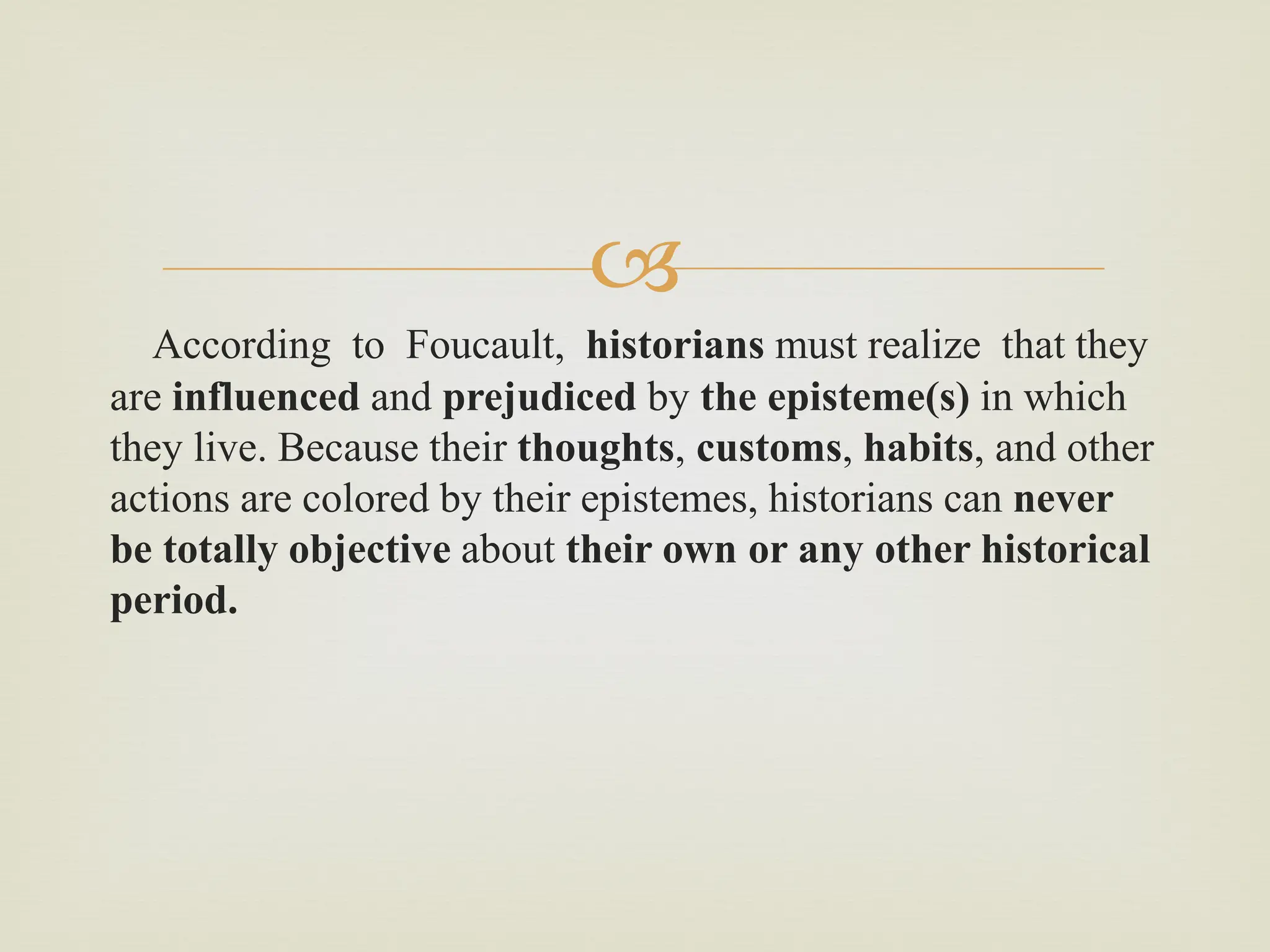
According to Foucault, historians must realize that they
are influenced and prejudiced by the episteme(s) in which
they live. Because their thoughts, customs, habits, and other
actions are colored by their epistemes, historians can never
be totally objective about their own or any other historical
period.

To be a historian, Foucault asserts, means one must
confront and articulate one's own set of biases before
examining the various discourses or the material evidence of
past events that comprise an episteme of any given period.

Such an archaeological examination of the various
discourses, Foucault believes, will not unearth a
monological view of an episteme (i.e., one that
presupposes a single, overarching, political vision or
design); instead, this kind of examination will reveal a set of
inconsistent, irregular, and often contradictory discourses
that will explain the development of that episteme,
including which elements were accepted, changed, or
rejected to form the "truth" and to set the acceptable
standards for that era.

There exists "no human nature independent
of culture," culture being defined by Geertz as "a set of
control mechanisms— plans, recipes, rules, instructions," for
governing behavior.
Clifford Geertz

Each person must be viewed as a cultural artifact.

How each person views society is always unique because
there exists what Geertz calls an "information gap" between
what our body tells us and what we have to know in order
to function in society. This gap also exists in society because
society cannot know everything that happens among all its
people.

Cultural Poetics also adapts Geertz's anthropological
methodology for describing culture, thick description.

Thick description describes the seemingly insignificant
details present in any cultural practice. By focusing on these
details, one can then reveal the inherent contradictory forces
at work within a culture.

Because texts are simply one of many elements that help
shape a culture, Cultural Poetics critics believe that all texts
are really social documents that reflect but also, and more
importantly, respond to their historical situation.
Texts, History, and
Interpretation

Since any historical situation is an intricate web of
often competing discourses, Cultural Poetics scholars
center history, declaring that any interpretation of a text
would be incomplete if we do not consider the text's
relationship to the discourses that helped fashion it and to
which the text is a response.

From this point of view, a text becomes a battleground of
competing ideas among the author, society, customs,
institutions, and social practices that are all eventually
negotiated by the author and the reader and influenced by
each contributor's episteme.

For a Cultural Poetics critic, everything we do is
interrelated to and within a network of practices embedded in
our culture. No act is insignificant; everything is
important.

In our search to attach meaning to our actions,
Cultural Poetics critics believe that we can never be fully
objective because we are all biased by cultural forces.

Cultural Poetics critics maintain that we will discover not only
the social world of the text but also the present-day social forces
working upon us as we negotiate meaning with printed material.
Like history itself, our interaction with a text is a dynamic,
ongoing process that will always be somewhat incomplete.

• Monological interpretations of a given culture, people,
or historical era can accurately demonstrate that culture's
beliefs and values.
• A historian can establish the "norms" and the "truth" of
any social order.
• A writer or a historian can be totally objective.
• Autonomous artifacts, including literary texts, can or do
exist.
WHAT CULTURAL
POETICS REJECTS

 Literature is shaped only by historic moments, and that
history serves as merely a background for literary study.
 Only one correct interpretation of a text exists.

 It intentionally smudges the line between history
and literature, believing that text (literature) and
context (history) are the same and that literature has no
history of its own but is ensconced in cultural history.
 It admits that definitive interpretations of a text are
unattainable because relevant material is too far spread
to gather exhaustively; we can never recover the original
meaning of anything because we cannot hear all the
voices that contributed to the event.
WHAT CULTURAL POETICS DOES
AND ACCEPTS

 It recognizes that power affects literature as deeply as it
does history.
 It believes that texts, like all forms of discourse, help
shape and are shaped by social forces.
 It looks to single moments in history that may have influenced
or been influenced by a literary text produced at the time,
relying heavily on historical documents to discover these
significant moments; by so doing, history can no longer be con-
sidered simply "background" information for textual
analysis but instead is an essential element in the
interpretive process.

• Literature is shaped by historical moments while also
shaping the individual reader or listener to these texts.
• One of the most important elements in textual analysis is
discovering how a text was formed…
• Writers, like texts, are subjected to social biases,
cultural influences, and political agendas; hence, no
writer or critic can ever be entirely objective.

No matter their methodology, Cultural Poetics scholars
begin by assuming that language shapes and is shaped by
the culture that uses it.
METHODOLOGY

 By language, Cultural Poetics critics mean much
more than spoken words.
 Included in this definition of language is history. Like
literature, writing, or other relationships that involve either
a transfer or a relationship of power, history becomes a
narrative discourse.

From this perspective, history and literature
are nearly synonymous, both being narrative discourses
that interact with their historical situations, their authors,
their readers, and their present-day cultures. Neither can
claim a complete or an objective understanding of its
content or historical situation because both are ongoing
conversations with their creators, readers, and cultures.

 Meaning evolves from the interaction of the variously
interwoven social discourses, no hierarchy of discourses
can exist; all discourses are necessary and must be
investigated in the process of textual analysis.
 The interpretative process must also include questions
about the methodological assumptions for discerning
meaning for each discourse and for every practitioner
because no single discourse, method, or critic can
reveal the one single truth about any social production
in isolation from other discourses.

A text's meaning as perceived through the lens of
Cultural Poetics resides in the cultural system composed of
the interlocking discourses of its author, the text, and
its reader.

To begin to understand a text's significance and to
realize the complex social structure of which it is a part,
Cultural Poetics critics declare that all three areas of
concern must be investigated. If one area is ignored, the
risk of returning to the old historicism, with its lack of
understanding about a text as a social production, is
unavoidable.

 Anecdotes are well-preserved messages that most often
come to us in their original state, unaltered by the
ideologies of publishers or other institutions of
preservation. As soon as they are gathered together, a
collection of anecdotes reveals "counter-histories" or
alternative perspectives of an incident or era presented
by voices that usually go unheard in a monolithic
interpretation of history.

Because Cultural Poetics views history and literature as
social discourses and therefore battlegrounds for conflicting
beliefs, actions, and customs, a text becomes "culture in
action."

Cultural Poetics scholars believe that an investigation into
these and similar happenings demonstrates the complex
relationships that exist among all discourses and shows how
narrative discourses such as history, literature, and other
social productions interact with, define, and are, in turn,
shaped by their culture. What we will learn by applying these
principles and methodologies is that there is not one voice
but many voices to be heard interpreting texts and our
culture: our own voice, the voices of others, the voices of
the past, the voices of the present, and the voices that will
be in the future.

Dulce et Decorum Est
BY WILFRED OWEN
Bent double, like old beggars under sacks,
Knock-kneed, coughing like hags, we cursed through sludge,
Till on the haunting flares we turned our backs,
And towards our distant rest began to trudge.
Men marched asleep. Many had lost their boots,
But limped on, blood-shod. All went lame; all blind;
Drunk with fatigue; deaf even to the hoots
Of gas-shells dropping softly behind.
Gas! GAS! Quick, boys!—An ecstasy of fumbling
Fitting the clumsy helmets just in time,
But someone still was yelling out and stumbling
And flound’ring like a man in fire or lime.—
Dim through the misty panes and thick green light,
As under a green sea, I saw him drowning.

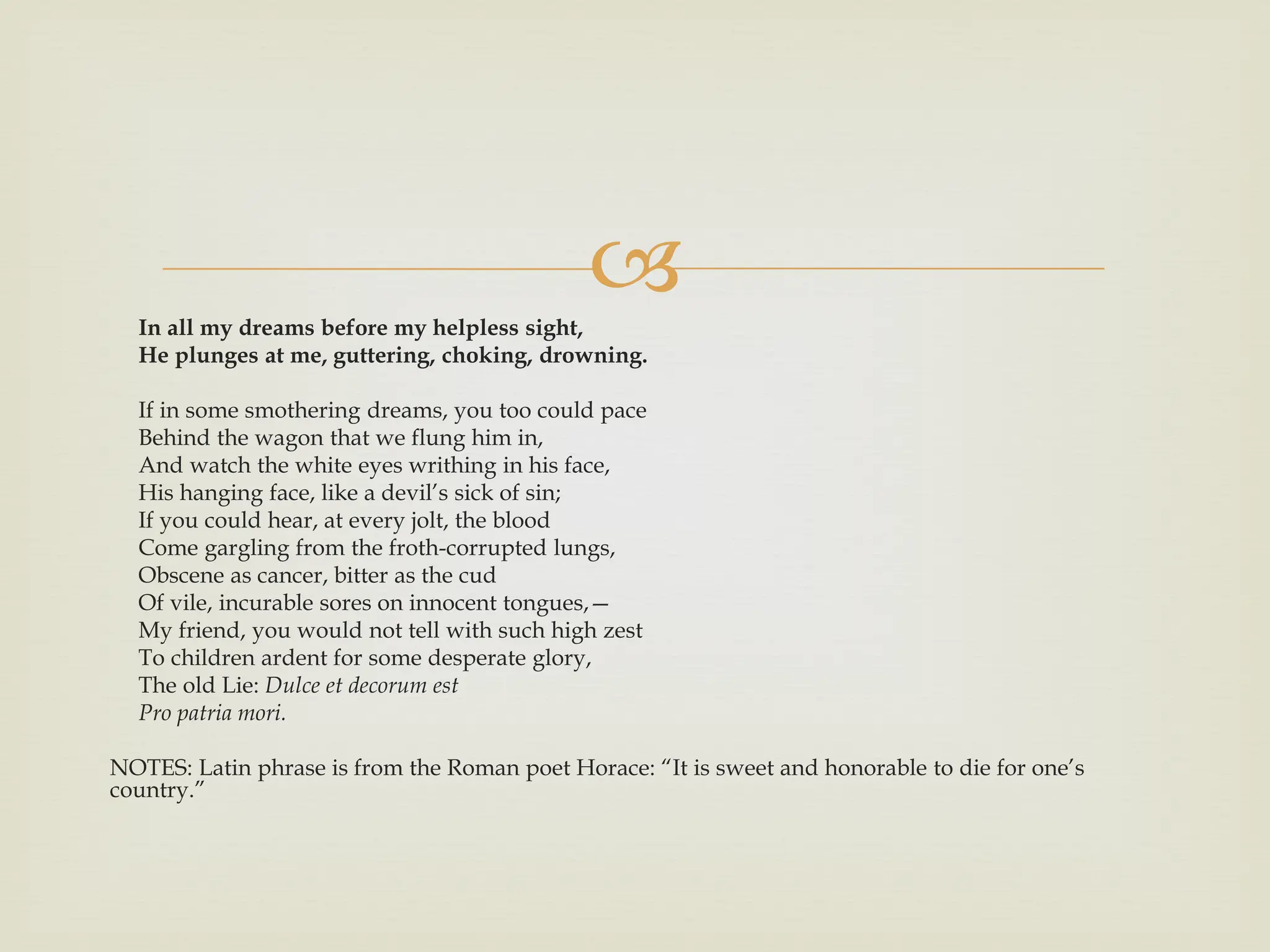
In all my dreams before my helpless sight,
He plunges at me, guttering, choking, drowning.
If in some smothering dreams, you too could pace
Behind the wagon that we flung him in,
And watch the white eyes writhing in his face,
His hanging face, like a devil’s sick of sin;
If you could hear, at every jolt, the blood
Come gargling from the froth-corrupted lungs,
Obscene as cancer, bitter as the cud
Of vile, incurable sores on innocent tongues,—
My friend, you would not tell with such high zest
To children ardent for some desperate glory,
The old Lie: Dulce et decorum est
Pro patria mori.
NOTES: Latin phrase is from the Roman poet Horace: “It is sweet and honorable to die for one’s
country.”

 From a New Historicist point of view, Owen's "Dulce
et Decorum Est" both reveals and shapes its culture
and is a no less authoritative account of the War than
is a history textbook.
 The dying soldier in Owen's "Dulce" is universal
He is the everyman, the nameless recruit whose
carefully studied face represents the tormented
spirits of all those fated to see the hellish affairs of
war.

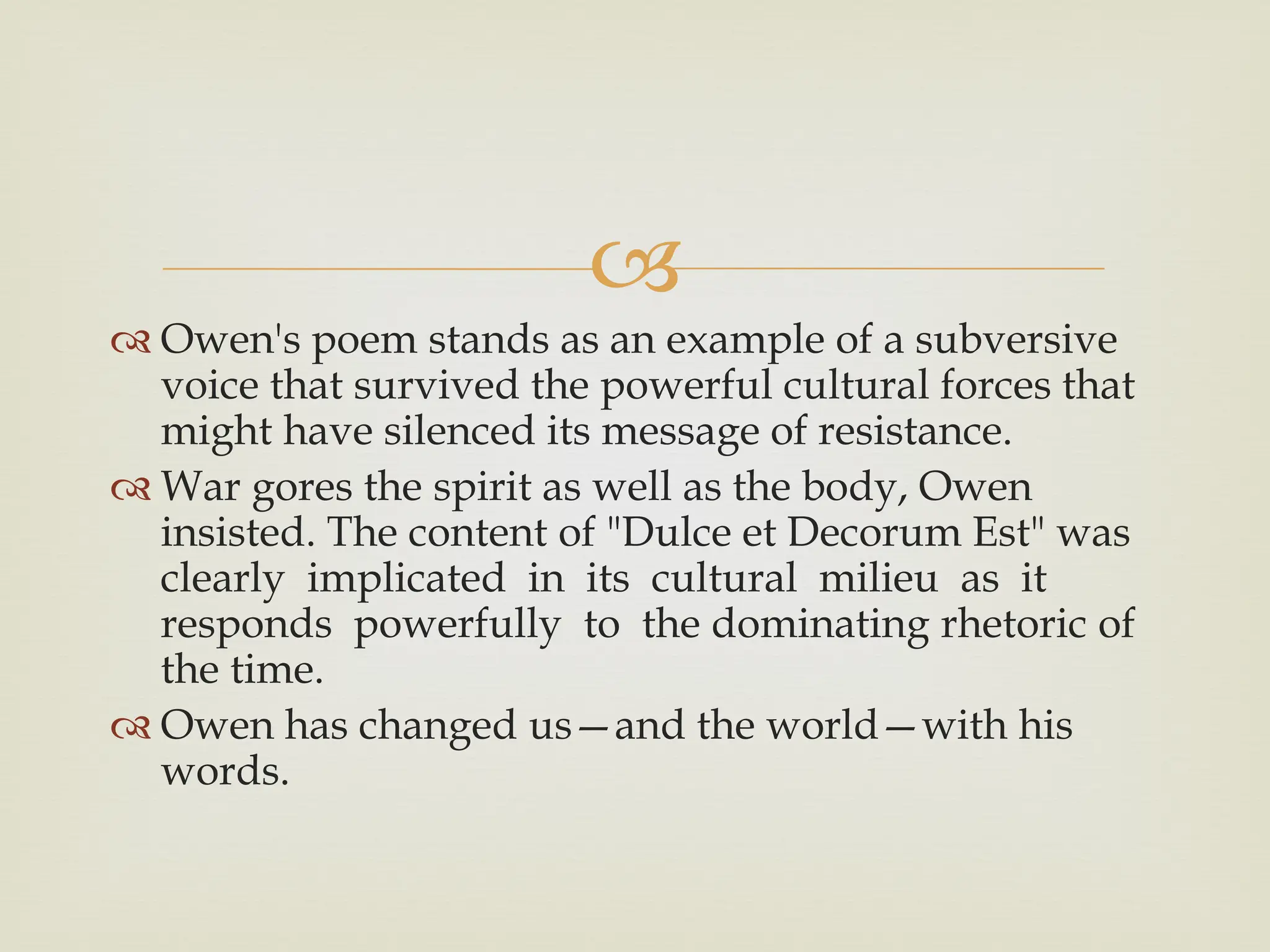
 Owen's poem stands as an example of a subversive
voice that survived the powerful cultural forces that
might have silenced its message of resistance.
 War gores the spirit as well as the body, Owen
insisted. The content of "Dulce et Decorum Est" was
clearly implicated in its cultural milieu as it
responds powerfully to the dominating rhetoric of
the time.
 Owen has changed us—and the world—with his
words.

Cultural Poetics & New Historicism: an overviewpdf

  • 1.
  • 2.
     • During the1940s, 1950s, and 1960s, New Criticism was the dominant approach to literary analysis. • New Criticism regards a literary text as an artifact with an existence of its own, independent of and not necessarily related to its author, its readers, the historical time it depicts, or the historical period in which it was written. • A text's meaning emerges when readers scrutinize the text alone. NEW CRITICISM
  • 3.
     • For theNew Critics, a literary text is highly structured and contains its meaning within itself. • Such an analysis, say the New Critics, is particularly rewarding because literature offers us a unique kind of knowledge and presents us with the deepest truths related to humanity, truths that science is unable to disclose.
  • 4.
     • What NewCriticism did not provide for Greenblatt and other critics was an attempt to understand literature from a historical perspective. In a New Critical analysis, the text was what mattered, not its historical context. • In addition, Greenblatt believed that questions concerning the nature and definition of literature were not encouraged.
  • 5.
     * This viewassumes that historians can write objectively about any given historical time period, person, event, or text and are able definitively to state the objective truth about that person, era, occurrence, or text. OLD HISTORICISM
  • 6.
     That historians canarticulate a unified and internally consistent worldview of any given people, country, or era and can reconstruct an accurate and objective picture of any historical event are key assumptions that Cultural Poetics or New Historicism challenges. NEW HISTORICISM
  • 7.
     Appearing as analternate approach to textual interpretation in the 1970s and early 1980s, Cultural Poetics—often called New Historicism in America and Cultural Materialism in Great Britain—declares that all history is subjective, written by people whose personal biases affect their interpretation of the past.
  • 8.
      Edward HalletCarr ,‘’Tarihin olguları hiçtir, yorum ise her şeydir’’ diyerek bu konudaki görüşünü ortaya koyar. Carr’a göre; bir tarih eserini ele alınca, ilk ilgilenmemiz gereken şey içindeki olgular değil, onu yazan tarihçi olmalıdır. Olguları incelemeden önce tarihçiyi incelemeyi elzem bulur.
  • 10.
     *Cultural Poetics asserts,history can never provide us with the objective truth of or give us a totally accurate picture of past events, persons, or eras nor the worldview of a group of people. *Disavowing the old historicism's autonomous view of his- tory, Cultural Poetics declares that history is one of many discourses, or ways of seeing and thinking about the world.
  • 11.
     Cultural Poetics claimsthat it provides its adherents with a practice of literary analysis that: • Highlights the interrelatedness of all human activities. • Admits its own prejudices. • Gives a more complete understanding of a text than does the old Historicism and other interpretative approaches.
  • 12.
     In the inauguralissue, D.A. Miller, a leading New Historicist, published his essay "Discipline in Different Voices: Bureaucracy, Police, Family and Bleak House" In this essay, he declares two of New Historicism's major tenets: Literary texts are embedded in social and politi- cal discourses, and all literary texts are vehicles of power. In the next issue of Representations, another leading New Historicist, Louis Montrose, published his essay "Shaping Fantasies," reiterating and expanding upon Miller's declaration that literary texts are seats of power. The same year Representations was issued,- another major New Historical text, James I and the Politics of Literature, authored by Jonathan Goldberg, asserted that different historical eras develop different "modes of power," with each epoch viewing reality differently, including conflicting concepts of truth. HISTORICAL DEVELOPLMENT
  • 13.
     New Historicists claim,literature should be read in relation to culture, history, society, and other factors that help determine a text's meaning.
  • 14.
     In his article«Towards a Poetics of Culture.(1987)» Greenblatt asserts that art and society are interrelated, but no scholar can use just one theoretical stance (or school of criticism) to discover this complex web of interrelationships. New Historicism should therefore be viewed as a reading practice, says Greenblatt, not a school of criticism, because when texts and their relationship to society are investigated, an array of often conflicting social and literary patterns evolves that demonstrate how art affects society and how society affects art.
  • 15.
     * How literaturewas formed, whose interest it serves, and what the term literature really means. Do contemporary issues and the cultural milieu (environment) of the times operate together to create literature, they wondered, or is literature an art form that will always be with us?
  • 16.
     Deconstruction, Marxism, Feminism,and Lacanian psychoanalysis began to challenge the assumptions of New Criticism. Rejecting New Criticism's claim that the meaning of a text can be found mainly in the text, poststructural theorists had been developing a variety of theoretical positions about the nature of the reading process, the part the reader plays in that process, and the definition of a text or the actual work of art. Among these multitude voices, Cultural Poetics arose.
  • 17.
     From the Marxistscholars—Georg Lukacs, Walter Benjamin, Raymond Williams, and others—they learned that history is shaped by the people who live it, and they accepted the Marxist idea of the interconnectedness of all life. They also believed that what we do with our hands and how we make our money do affect how and what we think.
  • 18.
     Unlike many ofthe poststructuralist theories—especially deconstruction—Cultural Poetics struggled to find a way out of undecidability, or aporia, about the nature of reality and the interpretation of a text. Although not denying that many factors affect the writing, the production, and the publication of texts, New Historicists sought to move beyond undecidability rather than simply asserting that a text has many possible meanings. In doing so, they challenged the assumptions of the old historicism, which presupposed historians could actually write an objective history of any situation. In addition, they redefined the meaning of a text and asserted that all critics must acknowledge and openly declare their own biases.
  • 19.
     • Throughout the1980s and 1990s, critics such as Catherine Gallagher, Jonathan Dollimore, Jerome McGann, Stephen Greenblatt, to name a few, voiced their concerns that the study of literature and its relationship to history has been too narrow. • Viewing a text as culture in action, these critics blur the distinction between an artistic production and any other kind of social production or event.
  • 20.
     Cultural Poetics: 1) CulturalMaterialism. 2) New Historicism.
  • 21.
     * Call fora reawakening of our historical consciousness. * Declare that history and literature must be seen as disciplines to be analyzed together. * Place all texts in their appropriate contexts. * Believe that while we are researching and learning about different societies that provide the historical context for various texts, we are simultaneously learning about ourselves, our own habits, and our own beliefs. Cultural Materialism New Historicism
  • 22.
     • Marxist inits theories and political and cultural in its aims. • Believing that literature can serve as an agent of change, cultural materialists declare that a culture's hegemony is unstable. CULTURAL MATERIALISM
  • 23.
     • New Historicismis the name given to the American branch of Cultural Poetics. • One of its originating voices, Greenblatt, along with a host of other scholars, believes that one's culture permeates both texts and critics. NEW HISTORICISM
  • 24.
     Because all criticsare influenced by their culture, New Historicists believe that none of us can escape public and private cultural influences.
  • 25.
     Like other poststructuralistpractices, Cultural Poetics begins by challenging the long-held belief that a text is an autonomous work of art that contains all elements necessary to arrive at a supposedly correct interpretation.
  • 26.
     Unlike the oldhistoricism, this New Historicism, or Cultural Poetics, asserts that an intricate connection exists between an aesthetic object—a text or any work of art—and society, while denying that a text can be evaluated in isolation from its cultural context.
  • 27.
     We must know,it declares, the societal concerns of the author, of the historical times evidenced in the work, and of other cultural elements exhibited in the text before we can devise a valid interpretation.
  • 28.
     Unlike many pasthistorians, Foucault declares that history is not linear (i.e. it does not have a definite beginning, a middle, and an end) nor is it necessarily teleological (i.e., purposefully going forward toward some known end). Michel Foucault
  • 29.
     History cannot beexplained as a series of causes and effects controlled by some mysterious destiny or an all-powerful deity.
  • 30.
     For Foucault, historyis the complex interrelationship of a variety of discourses, the various ways—artistic, social, political, and so on—that people think and talk about their world.
  • 31.
     How these discoursesinteract in any given historical period is not random. Rather, the interaction is dependent on a unifying principle (or pattern) Foucault calls the episteme—that is, through language and thought, each period in history develops its own perceptions concerning the nature of reality (or what it defines as truth), sets up its own acceptable and unacceptable standards of behavior; establishes its own criteria for judging what it deems good or bad; and certifies what group of people develop, articulate, protect, and defend the yardstick whereby all established truths, values, and actions will be deemed acceptable.
  • 32.
     To unearth theepisteme of any given historical period, Foucault borrows techniques and terminology from archaeology. Just as an archaeologist must slowly and meticulously dig through various layers of earth to uncover the symbolic treasures of the past, historians must expose each layer of discourse that comes together to shape people's episteme.
  • 33.
     As an archaeologistmust date each finding and then piece together the artifacts that define and help explain that culture, so must the historian piece together the various discourses and their interconnections among themselves and with nondiscursive practices—any cultural institution such as a form of government, for example—that will assist in articulating the episteme under investigation.
  • 34.
     From this pointof view, history is a form of power. Because each era or people develop their own episteme, the episteme actually controls how that era or group of people views reality. History, then, becomes the study and unearthing of a vast, complex web of interconnecting forces that ultimately determines what takes place in each culture or society.
  • 35.
     Foucault asserts thatthe abrupt and often radical changes that cause breaks from one episteme to another are neither good nor bad, valid nor invalid. Similar to the discourses that help produce them, different epistemes exist in their own right; they are neither moral nor immoral, but amoral.
  • 36.
     According to Foucault,historians must realize that they are influenced and prejudiced by the episteme(s) in which they live. Because their thoughts, customs, habits, and other actions are colored by their epistemes, historians can never be totally objective about their own or any other historical period.
  • 37.
     To be ahistorian, Foucault asserts, means one must confront and articulate one's own set of biases before examining the various discourses or the material evidence of past events that comprise an episteme of any given period.
  • 38.
     Such an archaeologicalexamination of the various discourses, Foucault believes, will not unearth a monological view of an episteme (i.e., one that presupposes a single, overarching, political vision or design); instead, this kind of examination will reveal a set of inconsistent, irregular, and often contradictory discourses that will explain the development of that episteme, including which elements were accepted, changed, or rejected to form the "truth" and to set the acceptable standards for that era.
  • 39.
     There exists "nohuman nature independent of culture," culture being defined by Geertz as "a set of control mechanisms— plans, recipes, rules, instructions," for governing behavior. Clifford Geertz
  • 40.
     Each person mustbe viewed as a cultural artifact.
  • 41.
     How each personviews society is always unique because there exists what Geertz calls an "information gap" between what our body tells us and what we have to know in order to function in society. This gap also exists in society because society cannot know everything that happens among all its people.
  • 43.
     Cultural Poetics alsoadapts Geertz's anthropological methodology for describing culture, thick description.
  • 44.
     Thick description describesthe seemingly insignificant details present in any cultural practice. By focusing on these details, one can then reveal the inherent contradictory forces at work within a culture.
  • 45.
     Because texts aresimply one of many elements that help shape a culture, Cultural Poetics critics believe that all texts are really social documents that reflect but also, and more importantly, respond to their historical situation. Texts, History, and Interpretation
  • 46.
     Since any historicalsituation is an intricate web of often competing discourses, Cultural Poetics scholars center history, declaring that any interpretation of a text would be incomplete if we do not consider the text's relationship to the discourses that helped fashion it and to which the text is a response.
  • 47.
     From this pointof view, a text becomes a battleground of competing ideas among the author, society, customs, institutions, and social practices that are all eventually negotiated by the author and the reader and influenced by each contributor's episteme.
  • 48.
     For a CulturalPoetics critic, everything we do is interrelated to and within a network of practices embedded in our culture. No act is insignificant; everything is important.
  • 49.
     In our searchto attach meaning to our actions, Cultural Poetics critics believe that we can never be fully objective because we are all biased by cultural forces.
  • 50.
     Cultural Poetics criticsmaintain that we will discover not only the social world of the text but also the present-day social forces working upon us as we negotiate meaning with printed material. Like history itself, our interaction with a text is a dynamic, ongoing process that will always be somewhat incomplete.
  • 51.
     • Monological interpretationsof a given culture, people, or historical era can accurately demonstrate that culture's beliefs and values. • A historian can establish the "norms" and the "truth" of any social order. • A writer or a historian can be totally objective. • Autonomous artifacts, including literary texts, can or do exist. WHAT CULTURAL POETICS REJECTS
  • 52.
      Literature isshaped only by historic moments, and that history serves as merely a background for literary study.  Only one correct interpretation of a text exists.
  • 53.
      It intentionallysmudges the line between history and literature, believing that text (literature) and context (history) are the same and that literature has no history of its own but is ensconced in cultural history.  It admits that definitive interpretations of a text are unattainable because relevant material is too far spread to gather exhaustively; we can never recover the original meaning of anything because we cannot hear all the voices that contributed to the event. WHAT CULTURAL POETICS DOES AND ACCEPTS
  • 54.
      It recognizesthat power affects literature as deeply as it does history.  It believes that texts, like all forms of discourse, help shape and are shaped by social forces.  It looks to single moments in history that may have influenced or been influenced by a literary text produced at the time, relying heavily on historical documents to discover these significant moments; by so doing, history can no longer be con- sidered simply "background" information for textual analysis but instead is an essential element in the interpretive process.
  • 55.
     • Literature isshaped by historical moments while also shaping the individual reader or listener to these texts. • One of the most important elements in textual analysis is discovering how a text was formed… • Writers, like texts, are subjected to social biases, cultural influences, and political agendas; hence, no writer or critic can ever be entirely objective.
  • 56.
     No matter theirmethodology, Cultural Poetics scholars begin by assuming that language shapes and is shaped by the culture that uses it. METHODOLOGY
  • 57.
      By language,Cultural Poetics critics mean much more than spoken words.  Included in this definition of language is history. Like literature, writing, or other relationships that involve either a transfer or a relationship of power, history becomes a narrative discourse.
  • 58.
     From this perspective,history and literature are nearly synonymous, both being narrative discourses that interact with their historical situations, their authors, their readers, and their present-day cultures. Neither can claim a complete or an objective understanding of its content or historical situation because both are ongoing conversations with their creators, readers, and cultures.
  • 59.
      Meaning evolvesfrom the interaction of the variously interwoven social discourses, no hierarchy of discourses can exist; all discourses are necessary and must be investigated in the process of textual analysis.  The interpretative process must also include questions about the methodological assumptions for discerning meaning for each discourse and for every practitioner because no single discourse, method, or critic can reveal the one single truth about any social production in isolation from other discourses.
  • 60.
     A text's meaningas perceived through the lens of Cultural Poetics resides in the cultural system composed of the interlocking discourses of its author, the text, and its reader.
  • 61.
     To begin tounderstand a text's significance and to realize the complex social structure of which it is a part, Cultural Poetics critics declare that all three areas of concern must be investigated. If one area is ignored, the risk of returning to the old historicism, with its lack of understanding about a text as a social production, is unavoidable.
  • 62.
      Anecdotes arewell-preserved messages that most often come to us in their original state, unaltered by the ideologies of publishers or other institutions of preservation. As soon as they are gathered together, a collection of anecdotes reveals "counter-histories" or alternative perspectives of an incident or era presented by voices that usually go unheard in a monolithic interpretation of history.
  • 63.
     Because Cultural Poeticsviews history and literature as social discourses and therefore battlegrounds for conflicting beliefs, actions, and customs, a text becomes "culture in action."
  • 64.
     Cultural Poetics scholarsbelieve that an investigation into these and similar happenings demonstrates the complex relationships that exist among all discourses and shows how narrative discourses such as history, literature, and other social productions interact with, define, and are, in turn, shaped by their culture. What we will learn by applying these principles and methodologies is that there is not one voice but many voices to be heard interpreting texts and our culture: our own voice, the voices of others, the voices of the past, the voices of the present, and the voices that will be in the future.
  • 67.
     Dulce et DecorumEst BY WILFRED OWEN Bent double, like old beggars under sacks, Knock-kneed, coughing like hags, we cursed through sludge, Till on the haunting flares we turned our backs, And towards our distant rest began to trudge. Men marched asleep. Many had lost their boots, But limped on, blood-shod. All went lame; all blind; Drunk with fatigue; deaf even to the hoots Of gas-shells dropping softly behind. Gas! GAS! Quick, boys!—An ecstasy of fumbling Fitting the clumsy helmets just in time, But someone still was yelling out and stumbling And flound’ring like a man in fire or lime.— Dim through the misty panes and thick green light, As under a green sea, I saw him drowning.
  • 68.
     In all mydreams before my helpless sight, He plunges at me, guttering, choking, drowning. If in some smothering dreams, you too could pace Behind the wagon that we flung him in, And watch the white eyes writhing in his face, His hanging face, like a devil’s sick of sin; If you could hear, at every jolt, the blood Come gargling from the froth-corrupted lungs, Obscene as cancer, bitter as the cud Of vile, incurable sores on innocent tongues,— My friend, you would not tell with such high zest To children ardent for some desperate glory, The old Lie: Dulce et decorum est Pro patria mori. NOTES: Latin phrase is from the Roman poet Horace: “It is sweet and honorable to die for one’s country.”
  • 69.
      From aNew Historicist point of view, Owen's "Dulce et Decorum Est" both reveals and shapes its culture and is a no less authoritative account of the War than is a history textbook.  The dying soldier in Owen's "Dulce" is universal He is the everyman, the nameless recruit whose carefully studied face represents the tormented spirits of all those fated to see the hellish affairs of war.
  • 70.
      Owen's poemstands as an example of a subversive voice that survived the powerful cultural forces that might have silenced its message of resistance.  War gores the spirit as well as the body, Owen insisted. The content of "Dulce et Decorum Est" was clearly implicated in its cultural milieu as it responds powerfully to the dominating rhetoric of the time.  Owen has changed us—and the world—with his words.