New Historicism & Cultural
Materialism
Outline
 The Influence of Foucault 1. History; 2.
Discourse
 Other Influences
 New Historicism examples
 Cultural Materialism Examples (1); (2); (3)
 Their Discontents and Your Views
 References
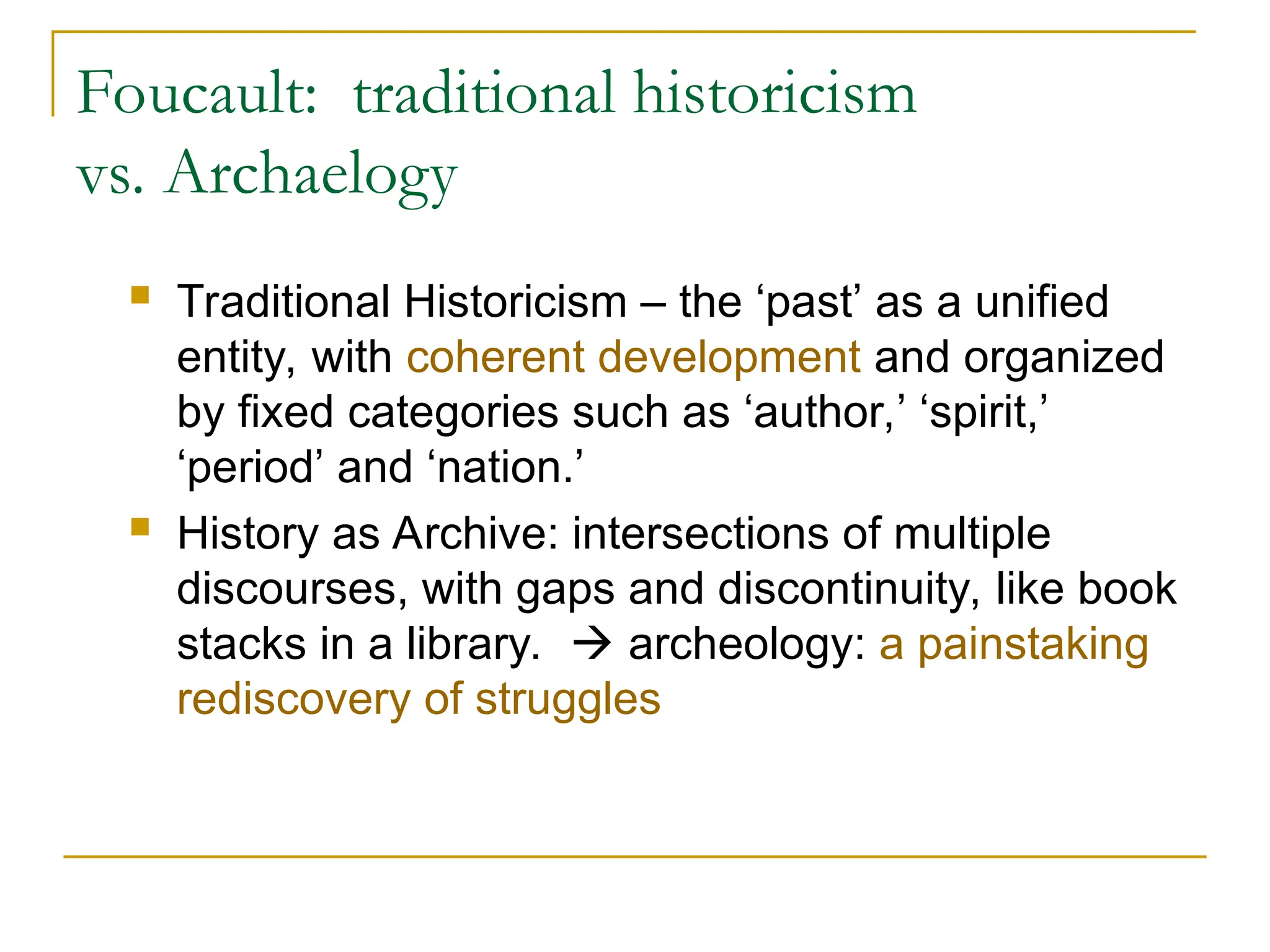
Foucault: traditional historicism
vs. Archaelogy
 Traditional Historicism – the ‘past’ as a unified
entity, with coherent development and organized
by fixed categories such as ‘author,’ ‘spirit,’
‘period’ and ‘nation.’
 History as Archive: intersections of multiple
discourses, with gaps and discontinuity, like book
stacks in a library.  archeology: a painstaking
rediscovery of struggles
Foucault: “historicize discourse”
 History—textualized; even every sentiment is in a
certain discourse, and thus historically conditioned.
 effective history:
1. knowledge as perspective, with slant and limitatio
ns; (e.g. Montrose)
2. working ‘without constants’;
3. “Historicity”: Working not to discover ‘ourselves,’ b
ut to introduce discontinuity in histories as well as
in us.
How does Foucault’s views of discourse influence literary studies?
Other Influences
 Clifford Geertz – Thick Description (e.g. cockf
ighting)
 Althusser – ideology;
 Raymond Williams
 Derrida – Différance
 Benjamin
Paul Klee's
"Angelus Novus"
Benjamin on
Paul Klee's "Angelus Novus"
 An angel looking as though he is about to move away
from something he is fixedly contemplating. His eyes are
staring, his mouth is open, his wings are spread. This is
how one pictures the angel of history. His face is turned
toward the past. Where we perceive a chain of events,
he sees one single catastrophe which keeps piling
wreckage upon wreckage and hurls it in front of his feet.
The angel would like to stay, awaken the dead, and
make whole what has been smashed. . . . But a storm is
blowing from Paradise; . . . irresistibly propels him into
the future to which his back is turned, This storm is what
we call progress.” Walter Benjamin, “Theses on the
Philosophy of History” (Ryan 35)
Benjamin Historical Materialism
 “A historical materialism cannot do without the
notion of a present which is not a transition,
but in which time stands still and has come to
a stop. For this notion defines the present in
which he himself is writing history. Historicism
gives the eternal image of the past; historical
materialism supplies a unique experience with
the past. . . .He remains in control of his
powers, man enough to blast open the
continuum of history.” (Ryan 39)
New Criticism   New Historicism
 New Criticism: the text and text alon
e.
 History is brought back to literary stu
dies and literature de-centered. Bot
h are in a network of text. (Historicity
of text, and textuality of history.)
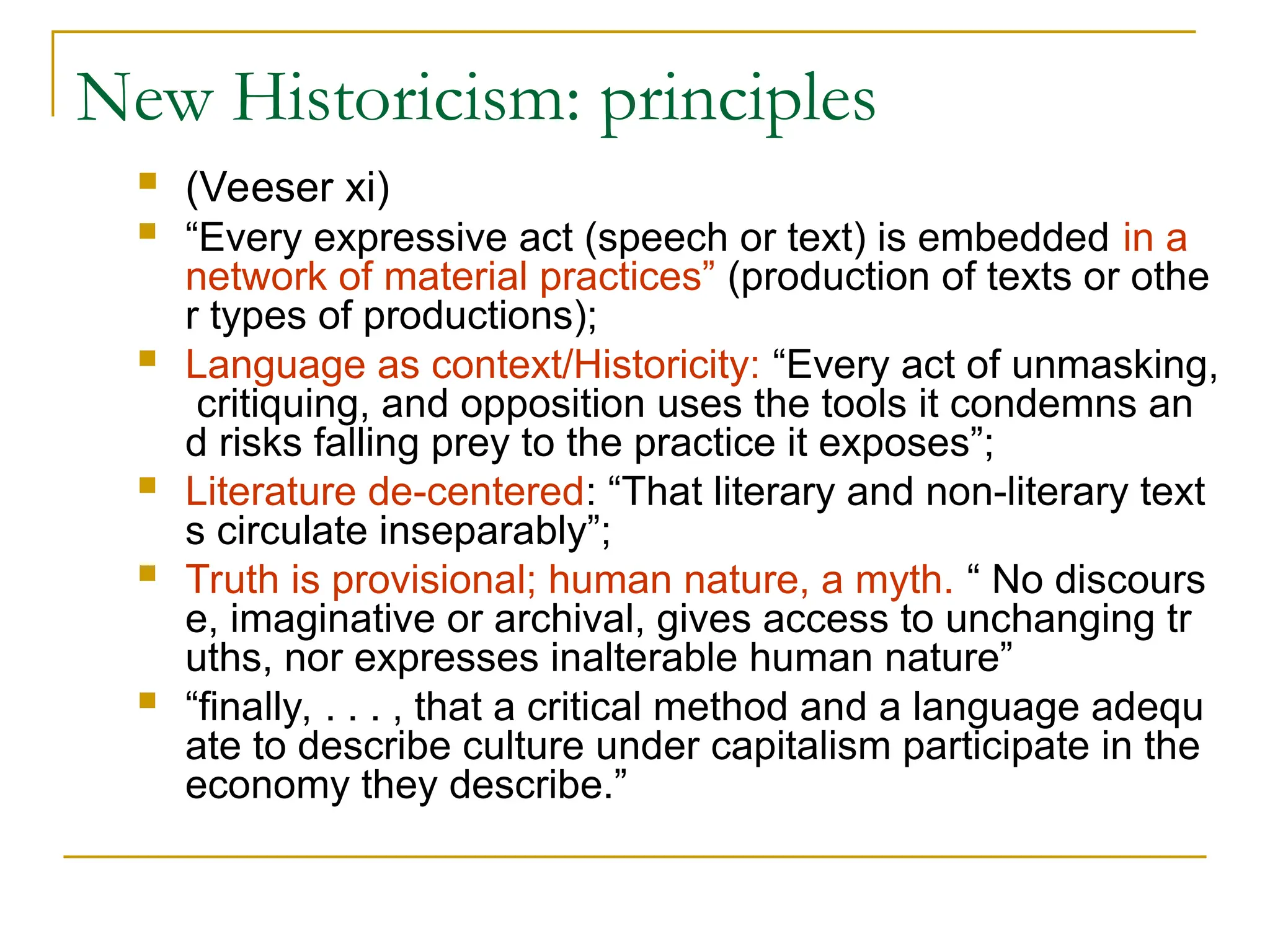
New Historicism: principles
 (Veeser xi)
 “Every expressive act (speech or text) is embedded in a
network of material practices” (production of texts or othe
r types of productions);
 Language as context/Historicity: “Every act of unmasking,
critiquing, and opposition uses the tools it condemns an
d risks falling prey to the practice it exposes”;
 Literature de-centered: “That literary and non-literary text
s circulate inseparably”;
 Truth is provisional; human nature, a myth. “ No discours
e, imaginative or archival, gives access to unchanging tr
uths, nor expresses inalterable human nature”
 “finally, . . . , that a critical method and a language adequ
ate to describe culture under capitalism participate in the
economy they describe.”
New Historicism: methods
 Investigates three areas of concern:
1. the life of the author;
2. the social rules found within a text;
3. a reflection of a work’s historical situation in the text.
 Avoiding sweeping generalization of a text or a
historical period, a new historicist pays close
attention to the conflicts and the apparently
insignificant details in history as well as the text.
New Historicism: examples
 An anecdote is used to interpret Twelfth Night.
 The prefaces to Wordsworth’s Lyrical Ballads,
as well as contemporary literary reviews and
capitalist system, are used to explain his views
on poetry.
 Different versions of Sonnet 29 are studied to
reveal the speaker’s economic concerns.
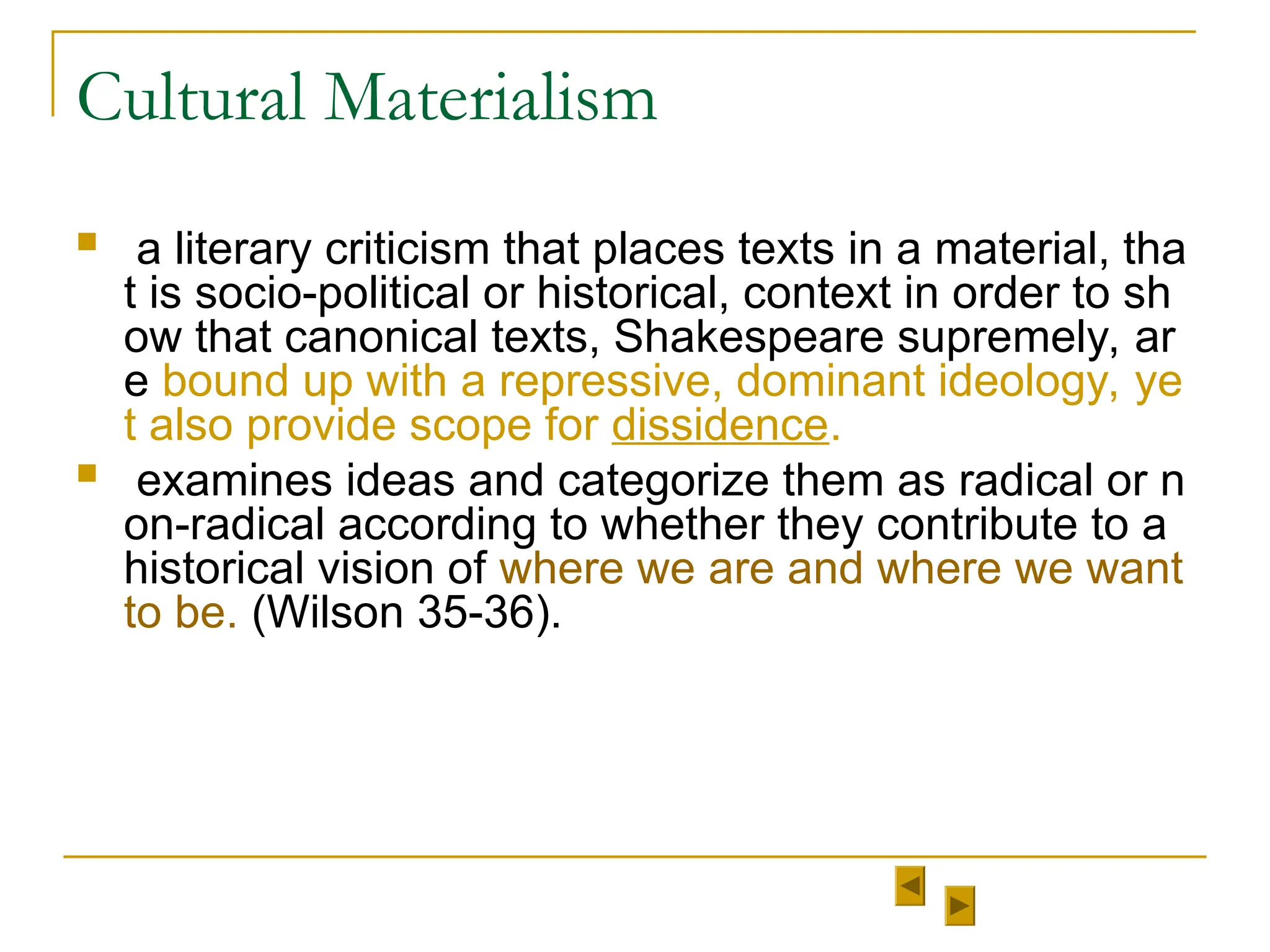
Cultural Materialism
 a literary criticism that places texts in a material, tha
t is socio-political or historical, context in order to sh
ow that canonical texts, Shakespeare supremely, ar
e bound up with a repressive, dominant ideology, ye
t also provide scope for dissidence.
 examines ideas and categorize them as radical or n
on-radical according to whether they contribute to a
historical vision of where we are and where we want
to be. (Wilson 35-36).
Example (1): Paul Brown’s reading of The
Tempest
 Instead of aesthetic harmony, truth and coher
ence, he sees the text as
 riven with contradictions which bear the traces of
social conflicts.
 an intervention in contemporary colonialist practi
ces
 Foregrounds what it seeks to cover (conflicts in c
olonialist ideologies).
An example: Paul Brown’s reading of The
Tempest (2)
Kermode – Prospero a
disciplined artist
Césaire – Caliban is the p
roductive natural man, the
slave that creates history.
Brown: does not do a humanist reading of the char
acters. Instead, he
-- sets The Tempest in the context of contemporary
colonial discourses of sexuality, masterlessness an
d savagism.
-- Caliban unifies the heterogeneous discourses of
masterlessness, savagism and sexuality.
Example (2) Barker, et al.
 To de-mystify contemporary Shakespeare --as
shown in
 midsummer tourism at Stratford-upon-Avon 
construction of an English past which is picturesque,
familiar and untroubled.
 Arden series of Shakespeare (eternal values of the texts
vs. their historical backgrounds)
Example (2) Barker, et al. (2)
 through examining his intertextuality or thru’ con-te
xtualization.
1. the inter-textual relations between Prospero’s versi
ons of history with that of Ariel’s, Miranda’s and Ca
liban’s
2. The moment of disturbance – when Prospero calls
a sudden halt to the celebratory mask.  the real
dramatic moment because Prospero is anxious to
keep the sub-plot of his play in its place.
Contemporary Shakespearean Discourses in UK
– as a ground for discrimination
 GCE (General Certificate Exam) –”A” level at
least one Shakespeare play
 Those on GCE “O” level and CSE (Certificate
of Secondary Education) should be steered a
way from Shakespeare (Sinfield 138) –
Contemporary Shakespearean Discourses in UK
– exam questions
 Assumptions of unchanging or eternal values.
 “At the center of King Lear lies the question, “What i
s a man?” Discuss.”
 “The Winter’s Tale is much more concerned with the
qualities of womanhood, its virtue, its insight, and its
endurance”. Discuss.”
 “Compare Shakespeare’s treatment of the problem
of evil in any two plays” (Sinfield 138-39).
Their Discontents and Your Views
 Greenblatt –1) ideology as strategies of conta
inment—no way out.
 2) sloganistic: "I do not want history to enable
me to escape the effect of the literary but to d
eepen it by making it touch the effect of the re
al, a touch that would reciprocally deepen an
d complicate history" (Learning 6).  n sacrifi
ce the structural investments of marxist thoug
ht. (James J. Paxson)
Anne D. Hall
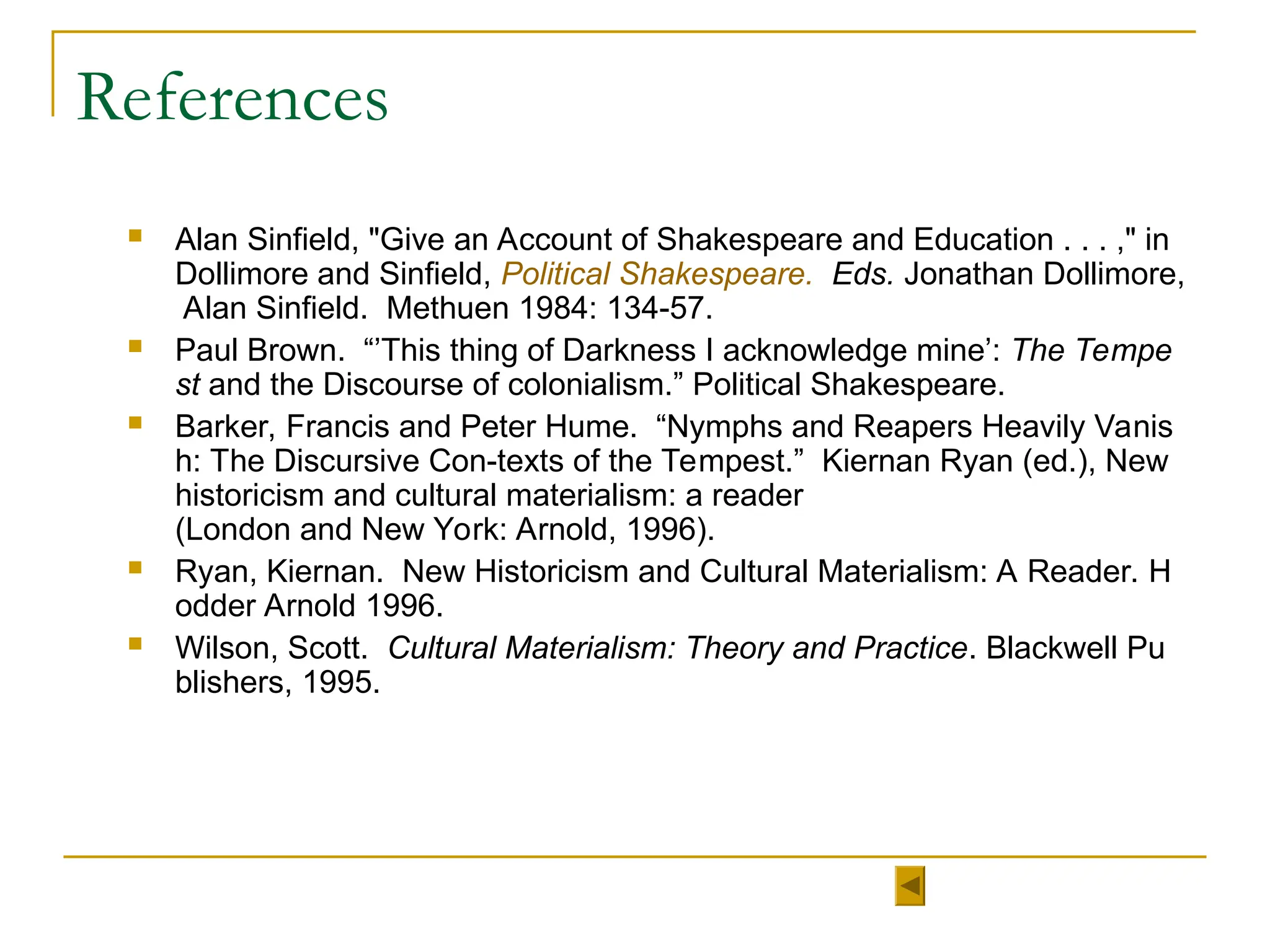
References
 Alan Sinfield, "Give an Account of Shakespeare and Education . . . ," in
Dollimore and Sinfield, Political Shakespeare. Eds. Jonathan Dollimore,
Alan Sinfield. Methuen 1984: 134-57.
 Paul Brown. “’This thing of Darkness I acknowledge mine’: The Tempe
st and the Discourse of colonialism.” Political Shakespeare.
 Barker, Francis and Peter Hume. “Nymphs and Reapers Heavily Vanis
h: The Discursive Con-texts of the Tempest.” Kiernan Ryan (ed.), New
historicism and cultural materialism: a reader
(London and New York: Arnold, 1996).
 Ryan, Kiernan. New Historicism and Cultural Materialism: A Reader. H
odder Arnold 1996.
 Wilson, Scott. Cultural Materialism: Theory and Practice. Blackwell Pu
blishers, 1995.

g_new_historicism_cultural_materialism.ppt

  • 1.
    New Historicism &Cultural Materialism
  • 2.
    Outline  The Influenceof Foucault 1. History; 2. Discourse  Other Influences  New Historicism examples  Cultural Materialism Examples (1); (2); (3)  Their Discontents and Your Views  References
  • 3.
    Foucault: traditional historicism vs.Archaelogy  Traditional Historicism – the ‘past’ as a unified entity, with coherent development and organized by fixed categories such as ‘author,’ ‘spirit,’ ‘period’ and ‘nation.’  History as Archive: intersections of multiple discourses, with gaps and discontinuity, like book stacks in a library.  archeology: a painstaking rediscovery of struggles
  • 4.
    Foucault: “historicize discourse” History—textualized; even every sentiment is in a certain discourse, and thus historically conditioned.  effective history: 1. knowledge as perspective, with slant and limitatio ns; (e.g. Montrose) 2. working ‘without constants’; 3. “Historicity”: Working not to discover ‘ourselves,’ b ut to introduce discontinuity in histories as well as in us. How does Foucault’s views of discourse influence literary studies?
  • 5.
    Other Influences  CliffordGeertz – Thick Description (e.g. cockf ighting)  Althusser – ideology;  Raymond Williams  Derrida – Différance  Benjamin
  • 6.
  • 7.
    Benjamin on Paul Klee's"Angelus Novus"  An angel looking as though he is about to move away from something he is fixedly contemplating. His eyes are staring, his mouth is open, his wings are spread. This is how one pictures the angel of history. His face is turned toward the past. Where we perceive a chain of events, he sees one single catastrophe which keeps piling wreckage upon wreckage and hurls it in front of his feet. The angel would like to stay, awaken the dead, and make whole what has been smashed. . . . But a storm is blowing from Paradise; . . . irresistibly propels him into the future to which his back is turned, This storm is what we call progress.” Walter Benjamin, “Theses on the Philosophy of History” (Ryan 35)
  • 8.
    Benjamin Historical Materialism “A historical materialism cannot do without the notion of a present which is not a transition, but in which time stands still and has come to a stop. For this notion defines the present in which he himself is writing history. Historicism gives the eternal image of the past; historical materialism supplies a unique experience with the past. . . .He remains in control of his powers, man enough to blast open the continuum of history.” (Ryan 39)
  • 9.
    New Criticism  New Historicism  New Criticism: the text and text alon e.  History is brought back to literary stu dies and literature de-centered. Bot h are in a network of text. (Historicity of text, and textuality of history.)
  • 10.
    New Historicism: principles (Veeser xi)  “Every expressive act (speech or text) is embedded in a network of material practices” (production of texts or othe r types of productions);  Language as context/Historicity: “Every act of unmasking, critiquing, and opposition uses the tools it condemns an d risks falling prey to the practice it exposes”;  Literature de-centered: “That literary and non-literary text s circulate inseparably”;  Truth is provisional; human nature, a myth. “ No discours e, imaginative or archival, gives access to unchanging tr uths, nor expresses inalterable human nature”  “finally, . . . , that a critical method and a language adequ ate to describe culture under capitalism participate in the economy they describe.”
  • 11.
    New Historicism: methods Investigates three areas of concern: 1. the life of the author; 2. the social rules found within a text; 3. a reflection of a work’s historical situation in the text.  Avoiding sweeping generalization of a text or a historical period, a new historicist pays close attention to the conflicts and the apparently insignificant details in history as well as the text.
  • 12.
    New Historicism: examples An anecdote is used to interpret Twelfth Night.  The prefaces to Wordsworth’s Lyrical Ballads, as well as contemporary literary reviews and capitalist system, are used to explain his views on poetry.  Different versions of Sonnet 29 are studied to reveal the speaker’s economic concerns.
  • 13.
    Cultural Materialism  aliterary criticism that places texts in a material, tha t is socio-political or historical, context in order to sh ow that canonical texts, Shakespeare supremely, ar e bound up with a repressive, dominant ideology, ye t also provide scope for dissidence.  examines ideas and categorize them as radical or n on-radical according to whether they contribute to a historical vision of where we are and where we want to be. (Wilson 35-36).
  • 14.
    Example (1): PaulBrown’s reading of The Tempest  Instead of aesthetic harmony, truth and coher ence, he sees the text as  riven with contradictions which bear the traces of social conflicts.  an intervention in contemporary colonialist practi ces  Foregrounds what it seeks to cover (conflicts in c olonialist ideologies).
  • 15.
    An example: PaulBrown’s reading of The Tempest (2) Kermode – Prospero a disciplined artist Césaire – Caliban is the p roductive natural man, the slave that creates history. Brown: does not do a humanist reading of the char acters. Instead, he -- sets The Tempest in the context of contemporary colonial discourses of sexuality, masterlessness an d savagism. -- Caliban unifies the heterogeneous discourses of masterlessness, savagism and sexuality.
  • 16.
    Example (2) Barker,et al.  To de-mystify contemporary Shakespeare --as shown in  midsummer tourism at Stratford-upon-Avon  construction of an English past which is picturesque, familiar and untroubled.  Arden series of Shakespeare (eternal values of the texts vs. their historical backgrounds)
  • 17.
    Example (2) Barker,et al. (2)  through examining his intertextuality or thru’ con-te xtualization. 1. the inter-textual relations between Prospero’s versi ons of history with that of Ariel’s, Miranda’s and Ca liban’s 2. The moment of disturbance – when Prospero calls a sudden halt to the celebratory mask.  the real dramatic moment because Prospero is anxious to keep the sub-plot of his play in its place.
  • 18.
    Contemporary Shakespearean Discoursesin UK – as a ground for discrimination  GCE (General Certificate Exam) –”A” level at least one Shakespeare play  Those on GCE “O” level and CSE (Certificate of Secondary Education) should be steered a way from Shakespeare (Sinfield 138) –
  • 19.
    Contemporary Shakespearean Discoursesin UK – exam questions  Assumptions of unchanging or eternal values.  “At the center of King Lear lies the question, “What i s a man?” Discuss.”  “The Winter’s Tale is much more concerned with the qualities of womanhood, its virtue, its insight, and its endurance”. Discuss.”  “Compare Shakespeare’s treatment of the problem of evil in any two plays” (Sinfield 138-39).
  • 20.
    Their Discontents andYour Views  Greenblatt –1) ideology as strategies of conta inment—no way out.  2) sloganistic: "I do not want history to enable me to escape the effect of the literary but to d eepen it by making it touch the effect of the re al, a touch that would reciprocally deepen an d complicate history" (Learning 6).  n sacrifi ce the structural investments of marxist thoug ht. (James J. Paxson)
  • 21.
  • 22.
    References  Alan Sinfield,"Give an Account of Shakespeare and Education . . . ," in Dollimore and Sinfield, Political Shakespeare. Eds. Jonathan Dollimore, Alan Sinfield. Methuen 1984: 134-57.  Paul Brown. “’This thing of Darkness I acknowledge mine’: The Tempe st and the Discourse of colonialism.” Political Shakespeare.  Barker, Francis and Peter Hume. “Nymphs and Reapers Heavily Vanis h: The Discursive Con-texts of the Tempest.” Kiernan Ryan (ed.), New historicism and cultural materialism: a reader (London and New York: Arnold, 1996).  Ryan, Kiernan. New Historicism and Cultural Materialism: A Reader. H odder Arnold 1996.  Wilson, Scott. Cultural Materialism: Theory and Practice. Blackwell Pu blishers, 1995.