Governance Challenges in
the Global Games Industry
New Directions in the Development of
Creative & Media Industries – June 2013
Darryl Woodford / dp.woodford@qut.edu.au
@dpwoodford
A WORD OF CAUTION
• Lots of optimism: new innovations, new business models
– HalfBrick & Beyond
• But what is the impact on players of these business
models?
• Where does the revenue come from?
• How will governments react?
KOMPU GACHA
• About to view a clip from “Grand Chase”, described as a
free MMO.
• And you can play for free. However, advanced skills are
hard (or in some cases, impossible) to acquire for free.
• You can get certain items for straight cash.
• But the best equipment is acquired through playing
Gacha.
KOMPU GACHA
• This is no longer considered a game, but is regulated as
if it were gambling.
• “For example, in Japan the Consumer Affairs Agency
hasrecently announced it intends to regulate a paid
lottery mechanic for virtual goods known as 'gacha' ,while
in the UK the Gambling Commission has reportedly
commented on social games as being on the 'perimeter'
of gambling regulation and thus being monitored by
them” (World Online Gambling Law report, June 2012)
KOMPU GACHA
• “There‟s a reasonable argument that complete gacha
would be regulated under gambling law under at least
some (if not most) Western jurisdictions, while at the
same time being a very lucrative game mechanic”.
(Purewal, 2012).
• [Social games are] “not prohibited under the IGA as they
do not satisfy the definition of a gambling service, due to
the virtual currency not being redeemable for real money
or anything else of value” (Australian IGA Review)
WHAT ELSE SHOULD BE?
• What else is „gambling‟? What else should be? Are there
other types of behaviors that should/will be regulated.
• UK Gambling Act:
–„Gaming‟ means „playing a game of chance for a prize‟. A
person plays such a game if
• „he plays a game of chance and thereby acquires a chance of
winning a prize; and
• whether or not he risks losing anything at the game‟”
WHAT ELSE SHOULD BE?
– An arrangement is a simple lottery if:
• (a) persons are required to pay in order to participate in the arrangement,
• (b) in the course of the arrangement one or more prizes are allocated to
one or more members of a class, and
• (c) the prizes are allocated by a process which relies wholly on chance.
– An arrangement is a complex lottery if:
• (a) persons are required to pay in order to participate in the arrangement,
• (b) in the course of the arrangement one or more prizes are allocated to
one or more members of a class,
• (c) the prizes are allocated by a series of processes, and
• (d) the first of those processes relies wholly on chance.
WHAT ELSE SHOULD BE?
• “A further issue associated with many gambling simulations is how
the odds are often geared to benefit the player, which may provide a
false impression of the ease of winning. In their evidence to the Joint
Select Committee, Professor Blaszczynski and Dr Gainsbury
identified a Canadian research study which compared the payout
rates of free and paid online slot machine games and found that 39
per cent of the free-play sites provided higher than usual odds in
favour of the player. Professor Blaszczynski noted that this then
encouraged people to play on paid gambling sites where the odds
are different and players end up losing. Such sites may also result in
dissociation between players‟ actions and the results if they are not
losing real money.”
(Australian IGA Review, p. 132-133)
WHAT ELSE SHOULD BE?
• “As social media sites, mobile platforms and game developers
operate in a dynamic environment, with their platforms being a
potential interface between online gambling organisations and
consumers of all ages, it is essential that government maintains a
close dialogue with such providers on this issue. The CWG has been
considering issues around the risks of online gambling to Australian
children. The issues surrounding children and exposure to prohibited
internet gambling services or gambling simulation applications will
continue to require attention.”
(Australian IGA Review, p. 136)
DOES THAT GO FAR ENOUGH?
• “…a child can buy chips to play an online slot which is
almost as good as anything you find on William Hill
Online… In fact, it might even pay out more than a slot
you might find on an online gambling site, which could
also encourage the vulnerable…But that‟s OK because
the chips aren‟t real money. Or are they?”
(Ralph Topping, CEO – William Hill).
DOES THAT GO FAR ENOUGH?
• “That‟s [addiction] what a game like Mafia Wars [on
Facebook] essentially creates. The interesting thing is
that you‟re still motivated by that simple triangle I
described. Push button, get thing, go do another thing,
get award, go on to the next thing. You see people that
may never have played RPGs getting into the game
mechanics. They may not understand what‟s going on,
but they get some fulfillment out of leveling.”
(Randy Breen, CEO – Social Gaming Network).
DOES THAT GO FAR ENOUGH?
• “Addiction in that vein means interest, passion and true
engagement. However what Randy is (unintentionally I
think) relating in the above quote is not the addiction of
engagement through awesomeness. Instead it is the
addiction of compulsiveness […] The reality is that
they‟ve actually sort-of kind-of half-intentionally built a
virtual slot machine industry”
(Jas Purewal, Lawyer at Osborne Clarke – writing for
Gamasutra).
DOES THAT GO FAR ENOUGH?
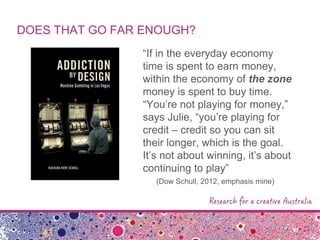
“If in the everyday economy
time is spent to earn money,
within the economy of the zone
money is spent to buy time.
“You‟re not playing for money,”
says Julie, “you‟re playing for
credit – credit so you can sit
their longer, which is the goal.
It‟s not about winning, it‟s about
continuing to play”
(Dow Schull, 2012, emphasis mine)
DOES THAT GO FAR ENOUGH?
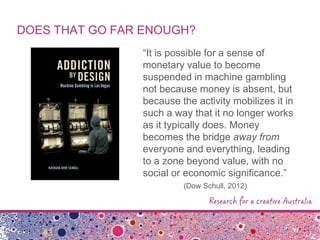
“It is possible for a sense of
monetary value to become
suspended in machine gambling
not because money is absent, but
because the activity mobilizes it in
such a way that it no longer works
as it typically does. Money
becomes the bridge away from
everyone and everything, leading
to a zone beyond value, with no
social or economic significance.”
(Dow Schull, 2012)
WHALES
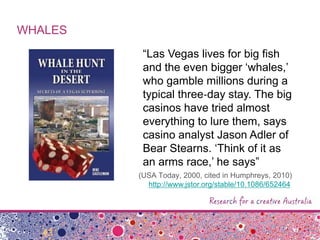
“Las Vegas lives for big fish
and the even bigger „whales,‟
who gamble millions during a
typical three‐day stay. The big
casinos have tried almost
everything to lure them, says
casino analyst Jason Adler of
Bear Stearns. „Think of it as
an arms race,‟ he says”
(USA Today, 2000, cited in Humphreys, 2010)
http://www.jstor.org/stable/10.1086/652464
WHALES
Source: Playnomics -- http://www.playnomics.com/wp-content/uploads/2013/05/Playnomics-Q1-
Engagement-Report.pdf
WHALES
Source: Playnomics -- http://www.playnomics.com/wp-content/uploads/2013/05/Playnomics-Q1-
Engagement-Report.pdf
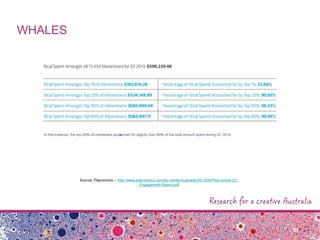
WHALES: 1% are $192k of $590k
Source: Playnomics -- http://www.playnomics.com/wp-content/uploads/2013/05/Playnomics-Q1-
Engagement-Report.pdf
SOME EXAMPLES:
– Second Life (2010):
Source: Personal Screenshot
SOME EXAMPLES:
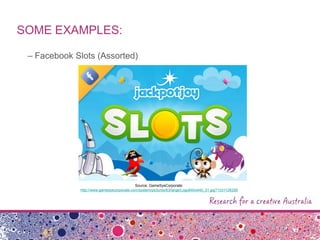
– Facebook Slots (Assorted)
Source: GameSysCorporate:
http://www.gamesyscorporate.com/system/pictures/63/large/Logo640x440_01.jpg?1331128328
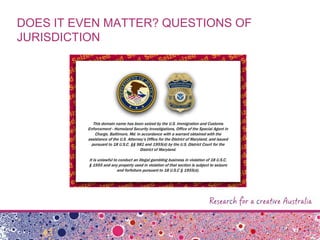
DOES IT EVEN MATTER? QUESTIONS OF
JURISDICTION
HOW LONG UNTIL A MEDIA PANIC?
• Tom Waterhouse (a sports
bookmaker) undertook
substantial cross-advertising
and product placement with
Australian broadcaster Nine‟s
coverage of Rugby League.
Two weeks of relentless
pressure, government
intervention and new
regulations forced him to
scale back his appearances.
• Industry should act before
the media does.
ACKNOWLEdGEMENTS
• ARC Centre for Excellence in Creative Industries and
Innovation (CCI) - http://www.cci.edu.au/
• Social Media Research Group, Creative Industries
Faculty, Queensland University of Technology --
http://socialmedia.qut.edu.au/

Governance Challenges in the Global Games Industry

  • 1.
    Governance Challenges in theGlobal Games Industry New Directions in the Development of Creative & Media Industries – June 2013 Darryl Woodford / dp.woodford@qut.edu.au @dpwoodford
  • 2.
    A WORD OFCAUTION • Lots of optimism: new innovations, new business models – HalfBrick & Beyond • But what is the impact on players of these business models? • Where does the revenue come from? • How will governments react?
  • 3.
    KOMPU GACHA • Aboutto view a clip from “Grand Chase”, described as a free MMO. • And you can play for free. However, advanced skills are hard (or in some cases, impossible) to acquire for free. • You can get certain items for straight cash. • But the best equipment is acquired through playing Gacha.
  • 5.
    KOMPU GACHA • Thisis no longer considered a game, but is regulated as if it were gambling. • “For example, in Japan the Consumer Affairs Agency hasrecently announced it intends to regulate a paid lottery mechanic for virtual goods known as 'gacha' ,while in the UK the Gambling Commission has reportedly commented on social games as being on the 'perimeter' of gambling regulation and thus being monitored by them” (World Online Gambling Law report, June 2012)
  • 6.
    KOMPU GACHA • “There‟sa reasonable argument that complete gacha would be regulated under gambling law under at least some (if not most) Western jurisdictions, while at the same time being a very lucrative game mechanic”. (Purewal, 2012). • [Social games are] “not prohibited under the IGA as they do not satisfy the definition of a gambling service, due to the virtual currency not being redeemable for real money or anything else of value” (Australian IGA Review)
  • 7.
    WHAT ELSE SHOULDBE? • What else is „gambling‟? What else should be? Are there other types of behaviors that should/will be regulated. • UK Gambling Act: –„Gaming‟ means „playing a game of chance for a prize‟. A person plays such a game if • „he plays a game of chance and thereby acquires a chance of winning a prize; and • whether or not he risks losing anything at the game‟”
  • 8.
    WHAT ELSE SHOULDBE? – An arrangement is a simple lottery if: • (a) persons are required to pay in order to participate in the arrangement, • (b) in the course of the arrangement one or more prizes are allocated to one or more members of a class, and • (c) the prizes are allocated by a process which relies wholly on chance. – An arrangement is a complex lottery if: • (a) persons are required to pay in order to participate in the arrangement, • (b) in the course of the arrangement one or more prizes are allocated to one or more members of a class, • (c) the prizes are allocated by a series of processes, and • (d) the first of those processes relies wholly on chance.
  • 9.
    WHAT ELSE SHOULDBE? • “A further issue associated with many gambling simulations is how the odds are often geared to benefit the player, which may provide a false impression of the ease of winning. In their evidence to the Joint Select Committee, Professor Blaszczynski and Dr Gainsbury identified a Canadian research study which compared the payout rates of free and paid online slot machine games and found that 39 per cent of the free-play sites provided higher than usual odds in favour of the player. Professor Blaszczynski noted that this then encouraged people to play on paid gambling sites where the odds are different and players end up losing. Such sites may also result in dissociation between players‟ actions and the results if they are not losing real money.” (Australian IGA Review, p. 132-133)
  • 10.
    WHAT ELSE SHOULDBE? • “As social media sites, mobile platforms and game developers operate in a dynamic environment, with their platforms being a potential interface between online gambling organisations and consumers of all ages, it is essential that government maintains a close dialogue with such providers on this issue. The CWG has been considering issues around the risks of online gambling to Australian children. The issues surrounding children and exposure to prohibited internet gambling services or gambling simulation applications will continue to require attention.” (Australian IGA Review, p. 136)
  • 11.
    DOES THAT GOFAR ENOUGH? • “…a child can buy chips to play an online slot which is almost as good as anything you find on William Hill Online… In fact, it might even pay out more than a slot you might find on an online gambling site, which could also encourage the vulnerable…But that‟s OK because the chips aren‟t real money. Or are they?” (Ralph Topping, CEO – William Hill).
  • 12.
    DOES THAT GOFAR ENOUGH? • “That‟s [addiction] what a game like Mafia Wars [on Facebook] essentially creates. The interesting thing is that you‟re still motivated by that simple triangle I described. Push button, get thing, go do another thing, get award, go on to the next thing. You see people that may never have played RPGs getting into the game mechanics. They may not understand what‟s going on, but they get some fulfillment out of leveling.” (Randy Breen, CEO – Social Gaming Network).
  • 13.
    DOES THAT GOFAR ENOUGH? • “Addiction in that vein means interest, passion and true engagement. However what Randy is (unintentionally I think) relating in the above quote is not the addiction of engagement through awesomeness. Instead it is the addiction of compulsiveness […] The reality is that they‟ve actually sort-of kind-of half-intentionally built a virtual slot machine industry” (Jas Purewal, Lawyer at Osborne Clarke – writing for Gamasutra).
  • 14.
    DOES THAT GOFAR ENOUGH? “If in the everyday economy time is spent to earn money, within the economy of the zone money is spent to buy time. “You‟re not playing for money,” says Julie, “you‟re playing for credit – credit so you can sit their longer, which is the goal. It‟s not about winning, it‟s about continuing to play” (Dow Schull, 2012, emphasis mine)
  • 15.
    DOES THAT GOFAR ENOUGH? “It is possible for a sense of monetary value to become suspended in machine gambling not because money is absent, but because the activity mobilizes it in such a way that it no longer works as it typically does. Money becomes the bridge away from everyone and everything, leading to a zone beyond value, with no social or economic significance.” (Dow Schull, 2012)
  • 16.
    WHALES “Las Vegas livesfor big fish and the even bigger „whales,‟ who gamble millions during a typical three‐day stay. The big casinos have tried almost everything to lure them, says casino analyst Jason Adler of Bear Stearns. „Think of it as an arms race,‟ he says” (USA Today, 2000, cited in Humphreys, 2010) http://www.jstor.org/stable/10.1086/652464
  • 17.
    WHALES Source: Playnomics --http://www.playnomics.com/wp-content/uploads/2013/05/Playnomics-Q1- Engagement-Report.pdf
  • 18.
    WHALES Source: Playnomics --http://www.playnomics.com/wp-content/uploads/2013/05/Playnomics-Q1- Engagement-Report.pdf
  • 19.
    WHALES: 1% are$192k of $590k Source: Playnomics -- http://www.playnomics.com/wp-content/uploads/2013/05/Playnomics-Q1- Engagement-Report.pdf
  • 20.
    SOME EXAMPLES: – SecondLife (2010): Source: Personal Screenshot
  • 21.
    SOME EXAMPLES: – FacebookSlots (Assorted) Source: GameSysCorporate: http://www.gamesyscorporate.com/system/pictures/63/large/Logo640x440_01.jpg?1331128328
  • 23.
    DOES IT EVENMATTER? QUESTIONS OF JURISDICTION
  • 24.
    HOW LONG UNTILA MEDIA PANIC? • Tom Waterhouse (a sports bookmaker) undertook substantial cross-advertising and product placement with Australian broadcaster Nine‟s coverage of Rugby League. Two weeks of relentless pressure, government intervention and new regulations forced him to scale back his appearances. • Industry should act before the media does.
  • 25.
    ACKNOWLEdGEMENTS • ARC Centrefor Excellence in Creative Industries and Innovation (CCI) - http://www.cci.edu.au/ • Social Media Research Group, Creative Industries Faculty, Queensland University of Technology -- http://socialmedia.qut.edu.au/

Editor's Notes

  • #5 Gacha is played by buying coins; 1000 “cash points” per coin, some packs have a free coin. Player choses a dungeon, then a character, then an egg from those scrolling by (for the Brits, think the conveyor belt on The Generation Game). The boss of the dungeon breaks open the egg to reveal the item; could be a piece of armor, a weapon, reinforcement boosters, 3 days of advanced play, pet, cash, skills or more. What you get is completely random, but once you have obtained ALL equipment, weapons and pets of a particular dungeon (e.g. Complete the set) , you get a VIP badge which can be used in the store for rare items. Of this 4 minute clip, only about 30 seconds at the end is what you would call the actual game.
  • #21 Even after it was banned, gambling persists in Second Life – A Problem of UGC.
  • #22 Remember the Australian Review & Behaviour Patterns
  • #24 One of the most pressing issues for developers around the world. If the Americans don’t like it, they’ll take your .com