Sponsor: Rigel Q. WoidaKaitlyn Williams (OSE) Steven Wirth (ECE)
Dean Whitman (AME) Ben Bossler (ME)
Alfie Tsang (SE) Reed Hubbell (ME)
Introduction
Small cube-sized satellites, appropriately termed
as CubeSats, are a cost-efficient and compact
alternative to standard commercial satellites. For
this project, the goal was to reduce cost using
these approaches:
 Commercial-off-the-shelf (COTS) components
 3-D printed internal structures
Cost Reduction
Mission Profile
 Payload is delivered to the International
Space Station (ISS).
 Satellite deploys from the ISS.
 CubeSat enters the following orbit where:
Mentor: Doug May
Team 15065 1U CubeSat Design using COTS 2015-16
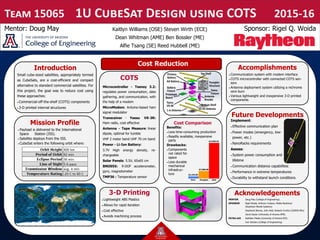
COTS
Microcontroller - Teensy 3.2:
regulates power consumption, data
gathering, and communication, with
the help of a modem
MicroModem: Arduino-based ham
signal modulator
Transceiver - Yaesu VX-3R:
Ham radio, cost effective
Antenna - Tape Measure: linear
dipole, optimal for tumble
VHF 2 meter band UHF 70 cm band
Power - Li-Ion Battery:
3.7V High energy density, re-
chargeable
Solar Panels: 5.5V, 65x65 cm
BNO055: 9-DOF accelerometer,
gyro, magnetometer
TMP36 : Temperature sensor
Cost Comparison
Benefits:
 Less time-consuming production
 Readily available, inexpensive
parts
Drawbacks:
 Components
not rated for
space
 Less durable
mechanical
infrastruc-
ture
Accomplishments
 Communication system with modem interface
 COTS microcontroller with connected COTS sen-
sors
 Antenna deployment system utilizing a nichrome
wire burn
 Various lightweight and inexpensive 3-D printed
components
Future Developments
Implement:
 Effective communication plan
 Power modes (emergency, low-
power, etc.)
 NanoRacks requirements
Assess:
 System power consumption and
lifetime
 Communication distance capabilities
 Performance in extreme temperatures
 Durability to withstand launch conditions
Acknowledgements
MENTOR Doug May (College of Engineering)
SPONSOR Rigel Woida, Anthony Vulcano, Mattie Bookhout
(Raytheon Missile Systems)
Stephanie Barnes, John Kidd, Roberto Furfaro (OSIRIS-REx)
David Gaylor (University of Arizona AME)
EXTRA AID Kathleen Melde (University of Arizona ECE)
Ivar Sanders (College of Engineering)
3-D Printing
 Lightweight ABS Plastics
 Allows for rapid iteration
 Cost effective
 Avoids machining process

CubeSat-Poster! (1)

  • 1.
    Sponsor: Rigel Q.WoidaKaitlyn Williams (OSE) Steven Wirth (ECE) Dean Whitman (AME) Ben Bossler (ME) Alfie Tsang (SE) Reed Hubbell (ME) Introduction Small cube-sized satellites, appropriately termed as CubeSats, are a cost-efficient and compact alternative to standard commercial satellites. For this project, the goal was to reduce cost using these approaches:  Commercial-off-the-shelf (COTS) components  3-D printed internal structures Cost Reduction Mission Profile  Payload is delivered to the International Space Station (ISS).  Satellite deploys from the ISS.  CubeSat enters the following orbit where: Mentor: Doug May Team 15065 1U CubeSat Design using COTS 2015-16 COTS Microcontroller - Teensy 3.2: regulates power consumption, data gathering, and communication, with the help of a modem MicroModem: Arduino-based ham signal modulator Transceiver - Yaesu VX-3R: Ham radio, cost effective Antenna - Tape Measure: linear dipole, optimal for tumble VHF 2 meter band UHF 70 cm band Power - Li-Ion Battery: 3.7V High energy density, re- chargeable Solar Panels: 5.5V, 65x65 cm BNO055: 9-DOF accelerometer, gyro, magnetometer TMP36 : Temperature sensor Cost Comparison Benefits:  Less time-consuming production  Readily available, inexpensive parts Drawbacks:  Components not rated for space  Less durable mechanical infrastruc- ture Accomplishments  Communication system with modem interface  COTS microcontroller with connected COTS sen- sors  Antenna deployment system utilizing a nichrome wire burn  Various lightweight and inexpensive 3-D printed components Future Developments Implement:  Effective communication plan  Power modes (emergency, low- power, etc.)  NanoRacks requirements Assess:  System power consumption and lifetime  Communication distance capabilities  Performance in extreme temperatures  Durability to withstand launch conditions Acknowledgements MENTOR Doug May (College of Engineering) SPONSOR Rigel Woida, Anthony Vulcano, Mattie Bookhout (Raytheon Missile Systems) Stephanie Barnes, John Kidd, Roberto Furfaro (OSIRIS-REx) David Gaylor (University of Arizona AME) EXTRA AID Kathleen Melde (University of Arizona ECE) Ivar Sanders (College of Engineering) 3-D Printing  Lightweight ABS Plastics  Allows for rapid iteration  Cost effective  Avoids machining process