CPDC GeoDesign Studio
Full Engagement
Mission:
Full Engagement
– Introduce new technologies to department practice
– Apply the latest academic concepts
– Collaborate in developing innovative multidisciplinary
solutions for real life problems
– Get real world experience and be work-ready at
Commencement
Invite students from a broad range of disciplines to:
In their own words and pictures…
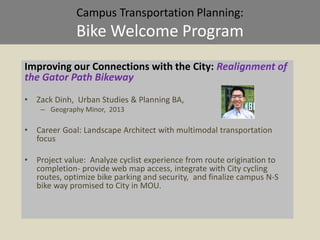
Campus Transportation Planning:
Bike Welcome Program
Improving our Connections with the City: Realignment of
the Gator Path Bikeway
• Zack Dinh, Urban Studies & Planning BA,
– Geography Minor, 2013
• Career Goal: Landscape Architect with multimodal transportation
focus
• Project value: Analyze cyclist experience from route origination to
completion- provide web map access, integrate with City cycling
routes, optimize bike parking and security, and finalize campus N-S
bike way promised to City in MOU.
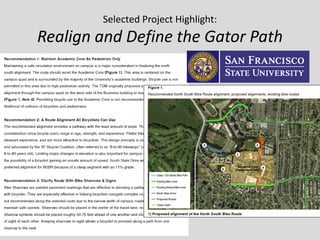
Selected Project Highlight:
Realign and Define the Gator Path
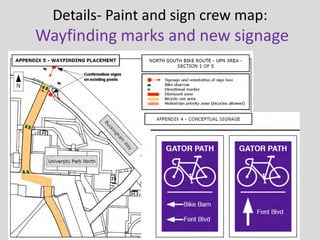
Details- Paint and sign crew map:
Wayfinding marks and new signage
Campus Mapping Technology Team
• Mapping the Campus as an intelligent GIS:
Develop and share online an accurate georeferenced
base map of campus with multiple customized user
interfaces and mobile online mapping applications
– Sean Fox-Thomas M.S. Geography 2015
• 3D Modeling and Rendering:
Software Research and Platform Development
– Brenten Lovato, B.S. Geography/Civil Engr. 2017
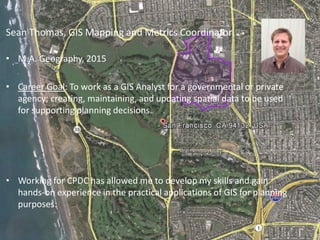
Sean Thomas, GIS Mapping and Metrics Coordinator
• M.A. Geography, 2015
• Career Goal: To work as a GIS Analyst for a governmental or private
agency; creating, maintaining, and updating spatial data to be used
for supporting planning decisions.
• Working for CPDC has allowed me to develop my skills and gain
hands-on experience in the practical applications of GIS for planning
purposes:
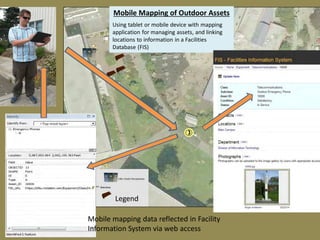
Mobile Mapping of Outdoor Assets
Using tablet or mobile device with mapping
application for managing assets, and linking
locations to information in a Facilities
Database (FIS)
Mobile mapping data reflected in Facility
Information System via web access
Legend
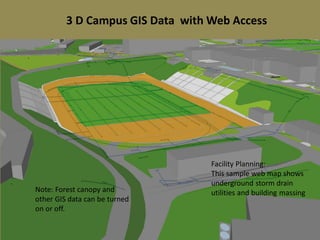
3 D Campus GIS Data with Web Access
Facility Planning:
This sample web map shows
underground storm drain
utilities and building massingNote: Forest canopy and
other GIS data can be turned
on or off.
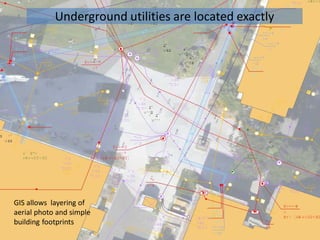
Underground utilities are located exactly
GIS allows layering of
aerial photo and simple
building footprints
GIS and CAD
datasets were
combined to
produce this
map, with light
poles overlaying
low [yellow]
and high voltage
[dark blue]
electrical lines
to illustrate the
underground
lighting circuit.
Street Lighting Circuit Mapping Exam
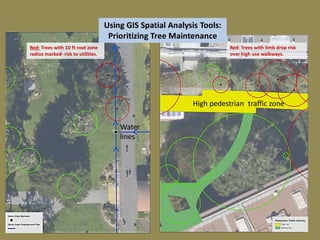
Red: Trees with 10 ft root zone
radius marked- risk to utilities.
Red: Trees with limb drop risk
over high use walkways.
Using GIS Spatial Analysis Tools:
Prioritizing Tree Maintenance
Water
lines
High pedestrian traffic zone
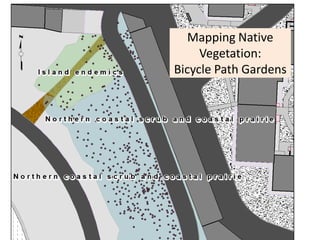
Mapping Native
Vegetation:
Bicycle Path Gardens
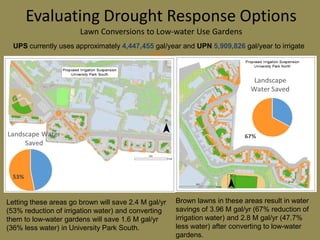
Evaluating Drought Response Options
Lawn Conversions to Low-water Use Gardens
UPS currently uses approximately 4,447,455 gal/year and UPN 5,909,826 gal/year to irrigate
lawns
Letting these areas go brown will save 2.4 M gal/yr
(53% reduction of irrigation water) and converting
them to low-water gardens will save 1.6 M gal/yr
(36% less water) in University Park South.
Brown lawns in these areas result in water
savings of 3.96 M gal/yr (67% reduction of
irrigation water) and 2.8 M gal/yr (47.7%
less water) after converting to low-water
gardens.
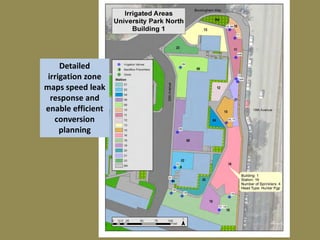
Detailed
irrigation zone
maps speed leak
response and
enable efficient
conversion
planning
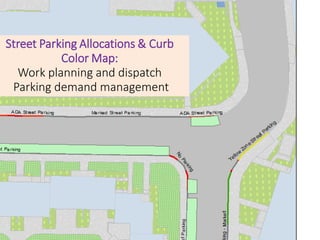
Street Parking Allocations & Curb
Color Map:
Work planning and dispatch
Parking demand management
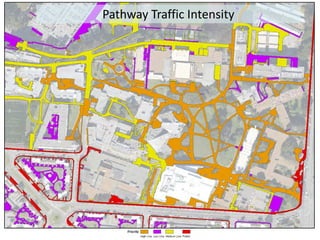
Pathway Traffic Intensity
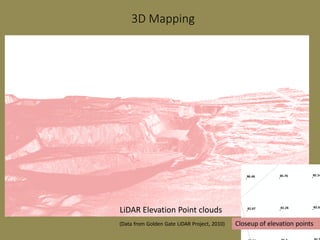
LiDAR Elevation Point clouds
(Data from Golden Gate LiDAR Project, 2010)
3D Mapping
Closeup of elevation points
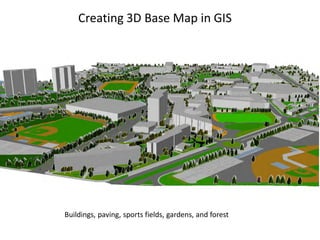
Creating 3D Base Map in GIS
Buildings, paving, sports fields, gardens, and forest
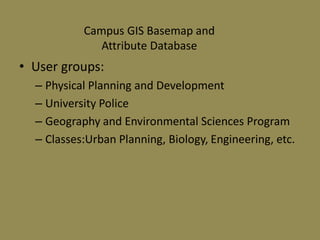
• User groups:
– Physical Planning and Development
– University Police
– Geography and Environmental Sciences Program
– Classes:Urban Planning, Biology, Engineering, etc.
Campus GIS Basemap and
Attribute Database
Brenten Lovato
• Career goal: Graduate program in Geomatics
Engineering
• Major: Geography & Environment;
Minor: Civil Engineering 2017
• Working at CPDC, I have learned my strengths and
weaknesses in the workplace. It has been great to
grow my strengths- testing and mastering advanced
technologies for use in design and planning of SF
State’s future physical campus.
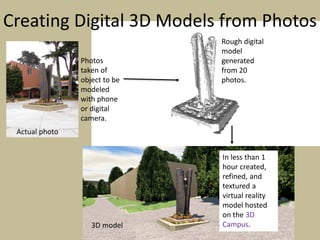
Creating Digital 3D Models from Photos
Photos
taken of
object to be
modeled
with phone
or digital
camera.
Rough digital
model
generated
from 20
photos.
In less than 1
hour created,
refined, and
textured a
virtual reality
model hosted
on the 3D
Campus.
Actual photo
3D model
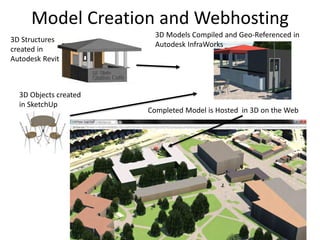
Model Creation and Webhosting
3D Objects created
in SketchUp
3D Models Compiled and Geo-Referenced in
Autodesk InfraWorks
Completed Model is Hosted in 3D on the Web
3D Structures
created in
Autodesk Revit
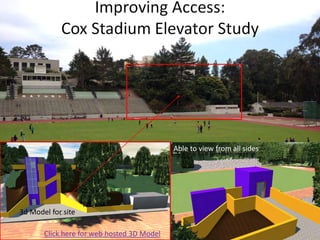
Click here for web hosted 3D Model
Able to view from all sides
3d Model for site
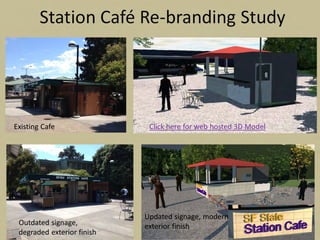
Click here for web hosted 3D ModelExisting Cafe
Outdated signage,
degraded exterior finish
Updated signage, modern
exterior finish
Urban Biodiversity Mapping
and Analysis Team:
• Botanical Richness and Net Resource Impacts
– Kim Drewiske, MS Botany 2015
• Campus Habitat Metrics and Global Impact
– Alexandrea Manuel, B.S. Zoology, 2015
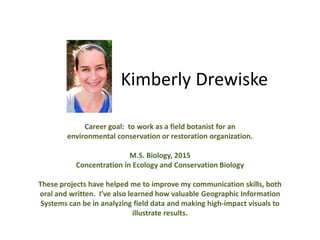
Kimberly Drewiske
Career goal: to work as a field botanist for an
environmental conservation or restoration organization.
M.S. Biology, 2015
Concentration in Ecology and Conservation Biology
These projects have helped me to improve my communication skills, both
oral and written. I’ve also learned how valuable Geographic Information
Systems can be in analyzing field data and making high-impact visuals to
illustrate results.
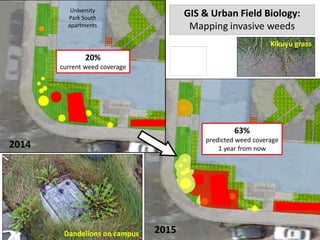
2014
2015
University
Park South
apartments
Dandelions on campus
20%
current weed coverage
63%
predicted weed coverage
1 year from now
GIS & Urban Field Biology:
Mapping invasive weeds
Kikuyu grass
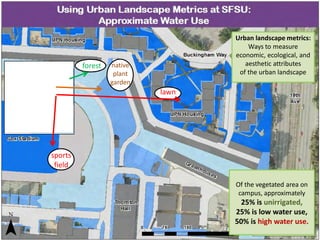
Urban landscape metrics:
Ways to measure
economic, ecological, and
aesthetic attributes
of the urban landscape
sports
field
lawn
forest native
plant
garden
Of the vegetated area on
campus, approximately
25% is unirrigated,
25% is low water use,
50% is high water use.
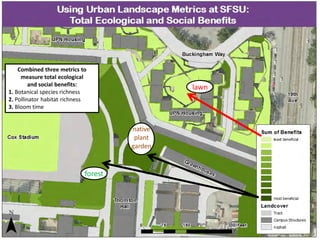
Combined three metrics to
measure total ecological
and social benefits:
1. Botanical species richness
2. Pollinator habitat richness
3. Bloom time
lawn
native
plant
garden
forest
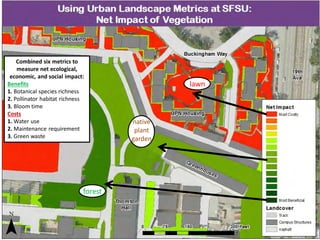
Mapping six attributes of the landscape
Combined six metrics to
measure net ecological,
economic, and social impact:
Benefits
1. Botanical species richness
2. Pollinator habitat richness
3. Bloom time
Costs
1. Water use
2. Maintenance requirement
3. Green waste
lawn
forest
native
plant
garden
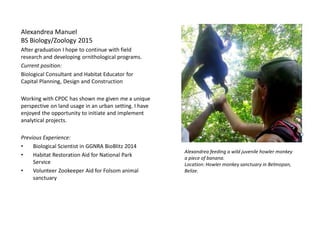
Alexandrea Manuel
BS Biology/Zoology 2015
After graduation I hope to continue with field
research and developing ornithological programs.
Current position:
Biological Consultant and Habitat Educator for
Capital Planning, Design and Construction
Working with CPDC has shown me given me a unique
perspective on land usage in an urban setting. I have
enjoyed the opportunity to initiate and implement
analytical projects.
Previous Experience:
• Biological Scientist in GGNRA BioBlitz 2014
• Habitat Restoration Aid for National Park
Service
• Volunteer Zookeeper Aid for Folsom animal
sanctuary
Alexandrea feeding a wild juvenile howler monkey
a piece of banana.
Location: Howler monkey sanctuary in Belmopan,
Belize.
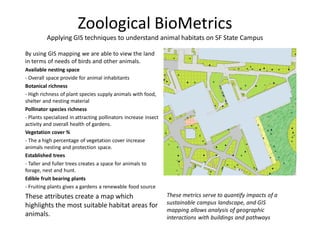
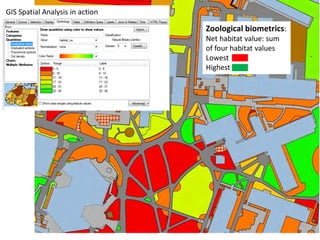
Zoological BioMetrics
Applying GIS techniques to understand animal habitats on SF State Campus
By using GIS mapping we are able to view the land
in terms of needs of birds and other animals.
Available nesting space
- Overall space provide for animal inhabitants
Botanical richness
- High richness of plant species supply animals with food,
shelter and nesting material
Pollinator species richness
- Plants specialized in attracting pollinators increase insect
activity and overall health of gardens.
Vegetation cover %
- The a high percentage of vegetation cover increase
animals nesting and protection space.
Established trees
- Taller and fuller trees creates a space for animals to
forage, nest and hunt.
Edible fruit bearing plants
- Fruiting plants gives a gardens a renewable food source
These attributes create a map which
highlights the most suitable habitat areas for
animals.
These metrics serve to quantify impacts of a
sustainable campus landscape, and GIS
mapping allows analysis of geographic
interactions with buildings and pathways
Zoological biometrics:
Net habitat value: sum
of four habitat values
Lowest
Highest
GIS Spatial Analysis in action
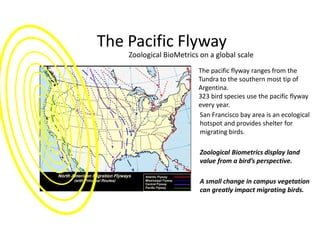
The Pacific Flyway
San Francisco bay area is an ecological
hotspot and provides shelter for
migrating birds.
Zoological Biometrics display land
value from a bird’s perspective.
A small change in campus vegetation
can greatly impact migrating birds.
The pacific flyway ranges from the
Tundra to the southern most tip of
Argentina.
323 bird species use the pacific flyway
every year.
Zoological BioMetrics on a global scale
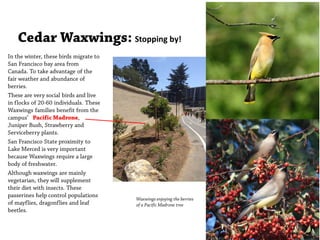
Cedar Waxwings: Stopping by!
In the winter, these birds migrate to
San Francisco bay area from
Canada. To take advantage of the
fair weather and abundance of
berries.
These are very social birds and live
in flocks of 20-60 individuals. These
Waxwings families benefit from the
campus’ Pacific Madrone,
Juniper Bush, Strawberry and
Serviceberry plants.
San Francisco State proximity to
Lake Merced is very important
because Waxwings require a large
body of freshwater.
Although waxwings are mainly
vegetarian, they will supplement
their diet with insects. These
passerines help control populations
of mayflies, dragonflies and leaf
beetles.
Waxwings enjoying the berries
of a Pacific Madrone tree
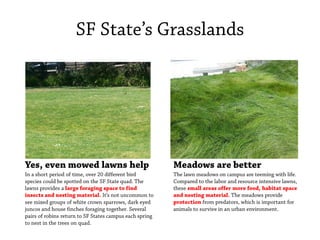
SF State’s Grasslands
Meadows are better
The lawn meadows on campus are teeming with life.
Compared to the labor and resource intensive lawns,
these small areas offer more food, habitat space
and nesting material. The meadows provide
protection from predators, which is important for
animals to survive in an urban environment.
Yes, even mowed lawns help
In a short period of time, over 20 different bird
species could be spotted on the SF State quad. The
lawns provides a large foraging space to find
insects and nesting material. It’s not uncommon to
see mixed groups of white crown sparrows, dark eyed
juncos and house finches foraging together. Several
pairs of robins return to SF States campus each spring
to nest in the trees on quad.
Community Furnishings Team
• Campus Seating Design
– Daniel Guasca, B.S. Industrial Design, 2016
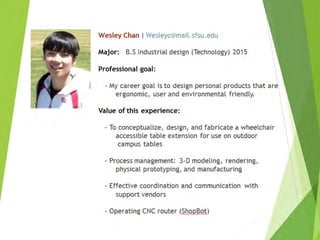
– Wesey Chan, B.S Industrial Design, 2016
– William Fong and Jennifer Cheung, B.S. Industrial
Design, 2013
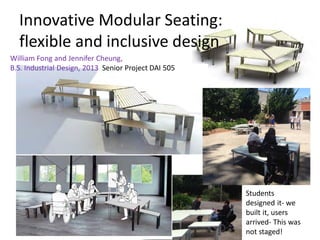
Innovative Modular Seating:
flexible and inclusive design
Students
designed it- we
built it, users
arrived- This was
not staged!
William Fong and Jennifer Cheung,
B.S. Industrial Design, 2013 Senior Project DAI 505
Position
Furniture Design and Manufacture
Major
B.S Industrial Design - concentration in Product design
Role description
To create furniture that defines public spaces and invites
students to make use of campus spaces
Project Description
Low cost furniture that can be easily distributed to activate
spaces, zero waste construction, simple tools.
Daniel Guasca | SFSU-CPDC | Product Design
What I experienced
Project calendars are great tools to organize the goals on a project. However, It was hard to follow due
to unexpected design issues.
I experienced the hardship of getting a conceptual product into manufacturing
Measure twice - cut once. I learned that measuring twice and making sure that everything fits how it is
suppose to fit is priceless.
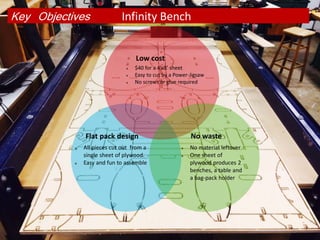
Key Objectives
 No material leftover
 One sheet of
plywood produces 2
benches, a table and
a bag-pack holder
 All pieces cut out from a
single sheet of plywood.
 Easy and fun to assemble
Flat pack design No waste
 $40 for a 4’x8’ sheet
 Easy to cut by a Power-Jigsaw
 No screws or glue required
Low cost
Infinity Bench
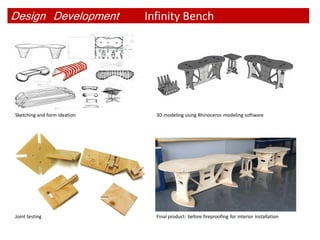
Design Development
3D modeling using Rhinoceros modeling software
Joint testing Final product- before fireproofing for interior installation
Sketching and form ideation
Infinity Bench
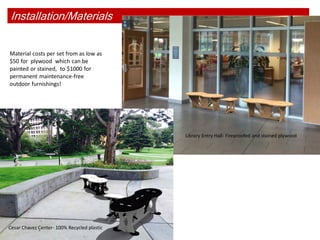
Installation/Materials
Joint testing
Library Entry Hall- Fireproofed and stained plywood
Cesar Chavez Center- 100% Recycled plastic
Material costs per set from as low as
$50 for plywood which can be
painted or stained, to $1000 for
permanent maintenance-free
outdoor furnishings!
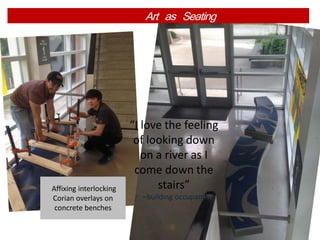
Art as Seating
“I love the feeling
of looking down
on a river as I
come down the
stairs”
–building occupant
Affixing interlocking
Corian overlays on
concrete benches
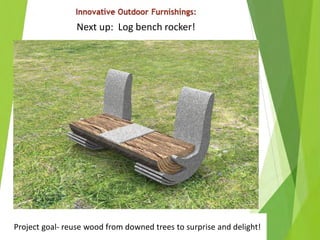
Next up: Log bench rocker!
Project goal- reuse wood from downed trees to surprise and delight!
The Facility Design and Planning Studio:
A Success Story:
• Student and community engagement offers a win/win
collaboration in exploring cutting edge technologies and
achieving productive innovation
• Mentoring students promotes staff professional development
through shared knowledge and technical experiences
• Collaborating with academic departments and sharing
research and equipment assets increases community synergy
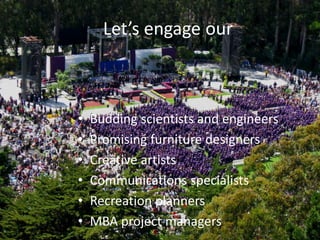
Let’s engage our
• Budding scientists and engineers
• Promising furniture designers
• Creative artists
• Communications specialists
• Recreation planners
• MBA project managers
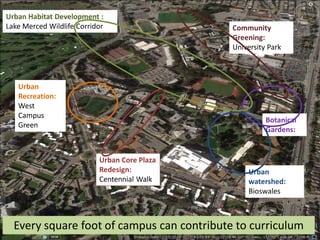
Botanical
Gardens:
Urban
Recreation:
West
Campus
Green
Urban Habitat Development :
Lake Merced Wildlife Corridor
Urban Core Plaza
Redesign:
Centennial Walk
Community
Greening:
University Park
Urban
watershed:
Bioswales
Every square foot of campus can contribute to curriculum
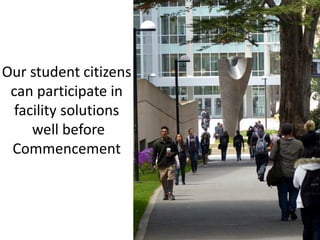
Our student citizens
can participate in
facility solutions
well before
Commencement
Let’s put students to work!
Phil Evans
Director, Site Planning
pevans@sfsu.edu
415-338-2712
Seth Hiatt, Associate Director
Institute for Geographic Information Science
Geography, College of Science and Engineering
(415) 338-3566 shiatt@sfsu.edu
Tom Parker, Professor
Biology, College of Science and Engineering
(415) 338-2375 parker@sfsu.edu
Ricardo Gomes, Professor
Design and Industry, College of Liberal and
Creative Arts
(415) 338-2229 ricgomes@sfsu.edu
Thank you!
Contact Phil at
Placewrights Collaborative
phil.s.evans@outlook.com
650-515-1193

CSU Full Engagement Proposal

  • 1.
  • 2.
    Mission: Full Engagement – Introducenew technologies to department practice – Apply the latest academic concepts – Collaborate in developing innovative multidisciplinary solutions for real life problems – Get real world experience and be work-ready at Commencement Invite students from a broad range of disciplines to:
  • 3.
    In their ownwords and pictures…
  • 4.
    Campus Transportation Planning: BikeWelcome Program Improving our Connections with the City: Realignment of the Gator Path Bikeway • Zack Dinh, Urban Studies & Planning BA, – Geography Minor, 2013 • Career Goal: Landscape Architect with multimodal transportation focus • Project value: Analyze cyclist experience from route origination to completion- provide web map access, integrate with City cycling routes, optimize bike parking and security, and finalize campus N-S bike way promised to City in MOU.
  • 5.
    Selected Project Highlight: Realignand Define the Gator Path
  • 6.
    Details- Paint andsign crew map: Wayfinding marks and new signage
  • 7.
    Campus Mapping TechnologyTeam • Mapping the Campus as an intelligent GIS: Develop and share online an accurate georeferenced base map of campus with multiple customized user interfaces and mobile online mapping applications – Sean Fox-Thomas M.S. Geography 2015 • 3D Modeling and Rendering: Software Research and Platform Development – Brenten Lovato, B.S. Geography/Civil Engr. 2017
  • 8.
    Sean Thomas, GISMapping and Metrics Coordinator • M.A. Geography, 2015 • Career Goal: To work as a GIS Analyst for a governmental or private agency; creating, maintaining, and updating spatial data to be used for supporting planning decisions. • Working for CPDC has allowed me to develop my skills and gain hands-on experience in the practical applications of GIS for planning purposes:
  • 9.
    Mobile Mapping ofOutdoor Assets Using tablet or mobile device with mapping application for managing assets, and linking locations to information in a Facilities Database (FIS) Mobile mapping data reflected in Facility Information System via web access Legend
  • 10.
    3 D CampusGIS Data with Web Access Facility Planning: This sample web map shows underground storm drain utilities and building massingNote: Forest canopy and other GIS data can be turned on or off.
  • 11.
    Underground utilities arelocated exactly GIS allows layering of aerial photo and simple building footprints
  • 12.
    GIS and CAD datasetswere combined to produce this map, with light poles overlaying low [yellow] and high voltage [dark blue] electrical lines to illustrate the underground lighting circuit. Street Lighting Circuit Mapping Exam
  • 13.
    Red: Trees with10 ft root zone radius marked- risk to utilities. Red: Trees with limb drop risk over high use walkways. Using GIS Spatial Analysis Tools: Prioritizing Tree Maintenance Water lines High pedestrian traffic zone
  • 14.
  • 15.
    Evaluating Drought ResponseOptions Lawn Conversions to Low-water Use Gardens UPS currently uses approximately 4,447,455 gal/year and UPN 5,909,826 gal/year to irrigate lawns Letting these areas go brown will save 2.4 M gal/yr (53% reduction of irrigation water) and converting them to low-water gardens will save 1.6 M gal/yr (36% less water) in University Park South. Brown lawns in these areas result in water savings of 3.96 M gal/yr (67% reduction of irrigation water) and 2.8 M gal/yr (47.7% less water) after converting to low-water gardens.
  • 16.
    Detailed irrigation zone maps speedleak response and enable efficient conversion planning
  • 17.
    Street Parking Allocations& Curb Color Map: Work planning and dispatch Parking demand management
  • 18.
  • 19.
    LiDAR Elevation Pointclouds (Data from Golden Gate LiDAR Project, 2010) 3D Mapping Closeup of elevation points
  • 20.
    Creating 3D BaseMap in GIS Buildings, paving, sports fields, gardens, and forest
  • 21.
    • User groups: –Physical Planning and Development – University Police – Geography and Environmental Sciences Program – Classes:Urban Planning, Biology, Engineering, etc. Campus GIS Basemap and Attribute Database
  • 22.
    Brenten Lovato • Careergoal: Graduate program in Geomatics Engineering • Major: Geography & Environment; Minor: Civil Engineering 2017 • Working at CPDC, I have learned my strengths and weaknesses in the workplace. It has been great to grow my strengths- testing and mastering advanced technologies for use in design and planning of SF State’s future physical campus.
  • 23.
    Creating Digital 3DModels from Photos Photos taken of object to be modeled with phone or digital camera. Rough digital model generated from 20 photos. In less than 1 hour created, refined, and textured a virtual reality model hosted on the 3D Campus. Actual photo 3D model
  • 24.
    Model Creation andWebhosting 3D Objects created in SketchUp 3D Models Compiled and Geo-Referenced in Autodesk InfraWorks Completed Model is Hosted in 3D on the Web 3D Structures created in Autodesk Revit
  • 25.
    Click here forweb hosted 3D Model Able to view from all sides 3d Model for site
  • 26.
    Click here forweb hosted 3D ModelExisting Cafe Outdated signage, degraded exterior finish Updated signage, modern exterior finish
  • 27.
    Urban Biodiversity Mapping andAnalysis Team: • Botanical Richness and Net Resource Impacts – Kim Drewiske, MS Botany 2015 • Campus Habitat Metrics and Global Impact – Alexandrea Manuel, B.S. Zoology, 2015
  • 28.
    Kimberly Drewiske Career goal:to work as a field botanist for an environmental conservation or restoration organization. M.S. Biology, 2015 Concentration in Ecology and Conservation Biology These projects have helped me to improve my communication skills, both oral and written. I’ve also learned how valuable Geographic Information Systems can be in analyzing field data and making high-impact visuals to illustrate results.
  • 29.
    2014 2015 University Park South apartments Dandelions oncampus 20% current weed coverage 63% predicted weed coverage 1 year from now GIS & Urban Field Biology: Mapping invasive weeds Kikuyu grass
  • 30.
    Urban landscape metrics: Waysto measure economic, ecological, and aesthetic attributes of the urban landscape sports field lawn forest native plant garden Of the vegetated area on campus, approximately 25% is unirrigated, 25% is low water use, 50% is high water use.
  • 31.
    Combined three metricsto measure total ecological and social benefits: 1. Botanical species richness 2. Pollinator habitat richness 3. Bloom time lawn native plant garden forest
  • 32.
    Mapping six attributesof the landscape Combined six metrics to measure net ecological, economic, and social impact: Benefits 1. Botanical species richness 2. Pollinator habitat richness 3. Bloom time Costs 1. Water use 2. Maintenance requirement 3. Green waste lawn forest native plant garden
  • 33.
    Alexandrea Manuel BS Biology/Zoology2015 After graduation I hope to continue with field research and developing ornithological programs. Current position: Biological Consultant and Habitat Educator for Capital Planning, Design and Construction Working with CPDC has shown me given me a unique perspective on land usage in an urban setting. I have enjoyed the opportunity to initiate and implement analytical projects. Previous Experience: • Biological Scientist in GGNRA BioBlitz 2014 • Habitat Restoration Aid for National Park Service • Volunteer Zookeeper Aid for Folsom animal sanctuary Alexandrea feeding a wild juvenile howler monkey a piece of banana. Location: Howler monkey sanctuary in Belmopan, Belize.
  • 34.
    Zoological BioMetrics Applying GIStechniques to understand animal habitats on SF State Campus By using GIS mapping we are able to view the land in terms of needs of birds and other animals. Available nesting space - Overall space provide for animal inhabitants Botanical richness - High richness of plant species supply animals with food, shelter and nesting material Pollinator species richness - Plants specialized in attracting pollinators increase insect activity and overall health of gardens. Vegetation cover % - The a high percentage of vegetation cover increase animals nesting and protection space. Established trees - Taller and fuller trees creates a space for animals to forage, nest and hunt. Edible fruit bearing plants - Fruiting plants gives a gardens a renewable food source These attributes create a map which highlights the most suitable habitat areas for animals. These metrics serve to quantify impacts of a sustainable campus landscape, and GIS mapping allows analysis of geographic interactions with buildings and pathways
  • 35.
    Zoological biometrics: Net habitatvalue: sum of four habitat values Lowest Highest GIS Spatial Analysis in action
  • 36.
    The Pacific Flyway SanFrancisco bay area is an ecological hotspot and provides shelter for migrating birds. Zoological Biometrics display land value from a bird’s perspective. A small change in campus vegetation can greatly impact migrating birds. The pacific flyway ranges from the Tundra to the southern most tip of Argentina. 323 bird species use the pacific flyway every year. Zoological BioMetrics on a global scale
  • 37.
    Cedar Waxwings: Stoppingby! In the winter, these birds migrate to San Francisco bay area from Canada. To take advantage of the fair weather and abundance of berries. These are very social birds and live in flocks of 20-60 individuals. These Waxwings families benefit from the campus’ Pacific Madrone, Juniper Bush, Strawberry and Serviceberry plants. San Francisco State proximity to Lake Merced is very important because Waxwings require a large body of freshwater. Although waxwings are mainly vegetarian, they will supplement their diet with insects. These passerines help control populations of mayflies, dragonflies and leaf beetles. Waxwings enjoying the berries of a Pacific Madrone tree
  • 38.
    SF State’s Grasslands Meadowsare better The lawn meadows on campus are teeming with life. Compared to the labor and resource intensive lawns, these small areas offer more food, habitat space and nesting material. The meadows provide protection from predators, which is important for animals to survive in an urban environment. Yes, even mowed lawns help In a short period of time, over 20 different bird species could be spotted on the SF State quad. The lawns provides a large foraging space to find insects and nesting material. It’s not uncommon to see mixed groups of white crown sparrows, dark eyed juncos and house finches foraging together. Several pairs of robins return to SF States campus each spring to nest in the trees on quad.
  • 39.
    Community Furnishings Team •Campus Seating Design – Daniel Guasca, B.S. Industrial Design, 2016 – Wesey Chan, B.S Industrial Design, 2016 – William Fong and Jennifer Cheung, B.S. Industrial Design, 2013
  • 40.
    Innovative Modular Seating: flexibleand inclusive design Students designed it- we built it, users arrived- This was not staged! William Fong and Jennifer Cheung, B.S. Industrial Design, 2013 Senior Project DAI 505
  • 41.
    Position Furniture Design andManufacture Major B.S Industrial Design - concentration in Product design Role description To create furniture that defines public spaces and invites students to make use of campus spaces Project Description Low cost furniture that can be easily distributed to activate spaces, zero waste construction, simple tools. Daniel Guasca | SFSU-CPDC | Product Design What I experienced Project calendars are great tools to organize the goals on a project. However, It was hard to follow due to unexpected design issues. I experienced the hardship of getting a conceptual product into manufacturing Measure twice - cut once. I learned that measuring twice and making sure that everything fits how it is suppose to fit is priceless.
  • 42.
    Key Objectives  Nomaterial leftover  One sheet of plywood produces 2 benches, a table and a bag-pack holder  All pieces cut out from a single sheet of plywood.  Easy and fun to assemble Flat pack design No waste  $40 for a 4’x8’ sheet  Easy to cut by a Power-Jigsaw  No screws or glue required Low cost Infinity Bench
  • 43.
    Design Development 3D modelingusing Rhinoceros modeling software Joint testing Final product- before fireproofing for interior installation Sketching and form ideation Infinity Bench
  • 44.
    Installation/Materials Joint testing Library EntryHall- Fireproofed and stained plywood Cesar Chavez Center- 100% Recycled plastic Material costs per set from as low as $50 for plywood which can be painted or stained, to $1000 for permanent maintenance-free outdoor furnishings!
  • 45.
    Art as Seating “Ilove the feeling of looking down on a river as I come down the stairs” –building occupant Affixing interlocking Corian overlays on concrete benches
  • 52.
    Next up: Logbench rocker! Project goal- reuse wood from downed trees to surprise and delight!
  • 53.
    The Facility Designand Planning Studio: A Success Story: • Student and community engagement offers a win/win collaboration in exploring cutting edge technologies and achieving productive innovation • Mentoring students promotes staff professional development through shared knowledge and technical experiences • Collaborating with academic departments and sharing research and equipment assets increases community synergy
  • 54.
    Let’s engage our •Budding scientists and engineers • Promising furniture designers • Creative artists • Communications specialists • Recreation planners • MBA project managers
  • 55.
    Botanical Gardens: Urban Recreation: West Campus Green Urban Habitat Development: Lake Merced Wildlife Corridor Urban Core Plaza Redesign: Centennial Walk Community Greening: University Park Urban watershed: Bioswales Every square foot of campus can contribute to curriculum
  • 56.
    Our student citizens canparticipate in facility solutions well before Commencement
  • 57.
  • 58.
    Phil Evans Director, SitePlanning pevans@sfsu.edu 415-338-2712 Seth Hiatt, Associate Director Institute for Geographic Information Science Geography, College of Science and Engineering (415) 338-3566 shiatt@sfsu.edu Tom Parker, Professor Biology, College of Science and Engineering (415) 338-2375 parker@sfsu.edu Ricardo Gomes, Professor Design and Industry, College of Liberal and Creative Arts (415) 338-2229 ricgomes@sfsu.edu Thank you! Contact Phil at Placewrights Collaborative phil.s.evans@outlook.com 650-515-1193