MCQ’S
 ‘Kyat’ is the currency of:
 (A) Nepal
(B) Myanmar
(C) Bhutan
(D) None of these
 Q. Myanmar is also known as:
(A) Burma
(B) Bengal
(C) Yangon
(D) None of these
 Q. Myanmar has been a member of the Association of Southeast
Asian Nations (ASEAN) since:
(A) 1991
(B) 1993
(C) 1995
(D) 1997
 Answers:
1. (B) Myanmar
2. (A) Burma
3. (D) 1997
 3 May is observed Internationally as:
 (A) Environment Day
(B) Population Day
(C) Press Freedom Day
(D) None of these
 Q. Who declared May 3 to be World’s Press Freedom Day?
(A) United Nations General Assembly
(B) United Nations Alliance of Civilization
(C) United Nations Security Council
(D) None of these
 Q. World’s Information Society Day is celebrated on:
(A) 15 May
(B) 17 May
(C) 19 May
(D) 21 May
 Answers:
1. (C) Press Freedom Day
2. (A) United Nations General Assembly
3. (B) 17 May
 The largest island in the Indian Ocean is:
 (A) Sri Lanka
(B) Sumatra
(C) Madagascar
(D) None of these
 Q. What is the total area of Madagascar Island?
(A) 587,041 km²
(B) 487,041 km²
(C) 387,041 km²
(D) 287,041 km²
 Q. Sumatra is an Island of:
(A) Sri Lanka
(B) Indonesia
(C) China
(D) None of these
 Answers:
1. (C) Madagascar
2. (A) 587,041 km²
3. (B) Indonesia
 The ‘Strait of Malacca’ is the main shipping channel between
the Indian Ocean and:
 (A) North Pacific Ocean
(B) South Pacific Ocean
(C) South Atlantic Ocean
(D) None of these
 Q. The ‘Strait of Malacca’ is named after the:
(A) Malacca Sultanate
(B) Malacca city
(C) Malacca Dilemma
(D) None of these
 Q. The strait that separates the North and South Island of
New Zealand is:
(A) Strait of Malacca
(B) Cook Strait
(C) Agattu Strait
(D) Alas Strait
 Answers:
1. (B) South Pacific Ocean
2. (A) Malacca Sultanate
3. (B) Cook Strait
 ‘Channel Tunnel’ is an under sea rail tunnel linking:
 (A) England and Ireland
(B) England and France
(C) France and Germany
(D) None of these
 Q. What is the length of ‘Channel Tunnel’ under sea rail tunnel?
(A) 50.45 km
(B) 60.45 km
(C) 70.45 km
(D) 80.45 km
 Q. ‘Channel Tunnel’ an under sea rail tunnel was opened in:
(A) 1992
(B) 1993
(C) 1994
(D) 1995
 Answers:
1. (B) England and France
2. (A) 50.45 km
3. (C) 1994
 “Silk Air” is an airline of:
 (A) Sri Lanka
(B) Switzerland
(C) Singapore
(D) China
 Q. When was the “Silk Air” airline of Singapore founded?
(A) 1979
(B) 1989
(C) 1999
(D) None of these
 Q. National language of Singapore is:
(A) Malay
(B) Mandarin
(C) English
(D) Tamil
 Answers:
1. (C) Singapore
2. (B) 1989
3. (A) Malay
 “ANTARA” is the news agency of:
 (A) Indonesia
(B) Malaysia
(C) Turkey
(D) None of these
 Q. “ANTARA” news agency was founded in:
(A) 1935
(B) 1936
(C) 1937
(D) 1938
 Q. When was “ANTARA” removed from the control of the presidency and reorganized as a private
state-owned enterprise?
(A) 2004
(B) 2005
(C) 2006
(D) 2007
 Answers:
1. (A) Indonesia
2. (C) 1937
3. (D) 1938
 The oldest internet search engine among the following is:
 (A) Google
(B) MSN search
(C) Yahoo
(D) Ask.com
 Q. The headquarters of popular web search engine Yahoo
search engine are located in:
(A) Sunnyvale, California
(B) Sacramento, California
(C) Los Angeles, California
(D) None of these
 Q. Yahoo search engine was launched in:
(A) 1965
(B) 1975
(C) 1985
(D) 1995
 Answers:
1. (C) Yahoo
2. (A) Sunnyvale, California
3. (D) 1995
 The headquarters of ‘Green Peace International’ is located at:
 (A) Vancouver
(B) Amsterdam
(C) London
(D) Paris
 Q. Greenpeace was founded in:
(A) 1971
(B) 1972
(C) 1973
(D) 1974
 Q. Greenpeace was founded by Irving Stowe and _______ Canadian and
US ex-pat environmental activists.
(A) Jim Bohlen
(B) Albert Bigelow
(C) Dorothy Stowe
(D) None of these
 Answers:
1. (B) Amsterdam
2. (A) 1971
3. (C) Dorothy Stowe
 Name the currency of Sri Lanka?
 (A) Rupiyah
(B) Lek
(C) Ringgit
(D) None of these
 Q. Number of rivers in Sri Lanka is:
(A) 97
(B) 100
(C) 103
(D) 106
 Q. The longest river in Sri Lanka is:
(A) Mahaweli River
(B) Malvathu River
(C) Kelani River
(D) Walawe River
 Answers:
1. (D) None of these
2. (C) 103
3. (A) Mahaweli River
 The Capital of Argentina is:
 (A) Columbia
(B) Barcelona
(C) Buenos Aires
(D) Peru
 Q. What is the National language of Argentina?
(A) French
(B) Spanish
(C) English
(D) None of these
 Q. Argentina is a country located in the southern half of:
(A) South America
(B) North America
(C) South Africa
(D) None of these
 Answers:
1. (C) Buenos Aires
2. (B) Spanish
3. (A) South America
 The first parliamentary elections in Afghanistan were held in:
 (A) 2004
(B) 2005
(C) 2006
(D) None of these
 Q. In 2004, who was elected as the President of Afghanistan?
(A) Hamid Karzai
(B) Ashraf Ghani
(C) Abdullah Abdullah
(D) None of these
 Q. In 2014, who was elected as the President of Afghanistan?
(A) Hamid Karzai
(B) Ashraf Ghani
(C) Abdullah Abdullah
(D) None of these
 Answers:
1. (B) 2005
2. (A) Hamid Karzai
3. (B) Ashraf Ghani
 Alliance among India, Germany, Japan and Brazil to support each other’s
bid for permanent seat on UN Security Council is called:
 (A) Alliance 4
(B) G 4
(C) Big 4
(D) None of these
 Q. What is the official language of G 4 nations?
(A) French
(B) Spanish
(C) English
(D) None of these
 Q. The countries who have supported the G 4’s bid for permanent seats
on the United Nations Security Council:
(A) Spain and France
(B) China and France
(C) Italy and France
(D) United Kingdom and France
 Answers:
1. (B) G 4
2. (C) English
3. (D) United Kingdom and France
 The term of office of a judge of the International Court of Justice
is?
 (A) 5 years
(B) 7 years
(C) 9 years
(D) None of these
 Q. International Court of Justice (ICJ) comprises a panel of:
(A) 10 Judges
(B) 15 Judges
(C) 20 Judges
(D) None of these
 Q. International Court of Justice (ICJ) is located in:
(A) Hague, Netherlands
(B) London, England
(C) Washington, US
(D) None of these
 Answers:
1. (C) 9 years
2. (B) 15 Judges
3. (A) Hague, Netherlands
 How many official working languages are recognized by UNO?
 (A) 8
(B) 6
(C) 4
(D) None of these
 Q. The United Nations Secretariat uses two working languages:
(A) English and French
(B) English and Spanish
(C) English and Arabic
(D) English and Russian
 Q. UN Spanish language day is celebrated on:
(A) 12 August
(B) 12 September
(C) 12 October
(D) 12 November
 Answers:
1. (B) 6
2. (A) English and French
3. (C) 12 October
 Who was the founder of HAMAS in 1987:
 (A) Sheikh Ahmed Yassin
(B) Yasser Arafat
(C) Abu Nidal
(D) None of these
 Q. Where is the headquarters of the HAMAS located?
(A) Ramallah, Palestine
(B) Gaza, Palestine
(C) Nablus, Palestine
(D) None of these
 Q. When did the HAMAS Shura council chose Ismail Haniya to
become the new leader to replace Mashal?
(A) May 6, 2015
(B) May 6, 2016
(C) May 6, 2017
(D) None of these
 Answers:
1. (A) Sheikh Ahmed Yassin
2. (B) Gaza, Palestine
3. (C) May 6, 2017
 The Permanent Secretariat of SAARC is established at:
 (A)Kathmandu
(B) Dhaka
(C) Dehli
(D) Islamabad
 Q. SAARC was founded in:
(A) Kathmandu
(B) Dhaka
(C) Dehli
(D) Islamabad
 Q. When the SAARC was established in Dhaka, Bangladesh?
(A) 8th December, 1980
(B) 8th December, 1982
(C) 8th December, 1985
(D) 8th December, 1987
 Answers:
1. (A) Kathmandu
2. (B) Dhaka
3. (C) 8th December, 1985
 Who were the three statesmen who formulated Non-Aligned
Movement (NAM)?
 (A) Gandhi, Nasser, Tito
(B) Nehru, Nasser, Tito
(C) Chou-en-Lai, Bhutto, Nehru
(D) Soe Karno, Nasser, Tito
 Q. When was the Non-Aligned Movement (NAM) was started?
(A) 1961
(B) 1962
(C) 1963
(D) 1964
 Q. Non-Aligned Movement (NAM) was started in:
(A) India
(B) Egypt
(C) Belgrade
(D) None of these
 Answers:
1. (B) Nehru, Nasser, Tito
2. (A) 1961
3. (C) Belgrade
 Asian Development Bank (ADB) was established in:
 (A) 1964
(B) 1966
(C) 1968
(D) None of these
 Q. Where is the headquarters of Asian Development Bank (ADB) are
located?
(A) Manila, Philippines
(B) Beijing, China
(C) Tokyo, Japan
(D) None of these
 Q. When did the Asian Development Bank (ADB) opened its first field
office in Bangladesh?
(A) 1980
(B) 1981
(C) 1982
(D) 1983
 Answers:
1. (B) 1966
2. (A) Manila, Philippines
3. (C) 1982
 Where is the Headquarter of the Amnesty International located?
 (A) Geneva
(B) London
(C) Paris
(D) New York
 Q. Amnesty International (AI) is a British non-government
organization focused on:
(A) Human Rights
(B) Scientific Research
(C) Technologies
(D) None of these
 Q. Amnesty International (AI) organization won Nobel Peace Prize
in:
(A) 1970
(B) 1977
(C) 1980
(D) 1987
 Answers:
1. (B) London
2. (A) Human Rights
3. (C) 1977
 Telephone was invented in 1876 in America by:
 (A) Marconi
(B) Galileo
(C) John Beard
(D) Graham Bell
 Q. Who invented the first mechanical computer in the early 19th
century?
(A) Marconi
(B) Galileo
(C) Charles Babbage
(D) Edison
 Q. Charles Babbage is considered the, Father of :
(A) Computer
(B) Technology
(C) Maths
(D) None of these
 Answers:
1. (D) Graham Bell
2. (C) Charles Babbage
3. (A) Computer
 Which one of the following is an alkali?
 (A) Water
(B) Vinegar
(C) Lemon juice
(D) Slaked lime
 Q. What is the chemical name of Slaked lime?
(A) Calcium Hydroxide
(B) Calcium Carbonate
(C) Calcium Dioxide
(D) None of these
 Q. What is the chemical formula of Slaked lime?
(A) CaCl2
(B) Ca(OH)2
(C) CaCO2
(D) None of these
 Answers:
1. (D) Slaked lime
2. (A) Calcium Hydroxide
3. (B) Ca(OH)2
 The temperature of liquid Nitrogen is:
 (A) -32°C
(B) -80°C
(C) -100°C
(D) -196°C
 Q. _______ is a cryogenic fluid that can cause rapid freezing
on contact with living tissue.
(A) Liquid Nitrogen
(B) Liquid Air
(C) Liquid Hydrogen
(D) None of these
 Q. What is the density of liquid air?
(A) 770 kg/m³
(B) 870 kg/m³
(C) 970 kg/m³
(D) None of these
 Answers:
1. (D) -196°C
2. (A) Liquid Nitrogen
3. (B) 870 kg/m³
 Boiling of an egg is a change which is:
 (A) Physical
(B) Chemical
(C) Physiological
(D) Morphological
 Q. Rusting of iron is an example of:
(A) Absorption
(B) Adsorption
(C) Oxidation
(D) Reduction
 Q. Mixing acid and base is a change which is:
(A) Physical
(B) Chemical
(C) Physiological
(D) Morphological
 Answers:
1. (B) Chemical
2. (C) Oxidation
3. (B) Chemical
 The building blocks of elements are called:
 (A) Atoms
(B) Molecules
(C) Compounds
(D) Isotopes
 Q. Who first gave the concept of ‘Atom’ ?
(A) Kapila
(B) Robert Edwards
(C) Kanada
(D) John Dalton
 Q. Which of the following was the first organic compound to be synthesised in the laboratory?
(A) Citric acid
(B) Formic acid
(C) Lactose
(D) Urea
 Answers:
1. (A) Atoms
2. (D) John Dalton
3. (D) Urea
 Ice can be changed to water by:
 (A) Adding more water molecules
(B) Changing the motion of the water molecules
(C) Rearranging the atoms in water molecules
(D) Destroying the atoms in water molecules
 Q. Water is a _______ most abundant molecule in the universe.
(A) second
(B) third
(C) fourth
(D) None of theseQ. The crystal structure of water is:
(A) Hexagonal
(B) Pentagonal
(C) Octagonal
(D) None of these
 Answers:
1. (B) Changing the motion of the water molecules
2. (B) Third
3. (A) Hexagonal
 Which one of the following statements is true?
 (A) Gases do not conduct heat
(B) The best conductors are non-metals
(C) Conduction currents occur only in liquids
(D) None of the statements is true.
 Q. The essence of the Kirchhoff’s law is that:
(A) A good absorber must be a bad radiator
(B) A good absorber must be a good radiator
(C) A good absorber must be a good conductor
(D) All are true
 Q. A bad emitter of radiation is a bad absorber:
(A) True
(B) False
(C) Uncertain
(D) None of these
 Answers:
1. (D) None of the statements is true
2. (B) A good absorber must be a good radiator
3. (A) True
 Who is the founder of Meteorology?
 (A) Aristotle
(B) Plato
(C) Newton
(D) Einstein
 Answer:
(A) Aristotle
 The density of water is greatest at:
 (A) -32°C
(B) 0°C
(C) 4°C
(D) 100°C
 Q. As the temperature rises gradually, it’s surface tension:
(A) goes on increasing
(B) goes on decreasing
(C) remains unchanged
(D) increase only when the heat is too intense
 Q. When a beam of light passes from air into water, its speed:
(A) increases
(B) decreases
(C) remains the same
(D) None of these
 Answers:
1. (C) 4°C
2. (B) goes on decreasing
3. (B) decreases
 The speed of light in vacuum is about:
 (A) 300 million meters per second
(B) 300 million meters per hour
(C) 300 million kilometers per second
(D) 300 million kilometers per hour
 Q. The speed of light in vacuum is a universal physical constant,
commonly denoted by:
(A) s
(B) d
(C) c
(D) l
 Q. Sunlight takes about _______ to travel the average distance from
the surface of the sun to the Earth.
(A) 5 min 17 sec
(B) 6 min 17 sec
(C) 7 min 17 sec
(D) 8 min 17 sec
 Answers:
1. (A) 300 million meters per second
2. (C) c
3. (D) 8 min 17 sec
 The speed of sound in dry air at 20 °C is about:
 (A) 130 m/s
(B) 230 m/s
(C) 330 m/s
(D) None of these
 Q. In an exceptionally stiff material such as diamond, the speed of
sound is:
(A) 12,000 m/s
(B) 10,000 m/s
(C) 8,000 m/s
(D) 6,000 m/s
 Q. The ratio of the speed of an object to the speed of sound in the fluid
is called object’s:
(A) Travelling speed
(B) Mach Number
(C) Effects on speed
(D) None of these
 Answers:
1. (D) None of these (343 m/s)
2. (A) 12,000 m/s
3. (B) Mach Number
 When sound is reflected from floor, ceiling or a wall, it mixes with the
original sound and changes its complexion, it is called as:
 (A) Sound
(B) Echo
(C) Reverberation
(D) Noise
 Q. The process of reducing the level of reverberation in a sound or signal
is:
(A) Dereverberation
(B) Antireverberation
(C) Unreverberation
(D) None of these
 Q. A reflection of sound that arrives at the listeners with a delay after the
direct sound is called:
(A) Noise
(B) Echo
(C) Reverberation
(D) None of these
 Answers:
1. (C) Reverberation
2. (A) Dereverberation
3. (B) Echo
 The magnet always points in the same direction, if allowed to
move freely i.e. towards North and South poles, because of:
 (A) Gravitational field
(B) A lot of metal deposits on North and South Poles
(C) Due to attraction of North Pole and repulsion of Western Pole
(D) Earth is a huge magnet
 Q. Materials that can be magnetized which are also the ones that
are strongly attracted to a magnet are called:
(A) Ferromagnetic
(B) Magnetized
(C) Electromagnetic
(D) None of these
 Q. A vector that characterizes the magnet’s overall magnetic
properties is called:
(A) Magnetic field
(B) Magnetic Moment
(C) Polarity
(D) None of these
 Answers:
1. (D) Earth is a huge magnet
2. (A) Ferromagnetic
3. (B) Magnetic Momen
 The unit of home electricity energy consumption is:
 (A) Watt hour
(B) Kilowatt hour
(C) Joule hour
(D) Kilojoule hour
 Q. The Kilowatt hour is a unit of energy equal to ______ megajoules.
(A) 3.6
(B) 4.6
(C) 5.6
(D) 6.6
 Q. The derived unit of energy within the International System of Units (SI) is:
(A) watt
(B) joule
(C) kilojoule
(D) None of these
 Answers:
1. (B) Kilowatt hour
2. (A) 3.6
3. (B) joule
 An electric current can produce:
 (A) Chemical effect
(B) Magnetic effect
(C) Heating effect
(D) All of these three
 Q. The SI unit of electric current is:
(A) Coulomb
(B) Ampere
(C) Joule
(D) None of these
 Q. The SI unit of electric charge is:
(A) Coulomb
(B) Ampere
(C) Joule
(D) None of these
 Answers:
1. (D) All of these three
2. (B) Ampere
3. (A) Coulomb
 The two most abundant elements in sea water are:
 (A) Sodium and Potassium
(B) Sodium and Calcium
(C) Sodium and Chlorine
(D) Chlorine and Iodine
 Q. The speed of sound in sea water is about:
(A) 15,00 m/s
(B) 16,00 m/s
(C) 17,00 m/s
(D) 18,00 m/s
 Q. Sea water PH is limited to the range:
(A) 5.5 to 6.4
(B) 6.5 to 7.4
(C) 7.5 to 8.4
(D) 8.5 to 9.4
 Answers:
1. (C) Sodium and Chlorine
2. (A) 15,00 m/s
3. (C) 7.5 to 8.4
 The most abundant natural Iron Oxides are:
 (A) Magnetite and Pyrite
(B) Magnetite and Bauxite
(C) Hematite and Pyrite
(D) Hematite and Magnetite
 Q. What is the chemical formula of Hematite?
(A) Fe2O3
(B) Fe3O4
(C) Fe2O4
(D) Fe3O2
 Q. What is the chemical formula of Magnetite?
(A) Fe2O3
(B) Fe3O4
(C) Fe2O4
(D) Fe3O2
 Answers:
1. (D) Hematite and Magnetite
2. (A) Fe2O3
3. (B) Fe3O4
 Which rocks are formed by the alteration of pre-existing rocks by great
heat or pressure?
 (A) Igneous rocks
(B) Sedimentary rocks
(C) Metamorphic rocks
(D) Acid rocks
 Q. The rock formed through the cooling and solidification of magma or
lava is known as:
(A) Sedimentary rock
(B) Igneous rock
(C) Metamorphic rock
(D) Acid rocks
 Q. Igneous rock is also known as:
(A) Magmatic rock
(B) Acid rock
(C) Basic rock
(D) Sedimentary rock
 Answers:
1. (C) Metamorphic rocks
2. (B) Igneous rock
3. (A) Magmatic rock
 The ozone layer is present about 30 miles (50 Km) in atmosphere
above the Earth. The stratum (layer) of atmosphere in which ozone
layer lies is called as:
 (A) Exosphere
(B) Mesosphere
(C) Stratosphere
(D) Ionosphere
 Q. The stratosphere layer is the second major layer of Earth’s
atmosphere, just above the layer:
(A) Troposphere
(B) Mesosphere
(C) Ionosphere
(D) Exosphere
 Q. The Mesosphere is the third major layer of the Earth’s atmosphere,
directly above the:
(A) Exosphere
(B) Mesosphere
(C) Ionosphere
(D) Stratosphere
 Answers:
1. (C) Stratosphere
2. (A) Troposphere
3. (D) Stratosphere
 The ozone layer protects the Earth from rays sent down by
the Sun:
 (A) Ultraviolet rays
(B) Infrared rays
(C) Gamma rays
(D) Radioactive rays
 Q. What is the Chemical form of Ozone?
(A) O4
(B) O3
(C) O2
(D) CO3
 Q. Ozone’s O3 Structure was determined in:
(A) 1862
(B) 1863
(C) 1864
(D) 1865
 Answers:
1. (A) Ultraviolet rays
2. (B) O3
3. (D) 1865
 When was Gas (Natural) discovered at Sui Baluchistan?
 (A) 1950
(B) 1952
(C) 1954
(D) None of these
 Q. Baluchistan got the status of province in:
(A) 1970
(B) 1971
(C) 1930
(D) 1935
 Q. Largest Province of Pakistan in terms of land area is:
(A) Punjab
(B) Sindh
(C) Baluchistan
(D) KPK
 Answers:
1. (B) 1952
2. (A) 1970
3. (C) Baluchistan
 An eclipse of the Sun occurs when:
 (A) The Moon is between the Sun and the Earth
(B) The Sun is between the Earth and the Moon
(C) The Earth is between the Sun and the Moon
(D) The Earth casts its shadow on the Moon
 Q. Earth’s orbit around the sun is a(n):
(A) Perihelion
(B) Aphelion
(C) Ellipse
(D) None of these
 Q. A ________ eclipse occurs when the Moon passes directly
behind Earth and into its shadow.
(A) Lunar
(B) Solar
(C) Partial
(D) None of these
 Answers:
1. (A) The Moon is between the Sun and the Earth
2. (C) Ellipse
3. (A) Lunar
 A unit of length equal to the average distance between the Earth
and Sun is called:
 (A) Light year
(B) Astronomical unit
(C) Parsec
(D) Parallax
 Q. What is the symbol of Astronomical unit?
(A) AU
(B) ASU
(C) ALU
(D) AST-U
 Q. The light year is a unit of length used to express _______
distances.
(A) Levenshtein
(B) Lee
(C) Astronomical
(D) None of these
 Answers:
1. (B) Astronomical unit
2. (A) AU
3. (C) Astronomical
 The age of the solar system is:
 (A) 4.5 billion years
(B) 5.5 billion years
(C) 6.5 billion years
(D) 7.5 billion years
 Q. The solar system is located in the Orion Arm, _______ light years
from the center of Milky way galaxy.
(A) 16,000
(B) 26,000
(C) 36,000
(D) 46,000
 Q. The two large planets Jupiter and Saturn are gas giants, being
composed mainly of Hydrogen and:
(A) Carbon dioxide
(B) Nitrogen
(C) Helium
(D) None of these
 Answers:
1. (A) 4.5 billion years
2. (B) 26,000
3. (C) Helium
 Sun is a:
 (A) Planet
(B) Comet
(C) Satellite
(D) None of these
 Q. The Latin name of sun is:
(A) Sunne
(B) Sol
(C) Comet
(D) None of these
 Q. The gravitational bound system of the Sun and the objects
that orbit it is called:
(A) Solar System
(B) Milky way
(C) Galaxy
(D) None of these
 Answers:
1. (D) None of these ( Star)
2. (B) Sol
3. (A) Solar system
 The planet of the solar system which has maximum number
of Moon is:
 (A) Jupiter
(B) Venus
(C) Saturn
(D) Uranus
 Q. The brightest planet in the solar system is:
(A) Venus
(B) Jupiter
(C) Earth
(D) Neptune
 Q. The Planet between Earth and Mercury is:
(A) Venus
(B) Mars
(C) Jupiter
(D) Neptune
 Answers:
1. (A) Jupiter
2. (A) Venus
3. (A) Venus
 Animals obtain carbohydrate mainly from:
 (A) Sucrose
(B) Starch
(C) Glucose
(D) Glycogen
 Q. Starch is a polysaccharide produced by _______ as energy
storage.
(A) Green plants
(B) Big trees
(C) Fungi
(D) None of these
 Q. When starch is cooked, the digestibility is:
(A) Decreased
(B) Increased
(C) Weaken
(D) None of these
 Answers:
1. (B) Starch
2. (A) Green plants
3. (B) Increased
 Cancer can be treated by:
 (A) Antibiotics and vaccines
(B) Radiotherapy and antibodies
(C) Chemotherapy and radiotherapy
(D) Antibodies and chemotherapy
 Q. Arthritis is a disease of:
(A) Skin
(B) Joint pain
(C) Eyes
(D) None of these
 Q. Trachoma is a disease of:
(A) Skin
(B) Eyes
(C) Ears
(D) Lungs
 Answers:
1. (C) Chemotherapy and radiotherapy
2. (B) Joint pain
3. (B) Eyes
 The most abundant element present in the human body is:
 (A) Nitrogen
(B) Carbon
(C) Hydrogen
(D) Oxygen
 Q. The most abundant element present in the earth’s crust is:
(A) Carbon
(B) Hydrogen
(C) Oxygen
(D) Nitrogen
 Q. What is the atomic number of Oxygen?
(A) 8
(B) 9
(C) 10
(D) 11
 Answers:
1. (D) Oxygen
2. (C) Oxygen
3. (A) 8
 The unit that coordinates different devices of the computer
system is:
 (A) ALU
(B) Register
(C) Control Unit
(D) Logical Instructions
 Q. The Control Unit (CU) is a part of:
(A) CPU
(B) ALU
(C) Register
(D) Logical Instructions
 Q. CPU stands for:
(A) Control Power Unit
(B) Central Processing Unit
(C) Central Power Unit
(D) None of these
 Answers:
1. (C) Control Unit
2. (A) CPU
3. (B) Central Processing Unit
 Laughing gas has chemical composition of the following two
elements which are:
 (A) Nitrogen + Hydrogen
(B) Nitrogen + Carbon
(C) Nitrogen + Oxygen
(D) Oxygen + Carbon
 Q. What is the chemical name of laughing gas?
(A) Nitrous oxide
(B) Nitric oxide
(C) Nitrogen dioxide
(D) None of these
 Q. Nitrous oxide (laughing gas) has significant medical uses,
especially in:
(A) Surgery
(B) Dentistry
(C) Both A & B
(D) None of these
 Answers:
1. (C) Nitrogen + Oxygen
2. (A) Nitrous oxide
3. (C) Both A & B
 Cobalt is a metal which is:
 (A) Strongly attracted by a magnet
(B) Not attracted by a magnet
(C) Not a magnet
(D) Weakly attracted by a magnet
 Q. Cobalt is a chemical element with the symbol Co, it’s atomic
number is:
(A) 17
(B) 27
(C) 37
(D) 47
 Q. Cobalt is the active center of a group of coenzymes called:
(A) Cobaltimins
(B) Cobalium
(C) Cobalamins
(D) None of these
 Answers:
1. (A) Strongly attracted by a magnet
2. (B) 27
3. (C) Cobalamins
 Which of the following is a form of sexual reproduction?
 (A) Hermaphroditism
(B) Fission
(C) Fragmentation
(D) Budding
 Q. Which of the following is a form of asexual reproduction?
(A) Hermaphroditism
(B) Allogamy
(C) Autogamy
(D) Fission
 Q. Each human cell contains _______ chromosomes.
(A) 36
(B) 46
(C) 56
(D) 66
 Answers:
1. (A) Hermaphroditism
2. (D) Fission
3. (B) 46
 Which of the following is an organic molecule needed by the
body in small amounts?
 (A) Protein
(B) Vitamin C
(C) Zinc
(D) Monosaccharide
 Q. The simplest form of sugar and the most basic unit of
carbohydrates, also known as simple sugar:
(A) Monosaccharides
(B) Chlorine
(C) Fluoride
(D) None of these
 Q. The most important monosaccharide, glucose is a:
(A) Tetrose
(B) Pentose
(C) Hexose
(D) Heptosell
 Answers:
1. (D) Monosaccharide
2. (A) Monosaccharides
3. (C) Hexose
 In humans, most nutrient molecules are absorbed by the:
 (A) Stomach
(B) Liver
(C) Small Intestine
(D) Large Intestine
 Q. The small Intestine is divided into _______ structural
parts.
(A) three
(B) four
(C) five
(D) six
 Q. What is the name of midsection of the small intestine?
(A) Duodenum
(B) Jejunum
(C) Ileum
(D) None of these
 Answers:
1. (C) small intestine
2. (A) three
3. (B) Jejunum
 Fossils found in the lowest geological strata are generally the most:
 (A) Advanced
(B) Complex
(C) Primitive
(D) Specialized
 Q. The study of fossils, their age, method of formation and
evolutionary significance is:
(A) Paleontology
(B) Astrobiology
(C) Anthropology
(D) None of these
 Q. The scientific study of humans, human behaviour and societies
in the past and present is known as:
(A) Astrobiology
(B) Anthropology
(C) Paleontology
(D) None of these
 Answers:
1. (C) Primitive
2. (A) Paleontology
3. (B) Anthropology
 The planet Mercury completes one rotation around the sun in:
 (A) 88 days
(B) 365 days
(C) 98 days
(D) 60 days
 Q. The planet Jupiter completes one rotation around the sun in:
(A) 10.86 years
(B) 11.86 years
(C) 12.86 years
(D) None of these
 Q. The planet Uranus completes one rotation around the sun in:
(A) 26.5 years
(B) 27.2 years
(C) 28.5 years
(D) 29.5 years
 Answers:
1. (A) 88 days
2. (B) 11.86 years
3. (D) 29.5 years
 The instrument which is specially designed for recording earthquake
wave is called seismograph which measures earthquake waves on a:
 (A) Diatonic scale
(B) Fahrenheit scale
(C) Ritcher scale
(D) Celsius scale
 Q. A device used for measuring wind speed and direction is called:
(A) Anemometer
(B) Hydrometer
(C) Ammeter
(D) None of these
 Q. The instrument which is use to measure the current in a circuit is
called:
(A) Anemometer
(B) Hydrometer
(C) Ammeter
(D) None of these
 Answers:
1. (C) Ritcher scale
2. (A) Anemometer
3. (C) Ammeter
 A body can escape the gravitational pull of the earth if it is thrown up with a
velocity of:
 (A) 25 miles/sec
(B) 60 miles/sec
(C) 7 miles/sec
(D) 10 miles/sec
 Q. Escape velocity is the speed at which the sum of an object’s kinetic
energy and its gravitational potential energy is equal to:
(A) zero
(B) each other
(C) it’s speed
(D) None of these
 Q. The simplest way of deriving the formula for escape velocity is to use
conservation of:
(A) Electric Power
(B) Energy
(C) Speed
(D) None of these
 Answers:
1. (C) 7 miles/sec
2. (A) zero
3. (B) Energy
 A nuclear reactor is a device used to carry out controlled nuclear reaction
whereas GM counter is a device used to detect:
 (A) Current
(B) Voltage
(C) Nuclear Radiation
(D) Power
 Q. Geiger-Müller (GM) tube is used for detection of ionizing radiation was
named after:
(A) Hans Geiger, Walther Müller
(B) William Geiger, Walther Müller
(C) Robert Geiger, Walther Müller
(D) None of these
 Q. A device used for the detection and measurement of all types of
radiations is:
(A) Scintillation Counter
(B) Geiger-Müller Tube
(C) Gamma-ray detector
(D) None of these
 Answers:
1. (C) Nucleus Radiation
2. (A) Hans Geiger, Walther Müller
3. (B) Geiger-Müller Tube
 A very important practical application of properties of matter is hoeing or
“godi” practiced by the farmers. This property of matter is called:
 (A) Elasticity
(B) Stress
(C) Capillarity
(D) Strain
 Q. The ability of a liquid to flow in narrow spaces without the assistance
of, or even in opposition to, external forces like gravity is called:
(A) Capillarity
(B) Absorption
(C) Retarding force
(D) None of these
 Q. The first recorded observation of capillary action was by:
(A) Robert Boyle
(B) Leonardo da Vinci
(C) Galileo
(D) None of these
 Answers:
1. (C) Capillarity
2. (A) Capillarity
3. (B) Leonardo da Vinci
 One of the countries through which equator passes is:
 (A) Kenya
(B) Pakistan
(C) Malaysia
(D) Malta
 Q. The equator of a rotating spheroid is the parallel at which
latitude is defined to be:
(A) 90°
(B) 180°
(C) 0°
(D) None of these
 Q. On Earth, the equator is about ______ long.
(A) 30,075 km
(B) 40,075 km
(C) 50,075 km
(D) 60,075 km
 Answers:
1. (A) Kenya
2. (C) 0°
3. (B) 40,075 km
 Bronze medal is made up of metals:
 (A) Copper, Nickel
(B) Copper, Tin
(C) Copper, Silver
(D) Copper, Zinc
 Q. The archaeological period in which bronze was the hardest
metal in widespread use is known as:
(A) Bronze Age
(B) Bronze Period
(C) Bronze Era
(D) None of these
 Q. Brass is an alloy of:
(A) Copper, Nickel
(B) Copper, Tin
(C) Copper, Silver
(D) Copper, Zinc
 Answers:
1. (B) Copper, Tin
2. (A) Bronze Age
3. (D) Copper, Zinc
 Magnifying power of a simple microscope can be increased by:
 (A) Increasing focal length of the lens
(B) Decreasing focal length of the lens
(C) Lens of large aperture
(D) Lens of short aperture
 Q. Instruments that use electromagnetic radiation to image objects are called:
(A) X-ray Microscopes
(B) Electric Microscopes
(C) Magnetic Microscopes
(D) None of these
 Q. The most common and the first invented microscope is:
(A) Electron Microscope
(B) X-ray Microscope
(C) Optical Microscope
(D) None of these
 Answers:
1. (B) Decreasing focal length of the lens
2. (A) X-ray Microscope
3. (C) Optical Microscope
 Lactometer is a type of hydrometer which is used to measure the
specific gravity of:
 (A) Honey
(B) Water
(C) Milk
(D) Olive oil
 Q. A saccharometer is a hydrometer used for determining the amount
of _______ in a solution.
(A) Sugar
(B) Salt
(C) Acid
(D) None of these
 Q. A saccharometer is a hydrometer invented by:
(A) Robert Boyle
(B) Thomas Thomson
(C) Galileo
(D) None of these
 Answers:
1. (C) Milk
2. (A) Sugar
3. (B) Thomas Thomson
 Cusec is a unit of:
 (A) Area
(B) Time
(C) Distance
(D) None of these
 Q. Cusec is informal shorthand for:
(A) Cubic meters per second
(B) Cubic feet per second
(C) Cubic square per second
(D) None of these
 Q. Cusec is used to measure:
(A) flow rate
(B) acceleration
(C) long distance
(D) None of these
 Answers:
1. (D) None of these [flow rate]
2. (B) Cubic feet per second
3. (A) flow rate
 The Continent Antarctica lies at the:
 (A) North pole
(B) South pole
(C) Middle of earth
(D) Equator
 Q. Antarctica is covered by ice by the percentage of:
(A) 68%
(B) 78%
(C) 88%
(D) 98%
 Q. The longest river in Antarctica is:
(A) Onyx River
(B) Alph River
(C) Penguin River
(D) Aiken Creck
 Answers:
1. (B) South pole
2. (D) 98%
3. (A) Onyx River
 Parsec is a unit of:
 (A) Energy
(B) Time
(C) Power
(D) Distance
 Q. What is the symbol of parec?
(A) pa
(B) pc
(C) pr
(D) pe
 Q. The parsec unit was first suggested by British astronomer:
(A) Herbert Hall Turner
(B) Paul Baize
(C) Jean Chazy
(D) Alexis Clairaut
 Answers:
1. (D) Distance
2. (B) pc
3. (A) Herbert Hall Turner
 It is possible to recognize a person in the dark by simply hearing his
unique voice. It is because of the:
 (A) Pitch
(B) Frequency
(C) Time period
(D) Quality
 Q. A property of sound that allows their ordering on a frequency-
related scale is called:
(A) Quality of sound
(B) Frequency
(C) Pitch
(D) Loudness
 Q. Instruments have their origin in variety of pitch standards are:
(A) Distorting
(B) Transposing
(C) Amplifying
(D) Musical
 Answers:
1. (A) Pitch
2. (C) Pitch
3. (B) Transposing
 In winter an iron pipe feels colder than a wooden window. This is because
wood is:
 (A) Conductor
(B) Non-conductor
(C) Semi-conductor
(D) None of these
 Q. Which of the following is a conductor?
(A) Plastic
(B) Rubber
(C) Iron
(D) wood
 Q. A material having the conductivity value falling between that of a
conduction and insulator is:
(A) Semi-conductor
(B) HTLS conductor
(C) Insulator
(D) None of these
 Answers:
1. (B) Non-conductor
2. (C) Iron
3. (A) Semi-conductor
 Light year is a unit of:
 (A) Distance
(B) Time period
(C) Light intensity
(D) Time
 Q. Newton is a unit of:
(A) Mass
(B) Force
(C) Acceleration
(D) None of these
 Q. Coulomb is a unit of:
(A) Electric charge
(B) Power
(C) Energy
(D) None of these
 Answers:
1. (A) Distance
2. (B) Force
3. (A) Electric charge
 The measurement of rainfall is made by an instrument known as:
 (A) Hygrometer
(B) Barometer
(C) Hydrometer
(D) None of these
 Q. An instrument used to measure the relative density of liquids is
called:
(A) Hydrometer
(B) Hygrometer
(C) Barometer
(D) None of these
 Q. An instrument that is used to measure air pressure in a certain
environment is:
(A) Hydrometer
(B) Hygrometer
(C) Barometer
(D) None of these
 Answers:
1. (D) None of these
2. (A) Hydrometer
3. (C) Barometer
 Water is heated in a kettle. The inside water is heated by convection. A
person sitting near the fire receives heat by:
 (A) Conduction
(B) Convection
(C) Radiation
(D) Reflection
 Q. The transfer of heat internal energy by microscopic collision of particles
and movement of electrons within a body is called:
(A) Thermal conduction
(B) Thermal convection
(C) Thermal radiation
(D) None of these
 Q. The heat transfer due to bulk movement of molecules within fluids such
as gases, liquids or molten rocks is called:
(A) Conduction
(B) Radiation
(C) Reflection
(D) Convection
 Answers:
1. (B) Convection
2. (A) Thermal conduction
3. (D) Convection
 Name the famous book of Ibn-Sina in which he discussed
human physiology and medicine:
 (A) Al-Qanoon
(B) Al-Masudi
(C) New Renaissance
(D) Tadhkria
 Answer: (A) Al-Qanoon
 Q. The Al-Qanoon encyclopedia of medicine by Ibn-Sina is a set
of :
(A) Three books
(B) Four books
(C) Five books
(D) Six books
 Answer: (C) Five books
 Q. When was the book Al-Qanoon of Ibn-Sina published ?
(A) 1020
(B) 1025
(C) 1030
(D) 1035
 Answer: (B) 1025
 In a railway track, two rails are joined end to end with a gap in
between them because:
 (A) Steel can be saved.
(B) Accidents due to contraction in winter can be avoided.
(C) Air gaps are necessary for bearing the weight of running train.
(D) Accidents due to expansion in summer can be avoided.
 Answer: (D) Accidents due to expansion in summer can be avoided.
 Q. In mechanics terms, a chassis or a frame work for carring wheels
attached to a vehicle is called:
(A) Bogie
(B) Trolley
(C) Wheelbarrow
(D) None of these
 Answer: (A) Bogie
 Q. The word “train” comes from the old French trahiner, derived from
the Latin trahere meaning:
(A) to drag
(B) to pull
(C) to speedup
(D) None of these
 Answer: (B) to pull
 Animal which captures and readily kills living animals for its food is
called:
 (A) Parasite
(B) Scavenger
(C) Predator
(D) Mammal
 Answer: (C) Predator
 Q. The animals that the predator hunts are called:
(A) Prey
(B) Scavenger
(C) Mammal
(D) None of these
 Answer: (A) Prey
 Q. A top predator or apex predator is the one who is:
(A) huge in size
(B) not the prey of other predators
(C) rare to find
(D) None of these
 Answer: (B) not the prey of other predators
 Quartz crystal in quartz watches works on the principle called:
 (A) Photoelectric effect
(B) Stark effect
(C) Thermionic effect
(D) Piezo-electric effect
 Answer: (D) Piezo-electric effect
 Q. The word Piezoelectricity means electricity resulting from:
(A) pressure and latent heat
(B) movement of crystals
(C) application of current
(D) None of these
 Answer: (A) pressure and latent heat
 Q. Chemically quartz is a specific form of compound called:
(A) Aluminum dioxide
(B) Silicon dioxide
(C) Barium oxide
(D) None of these
 Answer: (B) Silicon dioxide
 The Fruits without seed, like banana, are called:
 (A) seedless fruits
(B) parthenogenesis fruits
(C) parthenocarpic fruits
(D) placental fruits
 Answer: (C) parthenocarpic fruits
 Q. A small and pulpy fruit produced from the ovary of single flower
in which the outer layer of the ovary wall develops into an edible
fleshy portion is called a:
(A) Berry
(B) Soft fruits
(C) citrus fruits
(D) None of these
 Answer: (A) Berry
 Q. Which of the following fruit is a berry?
(A) Orange
(B) Mango
(C) Banana
(D) None of these
(C) Banana
 Oasis is associated with:
 (A) Glaciers
(B) Desert
(C) Island
(D) Volcanoes
 Answer: (B) Desert
 Q. A mixed woodland-grassland ecosystem characterized by the
trees being widely spaced so that the canopy does not close is
known as:
(A) Savanna
(B) Tundra
(C) Grassland
(D) None of these
 Answer: (A) Savanna
 Q. In biology, the above ground portion of a plant community or crop,
formed by the collection of individual plant crown is called:
(A) forest
(B) trees group
(C) canopy
(D) None of these
 Answer: (C) Canopy
 Yeast is used in making bread because it produces:
 (A) Carbon dioxide
(B) Sugar
(C) Bacteria
(D) Oxygen
 Answer: (A) Carbon dioxide
 Q. Yeast are eukaryostic single-celled microorganisms
classified an members of the kingdom:
(A) Alga
(B) Fungus
(C) Protozoa
(D) None of these
 Answer: (B) Fungus
 Q. Eukaryotes are organisms whose cells have:
(A) nucleus enclosed within membrane
(B) nucleus without membrane
(C) more than one nucleus
(D) None of these
 Answer: (A) nucleus enclosed within membrane
 Ozone layer prevents the following radiation from entering the
atmosphere:
 (A) Infra-red
(B) Ultraviolet
(C) X-rays
(D) Gamma rays
 Answer: (B) Ultraviolet
 Q. “World Ozone Day” is celebrated on:
(A) September, 16
(B) October, 16
(C) November, 16
(D) December, 16
 Answer: (A) September, 16
 Q. Ozone is an inorganic molecule with the chemical formula:
(A) O2
(B) O3
(C) O4
(D) O5
 Answer: (B) O3
 Which one of the following is a non-metallic mineral?
 (A) Manganese
(B) Magnesium
(C) Gypsum
(D) Bauxite
 Answer: (C) Gypsum
 Q. Gypsum is a soft sulfate mineral composed of:
(A) Calcium Sulfate Dihydrate
(B) Sodium Sulfate Dihydrate
(C) Nitrogen Sulfate Dihydrate
(D) None of these
 Answer: (A) Calcium Sulfate Dihydrate
 Q. Which of the following non-metallic minerals found in Pakistan?
(A) Sphene
(B) Sulphur
(C) Emerald
(D) Ruby
 Answer: (B) Sulphur
 Sedimentary rocks are:
 (A) Porous
(B) Hard
(C) Rough
(D) Brittle
 Answer: (A) Porous
 Q. The color of a sedimentary rock is often mostly determined by:
(A) Zinc
(B) Iron
(C) Calcium
(D) None of these
 Answer: (B) Iron
 Q. Thick sequences of red sedimentary rocks formed in arid
climates are called:
(A) Red rocks
(B) Red sponge
(C) Red beds
(D) None of these
 Answer: (C) Red beds
 A moderator is used in nuclear reactor in order to:
 (A) Accelerate the neutrons
(B) Slow down the speed of the neutrons
(C) Increase the number of electrons
(D) Decrease the number of electrons
 Answer: (B) Slow down the speed of the neutrons
 Q. A nuclear reactor, formerly known as:
(A) atomic pile
(B) atomic ship
(C) atomic shaft
(D) None of these
 Answer: (A) atomic pile
 Q. A device used to initiate and control a self-sustained nuclear
chain reaction is called:
(A) Nuclear reactor
(B) Nuclear generator
(C) Nuclear atom
(D) None of these
 Answer: (A) Nuclear reactor
 Monsoon is caused by:
 (A) Seasonal reversal of winds
(B) Revolution of earth
(C) Movement of the clouds
(D) Rise in temperature
 Answer: (A) Seasonal reversal of winds
 Q. The major monsoon systems of the world consists of West
African and _______ monsoon.
(A) Asia Indian
(B) Asia Chines
(C) Asia Australian
(D) None of these
 Answer: (C) Asia Australian
 Q. A larger scale air mass that rotates around a strong center of
low atmosphere pressure is a:
(A) Cyclone
(B) Hurricane
(C) Volcano
(D) None of these
 Answer: (A) Cyclone
 Kilowatt-hour is a unit of:
 (A) Power
(B) Electric current
(C) Energy
(D) Time
 Answer: (C) Energy
 Q. Ampere is a unit of:
(A) Power
(B) Electric current
(C) Energy
(D) Time
 Answer: (B) Electric current
 Q. Candela is a unit of:
(A) Energy
(B) Power
(C) Amount of substance
(D) Luminous intensity
 Answer: (D) Luminous intensity
 The half life of a radioactive element is 8-days. How long will it
take to reduce it from 10mg to 5mg?
 (A) 4 days
(B) 12 days
(C) 16 days
(D) 8 days
 Answer: (D) 8 days
 Q. The time required for a quantity to reduce to half of its initial
value of a radioactive element is called:
(A) Half-life
(B) Divided-life
(C) Decreased-life
(D) None of these
 Answer: (A) Half-life
 Q. What is the half-life of Polonium-210?
(A) 138.376 days
(B) 148.376 days
(C) 158.376 days
(D) 168.376 days
 Answer: (A) 138.376 days
 The number of spark plugs needed in a diesel engine is:
 (A) 2
(B) 3
(C) 0
(D) 4
 Answer: (C) 0
 Q. What is the name of heating device used to aid starting
diesel engines?
(A) Glow plug
(B) Spark plug
(C) Thermostat plug
(D) None of these
 Answer: (A) Glow plug
 Q. The diesel engine also known as a compression-ignition (CI)
engine is named after:
(A) Casey Diesel
(B) Rudolf Diesel
(C) Randall Diesel
(D) None of these
 Answer: (B) Rudolf Diesel
 Where do most of Asteroids lie?
 (A) In asteroid belt between the orbits of Mars and Jupiter
(B) In asteroid belt between the orbits of Mars and Venus.

(C) In asteroid belt between the orbits of Jupiter and Venus.
(D) Everywhere in the sky.Answer: (A) In asteroid belt between the
orbits of Mars and Jupiter
 Q. Minor planets, especially of the inner solar system are:
(A) Planetiods
(B) Asteroids
(C) Meteroroids
(D) None of these
 Answer: (B) Asteroids
 Q. Larger asteroids also known as:
(A) Planetiods
(B) Asteroids
(C) Meteroroids
(D) None of these
 Answer: (A) Planetiods
 Television signals are converted into light signals by:
 (A) Optical fibre
(B) Transistor
(C) Decoder
(D) Photo diode
 Answer: (D) Photo diode
 Q. LED generates light with the help of charge carriers, it converts:
(A) Electrical enery into light energy
(B) Light energy in to electrical energy
(C) Electrons in to light
(D) None of these
 Answer: (A) Electrical energy in to light energy
 Q. What is “LED” stands for?
(A) Light emitting display
(B) Light emitting diode
(C) Low energy display
(D) None of these
 Answer: (B) Light emitting diode
 Which of the following layers makes radio transmission possible?
 (A) Troposphere
(B) Ionosphere
(C) Mesosphere
(D) Stratosphere
 Answer: (B) Ionosphere
 Q. The ionized part of Earth’s upper atmosphere from about 60 km
to 1000 km altitude and it is ionized by solar radiation is known as:
(A) Ionosphere
(B) Troposphere
(C) Mesosphere
(D) Stratosphere
 Answer: (A) Ionosphere
 Q. The region below the Ionosphere is called:
(A) Troposphere
(B) Mesosphere
(C) Neutrosphere
(D) Stratosphere
 Answer: (C) Neutrosphere
 Diamond is a very expensive ornament. It is composed of a single
element.
 (A) Carbon
(B) Gold
(C) Silver
(D) Platinum
 Answer: (A) Carbon
 Q. What is the other name of ornament given by the architectural
historian Sir John Summerson, in a 1941 essay ?
(A) Surface decoration
(B) Surface modulation
(C) Surface cutting
(D) None of these
 Answer: (B) Surface modulation
 Q. What is the crystal structure of the diamond called?
(A) Orthorhombic
(B) Diamond Hexagonal
(C) Diamond cubic
(D) Diamond Tetragonal
 Answer: (C) Diamond cubic
 The position of earth in its orbit, when it is at its greatest distance
from the sun causing northern summer is called:
 (A) Aphelion
(B) Perihelion
(C) Perigee
(D) Apogee
 Answer: (A) Aphelion
 Q. The position of earth in its orbit, when it is nearest to sun is called:
(A) Aphelion
(B) Perihelion
(C) Perigee
(D) Apogee
 Answer: (B) Perihelion
 Q. Who composed the words Perihelion and Aphelion to describe the
orbital motions of the planets around the Sun?
(A) Johannes Kepler
(B) Johannes Vermeer
(C) Galileo Galilei
(D) None of these
 Answer: (A) Johannes Kepler
 Eugenics is the study of:
 (A) Altering human beings by changing their genetic components
(B) People of European origin
(C) Different races of mankind
(D) Genetics of plants
 Answer: (A) Altering human beings by changing their genetic
components
 Q. Who suggested applying the principles of selective breeding to
humans around 400 BC?
(A) Galton
(B) Plato
(C) Randall
(D) Allison
 Answer: (B) Plato
 Q. Who is the founder of Eugenics?
(A) Francis Galton
(B) Plato
(C) Randall
(D) Allison
 Answer: (Francis Galton)
 “Black holes” refer to:
 (A) Holes occurring in heavenly bodies
(B) Bright spots on the sun
(C) Collapsing objects of high density
(D) Collapsing objects of low density
 Answer: (C) Collapsing objects of high density
 Q. Area or boundary of the region associated with Black holes from
which no escape is possible is called:
(A) Event Horizon
(B) Curved Horizon
(C) Black Horizon
(D) None of these
 Answer: (A) Event Horizon
 Q. The first image of a black hole, at the center of Galaxy Messier 87,
was published by the Event Horizon Telescope (EHT) on:
(A) April 10, 2015
(B) April 10, 2017
(C) April 10, 2019
(D) None of these
 Answer: (C) April 10, 2019
 The most splendid and the most magnificent constellation in the sky
is:
 (A) Orion
(B) Columba
(C) Canis Major
(D) Taurus
 Answer: (A) Orion
 Q. In Muslim astronomy, Orion was known as:
(A) Al-jabbar
(B) Al-Saiph
(C) Hapj
(D) None of these
 Answer: (A) Al-Jabbar
 Q. What is the name of the brightest star in the constellation of Orion?
(A) Betelgeuse
(B) Rigel
(C) Saiph
(D) Alnilam
 Answer: (B) Rigel
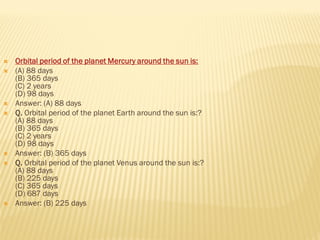
 Orbital period of the planet Mercury around the sun is:
 (A) 88 days
(B) 365 days
(C) 2 years
(D) 98 days
 Answer: (A) 88 days
 Q. Orbital period of the planet Earth around the sun is:?
(A) 88 days
(B) 365 days
(C) 2 years
(D) 98 days
 Answer: (B) 365 days
 Q. Orbital period of the planet Venus around the sun is:?
(A) 88 days
(B) 225 days
(C) 365 days
(D) 687 days
 Answer: (B) 225 days
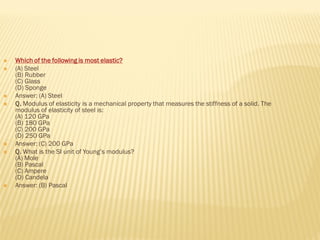
 Which of the following is most elastic?
 (A) Steel
(B) Rubber
(C) Glass
(D) Sponge
 Answer: (A) Steel
 Q. Modulus of elasticity is a mechanical property that measures the stiffness of a solid. The
modulus of elasticity of steel is:
(A) 120 GPa
(B) 180 GPa
(C) 200 GPa
(D) 250 GPa
 Answer: (C) 200 GPa
 Q. What is the SI unit of Young’s modulus?
(A) Mole
(B) Pascal
(C) Ampere
(D) Candela
 Answer: (B) Pascal
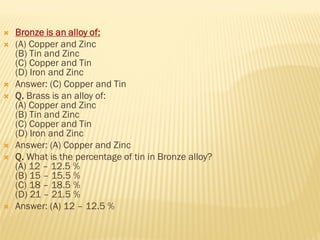
 Bronze is an alloy of:
 (A) Copper and Zinc
(B) Tin and Zinc
(C) Copper and Tin
(D) Iron and Zinc
 Answer: (C) Copper and Tin
 Q. Brass is an alloy of:
(A) Copper and Zinc
(B) Tin and Zinc
(C) Copper and Tin
(D) Iron and Zinc
 Answer: (A) Copper and Zinc
 Q. What is the percentage of tin in Bronze alloy?
(A) 12 – 12.5 %
(B) 15 – 15.5 %
(C) 18 – 18.5 %
(D) 21 – 21.5 %
 Answer: (A) 12 – 12.5 %
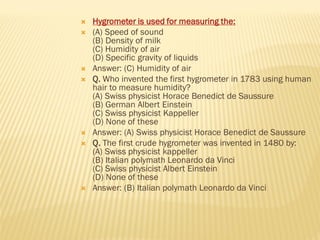
 Hygrometer is used for measuring the:
 (A) Speed of sound
(B) Density of milk
(C) Humidity of air
(D) Specific gravity of liquids
 Answer: (C) Humidity of air
 Q. Who invented the first hygrometer in 1783 using human
hair to measure humidity?
(A) Swiss physicist Horace Benedict de Saussure
(B) German Albert Einstein
(C) Swiss physicist Kappeller
(D) None of these
 Answer: (A) Swiss physicist Horace Benedict de Saussure
 Q. The first crude hygrometer was invented in 1480 by:
(A) Swiss physicist kappeller
(B) Italian polymath Leonardo da Vinci
(C) Swiss physicist Albert Einstein
(D) None of these
 Answer: (B) Italian polymath Leonardo da Vinci
 Deficiency of following vitamin decreases hemoglobin
production:
 (A) Biotin
(B) Thiamine
(C) Niacin
(D) Pyridoxine
 Answer: (D) Pyridoxine
 Q. Pyridoxine is also known as vitamin:
(A) B6
(B) B7
(C) B9
(D) B12
 Answer: (A) B6
 Q. Deficiency of following vitamin cause diseases like beriberi
which may increase the amount of lactic acid and pyruvic acid
within the blood:
(A) Biotin
(B) Thiamine
(C) Niacin
(D) Pyridoxine
 Answer: (B) Thiamine
 Chemical name of vinegar is:
 (A) Sodium Nitrate
(B) Dilute Acetic acid
(C) Chloride of lime
(D) Calcium
 Answer: (B) Dilute Acetic acid
 Q. What is the chemical formula of vinegar (acetic acid) ?
(A) CH3COOH
(B) CH2CO2OH
(C) CH4CO3OH
(D) none of these
 Answer: (A) CH3COOH
 Q. what is the chemical name of water?
(A) Hydrogen oxide
(B) Dihydrogen monoxide
(C) Hydrogen peroxide
(D) None of these
 Answer: (B) Dihydrogen monoxide
 Dry ice is
 (A) Methane hydrate
(B) Liquid Nitrogen
(C) Solid Carbondioxide
(D) Frozen Water
 Answer: (C) Solid Carbondioxide
 Q. What is the chemical formula of dry ice?
(A) CO
(B) CO2
(C) C2O2
(D) CO3
 Answer: (B) CO2
 Q. Which acid is present in the milk?
(A) Lactic acid
(B) Oxalic acid
(C) Malic acid
(D) Citric acid
 Answer: (A) Lactic acid
 Chemicals used to kill rats and mice are:
 (A) Insecticides
(B) Rodenticides
(C) Fungicides
(D) Herbicides
 Answer: (B) Rodenticides
 Q. Chemicals used to control unwanted plants, also known as weedkillers are:
(A) Insecticides
(B) Rodenticides
(C) Fungicides
(D) Herbicides
 Answer: (D) Herbicides
 Q. Chemical compounds or biological organisms used to kill parasitic fungi or their spores and
inhibits their growth are:
(A) Insecticides
(B) Rodenticides
(C) Bactericides
(D) Fungicides
 Answer: (D) Fungicides
 The science which deals with study of manners and customs of peoples is:
 (A) Ethnology
(B) Morphology
(C) Ethics
(D) Genetics
 Answer: (A) Ethnology
 Q. Ethnology is the branch of:
(A) Ethnography
(B) Anthropology
(C) Archaeology
(D) Ethology
 Answer: (B) Anthropology
 Q. The science which deals with the study of animal behavior, usually with a focus on behavior
under natural conditions is:
(A) Ethnography
(B) Anthropology
(C) Archaeology
(D) Ethology
 Answer: (D) Ethology
 The instrument which measures very high temperature is:
 (A) Manometer
(B) Thermostat
(C) Chronometer
(D) Pyrometer
 Answer: (D) Pyrometer
 Q. A device used to determine the electron temperature, electron density and electric potential
of plasma is:
(A) Manometer
(B) Langmiur probe
(C) Thermostat
(D) None of these
 Answer: (B) Langmiur probe
 Q. What is the average normal body temperature?
(A) 97°F – 99°F
(B) 100°F – 101°F
(C) 87°F – 90°F
(D) None of these
 Answer: (A) 97°F – 99°F
 Founder of modern astronomy was:
 (A) Archimedes
(B) William Gilbert
(C) Nicolas Copernicus
(D) Michel Faraday
 Answer: (C) Nicolas Copernicus
 Q. Who is the “Father of Observation Astronomy”, the “Father of
Modern Physics”, the “Father of the Scientific Method” and the
“Father of Modern Science”?
(A) Galileo Galilei
(B) William Gilbert
(C) Nicolas Copernicus
(D) Michel Faraday
 Answer: (A) Galileo Galilei
 Q. When did Nicolas Copernicus died?
(A) 24 May, 1443
(B) 24 May, 1543
(C) 24 May, 1643
(D) 24 May, 1743
 Answer: (B) 24 May, 1543
 Which form of drug abuse involves most risk of infection with the
HIV (AIDS) virus:
 (A) Cigarette smoking
(B) Using alcohol
(C) Injection of heroine
(D) Taking too much aspirin
 Answer: (C) Injection of heroine
 Q. HIV (virus) stands for?
(A) Human Infection Viruses
(B) Human Immunodeficiency Viruses
(C) High Infection Viruses
(D) None of these
 Answer: (B) Human Immunodeficiency Viruses
 Q. A small living organism that replicates only inside the living cells
of an organism is known as:
(A) Virus
(B) Bacteria
(C) Archaea
(D) None of these
 Answer: (A) Virus
 Role of biotechnology in the production of food is based on:
 (A) Decomposition
(B) Respiration
(C) Digestion
(D) Fermentation
 Answer: (D) Fermentation
 Q. A metabolic process that produces chemical changes in organic
substrates through the actions of enzymes is known as:
(A) Fermentation
(B) Decomposition
(C) Digestion
(D) None of these
 Answer: (A) Fermentation
 Q. The process in which green plants and some other organisms
transform light energy in to chemical energy is known as:
(A) Metabolism
(B) Photosynthesis
(C) Glycolysis
(D) None of these
 Answer: (B) Photosynthesis
 Laughing gas has chemical composition of following two
elements:
 (A) Nitrogen + Hydrogen
(B) Nitrogen + Carbon
(C) Nitrogen + Oxygen
(D) Oxygen + Carbon
 Answer: (C) Nitrogen + Oxygen
 Q. What is the chemical name of laughing gas?
(A) Carbon dioxide
(B) Nitrous oxide
(C) Nitric oxide
(D) None of these
 Answer: (B) Nitrous oxide
 Q. What is the chemical formula of laughing gas?
(A) N3O
(B) NO2
(C) N2O3
(D) N2O
 Answer: (D) N2O
 Sensitive layer of the eye is:
 (A) Choroids
(B) Sclerotic
(C) Retina
(D) Cornea
 Answer: (C) Retina
 Q. A thin circular structure in the eye, responsible for controlling the
diameter and size of the pupil and define the color of an eye is:
(A) Retina
(B) Iris
(C) Cornea
(D) None of these
 Answer: (B) Iris
 Q. The opaque, fibrous, protective outer layer of an eye is known as:
(A) Retina
(B) Iris
(C) Cornea
(D) Sclera
 Answer: (D) Sclera
 The name of the common mineral salt present in sweat is:
 (A) Calcium Oxalate
(B) Potassium Sulphate
(C) Sodium Chloride
(D) Iron Sulphide
 Answer: (C) Sodium Chloride
 Q. What is the chemical formula of sugar?
(A) C12H22O11
(B) C6H12O6
(C) CH2OH
(D)None of these
 Answer: (A) C12H22O11
 Q. What is the chemical formula of glucose?
(A) C12H22O11
(B) C6H12O6
(C) CH2OH
(D) None of these
 Answer: (B) C6H12O6
 Study of life in outer space is known as:
 (A) Endobiology
(B) Exobiology
(C) Enterobiology
(D) Neobiology
 Answer: (B) Exobiology
 Q. The study of places and the relationship between people and
their environments is known as:
(A) Geography
(B) Geology
(C) History
(D) None of these
 Answer: (A) Geography
 Q. The branch of astronomy that involves the origin and evolution
of the Universe, from the Big Bang to today and on into the future
is known as:
(A) Ontology
(B) Astrobiology
(C) Cosmology
(D) None of these
 Answer: (C) Cosmology
 Persons with following blood group are considered to be universal
recipient.
 (A) A+
(B) B+
(C) AB+
(D) O+
 Answer: (C) AB+
 Q. Persons with following blood group are considered to be universal
donor.
(A) AB+
(B) A-
(C) B+
(D) O-
 Answer: (D) O-
 Q. Which blood group can only receive blood from the same blood group
as itself?
(A) AB-
(B) B-
(C) O-
(D) A-
 Answer: (C) O-
 When was the local government system under the Devolution of
Power Plan, 2001, inaugurated?
 (A) August 4, 2001
(B) August 14, 2001
(C) August 24, 2001
(D) None of these
 Q. All India Muslim students Federation was founded at:
(A) Calcutta
(B) Dhaka
(C) Lahore
(D) Ali Garh
 Q. The Lucknow pact of 1916 was made between:
(A) The moderates and the extremists
(B) The British and the Indians
(C) The Hindus and the Muslims
(D) The Congress and the Muslim League
 Answers:
1. (B) August 14, 2001
2. (B) Dhaka
3. (D) The Congress and the Muslim League
 When Simla Conference was concluded with failure?
 (A) June 14, 1945
(B) July 14, 1945
(C) August 14, 1945
(D) None of these
 Q. Under which Act Muslims were given the right of separate electorate?
(A) Indian Act of 1935
(B) Indian Act of 1940
(C) Indian Act of 1909
(D) Indian Act of 1919
 Q. Simla agreement was signed by Indian PM:
(A) I.K Gujran
(B) Shastri
(C) Indira Gandhi
(D) None of these
 Answers:
1. (B) July 14, 1945
2. (D) Indian Act of 1919
3. (C) Indira Gandhi
 When the Congress Ministries resigned from their offices?
 (A) November, 1937
(B) November, 1938
(C) November, 1939
(D) None of these
 Q. Gupta Dynasty ruled over most of the India from 320 BC to:
(A) 575 BC
(B) 510 BC
(C) 475 BC
(D) 550 BC
 Q. Where was the session of Muslim League held when the
resolution demanding the creation of Pakistan was passed?
(A) Lahore
(B) Calcutta
(C) Bombay
(D) Madras
 Answers:
1. (C) November, 1939
2. (D) 550 BC
3. (A) Lahore
 Who led the Simla Deputation in 1906?
 (A) Sir Agha Khan
(B) Sir Syed Ahmed Khan
(C) Nawab Mohsin-ul-Mulk
(D) None of these
 Q. What was the real name of Sir Agha Khan III who become the first
president of All-India Muslim League?
(A) Aqa Ali Shah
(B) Sultan Mahomed Shah
(C) Sir Syed Ahmad Khan
(D) None of these
 Q. When did Agha Khan III, Sultan Mahomed died?
(A) 11 July, 1955
(B) 11 July, 1956
(C) 11 July, 1957
(D) 11 July, 1958
 Answers:
1. (A) Sir Agha Khan
2. (B) Sultan Mahomed Shah
3. (C) 11 July, 1957
 When Nadva-tul-Ulema came into being?
 (A) 1873
(B) 1883
(C) 1893
(D) None of these
 Q. Nadva-tul-Ulema Lucknow was established by Maulana Abdul Ghafoor,
Maulana Shibli Naumani and:
(A) Maulana Abdul Haq
(B) Sir Syed Ahmad Khan
(C) Abdul Majid Daryabadi
(D) None of these
 Q. Maulana Shibli Naumani was an Islamic scholar from the Indian
Subcontinent during:
(A) Mughal Sultanate
(B) British Raj
(C) Sikh Empire
(D) None of these
 Answers:
1. (D) None of these (1898)
2. (A) Maulana Abdul Haq
3. (B) British Raj
 Who was known in history as Mujaddid Alf Thani, the Reformer of
the Second Millennium?
 (A) Sheikh Ahmed Sirhindi
(B) Shah Waliullah
(C) Sir Syed Ahmad Khan
(D) None of these
 Q. Sheikh Ahmad Sirhindi was born on:
(A) 26 June 1464
(B) 26 June 1564
(C) 26 June 1664
(D) None of these
 Q. At what age, Sheikh Ahmad Sirhindi died?
(A) 40
(B) 50
(C) 60
(D) 70
 Answers:
1. (A) Sheikh Ahmad Sirhindi
2. (B) 26 June 1564
3. (C) 60
 Who founded Daulatabad and shifted the capital of Delhi
Sultanate?
 (A) Ghiyas-ud-Din Tughluq
(B) Muhammad Tughluq
(C) Feroz Shah Tughluq
(D) None of these
 Q. Muhammad bin Tughluq was the eldest son of:
(A) Ghiyas-ud-Din Tughluq
(B) Feroz Shah Tughluq
(C) Nizamuddin Auliya
(D) None of these
 Q. Muhammad bin Tughluq died in:
(A) 1331
(B) 1341
(C) 1351
(D) None of these
 Answers:
1. (B) Muhammad Tughluq
2. (A) Ghiyas-ud-Din Tughluq
3. (C) 1351
 Ghiyas-ud-Din Balban declared himself the king of Delhi Sultanate
in the year.
 (A) 1166
(B) 1266
(C) 1366
(D) None of these
 Q. What was the age of Ghiyas-ud-Din Balban when he declared
himself sultan of Delhi Sultanate?
(A) Sixty
(B) Seventy
(C) Eighty
(D) None of these
 Q. When did Ghiyas-ud-Din Balban died?
(A) 1265
(B) 1276
(C) 1287
(D) 1298
 Answers:
1. (B) 1266
2. (A) Sixty
3. (C) 1287
 What is the National Flower of Pakistan?
 (A) Tulip
(B) Rose
(C) Jasmine
(D) None of these
 Q. What is the National Fruit of Pakistan?
(A) Mango
(B) Orange
(C) Banana
(D) None of these
 Q. What is the National Animal of Pakistan?
(A) Lion
(B) Markhor
(C) Deer
(D) Tiger
 Answers:
1. (C) Jasmine
2. (A) Mango
3. (B) Markhor
 The Iran – Pakistan – India gas pipeline is also known as:
 (A) Friendly pipeline
(B) Peace pipeline
(C) Great pipeline
(D) None of these
 Q. When was a preliminary agreement was signed between the
governments of Iran and Pakistan?
(A) 1995
(B) 1997
(C) 1999
(D) None of these
 Q. When did the United States asked Pakistan to abandon the
pipeline project?
(A) January 2008
(B) January 2009
(C) January 2010
(D) None of these
 Answers:
1. (B) Peace pipeline
2. (A) 1995
3. (C) January 2010
 When was the state of Swat included in Pakistan?
 (A) 4th April, 1969
(B) 28th July, 1969
(C) 29th June, 1970
(D) None of these
 Q. Swat is located in the province of:
(A) KPK
(B) Sindh
(C) Baluchistan
(D) None of these
 Q. What is the capital of Swat district in KPK?
(A) Azad Kashmir
(B) Saidu Sharif
(C) Gilgit-Baltistan
(D) None of these
 Answers:
1. (B) 28th July, 1969
2. (A) KPK
3. (B) Saidu Sharif
 Which Radio Station already existed at the time of creation of Pakistan?
 (A) Peshawar
(B) Karachi
(C) Quetta
(D) None of these
 Q. Who made announcement of Pakistan’s Independence from Britain in Urdu
and English from Lahore on 13th August, 1947 at 11:59 pm?
(A) Agha Ali Khan
(B) Agha Nasir
(C) Mustafa Ali Hamdani
(D) None of these
 Q. Who made announcement of Pakistan’s Independence from Britain in Phasto
from Peshawar on 13th August, 1947 at 11:59 pm?
(A) Asadullah Khan
(B)Abdullah Jan Maghmoom
(C) Abdul Salam Khan
(D) None of these
 Answers:
1. (A) Peshawar
2. (C) Mustafa Ali Hamdani
3. (B) Abdullah Jan Maghmoom
 From which country, Pakistan purchased Gawadar?
 (A) Kuwait
(B) Iran
(C) Muscat
(D) None of these
 Q. Muscat is the Capital of:
(A) Dubai
(B) Oman
(C) Saudi Arabia
(D) None of these
 Q. Gwadar is located in the province of:
(A) Punjab
(B) Sindh
(C) KPK
(D) Baluchistan
 Answers:
1. (D) None of these [Pakistan purchased Gwadar
from Oman]
2. (B) Oman
3. (D) Baluchistan
 Who rejected the theory of composite nationalism,
advanced by Indian National Congress?
 (A) Maulana Maudoodi
(B) Allama Mashriqi
(C) Hussain Ahmad Madni
(D) Quaid-e-Azam
 Answer: (D) Quaid-e-Azam
 Q. When did Muhammad Ali Jinnah realised that
Muslims of the Indian subcontinent should have their
own state?
(A) 1935
(B) 1940
(C) 1945
(D) None of these
 Answer: (B) 1940
 Q. At what age Quaid-e-Azam Muhammad Ali Jinnah
died?
(A) 61
(B) 70
(C) 71
(D) 80
 Answer: (C) 71
 Who presided over the session of Constituent Assembly of Pakistan on
10 August 1947?
 (A) Quaid-e-Azam
(B) Liaquat Ali Khan
(C) Ch. Khaliquzzaman
(D) Sir Aga Khan
 Answer: (A) Quaid-e-Azam
 Q. When was the Constituent Assembly of Pakistan founded?
(A) 11 August, 1940
(B) 11 August, 1947
(C) 11 August, 1948
(D) None of these
 Answer: (B) 11 August, 1947
 Q. What was the purpose of the Constituent Assembly of Pakistan?
(A) Help Muslims in politics
(B) Conduct elections
(C) Write Pakistan’s constitution and serve as it’s first parliament
(D) None of these
 Answer: (C) Write Pakistan’s constitution and serve as it’s first
parliament
 How many Muslim seats were secured by All India Muslim
League, in 1945-46 Election of Provincial legislatures?
 (A) 396
(B) 425
(C) 441
(D) None of these
 Answer: (B) 425
 Q. In 1946 Indian provincial elections, who was the president
of Indian National Congress ?
(A) Abdul Kalam Azad
(B) Muhammad Ali Jauhar
(C) Mahatma Gandhi
(D) None of these
 Answer: (A) Abdul Kalam Azad
 Q. At what age Abdul Kalam Azad served as youngest
president of the Indian National Congress?
(A) 20
(B) 25
(C) 30
(D) 35
 Answer: (D) 35
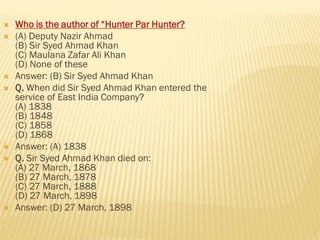
 Who is the author of “Hunter Par Hunter?
 (A) Deputy Nazir Ahmad
(B) Sir Syed Ahmad Khan
(C) Maulana Zafar Ali Khan
(D) None of these
 Answer: (B) Sir Syed Ahmad Khan
 Q. When did Sir Syed Ahmad Khan entered the
service of East India Company?
(A) 1838
(B) 1848
(C) 1858
(D) 1868
 Answer: (A) 1838
 Q. Sir Syed Ahmad Khan died on:
(A) 27 March, 1868
(B) 27 March, 1878
(C) 27 March, 1888
(D) 27 March, 1898
 Answer: (D) 27 March, 1898
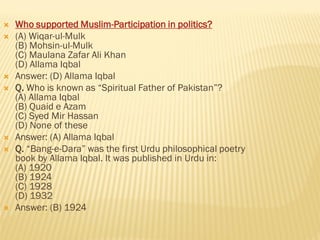
 Who supported Muslim-Participation in politics?
 (A) Wiqar-ul-Mulk
(B) Mohsin-ul-Mulk
(C) Maulana Zafar Ali Khan
(D) Allama Iqbal
 Answer: (D) Allama Iqbal
 Q. Who is known as “Spiritual Father of Pakistan”?
(A) Allama Iqbal
(B) Quaid e Azam
(C) Syed Mir Hassan
(D) None of these
 Answer: (A) Allama Iqbal
 Q. “Bang-e-Dara” was the first Urdu philosophical poetry
book by Allama Iqbal. It was published in Urdu in:
(A) 1920
(B) 1924
(C) 1928
(D) 1932
 Answer: (B) 1924
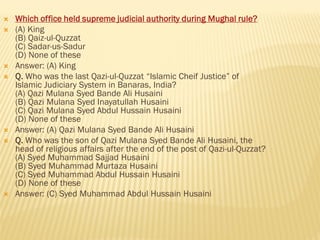
 Which office held supreme judicial authority during Mughal rule?
 (A) King
(B) Qaiz-ul-Quzzat
(C) Sadar-us-Sadur
(D) None of these
 Answer: (A) King
 Q. Who was the last Qazi-ul-Quzzat “Islamic Cheif Justice” of
Islamic Judiciary System in Banaras, India?
(A) Qazi Mulana Syed Bande Ali Husaini
(B) Qazi Mulana Syed Inayatullah Husaini
(C) Qazi Mulana Syed Abdul Hussain Husaini
(D) None of these
 Answer: (A) Qazi Mulana Syed Bande Ali Husaini
 Q. Who was the son of Qazi Mulana Syed Bande Ali Husaini, the
head of religious affairs after the end of the post of Qazi-ul-Quzzat?
(A) Syed Muhammad Sajjad Husaini
(B) Syed Muhammad Murtaza Husaini
(C) Syed Muhammad Abdul Hussain Husaini
(D) None of these
 Answer: (C) Syed Muhammad Abdul Hussain Husaini
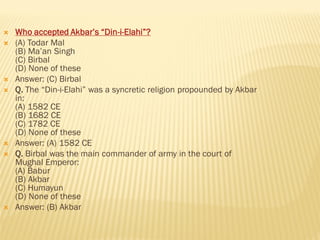
 Who accepted Akbar’s “Din-i-Elahi”?
 (A) Todar Mal
(B) Ma’an Singh
(C) Birbal
(D) None of these
 Answer: (C) Birbal
 Q. The “Din-i-Elahi” was a syncretic religion propounded by Akbar
in:
(A) 1582 CE
(B) 1682 CE
(C) 1782 CE
(D) None of these
 Answer: (A) 1582 CE
 Q. Birbal was the main commander of army in the court of
Mughal Emperor:
(A) Babur
(B) Akbar
(C) Humayun
(D) None of these
 Answer: (B) Akbar
 Who wrote ‘Humayun Nama’?
 (A) Shahabuddin
(B) Gulbadan Begum
(C) Humayun
(D) Qudrat ullah Shahab
 Answer: (B) Gulbadan Begum
 Q. Gulbadan Begum was a Mughal princess and the daughter
of Emperor:
(A) Humayun
(B) Akbar
(C) Babur
(D) None of these
 Answer: (C) Babur
 Q. Gulbadan Begum wrote “Humayun Nama”, the account of
the life of her half-brother, Emperor Humayun, on the request
of:
(A) Brother, Humayun
(B) Father, Babur
(C) Nephew, Akbar
(D) None of these
 Answer: (C) Nephew, Akbar
 Who laid foundation of Agra city?
 (A) Sikandar Lodhi
(B) Babur
(C) Shah Jahan
(D) Sir Syed Ahmad Khan
 Answer: (A) Sikandar Lodhi
 Q. What was the name of the father of Sikandar Lodhi, who was
Afghan ruler of Lodhi Sultanate?
(A) Alauddin Hussain Shah
(B) Sultan Bahlul Lodhi
(C) Alam Shah
(D) None of these
 Answer: (B) Sultan Bahlul Lodhi
 Q. Who was the founder of Lodhi dynasty from the Delhi
Sultanate upon the abdication of the last claimant from the
previous Sayyid rule?
(A) Sikandar Lodhi
(B) Shah Jahan
(C) Bahlul Khan Lodhi
(D) None of these
 Answer: (C) Bahlul Khan Lodhi
 Who constructed five canals to remove scarcity of water?
 (A) Alauddin khalji
(B) Ghiayas-ud-din Tughlaq
(C) Feroz Shah Tughlaq
(D) Akbar
 Answer: (C) Feroz Shah Tughlaq
 Q. What was the age of Feroz Shah Tughlaq when he became
sultan of Delhi?
(A) 45
(B) 50
(C) 55
(D) 60
 Answer: (A) 45
 Q. When was Feroz Shah Tughlaq became the sultan of Delhi?
(A) 1341
(B) 1351
(C) 1361
(D) 1371
 Answer: (B) 1351
 In which year Pakistan became ‘Republic’?
 (A) 1947
(B) 1956
(C) 1962
(D) None of these
 Answer: (B) 1956
 Q. The first constitution was adopted in 1956 but suspended by
Ayub Khan in 1958. When did Ayub Khan replaced first constitution
with the second constitution?
(A) 1960
(B) 1961
(C) 1962
(D) 1963
 Answer: (C) 1962
 Q. When did the first successful democratic transition occurred in
Pakistan?
(A) May 1913
(B) May 2004
(C) May 2013
(D) None of these
 Answer: (C) May 2013
 Who was the first leader of opposition in he first National
Assembly constituted under the 1962 Constitution of Pakistan?
 (A) Sardar Bahadur Khan
(B) Khan A. Sabur
(C) Mumtaz Daultana
(D) None of these
 Answer: (A) Sardar Bahadur Khan
 Q. What was the name of Sardar Bahadur Khan’s Brother?
(A) Khan A. Sabur
(B) Ayub Khan
(C) Mumtaz Daultana
(D) None of these
 Answer: (B) Ayub Khan
 Q. From which university Sardar Bahadur Khan received his
LLB degree?
(A) University of Madras
(B) University of Calcutta
(C) Aligarh Muslim University
(D) None of these
 Answer: (C) Aligarh Muslim University
 The All-India Muslim League observed ‘Day of Deliverance’ after the
resignation of the All-India Congress ministries. On what date was it
observed?
 (A) 22 October,1938
(B) 22 December, 1938
(C) 22 October, 1939
(D) 22 December, 1939
 Answer: (D) 22 December,1939
 Q. When did Jinnah put out an appeal calling for Indian Muslims to
celebrate 22 December, 1939 as a “Day of Deliverance” from
Congress?
(A) 2 December,1938
(B) 2 December,1939
(C) 8 December, 1938
(D) 8 December, 1939
 Answer: (B) 2 December,1939
 Q. When did Quaid-e-Azam Muhammad Ali Jinnah left Congress?
(A) 1913
(B) 1920
(C) 1923
(D) 1930
 Answer: (B) 1920
 “Few individuals significantly alter the course of history. Fewer still
modify the map of the world. Hardly anyone can be credited with
creating a nation-state. Mohammad Ali Jinnah did all three”. Who
made these remarks about Quaid-e-Azam?
 (A) Stanley Wolpert
(B) Ian Stephens
(C) Lawrence Ziring
(D) None of these
 Answer: (A) Stanley Wolpert
 Q. Who was the first Governor General of Pakistan?
(A) Allam Iqbal
(B) Sir Syed Ahmad Khan
(C) Quaid-e-Azam
(D) None of these
 Answer: (C) Quaid-e-Azam
 Q. When did Quaid-e-Azam Muhammad Ali Jinnah joined Muslim
League?
(A) 1906
(B) 1908
(C) 1911
(D) 1913
 Answer: (D) 1913
 First Session of the All-India Muslim League was held on 29-30
December 1907. Where was it held?
 (A) Lahore
(B) Aligarh
(C) Karachi
(D) None of these
 Answer: (C) Karachi
 Q. Who was the founder of All-India Muslim League?
(A) Nawab Khawaja Salimullah
(B) Quaid-e-Azam
(C) Sir Syed Ahmad Khan
(D) Syed Ameer Ali
 Answer: (A) Nawab Khawaja Salimullah
 Q. When did All-India Muslim League was officially founded by
Nawab khawaja Salimullah?
(A) 1902
(B) 1904
(C) 1906
(D) 1908
 Answer: (C) 1906
 Which Muslim leader left the politics after the cancellation of the
partition of Bengal?
 (A) Nawab Salimullah Khan
(B) Nawab Waqar-ul-Mulk
(C) Nawab Hamidullah Khan
(D) None of these
 Answer: (A) Nawab Salimullah Khan
 Q. When did Nawab Salimullah Khan began supporting the partition
of Bengal in the face of opposition of Indian National Congress?
(A) 1900-01
(B) 1903-04
(C) 1906-07
(D) None of these
 Answer: (B) 1903-04
 Q. When did Nawab Salimullah Khan became president of the All
Bengal Muslim League, formed newly Kolkata?
(A) 1901
(B) 1903
(C) 1905
(D) 1907
 Answer: (D) 1907
 Mention the important announcement(s) that was/were made by the
Governor General Lord Hardinge in his Darbar at Delhi in 1911?
 (A) Annulment of the partition of Bengal
(B) Central National Mohammadan Association
(C) Both of these
(D) None of these
 Answer: (C) Both of these
 Q. Who announced the decision to effect first partition of Bengal in July
1905?
(A) Lord Curzon
(B) Lord Hardinge
(C) Lord Carmichael
(D) None of these
 Answer: (A) Lord Curzon
 Q. In which year after a successful war of independence with west
Pakistan, East Bengal became Bangladesh?
(A) 1957
(B) 1960
(C) 1965
(D) 1971
 Answer: (D) 1971
 Which organisation is considered the first Muslim political body
constituted to represent the Muslims of the subcontinent as a whole?
 (A) Anjuman-e-Mussalmanan-e-Hind
(B) Central National Mohammadan Association
(C) Urdu Defence Association
(D) None of these
 Answer: (B) Central National Mohammadan Association
 Q. Who founded the political organization, Central National
Muhammadan Association ?
(A) Sir Syed Ahmad Khan
(B) Quaid-e-Azam
(C) Syed Ameer Ali
(D) None of these
 Answer: (C) Syed Ameer Ali
 Q. When and where the political organization, Central National
Muhammadan Association was founded?
(A) 1877, Calcutta
(B) 1877, Aligarh
(C) 1857, Calcutta
(D) 1857, Aligarh
 Answer: (A) 1877, Calcutta
 What was the designation of Sir Syed Ahmad Khan in M.A.O. School at
Aligarh?
 (A) Secretary, Managing Committee
(B) President, Managing Committee
(C) Patron, Managing Committee
(D) None of these
 Answer: (D) None of these
 Q. When was the Muhammadan Anglo-Oriental (M.A.O) college was
founded by Sir Syed Ahmad Khan ?
(A) 1870
(B) 1872
(C) 1875
(D) 1877
 Answer: (C) 1875
 Q. What was the old given Urdu name of the M.A.O (Muhammadan
Anglo-Oriental) college?
(A) Madrasatul Uloom Musalmanan-e-Hind
(B) Madrasah Nizamiyah
(C) Madrasah Babul Uloom
(D) None of these
 Answer: (A) Madrasatul Uloom Musalmanan-e-Hind
 Sir Syed Ahmad Khan established a Translation Society (later, renamed
as ‘Scientific Society’) in 1864. In which town was it founded?
 (A) Bijnaur
(B) Aligarh
(C) Ghazipur
(D) None of these
 Answer: (C) Ghazipur
 Q. When did Sir Syed Ahmad Khan established the booklet Asbab-e-
Baghawat-e-Hind, In which he studied the causes of the Indian revolt?
(A) 1855
(B) 1857
(C) 1859
(D) 1860
 Answer: (C) 1859
 Q. Where did Sir Syed Ahmad Khan founded a modern madrassa in
1859, which was one of the first religious school to impart scientific
education ?
(A) Aligarh
(B) Muradabad
(C) Ghazipur
(D) Bijnaur
 Answer: (B) Muradabad
 Where, during the War of Independence, was Sir Syed Ahmad Khan
working/posted?
 (A) Delhi
(B) Bijnaur
(C) Aligarh
(D) None of these
 Answer: (B) Bijnaur
 Q. When did Sir Ahmad Khan entered the service of East India
Company?
(A) 1832
(B) 1835
(C) 1838
(D) 1840
 Answer: (C) 1838
 Q. Which university awarded Sir Syed Ahmad Khan an honorary LLD
in 1889?
(A) University of Edinburgh
(B) University of Aligarh
(C) University of New York
(D) None of these
 Answer: (A) University of Edinburgh
 Which of the following was/were the drawback(s) of the Government of
India Act of 1858?
 (A) Control of the Secretary of State for India and his Council was
bureaucratic in nature
(B) Expense of the Secretary of State for India and his Council became a
burden on Indian revenues
(C) Both of these
(D) None of these
 Answer: (B) Expense of the Secretary of State for India and his Council
became a burden on Indian revenues
 Q. When was the Government of India Act 1858 passed?
(A) August 2
(B) June 2
(C) February 2
(D) None of these
 Answer: (A) August 2
 Q. Who introduced the bill which was originally titled as “An Act for the
Better Government of India” and it was passed on August 2, 1858?
(A) Queen Victoria
(B) Cord Palmerson
(C) Edward Henry Stanley
(D) None of these
 Answer: (C) Edward Henry Stanley
 Faraizi Movement was primarily a religious movement. What
change Dudhu Mian brought in the movement?
 (A) Transferred it into a guerrilla movement
(B) Transferred it into a political movement
(C) Transferred it into a cultural movement
(D) None of these
 Answer: (A) Transferred it into a guerrilla movement
 Q. What was the real name of Dudhu Mian?
(A) Qutubuddin Ahmad
(B) Muhsinuddin Ahmad
(C) Aleemunddin Ahmad
(D) None of these
 Answer: (B) Muhsinuddin Ahmad
 Q. Who founded the Faraizi movement in 1819?
(A) Haji Shariatullah
(B) Dudhu Mian
(C) Qutubuddin Ahmad
(D) None of these
 Answer: (A) Haji Shariatullah
 Who for the first time translated the Holy Quran in Urdu
language?
 (A) Shah Waliullah and Shah Abdul Aziz
(B) Shah Abdul Qadir and Shah Rafiuddin
(C) Syed Ahmad Baralvi and Shah Ismail Dehlavi
(D) None of these
 Answer: (B) Shah Abdul Qadir and Shah Rafiuddin
 Q. Who was the father of Shah Abdul Qadir?
(A) Shah Waliullah
(B) Shah Ahmad Baralvi
(C) Shah Rafiuddin
(D) Shah Abdul Aziz
 Answer: (A) Shah Waliullah
 Q. What was the title of the translation of Holy Quran in
Urdu by Shah Abdul Qadir?
(A) Mutalaeh Quran
(B) Tafseerul Quran
(C) Mozah Al-Quran
(D) None of these
 Answer: (C) Mozah Al-Quran
 Who was formal teacher of Syed Ahmad Barelvi?
 (A) Sheikh Ahmad Sirhindi
(B) Shah Waliullah
(C) Shah Abdul Aziz
(D) None of these
 Answer: (C) Shah Abdul Aziz
 Q. Who was the father of Shah Abdul Aziz?
(A) Shah Waliullah
(B) Shah Abdur Rahim
(C) Sheikh Ahmad Sirhindi
(D) None of these
 Answer: (A) Shah Waliullah
 Q. What was the age of Shah Abdul Aziz when his father Shah
Waliullah died?
(A) 13 years
(B) 15 years
(C) 17 years
(D) 19 years
 Answer: (C) 17 years
 What was the real name of Shah Waliullah?
 (A) Qutubuddin Ahmad Faruqi
(B) Qutubuddin Ahmad Siddiqui
(C) Qutubuddin Ahmad Syed
(D) None of these
 Answer: (C) Qutubuddin Ahmad Syed
 Q. In which language Shah Waliullah translated the Holy
Quran?
(A) Urdu
(B) English
(C) Persian
(D) Hindi
 Answer: (C) Persian
 Q. When did Shah Waliullah died ?
(A) August 20, 1762
(B) August 20, 1862
(C) August 20, 1962
(D) None of these
 Answer: (A) August 20, 1762
 Who recalled Muhammad Bin Qasim from Sindh?
 (A) Caliph Walid
(B) Caliph Sulaiman
(C) Caliph Abdul Aziz
(D) None of these
 Answer: (B) Caliph Sulaiman
 Q. When did Muhammad Bin Qasim conquered Sindh?
(A) 612 AD
(B) 712 AD
(C) 812 AD
(D) 912 AD
 Answer: (B) 712 AD
 Q. When did Muhammad Bin Qasim died?
(A) July 18, 715 AD
(B) July 18, 815 AD
(C) July 18, 915 AD
(D) None of these
 Answer: (A) July 18, 715 AD
 First Session of the All-India Muslim League was held on 29-30
December 1907. Where was it held?
 (A) Lahore
(B) Aligarh
(C) Karachi
(D) None of these
 Answer: (C) Karachi
 Q. The First Session of the All-India Muslim League was presided
over by
(A) Allama Iqbal
(B) Quaid-e-Azam
(C) Mohsin-ul-Mulk
(D) Sir Adamjee Pir Bhai
 Answer: (D) Sir Adamjee Pir Bhai
 Q. Who was appointed the first president of the All-India Muslim
League?
(A) Allama Iqbal
(B) Sir Aga Khan
(C) Mohsin-ul-Mulk
(D) Muhammad Ali Johar
 Answer: (B) Sir Aga Khan
 The demand of separate electorate for Indian Muslims was first accepted in the Act of:
(a) 1909
(b) 1919
(c) 1935
(d) None ofthese
[B]
-
correction:1909.
The country, which supported the Pakistan Movement before the emergence of
Pakistan:
(a) Iran
(b) Indonesia
(c) Saudi Arabia
(d) None of these
-
correction:iran
Which mountain range is located between China and Pakistan:
(a) Siwaliks
(b) Hindu Kush Range
(c) Great Himalayas
(d) None of these
-
correction:karakoram range

 Faraizi Movemnents was primarily a religious movement. What
change Dudhu Mian brought in the movement?
(a) Transferred it into a guerrilla movement
(b) Transferred it into a political movement
(c) Transferred it into a Cultural movement
(d) None of these
cORRECTION: option d.
or in a broad perspective, it was made into a political movement
later.
As per the Government of Indian Act 1858, the transfer of the
control of the Government of Indian from the East Indian Company
and assumption by the Crown was to be announced by Queen’s
Proclamation, which was accordingly read in a Darbar. Where was
this Darbar held?
(a) Calcuta
(b) Delhi
(c) Allahabad
(d) None of these
CORRECTION:option b
 Mention the importance announcement (s) that was/were
made by the Governor General Lord Hardinge in thie Darbar
at Delhi in 1911?
(a) Annulment of the partition of Bengal
(b) Transfer of Capital from Calcutta to Delhi
(c) Both of these
(d) None of these
-CORRECTION:option c
 In 1867, some prominent Hindus of Banares Launched a
movement for the replacement of Urdu written in Nasta’leeq
by Hindi written in Deva Nagiri script as the Court language.
In which province(s) was this movement started?
(a) Bengal Province
(b) Central Provinces
(c) North-western Provinces
(d) None of these
-CORRECTION:option c
 The Silsilah-i-Chishtiyah was founded in sub Continent by whom?
a) Kh. Bahaud Din Naqshbandi
b) Kh Muinud Din Ajmeri
c) Sh. Bahaud Din Zakria
d) None of these
When Shah Wali Ullah died?
a) 1162
b) 1762
c) 1862
d) none of these
Who was appointed the first principal of Darul ulum Deoband?
a) Maulana Mamluk Ali
b) Haji Muhammad Abid
c) Maulana Muhammad Qasim
d) None of these
 All India national congress was established by a British civil servant in 1885. Name the
officer:
a) Madan mohan
b) Lord Dufferin
c) A.O. Hume
d) None of these
6) Viceroy Lord Curzon divided the Bengal in east and west on:
a) 19th may 1905
b) 19th june 1905
c) 19th july 1905
d) None of these
7) Which year proved the turning point of the Muslim destiny in the history of India?
a) 1905
b) 1906
c) 1907
d) None of these
 Where the annual sessions of National Congress and Muslim League were held
simultaneously?
a) Delhi
b) Bombay
c) Lucknow
d) None of these
9) Who was the author of “Emergence of Pakistan”?
a) I.H Qureshi
b) Waheed-ud-Zaman
c) Muhammad Ali Ch.
D) None of these
10) When Sir Stafford Cripps announced his formula to seek the co-operation between the
National Congress and Muslim League?
a) March 30,1940
b) March 30,1942
c) March 30,1944
d) None of these
11) When the Simla conference under the presidentship of Lord Wavell was ended?
a) June 14, 1945
b) July 14, 1945
c) August 14, 1945
d) None of these
 By whom the formula of 3rd June 1947 to divide India was announced?
a) Lord Atllee
b) Lord Wovell
c) Lord Mount Batten
d) None of these
Who was the first president of Constituent Assembly of Pakistan?
a) Quaid-e-Azam
b) Liaquat Ali Khan
c) Sikandar Mirza
d) None of these
Under whom leadership the Constitution of 1956 was passed?
a) Liaquat Ali Khan
b) Ch. Muhammad Ali
c) Sikandar Mirza
d) None of these
When the Constitution of 1973 was proclaimed?
a) April 12, 1972
b) March 23, 1973
c) August 14, 1973
d) None of these
 When Indus Water Treaty was signed between India and Pakistan?
a) 1960
b) 1962
c) 1969
d) None of these
in which constitution the presidential and parliamentary system at centre and
provinces were adopted respectively?
a) 1956
b) 1962
c) 1972
d) 1973
When was the 18th Amendment Bill passed by National Assembly?
a) April 12, 2010
b) March 12, 2010
c) May 12, 2010
d) None of these (April, 08, 2012)
How much amount was allocated for the agriculture sector in the 7th five year plan?
A) Rs.13600 million
b) Rs.14600 million
c) Rs.15600 million
d) None of these
 Which pass connects Parachanar
and Kohat with Afghanistan?
A) Khyber pass
b) Kurram pass
c) Gomal pass
d) None of these
 4) Who floated the idea of
establishment of Anjuman-e-Hamiat-
e-Islam?
a) Maulana Shibli
b) Kh. Hamid ud din
c) Munshi Charag Din
d) None of these

Css mcqs. solved 500 mcqs for ppsc, fpsc and css exams

  • 1.
    MCQ’S  ‘Kyat’ isthe currency of:  (A) Nepal (B) Myanmar (C) Bhutan (D) None of these  Q. Myanmar is also known as: (A) Burma (B) Bengal (C) Yangon (D) None of these  Q. Myanmar has been a member of the Association of Southeast Asian Nations (ASEAN) since: (A) 1991 (B) 1993 (C) 1995 (D) 1997  Answers: 1. (B) Myanmar 2. (A) Burma 3. (D) 1997
  • 2.
     3 Mayis observed Internationally as:  (A) Environment Day (B) Population Day (C) Press Freedom Day (D) None of these  Q. Who declared May 3 to be World’s Press Freedom Day? (A) United Nations General Assembly (B) United Nations Alliance of Civilization (C) United Nations Security Council (D) None of these  Q. World’s Information Society Day is celebrated on: (A) 15 May (B) 17 May (C) 19 May (D) 21 May  Answers: 1. (C) Press Freedom Day 2. (A) United Nations General Assembly 3. (B) 17 May
  • 3.
     The largestisland in the Indian Ocean is:  (A) Sri Lanka (B) Sumatra (C) Madagascar (D) None of these  Q. What is the total area of Madagascar Island? (A) 587,041 km² (B) 487,041 km² (C) 387,041 km² (D) 287,041 km²  Q. Sumatra is an Island of: (A) Sri Lanka (B) Indonesia (C) China (D) None of these  Answers: 1. (C) Madagascar 2. (A) 587,041 km² 3. (B) Indonesia
  • 4.
     The ‘Straitof Malacca’ is the main shipping channel between the Indian Ocean and:  (A) North Pacific Ocean (B) South Pacific Ocean (C) South Atlantic Ocean (D) None of these  Q. The ‘Strait of Malacca’ is named after the: (A) Malacca Sultanate (B) Malacca city (C) Malacca Dilemma (D) None of these  Q. The strait that separates the North and South Island of New Zealand is: (A) Strait of Malacca (B) Cook Strait (C) Agattu Strait (D) Alas Strait  Answers: 1. (B) South Pacific Ocean 2. (A) Malacca Sultanate 3. (B) Cook Strait
  • 5.
     ‘Channel Tunnel’is an under sea rail tunnel linking:  (A) England and Ireland (B) England and France (C) France and Germany (D) None of these  Q. What is the length of ‘Channel Tunnel’ under sea rail tunnel? (A) 50.45 km (B) 60.45 km (C) 70.45 km (D) 80.45 km  Q. ‘Channel Tunnel’ an under sea rail tunnel was opened in: (A) 1992 (B) 1993 (C) 1994 (D) 1995  Answers: 1. (B) England and France 2. (A) 50.45 km 3. (C) 1994
  • 6.
     “Silk Air”is an airline of:  (A) Sri Lanka (B) Switzerland (C) Singapore (D) China  Q. When was the “Silk Air” airline of Singapore founded? (A) 1979 (B) 1989 (C) 1999 (D) None of these  Q. National language of Singapore is: (A) Malay (B) Mandarin (C) English (D) Tamil  Answers: 1. (C) Singapore 2. (B) 1989 3. (A) Malay
  • 7.
     “ANTARA” isthe news agency of:  (A) Indonesia (B) Malaysia (C) Turkey (D) None of these  Q. “ANTARA” news agency was founded in: (A) 1935 (B) 1936 (C) 1937 (D) 1938  Q. When was “ANTARA” removed from the control of the presidency and reorganized as a private state-owned enterprise? (A) 2004 (B) 2005 (C) 2006 (D) 2007  Answers: 1. (A) Indonesia 2. (C) 1937 3. (D) 1938
  • 8.
     The oldestinternet search engine among the following is:  (A) Google (B) MSN search (C) Yahoo (D) Ask.com  Q. The headquarters of popular web search engine Yahoo search engine are located in: (A) Sunnyvale, California (B) Sacramento, California (C) Los Angeles, California (D) None of these  Q. Yahoo search engine was launched in: (A) 1965 (B) 1975 (C) 1985 (D) 1995  Answers: 1. (C) Yahoo 2. (A) Sunnyvale, California 3. (D) 1995
  • 9.
     The headquartersof ‘Green Peace International’ is located at:  (A) Vancouver (B) Amsterdam (C) London (D) Paris  Q. Greenpeace was founded in: (A) 1971 (B) 1972 (C) 1973 (D) 1974  Q. Greenpeace was founded by Irving Stowe and _______ Canadian and US ex-pat environmental activists. (A) Jim Bohlen (B) Albert Bigelow (C) Dorothy Stowe (D) None of these  Answers: 1. (B) Amsterdam 2. (A) 1971 3. (C) Dorothy Stowe
  • 10.
     Name thecurrency of Sri Lanka?  (A) Rupiyah (B) Lek (C) Ringgit (D) None of these  Q. Number of rivers in Sri Lanka is: (A) 97 (B) 100 (C) 103 (D) 106  Q. The longest river in Sri Lanka is: (A) Mahaweli River (B) Malvathu River (C) Kelani River (D) Walawe River  Answers: 1. (D) None of these 2. (C) 103 3. (A) Mahaweli River
  • 11.
     The Capitalof Argentina is:  (A) Columbia (B) Barcelona (C) Buenos Aires (D) Peru  Q. What is the National language of Argentina? (A) French (B) Spanish (C) English (D) None of these  Q. Argentina is a country located in the southern half of: (A) South America (B) North America (C) South Africa (D) None of these  Answers: 1. (C) Buenos Aires 2. (B) Spanish 3. (A) South America
  • 12.
     The firstparliamentary elections in Afghanistan were held in:  (A) 2004 (B) 2005 (C) 2006 (D) None of these  Q. In 2004, who was elected as the President of Afghanistan? (A) Hamid Karzai (B) Ashraf Ghani (C) Abdullah Abdullah (D) None of these  Q. In 2014, who was elected as the President of Afghanistan? (A) Hamid Karzai (B) Ashraf Ghani (C) Abdullah Abdullah (D) None of these  Answers: 1. (B) 2005 2. (A) Hamid Karzai 3. (B) Ashraf Ghani
  • 13.
     Alliance amongIndia, Germany, Japan and Brazil to support each other’s bid for permanent seat on UN Security Council is called:  (A) Alliance 4 (B) G 4 (C) Big 4 (D) None of these  Q. What is the official language of G 4 nations? (A) French (B) Spanish (C) English (D) None of these  Q. The countries who have supported the G 4’s bid for permanent seats on the United Nations Security Council: (A) Spain and France (B) China and France (C) Italy and France (D) United Kingdom and France  Answers: 1. (B) G 4 2. (C) English 3. (D) United Kingdom and France
  • 14.
     The termof office of a judge of the International Court of Justice is?  (A) 5 years (B) 7 years (C) 9 years (D) None of these  Q. International Court of Justice (ICJ) comprises a panel of: (A) 10 Judges (B) 15 Judges (C) 20 Judges (D) None of these  Q. International Court of Justice (ICJ) is located in: (A) Hague, Netherlands (B) London, England (C) Washington, US (D) None of these  Answers: 1. (C) 9 years 2. (B) 15 Judges 3. (A) Hague, Netherlands
  • 15.
     How manyofficial working languages are recognized by UNO?  (A) 8 (B) 6 (C) 4 (D) None of these  Q. The United Nations Secretariat uses two working languages: (A) English and French (B) English and Spanish (C) English and Arabic (D) English and Russian  Q. UN Spanish language day is celebrated on: (A) 12 August (B) 12 September (C) 12 October (D) 12 November  Answers: 1. (B) 6 2. (A) English and French 3. (C) 12 October
  • 16.
     Who wasthe founder of HAMAS in 1987:  (A) Sheikh Ahmed Yassin (B) Yasser Arafat (C) Abu Nidal (D) None of these  Q. Where is the headquarters of the HAMAS located? (A) Ramallah, Palestine (B) Gaza, Palestine (C) Nablus, Palestine (D) None of these  Q. When did the HAMAS Shura council chose Ismail Haniya to become the new leader to replace Mashal? (A) May 6, 2015 (B) May 6, 2016 (C) May 6, 2017 (D) None of these  Answers: 1. (A) Sheikh Ahmed Yassin 2. (B) Gaza, Palestine 3. (C) May 6, 2017
  • 17.
     The PermanentSecretariat of SAARC is established at:  (A)Kathmandu (B) Dhaka (C) Dehli (D) Islamabad  Q. SAARC was founded in: (A) Kathmandu (B) Dhaka (C) Dehli (D) Islamabad  Q. When the SAARC was established in Dhaka, Bangladesh? (A) 8th December, 1980 (B) 8th December, 1982 (C) 8th December, 1985 (D) 8th December, 1987  Answers: 1. (A) Kathmandu 2. (B) Dhaka 3. (C) 8th December, 1985
  • 18.
     Who werethe three statesmen who formulated Non-Aligned Movement (NAM)?  (A) Gandhi, Nasser, Tito (B) Nehru, Nasser, Tito (C) Chou-en-Lai, Bhutto, Nehru (D) Soe Karno, Nasser, Tito  Q. When was the Non-Aligned Movement (NAM) was started? (A) 1961 (B) 1962 (C) 1963 (D) 1964  Q. Non-Aligned Movement (NAM) was started in: (A) India (B) Egypt (C) Belgrade (D) None of these  Answers: 1. (B) Nehru, Nasser, Tito 2. (A) 1961 3. (C) Belgrade
  • 19.
     Asian DevelopmentBank (ADB) was established in:  (A) 1964 (B) 1966 (C) 1968 (D) None of these  Q. Where is the headquarters of Asian Development Bank (ADB) are located? (A) Manila, Philippines (B) Beijing, China (C) Tokyo, Japan (D) None of these  Q. When did the Asian Development Bank (ADB) opened its first field office in Bangladesh? (A) 1980 (B) 1981 (C) 1982 (D) 1983  Answers: 1. (B) 1966 2. (A) Manila, Philippines 3. (C) 1982
  • 20.
     Where isthe Headquarter of the Amnesty International located?  (A) Geneva (B) London (C) Paris (D) New York  Q. Amnesty International (AI) is a British non-government organization focused on: (A) Human Rights (B) Scientific Research (C) Technologies (D) None of these  Q. Amnesty International (AI) organization won Nobel Peace Prize in: (A) 1970 (B) 1977 (C) 1980 (D) 1987  Answers: 1. (B) London 2. (A) Human Rights 3. (C) 1977
  • 21.
     Telephone wasinvented in 1876 in America by:  (A) Marconi (B) Galileo (C) John Beard (D) Graham Bell  Q. Who invented the first mechanical computer in the early 19th century? (A) Marconi (B) Galileo (C) Charles Babbage (D) Edison  Q. Charles Babbage is considered the, Father of : (A) Computer (B) Technology (C) Maths (D) None of these  Answers: 1. (D) Graham Bell 2. (C) Charles Babbage 3. (A) Computer
  • 22.
     Which oneof the following is an alkali?  (A) Water (B) Vinegar (C) Lemon juice (D) Slaked lime  Q. What is the chemical name of Slaked lime? (A) Calcium Hydroxide (B) Calcium Carbonate (C) Calcium Dioxide (D) None of these  Q. What is the chemical formula of Slaked lime? (A) CaCl2 (B) Ca(OH)2 (C) CaCO2 (D) None of these  Answers: 1. (D) Slaked lime 2. (A) Calcium Hydroxide 3. (B) Ca(OH)2
  • 23.
     The temperatureof liquid Nitrogen is:  (A) -32°C (B) -80°C (C) -100°C (D) -196°C  Q. _______ is a cryogenic fluid that can cause rapid freezing on contact with living tissue. (A) Liquid Nitrogen (B) Liquid Air (C) Liquid Hydrogen (D) None of these  Q. What is the density of liquid air? (A) 770 kg/m³ (B) 870 kg/m³ (C) 970 kg/m³ (D) None of these  Answers: 1. (D) -196°C 2. (A) Liquid Nitrogen 3. (B) 870 kg/m³
  • 24.
     Boiling ofan egg is a change which is:  (A) Physical (B) Chemical (C) Physiological (D) Morphological  Q. Rusting of iron is an example of: (A) Absorption (B) Adsorption (C) Oxidation (D) Reduction  Q. Mixing acid and base is a change which is: (A) Physical (B) Chemical (C) Physiological (D) Morphological  Answers: 1. (B) Chemical 2. (C) Oxidation 3. (B) Chemical
  • 25.
     The buildingblocks of elements are called:  (A) Atoms (B) Molecules (C) Compounds (D) Isotopes  Q. Who first gave the concept of ‘Atom’ ? (A) Kapila (B) Robert Edwards (C) Kanada (D) John Dalton  Q. Which of the following was the first organic compound to be synthesised in the laboratory? (A) Citric acid (B) Formic acid (C) Lactose (D) Urea  Answers: 1. (A) Atoms 2. (D) John Dalton 3. (D) Urea
  • 26.
     Ice canbe changed to water by:  (A) Adding more water molecules (B) Changing the motion of the water molecules (C) Rearranging the atoms in water molecules (D) Destroying the atoms in water molecules  Q. Water is a _______ most abundant molecule in the universe. (A) second (B) third (C) fourth (D) None of theseQ. The crystal structure of water is: (A) Hexagonal (B) Pentagonal (C) Octagonal (D) None of these  Answers: 1. (B) Changing the motion of the water molecules 2. (B) Third 3. (A) Hexagonal
  • 27.
     Which oneof the following statements is true?  (A) Gases do not conduct heat (B) The best conductors are non-metals (C) Conduction currents occur only in liquids (D) None of the statements is true.  Q. The essence of the Kirchhoff’s law is that: (A) A good absorber must be a bad radiator (B) A good absorber must be a good radiator (C) A good absorber must be a good conductor (D) All are true  Q. A bad emitter of radiation is a bad absorber: (A) True (B) False (C) Uncertain (D) None of these  Answers: 1. (D) None of the statements is true 2. (B) A good absorber must be a good radiator 3. (A) True
  • 28.
     Who isthe founder of Meteorology?  (A) Aristotle (B) Plato (C) Newton (D) Einstein  Answer: (A) Aristotle
  • 29.
     The densityof water is greatest at:  (A) -32°C (B) 0°C (C) 4°C (D) 100°C  Q. As the temperature rises gradually, it’s surface tension: (A) goes on increasing (B) goes on decreasing (C) remains unchanged (D) increase only when the heat is too intense  Q. When a beam of light passes from air into water, its speed: (A) increases (B) decreases (C) remains the same (D) None of these  Answers: 1. (C) 4°C 2. (B) goes on decreasing 3. (B) decreases
  • 30.
     The speedof light in vacuum is about:  (A) 300 million meters per second (B) 300 million meters per hour (C) 300 million kilometers per second (D) 300 million kilometers per hour  Q. The speed of light in vacuum is a universal physical constant, commonly denoted by: (A) s (B) d (C) c (D) l  Q. Sunlight takes about _______ to travel the average distance from the surface of the sun to the Earth. (A) 5 min 17 sec (B) 6 min 17 sec (C) 7 min 17 sec (D) 8 min 17 sec  Answers: 1. (A) 300 million meters per second 2. (C) c 3. (D) 8 min 17 sec
  • 31.
     The speedof sound in dry air at 20 °C is about:  (A) 130 m/s (B) 230 m/s (C) 330 m/s (D) None of these  Q. In an exceptionally stiff material such as diamond, the speed of sound is: (A) 12,000 m/s (B) 10,000 m/s (C) 8,000 m/s (D) 6,000 m/s  Q. The ratio of the speed of an object to the speed of sound in the fluid is called object’s: (A) Travelling speed (B) Mach Number (C) Effects on speed (D) None of these  Answers: 1. (D) None of these (343 m/s) 2. (A) 12,000 m/s 3. (B) Mach Number
  • 32.
     When soundis reflected from floor, ceiling or a wall, it mixes with the original sound and changes its complexion, it is called as:  (A) Sound (B) Echo (C) Reverberation (D) Noise  Q. The process of reducing the level of reverberation in a sound or signal is: (A) Dereverberation (B) Antireverberation (C) Unreverberation (D) None of these  Q. A reflection of sound that arrives at the listeners with a delay after the direct sound is called: (A) Noise (B) Echo (C) Reverberation (D) None of these  Answers: 1. (C) Reverberation 2. (A) Dereverberation 3. (B) Echo
  • 33.
     The magnetalways points in the same direction, if allowed to move freely i.e. towards North and South poles, because of:  (A) Gravitational field (B) A lot of metal deposits on North and South Poles (C) Due to attraction of North Pole and repulsion of Western Pole (D) Earth is a huge magnet  Q. Materials that can be magnetized which are also the ones that are strongly attracted to a magnet are called: (A) Ferromagnetic (B) Magnetized (C) Electromagnetic (D) None of these  Q. A vector that characterizes the magnet’s overall magnetic properties is called: (A) Magnetic field (B) Magnetic Moment (C) Polarity (D) None of these  Answers: 1. (D) Earth is a huge magnet 2. (A) Ferromagnetic 3. (B) Magnetic Momen
  • 34.
     The unitof home electricity energy consumption is:  (A) Watt hour (B) Kilowatt hour (C) Joule hour (D) Kilojoule hour  Q. The Kilowatt hour is a unit of energy equal to ______ megajoules. (A) 3.6 (B) 4.6 (C) 5.6 (D) 6.6  Q. The derived unit of energy within the International System of Units (SI) is: (A) watt (B) joule (C) kilojoule (D) None of these  Answers: 1. (B) Kilowatt hour 2. (A) 3.6 3. (B) joule
  • 35.
     An electriccurrent can produce:  (A) Chemical effect (B) Magnetic effect (C) Heating effect (D) All of these three  Q. The SI unit of electric current is: (A) Coulomb (B) Ampere (C) Joule (D) None of these  Q. The SI unit of electric charge is: (A) Coulomb (B) Ampere (C) Joule (D) None of these  Answers: 1. (D) All of these three 2. (B) Ampere 3. (A) Coulomb
  • 36.
     The twomost abundant elements in sea water are:  (A) Sodium and Potassium (B) Sodium and Calcium (C) Sodium and Chlorine (D) Chlorine and Iodine  Q. The speed of sound in sea water is about: (A) 15,00 m/s (B) 16,00 m/s (C) 17,00 m/s (D) 18,00 m/s  Q. Sea water PH is limited to the range: (A) 5.5 to 6.4 (B) 6.5 to 7.4 (C) 7.5 to 8.4 (D) 8.5 to 9.4  Answers: 1. (C) Sodium and Chlorine 2. (A) 15,00 m/s 3. (C) 7.5 to 8.4
  • 37.
     The mostabundant natural Iron Oxides are:  (A) Magnetite and Pyrite (B) Magnetite and Bauxite (C) Hematite and Pyrite (D) Hematite and Magnetite  Q. What is the chemical formula of Hematite? (A) Fe2O3 (B) Fe3O4 (C) Fe2O4 (D) Fe3O2  Q. What is the chemical formula of Magnetite? (A) Fe2O3 (B) Fe3O4 (C) Fe2O4 (D) Fe3O2  Answers: 1. (D) Hematite and Magnetite 2. (A) Fe2O3 3. (B) Fe3O4
  • 38.
     Which rocksare formed by the alteration of pre-existing rocks by great heat or pressure?  (A) Igneous rocks (B) Sedimentary rocks (C) Metamorphic rocks (D) Acid rocks  Q. The rock formed through the cooling and solidification of magma or lava is known as: (A) Sedimentary rock (B) Igneous rock (C) Metamorphic rock (D) Acid rocks  Q. Igneous rock is also known as: (A) Magmatic rock (B) Acid rock (C) Basic rock (D) Sedimentary rock  Answers: 1. (C) Metamorphic rocks 2. (B) Igneous rock 3. (A) Magmatic rock
  • 39.
     The ozonelayer is present about 30 miles (50 Km) in atmosphere above the Earth. The stratum (layer) of atmosphere in which ozone layer lies is called as:  (A) Exosphere (B) Mesosphere (C) Stratosphere (D) Ionosphere  Q. The stratosphere layer is the second major layer of Earth’s atmosphere, just above the layer: (A) Troposphere (B) Mesosphere (C) Ionosphere (D) Exosphere  Q. The Mesosphere is the third major layer of the Earth’s atmosphere, directly above the: (A) Exosphere (B) Mesosphere (C) Ionosphere (D) Stratosphere  Answers: 1. (C) Stratosphere 2. (A) Troposphere 3. (D) Stratosphere
  • 40.
     The ozonelayer protects the Earth from rays sent down by the Sun:  (A) Ultraviolet rays (B) Infrared rays (C) Gamma rays (D) Radioactive rays  Q. What is the Chemical form of Ozone? (A) O4 (B) O3 (C) O2 (D) CO3  Q. Ozone’s O3 Structure was determined in: (A) 1862 (B) 1863 (C) 1864 (D) 1865  Answers: 1. (A) Ultraviolet rays 2. (B) O3 3. (D) 1865
  • 41.
     When wasGas (Natural) discovered at Sui Baluchistan?  (A) 1950 (B) 1952 (C) 1954 (D) None of these  Q. Baluchistan got the status of province in: (A) 1970 (B) 1971 (C) 1930 (D) 1935  Q. Largest Province of Pakistan in terms of land area is: (A) Punjab (B) Sindh (C) Baluchistan (D) KPK  Answers: 1. (B) 1952 2. (A) 1970 3. (C) Baluchistan
  • 42.
     An eclipseof the Sun occurs when:  (A) The Moon is between the Sun and the Earth (B) The Sun is between the Earth and the Moon (C) The Earth is between the Sun and the Moon (D) The Earth casts its shadow on the Moon  Q. Earth’s orbit around the sun is a(n): (A) Perihelion (B) Aphelion (C) Ellipse (D) None of these  Q. A ________ eclipse occurs when the Moon passes directly behind Earth and into its shadow. (A) Lunar (B) Solar (C) Partial (D) None of these  Answers: 1. (A) The Moon is between the Sun and the Earth 2. (C) Ellipse 3. (A) Lunar
  • 43.
     A unitof length equal to the average distance between the Earth and Sun is called:  (A) Light year (B) Astronomical unit (C) Parsec (D) Parallax  Q. What is the symbol of Astronomical unit? (A) AU (B) ASU (C) ALU (D) AST-U  Q. The light year is a unit of length used to express _______ distances. (A) Levenshtein (B) Lee (C) Astronomical (D) None of these  Answers: 1. (B) Astronomical unit 2. (A) AU 3. (C) Astronomical
  • 44.
     The ageof the solar system is:  (A) 4.5 billion years (B) 5.5 billion years (C) 6.5 billion years (D) 7.5 billion years  Q. The solar system is located in the Orion Arm, _______ light years from the center of Milky way galaxy. (A) 16,000 (B) 26,000 (C) 36,000 (D) 46,000  Q. The two large planets Jupiter and Saturn are gas giants, being composed mainly of Hydrogen and: (A) Carbon dioxide (B) Nitrogen (C) Helium (D) None of these  Answers: 1. (A) 4.5 billion years 2. (B) 26,000 3. (C) Helium
  • 45.
     Sun isa:  (A) Planet (B) Comet (C) Satellite (D) None of these  Q. The Latin name of sun is: (A) Sunne (B) Sol (C) Comet (D) None of these  Q. The gravitational bound system of the Sun and the objects that orbit it is called: (A) Solar System (B) Milky way (C) Galaxy (D) None of these  Answers: 1. (D) None of these ( Star) 2. (B) Sol 3. (A) Solar system
  • 46.
     The planetof the solar system which has maximum number of Moon is:  (A) Jupiter (B) Venus (C) Saturn (D) Uranus  Q. The brightest planet in the solar system is: (A) Venus (B) Jupiter (C) Earth (D) Neptune  Q. The Planet between Earth and Mercury is: (A) Venus (B) Mars (C) Jupiter (D) Neptune  Answers: 1. (A) Jupiter 2. (A) Venus 3. (A) Venus
  • 47.
     Animals obtaincarbohydrate mainly from:  (A) Sucrose (B) Starch (C) Glucose (D) Glycogen  Q. Starch is a polysaccharide produced by _______ as energy storage. (A) Green plants (B) Big trees (C) Fungi (D) None of these  Q. When starch is cooked, the digestibility is: (A) Decreased (B) Increased (C) Weaken (D) None of these  Answers: 1. (B) Starch 2. (A) Green plants 3. (B) Increased
  • 48.
     Cancer canbe treated by:  (A) Antibiotics and vaccines (B) Radiotherapy and antibodies (C) Chemotherapy and radiotherapy (D) Antibodies and chemotherapy  Q. Arthritis is a disease of: (A) Skin (B) Joint pain (C) Eyes (D) None of these  Q. Trachoma is a disease of: (A) Skin (B) Eyes (C) Ears (D) Lungs  Answers: 1. (C) Chemotherapy and radiotherapy 2. (B) Joint pain 3. (B) Eyes
  • 49.
     The mostabundant element present in the human body is:  (A) Nitrogen (B) Carbon (C) Hydrogen (D) Oxygen  Q. The most abundant element present in the earth’s crust is: (A) Carbon (B) Hydrogen (C) Oxygen (D) Nitrogen  Q. What is the atomic number of Oxygen? (A) 8 (B) 9 (C) 10 (D) 11  Answers: 1. (D) Oxygen 2. (C) Oxygen 3. (A) 8
  • 50.
     The unitthat coordinates different devices of the computer system is:  (A) ALU (B) Register (C) Control Unit (D) Logical Instructions  Q. The Control Unit (CU) is a part of: (A) CPU (B) ALU (C) Register (D) Logical Instructions  Q. CPU stands for: (A) Control Power Unit (B) Central Processing Unit (C) Central Power Unit (D) None of these  Answers: 1. (C) Control Unit 2. (A) CPU 3. (B) Central Processing Unit
  • 51.
     Laughing gashas chemical composition of the following two elements which are:  (A) Nitrogen + Hydrogen (B) Nitrogen + Carbon (C) Nitrogen + Oxygen (D) Oxygen + Carbon  Q. What is the chemical name of laughing gas? (A) Nitrous oxide (B) Nitric oxide (C) Nitrogen dioxide (D) None of these  Q. Nitrous oxide (laughing gas) has significant medical uses, especially in: (A) Surgery (B) Dentistry (C) Both A & B (D) None of these  Answers: 1. (C) Nitrogen + Oxygen 2. (A) Nitrous oxide 3. (C) Both A & B
  • 52.
     Cobalt isa metal which is:  (A) Strongly attracted by a magnet (B) Not attracted by a magnet (C) Not a magnet (D) Weakly attracted by a magnet  Q. Cobalt is a chemical element with the symbol Co, it’s atomic number is: (A) 17 (B) 27 (C) 37 (D) 47  Q. Cobalt is the active center of a group of coenzymes called: (A) Cobaltimins (B) Cobalium (C) Cobalamins (D) None of these  Answers: 1. (A) Strongly attracted by a magnet 2. (B) 27 3. (C) Cobalamins
  • 53.
     Which ofthe following is a form of sexual reproduction?  (A) Hermaphroditism (B) Fission (C) Fragmentation (D) Budding  Q. Which of the following is a form of asexual reproduction? (A) Hermaphroditism (B) Allogamy (C) Autogamy (D) Fission  Q. Each human cell contains _______ chromosomes. (A) 36 (B) 46 (C) 56 (D) 66  Answers: 1. (A) Hermaphroditism 2. (D) Fission 3. (B) 46
  • 54.
     Which ofthe following is an organic molecule needed by the body in small amounts?  (A) Protein (B) Vitamin C (C) Zinc (D) Monosaccharide  Q. The simplest form of sugar and the most basic unit of carbohydrates, also known as simple sugar: (A) Monosaccharides (B) Chlorine (C) Fluoride (D) None of these  Q. The most important monosaccharide, glucose is a: (A) Tetrose (B) Pentose (C) Hexose (D) Heptosell  Answers: 1. (D) Monosaccharide 2. (A) Monosaccharides 3. (C) Hexose
  • 55.
     In humans,most nutrient molecules are absorbed by the:  (A) Stomach (B) Liver (C) Small Intestine (D) Large Intestine  Q. The small Intestine is divided into _______ structural parts. (A) three (B) four (C) five (D) six  Q. What is the name of midsection of the small intestine? (A) Duodenum (B) Jejunum (C) Ileum (D) None of these  Answers: 1. (C) small intestine 2. (A) three 3. (B) Jejunum
  • 56.
     Fossils foundin the lowest geological strata are generally the most:  (A) Advanced (B) Complex (C) Primitive (D) Specialized  Q. The study of fossils, their age, method of formation and evolutionary significance is: (A) Paleontology (B) Astrobiology (C) Anthropology (D) None of these  Q. The scientific study of humans, human behaviour and societies in the past and present is known as: (A) Astrobiology (B) Anthropology (C) Paleontology (D) None of these  Answers: 1. (C) Primitive 2. (A) Paleontology 3. (B) Anthropology
  • 57.
     The planetMercury completes one rotation around the sun in:  (A) 88 days (B) 365 days (C) 98 days (D) 60 days  Q. The planet Jupiter completes one rotation around the sun in: (A) 10.86 years (B) 11.86 years (C) 12.86 years (D) None of these  Q. The planet Uranus completes one rotation around the sun in: (A) 26.5 years (B) 27.2 years (C) 28.5 years (D) 29.5 years  Answers: 1. (A) 88 days 2. (B) 11.86 years 3. (D) 29.5 years
  • 58.
     The instrumentwhich is specially designed for recording earthquake wave is called seismograph which measures earthquake waves on a:  (A) Diatonic scale (B) Fahrenheit scale (C) Ritcher scale (D) Celsius scale  Q. A device used for measuring wind speed and direction is called: (A) Anemometer (B) Hydrometer (C) Ammeter (D) None of these  Q. The instrument which is use to measure the current in a circuit is called: (A) Anemometer (B) Hydrometer (C) Ammeter (D) None of these  Answers: 1. (C) Ritcher scale 2. (A) Anemometer 3. (C) Ammeter
  • 59.
     A bodycan escape the gravitational pull of the earth if it is thrown up with a velocity of:  (A) 25 miles/sec (B) 60 miles/sec (C) 7 miles/sec (D) 10 miles/sec  Q. Escape velocity is the speed at which the sum of an object’s kinetic energy and its gravitational potential energy is equal to: (A) zero (B) each other (C) it’s speed (D) None of these  Q. The simplest way of deriving the formula for escape velocity is to use conservation of: (A) Electric Power (B) Energy (C) Speed (D) None of these  Answers: 1. (C) 7 miles/sec 2. (A) zero 3. (B) Energy
  • 60.
     A nuclearreactor is a device used to carry out controlled nuclear reaction whereas GM counter is a device used to detect:  (A) Current (B) Voltage (C) Nuclear Radiation (D) Power  Q. Geiger-Müller (GM) tube is used for detection of ionizing radiation was named after: (A) Hans Geiger, Walther Müller (B) William Geiger, Walther Müller (C) Robert Geiger, Walther Müller (D) None of these  Q. A device used for the detection and measurement of all types of radiations is: (A) Scintillation Counter (B) Geiger-Müller Tube (C) Gamma-ray detector (D) None of these  Answers: 1. (C) Nucleus Radiation 2. (A) Hans Geiger, Walther Müller 3. (B) Geiger-Müller Tube
  • 61.
     A veryimportant practical application of properties of matter is hoeing or “godi” practiced by the farmers. This property of matter is called:  (A) Elasticity (B) Stress (C) Capillarity (D) Strain  Q. The ability of a liquid to flow in narrow spaces without the assistance of, or even in opposition to, external forces like gravity is called: (A) Capillarity (B) Absorption (C) Retarding force (D) None of these  Q. The first recorded observation of capillary action was by: (A) Robert Boyle (B) Leonardo da Vinci (C) Galileo (D) None of these  Answers: 1. (C) Capillarity 2. (A) Capillarity 3. (B) Leonardo da Vinci
  • 62.
     One ofthe countries through which equator passes is:  (A) Kenya (B) Pakistan (C) Malaysia (D) Malta  Q. The equator of a rotating spheroid is the parallel at which latitude is defined to be: (A) 90° (B) 180° (C) 0° (D) None of these  Q. On Earth, the equator is about ______ long. (A) 30,075 km (B) 40,075 km (C) 50,075 km (D) 60,075 km  Answers: 1. (A) Kenya 2. (C) 0° 3. (B) 40,075 km
  • 63.
     Bronze medalis made up of metals:  (A) Copper, Nickel (B) Copper, Tin (C) Copper, Silver (D) Copper, Zinc  Q. The archaeological period in which bronze was the hardest metal in widespread use is known as: (A) Bronze Age (B) Bronze Period (C) Bronze Era (D) None of these  Q. Brass is an alloy of: (A) Copper, Nickel (B) Copper, Tin (C) Copper, Silver (D) Copper, Zinc  Answers: 1. (B) Copper, Tin 2. (A) Bronze Age 3. (D) Copper, Zinc
  • 64.
     Magnifying powerof a simple microscope can be increased by:  (A) Increasing focal length of the lens (B) Decreasing focal length of the lens (C) Lens of large aperture (D) Lens of short aperture  Q. Instruments that use electromagnetic radiation to image objects are called: (A) X-ray Microscopes (B) Electric Microscopes (C) Magnetic Microscopes (D) None of these  Q. The most common and the first invented microscope is: (A) Electron Microscope (B) X-ray Microscope (C) Optical Microscope (D) None of these  Answers: 1. (B) Decreasing focal length of the lens 2. (A) X-ray Microscope 3. (C) Optical Microscope
  • 65.
     Lactometer isa type of hydrometer which is used to measure the specific gravity of:  (A) Honey (B) Water (C) Milk (D) Olive oil  Q. A saccharometer is a hydrometer used for determining the amount of _______ in a solution. (A) Sugar (B) Salt (C) Acid (D) None of these  Q. A saccharometer is a hydrometer invented by: (A) Robert Boyle (B) Thomas Thomson (C) Galileo (D) None of these  Answers: 1. (C) Milk 2. (A) Sugar 3. (B) Thomas Thomson
  • 66.
     Cusec isa unit of:  (A) Area (B) Time (C) Distance (D) None of these  Q. Cusec is informal shorthand for: (A) Cubic meters per second (B) Cubic feet per second (C) Cubic square per second (D) None of these  Q. Cusec is used to measure: (A) flow rate (B) acceleration (C) long distance (D) None of these  Answers: 1. (D) None of these [flow rate] 2. (B) Cubic feet per second 3. (A) flow rate
  • 67.
     The ContinentAntarctica lies at the:  (A) North pole (B) South pole (C) Middle of earth (D) Equator  Q. Antarctica is covered by ice by the percentage of: (A) 68% (B) 78% (C) 88% (D) 98%  Q. The longest river in Antarctica is: (A) Onyx River (B) Alph River (C) Penguin River (D) Aiken Creck  Answers: 1. (B) South pole 2. (D) 98% 3. (A) Onyx River
  • 68.
     Parsec isa unit of:  (A) Energy (B) Time (C) Power (D) Distance  Q. What is the symbol of parec? (A) pa (B) pc (C) pr (D) pe  Q. The parsec unit was first suggested by British astronomer: (A) Herbert Hall Turner (B) Paul Baize (C) Jean Chazy (D) Alexis Clairaut  Answers: 1. (D) Distance 2. (B) pc 3. (A) Herbert Hall Turner
  • 69.
     It ispossible to recognize a person in the dark by simply hearing his unique voice. It is because of the:  (A) Pitch (B) Frequency (C) Time period (D) Quality  Q. A property of sound that allows their ordering on a frequency- related scale is called: (A) Quality of sound (B) Frequency (C) Pitch (D) Loudness  Q. Instruments have their origin in variety of pitch standards are: (A) Distorting (B) Transposing (C) Amplifying (D) Musical  Answers: 1. (A) Pitch 2. (C) Pitch 3. (B) Transposing
  • 70.
     In winteran iron pipe feels colder than a wooden window. This is because wood is:  (A) Conductor (B) Non-conductor (C) Semi-conductor (D) None of these  Q. Which of the following is a conductor? (A) Plastic (B) Rubber (C) Iron (D) wood  Q. A material having the conductivity value falling between that of a conduction and insulator is: (A) Semi-conductor (B) HTLS conductor (C) Insulator (D) None of these  Answers: 1. (B) Non-conductor 2. (C) Iron 3. (A) Semi-conductor
  • 71.
     Light yearis a unit of:  (A) Distance (B) Time period (C) Light intensity (D) Time  Q. Newton is a unit of: (A) Mass (B) Force (C) Acceleration (D) None of these  Q. Coulomb is a unit of: (A) Electric charge (B) Power (C) Energy (D) None of these  Answers: 1. (A) Distance 2. (B) Force 3. (A) Electric charge
  • 72.
     The measurementof rainfall is made by an instrument known as:  (A) Hygrometer (B) Barometer (C) Hydrometer (D) None of these  Q. An instrument used to measure the relative density of liquids is called: (A) Hydrometer (B) Hygrometer (C) Barometer (D) None of these  Q. An instrument that is used to measure air pressure in a certain environment is: (A) Hydrometer (B) Hygrometer (C) Barometer (D) None of these  Answers: 1. (D) None of these 2. (A) Hydrometer 3. (C) Barometer
  • 73.
     Water isheated in a kettle. The inside water is heated by convection. A person sitting near the fire receives heat by:  (A) Conduction (B) Convection (C) Radiation (D) Reflection  Q. The transfer of heat internal energy by microscopic collision of particles and movement of electrons within a body is called: (A) Thermal conduction (B) Thermal convection (C) Thermal radiation (D) None of these  Q. The heat transfer due to bulk movement of molecules within fluids such as gases, liquids or molten rocks is called: (A) Conduction (B) Radiation (C) Reflection (D) Convection  Answers: 1. (B) Convection 2. (A) Thermal conduction 3. (D) Convection
  • 74.
     Name thefamous book of Ibn-Sina in which he discussed human physiology and medicine:  (A) Al-Qanoon (B) Al-Masudi (C) New Renaissance (D) Tadhkria  Answer: (A) Al-Qanoon  Q. The Al-Qanoon encyclopedia of medicine by Ibn-Sina is a set of : (A) Three books (B) Four books (C) Five books (D) Six books  Answer: (C) Five books  Q. When was the book Al-Qanoon of Ibn-Sina published ? (A) 1020 (B) 1025 (C) 1030 (D) 1035  Answer: (B) 1025
  • 75.
     In arailway track, two rails are joined end to end with a gap in between them because:  (A) Steel can be saved. (B) Accidents due to contraction in winter can be avoided. (C) Air gaps are necessary for bearing the weight of running train. (D) Accidents due to expansion in summer can be avoided.  Answer: (D) Accidents due to expansion in summer can be avoided.  Q. In mechanics terms, a chassis or a frame work for carring wheels attached to a vehicle is called: (A) Bogie (B) Trolley (C) Wheelbarrow (D) None of these  Answer: (A) Bogie  Q. The word “train” comes from the old French trahiner, derived from the Latin trahere meaning: (A) to drag (B) to pull (C) to speedup (D) None of these  Answer: (B) to pull
  • 76.
     Animal whichcaptures and readily kills living animals for its food is called:  (A) Parasite (B) Scavenger (C) Predator (D) Mammal  Answer: (C) Predator  Q. The animals that the predator hunts are called: (A) Prey (B) Scavenger (C) Mammal (D) None of these  Answer: (A) Prey  Q. A top predator or apex predator is the one who is: (A) huge in size (B) not the prey of other predators (C) rare to find (D) None of these  Answer: (B) not the prey of other predators
  • 77.
     Quartz crystalin quartz watches works on the principle called:  (A) Photoelectric effect (B) Stark effect (C) Thermionic effect (D) Piezo-electric effect  Answer: (D) Piezo-electric effect  Q. The word Piezoelectricity means electricity resulting from: (A) pressure and latent heat (B) movement of crystals (C) application of current (D) None of these  Answer: (A) pressure and latent heat  Q. Chemically quartz is a specific form of compound called: (A) Aluminum dioxide (B) Silicon dioxide (C) Barium oxide (D) None of these  Answer: (B) Silicon dioxide
  • 78.
     The Fruitswithout seed, like banana, are called:  (A) seedless fruits (B) parthenogenesis fruits (C) parthenocarpic fruits (D) placental fruits  Answer: (C) parthenocarpic fruits  Q. A small and pulpy fruit produced from the ovary of single flower in which the outer layer of the ovary wall develops into an edible fleshy portion is called a: (A) Berry (B) Soft fruits (C) citrus fruits (D) None of these  Answer: (A) Berry  Q. Which of the following fruit is a berry? (A) Orange (B) Mango (C) Banana (D) None of these (C) Banana
  • 79.
     Oasis isassociated with:  (A) Glaciers (B) Desert (C) Island (D) Volcanoes  Answer: (B) Desert  Q. A mixed woodland-grassland ecosystem characterized by the trees being widely spaced so that the canopy does not close is known as: (A) Savanna (B) Tundra (C) Grassland (D) None of these  Answer: (A) Savanna  Q. In biology, the above ground portion of a plant community or crop, formed by the collection of individual plant crown is called: (A) forest (B) trees group (C) canopy (D) None of these  Answer: (C) Canopy
  • 80.
     Yeast isused in making bread because it produces:  (A) Carbon dioxide (B) Sugar (C) Bacteria (D) Oxygen  Answer: (A) Carbon dioxide  Q. Yeast are eukaryostic single-celled microorganisms classified an members of the kingdom: (A) Alga (B) Fungus (C) Protozoa (D) None of these  Answer: (B) Fungus  Q. Eukaryotes are organisms whose cells have: (A) nucleus enclosed within membrane (B) nucleus without membrane (C) more than one nucleus (D) None of these  Answer: (A) nucleus enclosed within membrane
  • 81.
     Ozone layerprevents the following radiation from entering the atmosphere:  (A) Infra-red (B) Ultraviolet (C) X-rays (D) Gamma rays  Answer: (B) Ultraviolet  Q. “World Ozone Day” is celebrated on: (A) September, 16 (B) October, 16 (C) November, 16 (D) December, 16  Answer: (A) September, 16  Q. Ozone is an inorganic molecule with the chemical formula: (A) O2 (B) O3 (C) O4 (D) O5  Answer: (B) O3
  • 82.
     Which oneof the following is a non-metallic mineral?  (A) Manganese (B) Magnesium (C) Gypsum (D) Bauxite  Answer: (C) Gypsum  Q. Gypsum is a soft sulfate mineral composed of: (A) Calcium Sulfate Dihydrate (B) Sodium Sulfate Dihydrate (C) Nitrogen Sulfate Dihydrate (D) None of these  Answer: (A) Calcium Sulfate Dihydrate  Q. Which of the following non-metallic minerals found in Pakistan? (A) Sphene (B) Sulphur (C) Emerald (D) Ruby  Answer: (B) Sulphur
  • 83.
     Sedimentary rocksare:  (A) Porous (B) Hard (C) Rough (D) Brittle  Answer: (A) Porous  Q. The color of a sedimentary rock is often mostly determined by: (A) Zinc (B) Iron (C) Calcium (D) None of these  Answer: (B) Iron  Q. Thick sequences of red sedimentary rocks formed in arid climates are called: (A) Red rocks (B) Red sponge (C) Red beds (D) None of these  Answer: (C) Red beds
  • 84.
     A moderatoris used in nuclear reactor in order to:  (A) Accelerate the neutrons (B) Slow down the speed of the neutrons (C) Increase the number of electrons (D) Decrease the number of electrons  Answer: (B) Slow down the speed of the neutrons  Q. A nuclear reactor, formerly known as: (A) atomic pile (B) atomic ship (C) atomic shaft (D) None of these  Answer: (A) atomic pile  Q. A device used to initiate and control a self-sustained nuclear chain reaction is called: (A) Nuclear reactor (B) Nuclear generator (C) Nuclear atom (D) None of these  Answer: (A) Nuclear reactor
  • 85.
     Monsoon iscaused by:  (A) Seasonal reversal of winds (B) Revolution of earth (C) Movement of the clouds (D) Rise in temperature  Answer: (A) Seasonal reversal of winds  Q. The major monsoon systems of the world consists of West African and _______ monsoon. (A) Asia Indian (B) Asia Chines (C) Asia Australian (D) None of these  Answer: (C) Asia Australian  Q. A larger scale air mass that rotates around a strong center of low atmosphere pressure is a: (A) Cyclone (B) Hurricane (C) Volcano (D) None of these  Answer: (A) Cyclone
  • 86.
     Kilowatt-hour isa unit of:  (A) Power (B) Electric current (C) Energy (D) Time  Answer: (C) Energy  Q. Ampere is a unit of: (A) Power (B) Electric current (C) Energy (D) Time  Answer: (B) Electric current  Q. Candela is a unit of: (A) Energy (B) Power (C) Amount of substance (D) Luminous intensity  Answer: (D) Luminous intensity
  • 87.
     The halflife of a radioactive element is 8-days. How long will it take to reduce it from 10mg to 5mg?  (A) 4 days (B) 12 days (C) 16 days (D) 8 days  Answer: (D) 8 days  Q. The time required for a quantity to reduce to half of its initial value of a radioactive element is called: (A) Half-life (B) Divided-life (C) Decreased-life (D) None of these  Answer: (A) Half-life  Q. What is the half-life of Polonium-210? (A) 138.376 days (B) 148.376 days (C) 158.376 days (D) 168.376 days  Answer: (A) 138.376 days
  • 88.
     The numberof spark plugs needed in a diesel engine is:  (A) 2 (B) 3 (C) 0 (D) 4  Answer: (C) 0  Q. What is the name of heating device used to aid starting diesel engines? (A) Glow plug (B) Spark plug (C) Thermostat plug (D) None of these  Answer: (A) Glow plug  Q. The diesel engine also known as a compression-ignition (CI) engine is named after: (A) Casey Diesel (B) Rudolf Diesel (C) Randall Diesel (D) None of these  Answer: (B) Rudolf Diesel
  • 89.
     Where domost of Asteroids lie?  (A) In asteroid belt between the orbits of Mars and Jupiter (B) In asteroid belt between the orbits of Mars and Venus.  (C) In asteroid belt between the orbits of Jupiter and Venus. (D) Everywhere in the sky.Answer: (A) In asteroid belt between the orbits of Mars and Jupiter  Q. Minor planets, especially of the inner solar system are: (A) Planetiods (B) Asteroids (C) Meteroroids (D) None of these  Answer: (B) Asteroids  Q. Larger asteroids also known as: (A) Planetiods (B) Asteroids (C) Meteroroids (D) None of these  Answer: (A) Planetiods
  • 90.
     Television signalsare converted into light signals by:  (A) Optical fibre (B) Transistor (C) Decoder (D) Photo diode  Answer: (D) Photo diode  Q. LED generates light with the help of charge carriers, it converts: (A) Electrical enery into light energy (B) Light energy in to electrical energy (C) Electrons in to light (D) None of these  Answer: (A) Electrical energy in to light energy  Q. What is “LED” stands for? (A) Light emitting display (B) Light emitting diode (C) Low energy display (D) None of these  Answer: (B) Light emitting diode
  • 91.
     Which ofthe following layers makes radio transmission possible?  (A) Troposphere (B) Ionosphere (C) Mesosphere (D) Stratosphere  Answer: (B) Ionosphere  Q. The ionized part of Earth’s upper atmosphere from about 60 km to 1000 km altitude and it is ionized by solar radiation is known as: (A) Ionosphere (B) Troposphere (C) Mesosphere (D) Stratosphere  Answer: (A) Ionosphere  Q. The region below the Ionosphere is called: (A) Troposphere (B) Mesosphere (C) Neutrosphere (D) Stratosphere  Answer: (C) Neutrosphere
  • 92.
     Diamond isa very expensive ornament. It is composed of a single element.  (A) Carbon (B) Gold (C) Silver (D) Platinum  Answer: (A) Carbon  Q. What is the other name of ornament given by the architectural historian Sir John Summerson, in a 1941 essay ? (A) Surface decoration (B) Surface modulation (C) Surface cutting (D) None of these  Answer: (B) Surface modulation  Q. What is the crystal structure of the diamond called? (A) Orthorhombic (B) Diamond Hexagonal (C) Diamond cubic (D) Diamond Tetragonal  Answer: (C) Diamond cubic
  • 93.
     The positionof earth in its orbit, when it is at its greatest distance from the sun causing northern summer is called:  (A) Aphelion (B) Perihelion (C) Perigee (D) Apogee  Answer: (A) Aphelion  Q. The position of earth in its orbit, when it is nearest to sun is called: (A) Aphelion (B) Perihelion (C) Perigee (D) Apogee  Answer: (B) Perihelion  Q. Who composed the words Perihelion and Aphelion to describe the orbital motions of the planets around the Sun? (A) Johannes Kepler (B) Johannes Vermeer (C) Galileo Galilei (D) None of these  Answer: (A) Johannes Kepler
  • 94.
     Eugenics isthe study of:  (A) Altering human beings by changing their genetic components (B) People of European origin (C) Different races of mankind (D) Genetics of plants  Answer: (A) Altering human beings by changing their genetic components  Q. Who suggested applying the principles of selective breeding to humans around 400 BC? (A) Galton (B) Plato (C) Randall (D) Allison  Answer: (B) Plato  Q. Who is the founder of Eugenics? (A) Francis Galton (B) Plato (C) Randall (D) Allison  Answer: (Francis Galton)
  • 95.
     “Black holes”refer to:  (A) Holes occurring in heavenly bodies (B) Bright spots on the sun (C) Collapsing objects of high density (D) Collapsing objects of low density  Answer: (C) Collapsing objects of high density  Q. Area or boundary of the region associated with Black holes from which no escape is possible is called: (A) Event Horizon (B) Curved Horizon (C) Black Horizon (D) None of these  Answer: (A) Event Horizon  Q. The first image of a black hole, at the center of Galaxy Messier 87, was published by the Event Horizon Telescope (EHT) on: (A) April 10, 2015 (B) April 10, 2017 (C) April 10, 2019 (D) None of these  Answer: (C) April 10, 2019
  • 96.
     The mostsplendid and the most magnificent constellation in the sky is:  (A) Orion (B) Columba (C) Canis Major (D) Taurus  Answer: (A) Orion  Q. In Muslim astronomy, Orion was known as: (A) Al-jabbar (B) Al-Saiph (C) Hapj (D) None of these  Answer: (A) Al-Jabbar  Q. What is the name of the brightest star in the constellation of Orion? (A) Betelgeuse (B) Rigel (C) Saiph (D) Alnilam  Answer: (B) Rigel
  • 97.
     Orbital periodof the planet Mercury around the sun is:  (A) 88 days (B) 365 days (C) 2 years (D) 98 days  Answer: (A) 88 days  Q. Orbital period of the planet Earth around the sun is:? (A) 88 days (B) 365 days (C) 2 years (D) 98 days  Answer: (B) 365 days  Q. Orbital period of the planet Venus around the sun is:? (A) 88 days (B) 225 days (C) 365 days (D) 687 days  Answer: (B) 225 days
  • 98.
     Which ofthe following is most elastic?  (A) Steel (B) Rubber (C) Glass (D) Sponge  Answer: (A) Steel  Q. Modulus of elasticity is a mechanical property that measures the stiffness of a solid. The modulus of elasticity of steel is: (A) 120 GPa (B) 180 GPa (C) 200 GPa (D) 250 GPa  Answer: (C) 200 GPa  Q. What is the SI unit of Young’s modulus? (A) Mole (B) Pascal (C) Ampere (D) Candela  Answer: (B) Pascal
  • 99.
     Bronze isan alloy of:  (A) Copper and Zinc (B) Tin and Zinc (C) Copper and Tin (D) Iron and Zinc  Answer: (C) Copper and Tin  Q. Brass is an alloy of: (A) Copper and Zinc (B) Tin and Zinc (C) Copper and Tin (D) Iron and Zinc  Answer: (A) Copper and Zinc  Q. What is the percentage of tin in Bronze alloy? (A) 12 – 12.5 % (B) 15 – 15.5 % (C) 18 – 18.5 % (D) 21 – 21.5 %  Answer: (A) 12 – 12.5 %
  • 100.
     Hygrometer isused for measuring the:  (A) Speed of sound (B) Density of milk (C) Humidity of air (D) Specific gravity of liquids  Answer: (C) Humidity of air  Q. Who invented the first hygrometer in 1783 using human hair to measure humidity? (A) Swiss physicist Horace Benedict de Saussure (B) German Albert Einstein (C) Swiss physicist Kappeller (D) None of these  Answer: (A) Swiss physicist Horace Benedict de Saussure  Q. The first crude hygrometer was invented in 1480 by: (A) Swiss physicist kappeller (B) Italian polymath Leonardo da Vinci (C) Swiss physicist Albert Einstein (D) None of these  Answer: (B) Italian polymath Leonardo da Vinci
  • 101.
     Deficiency offollowing vitamin decreases hemoglobin production:  (A) Biotin (B) Thiamine (C) Niacin (D) Pyridoxine  Answer: (D) Pyridoxine  Q. Pyridoxine is also known as vitamin: (A) B6 (B) B7 (C) B9 (D) B12  Answer: (A) B6  Q. Deficiency of following vitamin cause diseases like beriberi which may increase the amount of lactic acid and pyruvic acid within the blood: (A) Biotin (B) Thiamine (C) Niacin (D) Pyridoxine  Answer: (B) Thiamine
  • 102.
     Chemical nameof vinegar is:  (A) Sodium Nitrate (B) Dilute Acetic acid (C) Chloride of lime (D) Calcium  Answer: (B) Dilute Acetic acid  Q. What is the chemical formula of vinegar (acetic acid) ? (A) CH3COOH (B) CH2CO2OH (C) CH4CO3OH (D) none of these  Answer: (A) CH3COOH  Q. what is the chemical name of water? (A) Hydrogen oxide (B) Dihydrogen monoxide (C) Hydrogen peroxide (D) None of these  Answer: (B) Dihydrogen monoxide
  • 103.
     Dry iceis  (A) Methane hydrate (B) Liquid Nitrogen (C) Solid Carbondioxide (D) Frozen Water  Answer: (C) Solid Carbondioxide  Q. What is the chemical formula of dry ice? (A) CO (B) CO2 (C) C2O2 (D) CO3  Answer: (B) CO2  Q. Which acid is present in the milk? (A) Lactic acid (B) Oxalic acid (C) Malic acid (D) Citric acid  Answer: (A) Lactic acid
  • 104.
     Chemicals usedto kill rats and mice are:  (A) Insecticides (B) Rodenticides (C) Fungicides (D) Herbicides  Answer: (B) Rodenticides  Q. Chemicals used to control unwanted plants, also known as weedkillers are: (A) Insecticides (B) Rodenticides (C) Fungicides (D) Herbicides  Answer: (D) Herbicides  Q. Chemical compounds or biological organisms used to kill parasitic fungi or their spores and inhibits their growth are: (A) Insecticides (B) Rodenticides (C) Bactericides (D) Fungicides  Answer: (D) Fungicides
  • 105.
     The sciencewhich deals with study of manners and customs of peoples is:  (A) Ethnology (B) Morphology (C) Ethics (D) Genetics  Answer: (A) Ethnology  Q. Ethnology is the branch of: (A) Ethnography (B) Anthropology (C) Archaeology (D) Ethology  Answer: (B) Anthropology  Q. The science which deals with the study of animal behavior, usually with a focus on behavior under natural conditions is: (A) Ethnography (B) Anthropology (C) Archaeology (D) Ethology  Answer: (D) Ethology
  • 106.
     The instrumentwhich measures very high temperature is:  (A) Manometer (B) Thermostat (C) Chronometer (D) Pyrometer  Answer: (D) Pyrometer  Q. A device used to determine the electron temperature, electron density and electric potential of plasma is: (A) Manometer (B) Langmiur probe (C) Thermostat (D) None of these  Answer: (B) Langmiur probe  Q. What is the average normal body temperature? (A) 97°F – 99°F (B) 100°F – 101°F (C) 87°F – 90°F (D) None of these  Answer: (A) 97°F – 99°F
  • 107.
     Founder ofmodern astronomy was:  (A) Archimedes (B) William Gilbert (C) Nicolas Copernicus (D) Michel Faraday  Answer: (C) Nicolas Copernicus  Q. Who is the “Father of Observation Astronomy”, the “Father of Modern Physics”, the “Father of the Scientific Method” and the “Father of Modern Science”? (A) Galileo Galilei (B) William Gilbert (C) Nicolas Copernicus (D) Michel Faraday  Answer: (A) Galileo Galilei  Q. When did Nicolas Copernicus died? (A) 24 May, 1443 (B) 24 May, 1543 (C) 24 May, 1643 (D) 24 May, 1743  Answer: (B) 24 May, 1543
  • 108.
     Which formof drug abuse involves most risk of infection with the HIV (AIDS) virus:  (A) Cigarette smoking (B) Using alcohol (C) Injection of heroine (D) Taking too much aspirin  Answer: (C) Injection of heroine  Q. HIV (virus) stands for? (A) Human Infection Viruses (B) Human Immunodeficiency Viruses (C) High Infection Viruses (D) None of these  Answer: (B) Human Immunodeficiency Viruses  Q. A small living organism that replicates only inside the living cells of an organism is known as: (A) Virus (B) Bacteria (C) Archaea (D) None of these  Answer: (A) Virus
  • 109.
     Role ofbiotechnology in the production of food is based on:  (A) Decomposition (B) Respiration (C) Digestion (D) Fermentation  Answer: (D) Fermentation  Q. A metabolic process that produces chemical changes in organic substrates through the actions of enzymes is known as: (A) Fermentation (B) Decomposition (C) Digestion (D) None of these  Answer: (A) Fermentation  Q. The process in which green plants and some other organisms transform light energy in to chemical energy is known as: (A) Metabolism (B) Photosynthesis (C) Glycolysis (D) None of these  Answer: (B) Photosynthesis
  • 110.
     Laughing gashas chemical composition of following two elements:  (A) Nitrogen + Hydrogen (B) Nitrogen + Carbon (C) Nitrogen + Oxygen (D) Oxygen + Carbon  Answer: (C) Nitrogen + Oxygen  Q. What is the chemical name of laughing gas? (A) Carbon dioxide (B) Nitrous oxide (C) Nitric oxide (D) None of these  Answer: (B) Nitrous oxide  Q. What is the chemical formula of laughing gas? (A) N3O (B) NO2 (C) N2O3 (D) N2O  Answer: (D) N2O
  • 111.
     Sensitive layerof the eye is:  (A) Choroids (B) Sclerotic (C) Retina (D) Cornea  Answer: (C) Retina  Q. A thin circular structure in the eye, responsible for controlling the diameter and size of the pupil and define the color of an eye is: (A) Retina (B) Iris (C) Cornea (D) None of these  Answer: (B) Iris  Q. The opaque, fibrous, protective outer layer of an eye is known as: (A) Retina (B) Iris (C) Cornea (D) Sclera  Answer: (D) Sclera
  • 112.
     The nameof the common mineral salt present in sweat is:  (A) Calcium Oxalate (B) Potassium Sulphate (C) Sodium Chloride (D) Iron Sulphide  Answer: (C) Sodium Chloride  Q. What is the chemical formula of sugar? (A) C12H22O11 (B) C6H12O6 (C) CH2OH (D)None of these  Answer: (A) C12H22O11  Q. What is the chemical formula of glucose? (A) C12H22O11 (B) C6H12O6 (C) CH2OH (D) None of these  Answer: (B) C6H12O6
  • 113.
     Study oflife in outer space is known as:  (A) Endobiology (B) Exobiology (C) Enterobiology (D) Neobiology  Answer: (B) Exobiology  Q. The study of places and the relationship between people and their environments is known as: (A) Geography (B) Geology (C) History (D) None of these  Answer: (A) Geography  Q. The branch of astronomy that involves the origin and evolution of the Universe, from the Big Bang to today and on into the future is known as: (A) Ontology (B) Astrobiology (C) Cosmology (D) None of these  Answer: (C) Cosmology
  • 114.
     Persons withfollowing blood group are considered to be universal recipient.  (A) A+ (B) B+ (C) AB+ (D) O+  Answer: (C) AB+  Q. Persons with following blood group are considered to be universal donor. (A) AB+ (B) A- (C) B+ (D) O-  Answer: (D) O-  Q. Which blood group can only receive blood from the same blood group as itself? (A) AB- (B) B- (C) O- (D) A-  Answer: (C) O-
  • 115.
     When wasthe local government system under the Devolution of Power Plan, 2001, inaugurated?  (A) August 4, 2001 (B) August 14, 2001 (C) August 24, 2001 (D) None of these  Q. All India Muslim students Federation was founded at: (A) Calcutta (B) Dhaka (C) Lahore (D) Ali Garh  Q. The Lucknow pact of 1916 was made between: (A) The moderates and the extremists (B) The British and the Indians (C) The Hindus and the Muslims (D) The Congress and the Muslim League  Answers: 1. (B) August 14, 2001 2. (B) Dhaka 3. (D) The Congress and the Muslim League
  • 116.
     When SimlaConference was concluded with failure?  (A) June 14, 1945 (B) July 14, 1945 (C) August 14, 1945 (D) None of these  Q. Under which Act Muslims were given the right of separate electorate? (A) Indian Act of 1935 (B) Indian Act of 1940 (C) Indian Act of 1909 (D) Indian Act of 1919  Q. Simla agreement was signed by Indian PM: (A) I.K Gujran (B) Shastri (C) Indira Gandhi (D) None of these  Answers: 1. (B) July 14, 1945 2. (D) Indian Act of 1919 3. (C) Indira Gandhi
  • 117.
     When theCongress Ministries resigned from their offices?  (A) November, 1937 (B) November, 1938 (C) November, 1939 (D) None of these  Q. Gupta Dynasty ruled over most of the India from 320 BC to: (A) 575 BC (B) 510 BC (C) 475 BC (D) 550 BC  Q. Where was the session of Muslim League held when the resolution demanding the creation of Pakistan was passed? (A) Lahore (B) Calcutta (C) Bombay (D) Madras  Answers: 1. (C) November, 1939 2. (D) 550 BC 3. (A) Lahore
  • 118.
     Who ledthe Simla Deputation in 1906?  (A) Sir Agha Khan (B) Sir Syed Ahmed Khan (C) Nawab Mohsin-ul-Mulk (D) None of these  Q. What was the real name of Sir Agha Khan III who become the first president of All-India Muslim League? (A) Aqa Ali Shah (B) Sultan Mahomed Shah (C) Sir Syed Ahmad Khan (D) None of these  Q. When did Agha Khan III, Sultan Mahomed died? (A) 11 July, 1955 (B) 11 July, 1956 (C) 11 July, 1957 (D) 11 July, 1958  Answers: 1. (A) Sir Agha Khan 2. (B) Sultan Mahomed Shah 3. (C) 11 July, 1957
  • 119.
     When Nadva-tul-Ulemacame into being?  (A) 1873 (B) 1883 (C) 1893 (D) None of these  Q. Nadva-tul-Ulema Lucknow was established by Maulana Abdul Ghafoor, Maulana Shibli Naumani and: (A) Maulana Abdul Haq (B) Sir Syed Ahmad Khan (C) Abdul Majid Daryabadi (D) None of these  Q. Maulana Shibli Naumani was an Islamic scholar from the Indian Subcontinent during: (A) Mughal Sultanate (B) British Raj (C) Sikh Empire (D) None of these  Answers: 1. (D) None of these (1898) 2. (A) Maulana Abdul Haq 3. (B) British Raj
  • 120.
     Who wasknown in history as Mujaddid Alf Thani, the Reformer of the Second Millennium?  (A) Sheikh Ahmed Sirhindi (B) Shah Waliullah (C) Sir Syed Ahmad Khan (D) None of these  Q. Sheikh Ahmad Sirhindi was born on: (A) 26 June 1464 (B) 26 June 1564 (C) 26 June 1664 (D) None of these  Q. At what age, Sheikh Ahmad Sirhindi died? (A) 40 (B) 50 (C) 60 (D) 70  Answers: 1. (A) Sheikh Ahmad Sirhindi 2. (B) 26 June 1564 3. (C) 60
  • 121.
     Who foundedDaulatabad and shifted the capital of Delhi Sultanate?  (A) Ghiyas-ud-Din Tughluq (B) Muhammad Tughluq (C) Feroz Shah Tughluq (D) None of these  Q. Muhammad bin Tughluq was the eldest son of: (A) Ghiyas-ud-Din Tughluq (B) Feroz Shah Tughluq (C) Nizamuddin Auliya (D) None of these  Q. Muhammad bin Tughluq died in: (A) 1331 (B) 1341 (C) 1351 (D) None of these  Answers: 1. (B) Muhammad Tughluq 2. (A) Ghiyas-ud-Din Tughluq 3. (C) 1351
  • 122.
     Ghiyas-ud-Din Balbandeclared himself the king of Delhi Sultanate in the year.  (A) 1166 (B) 1266 (C) 1366 (D) None of these  Q. What was the age of Ghiyas-ud-Din Balban when he declared himself sultan of Delhi Sultanate? (A) Sixty (B) Seventy (C) Eighty (D) None of these  Q. When did Ghiyas-ud-Din Balban died? (A) 1265 (B) 1276 (C) 1287 (D) 1298  Answers: 1. (B) 1266 2. (A) Sixty 3. (C) 1287
  • 123.
     What isthe National Flower of Pakistan?  (A) Tulip (B) Rose (C) Jasmine (D) None of these  Q. What is the National Fruit of Pakistan? (A) Mango (B) Orange (C) Banana (D) None of these  Q. What is the National Animal of Pakistan? (A) Lion (B) Markhor (C) Deer (D) Tiger  Answers: 1. (C) Jasmine 2. (A) Mango 3. (B) Markhor
  • 124.
     The Iran– Pakistan – India gas pipeline is also known as:  (A) Friendly pipeline (B) Peace pipeline (C) Great pipeline (D) None of these  Q. When was a preliminary agreement was signed between the governments of Iran and Pakistan? (A) 1995 (B) 1997 (C) 1999 (D) None of these  Q. When did the United States asked Pakistan to abandon the pipeline project? (A) January 2008 (B) January 2009 (C) January 2010 (D) None of these  Answers: 1. (B) Peace pipeline 2. (A) 1995 3. (C) January 2010
  • 125.
     When wasthe state of Swat included in Pakistan?  (A) 4th April, 1969 (B) 28th July, 1969 (C) 29th June, 1970 (D) None of these  Q. Swat is located in the province of: (A) KPK (B) Sindh (C) Baluchistan (D) None of these  Q. What is the capital of Swat district in KPK? (A) Azad Kashmir (B) Saidu Sharif (C) Gilgit-Baltistan (D) None of these  Answers: 1. (B) 28th July, 1969 2. (A) KPK 3. (B) Saidu Sharif
  • 126.
     Which RadioStation already existed at the time of creation of Pakistan?  (A) Peshawar (B) Karachi (C) Quetta (D) None of these  Q. Who made announcement of Pakistan’s Independence from Britain in Urdu and English from Lahore on 13th August, 1947 at 11:59 pm? (A) Agha Ali Khan (B) Agha Nasir (C) Mustafa Ali Hamdani (D) None of these  Q. Who made announcement of Pakistan’s Independence from Britain in Phasto from Peshawar on 13th August, 1947 at 11:59 pm? (A) Asadullah Khan (B)Abdullah Jan Maghmoom (C) Abdul Salam Khan (D) None of these  Answers: 1. (A) Peshawar 2. (C) Mustafa Ali Hamdani 3. (B) Abdullah Jan Maghmoom
  • 127.
     From whichcountry, Pakistan purchased Gawadar?  (A) Kuwait (B) Iran (C) Muscat (D) None of these  Q. Muscat is the Capital of: (A) Dubai (B) Oman (C) Saudi Arabia (D) None of these  Q. Gwadar is located in the province of: (A) Punjab (B) Sindh (C) KPK (D) Baluchistan  Answers: 1. (D) None of these [Pakistan purchased Gwadar from Oman] 2. (B) Oman 3. (D) Baluchistan
  • 128.
     Who rejectedthe theory of composite nationalism, advanced by Indian National Congress?  (A) Maulana Maudoodi (B) Allama Mashriqi (C) Hussain Ahmad Madni (D) Quaid-e-Azam  Answer: (D) Quaid-e-Azam  Q. When did Muhammad Ali Jinnah realised that Muslims of the Indian subcontinent should have their own state? (A) 1935 (B) 1940 (C) 1945 (D) None of these  Answer: (B) 1940  Q. At what age Quaid-e-Azam Muhammad Ali Jinnah died? (A) 61 (B) 70 (C) 71 (D) 80  Answer: (C) 71
  • 129.
     Who presidedover the session of Constituent Assembly of Pakistan on 10 August 1947?  (A) Quaid-e-Azam (B) Liaquat Ali Khan (C) Ch. Khaliquzzaman (D) Sir Aga Khan  Answer: (A) Quaid-e-Azam  Q. When was the Constituent Assembly of Pakistan founded? (A) 11 August, 1940 (B) 11 August, 1947 (C) 11 August, 1948 (D) None of these  Answer: (B) 11 August, 1947  Q. What was the purpose of the Constituent Assembly of Pakistan? (A) Help Muslims in politics (B) Conduct elections (C) Write Pakistan’s constitution and serve as it’s first parliament (D) None of these  Answer: (C) Write Pakistan’s constitution and serve as it’s first parliament
  • 130.
     How manyMuslim seats were secured by All India Muslim League, in 1945-46 Election of Provincial legislatures?  (A) 396 (B) 425 (C) 441 (D) None of these  Answer: (B) 425  Q. In 1946 Indian provincial elections, who was the president of Indian National Congress ? (A) Abdul Kalam Azad (B) Muhammad Ali Jauhar (C) Mahatma Gandhi (D) None of these  Answer: (A) Abdul Kalam Azad  Q. At what age Abdul Kalam Azad served as youngest president of the Indian National Congress? (A) 20 (B) 25 (C) 30 (D) 35  Answer: (D) 35
  • 131.
     Who isthe author of “Hunter Par Hunter?  (A) Deputy Nazir Ahmad (B) Sir Syed Ahmad Khan (C) Maulana Zafar Ali Khan (D) None of these  Answer: (B) Sir Syed Ahmad Khan  Q. When did Sir Syed Ahmad Khan entered the service of East India Company? (A) 1838 (B) 1848 (C) 1858 (D) 1868  Answer: (A) 1838  Q. Sir Syed Ahmad Khan died on: (A) 27 March, 1868 (B) 27 March, 1878 (C) 27 March, 1888 (D) 27 March, 1898  Answer: (D) 27 March, 1898
  • 132.
     Who supportedMuslim-Participation in politics?  (A) Wiqar-ul-Mulk (B) Mohsin-ul-Mulk (C) Maulana Zafar Ali Khan (D) Allama Iqbal  Answer: (D) Allama Iqbal  Q. Who is known as “Spiritual Father of Pakistan”? (A) Allama Iqbal (B) Quaid e Azam (C) Syed Mir Hassan (D) None of these  Answer: (A) Allama Iqbal  Q. “Bang-e-Dara” was the first Urdu philosophical poetry book by Allama Iqbal. It was published in Urdu in: (A) 1920 (B) 1924 (C) 1928 (D) 1932  Answer: (B) 1924
  • 133.
     Which officeheld supreme judicial authority during Mughal rule?  (A) King (B) Qaiz-ul-Quzzat (C) Sadar-us-Sadur (D) None of these  Answer: (A) King  Q. Who was the last Qazi-ul-Quzzat “Islamic Cheif Justice” of Islamic Judiciary System in Banaras, India? (A) Qazi Mulana Syed Bande Ali Husaini (B) Qazi Mulana Syed Inayatullah Husaini (C) Qazi Mulana Syed Abdul Hussain Husaini (D) None of these  Answer: (A) Qazi Mulana Syed Bande Ali Husaini  Q. Who was the son of Qazi Mulana Syed Bande Ali Husaini, the head of religious affairs after the end of the post of Qazi-ul-Quzzat? (A) Syed Muhammad Sajjad Husaini (B) Syed Muhammad Murtaza Husaini (C) Syed Muhammad Abdul Hussain Husaini (D) None of these  Answer: (C) Syed Muhammad Abdul Hussain Husaini
  • 134.
     Who acceptedAkbar’s “Din-i-Elahi”?  (A) Todar Mal (B) Ma’an Singh (C) Birbal (D) None of these  Answer: (C) Birbal  Q. The “Din-i-Elahi” was a syncretic religion propounded by Akbar in: (A) 1582 CE (B) 1682 CE (C) 1782 CE (D) None of these  Answer: (A) 1582 CE  Q. Birbal was the main commander of army in the court of Mughal Emperor: (A) Babur (B) Akbar (C) Humayun (D) None of these  Answer: (B) Akbar
  • 135.
     Who wrote‘Humayun Nama’?  (A) Shahabuddin (B) Gulbadan Begum (C) Humayun (D) Qudrat ullah Shahab  Answer: (B) Gulbadan Begum  Q. Gulbadan Begum was a Mughal princess and the daughter of Emperor: (A) Humayun (B) Akbar (C) Babur (D) None of these  Answer: (C) Babur  Q. Gulbadan Begum wrote “Humayun Nama”, the account of the life of her half-brother, Emperor Humayun, on the request of: (A) Brother, Humayun (B) Father, Babur (C) Nephew, Akbar (D) None of these  Answer: (C) Nephew, Akbar
  • 136.
     Who laidfoundation of Agra city?  (A) Sikandar Lodhi (B) Babur (C) Shah Jahan (D) Sir Syed Ahmad Khan  Answer: (A) Sikandar Lodhi  Q. What was the name of the father of Sikandar Lodhi, who was Afghan ruler of Lodhi Sultanate? (A) Alauddin Hussain Shah (B) Sultan Bahlul Lodhi (C) Alam Shah (D) None of these  Answer: (B) Sultan Bahlul Lodhi  Q. Who was the founder of Lodhi dynasty from the Delhi Sultanate upon the abdication of the last claimant from the previous Sayyid rule? (A) Sikandar Lodhi (B) Shah Jahan (C) Bahlul Khan Lodhi (D) None of these  Answer: (C) Bahlul Khan Lodhi
  • 137.
     Who constructedfive canals to remove scarcity of water?  (A) Alauddin khalji (B) Ghiayas-ud-din Tughlaq (C) Feroz Shah Tughlaq (D) Akbar  Answer: (C) Feroz Shah Tughlaq  Q. What was the age of Feroz Shah Tughlaq when he became sultan of Delhi? (A) 45 (B) 50 (C) 55 (D) 60  Answer: (A) 45  Q. When was Feroz Shah Tughlaq became the sultan of Delhi? (A) 1341 (B) 1351 (C) 1361 (D) 1371  Answer: (B) 1351
  • 138.
     In whichyear Pakistan became ‘Republic’?  (A) 1947 (B) 1956 (C) 1962 (D) None of these  Answer: (B) 1956  Q. The first constitution was adopted in 1956 but suspended by Ayub Khan in 1958. When did Ayub Khan replaced first constitution with the second constitution? (A) 1960 (B) 1961 (C) 1962 (D) 1963  Answer: (C) 1962  Q. When did the first successful democratic transition occurred in Pakistan? (A) May 1913 (B) May 2004 (C) May 2013 (D) None of these  Answer: (C) May 2013
  • 139.
     Who wasthe first leader of opposition in he first National Assembly constituted under the 1962 Constitution of Pakistan?  (A) Sardar Bahadur Khan (B) Khan A. Sabur (C) Mumtaz Daultana (D) None of these  Answer: (A) Sardar Bahadur Khan  Q. What was the name of Sardar Bahadur Khan’s Brother? (A) Khan A. Sabur (B) Ayub Khan (C) Mumtaz Daultana (D) None of these  Answer: (B) Ayub Khan  Q. From which university Sardar Bahadur Khan received his LLB degree? (A) University of Madras (B) University of Calcutta (C) Aligarh Muslim University (D) None of these  Answer: (C) Aligarh Muslim University
  • 140.
     The All-IndiaMuslim League observed ‘Day of Deliverance’ after the resignation of the All-India Congress ministries. On what date was it observed?  (A) 22 October,1938 (B) 22 December, 1938 (C) 22 October, 1939 (D) 22 December, 1939  Answer: (D) 22 December,1939  Q. When did Jinnah put out an appeal calling for Indian Muslims to celebrate 22 December, 1939 as a “Day of Deliverance” from Congress? (A) 2 December,1938 (B) 2 December,1939 (C) 8 December, 1938 (D) 8 December, 1939  Answer: (B) 2 December,1939  Q. When did Quaid-e-Azam Muhammad Ali Jinnah left Congress? (A) 1913 (B) 1920 (C) 1923 (D) 1930  Answer: (B) 1920
  • 141.
     “Few individualssignificantly alter the course of history. Fewer still modify the map of the world. Hardly anyone can be credited with creating a nation-state. Mohammad Ali Jinnah did all three”. Who made these remarks about Quaid-e-Azam?  (A) Stanley Wolpert (B) Ian Stephens (C) Lawrence Ziring (D) None of these  Answer: (A) Stanley Wolpert  Q. Who was the first Governor General of Pakistan? (A) Allam Iqbal (B) Sir Syed Ahmad Khan (C) Quaid-e-Azam (D) None of these  Answer: (C) Quaid-e-Azam  Q. When did Quaid-e-Azam Muhammad Ali Jinnah joined Muslim League? (A) 1906 (B) 1908 (C) 1911 (D) 1913  Answer: (D) 1913
  • 142.
     First Sessionof the All-India Muslim League was held on 29-30 December 1907. Where was it held?  (A) Lahore (B) Aligarh (C) Karachi (D) None of these  Answer: (C) Karachi  Q. Who was the founder of All-India Muslim League? (A) Nawab Khawaja Salimullah (B) Quaid-e-Azam (C) Sir Syed Ahmad Khan (D) Syed Ameer Ali  Answer: (A) Nawab Khawaja Salimullah  Q. When did All-India Muslim League was officially founded by Nawab khawaja Salimullah? (A) 1902 (B) 1904 (C) 1906 (D) 1908  Answer: (C) 1906
  • 143.
     Which Muslimleader left the politics after the cancellation of the partition of Bengal?  (A) Nawab Salimullah Khan (B) Nawab Waqar-ul-Mulk (C) Nawab Hamidullah Khan (D) None of these  Answer: (A) Nawab Salimullah Khan  Q. When did Nawab Salimullah Khan began supporting the partition of Bengal in the face of opposition of Indian National Congress? (A) 1900-01 (B) 1903-04 (C) 1906-07 (D) None of these  Answer: (B) 1903-04  Q. When did Nawab Salimullah Khan became president of the All Bengal Muslim League, formed newly Kolkata? (A) 1901 (B) 1903 (C) 1905 (D) 1907  Answer: (D) 1907
  • 144.
     Mention theimportant announcement(s) that was/were made by the Governor General Lord Hardinge in his Darbar at Delhi in 1911?  (A) Annulment of the partition of Bengal (B) Central National Mohammadan Association (C) Both of these (D) None of these  Answer: (C) Both of these  Q. Who announced the decision to effect first partition of Bengal in July 1905? (A) Lord Curzon (B) Lord Hardinge (C) Lord Carmichael (D) None of these  Answer: (A) Lord Curzon  Q. In which year after a successful war of independence with west Pakistan, East Bengal became Bangladesh? (A) 1957 (B) 1960 (C) 1965 (D) 1971  Answer: (D) 1971
  • 145.
     Which organisationis considered the first Muslim political body constituted to represent the Muslims of the subcontinent as a whole?  (A) Anjuman-e-Mussalmanan-e-Hind (B) Central National Mohammadan Association (C) Urdu Defence Association (D) None of these  Answer: (B) Central National Mohammadan Association  Q. Who founded the political organization, Central National Muhammadan Association ? (A) Sir Syed Ahmad Khan (B) Quaid-e-Azam (C) Syed Ameer Ali (D) None of these  Answer: (C) Syed Ameer Ali  Q. When and where the political organization, Central National Muhammadan Association was founded? (A) 1877, Calcutta (B) 1877, Aligarh (C) 1857, Calcutta (D) 1857, Aligarh  Answer: (A) 1877, Calcutta
  • 146.
     What wasthe designation of Sir Syed Ahmad Khan in M.A.O. School at Aligarh?  (A) Secretary, Managing Committee (B) President, Managing Committee (C) Patron, Managing Committee (D) None of these  Answer: (D) None of these  Q. When was the Muhammadan Anglo-Oriental (M.A.O) college was founded by Sir Syed Ahmad Khan ? (A) 1870 (B) 1872 (C) 1875 (D) 1877  Answer: (C) 1875  Q. What was the old given Urdu name of the M.A.O (Muhammadan Anglo-Oriental) college? (A) Madrasatul Uloom Musalmanan-e-Hind (B) Madrasah Nizamiyah (C) Madrasah Babul Uloom (D) None of these  Answer: (A) Madrasatul Uloom Musalmanan-e-Hind
  • 147.
     Sir SyedAhmad Khan established a Translation Society (later, renamed as ‘Scientific Society’) in 1864. In which town was it founded?  (A) Bijnaur (B) Aligarh (C) Ghazipur (D) None of these  Answer: (C) Ghazipur  Q. When did Sir Syed Ahmad Khan established the booklet Asbab-e- Baghawat-e-Hind, In which he studied the causes of the Indian revolt? (A) 1855 (B) 1857 (C) 1859 (D) 1860  Answer: (C) 1859  Q. Where did Sir Syed Ahmad Khan founded a modern madrassa in 1859, which was one of the first religious school to impart scientific education ? (A) Aligarh (B) Muradabad (C) Ghazipur (D) Bijnaur  Answer: (B) Muradabad
  • 148.
     Where, duringthe War of Independence, was Sir Syed Ahmad Khan working/posted?  (A) Delhi (B) Bijnaur (C) Aligarh (D) None of these  Answer: (B) Bijnaur  Q. When did Sir Ahmad Khan entered the service of East India Company? (A) 1832 (B) 1835 (C) 1838 (D) 1840  Answer: (C) 1838  Q. Which university awarded Sir Syed Ahmad Khan an honorary LLD in 1889? (A) University of Edinburgh (B) University of Aligarh (C) University of New York (D) None of these  Answer: (A) University of Edinburgh
  • 149.
     Which ofthe following was/were the drawback(s) of the Government of India Act of 1858?  (A) Control of the Secretary of State for India and his Council was bureaucratic in nature (B) Expense of the Secretary of State for India and his Council became a burden on Indian revenues (C) Both of these (D) None of these  Answer: (B) Expense of the Secretary of State for India and his Council became a burden on Indian revenues  Q. When was the Government of India Act 1858 passed? (A) August 2 (B) June 2 (C) February 2 (D) None of these  Answer: (A) August 2  Q. Who introduced the bill which was originally titled as “An Act for the Better Government of India” and it was passed on August 2, 1858? (A) Queen Victoria (B) Cord Palmerson (C) Edward Henry Stanley (D) None of these  Answer: (C) Edward Henry Stanley
  • 150.
     Faraizi Movementwas primarily a religious movement. What change Dudhu Mian brought in the movement?  (A) Transferred it into a guerrilla movement (B) Transferred it into a political movement (C) Transferred it into a cultural movement (D) None of these  Answer: (A) Transferred it into a guerrilla movement  Q. What was the real name of Dudhu Mian? (A) Qutubuddin Ahmad (B) Muhsinuddin Ahmad (C) Aleemunddin Ahmad (D) None of these  Answer: (B) Muhsinuddin Ahmad  Q. Who founded the Faraizi movement in 1819? (A) Haji Shariatullah (B) Dudhu Mian (C) Qutubuddin Ahmad (D) None of these  Answer: (A) Haji Shariatullah
  • 151.
     Who forthe first time translated the Holy Quran in Urdu language?  (A) Shah Waliullah and Shah Abdul Aziz (B) Shah Abdul Qadir and Shah Rafiuddin (C) Syed Ahmad Baralvi and Shah Ismail Dehlavi (D) None of these  Answer: (B) Shah Abdul Qadir and Shah Rafiuddin  Q. Who was the father of Shah Abdul Qadir? (A) Shah Waliullah (B) Shah Ahmad Baralvi (C) Shah Rafiuddin (D) Shah Abdul Aziz  Answer: (A) Shah Waliullah  Q. What was the title of the translation of Holy Quran in Urdu by Shah Abdul Qadir? (A) Mutalaeh Quran (B) Tafseerul Quran (C) Mozah Al-Quran (D) None of these  Answer: (C) Mozah Al-Quran
  • 152.
     Who wasformal teacher of Syed Ahmad Barelvi?  (A) Sheikh Ahmad Sirhindi (B) Shah Waliullah (C) Shah Abdul Aziz (D) None of these  Answer: (C) Shah Abdul Aziz  Q. Who was the father of Shah Abdul Aziz? (A) Shah Waliullah (B) Shah Abdur Rahim (C) Sheikh Ahmad Sirhindi (D) None of these  Answer: (A) Shah Waliullah  Q. What was the age of Shah Abdul Aziz when his father Shah Waliullah died? (A) 13 years (B) 15 years (C) 17 years (D) 19 years  Answer: (C) 17 years
  • 153.
     What wasthe real name of Shah Waliullah?  (A) Qutubuddin Ahmad Faruqi (B) Qutubuddin Ahmad Siddiqui (C) Qutubuddin Ahmad Syed (D) None of these  Answer: (C) Qutubuddin Ahmad Syed  Q. In which language Shah Waliullah translated the Holy Quran? (A) Urdu (B) English (C) Persian (D) Hindi  Answer: (C) Persian  Q. When did Shah Waliullah died ? (A) August 20, 1762 (B) August 20, 1862 (C) August 20, 1962 (D) None of these  Answer: (A) August 20, 1762
  • 154.
     Who recalledMuhammad Bin Qasim from Sindh?  (A) Caliph Walid (B) Caliph Sulaiman (C) Caliph Abdul Aziz (D) None of these  Answer: (B) Caliph Sulaiman  Q. When did Muhammad Bin Qasim conquered Sindh? (A) 612 AD (B) 712 AD (C) 812 AD (D) 912 AD  Answer: (B) 712 AD  Q. When did Muhammad Bin Qasim died? (A) July 18, 715 AD (B) July 18, 815 AD (C) July 18, 915 AD (D) None of these  Answer: (A) July 18, 715 AD
  • 155.
     First Sessionof the All-India Muslim League was held on 29-30 December 1907. Where was it held?  (A) Lahore (B) Aligarh (C) Karachi (D) None of these  Answer: (C) Karachi  Q. The First Session of the All-India Muslim League was presided over by (A) Allama Iqbal (B) Quaid-e-Azam (C) Mohsin-ul-Mulk (D) Sir Adamjee Pir Bhai  Answer: (D) Sir Adamjee Pir Bhai  Q. Who was appointed the first president of the All-India Muslim League? (A) Allama Iqbal (B) Sir Aga Khan (C) Mohsin-ul-Mulk (D) Muhammad Ali Johar  Answer: (B) Sir Aga Khan
  • 156.
     The demandof separate electorate for Indian Muslims was first accepted in the Act of: (a) 1909 (b) 1919 (c) 1935 (d) None ofthese [B] - correction:1909. The country, which supported the Pakistan Movement before the emergence of Pakistan: (a) Iran (b) Indonesia (c) Saudi Arabia (d) None of these - correction:iran Which mountain range is located between China and Pakistan: (a) Siwaliks (b) Hindu Kush Range (c) Great Himalayas (d) None of these - correction:karakoram range 
  • 157.
     Faraizi Movemnentswas primarily a religious movement. What change Dudhu Mian brought in the movement? (a) Transferred it into a guerrilla movement (b) Transferred it into a political movement (c) Transferred it into a Cultural movement (d) None of these cORRECTION: option d. or in a broad perspective, it was made into a political movement later. As per the Government of Indian Act 1858, the transfer of the control of the Government of Indian from the East Indian Company and assumption by the Crown was to be announced by Queen’s Proclamation, which was accordingly read in a Darbar. Where was this Darbar held? (a) Calcuta (b) Delhi (c) Allahabad (d) None of these CORRECTION:option b
  • 158.
     Mention theimportance announcement (s) that was/were made by the Governor General Lord Hardinge in thie Darbar at Delhi in 1911? (a) Annulment of the partition of Bengal (b) Transfer of Capital from Calcutta to Delhi (c) Both of these (d) None of these -CORRECTION:option c  In 1867, some prominent Hindus of Banares Launched a movement for the replacement of Urdu written in Nasta’leeq by Hindi written in Deva Nagiri script as the Court language. In which province(s) was this movement started? (a) Bengal Province (b) Central Provinces (c) North-western Provinces (d) None of these -CORRECTION:option c
  • 159.
     The Silsilah-i-Chishtiyahwas founded in sub Continent by whom? a) Kh. Bahaud Din Naqshbandi b) Kh Muinud Din Ajmeri c) Sh. Bahaud Din Zakria d) None of these When Shah Wali Ullah died? a) 1162 b) 1762 c) 1862 d) none of these Who was appointed the first principal of Darul ulum Deoband? a) Maulana Mamluk Ali b) Haji Muhammad Abid c) Maulana Muhammad Qasim d) None of these
  • 160.
     All Indianational congress was established by a British civil servant in 1885. Name the officer: a) Madan mohan b) Lord Dufferin c) A.O. Hume d) None of these 6) Viceroy Lord Curzon divided the Bengal in east and west on: a) 19th may 1905 b) 19th june 1905 c) 19th july 1905 d) None of these 7) Which year proved the turning point of the Muslim destiny in the history of India? a) 1905 b) 1906 c) 1907 d) None of these
  • 161.
     Where theannual sessions of National Congress and Muslim League were held simultaneously? a) Delhi b) Bombay c) Lucknow d) None of these 9) Who was the author of “Emergence of Pakistan”? a) I.H Qureshi b) Waheed-ud-Zaman c) Muhammad Ali Ch. D) None of these 10) When Sir Stafford Cripps announced his formula to seek the co-operation between the National Congress and Muslim League? a) March 30,1940 b) March 30,1942 c) March 30,1944 d) None of these 11) When the Simla conference under the presidentship of Lord Wavell was ended? a) June 14, 1945 b) July 14, 1945 c) August 14, 1945 d) None of these
  • 162.
     By whomthe formula of 3rd June 1947 to divide India was announced? a) Lord Atllee b) Lord Wovell c) Lord Mount Batten d) None of these Who was the first president of Constituent Assembly of Pakistan? a) Quaid-e-Azam b) Liaquat Ali Khan c) Sikandar Mirza d) None of these Under whom leadership the Constitution of 1956 was passed? a) Liaquat Ali Khan b) Ch. Muhammad Ali c) Sikandar Mirza d) None of these When the Constitution of 1973 was proclaimed? a) April 12, 1972 b) March 23, 1973 c) August 14, 1973 d) None of these
  • 163.
     When IndusWater Treaty was signed between India and Pakistan? a) 1960 b) 1962 c) 1969 d) None of these in which constitution the presidential and parliamentary system at centre and provinces were adopted respectively? a) 1956 b) 1962 c) 1972 d) 1973 When was the 18th Amendment Bill passed by National Assembly? a) April 12, 2010 b) March 12, 2010 c) May 12, 2010 d) None of these (April, 08, 2012) How much amount was allocated for the agriculture sector in the 7th five year plan? A) Rs.13600 million b) Rs.14600 million c) Rs.15600 million d) None of these
  • 164.
     Which passconnects Parachanar and Kohat with Afghanistan? A) Khyber pass b) Kurram pass c) Gomal pass d) None of these  4) Who floated the idea of establishment of Anjuman-e-Hamiat- e-Islam? a) Maulana Shibli b) Kh. Hamid ud din c) Munshi Charag Din d) None of these