STACK ADT:
• Stack is a linear data structure in which the
insertion and deletion operations are
performed at only one end.
• In a stack, adding and removing of elements
are performed at a single position which is
known as "top".
• In stack, the insertion and deletion operations
are performed based on LIFO (Last In First
Out) & FILO (First In Last Out) principle.
• In a stack, the insertion operation is performed
using a function called "push" and deletion
operation is performed using a function
called "pop".
Operations on a Stack
• The following operations are performed on the
stack.
1. Push (To insert an element on to the stack)
2. Pop (To delete an element from the stack)
3. Display (To display elements of the stack)
• Stack data structure can be implemented in
two ways. They are as follows.
1. Using Array
2. Using Linked List
• When a stack is implemented using an array,
that stack can organize an only limited number
of elements.
• When a stack is implemented using a linked
list, that stack can organize an unlimited
number of elements.
Implementation of Stack using Array:
#include<stdio.h>
#include<conio.h>
#define SIZE 10
void push(int);
void pop();
void display();
int stack[SIZE], top = -1;
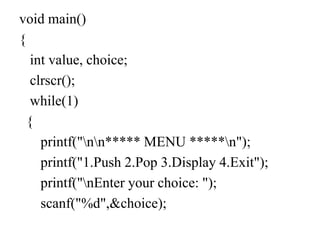
void main()
{
int value, choice;
clrscr();
while(1)
{
printf("nn***** MENU *****n");
printf("1.Push 2.Pop 3.Display 4.Exit");
printf("nEnter your choice: ");
scanf("%d",&choice);
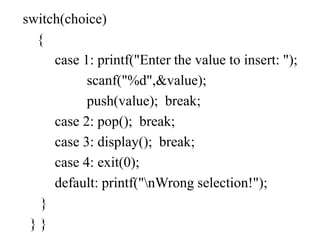
switch(choice)
{
case 1: printf("Enter the value to insert: ");
scanf("%d",&value);
push(value); break;
case 2: pop(); break;
case 3: display(); break;
case 4: exit(0);
default: printf("nWrong selection!");
}
} }
void push(int value)
{
if(top == SIZE-1)
printf("nStack is Full!");
else
{
top++;
stack[top] = value;
printf("nInsertion success!!!");
}
}
void pop()
{
if(top == -1)
printf("nStack is Empty!");
else
{
printf("nDeleted : %d", stack[top]);
top--;
}
}
void display()
{
if(top == -1)
printf("nStack is Empty!!!");
else
{
int i;
printf("nStack elements are:n");
for(i=top; i>=0; i--)
printf("%dn",stack[i]);
} }
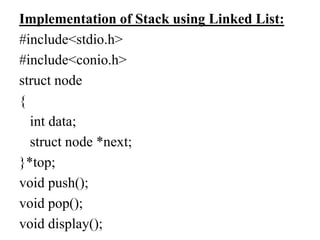
Implementation of Stack using Linked List:
#include<stdio.h>
#include<conio.h>
struct node
{
int data;
struct node *next;
}*top;
void push();
void pop();
void display();
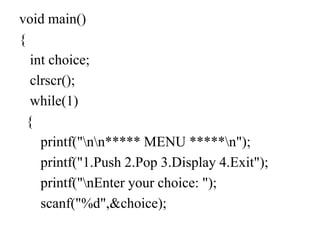
void main()
{
int choice;
clrscr();
while(1)
{
printf("nn***** MENU *****n");
printf("1.Push 2.Pop 3.Display 4.Exit");
printf("nEnter your choice: ");
scanf("%d",&choice);
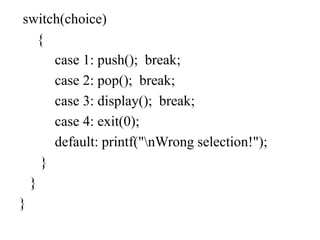
switch(choice)
{
case 1: push(); break;
case 2: pop(); break;
case 3: display(); break;
case 4: exit(0);
default: printf("nWrong selection!");
}
}
}
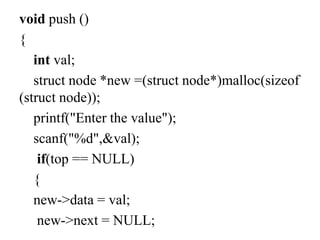
void push ()
{
int val;
struct node *new =(struct node*)malloc(sizeof
(struct node));
printf("Enter the value");
scanf("%d",&val);
if(top == NULL)
{
new->data = val;
new->next = NULL;
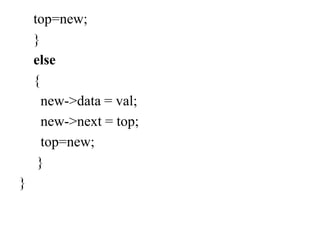
top=new;
}
else
{
new->data = val;
new->next = top;
top=new;
}
}
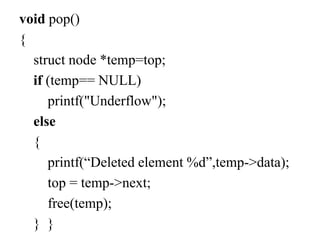
void pop()
{
struct node *temp=top;
if (temp== NULL)
printf("Underflow");
else
{
printf(“Deleted element %d”,temp->data);
top = temp->next;
free(temp);
} }
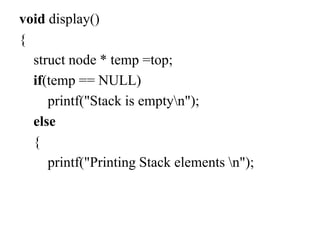
void display()
{
struct node * temp =top;
if(temp == NULL)
printf("Stack is emptyn");
else
{
printf("Printing Stack elements n");
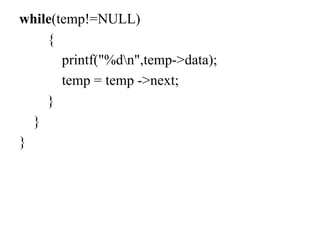
while(temp!=NULL)
{
printf("%dn",temp->data);
temp = temp ->next;
}
}
}
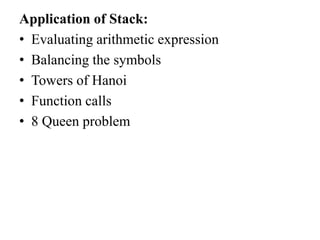
Application of Stack:
• Evaluating arithmetic expression
• Balancing the symbols
• Towers of Hanoi
• Function calls
• 8 Queen problem

CS8391-Data Structures Unit 2

  • 1.
    STACK ADT: • Stackis a linear data structure in which the insertion and deletion operations are performed at only one end. • In a stack, adding and removing of elements are performed at a single position which is known as "top". • In stack, the insertion and deletion operations are performed based on LIFO (Last In First Out) & FILO (First In Last Out) principle.
  • 2.
    • In astack, the insertion operation is performed using a function called "push" and deletion operation is performed using a function called "pop". Operations on a Stack • The following operations are performed on the stack. 1. Push (To insert an element on to the stack) 2. Pop (To delete an element from the stack) 3. Display (To display elements of the stack)
  • 3.
    • Stack datastructure can be implemented in two ways. They are as follows. 1. Using Array 2. Using Linked List • When a stack is implemented using an array, that stack can organize an only limited number of elements. • When a stack is implemented using a linked list, that stack can organize an unlimited number of elements.
  • 4.
    Implementation of Stackusing Array: #include<stdio.h> #include<conio.h> #define SIZE 10 void push(int); void pop(); void display(); int stack[SIZE], top = -1;
  • 5.
    void main() { int value,choice; clrscr(); while(1) { printf("nn***** MENU *****n"); printf("1.Push 2.Pop 3.Display 4.Exit"); printf("nEnter your choice: "); scanf("%d",&choice);
  • 6.
    switch(choice) { case 1: printf("Enterthe value to insert: "); scanf("%d",&value); push(value); break; case 2: pop(); break; case 3: display(); break; case 4: exit(0); default: printf("nWrong selection!"); } } }
  • 7.
    void push(int value) { if(top== SIZE-1) printf("nStack is Full!"); else { top++; stack[top] = value; printf("nInsertion success!!!"); } }
  • 8.
    void pop() { if(top ==-1) printf("nStack is Empty!"); else { printf("nDeleted : %d", stack[top]); top--; } }
  • 9.
    void display() { if(top ==-1) printf("nStack is Empty!!!"); else { int i; printf("nStack elements are:n"); for(i=top; i>=0; i--) printf("%dn",stack[i]); } }
  • 10.
    Implementation of Stackusing Linked List: #include<stdio.h> #include<conio.h> struct node { int data; struct node *next; }*top; void push(); void pop(); void display();
  • 11.
    void main() { int choice; clrscr(); while(1) { printf("nn*****MENU *****n"); printf("1.Push 2.Pop 3.Display 4.Exit"); printf("nEnter your choice: "); scanf("%d",&choice);
  • 12.
    switch(choice) { case 1: push();break; case 2: pop(); break; case 3: display(); break; case 4: exit(0); default: printf("nWrong selection!"); } } }
  • 13.
    void push () { intval; struct node *new =(struct node*)malloc(sizeof (struct node)); printf("Enter the value"); scanf("%d",&val); if(top == NULL) { new->data = val; new->next = NULL;
  • 14.
  • 15.
    void pop() { struct node*temp=top; if (temp== NULL) printf("Underflow"); else { printf(“Deleted element %d”,temp->data); top = temp->next; free(temp); } }
  • 16.
    void display() { struct node* temp =top; if(temp == NULL) printf("Stack is emptyn"); else { printf("Printing Stack elements n");
  • 17.
  • 18.
    Application of Stack: •Evaluating arithmetic expression • Balancing the symbols • Towers of Hanoi • Function calls • 8 Queen problem