OPERATING SYSTEM
(R18 II(II Sem))
Department of computer science and engineering (AI & ML)
LEC 6
by
Asst.Prof.M.Gokilavani
VITS
6/11/2023 Department of CSE (AI/ML) 1
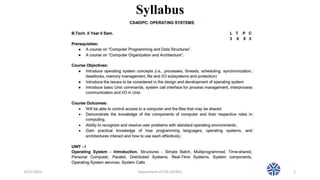
Syllabus
6/11/2023 Department of CSE (AI/ML) 2
6/11/2023 Department of CSE (AI/ML) 3
TEXTBOOK:
• Operating System Principles- Abraham Silberchatz, Peter B. Galvin, Greg
Gagne 7th Edition, John Wiley.
• Advanced programming in the UNIX environment, W.R. Stevens, Pearson
education.
REFERENCES:
• Operating Systems – Internals and Design Principles Stallings, Fifth Edition–
2005, Pearson Education/PHI.
• Operating System A Design Approach- Crowley, TMH.
• Modern Operating Systems, Andrew S. Tanenbaum 2nd edition, Pearson/PHI.
• UNIX programming environment, Kernighan and Pike, PHI/ Pearson Education.
• UNIX Internals -The New Frontiers, U. Vahalia, Pearson Education
6/11/2023 Department of CSE (AI/ML) 4
Topics covered in Lec 6
6/11/2023 Department of CSE (AI/ML) 5
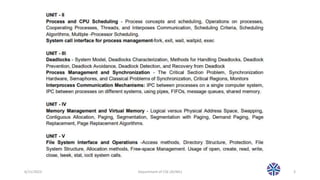
UNIT – I: Operating System - Introduction, Structures - Simple Batch,
Multiprogrammed, Time-shared, Personal Computer, Parallel, Distributed
Systems, Real-Time Systems, System components, Operating System
services, System Calls.
Operating System Structure
• General-purpose OS is very large program
• Various ways to structure ones
• Simple structure – MS-DOS
• More complex -- UNIX
• Layered – an abstraction
• Microkernel -Mach
6/11/2023 Department of CSE (AI/ML) 6
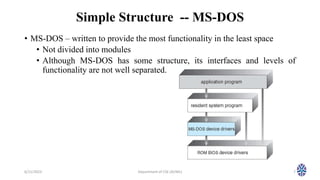
Simple Structure -- MS-DOS
6/11/2023 Department of CSE (AI/ML) 7
• MS-DOS – written to provide the most functionality in the least space
• Not divided into modules
• Although MS-DOS has some structure, its interfaces and levels of
functionality are not well separated.
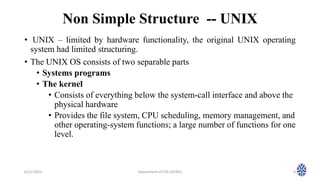
Non Simple Structure -- UNIX
• UNIX – limited by hardware functionality, the original UNIX operating
system had limited structuring.
• The UNIX OS consists of two separable parts
• Systems programs
• The kernel
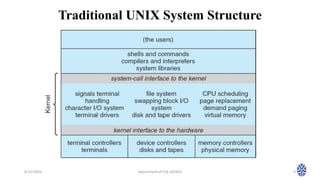
• Consists of everything below the system-call interface and above the
physical hardware
• Provides the file system, CPU scheduling, memory management, and
other operating-system functions; a large number of functions for one
level.
6/11/2023 Department of CSE (AI/ML) 8
Traditional UNIX System Structure
6/11/2023 Department of CSE (AI/ML) 9
Layered Approach
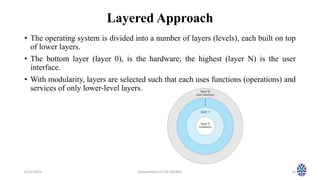
• The operating system is divided into a number of layers (levels), each built on top
of lower layers.
• The bottom layer (layer 0), is the hardware; the highest (layer N) is the user
interface.
• With modularity, layers are selected such that each uses functions (operations) and
services of only lower-level layers.
6/11/2023 Department of CSE (AI/ML) 10
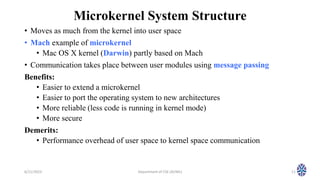
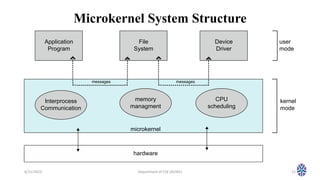
Microkernel System Structure
• Moves as much from the kernel into user space
• Mach example of microkernel
• Mac OS X kernel (Darwin) partly based on Mach
• Communication takes place between user modules using message passing
Benefits:
• Easier to extend a microkernel
• Easier to port the operating system to new architectures
• More reliable (less code is running in kernel mode)
• More secure
Demerits:
• Performance overhead of user space to kernel space communication
6/11/2023 Department of CSE (AI/ML) 11
Microkernel System Structure
6/11/2023 Department of CSE (AI/ML) 12
Application
Program
File
System
Device
Driver
Interprocess
Communication
memory
managment
CPU
scheduling
messages
messages
microkernel
hardware
user
mode
kernel
mode
Topics to be covered in next Lec 7
•Operating System Properties
6/11/2023 Department of CSE (AI/ML) 13
Thank you!!!

CS403: Operating System : Lec 6 OS Structure.pptx

  • 1.
    OPERATING SYSTEM (R18 II(IISem)) Department of computer science and engineering (AI & ML) LEC 6 by Asst.Prof.M.Gokilavani VITS 6/11/2023 Department of CSE (AI/ML) 1
  • 2.
  • 3.
  • 4.
    TEXTBOOK: • Operating SystemPrinciples- Abraham Silberchatz, Peter B. Galvin, Greg Gagne 7th Edition, John Wiley. • Advanced programming in the UNIX environment, W.R. Stevens, Pearson education. REFERENCES: • Operating Systems – Internals and Design Principles Stallings, Fifth Edition– 2005, Pearson Education/PHI. • Operating System A Design Approach- Crowley, TMH. • Modern Operating Systems, Andrew S. Tanenbaum 2nd edition, Pearson/PHI. • UNIX programming environment, Kernighan and Pike, PHI/ Pearson Education. • UNIX Internals -The New Frontiers, U. Vahalia, Pearson Education 6/11/2023 Department of CSE (AI/ML) 4
  • 5.
    Topics covered inLec 6 6/11/2023 Department of CSE (AI/ML) 5 UNIT – I: Operating System - Introduction, Structures - Simple Batch, Multiprogrammed, Time-shared, Personal Computer, Parallel, Distributed Systems, Real-Time Systems, System components, Operating System services, System Calls.
  • 6.
    Operating System Structure •General-purpose OS is very large program • Various ways to structure ones • Simple structure – MS-DOS • More complex -- UNIX • Layered – an abstraction • Microkernel -Mach 6/11/2023 Department of CSE (AI/ML) 6
  • 7.
    Simple Structure --MS-DOS 6/11/2023 Department of CSE (AI/ML) 7 • MS-DOS – written to provide the most functionality in the least space • Not divided into modules • Although MS-DOS has some structure, its interfaces and levels of functionality are not well separated.
  • 8.
    Non Simple Structure-- UNIX • UNIX – limited by hardware functionality, the original UNIX operating system had limited structuring. • The UNIX OS consists of two separable parts • Systems programs • The kernel • Consists of everything below the system-call interface and above the physical hardware • Provides the file system, CPU scheduling, memory management, and other operating-system functions; a large number of functions for one level. 6/11/2023 Department of CSE (AI/ML) 8
  • 9.
    Traditional UNIX SystemStructure 6/11/2023 Department of CSE (AI/ML) 9
  • 10.
    Layered Approach • Theoperating system is divided into a number of layers (levels), each built on top of lower layers. • The bottom layer (layer 0), is the hardware; the highest (layer N) is the user interface. • With modularity, layers are selected such that each uses functions (operations) and services of only lower-level layers. 6/11/2023 Department of CSE (AI/ML) 10
  • 11.
    Microkernel System Structure •Moves as much from the kernel into user space • Mach example of microkernel • Mac OS X kernel (Darwin) partly based on Mach • Communication takes place between user modules using message passing Benefits: • Easier to extend a microkernel • Easier to port the operating system to new architectures • More reliable (less code is running in kernel mode) • More secure Demerits: • Performance overhead of user space to kernel space communication 6/11/2023 Department of CSE (AI/ML) 11
  • 12.
    Microkernel System Structure 6/11/2023Department of CSE (AI/ML) 12 Application Program File System Device Driver Interprocess Communication memory managment CPU scheduling messages messages microkernel hardware user mode kernel mode
  • 13.
    Topics to becovered in next Lec 7 •Operating System Properties 6/11/2023 Department of CSE (AI/ML) 13 Thank you!!!