Cryptocurrency and BlockchainTechnology Explained
• Cryptocurrency and Blockchain Technology
• Introduction to Cryptocurrency and Blockchain
• Understanding Cryptocurrency
• Exploring Blockchain Technology
• The Symbiotic Relationship
• Key Functions of Cryptocurrency
• Core Functions of Blockchain
• Advantages of Cryptocurrency
• Advantages of Blockchain
• Cryptocurrency: Common Misconceptions
3.
Cryptocurrency and BlockchainTechnology Explained
• Debunking Cryptocurrency Myths
• Blockchain: Common Misconceptions
• Debunking Blockchain Myths
• Real-World Applications
• Conclusion and Future Outlook
4.
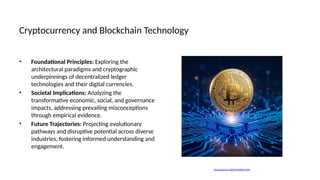
Cryptocurrency and BlockchainTechnology
• Foundational Principles: Exploring the
architectural paradigms and cryptographic
underpinnings of decentralized ledger
technologies and their digital currencies.
• Societal Implications: Analyzing the
transformative economic, social, and governance
impacts, addressing prevailing misconceptions
through empirical evidence.
• Future Trajectories: Projecting evolutionary
pathways and disruptive potential across diverse
industries, fostering informed understanding and
engagement.
Generated on AIDOCMAKER.COM
5.
Introduction to Cryptocurrencyand Blockchain
• Decentralized Digital Ecosystems: Cryptocurrency functions as a decentralized digital currency, intrinsically
supported by blockchain's distributed ledger architecture.
• Clarity for General Audience: The presentation aims to demystify complex cryptographic and distributed
ledger technologies for a general audience.
• Dispelling Misconceptions: Key objective is to debunk prevailing misconceptions, fostering an accurate
understanding of their inherent potential.
6.
Understanding Cryptocurrency
• CryptographicSecurity: Cryptographically secured digital currency, designed to prevent counterfeiting and
double-spending through advanced cryptographic primitives and ledger integrity.
• Decentralized Control: Operates independently of central authorities like governments or financial
institutions, fostering censorship resistance and direct peer-to-peer interactions.
• Economic Utility & Prominent Examples: Functions as digital medium of exchange, store of value, or unit
of account (e.g., Bitcoin, Ethereum).
7.
Exploring Blockchain Technology
•Decentralized Ledger: A distributed, immutable
ledger system, blockchain ensures data integrity
and transactional transparency across a network.
• Cryptographic Chaining: Transactions coalesce
into blocks, securely linked chronologically via
each block's cryptographic hash of its
predecessor.
• Network Consensus: Maintained across
distributed nodes, this decentralized architecture
ensures transparent, immutable record-keeping
without central authority.
Generated on AIDOCMAKER.COM
8.
The Symbiotic Relationship
•Foundational Infrastructure: Blockchain provides the secure, transparent, immutable ledger acting as
cryptocurrency's operating system, enabling its functionality.
• OS-Application Analogy: Cryptocurrency operates as an application on blockchain's robust operating
system, leveraging its decentralized, cryptographic integrity.
• Transactional Integrity: Blockchain's immutability and transparency secure cryptocurrency transactions,
preventing fraud and ensuring trust across the decentralized network.
9.
Key Functions ofCryptocurrency
• Medium for Digital Payments: Enables global peer-to-peer digital payments, bypassing traditional
intermediaries for swift, borderless transactions.
• Enhanced Financial Autonomy: Offers an alternative to traditional banking, granting users direct,
sovereign control over their financial assets.
• Transactional Pseudonymity: Transactions are publicly recorded via wallet addresses; personal identities
remain private, ensuring pseudonymity.
10.
Core Functions ofBlockchain
• Data Integrity & Immutability: Cryptographic
hashing ensures data integrity and immutability,
making records tamper-proof across
decentralized, verifiable ledgers.
• Self-Executing Smart Contracts: Smart contracts
are self-executing agreements with terms directly
coded, automating processes trustlessly without
intermediaries.
• Decentralized Applications (dApps): dApps
leverage blockchain for enhanced transparency,
censorship resistance, and secure, decentralized
functionality across diverse sectors.
Generated on AIDOCMAKER.COM
11.
Advantages of Cryptocurrency
•Financial Inclusion: Cryptocurrency extends vital financial services to global unbanked and underbanked
populations, fostering economic participation for underserved demographics.
• Borderless Transactions: Facilitates rapid, cost-effective cross-border transfers by circumventing
conventional banking infrastructure, minimizing intermediaries and fees.
• User Asset Sovereignty: Users maintain direct, decentralized control over their assets, eliminating
intermediary dependency and enhancing individual financial autonomy.
12.
Advantages of Blockchain
•Unprecedented Transparency: All verified transactions are publicly viewable on the distributed ledger,
fostering unprecedented clarity and accountability.
• Enhanced Security: Cryptographic encryption and decentralized architecture confer superior resistance to
hacking, tampering, and unauthorized data manipulation attempts.
• Immutable Auditability: Every transaction’s traceable, immutable record enables comprehensive auditing,
ensuring regulatory compliance and verifiable accountability across the network.
13.
Cryptocurrency: Common Misconceptions
•Illicit Use Misconception: A prevalent myth
suggests cryptocurrency's primary utility lies in
facilitating illicit transactions; this misrepresents
its broad legitimate adoption.
• Intrinsic Value Fallacy: The misconception that
cryptocurrency lacks inherent value, dismissed as
mere speculative bubble, ignores its utility and
demand.
• Guaranteed Profit Myth: The erroneous belief
that cryptocurrency investments uniformly
ensure rapid, effortless financial gains overlooks
market volatility and inherent risks.
Generated on AIDOCMAKER.COM
14.
Debunking Cryptocurrency Myths
•Illicit Use Rebuttal: Illicit transactions are a minor fraction; legitimate payments, remittances, and
investments represent cryptocurrency's predominant global utility.
• Value Derivation: Value stems from supply-demand dynamics, network effects, utility, and tangible real-
world adoption, not pure speculation.
• Volatility and Risk: Markets exhibit high volatility, prone to significant price swings; not a guaranteed 'get
rich quick' scheme.
15.
Blockchain: Common Misconceptions
•Beyond Bitcoin: Blockchain is a versatile technology with diverse applications far beyond mere digital
currencies.
• Robust Security: Cryptographic principles and decentralized consensus mechanisms make core blockchain
protocols inherently highly secure.
• Energy Efficiency: While some early iterations were energy-intensive, many modern blockchain protocols
employ highly efficient consensus mechanisms.
16.
Debunking Blockchain Myths
•Beyond Currency: Bitcoin is one application;
blockchain's versatility extends to healthcare,
supply chain, and voting systems, showcasing
broad sector utility.
• Inherent Security: Core blockchain security
derives from robust cryptography and distributed
consensus; vulnerabilities typically arise from
application layers or user interaction.
• Energy Efficiency: While Proof-of-Work is energy-
intensive, newer Proof-of-Stake and other
consensus mechanisms offer significantly more
efficient and sustainable operations.
Generated on AIDOCMAKER.COM
17.
Real-World Applications
• Nation-StateAdoption: El Salvador pioneered Bitcoin as legal tender, enhancing financial inclusion and
cross-border remittances.
• Healthcare Interoperability: Blockchain secures patient records, enabling seamless, transparent data
sharing and interoperability across medical systems.
• Supply Chain Transparency: Blockchain provides immutable, verifiable tracking of goods, boosting supply
chain efficiency and mitigating fraud.
18.
Conclusion and FutureOutlook
• Synthesized Core Understanding: Cryptocurrency and blockchain, distinct yet interdependent,
fundamentally transform digital finance through their core functionalities.
• Navigating Digital Evolution: Grasping these technologies is crucial for navigating the evolving digital
landscape, empowering informed participation and innovation.
• Transformative Future Outlook: Their profound implications promise to reshape global finance,
governance, and industries, driving unprecedented innovation and decentralization.






![AVG Internet Security Crack + [Activation] 2025](https://cdn.slidesharecdn.com/ss_thumbnails/understandingblockchain-250316100000-fcfb236d-thumbnail.jpg?width=640&height=640&fit=bounds)

![Adguard Premium Crack + License Key [Latest Version]](https://cdn.slidesharecdn.com/ss_thumbnails/understandingblockchain-250316100234-eef745e9-thumbnail.jpg?width=640&height=640&fit=bounds)


