APPLICATION NOTE
Crypto Products Backgrounder
3RD
QUARTER 2015
Introduction
Atmel CryptoAuthentication™ and Trusted Platform Module (TPM) crypto element devices with
hardware-based key storage and cryptographic countermeasures prevent would-be attackers
from cloning, counterfeiting, or tampering with a product, the consumables it uses, the firmware
it runs, the accessories that support it, and the network nodes to which it connects. Keeping
products authentic helps maintain an OEM revenue flow by ensuring that only legitimate
products can work in the host system, and by keeping would-be hackers from using them
beyond their expiration date. Atmel’s crypto element devices can fight off even the most
aggressive attacks. Attackers cannot attack because they cannot see the secret keys stored in
protected hardware. That is why protected hardware-based key storage is the strongest there
is.
Atmel CryptoAuthentication crypto element devices support modern cryptographic standards
such as SHA-256, ECDSA, ECDH and others. They work with any microcontroller, are cost
effective, require only one GPIO, and use very little power. Additionally, they operate over a
wide voltage range and come in a range of small packages. Standalone crypto elements can
be used in a wide spectrum of applications, many of which are described in this document.
Atmel TPM crypto elements integrate MCU, EEPROM, and crypto engines with ultra-secure
hardware-based key storage on a single chip. TPMs implement public key (RSA) security.
TPMs are ideal security solutions for PCs, tablets and the expanding platform of Operating
System (OS) based embedded systems that require and/or can benefit from Trusted
Computing Group (TCG) specification compliance.
Cryptography involves many standards, algorithms, processes, definitions, and methods; and,
as such, it is mathematically complex and highly detailed. Fortunately, Atmel does the more
difficult cryptographic engineering and has built that right into the crypto element devices.
Therefore, users need not be crypto experts and can easily add robust security to digital
systems.
This document provides some cryptography basics, describes important uses of crypto
elements and their features, outlines the Atmel family of crypto element devices, and covers
many other things. This is intended to be an introduction and desk reference. More in-depth
materials such as app notes, training manuals, and code examples are available on the Atmel
web site
http://www.atmel.com/products/security-ics/default.aspx
Delete this instruction and edit date inside these brackets 07/07/2012Delete this instruction and edit date inside these brackets 07/07/2012
3Q2015 CRYPTO PRODUCTS BACKGROUNDR r12
2 Atmel | CRYPTO
Table of Contents
1. Introduction : CRYPTO ELEMENTS HARDEN SECURIY ................................ 6
Crypto Element Uses .................................................................................... 10
2. Uses of Crypto Elements ...................................................................... 11
3. Crypto Element Uses: Accessory Authentication ...................................... 13
4. Crypto Element Uses: Medical Device Authentication................................ 14
5. Crypto Element Uses: Firmware Anti-Cloning .......................................... 15
6. Crypto Element Uses: Industrial Network Security .................................. 16
7. Crypto Element Uses: Consumable Authentication ................................... 17
8. Crypto Element Uses: Automotive Authentication .................................... 18
Crypto Basics 19
9. Crypto Basics: The Three fundamental elements of security (“CIA”).......... 20
10. Crypto Basics : Symmetric and Asymmetric Authentication...................... 21
11. Crypto Basics : Hash Function............................................................... 22
12. Crypto Basics: Encryption/Decryption .................................................... 23
Coding and decoding information using a secret key......................................... 23
13. Crypto Basics : REAL.EASY Crypto Glossary ........................................... 24
Crypto Operations ................................................................................. 27
14. Crypto Operations: Why use Crypto Elements?........................................ 28
Because connected things need strong authentication…and more. ...................... 28
Why use crypto elements? (Continued) ........................................................... 29
15. Crypto Operations: Symmetric Authentication with secrets stored on the host
using Random Challenge-Response........................................................ 30
16. Crypto Operations: Symmetric Authentication without secret storage on the
host using a Fixed Challenge................................................................. 31
17. Crypto Operations: Symmetric Authentication without secret storage on the
host using Fixed Challenge and intermediate key..................................... 32
18. Crypto Operations: Asymmetric Authentication Using Digital Signatures
(ECDSA) 33
19. Crypto Operations: Asymmetric Authentication ...................................... 34
Making the ECDSA certificates ....................................................................... 34
20. Crypto Operations: Asymmetric Authentication ...................................... 35
3Q2015 CRYPTO PRODUCTS BACKGROUNDR r12
3 Atmel | CRYPTO
Creating the Client’s Certificate...................................................................... 35
21. Crypto Operations: Asymmetric Authentication ...................................... 36
Creating the Signer’s Certificate..................................................................... 36
22. Crypto Operations: Asymmetric Authentication ...................................... 37
ECDSA is a two phased process (Phase 1, Part 1: Verify Client’s Public Key)........ 37
23. Crypto Operations: Asymmetric Authentication ...................................... 38
ECDSA is a two phased process (Phase 1, Part 2: Verify Issuer’s Signature) ........ 38
24. Crypto Operations: Asymmetric Authentication ...................................... 39
ECDSA is a two phased process (Phase 2: Verify Private Key)............................ 39
25. Crypto Operations: Secure Boot Step 1. Signing the application code in the
factory. 40
26. Crypto Operations: Secure Boot Step 2. Authenticating the device in the field
41
27. Crypto Operations: Protecting Downloaded Firmware with Symmetric Keys;
Step1: Encrypt and MAC application code............................................... 42
28. Crypto Operations: Protecting Downloaded Firmware with Symmetric Keys;
Step2: Download, Decrypt, and Authenticate .......................................... 43
29. Crypto Operations: Symmetric Session Key Exchange with crypto devices on
both sides 44
30. Crypto Operations: Protecting Communication between the Crypto element
and MCU. 44
31. Crypto Operations: Decrypting encrytped data at rest.............................. 48
32. Crypto Operations: Message Authentication (For Data Integrity Checking). 49
33. Crypto Operations: Secure Password Protection ..................................... 51
34. Crypto Operations: Confidentiality Using Symmetric Session Key Exchange
with a crypto element on the client side only. ......................................... 52
35. Crypto Operations: Node Data Integrity Using Symmetric Intermediate Keys
53
36. Crypto Operations: Node Authentication Using Symmetric Intermediate Keys
54
37. Crypto Operations: Using Diversified Keys to increase security................. 55
38. Crypto Operations: Increasing protection with more complex challenges ... 58
39. Crypto Operations: Using ECDH Key agreement with the ATECC508A for
confidentiality ..................................................................................... 59
40. Crypto Operations: Security and the IoT ................................................ 60
41. Crypto Operations: ECDH Key Agreement.............................................. 61
The Magic of ECDH Key Agreement ................................................................ 61
Key Agreement 61
3Q2015 CRYPTO PRODUCTS BACKGROUNDR r12
4 Atmel | CRYPTO
42. Crypto Operations: Hardening Transport Layer Security (TLS)................... 63
43. Crypto Operations: Applications Layer Security is Needed for IoT Nodes..... 66
44. Crypto Operations: Applications Layer Security Using the ATECC508A........ 67
45. Crypto Operations: Atmel Multi-Layer Security Solutions .......................... 68
46. Crypto Operations: MCU-Wireless Security Module.................................. 69
47. Atmel Microcontrollers.......................................................................... 70
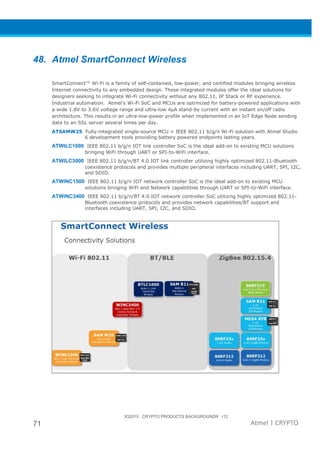
48. Atmel SmartConnect Wireless ............................................................... 71
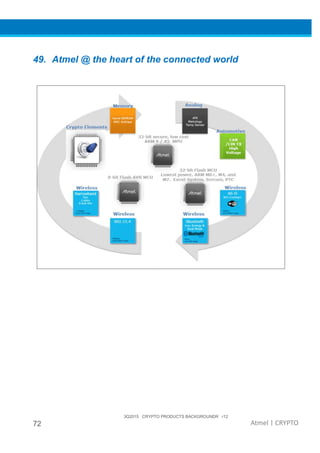
49. Atmel @ the heart of the connected world .............................................. 72
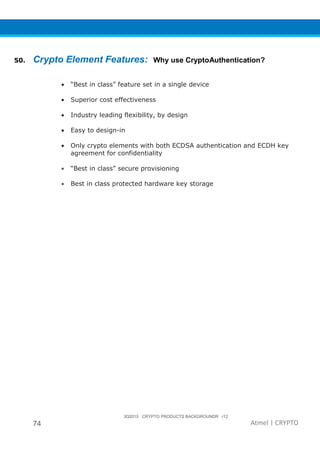
50. Crypto Element Features: Why use CryptoAuthentication?...................... 74
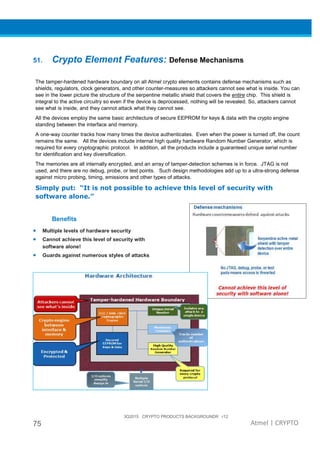
51. Crypto Element Features: Defense Mechanisms....................................... 75
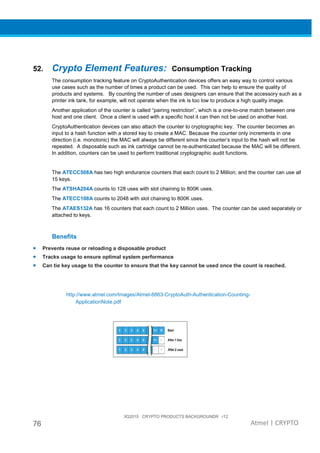
52. Crypto Element Features: Consumption Tracking.................................... 76
53. Crypto Element Features: Secure Provisioning ........................................ 77
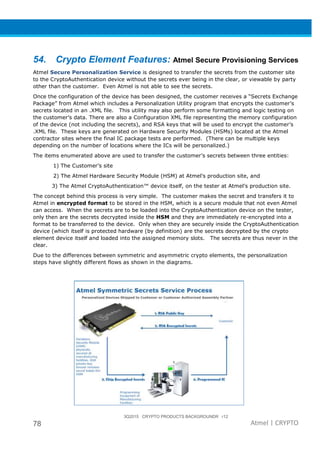
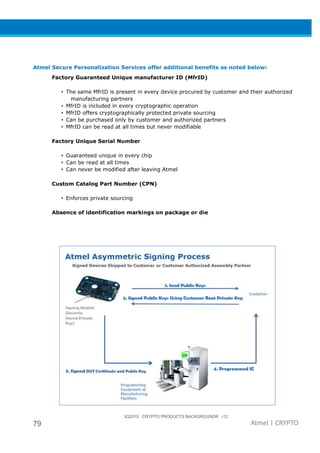
54. Crypto Element Features: Atmel Secure Provisioning Services................... 78
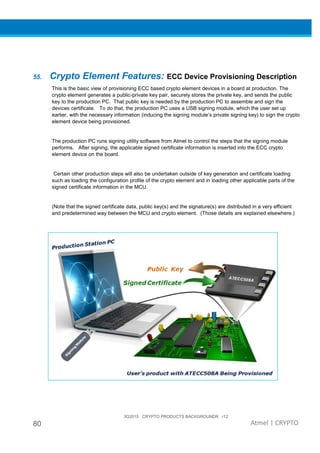
55. Crypto Element Features: ECC Device Provisioning Description ................. 80
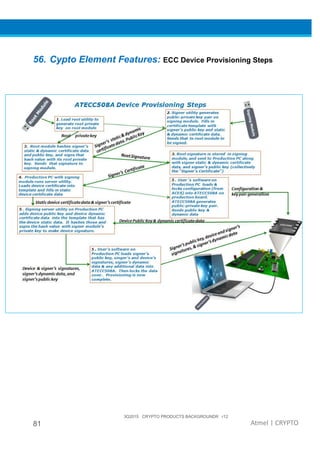
56. Cypto Element Features: ECC Device Provisioning Steps .......................... 81
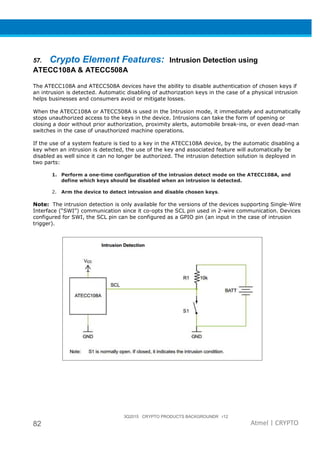
57. Crypto Element Features: Intrusion Detection using ATECC108A & ATECC508A
82
58. CryptoAuthentication ™ Devices............................................................ 84
59. CryptoAuthentication ™ Devices: ATECC108A ........................................ 85
60. CryptoAuthentication ™ Devices: ATSHA204A ......................................... 87
61. CryptoAuthentication ™ Devices: ATSHA204A Features/Benefits ............... 89
62. CryptoAuthentication ™ Devices: ATAES132A ........................................ 90
63. CryptoAuthentication ™ Devices: ATECC508A ........................................ 92
64. Crypto Element Features: Atmel ECC Crypto Element Device Summary..... 93
65. CryptoAuthentication Devices: Selector Guide ........................................ 95
66. CryptoAuthentication Device Ordering Guide: ATECC108A ........................ 99
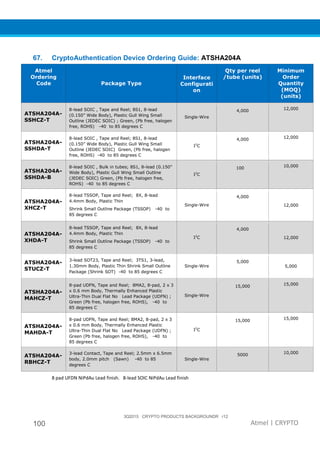
67. CryptoAuthentication Device Ordering Guide: ATSHA204A.......................100
68. CryptoAuthentication Device Ordering Guide: ATAES132A .......................101
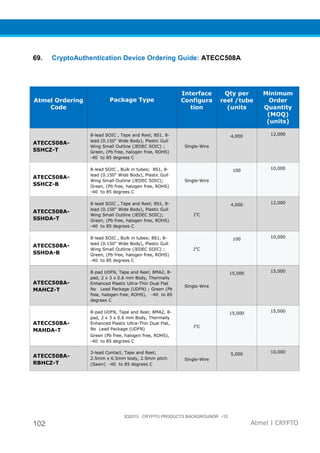
69. CryptoAuthentication Device Ordering Guide: ATECC508A .......................102
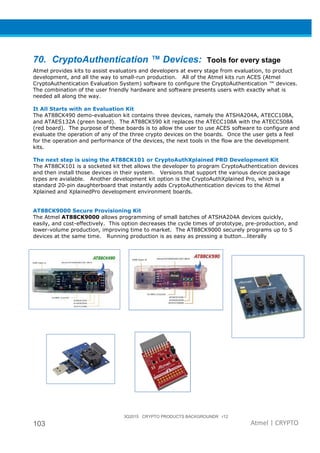
70. CryptoAuthentication ™ Devices: Tools for every stage ..........................103
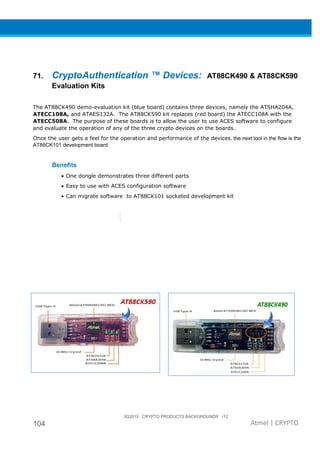
71. CryptoAuthentication ™ Devices: AT88CK490 and AT88CK590 Evaluation Kits
104
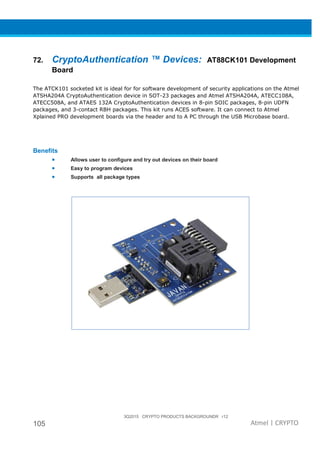
72. CryptoAuthentication ™ Devices: AT88CK101 Development Board...........105
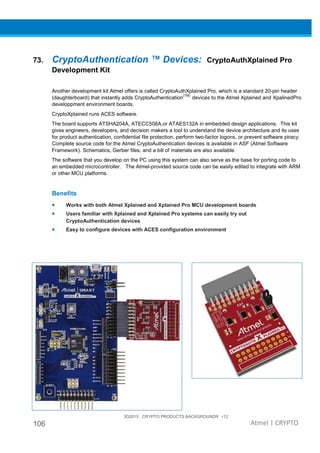
73. CryptoAuthentication ™ Devices: CryptoAuthXplained Pro Development Kit106
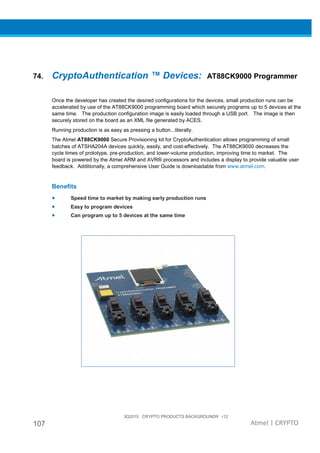
74. CryptoAuthentication ™ Devices: AT88CK9000 Programmer ...................107
3Q2015 CRYPTO PRODUCTS BACKGROUNDR r12
5 Atmel | CRYPTO
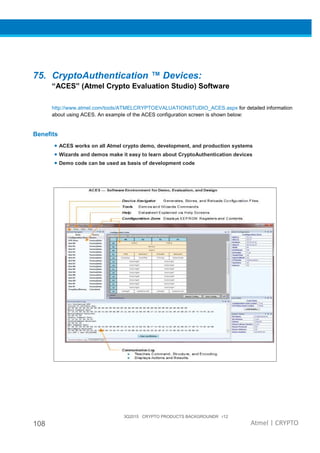
75. CryptoAuthentication ™ Devices:..........................................................108
“ACES” (Atmel Crypto Evaluation Studio) Software..........................................108
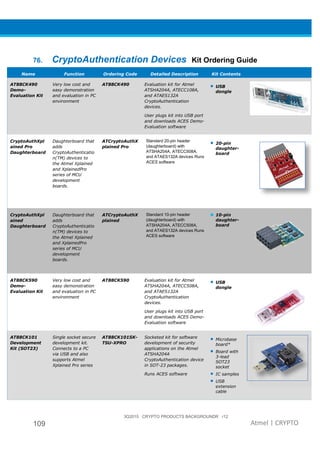
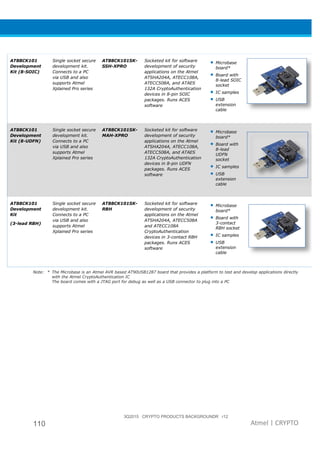
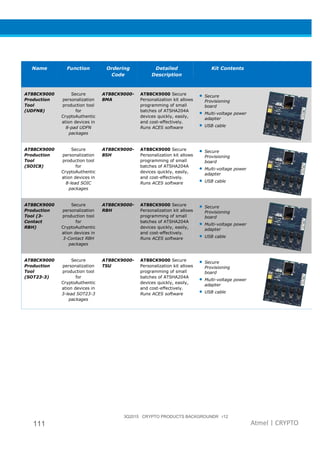
76. CryptoAuthentication Kit Ordering Guide ..............................................109
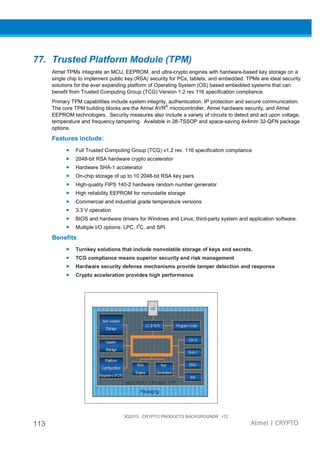
77. Trusted Platform Module (TPM) ............................................................113
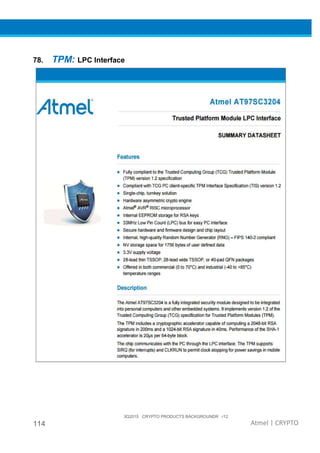
78. TPM: LPC Interface .............................................................................114
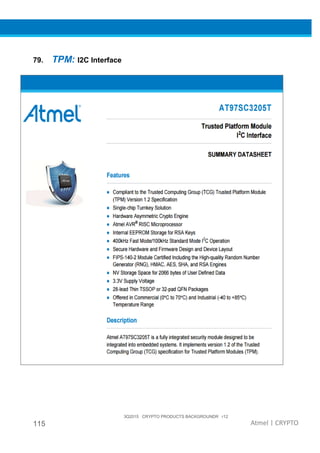
79. TPM: I2C Interface .............................................................................115
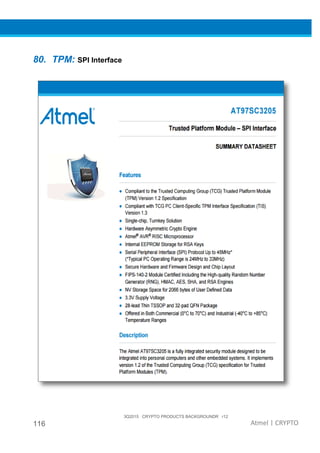
80. TPM: SPI Interface .............................................................................116
81. TPM: Operations.................................................................................117
TPM: Operations (Continued).......................................................................118
82. TPM Uses: Authentication ....................................................................119
83. TPM Uses: Access Points / Gateways.....................................................120
84. TPM Uses: Secure Boot .......................................................................121
85. TPM: Device Selector Guide .................................................................122
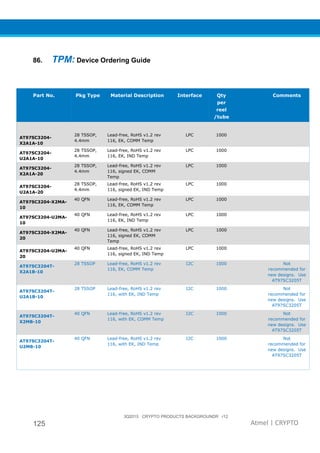
86. TPM: Device Ordering Guide ................................................................125
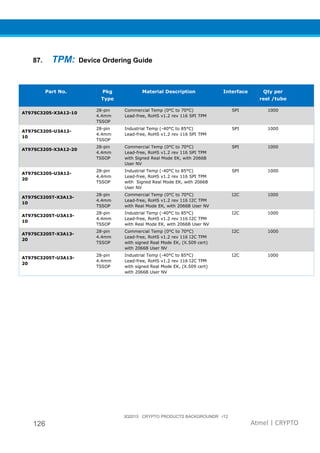
87. TPM: Device Ordering Guide ...............................................................126
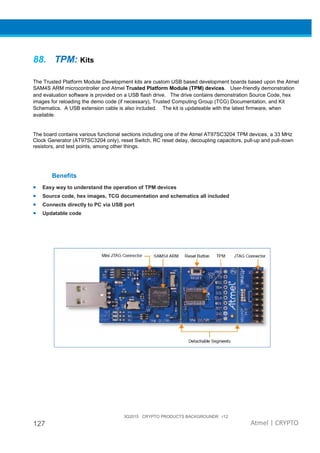
88. TPM: Kits
127
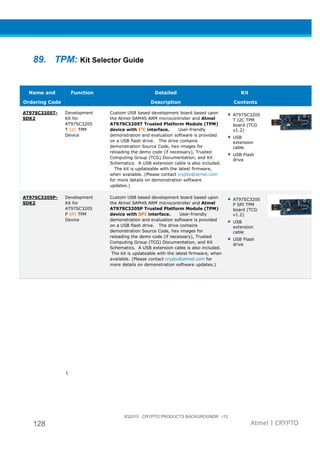
89. TPM: Kit Selector Guide.......................................................................128
90. Atmel Crypto Contacts ........................................................................129
91. Crypto FAQs
131
6
1. CRYPTO ELEMENTS
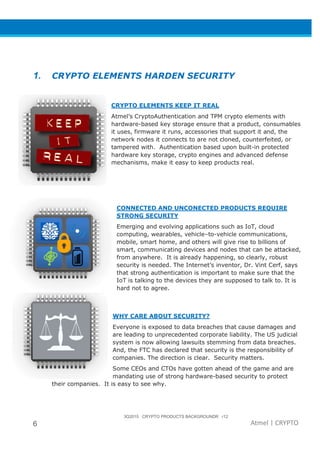
CRYPTO ELEMENTS KEEP IT REAL
Atmel’s
hardware
it uses, firmware it runs, accessories that support it and, the
netwo
tampered with.
hardware key storage, c
mechanisms, make it easy to keep products real.
WHY
Everyone is exposed to
are leading to
system is
And, t
companies
Some
mandating
their companies. It is easy to see why.
3Q2015 CRYPTO PRODUCTS BACKGROUNDR r12
CRYPTO ELEMENTS HARDEN SECURITY
CRYPTO ELEMENTS KEEP IT REAL
Atmel’s CryptoAuthentication and TPM crypto elements with
hardware-based key storage ensure that a product, consumables
it uses, firmware it runs, accessories that support it and, the
network nodes it connects to are not cloned
tampered with. Authentication based upon built
hardware key storage, crypto engines a
mechanisms, make it easy to keep products real.
CONNECTED AND UNCONECTED PRODUCTS REQUIRE
STRONG SECURITY
Emerging and evolving applications such as
computing, wearables, vehicle–to-vehicle communications
mobile, smart home, and others will give
smart, communicating devices and nodes that can be attacked
from anywhere. It is already happening, so c
security is needed. The Internet’s inventor
that strong authentication is important
IoT is talking to the devices they are supposed to talk to.
hard not to agree.
WHY CARE ABOUT SECURITY?
Everyone is exposed to data breaches that cause damage
are leading to unprecedented corporate liability.
system is now allowing lawsuits stemming from data breaches.
And, the FTC has declared that security is t
companies. The direction is clear. Security matters.
Some CEOs and CTOs have gotten ahead of the game and
mandating use of strong hardware-based security to protect
It is easy to see why.
3Q2015 CRYPTO PRODUCTS BACKGROUNDR r12
Atmel | CRYPTO
TY
tion and TPM crypto elements with
ensure that a product, consumables
it uses, firmware it runs, accessories that support it and, the
cloned, counterfeited, or
Authentication based upon built-in protected
engines and advanced defense
mechanisms, make it easy to keep products real.
CONNECTED AND UNCONECTED PRODUCTS REQUIRE
Emerging and evolving applications such as IoT, cloud
vehicle communications,
give rise to billions of
nodes that can be attacked,
already happening, so clearly, robust
’s inventor, Dr. Vint Cerf, says
nt to make sure that the
IoT is talking to the devices they are supposed to talk to. It is
that cause damages and
corporate liability. The US judicial
lawsuits stemming from data breaches.
he FTC has declared that security is the responsibility of
The direction is clear. Security matters.
have gotten ahead of the game and are
based security to protect
3Q2015 CRYPTO PRODUCTS BACKGROUNDR r12
7 Atmel | CRYPTO
SECURITY MATTERS
Even with the explosion of data breaches, security is surprisingly still
treated as an afterthought. Security should, in fact, be the prerequisite
of any system design. Engineers, executives, investors, and
researchers alike have been whistling past the graveyard hoping that
their digital interests will not be attacked too badly, but that is
irrational because targets to attack are easy to find now.
FINDING UNPROTECTED NODES IS EASY...AND THAT MEANS
TROUBLE
Traffic lights, security cameras, home automation devices, appliances,
heating systems, industrial networks…you name it… are now super
easy to find because of Shodan, which is the Google of embedded
systems.
Shodan searches the Internet’s back channels 24/7 looking for servers,
webcams, printers, routers and all the other stuff connected to the
Internet. Shodan alone proves that robust security for connected
devices is needed badly because if it is connected, it is vulnerable.
IF IT IS CONNECTED, IT IS VULNERABLE
Hackers steal passwords, digital IDs, IP, and financial
data because software is used to protect system software.
But, all software is vulnerable because all software has
bugs. So don’t store important things like secret keys in
software.
8
He totally gets it. What
3Q2015 CRYPTO PRODUCTS BACKGROUNDR r12
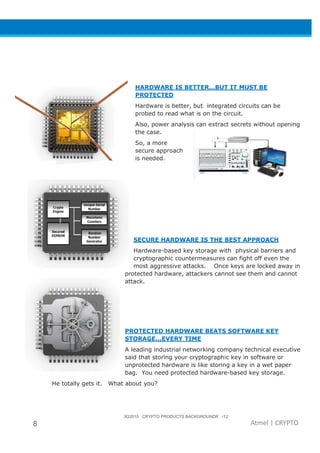
HARDWARE IS BETTER…BUT IT MUST BE
PROTECTED
Hardware is better, but integrated
probed to read what is on the circuit.
Also, power analysis can extract secrets
the case.
So, a more
secure approach
is needed.
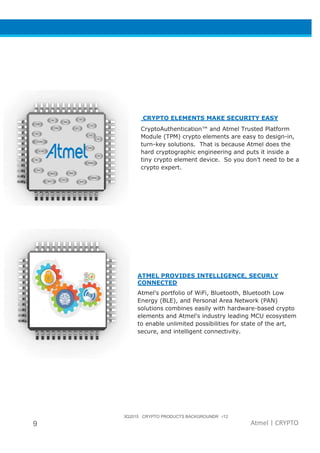
SECURE HARDWARE IS THE BEST APPROACH
Hardware-based key storage with
cryptographic countermeasures can
most aggressive attacks. Once keys are
protected hardware, attackers cannot see them
attack.
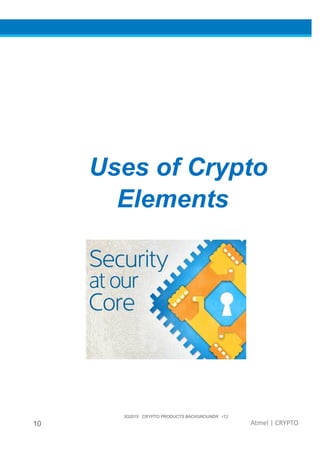
PROTECTED HARDWARE BEATS SOFTWARE KEY
STORAGE...EVERY TIME
A leading industrial networking company
said that storing your cryptographic key
unprotected hardware is like storing a key
bag. You need protected hardware
What about you?
3Q2015 CRYPTO PRODUCTS BACKGROUNDR r12
Atmel | CRYPTO
ARDWARE IS BETTER…BUT IT MUST BE
but integrated circuits can be
probed to read what is on the circuit.
can extract secrets without opening
SECURE HARDWARE IS THE BEST APPROACH
with physical barriers and
yptographic countermeasures can fight off even the
Once keys are locked away in
protected hardware, attackers cannot see them and cannot
BEATS SOFTWARE KEY
king company technical executive
graphic key in software or
unprotected hardware is like storing a key in a wet paper
You need protected hardware-based key storage.
3Q2015 CRYPTO PRODUCTS BACKGROUNDR r12
9 Atmel | CRYPTO
CRYPTO ELEMENTS MAKE SECURITY EASY
CryptoAuthentication™ and Atmel Trusted Platform
Module (TPM) crypto elements are easy to design-in,
turn-key solutions. That is because Atmel does the
hard cryptographic engineering and puts it inside a
tiny crypto element device. So you don’t need to be a
crypto expert.
ATMEL PROVIDES INTELLIGENCE, SECURLY
CONNECTED
Atmel’s portfolio of WiFi, Bluetooth, Bluetooth Low
Energy (BLE), and Personal Area Network (PAN)
solutions combines easily with hardware-based crypto
elements and Atmel’s industry leading MCU ecosystem
to enable unlimited possibilities for state of the art,
secure, and intelligent connectivity.
3Q2015 CRYPTO PRODUCTS BACKGROUNDR r12
10 Atmel | CRYPTO
Uses of Crypto
Elements
3Q2015 CRYPTO PRODUCTS BACKGROUNDR r12
11 Atmel | CRYPTO
2. Uses of Crypto Elements
Use Case Description
Secure Boot
Authenticate code stored in flash memory at boot time to detect unauthorized
modifications
Secure Down load Validate code updates &support encryption (broadcast or per-system basis)
Feature
Management
Store, update and verify optional feature restrictions.
Ecosystem Control
Ensure only authorized nodes and accessories work. Identification for
warranty purposes.
Anti-
Counterfeiting
Authenticate a removable, replaceable, or consumable client (such as system
accessories, electronic daughter cards, or other spare parts).
Consumption
Logging
Guarantee quality of device, maintenance schedule, etc. by tracking usage.
Anti-cloning
Prevent building with identical BOM and stolen code. (Anti-piracy or firmware
protection.)
Standards-based
Communications
Security
Provide key storage & management plus asymmetric acceleration for standard
communications protocols such as TLS, IPSEC, etc.
User defined
communication
channel protection
Security for customer-designed connections (e.g. application layer security)
Protect Data at
Rest (Files)
Security for data stored in standard nonvolatile memory in an embedded
device
Storing Secrets
Directly store small quantities of data for configuration, calibration, ePurse
value, etc.
User Password
Management
Validate user-entered passwords without letting the expected value become
known. Map memorable passwords to a random number, etc.
Random Number
Generator
For cryptographic and other system purposes.
Tamper Detection Cryptographically manage external tamper switches, wires, etc.
Cloud Provider
Requirements
Security according to cloud providers’ specifications.
3Q2015 CRYPTO PRODUCTS BACKGROUNDR r12
12 Atmel | CRYPTO
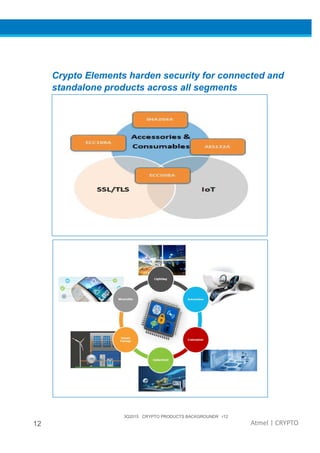
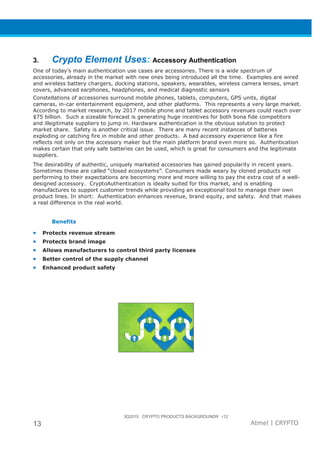
Crypto Elements harden security for connected and
standalone products across all segments
3Q2015 CRYPTO PRODUCTS BACKGROUNDR r12
13 Atmel | CRYPTO
3. Crypto Element Uses: Accessory Authentication
One of today’s main authentication use cases are accessories. There is a wide spectrum of
accessories, already in the market with new ones being introduced all the time. Examples are wired
and wireless battery chargers, docking stations, speakers, wearables, wireless camera lenses, smart
covers, advanced earphones, headphones, and medical diagnostic sensors
Constellations of accessories surround mobile phones, tablets, computers, GPS units, digital
cameras, in-car entertainment equipment, and other platforms. This represents a very large market.
According to market research, by 2017 mobile phone and tablet accessory revenues could reach over
$75 billion. Such a sizeable forecast is generating huge incentives for both bona fide competitors
and illegitimate suppliers to jump in. Hardware authentication is the obvious solution to protect
market share. Safety is another critical issue. There are many recent instances of batteries
exploding or catching fire in mobile and other products. A bad accessory experience like a fire
reflects not only on the accessory maker but the main platform brand even more so. Authentication
makes certain that only safe batteries can be used, which is great for consumers and the legitimate
suppliers.
The desirability of authentic, uniquely marketed accessories has gained popularity in recent years.
Sometimes these are called “closed ecosystems”. Consumers made weary by cloned products not
performing to their expectations are becoming more and more willing to pay the extra cost of a well-
designed accessory. CryptoAuthentication is ideally suited for this market, and is enabling
manufactures to support customer trends while providing an exceptional tool to manage their own
product lines. In short: Authentication enhances revenue, brand equity, and safety. And that makes
a real difference in the real world.
Benefits
• Protects revenue stream
• Protects brand image
• Allows manufacturers to control third party licenses
• Better control of the supply channel
• Enhanced product safety
3Q2015 CRYPTO PRODUCTS BACKGROUNDR r12
14 Atmel | CRYPTO
4. Crypto Element Uses: Medical Device Authentication
Authentication of medical devices is a growing market and it has started to be driven by
government agencies. Governments have become the main drivers of medical policies and are
clearly shaping the future of medical care. New policies will have enormous impact on the design,
distribution, financing, and use of medical equipment of all kinds. Looking at where the US
government, for example, wants medicine to go we can see two clearly emerging vectors; namely
electronic records and telemedicine. Both of these vectors point in the direction of authentication.
Handset/tablet based telemedicine using an array of wired and wireless diagnostic sensors will help
extend healthcare services to underserved and remote populations. Implantable sensors and
devices are already being programmed wirelessly such as pacemakers and defibrillators, and the
FDA has expressed concern that such products could be interfered with or hacked with mal-intent.
So, in mid-2013 the FDA issued guidelines for authentication of wireless medical appliances in order
to promote safety. Without a doubt, the last thing a patient with a pacemaker wants to have to
worry about is someone hacking their heartbeat.
Authentication is also a way to ensure privacy of electronic medical records, which is required by
laws such as HIPAA. The mandate for electronic records went into effect in January 2014. The need
for authentication of electronic records will only grow as the systems continue to roll out and evolve.
Benefits
• Secures ecosystems
• Improves quality
• Tracks charges
• Reduces medical liability exposure
3Q2015 CRYPTO PRODUCTS BACKGROUNDR r12
15 Atmel | CRYPTO
5. Crypto Element Uses: Firmware Anti-Cloning
Firmware in every type of product is vulnerable to cloning. Using CryptoAuthentication
devices can ensure that only the authorized firmware is loaded at boot time. There is a
growing trend in many industries where Intellectual Property (IP), particularly firmware is
being copied, and the benefits of expensive R&D investments end up being forfeited by the
legitimate owners. CryptoAuthentication is a simple and effective way to guard against
firmware and product cloning.
Placing a CryptoAuthentication device onboard a micro-controlled system provides a simple
solution that can match the secret stored in the security IC to the operating firmware. How
that can be accomplished depicted in the secure boot diagrams (shown later) showing step
one where the application code is signed in the factory and step two where it is verified by the
Crypto device before launching the application.
Benefits
• Prevents cloning
• Protects investments in firmware
3Q2015 CRYPTO PRODUCTS BACKGROUNDR r12
16 Atmel | CRYPTO
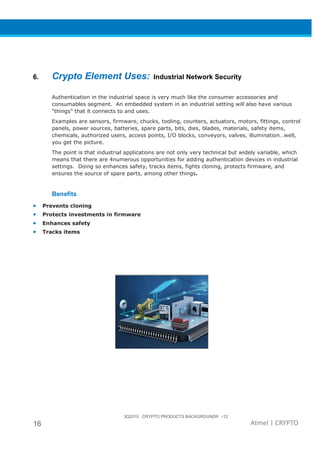
6. Crypto Element Uses: Industrial Network Security
Authentication in the industrial space is very much like the consumer accessories and
consumables segment. An embedded system in an industrial setting will also have various
“things” that it connects to and uses.
Examples are sensors, firmware, chucks, tooling, counters, actuators, motors, fittings, control
panels, power sources, batteries, spare parts, bits, dies, blades, materials, safety items,
chemicals, authorized users, access points, I/O blocks, conveyors, valves, illumination…well,
you get the picture.
The point is that industrial applications are not only very technical but widely variable, which
means that there are 4numerous opportunities for adding authentication devices in industrial
settings. Doing so enhances safety, tracks items, fights cloning, protects firmware, and
ensures the source of spare parts, among other things.
Benefits
• Prevents cloning
• Protects investments in firmware
• Enhances safety
• Tracks items
3Q2015 CRYPTO PRODUCTS BACKGROUNDR r12
17 Atmel | CRYPTO
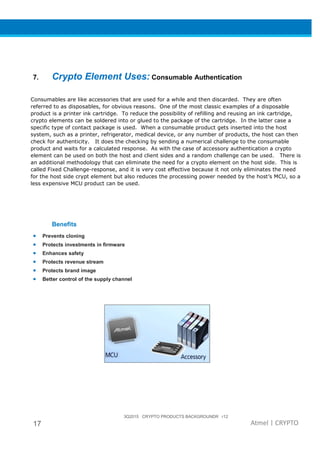
7. Crypto Element Uses: Consumable Authentication
Consumables are like accessories that are used for a while and then discarded. They are often
referred to as disposables, for obvious reasons. One of the most classic examples of a disposable
product is a printer ink cartridge. To reduce the possibility of refilling and reusing an ink cartridge,
crypto elements can be soldered into or glued to the package of the cartridge. In the latter case a
specific type of contact package is used. When a consumable product gets inserted into the host
system, such as a printer, refrigerator, medical device, or any number of products, the host can then
check for authenticity. It does the checking by sending a numerical challenge to the consumable
product and waits for a calculated response. As with the case of accessory authentication a crypto
element can be used on both the host and client sides and a random challenge can be used. There is
an additional methodology that can eliminate the need for a crypto element on the host side. This is
called Fixed Challenge-response, and it is very cost effective because it not only eliminates the need
for the host side crypt element but also reduces the processing power needed by the host’s MCU, so a
less expensive MCU product can be used.
Benefits
• Prevents cloning
• Protects investments in firmware
• Enhances safety
• Protects revenue stream
• Protects brand image
• Better control of the supply channel
18
8. Crypto Element Use
With Vehicle-to-Vehicle (V2V) and Vehicle to Internet (V2I) communications
and listen” to one another
direction, road conditions, and sense other cars, motorcycles, and pedestrians
driver of V2V is signaling impending collisions so th
countermeasures.
While it may seem revolutionary, V2V is really a branch of Internet of Things (IoT).
IoT and V2V as equations, they could be expressed in the following way:
IoT = (MCU + Sensor + Security + Wireless)
V2V = IoT + Car
Equation two states that V2V is really the IoT on wheels.
devices presents a huge challenge, which is safety. Safety can be compromised by hackers
interfering with V2V communications and hacking into automotive control systems. Safety
and security are closely related. Clearly there needs to be strong security on ALL systems in
cars. The US Department and Transportation (DoT) and National Highway Traffic
Administration (NHTSA) are partnering with research institutions and auto companies to
collaborate on technology development and interoperability of V2V to promote traffic safety.
V2V can transform the automotive
opens the door for hackers who want to intercept, spoof, and misuse data. So,
becomes the final piece of the picture, and arguably the element that makes IoT/V2V even
possible to be widely adopted.
based key storage.
3Q2015 CRYPTO PRODUCTS BACKGROUNDR r12
Crypto Element Uses: Automotive Authentication
Vehicle (V2V) and Vehicle to Internet (V2I) communications
and listen” to one another — automatically. They will share information like proximity, speed,
ns, and sense other cars, motorcycles, and pedestrians
of V2V is signaling impending collisions so that the cars can automatically take
While it may seem revolutionary, V2V is really a branch of Internet of Things (IoT).
IoT and V2V as equations, they could be expressed in the following way:
or + Security + Wireless) Low Power
Equation two states that V2V is really the IoT on wheels. However, this spread of electronic
devices presents a huge challenge, which is safety. Safety can be compromised by hackers
fering with V2V communications and hacking into automotive control systems. Safety
and security are closely related. Clearly there needs to be strong security on ALL systems in
US Department and Transportation (DoT) and National Highway Traffic
Administration (NHTSA) are partnering with research institutions and auto companies to
collaborate on technology development and interoperability of V2V to promote traffic safety.
V2V can transform the automotive experience. The danger is that remo
opens the door for hackers who want to intercept, spoof, and misuse data. So,
becomes the final piece of the picture, and arguably the element that makes IoT/V2V even
possible to be widely adopted. Of course the strongest form of security comes from hardware
3Q2015 CRYPTO PRODUCTS BACKGROUNDR r12
Atmel | CRYPTO
Authentication
Vehicle (V2V) and Vehicle to Internet (V2I) communications cars will “talk
automatically. They will share information like proximity, speed,
ns, and sense other cars, motorcycles, and pedestrians. The chief
at the cars can automatically take
While it may seem revolutionary, V2V is really a branch of Internet of Things (IoT). Describing
IoT and V2V as equations, they could be expressed in the following way:
However, this spread of electronic
devices presents a huge challenge, which is safety. Safety can be compromised by hackers
fering with V2V communications and hacking into automotive control systems. Safety
and security are closely related. Clearly there needs to be strong security on ALL systems in
US Department and Transportation (DoT) and National Highway Traffic Safety
Administration (NHTSA) are partnering with research institutions and auto companies to
collaborate on technology development and interoperability of V2V to promote traffic safety.
The danger is that remote communication
opens the door for hackers who want to intercept, spoof, and misuse data. So, strong security
becomes the final piece of the picture, and arguably the element that makes IoT/V2V even
orm of security comes from hardware-
3Q2015 CRYPTO PRODUCTS BACKGROUNDR r12
19 Atmel | CRYPTO
Crypto Basics
3Q2015 CRYPTO PRODUCTS BACKGROUNDR r12
20 Atmel | CRYPTO
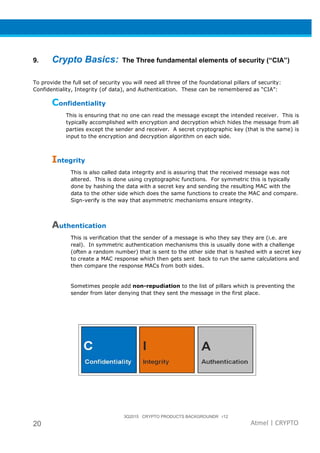
9. Crypto Basics: The Three fundamental elements of security (“CIA”)
To provide the full set of security you will need all three of the foundational pillars of security:
Confidentiality, Integrity (of data), and Authentication. These can be remembered as “CIA”:
Confidentiality
This is ensuring that no one can read the message except the intended receiver. This is
typically accomplished with encryption and decryption which hides the message from all
parties except the sender and receiver. A secret cryptographic key (that is the same) is
input to the encryption and decryption algorithm on each side.
Integrity
This is also called data integrity and is assuring that the received message was not
altered. This is done using cryptographic functions. For symmetric this is typically
done by hashing the data with a secret key and sending the resulting MAC with the
data to the other side which does the same functions to create the MAC and compare.
Sign-verify is the way that asymmetric mechanisms ensure integrity.
Authentication
This is verification that the sender of a message is who they say they are (i.e. are
real). In symmetric authentication mechanisms this is usually done with a challenge
(often a random number) that is sent to the other side that is hashed with a secret key
to create a MAC response which then gets sent back to run the same calculations and
then compare the response MACs from both sides.
Sometimes people add non-repudiation to the list of pillars which is preventing the
sender from later denying that they sent the message in the first place.
3Q2015 CRYPTO PRODUCTS BACKGROUNDR r12
21 Atmel | CRYPTO
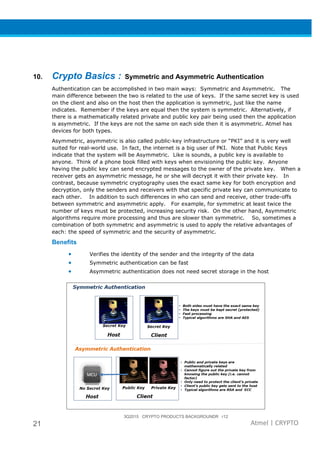
10. Crypto Basics : Symmetric and Asymmetric Authentication
Authentication can be accomplished in two main ways: Symmetric and Asymmetric. The
main difference between the two is related to the use of keys. If the same secret key is used
on the client and also on the host then the application is symmetric, just like the name
indicates. Remember if the keys are equal then the system is symmetric. Alternatively, if
there is a mathematically related private and public key pair being used then the application
is asymmetric. If the keys are not the same on each side then it is asymmetric. Atmel has
devices for both types.
Asymmetric, asymmetric is also called public-key infrastructure or “PKI” and it is very well
suited for real-world use. In fact, the internet is a big user of PKI. Note that Public Keys
indicate that the system will be Asymmetric. Like is sounds, a public key is available to
anyone. Think of a phone book filled with keys when envisioning the public key. Anyone
having the public key can send encrypted messages to the owner of the private key. When a
receiver gets an asymmetric message, he or she will decrypt it with their private key. In
contrast, because symmetric cryptography uses the exact same key for both encryption and
decryption, only the senders and receivers with that specific private key can communicate to
each other. In addition to such differences in who can send and receive, other trade-offs
between symmetric and asymmetric apply. For example, for symmetric at least twice the
number of keys must be protected, increasing security risk. On the other hand, Asymmetric
algorithms require more processing and thus are slower than symmetric. So, sometimes a
combination of both symmetric and asymmetric is used to apply the relative advantages of
each: the speed of symmetric and the security of asymmetric.
Benefits
• Verifies the identity of the sender and the integrity of the data
• Symmetric authentication can be fast
• Asymmetric authentication does not need secret storage in the host
3Q2015 CRYPTO PRODUCTS BACKGROUNDR r12
22 Atmel | CRYPTO
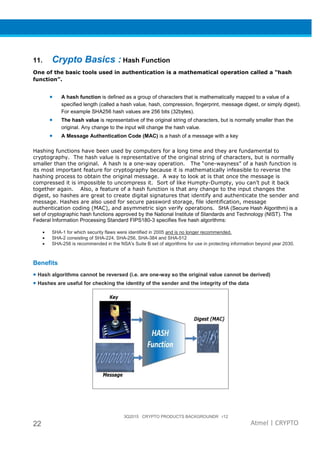
11. Crypto Basics : Hash Function
One of the basic tools used in authentication is a mathematical operation called a “hash
function”.
• A hash function is defined as a group of characters that is mathematically mapped to a value of a
specified length (called a hash value, hash, compression, fingerprint, message digest, or simply digest).
For example SHA256 hash values are 256 bits (32bytes).
• The hash value is representative of the original string of characters, but is normally smaller than the
original. Any change to the input will change the hash value.
• A Message Authentication Code (MAC) is a hash of a message with a key
Hashing functions have been used by computers for a long time and they are fundamental to
cryptography. The hash value is representative of the original string of characters, but is normally
smaller than the original. A hash is a one-way operation. The “one-wayness” of a hash function is
its most important feature for cryptography because it is mathematically infeasible to reverse the
hashing process to obtain the original message. A way to look at is that once the message is
compressed it is impossible to uncompress it. Sort of like Humpty-Dumpty, you can’t put it back
together again. Also, a feature of a hash function is that any change to the input changes the
digest, so hashes are great to create digital signatures that identify and authenticate the sender and
message. Hashes are also used for secure password storage, file identification, message
authentication coding (MAC), and asymmetric sign verify operations. SHA (Secure Hash Algorithm) is a
set of cryptographic hash functions approved by the National Institute of Standards and Technology (NIST). The
Federal Information Processing Standard FIPS180-3 specifies five hash algorithms:
• SHA-1 for which security flaws were identified in 2005 and is no longer recommended.
• SHA-2 consisting of SHA-224, SHA-256, SHA-384 and SHA-512
• SHA-256 is recommended in the NSA's Suite B set of algorithms for use in protecting information beyond year 2030.
Benefits
• Hash algorithms cannot be reversed (i.e. are one-way so the original value cannot be derived)
• Hashes are useful for checking the identity of the sender and the integrity of the data
3Q2015 CRYPTO PRODUCTS BACKGROUNDR r12
23 Atmel | CRYPTO
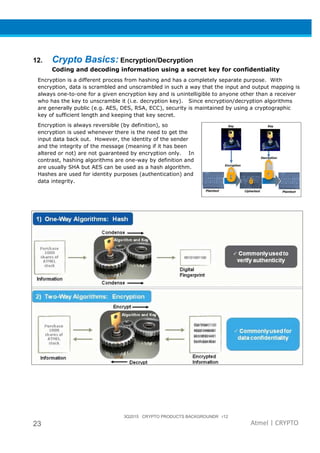
12. Crypto Basics: Encryption/Decryption
Coding and decoding information using a secret key for confidentiality
Encryption is a different process from hashing and has a completely separate purpose. With
encryption, data is scrambled and unscrambled in such a way that the input and output mapping is
always one-to-one for a given encryption key and is unintelligible to anyone other than a receiver
who has the key to unscramble it (i.e. decryption key). Since encryption/decryption algorithms
are generally public (e.g. AES, DES, RSA, ECC), security is maintained by using a cryptographic
key of sufficient length and keeping that key secret.
Encryption is always reversible (by definition), so
encryption is used whenever there is the need to get the
input data back out. However, the identity of the sender
and the integrity of the message (meaning if it has been
altered or not) are not guaranteed by encryption only. In
contrast, hashing algorithms are one-way by definition and
are usually SHA but AES can be used as a hash algorithm.
Hashes are used for identity purposes (authentication) and
data integrity.
3Q2015 CRYPTO PRODUCTS BACKGROUNDR r12
24 Atmel | CRYPTO
13. Crypto Basics : Crypto Glossary
Encryption is encoding and decoding of a message for confidentiality. It is always
reversible. Encryption does not authenticate.
Authentication is used to check the identity and of the sender and the integrity of the
message. The message is not necessarily encrypted.
Symmetric authentication uses an identical key on the host and client sides, and both of
those keys must be protected (this is very important). Symmetric authentication tends
to be relatively fast.
Asymmetric authentication uses a public / private key pair. The private key must be
securely stored on the client. Secure key storage on the host is not needed. The keys
are mathematically related, but the private key cannot be obtained from simply having
the public key. More computation is required with asymmetric authentication than
symmetric.
Key Storage is one of the most important determinants of the strength of security in a
system. Hardware key storage is much stronger than software-based solutions because
hardware storage methods are much more difficult to attack. (CryptoAuthentication ICs
are hardware key storage devices.)
Hash functions are a group of characters that is mathematically mapped to a value of a
certain length and is representative of the original string of characters, but is normally
smaller than the original. Hash functions are commonly used in authentication and
encryption operations. They are one way functions which means that the original value
cannot be recreated from the hashed value (i.e. digest).
Challenge-Response is an operation where a challenge (usually a random number) is sent
to a client to elicit a response in order to test the authenticity of a client. The response
is often a hash value of that number another number such as a cryptographic key. The
response is then compared to a parallel calculation done on the originating device to
see if they match.
MAC (Message Authentication Code) is the result of a hash operation with a secret key
and a message. That result (called the MAC) can be used to ensure the data has not
been modified or corrupted by running the MAC on received data and comparing the
MAC of the message that was sent with it. If the MAC received with the message and
the MAC calculated on the receive side on the received message match then the
received data was unchanged.
Sign/Verify is an authentication operation that creates a hash digest of data, which is then
encrypted using a private key to make a signature. To verify, the receiver hashes the
received data and then decrypts the received signature of that data with the sender’s
public key. If the signature received from the sender matches the hash that the
receiver generated with the public key, then the signature is considered valid.
ECDSA (Elliptic Curve Digital Signature Algorithm) an elegant and standardized method to
provide asymmetric authentication using a sign-verify process using Elliptic Curve (ECC)
3Q2015 CRYPTO PRODUCTS BACKGROUNDR r12
25 Atmel | CRYPTO
algorithms to make a signature. ECDSA has two phases which are 1) to verify the
public key, and 2) verify the private key of the client (i.e. accessory) device. ECDSA
capability is built into the Atmel ATECC108A device. X.509 is an ITU standard that
specifies what goes into the certificate.
ECDH Key Agreement (Elliptic Curve Diffie-Hellman) an elegant and standardized method
to provide asymmetric authentication using a sign-verify process using an
anonymous key agreement protocol that allows two parties, each having an elliptic
curve public–private key pair, to establish a shared secret over an insecure channel.
This shared secret may be directly used as a key, or to derive another key which can
then be used to encrypt subsequent communications using a symmetric key cipher. It is
a variant of the Diffie–Hellman protocol using elliptic curve cryptography.
Root certificate is a public key certificate that identifies the Root Certificate
Authority (CA). The most common commercial variety is based on the ITU-
T X.509 standard, which normally includes a digital signature from a certificate
authority. .Digital certificates are verified using a chain of trust. The trust anchor for the
digital certificate is the Root Certificate Authority (CA).
Public-key cryptography (PKI), is a class of algorithms which requires two
separate keys, one of which is secret (private) and one public. This key pair is
mathematically linked by algorithms that are computationally infeasible to determine
the private key from the public key (i.e. cannot factor). The public key is used
to encrypt plaintext or verify a digital signature. The private key is used to
decrypt ciphertext or to create a digital signature. The term "asymmetric" stems from
the use of different keys to perform these opposite functions, each the inverse of the
other – as contrasted with conventional ("symmetric") cryptography which relies on the
same key to perform both. Public-key algorithms are based on mathematical problems
which currently admit no efficient solution that are inherent in certain integer
factorization, discrete logarithm, and elliptic curve relationships.
Transport Layer Security (TLS) is how security for HTTP protocol is provided to secure
websites. TLS authenticates the server at the request of the client. The server that
hosts the website, for example, can optionally also authenticate the client. After
authentication encryption/decryption session keys are exchanged, which are then used
for encryption and decryption using the selected encryption/decryption algorithm. TLS
uses a handshake procedure to select which security algorithms will be used for the
session and also sends random numbers and cryptographic certificates authentication
and key exchange processes. TKS offers all three pillars of security, namely
confidentiality, (data) integrity, and authentication. TLS is the successor to Secure
Socket Layer (SSL), so you will often see the term “SSL/TLS”.
Application Layer Security (OSI Application Layer) ensures that the information that will
be sent through a communications channel or directly connected to a machine or device
is secure. Examples of cryptographic procedures to provide applications layer security
are ECDSA for authentication, ECDH key agreement to create session keys, and
encryption/decryption engines (such as AES that use the session keys) for encrypting
and decrypting messages. These methods make sure that the data source (e.g. a
sensor in an IoT node) is authentic, the data is confidential, and has not been tampered
3Q2015 CRYPTO PRODUCTS BACKGROUNDR r12
26 Atmel | CRYPTO
with (has integrity). Security at both the transport and application layers is
recommended for wireless applications.
“CIA” Confidentiality, integrity (of the data), and authenticity. All three are necessary for
a truly secure application.
Hardware Security Module (HSM) is a physical computing device that safeguards and
manages digital keys for strong authentication and provides cryptographic processing.
These modules traditionally come in the form of a plug-in card or an external device
that attaches directly to a computer or network server.
Trusted Platform Module (TPM) is an international standard for a secure cryptographic
processor designed to secure hardware with protected cryptographic keys. The
specification is devined by the Trusted Computing Group (TCG). ISO and IEC
standardized the specification as ISO/IEC 11889 in 2009. TCG published revision 116
version 1.2 on March 3, 2011. Trusted Platform Module Library Specification Revision
01.16 was released October 2014 and is the most current TPM 2.0 release
3Q2015 CRYPTO PRODUCTS BACKGROUNDR r12
27 Atmel | CRYPTO
Crypto
Operations
3Q2015 CRYPTO PRODUCTS BACKGROUNDR r12
28 Atmel | CRYPTO
14. Crypto Operations: Why use Crypto Elements?
Because connected things need strong authentication…and more.
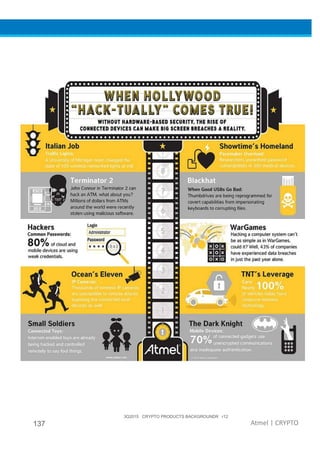
It seems that every day new and increasingly dangerous viruses are infecting digital
systems. Viruses with names such as Heartbleed, Shellshock, Poodle, and Bad USB have put
innocent people at risk in 2014 alone. Russian Cyber gangs (a.k.a. “CyberVor”) have exposed
over a billion passwords. The scary thing is that the attacks are targeted at the very security
mechanisms that are meant to provide protection. Because the digital protection mechanisms
themselves have become targets, they must be hardened. This is especially important now
that the digital universe is going through a type of Big Bang with the explosion of the IoT.
That is sending billions of little sensing and communicating processors all over the earth, like
dust. Growth in processing, communicating, and sensing semiconductors (which are exactly
what the IoT is made from) will grow at a rate of over 36% in 2015 according to Gartner,
dwarfing the overall semiconductor market growth of 5.7%. Big Bang. Big Growth.
As for security, the IoT will multiply the number of points for infection that hackers
can attack by many orders of magnitude.
It is not hard to see that trust in the data communicated via an ubiquitous (and nosey) IoT
will be necessary for the IoT to be widely adopted. Without trust, the IoT will fail to launch.
There is hardly any doubt there. In fact, the recognized inventor of the Internet, Vint Cerf,
completely agrees, saying that strong authentication is important for the IoT, and we need to
make sure they are talking to the devices they are supposed to talk to. Those are very clear
statements, but for fun let’s translate Dr. Cerf’s admonition into pop culture parlance: “No
security? No IoT for you.”
There is much more to the story behind why the IoT needs strong security. Because the
world has become hyper-connected, financial and other sensitive transactions have become
almost exclusively electronic. Money now is simply electronic data, so everyone and every
company are at risk of financial losses stemming directly from data breaches. See?
Databanks are where the money is kept and data is what criminals attack. While breaches
are in fact being publicized, there has not been much open talk about their leading to
significant corporate financial liability. That liability, however, is real and growing. So, CEOs
should not be the least bit surprised when they start to be challenged by significant
shareholder and class action lawsuits stemming from security breaches.
Although inadvertent, companies are in fact exposing identities and sensitive financial
information of millions of customers, and they may not always be taking all the measures that
they can to ensure the security and safety of their products, data, and systems. Both
exposure of personal data and risk of product cloning can translate to financial damages.
Damages translate to legal action. The logic of tort and securities lawyers is that if proven
methods to secure against hacking and cloning already exist, then it is the fiduciary duty of
the leaders of corporations (i.e. the C-Suite occupants) to embrace such
protection mechanisms (such as hardware-based key storage), and not doing so could
possibly be argued as being negligent. Agree or not, that line of argumentation is logical and
perhaps likely.
A few CEOs have already started to equip their systems and products with strong hardware-
based security devices...but they are doing it quietly and not telling their competitors. This
gives them an edge.
3Q2015 CRYPTO PRODUCTS BACKGROUNDR r12
29 Atmel | CRYPTO
Why use crypto elements? (Continued)
Software, Hardware, and Hackers. Why is it that hackers are able to penetrate systems
and steal passwords, digital IDs, intellectual property, financial data, and other secrets? It is
because until now only software has been used to protect software from hackers. Hackers
love software. Breaking into software is what they live for.
The problem is that rogue software can see into system memory, so it is not a great place to
store important things such as passwords, digital IDs, security keys, and other valuable
things. The bottom line is that all software is vulnerable because software has bugs despite
the best efforts of developers to eliminate them. So what about storing important things in
hardware?
Hardware is better, but standard integrated circuits can be physically probed to read what
is on the circuit. Also, power analysis can quickly extract secrets from hardware. So, is
there anything that can be done? The answer fortunately is yes.
Three of four generations of hardware key storage devices have been designed to protect
keys with physical barriers and cryptographic countermeasures that ward off even the most
aggressive attacks. Once keys are securely locked away in protected hardware attackers
cannot see them and they cannot attack what they cannot see. Secure hardware key
storage devices like Atmel CryptoAuthentication™ employ both cryptographic algorithms and
a tamper-hardened hardware boundary to keep attackers from getting at the cryptographic
keys and other sensitive data.
Keeping secrets keys secret. The basic idea behind such protection is that cryptographic
security depends on how securely the cryptographic keys are stored. But of course it is of no
use if the keys are simply locked away. There needs to be a mechanism to use the keys
without exposing them. That is the other part of the CryptoAuthentication™ equation,
namely built-in crypto engines that run cryptographic processes and algorithms. A simple
example of accessing the secret key without exposing it is using challenges (usually random
numbers), secret keys, and cryptographic algorithms to create unique and irreversible
signatures that provide security without anyone seeing the secret key.
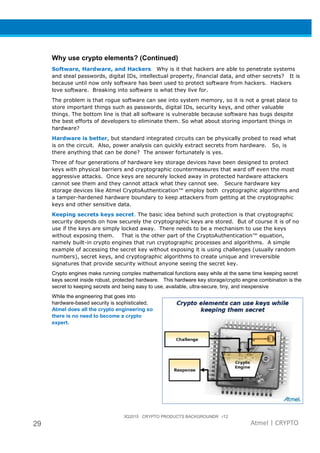
Crypto engines make running complex mathematical functions easy while at the same time keeping secret
keys secret inside robust, protected hardware. This hardware key storage/crypto engine combination is the
secret to keeping secrets and being easy to use, available, ultra-secure, tiny, and inexpensive
While the engineering that goes into
hardware-based security is sophisticated,
Atmel does all the crypto engineering so
there is no need to become a crypto
expert.
3Q2015 CRYPTO PRODUCTS BACKGROUNDR r12
30 Atmel | CRYPTO
15. Crypto Operations: Symmetric Authentication with secrets stored on
the host using Random Challenge-Response.
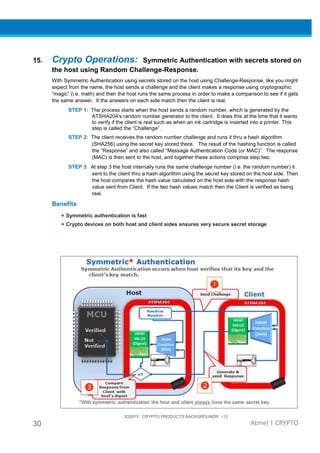
With Symmetric Authentication using secrets stored on the host using Challenge-Response, like you might
expect from the name, the host sends a challenge and the client makes a response using cryptographic
“magic” (i.e. math) and then the host runs the same process in order to make a comparison to see if it gets
the same answer. It the answers on each side match then the client is real.
STEP 1: The process starts when the host sends a random number, which is generated by the
ATSHA204’s random number generator to the client. It does this at the time that it wants
to verify if the client is real such as when an ink cartridge is inserted into a printer. This
step is called the “Challenge”.
STEP 2: The client receives the random number challenge and runs it thru a hash algorithm
(SHA256) using the secret key stored there. The result of the hashing function is called
the “Response” and also called “Message Authentication Code (or MAC)”. The response
(MAC) is then sent to the host, and together these actions comprise step two.
STEP 3: At step 3 the host internally runs the same challenge number (i.e. the random number) it
sent to the client thru a hash algorithm using the secret key stored on the host side. Then
the host compares the hash value calculated on the host side with the response hash
value sent from Client. If the two hash values match then the Client is verified as being
real.
Benefits
• Symmetric authentication is fast
• Crypto devices on both host and client sides ensures very secure secret storage
3Q2015 CRYPTO PRODUCTS BACKGROUNDR r12
31 Atmel | CRYPTO
16. Crypto Operations: Symmetric Authentication without secret
storage on the host using a Fixed Challenge
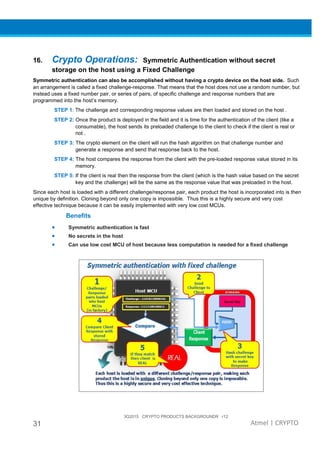
Symmetric authentication can also be accomplished without having a crypto device on the host side. Such
an arrangement is called a fixed challenge-response. That means that the host does not use a random number, but
instead uses a fixed number pair, or series of pairs, of specific challenge and response numbers that are
programmed into the host’s memory.
STEP 1: The challenge and corresponding response values are then loaded and stored on the host .
STEP 2: Once the product is deployed in the field and it is time for the authentication of the client (like a
consumable), the host sends its preloaded challenge to the client to check if the client is real or
not .
STEP 3: The crypto element on the client will run the hash algorithm on that challenge number and
generate a response and send that response back to the host.
STEP 4: The host compares the response from the client with the pre-loaded response value stored in its
memory.
STEP 5: If the client is real then the response from the client (which is the hash value based on the secret
key and the challenge) will be the same as the response value that was preloaded in the host.
Since each host is loaded with a different challenge/response pair, each product the host is incorporated into is then
unique by definition. Cloning beyond only one copy is impossible. Thus this is a highly secure and very cost
effective technique because it can be easily implemented with very low cost MCUs.
Benefits
• Symmetric authentication is fast
• No secrets in the host
• Can use low cost MCU of host because less computation is needed for a fixed challenge
3Q2015 CRYPTO PRODUCTS BACKGROUNDR r12
32 Atmel | CRYPTO
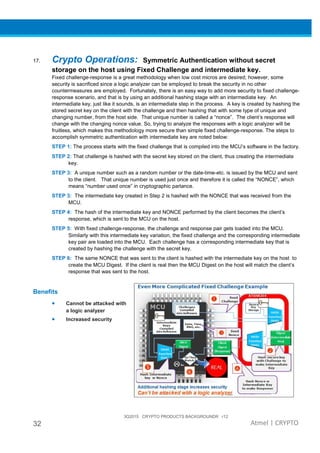
17. Crypto Operations: Symmetric Authentication without secret
storage on the host using Fixed Challenge and intermediate key.
Fixed challenge-response is a great methodology when low cost micros are desired; however, some
security is sacrificed since a logic analyzer can be employed to break the security in no other
countermeasures are employed. Fortunately, there is an easy way to add more security to fixed challenge-
response scenario, and that is by using an additional hashing stage with an intermediate key. An
intermediate key, just like it sounds, is an intermediate step in the process. A key is created by hashing the
stored secret key on the client with the challenge and then hashing that with some type of unique and
changing number, from the host side. That unique number is called a “nonce”. The client’s response will
change with the changing nonce value. So, trying to analyze the responses with a logic analyzer will be
fruitless, which makes this methodology more secure than simple fixed challenge-response. The steps to
accomplish symmetric authentication with intermediate key are noted below:
STEP 1: The process starts with the fixed challenge that is compiled into the MCU’s software in the factory.
STEP 2: That challenge is hashed with the secret key stored on the client, thus creating the intermediate
key.
STEP 3: A unique number such as a random number or the date-time-etc. is issued by the MCU and sent
to the client. That unique number is used just once and therefore it is called the “NONCE”, which
means “number used once” in cryptographic parlance.
STEP 3: The intermediate key created in Step 2 is hashed with the NONCE that was received from the
MCU.
STEP 4: The hash of the intermediate key and NONCE performed by the client becomes the client’s
response, which is sent to the MCU on the host.
STEP 5: With fixed challenge-response, the challenge and response pair gets loaded into the MCU.
Similarly with this intermediate key variation, the fixed challenge and the corresponding intermediate
key pair are loaded into the MCU. Each challenge has a corresponding intermediate key that is
created by hashing the challenge with the secret key.
STEP 6: The same NONCE that was sent to the client is hashed with the intermediate key on the host to
create the MCU Digest. If the client is real then the MCU Digest on the host will match the client’s
response that was sent to the host.
Benefits
• Cannot be attacked with
a logic analyzer
• Increased security
3Q2015 CRYPTO PRODUCTS BACKGROUNDR r12
33 Atmel | CRYPTO
18. Crypto Operations: Asymmetric Authentication Using Digital
Signatures (ECDSA)
In the real world the Asymmetric Authentication process typically begins when a client device is inserted
into a host system or the host system wants to know what exactly is connected to it. Examples are a
printer ink cartridge being inserted into a printer, a thermostat control block wanting to talk to a remote
temperature sensor, a cell phone connecting to a wall charger, and many others.
The best way to understand how ECDSA performs authentication and how it ties that back to
the root of trust is to break it down into its individual steps. Admittedly, there are many
steps but each one does a very specific and simple thing, so it is easy to follow. To simplify
the process, it is useful to group the steps into sequential phases that perform distinct
objectives in the process. Fortunately, there is a clear break between two major objectives,
so we can break it into a phase one and phase two.
Phase one’s goal is to use ECDSA calculation algorithms to verify the public key on
the client. Phase one has a second goal which is implied, and that is to verify the entire
certificate chain back to the root of trust (i.e. the certificate authority or “issuer”). One way
to look at it is that the host MCU must identify and confirm the entire history of who signed
what. (In this example we will look at a two level signing history going from the issuer to the
signing module to the client device.)
To accomplish the verification of the public key in phase one it is necessary to verify all the
signatures in the certificate chain. In this example the signatures are stored in the client in
two distinct digital certificates. One is the client’s certificate and the other is the signer’s
certificate. The certificates are the mechanism that allows the chain to reach back to the root
of trust (i.e. the issuer).
Phase two’s goal is to use ECDSA calculations to verify that the private key on the
client is related to the previously verified public key. Verifying that the client has a valid
public-private key pair is the soul of symmetric authentication. If the ECDSA verify
calculation operations of both phases pass then the client is verified as real. And that is the
whole purpose.
Benefits
• Increased security because asymmetric authentication does not need secure key storage on
the host (only the client)
• No need to update the host with secrets in the field. (Can update the public key at any time.)
• ATECC108A and ATECC508A have ECDSA built in, making it super-easy to implement.
3Q2015 CRYPTO PRODUCTS BACKGROUNDR r12
34 Atmel | CRYPTO
19. Crypto Operations: Asymmetric Authentication
Making the ECDSA certificates
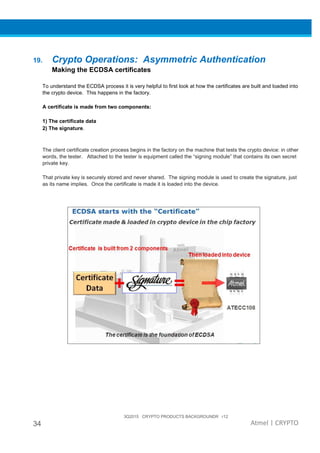
To understand the ECDSA process it is very helpful to first look at how the certificates are built and loaded into
the crypto device. This happens in the factory.
A certificate is made from two components:
1) The certificate data
2) The signature.
The client certificate creation process begins in the factory on the machine that tests the crypto device: in other
words, the tester. Attached to the tester is equipment called the “signing module” that contains its own secret
private key.
That private key is securely stored and never shared. The signing module is used to create the signature, just
as its name implies. Once the certificate is made it is loaded into the device.
3Q2015 CRYPTO PRODUCTS BACKGROUNDR r12
35 Atmel | CRYPTO
20. Crypto Operations: Asymmetric Authentication
Creating the Client’s Certificate
First, let’s look at the creation of the certificate data.
The certificate data is made up of three items: 1) static data, 2) dynamic data, and 3) the
client’s public key. You can look at the static data as a type of boilerplate that contains basic
information such as the company’s name, address, and other information that never changes. In
contrast, dynamic data from the tester are data that generally change with each part or group of
parts being tested. Dynamic data include things like the serial number, date, time, expiration date,
and so on. The client’s public key is the third item that goes into the certificate data. Recall that
the client’s public key is paired to the private key of the client device. The private key is securely
stored in the ATECC508A and never shared (which makes it private). Now the process moves to
making the signature.
Recall that the certificate data c omprises just half of a certificate. The other half is the
signature. What is a little tricky to understand at first is that the certificate data have two purposes
when it comes to building the certificate: (1) to become part of the certificate, and (2) to get hashed
and then run through a signing algorithm to produce the signature. Both the certificate data and the
signature made from that certificate data make up the complete certificate, and that is a major point
to remember. You can see the two purposes of the certificate data clearly in the diagram, which
shows how the certificate data are assembled and stored in the certificate and then also digested and
input to the signing process on the signing module.
As for the details, the signature process begins with a copy of the certificate data being put through
a hash algorithm to create a number called a hash value (or digest). ECDSA P-256 specifies a 32
byte digest length and SHA256 as the hashing algorithm. Once created, the digest is ready to be
signed by the sign module in the factory.
The sign module is a piece
of equipment that
securely stores the
signer’s private key. Being
securely stored means
that no one can get
access to that key. The
sign module uses the ECC
sign algorithm to sign the
digest of the certificate
data with the signer’s
private key. The result of
that process becomes the
“signature” of the
certificate data that went
into the singing module
and signed with the
private key of the module.
The signature then joins
the original (i.e.
unhashed) certificate data
to complete
the certificate.
3Q2015 CRYPTO PRODUCTS BACKGROUNDR r12
36 Atmel | CRYPTO
21. Crypto Operations: Asymmetric Authentication
Creating the Signer’s Certificate
Another certificate called the signer’s certificate is used to create the link to the certificate
authority (issuer). The signer’s certificate is made by the issuer creating a signature over the
signer’s certificate data that it receives from the tester. It signs the data using its (i.e. the
issuer’s) private key. Both the signer’s and client’s certificates are stored in the ATECC508A
device. The signer’s certificate is made by the tester’s assembling the signer’s certificate data
and placing it into the certificate, and then hashing signer certificate data and sending that
digest to the certificate authority (issuer) to be signed with the issuer’s private key. Once
created, the signature is sent back to the tester to be inserted into the signer’s certificate
alongside the signer’s certificate data. That completes the singer’s certificate. The public key
of the issuer that corresponds to the issuer’s private key gets sent to the MCU to use later
during the actual authentication process. Both certificates are now finished and can be
securely installed into the crypto device by the
tester.
3Q2015 CRYPTO PRODUCTS BACKGROUNDR r12
37 Atmel | CRYPTO
22. Crypto Operations: Asymmetric Authentication
ECDSA is a two phased process (Phase 1, Part 1: Verify Client’s Public Key)
ECDSA is a two phased process with phase one being to verify both the client’s and signer’s
public keys. Phase one links (i.e. chains) the client’s and signer’s signatures back to the
issuer’s signature, which establishes the root of trust (i.e. ties to the anchor).
Phase two’s purpose is to verify the client’s private key. When each of the keys are verified it
is proven that there is a valid client public and private key pair, and that they tie back to the
root of trust. In short, that means that the client is mathematically verified as being real (i.e.
authenticated).
Phase 1 starts with the host requesting information to be sent over by the client (accessory).
That information comes over to the host in the client’s certificate and in the singer’s
certificate. When the host receives the certificates, it extracts the client’s certificate data
(client’s static data, client’s dynamic data, and client’s public key) and the signature made by
the signing module in the chip factory) from the client’s certificate. It also extracts the
signer’s certificate data (including the signer’s public key) and the issuer’s signature that was
made by the certificate authority (the issuer) from the signer’s certificate. The host runs a
hashing process on the both sets of certificate data that it just received, creating two 32-byte
message digests (P-256 curve): 1) the client’s digest, and 2) the signer’s digest.
The extracted signer’s public key from the signer’s certificate is input to the ECDSA verify
calculation together with the client’s digest (number 1 above) and the client’s signature from
the client’s certificate. The purpose of this ECDSA calculation is to verify the client’s public
key.
3Q2015 CRYPTO PRODUCTS BACKGROUNDR r12
38 Atmel | CRYPTO
23. Crypto Operations: Asymmetric Authentication
ECDSA is a two phased process (Phase 1, Part 2: Verify Issuer’s Signature)
Before the ECDSA calculation of phase 1, part 1 can be accepted as complete, another ECDSA
calculation must be run to verify that the root of trust exists. That second calculation is called
phase 1, part 2. The root of trust is established by linking the signer’s signature to the
issuer’s signature. This is done by verifying via an ECDSA verify calculation the issuer’s
signature.
To do so, the issuer’s signature (extracted from the Signer’s certificate) is input to the second
ECDSA calculation along with two other inputs:
1) The digest made by hashing the signer’s certificate data, and
2) The issuer’s public key that came over to the MCU at some earlier point (and was
stored in memory of the MCU).
If both ECDSA calculations pass then the client’s public key is considered to be verified all the
way back to the root of trust (i.e. the issuer).
3Q2015 CRYPTO PRODUCTS BACKGROUNDR r12
39 Atmel | CRYPTO
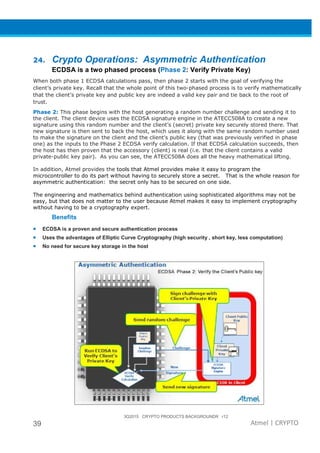
24. Crypto Operations: Asymmetric Authentication
ECDSA is a two phased process (Phase 2: Verify Private Key)
When both phase 1 ECDSA calculations pass, then phase 2 starts with the goal of verifying the
client’s private key. Recall that the whole point of this two-phased process is to verify mathematically
that the client’s private key and public key are indeed a valid key pair and tie back to the root of
trust.
Phase 2: This phase begins with the host generating a random number challenge and sending it to
the client. The client device uses the ECDSA signature engine in the ATECC508A to create a new
signature using this random number and the client’s (secret) private key securely stored there. That
new signature is then sent to back the host, which uses it along with the same random number used
to make the signature on the client and the client’s public key (that was previously verified in phase
one) as the inputs to the Phase 2 ECDSA verify calculation. If that ECDSA calculation succeeds, then
the host has then proven that the accessory (client) is real (i.e. that the client contains a valid
private-public key pair). As you can see, the ATECC508A does all the heavy mathematical lifting.
In addition, Atmel provides the tools that Atmel provides make it easy to program the
microcontroller to do its part without having to securely store a secret. That is the whole reason for
asymmetric authentication: the secret only has to be secured on one side.
The engineering and mathematics behind authentication using sophisticated algorithms may not be
easy, but that does not matter to the user because Atmel makes it easy to implement cryptography
without having to be a cryptography expert.
Benefits
• ECDSA is a proven and secure authentication process
• Uses the advantages of Elliptic Curve Cryptography (high security , short key, less computation)
• No need for secure key storage in the host
3Q2015 CRYPTO PRODUCTS BACKGROUNDR r12
40 Atmel | CRYPTO
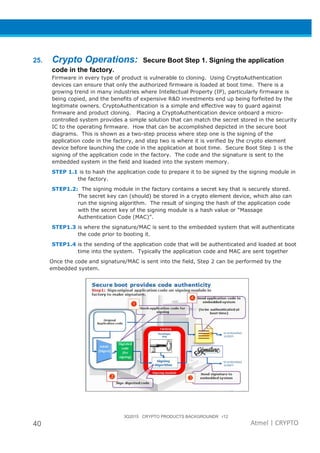
25. Crypto Operations: Secure Boot Step 1. Signing the application
code in the factory.
Firmware in every type of product is vulnerable to cloning. Using CryptoAuthentication
devices can ensure that only the authorized firmware is loaded at boot time. There is a
growing trend in many industries where Intellectual Property (IP), particularly firmware is
being copied, and the benefits of expensive R&D investments end up being forfeited by the
legitimate owners. CryptoAuthentication is a simple and effective way to guard against
firmware and product cloning. Placing a CryptoAuthentication device onboard a micro-
controlled system provides a simple solution that can match the secret stored in the security
IC to the operating firmware. How that can be accomplished depicted in the secure boot
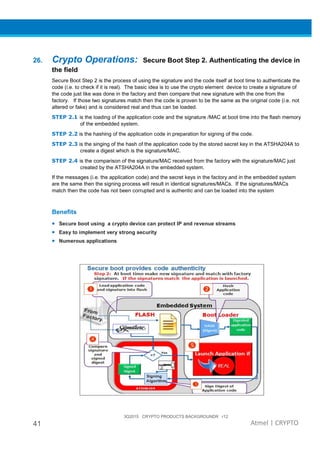
diagrams. This is shown as a two-step process where step one is the signing of the
application code in the factory, and step two is where it is verified by the crypto element
device before launching the code in the application at boot time. Secure Boot Step 1 is the
signing of the application code in the factory. The code and the signature is sent to the
embedded system in the field and loaded into the system memory.
STEP 1.1 is to hash the application code to prepare it to be signed by the signing module in
the factory.
STEP1.2: The signing module in the factory contains a secret key that is securely stored.
The secret key can (should) be stored in a crypto element device, which also can
run the signing algorithm. The result of singing the hash of the application code
with the secret key of the signing module is a hash value or “Massage
Authentication Code (MAC)”.
STEP1.3 is where the signature/MAC is sent to the embedded system that will authenticate
the code prior to booting it.
STEP1.4 is the sending of the application code that will be authenticated and loaded at boot
time into the system. Typically the application code and MAC are sent together
Once the code and signature/MAC is sent into the field, Step 2 can be performed by the
embedded system.
3Q2015 CRYPTO PRODUCTS BACKGROUNDR r12
41 Atmel | CRYPTO
26. Crypto Operations: Secure Boot Step 2. Authenticating the device in
the field
Secure Boot Step 2 is the process of using the signature and the code itself at boot time to authenticate the
code (i.e. to check if it is real). The basic idea is to use the crypto element device to create a signature of
the code just like was done in the factory and then compare that new signature with the one from the
factory. If those two signatures match then the code is proven to be the same as the original code (i.e. not
altered or fake) and is considered real and thus can be loaded.
STEP 2.1 is the loading of the application code and the signature /MAC at boot time into the flash memory
of the embedded system.
STEP 2.2 is the hashing of the application code in preparation for signing of the code.
STEP 2.3 is the singing of the hash of the application code by the stored secret key in the ATSHA204A to
create a digest which is the signature/MAC.
STEP 2.4 is the comparison of the signature/MAC received from the factory with the signature/MAC just
created by the ATSHA204A in the embedded system.
If the messages (i.e. the application code) and the secret keys in the factory and in the embedded system
are the same then the signing process will result in identical signatures/MACs. If the signatures/MACs
match then the code has not been corrupted and is authentic and can be loaded into the system
Benefits
• Secure boot using a crypto device can protect IP and revenue streams
• Easy to implement very strong security
• Numerous applications
3Q2015 CRYPTO PRODUCTS BACKGROUNDR r12
42 Atmel | CRYPTO
27. Crypto Operations: Protecting Downloaded Firmware with
Symmetric Keys; Step1: Encrypt and MAC application code
Software and firmware IP protection possibly provides the largest opportunity application target market.
This segment includes anyone that has an embedded system or software solution. And, that is just about
anyone that has a processor in their system.
Most systems use nonvolatile memory to store programs to remotely add features and fix problems, but
they are vulnerable to hacking. That is because all software based systems can be hacked.
CryptoAuthentication crypto element devices protect downloaded firmware by preventing hackers from
getting software images and algorithms. This ensures that only unmodified OEM-authorized firmware gets
loaded in nonvolatile memory. The usage models are flexible. All downloads will be identical and the user
can post download on the web without concern of theft because the firmware will be encrypted. Two of the
fundamental cryptographic pillars are used in this case: encryption and authentication. Encryption allows
the software IP to be sent to target users without others being able to understand what it is and use it. It will
of course be decrypted on the other side. Authentication is used to ensure that the code that gets
decrypted is indeed the intended code and has not been altered, replaced, or corrupted.
This is a two step process with Step 1 being done by the developer on the sending side to encrypt the
original application code using an encryption key, and to create a Message Authentication Code (MAC) to
ensure authenticity. Step 2 is done on the receiving side by downloading the encrypted code and MAC in
order to decrypt and authenticate the code. Step 1: Encrypt and MAC application code happens as follows:
STEP 1.1: The code developer creates an encryption key in order to encrypt the code that will be
downloaded by the receiving side. This is done using an ATSHA204A that stores a secret key
for encryption. The ATSHA204A hashes a seed number with the secret key to create a digest
(Message Authentication Code (MAC)), which will be the encryption key that is input to the
encryption algorithm that is run on the MCU.
STEP 1.2: The MCU encrypts the code using an encryption algorithm (such as AES) using the encryption
key just created.
STEP 1.3: The encrypted code is put in a place to allow it to be downloaded by the target user. The seed
number used to create the encryption key will also be put in that same place. The seed and
encrypted code will be downloaded together.
STEP1.4: addresses the other pillar of security which is authentication. This is done by hashing (or
padding) the original application code to size it correctly to be hashed with the secret
authentication key, which is
a different key than used
earlier fro encryption. The
result of the hash of the
digested (or padded)
application code with the
authentication key is the
“Authentication MAC”.
STEP 1.5: That Authentication MAC
gets put into the same place
as the encrypted code and
seed number so that all of
those can be downloaded
by the receiving side.
3Q2015 CRYPTO PRODUCTS BACKGROUNDR r12
43 Atmel | CRYPTO
28. Crypto Operations: Protecting Downloaded Firmware with Symmetric
Keys; Step2: Download, Decrypt, and Authenticate
The target user of protected firmware will download the encrypted code, seed number, and Authentication
MAC.
STEP 2.1 To decrypt the code the seed that was downloaded is hashed with the secret key stored in the
crypto element on the client embedded system. Being symmetric, this stored secret key has
the same value the key stored the on the transmitting (uploading) side. The result of the
hashing of the secret key with the seed number will be the decryption key, which of course
matches the encryption key if it has not been corrupted during transit.
STEP 2.2: The embedded system’s MCU uses the decryption key just created as input to the encryption
algorithm (such as AES) to decrypt and recover the application code. The process then
moves to the authentication stage.
STEP 2.3: The newly decrypted code gets hashed (or padded) just like was done by the developer on
the transmitting side to prepare it for hashing with the secret Authentication key. That key is
exactly the same as the Authentication key the developer used since this is a symmetric
process. The result of that hash is the Client’s Authentication MAC.
STEP 2.4: It will be compared (using the CheckMAC command) to the Authentication MAC that was
downloaded with the encrypted code and seed. It they match then the downloaded and
decrypted code is authenticated and can be loaded into the system.
Benefits
• Special downloads for each customer by tying to authorized serial numbers.
• All downloads will be identical
• Can post the download on the web because it will be encrypted
3Q2015 CRYPTO PRODUCTS BACKGROUNDR r12
44 Atmel | CRYPTO
29. Crypto Operations: Symmetric Session Key Exchange with crypto
devices on both sides
The ATSHA204A crypto element device can be used for secure session key exchange. The
crypto element works together with an MCU that performs encryption/decryption with an
algorithm such as AES. In order to create an encryption-decryption session the MCU on each
side will need an identical encryption-decryption key. To increase security the key on each
side should change with each session. That is why such keys are called session keys. The
session key is securely exchanges from one side to the other. A random number is used to
ensure that the keys will be different for each session.
STEP 1: The process starts by hashing the secret key stored in the ATSHA204A device
with a random number created by the ATSHA204A. Note that the system may
inject the random number into the crypto device, but Atmel advises using the
crypto device’s internal TRNG for high-quality random numbers to achieve the
most effective session encryption keys. Effective session encryption keys are
ones that virtually never repeat, thereby obviating replay and statistical
attacks. This device will also emit the random number for later use. Generation
of the session encryption key essentially opens a trusted communication
session. The combination of the crypto device TRNG and the entropy properties
of the SHA-256 cryptographic algorithm guarantee the quality of the session
keys.
STEP 2: The result of the hashing operation will be a 32 byte Message Authentication
Code or “MAC”. 16 bytes of that 32 byte (256 bit) MAC from the SHA204A will
be the AES session key that gets sent to the MCU.
STEP 3: The MCU runs an encryption algorithm such as AES over the data to be
encrypted.
STEP 4: The newly encrypted data and the random number are then sent over to the
other side so the data can be decrypted.
STEP5: Of course, to decrypt the message the same key that was used to encrypt it
must be used in the decryption process. That is exactly why the random
number is sent over, which is to recreate the session key from that random
number and the key stored on the SHA204A on the decrypting side. That is
done by the random number being input to the SHA-256 hashing algorithm
together with the key stored on the SHA204A. Because this is a symmetric
operation the secret keys stored on the SHA204A devices on both sides are
identical. So, when the same random number is hashed with the same secret
key, then the 32 byte digest that results will be the same on the receiver
(decrypting) side and on the sender (encrypting) side.
STEP 6: Just like on the encrypting side, 16 bytes of the digest (i.e. MAC) represent the
encryption/decryption key and will be input to the MCU.
STEP 7: The receiving side’s MCU runs the decryption algorithm (such as AES) using
the session key to decrypt the encrypted code that was sent over from the
other side. Disposition of the session encryption keys together with the earlier
disposition of the random numbers by both the initiating and receiving systems
3Q2015 CRYPTO PRODUCTS BACKGROUNDR r12
45 Atmel | CRYPTO
essentially closes the trusted session. In other words, enough information no
longer exists to ever recover or replay that session as long as the random
number used was from a quality source like the crypto device’s TRNG. By
controlling how often a session key is generated in the initiating system, the
system integrator effectively controls the session’s lifetime determined by
number of secure transactions, i.e., transmission and recovery of sensitive
data.
Successful recovery of the session encryption key essentially proves the mutual authenticity of the initiating
and target systems. A non-authentic system will not be able to recover the session encryption key, and,
therefore, will not be able to gain access to the sensitive information. In other words, only mutually authentic
systems can securely communicate, and authentication effectively derives from the shared root secret
within the fortified confines of the crypto device.
Please Note: An alternative method for key exchange such as ECDH (Elliptic Curve Diffie-Hellman) can be
easily implemented using the Atmel ATECC508A device, and is described elsewhere. The methodology
described here uses symmetric techniques, and thus can be easily implemented in ATSHA204A devices,
which may be more attractive for certain systems. Please note that other CryptoAuthentication™ crypto
elements, namely the ATECC108A and ATECC508A, are supersets of the ATSHA204A and thus can also
perform the methodology described in this document.
Commands of Interest
Atmel crypto elements like the ATSHA204A come with a rich set of commands that offer system integrators
high flexibility in tackling various security challenges. Please note that after device personalization, only
three of these commands are necessary to accomplish the application described here; namely, Random,
MAC, and Nonce commands, which are described in the following table:
3Q2015 CRYPTO PRODUCTS BACKGROUNDR r12
46 Atmel | CRYPTO
CryptoAuthentication Commands of Interest
Command Description
Random Generates a random number for the creation of session encryption keys.
MAC Combines the random number with the embedded root secret to create or recover the session encryption key.
Nonce A precursor to the MAC command whose function is to initialize the crypto device into an internal state of high
entropy. High entropy in this context is desirable because it eliminates the ease of guessing and mounting
replay attacks. This miniscule list of commands emphasizes the ease of implementation and minimal demand
on system resources like CPU bandwidth and code storage requirements.
Benefits
• Changes key for each session so keys are not used for very long which increases security
• Very simply yet secure methodology
• Easily implemented with ATSHA204A devices
3Q2015 CRYPTO PRODUCTS BACKGROUNDR r12
47 Atmel | CRYPTO
30. Crypto Operations: Protecting Communication between the Crypto
element and MCU.
The question often comes up about how to ensure that the communication between the crypto device and the
host MCU is not attacked by a man-in-the-middle. This can be accomplished by performing an authentication
on the result of CheckMAC function. The idea is to make sure that when the authentication device puts out
the Boolean response from the Check MAC that response is not able to be tampered with. The process
starts when the Boolean (1 or 0) from the Check Mac function is set to the MCU. The Check Mac function is
the operation that compares two Message Authentication Codes (MACs) to see if they match. Computing
MACs and comparing them to see if they are indeed identical is the heart of symmetric authentication. Upon
the CheckMac returning a response a second key (KEY 2) is loaded immediately into the TempKey register to
that a second comparison can be made using a unique number from the MCU that is hashed on the MCU and
also hashed on the authentication device (with KEY 2) and then compared. All the Atmel crypto element
devices have this method of protecting the single Boolean bit that comes from the authentication chip to the
microprocessor.
The process involves using a second key that is both stored in the crypto element device and compiled into
the code.
STEP 1: The crypto element completes the ‘Check’ operation,
STEP 2: At the time of completion of the Check operation, a second secret is copied into the TempKey
register.
STEP 3: Then the MCU sends over a unique number (such as the time of day)
STEP 4: The unique number is then combined with that second secret using a hashing function to make a
response (Message Authentication Code (MAC). The MAC is returned to the MCU.
STEP 5: The software on the micro does the same hashing operation using the compiled secret Key 2
with the same unique number to make the MCU digest.
STEP 6: The MCU compares the client’s digest (MAC) to the MCU digest (MAC to see if they are
identical.
This is beneficial, because it means that you cannot just put a simple switch in the wire between the two and
“always send a 1”.
Benefits
• Provides complete security between the MCU and crypto device
• Capability built into every CryptoAuthentication device
• Simple to implement
3Q2015 CRYPTO PRODUCTS BACKGROUNDR r12
48 Atmel | CRYPTO
31. Crypto Operations: Decrypting encrytped data at rest
Crypto elements with hardware key storage can be used together with an MCU to encrypt stored files.
(This is often called protecting data at rest.) With a crypto element, the encryption-decryption key is
securely stored in protected hardware as opposed to being stored in software, which is less secure.
The encryption/decryption process in this example is AES (Advanced Encryption System). With such
encryption algorithms files are encrypted using a particular seed number that is hashed with the secret
encryption that is stored at the encryption site. The same secret key is stored securely at the decryption
site as well.
The steps to send and decrypt the encrypted files are as follows:
STEP 1: The encrypted code and seed received on the decrypting side is hashed with the secret
key and seed to create a Message Authentication code (MAC). That MAC is the
decryption key and gets sent to the MCU.
STEP 2 the MAC/decryption key is input to the MCU that will run the AES algorithm to decrypt the
encrypted files. The reason that works is that that very same seed number was hashed
at the encryption site with the exact same secret key. Therefore that hash (MAC) on the
encryption side and on the decryption side will be the same if the data did not get
corrupted or altered in transit.
STEP 3 The system MCU decrypts the encrypted file into clear text
STEP 4 The decrypted file can now be used in the system as desired.
Benefits
• Highly secure decryption
• Easy to implement
• Very fast operation
3Q2015 CRYPTO PRODUCTS BACKGROUNDR r12
49 Atmel | CRYPTO
32. Crypto Operations: Data Integrity Checking using Message
Authentication Code (MAC)
CryptoAuthentication crypto element devices can be used to authenticate a message by creating a
simple Message Authentication Code (MAC) and appending that MAC to the message packet. This
is a data integrity mechanism. A MAC is a very fundamental cryptographic function. The basic
definition of a MAC is the result of a hash (compression) of a key and message.
Creating the authorized packet on the sending side:
STEP 1: is to begin the creation of the authorized packet. In this example the message is the
start time, end, time, and the authorized action. That message is first hashed by the
host to put it into the right size (which is 32 bytes for SHA256).
STEP 2 The result of the hash in step 1 (the message digest) is input together with the secret
key stored in the crypto element to create a message authentication code (MAC).
STEP 3: Now that the MAC has been created it is appended to the original (un-hashed)
message packet.
STEP 4: The message packet plus the MAC is sent to the other side where the integrity will be
validated.
Recall that the core mission of this application example is to execute the authorized
action only if the current time is within the specified time range (i.e. between the
start and end times that are included in the message packet).
3Q2015 CRYPTO PRODUCTS BACKGROUNDR r12
50 Atmel | CRYPTO
Data Integrity Checking using Message Authentication Code (MAC)
(Continued)
Validating the Authorized Packet on the receiving side:
STEP 5: The message packet is made up of the authorized action plus the start and end
times. That packet is compressed to 32bytes just like on the sending side
STEP 6: That compression is hashed together with the secret key stored on the receiving
side’s ATSHA204A to create a MAC (the receiving side MAC). Of course, the intent is
to mimic what happened on the receiving side what happened on the sending side.
STEP 7: The receiving side MAC is compared on the by the crypto element to the sending
side’s MAC which came over with the message packet. If the MACs match, then the
messages must be identical, and that proves that they were not tampered with (i.e.
data integrity has been preserved and proven).
STEP 8: Now that you know the messages have not been altered and also authentic, the
current time can be checked with the range sent over in the original message to see
if it is in the specified range. If it is then the authorized action can be executed.
Benefits
• Adds secure methods of control based upon a selection of criteria
• Easy to implement
3Q2015 CRYPTO PRODUCTS BACKGROUNDR r12
51 Atmel | CRYPTO
33. Crypto Operations: Secure Password Protection
To ensure that a password that, for example, is typed into a system is not intercepted, an authentication process is
very useful. A random challenge-response is one way to accomplish that using a crypto element..
STEP 1: The ATSHA204A crypto element device sends a random challenge to the system MCU at the time the
password is being entered on the keyboard.
STEP 2: That random challenge then gets hashed with the password to create a response digest.
STEP 3: The response digest gets sent to the crypto device which also hashed the same random challenge and
the password with is stored in a key slot on the device.
STEP 4: The stored password and random challenge number are hashed to create a digest
STEP 5: The digest is then compared to the response digest made on the MCU,
STEP 6: If the digests match then the password is considered real (authentic).
3Q2015 CRYPTO PRODUCTS BACKGROUNDR r12
52 Atmel | CRYPTO
34. Crypto Operations: Confidentiality Using Symmetric Session Key
Exchange with a crypto element on the client side only.
Confidentiality is making sure that a message cannot be seen by an unintended party. Encryption and decryption
based upon a selected algorithm such as Advanced Encryption System (AES) is how that is accomplished. To
perform encryption and decryption, both sides need the same encryption/decryption key, which is input to the
algorithm running on an MCU on each side. The trick is to produce the key in each side in a way that does not
allow anyone else to obtain it. An excellent way to do that is to create a new key for each communication session
by sending information that only the intended parties can use to create the keys. The fact that a new key is
created for each session increases security greatly, amd not surprisingly this is called session key exchange. The
example shown here is symmetric key exchange using the ATSHA204A crypto element device on only one side of
the communication session. To exchange symmetric session keys in platforms where it is not possible or desirable
to securely store a secret key in the host, a method that preloads challenges and intermediate keys in the host is
recommended. This is a “fixed challenge with intermediate key” methodology.
STEP 1: The process starts with a challenge number that being loaded into the host’s software in the factory. At
the time of authentication in the field, that challenge number is sent to the remote node.
STEP 2: The node’s secret key is stored in the ATSHA204A. This secret key is hashed with the challenge that
was sent over from the host. The result of that hashing operation is a message authentication code
(MAC). That MAC is the encryption-intermediate key. The host side has that very same intermediate key
already loaded in its software. The host’s intermediate key was created using the same hash algorithm
with the same challenge number and same secret key as on the client. That process occurred on tester
in the factory. The tester securely stores the secret key and the only the intermediate key calculated with
the stored key is released. The secret key stays in the factory and stays secret. Once the hash
calculations are run on the tester to make the intermediate keys, the challenges and corresponding
resulting intermediate keys are made available to be compiled into the host’s software by the host’s
designers. Now, both the host (in software) and the client/node (calculated by the hash of the secret key
and challenge) have the same intermediate key. These will be used to create the session keys on each
side.
STEP 3: To create the session keys, the host sends a random number to the node.
STEP 4: The node hashes that random number with the intermediate key that was created in Step 2 to form the
Encryption Session Key.
STEP 5: The session key can now be input to the encryption algorithm to encrypt the original message. That
encrypted message can now be sent to the host without being observed by a man in the middle.
STEP 6: When the host receives
the encrypted message, it
is time to decrypt. So the
host hashes the
intermediate key pre-
loaded in its software with
the same random number
it sent to the node. The
result of that hashing
operation is the
Decryption-Session Key,
and it is identical to the
session key on the Node,
which was calculated in
Step 4.
STEP 7: That key is then used to
decrypt the message that
was sent over from the
Node.
3Q2015 CRYPTO PRODUCTS BACKGROUNDR r12
53 Atmel | CRYPTO
35. Crypto Operations: Node Data Integrity Using Symmetric
Intermediate Keys
To provide node data integrity in a platform where it is not possible or desirable to securely store a secret key on
the host, a fixed challenge method using an intermediate key is recommended. A fixed challenge is a known
number that has previously been loaded into the host’s software (as opposed to a random challenge where the
challenge is a random number).
STEP 1: The challenge number is sent by the host to the remote node.
STEP 2: The challenge is hashed together with the secret key stored on the ATSHA204A on the client/node and
the result is a message authentication code (MAC) that acts as the intermediate key. The host side has
the same intermediate key that corresponds to the challenge compiled into its software. The intermediate
key on the host side was calculated in the same way by hashing the challenge number with the same key
in the node. That happens in the factory ahead of time. The challenge/intermediate key pair are loaded
into the software by the host’s designer.
STEP 3: The next step involves the data. An example of the data could be sensor data that is created on the node.
That data is sent to the ATSHA204A and to the host in the clear (i.e. not encrypted). Note that the data will
have to be in 32 byte format right from the source such as the sensor, or it has to be hashed or padded to
32 bytes for the next step.
STEP 4: The client hashes the 32 byte data (or hash or pad) with the intermediate key to create a response. The
response is a message authentication code (MAC) called the Response MAC in the diagram.
STEP 5: The data is also sent to the host and it will be padded or hashed if needed and the 32byte result will be
hashed with the
intermediate key stored in
the host to create a
message authentication
code (MAC) which is the
host MAC in the diagram.
STEP 6: The Host MAC and
Response MACs are
compared by the host’s
MCU to see if they match.
If they match then the data
received on both sides is
proven to be exactly the
same and thus has not
been corrupted or
modified. Thus, the
integrity of the data is
proven.
3Q2015 CRYPTO PRODUCTS BACKGROUNDR r12
54 Atmel | CRYPTO
36. Crypto Operations: Node Authentication Using Symmetric
Intermediate Keys
To provide node authentication in a platform where it is not possible or desirable to securely store a secret
key on the host, a method called fixed challenge-response using an intermediate key is recommended. A
fixed challenge is a number that has previously been loaded into the host’s software.
The steps for authentication are noted below:
STEP 1: A fixed challenge number that was pre-loaded into the host is sent to the client/node by the host.
Note that the fixed challenge number in the host was previously was hashed with the exact same
secret key stored in the client/node and the result of that hash was a message authentication code
(MAC) that becomes the intermediate key. This happened in the factory and the fixed challenge and
its corresponding MAC/intermediate key are both loaded into the software of the host.
STEP 2: The fixed challenge number sent in STEP 1 is received by the client gets hashed with the secret
authentication key stored securely in the ATSHA204A on the client/node. (Note that that this key is
different from the other secret keys stored on the ATSHA204A that get used for confidentiality and
data integrity.) The digest of that hashing process is a message authentication code (MAC), which
becomes the intermediate authentication key of the client.
STEP 3: The host then sends a random number challenge to the node,
STEP 4: The ATSHA204A on the node hashes that random challenge with the intermediate key that was
calculated in Step 2. The result of that hash operation is a message authentication code (MAC)
called the Response MAC in the diagram. The Response MAC is sent to the host.
STEP 5: The random number challenge that was sent to the client/node is hashed on the host side with the
intermediate key stored in the host to create a message authentication code (MAC) called the Host
MAC in the diagram.
STEP 6: The host’s MCU compares the Host MAC and Response MAC to see if they match. If they do then
the client/node is proven to be real (authentic).
3Q2015 CRYPTO PRODUCTS BACKGROUNDR r12
55 Atmel | CRYPTO
37. Crypto Operations: Using Diversified Keys to increase security
An excellent way to increase security in a symmetric operation is to use something called diversified keys.
This is also called a Key Derivation Function (or KDF). What that means is that the key that is in the host, called
the root key, is not shared as such with the clients. Instead each client gets a derivative of that root key based
upon a unique number assigned to that particular client, such as its serial number. That serial number is hashed
with the root key in the factory and stored in the client device and it is known as the “diversified key”. It is called
diversified since each client’s key will be different from that is other clients (i.e. they are diverse).
STEP 1: The client sends the serial number to the host MCU
STEP 2: The host hashes the serial number with the stored secret root key. That hash value (digest) should
then be the same as the client’s diversified key.
STEP 3: The next step is to use a random number challenge-response operation to verify that the diversified
keys are indeed the same, and thus that the client is real. To do so, the host sends a random
number challenge to the client
STEP 4: The host also hashes the random number challenge number with the diversified key it just
calculated. The result of that operation is the MCU digest.
STEP 5: The client hashes the diversified key with the random number challenge to create the Response
which is a digest (or MAC).
STEP 6: That Response (MAC) is sent to the host.
STEP 7: The host MCU compares the Response from the client with the MCU digest to see if the match. If
they do then the client is considered as being real.
3Q2015 CRYPTO PRODUCTS BACKGROUNDR r12
56 Atmel | CRYPTO
Example of using diversified keys with the ATSHA204A
The following example illustrates the operation of a diversified key in the ATSHA204A. The host will read the
Serial Number (S/M) from the client and then load that value into tempkey. This is done to allow the host to
match the key stored in the client.
3Q2015 CRYPTO PRODUCTS BACKGROUNDR r12
57 Atmel | CRYPTO
Benefits
• All clients will have a different key so the loss of one does not affect any others
• Simple operation to improve security substantially
• Users can use this technique to easily create client blacklists
3Q2015 CRYPTO PRODUCTS BACKGROUNDR r12
58 Atmel | CRYPTO
38. Crypto Operations: Increasing protection with more complex
challenges
Security increases with cryptographic complexity. The simplest expression of this is that more randomness means
more security. There is a range of techniques that can be used alone or in combination with each other
Technique Description
Fixed Challenge
Response
The system sends a challenge to the client that has a crypto element that calculates the corresponding response using its
secret key. The response is sent back to the system where it is compared with the expected response. Action is then taken
depending on whether the response is correct.
Multiple Unordered
Fixed Challenge
Using several unordered challenge/responses where the system chooses a set of pairs based on some algorithm in the
system code. The number of challenge/response pairs is limited by the amount of space that a given system has to store the
support code and challenge/response pairs. You can also offset where the challenge and its corresponding response is held
in memory.
Chaining Challenge
Responses
A given response to a challenge can be “chained” to a new challenge. This can be done multiple times during system
operation and the actual authentication can be done once the system is satisfied that enough chaining has occurred to
ensure security between the system and the client. The authentication can be postponed until the last response to make it
harder for someone sniffing on the bus to determine which challenge/response was correct.
Periodic/Multiple
Authentication
Authenticating multiple times, which obviously makes it harder for an imposter
Code Misdirection
This is the addition of code to obfuscate to some degree the code path being executed, making it harder for hackers to clone a
device. An example is declaring a function pointer and doing a check within a local function. Once the answer is received the
function pointer is set to null. This makes it harder to de-compile the source code and clone a device. Code misdirection
could also be used to point to code that causes severe penalties if the response to a given challenge is incorrect, such as
pointing to a infinite loop or code that does something destructive.
Dynamic Challenge on
the Stack-
This incorporates the dynamic challenge on the stack where the challenge is stored as a local variable and not revealed in the
stack for a hacker to analyze. The generated challenge response could be alternated periodically between the fixed
challenge response and the dynamic challenge on the stack.
Intermediate Keys
Another way to add complexity and hide the value of fixed challenges is to use intermediated keys where the challenge is
hashed with another value, for example one that varies such as time. This ensures that the responses to a certain challenge
are not always the same.
Random challenge This is a classic and relatively strong way to increase complexity. Random is random by definition, obviously.
Moving the challenge
to temp key
This is a way to time shift the response to that the attacker will have difficulty guessing which response is tied to which
challenge. In this technique, a challenge could be stored in a 32-byte register (scratch pad) named TempKey. At some point
much later the MAC command could be ran on the stored challenge and the response then could be sent back to the system.
Rolled key
This is another classic and strong technique (in fact this technique is used to secure garage door openers). Instead of using
a “static” key in the MAC calculation, the rolled key adds security by changing the key value used in the calculation by
combining some offset values and creating a new key. The offset value could be something meaningful like the serial
number, time stamp, random number, etc. This further increases the effort it would take to hack the device because the
secret key value will have been changed.
3Q2015 CRYPTO PRODUCTS BACKGROUNDR r12
59 Atmel | CRYPTO
39. Crypto Operations: Using ECDH Key agreement with the
ATECC508A for confidentiality
Confidentiality is making sure that the message cannot be seen by an unintended party. The method used is
encryption and decryption based upon a selected algorithm, which in this example is Advanced Encryption System
(AES). To perform encryption and decryption, both sides need the same encryption/decryption key which is input to
the algorithm on each side. The trick is to produce the key in each side in a way that does not allow anyone else to
obtain it. An excellent way to do that is to create a new key for each communication session by sending information
that only the intended parties can use to create the keys. The fact that a new key is created for each session
increases security greatly. This method is not surprisingly called session key exchange. This is what we will now
describe.
The example here is ECDH key exchange which stands for Elliptic Curve Diffie-Hellman. The ECDH mathematics
called point-multiply (depicted by the dot in the diagram) works such that the private key of side A point multiplied
by the public key of side B is exactly equal to the private key of side B point-multiplied by the public key of side A.
The key point is that knowing the public key of either side does not allow anyone else other than the intended
parties to obtain the shared session key. (The mathematical magic of elliptic curve point-multiply is explained
elsewhere.) Once the encrypting side (which can be either side but is defined as side A in this example, gets the
session key that can be used by the microprocessor to encrypt the message using AES (in this example. The
encrypted message is then sent to the other side (Side B) which also now has the same session key due to the
result of the ECDH calculation don on Side B’s private key and Side A’s public key. The micro then uses the
session key to decrypt the encrypted message. That completes the key agreement and encryption/decryption
process.
To obtain data integrity an alternative model of AES can be employed such as AES-CCM or AES-GCM. To obtain
authenticity the ECDSA operation in the ATECC508A can be run. Therefore all three of the pillars of security are
possible using the ATECC508A, namely Confidentiality, Integrity, and Authentication (which ironically is sometimes
referred to as “CIA”).
(Please note that the
session keys shown here
are in fact “Pre-Master”
secrets. More entropy is
typically added after this
stage to create the actual
session keys. The
premaster secret can get
run through a pseudo
random function resulting in
the mater secret. The
Master secret then can be
run through a key derivation
function (KDF) with a
random number that applies
to that session to further
increase entropy.)
3Q2015 CRYPTO PRODUCTS BACKGROUNDR r12
60 Atmel | CRYPTO
40. Crypto Operations: Security and the IoT
Security matters in the IoT because users must trust that the nodes are who they say are
(i.e. are authentic). Additionally, confidentiality of the data is important to keep unauthorized
third parties from getting the data and misusing it.
Also, without data integrity mechanisms there is no way to ensure that data have not been
tampered with or corrupted. All three of these matter...a lot. Without security the IoT cannot
be trusted. Fortunately, the ATECC508A addresses all of the pillars of security and help
catalyze the growth of the IoT.
As you can see in the chart, the growth of the IoT will be astonishing, but without real
security the IoT cannot be taken seriously, and remain simply a toy.
3Q2015 CRYPTO PRODUCTS BACKGROUNDR r12
61 Atmel | CRYPTO
41. Crypto Operations: ECDH Key Agreement
The Magic of ECDH Key Agreement
What if you and I want to exchange encrypted messages? Encryption is essentially scrambling a message
so only the intended reader can see it after they unscramble it. By definition, scrambling and unscrambling
are inverse (i.e. reversible) processes. Doing and undoing mathematical operations in a secret way, which
outside parties cannot understand or see, is the basis of encryption/decryption. Julius Caesar used
encryption to communicate privately. The act of shifting the alphabet by a specific number of places is still
called the Caesar cipher. Note that the number of places is kept secret and acts as the key.
A modern-day encryption key is a number that is used by an encryption algorithm, such as AES (Advanced
Encryption Standard) and others, to encode a message so no one other than the intended reader can see
it. Only the intended parties are supposed to have the secret key. The interaction between a key and the
algorithm is of fundamental importance in cryptography of all types. That interaction is where the magic
happens. An algorithm is simply the formula that tells the processor the exact, step-by-step mathematical
functions to perform and the order of those functions. The algorithm is where the magical mathematical
spells are kept, but those are not kept secret in modern practice. The key is used with the algorithm to
create secrecy.
For example, the magic formula of the AES algorithm is a substitution-permutation network process,
meaning that AES uses a series of mathematical operations done upon the message to be encrypted
and the cryptographic key (crypto people call the unencrypted message “plaintext“). How that works is that
the output of one round of calculations done on the plaintext is substituted by another block of bits and then
the output of that is changed (i.e. permutated) by another block of bits and then it happens over and over,
again and again. This round-after-round of operations changes the coded text in a very confused manor,
which is the whole idea. Decryption is exactly as it sounds, simply reversing the entire process.
That description, although in actual fact very cursory, is probably TMI here, but the point is that highly
sophisticated mathematical cryptographic algorithms that have been tested and proven to be difficult to
attack are available to everyone. If a secret key is kept secret, the message processed with that algorithm
will be secret from unintended parties. This is called Kerchoffs’ principle which is named after Auguste
Kerchoffs who was a Dutch professor, linguist, and cryptographer in the 19
th
century. This principle can be
paraphrased as, “The key to encryption is the key.” This powerful concept is the heart of modern
cryptography. What it says is that you need both the strong mathematical (algorithmical) magic and secret
keys for strong cryptography.
Another way to look at is that the enemy can know the formula, but it does him or her no good unless they
know the secret key. That is, by the way, why it is so darn important to keep the secret key secret. If the key
is not secret neither is your message or its authenticity. Period. Getting the key is what many attackers try
to do by using a wide variety of innovative attacks that typically take advantage of software bugs. So, the
best way to keep the secret is to store the key in secure hardware that can protect if from attacks. Software
storage of keys is just not as strong as hardware storage. Bugs are endemic, no matter how hard the
coders try to eliminate them. Hardware key storage trumping software is another fundamental point worth
remembering. So now that we have a good algorithm (e.g. AES) and a secret key we can start encrypting
to gain confidentiality.
Key Agreement
In order for encryption on the sender’s side and decryption on the receiver’s side, both sides must agree to
have the same key. That agreement can happen in advance, but that is not practical in many situations. As
a result, there needs to be a way to exchange the key during the session where the encrypted message is
to be sent. Another powerful cryptographic algorithm will be used to do just that.
There is a process called ECDH key agreement, which is a way to send the secret key without either of the
sides actually having to meet each other. ECDH uses a different type of algorithm from AES that is called
“EC” to send the secret key from one side to the other. EC stands for elliptic curve, which literally refers to a
curve described by an elliptic equation.
62
A certain set of elliptic curves (defined by the constants in the equation)
have the property that given
third point, P+Q, on the curve that displays the properties of commutivity,
associativity, identity, and inverses when applying elliptic curve point
multiplication. Point-multiplication is the operation of succ
point along an elliptic curve
typical elliptic curve is shown in the
with different values of the constants a and b.
The thing that makes this all work is that EC point
but the inverse operation is not doable. Cryptographers call this a one
or trap door function. (Trap doors go only one way, see?)
with simple algebra if you know the values of A and A times B you can find
the value of B very easily.
and A point-multiplied by B
magic.
That irreversibility and the fact that A point
commutative) are what makes this a superb encryption algorithm, especially for use in key exchange.
To best explain key agreement with ECDH, let’s say that everyone agrees in advance on a number
called G, which is a constant
call the sender’s private key
purpose we will name one the sender and the other the receiver just to be different from using the typical
Alice and Bob nomenclature used by most crpyto books.) Each private key has a mathe
and unique public key that is calculated using the elliptic curve equation.
why elliptic curves are used. If we point
do the same thing for the re
that private key by the same number
sender and receiver can then exchange their public keys with each other on an
keys do not need to be kept secret. Even an unsecured email is fine.
Now, the sender and receiver can make computations using their respective private keys (which they are
securely hiding and will never share) and the public key from the other side. Here is where the commutative
law of point-multiply will work its magic.
The sender point-multiplies the public key from the other side by his or her stored private key.
This is equates to:
PubKeyReceive point-multiplied by
multiplied by PrivKeySend
The receiver does the same thing using his or her private key and the public key just received.
This equates to:
PubKeySend point-multiplied by
by PrivKeyReceive.
Because point-multiply is commutative these equations have the same value!
And, the rabbit comes out of the hat
can now be used as the new encryption key for AES
That is because someone else
calculated value can now be used by the AES algorithm to encrypt and decrypt m
it? Below is a link to a wonderful video explai
that creates the one-way, trapdoor function used in Diffie
ECDH stands for Diffie-Hellman who were two of the inventors of this process.)
3Q2015 CRYPTO PRODUCTS BACKGROUNDR r12
A certain set of elliptic curves (defined by the constants in the equation)
have the property that given two points on the curve (P and Q) there is a
third point, P+Q, on the curve that displays the properties of commutivity,
associativity, identity, and inverses when applying elliptic curve point
multiplication is the operation of successively adding a
elliptic curve to itself repeatedly. Just for fun the shape of a
elliptic curve is shown in the diagram. The specific shape changes
with different values of the constants a and b.
The thing that makes this all work is that EC point-multiplication is doable,
but the inverse operation is not doable. Cryptographers call this a one-way
ction. (Trap doors go only one way, see?) In regular math,
with simple algebra if you know the values of A and A times B you can find
With Elliptic curve point-multiply if you know A
multiplied by B you cannot figure out what B is. That is the
That irreversibility and the fact that A point-multiplied by B is equal to B point
commutative) are what makes this a superb encryption algorithm, especially for use in key exchange.
key agreement with ECDH, let’s say that everyone agrees in advance on a number
constant point on the Elliptical curve. Now we will do some point
call the sender’s private key PrivKeySend. (Note that each party can be a sender or receiver, but for this
purpose we will name one the sender and the other the receiver just to be different from using the typical
Alice and Bob nomenclature used by most crpyto books.) Each private key has a mathe
and unique public key that is calculated using the elliptic curve equation. Uniqueness is another reason
why elliptic curves are used. If we point-multiply the number G by PrivKeySend
do the same thing for the receiver who has a different private key called PrivKeyReceive
that private key by the same number G to get the receiver’s public key called
sender and receiver can then exchange their public keys with each other on an
keys do not need to be kept secret. Even an unsecured email is fine.
Now, the sender and receiver can make computations using their respective private keys (which they are
securely hiding and will never share) and the public key from the other side. Here is where the commutative
multiply will work its magic.
multiplies the public key from the other side by his or her stored private key.
multiplied by PrivKeySend which = G point-multiplied by
PrivKeySend
The receiver does the same thing using his or her private key and the public key just received.
multiplied by PrivKeyReceive = G point-multiplied by PrivKeySend
is commutative these equations have the same value!
And, the rabbit comes out of the hat: The sender and receiver now have the exact same value, which
the new encryption key for AES in their possession. No one
That is because someone else would need to have one of the private keys, which they cannot get
calculated value can now be used by the AES algorithm to encrypt and decrypt m
wonderful video explaining the modular mathematics and discrete logarithm problem
way, trapdoor function used in Diffie-Hellman key exchange. (Oh yeah,
Hellman who were two of the inventors of this process.)
http://www.youtube.com/watch?v=3QnD2c4Xovk
3Q2015 CRYPTO PRODUCTS BACKGROUNDR r12
Atmel | CRYPTO
essively adding a
way
with simple algebra if you know the values of A and A times B you can find
multiplied by B is equal to B point-multiplied by A (i.e.
commutative) are what makes this a superb encryption algorithm, especially for use in key exchange.
key agreement with ECDH, let’s say that everyone agrees in advance on a number
Now we will do some point-multiply math. Let’s
(Note that each party can be a sender or receiver, but for this
purpose we will name one the sender and the other the receiver just to be different from using the typical
Alice and Bob nomenclature used by most crpyto books.) Each private key has a mathematically related
Uniqueness is another reason
PrivKeySend we get PubKeySend. Let’s
PrivKeyReceive and point-multiply
to get the receiver’s public key called PubKeyReceive. The
sender and receiver can then exchange their public keys with each other on any network since the public
Now, the sender and receiver can make computations using their respective private keys (which they are
securely hiding and will never share) and the public key from the other side. Here is where the commutative
multiplies the public key from the other side by his or her stored private key.
multiplied by PrivKeyReceive point-
The receiver does the same thing using his or her private key and the public key just received.
PrivKeySend point-multiplied
is commutative these equations have the same value!
: The sender and receiver now have the exact same value, which
in their possession. No one else can get that value.
to have one of the private keys, which they cannot get. This
calculated value can now be used by the AES algorithm to encrypt and decrypt messages. Pretty cool, isn’t
ning the modular mathematics and discrete logarithm problem
hange. (Oh yeah, the “DH” in
Hellman who were two of the inventors of this process.)
http://www.youtube.com/watch?v=3QnD2c4Xovk
3Q2015 CRYPTO PRODUCTS BACKGROUNDR r12
63 Atmel | CRYPTO
42. Crypto Operations: Hardening Transport Layer Security (TLS)
Transport Layer Security (TLS) is how the HTTP protocol secures websites. TLS is why you see the “s” for
“secure” appearing after the http on the browser when you use a secure site. TLS authenticates the server
at the request of the client. An Internet user is an example of a client (literally, their computers are the
client). The server that hosts the website, for example, can optionally also authenticate the client. The
great thing about TLS is that it offers all three of the pillars of security, namely confidentiality, (data)
integrity, and authentication (which is referred to as “C.I.A.”). TLS is the successor to Secure Socket Layer
(SSL), so you will often see the term “SSL/TLS”.
TLS authentication is asymmetric and uses X.509 certificates. Encryption/decryption session keys are
created for confidentiality using key agreement protocols. Data integrity is provided using message
authentication codes (MACs).
TLS Authentication. For authentication, the relation between a certificate and its owner is proven via
series of signing and verification steps that link the certificates back to a certificate authority (CA). Linking to
the CA establishes the “root of trust”. The TLS authentication process starts with a handshake.
TLS Handshake. TLS sessions are initiated via a handshake protocol, where the client and server agree
on the security parameters for the session, called the “cipher suite”. The client presents a list of cipher
suites (e.g. RSA, ECC-P256, AES-128, SHA-256, ECDSA, ECDH, etc.) to the server to choose from. The
server tells the client which encryption and hash algorithms from that list that it wants to use. The server
then sends back a digital certificate (X.509) that has the server’s name (identity), the certificate authority ID,
the server’s public key, and the signature over the data in the certificate, among other things. The client
then verifies that the certificate from the server links back to the certificate authority via a signing chain.
ECDSA is one of the important methods available to verify the linkage.
TLS Confidentiality. Once authenticity is established, confidentiality is provided by encrypting and
decrypting messages using an algorithm that was selected as part of the cipher suite agreement during the
TLS handshake. Encryption algorithms such as AES and others require an encryption/decryption key that
is the same on both sides for each TLS session. This is called the TLS “session key”. Creating the session
key is a several step process that starts with the creation of the “pre-master secret”. This example will
explain the use ECDH key agreement to make the pre-master secret. Note that ECDH key agreement it is
far more computationally efficient than RSA, and thus a better candidate for IoT, for example.
Pre-Master Secret. The TLS session key agreement process starts after the authentication, as noted. The
client’s public key was already sent over to the server in the certificate during the handshake. Likewise, the
server’s public key came over to the client in the server’s certificate. So both sides have the other side’s
public key. Having the server’s public key allows the client to run ECDH point-multiply using its private key
and the server’s public key. The mirror image happens on the server which runs ECDH point-multiply on its
private key and the client’s public key. The mathematics of ECDH produces a product from each of those
ECDH point-multiply calculations and the product is exactly the same on each side. That means each side
now has an identical number, which is the “pre-master secret”. Next, that pre-master secret is used on
both sides as a seed to a Pseudo Random Function (PRF) based on an HMAC function in order to create
the “master secret”. Next the server random number and client random number that were exchanged
during the TLS handshake are each separately hashed on each sides with the master secret. This hashing
operation is called a “MAC” (i.e. Message Authentication Code), which is defined as a hash of a message
and a key. The messages in this case are the two random numbers and the key is the master secret.
Note that the master secret on both sides is put into a Key Derivation Function (KDF) with the client random
number to create the client session key on both sides; and the master secret is also is put into a Key
Derivation Function (KDF) with the client random number to create the client session key on both sides.
The client session key is used to encrypt a message on the client side and decrypt that message on the
server side. The server session key is used to encrypt a message on the server side and decrypt it on the
client side. The encryption and decryption algorithms are done by the processors on each side.
This allows for encrypted communication in each direction using different session keys for each direction,
which is better crypto practice than using the same session key for communication in both directions.
3Q2015 CRYPTO PRODUCTS BACKGROUNDR r12
64 Atmel | CRYPTO
These client and server session keys will be used until the TLS session is closed. The next session will go
through this entire process again and create entirely different session keys.
(Note that the RSA crypto protocol uses a different technique than ECDH to create the pre-master secret,
but the remaining steps leading to the session keys are the same for ECDH and RSA. In the case of RSA,
to generate the pre-master secret, the client encrypts (using RSA) the random number with the server’s
public key which came over in the certificate. The server then decrypts that encrypted message with its
private key to retrieve the random number. Only the server with the private key can decrypt the message
and retrieve that random number, so now only the server and the client have that (same) random number,
which becomes the pre-master secret.)
Data Integrity. Data integrity is established by TLS during the session using a MAC function to sign the
cleartext message that is encrypted and sent from one side to the other. When that data is received in
encrypted format (the ciphertext) and then decrypted, the MAC is removed and the remaining cleartext
message is run through a hashing (MAC) function. That MAC result is then compared to the received MAC
number. If the MAC numbers are the same then the data has not been corrupted and data integrity is
proven.
Hardening TLS Security. The ATECC508A device stores the private keys for ECDSA and ECDH in
secure hardware, so the TLS sessions cannot be attacked by methods such as Heartbleed that
obtain the keys out of software storage and used to break the security of the session. With the keys
stored in hardware TLS security is literally “hardened”, ensuring confidentiality, data integrity and
authentication. The ATECC508A can also off load the ECDSA and ECDH functions from the host
processor.
3Q2015 CRYPTO PRODUCTS BACKGROUNDR r12
65 Atmel | CRYPTO
TLS session example showing ECDSA authentication, ECDH key agreement, and encryption/decryption
3Q2015 CRYPTO PRODUCTS BACKGROUNDR r12
66 Atmel | CRYPTO
43. Crypto Operations: Applications Layer Security is Needed for IoT
Nodes
Once a secure communications channel is set up using a Transport Layer Security method like TLS, for example,
the other half of the true security equation is needed, namely applications layer security. To understand this notion,
think of logging into your bank account on the web. First you go to the bank’s web site, which will set up a secure
channel using TLS. You know TLS is successful when you see the lock symbol and https (“s” for secure) in the
browser. Then you will see a log in page from the bank, which is how the bank authenticates that you are you and
not some hacker trying to get into your account. Your password is literally your secret key and the bank has a
stored copy of your password which it compares to what you entered. (You may recognize that this is literally
symmetric authentication with a secret key, though the key length is very small.) When you log in you are in fact
operating at the application. The application is of course electronic banking. So, as autonomous IoT nodes spread
around the world like smart dust, how do those nodes ensure security? That can be done using essentially the
same two steps:
1) Set up Transport Layer Security to secure the communications channel using TLS or another
methodology to get confidentiality, data integrity and confidentiality (CIA) in the channel. This channel
can be wired or wireless.
2) Set up Applications Layer Security, to secure the information that will be sent through the
communications channel by using cryptographic procedures. Proven cryptographic procedures to do so
can be ECDSA for authentication, ECDH key agreement to create session keys, and
encryption/decryption engines (such as AES that use the session keys) for encrypting and decrypting
messages. These methods make sure that the data source in the node (e.g. a sensor) is authentic, the
data is confidential, and has not been tampered with (has integrity).
The reason that multi-layer security, particularly application layer security is required is that attackers can
get into systems at the edge nodes despite a secure channel. TLS is not enough.
IoT nodes collect data, typically via a sensor of some type (or acts on data via an actuator). A microcontroller
(MCU) controls the operation of the node and some chosen technology such as WiFi, Bluetooth, Zigbee or
something else provides the communications
channel. The reason that application layer security
needs to be added to the transport layer security is
that if an attacker can hack into the communications
channel via any range of attacks (Heartbleed,
BEAST, CRIME, TIME, BREACH, Lucky 13, RC4
biases, etc.) then they can intercept, read, replace,
and/or corrupt the sensor/actuator or other IoT node
information. Unfortunately in the real world,
transport layer security gets breached, so it is
not sufficient. True security requires both transport
layer and applications layer security. Think of it as a
secure pipe line with secure data flowing inside.
Crypto elements are an ideal way to establish
applications layer security for the IoT. The crypto
element gets in between the sensor and the micro to
make sure that the data from the sensor has all
three pillars of security applied to it: confidentiality,
integrity, and authentication (“CIA”). CIA at both the
transport and application layers is what will make an IoT node truly secure.
3Q2015 CRYPTO PRODUCTS BACKGROUNDR r12
67 Atmel | CRYPTO
44. Crypto Operations: Applications Layer Security Using the
ATECC508A
Crypto elements such as the ATECC508A are an easy and cost effective way to use hardware-based key storage
harden both transport layer security by securely storing secret keys, and provide applications layer security via
crypto engines such as the ATECC508A.
The ATECC508A stores keys, secrets, and certificates on-chip in protected hardware, which is the strongest form of
storage. The ATECC508A provides ECDSA (P256 curve) to implement authentication via the sign-verify process.
The device also runs ECDH (Elliptic Curve Diffie-Helman) Key Agreement capability to implement confidentiality (via
encryption/decryption). The ATECC508A is a perfect companion for microprocessors running encryption algorithms
such as AES, because of the built in ECDH key agreement functionality, which easily provides the microprocessor
with the encryption/decryption keys on each side of the process using simple command calls.
The ATECC508A can very simply implement secure boot using the ECDSA validation process (the yellow blocks in
the diagram) ensuring that only the correct (i.e. validated) code is loaded at boot time.
In systems where ECDH key agreement is used with microprocessors running AES, data Integrity can be easily
provided using various mechanisms such as AES-CCM and AES-GCM.
Therefore, all three of the pillars of security are supported by the ATECC508A; namely, confidentiality, integrity, and
authentication (“CIA”), making this a very elegant and robust security solution for the IoT and beyond.
3Q2015 CRYPTO PRODUCTS BACKGROUNDR r12
68 Atmel | CRYPTO
45. Crypto Operations: Atmel Multi-Layer Security Solutions
The Atmel industry leading portfolio of crypto, connectivity, and controller devices is architected to combine easily to
form the foundation of a secure IoT.
Atmel Wireless devices support a wide spectrum of standards including WiFi, Bluetooth, Bluetooth Low Energy, and
Personal Area Networks (802.15.4).
They feature hardware accelerated Transport Layer Security (TLS) and the strongest link security software
available (WPA2 Enterprise).
Crypto elements such as CryptoAuthentication™ and Trusted Platform Modules (TPM) with protected hardware-
based key storage make it easy to provide extremely robust security for IoT edge nodes, hubs, and other “things”
without having to be a crypto expert.
Built in crypto engines perform ECDSA for asymmetric authentication and ECDH key agreement to provide session
keys to MCUs, such as Atmel ARM and AVR products that run encryption algorithms such as AES.
That’s how Atmel has you covered with state of the art, multi-layer, smart, secure communication…right out of the
box.
3Q2015 CRYPTO PRODUCTS BACKGROUNDR r12
69 Atmel | CRYPTO
46. Crypto Operations: MCU-Wireless Security Module
The Atmel industry leading portfolio of crypto, connectivity, and controller devices are architected to
combine easily to form the foundation of a secure IoT.
Atmel Wireless devices support a wide spectrum of standards including WiFi, Bluetooth, Bluetooth Low
Energy, and Personal Area Networks (802.15.4).
They feature hardware accelerated Transport Layer Security (TLS) and the strongest link security software
available (WPA2 Enterprise).
Atmel enables state of the art, multi-layer, smart, secure communication…right out of the box.
3Q2015 CRYPTO PRODUCTS BACKGROUNDR r12
70 Atmel | CRYPTO
47. Atmel Microcontrollers
Atmel® microcontrollers deliver a rich blend of highly efficient Integrated designs, proven technology, and
groundbreaking innovation that is ideal for today's smart, connected products. In this era of the Internet of Things
(IoT), microcontrollers comprise a key technology that fuels machine-to-machine (M2M) communications. Building
on decades of experience and industry leadership, Atmel offers proven architectures that are optimized for low
power, high-speed connectivity, optimal data bandwidth and rich interface support. By using our wide variety of
configuration options, developers can devise complete system solutions for all kinds of applications.
Atmel microcontrollers can also support seamless integration of capacitive touch technology to implement buttons,
sliders and wheels. In addition, Atmel microcontrollers (MCUs) deliver wireless and security support. No matter what
your market or device, Atmel offers a compelling solution that is tailored to your needs—today and tomorrow.
Atmel AVR 8- and 32-bit Microcontrollers — Atmel AVR® 8- and 32-bit MCUs deliver a unique combination of
performance, power efficiency and design flexibility. Optimized to speed time to market—and easily adapt to new
ones—they are based on the industry's most code-efficient architecture for C and assembly programming. The
extensive AVR portfolio, combined with the seamlessly-integrated Atmel Studio development platform, makes it
easy to reuse knowledge when improving your products and expanding to new markets.
ARM-based microcontrollers — In addition to a wide range of industry-leading ARM926™, Atmel offers ARM
Cortex-A5-based MPU solutions. This broad portfolio of 32-bit ARM-based solutions can meet the needs of virtually
any device or marketplace. Flexible and highly integrated, Atmel ARM-based solutions are designed to optimize
system control, wired and wireless connectivity, user interface management, low power and ease of use.
3Q2015 CRYPTO PRODUCTS BACKGROUNDR r12
71 Atmel | CRYPTO
48. Atmel SmartConnect Wireless
SmartConnect™ Wi-Fi is a family of self-contained, low-power, and certified modules bringing wireless
Internet connectivity to any embedded design. These integrated modules offer the ideal solutions for
designers seeking to integrate Wi-Fi connectivity without any 802.11, IP Stack or RF experience.
Industrial automation. Atmel’s Wi-Fi SoC and MCUs are optimized for battery-powered applications with
a wide 1.8V to 3.6V voltage range and ultra-low 4µA stand-by current with an instant on/off radio
architecture. This results in an ultra-low-power profile when implemented in an IoT Edge Node sending
data to an SSL server several times per day.
ATSAMW25 Fully-integrated single-source MCU + IEEE 802.11 b/g/n Wi-Fi solution with Atmel Studio
6 development tools providing battery powered endpoints lasting years.
ATWILC1000 IEEE 802.11 b/g/n IOT link controller SoC is the ideal add-on to existing MCU solutions
bringing WiFi through UART or SPI-to-WiFi interface.
ATWILC3000 IEEE 802.11 b/g/n/BT 4.0 IOT link controller utilizing highly optimized 802.11-Bluetooth
coexistence protocols and provides multiple peripheral interfaces including UART, SPI, I2C,
and SDIO.
ATWINC1500 IEEE 802.11 b/g/n IOT network controller SoC is the ideal add-on to existing MCU
solutions bringing WiFi and Network capabilities through UART or SPI-to-WiFi interface.
ATWINC3400 IEEE 802.11 b/g/n/BT 4.0 IOT network controller SoC utilizing highly optimized 802.11-
Bluetooth coexistence protocols and provides network capabilities/BT support and
interfaces including UART, SPI, I2C, and SDIO.
3Q2015 CRYPTO PRODUCTS BACKGROUNDR r12
72 Atmel | CRYPTO
49. Atmel @ the heart of the connected world
3Q2015 CRYPTO PRODUCTS BACKGROUNDR r12
73 Atmel | CRYPTO
Crypto Element
Features
3Q2015 CRYPTO PRODUCTS BACKGROUNDR r12
74 Atmel | CRYPTO
50. Crypto Element Features: Why use CryptoAuthentication?
• “Best in class” feature set in a single device
• Superior cost effectiveness
• Industry leading flexibility, by design
• Easy to design-in
• Only crypto elements with both ECDSA authentication and ECDH key
agreement for confidentiality
• “Best in class” secure provisioning
• Best in class protected hardware key storage
3Q2015 CRYPTO PRODUCTS BACKGROUNDR r12
75 Atmel | CRYPTO
51. Crypto Element Features: Defense Mechanisms
The tamper-hardened hardware boundary on all Atmel crypto elements contains defense mechanisms such as
shields, regulators, clock generators, and other counter-measures so attackers cannot see what is inside. You can
see in the lower picture the structure of the serpentine metallic shield that covers the entire chip. This shield is
integral to the active circuitry so even if the device is deprocessed, nothing will be revealed. So, attackers cannot
see what is inside, and they cannot attack what they cannot see.
All the devices employ the same basic architecture of secure EEPROM for keys & data with the crypto engine
standing between the interface and memory.
A one-way counter tracks how many times the device authenticates. Even when the power is turned off, the count
remains the same. All the devices include internal high quality hardware Random Number Generator, which is
required for every cryptographic protocol. In addition, all the products include a guaranteed unique serial number
for identification and key diversification.
The memories are all internally encrypted, and an array of tamper-detection schemes is in force. JTAG is not
used, and there are no debug, probe, or test points. Such design methodologies add up to a ultra-strong defense
against micro probing, timing, emissions and other types of attacks.
Simply put: “It is not possible to achieve this level of security with
software alone.”
Benefits
• Multiple levels of hardware security
• Cannot achieve this level of security with
software alone!
• Guards against numerous styles of attacks
3Q2015 CRYPTO PRODUCTS BACKGROUNDR r12
76 Atmel | CRYPTO
52. Crypto Element Features: Consumption Tracking
The consumption tracking feature on CryptoAuthentication devices offers an easy way to control various
use cases such as the number of times a product can be used. This can help to ensure the quality of
products and systems. By counting the number of uses designers can ensure that the accessory such as a
printer ink tank, for example, will not operate when the ink is too low to produce a high quality image.
Another application of the counter is called “pairing restriction”, which is a one-to-one match between one
host and one client. Once a client is used with a specific host it can then not be used on another host.
CryptoAuthentication devices can also attach the counter to cryptographic key. The counter becomes an
input to a hash function with a stored key to create a MAC. Because the counter only increments in one
direction (i.e. monotonic) the MAC will always be different since the counter’s input to the hash will not be
repeated. A disposable such as ink cartridge cannot be re-authenticated because the MAC will be different.
In addition, counters can be used to perform traditional cryptographic audit functions.
The ATECC508A has two high endurance counters that each count to 2 Million; and the counter can use all
15 keys.
The ATSHA204A counts to 128 uses with slot chaining to 800K uses.
The ATECC108A counts to 2048 with slot chaining to 800K uses.
The ATAES132A has 16 counters that each count to 2 Million uses. The counter can be used separately or
attached to keys.
Benefits
• Prevents reuse or reloading a disposable product
• Tracks usage to ensure optimal system performance
• Can tie key usage to the counter to ensure that the key cannot be used once the count is reached.
http://www.atmel.com/Images/Atmel-8863-CryptoAuth-Authentication-Counting-
ApplicationNote.pdf
3Q2015 CRYPTO PRODUCTS BACKGROUNDR r12
77 Atmel | CRYPTO
53. Crypto Element Features: Secure Provisioning
To perform the specific authentication task required by a target application using
CryptoAuthentication™ devices, the devices must first be programmed. This programming process is
called “provisioning” and entails configuring the device with the desired firmware protection profile,
which includes secrets such as secret keys. Any way of doing so must protect the keys at
every step.
There is a range of different ways to provision a crypto element:
1) Using a socket developed in-house by the customer and issuing commands to every
memory location in the device. This is not well suited for volume production
2) Use Atmel Crypto Evaluation Studio (ACES) software tool to issue commands to an
AT88CK101 development kit that houses the device in a socket.
3) Use the Atmel AT888CK9000 Secure Personalization Kit. This kit programs up to five
ATSHA204A devices at a time using the ACES tool.
4) Use an approved third-party programmer from System General or Xeltek.
5) Use a secure personalization service from a trained and authorized Atmel partner, such as
Avnet, Arrow, and EBV.
6) Use Atmel’s “Secure Personalization Services”. Atmel provides the full
personalization process that loads the customer’s secrets into the volume production
devices in a highly secure way. What “secure way” means is that the customer’s secrets
are never exposed at any point in the process, even to Atmel. Secure algorithms,
processes, and hardware security modules are employed to preserve the secrets. (Certain
volume minimums may apply.)
3Q2015 CRYPTO PRODUCTS BACKGROUNDR r12
78 Atmel | CRYPTO
54. Crypto Element Features: Atmel Secure Provisioning Services
Atmel Secure Personalization Service is designed to transfer the secrets from the customer site
to the CryptoAuthentication device without the secrets ever being in the clear, or viewable by party
other than the customer. Even Atmel is not able to see the secrets.
Once the configuration of the device has been designed, the customer receives a “Secrets Exchange
Package” from Atmel which includes a Personalization Utility program that encrypts the customer’s
secrets located in an .XML file. This utility may also perform some formatting and logic testing on
the customer’s data. There are also a Configuration XML file representing the memory configuration
of the device (not including the secrets), and RSA keys that will be used to encrypt the customer’s
.XML file. These keys are generated on Hardware Security Modules (HSMs) located at the Atmel
contractor sites where the final IC package tests are performed. (There can be multiple keys
depending on the number of locations where the ICs will be personalized.)
The items enumerated above are used to transfer the customer’s secrets between three entities:
1) The Customer’s site
2) The Atmel Hardware Security Module (HSM) at Atmel’s production site, and
3) The Atmel CryptoAuthentication™ device itself, on the tester at Atmel’s production site.
The concept behind this process is very simple. The customer makes the secret and transfers it to
Atmel in encrypted format to be stored in the HSM, which is a secure module that not even Atmel
can access. When the secrets are to be loaded into the CryptoAuthentication device on the tester,
only then are the secrets decrypted inside the HSM and they are immediately re-encrypted into a
format to be transferred to the device. Only when they are securely inside the CryptoAuthentication
device (which itself is protected hardware (by definition) are the secrets decrypted by the crypto
element device itself and loaded into the assigned memory slots. The secrets are thus never in the
clear.
Due to the differences between symmetric and asymmetric crypto elements, the personalization
steps have slightly different flows as shown in the diagrams.
3Q2015 CRYPTO PRODUCTS BACKGROUNDR r12
79 Atmel | CRYPTO
Atmel Secure Personalization Services offer additional benefits as noted below:
Factory Guaranteed Unique manufacturer ID (MfrID)
• The same MfrID is present in every device procured by customer and their authorized
manufacturing partners
• MfrID is included in every cryptographic operation
• MfrID offers cryptographically protected private sourcing
• Can be purchased only by customer and authorized partners
• MfrID can be read at all times but never modifiable
Factory Unique Serial Number
• Guaranteed unique in every chip
• Can be read at all times
• Can never be modified after leaving Atmel
Custom Catalog Part Number (CPN)
• Enforces private sourcing
Absence of identification markings on package or die
3Q2015 CRYPTO PRODUCTS BACKGROUNDR r12
80 Atmel | CRYPTO
55. Crypto Element Features: ECC Device Provisioning Description
This is the basic view of provisioning ECC based crypto element devices in a board at production. The
crypto element generates a public-private key pair, securely stores the private key, and sends the public
key to the production PC. That public key is needed by the production PC to assemble and sign the
devices certificate. To do that, the production PC uses a USB signing module, which the user set up
earlier, with the necessary information (inducing the signing module’s private signing key) to sign the crypto
element device being provisioned.
The production PC runs signing utility software from Atmel to control the steps that the signing module
performs. After signing, the applicable signed certificate information is inserted into the ECC crypto
element device on the board.
Certain other production steps will also be undertaken outside of key generation and certificate loading
such as loading the configuration profile of the crypto element and in loading other applicable parts of the
signed certificate information in the MCU.
(Note that the signed certificate data, public key(s) and the signature(s) are distributed in a very efficient
and predetermined way between the MCU and crypto element. (Those details are explained elsewhere.)
3Q2015 CRYPTO PRODUCTS BACKGROUNDR r12
81 Atmel | CRYPTO
56. Cypto Element Features: ECC Device Provisioning Steps
3Q2015 CRYPTO PRODUCTS BACKGROUNDR r12
82 Atmel | CRYPTO
57. Crypto Element Features: Intrusion Detection using
ATECC108A & ATECC508A
The ATECC108A and ATECC508A devices have the ability to disable authentication of chosen keys if
an intrusion is detected. Automatic disabling of authorization keys in the case of a physical intrusion
helps businesses and consumers avoid or mitigate losses.
When the ATECC108A or ATECC508A is used in the Intrusion mode, it immediately and automatically
stops unauthorized access to the keys in the device. Intrusions can take the form of opening or
closing a door without prior authorization, proximity alerts, automobile break-ins, or even dead-man
switches in the case of unauthorized machine operations.
If the use of a system feature is tied to a key in the ATECC108A device, by the automatic disabling a
key when an intrusion is detected, the use of the key and associated feature will automatically be
disabled as well since it can no longer be authorized. The intrusion detection solution is deployed in
two parts:
1. Perform a one-time configuration of the intrusion detect mode on the ATECC108A, and
define which keys should be disabled when an intrusion is detected.
2. Arm the device to detect intrusion and disable chosen keys.
Note: The intrusion detection is only available for the versions of the devices supporting Single-Wire
Interface (“SWI”) communication since it co-opts the SCL pin used in 2-wire communication. Devices
configured for SWI, the SCL pin can be configured as a GPIO pin (an input in the case of intrusion
trigger).
3Q2015 CRYPTO PRODUCTS BACKGROUNDR r12
83 Atmel | CRYPTO
Crypto
Devices
3Q2015 CRYPTO PRODUCTS BACKGROUNDR r12
84 Atmel | CRYPTO
58. CryptoAuthentication ™ Devices
The ATSHA204A is ideal for cost sensitive applications given its low price. It is perfect for applications that
store the same secret in the host and client. It supports the SHA256 cryptography algorithm.
The ATECC108A/508A are advantageous for systems with components from different manufacturers
because secrets can be easily locked. Also, the devices are optimal for ECDSA and X.509 digital certificate
procedures, because those capabilities are built right in. Both are supersets of the ATSHA204A, so they
perform all the same symmetric functions. The devices support both SHA256 and ECC. The ATECC508A
additionally supports ECDH key agreement making it ideal for network node and IoT applications using
encryption methods such as AES.
The ATAES132A is a secure drop-in for serial 32K EEPROMs. It is a fitting solution for securing up to 4K
bytes of data for fingerprints, calibration data, firmware blocks, biometrics and other things. The device
supports the AES128 cryptography algorithm.
These are just a few of the high points. There are many other points of differentiation as well, which you can
see in more detail in the datasheets.
Watch Atmel's webinar: Why Investing in Security is Important in Embedded Systems
View Atmel security videos
View More Atmel Security Videos
Benefits
• Price sensitive option (ATSHA204A)
• Symmetric options (ATSHA204A & ATECC108A/508A)
• Asymmetric authentication (ATECC508A) with ECDSA and ECDH built-in
• Asymmetric authentication (ATECC108A) with ECDSA built-in
• Add security with a drop in device to standard EEPROM sockets (ATAES132A)
3Q2015 CRYPTO PRODUCTS BACKGROUNDR r12
85 Atmel | CRYPTO
59. CryptoAuthentication ™ Devices: ATECC108A
The ATECC108A supports full 256-bit Elliptic Curve Cryptography. A key feature is there is not any need for
secure storage in the host. The ATECC108A includes an EEPROM array for storage of up to 16 keys,
miscellaneous read/write, read-only or secret data, consumption logging, and security configurations. Access to
memory can be restricted in a variety of ways and then the configuration can be locked to prevent changes.
The ATECC108A features defense mechanisms to prevent physical attacks on the device or logical attacks on the
data transmitted between the device and the system. Hardware restrictions on the keys generation or use provide
further defenses. Access to the device is made through a standard I2C Interface at speeds of up to 1Mb/. It also
supports a Single-Wire Interface (SWI), which can reduce the number of GPIOs required on the system MCU.
Multiple ATECC108A devices can share the same bus, which saves processor GPIO usage in systems with multiple
clients.
Using the ATECC108A’s cryptographic protocols, a host system or remote server can verify a signature to prove
that the serial number is authentic. The ATECC108A can generate high-quality FIPS random numbers for any
purpose including ensuring that that replay attacks (i.e. re-transmitting a previously successful transaction) always
fail. System integration is easy due to a wide supply voltage range (of 2.0V – 5.5V) and an ultra-low sleep current
(of <150nA).
Benefits
• Easy way to run Elliptic Curve Digital Signature Algorithm (ECDSA) Sign-Verify operations
• Authentication without the need for secure storage in the host
• No requirement for high speed computing in client devices
3Q2015 CRYPTO PRODUCTS BACKGROUNDR r12
86 Atmel | CRYPTO
3Q2015 CRYPTO PRODUCTS BACKGROUNDR r12
87 Atmel | CRYPTO
60. CryptoAuthentication ™ Devices: ATSHA204A
The ATSHA204 has been architected to provide flexible user-configured security to enable a wide range of
authentication models, and is easy and timely to design in with no crypto expertise required. The ATSHA204A
supports the SHA256 standard and is the most cost effective solution in the portfolio today. The first
CryptoAuthentication product to integrate the SHA-256 hash algorithm with a 4.5Kb EEPROM, the ATSHA204A
provides robust hardware authentication and secure key/data storage. Features such as small outline plastic
package and a single-wire interface make the Atmel ATSHA204 ideal for handheld electronic systems or any
space-constrained embedded system.
Implementing host-side security to provide a full system solution is now easier than ever. The devices include a
client and host security capability that offloads key storage and the execution algorithms from the microcontroller,
significantly reducing both system cost and complexity. CryptoAuthentication incorporates the latest security
features developed from a long history of security IC design expertise. The devices have full metal shields over the
entire internal circuitry, so that if an attacker cuts or shorts any trace in the shield, the device stops functioning.
Additional security features include internal clocks and voltage generation, encrypted memories, tamper detection
and fully secure production test methods.
Features include:
• Superior SHA-256 NIST-approved algorithm
• Secure authentication and key exchange
• Integrated capability for Host and Client
• Superior SHA-256 Hash algorithm with Message Authentication Code (MAC) and Hash-Based Message
Authentication Code (HMAC) options
• Best-in-class, 256-bit key length; storage for up to 16 keys
• Guaranteed unique 72-bit serial number
• 4.5Kb EEPROM for keys and data
• 512 bit OTP (One Time Programmable) bits for fixed information
• 2.0V to 5.5V supply, and 1.8V to 5.5V communications voltage ranges, <150nA sleep current
• 8-SOIC, 8- TSSOP, 3- SOT23, 8-UDFN, and 3-lead Contact packages
• Single-wire and I
2
C interface
• Secure personalization
Benefits
• Cost effective symmetric authentication solution
• Fast authentication
• No need to become a crypto expert
• Easy key management
3Q2015 CRYPTO PRODUCTS BACKGROUNDR r12
88 Atmel | CRYPTO
3Q2015 CRYPTO PRODUCTS BACKGROUNDR r12
89 Atmel | CRYPTO
61. CryptoAuthentication ™ Devices:
ATSHA204A Features/Benefits
90
62. CryptoAuthentication ™ Devices:
The ATAES132A is a very fast, high-security, serial 32 K EEPROM that enables authentication and confidential nonvolatile data
storage. It is a direct drop-in for industry standard serial EEPROMs
restrictions for the 16 user zones are independently configured and any key can be used with any zone. Keys can also be used
for standalone authentication. Such flexibili
cryptographic engine operates in AES-
Authentication Codes (MACs). Data encryption/decryption
packets, depending upon the configuration. Data encrypted by one ATAES132
versa. Extended security functions are accessed by sending comm
instructions and reading responses using standard Read instructions. The device incorporates multiple physical security
mechanisms to prevent release of the internally stored secrets. Secure personalization
device provides sixteen high-endurance monotonic EEPROM Counters. The Configuration Memory registers control access to
the User Memory, as well as the restrictions on Key and Counter functionality. The User Memory
standard SPI or I2C commands. The device’s Secure Serial EEPROM architecture and packages compatible with standard SPI
and I2C EEPROM footprints allow insertion into many existing Serial EEPROM applications.
Features include:
• 32Kb Standard Serial EEPROM Memory
– Compatible with Atmel AT24C32D / AT25320B
– 16 User Zones of 2Kb Each
• AES Algorithm with 128
• AES-CCM for Authentication
• Message Authentication Code (MAC) Capability
• Storage for up to 16 128
• Two high-endurance monotonic counters
• Guaranteed Unique 72
• Internal High-quality FIPS Random Number Generator (RNG)
• High-speed Serial Options:
– 10 MHz SPI (mode 0 and 3) , with One GPIO Pin
• 1MHz Standard I2C Interface 2.5V to 5.5V
• 1.8V to 5.5V IO levels,
• 8-pad UDFN and 8-lead SOIC
Benefits
• Easily add security by just replacing existing Serial EEPROM
• Securely store identity data like fingerprints and pictures
• Authenticate consumables, compo
3Q2015 CRYPTO PRODUCTS BACKGROUNDR r12
CryptoAuthentication ™ Devices: ATAES132
security, serial 32 K EEPROM that enables authentication and confidential nonvolatile data
industry standard serial EEPROMs, and supports the AES cryptography standard. Access
restrictions for the 16 user zones are independently configured and any key can be used with any zone. Keys can also be used
for standalone authentication. Such flexibility permits the ATAES132A to be used in a wide range of applications. The AES
-CCM mode to provide authentication, stored data encryption/decryption, and Message
Authentication Codes (MACs). Data encryption/decryption can be performed for internally stored data or for small external data
packets, depending upon the configuration. Data encrypted by one ATAES132A device can be decrypted by another, and vice
versa. Extended security functions are accessed by sending command packets to the ATAES132
instructions and reading responses using standard Read instructions. The device incorporates multiple physical security
mechanisms to prevent release of the internally stored secrets. Secure personalization facilitates 3rd
endurance monotonic EEPROM Counters. The Configuration Memory registers control access to
the User Memory, as well as the restrictions on Key and Counter functionality. The User Memory
. The device’s Secure Serial EEPROM architecture and packages compatible with standard SPI
and I2C EEPROM footprints allow insertion into many existing Serial EEPROM applications.
32Kb Standard Serial EEPROM Memory
Compatible with Atmel AT24C32D / AT25320B serial EEPROMs
16 User Zones of 2Kb Each
AES Algorithm with 128-bit keys
CCM for Authentication
Message Authentication Code (MAC) Capability
Storage for up to 16 128-bit Keys
endurance monotonic counters
Guaranteed Unique 72-bit Serial Number
quality FIPS Random Number Generator (RNG)
speed Serial Options:
10 MHz SPI (mode 0 and 3) , with One GPIO Pin
1MHz Standard I2C Interface 2.5V to 5.5V Supply Voltage Range
, <250nA Sleep Current
lead SOIC
Easily add security by just replacing existing Serial EEPROM
ecurely store identity data like fingerprints and pictures
Authenticate consumables, components, and network access
3Q2015 CRYPTO PRODUCTS BACKGROUNDR r12
Atmel | CRYPTO
ATAES132A
security, serial 32 K EEPROM that enables authentication and confidential nonvolatile data
, and supports the AES cryptography standard. Access
restrictions for the 16 user zones are independently configured and any key can be used with any zone. Keys can also be used
to be used in a wide range of applications. The AES-128
CCM mode to provide authentication, stored data encryption/decryption, and Message
can be performed for internally stored data or for small external data
device can be decrypted by another, and vice
and packets to the ATAES132A using standard Write
instructions and reading responses using standard Read instructions. The device incorporates multiple physical security
facilitates 3rd-party manufacturing. The
endurance monotonic EEPROM Counters. The Configuration Memory registers control access to
the User Memory, as well as the restrictions on Key and Counter functionality. The User Memory can be accessed directly with
. The device’s Secure Serial EEPROM architecture and packages compatible with standard SPI
3Q2015 CRYPTO PRODUCTS BACKGROUNDR r12
91 Atmel | CRYPTO
3Q2015 CRYPTO PRODUCTS BACKGROUNDR r12
92 Atmel | CRYPTO
63. CryptoAuthentication ™ Devices: ATECC508A
The ATECC508A is the first crypto device to integrate ECDH (Elliptic Curve Diffie–Hellman) key agreement,
which makes it easy to add confidentiality (encryption/decryption) to digital systems including Internet of
Things (IoT) nodes used in home automation, industrial networking, accessory and consumable
authentication, medical, mobile and other applications. In addition to ECDH the ATECC508A also has
ECDSA (Elliptic Curve Digital Signature Algorithm) sign-verify capabilities built right in to provide highly
secure asymmetric authentication.
The combination of ECDH and ECDSA in the ATECC508A makes the device an ideal way to provide all
three pillars of security—namely confidentiality, data integrity, and authentication—when used with MCU or
MPUs running encryption/ decryption algorithms (such as AES) in software.
Similar to all Atmel CryptoAuthentication products, the new ATECC508A employs ultra-secure hardware-
based cryptographic key storage and cryptographic countermeasures which are more secure than software-
based key storage.
This next-generation CryptoAuthentication device is compatible with any microprocessor (MPU) or
microcontroller (MCU) including Atmel® | SMART and Atmel AVR® MCUs or MPUs. As with all
CryptoAuthentication devices, the ATECCC508A delivers extremely low-power consumption, requires only
a single GPIO over a wide voltage range, and has a tiny form factor, making it ideal for a variety of
applications including those that require longer battery life and flexible form factors.
Benefits
• Easy way to run Elliptic Curve Digital Signature Algorithm (ECDSA) and Elliptic Curve Diffie-
Hellman (ECDH) Key Agreement protocols
• Authentication without the need for secure storage in the host
• No requirement for high speed computing in client devices
3Q2015 CRYPTO PRODUCTS BACKGROUNDR r12
93 Atmel | CRYPTO
64. Crypto Element Devices: Atmel ECC Device Summary
Features Benefits
EDCDA Authentication
FIPS186-3 Elliptic Curve Digital Signature Algorithm
Asymmetric authentication
ATECC108A uses B & K 283, and P256 curves.
ATECC508A uses P256 curves
ECDH Key Agreement
(ATECC508A)
FIPS SP800-56A Elliptic Curve Diffie-Hellman algorithm
Provides session keys for encryption/decryption
Host Mode Operation
Same device can generate and verify ECDSA signatures (P256 curves)
Can use device on both sides of a system to simplify design and operation
Stand alone architecture Ideal for handheld electronic systems or any space-constrained embedded system. Works with ANY MCU !
Range of packages
Fits in a wide range of applications and products including installation without a PCB (using contact
package)
Easy, secure provisioning
Kits available to securely provision easily from a PC
Atmel and distributors can provide provisioning service (based on volume)
Store public key
Additional NV for public keys stores key validation status
Subsequent authentication to the same node just requires an dingle sign-verify
Support for X.509 format signatures vie simple SHA command
SHA-256 hash command ~9 ms per byte block
Compressed certificates
Stores information to re-create full X.509 certificate in only 72bytes
Can store eight compressed certificates on chip and other off chip
Can use standard certificate validation software and techniques
Single/Limited use keys (option)
Once keys are used the desired number of times they become unusable
Individual slot locking
A slot cannot be changed once locked
Used to store things like model data, network address, etc.
Random nonce
Prevents replay attacks by requiring crypto transaction has a random number
Key authorization
Requires knowing the appropriate key to use a target key on per-use basis (authorization status not stored
in NVM)
Symmetric or asymmetric authorization
One use model is password authorization
Tamper/Intrusion input pin Connects to switches on product case and metal shields on device detects physical attacks on system
Authenticated output
Driven to programmable default level on power up, and then to opposite state after validation
Can enable portion of a system, status indications, etc.
3Q2015 CRYPTO PRODUCTS BACKGROUNDR r12
94 Atmel | CRYPTO
GPIO
Totem-pole output capable of driving dual color LED
Retains state during sleep
(2.0 x 3.0 x 0.6 mm 8-lead UDFN is preferred)
Selectable Input thresholds Useful if chip supply is higher than MCU’s (e.g. 1.6V)
CRC-16 protected IO
Results can be re-transmitted without re-computation (or ignored)
CRC-16 source code library (on web site)
72-bit unique ID Guaranteed to be unique
Counters
ATECC108A has 2048 counter with slot chaining to 800K counts)
ATECC508Ahas two high endurance counters that each count to 2 Million
IO encryption On ATECC508A
Software compatibility between ATECC108A and ATECC508A with some minor SHA function differences
3Q2015 CRYPTO PRODUCTS BACKGROUNDR r12
95 Atmel | CRYPTO
65. CryptoAuthentication Devices: Selector Guide
ATSHA204A ATECC508A ATECC108A
ATAES132A
Status
Full
Production
Full Production Full Production
Full Production
Description
Secure authentication
and validation device
High speed ECC crypto engine with secure key storage.
FIPS186-3 Elliptic Curve Digital Signature Algorithm (ECDSA) for
ECC Sign-Verify
High-security,
Serial EEPROM
providing
authentication
and confidential
nonvolatile data
storage.
ECDH
FIPS SP800-56A
Elliptic Curve
Diffie-Hellman
Algorithm
Function(s) Authentication
Authentication,
and key exchange
for confidentiality
(when used with
encryption
algorithm)
Authentication Encryption /
Authentication
Data Sheet
Status
Public
NDA
Public
Authentication
SHA , HMAC
(Symmetric)
SHA, HMAC, (Symmetric),
ECC (Asymmetric)
AES-CCM
(Mutual)
(Symmetric)
Crypto
Algorithms
SHA256
SHA256,
ECCP256
SHA256 ,ECC-P256,ECC-B283,ECC-K283 AES128
Key Length 256
SHA=256;
ECC=P256
SHA=256; ECC=P256; =K283, =B283 128
Key Exchange SHA ECDH SHA AES-CCM
Secure boot SHA SHA/ECC -
Key
Authorization
-
SHA, ECC
AES
Key Creation
SHA /
Random
SHA / Random
Random
Command
Authorization
-
-
AEC-CCM
Encrypted
Read/Write
SHA / XOR
SHA / XOR
AES-CCM
3Q2015 CRYPTO PRODUCTS BACKGROUNDR r12
96 Atmel | CRYPTO
CryptoAuthentication Devices: Selector Guide
ATSHA204A ATEC508A ATECC108A ATAES132A
Commands 13 18 26
Power
(max.)
3 mA
16 mA
26 mA
Sleep < 150nA < 150nA <250nA
Vcc 2.0 – 5.5V 2.0 – 5.5V 2.5V to 5.5V
Communica
tions
Voltage
1.8V to
5.5V
1.8V to 5.5V
1.8V to 5.5V
EEPROM
size
4.5Kb
10 Kb 32K b(User);
2Kb(Keys)
I/O
Interface
I2C, Single
Wire
High-speed SPI with one GPIO Pin,
1MHz I2C
I2C, SPI
Key Offload
& Reload
-
-
Yes
Packages
UDFN8,
SOIC8,
SOT23-3, 3-
Contact (RBH)
UDFN8, SOIC8, 3-Contact (RBH)
UDFN8, SOIC8
Limited Use
Keys
9
9
16
Secure
Count Max
1K
2 counters of 2 million each (ATECC508A); 1K
(ATECC108A) 2M x 16
Authenticat
ion Counter
Yes
Yes
Yes
Factory
Unique ID
72 bits
72 bits
128 bits
3Q2015 CRYPTO PRODUCTS BACKGROUNDR r12
97 Atmel | CRYPTO
CryptoAuthentication Devices: Selector Guide
ATSHA204A ATECC508A ATECC108A ATAES132A
Special
Features
• Turnkey
authentication,
validation,
key derivation,
and password
checking
• Lowest cost
Atmel
Encryption /
Authentication
Device
• Only host has to store public key
• Slot locking in field
• Programmable random Nonce
• 1.75k bit slot for storage
• 512 OTP Bits for Fixed Information or
Consumption Logging
• Intrusion Protection
• Full compatibility with ATSHA204
• Full HW & SW
compatibility with
serial EEPROMs,
• 16 counters
• Anti-clone circuitry
• Mutual
authentication w.
mutual random
Nonce
• On-off chip key
transfer
• On-board
encryption/decrypti
on of external data
• I2C mode has "Auth
Out" pin to show
valid authentication
Target
Apps
•Cost sensitive
apps.
•Apps where all
components are
from same OEM.
• Apps where host hardware changes are
difficult.
• Apps with many partners or complex
ecosystem.
• Network Node authentication / IoT
• Apps needing full
software
compatibility with
serial EEPROM or
SPI
• Apps that need to
secure up to
4Kbytes of data for
fingerprints,
calibration data,
firmware blocks,
etc.
3Q2015 CRYPTO PRODUCTS BACKGROUNDR r12
98 Atmel | CRYPTO
ATSHA204A
ATECC508A
ATECC108A
ATAES132A
Other Features
Same device for both host and client sides
Can be securely personalized
Enforces random Nonce
Secure test
Hardware and PRNG components
Internal clock generation
Random Number Generator (RNG)
Cost effective key-only and secrets-only storage
Internally encrypted memories
Voltage tamper resistance
Common root of trust
Active Shield
Randomized math operations
No probe or test points
Data independent crypto execution
Notes
1: All devices include additional configuration memory.
2: Monotonic counters can operate independently or be connected to cryptographic keys.
3: Specifications are subject to change
3Q2015 CRYPTO PRODUCTS BACKGROUNDR r12
99 Atmel | CRYPTO
66. CryptoAuthentication Device Ordering Guide: ATECC108A
Atmel
Ordering
Code Package Type
Interface
Configur
ation
Qty per
reel
/tube
(units)
Minimum
Order
Quantity
(MOQ)
(units)
ATECC108A-
SSHCZ-T
8-lead SOIC , Tape and Reel; 8S1, 8-lead
(0.150” Wide Body), Plastic Gull Wing
Small Outline (JEDEC SOIC) ; Green, (Pb
free, halogen free, ROHS) -40 to 85
degrees C
Single-Wire
4,000 12,000
ATECC108A-
SSHCZ-B
8-lead SOIC , Bulk in tubes; 8S1, 8-lead
(0.150” Wide Body), Plastic Gull Wing
Small Outline (JEDEC SOIC); Green, (Pb
free, halogen free, ROHS) -40 to 85
degrees C
Single-Wire
100 10,000
ATECC108A-
SSHDA-T
8-lead SOIC , Tape and Reel; 8S1, 8-lead
(0.150” Wide Body), Plastic Gull Wing
Small Outline (JEDEC SOIC); Green, (Pb
free, halogen free, ROHS) -40 to 85
degrees C
I
2
C
4,000 12,000
ATECC108A-
SSHDA-B
8-lead SOIC , Bulk in tubes; 8S1, 8-lead
(0.150” Wide Body), Plastic Gull Wing
Small Outline (JEDEC SOIC) ; Green, (Pb
free, halogen free, ROHS) -40 to 85
degrees C
I
2
C
100 10,000
ATECC108A-
MAHCZ-T
8-pad UDFN, Tape and Reel; 8MA2, 8-pad,
2 x 3 x 0.6 mm Body, Thermally Enhanced
Plastic Ultra-Thin Dual Flat No Lead
Package (UDFN) ; Green (Pb free, halogen
free, ROHS), -40 to 85 degrees C
Single-Wire
15,000 15,000
ATECC108A-
MAHDA-T
8-pad UDFN, Tape and Reel; 8MA2, 8-pad,
2 x 3 x 0.6 mm Body, Thermally Enhanced
Plastic Ultra-Thin Dual Flat No Lead
Package (UDFN) Green (Pb free, halogen
free, ROHS), -40 to 85 degrees C
I
2
C
15,000 15,000
ATECC108A-
RBHCZ-T
3-lead Contact, Tape and Reel; 2.5mm x
6.5mm body, 2.0mm pitch (Sawn) -40 to
85 degrees C
Single-Wire
5,000 10,000
3Q2015 CRYPTO PRODUCTS BACKGROUNDR r12
100 Atmel | CRYPTO
67. CryptoAuthentication Device Ordering Guide: ATSHA204A
Atmel
Ordering
Code Package Type
Interface
Configurati
on
Qty per reel
/tube (units)
Minimum
Order
Quantity
(MOQ)
(units)
ATSHA204A-
SSHCZ-T
8-lead SOIC , Tape and Reel; 8S1, 8-lead
(0.150” Wide Body), Plastic Gull Wing Small
Outline (JEDEC SOIC) ; Green, (Pb free, halogen
free, ROHS) -40 to 85 degrees C
Single-Wire
4,000 12,000
ATSHA204A-
SSHDA-T
8-lead SOIC , Tape and Reel; 8S1, 8-lead
(0.150” Wide Body), Plastic Gull Wing Small
Outline (JEDEC SOIC) Green, (Pb free, halogen
free, ROHS) -40 to 85 degrees C
I2
C
4,000 12,000
ATSHA204A-
SSHDA-B
8-lead SOIC , Bulk in tubes; 8S1, 8-lead (0.150”
Wide Body), Plastic Gull Wing Small Outline
(JEDEC SOIC) Green, (Pb free, halogen free,
ROHS) -40 to 85 degrees C
I2
C
100 10,000
ATSHA204A-
XHCZ-T
8-lead TSSOP, Tape and Reel; 8X, 8-lead
4.4mm Body, Plastic Thin
Shrink Small Outline Package (TSSOP) -40 to
85 degrees C
Single-Wire
4,000
12,000
ATSHA204A-
XHDA-T
8-lead TSSOP, Tape and Reel; 8X, 8-lead
4.4mm Body, Plastic Thin
Shrink Small Outline Package (TSSOP) -40 to
85 degrees C
I2
C
4,000
12,000
ATSHA204A-
STUCZ-T
3-lead SOT23, Tape and Reel; 3TS1, 3-lead,
1.30mm Body, Plastic Thin Shrink Small Outline
Package (Shrink SOT) -40 to 85 degrees C
Single-Wire
5,000
5,000
ATSHA204A-
MAHCZ-T
8-pad UDFN, Tape and Reel; 8MA2, 8-pad, 2 x 3
x 0.6 mm Body, Thermally Enhanced Plastic
Ultra-Thin Dual Flat No Lead Package (UDFN) ;
Green (Pb free, halogen free, ROHS), -40 to
85 degrees C
Single-Wire
15,000 15,000
ATSHA204A-
MAHDA-T
8-pad UDFN, Tape and Reel; 8MA2, 8-pad, 2 x 3
x 0.6 mm Body, Thermally Enhanced Plastic
Ultra-Thin Dual Flat No Lead Package (UDFN) ;
Green (Pb free, halogen free, ROHS), -40 to
85 degrees C
I2
C
15,000
15,000
ATSHA204A-
RBHCZ-T
3-lead Contact, Tape and Reel; 2.5mm x 6.5mm
body, 2.0mm pitch (Sawn) -40 to 85
degrees C
Single-Wire
5000 10,000
8 pad UFDN NiPdAu Lead finish. 8-lead SOIC NiPdAu Lead finish
3Q2015 CRYPTO PRODUCTS BACKGROUNDR r12
101 Atmel | CRYPTO
68. CryptoAuthentication Device Ordering Guide: ATAES132A
Atmel Ordering
Code
Package Type Interface
Configuration
Qty per reel /tube
(units)
Minimum Order
Quantity (MOQ) (units)
ATAES132A-SH-
ER
8-lead SOIC , Bulk in tubes; 8S1,
8-lead (0.150” Wide Body),
Plastic Gull Wing Small Outline
(JEDEC SOIC) Green, (Pb free,
halogen free, ROHS) -40 to 85
degrees C
I2
C
100 10,000
ATAES132A-SH-
ER-T
8-lead SOIC , Tape and Reel;
8S1, 8-lead (0.150” Wide Body),
Plastic Gull Wing Small Outline
(JEDEC SOIC) Green, (Pb free,
halogen free, ROHS) -40 to 85
degrees C
I2
C
4,000 12,000
ATAES132A-M-
ER-T
8-pad UDFN, Tape and Reel;
8MA2, 8-pad, 2 x 3 x 0.6 mm
Body, Thermally Enhanced
Plastic Ultra-Thin Dual Flat No
Lead Package (UDFN) ; Green (Pb
free, halogen free, ROHS), -40
to 85 degrees C
I2
C
15,000 15,000
ATAES132A-SH-
EQ
8-lead SOIC , Bulk in tubes; 8S1,
8-lead (0.150” Wide Body),
Plastic Gull Wing ; Small Outline
(JEDEC SOIC) ; Green, (Pb free,
halogen free, ROHS) -40 to 85
degrees C
SPI
100 10,000
ATAES132A-SH-
EQ-T
8-lead SOIC , Tape and Reel; 8S1, 8
lead (0.150” Wide Body), Plastic Gull
Wing Small Outline (JEDEC SOIC) ;
Green, (Pb free, halogen free, ROHS)
-40 to 85 degrees C
SPI
4,000 12,000
ATAES132A-
MAH-EQ-T
8-pad UDFN, Tape and Reel;
8MA2, 8-pad, 2 x 3 x 0.6 mm
Body, Thermally Enhanced Plastic
Ultra-Thin Dual Flat No Lead
Package (UDFN) ; Green (Pb free,
halogen free, ROHS), -40 to 85
degrees C
SPI
15,000 15,000
3Q2015 CRYPTO PRODUCTS BACKGROUNDR r12
102 Atmel | CRYPTO
69. CryptoAuthentication Device Ordering Guide: ATECC508A
Atmel Ordering
Code
Package Type
Interface
Configura
tion
Qty per
reel /tube
(units
Minimum
Order
Quantity
(MOQ)
(units)
ATECC508A-
SSHCZ-T
8-lead SOIC , Tape and Reel; 8S1, 8-
lead (0.150” Wide Body), Plastic Gull
Wing Small Outline (JEDEC SOIC) ;
Green, (Pb free, halogen free, ROHS)
-40 to 85 degrees C
Single-Wire
4,000 12,000
ATECC508A-
SSHCZ-B
8-lead SOIC , Bulk in tubes; 8S1, 8-
lead (0.150” Wide Body), Plastic Gull
Wing Small Outline (JEDEC SOIC);
Green, (Pb free, halogen free, ROHS)
-40 to 85 degrees C
Single-Wire
100 10,000
ATECC508A-
SSHDA-T
8-lead SOIC , Tape and Reel; 8S1, 8-
lead (0.150” Wide Body), Plastic Gull
Wing Small Outline (JEDEC SOIC);
Green, (Pb free, halogen free, ROHS)
-40 to 85 degrees C
I2
C
4,000 12,000
ATECC508A-
SSHDA-B
8-lead SOIC , Bulk in tubes; 8S1, 8-
lead (0.150” Wide Body), Plastic Gull
Wing Small Outline (JEDEC SOIC) ;
Green, (Pb free, halogen free, ROHS)
-40 to 85 degrees C
I2
C
100 10,000
ATECC508A-
MAHCZ-T
8-pad UDFN, Tape and Reel; 8MA2, 8-
pad, 2 x 3 x 0.6 mm Body, Thermally
Enhanced Plastic Ultra-Thin Dual Flat
No Lead Package (UDFN) ; Green (Pb
free, halogen free, ROHS), -40 to 85
degrees C
Single-Wire
15,000
15,000
ATECC508A-
MAHDA-T
8-pad UDFN, Tape and Reel; 8MA2, 8-
pad, 2 x 3 x 0.6 mm Body, Thermally
Enhanced Plastic Ultra-Thin Dual Flat,
No Lead Package (UDFN)
Green (Pb free, halogen free, ROHS),
-40 to 85 degrees C
I2
C
15,000 15,000
ATECC508A-
RBHCZ-T
3-lead Contact, Tape and Reel;
2.5mm x 6.5mm body, 2.0mm pitch
(Sawn) -40 to 85 degrees C
Single-Wire
5,000 10,000
3Q2015 CRYPTO PRODUCTS BACKGROUNDR r12
103 Atmel | CRYPTO
70. CryptoAuthentication ™ Devices: Tools for every stage
Atmel provides kits to assist evaluators and developers at every stage from evaluation, to product
development, and all the way to small-run production. All of the Atmel kits run ACES (Atmel
CryptoAuthentication Evaluation System) software to configure the CryptoAuthentication ™ devices.
The combination of the user friendly hardware and software presents users with exactly what is
needed all along the way.
It All Starts with an Evaluation Kit
The AT88CK490 demo-evaluation kit contains three devices, namely the ATSHA204A, ATECC108A,
and ATAES132A (green board). The AT88CK590 kit replaces the ATECC108A with the ATECC508A
(red board). The purpose of these boards is to allow the user to use ACES software to configure and
evaluate the operation of any of the three crypto devices on the boards. Once the user gets a feel
for the operation and performance of the devices, the next tools in the flow are the development
kits.
The next step is using the AT88CK101 or CryptoAuthXplained PRO Development Kit
The AT88CK101 is a socketed kit thet allows the developer to program CryptoAuthentication devices
and then install those devices in their system. Versions that support the various device package
types are avialable. Another development kit option is the CryptoAuthXplained Pro, which is a
standard 20-pin daughterboard that instantly adds CryptoAuthentication devices to the Atmel
Xplained and XplainedPro development environment boards.
AT88CK9000 Secure Provisioning Kit
The Atmel AT88CK9000 allows programming of small batches of ATSHA204A devices quickly,
easily, and cost-effectively. This option decreases the cycle times of prototype, pre-production, and
lower-volume production, improving time to market. The AT88CK9000 securely programs up to 5
devices at the same time. Running production is as easy as pressing a button...literally
3Q2015 CRYPTO PRODUCTS BACKGROUNDR r12
104 Atmel | CRYPTO
71. CryptoAuthentication ™ Devices: AT88CK490 & AT88CK590
Evaluation Kits
The AT88CK490 demo-evaluation kit (blue board) contains three devices, namely the ATSHA204A,
ATECC108A, and ATAES132A. The AT88CK590 kit replaces (red board) the ATECC108A with the
ATECC508A. The purpose of these boards is to allow the user to use ACES software to configure
and evaluate the operation of any of the three crypto devices on the boards.
Once the user gets a feel for the operation and performance of the devices, the next tool in the flow is the
AT88CK101 development board
Benefits
• One dongle demonstrates three different parts
• Easy to use with ACES configuration software
• Can migrate software to AT88CK101 socketed development kit
3Q2015 CRYPTO PRODUCTS BACKGROUNDR r12
105 Atmel | CRYPTO
72. CryptoAuthentication ™ Devices: AT88CK101 Development
Board
The ATCK101 socketed kit is ideal for for software development of security applications on the Atmel
ATSHA204A CryptoAuthentication device in SOT-23 packages and Atmel ATSHA204A, ATECC108A,
ATECC508A, and ATAES 132A CryptoAuthentication devices in 8-pin SOIC packages, 8-pin UDFN
packages, and 3-contact RBH packages. This kit runs ACES software. It can connect to Atmel
Xplained PRO development boards via the header and to A PC through the USB Microbase board.
Benefits
• Allows user to configure and try out devices on their board
• Easy to program devices
• Supports all package types
3Q2015 CRYPTO PRODUCTS BACKGROUNDR r12
106 Atmel | CRYPTO
73. CryptoAuthentication ™ Devices: CryptoAuthXplained Pro
Development Kit
Another development kit Atmel offers is called CryptoAuthXplained Pro, which is a standard 20-pin header
(daughterboard) that instantly adds CryptoAuthentication
(TM)
devices to the Atmel Xplained and XpalinedPro
developpment environment boards.
CryptoXplained runs ACES software.
The board supports ATSHA204A, ATECC508A,or ATAES132A in embedded design applications. This kit
gives engineers, developers, and decision makers a tool to understand the device architecture and its uses
for product authentication, confidential file protection, perform two-factor logons, or prevent software piracy.
Complete source code for the Atmel CryptoAuthentication devices is available in ASF (Atmel Software
Framework). Schematics, Gerber files, and a bill of materials are also available.
The software that you develop on the PC using this system can also serve as the base for porting code to
an embedded microcontroller. The Atmel-provided source code can be easily edited to integrate with ARM
or other MCU platforms.
Benefits
• Works with both Atmel Xplained and Xplained Pro MCU development boards
• Users familiar with Xplained and Xplained Pro systems can easily try out
CryptoAuthentication devices
• Easy to configure devices with ACES configuration environment
3Q2015 CRYPTO PRODUCTS BACKGROUNDR r12
107 Atmel | CRYPTO
74. CryptoAuthentication ™ Devices: AT88CK9000 Programmer
Once the developer has created the desired configurations for the devices, small production runs can be
accelerated by use of the AT88CK9000 programming board which securely programs up to 5 devices at the
same time. The production configuration image is easily loaded through a USB port. The image is then
securely stored on the board as an XML file generated by ACES.
Running production is as easy as pressing a button...literally.
The Atmel AT88CK9000 Secure Provisioning kit for CryptoAuthentication allows programming of small
batches of ATSHA204A devices quickly, easily, and cost-effectively. The AT88CK9000 decreases the
cycle times of prototype, pre-production, and lower-volume production, improving time to market. The
board is powered by the Atmel ARM and AVR® processors and includes a display to provide valuable user
feedback. Additionally, a comprehensive User Guide is downloadable from www.atmel.com.
Benefits
• Speed time to market by making early production runs
• Easy to program devices
• Can program up to 5 devices at the same time
3Q2015 CRYPTO PRODUCTS BACKGROUNDR r12
108 Atmel | CRYPTO
75. CryptoAuthentication ™ Devices:
“ACES” (Atmel Crypto Evaluation Studio) Software
http://www.atmel.com/tools/ATMELCRYPTOEVALUATIONSTUDIO_ACES.aspx for detailed information
about using ACES. An example of the ACES configuration screen is shown below:
Benefits
• ACES works on all Atmel crypto demo, development, and production systems
• Wizards and demos make it easy to learn about CryptoAuthentication devices
• Demo code can be used as basis of development code
109
76. CryptoAuthentication
Name Function Ordering Code
AT88CK490
Demo-
Evaluation Kit
Very low cost and
easy demonstration
and evaluation in PC
environment
AT88CK490
CryptoAuthXpl
ained Pro
Daughterboard
Daughterboard that
adds
CryptoAuthenticatio
n(TM) devices to
the Atmel Xplained
and XplainedPro
series of MCU
development
boards.
ATCryptoAuthX
plained Pro
CryptoAuthXpl
ained
Daughterboard
Daughterboard that
adds
CryptoAuthenticatio
n(TM) devices to
the Atmel Xplained
and XplainedPro
series of MCU
development
boards.
ATCryptoAuthX
plained
AT88CK590
Demo-
Evaluation Kit
Very low cost and
easy demonstration
and evaluation in PC
environment
AT88CK590
AT88CK101
Development
Kit (SOT23)
Single socket secure
development kit.
Connects to a PC
via USB and also
supports Atmel
Xplained Pro series
AT88CK101SK
TSU-
3Q2015 CRYPTO PRODUCTS BACKGROUNDR r12
CryptoAuthentication Devices Kit Ordering Guide
Ordering Code Detailed Description Kit Contents
AT88CK490 Evaluation kit for Atmel
ATSHA204A, ATECC108A,
and ATAES132A
CryptoAuthentication
devices.
User plugs kit into USB port
and downloads ACES Demo-
Evaluation software
• USB
dongle
ATCryptoAuthX
plained Pro
Standard 20-pin header
(daughterboard) with
ATSHA204A, ATECC508A,
and ATAES132A devices Runs
ACES software
• 20-pin
daughter
board
ATCryptoAuthX
plained
Standard 10-pin header
(daughterboard) with
ATSHA204A, ATECC508A,
and ATAES132A devices Runs
ACES software
10-pin
daughter
board
AT88CK590 Evaluation kit for Atmel
ATSHA204A, ATECC508A,
and ATAES132A
CryptoAuthentication
devices.
User plugs kit into USB port
and downloads ACES Demo-
Evaluation software
• USB
dongle
AT88CK101SK-
-XPRO
Socketed kit for software
development of security
applications on the Atmel
ATSHA204A
CryptoAuthentication device
in SOT-23 packages.
Runs ACES software
• Microbase
board*
• Board with
3-lead
SOT23
socket
• IC samples
• USB
extension
cable
3Q2015 CRYPTO PRODUCTS BACKGROUNDR r12
Atmel | CRYPTO
rdering Guide
Kit Contents
USB
dongle
pin
daughter-
board
pin
daughter-
board
USB
dongle
Microbase
board*
Board with
lead
SOT23
socket
IC samples
USB
extension
cable
110
AT88CK101
Development
Kit (8-SOIC)
Single socket secure
development kit.
Connects to a PC
via USB and also
supports Atmel
Xplained Pro series
AT88CK101SK
SSH-
AT88CK101
Development
Kit (8-UDFN)
Single socket secure
development kit.
Connects to a PC
via USB and also
supports Atmel
Xplained Pro series
AT88CK101SK
MAH
AT88CK101
Development
Kit
(3-lead RBH)
Single socket secure
development kit.
Connects to a PC
via USB and also
supports Atmel
Xplained Pro series
AT88CK101SK
RBH
Note: * The Microbase is an Atmel AVR based AT90USB1287 board that provides a platform to test and develop applications directly
with the Atmel CryptoAuthentication IC
The board comes with a JTAG port for debug as well as a USB connector to plug into a
3Q2015 CRYPTO PRODUCTS BACKGROUNDR r12
AT88CK101SK-
-XPRO
Socketed kit for software
development of security
applications on the Atmel
ATSHA204A, ATECC108A,
ATECC508A, and ATAES
132A CryptoAuthentication
devices in 8-pin SOIC
packages. Runs ACES
software
• Microbase
board*
• Board with
8-lead SOIC
socket
• IC samples
• USB
extension
cable
AT88CK101SK-
MAH-XPRO
Socketed kit for software
development of security
applications on the Atmel
ATSHA204A, ATECC108A,
ATECC508A, and ATAES
132A CryptoAuthentication
devices in 8-pin UDFN
packages. Runs ACES
software
• Microbase
board*
• Board with
8-lead
UDFN
socket
• IC samples
• USB
extension
cable
AT88CK101SK- Socketed kit for software
development of security
applications on the Atmel
ATSHA204A, ATECC508A
and ATECC108A
CryptoAuthentication
devices in 3-contact RBH
packages. Runs ACES
software
• Microbase
board*
• Board with
3-contact
RBH socket
• IC samples
• USB
extension
cable
The Microbase is an Atmel AVR based AT90USB1287 board that provides a platform to test and develop applications directly
with the Atmel CryptoAuthentication IC
The board comes with a JTAG port for debug as well as a USB connector to plug into a PC
3Q2015 CRYPTO PRODUCTS BACKGROUNDR r12
Atmel | CRYPTO
Microbase
board*
Board with
lead SOIC
socket
IC samples
USB
extension
cable
Microbase
board*
Board with
lead
UDFN
socket
IC samples
USB
extension
cable
Microbase
board*
Board with
contact
RBH socket
IC samples
USB
extension
cable
The Microbase is an Atmel AVR based AT90USB1287 board that provides a platform to test and develop applications directly
PC
3Q2015 CRYPTO PRODUCTS BACKGROUNDR r12
111 Atmel | CRYPTO
Name Function Ordering
Code
Detailed
Description
Kit Contents
AT88CK9000
Production
Tool
(UDFN8)
Secure
personalization
production tool
for
CryptoAuthentic
ation devices in
8-pad UDFN
packages
AT88CK9000-
8MA
AT88CK9000 Secure
Personalization kit allows
programming of small
batches of ATSHA204A
devices quickly, easily,
and cost-effectively.
Runs ACES software
• Secure
Provisioning
board
• Multi-voltage power
adapter
• USB cable
AT88CK9000
Production
Tool
(SOIC8)
Secure
personalization
production tool
for
CryptoAuthentic
ation devices in
8-lead SOIC
packages
AT88CK9000-
8SH
AT88CK9000 Secure
Personalization kit allows
programming of small
batches of ATSHA204A
devices quickly, easily,
and cost-effectively.
Runs ACES software
• Secure
Provisioning
board
• Multi-voltage power
adapter
• USB cable
AT88CK9000
Production
Tool (3-
Contact
RBH)
Secure
personalization
production tool
for
CryptoAuthentic
ation devices in
3-Contact RBH
packages
AT88CK9000-
RBH
AT88CK9000 Secure
Personalization kit allows
programming of small
batches of ATSHA204A
devices quickly, easily,
and cost-effectively.
Runs ACES software
• Secure
Provisioning
board
• Multi-voltage power
adapter
• USB cable
AT88CK9000
Production
Tool
(SOT23-3)
Secure
personalization
production tool
for
CryptoAuthentic
ation devices in
3-lead SOT23-3
packages
AT88CK9000-
TSU
AT88CK9000 Secure
Personalization kit allows
programming of small
batches of ATSHA204A
devices quickly, easily,
and cost-effectively.
Runs ACES software
• Secure
Provisioning
board
• Multi-voltage power
adapter
• USB cable
3Q2015 CRYPTO PRODUCTS BACKGROUNDR r12
112 Atmel | CRYPTO
TPM
3Q2015 CRYPTO PRODUCTS BACKGROUNDR r12
113 Atmel | CRYPTO
77. Trusted Platform Module (TPM)
Atmel TPMs integrate an MCU, EEPROM, and ultra-crypto engines with hardware-based key storage on a
single chip to implement public key (RSA) security for PCs, tablets, and embedded. TPMs are ideal security
solutions for the ever expanding platform of Operating System (OS) based embedded systems that can
benefit from Trusted Computing Group (TCG) Version 1.2 rev 116 specification compliance.
Primary TPM capabilities include system integrity, authentication, IP protection and secure communication.
The core TPM building blocks are the Atmel AVR®
microcontroller, Atmel hardware security, and Atmel
EEPROM technologies. Security measures also include a variety of circuits to detect and act upon voltage,
temperature and frequency tampering. Available in 28-TSSOP and space-saving 4x4mm 32-QFN package
options.
Features include:
• Full Trusted Computing Group (TCG) v1.2 rev. 116 specification compliance
• 2048-bit RSA hardware crypto accelerator
• Hardware SHA-1 accelerator
• On-chip storage of up to 10 2048-bit RSA key pairs
• High-quality FIPS 140-2 hardware random number generator
• High reliability EEPROM for nonvolatile storage
• Commercial and industrial grade temperature versions
• 3.3 V operation
• BIOS and hardware drivers for Windows and Linux; third-party system and application software.
• Multiple I/O options: LPC, I
2
C, and SPI
Benefits
• Turnkey solutions that include nonvolatile storage of keys and secrets.
• TCG compliance means superior security and risk management
• Hardware security defense mechanisms provide tamper detection and response
• Crypto acceleration provides high performance
3Q2015 CRYPTO PRODUCTS BACKGROUNDR r12
114 Atmel | CRYPTO
78. TPM: LPC Interface
3Q2015 CRYPTO PRODUCTS BACKGROUNDR r12
115 Atmel | CRYPTO
79. TPM: I2C Interface
116
80. TPM: SPI Interface
3Q2015 CRYPTO PRODUCTS BACKGROUNDR r12
Interface
3Q2015 CRYPTO PRODUCTS BACKGROUNDR r12
Atmel | CRYPTO
117
81. TPM: Operations
The TPM is a cryptographic device with heavy cryptographic firepower, such as Platform Configuration
Registers, protected user configurable non
both seal and bind data to a TPM.
Processing Standards (FIPS) 140
and HMAC) and various sophisticated physical security counter
of the box with standards-based commands defined by the Trusted Computing Group, along with a set of
Atmel-specific commands, which are tested and ready to counter real world attacks.
Platform Configuration Registers:
Platform Configuration Registers (PCRs), which use cryptographic hashing functions. These registers can
be used to ensure that only trusted code gets loaded at boot time of the system. It does this by using the
existing data in a PCR as one input to a hashing function with the other input being new data. The result of
that hashing function becomes the new PCR value that will be used as the input to the next hashing
function with the next round of new data. This process
value of the PCR. As the PCR value gets updated, the updated values can then be compared with known
hash values stored in the system. If the reference values previously stored in the TPM compare correctly
with the newly generated PCR values then the inputs to the hashing function (new data in the diagram) are
proven to have been exactly the same as the reference inputs whose hash is stored on the TPM. Such
matching of the hash values verifies the inputs as b
Secure Boot: The PCR flow just described is very useful when enforcing secure boot of the system.
Unless the hashes match showing that the code is what it supposed to be the code will not be loaded.
Even if a byte is added, deleted, or c
boot, the data input to the hashing function is a piece of the BIOS (or operating system).
3Q2015 CRYPTO PRODUCTS BACKGROUNDR r12
Operations
The TPM is a cryptographic device with heavy cryptographic firepower, such as Platform Configuration
Registers, protected user configurable non-volatile storage, an enforced key hierarchy, and the ability to
both seal and bind data to a TPM. It does not stop there. Atmel’s TPM has
Processing Standards (FIPS) 140-2 certified cryptographic algorithms (such as RSA, SHA1, AES, RNG,
and HMAC) and various sophisticated physical security counter-measures.
based commands defined by the Trusted Computing Group, along with a set of
specific commands, which are tested and ready to counter real world attacks.
Platform Configuration Registers: One of the important weapons contained in the TPM is a bank of
Platform Configuration Registers (PCRs), which use cryptographic hashing functions. These registers can
be used to ensure that only trusted code gets loaded at boot time of the system. It does this by using the
data in a PCR as one input to a hashing function with the other input being new data. The result of
that hashing function becomes the new PCR value that will be used as the input to the next hashing
function with the next round of new data. This process provides security by continuously changing the
value of the PCR. As the PCR value gets updated, the updated values can then be compared with known
hash values stored in the system. If the reference values previously stored in the TPM compare correctly
th the newly generated PCR values then the inputs to the hashing function (new data in the diagram) are
proven to have been exactly the same as the reference inputs whose hash is stored on the TPM. Such
matching of the hash values verifies the inputs as being authentic.
The PCR flow just described is very useful when enforcing secure boot of the system.
Unless the hashes match showing that the code is what it supposed to be the code will not be loaded.
Even if a byte is added, deleted, or changed; or if a bit is modified then the system will not boot. For secure
boot, the data input to the hashing function is a piece of the BIOS (or operating system).
3Q2015 CRYPTO PRODUCTS BACKGROUNDR r12
Atmel | CRYPTO
The TPM is a cryptographic device with heavy cryptographic firepower, such as Platform Configuration
volatile storage, an enforced key hierarchy, and the ability to
Atmel’s TPM has a variety of Federal Information
2 certified cryptographic algorithms (such as RSA, SHA1, AES, RNG,
The TPM can be used right out
based commands defined by the Trusted Computing Group, along with a set of
specific commands, which are tested and ready to counter real world attacks.
contained in the TPM is a bank of
Platform Configuration Registers (PCRs), which use cryptographic hashing functions. These registers can
be used to ensure that only trusted code gets loaded at boot time of the system. It does this by using the
data in a PCR as one input to a hashing function with the other input being new data. The result of
that hashing function becomes the new PCR value that will be used as the input to the next hashing
provides security by continuously changing the
value of the PCR. As the PCR value gets updated, the updated values can then be compared with known
hash values stored in the system. If the reference values previously stored in the TPM compare correctly
th the newly generated PCR values then the inputs to the hashing function (new data in the diagram) are
proven to have been exactly the same as the reference inputs whose hash is stored on the TPM. Such
The PCR flow just described is very useful when enforcing secure boot of the system.
Unless the hashes match showing that the code is what it supposed to be the code will not be loaded.
hanged; or if a bit is modified then the system will not boot. For secure
boot, the data input to the hashing function is a piece of the BIOS (or operating system).
118
TPM: Operations
User Configurable Non-Volatile Storage
multiple configuration options. What this means is that the user is presented with several ways to restrict the
access and use of the memory space, such as by password, physical presence of the
states. Also the memory space can be set up so that it can be written only once, not read until the next
write or startup of the TPM, not written to
Enforced Key Hierarchy.
must have another key acting as a parent key (i.e. a key higher in a hierarchy) for that key to get loaded
into the TPM. The authorization information for the parent key needs to be known before the
be used, which adds another layer of security.
Binding and Sealing Data
TPM. A seal operation keeps the data contained (i.e. “sealed”) so that it can only be a
pre-defined configuration of the system has been reached. This pre
PCRs on the TPM. The TPM will not unseal the data until the platform configuration matches the
configuration stored within t
objects) that are bound to a private key that is held within the TPM. The data within the blob can only be
decrypted with the private key in the TPM. Thus, the data is said to be
be reused for different sets of data.
FIPS 140-2 Certified. Atmel has dozens of FIPS 140
including LPC, SPI, and I
2
C. The TPM uses a number of FIPS certified
These standards were developed, tested, and certified by the United States federal government for use in
computer systems. The TPM’s FIPS certified algorithms include RSA, SHA1, HMAC, AES, RNG and CVL
(see the following link: http://csrc.nist.gov/groups/STM/cmvp/documents/140
details on Atmel’s TPM FIPS certifications).
Active Metal Shield: The TPM has built
tamper detection covers the entire device. If someone attempts to penetrate this shield to see the structures
beneath it, the TPM can detect this and go into a fault condition that prevents
You might be asking, “Why those functions can’t
can be provided in software, software alone is not as robust as a hardware
software has bugs, despite how hard the developers try to eliminate them, and hackers can exploit those
bugs to gain access to supposedly secure systems. TPM on the other hand stores secret keys in protected
hardware that hackers cannot get access to, and they cannot att
The TPM embeds intelligence via an on
functions. The commands used by the Atmel TPM have been defined and vetted by the Trusted Computing
Group (TCG), which is a global
hardware security. The Atmel TPM has been successfully tested against TCG’s Compliance Test Suite to
ensure conformance. Security is also enhanced because secrets never leave the TPM unless
been encrypted.
3Q2015 CRYPTO PRODUCTS BACKGROUNDR r12
Operations (Continued)
Volatile Storage Another weapon is user-configurable non
multiple configuration options. What this means is that the user is presented with several ways to restrict the
access and use of the memory space, such as by password, physical presence of the
states. Also the memory space can be set up so that it can be written only once, not read until the next
tup of the TPM, not written to until the next startup of the TPM, and others.
. The TPM also incorporates an enforced key hierarchy, which means that keys
must have another key acting as a parent key (i.e. a key higher in a hierarchy) for that key to get loaded
The authorization information for the parent key needs to be known before the
be used, which adds another layer of security.
Binding and Sealing Data. Another part of the TPM’s arsenal is the ability to bind and/or seal data to the
TPM. A seal operation keeps the data contained (i.e. “sealed”) so that it can only be a
defined configuration of the system has been reached. This pre-defined configuration is held within the
PCRs on the TPM. The TPM will not unseal the data until the platform configuration matches the
configuration stored within the PCRs. A bind operation creates encrypted data blobs (i.e. binary large
objects) that are bound to a private key that is held within the TPM. The data within the blob can only be
decrypted with the private key in the TPM. Thus, the data is said to be “bound” to that key. Such keys can
d for different sets of data.
Atmel has dozens of FIPS 140-2 full module-level certified devices with various I/O’s
C. The TPM uses a number of FIPS certified algorithms to perform its operations.
These standards were developed, tested, and certified by the United States federal government for use in
computer systems. The TPM’s FIPS certified algorithms include RSA, SHA1, HMAC, AES, RNG and CVL
http://csrc.nist.gov/groups/STM/cmvp/documents/140
details on Atmel’s TPM FIPS certifications).
The TPM has built-in physical armor of its own. A serpentine active metal shield with
tamper detection covers the entire device. If someone attempts to penetrate this shield to see the structures
beneath it, the TPM can detect this and go into a fault condition that prevents
might be asking, “Why those functions can’t just be done in software?” While some of the protections
can be provided in software, software alone is not as robust as a hardware-
s, despite how hard the developers try to eliminate them, and hackers can exploit those
bugs to gain access to supposedly secure systems. TPM on the other hand stores secret keys in protected
hardware that hackers cannot get access to, and they cannot attack what they cannot see.
The TPM embeds intelligence via an on-board microcontroller to manage and process cryptographic
functions. The commands used by the Atmel TPM have been defined and vetted by the Trusted Computing
Group (TCG), which is a global consortium of companies established to define robust standards for
hardware security. The Atmel TPM has been successfully tested against TCG’s Compliance Test Suite to
ensure conformance. Security is also enhanced because secrets never leave the TPM unless
3Q2015 CRYPTO PRODUCTS BACKGROUNDR r12
Atmel | CRYPTO
configurable non-volatile storage with
multiple configuration options. What this means is that the user is presented with several ways to restrict the
access and use of the memory space, such as by password, physical presence of the user, and PCR
states. Also the memory space can be set up so that it can be written only once, not read until the next
startup of the TPM, and others.
rates an enforced key hierarchy, which means that keys
must have another key acting as a parent key (i.e. a key higher in a hierarchy) for that key to get loaded
The authorization information for the parent key needs to be known before the child key can
Another part of the TPM’s arsenal is the ability to bind and/or seal data to the
TPM. A seal operation keeps the data contained (i.e. “sealed”) so that it can only be accessed if a particular
defined configuration is held within the
PCRs on the TPM. The TPM will not unseal the data until the platform configuration matches the
he PCRs. A bind operation creates encrypted data blobs (i.e. binary large
objects) that are bound to a private key that is held within the TPM. The data within the blob can only be
“bound” to that key. Such keys can
level certified devices with various I/O’s
algorithms to perform its operations.
These standards were developed, tested, and certified by the United States federal government for use in
computer systems. The TPM’s FIPS certified algorithms include RSA, SHA1, HMAC, AES, RNG and CVL
http://csrc.nist.gov/groups/STM/cmvp/documents/140-1/140val-all.htm for more
physical armor of its own. A serpentine active metal shield with
tamper detection covers the entire device. If someone attempts to penetrate this shield to see the structures
beneath it, the TPM can detect this and go into a fault condition that prevents further actions on the TPM.
just be done in software?” While some of the protections
-based system. That is because
s, despite how hard the developers try to eliminate them, and hackers can exploit those
bugs to gain access to supposedly secure systems. TPM on the other hand stores secret keys in protected
ack what they cannot see.
board microcontroller to manage and process cryptographic
functions. The commands used by the Atmel TPM have been defined and vetted by the Trusted Computing
consortium of companies established to define robust standards for
hardware security. The Atmel TPM has been successfully tested against TCG’s Compliance Test Suite to
ensure conformance. Security is also enhanced because secrets never leave the TPM unless they have
3Q2015 CRYPTO PRODUCTS BACKGROUNDR r12
119 Atmel | CRYPTO
82. TPM Uses: Authentication
Network devices should be authenticated
• Servers, routers, access points, multifunction printers and femtocells
• Devices need ability to deny access to unauthorized users
• Cloned, generic or non-subscribed devices should not get access
TPM can help to ensure authenticity
• Keys are generated and protected in secure hardware
• Certificates are created and protected in the TPM
• Authorization checks are done in the TPM
• Sign-verify commands with 2048-RSA public key cryptography (PKI)
TPM is useful for Operating System (OS) based applications
• PC based systems typically specify TPG compliance
• Embedded systems with operating systems are becoming more commonplace
• TPM devices are becoming more important for embedded systems.
120
83. TPM Uses: Access Points / Gateways
TPM started out mainly for the PC market to add true security to that important platform. As networking moved
from offices to homes and with the advent of the Internet, embedded systems such as routers and gateways
have become nearly as common in people homes as televisions.
security-conscious platform, and hackers have
door to get into people’s home and business networks.
Therefore, there is a strong need to not only secure the routers and gateways themselves but ensure the things
that are connected to them do not take do bad things to good networks.
Routers, gateways, and access points are starting to use TPM dev ices to ensure t
are able to connect to the Internet through them. White
Multi-function printers, smart home, and appliances are getting smart, but they are not always a
they are smart. In fact, security tends to lag intelligence as a rule. You should make sure that not only does
your security no lag intelligence but also does not lack intelligence.
That is where the secure gateways
that itself is secure can act as the
stays secure.
3Q2015 CRYPTO PRODUCTS BACKGROUNDR r12
Access Points / Gateways
for the PC market to add true security to that important platform. As networking moved
from offices to homes and with the advent of the Internet, embedded systems such as routers and gateways
in people homes as televisions. Routers have not
conscious platform, and hackers have recently recognized that. Routers
door to get into people’s home and business networks.
there is a strong need to not only secure the routers and gateways themselves but ensure the things
that are connected to them do not take do bad things to good networks.
Routers, gateways, and access points are starting to use TPM dev ices to ensure t
are able to connect to the Internet through them. White goods, lighting, wearables, smart meters
smart home, and appliances are getting smart, but they are not always a
In fact, security tends to lag intelligence as a rule. You should make sure that not only does
your security no lag intelligence but also does not lack intelligence.
That is where the secure gateways that use protected hardware-based key storage
can act as the thing that polices the network to make sure that the network
3Q2015 CRYPTO PRODUCTS BACKGROUNDR r12
Atmel | CRYPTO
for the PC market to add true security to that important platform. As networking moved
from offices to homes and with the advent of the Internet, embedded systems such as routers and gateways
Routers have not typically been a very
recognized that. Routers are now being used as a back
there is a strong need to not only secure the routers and gateways themselves but ensure the things
Routers, gateways, and access points are starting to use TPM dev ices to ensure that only authenticated devices
ighting, wearables, smart meters, micro cells,
smart home, and appliances are getting smart, but they are not always as secure as
In fact, security tends to lag intelligence as a rule. You should make sure that not only does
torage come in. An access point
the network to make sure that the network is secure and
3Q2015 CRYPTO PRODUCTS BACKGROUNDR r12
121 Atmel | CRYPTO
84. TPM Uses: Secure Boot
Platforms configured with different software modules can be
corrupted
• So the platforms may not be trustable
• Files can be intercepted
TPM can help
• Store hash value of each root module in protected hardware
• Verify that only authorized changes have been made to any module
(firmware, software, & hardware)
• Verify that a particular system was in a TRUSTED state at any particular time
• Real-time audits can verify the state of a platform at any time
3Q2015 CRYPTO PRODUCTS BACKGROUNDR r12
122 Atmel | CRYPTO
85. TPM: Device Selector Guide
Trusted Platform Modules
AT97SC3204 AT97SC3205
Status Full Production
Datasheet
Status
Full Data Sheet (NDA required)
Description
Trusted Platform Module with single-chip strong hardware-based asymmetric-key (RSA)
security for PCs and embedded processors. Turnkey system integrating Atmel's AVR®
microcontroller, EEPROM, and security technology.
TCG Version TCG version 1.2
Function(s) Authentication/ Key Generation / Protected key storage
Authentication
Modes
SHA1/ HMAC / RSA
Crypto
Algorithms
RSA 512-2048
Key Length 2048
Secure boot SHA
Key Exchange
RSA
Key
Authorization
Key Creation
Command
Authorization
Commands 103
3Q2015 CRYPTO PRODUCTS BACKGROUNDR r12
123 Atmel | CRYPTO
Trusted Platform Modules
AT97SC3204 AT97SC3205
Power (min.) 3 mA 80 uA
Vcc 3.3V
EEPROM size 2.1Kbytes
Key Offload &
Reload
Yes
Factory Unique ID 2048 bit Endorsement Key
Packages TSSOP28, QFN32
I/O Interface I2
C (T-version), LPC I2
C (T-version), SPI
3Q2015 CRYPTO PRODUCTS BACKGROUNDR r12
124 Atmel | CRYPTO
Trusted Platform Modules
AT97SC3204 AT97SC3205
Special
Features
CC EAL 3+ (4+ Pending) -
- Internal clock generation
FIPS 140-2 Certified FIPS 140-2 Certification (Pending)
FIPS certified Random Number Generator (RNG) available on demand for external use
Optional Embedded X.509 certificates (signed endorsement keys)
Turnkey with Atmel AVR® microcontroller
Common root of trust
Active Shield
Randomized math ops
No probe or test points
FIPS 140-2 certified algorithms
No need for firmware development (turnkey)
Flexible Architecture - multiple security in one chip
Data independent crypto execution
Target
Apps
Optimized for standards based Public Key Infrastructure internet / network applications such
as Tablets, Phablets, PC's, Access Points, Micro Cells, Routers, Servers, MFP's, x86 based
machines, and embedded systems
3Q2015 CRYPTO PRODUCTS BACKGROUNDR r12
125 Atmel | CRYPTO
86. TPM: Device Ordering Guide
Part No. Pkg Type Material Description Interface Qty
per
reel
/tube
Comments
AT97SC3204-
X2A1A-10
28 TSSOP,
4.4mm
Lead-free, RoHS v1.2 rev
116, EK, COMM Temp
LPC 1000
AT97SC3204-
U2A1A-10
28 TSSOP,
4.4mm
Lead-free, RoHS v1.2 rev
116, EK, IND Temp
LPC 1000
AT97SC3204-
X2A1A-20
28 TSSOP,
4.4mm
Lead-free, RoHS v1.2 rev
116, signed EK, COMM
Temp
LPC 1000
AT97SC3204-
U2A1A-20
28 TSSOP,
4.4mm
Lead-free, RoHS v1.2 rev
116, signed EK, IND Temp
LPC 1000
AT97SC3204-X2MA-
10
40 QFN Lead-free, RoHS v1.2 rev
116, EK, COMM Temp
LPC 1000
AT97SC3204-U2MA-
10
40 QFN Lead-free, RoHS v1.2 rev
116, EK, IND Temp
LPC 1000
AT97SC3204-X2MA-
20
40 QFN Lead-free, RoHS v1.2 rev
116, signed EK, COMM
Temp
LPC 1000
AT97SC3204-U2MA-
20
40 QFN Lead-free, RoHS v1.2 rev
116, signed EK, IND Temp
LPC 1000
AT97SC3204T-
X2A1B-10
28 TSSOP Lead-free, RoHS v1.2 rev
116, EK, COMM Temp
I2C 1000 Not
recommended for
new designs. Use
AT97SC3205T
AT97SC3204T-
U2A1B-10
28 TSSOP Lead-free, RoHS v1.2 rev
116, with EK, IND Temp
I2C 1000 Not
recommended for
new designs. Use
AT97SC3205T
AT97SC3204T-
X2MB-10
40 QFN Lead-free, RoHS v1.2 rev
116, with EK, COMM Temp
I2C 1000 Not
recommended for
new designs. Use
AT97SC3205T
AT97SC3204T-
U2MB-10
40 QFN Lead-free, RoHS v1.2 rev
116, with EK, IND Temp
I2C 1000 Not
recommended for
new designs. Use
AT97SC3205T
3Q2015 CRYPTO PRODUCTS BACKGROUNDR r12
126 Atmel | CRYPTO
87. TPM: Device Ordering Guide
Part No. Pkg
Type
Material Description Interface Qty per
reel /tube
AT97SC3205-X3A12-10
28-pin
4.4mm
TSSOP
Commercial Temp (0°C to 70°C)
Lead-free, RoHS v1.2 rev 116 SPI TPM
SPI 1000
AT97SC3205-U3A12-
10
28-pin
4.4mm
TSSOP
Industrial Temp (-40°C to 85°C)
Lead-free, RoHS v1.2 rev 116 SPI TPM
SPI 1000
AT97SC3205-X3A12-20
28-pin
4.4mm
TSSOP
Commercial Temp (0°C to 70°C)
Lead-free, RoHS v1.2 rev 116 SPI TPM
with Signed Real Mode EK, with 2066B
User NV
SPI 1000
AT97SC3205-U3A12-
20
28-pin
4.4mm
TSSOP
Industrial Temp (-40°C to 85°C)
Lead-free, RoHS v1.2 rev 116 SPI TPM
with Signed Real Mode EK, with 2066B
User NV
SPI 1000
AT97SC3205T-X3A13-
10
28-pin
4.4mm
TSSOP
Commercial Temp (0°C to 70°C)
Lead-free, RoHS v1.2 rev 116 I2C TPM
with Real Mode EK, with 2066B User NV
I2C 1000
AT97SC3205T-U3A13-
10
28-pin
4.4mm
TSSOP
Industrial Temp (-40°C to 85°C)
Lead-free, RoHS v1.2 rev 116 I2C TPM
with Real Mode EK, with 2066B User NV
I2C 1000
AT97SC3205T-X3A13-
20
28-pin
4.4mm
TSSOP
Commercial Temp (0°C to 70°C)
Lead-free, RoHS v1.2 rev 116 I2C TPM
with signed Real Mode EK, (X.509 cert)
with 2066B User NV
I2C 1000
AT97SC3205T-U3A13-
20
28-pin
4.4mm
TSSOP
Industrial Temp (-40°C to 85°C)
Lead-free, RoHS v1.2 rev 116 I2C TPM
with signed Real Mode EK, (X.509 cert)
with 2066B User NV
I2C 1000
3Q2015 CRYPTO PRODUCTS BACKGROUNDR r12
127 Atmel | CRYPTO
88. TPM: Kits
The Trusted Platform Module Development kits are custom USB based development boards based upon the Atmel
SAM4S ARM microcontroller and Atmel Trusted Platform Module (TPM) devices. User-friendly demonstration
and evaluation software is provided on a USB flash drive. The drive contains demonstration Source Code, hex
images for reloading the demo code (if necessary), Trusted Computing Group (TCG) Documentation, and Kit
Schematics. A USB extension cable is also included. The kit is updateable with the latest firmware, when
available.
The board contains various functional sections including one of the Atmel AT97SC3204 TPM devices, a 33 MHz
Clock Generator (AT97SC3204 only), reset Switch, RC reset delay, decoupling capacitors, pull-up and pull-down
resistors, and test points, among other things.
Benefits
• Easy way to understand the operation of TPM devices
• Source code, hex images, TCG documentation and schematics all included
• Connects directly to PC via USB port
• Updatable code
3Q2015 CRYPTO PRODUCTS BACKGROUNDR r12
128 Atmel | CRYPTO
89. TPM: Kit Selector Guide

Name and
Ordering Code
Function Detailed
Description
Kit
Contents
AT97SC3205T-
SDK2
Development
Kit for
AT97SC3205
T I2C TPM
Device
Custom USB based development board based upon
the Atmel SAM4S ARM microcontroller and Atmel
AT97SC3205T Trusted Platform Module (TPM)
device with I2
C interface. User-friendly
demonstration and evaluation software is provided
on a USB flash drive. The drive contains
demonstration Source Code, hex images for
reloading the demo code (if necessary), Trusted
Computing Group (TCG) Documentation, and Kit
Schematics. A USB extension cable is also included.
The kit is updateable with the latest firmware,
when available. (Please contact crypto@atmel.com
for more details on demonstration software
updates.)
• AT97SC3205
T I2C TPM
board (TCG
v1.2)
• USB
extension
cable
• USB Flash
drive
AT97SC3205P-
SDK2
Development
Kit for
AT97SC3205
P SPI TPM
Device
Custom USB based development board based upon
the Atmel SAM4S ARM microcontroller and Atmel
AT97SC3205P Trusted Platform Module (TPM)
device with SPI interface. User-friendly
demonstration and evaluation software is provided
on a USB flash drive. The drive contains
demonstration Source Code, hex images for
reloading the demo code (if necessary), Trusted
Computing Group (TCG) Documentation, and Kit
Schematics. A USB extension cable is also included.
The kit is updateable with the latest firmware, when
available. (Please contact crypto@atmel.com for
more details on demonstration software updates.)
• AT97SC3205
P SPI TPM
board (TCG
v1.2)
• USB
extension
cable
• USB Flash
drive
3Q2015 CRYPTO PRODUCTS BACKGROUNDR r12
129 Atmel | CRYPTO
90. Atmel Crypto Contacts
Product Line Marketing
Coverage Name Contact
Sr. Director of Systems, Software,
and Advanced Technology
Kerry Maletsky (+1) (719) 540-1848 Office
(+1) (719) 651-2119 Mobile
kerry.maletsky@atmel.com
Product Marketing Director and
Automotive Products
Nicolas Schieli +33 (442) 536 096 Office
+33 (675) 944 498 Mobile
nicolas.schieli@atmel.com
Mobile Accessories, Ecosystems, and
everything ATECC108A/ATECC508A
Eustace Asanghanwa +1 (719) 540-6689 Office
+1)(719) 640-5299 Mobile
eustace.asanghanwa@atmel.com
Home and Building Automation,
Wearables, Wireless Audio Products
Richard Venia +1 (719) 540-1289 Office
+1 (719) 352-2657 Mobile
richard.venia@atmel.com
Consumer and Consumables
Products & Marketing Collateral
Bill Boldt +1 (719) 338-0688 Office/Mobile
bill.boldt@atmel.com
Medical Products and
Standardization Support
Ronald Ih +1 (408) 437-2018 Office
+1 (408) 666-8921 Mobile
ronald.ih@atmel.com
Distribution Customers (Americas &
Asia)
Dianna Ogrodny (+1) (719) 540-1079 Office
(+1) (719) 651-1943 Mobile
dianna.ogrodny@atmel.com
Europe, Middle East, & Africa
Customers
Alexander Kurz (+49) 7131-67-2610 Office
(+49) 172-62-44-134 Mobile
alexander.kurz@atmel.com
TPM Todd Slack (+1) (719) 540-3021 Office
(+1) (719) 640-7945 Mobile
todd.slack@atmel.com
3Q2015 CRYPTO PRODUCTS BACKGROUNDR r12
130 Atmel | CRYPTO
Crypto Applications and Atmel Personalization Services
CryptoAuthentication (Primary) Steve Jarmusz (+1) (719) 540-1752 Office
(+1) (719) 641-9937 Mobile
steve.jarmusz@atmel.com
CryptoAuthentication (Backup) Steve Clark (+1) (719) 540-1145 Office
steve.clark@atmel.com
Mexico, Central America, and South
America
Oscar Sanchez (+1) (719) 540-1963 Office
(+1) (719) 719 3256137 Mobile
oscar.sanchez@atmel.com
TPM (Primary) Ronnie Thomas (+1) (719) 540-1604 Office
ronnie.thomas@atmel.com
TPM (Backup) Tom Moulton (+1) (719) 540-1275 Office
tom.moulton@atmel.com
Atmel Personalization Services (Primary) Chris Berg (+1) (719) 540-1457 Office
chris.berg@atmel.com
Atmel Personalization Services (Backup) Steve Jarmusz (+1) (719) 540-1752 Office
(+1) (719) 641-9937 Mobile
steve.jarmusz@atmel.com
3Q2015 CRYPTO PRODUCTS BACKGROUNDR r12
131 Atmel | CRYPTO
91. Crypto FAQs
Question 1: I have AES cryptography already, so why do I need anything more? If I
am encrypting, isn’t that all the security I need?
AES is an algorithm that scrambles (i.e. encrypts) information. The scrambled information can
then be transferred somewhere else or stored in encrypted form and will remain unusable until it
is unscrambled (decrypted) into its original form. AES requires a key to encrypt and the same
key to decrypt. Both the transmitter of the encrypted information and the receiver of it must
store that key and keep that key secret on both sides. If the key is not kept secret on either side
then the information can be obtained by unintended outside parties, which defeats the whole
purpose. So, securely storing the key is one of the most critical parts of security. The memory
where the key is stored must be able to withstand attacks that try to read the key(s).
Hardware security devices, like Atmel’s CryptoAuthentication devices, offer a method of
protecting secret keys that restrict access and provide key generation and management.
Hardware security is much stronger then software based security because of the defense
mechanisms that are on hardware security devices that repel attacks of various types.
Question 2: I have heard that security has rankings, and that they rank something like
this: 1) SHA, 2) AES, 3) RSA, 4) ECC. Does Atmel have the highest ranking?
In essence, security is a function of two main critical factors: 1) The length of the key used by
the cryptographic algorithms, and 2) the mathematical operations that are employed by the
cryptographic algorithms. The strength of security, therefore, depends on both the key size and
the specific algorithms employed. So, any of these algorithms might be stronger or weaker than
any other. Among most cryptographic experts, the following key sizes are considered to be
approximately similar in strength: SHA-256, AES-128, RSA-3072 and ECC-256. The letters
depict the algorithm (e.g. SHA) and the numbers after the dash represent the length of the key
(e.g. -256). These important industry standard algorithms are all used in different ways
depending on the application, and many cryptographic systems even use several types of
algorithms together to optimize the benefits of each for higher security and operational
efficiencies (such as speed).
3Q2015 CRYPTO PRODUCTS BACKGROUNDR r12
132 Atmel | CRYPTO
Question 3: Symmetric algorithms like AES and SHA use a single key for all products
(e.g. the host and the clients), so if the key is “broken” once, it would then be broken
everywhere. Why would I want that?
The secret to understanding cryptography is that operations always depend on keeping secrets
(literally), and that means keeping the secret keys secret. Secure storage of the secrets (i.e.
keys) is what maintains a system’s integrity regardless of the algorithm.
Fortunately, because of clever cryptographic engineering it is not necessary for all systems using
symmetric algorithms to store the exact same key, even though this may sound counter-
intuitive. Using a technique called “key diversification” each client in the system can store a
unique key that is derived from its unique serial number and the key in the host (i.e. the root
key). During the authentication process with diversified keys the client sends the host the
client’s diversified key and the its unique serial number. The host can then derive the root key
from that serial number and that diversified key and compare that derived root key to the host’s
stored root key. If the stored and derived root keys match then the host knows that the client is
real (i.e. authenticated).
Regardless of the algorithm type, crypto protocol, or system architecture, the best solution is to
prevent the break in the first place by using high security hardware key storage.
Question 4: How can I justify the cost of an additional device to put security in every
system I produce?
Adding security into a system is similar to buying insurance. The cost of a security breach is
analogous to the cost of an accident, fire, earthquake, or worse. The small cost of adding a
crypto device ensures that future catastrophic costs are not encountered.
Some of the benefits of adding a crypto device are as follows:
1) Increase revenue that can be lost due to the sale of unauthorized products (e.g. clones).
2) Improve revenue by preventing authorized subcontractors from using unauthorized sales
channels (i.e. selling clones in the gray market).
3) Minimize the cost of warranty support for non-authentic (i.e. cloned) products.
4) Enforce product and manufacturing licensing agreements to gain royalty income as agreed
to.
5) Increase product family revenue by allowing only authorized accessories to operate on an
OEM’s system.
6) Conform to regulatory requirements such as HIPAA for medical information privacy in the
US, cross-border medical authentication recommendations in Europe, and new FDA
recommendations in the US for wireless medical device authentication.
3Q2015 CRYPTO PRODUCTS BACKGROUNDR r12
133 Atmel | CRYPTO
Question 5: How do I protect the bus between the crypto device and microprocessor?
The question often comes up about how to ensure that the communication between the crypto device and the
host MCU is not attacked by a man-in-the-middle. In order to prevent a hacker from manipulating the bus
between the two chips, the “Authentication OK” signal (i.e. the Boolean response) can be uniquely encrypted by
the crypto IC.
One way to secure the bus between the crypto IC and MCU is to perform an authentication on the result of
crypto calculation on crypto device (this is called the CheckMAC function). The idea is to make sure that when
the authentication (i.e. crypto) device puts out the Boolean response (which means “True” or “False”, or one or
zero) from the Check MAC operation that the response cannot be tampered with. The following paragraph
explains in detail how that is done on a technical basis. However, the simple point here is that the Atmel’s
CryptoAuthentication devices contain a built-in mechanism to prevent an attack on the bus between the device
and the MCU by effectively encrypting that communication.
Technical Explanation: All the Atmel devices have a method of protecting the single Boolean bit that comes
from the authentication chip to the microprocessor. It involves using the second key that is both stored in the
CryptoAuthentication device and compiled into the code. After the successful completion of the “CheckMAC”
operation, the second secret is copied into the TempKey register. Then the MCU sends over a unique number
(for example, time of day), which is then combined with that second secret using SHA and returned to the MCU.
The software on the MCU does the same combination using the compiled secret to see if it agrees with the
result from the authentication device. This is beneficial, because it means that you cannot just put a simple
switch in the wire between the two and always send a 1 (i.e. “True”).
The Atmel cryptographic ICs can also be set up to implement a secure boot with any MCU. In this mode the
devices confirm the authenticity of downloaded code.
Question 6: How can you encrypt with a one way algorithm like SHA, and isn’t XOR
weak?
Many encryption algorithms like DES and AES use the XOR function as a key part of their
implementation. Those algorithms use a secret key to produce code that is XORed with the data
in order to encrypt or decrypt that data. The secrecy of the encrypted data depends upon how
well the crypto algorithm mathematically scrambles that code, and not upon the strength of the
XOR function itself.
Hash algorithm-based devices (such as the ATSHA204) use the SHA256 algorithm in the same
way to implement an encrypted transport of data between the crypto device and a
microprocessor.
During an encrypted read operation the crypto device uses a random number that is hashed with
an internal secret (i.e. the secret key) to create a result (i.e. a hash value or digest). That hash
value (i.e. digest) is then XORed with the value to be sent out of the device. (In other words, to
encrypt the plaintext, the plaintext is XORed with the hash of the secret key and a random
number.) When that encrypted data is received outside of the crypto device, the receiver will
need to know the secret (i.e. secret key) that was used in order for that receiver to reproduce the
device’s internal value that he or she will XOR with the received encrypted data to
mathematically reconstruct the plaintext.
Similarly, on an encrypted write operation the chip inserts data based on the XOR of the internal
calculated result. The encrypted data sent to the device should be calculated using the same
internal secrets or the chip will not contain the expected value.
3Q2015 CRYPTO PRODUCTS BACKGROUNDR r12
134 Atmel | CRYPTO
Since a completely new random number is created for each and every encrypted transport, and
because the hash of that random number with the secret key is used as the XOR code, then
breaking such an encrypted transport would require actually breaking the SHA-256 algorithm
itself or obtaining the secret key.
Question 7: I have heard that my system isn’t secure unless I use a secure micro, is that
true?
Secure microprocessors are a great solution if your entire system can be implemented inside the
provided resources of the secure micro and the cost point of the product is appropriate for the
system.
For today’s high performance systems, high-end microprocessors with external expandability or
special purpose hardware are required for most solutions. So, secure microprocessors are
typically used as a separate companion device to the system MCU. The security challenges then
becomes two-fold: 1) Coupling the secure micro with the unsecure operations of the high
performance MCU, and 2) protecting the bus between the two.
The best choice today to address those two issues is by using a specialized crypto device (like
Atmel’s CryptoAuthentication) or a secure micro.
A very important point is that a secure device is only as good as the protection of the stored
secrets (i.e. keys) in a specialized crypto key storage device or in a secure MCU.
Special purpose crypto element devices (like CryptoAuthentication) focus solely on secure
authentication, key agreement, and key storage, and as a result they can be the more cost
effective choice, and often far more secure.
The security functionality of a dedicated hardware-based crypto element device is carefully tested
and verified by the manufacturer (e.g. Atmel), so the system designer does not need to worry
about bugs that could be exploited by attackers. In addition, with a hardware approach, the
system designer does not need to be concerned about future software updates of the software-
based solution that can later expose a security weakness.
Question 8: How do I protect my valuable software IP?
The only way to fully protect the system software is to use a secure (i.e. smart card based)
microcontroller and store the entire system code within the device. In that way it cannot be read,
copied, or modified by an attacker. However, due to cost and other concerns, this will not be an
acceptable solution for most systems. On the other hand, a specialized cryptographic
authentication IC can provide excellent protection at a low cost.
In order to stop others from copying the system firmware and producing duplicate products (i.e.
clones), a crypto IC can be employed to match the firmware to legitimate products. Authorizing
firmware can be done by sending challenges to the cryptographic IC regularly during normal
operation and then checking for the correct response. If a system doesn’t include a correctly
programmed crypto IC, the firmware will fail to operate, thus protecting against cloning.
If, in the above scheme, the firmware is updated on a regular basis and new challenge-responses
are incorporated into the system, it becomes very difficult for a hacker to analyze the firmware
and remove the authorization checks. If a remote connection is available, implementing some of
the challenges randomly from a trusted backend server can make this nearly foolproof.
3Q2015 CRYPTO PRODUCTS BACKGROUNDR r12
135 Atmel | CRYPTO
Processors like the Atmel ARM9 devices include an on-chip boot ROM. This ROM can be
programmed to use a crypto IC to check a firmware signature stored in the external flash prior to
executing that program. If unauthorized modifications have been made to the operating program,
it will be immediately detected and system operations can be interrupted.
When system architects are looking to protect sensitive algorithm, data, or protocols, the same
secure boot methodology can be used to decrypt the encrypted program module stored in the
external flash. The decryption key can be stored in the crypto IC since there is often no secure
storage in the system processor.
Question 9: Is there licensing involved with using the Atmel devices?
The cryptographic algorithms used inside Atmel Crypto devices are industry-standard and
approved algorithms that do not require paying a license fee to Atmel or any third party. In
addition, Atmel offers communication layer source code free of charge for users to employ in any
way without royalty.
Question 10: Why would Atmel’s chips be the preferred devices to use?
Atmel chips are designed from the ground up to provide an ultra-high level of hardware security.
Atmel is now beyond the third generation of devices that contain years of high security device
making experience and know-how. Some of the benefits that accrue to the Atmel devices are
noted below:
• Atmel uses proprietary test methods to eliminate test and probe access points
• Other chips use standard layout methods, but Atmel implements a serpentine active metal
shield over the entire device preventing probing of internal secret nodes by providing a
physical barrier and by detecting and acting upon attempted attacks.
• Atmel chips use the SHA-256 and ECC algorithms to ensure a long system life. CRC based
systems cannot stand up to modern cryptanalysis and SHA-1 is no longer recommended for
new system use by the US government.
• Few authentication chips include a random number generator, forcing the system to use weak
methods to prevent replay attacks. Atmel devices include a multi-level FIPs level random
number generator on-chip for the highest quality output.
• Atmel takes great care to analyze all possible input conditions to ensure that faulty or
aggressive input sequences will never result in the loss of secret data.
• Many companies have the ability to design a straightforward digital device. But Atmel includes
environmental tampers to prevent operation outside the specification range, encrypts internal
busses to prevent emissions attacks, controls timing to prevent timing attacks, uses an
internal clock generator to prevent “over-clocking”, and provides many other security
features.
3Q2015 CRYPTO PRODUCTS BACKGROUNDR r12
136 Atmel | CRYPTO
Question 11: It seems hard to trust anything in the constantly changing digital world.
How can we build IoT systems that can continue to be trusted over time?
Trust is probably the most important part of any IoT system, because unless the data is
trusted it is of little real value. This should be obvious. In an IoT system the three pillars of
security should be present: Confidentiality, data integrity, and authenticity. The key to all of
these is ensuring that the secret keys, and other important things, stay secret. Storing digital
IDs, passwords, secret keys, private keys, names, and other important private data in
software alone is not a great idea because software has bugs, and can thus be hacked.
Protected hardware-based key storage is the best alternative.
Question 12: Constant change means constant software updates. How do you architect
an IoT system to protect this update process?
1. Protect the download image (don’t let it be modified, don’t let it be loaded into a clone
system)
2. Repeatedly verify the code stored in the system (Flash), one way is secure boot
3. Use signatures to validate the code image, code fragments. Depends on an immutable public
key, correct cryptographic implementations. Don’t cheat on the algorithm or key size. Think
about how to update or augment the keys in the future.
Build a layered update process so that the unchangeable core can be as simple (and as well
tested) as possible. Push as much as possible to as secondary boot layer that can be validated
by the primary one.
Create a method which allows for flexibility in the download. Support broadcast images as
well as (possibly partial) targeted images.
Question 13: What should I look for when considering hardware security devices?
Here is a check list to get started:
3Q2015 CRYPTO PRODUCTS BACKGROUNDR r12
137 Atmel | CRYPTO
3Q2015 CRYPTO PRODUCTS BACKGROUNDR r12
138 Atmel | CRYPTO
© 2015 Atmel Corporation. All rights reserved.
Atmel®
, logo and combinations thereof, CryptoAuthentication™ and others are registered trademarks or trademarks of Atmel Corporatio
product names may be trademarks of others.
Atmel Corporation
1600 Technology Drive
San Jose, CA 95110
USA
Tel: (+1)(408) 441-0311
Fax: (+1)(408) 487-2600
www.atmel.com
Atmel Asia Limited
Unit 01-5 & 16, 19F
BEA Tower, Millennium City 5
418 Kwun Tong Road
Kwun Tong, Kowloon
HONG KONG
Tel: (+852) 2245-6100
Fax: (+852) 2722-1369
Atmel Munich GmbH
Business Campus
Parkring 4
D-85748 Garching b. Munich
GERMANY
Tel: (+49) 89-31970-0
Fax: (+49) 89-3194621
Atmel Japan G.K.
16F Shin-Osaki Kangyo Bldg.
1-6-4 Osaki, Shinagawa-ku
Tokyo 141-0032
JAPAN
Tel: (+81)(3) 6417-0300
Fax: (+81)(3) 6417-0370
Disclaimer: the information in this document is provided in connection with Atmel products. No license, express or implied, by estoppel or
otherwise, to any intellectual property right is granted by this document or in connection with the sale of Atmel products. except as set forth
in the Atmel terms and conditions of sales located on the Atmel website, Atmel assumes no liability whatsoever and disclaims any express,
implied or statutory warranty relating to its products including, but not limited to, the implied warranty of merchantability, fitness for a
particular purpose, or non-infringement. in no event shall Atmel be liable for any direct, indirect, consequential, punitive, special or incidental
damages (including, without limitation, damages for loss and profits, business interruption, or loss of information) arising out of the use or
inability to use this document, even if Atmel has been advised of the possibility of such damages. Atmel makes no representations or
warranties with respect to the accuracy or completeness of the contents of this document and reserves the right to make changes to
specifications and products descriptions at any time without notice. Atmel does not make any commitment to update the information
contained herein. Unless specifically provided otherwise, Atmel products are not suitable for, and shall not be used in, automotive
applications. Atmel products are not intended, authorized, or warranted for use as components in applications intended to support or sustain
life.

Crypto products backgrounder r0

  • 1.
    APPLICATION NOTE Crypto ProductsBackgrounder 3RD QUARTER 2015 Introduction Atmel CryptoAuthentication™ and Trusted Platform Module (TPM) crypto element devices with hardware-based key storage and cryptographic countermeasures prevent would-be attackers from cloning, counterfeiting, or tampering with a product, the consumables it uses, the firmware it runs, the accessories that support it, and the network nodes to which it connects. Keeping products authentic helps maintain an OEM revenue flow by ensuring that only legitimate products can work in the host system, and by keeping would-be hackers from using them beyond their expiration date. Atmel’s crypto element devices can fight off even the most aggressive attacks. Attackers cannot attack because they cannot see the secret keys stored in protected hardware. That is why protected hardware-based key storage is the strongest there is. Atmel CryptoAuthentication crypto element devices support modern cryptographic standards such as SHA-256, ECDSA, ECDH and others. They work with any microcontroller, are cost effective, require only one GPIO, and use very little power. Additionally, they operate over a wide voltage range and come in a range of small packages. Standalone crypto elements can be used in a wide spectrum of applications, many of which are described in this document. Atmel TPM crypto elements integrate MCU, EEPROM, and crypto engines with ultra-secure hardware-based key storage on a single chip. TPMs implement public key (RSA) security. TPMs are ideal security solutions for PCs, tablets and the expanding platform of Operating System (OS) based embedded systems that require and/or can benefit from Trusted Computing Group (TCG) specification compliance. Cryptography involves many standards, algorithms, processes, definitions, and methods; and, as such, it is mathematically complex and highly detailed. Fortunately, Atmel does the more difficult cryptographic engineering and has built that right into the crypto element devices. Therefore, users need not be crypto experts and can easily add robust security to digital systems. This document provides some cryptography basics, describes important uses of crypto elements and their features, outlines the Atmel family of crypto element devices, and covers many other things. This is intended to be an introduction and desk reference. More in-depth materials such as app notes, training manuals, and code examples are available on the Atmel web site http://www.atmel.com/products/security-ics/default.aspx Delete this instruction and edit date inside these brackets 07/07/2012Delete this instruction and edit date inside these brackets 07/07/2012
  • 2.
    3Q2015 CRYPTO PRODUCTSBACKGROUNDR r12 2 Atmel | CRYPTO Table of Contents 1. Introduction : CRYPTO ELEMENTS HARDEN SECURIY ................................ 6 Crypto Element Uses .................................................................................... 10 2. Uses of Crypto Elements ...................................................................... 11 3. Crypto Element Uses: Accessory Authentication ...................................... 13 4. Crypto Element Uses: Medical Device Authentication................................ 14 5. Crypto Element Uses: Firmware Anti-Cloning .......................................... 15 6. Crypto Element Uses: Industrial Network Security .................................. 16 7. Crypto Element Uses: Consumable Authentication ................................... 17 8. Crypto Element Uses: Automotive Authentication .................................... 18 Crypto Basics 19 9. Crypto Basics: The Three fundamental elements of security (“CIA”).......... 20 10. Crypto Basics : Symmetric and Asymmetric Authentication...................... 21 11. Crypto Basics : Hash Function............................................................... 22 12. Crypto Basics: Encryption/Decryption .................................................... 23 Coding and decoding information using a secret key......................................... 23 13. Crypto Basics : REAL.EASY Crypto Glossary ........................................... 24 Crypto Operations ................................................................................. 27 14. Crypto Operations: Why use Crypto Elements?........................................ 28 Because connected things need strong authentication…and more. ...................... 28 Why use crypto elements? (Continued) ........................................................... 29 15. Crypto Operations: Symmetric Authentication with secrets stored on the host using Random Challenge-Response........................................................ 30 16. Crypto Operations: Symmetric Authentication without secret storage on the host using a Fixed Challenge................................................................. 31 17. Crypto Operations: Symmetric Authentication without secret storage on the host using Fixed Challenge and intermediate key..................................... 32 18. Crypto Operations: Asymmetric Authentication Using Digital Signatures (ECDSA) 33 19. Crypto Operations: Asymmetric Authentication ...................................... 34 Making the ECDSA certificates ....................................................................... 34 20. Crypto Operations: Asymmetric Authentication ...................................... 35
  • 3.
    3Q2015 CRYPTO PRODUCTSBACKGROUNDR r12 3 Atmel | CRYPTO Creating the Client’s Certificate...................................................................... 35 21. Crypto Operations: Asymmetric Authentication ...................................... 36 Creating the Signer’s Certificate..................................................................... 36 22. Crypto Operations: Asymmetric Authentication ...................................... 37 ECDSA is a two phased process (Phase 1, Part 1: Verify Client’s Public Key)........ 37 23. Crypto Operations: Asymmetric Authentication ...................................... 38 ECDSA is a two phased process (Phase 1, Part 2: Verify Issuer’s Signature) ........ 38 24. Crypto Operations: Asymmetric Authentication ...................................... 39 ECDSA is a two phased process (Phase 2: Verify Private Key)............................ 39 25. Crypto Operations: Secure Boot Step 1. Signing the application code in the factory. 40 26. Crypto Operations: Secure Boot Step 2. Authenticating the device in the field 41 27. Crypto Operations: Protecting Downloaded Firmware with Symmetric Keys; Step1: Encrypt and MAC application code............................................... 42 28. Crypto Operations: Protecting Downloaded Firmware with Symmetric Keys; Step2: Download, Decrypt, and Authenticate .......................................... 43 29. Crypto Operations: Symmetric Session Key Exchange with crypto devices on both sides 44 30. Crypto Operations: Protecting Communication between the Crypto element and MCU. 44 31. Crypto Operations: Decrypting encrytped data at rest.............................. 48 32. Crypto Operations: Message Authentication (For Data Integrity Checking). 49 33. Crypto Operations: Secure Password Protection ..................................... 51 34. Crypto Operations: Confidentiality Using Symmetric Session Key Exchange with a crypto element on the client side only. ......................................... 52 35. Crypto Operations: Node Data Integrity Using Symmetric Intermediate Keys 53 36. Crypto Operations: Node Authentication Using Symmetric Intermediate Keys 54 37. Crypto Operations: Using Diversified Keys to increase security................. 55 38. Crypto Operations: Increasing protection with more complex challenges ... 58 39. Crypto Operations: Using ECDH Key agreement with the ATECC508A for confidentiality ..................................................................................... 59 40. Crypto Operations: Security and the IoT ................................................ 60 41. Crypto Operations: ECDH Key Agreement.............................................. 61 The Magic of ECDH Key Agreement ................................................................ 61 Key Agreement 61
  • 4.
    3Q2015 CRYPTO PRODUCTSBACKGROUNDR r12 4 Atmel | CRYPTO 42. Crypto Operations: Hardening Transport Layer Security (TLS)................... 63 43. Crypto Operations: Applications Layer Security is Needed for IoT Nodes..... 66 44. Crypto Operations: Applications Layer Security Using the ATECC508A........ 67 45. Crypto Operations: Atmel Multi-Layer Security Solutions .......................... 68 46. Crypto Operations: MCU-Wireless Security Module.................................. 69 47. Atmel Microcontrollers.......................................................................... 70 48. Atmel SmartConnect Wireless ............................................................... 71 49. Atmel @ the heart of the connected world .............................................. 72 50. Crypto Element Features: Why use CryptoAuthentication?...................... 74 51. Crypto Element Features: Defense Mechanisms....................................... 75 52. Crypto Element Features: Consumption Tracking.................................... 76 53. Crypto Element Features: Secure Provisioning ........................................ 77 54. Crypto Element Features: Atmel Secure Provisioning Services................... 78 55. Crypto Element Features: ECC Device Provisioning Description ................. 80 56. Cypto Element Features: ECC Device Provisioning Steps .......................... 81 57. Crypto Element Features: Intrusion Detection using ATECC108A & ATECC508A 82 58. CryptoAuthentication ™ Devices............................................................ 84 59. CryptoAuthentication ™ Devices: ATECC108A ........................................ 85 60. CryptoAuthentication ™ Devices: ATSHA204A ......................................... 87 61. CryptoAuthentication ™ Devices: ATSHA204A Features/Benefits ............... 89 62. CryptoAuthentication ™ Devices: ATAES132A ........................................ 90 63. CryptoAuthentication ™ Devices: ATECC508A ........................................ 92 64. Crypto Element Features: Atmel ECC Crypto Element Device Summary..... 93 65. CryptoAuthentication Devices: Selector Guide ........................................ 95 66. CryptoAuthentication Device Ordering Guide: ATECC108A ........................ 99 67. CryptoAuthentication Device Ordering Guide: ATSHA204A.......................100 68. CryptoAuthentication Device Ordering Guide: ATAES132A .......................101 69. CryptoAuthentication Device Ordering Guide: ATECC508A .......................102 70. CryptoAuthentication ™ Devices: Tools for every stage ..........................103 71. CryptoAuthentication ™ Devices: AT88CK490 and AT88CK590 Evaluation Kits 104 72. CryptoAuthentication ™ Devices: AT88CK101 Development Board...........105 73. CryptoAuthentication ™ Devices: CryptoAuthXplained Pro Development Kit106 74. CryptoAuthentication ™ Devices: AT88CK9000 Programmer ...................107
  • 5.
    3Q2015 CRYPTO PRODUCTSBACKGROUNDR r12 5 Atmel | CRYPTO 75. CryptoAuthentication ™ Devices:..........................................................108 “ACES” (Atmel Crypto Evaluation Studio) Software..........................................108 76. CryptoAuthentication Kit Ordering Guide ..............................................109 77. Trusted Platform Module (TPM) ............................................................113 78. TPM: LPC Interface .............................................................................114 79. TPM: I2C Interface .............................................................................115 80. TPM: SPI Interface .............................................................................116 81. TPM: Operations.................................................................................117 TPM: Operations (Continued).......................................................................118 82. TPM Uses: Authentication ....................................................................119 83. TPM Uses: Access Points / Gateways.....................................................120 84. TPM Uses: Secure Boot .......................................................................121 85. TPM: Device Selector Guide .................................................................122 86. TPM: Device Ordering Guide ................................................................125 87. TPM: Device Ordering Guide ...............................................................126 88. TPM: Kits 127 89. TPM: Kit Selector Guide.......................................................................128 90. Atmel Crypto Contacts ........................................................................129 91. Crypto FAQs 131
  • 6.
    6 1. CRYPTO ELEMENTS CRYPTOELEMENTS KEEP IT REAL Atmel’s hardware it uses, firmware it runs, accessories that support it and, the netwo tampered with. hardware key storage, c mechanisms, make it easy to keep products real. WHY Everyone is exposed to are leading to system is And, t companies Some mandating their companies. It is easy to see why. 3Q2015 CRYPTO PRODUCTS BACKGROUNDR r12 CRYPTO ELEMENTS HARDEN SECURITY CRYPTO ELEMENTS KEEP IT REAL Atmel’s CryptoAuthentication and TPM crypto elements with hardware-based key storage ensure that a product, consumables it uses, firmware it runs, accessories that support it and, the network nodes it connects to are not cloned tampered with. Authentication based upon built hardware key storage, crypto engines a mechanisms, make it easy to keep products real. CONNECTED AND UNCONECTED PRODUCTS REQUIRE STRONG SECURITY Emerging and evolving applications such as computing, wearables, vehicle–to-vehicle communications mobile, smart home, and others will give smart, communicating devices and nodes that can be attacked from anywhere. It is already happening, so c security is needed. The Internet’s inventor that strong authentication is important IoT is talking to the devices they are supposed to talk to. hard not to agree. WHY CARE ABOUT SECURITY? Everyone is exposed to data breaches that cause damage are leading to unprecedented corporate liability. system is now allowing lawsuits stemming from data breaches. And, the FTC has declared that security is t companies. The direction is clear. Security matters. Some CEOs and CTOs have gotten ahead of the game and mandating use of strong hardware-based security to protect It is easy to see why. 3Q2015 CRYPTO PRODUCTS BACKGROUNDR r12 Atmel | CRYPTO TY tion and TPM crypto elements with ensure that a product, consumables it uses, firmware it runs, accessories that support it and, the cloned, counterfeited, or Authentication based upon built-in protected engines and advanced defense mechanisms, make it easy to keep products real. CONNECTED AND UNCONECTED PRODUCTS REQUIRE Emerging and evolving applications such as IoT, cloud vehicle communications, give rise to billions of nodes that can be attacked, already happening, so clearly, robust ’s inventor, Dr. Vint Cerf, says nt to make sure that the IoT is talking to the devices they are supposed to talk to. It is that cause damages and corporate liability. The US judicial lawsuits stemming from data breaches. he FTC has declared that security is the responsibility of The direction is clear. Security matters. have gotten ahead of the game and are based security to protect
  • 7.
    3Q2015 CRYPTO PRODUCTSBACKGROUNDR r12 7 Atmel | CRYPTO SECURITY MATTERS Even with the explosion of data breaches, security is surprisingly still treated as an afterthought. Security should, in fact, be the prerequisite of any system design. Engineers, executives, investors, and researchers alike have been whistling past the graveyard hoping that their digital interests will not be attacked too badly, but that is irrational because targets to attack are easy to find now. FINDING UNPROTECTED NODES IS EASY...AND THAT MEANS TROUBLE Traffic lights, security cameras, home automation devices, appliances, heating systems, industrial networks…you name it… are now super easy to find because of Shodan, which is the Google of embedded systems. Shodan searches the Internet’s back channels 24/7 looking for servers, webcams, printers, routers and all the other stuff connected to the Internet. Shodan alone proves that robust security for connected devices is needed badly because if it is connected, it is vulnerable. IF IT IS CONNECTED, IT IS VULNERABLE Hackers steal passwords, digital IDs, IP, and financial data because software is used to protect system software. But, all software is vulnerable because all software has bugs. So don’t store important things like secret keys in software.
  • 8.
    8 He totally getsit. What 3Q2015 CRYPTO PRODUCTS BACKGROUNDR r12 HARDWARE IS BETTER…BUT IT MUST BE PROTECTED Hardware is better, but integrated probed to read what is on the circuit. Also, power analysis can extract secrets the case. So, a more secure approach is needed. SECURE HARDWARE IS THE BEST APPROACH Hardware-based key storage with cryptographic countermeasures can most aggressive attacks. Once keys are protected hardware, attackers cannot see them attack. PROTECTED HARDWARE BEATS SOFTWARE KEY STORAGE...EVERY TIME A leading industrial networking company said that storing your cryptographic key unprotected hardware is like storing a key bag. You need protected hardware What about you? 3Q2015 CRYPTO PRODUCTS BACKGROUNDR r12 Atmel | CRYPTO ARDWARE IS BETTER…BUT IT MUST BE but integrated circuits can be probed to read what is on the circuit. can extract secrets without opening SECURE HARDWARE IS THE BEST APPROACH with physical barriers and yptographic countermeasures can fight off even the Once keys are locked away in protected hardware, attackers cannot see them and cannot BEATS SOFTWARE KEY king company technical executive graphic key in software or unprotected hardware is like storing a key in a wet paper You need protected hardware-based key storage.
  • 9.
    3Q2015 CRYPTO PRODUCTSBACKGROUNDR r12 9 Atmel | CRYPTO CRYPTO ELEMENTS MAKE SECURITY EASY CryptoAuthentication™ and Atmel Trusted Platform Module (TPM) crypto elements are easy to design-in, turn-key solutions. That is because Atmel does the hard cryptographic engineering and puts it inside a tiny crypto element device. So you don’t need to be a crypto expert. ATMEL PROVIDES INTELLIGENCE, SECURLY CONNECTED Atmel’s portfolio of WiFi, Bluetooth, Bluetooth Low Energy (BLE), and Personal Area Network (PAN) solutions combines easily with hardware-based crypto elements and Atmel’s industry leading MCU ecosystem to enable unlimited possibilities for state of the art, secure, and intelligent connectivity.
  • 10.
    3Q2015 CRYPTO PRODUCTSBACKGROUNDR r12 10 Atmel | CRYPTO Uses of Crypto Elements
  • 11.
    3Q2015 CRYPTO PRODUCTSBACKGROUNDR r12 11 Atmel | CRYPTO 2. Uses of Crypto Elements Use Case Description Secure Boot Authenticate code stored in flash memory at boot time to detect unauthorized modifications Secure Down load Validate code updates &support encryption (broadcast or per-system basis) Feature Management Store, update and verify optional feature restrictions. Ecosystem Control Ensure only authorized nodes and accessories work. Identification for warranty purposes. Anti- Counterfeiting Authenticate a removable, replaceable, or consumable client (such as system accessories, electronic daughter cards, or other spare parts). Consumption Logging Guarantee quality of device, maintenance schedule, etc. by tracking usage. Anti-cloning Prevent building with identical BOM and stolen code. (Anti-piracy or firmware protection.) Standards-based Communications Security Provide key storage & management plus asymmetric acceleration for standard communications protocols such as TLS, IPSEC, etc. User defined communication channel protection Security for customer-designed connections (e.g. application layer security) Protect Data at Rest (Files) Security for data stored in standard nonvolatile memory in an embedded device Storing Secrets Directly store small quantities of data for configuration, calibration, ePurse value, etc. User Password Management Validate user-entered passwords without letting the expected value become known. Map memorable passwords to a random number, etc. Random Number Generator For cryptographic and other system purposes. Tamper Detection Cryptographically manage external tamper switches, wires, etc. Cloud Provider Requirements Security according to cloud providers’ specifications.
  • 12.
    3Q2015 CRYPTO PRODUCTSBACKGROUNDR r12 12 Atmel | CRYPTO Crypto Elements harden security for connected and standalone products across all segments
  • 13.
    3Q2015 CRYPTO PRODUCTSBACKGROUNDR r12 13 Atmel | CRYPTO 3. Crypto Element Uses: Accessory Authentication One of today’s main authentication use cases are accessories. There is a wide spectrum of accessories, already in the market with new ones being introduced all the time. Examples are wired and wireless battery chargers, docking stations, speakers, wearables, wireless camera lenses, smart covers, advanced earphones, headphones, and medical diagnostic sensors Constellations of accessories surround mobile phones, tablets, computers, GPS units, digital cameras, in-car entertainment equipment, and other platforms. This represents a very large market. According to market research, by 2017 mobile phone and tablet accessory revenues could reach over $75 billion. Such a sizeable forecast is generating huge incentives for both bona fide competitors and illegitimate suppliers to jump in. Hardware authentication is the obvious solution to protect market share. Safety is another critical issue. There are many recent instances of batteries exploding or catching fire in mobile and other products. A bad accessory experience like a fire reflects not only on the accessory maker but the main platform brand even more so. Authentication makes certain that only safe batteries can be used, which is great for consumers and the legitimate suppliers. The desirability of authentic, uniquely marketed accessories has gained popularity in recent years. Sometimes these are called “closed ecosystems”. Consumers made weary by cloned products not performing to their expectations are becoming more and more willing to pay the extra cost of a well- designed accessory. CryptoAuthentication is ideally suited for this market, and is enabling manufactures to support customer trends while providing an exceptional tool to manage their own product lines. In short: Authentication enhances revenue, brand equity, and safety. And that makes a real difference in the real world. Benefits • Protects revenue stream • Protects brand image • Allows manufacturers to control third party licenses • Better control of the supply channel • Enhanced product safety
  • 14.
    3Q2015 CRYPTO PRODUCTSBACKGROUNDR r12 14 Atmel | CRYPTO 4. Crypto Element Uses: Medical Device Authentication Authentication of medical devices is a growing market and it has started to be driven by government agencies. Governments have become the main drivers of medical policies and are clearly shaping the future of medical care. New policies will have enormous impact on the design, distribution, financing, and use of medical equipment of all kinds. Looking at where the US government, for example, wants medicine to go we can see two clearly emerging vectors; namely electronic records and telemedicine. Both of these vectors point in the direction of authentication. Handset/tablet based telemedicine using an array of wired and wireless diagnostic sensors will help extend healthcare services to underserved and remote populations. Implantable sensors and devices are already being programmed wirelessly such as pacemakers and defibrillators, and the FDA has expressed concern that such products could be interfered with or hacked with mal-intent. So, in mid-2013 the FDA issued guidelines for authentication of wireless medical appliances in order to promote safety. Without a doubt, the last thing a patient with a pacemaker wants to have to worry about is someone hacking their heartbeat. Authentication is also a way to ensure privacy of electronic medical records, which is required by laws such as HIPAA. The mandate for electronic records went into effect in January 2014. The need for authentication of electronic records will only grow as the systems continue to roll out and evolve. Benefits • Secures ecosystems • Improves quality • Tracks charges • Reduces medical liability exposure
  • 15.
    3Q2015 CRYPTO PRODUCTSBACKGROUNDR r12 15 Atmel | CRYPTO 5. Crypto Element Uses: Firmware Anti-Cloning Firmware in every type of product is vulnerable to cloning. Using CryptoAuthentication devices can ensure that only the authorized firmware is loaded at boot time. There is a growing trend in many industries where Intellectual Property (IP), particularly firmware is being copied, and the benefits of expensive R&D investments end up being forfeited by the legitimate owners. CryptoAuthentication is a simple and effective way to guard against firmware and product cloning. Placing a CryptoAuthentication device onboard a micro-controlled system provides a simple solution that can match the secret stored in the security IC to the operating firmware. How that can be accomplished depicted in the secure boot diagrams (shown later) showing step one where the application code is signed in the factory and step two where it is verified by the Crypto device before launching the application. Benefits • Prevents cloning • Protects investments in firmware
  • 16.
    3Q2015 CRYPTO PRODUCTSBACKGROUNDR r12 16 Atmel | CRYPTO 6. Crypto Element Uses: Industrial Network Security Authentication in the industrial space is very much like the consumer accessories and consumables segment. An embedded system in an industrial setting will also have various “things” that it connects to and uses. Examples are sensors, firmware, chucks, tooling, counters, actuators, motors, fittings, control panels, power sources, batteries, spare parts, bits, dies, blades, materials, safety items, chemicals, authorized users, access points, I/O blocks, conveyors, valves, illumination…well, you get the picture. The point is that industrial applications are not only very technical but widely variable, which means that there are 4numerous opportunities for adding authentication devices in industrial settings. Doing so enhances safety, tracks items, fights cloning, protects firmware, and ensures the source of spare parts, among other things. Benefits • Prevents cloning • Protects investments in firmware • Enhances safety • Tracks items
  • 17.
    3Q2015 CRYPTO PRODUCTSBACKGROUNDR r12 17 Atmel | CRYPTO 7. Crypto Element Uses: Consumable Authentication Consumables are like accessories that are used for a while and then discarded. They are often referred to as disposables, for obvious reasons. One of the most classic examples of a disposable product is a printer ink cartridge. To reduce the possibility of refilling and reusing an ink cartridge, crypto elements can be soldered into or glued to the package of the cartridge. In the latter case a specific type of contact package is used. When a consumable product gets inserted into the host system, such as a printer, refrigerator, medical device, or any number of products, the host can then check for authenticity. It does the checking by sending a numerical challenge to the consumable product and waits for a calculated response. As with the case of accessory authentication a crypto element can be used on both the host and client sides and a random challenge can be used. There is an additional methodology that can eliminate the need for a crypto element on the host side. This is called Fixed Challenge-response, and it is very cost effective because it not only eliminates the need for the host side crypt element but also reduces the processing power needed by the host’s MCU, so a less expensive MCU product can be used. Benefits • Prevents cloning • Protects investments in firmware • Enhances safety • Protects revenue stream • Protects brand image • Better control of the supply channel
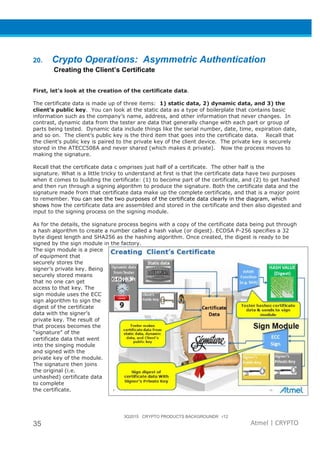
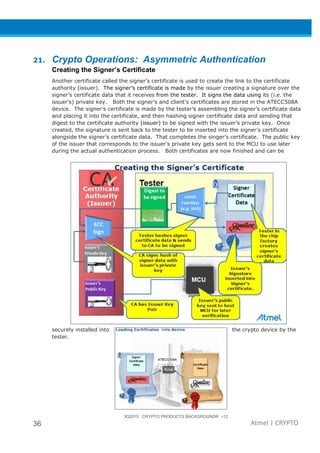
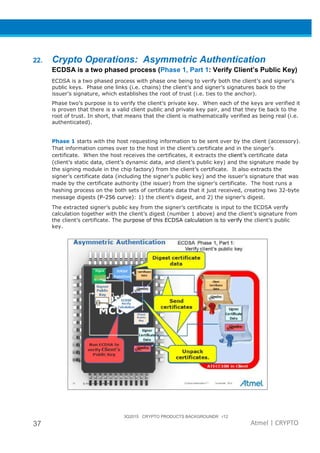
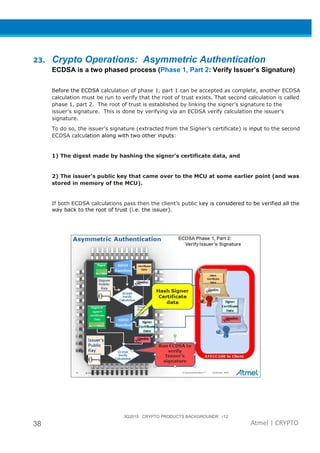
  • 18.
    18 8. Crypto ElementUse With Vehicle-to-Vehicle (V2V) and Vehicle to Internet (V2I) communications and listen” to one another direction, road conditions, and sense other cars, motorcycles, and pedestrians driver of V2V is signaling impending collisions so th countermeasures. While it may seem revolutionary, V2V is really a branch of Internet of Things (IoT). IoT and V2V as equations, they could be expressed in the following way: IoT = (MCU + Sensor + Security + Wireless) V2V = IoT + Car Equation two states that V2V is really the IoT on wheels. devices presents a huge challenge, which is safety. Safety can be compromised by hackers interfering with V2V communications and hacking into automotive control systems. Safety and security are closely related. Clearly there needs to be strong security on ALL systems in cars. The US Department and Transportation (DoT) and National Highway Traffic Administration (NHTSA) are partnering with research institutions and auto companies to collaborate on technology development and interoperability of V2V to promote traffic safety. V2V can transform the automotive opens the door for hackers who want to intercept, spoof, and misuse data. So, becomes the final piece of the picture, and arguably the element that makes IoT/V2V even possible to be widely adopted. based key storage. 3Q2015 CRYPTO PRODUCTS BACKGROUNDR r12 Crypto Element Uses: Automotive Authentication Vehicle (V2V) and Vehicle to Internet (V2I) communications and listen” to one another — automatically. They will share information like proximity, speed, ns, and sense other cars, motorcycles, and pedestrians of V2V is signaling impending collisions so that the cars can automatically take While it may seem revolutionary, V2V is really a branch of Internet of Things (IoT). IoT and V2V as equations, they could be expressed in the following way: or + Security + Wireless) Low Power Equation two states that V2V is really the IoT on wheels. However, this spread of electronic devices presents a huge challenge, which is safety. Safety can be compromised by hackers fering with V2V communications and hacking into automotive control systems. Safety and security are closely related. Clearly there needs to be strong security on ALL systems in US Department and Transportation (DoT) and National Highway Traffic Administration (NHTSA) are partnering with research institutions and auto companies to collaborate on technology development and interoperability of V2V to promote traffic safety. V2V can transform the automotive experience. The danger is that remo opens the door for hackers who want to intercept, spoof, and misuse data. So, becomes the final piece of the picture, and arguably the element that makes IoT/V2V even possible to be widely adopted. Of course the strongest form of security comes from hardware 3Q2015 CRYPTO PRODUCTS BACKGROUNDR r12 Atmel | CRYPTO Authentication Vehicle (V2V) and Vehicle to Internet (V2I) communications cars will “talk automatically. They will share information like proximity, speed, ns, and sense other cars, motorcycles, and pedestrians. The chief at the cars can automatically take While it may seem revolutionary, V2V is really a branch of Internet of Things (IoT). Describing IoT and V2V as equations, they could be expressed in the following way: However, this spread of electronic devices presents a huge challenge, which is safety. Safety can be compromised by hackers fering with V2V communications and hacking into automotive control systems. Safety and security are closely related. Clearly there needs to be strong security on ALL systems in US Department and Transportation (DoT) and National Highway Traffic Safety Administration (NHTSA) are partnering with research institutions and auto companies to collaborate on technology development and interoperability of V2V to promote traffic safety. The danger is that remote communication opens the door for hackers who want to intercept, spoof, and misuse data. So, strong security becomes the final piece of the picture, and arguably the element that makes IoT/V2V even orm of security comes from hardware-
  • 19.
    3Q2015 CRYPTO PRODUCTSBACKGROUNDR r12 19 Atmel | CRYPTO Crypto Basics
  • 20.
    3Q2015 CRYPTO PRODUCTSBACKGROUNDR r12 20 Atmel | CRYPTO 9. Crypto Basics: The Three fundamental elements of security (“CIA”) To provide the full set of security you will need all three of the foundational pillars of security: Confidentiality, Integrity (of data), and Authentication. These can be remembered as “CIA”: Confidentiality This is ensuring that no one can read the message except the intended receiver. This is typically accomplished with encryption and decryption which hides the message from all parties except the sender and receiver. A secret cryptographic key (that is the same) is input to the encryption and decryption algorithm on each side. Integrity This is also called data integrity and is assuring that the received message was not altered. This is done using cryptographic functions. For symmetric this is typically done by hashing the data with a secret key and sending the resulting MAC with the data to the other side which does the same functions to create the MAC and compare. Sign-verify is the way that asymmetric mechanisms ensure integrity. Authentication This is verification that the sender of a message is who they say they are (i.e. are real). In symmetric authentication mechanisms this is usually done with a challenge (often a random number) that is sent to the other side that is hashed with a secret key to create a MAC response which then gets sent back to run the same calculations and then compare the response MACs from both sides. Sometimes people add non-repudiation to the list of pillars which is preventing the sender from later denying that they sent the message in the first place.
  • 21.
    3Q2015 CRYPTO PRODUCTSBACKGROUNDR r12 21 Atmel | CRYPTO 10. Crypto Basics : Symmetric and Asymmetric Authentication Authentication can be accomplished in two main ways: Symmetric and Asymmetric. The main difference between the two is related to the use of keys. If the same secret key is used on the client and also on the host then the application is symmetric, just like the name indicates. Remember if the keys are equal then the system is symmetric. Alternatively, if there is a mathematically related private and public key pair being used then the application is asymmetric. If the keys are not the same on each side then it is asymmetric. Atmel has devices for both types. Asymmetric, asymmetric is also called public-key infrastructure or “PKI” and it is very well suited for real-world use. In fact, the internet is a big user of PKI. Note that Public Keys indicate that the system will be Asymmetric. Like is sounds, a public key is available to anyone. Think of a phone book filled with keys when envisioning the public key. Anyone having the public key can send encrypted messages to the owner of the private key. When a receiver gets an asymmetric message, he or she will decrypt it with their private key. In contrast, because symmetric cryptography uses the exact same key for both encryption and decryption, only the senders and receivers with that specific private key can communicate to each other. In addition to such differences in who can send and receive, other trade-offs between symmetric and asymmetric apply. For example, for symmetric at least twice the number of keys must be protected, increasing security risk. On the other hand, Asymmetric algorithms require more processing and thus are slower than symmetric. So, sometimes a combination of both symmetric and asymmetric is used to apply the relative advantages of each: the speed of symmetric and the security of asymmetric. Benefits • Verifies the identity of the sender and the integrity of the data • Symmetric authentication can be fast • Asymmetric authentication does not need secret storage in the host
  • 22.
    3Q2015 CRYPTO PRODUCTSBACKGROUNDR r12 22 Atmel | CRYPTO 11. Crypto Basics : Hash Function One of the basic tools used in authentication is a mathematical operation called a “hash function”. • A hash function is defined as a group of characters that is mathematically mapped to a value of a specified length (called a hash value, hash, compression, fingerprint, message digest, or simply digest). For example SHA256 hash values are 256 bits (32bytes). • The hash value is representative of the original string of characters, but is normally smaller than the original. Any change to the input will change the hash value. • A Message Authentication Code (MAC) is a hash of a message with a key Hashing functions have been used by computers for a long time and they are fundamental to cryptography. The hash value is representative of the original string of characters, but is normally smaller than the original. A hash is a one-way operation. The “one-wayness” of a hash function is its most important feature for cryptography because it is mathematically infeasible to reverse the hashing process to obtain the original message. A way to look at is that once the message is compressed it is impossible to uncompress it. Sort of like Humpty-Dumpty, you can’t put it back together again. Also, a feature of a hash function is that any change to the input changes the digest, so hashes are great to create digital signatures that identify and authenticate the sender and message. Hashes are also used for secure password storage, file identification, message authentication coding (MAC), and asymmetric sign verify operations. SHA (Secure Hash Algorithm) is a set of cryptographic hash functions approved by the National Institute of Standards and Technology (NIST). The Federal Information Processing Standard FIPS180-3 specifies five hash algorithms: • SHA-1 for which security flaws were identified in 2005 and is no longer recommended. • SHA-2 consisting of SHA-224, SHA-256, SHA-384 and SHA-512 • SHA-256 is recommended in the NSA's Suite B set of algorithms for use in protecting information beyond year 2030. Benefits • Hash algorithms cannot be reversed (i.e. are one-way so the original value cannot be derived) • Hashes are useful for checking the identity of the sender and the integrity of the data
  • 23.
    3Q2015 CRYPTO PRODUCTSBACKGROUNDR r12 23 Atmel | CRYPTO 12. Crypto Basics: Encryption/Decryption Coding and decoding information using a secret key for confidentiality Encryption is a different process from hashing and has a completely separate purpose. With encryption, data is scrambled and unscrambled in such a way that the input and output mapping is always one-to-one for a given encryption key and is unintelligible to anyone other than a receiver who has the key to unscramble it (i.e. decryption key). Since encryption/decryption algorithms are generally public (e.g. AES, DES, RSA, ECC), security is maintained by using a cryptographic key of sufficient length and keeping that key secret. Encryption is always reversible (by definition), so encryption is used whenever there is the need to get the input data back out. However, the identity of the sender and the integrity of the message (meaning if it has been altered or not) are not guaranteed by encryption only. In contrast, hashing algorithms are one-way by definition and are usually SHA but AES can be used as a hash algorithm. Hashes are used for identity purposes (authentication) and data integrity.
  • 24.
    3Q2015 CRYPTO PRODUCTSBACKGROUNDR r12 24 Atmel | CRYPTO 13. Crypto Basics : Crypto Glossary Encryption is encoding and decoding of a message for confidentiality. It is always reversible. Encryption does not authenticate. Authentication is used to check the identity and of the sender and the integrity of the message. The message is not necessarily encrypted. Symmetric authentication uses an identical key on the host and client sides, and both of those keys must be protected (this is very important). Symmetric authentication tends to be relatively fast. Asymmetric authentication uses a public / private key pair. The private key must be securely stored on the client. Secure key storage on the host is not needed. The keys are mathematically related, but the private key cannot be obtained from simply having the public key. More computation is required with asymmetric authentication than symmetric. Key Storage is one of the most important determinants of the strength of security in a system. Hardware key storage is much stronger than software-based solutions because hardware storage methods are much more difficult to attack. (CryptoAuthentication ICs are hardware key storage devices.) Hash functions are a group of characters that is mathematically mapped to a value of a certain length and is representative of the original string of characters, but is normally smaller than the original. Hash functions are commonly used in authentication and encryption operations. They are one way functions which means that the original value cannot be recreated from the hashed value (i.e. digest). Challenge-Response is an operation where a challenge (usually a random number) is sent to a client to elicit a response in order to test the authenticity of a client. The response is often a hash value of that number another number such as a cryptographic key. The response is then compared to a parallel calculation done on the originating device to see if they match. MAC (Message Authentication Code) is the result of a hash operation with a secret key and a message. That result (called the MAC) can be used to ensure the data has not been modified or corrupted by running the MAC on received data and comparing the MAC of the message that was sent with it. If the MAC received with the message and the MAC calculated on the receive side on the received message match then the received data was unchanged. Sign/Verify is an authentication operation that creates a hash digest of data, which is then encrypted using a private key to make a signature. To verify, the receiver hashes the received data and then decrypts the received signature of that data with the sender’s public key. If the signature received from the sender matches the hash that the receiver generated with the public key, then the signature is considered valid. ECDSA (Elliptic Curve Digital Signature Algorithm) an elegant and standardized method to provide asymmetric authentication using a sign-verify process using Elliptic Curve (ECC)
  • 25.
    3Q2015 CRYPTO PRODUCTSBACKGROUNDR r12 25 Atmel | CRYPTO algorithms to make a signature. ECDSA has two phases which are 1) to verify the public key, and 2) verify the private key of the client (i.e. accessory) device. ECDSA capability is built into the Atmel ATECC108A device. X.509 is an ITU standard that specifies what goes into the certificate. ECDH Key Agreement (Elliptic Curve Diffie-Hellman) an elegant and standardized method to provide asymmetric authentication using a sign-verify process using an anonymous key agreement protocol that allows two parties, each having an elliptic curve public–private key pair, to establish a shared secret over an insecure channel. This shared secret may be directly used as a key, or to derive another key which can then be used to encrypt subsequent communications using a symmetric key cipher. It is a variant of the Diffie–Hellman protocol using elliptic curve cryptography. Root certificate is a public key certificate that identifies the Root Certificate Authority (CA). The most common commercial variety is based on the ITU- T X.509 standard, which normally includes a digital signature from a certificate authority. .Digital certificates are verified using a chain of trust. The trust anchor for the digital certificate is the Root Certificate Authority (CA). Public-key cryptography (PKI), is a class of algorithms which requires two separate keys, one of which is secret (private) and one public. This key pair is mathematically linked by algorithms that are computationally infeasible to determine the private key from the public key (i.e. cannot factor). The public key is used to encrypt plaintext or verify a digital signature. The private key is used to decrypt ciphertext or to create a digital signature. The term "asymmetric" stems from the use of different keys to perform these opposite functions, each the inverse of the other – as contrasted with conventional ("symmetric") cryptography which relies on the same key to perform both. Public-key algorithms are based on mathematical problems which currently admit no efficient solution that are inherent in certain integer factorization, discrete logarithm, and elliptic curve relationships. Transport Layer Security (TLS) is how security for HTTP protocol is provided to secure websites. TLS authenticates the server at the request of the client. The server that hosts the website, for example, can optionally also authenticate the client. After authentication encryption/decryption session keys are exchanged, which are then used for encryption and decryption using the selected encryption/decryption algorithm. TLS uses a handshake procedure to select which security algorithms will be used for the session and also sends random numbers and cryptographic certificates authentication and key exchange processes. TKS offers all three pillars of security, namely confidentiality, (data) integrity, and authentication. TLS is the successor to Secure Socket Layer (SSL), so you will often see the term “SSL/TLS”. Application Layer Security (OSI Application Layer) ensures that the information that will be sent through a communications channel or directly connected to a machine or device is secure. Examples of cryptographic procedures to provide applications layer security are ECDSA for authentication, ECDH key agreement to create session keys, and encryption/decryption engines (such as AES that use the session keys) for encrypting and decrypting messages. These methods make sure that the data source (e.g. a sensor in an IoT node) is authentic, the data is confidential, and has not been tampered
  • 26.
    3Q2015 CRYPTO PRODUCTSBACKGROUNDR r12 26 Atmel | CRYPTO with (has integrity). Security at both the transport and application layers is recommended for wireless applications. “CIA” Confidentiality, integrity (of the data), and authenticity. All three are necessary for a truly secure application. Hardware Security Module (HSM) is a physical computing device that safeguards and manages digital keys for strong authentication and provides cryptographic processing. These modules traditionally come in the form of a plug-in card or an external device that attaches directly to a computer or network server. Trusted Platform Module (TPM) is an international standard for a secure cryptographic processor designed to secure hardware with protected cryptographic keys. The specification is devined by the Trusted Computing Group (TCG). ISO and IEC standardized the specification as ISO/IEC 11889 in 2009. TCG published revision 116 version 1.2 on March 3, 2011. Trusted Platform Module Library Specification Revision 01.16 was released October 2014 and is the most current TPM 2.0 release
  • 27.
    3Q2015 CRYPTO PRODUCTSBACKGROUNDR r12 27 Atmel | CRYPTO Crypto Operations
  • 28.
    3Q2015 CRYPTO PRODUCTSBACKGROUNDR r12 28 Atmel | CRYPTO 14. Crypto Operations: Why use Crypto Elements? Because connected things need strong authentication…and more. It seems that every day new and increasingly dangerous viruses are infecting digital systems. Viruses with names such as Heartbleed, Shellshock, Poodle, and Bad USB have put innocent people at risk in 2014 alone. Russian Cyber gangs (a.k.a. “CyberVor”) have exposed over a billion passwords. The scary thing is that the attacks are targeted at the very security mechanisms that are meant to provide protection. Because the digital protection mechanisms themselves have become targets, they must be hardened. This is especially important now that the digital universe is going through a type of Big Bang with the explosion of the IoT. That is sending billions of little sensing and communicating processors all over the earth, like dust. Growth in processing, communicating, and sensing semiconductors (which are exactly what the IoT is made from) will grow at a rate of over 36% in 2015 according to Gartner, dwarfing the overall semiconductor market growth of 5.7%. Big Bang. Big Growth. As for security, the IoT will multiply the number of points for infection that hackers can attack by many orders of magnitude. It is not hard to see that trust in the data communicated via an ubiquitous (and nosey) IoT will be necessary for the IoT to be widely adopted. Without trust, the IoT will fail to launch. There is hardly any doubt there. In fact, the recognized inventor of the Internet, Vint Cerf, completely agrees, saying that strong authentication is important for the IoT, and we need to make sure they are talking to the devices they are supposed to talk to. Those are very clear statements, but for fun let’s translate Dr. Cerf’s admonition into pop culture parlance: “No security? No IoT for you.” There is much more to the story behind why the IoT needs strong security. Because the world has become hyper-connected, financial and other sensitive transactions have become almost exclusively electronic. Money now is simply electronic data, so everyone and every company are at risk of financial losses stemming directly from data breaches. See? Databanks are where the money is kept and data is what criminals attack. While breaches are in fact being publicized, there has not been much open talk about their leading to significant corporate financial liability. That liability, however, is real and growing. So, CEOs should not be the least bit surprised when they start to be challenged by significant shareholder and class action lawsuits stemming from security breaches. Although inadvertent, companies are in fact exposing identities and sensitive financial information of millions of customers, and they may not always be taking all the measures that they can to ensure the security and safety of their products, data, and systems. Both exposure of personal data and risk of product cloning can translate to financial damages. Damages translate to legal action. The logic of tort and securities lawyers is that if proven methods to secure against hacking and cloning already exist, then it is the fiduciary duty of the leaders of corporations (i.e. the C-Suite occupants) to embrace such protection mechanisms (such as hardware-based key storage), and not doing so could possibly be argued as being negligent. Agree or not, that line of argumentation is logical and perhaps likely. A few CEOs have already started to equip their systems and products with strong hardware- based security devices...but they are doing it quietly and not telling their competitors. This gives them an edge.
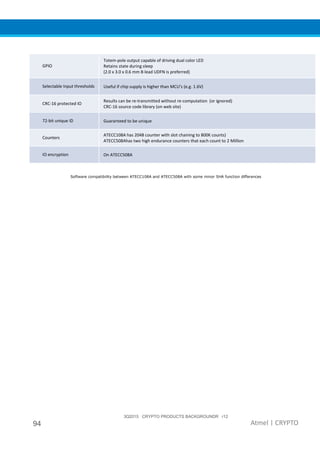
  • 29.
    3Q2015 CRYPTO PRODUCTSBACKGROUNDR r12 29 Atmel | CRYPTO Why use crypto elements? (Continued) Software, Hardware, and Hackers. Why is it that hackers are able to penetrate systems and steal passwords, digital IDs, intellectual property, financial data, and other secrets? It is because until now only software has been used to protect software from hackers. Hackers love software. Breaking into software is what they live for. The problem is that rogue software can see into system memory, so it is not a great place to store important things such as passwords, digital IDs, security keys, and other valuable things. The bottom line is that all software is vulnerable because software has bugs despite the best efforts of developers to eliminate them. So what about storing important things in hardware? Hardware is better, but standard integrated circuits can be physically probed to read what is on the circuit. Also, power analysis can quickly extract secrets from hardware. So, is there anything that can be done? The answer fortunately is yes. Three of four generations of hardware key storage devices have been designed to protect keys with physical barriers and cryptographic countermeasures that ward off even the most aggressive attacks. Once keys are securely locked away in protected hardware attackers cannot see them and they cannot attack what they cannot see. Secure hardware key storage devices like Atmel CryptoAuthentication™ employ both cryptographic algorithms and a tamper-hardened hardware boundary to keep attackers from getting at the cryptographic keys and other sensitive data. Keeping secrets keys secret. The basic idea behind such protection is that cryptographic security depends on how securely the cryptographic keys are stored. But of course it is of no use if the keys are simply locked away. There needs to be a mechanism to use the keys without exposing them. That is the other part of the CryptoAuthentication™ equation, namely built-in crypto engines that run cryptographic processes and algorithms. A simple example of accessing the secret key without exposing it is using challenges (usually random numbers), secret keys, and cryptographic algorithms to create unique and irreversible signatures that provide security without anyone seeing the secret key. Crypto engines make running complex mathematical functions easy while at the same time keeping secret keys secret inside robust, protected hardware. This hardware key storage/crypto engine combination is the secret to keeping secrets and being easy to use, available, ultra-secure, tiny, and inexpensive While the engineering that goes into hardware-based security is sophisticated, Atmel does all the crypto engineering so there is no need to become a crypto expert.
  • 30.
    3Q2015 CRYPTO PRODUCTSBACKGROUNDR r12 30 Atmel | CRYPTO 15. Crypto Operations: Symmetric Authentication with secrets stored on the host using Random Challenge-Response. With Symmetric Authentication using secrets stored on the host using Challenge-Response, like you might expect from the name, the host sends a challenge and the client makes a response using cryptographic “magic” (i.e. math) and then the host runs the same process in order to make a comparison to see if it gets the same answer. It the answers on each side match then the client is real. STEP 1: The process starts when the host sends a random number, which is generated by the ATSHA204’s random number generator to the client. It does this at the time that it wants to verify if the client is real such as when an ink cartridge is inserted into a printer. This step is called the “Challenge”. STEP 2: The client receives the random number challenge and runs it thru a hash algorithm (SHA256) using the secret key stored there. The result of the hashing function is called the “Response” and also called “Message Authentication Code (or MAC)”. The response (MAC) is then sent to the host, and together these actions comprise step two. STEP 3: At step 3 the host internally runs the same challenge number (i.e. the random number) it sent to the client thru a hash algorithm using the secret key stored on the host side. Then the host compares the hash value calculated on the host side with the response hash value sent from Client. If the two hash values match then the Client is verified as being real. Benefits • Symmetric authentication is fast • Crypto devices on both host and client sides ensures very secure secret storage
  • 31.
    3Q2015 CRYPTO PRODUCTSBACKGROUNDR r12 31 Atmel | CRYPTO 16. Crypto Operations: Symmetric Authentication without secret storage on the host using a Fixed Challenge Symmetric authentication can also be accomplished without having a crypto device on the host side. Such an arrangement is called a fixed challenge-response. That means that the host does not use a random number, but instead uses a fixed number pair, or series of pairs, of specific challenge and response numbers that are programmed into the host’s memory. STEP 1: The challenge and corresponding response values are then loaded and stored on the host . STEP 2: Once the product is deployed in the field and it is time for the authentication of the client (like a consumable), the host sends its preloaded challenge to the client to check if the client is real or not . STEP 3: The crypto element on the client will run the hash algorithm on that challenge number and generate a response and send that response back to the host. STEP 4: The host compares the response from the client with the pre-loaded response value stored in its memory. STEP 5: If the client is real then the response from the client (which is the hash value based on the secret key and the challenge) will be the same as the response value that was preloaded in the host. Since each host is loaded with a different challenge/response pair, each product the host is incorporated into is then unique by definition. Cloning beyond only one copy is impossible. Thus this is a highly secure and very cost effective technique because it can be easily implemented with very low cost MCUs. Benefits • Symmetric authentication is fast • No secrets in the host • Can use low cost MCU of host because less computation is needed for a fixed challenge
  • 32.
    3Q2015 CRYPTO PRODUCTSBACKGROUNDR r12 32 Atmel | CRYPTO 17. Crypto Operations: Symmetric Authentication without secret storage on the host using Fixed Challenge and intermediate key. Fixed challenge-response is a great methodology when low cost micros are desired; however, some security is sacrificed since a logic analyzer can be employed to break the security in no other countermeasures are employed. Fortunately, there is an easy way to add more security to fixed challenge- response scenario, and that is by using an additional hashing stage with an intermediate key. An intermediate key, just like it sounds, is an intermediate step in the process. A key is created by hashing the stored secret key on the client with the challenge and then hashing that with some type of unique and changing number, from the host side. That unique number is called a “nonce”. The client’s response will change with the changing nonce value. So, trying to analyze the responses with a logic analyzer will be fruitless, which makes this methodology more secure than simple fixed challenge-response. The steps to accomplish symmetric authentication with intermediate key are noted below: STEP 1: The process starts with the fixed challenge that is compiled into the MCU’s software in the factory. STEP 2: That challenge is hashed with the secret key stored on the client, thus creating the intermediate key. STEP 3: A unique number such as a random number or the date-time-etc. is issued by the MCU and sent to the client. That unique number is used just once and therefore it is called the “NONCE”, which means “number used once” in cryptographic parlance. STEP 3: The intermediate key created in Step 2 is hashed with the NONCE that was received from the MCU. STEP 4: The hash of the intermediate key and NONCE performed by the client becomes the client’s response, which is sent to the MCU on the host. STEP 5: With fixed challenge-response, the challenge and response pair gets loaded into the MCU. Similarly with this intermediate key variation, the fixed challenge and the corresponding intermediate key pair are loaded into the MCU. Each challenge has a corresponding intermediate key that is created by hashing the challenge with the secret key. STEP 6: The same NONCE that was sent to the client is hashed with the intermediate key on the host to create the MCU Digest. If the client is real then the MCU Digest on the host will match the client’s response that was sent to the host. Benefits • Cannot be attacked with a logic analyzer • Increased security
  • 33.
    3Q2015 CRYPTO PRODUCTSBACKGROUNDR r12 33 Atmel | CRYPTO 18. Crypto Operations: Asymmetric Authentication Using Digital Signatures (ECDSA) In the real world the Asymmetric Authentication process typically begins when a client device is inserted into a host system or the host system wants to know what exactly is connected to it. Examples are a printer ink cartridge being inserted into a printer, a thermostat control block wanting to talk to a remote temperature sensor, a cell phone connecting to a wall charger, and many others. The best way to understand how ECDSA performs authentication and how it ties that back to the root of trust is to break it down into its individual steps. Admittedly, there are many steps but each one does a very specific and simple thing, so it is easy to follow. To simplify the process, it is useful to group the steps into sequential phases that perform distinct objectives in the process. Fortunately, there is a clear break between two major objectives, so we can break it into a phase one and phase two. Phase one’s goal is to use ECDSA calculation algorithms to verify the public key on the client. Phase one has a second goal which is implied, and that is to verify the entire certificate chain back to the root of trust (i.e. the certificate authority or “issuer”). One way to look at it is that the host MCU must identify and confirm the entire history of who signed what. (In this example we will look at a two level signing history going from the issuer to the signing module to the client device.) To accomplish the verification of the public key in phase one it is necessary to verify all the signatures in the certificate chain. In this example the signatures are stored in the client in two distinct digital certificates. One is the client’s certificate and the other is the signer’s certificate. The certificates are the mechanism that allows the chain to reach back to the root of trust (i.e. the issuer). Phase two’s goal is to use ECDSA calculations to verify that the private key on the client is related to the previously verified public key. Verifying that the client has a valid public-private key pair is the soul of symmetric authentication. If the ECDSA verify calculation operations of both phases pass then the client is verified as real. And that is the whole purpose. Benefits • Increased security because asymmetric authentication does not need secure key storage on the host (only the client) • No need to update the host with secrets in the field. (Can update the public key at any time.) • ATECC108A and ATECC508A have ECDSA built in, making it super-easy to implement.
  • 34.
    3Q2015 CRYPTO PRODUCTSBACKGROUNDR r12 34 Atmel | CRYPTO 19. Crypto Operations: Asymmetric Authentication Making the ECDSA certificates To understand the ECDSA process it is very helpful to first look at how the certificates are built and loaded into the crypto device. This happens in the factory. A certificate is made from two components: 1) The certificate data 2) The signature. The client certificate creation process begins in the factory on the machine that tests the crypto device: in other words, the tester. Attached to the tester is equipment called the “signing module” that contains its own secret private key. That private key is securely stored and never shared. The signing module is used to create the signature, just as its name implies. Once the certificate is made it is loaded into the device.
  • 35.
    3Q2015 CRYPTO PRODUCTSBACKGROUNDR r12 35 Atmel | CRYPTO 20. Crypto Operations: Asymmetric Authentication Creating the Client’s Certificate First, let’s look at the creation of the certificate data. The certificate data is made up of three items: 1) static data, 2) dynamic data, and 3) the client’s public key. You can look at the static data as a type of boilerplate that contains basic information such as the company’s name, address, and other information that never changes. In contrast, dynamic data from the tester are data that generally change with each part or group of parts being tested. Dynamic data include things like the serial number, date, time, expiration date, and so on. The client’s public key is the third item that goes into the certificate data. Recall that the client’s public key is paired to the private key of the client device. The private key is securely stored in the ATECC508A and never shared (which makes it private). Now the process moves to making the signature. Recall that the certificate data c omprises just half of a certificate. The other half is the signature. What is a little tricky to understand at first is that the certificate data have two purposes when it comes to building the certificate: (1) to become part of the certificate, and (2) to get hashed and then run through a signing algorithm to produce the signature. Both the certificate data and the signature made from that certificate data make up the complete certificate, and that is a major point to remember. You can see the two purposes of the certificate data clearly in the diagram, which shows how the certificate data are assembled and stored in the certificate and then also digested and input to the signing process on the signing module. As for the details, the signature process begins with a copy of the certificate data being put through a hash algorithm to create a number called a hash value (or digest). ECDSA P-256 specifies a 32 byte digest length and SHA256 as the hashing algorithm. Once created, the digest is ready to be signed by the sign module in the factory. The sign module is a piece of equipment that securely stores the signer’s private key. Being securely stored means that no one can get access to that key. The sign module uses the ECC sign algorithm to sign the digest of the certificate data with the signer’s private key. The result of that process becomes the “signature” of the certificate data that went into the singing module and signed with the private key of the module. The signature then joins the original (i.e. unhashed) certificate data to complete the certificate.
  • 36.
    3Q2015 CRYPTO PRODUCTSBACKGROUNDR r12 36 Atmel | CRYPTO 21. Crypto Operations: Asymmetric Authentication Creating the Signer’s Certificate Another certificate called the signer’s certificate is used to create the link to the certificate authority (issuer). The signer’s certificate is made by the issuer creating a signature over the signer’s certificate data that it receives from the tester. It signs the data using its (i.e. the issuer’s) private key. Both the signer’s and client’s certificates are stored in the ATECC508A device. The signer’s certificate is made by the tester’s assembling the signer’s certificate data and placing it into the certificate, and then hashing signer certificate data and sending that digest to the certificate authority (issuer) to be signed with the issuer’s private key. Once created, the signature is sent back to the tester to be inserted into the signer’s certificate alongside the signer’s certificate data. That completes the singer’s certificate. The public key of the issuer that corresponds to the issuer’s private key gets sent to the MCU to use later during the actual authentication process. Both certificates are now finished and can be securely installed into the crypto device by the tester.
  • 37.
    3Q2015 CRYPTO PRODUCTSBACKGROUNDR r12 37 Atmel | CRYPTO 22. Crypto Operations: Asymmetric Authentication ECDSA is a two phased process (Phase 1, Part 1: Verify Client’s Public Key) ECDSA is a two phased process with phase one being to verify both the client’s and signer’s public keys. Phase one links (i.e. chains) the client’s and signer’s signatures back to the issuer’s signature, which establishes the root of trust (i.e. ties to the anchor). Phase two’s purpose is to verify the client’s private key. When each of the keys are verified it is proven that there is a valid client public and private key pair, and that they tie back to the root of trust. In short, that means that the client is mathematically verified as being real (i.e. authenticated). Phase 1 starts with the host requesting information to be sent over by the client (accessory). That information comes over to the host in the client’s certificate and in the singer’s certificate. When the host receives the certificates, it extracts the client’s certificate data (client’s static data, client’s dynamic data, and client’s public key) and the signature made by the signing module in the chip factory) from the client’s certificate. It also extracts the signer’s certificate data (including the signer’s public key) and the issuer’s signature that was made by the certificate authority (the issuer) from the signer’s certificate. The host runs a hashing process on the both sets of certificate data that it just received, creating two 32-byte message digests (P-256 curve): 1) the client’s digest, and 2) the signer’s digest. The extracted signer’s public key from the signer’s certificate is input to the ECDSA verify calculation together with the client’s digest (number 1 above) and the client’s signature from the client’s certificate. The purpose of this ECDSA calculation is to verify the client’s public key.
  • 38.
    3Q2015 CRYPTO PRODUCTSBACKGROUNDR r12 38 Atmel | CRYPTO 23. Crypto Operations: Asymmetric Authentication ECDSA is a two phased process (Phase 1, Part 2: Verify Issuer’s Signature) Before the ECDSA calculation of phase 1, part 1 can be accepted as complete, another ECDSA calculation must be run to verify that the root of trust exists. That second calculation is called phase 1, part 2. The root of trust is established by linking the signer’s signature to the issuer’s signature. This is done by verifying via an ECDSA verify calculation the issuer’s signature. To do so, the issuer’s signature (extracted from the Signer’s certificate) is input to the second ECDSA calculation along with two other inputs: 1) The digest made by hashing the signer’s certificate data, and 2) The issuer’s public key that came over to the MCU at some earlier point (and was stored in memory of the MCU). If both ECDSA calculations pass then the client’s public key is considered to be verified all the way back to the root of trust (i.e. the issuer).
  • 39.
    3Q2015 CRYPTO PRODUCTSBACKGROUNDR r12 39 Atmel | CRYPTO 24. Crypto Operations: Asymmetric Authentication ECDSA is a two phased process (Phase 2: Verify Private Key) When both phase 1 ECDSA calculations pass, then phase 2 starts with the goal of verifying the client’s private key. Recall that the whole point of this two-phased process is to verify mathematically that the client’s private key and public key are indeed a valid key pair and tie back to the root of trust. Phase 2: This phase begins with the host generating a random number challenge and sending it to the client. The client device uses the ECDSA signature engine in the ATECC508A to create a new signature using this random number and the client’s (secret) private key securely stored there. That new signature is then sent to back the host, which uses it along with the same random number used to make the signature on the client and the client’s public key (that was previously verified in phase one) as the inputs to the Phase 2 ECDSA verify calculation. If that ECDSA calculation succeeds, then the host has then proven that the accessory (client) is real (i.e. that the client contains a valid private-public key pair). As you can see, the ATECC508A does all the heavy mathematical lifting. In addition, Atmel provides the tools that Atmel provides make it easy to program the microcontroller to do its part without having to securely store a secret. That is the whole reason for asymmetric authentication: the secret only has to be secured on one side. The engineering and mathematics behind authentication using sophisticated algorithms may not be easy, but that does not matter to the user because Atmel makes it easy to implement cryptography without having to be a cryptography expert. Benefits • ECDSA is a proven and secure authentication process • Uses the advantages of Elliptic Curve Cryptography (high security , short key, less computation) • No need for secure key storage in the host
  • 40.
    3Q2015 CRYPTO PRODUCTSBACKGROUNDR r12 40 Atmel | CRYPTO 25. Crypto Operations: Secure Boot Step 1. Signing the application code in the factory. Firmware in every type of product is vulnerable to cloning. Using CryptoAuthentication devices can ensure that only the authorized firmware is loaded at boot time. There is a growing trend in many industries where Intellectual Property (IP), particularly firmware is being copied, and the benefits of expensive R&D investments end up being forfeited by the legitimate owners. CryptoAuthentication is a simple and effective way to guard against firmware and product cloning. Placing a CryptoAuthentication device onboard a micro- controlled system provides a simple solution that can match the secret stored in the security IC to the operating firmware. How that can be accomplished depicted in the secure boot diagrams. This is shown as a two-step process where step one is the signing of the application code in the factory, and step two is where it is verified by the crypto element device before launching the code in the application at boot time. Secure Boot Step 1 is the signing of the application code in the factory. The code and the signature is sent to the embedded system in the field and loaded into the system memory. STEP 1.1 is to hash the application code to prepare it to be signed by the signing module in the factory. STEP1.2: The signing module in the factory contains a secret key that is securely stored. The secret key can (should) be stored in a crypto element device, which also can run the signing algorithm. The result of singing the hash of the application code with the secret key of the signing module is a hash value or “Massage Authentication Code (MAC)”. STEP1.3 is where the signature/MAC is sent to the embedded system that will authenticate the code prior to booting it. STEP1.4 is the sending of the application code that will be authenticated and loaded at boot time into the system. Typically the application code and MAC are sent together Once the code and signature/MAC is sent into the field, Step 2 can be performed by the embedded system.
  • 41.
    3Q2015 CRYPTO PRODUCTSBACKGROUNDR r12 41 Atmel | CRYPTO 26. Crypto Operations: Secure Boot Step 2. Authenticating the device in the field Secure Boot Step 2 is the process of using the signature and the code itself at boot time to authenticate the code (i.e. to check if it is real). The basic idea is to use the crypto element device to create a signature of the code just like was done in the factory and then compare that new signature with the one from the factory. If those two signatures match then the code is proven to be the same as the original code (i.e. not altered or fake) and is considered real and thus can be loaded. STEP 2.1 is the loading of the application code and the signature /MAC at boot time into the flash memory of the embedded system. STEP 2.2 is the hashing of the application code in preparation for signing of the code. STEP 2.3 is the singing of the hash of the application code by the stored secret key in the ATSHA204A to create a digest which is the signature/MAC. STEP 2.4 is the comparison of the signature/MAC received from the factory with the signature/MAC just created by the ATSHA204A in the embedded system. If the messages (i.e. the application code) and the secret keys in the factory and in the embedded system are the same then the signing process will result in identical signatures/MACs. If the signatures/MACs match then the code has not been corrupted and is authentic and can be loaded into the system Benefits • Secure boot using a crypto device can protect IP and revenue streams • Easy to implement very strong security • Numerous applications
  • 42.
    3Q2015 CRYPTO PRODUCTSBACKGROUNDR r12 42 Atmel | CRYPTO 27. Crypto Operations: Protecting Downloaded Firmware with Symmetric Keys; Step1: Encrypt and MAC application code Software and firmware IP protection possibly provides the largest opportunity application target market. This segment includes anyone that has an embedded system or software solution. And, that is just about anyone that has a processor in their system. Most systems use nonvolatile memory to store programs to remotely add features and fix problems, but they are vulnerable to hacking. That is because all software based systems can be hacked. CryptoAuthentication crypto element devices protect downloaded firmware by preventing hackers from getting software images and algorithms. This ensures that only unmodified OEM-authorized firmware gets loaded in nonvolatile memory. The usage models are flexible. All downloads will be identical and the user can post download on the web without concern of theft because the firmware will be encrypted. Two of the fundamental cryptographic pillars are used in this case: encryption and authentication. Encryption allows the software IP to be sent to target users without others being able to understand what it is and use it. It will of course be decrypted on the other side. Authentication is used to ensure that the code that gets decrypted is indeed the intended code and has not been altered, replaced, or corrupted. This is a two step process with Step 1 being done by the developer on the sending side to encrypt the original application code using an encryption key, and to create a Message Authentication Code (MAC) to ensure authenticity. Step 2 is done on the receiving side by downloading the encrypted code and MAC in order to decrypt and authenticate the code. Step 1: Encrypt and MAC application code happens as follows: STEP 1.1: The code developer creates an encryption key in order to encrypt the code that will be downloaded by the receiving side. This is done using an ATSHA204A that stores a secret key for encryption. The ATSHA204A hashes a seed number with the secret key to create a digest (Message Authentication Code (MAC)), which will be the encryption key that is input to the encryption algorithm that is run on the MCU. STEP 1.2: The MCU encrypts the code using an encryption algorithm (such as AES) using the encryption key just created. STEP 1.3: The encrypted code is put in a place to allow it to be downloaded by the target user. The seed number used to create the encryption key will also be put in that same place. The seed and encrypted code will be downloaded together. STEP1.4: addresses the other pillar of security which is authentication. This is done by hashing (or padding) the original application code to size it correctly to be hashed with the secret authentication key, which is a different key than used earlier fro encryption. The result of the hash of the digested (or padded) application code with the authentication key is the “Authentication MAC”. STEP 1.5: That Authentication MAC gets put into the same place as the encrypted code and seed number so that all of those can be downloaded by the receiving side.
  • 43.
    3Q2015 CRYPTO PRODUCTSBACKGROUNDR r12 43 Atmel | CRYPTO 28. Crypto Operations: Protecting Downloaded Firmware with Symmetric Keys; Step2: Download, Decrypt, and Authenticate The target user of protected firmware will download the encrypted code, seed number, and Authentication MAC. STEP 2.1 To decrypt the code the seed that was downloaded is hashed with the secret key stored in the crypto element on the client embedded system. Being symmetric, this stored secret key has the same value the key stored the on the transmitting (uploading) side. The result of the hashing of the secret key with the seed number will be the decryption key, which of course matches the encryption key if it has not been corrupted during transit. STEP 2.2: The embedded system’s MCU uses the decryption key just created as input to the encryption algorithm (such as AES) to decrypt and recover the application code. The process then moves to the authentication stage. STEP 2.3: The newly decrypted code gets hashed (or padded) just like was done by the developer on the transmitting side to prepare it for hashing with the secret Authentication key. That key is exactly the same as the Authentication key the developer used since this is a symmetric process. The result of that hash is the Client’s Authentication MAC. STEP 2.4: It will be compared (using the CheckMAC command) to the Authentication MAC that was downloaded with the encrypted code and seed. It they match then the downloaded and decrypted code is authenticated and can be loaded into the system. Benefits • Special downloads for each customer by tying to authorized serial numbers. • All downloads will be identical • Can post the download on the web because it will be encrypted
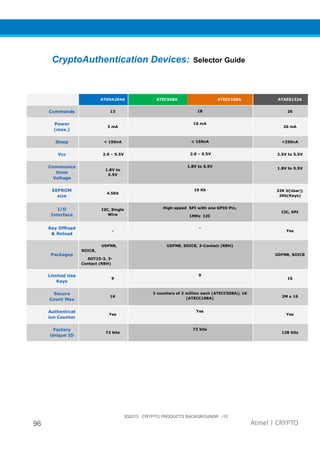
  • 44.
    3Q2015 CRYPTO PRODUCTSBACKGROUNDR r12 44 Atmel | CRYPTO 29. Crypto Operations: Symmetric Session Key Exchange with crypto devices on both sides The ATSHA204A crypto element device can be used for secure session key exchange. The crypto element works together with an MCU that performs encryption/decryption with an algorithm such as AES. In order to create an encryption-decryption session the MCU on each side will need an identical encryption-decryption key. To increase security the key on each side should change with each session. That is why such keys are called session keys. The session key is securely exchanges from one side to the other. A random number is used to ensure that the keys will be different for each session. STEP 1: The process starts by hashing the secret key stored in the ATSHA204A device with a random number created by the ATSHA204A. Note that the system may inject the random number into the crypto device, but Atmel advises using the crypto device’s internal TRNG for high-quality random numbers to achieve the most effective session encryption keys. Effective session encryption keys are ones that virtually never repeat, thereby obviating replay and statistical attacks. This device will also emit the random number for later use. Generation of the session encryption key essentially opens a trusted communication session. The combination of the crypto device TRNG and the entropy properties of the SHA-256 cryptographic algorithm guarantee the quality of the session keys. STEP 2: The result of the hashing operation will be a 32 byte Message Authentication Code or “MAC”. 16 bytes of that 32 byte (256 bit) MAC from the SHA204A will be the AES session key that gets sent to the MCU. STEP 3: The MCU runs an encryption algorithm such as AES over the data to be encrypted. STEP 4: The newly encrypted data and the random number are then sent over to the other side so the data can be decrypted. STEP5: Of course, to decrypt the message the same key that was used to encrypt it must be used in the decryption process. That is exactly why the random number is sent over, which is to recreate the session key from that random number and the key stored on the SHA204A on the decrypting side. That is done by the random number being input to the SHA-256 hashing algorithm together with the key stored on the SHA204A. Because this is a symmetric operation the secret keys stored on the SHA204A devices on both sides are identical. So, when the same random number is hashed with the same secret key, then the 32 byte digest that results will be the same on the receiver (decrypting) side and on the sender (encrypting) side. STEP 6: Just like on the encrypting side, 16 bytes of the digest (i.e. MAC) represent the encryption/decryption key and will be input to the MCU. STEP 7: The receiving side’s MCU runs the decryption algorithm (such as AES) using the session key to decrypt the encrypted code that was sent over from the other side. Disposition of the session encryption keys together with the earlier disposition of the random numbers by both the initiating and receiving systems
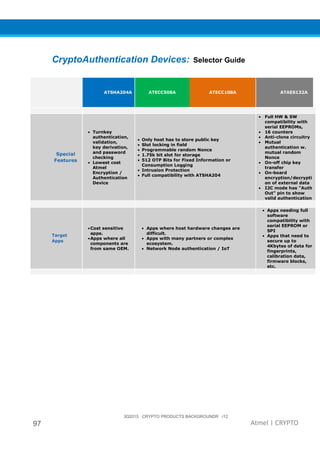
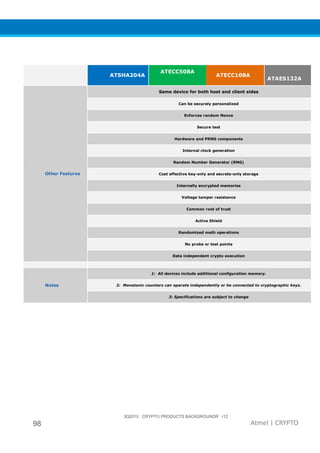
  • 45.
    3Q2015 CRYPTO PRODUCTSBACKGROUNDR r12 45 Atmel | CRYPTO essentially closes the trusted session. In other words, enough information no longer exists to ever recover or replay that session as long as the random number used was from a quality source like the crypto device’s TRNG. By controlling how often a session key is generated in the initiating system, the system integrator effectively controls the session’s lifetime determined by number of secure transactions, i.e., transmission and recovery of sensitive data. Successful recovery of the session encryption key essentially proves the mutual authenticity of the initiating and target systems. A non-authentic system will not be able to recover the session encryption key, and, therefore, will not be able to gain access to the sensitive information. In other words, only mutually authentic systems can securely communicate, and authentication effectively derives from the shared root secret within the fortified confines of the crypto device. Please Note: An alternative method for key exchange such as ECDH (Elliptic Curve Diffie-Hellman) can be easily implemented using the Atmel ATECC508A device, and is described elsewhere. The methodology described here uses symmetric techniques, and thus can be easily implemented in ATSHA204A devices, which may be more attractive for certain systems. Please note that other CryptoAuthentication™ crypto elements, namely the ATECC108A and ATECC508A, are supersets of the ATSHA204A and thus can also perform the methodology described in this document. Commands of Interest Atmel crypto elements like the ATSHA204A come with a rich set of commands that offer system integrators high flexibility in tackling various security challenges. Please note that after device personalization, only three of these commands are necessary to accomplish the application described here; namely, Random, MAC, and Nonce commands, which are described in the following table:
  • 46.
    3Q2015 CRYPTO PRODUCTSBACKGROUNDR r12 46 Atmel | CRYPTO CryptoAuthentication Commands of Interest Command Description Random Generates a random number for the creation of session encryption keys. MAC Combines the random number with the embedded root secret to create or recover the session encryption key. Nonce A precursor to the MAC command whose function is to initialize the crypto device into an internal state of high entropy. High entropy in this context is desirable because it eliminates the ease of guessing and mounting replay attacks. This miniscule list of commands emphasizes the ease of implementation and minimal demand on system resources like CPU bandwidth and code storage requirements. Benefits • Changes key for each session so keys are not used for very long which increases security • Very simply yet secure methodology • Easily implemented with ATSHA204A devices
  • 47.
    3Q2015 CRYPTO PRODUCTSBACKGROUNDR r12 47 Atmel | CRYPTO 30. Crypto Operations: Protecting Communication between the Crypto element and MCU. The question often comes up about how to ensure that the communication between the crypto device and the host MCU is not attacked by a man-in-the-middle. This can be accomplished by performing an authentication on the result of CheckMAC function. The idea is to make sure that when the authentication device puts out the Boolean response from the Check MAC that response is not able to be tampered with. The process starts when the Boolean (1 or 0) from the Check Mac function is set to the MCU. The Check Mac function is the operation that compares two Message Authentication Codes (MACs) to see if they match. Computing MACs and comparing them to see if they are indeed identical is the heart of symmetric authentication. Upon the CheckMac returning a response a second key (KEY 2) is loaded immediately into the TempKey register to that a second comparison can be made using a unique number from the MCU that is hashed on the MCU and also hashed on the authentication device (with KEY 2) and then compared. All the Atmel crypto element devices have this method of protecting the single Boolean bit that comes from the authentication chip to the microprocessor. The process involves using a second key that is both stored in the crypto element device and compiled into the code. STEP 1: The crypto element completes the ‘Check’ operation, STEP 2: At the time of completion of the Check operation, a second secret is copied into the TempKey register. STEP 3: Then the MCU sends over a unique number (such as the time of day) STEP 4: The unique number is then combined with that second secret using a hashing function to make a response (Message Authentication Code (MAC). The MAC is returned to the MCU. STEP 5: The software on the micro does the same hashing operation using the compiled secret Key 2 with the same unique number to make the MCU digest. STEP 6: The MCU compares the client’s digest (MAC) to the MCU digest (MAC to see if they are identical. This is beneficial, because it means that you cannot just put a simple switch in the wire between the two and “always send a 1”. Benefits • Provides complete security between the MCU and crypto device • Capability built into every CryptoAuthentication device • Simple to implement
  • 48.
    3Q2015 CRYPTO PRODUCTSBACKGROUNDR r12 48 Atmel | CRYPTO 31. Crypto Operations: Decrypting encrytped data at rest Crypto elements with hardware key storage can be used together with an MCU to encrypt stored files. (This is often called protecting data at rest.) With a crypto element, the encryption-decryption key is securely stored in protected hardware as opposed to being stored in software, which is less secure. The encryption/decryption process in this example is AES (Advanced Encryption System). With such encryption algorithms files are encrypted using a particular seed number that is hashed with the secret encryption that is stored at the encryption site. The same secret key is stored securely at the decryption site as well. The steps to send and decrypt the encrypted files are as follows: STEP 1: The encrypted code and seed received on the decrypting side is hashed with the secret key and seed to create a Message Authentication code (MAC). That MAC is the decryption key and gets sent to the MCU. STEP 2 the MAC/decryption key is input to the MCU that will run the AES algorithm to decrypt the encrypted files. The reason that works is that that very same seed number was hashed at the encryption site with the exact same secret key. Therefore that hash (MAC) on the encryption side and on the decryption side will be the same if the data did not get corrupted or altered in transit. STEP 3 The system MCU decrypts the encrypted file into clear text STEP 4 The decrypted file can now be used in the system as desired. Benefits • Highly secure decryption • Easy to implement • Very fast operation
  • 49.
    3Q2015 CRYPTO PRODUCTSBACKGROUNDR r12 49 Atmel | CRYPTO 32. Crypto Operations: Data Integrity Checking using Message Authentication Code (MAC) CryptoAuthentication crypto element devices can be used to authenticate a message by creating a simple Message Authentication Code (MAC) and appending that MAC to the message packet. This is a data integrity mechanism. A MAC is a very fundamental cryptographic function. The basic definition of a MAC is the result of a hash (compression) of a key and message. Creating the authorized packet on the sending side: STEP 1: is to begin the creation of the authorized packet. In this example the message is the start time, end, time, and the authorized action. That message is first hashed by the host to put it into the right size (which is 32 bytes for SHA256). STEP 2 The result of the hash in step 1 (the message digest) is input together with the secret key stored in the crypto element to create a message authentication code (MAC). STEP 3: Now that the MAC has been created it is appended to the original (un-hashed) message packet. STEP 4: The message packet plus the MAC is sent to the other side where the integrity will be validated. Recall that the core mission of this application example is to execute the authorized action only if the current time is within the specified time range (i.e. between the start and end times that are included in the message packet).
  • 50.
    3Q2015 CRYPTO PRODUCTSBACKGROUNDR r12 50 Atmel | CRYPTO Data Integrity Checking using Message Authentication Code (MAC) (Continued) Validating the Authorized Packet on the receiving side: STEP 5: The message packet is made up of the authorized action plus the start and end times. That packet is compressed to 32bytes just like on the sending side STEP 6: That compression is hashed together with the secret key stored on the receiving side’s ATSHA204A to create a MAC (the receiving side MAC). Of course, the intent is to mimic what happened on the receiving side what happened on the sending side. STEP 7: The receiving side MAC is compared on the by the crypto element to the sending side’s MAC which came over with the message packet. If the MACs match, then the messages must be identical, and that proves that they were not tampered with (i.e. data integrity has been preserved and proven). STEP 8: Now that you know the messages have not been altered and also authentic, the current time can be checked with the range sent over in the original message to see if it is in the specified range. If it is then the authorized action can be executed. Benefits • Adds secure methods of control based upon a selection of criteria • Easy to implement
  • 51.
    3Q2015 CRYPTO PRODUCTSBACKGROUNDR r12 51 Atmel | CRYPTO 33. Crypto Operations: Secure Password Protection To ensure that a password that, for example, is typed into a system is not intercepted, an authentication process is very useful. A random challenge-response is one way to accomplish that using a crypto element.. STEP 1: The ATSHA204A crypto element device sends a random challenge to the system MCU at the time the password is being entered on the keyboard. STEP 2: That random challenge then gets hashed with the password to create a response digest. STEP 3: The response digest gets sent to the crypto device which also hashed the same random challenge and the password with is stored in a key slot on the device. STEP 4: The stored password and random challenge number are hashed to create a digest STEP 5: The digest is then compared to the response digest made on the MCU, STEP 6: If the digests match then the password is considered real (authentic).
  • 52.
    3Q2015 CRYPTO PRODUCTSBACKGROUNDR r12 52 Atmel | CRYPTO 34. Crypto Operations: Confidentiality Using Symmetric Session Key Exchange with a crypto element on the client side only. Confidentiality is making sure that a message cannot be seen by an unintended party. Encryption and decryption based upon a selected algorithm such as Advanced Encryption System (AES) is how that is accomplished. To perform encryption and decryption, both sides need the same encryption/decryption key, which is input to the algorithm running on an MCU on each side. The trick is to produce the key in each side in a way that does not allow anyone else to obtain it. An excellent way to do that is to create a new key for each communication session by sending information that only the intended parties can use to create the keys. The fact that a new key is created for each session increases security greatly, amd not surprisingly this is called session key exchange. The example shown here is symmetric key exchange using the ATSHA204A crypto element device on only one side of the communication session. To exchange symmetric session keys in platforms where it is not possible or desirable to securely store a secret key in the host, a method that preloads challenges and intermediate keys in the host is recommended. This is a “fixed challenge with intermediate key” methodology. STEP 1: The process starts with a challenge number that being loaded into the host’s software in the factory. At the time of authentication in the field, that challenge number is sent to the remote node. STEP 2: The node’s secret key is stored in the ATSHA204A. This secret key is hashed with the challenge that was sent over from the host. The result of that hashing operation is a message authentication code (MAC). That MAC is the encryption-intermediate key. The host side has that very same intermediate key already loaded in its software. The host’s intermediate key was created using the same hash algorithm with the same challenge number and same secret key as on the client. That process occurred on tester in the factory. The tester securely stores the secret key and the only the intermediate key calculated with the stored key is released. The secret key stays in the factory and stays secret. Once the hash calculations are run on the tester to make the intermediate keys, the challenges and corresponding resulting intermediate keys are made available to be compiled into the host’s software by the host’s designers. Now, both the host (in software) and the client/node (calculated by the hash of the secret key and challenge) have the same intermediate key. These will be used to create the session keys on each side. STEP 3: To create the session keys, the host sends a random number to the node. STEP 4: The node hashes that random number with the intermediate key that was created in Step 2 to form the Encryption Session Key. STEP 5: The session key can now be input to the encryption algorithm to encrypt the original message. That encrypted message can now be sent to the host without being observed by a man in the middle. STEP 6: When the host receives the encrypted message, it is time to decrypt. So the host hashes the intermediate key pre- loaded in its software with the same random number it sent to the node. The result of that hashing operation is the Decryption-Session Key, and it is identical to the session key on the Node, which was calculated in Step 4. STEP 7: That key is then used to decrypt the message that was sent over from the Node.
  • 53.
    3Q2015 CRYPTO PRODUCTSBACKGROUNDR r12 53 Atmel | CRYPTO 35. Crypto Operations: Node Data Integrity Using Symmetric Intermediate Keys To provide node data integrity in a platform where it is not possible or desirable to securely store a secret key on the host, a fixed challenge method using an intermediate key is recommended. A fixed challenge is a known number that has previously been loaded into the host’s software (as opposed to a random challenge where the challenge is a random number). STEP 1: The challenge number is sent by the host to the remote node. STEP 2: The challenge is hashed together with the secret key stored on the ATSHA204A on the client/node and the result is a message authentication code (MAC) that acts as the intermediate key. The host side has the same intermediate key that corresponds to the challenge compiled into its software. The intermediate key on the host side was calculated in the same way by hashing the challenge number with the same key in the node. That happens in the factory ahead of time. The challenge/intermediate key pair are loaded into the software by the host’s designer. STEP 3: The next step involves the data. An example of the data could be sensor data that is created on the node. That data is sent to the ATSHA204A and to the host in the clear (i.e. not encrypted). Note that the data will have to be in 32 byte format right from the source such as the sensor, or it has to be hashed or padded to 32 bytes for the next step. STEP 4: The client hashes the 32 byte data (or hash or pad) with the intermediate key to create a response. The response is a message authentication code (MAC) called the Response MAC in the diagram. STEP 5: The data is also sent to the host and it will be padded or hashed if needed and the 32byte result will be hashed with the intermediate key stored in the host to create a message authentication code (MAC) which is the host MAC in the diagram. STEP 6: The Host MAC and Response MACs are compared by the host’s MCU to see if they match. If they match then the data received on both sides is proven to be exactly the same and thus has not been corrupted or modified. Thus, the integrity of the data is proven.
  • 54.
    3Q2015 CRYPTO PRODUCTSBACKGROUNDR r12 54 Atmel | CRYPTO 36. Crypto Operations: Node Authentication Using Symmetric Intermediate Keys To provide node authentication in a platform where it is not possible or desirable to securely store a secret key on the host, a method called fixed challenge-response using an intermediate key is recommended. A fixed challenge is a number that has previously been loaded into the host’s software. The steps for authentication are noted below: STEP 1: A fixed challenge number that was pre-loaded into the host is sent to the client/node by the host. Note that the fixed challenge number in the host was previously was hashed with the exact same secret key stored in the client/node and the result of that hash was a message authentication code (MAC) that becomes the intermediate key. This happened in the factory and the fixed challenge and its corresponding MAC/intermediate key are both loaded into the software of the host. STEP 2: The fixed challenge number sent in STEP 1 is received by the client gets hashed with the secret authentication key stored securely in the ATSHA204A on the client/node. (Note that that this key is different from the other secret keys stored on the ATSHA204A that get used for confidentiality and data integrity.) The digest of that hashing process is a message authentication code (MAC), which becomes the intermediate authentication key of the client. STEP 3: The host then sends a random number challenge to the node, STEP 4: The ATSHA204A on the node hashes that random challenge with the intermediate key that was calculated in Step 2. The result of that hash operation is a message authentication code (MAC) called the Response MAC in the diagram. The Response MAC is sent to the host. STEP 5: The random number challenge that was sent to the client/node is hashed on the host side with the intermediate key stored in the host to create a message authentication code (MAC) called the Host MAC in the diagram. STEP 6: The host’s MCU compares the Host MAC and Response MAC to see if they match. If they do then the client/node is proven to be real (authentic).
  • 55.
    3Q2015 CRYPTO PRODUCTSBACKGROUNDR r12 55 Atmel | CRYPTO 37. Crypto Operations: Using Diversified Keys to increase security An excellent way to increase security in a symmetric operation is to use something called diversified keys. This is also called a Key Derivation Function (or KDF). What that means is that the key that is in the host, called the root key, is not shared as such with the clients. Instead each client gets a derivative of that root key based upon a unique number assigned to that particular client, such as its serial number. That serial number is hashed with the root key in the factory and stored in the client device and it is known as the “diversified key”. It is called diversified since each client’s key will be different from that is other clients (i.e. they are diverse). STEP 1: The client sends the serial number to the host MCU STEP 2: The host hashes the serial number with the stored secret root key. That hash value (digest) should then be the same as the client’s diversified key. STEP 3: The next step is to use a random number challenge-response operation to verify that the diversified keys are indeed the same, and thus that the client is real. To do so, the host sends a random number challenge to the client STEP 4: The host also hashes the random number challenge number with the diversified key it just calculated. The result of that operation is the MCU digest. STEP 5: The client hashes the diversified key with the random number challenge to create the Response which is a digest (or MAC). STEP 6: That Response (MAC) is sent to the host. STEP 7: The host MCU compares the Response from the client with the MCU digest to see if the match. If they do then the client is considered as being real.
  • 56.
    3Q2015 CRYPTO PRODUCTSBACKGROUNDR r12 56 Atmel | CRYPTO Example of using diversified keys with the ATSHA204A The following example illustrates the operation of a diversified key in the ATSHA204A. The host will read the Serial Number (S/M) from the client and then load that value into tempkey. This is done to allow the host to match the key stored in the client.
  • 57.
    3Q2015 CRYPTO PRODUCTSBACKGROUNDR r12 57 Atmel | CRYPTO Benefits • All clients will have a different key so the loss of one does not affect any others • Simple operation to improve security substantially • Users can use this technique to easily create client blacklists
  • 58.
    3Q2015 CRYPTO PRODUCTSBACKGROUNDR r12 58 Atmel | CRYPTO 38. Crypto Operations: Increasing protection with more complex challenges Security increases with cryptographic complexity. The simplest expression of this is that more randomness means more security. There is a range of techniques that can be used alone or in combination with each other Technique Description Fixed Challenge Response The system sends a challenge to the client that has a crypto element that calculates the corresponding response using its secret key. The response is sent back to the system where it is compared with the expected response. Action is then taken depending on whether the response is correct. Multiple Unordered Fixed Challenge Using several unordered challenge/responses where the system chooses a set of pairs based on some algorithm in the system code. The number of challenge/response pairs is limited by the amount of space that a given system has to store the support code and challenge/response pairs. You can also offset where the challenge and its corresponding response is held in memory. Chaining Challenge Responses A given response to a challenge can be “chained” to a new challenge. This can be done multiple times during system operation and the actual authentication can be done once the system is satisfied that enough chaining has occurred to ensure security between the system and the client. The authentication can be postponed until the last response to make it harder for someone sniffing on the bus to determine which challenge/response was correct. Periodic/Multiple Authentication Authenticating multiple times, which obviously makes it harder for an imposter Code Misdirection This is the addition of code to obfuscate to some degree the code path being executed, making it harder for hackers to clone a device. An example is declaring a function pointer and doing a check within a local function. Once the answer is received the function pointer is set to null. This makes it harder to de-compile the source code and clone a device. Code misdirection could also be used to point to code that causes severe penalties if the response to a given challenge is incorrect, such as pointing to a infinite loop or code that does something destructive. Dynamic Challenge on the Stack- This incorporates the dynamic challenge on the stack where the challenge is stored as a local variable and not revealed in the stack for a hacker to analyze. The generated challenge response could be alternated periodically between the fixed challenge response and the dynamic challenge on the stack. Intermediate Keys Another way to add complexity and hide the value of fixed challenges is to use intermediated keys where the challenge is hashed with another value, for example one that varies such as time. This ensures that the responses to a certain challenge are not always the same. Random challenge This is a classic and relatively strong way to increase complexity. Random is random by definition, obviously. Moving the challenge to temp key This is a way to time shift the response to that the attacker will have difficulty guessing which response is tied to which challenge. In this technique, a challenge could be stored in a 32-byte register (scratch pad) named TempKey. At some point much later the MAC command could be ran on the stored challenge and the response then could be sent back to the system. Rolled key This is another classic and strong technique (in fact this technique is used to secure garage door openers). Instead of using a “static” key in the MAC calculation, the rolled key adds security by changing the key value used in the calculation by combining some offset values and creating a new key. The offset value could be something meaningful like the serial number, time stamp, random number, etc. This further increases the effort it would take to hack the device because the secret key value will have been changed.
  • 59.
    3Q2015 CRYPTO PRODUCTSBACKGROUNDR r12 59 Atmel | CRYPTO 39. Crypto Operations: Using ECDH Key agreement with the ATECC508A for confidentiality Confidentiality is making sure that the message cannot be seen by an unintended party. The method used is encryption and decryption based upon a selected algorithm, which in this example is Advanced Encryption System (AES). To perform encryption and decryption, both sides need the same encryption/decryption key which is input to the algorithm on each side. The trick is to produce the key in each side in a way that does not allow anyone else to obtain it. An excellent way to do that is to create a new key for each communication session by sending information that only the intended parties can use to create the keys. The fact that a new key is created for each session increases security greatly. This method is not surprisingly called session key exchange. This is what we will now describe. The example here is ECDH key exchange which stands for Elliptic Curve Diffie-Hellman. The ECDH mathematics called point-multiply (depicted by the dot in the diagram) works such that the private key of side A point multiplied by the public key of side B is exactly equal to the private key of side B point-multiplied by the public key of side A. The key point is that knowing the public key of either side does not allow anyone else other than the intended parties to obtain the shared session key. (The mathematical magic of elliptic curve point-multiply is explained elsewhere.) Once the encrypting side (which can be either side but is defined as side A in this example, gets the session key that can be used by the microprocessor to encrypt the message using AES (in this example. The encrypted message is then sent to the other side (Side B) which also now has the same session key due to the result of the ECDH calculation don on Side B’s private key and Side A’s public key. The micro then uses the session key to decrypt the encrypted message. That completes the key agreement and encryption/decryption process. To obtain data integrity an alternative model of AES can be employed such as AES-CCM or AES-GCM. To obtain authenticity the ECDSA operation in the ATECC508A can be run. Therefore all three of the pillars of security are possible using the ATECC508A, namely Confidentiality, Integrity, and Authentication (which ironically is sometimes referred to as “CIA”). (Please note that the session keys shown here are in fact “Pre-Master” secrets. More entropy is typically added after this stage to create the actual session keys. The premaster secret can get run through a pseudo random function resulting in the mater secret. The Master secret then can be run through a key derivation function (KDF) with a random number that applies to that session to further increase entropy.)
  • 60.
    3Q2015 CRYPTO PRODUCTSBACKGROUNDR r12 60 Atmel | CRYPTO 40. Crypto Operations: Security and the IoT Security matters in the IoT because users must trust that the nodes are who they say are (i.e. are authentic). Additionally, confidentiality of the data is important to keep unauthorized third parties from getting the data and misusing it. Also, without data integrity mechanisms there is no way to ensure that data have not been tampered with or corrupted. All three of these matter...a lot. Without security the IoT cannot be trusted. Fortunately, the ATECC508A addresses all of the pillars of security and help catalyze the growth of the IoT. As you can see in the chart, the growth of the IoT will be astonishing, but without real security the IoT cannot be taken seriously, and remain simply a toy.
  • 61.
    3Q2015 CRYPTO PRODUCTSBACKGROUNDR r12 61 Atmel | CRYPTO 41. Crypto Operations: ECDH Key Agreement The Magic of ECDH Key Agreement What if you and I want to exchange encrypted messages? Encryption is essentially scrambling a message so only the intended reader can see it after they unscramble it. By definition, scrambling and unscrambling are inverse (i.e. reversible) processes. Doing and undoing mathematical operations in a secret way, which outside parties cannot understand or see, is the basis of encryption/decryption. Julius Caesar used encryption to communicate privately. The act of shifting the alphabet by a specific number of places is still called the Caesar cipher. Note that the number of places is kept secret and acts as the key. A modern-day encryption key is a number that is used by an encryption algorithm, such as AES (Advanced Encryption Standard) and others, to encode a message so no one other than the intended reader can see it. Only the intended parties are supposed to have the secret key. The interaction between a key and the algorithm is of fundamental importance in cryptography of all types. That interaction is where the magic happens. An algorithm is simply the formula that tells the processor the exact, step-by-step mathematical functions to perform and the order of those functions. The algorithm is where the magical mathematical spells are kept, but those are not kept secret in modern practice. The key is used with the algorithm to create secrecy. For example, the magic formula of the AES algorithm is a substitution-permutation network process, meaning that AES uses a series of mathematical operations done upon the message to be encrypted and the cryptographic key (crypto people call the unencrypted message “plaintext“). How that works is that the output of one round of calculations done on the plaintext is substituted by another block of bits and then the output of that is changed (i.e. permutated) by another block of bits and then it happens over and over, again and again. This round-after-round of operations changes the coded text in a very confused manor, which is the whole idea. Decryption is exactly as it sounds, simply reversing the entire process. That description, although in actual fact very cursory, is probably TMI here, but the point is that highly sophisticated mathematical cryptographic algorithms that have been tested and proven to be difficult to attack are available to everyone. If a secret key is kept secret, the message processed with that algorithm will be secret from unintended parties. This is called Kerchoffs’ principle which is named after Auguste Kerchoffs who was a Dutch professor, linguist, and cryptographer in the 19 th century. This principle can be paraphrased as, “The key to encryption is the key.” This powerful concept is the heart of modern cryptography. What it says is that you need both the strong mathematical (algorithmical) magic and secret keys for strong cryptography. Another way to look at is that the enemy can know the formula, but it does him or her no good unless they know the secret key. That is, by the way, why it is so darn important to keep the secret key secret. If the key is not secret neither is your message or its authenticity. Period. Getting the key is what many attackers try to do by using a wide variety of innovative attacks that typically take advantage of software bugs. So, the best way to keep the secret is to store the key in secure hardware that can protect if from attacks. Software storage of keys is just not as strong as hardware storage. Bugs are endemic, no matter how hard the coders try to eliminate them. Hardware key storage trumping software is another fundamental point worth remembering. So now that we have a good algorithm (e.g. AES) and a secret key we can start encrypting to gain confidentiality. Key Agreement In order for encryption on the sender’s side and decryption on the receiver’s side, both sides must agree to have the same key. That agreement can happen in advance, but that is not practical in many situations. As a result, there needs to be a way to exchange the key during the session where the encrypted message is to be sent. Another powerful cryptographic algorithm will be used to do just that. There is a process called ECDH key agreement, which is a way to send the secret key without either of the sides actually having to meet each other. ECDH uses a different type of algorithm from AES that is called “EC” to send the secret key from one side to the other. EC stands for elliptic curve, which literally refers to a curve described by an elliptic equation.
  • 62.
    62 A certain setof elliptic curves (defined by the constants in the equation) have the property that given third point, P+Q, on the curve that displays the properties of commutivity, associativity, identity, and inverses when applying elliptic curve point multiplication. Point-multiplication is the operation of succ point along an elliptic curve typical elliptic curve is shown in the with different values of the constants a and b. The thing that makes this all work is that EC point but the inverse operation is not doable. Cryptographers call this a one or trap door function. (Trap doors go only one way, see?) with simple algebra if you know the values of A and A times B you can find the value of B very easily. and A point-multiplied by B magic. That irreversibility and the fact that A point commutative) are what makes this a superb encryption algorithm, especially for use in key exchange. To best explain key agreement with ECDH, let’s say that everyone agrees in advance on a number called G, which is a constant call the sender’s private key purpose we will name one the sender and the other the receiver just to be different from using the typical Alice and Bob nomenclature used by most crpyto books.) Each private key has a mathe and unique public key that is calculated using the elliptic curve equation. why elliptic curves are used. If we point do the same thing for the re that private key by the same number sender and receiver can then exchange their public keys with each other on an keys do not need to be kept secret. Even an unsecured email is fine. Now, the sender and receiver can make computations using their respective private keys (which they are securely hiding and will never share) and the public key from the other side. Here is where the commutative law of point-multiply will work its magic. The sender point-multiplies the public key from the other side by his or her stored private key. This is equates to: PubKeyReceive point-multiplied by multiplied by PrivKeySend The receiver does the same thing using his or her private key and the public key just received. This equates to: PubKeySend point-multiplied by by PrivKeyReceive. Because point-multiply is commutative these equations have the same value! And, the rabbit comes out of the hat can now be used as the new encryption key for AES That is because someone else calculated value can now be used by the AES algorithm to encrypt and decrypt m it? Below is a link to a wonderful video explai that creates the one-way, trapdoor function used in Diffie ECDH stands for Diffie-Hellman who were two of the inventors of this process.) 3Q2015 CRYPTO PRODUCTS BACKGROUNDR r12 A certain set of elliptic curves (defined by the constants in the equation) have the property that given two points on the curve (P and Q) there is a third point, P+Q, on the curve that displays the properties of commutivity, associativity, identity, and inverses when applying elliptic curve point multiplication is the operation of successively adding a elliptic curve to itself repeatedly. Just for fun the shape of a elliptic curve is shown in the diagram. The specific shape changes with different values of the constants a and b. The thing that makes this all work is that EC point-multiplication is doable, but the inverse operation is not doable. Cryptographers call this a one-way ction. (Trap doors go only one way, see?) In regular math, with simple algebra if you know the values of A and A times B you can find With Elliptic curve point-multiply if you know A multiplied by B you cannot figure out what B is. That is the That irreversibility and the fact that A point-multiplied by B is equal to B point commutative) are what makes this a superb encryption algorithm, especially for use in key exchange. key agreement with ECDH, let’s say that everyone agrees in advance on a number constant point on the Elliptical curve. Now we will do some point call the sender’s private key PrivKeySend. (Note that each party can be a sender or receiver, but for this purpose we will name one the sender and the other the receiver just to be different from using the typical Alice and Bob nomenclature used by most crpyto books.) Each private key has a mathe and unique public key that is calculated using the elliptic curve equation. Uniqueness is another reason why elliptic curves are used. If we point-multiply the number G by PrivKeySend do the same thing for the receiver who has a different private key called PrivKeyReceive that private key by the same number G to get the receiver’s public key called sender and receiver can then exchange their public keys with each other on an keys do not need to be kept secret. Even an unsecured email is fine. Now, the sender and receiver can make computations using their respective private keys (which they are securely hiding and will never share) and the public key from the other side. Here is where the commutative multiply will work its magic. multiplies the public key from the other side by his or her stored private key. multiplied by PrivKeySend which = G point-multiplied by PrivKeySend The receiver does the same thing using his or her private key and the public key just received. multiplied by PrivKeyReceive = G point-multiplied by PrivKeySend is commutative these equations have the same value! And, the rabbit comes out of the hat: The sender and receiver now have the exact same value, which the new encryption key for AES in their possession. No one That is because someone else would need to have one of the private keys, which they cannot get calculated value can now be used by the AES algorithm to encrypt and decrypt m wonderful video explaining the modular mathematics and discrete logarithm problem way, trapdoor function used in Diffie-Hellman key exchange. (Oh yeah, Hellman who were two of the inventors of this process.) http://www.youtube.com/watch?v=3QnD2c4Xovk 3Q2015 CRYPTO PRODUCTS BACKGROUNDR r12 Atmel | CRYPTO essively adding a way with simple algebra if you know the values of A and A times B you can find multiplied by B is equal to B point-multiplied by A (i.e. commutative) are what makes this a superb encryption algorithm, especially for use in key exchange. key agreement with ECDH, let’s say that everyone agrees in advance on a number Now we will do some point-multiply math. Let’s (Note that each party can be a sender or receiver, but for this purpose we will name one the sender and the other the receiver just to be different from using the typical Alice and Bob nomenclature used by most crpyto books.) Each private key has a mathematically related Uniqueness is another reason PrivKeySend we get PubKeySend. Let’s PrivKeyReceive and point-multiply to get the receiver’s public key called PubKeyReceive. The sender and receiver can then exchange their public keys with each other on any network since the public Now, the sender and receiver can make computations using their respective private keys (which they are securely hiding and will never share) and the public key from the other side. Here is where the commutative multiplies the public key from the other side by his or her stored private key. multiplied by PrivKeyReceive point- The receiver does the same thing using his or her private key and the public key just received. PrivKeySend point-multiplied is commutative these equations have the same value! : The sender and receiver now have the exact same value, which in their possession. No one else can get that value. to have one of the private keys, which they cannot get. This calculated value can now be used by the AES algorithm to encrypt and decrypt messages. Pretty cool, isn’t ning the modular mathematics and discrete logarithm problem hange. (Oh yeah, the “DH” in Hellman who were two of the inventors of this process.) http://www.youtube.com/watch?v=3QnD2c4Xovk
  • 63.
    3Q2015 CRYPTO PRODUCTSBACKGROUNDR r12 63 Atmel | CRYPTO 42. Crypto Operations: Hardening Transport Layer Security (TLS) Transport Layer Security (TLS) is how the HTTP protocol secures websites. TLS is why you see the “s” for “secure” appearing after the http on the browser when you use a secure site. TLS authenticates the server at the request of the client. An Internet user is an example of a client (literally, their computers are the client). The server that hosts the website, for example, can optionally also authenticate the client. The great thing about TLS is that it offers all three of the pillars of security, namely confidentiality, (data) integrity, and authentication (which is referred to as “C.I.A.”). TLS is the successor to Secure Socket Layer (SSL), so you will often see the term “SSL/TLS”. TLS authentication is asymmetric and uses X.509 certificates. Encryption/decryption session keys are created for confidentiality using key agreement protocols. Data integrity is provided using message authentication codes (MACs). TLS Authentication. For authentication, the relation between a certificate and its owner is proven via series of signing and verification steps that link the certificates back to a certificate authority (CA). Linking to the CA establishes the “root of trust”. The TLS authentication process starts with a handshake. TLS Handshake. TLS sessions are initiated via a handshake protocol, where the client and server agree on the security parameters for the session, called the “cipher suite”. The client presents a list of cipher suites (e.g. RSA, ECC-P256, AES-128, SHA-256, ECDSA, ECDH, etc.) to the server to choose from. The server tells the client which encryption and hash algorithms from that list that it wants to use. The server then sends back a digital certificate (X.509) that has the server’s name (identity), the certificate authority ID, the server’s public key, and the signature over the data in the certificate, among other things. The client then verifies that the certificate from the server links back to the certificate authority via a signing chain. ECDSA is one of the important methods available to verify the linkage. TLS Confidentiality. Once authenticity is established, confidentiality is provided by encrypting and decrypting messages using an algorithm that was selected as part of the cipher suite agreement during the TLS handshake. Encryption algorithms such as AES and others require an encryption/decryption key that is the same on both sides for each TLS session. This is called the TLS “session key”. Creating the session key is a several step process that starts with the creation of the “pre-master secret”. This example will explain the use ECDH key agreement to make the pre-master secret. Note that ECDH key agreement it is far more computationally efficient than RSA, and thus a better candidate for IoT, for example. Pre-Master Secret. The TLS session key agreement process starts after the authentication, as noted. The client’s public key was already sent over to the server in the certificate during the handshake. Likewise, the server’s public key came over to the client in the server’s certificate. So both sides have the other side’s public key. Having the server’s public key allows the client to run ECDH point-multiply using its private key and the server’s public key. The mirror image happens on the server which runs ECDH point-multiply on its private key and the client’s public key. The mathematics of ECDH produces a product from each of those ECDH point-multiply calculations and the product is exactly the same on each side. That means each side now has an identical number, which is the “pre-master secret”. Next, that pre-master secret is used on both sides as a seed to a Pseudo Random Function (PRF) based on an HMAC function in order to create the “master secret”. Next the server random number and client random number that were exchanged during the TLS handshake are each separately hashed on each sides with the master secret. This hashing operation is called a “MAC” (i.e. Message Authentication Code), which is defined as a hash of a message and a key. The messages in this case are the two random numbers and the key is the master secret. Note that the master secret on both sides is put into a Key Derivation Function (KDF) with the client random number to create the client session key on both sides; and the master secret is also is put into a Key Derivation Function (KDF) with the client random number to create the client session key on both sides. The client session key is used to encrypt a message on the client side and decrypt that message on the server side. The server session key is used to encrypt a message on the server side and decrypt it on the client side. The encryption and decryption algorithms are done by the processors on each side. This allows for encrypted communication in each direction using different session keys for each direction, which is better crypto practice than using the same session key for communication in both directions.
  • 64.
    3Q2015 CRYPTO PRODUCTSBACKGROUNDR r12 64 Atmel | CRYPTO These client and server session keys will be used until the TLS session is closed. The next session will go through this entire process again and create entirely different session keys. (Note that the RSA crypto protocol uses a different technique than ECDH to create the pre-master secret, but the remaining steps leading to the session keys are the same for ECDH and RSA. In the case of RSA, to generate the pre-master secret, the client encrypts (using RSA) the random number with the server’s public key which came over in the certificate. The server then decrypts that encrypted message with its private key to retrieve the random number. Only the server with the private key can decrypt the message and retrieve that random number, so now only the server and the client have that (same) random number, which becomes the pre-master secret.) Data Integrity. Data integrity is established by TLS during the session using a MAC function to sign the cleartext message that is encrypted and sent from one side to the other. When that data is received in encrypted format (the ciphertext) and then decrypted, the MAC is removed and the remaining cleartext message is run through a hashing (MAC) function. That MAC result is then compared to the received MAC number. If the MAC numbers are the same then the data has not been corrupted and data integrity is proven. Hardening TLS Security. The ATECC508A device stores the private keys for ECDSA and ECDH in secure hardware, so the TLS sessions cannot be attacked by methods such as Heartbleed that obtain the keys out of software storage and used to break the security of the session. With the keys stored in hardware TLS security is literally “hardened”, ensuring confidentiality, data integrity and authentication. The ATECC508A can also off load the ECDSA and ECDH functions from the host processor.
  • 65.
    3Q2015 CRYPTO PRODUCTSBACKGROUNDR r12 65 Atmel | CRYPTO TLS session example showing ECDSA authentication, ECDH key agreement, and encryption/decryption
  • 66.
    3Q2015 CRYPTO PRODUCTSBACKGROUNDR r12 66 Atmel | CRYPTO 43. Crypto Operations: Applications Layer Security is Needed for IoT Nodes Once a secure communications channel is set up using a Transport Layer Security method like TLS, for example, the other half of the true security equation is needed, namely applications layer security. To understand this notion, think of logging into your bank account on the web. First you go to the bank’s web site, which will set up a secure channel using TLS. You know TLS is successful when you see the lock symbol and https (“s” for secure) in the browser. Then you will see a log in page from the bank, which is how the bank authenticates that you are you and not some hacker trying to get into your account. Your password is literally your secret key and the bank has a stored copy of your password which it compares to what you entered. (You may recognize that this is literally symmetric authentication with a secret key, though the key length is very small.) When you log in you are in fact operating at the application. The application is of course electronic banking. So, as autonomous IoT nodes spread around the world like smart dust, how do those nodes ensure security? That can be done using essentially the same two steps: 1) Set up Transport Layer Security to secure the communications channel using TLS or another methodology to get confidentiality, data integrity and confidentiality (CIA) in the channel. This channel can be wired or wireless. 2) Set up Applications Layer Security, to secure the information that will be sent through the communications channel by using cryptographic procedures. Proven cryptographic procedures to do so can be ECDSA for authentication, ECDH key agreement to create session keys, and encryption/decryption engines (such as AES that use the session keys) for encrypting and decrypting messages. These methods make sure that the data source in the node (e.g. a sensor) is authentic, the data is confidential, and has not been tampered with (has integrity). The reason that multi-layer security, particularly application layer security is required is that attackers can get into systems at the edge nodes despite a secure channel. TLS is not enough. IoT nodes collect data, typically via a sensor of some type (or acts on data via an actuator). A microcontroller (MCU) controls the operation of the node and some chosen technology such as WiFi, Bluetooth, Zigbee or something else provides the communications channel. The reason that application layer security needs to be added to the transport layer security is that if an attacker can hack into the communications channel via any range of attacks (Heartbleed, BEAST, CRIME, TIME, BREACH, Lucky 13, RC4 biases, etc.) then they can intercept, read, replace, and/or corrupt the sensor/actuator or other IoT node information. Unfortunately in the real world, transport layer security gets breached, so it is not sufficient. True security requires both transport layer and applications layer security. Think of it as a secure pipe line with secure data flowing inside. Crypto elements are an ideal way to establish applications layer security for the IoT. The crypto element gets in between the sensor and the micro to make sure that the data from the sensor has all three pillars of security applied to it: confidentiality, integrity, and authentication (“CIA”). CIA at both the transport and application layers is what will make an IoT node truly secure.
  • 67.
    3Q2015 CRYPTO PRODUCTSBACKGROUNDR r12 67 Atmel | CRYPTO 44. Crypto Operations: Applications Layer Security Using the ATECC508A Crypto elements such as the ATECC508A are an easy and cost effective way to use hardware-based key storage harden both transport layer security by securely storing secret keys, and provide applications layer security via crypto engines such as the ATECC508A. The ATECC508A stores keys, secrets, and certificates on-chip in protected hardware, which is the strongest form of storage. The ATECC508A provides ECDSA (P256 curve) to implement authentication via the sign-verify process. The device also runs ECDH (Elliptic Curve Diffie-Helman) Key Agreement capability to implement confidentiality (via encryption/decryption). The ATECC508A is a perfect companion for microprocessors running encryption algorithms such as AES, because of the built in ECDH key agreement functionality, which easily provides the microprocessor with the encryption/decryption keys on each side of the process using simple command calls. The ATECC508A can very simply implement secure boot using the ECDSA validation process (the yellow blocks in the diagram) ensuring that only the correct (i.e. validated) code is loaded at boot time. In systems where ECDH key agreement is used with microprocessors running AES, data Integrity can be easily provided using various mechanisms such as AES-CCM and AES-GCM. Therefore, all three of the pillars of security are supported by the ATECC508A; namely, confidentiality, integrity, and authentication (“CIA”), making this a very elegant and robust security solution for the IoT and beyond.
  • 68.
    3Q2015 CRYPTO PRODUCTSBACKGROUNDR r12 68 Atmel | CRYPTO 45. Crypto Operations: Atmel Multi-Layer Security Solutions The Atmel industry leading portfolio of crypto, connectivity, and controller devices is architected to combine easily to form the foundation of a secure IoT. Atmel Wireless devices support a wide spectrum of standards including WiFi, Bluetooth, Bluetooth Low Energy, and Personal Area Networks (802.15.4). They feature hardware accelerated Transport Layer Security (TLS) and the strongest link security software available (WPA2 Enterprise). Crypto elements such as CryptoAuthentication™ and Trusted Platform Modules (TPM) with protected hardware- based key storage make it easy to provide extremely robust security for IoT edge nodes, hubs, and other “things” without having to be a crypto expert. Built in crypto engines perform ECDSA for asymmetric authentication and ECDH key agreement to provide session keys to MCUs, such as Atmel ARM and AVR products that run encryption algorithms such as AES. That’s how Atmel has you covered with state of the art, multi-layer, smart, secure communication…right out of the box.
  • 69.
    3Q2015 CRYPTO PRODUCTSBACKGROUNDR r12 69 Atmel | CRYPTO 46. Crypto Operations: MCU-Wireless Security Module The Atmel industry leading portfolio of crypto, connectivity, and controller devices are architected to combine easily to form the foundation of a secure IoT. Atmel Wireless devices support a wide spectrum of standards including WiFi, Bluetooth, Bluetooth Low Energy, and Personal Area Networks (802.15.4). They feature hardware accelerated Transport Layer Security (TLS) and the strongest link security software available (WPA2 Enterprise). Atmel enables state of the art, multi-layer, smart, secure communication…right out of the box.
  • 70.
    3Q2015 CRYPTO PRODUCTSBACKGROUNDR r12 70 Atmel | CRYPTO 47. Atmel Microcontrollers Atmel® microcontrollers deliver a rich blend of highly efficient Integrated designs, proven technology, and groundbreaking innovation that is ideal for today's smart, connected products. In this era of the Internet of Things (IoT), microcontrollers comprise a key technology that fuels machine-to-machine (M2M) communications. Building on decades of experience and industry leadership, Atmel offers proven architectures that are optimized for low power, high-speed connectivity, optimal data bandwidth and rich interface support. By using our wide variety of configuration options, developers can devise complete system solutions for all kinds of applications. Atmel microcontrollers can also support seamless integration of capacitive touch technology to implement buttons, sliders and wheels. In addition, Atmel microcontrollers (MCUs) deliver wireless and security support. No matter what your market or device, Atmel offers a compelling solution that is tailored to your needs—today and tomorrow. Atmel AVR 8- and 32-bit Microcontrollers — Atmel AVR® 8- and 32-bit MCUs deliver a unique combination of performance, power efficiency and design flexibility. Optimized to speed time to market—and easily adapt to new ones—they are based on the industry's most code-efficient architecture for C and assembly programming. The extensive AVR portfolio, combined with the seamlessly-integrated Atmel Studio development platform, makes it easy to reuse knowledge when improving your products and expanding to new markets. ARM-based microcontrollers — In addition to a wide range of industry-leading ARM926™, Atmel offers ARM Cortex-A5-based MPU solutions. This broad portfolio of 32-bit ARM-based solutions can meet the needs of virtually any device or marketplace. Flexible and highly integrated, Atmel ARM-based solutions are designed to optimize system control, wired and wireless connectivity, user interface management, low power and ease of use.
  • 71.
    3Q2015 CRYPTO PRODUCTSBACKGROUNDR r12 71 Atmel | CRYPTO 48. Atmel SmartConnect Wireless SmartConnect™ Wi-Fi is a family of self-contained, low-power, and certified modules bringing wireless Internet connectivity to any embedded design. These integrated modules offer the ideal solutions for designers seeking to integrate Wi-Fi connectivity without any 802.11, IP Stack or RF experience. Industrial automation. Atmel’s Wi-Fi SoC and MCUs are optimized for battery-powered applications with a wide 1.8V to 3.6V voltage range and ultra-low 4µA stand-by current with an instant on/off radio architecture. This results in an ultra-low-power profile when implemented in an IoT Edge Node sending data to an SSL server several times per day. ATSAMW25 Fully-integrated single-source MCU + IEEE 802.11 b/g/n Wi-Fi solution with Atmel Studio 6 development tools providing battery powered endpoints lasting years. ATWILC1000 IEEE 802.11 b/g/n IOT link controller SoC is the ideal add-on to existing MCU solutions bringing WiFi through UART or SPI-to-WiFi interface. ATWILC3000 IEEE 802.11 b/g/n/BT 4.0 IOT link controller utilizing highly optimized 802.11-Bluetooth coexistence protocols and provides multiple peripheral interfaces including UART, SPI, I2C, and SDIO. ATWINC1500 IEEE 802.11 b/g/n IOT network controller SoC is the ideal add-on to existing MCU solutions bringing WiFi and Network capabilities through UART or SPI-to-WiFi interface. ATWINC3400 IEEE 802.11 b/g/n/BT 4.0 IOT network controller SoC utilizing highly optimized 802.11- Bluetooth coexistence protocols and provides network capabilities/BT support and interfaces including UART, SPI, I2C, and SDIO.
  • 72.
    3Q2015 CRYPTO PRODUCTSBACKGROUNDR r12 72 Atmel | CRYPTO 49. Atmel @ the heart of the connected world
  • 73.
    3Q2015 CRYPTO PRODUCTSBACKGROUNDR r12 73 Atmel | CRYPTO Crypto Element Features
  • 74.
    3Q2015 CRYPTO PRODUCTSBACKGROUNDR r12 74 Atmel | CRYPTO 50. Crypto Element Features: Why use CryptoAuthentication? • “Best in class” feature set in a single device • Superior cost effectiveness • Industry leading flexibility, by design • Easy to design-in • Only crypto elements with both ECDSA authentication and ECDH key agreement for confidentiality • “Best in class” secure provisioning • Best in class protected hardware key storage
  • 75.
    3Q2015 CRYPTO PRODUCTSBACKGROUNDR r12 75 Atmel | CRYPTO 51. Crypto Element Features: Defense Mechanisms The tamper-hardened hardware boundary on all Atmel crypto elements contains defense mechanisms such as shields, regulators, clock generators, and other counter-measures so attackers cannot see what is inside. You can see in the lower picture the structure of the serpentine metallic shield that covers the entire chip. This shield is integral to the active circuitry so even if the device is deprocessed, nothing will be revealed. So, attackers cannot see what is inside, and they cannot attack what they cannot see. All the devices employ the same basic architecture of secure EEPROM for keys & data with the crypto engine standing between the interface and memory. A one-way counter tracks how many times the device authenticates. Even when the power is turned off, the count remains the same. All the devices include internal high quality hardware Random Number Generator, which is required for every cryptographic protocol. In addition, all the products include a guaranteed unique serial number for identification and key diversification. The memories are all internally encrypted, and an array of tamper-detection schemes is in force. JTAG is not used, and there are no debug, probe, or test points. Such design methodologies add up to a ultra-strong defense against micro probing, timing, emissions and other types of attacks. Simply put: “It is not possible to achieve this level of security with software alone.” Benefits • Multiple levels of hardware security • Cannot achieve this level of security with software alone! • Guards against numerous styles of attacks
  • 76.
    3Q2015 CRYPTO PRODUCTSBACKGROUNDR r12 76 Atmel | CRYPTO 52. Crypto Element Features: Consumption Tracking The consumption tracking feature on CryptoAuthentication devices offers an easy way to control various use cases such as the number of times a product can be used. This can help to ensure the quality of products and systems. By counting the number of uses designers can ensure that the accessory such as a printer ink tank, for example, will not operate when the ink is too low to produce a high quality image. Another application of the counter is called “pairing restriction”, which is a one-to-one match between one host and one client. Once a client is used with a specific host it can then not be used on another host. CryptoAuthentication devices can also attach the counter to cryptographic key. The counter becomes an input to a hash function with a stored key to create a MAC. Because the counter only increments in one direction (i.e. monotonic) the MAC will always be different since the counter’s input to the hash will not be repeated. A disposable such as ink cartridge cannot be re-authenticated because the MAC will be different. In addition, counters can be used to perform traditional cryptographic audit functions. The ATECC508A has two high endurance counters that each count to 2 Million; and the counter can use all 15 keys. The ATSHA204A counts to 128 uses with slot chaining to 800K uses. The ATECC108A counts to 2048 with slot chaining to 800K uses. The ATAES132A has 16 counters that each count to 2 Million uses. The counter can be used separately or attached to keys. Benefits • Prevents reuse or reloading a disposable product • Tracks usage to ensure optimal system performance • Can tie key usage to the counter to ensure that the key cannot be used once the count is reached. http://www.atmel.com/Images/Atmel-8863-CryptoAuth-Authentication-Counting- ApplicationNote.pdf
  • 77.
    3Q2015 CRYPTO PRODUCTSBACKGROUNDR r12 77 Atmel | CRYPTO 53. Crypto Element Features: Secure Provisioning To perform the specific authentication task required by a target application using CryptoAuthentication™ devices, the devices must first be programmed. This programming process is called “provisioning” and entails configuring the device with the desired firmware protection profile, which includes secrets such as secret keys. Any way of doing so must protect the keys at every step. There is a range of different ways to provision a crypto element: 1) Using a socket developed in-house by the customer and issuing commands to every memory location in the device. This is not well suited for volume production 2) Use Atmel Crypto Evaluation Studio (ACES) software tool to issue commands to an AT88CK101 development kit that houses the device in a socket. 3) Use the Atmel AT888CK9000 Secure Personalization Kit. This kit programs up to five ATSHA204A devices at a time using the ACES tool. 4) Use an approved third-party programmer from System General or Xeltek. 5) Use a secure personalization service from a trained and authorized Atmel partner, such as Avnet, Arrow, and EBV. 6) Use Atmel’s “Secure Personalization Services”. Atmel provides the full personalization process that loads the customer’s secrets into the volume production devices in a highly secure way. What “secure way” means is that the customer’s secrets are never exposed at any point in the process, even to Atmel. Secure algorithms, processes, and hardware security modules are employed to preserve the secrets. (Certain volume minimums may apply.)
  • 78.
    3Q2015 CRYPTO PRODUCTSBACKGROUNDR r12 78 Atmel | CRYPTO 54. Crypto Element Features: Atmel Secure Provisioning Services Atmel Secure Personalization Service is designed to transfer the secrets from the customer site to the CryptoAuthentication device without the secrets ever being in the clear, or viewable by party other than the customer. Even Atmel is not able to see the secrets. Once the configuration of the device has been designed, the customer receives a “Secrets Exchange Package” from Atmel which includes a Personalization Utility program that encrypts the customer’s secrets located in an .XML file. This utility may also perform some formatting and logic testing on the customer’s data. There are also a Configuration XML file representing the memory configuration of the device (not including the secrets), and RSA keys that will be used to encrypt the customer’s .XML file. These keys are generated on Hardware Security Modules (HSMs) located at the Atmel contractor sites where the final IC package tests are performed. (There can be multiple keys depending on the number of locations where the ICs will be personalized.) The items enumerated above are used to transfer the customer’s secrets between three entities: 1) The Customer’s site 2) The Atmel Hardware Security Module (HSM) at Atmel’s production site, and 3) The Atmel CryptoAuthentication™ device itself, on the tester at Atmel’s production site. The concept behind this process is very simple. The customer makes the secret and transfers it to Atmel in encrypted format to be stored in the HSM, which is a secure module that not even Atmel can access. When the secrets are to be loaded into the CryptoAuthentication device on the tester, only then are the secrets decrypted inside the HSM and they are immediately re-encrypted into a format to be transferred to the device. Only when they are securely inside the CryptoAuthentication device (which itself is protected hardware (by definition) are the secrets decrypted by the crypto element device itself and loaded into the assigned memory slots. The secrets are thus never in the clear. Due to the differences between symmetric and asymmetric crypto elements, the personalization steps have slightly different flows as shown in the diagrams.
  • 79.
    3Q2015 CRYPTO PRODUCTSBACKGROUNDR r12 79 Atmel | CRYPTO Atmel Secure Personalization Services offer additional benefits as noted below: Factory Guaranteed Unique manufacturer ID (MfrID) • The same MfrID is present in every device procured by customer and their authorized manufacturing partners • MfrID is included in every cryptographic operation • MfrID offers cryptographically protected private sourcing • Can be purchased only by customer and authorized partners • MfrID can be read at all times but never modifiable Factory Unique Serial Number • Guaranteed unique in every chip • Can be read at all times • Can never be modified after leaving Atmel Custom Catalog Part Number (CPN) • Enforces private sourcing Absence of identification markings on package or die
  • 80.
    3Q2015 CRYPTO PRODUCTSBACKGROUNDR r12 80 Atmel | CRYPTO 55. Crypto Element Features: ECC Device Provisioning Description This is the basic view of provisioning ECC based crypto element devices in a board at production. The crypto element generates a public-private key pair, securely stores the private key, and sends the public key to the production PC. That public key is needed by the production PC to assemble and sign the devices certificate. To do that, the production PC uses a USB signing module, which the user set up earlier, with the necessary information (inducing the signing module’s private signing key) to sign the crypto element device being provisioned. The production PC runs signing utility software from Atmel to control the steps that the signing module performs. After signing, the applicable signed certificate information is inserted into the ECC crypto element device on the board. Certain other production steps will also be undertaken outside of key generation and certificate loading such as loading the configuration profile of the crypto element and in loading other applicable parts of the signed certificate information in the MCU. (Note that the signed certificate data, public key(s) and the signature(s) are distributed in a very efficient and predetermined way between the MCU and crypto element. (Those details are explained elsewhere.)
  • 81.
    3Q2015 CRYPTO PRODUCTSBACKGROUNDR r12 81 Atmel | CRYPTO 56. Cypto Element Features: ECC Device Provisioning Steps
  • 82.
    3Q2015 CRYPTO PRODUCTSBACKGROUNDR r12 82 Atmel | CRYPTO 57. Crypto Element Features: Intrusion Detection using ATECC108A & ATECC508A The ATECC108A and ATECC508A devices have the ability to disable authentication of chosen keys if an intrusion is detected. Automatic disabling of authorization keys in the case of a physical intrusion helps businesses and consumers avoid or mitigate losses. When the ATECC108A or ATECC508A is used in the Intrusion mode, it immediately and automatically stops unauthorized access to the keys in the device. Intrusions can take the form of opening or closing a door without prior authorization, proximity alerts, automobile break-ins, or even dead-man switches in the case of unauthorized machine operations. If the use of a system feature is tied to a key in the ATECC108A device, by the automatic disabling a key when an intrusion is detected, the use of the key and associated feature will automatically be disabled as well since it can no longer be authorized. The intrusion detection solution is deployed in two parts: 1. Perform a one-time configuration of the intrusion detect mode on the ATECC108A, and define which keys should be disabled when an intrusion is detected. 2. Arm the device to detect intrusion and disable chosen keys. Note: The intrusion detection is only available for the versions of the devices supporting Single-Wire Interface (“SWI”) communication since it co-opts the SCL pin used in 2-wire communication. Devices configured for SWI, the SCL pin can be configured as a GPIO pin (an input in the case of intrusion trigger).
  • 83.
    3Q2015 CRYPTO PRODUCTSBACKGROUNDR r12 83 Atmel | CRYPTO Crypto Devices
  • 84.
    3Q2015 CRYPTO PRODUCTSBACKGROUNDR r12 84 Atmel | CRYPTO 58. CryptoAuthentication ™ Devices The ATSHA204A is ideal for cost sensitive applications given its low price. It is perfect for applications that store the same secret in the host and client. It supports the SHA256 cryptography algorithm. The ATECC108A/508A are advantageous for systems with components from different manufacturers because secrets can be easily locked. Also, the devices are optimal for ECDSA and X.509 digital certificate procedures, because those capabilities are built right in. Both are supersets of the ATSHA204A, so they perform all the same symmetric functions. The devices support both SHA256 and ECC. The ATECC508A additionally supports ECDH key agreement making it ideal for network node and IoT applications using encryption methods such as AES. The ATAES132A is a secure drop-in for serial 32K EEPROMs. It is a fitting solution for securing up to 4K bytes of data for fingerprints, calibration data, firmware blocks, biometrics and other things. The device supports the AES128 cryptography algorithm. These are just a few of the high points. There are many other points of differentiation as well, which you can see in more detail in the datasheets. Watch Atmel's webinar: Why Investing in Security is Important in Embedded Systems View Atmel security videos View More Atmel Security Videos Benefits • Price sensitive option (ATSHA204A) • Symmetric options (ATSHA204A & ATECC108A/508A) • Asymmetric authentication (ATECC508A) with ECDSA and ECDH built-in • Asymmetric authentication (ATECC108A) with ECDSA built-in • Add security with a drop in device to standard EEPROM sockets (ATAES132A)
  • 85.
    3Q2015 CRYPTO PRODUCTSBACKGROUNDR r12 85 Atmel | CRYPTO 59. CryptoAuthentication ™ Devices: ATECC108A The ATECC108A supports full 256-bit Elliptic Curve Cryptography. A key feature is there is not any need for secure storage in the host. The ATECC108A includes an EEPROM array for storage of up to 16 keys, miscellaneous read/write, read-only or secret data, consumption logging, and security configurations. Access to memory can be restricted in a variety of ways and then the configuration can be locked to prevent changes. The ATECC108A features defense mechanisms to prevent physical attacks on the device or logical attacks on the data transmitted between the device and the system. Hardware restrictions on the keys generation or use provide further defenses. Access to the device is made through a standard I2C Interface at speeds of up to 1Mb/. It also supports a Single-Wire Interface (SWI), which can reduce the number of GPIOs required on the system MCU. Multiple ATECC108A devices can share the same bus, which saves processor GPIO usage in systems with multiple clients. Using the ATECC108A’s cryptographic protocols, a host system or remote server can verify a signature to prove that the serial number is authentic. The ATECC108A can generate high-quality FIPS random numbers for any purpose including ensuring that that replay attacks (i.e. re-transmitting a previously successful transaction) always fail. System integration is easy due to a wide supply voltage range (of 2.0V – 5.5V) and an ultra-low sleep current (of <150nA). Benefits • Easy way to run Elliptic Curve Digital Signature Algorithm (ECDSA) Sign-Verify operations • Authentication without the need for secure storage in the host • No requirement for high speed computing in client devices
  • 86.
    3Q2015 CRYPTO PRODUCTSBACKGROUNDR r12 86 Atmel | CRYPTO
  • 87.
    3Q2015 CRYPTO PRODUCTSBACKGROUNDR r12 87 Atmel | CRYPTO 60. CryptoAuthentication ™ Devices: ATSHA204A The ATSHA204 has been architected to provide flexible user-configured security to enable a wide range of authentication models, and is easy and timely to design in with no crypto expertise required. The ATSHA204A supports the SHA256 standard and is the most cost effective solution in the portfolio today. The first CryptoAuthentication product to integrate the SHA-256 hash algorithm with a 4.5Kb EEPROM, the ATSHA204A provides robust hardware authentication and secure key/data storage. Features such as small outline plastic package and a single-wire interface make the Atmel ATSHA204 ideal for handheld electronic systems or any space-constrained embedded system. Implementing host-side security to provide a full system solution is now easier than ever. The devices include a client and host security capability that offloads key storage and the execution algorithms from the microcontroller, significantly reducing both system cost and complexity. CryptoAuthentication incorporates the latest security features developed from a long history of security IC design expertise. The devices have full metal shields over the entire internal circuitry, so that if an attacker cuts or shorts any trace in the shield, the device stops functioning. Additional security features include internal clocks and voltage generation, encrypted memories, tamper detection and fully secure production test methods. Features include: • Superior SHA-256 NIST-approved algorithm • Secure authentication and key exchange • Integrated capability for Host and Client • Superior SHA-256 Hash algorithm with Message Authentication Code (MAC) and Hash-Based Message Authentication Code (HMAC) options • Best-in-class, 256-bit key length; storage for up to 16 keys • Guaranteed unique 72-bit serial number • 4.5Kb EEPROM for keys and data • 512 bit OTP (One Time Programmable) bits for fixed information • 2.0V to 5.5V supply, and 1.8V to 5.5V communications voltage ranges, <150nA sleep current • 8-SOIC, 8- TSSOP, 3- SOT23, 8-UDFN, and 3-lead Contact packages • Single-wire and I 2 C interface • Secure personalization Benefits • Cost effective symmetric authentication solution • Fast authentication • No need to become a crypto expert • Easy key management
  • 88.
    3Q2015 CRYPTO PRODUCTSBACKGROUNDR r12 88 Atmel | CRYPTO
  • 89.
    3Q2015 CRYPTO PRODUCTSBACKGROUNDR r12 89 Atmel | CRYPTO 61. CryptoAuthentication ™ Devices: ATSHA204A Features/Benefits
  • 90.
    90 62. CryptoAuthentication ™Devices: The ATAES132A is a very fast, high-security, serial 32 K EEPROM that enables authentication and confidential nonvolatile data storage. It is a direct drop-in for industry standard serial EEPROMs restrictions for the 16 user zones are independently configured and any key can be used with any zone. Keys can also be used for standalone authentication. Such flexibili cryptographic engine operates in AES- Authentication Codes (MACs). Data encryption/decryption packets, depending upon the configuration. Data encrypted by one ATAES132 versa. Extended security functions are accessed by sending comm instructions and reading responses using standard Read instructions. The device incorporates multiple physical security mechanisms to prevent release of the internally stored secrets. Secure personalization device provides sixteen high-endurance monotonic EEPROM Counters. The Configuration Memory registers control access to the User Memory, as well as the restrictions on Key and Counter functionality. The User Memory standard SPI or I2C commands. The device’s Secure Serial EEPROM architecture and packages compatible with standard SPI and I2C EEPROM footprints allow insertion into many existing Serial EEPROM applications. Features include: • 32Kb Standard Serial EEPROM Memory – Compatible with Atmel AT24C32D / AT25320B – 16 User Zones of 2Kb Each • AES Algorithm with 128 • AES-CCM for Authentication • Message Authentication Code (MAC) Capability • Storage for up to 16 128 • Two high-endurance monotonic counters • Guaranteed Unique 72 • Internal High-quality FIPS Random Number Generator (RNG) • High-speed Serial Options: – 10 MHz SPI (mode 0 and 3) , with One GPIO Pin • 1MHz Standard I2C Interface 2.5V to 5.5V • 1.8V to 5.5V IO levels, • 8-pad UDFN and 8-lead SOIC Benefits • Easily add security by just replacing existing Serial EEPROM • Securely store identity data like fingerprints and pictures • Authenticate consumables, compo 3Q2015 CRYPTO PRODUCTS BACKGROUNDR r12 CryptoAuthentication ™ Devices: ATAES132 security, serial 32 K EEPROM that enables authentication and confidential nonvolatile data industry standard serial EEPROMs, and supports the AES cryptography standard. Access restrictions for the 16 user zones are independently configured and any key can be used with any zone. Keys can also be used for standalone authentication. Such flexibility permits the ATAES132A to be used in a wide range of applications. The AES -CCM mode to provide authentication, stored data encryption/decryption, and Message Authentication Codes (MACs). Data encryption/decryption can be performed for internally stored data or for small external data packets, depending upon the configuration. Data encrypted by one ATAES132A device can be decrypted by another, and vice versa. Extended security functions are accessed by sending command packets to the ATAES132 instructions and reading responses using standard Read instructions. The device incorporates multiple physical security mechanisms to prevent release of the internally stored secrets. Secure personalization facilitates 3rd endurance monotonic EEPROM Counters. The Configuration Memory registers control access to the User Memory, as well as the restrictions on Key and Counter functionality. The User Memory . The device’s Secure Serial EEPROM architecture and packages compatible with standard SPI and I2C EEPROM footprints allow insertion into many existing Serial EEPROM applications. 32Kb Standard Serial EEPROM Memory Compatible with Atmel AT24C32D / AT25320B serial EEPROMs 16 User Zones of 2Kb Each AES Algorithm with 128-bit keys CCM for Authentication Message Authentication Code (MAC) Capability Storage for up to 16 128-bit Keys endurance monotonic counters Guaranteed Unique 72-bit Serial Number quality FIPS Random Number Generator (RNG) speed Serial Options: 10 MHz SPI (mode 0 and 3) , with One GPIO Pin 1MHz Standard I2C Interface 2.5V to 5.5V Supply Voltage Range , <250nA Sleep Current lead SOIC Easily add security by just replacing existing Serial EEPROM ecurely store identity data like fingerprints and pictures Authenticate consumables, components, and network access 3Q2015 CRYPTO PRODUCTS BACKGROUNDR r12 Atmel | CRYPTO ATAES132A security, serial 32 K EEPROM that enables authentication and confidential nonvolatile data , and supports the AES cryptography standard. Access restrictions for the 16 user zones are independently configured and any key can be used with any zone. Keys can also be used to be used in a wide range of applications. The AES-128 CCM mode to provide authentication, stored data encryption/decryption, and Message can be performed for internally stored data or for small external data device can be decrypted by another, and vice and packets to the ATAES132A using standard Write instructions and reading responses using standard Read instructions. The device incorporates multiple physical security facilitates 3rd-party manufacturing. The endurance monotonic EEPROM Counters. The Configuration Memory registers control access to the User Memory, as well as the restrictions on Key and Counter functionality. The User Memory can be accessed directly with . The device’s Secure Serial EEPROM architecture and packages compatible with standard SPI
  • 91.
    3Q2015 CRYPTO PRODUCTSBACKGROUNDR r12 91 Atmel | CRYPTO
  • 92.
    3Q2015 CRYPTO PRODUCTSBACKGROUNDR r12 92 Atmel | CRYPTO 63. CryptoAuthentication ™ Devices: ATECC508A The ATECC508A is the first crypto device to integrate ECDH (Elliptic Curve Diffie–Hellman) key agreement, which makes it easy to add confidentiality (encryption/decryption) to digital systems including Internet of Things (IoT) nodes used in home automation, industrial networking, accessory and consumable authentication, medical, mobile and other applications. In addition to ECDH the ATECC508A also has ECDSA (Elliptic Curve Digital Signature Algorithm) sign-verify capabilities built right in to provide highly secure asymmetric authentication. The combination of ECDH and ECDSA in the ATECC508A makes the device an ideal way to provide all three pillars of security—namely confidentiality, data integrity, and authentication—when used with MCU or MPUs running encryption/ decryption algorithms (such as AES) in software. Similar to all Atmel CryptoAuthentication products, the new ATECC508A employs ultra-secure hardware- based cryptographic key storage and cryptographic countermeasures which are more secure than software- based key storage. This next-generation CryptoAuthentication device is compatible with any microprocessor (MPU) or microcontroller (MCU) including Atmel® | SMART and Atmel AVR® MCUs or MPUs. As with all CryptoAuthentication devices, the ATECCC508A delivers extremely low-power consumption, requires only a single GPIO over a wide voltage range, and has a tiny form factor, making it ideal for a variety of applications including those that require longer battery life and flexible form factors. Benefits • Easy way to run Elliptic Curve Digital Signature Algorithm (ECDSA) and Elliptic Curve Diffie- Hellman (ECDH) Key Agreement protocols • Authentication without the need for secure storage in the host • No requirement for high speed computing in client devices
  • 93.
    3Q2015 CRYPTO PRODUCTSBACKGROUNDR r12 93 Atmel | CRYPTO 64. Crypto Element Devices: Atmel ECC Device Summary Features Benefits EDCDA Authentication FIPS186-3 Elliptic Curve Digital Signature Algorithm Asymmetric authentication ATECC108A uses B & K 283, and P256 curves. ATECC508A uses P256 curves ECDH Key Agreement (ATECC508A) FIPS SP800-56A Elliptic Curve Diffie-Hellman algorithm Provides session keys for encryption/decryption Host Mode Operation Same device can generate and verify ECDSA signatures (P256 curves) Can use device on both sides of a system to simplify design and operation Stand alone architecture Ideal for handheld electronic systems or any space-constrained embedded system. Works with ANY MCU ! Range of packages Fits in a wide range of applications and products including installation without a PCB (using contact package) Easy, secure provisioning Kits available to securely provision easily from a PC Atmel and distributors can provide provisioning service (based on volume) Store public key Additional NV for public keys stores key validation status Subsequent authentication to the same node just requires an dingle sign-verify Support for X.509 format signatures vie simple SHA command SHA-256 hash command ~9 ms per byte block Compressed certificates Stores information to re-create full X.509 certificate in only 72bytes Can store eight compressed certificates on chip and other off chip Can use standard certificate validation software and techniques Single/Limited use keys (option) Once keys are used the desired number of times they become unusable Individual slot locking A slot cannot be changed once locked Used to store things like model data, network address, etc. Random nonce Prevents replay attacks by requiring crypto transaction has a random number Key authorization Requires knowing the appropriate key to use a target key on per-use basis (authorization status not stored in NVM) Symmetric or asymmetric authorization One use model is password authorization Tamper/Intrusion input pin Connects to switches on product case and metal shields on device detects physical attacks on system Authenticated output Driven to programmable default level on power up, and then to opposite state after validation Can enable portion of a system, status indications, etc.
  • 94.
    3Q2015 CRYPTO PRODUCTSBACKGROUNDR r12 94 Atmel | CRYPTO GPIO Totem-pole output capable of driving dual color LED Retains state during sleep (2.0 x 3.0 x 0.6 mm 8-lead UDFN is preferred) Selectable Input thresholds Useful if chip supply is higher than MCU’s (e.g. 1.6V) CRC-16 protected IO Results can be re-transmitted without re-computation (or ignored) CRC-16 source code library (on web site) 72-bit unique ID Guaranteed to be unique Counters ATECC108A has 2048 counter with slot chaining to 800K counts) ATECC508Ahas two high endurance counters that each count to 2 Million IO encryption On ATECC508A Software compatibility between ATECC108A and ATECC508A with some minor SHA function differences
  • 95.
    3Q2015 CRYPTO PRODUCTSBACKGROUNDR r12 95 Atmel | CRYPTO 65. CryptoAuthentication Devices: Selector Guide ATSHA204A ATECC508A ATECC108A ATAES132A Status Full Production Full Production Full Production Full Production Description Secure authentication and validation device High speed ECC crypto engine with secure key storage. FIPS186-3 Elliptic Curve Digital Signature Algorithm (ECDSA) for ECC Sign-Verify High-security, Serial EEPROM providing authentication and confidential nonvolatile data storage. ECDH FIPS SP800-56A Elliptic Curve Diffie-Hellman Algorithm Function(s) Authentication Authentication, and key exchange for confidentiality (when used with encryption algorithm) Authentication Encryption / Authentication Data Sheet Status Public NDA Public Authentication SHA , HMAC (Symmetric) SHA, HMAC, (Symmetric), ECC (Asymmetric) AES-CCM (Mutual) (Symmetric) Crypto Algorithms SHA256 SHA256, ECCP256 SHA256 ,ECC-P256,ECC-B283,ECC-K283 AES128 Key Length 256 SHA=256; ECC=P256 SHA=256; ECC=P256; =K283, =B283 128 Key Exchange SHA ECDH SHA AES-CCM Secure boot SHA SHA/ECC - Key Authorization - SHA, ECC AES Key Creation SHA / Random SHA / Random Random Command Authorization - - AEC-CCM Encrypted Read/Write SHA / XOR SHA / XOR AES-CCM
  • 96.
    3Q2015 CRYPTO PRODUCTSBACKGROUNDR r12 96 Atmel | CRYPTO CryptoAuthentication Devices: Selector Guide ATSHA204A ATEC508A ATECC108A ATAES132A Commands 13 18 26 Power (max.) 3 mA 16 mA 26 mA Sleep < 150nA < 150nA <250nA Vcc 2.0 – 5.5V 2.0 – 5.5V 2.5V to 5.5V Communica tions Voltage 1.8V to 5.5V 1.8V to 5.5V 1.8V to 5.5V EEPROM size 4.5Kb 10 Kb 32K b(User); 2Kb(Keys) I/O Interface I2C, Single Wire High-speed SPI with one GPIO Pin, 1MHz I2C I2C, SPI Key Offload & Reload - - Yes Packages UDFN8, SOIC8, SOT23-3, 3- Contact (RBH) UDFN8, SOIC8, 3-Contact (RBH) UDFN8, SOIC8 Limited Use Keys 9 9 16 Secure Count Max 1K 2 counters of 2 million each (ATECC508A); 1K (ATECC108A) 2M x 16 Authenticat ion Counter Yes Yes Yes Factory Unique ID 72 bits 72 bits 128 bits
  • 97.
    3Q2015 CRYPTO PRODUCTSBACKGROUNDR r12 97 Atmel | CRYPTO CryptoAuthentication Devices: Selector Guide ATSHA204A ATECC508A ATECC108A ATAES132A Special Features • Turnkey authentication, validation, key derivation, and password checking • Lowest cost Atmel Encryption / Authentication Device • Only host has to store public key • Slot locking in field • Programmable random Nonce • 1.75k bit slot for storage • 512 OTP Bits for Fixed Information or Consumption Logging • Intrusion Protection • Full compatibility with ATSHA204 • Full HW & SW compatibility with serial EEPROMs, • 16 counters • Anti-clone circuitry • Mutual authentication w. mutual random Nonce • On-off chip key transfer • On-board encryption/decrypti on of external data • I2C mode has "Auth Out" pin to show valid authentication Target Apps •Cost sensitive apps. •Apps where all components are from same OEM. • Apps where host hardware changes are difficult. • Apps with many partners or complex ecosystem. • Network Node authentication / IoT • Apps needing full software compatibility with serial EEPROM or SPI • Apps that need to secure up to 4Kbytes of data for fingerprints, calibration data, firmware blocks, etc.
  • 98.
    3Q2015 CRYPTO PRODUCTSBACKGROUNDR r12 98 Atmel | CRYPTO ATSHA204A ATECC508A ATECC108A ATAES132A Other Features Same device for both host and client sides Can be securely personalized Enforces random Nonce Secure test Hardware and PRNG components Internal clock generation Random Number Generator (RNG) Cost effective key-only and secrets-only storage Internally encrypted memories Voltage tamper resistance Common root of trust Active Shield Randomized math operations No probe or test points Data independent crypto execution Notes 1: All devices include additional configuration memory. 2: Monotonic counters can operate independently or be connected to cryptographic keys. 3: Specifications are subject to change
  • 99.
    3Q2015 CRYPTO PRODUCTSBACKGROUNDR r12 99 Atmel | CRYPTO 66. CryptoAuthentication Device Ordering Guide: ATECC108A Atmel Ordering Code Package Type Interface Configur ation Qty per reel /tube (units) Minimum Order Quantity (MOQ) (units) ATECC108A- SSHCZ-T 8-lead SOIC , Tape and Reel; 8S1, 8-lead (0.150” Wide Body), Plastic Gull Wing Small Outline (JEDEC SOIC) ; Green, (Pb free, halogen free, ROHS) -40 to 85 degrees C Single-Wire 4,000 12,000 ATECC108A- SSHCZ-B 8-lead SOIC , Bulk in tubes; 8S1, 8-lead (0.150” Wide Body), Plastic Gull Wing Small Outline (JEDEC SOIC); Green, (Pb free, halogen free, ROHS) -40 to 85 degrees C Single-Wire 100 10,000 ATECC108A- SSHDA-T 8-lead SOIC , Tape and Reel; 8S1, 8-lead (0.150” Wide Body), Plastic Gull Wing Small Outline (JEDEC SOIC); Green, (Pb free, halogen free, ROHS) -40 to 85 degrees C I 2 C 4,000 12,000 ATECC108A- SSHDA-B 8-lead SOIC , Bulk in tubes; 8S1, 8-lead (0.150” Wide Body), Plastic Gull Wing Small Outline (JEDEC SOIC) ; Green, (Pb free, halogen free, ROHS) -40 to 85 degrees C I 2 C 100 10,000 ATECC108A- MAHCZ-T 8-pad UDFN, Tape and Reel; 8MA2, 8-pad, 2 x 3 x 0.6 mm Body, Thermally Enhanced Plastic Ultra-Thin Dual Flat No Lead Package (UDFN) ; Green (Pb free, halogen free, ROHS), -40 to 85 degrees C Single-Wire 15,000 15,000 ATECC108A- MAHDA-T 8-pad UDFN, Tape and Reel; 8MA2, 8-pad, 2 x 3 x 0.6 mm Body, Thermally Enhanced Plastic Ultra-Thin Dual Flat No Lead Package (UDFN) Green (Pb free, halogen free, ROHS), -40 to 85 degrees C I 2 C 15,000 15,000 ATECC108A- RBHCZ-T 3-lead Contact, Tape and Reel; 2.5mm x 6.5mm body, 2.0mm pitch (Sawn) -40 to 85 degrees C Single-Wire 5,000 10,000
  • 100.
    3Q2015 CRYPTO PRODUCTSBACKGROUNDR r12 100 Atmel | CRYPTO 67. CryptoAuthentication Device Ordering Guide: ATSHA204A Atmel Ordering Code Package Type Interface Configurati on Qty per reel /tube (units) Minimum Order Quantity (MOQ) (units) ATSHA204A- SSHCZ-T 8-lead SOIC , Tape and Reel; 8S1, 8-lead (0.150” Wide Body), Plastic Gull Wing Small Outline (JEDEC SOIC) ; Green, (Pb free, halogen free, ROHS) -40 to 85 degrees C Single-Wire 4,000 12,000 ATSHA204A- SSHDA-T 8-lead SOIC , Tape and Reel; 8S1, 8-lead (0.150” Wide Body), Plastic Gull Wing Small Outline (JEDEC SOIC) Green, (Pb free, halogen free, ROHS) -40 to 85 degrees C I2 C 4,000 12,000 ATSHA204A- SSHDA-B 8-lead SOIC , Bulk in tubes; 8S1, 8-lead (0.150” Wide Body), Plastic Gull Wing Small Outline (JEDEC SOIC) Green, (Pb free, halogen free, ROHS) -40 to 85 degrees C I2 C 100 10,000 ATSHA204A- XHCZ-T 8-lead TSSOP, Tape and Reel; 8X, 8-lead 4.4mm Body, Plastic Thin Shrink Small Outline Package (TSSOP) -40 to 85 degrees C Single-Wire 4,000 12,000 ATSHA204A- XHDA-T 8-lead TSSOP, Tape and Reel; 8X, 8-lead 4.4mm Body, Plastic Thin Shrink Small Outline Package (TSSOP) -40 to 85 degrees C I2 C 4,000 12,000 ATSHA204A- STUCZ-T 3-lead SOT23, Tape and Reel; 3TS1, 3-lead, 1.30mm Body, Plastic Thin Shrink Small Outline Package (Shrink SOT) -40 to 85 degrees C Single-Wire 5,000 5,000 ATSHA204A- MAHCZ-T 8-pad UDFN, Tape and Reel; 8MA2, 8-pad, 2 x 3 x 0.6 mm Body, Thermally Enhanced Plastic Ultra-Thin Dual Flat No Lead Package (UDFN) ; Green (Pb free, halogen free, ROHS), -40 to 85 degrees C Single-Wire 15,000 15,000 ATSHA204A- MAHDA-T 8-pad UDFN, Tape and Reel; 8MA2, 8-pad, 2 x 3 x 0.6 mm Body, Thermally Enhanced Plastic Ultra-Thin Dual Flat No Lead Package (UDFN) ; Green (Pb free, halogen free, ROHS), -40 to 85 degrees C I2 C 15,000 15,000 ATSHA204A- RBHCZ-T 3-lead Contact, Tape and Reel; 2.5mm x 6.5mm body, 2.0mm pitch (Sawn) -40 to 85 degrees C Single-Wire 5000 10,000 8 pad UFDN NiPdAu Lead finish. 8-lead SOIC NiPdAu Lead finish
  • 101.
    3Q2015 CRYPTO PRODUCTSBACKGROUNDR r12 101 Atmel | CRYPTO 68. CryptoAuthentication Device Ordering Guide: ATAES132A Atmel Ordering Code Package Type Interface Configuration Qty per reel /tube (units) Minimum Order Quantity (MOQ) (units) ATAES132A-SH- ER 8-lead SOIC , Bulk in tubes; 8S1, 8-lead (0.150” Wide Body), Plastic Gull Wing Small Outline (JEDEC SOIC) Green, (Pb free, halogen free, ROHS) -40 to 85 degrees C I2 C 100 10,000 ATAES132A-SH- ER-T 8-lead SOIC , Tape and Reel; 8S1, 8-lead (0.150” Wide Body), Plastic Gull Wing Small Outline (JEDEC SOIC) Green, (Pb free, halogen free, ROHS) -40 to 85 degrees C I2 C 4,000 12,000 ATAES132A-M- ER-T 8-pad UDFN, Tape and Reel; 8MA2, 8-pad, 2 x 3 x 0.6 mm Body, Thermally Enhanced Plastic Ultra-Thin Dual Flat No Lead Package (UDFN) ; Green (Pb free, halogen free, ROHS), -40 to 85 degrees C I2 C 15,000 15,000 ATAES132A-SH- EQ 8-lead SOIC , Bulk in tubes; 8S1, 8-lead (0.150” Wide Body), Plastic Gull Wing ; Small Outline (JEDEC SOIC) ; Green, (Pb free, halogen free, ROHS) -40 to 85 degrees C SPI 100 10,000 ATAES132A-SH- EQ-T 8-lead SOIC , Tape and Reel; 8S1, 8 lead (0.150” Wide Body), Plastic Gull Wing Small Outline (JEDEC SOIC) ; Green, (Pb free, halogen free, ROHS) -40 to 85 degrees C SPI 4,000 12,000 ATAES132A- MAH-EQ-T 8-pad UDFN, Tape and Reel; 8MA2, 8-pad, 2 x 3 x 0.6 mm Body, Thermally Enhanced Plastic Ultra-Thin Dual Flat No Lead Package (UDFN) ; Green (Pb free, halogen free, ROHS), -40 to 85 degrees C SPI 15,000 15,000
  • 102.
    3Q2015 CRYPTO PRODUCTSBACKGROUNDR r12 102 Atmel | CRYPTO 69. CryptoAuthentication Device Ordering Guide: ATECC508A Atmel Ordering Code Package Type Interface Configura tion Qty per reel /tube (units Minimum Order Quantity (MOQ) (units) ATECC508A- SSHCZ-T 8-lead SOIC , Tape and Reel; 8S1, 8- lead (0.150” Wide Body), Plastic Gull Wing Small Outline (JEDEC SOIC) ; Green, (Pb free, halogen free, ROHS) -40 to 85 degrees C Single-Wire 4,000 12,000 ATECC508A- SSHCZ-B 8-lead SOIC , Bulk in tubes; 8S1, 8- lead (0.150” Wide Body), Plastic Gull Wing Small Outline (JEDEC SOIC); Green, (Pb free, halogen free, ROHS) -40 to 85 degrees C Single-Wire 100 10,000 ATECC508A- SSHDA-T 8-lead SOIC , Tape and Reel; 8S1, 8- lead (0.150” Wide Body), Plastic Gull Wing Small Outline (JEDEC SOIC); Green, (Pb free, halogen free, ROHS) -40 to 85 degrees C I2 C 4,000 12,000 ATECC508A- SSHDA-B 8-lead SOIC , Bulk in tubes; 8S1, 8- lead (0.150” Wide Body), Plastic Gull Wing Small Outline (JEDEC SOIC) ; Green, (Pb free, halogen free, ROHS) -40 to 85 degrees C I2 C 100 10,000 ATECC508A- MAHCZ-T 8-pad UDFN, Tape and Reel; 8MA2, 8- pad, 2 x 3 x 0.6 mm Body, Thermally Enhanced Plastic Ultra-Thin Dual Flat No Lead Package (UDFN) ; Green (Pb free, halogen free, ROHS), -40 to 85 degrees C Single-Wire 15,000 15,000 ATECC508A- MAHDA-T 8-pad UDFN, Tape and Reel; 8MA2, 8- pad, 2 x 3 x 0.6 mm Body, Thermally Enhanced Plastic Ultra-Thin Dual Flat, No Lead Package (UDFN) Green (Pb free, halogen free, ROHS), -40 to 85 degrees C I2 C 15,000 15,000 ATECC508A- RBHCZ-T 3-lead Contact, Tape and Reel; 2.5mm x 6.5mm body, 2.0mm pitch (Sawn) -40 to 85 degrees C Single-Wire 5,000 10,000
  • 103.
    3Q2015 CRYPTO PRODUCTSBACKGROUNDR r12 103 Atmel | CRYPTO 70. CryptoAuthentication ™ Devices: Tools for every stage Atmel provides kits to assist evaluators and developers at every stage from evaluation, to product development, and all the way to small-run production. All of the Atmel kits run ACES (Atmel CryptoAuthentication Evaluation System) software to configure the CryptoAuthentication ™ devices. The combination of the user friendly hardware and software presents users with exactly what is needed all along the way. It All Starts with an Evaluation Kit The AT88CK490 demo-evaluation kit contains three devices, namely the ATSHA204A, ATECC108A, and ATAES132A (green board). The AT88CK590 kit replaces the ATECC108A with the ATECC508A (red board). The purpose of these boards is to allow the user to use ACES software to configure and evaluate the operation of any of the three crypto devices on the boards. Once the user gets a feel for the operation and performance of the devices, the next tools in the flow are the development kits. The next step is using the AT88CK101 or CryptoAuthXplained PRO Development Kit The AT88CK101 is a socketed kit thet allows the developer to program CryptoAuthentication devices and then install those devices in their system. Versions that support the various device package types are avialable. Another development kit option is the CryptoAuthXplained Pro, which is a standard 20-pin daughterboard that instantly adds CryptoAuthentication devices to the Atmel Xplained and XplainedPro development environment boards. AT88CK9000 Secure Provisioning Kit The Atmel AT88CK9000 allows programming of small batches of ATSHA204A devices quickly, easily, and cost-effectively. This option decreases the cycle times of prototype, pre-production, and lower-volume production, improving time to market. The AT88CK9000 securely programs up to 5 devices at the same time. Running production is as easy as pressing a button...literally
  • 104.
    3Q2015 CRYPTO PRODUCTSBACKGROUNDR r12 104 Atmel | CRYPTO 71. CryptoAuthentication ™ Devices: AT88CK490 & AT88CK590 Evaluation Kits The AT88CK490 demo-evaluation kit (blue board) contains three devices, namely the ATSHA204A, ATECC108A, and ATAES132A. The AT88CK590 kit replaces (red board) the ATECC108A with the ATECC508A. The purpose of these boards is to allow the user to use ACES software to configure and evaluate the operation of any of the three crypto devices on the boards. Once the user gets a feel for the operation and performance of the devices, the next tool in the flow is the AT88CK101 development board Benefits • One dongle demonstrates three different parts • Easy to use with ACES configuration software • Can migrate software to AT88CK101 socketed development kit
  • 105.
    3Q2015 CRYPTO PRODUCTSBACKGROUNDR r12 105 Atmel | CRYPTO 72. CryptoAuthentication ™ Devices: AT88CK101 Development Board The ATCK101 socketed kit is ideal for for software development of security applications on the Atmel ATSHA204A CryptoAuthentication device in SOT-23 packages and Atmel ATSHA204A, ATECC108A, ATECC508A, and ATAES 132A CryptoAuthentication devices in 8-pin SOIC packages, 8-pin UDFN packages, and 3-contact RBH packages. This kit runs ACES software. It can connect to Atmel Xplained PRO development boards via the header and to A PC through the USB Microbase board. Benefits • Allows user to configure and try out devices on their board • Easy to program devices • Supports all package types
  • 106.
    3Q2015 CRYPTO PRODUCTSBACKGROUNDR r12 106 Atmel | CRYPTO 73. CryptoAuthentication ™ Devices: CryptoAuthXplained Pro Development Kit Another development kit Atmel offers is called CryptoAuthXplained Pro, which is a standard 20-pin header (daughterboard) that instantly adds CryptoAuthentication (TM) devices to the Atmel Xplained and XpalinedPro developpment environment boards. CryptoXplained runs ACES software. The board supports ATSHA204A, ATECC508A,or ATAES132A in embedded design applications. This kit gives engineers, developers, and decision makers a tool to understand the device architecture and its uses for product authentication, confidential file protection, perform two-factor logons, or prevent software piracy. Complete source code for the Atmel CryptoAuthentication devices is available in ASF (Atmel Software Framework). Schematics, Gerber files, and a bill of materials are also available. The software that you develop on the PC using this system can also serve as the base for porting code to an embedded microcontroller. The Atmel-provided source code can be easily edited to integrate with ARM or other MCU platforms. Benefits • Works with both Atmel Xplained and Xplained Pro MCU development boards • Users familiar with Xplained and Xplained Pro systems can easily try out CryptoAuthentication devices • Easy to configure devices with ACES configuration environment
  • 107.
    3Q2015 CRYPTO PRODUCTSBACKGROUNDR r12 107 Atmel | CRYPTO 74. CryptoAuthentication ™ Devices: AT88CK9000 Programmer Once the developer has created the desired configurations for the devices, small production runs can be accelerated by use of the AT88CK9000 programming board which securely programs up to 5 devices at the same time. The production configuration image is easily loaded through a USB port. The image is then securely stored on the board as an XML file generated by ACES. Running production is as easy as pressing a button...literally. The Atmel AT88CK9000 Secure Provisioning kit for CryptoAuthentication allows programming of small batches of ATSHA204A devices quickly, easily, and cost-effectively. The AT88CK9000 decreases the cycle times of prototype, pre-production, and lower-volume production, improving time to market. The board is powered by the Atmel ARM and AVR® processors and includes a display to provide valuable user feedback. Additionally, a comprehensive User Guide is downloadable from www.atmel.com. Benefits • Speed time to market by making early production runs • Easy to program devices • Can program up to 5 devices at the same time
  • 108.
    3Q2015 CRYPTO PRODUCTSBACKGROUNDR r12 108 Atmel | CRYPTO 75. CryptoAuthentication ™ Devices: “ACES” (Atmel Crypto Evaluation Studio) Software http://www.atmel.com/tools/ATMELCRYPTOEVALUATIONSTUDIO_ACES.aspx for detailed information about using ACES. An example of the ACES configuration screen is shown below: Benefits • ACES works on all Atmel crypto demo, development, and production systems • Wizards and demos make it easy to learn about CryptoAuthentication devices • Demo code can be used as basis of development code
  • 109.
    109 76. CryptoAuthentication Name FunctionOrdering Code AT88CK490 Demo- Evaluation Kit Very low cost and easy demonstration and evaluation in PC environment AT88CK490 CryptoAuthXpl ained Pro Daughterboard Daughterboard that adds CryptoAuthenticatio n(TM) devices to the Atmel Xplained and XplainedPro series of MCU development boards. ATCryptoAuthX plained Pro CryptoAuthXpl ained Daughterboard Daughterboard that adds CryptoAuthenticatio n(TM) devices to the Atmel Xplained and XplainedPro series of MCU development boards. ATCryptoAuthX plained AT88CK590 Demo- Evaluation Kit Very low cost and easy demonstration and evaluation in PC environment AT88CK590 AT88CK101 Development Kit (SOT23) Single socket secure development kit. Connects to a PC via USB and also supports Atmel Xplained Pro series AT88CK101SK TSU- 3Q2015 CRYPTO PRODUCTS BACKGROUNDR r12 CryptoAuthentication Devices Kit Ordering Guide Ordering Code Detailed Description Kit Contents AT88CK490 Evaluation kit for Atmel ATSHA204A, ATECC108A, and ATAES132A CryptoAuthentication devices. User plugs kit into USB port and downloads ACES Demo- Evaluation software • USB dongle ATCryptoAuthX plained Pro Standard 20-pin header (daughterboard) with ATSHA204A, ATECC508A, and ATAES132A devices Runs ACES software • 20-pin daughter board ATCryptoAuthX plained Standard 10-pin header (daughterboard) with ATSHA204A, ATECC508A, and ATAES132A devices Runs ACES software 10-pin daughter board AT88CK590 Evaluation kit for Atmel ATSHA204A, ATECC508A, and ATAES132A CryptoAuthentication devices. User plugs kit into USB port and downloads ACES Demo- Evaluation software • USB dongle AT88CK101SK- -XPRO Socketed kit for software development of security applications on the Atmel ATSHA204A CryptoAuthentication device in SOT-23 packages. Runs ACES software • Microbase board* • Board with 3-lead SOT23 socket • IC samples • USB extension cable 3Q2015 CRYPTO PRODUCTS BACKGROUNDR r12 Atmel | CRYPTO rdering Guide Kit Contents USB dongle pin daughter- board pin daughter- board USB dongle Microbase board* Board with lead SOT23 socket IC samples USB extension cable
  • 110.
    110 AT88CK101 Development Kit (8-SOIC) Single socketsecure development kit. Connects to a PC via USB and also supports Atmel Xplained Pro series AT88CK101SK SSH- AT88CK101 Development Kit (8-UDFN) Single socket secure development kit. Connects to a PC via USB and also supports Atmel Xplained Pro series AT88CK101SK MAH AT88CK101 Development Kit (3-lead RBH) Single socket secure development kit. Connects to a PC via USB and also supports Atmel Xplained Pro series AT88CK101SK RBH Note: * The Microbase is an Atmel AVR based AT90USB1287 board that provides a platform to test and develop applications directly with the Atmel CryptoAuthentication IC The board comes with a JTAG port for debug as well as a USB connector to plug into a 3Q2015 CRYPTO PRODUCTS BACKGROUNDR r12 AT88CK101SK- -XPRO Socketed kit for software development of security applications on the Atmel ATSHA204A, ATECC108A, ATECC508A, and ATAES 132A CryptoAuthentication devices in 8-pin SOIC packages. Runs ACES software • Microbase board* • Board with 8-lead SOIC socket • IC samples • USB extension cable AT88CK101SK- MAH-XPRO Socketed kit for software development of security applications on the Atmel ATSHA204A, ATECC108A, ATECC508A, and ATAES 132A CryptoAuthentication devices in 8-pin UDFN packages. Runs ACES software • Microbase board* • Board with 8-lead UDFN socket • IC samples • USB extension cable AT88CK101SK- Socketed kit for software development of security applications on the Atmel ATSHA204A, ATECC508A and ATECC108A CryptoAuthentication devices in 3-contact RBH packages. Runs ACES software • Microbase board* • Board with 3-contact RBH socket • IC samples • USB extension cable The Microbase is an Atmel AVR based AT90USB1287 board that provides a platform to test and develop applications directly with the Atmel CryptoAuthentication IC The board comes with a JTAG port for debug as well as a USB connector to plug into a PC 3Q2015 CRYPTO PRODUCTS BACKGROUNDR r12 Atmel | CRYPTO Microbase board* Board with lead SOIC socket IC samples USB extension cable Microbase board* Board with lead UDFN socket IC samples USB extension cable Microbase board* Board with contact RBH socket IC samples USB extension cable The Microbase is an Atmel AVR based AT90USB1287 board that provides a platform to test and develop applications directly PC
  • 111.
    3Q2015 CRYPTO PRODUCTSBACKGROUNDR r12 111 Atmel | CRYPTO Name Function Ordering Code Detailed Description Kit Contents AT88CK9000 Production Tool (UDFN8) Secure personalization production tool for CryptoAuthentic ation devices in 8-pad UDFN packages AT88CK9000- 8MA AT88CK9000 Secure Personalization kit allows programming of small batches of ATSHA204A devices quickly, easily, and cost-effectively. Runs ACES software • Secure Provisioning board • Multi-voltage power adapter • USB cable AT88CK9000 Production Tool (SOIC8) Secure personalization production tool for CryptoAuthentic ation devices in 8-lead SOIC packages AT88CK9000- 8SH AT88CK9000 Secure Personalization kit allows programming of small batches of ATSHA204A devices quickly, easily, and cost-effectively. Runs ACES software • Secure Provisioning board • Multi-voltage power adapter • USB cable AT88CK9000 Production Tool (3- Contact RBH) Secure personalization production tool for CryptoAuthentic ation devices in 3-Contact RBH packages AT88CK9000- RBH AT88CK9000 Secure Personalization kit allows programming of small batches of ATSHA204A devices quickly, easily, and cost-effectively. Runs ACES software • Secure Provisioning board • Multi-voltage power adapter • USB cable AT88CK9000 Production Tool (SOT23-3) Secure personalization production tool for CryptoAuthentic ation devices in 3-lead SOT23-3 packages AT88CK9000- TSU AT88CK9000 Secure Personalization kit allows programming of small batches of ATSHA204A devices quickly, easily, and cost-effectively. Runs ACES software • Secure Provisioning board • Multi-voltage power adapter • USB cable
  • 112.
    3Q2015 CRYPTO PRODUCTSBACKGROUNDR r12 112 Atmel | CRYPTO TPM
  • 113.
    3Q2015 CRYPTO PRODUCTSBACKGROUNDR r12 113 Atmel | CRYPTO 77. Trusted Platform Module (TPM) Atmel TPMs integrate an MCU, EEPROM, and ultra-crypto engines with hardware-based key storage on a single chip to implement public key (RSA) security for PCs, tablets, and embedded. TPMs are ideal security solutions for the ever expanding platform of Operating System (OS) based embedded systems that can benefit from Trusted Computing Group (TCG) Version 1.2 rev 116 specification compliance. Primary TPM capabilities include system integrity, authentication, IP protection and secure communication. The core TPM building blocks are the Atmel AVR® microcontroller, Atmel hardware security, and Atmel EEPROM technologies. Security measures also include a variety of circuits to detect and act upon voltage, temperature and frequency tampering. Available in 28-TSSOP and space-saving 4x4mm 32-QFN package options. Features include: • Full Trusted Computing Group (TCG) v1.2 rev. 116 specification compliance • 2048-bit RSA hardware crypto accelerator • Hardware SHA-1 accelerator • On-chip storage of up to 10 2048-bit RSA key pairs • High-quality FIPS 140-2 hardware random number generator • High reliability EEPROM for nonvolatile storage • Commercial and industrial grade temperature versions • 3.3 V operation • BIOS and hardware drivers for Windows and Linux; third-party system and application software. • Multiple I/O options: LPC, I 2 C, and SPI Benefits • Turnkey solutions that include nonvolatile storage of keys and secrets. • TCG compliance means superior security and risk management • Hardware security defense mechanisms provide tamper detection and response • Crypto acceleration provides high performance
  • 114.
    3Q2015 CRYPTO PRODUCTSBACKGROUNDR r12 114 Atmel | CRYPTO 78. TPM: LPC Interface
  • 115.
    3Q2015 CRYPTO PRODUCTSBACKGROUNDR r12 115 Atmel | CRYPTO 79. TPM: I2C Interface
  • 116.
    116 80. TPM: SPIInterface 3Q2015 CRYPTO PRODUCTS BACKGROUNDR r12 Interface 3Q2015 CRYPTO PRODUCTS BACKGROUNDR r12 Atmel | CRYPTO
  • 117.
    117 81. TPM: Operations TheTPM is a cryptographic device with heavy cryptographic firepower, such as Platform Configuration Registers, protected user configurable non both seal and bind data to a TPM. Processing Standards (FIPS) 140 and HMAC) and various sophisticated physical security counter of the box with standards-based commands defined by the Trusted Computing Group, along with a set of Atmel-specific commands, which are tested and ready to counter real world attacks. Platform Configuration Registers: Platform Configuration Registers (PCRs), which use cryptographic hashing functions. These registers can be used to ensure that only trusted code gets loaded at boot time of the system. It does this by using the existing data in a PCR as one input to a hashing function with the other input being new data. The result of that hashing function becomes the new PCR value that will be used as the input to the next hashing function with the next round of new data. This process value of the PCR. As the PCR value gets updated, the updated values can then be compared with known hash values stored in the system. If the reference values previously stored in the TPM compare correctly with the newly generated PCR values then the inputs to the hashing function (new data in the diagram) are proven to have been exactly the same as the reference inputs whose hash is stored on the TPM. Such matching of the hash values verifies the inputs as b Secure Boot: The PCR flow just described is very useful when enforcing secure boot of the system. Unless the hashes match showing that the code is what it supposed to be the code will not be loaded. Even if a byte is added, deleted, or c boot, the data input to the hashing function is a piece of the BIOS (or operating system). 3Q2015 CRYPTO PRODUCTS BACKGROUNDR r12 Operations The TPM is a cryptographic device with heavy cryptographic firepower, such as Platform Configuration Registers, protected user configurable non-volatile storage, an enforced key hierarchy, and the ability to both seal and bind data to a TPM. It does not stop there. Atmel’s TPM has Processing Standards (FIPS) 140-2 certified cryptographic algorithms (such as RSA, SHA1, AES, RNG, and HMAC) and various sophisticated physical security counter-measures. based commands defined by the Trusted Computing Group, along with a set of specific commands, which are tested and ready to counter real world attacks. Platform Configuration Registers: One of the important weapons contained in the TPM is a bank of Platform Configuration Registers (PCRs), which use cryptographic hashing functions. These registers can be used to ensure that only trusted code gets loaded at boot time of the system. It does this by using the data in a PCR as one input to a hashing function with the other input being new data. The result of that hashing function becomes the new PCR value that will be used as the input to the next hashing function with the next round of new data. This process provides security by continuously changing the value of the PCR. As the PCR value gets updated, the updated values can then be compared with known hash values stored in the system. If the reference values previously stored in the TPM compare correctly th the newly generated PCR values then the inputs to the hashing function (new data in the diagram) are proven to have been exactly the same as the reference inputs whose hash is stored on the TPM. Such matching of the hash values verifies the inputs as being authentic. The PCR flow just described is very useful when enforcing secure boot of the system. Unless the hashes match showing that the code is what it supposed to be the code will not be loaded. Even if a byte is added, deleted, or changed; or if a bit is modified then the system will not boot. For secure boot, the data input to the hashing function is a piece of the BIOS (or operating system). 3Q2015 CRYPTO PRODUCTS BACKGROUNDR r12 Atmel | CRYPTO The TPM is a cryptographic device with heavy cryptographic firepower, such as Platform Configuration volatile storage, an enforced key hierarchy, and the ability to Atmel’s TPM has a variety of Federal Information 2 certified cryptographic algorithms (such as RSA, SHA1, AES, RNG, The TPM can be used right out based commands defined by the Trusted Computing Group, along with a set of specific commands, which are tested and ready to counter real world attacks. contained in the TPM is a bank of Platform Configuration Registers (PCRs), which use cryptographic hashing functions. These registers can be used to ensure that only trusted code gets loaded at boot time of the system. It does this by using the data in a PCR as one input to a hashing function with the other input being new data. The result of that hashing function becomes the new PCR value that will be used as the input to the next hashing provides security by continuously changing the value of the PCR. As the PCR value gets updated, the updated values can then be compared with known hash values stored in the system. If the reference values previously stored in the TPM compare correctly th the newly generated PCR values then the inputs to the hashing function (new data in the diagram) are proven to have been exactly the same as the reference inputs whose hash is stored on the TPM. Such The PCR flow just described is very useful when enforcing secure boot of the system. Unless the hashes match showing that the code is what it supposed to be the code will not be loaded. hanged; or if a bit is modified then the system will not boot. For secure boot, the data input to the hashing function is a piece of the BIOS (or operating system).
  • 118.
    118 TPM: Operations User ConfigurableNon-Volatile Storage multiple configuration options. What this means is that the user is presented with several ways to restrict the access and use of the memory space, such as by password, physical presence of the states. Also the memory space can be set up so that it can be written only once, not read until the next write or startup of the TPM, not written to Enforced Key Hierarchy. must have another key acting as a parent key (i.e. a key higher in a hierarchy) for that key to get loaded into the TPM. The authorization information for the parent key needs to be known before the be used, which adds another layer of security. Binding and Sealing Data TPM. A seal operation keeps the data contained (i.e. “sealed”) so that it can only be a pre-defined configuration of the system has been reached. This pre PCRs on the TPM. The TPM will not unseal the data until the platform configuration matches the configuration stored within t objects) that are bound to a private key that is held within the TPM. The data within the blob can only be decrypted with the private key in the TPM. Thus, the data is said to be be reused for different sets of data. FIPS 140-2 Certified. Atmel has dozens of FIPS 140 including LPC, SPI, and I 2 C. The TPM uses a number of FIPS certified These standards were developed, tested, and certified by the United States federal government for use in computer systems. The TPM’s FIPS certified algorithms include RSA, SHA1, HMAC, AES, RNG and CVL (see the following link: http://csrc.nist.gov/groups/STM/cmvp/documents/140 details on Atmel’s TPM FIPS certifications). Active Metal Shield: The TPM has built tamper detection covers the entire device. If someone attempts to penetrate this shield to see the structures beneath it, the TPM can detect this and go into a fault condition that prevents You might be asking, “Why those functions can’t can be provided in software, software alone is not as robust as a hardware software has bugs, despite how hard the developers try to eliminate them, and hackers can exploit those bugs to gain access to supposedly secure systems. TPM on the other hand stores secret keys in protected hardware that hackers cannot get access to, and they cannot att The TPM embeds intelligence via an on functions. The commands used by the Atmel TPM have been defined and vetted by the Trusted Computing Group (TCG), which is a global hardware security. The Atmel TPM has been successfully tested against TCG’s Compliance Test Suite to ensure conformance. Security is also enhanced because secrets never leave the TPM unless been encrypted. 3Q2015 CRYPTO PRODUCTS BACKGROUNDR r12 Operations (Continued) Volatile Storage Another weapon is user-configurable non multiple configuration options. What this means is that the user is presented with several ways to restrict the access and use of the memory space, such as by password, physical presence of the states. Also the memory space can be set up so that it can be written only once, not read until the next tup of the TPM, not written to until the next startup of the TPM, and others. . The TPM also incorporates an enforced key hierarchy, which means that keys must have another key acting as a parent key (i.e. a key higher in a hierarchy) for that key to get loaded The authorization information for the parent key needs to be known before the be used, which adds another layer of security. Binding and Sealing Data. Another part of the TPM’s arsenal is the ability to bind and/or seal data to the TPM. A seal operation keeps the data contained (i.e. “sealed”) so that it can only be a defined configuration of the system has been reached. This pre-defined configuration is held within the PCRs on the TPM. The TPM will not unseal the data until the platform configuration matches the configuration stored within the PCRs. A bind operation creates encrypted data blobs (i.e. binary large objects) that are bound to a private key that is held within the TPM. The data within the blob can only be decrypted with the private key in the TPM. Thus, the data is said to be “bound” to that key. Such keys can d for different sets of data. Atmel has dozens of FIPS 140-2 full module-level certified devices with various I/O’s C. The TPM uses a number of FIPS certified algorithms to perform its operations. These standards were developed, tested, and certified by the United States federal government for use in computer systems. The TPM’s FIPS certified algorithms include RSA, SHA1, HMAC, AES, RNG and CVL http://csrc.nist.gov/groups/STM/cmvp/documents/140 details on Atmel’s TPM FIPS certifications). The TPM has built-in physical armor of its own. A serpentine active metal shield with tamper detection covers the entire device. If someone attempts to penetrate this shield to see the structures beneath it, the TPM can detect this and go into a fault condition that prevents might be asking, “Why those functions can’t just be done in software?” While some of the protections can be provided in software, software alone is not as robust as a hardware- s, despite how hard the developers try to eliminate them, and hackers can exploit those bugs to gain access to supposedly secure systems. TPM on the other hand stores secret keys in protected hardware that hackers cannot get access to, and they cannot attack what they cannot see. The TPM embeds intelligence via an on-board microcontroller to manage and process cryptographic functions. The commands used by the Atmel TPM have been defined and vetted by the Trusted Computing Group (TCG), which is a global consortium of companies established to define robust standards for hardware security. The Atmel TPM has been successfully tested against TCG’s Compliance Test Suite to ensure conformance. Security is also enhanced because secrets never leave the TPM unless 3Q2015 CRYPTO PRODUCTS BACKGROUNDR r12 Atmel | CRYPTO configurable non-volatile storage with multiple configuration options. What this means is that the user is presented with several ways to restrict the access and use of the memory space, such as by password, physical presence of the user, and PCR states. Also the memory space can be set up so that it can be written only once, not read until the next startup of the TPM, and others. rates an enforced key hierarchy, which means that keys must have another key acting as a parent key (i.e. a key higher in a hierarchy) for that key to get loaded The authorization information for the parent key needs to be known before the child key can Another part of the TPM’s arsenal is the ability to bind and/or seal data to the TPM. A seal operation keeps the data contained (i.e. “sealed”) so that it can only be accessed if a particular defined configuration is held within the PCRs on the TPM. The TPM will not unseal the data until the platform configuration matches the he PCRs. A bind operation creates encrypted data blobs (i.e. binary large objects) that are bound to a private key that is held within the TPM. The data within the blob can only be “bound” to that key. Such keys can level certified devices with various I/O’s algorithms to perform its operations. These standards were developed, tested, and certified by the United States federal government for use in computer systems. The TPM’s FIPS certified algorithms include RSA, SHA1, HMAC, AES, RNG and CVL http://csrc.nist.gov/groups/STM/cmvp/documents/140-1/140val-all.htm for more physical armor of its own. A serpentine active metal shield with tamper detection covers the entire device. If someone attempts to penetrate this shield to see the structures beneath it, the TPM can detect this and go into a fault condition that prevents further actions on the TPM. just be done in software?” While some of the protections -based system. That is because s, despite how hard the developers try to eliminate them, and hackers can exploit those bugs to gain access to supposedly secure systems. TPM on the other hand stores secret keys in protected ack what they cannot see. board microcontroller to manage and process cryptographic functions. The commands used by the Atmel TPM have been defined and vetted by the Trusted Computing consortium of companies established to define robust standards for hardware security. The Atmel TPM has been successfully tested against TCG’s Compliance Test Suite to ensure conformance. Security is also enhanced because secrets never leave the TPM unless they have
  • 119.
    3Q2015 CRYPTO PRODUCTSBACKGROUNDR r12 119 Atmel | CRYPTO 82. TPM Uses: Authentication Network devices should be authenticated • Servers, routers, access points, multifunction printers and femtocells • Devices need ability to deny access to unauthorized users • Cloned, generic or non-subscribed devices should not get access TPM can help to ensure authenticity • Keys are generated and protected in secure hardware • Certificates are created and protected in the TPM • Authorization checks are done in the TPM • Sign-verify commands with 2048-RSA public key cryptography (PKI) TPM is useful for Operating System (OS) based applications • PC based systems typically specify TPG compliance • Embedded systems with operating systems are becoming more commonplace • TPM devices are becoming more important for embedded systems.
  • 120.
    120 83. TPM Uses:Access Points / Gateways TPM started out mainly for the PC market to add true security to that important platform. As networking moved from offices to homes and with the advent of the Internet, embedded systems such as routers and gateways have become nearly as common in people homes as televisions. security-conscious platform, and hackers have door to get into people’s home and business networks. Therefore, there is a strong need to not only secure the routers and gateways themselves but ensure the things that are connected to them do not take do bad things to good networks. Routers, gateways, and access points are starting to use TPM dev ices to ensure t are able to connect to the Internet through them. White Multi-function printers, smart home, and appliances are getting smart, but they are not always a they are smart. In fact, security tends to lag intelligence as a rule. You should make sure that not only does your security no lag intelligence but also does not lack intelligence. That is where the secure gateways that itself is secure can act as the stays secure. 3Q2015 CRYPTO PRODUCTS BACKGROUNDR r12 Access Points / Gateways for the PC market to add true security to that important platform. As networking moved from offices to homes and with the advent of the Internet, embedded systems such as routers and gateways in people homes as televisions. Routers have not conscious platform, and hackers have recently recognized that. Routers door to get into people’s home and business networks. there is a strong need to not only secure the routers and gateways themselves but ensure the things that are connected to them do not take do bad things to good networks. Routers, gateways, and access points are starting to use TPM dev ices to ensure t are able to connect to the Internet through them. White goods, lighting, wearables, smart meters smart home, and appliances are getting smart, but they are not always a In fact, security tends to lag intelligence as a rule. You should make sure that not only does your security no lag intelligence but also does not lack intelligence. That is where the secure gateways that use protected hardware-based key storage can act as the thing that polices the network to make sure that the network 3Q2015 CRYPTO PRODUCTS BACKGROUNDR r12 Atmel | CRYPTO for the PC market to add true security to that important platform. As networking moved from offices to homes and with the advent of the Internet, embedded systems such as routers and gateways Routers have not typically been a very recognized that. Routers are now being used as a back there is a strong need to not only secure the routers and gateways themselves but ensure the things Routers, gateways, and access points are starting to use TPM dev ices to ensure that only authenticated devices ighting, wearables, smart meters, micro cells, smart home, and appliances are getting smart, but they are not always as secure as In fact, security tends to lag intelligence as a rule. You should make sure that not only does torage come in. An access point the network to make sure that the network is secure and
  • 121.
    3Q2015 CRYPTO PRODUCTSBACKGROUNDR r12 121 Atmel | CRYPTO 84. TPM Uses: Secure Boot Platforms configured with different software modules can be corrupted • So the platforms may not be trustable • Files can be intercepted TPM can help • Store hash value of each root module in protected hardware • Verify that only authorized changes have been made to any module (firmware, software, & hardware) • Verify that a particular system was in a TRUSTED state at any particular time • Real-time audits can verify the state of a platform at any time
  • 122.
    3Q2015 CRYPTO PRODUCTSBACKGROUNDR r12 122 Atmel | CRYPTO 85. TPM: Device Selector Guide Trusted Platform Modules AT97SC3204 AT97SC3205 Status Full Production Datasheet Status Full Data Sheet (NDA required) Description Trusted Platform Module with single-chip strong hardware-based asymmetric-key (RSA) security for PCs and embedded processors. Turnkey system integrating Atmel's AVR® microcontroller, EEPROM, and security technology. TCG Version TCG version 1.2 Function(s) Authentication/ Key Generation / Protected key storage Authentication Modes SHA1/ HMAC / RSA Crypto Algorithms RSA 512-2048 Key Length 2048 Secure boot SHA Key Exchange RSA Key Authorization Key Creation Command Authorization Commands 103
  • 123.
    3Q2015 CRYPTO PRODUCTSBACKGROUNDR r12 123 Atmel | CRYPTO Trusted Platform Modules AT97SC3204 AT97SC3205 Power (min.) 3 mA 80 uA Vcc 3.3V EEPROM size 2.1Kbytes Key Offload & Reload Yes Factory Unique ID 2048 bit Endorsement Key Packages TSSOP28, QFN32 I/O Interface I2 C (T-version), LPC I2 C (T-version), SPI
  • 124.
    3Q2015 CRYPTO PRODUCTSBACKGROUNDR r12 124 Atmel | CRYPTO Trusted Platform Modules AT97SC3204 AT97SC3205 Special Features CC EAL 3+ (4+ Pending) - - Internal clock generation FIPS 140-2 Certified FIPS 140-2 Certification (Pending) FIPS certified Random Number Generator (RNG) available on demand for external use Optional Embedded X.509 certificates (signed endorsement keys) Turnkey with Atmel AVR® microcontroller Common root of trust Active Shield Randomized math ops No probe or test points FIPS 140-2 certified algorithms No need for firmware development (turnkey) Flexible Architecture - multiple security in one chip Data independent crypto execution Target Apps Optimized for standards based Public Key Infrastructure internet / network applications such as Tablets, Phablets, PC's, Access Points, Micro Cells, Routers, Servers, MFP's, x86 based machines, and embedded systems
  • 125.
    3Q2015 CRYPTO PRODUCTSBACKGROUNDR r12 125 Atmel | CRYPTO 86. TPM: Device Ordering Guide Part No. Pkg Type Material Description Interface Qty per reel /tube Comments AT97SC3204- X2A1A-10 28 TSSOP, 4.4mm Lead-free, RoHS v1.2 rev 116, EK, COMM Temp LPC 1000 AT97SC3204- U2A1A-10 28 TSSOP, 4.4mm Lead-free, RoHS v1.2 rev 116, EK, IND Temp LPC 1000 AT97SC3204- X2A1A-20 28 TSSOP, 4.4mm Lead-free, RoHS v1.2 rev 116, signed EK, COMM Temp LPC 1000 AT97SC3204- U2A1A-20 28 TSSOP, 4.4mm Lead-free, RoHS v1.2 rev 116, signed EK, IND Temp LPC 1000 AT97SC3204-X2MA- 10 40 QFN Lead-free, RoHS v1.2 rev 116, EK, COMM Temp LPC 1000 AT97SC3204-U2MA- 10 40 QFN Lead-free, RoHS v1.2 rev 116, EK, IND Temp LPC 1000 AT97SC3204-X2MA- 20 40 QFN Lead-free, RoHS v1.2 rev 116, signed EK, COMM Temp LPC 1000 AT97SC3204-U2MA- 20 40 QFN Lead-free, RoHS v1.2 rev 116, signed EK, IND Temp LPC 1000 AT97SC3204T- X2A1B-10 28 TSSOP Lead-free, RoHS v1.2 rev 116, EK, COMM Temp I2C 1000 Not recommended for new designs. Use AT97SC3205T AT97SC3204T- U2A1B-10 28 TSSOP Lead-free, RoHS v1.2 rev 116, with EK, IND Temp I2C 1000 Not recommended for new designs. Use AT97SC3205T AT97SC3204T- X2MB-10 40 QFN Lead-free, RoHS v1.2 rev 116, with EK, COMM Temp I2C 1000 Not recommended for new designs. Use AT97SC3205T AT97SC3204T- U2MB-10 40 QFN Lead-free, RoHS v1.2 rev 116, with EK, IND Temp I2C 1000 Not recommended for new designs. Use AT97SC3205T
  • 126.
    3Q2015 CRYPTO PRODUCTSBACKGROUNDR r12 126 Atmel | CRYPTO 87. TPM: Device Ordering Guide Part No. Pkg Type Material Description Interface Qty per reel /tube AT97SC3205-X3A12-10 28-pin 4.4mm TSSOP Commercial Temp (0°C to 70°C) Lead-free, RoHS v1.2 rev 116 SPI TPM SPI 1000 AT97SC3205-U3A12- 10 28-pin 4.4mm TSSOP Industrial Temp (-40°C to 85°C) Lead-free, RoHS v1.2 rev 116 SPI TPM SPI 1000 AT97SC3205-X3A12-20 28-pin 4.4mm TSSOP Commercial Temp (0°C to 70°C) Lead-free, RoHS v1.2 rev 116 SPI TPM with Signed Real Mode EK, with 2066B User NV SPI 1000 AT97SC3205-U3A12- 20 28-pin 4.4mm TSSOP Industrial Temp (-40°C to 85°C) Lead-free, RoHS v1.2 rev 116 SPI TPM with Signed Real Mode EK, with 2066B User NV SPI 1000 AT97SC3205T-X3A13- 10 28-pin 4.4mm TSSOP Commercial Temp (0°C to 70°C) Lead-free, RoHS v1.2 rev 116 I2C TPM with Real Mode EK, with 2066B User NV I2C 1000 AT97SC3205T-U3A13- 10 28-pin 4.4mm TSSOP Industrial Temp (-40°C to 85°C) Lead-free, RoHS v1.2 rev 116 I2C TPM with Real Mode EK, with 2066B User NV I2C 1000 AT97SC3205T-X3A13- 20 28-pin 4.4mm TSSOP Commercial Temp (0°C to 70°C) Lead-free, RoHS v1.2 rev 116 I2C TPM with signed Real Mode EK, (X.509 cert) with 2066B User NV I2C 1000 AT97SC3205T-U3A13- 20 28-pin 4.4mm TSSOP Industrial Temp (-40°C to 85°C) Lead-free, RoHS v1.2 rev 116 I2C TPM with signed Real Mode EK, (X.509 cert) with 2066B User NV I2C 1000
  • 127.
    3Q2015 CRYPTO PRODUCTSBACKGROUNDR r12 127 Atmel | CRYPTO 88. TPM: Kits The Trusted Platform Module Development kits are custom USB based development boards based upon the Atmel SAM4S ARM microcontroller and Atmel Trusted Platform Module (TPM) devices. User-friendly demonstration and evaluation software is provided on a USB flash drive. The drive contains demonstration Source Code, hex images for reloading the demo code (if necessary), Trusted Computing Group (TCG) Documentation, and Kit Schematics. A USB extension cable is also included. The kit is updateable with the latest firmware, when available. The board contains various functional sections including one of the Atmel AT97SC3204 TPM devices, a 33 MHz Clock Generator (AT97SC3204 only), reset Switch, RC reset delay, decoupling capacitors, pull-up and pull-down resistors, and test points, among other things. Benefits • Easy way to understand the operation of TPM devices • Source code, hex images, TCG documentation and schematics all included • Connects directly to PC via USB port • Updatable code
  • 128.
    3Q2015 CRYPTO PRODUCTSBACKGROUNDR r12 128 Atmel | CRYPTO 89. TPM: Kit Selector Guide Name and Ordering Code Function Detailed Description Kit Contents AT97SC3205T- SDK2 Development Kit for AT97SC3205 T I2C TPM Device Custom USB based development board based upon the Atmel SAM4S ARM microcontroller and Atmel AT97SC3205T Trusted Platform Module (TPM) device with I2 C interface. User-friendly demonstration and evaluation software is provided on a USB flash drive. The drive contains demonstration Source Code, hex images for reloading the demo code (if necessary), Trusted Computing Group (TCG) Documentation, and Kit Schematics. A USB extension cable is also included. The kit is updateable with the latest firmware, when available. (Please contact crypto@atmel.com for more details on demonstration software updates.) • AT97SC3205 T I2C TPM board (TCG v1.2) • USB extension cable • USB Flash drive AT97SC3205P- SDK2 Development Kit for AT97SC3205 P SPI TPM Device Custom USB based development board based upon the Atmel SAM4S ARM microcontroller and Atmel AT97SC3205P Trusted Platform Module (TPM) device with SPI interface. User-friendly demonstration and evaluation software is provided on a USB flash drive. The drive contains demonstration Source Code, hex images for reloading the demo code (if necessary), Trusted Computing Group (TCG) Documentation, and Kit Schematics. A USB extension cable is also included. The kit is updateable with the latest firmware, when available. (Please contact crypto@atmel.com for more details on demonstration software updates.) • AT97SC3205 P SPI TPM board (TCG v1.2) • USB extension cable • USB Flash drive
  • 129.
    3Q2015 CRYPTO PRODUCTSBACKGROUNDR r12 129 Atmel | CRYPTO 90. Atmel Crypto Contacts Product Line Marketing Coverage Name Contact Sr. Director of Systems, Software, and Advanced Technology Kerry Maletsky (+1) (719) 540-1848 Office (+1) (719) 651-2119 Mobile kerry.maletsky@atmel.com Product Marketing Director and Automotive Products Nicolas Schieli +33 (442) 536 096 Office +33 (675) 944 498 Mobile nicolas.schieli@atmel.com Mobile Accessories, Ecosystems, and everything ATECC108A/ATECC508A Eustace Asanghanwa +1 (719) 540-6689 Office +1)(719) 640-5299 Mobile eustace.asanghanwa@atmel.com Home and Building Automation, Wearables, Wireless Audio Products Richard Venia +1 (719) 540-1289 Office +1 (719) 352-2657 Mobile richard.venia@atmel.com Consumer and Consumables Products & Marketing Collateral Bill Boldt +1 (719) 338-0688 Office/Mobile bill.boldt@atmel.com Medical Products and Standardization Support Ronald Ih +1 (408) 437-2018 Office +1 (408) 666-8921 Mobile ronald.ih@atmel.com Distribution Customers (Americas & Asia) Dianna Ogrodny (+1) (719) 540-1079 Office (+1) (719) 651-1943 Mobile dianna.ogrodny@atmel.com Europe, Middle East, & Africa Customers Alexander Kurz (+49) 7131-67-2610 Office (+49) 172-62-44-134 Mobile alexander.kurz@atmel.com TPM Todd Slack (+1) (719) 540-3021 Office (+1) (719) 640-7945 Mobile todd.slack@atmel.com
  • 130.
    3Q2015 CRYPTO PRODUCTSBACKGROUNDR r12 130 Atmel | CRYPTO Crypto Applications and Atmel Personalization Services CryptoAuthentication (Primary) Steve Jarmusz (+1) (719) 540-1752 Office (+1) (719) 641-9937 Mobile steve.jarmusz@atmel.com CryptoAuthentication (Backup) Steve Clark (+1) (719) 540-1145 Office steve.clark@atmel.com Mexico, Central America, and South America Oscar Sanchez (+1) (719) 540-1963 Office (+1) (719) 719 3256137 Mobile oscar.sanchez@atmel.com TPM (Primary) Ronnie Thomas (+1) (719) 540-1604 Office ronnie.thomas@atmel.com TPM (Backup) Tom Moulton (+1) (719) 540-1275 Office tom.moulton@atmel.com Atmel Personalization Services (Primary) Chris Berg (+1) (719) 540-1457 Office chris.berg@atmel.com Atmel Personalization Services (Backup) Steve Jarmusz (+1) (719) 540-1752 Office (+1) (719) 641-9937 Mobile steve.jarmusz@atmel.com
  • 131.
    3Q2015 CRYPTO PRODUCTSBACKGROUNDR r12 131 Atmel | CRYPTO 91. Crypto FAQs Question 1: I have AES cryptography already, so why do I need anything more? If I am encrypting, isn’t that all the security I need? AES is an algorithm that scrambles (i.e. encrypts) information. The scrambled information can then be transferred somewhere else or stored in encrypted form and will remain unusable until it is unscrambled (decrypted) into its original form. AES requires a key to encrypt and the same key to decrypt. Both the transmitter of the encrypted information and the receiver of it must store that key and keep that key secret on both sides. If the key is not kept secret on either side then the information can be obtained by unintended outside parties, which defeats the whole purpose. So, securely storing the key is one of the most critical parts of security. The memory where the key is stored must be able to withstand attacks that try to read the key(s). Hardware security devices, like Atmel’s CryptoAuthentication devices, offer a method of protecting secret keys that restrict access and provide key generation and management. Hardware security is much stronger then software based security because of the defense mechanisms that are on hardware security devices that repel attacks of various types. Question 2: I have heard that security has rankings, and that they rank something like this: 1) SHA, 2) AES, 3) RSA, 4) ECC. Does Atmel have the highest ranking? In essence, security is a function of two main critical factors: 1) The length of the key used by the cryptographic algorithms, and 2) the mathematical operations that are employed by the cryptographic algorithms. The strength of security, therefore, depends on both the key size and the specific algorithms employed. So, any of these algorithms might be stronger or weaker than any other. Among most cryptographic experts, the following key sizes are considered to be approximately similar in strength: SHA-256, AES-128, RSA-3072 and ECC-256. The letters depict the algorithm (e.g. SHA) and the numbers after the dash represent the length of the key (e.g. -256). These important industry standard algorithms are all used in different ways depending on the application, and many cryptographic systems even use several types of algorithms together to optimize the benefits of each for higher security and operational efficiencies (such as speed).
  • 132.
    3Q2015 CRYPTO PRODUCTSBACKGROUNDR r12 132 Atmel | CRYPTO Question 3: Symmetric algorithms like AES and SHA use a single key for all products (e.g. the host and the clients), so if the key is “broken” once, it would then be broken everywhere. Why would I want that? The secret to understanding cryptography is that operations always depend on keeping secrets (literally), and that means keeping the secret keys secret. Secure storage of the secrets (i.e. keys) is what maintains a system’s integrity regardless of the algorithm. Fortunately, because of clever cryptographic engineering it is not necessary for all systems using symmetric algorithms to store the exact same key, even though this may sound counter- intuitive. Using a technique called “key diversification” each client in the system can store a unique key that is derived from its unique serial number and the key in the host (i.e. the root key). During the authentication process with diversified keys the client sends the host the client’s diversified key and the its unique serial number. The host can then derive the root key from that serial number and that diversified key and compare that derived root key to the host’s stored root key. If the stored and derived root keys match then the host knows that the client is real (i.e. authenticated). Regardless of the algorithm type, crypto protocol, or system architecture, the best solution is to prevent the break in the first place by using high security hardware key storage. Question 4: How can I justify the cost of an additional device to put security in every system I produce? Adding security into a system is similar to buying insurance. The cost of a security breach is analogous to the cost of an accident, fire, earthquake, or worse. The small cost of adding a crypto device ensures that future catastrophic costs are not encountered. Some of the benefits of adding a crypto device are as follows: 1) Increase revenue that can be lost due to the sale of unauthorized products (e.g. clones). 2) Improve revenue by preventing authorized subcontractors from using unauthorized sales channels (i.e. selling clones in the gray market). 3) Minimize the cost of warranty support for non-authentic (i.e. cloned) products. 4) Enforce product and manufacturing licensing agreements to gain royalty income as agreed to. 5) Increase product family revenue by allowing only authorized accessories to operate on an OEM’s system. 6) Conform to regulatory requirements such as HIPAA for medical information privacy in the US, cross-border medical authentication recommendations in Europe, and new FDA recommendations in the US for wireless medical device authentication.
  • 133.
    3Q2015 CRYPTO PRODUCTSBACKGROUNDR r12 133 Atmel | CRYPTO Question 5: How do I protect the bus between the crypto device and microprocessor? The question often comes up about how to ensure that the communication between the crypto device and the host MCU is not attacked by a man-in-the-middle. In order to prevent a hacker from manipulating the bus between the two chips, the “Authentication OK” signal (i.e. the Boolean response) can be uniquely encrypted by the crypto IC. One way to secure the bus between the crypto IC and MCU is to perform an authentication on the result of crypto calculation on crypto device (this is called the CheckMAC function). The idea is to make sure that when the authentication (i.e. crypto) device puts out the Boolean response (which means “True” or “False”, or one or zero) from the Check MAC operation that the response cannot be tampered with. The following paragraph explains in detail how that is done on a technical basis. However, the simple point here is that the Atmel’s CryptoAuthentication devices contain a built-in mechanism to prevent an attack on the bus between the device and the MCU by effectively encrypting that communication. Technical Explanation: All the Atmel devices have a method of protecting the single Boolean bit that comes from the authentication chip to the microprocessor. It involves using the second key that is both stored in the CryptoAuthentication device and compiled into the code. After the successful completion of the “CheckMAC” operation, the second secret is copied into the TempKey register. Then the MCU sends over a unique number (for example, time of day), which is then combined with that second secret using SHA and returned to the MCU. The software on the MCU does the same combination using the compiled secret to see if it agrees with the result from the authentication device. This is beneficial, because it means that you cannot just put a simple switch in the wire between the two and always send a 1 (i.e. “True”). The Atmel cryptographic ICs can also be set up to implement a secure boot with any MCU. In this mode the devices confirm the authenticity of downloaded code. Question 6: How can you encrypt with a one way algorithm like SHA, and isn’t XOR weak? Many encryption algorithms like DES and AES use the XOR function as a key part of their implementation. Those algorithms use a secret key to produce code that is XORed with the data in order to encrypt or decrypt that data. The secrecy of the encrypted data depends upon how well the crypto algorithm mathematically scrambles that code, and not upon the strength of the XOR function itself. Hash algorithm-based devices (such as the ATSHA204) use the SHA256 algorithm in the same way to implement an encrypted transport of data between the crypto device and a microprocessor. During an encrypted read operation the crypto device uses a random number that is hashed with an internal secret (i.e. the secret key) to create a result (i.e. a hash value or digest). That hash value (i.e. digest) is then XORed with the value to be sent out of the device. (In other words, to encrypt the plaintext, the plaintext is XORed with the hash of the secret key and a random number.) When that encrypted data is received outside of the crypto device, the receiver will need to know the secret (i.e. secret key) that was used in order for that receiver to reproduce the device’s internal value that he or she will XOR with the received encrypted data to mathematically reconstruct the plaintext. Similarly, on an encrypted write operation the chip inserts data based on the XOR of the internal calculated result. The encrypted data sent to the device should be calculated using the same internal secrets or the chip will not contain the expected value.
  • 134.
    3Q2015 CRYPTO PRODUCTSBACKGROUNDR r12 134 Atmel | CRYPTO Since a completely new random number is created for each and every encrypted transport, and because the hash of that random number with the secret key is used as the XOR code, then breaking such an encrypted transport would require actually breaking the SHA-256 algorithm itself or obtaining the secret key. Question 7: I have heard that my system isn’t secure unless I use a secure micro, is that true? Secure microprocessors are a great solution if your entire system can be implemented inside the provided resources of the secure micro and the cost point of the product is appropriate for the system. For today’s high performance systems, high-end microprocessors with external expandability or special purpose hardware are required for most solutions. So, secure microprocessors are typically used as a separate companion device to the system MCU. The security challenges then becomes two-fold: 1) Coupling the secure micro with the unsecure operations of the high performance MCU, and 2) protecting the bus between the two. The best choice today to address those two issues is by using a specialized crypto device (like Atmel’s CryptoAuthentication) or a secure micro. A very important point is that a secure device is only as good as the protection of the stored secrets (i.e. keys) in a specialized crypto key storage device or in a secure MCU. Special purpose crypto element devices (like CryptoAuthentication) focus solely on secure authentication, key agreement, and key storage, and as a result they can be the more cost effective choice, and often far more secure. The security functionality of a dedicated hardware-based crypto element device is carefully tested and verified by the manufacturer (e.g. Atmel), so the system designer does not need to worry about bugs that could be exploited by attackers. In addition, with a hardware approach, the system designer does not need to be concerned about future software updates of the software- based solution that can later expose a security weakness. Question 8: How do I protect my valuable software IP? The only way to fully protect the system software is to use a secure (i.e. smart card based) microcontroller and store the entire system code within the device. In that way it cannot be read, copied, or modified by an attacker. However, due to cost and other concerns, this will not be an acceptable solution for most systems. On the other hand, a specialized cryptographic authentication IC can provide excellent protection at a low cost. In order to stop others from copying the system firmware and producing duplicate products (i.e. clones), a crypto IC can be employed to match the firmware to legitimate products. Authorizing firmware can be done by sending challenges to the cryptographic IC regularly during normal operation and then checking for the correct response. If a system doesn’t include a correctly programmed crypto IC, the firmware will fail to operate, thus protecting against cloning. If, in the above scheme, the firmware is updated on a regular basis and new challenge-responses are incorporated into the system, it becomes very difficult for a hacker to analyze the firmware and remove the authorization checks. If a remote connection is available, implementing some of the challenges randomly from a trusted backend server can make this nearly foolproof.
  • 135.
    3Q2015 CRYPTO PRODUCTSBACKGROUNDR r12 135 Atmel | CRYPTO Processors like the Atmel ARM9 devices include an on-chip boot ROM. This ROM can be programmed to use a crypto IC to check a firmware signature stored in the external flash prior to executing that program. If unauthorized modifications have been made to the operating program, it will be immediately detected and system operations can be interrupted. When system architects are looking to protect sensitive algorithm, data, or protocols, the same secure boot methodology can be used to decrypt the encrypted program module stored in the external flash. The decryption key can be stored in the crypto IC since there is often no secure storage in the system processor. Question 9: Is there licensing involved with using the Atmel devices? The cryptographic algorithms used inside Atmel Crypto devices are industry-standard and approved algorithms that do not require paying a license fee to Atmel or any third party. In addition, Atmel offers communication layer source code free of charge for users to employ in any way without royalty. Question 10: Why would Atmel’s chips be the preferred devices to use? Atmel chips are designed from the ground up to provide an ultra-high level of hardware security. Atmel is now beyond the third generation of devices that contain years of high security device making experience and know-how. Some of the benefits that accrue to the Atmel devices are noted below: • Atmel uses proprietary test methods to eliminate test and probe access points • Other chips use standard layout methods, but Atmel implements a serpentine active metal shield over the entire device preventing probing of internal secret nodes by providing a physical barrier and by detecting and acting upon attempted attacks. • Atmel chips use the SHA-256 and ECC algorithms to ensure a long system life. CRC based systems cannot stand up to modern cryptanalysis and SHA-1 is no longer recommended for new system use by the US government. • Few authentication chips include a random number generator, forcing the system to use weak methods to prevent replay attacks. Atmel devices include a multi-level FIPs level random number generator on-chip for the highest quality output. • Atmel takes great care to analyze all possible input conditions to ensure that faulty or aggressive input sequences will never result in the loss of secret data. • Many companies have the ability to design a straightforward digital device. But Atmel includes environmental tampers to prevent operation outside the specification range, encrypts internal busses to prevent emissions attacks, controls timing to prevent timing attacks, uses an internal clock generator to prevent “over-clocking”, and provides many other security features.
  • 136.
    3Q2015 CRYPTO PRODUCTSBACKGROUNDR r12 136 Atmel | CRYPTO Question 11: It seems hard to trust anything in the constantly changing digital world. How can we build IoT systems that can continue to be trusted over time? Trust is probably the most important part of any IoT system, because unless the data is trusted it is of little real value. This should be obvious. In an IoT system the three pillars of security should be present: Confidentiality, data integrity, and authenticity. The key to all of these is ensuring that the secret keys, and other important things, stay secret. Storing digital IDs, passwords, secret keys, private keys, names, and other important private data in software alone is not a great idea because software has bugs, and can thus be hacked. Protected hardware-based key storage is the best alternative. Question 12: Constant change means constant software updates. How do you architect an IoT system to protect this update process? 1. Protect the download image (don’t let it be modified, don’t let it be loaded into a clone system) 2. Repeatedly verify the code stored in the system (Flash), one way is secure boot 3. Use signatures to validate the code image, code fragments. Depends on an immutable public key, correct cryptographic implementations. Don’t cheat on the algorithm or key size. Think about how to update or augment the keys in the future. Build a layered update process so that the unchangeable core can be as simple (and as well tested) as possible. Push as much as possible to as secondary boot layer that can be validated by the primary one. Create a method which allows for flexibility in the download. Support broadcast images as well as (possibly partial) targeted images. Question 13: What should I look for when considering hardware security devices? Here is a check list to get started:
  • 137.
    3Q2015 CRYPTO PRODUCTSBACKGROUNDR r12 137 Atmel | CRYPTO
  • 138.
    3Q2015 CRYPTO PRODUCTSBACKGROUNDR r12 138 Atmel | CRYPTO © 2015 Atmel Corporation. All rights reserved. Atmel® , logo and combinations thereof, CryptoAuthentication™ and others are registered trademarks or trademarks of Atmel Corporatio product names may be trademarks of others. Atmel Corporation 1600 Technology Drive San Jose, CA 95110 USA Tel: (+1)(408) 441-0311 Fax: (+1)(408) 487-2600 www.atmel.com Atmel Asia Limited Unit 01-5 & 16, 19F BEA Tower, Millennium City 5 418 Kwun Tong Road Kwun Tong, Kowloon HONG KONG Tel: (+852) 2245-6100 Fax: (+852) 2722-1369 Atmel Munich GmbH Business Campus Parkring 4 D-85748 Garching b. Munich GERMANY Tel: (+49) 89-31970-0 Fax: (+49) 89-3194621 Atmel Japan G.K. 16F Shin-Osaki Kangyo Bldg. 1-6-4 Osaki, Shinagawa-ku Tokyo 141-0032 JAPAN Tel: (+81)(3) 6417-0300 Fax: (+81)(3) 6417-0370 Disclaimer: the information in this document is provided in connection with Atmel products. No license, express or implied, by estoppel or otherwise, to any intellectual property right is granted by this document or in connection with the sale of Atmel products. except as set forth in the Atmel terms and conditions of sales located on the Atmel website, Atmel assumes no liability whatsoever and disclaims any express, implied or statutory warranty relating to its products including, but not limited to, the implied warranty of merchantability, fitness for a particular purpose, or non-infringement. in no event shall Atmel be liable for any direct, indirect, consequential, punitive, special or incidental damages (including, without limitation, damages for loss and profits, business interruption, or loss of information) arising out of the use or inability to use this document, even if Atmel has been advised of the possibility of such damages. Atmel makes no representations or warranties with respect to the accuracy or completeness of the contents of this document and reserves the right to make changes to specifications and products descriptions at any time without notice. Atmel does not make any commitment to update the information contained herein. Unless specifically provided otherwise, Atmel products are not suitable for, and shall not be used in, automotive applications. Atmel products are not intended, authorized, or warranted for use as components in applications intended to support or sustain life.