THE CRUCIBLE
   Introduction Notes
HISTORY OF
WITCHCRAFT
HISTORY OF
          WITCHCRAFT
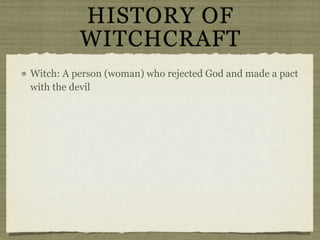
Witch: A person (woman) who rejected God and made a pact
with the devil
HISTORY OF
           WITCHCRAFT
Witch: A person (woman) who rejected God and made a pact
with the devil

Witches were believed to fly, bewitch people, work magic,
and turn into animals
HISTORY OF
           WITCHCRAFT
Witch: A person (woman) who rejected God and made a pact
with the devil

Witches were believed to fly, bewitch people, work magic,
and turn into animals

Malleus Maleficarum was the book that explained what
witchcraft was and how to convict a witch
HISTORY OF
           WITCHCRAFT
Witch: A person (woman) who rejected God and made a pact
with the devil

Witches were believed to fly, bewitch people, work magic,
and turn into animals

Malleus Maleficarum was the book that explained what
witchcraft was and how to convict a witch

Subjects were thought to be guilty until proven innocent
HISTORY OF
           WITCHCRAFT
Witch: A person (woman) who rejected God and made a pact
with the devil

Witches were believed to fly, bewitch people, work magic,
and turn into animals

Malleus Maleficarum was the book that explained what
witchcraft was and how to convict a witch

Subjects were thought to be guilty until proven innocent

English people believed in witches, so did Puritans
ILLOGICAL
CONVICTIONS
ILLOGICAL
          CONVICTIONS
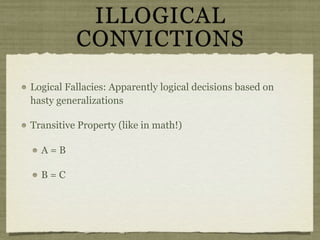
Logical Fallacies: Apparently logical decisions based on
hasty generalizations
ILLOGICAL
          CONVICTIONS
Logical Fallacies: Apparently logical decisions based on
hasty generalizations

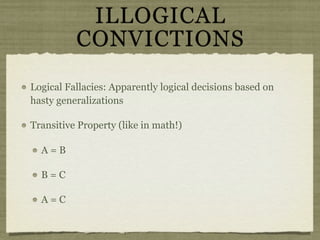
Transitive Property (like in math!)
ILLOGICAL
          CONVICTIONS
Logical Fallacies: Apparently logical decisions based on
hasty generalizations

Transitive Property (like in math!)

  A=B
ILLOGICAL
          CONVICTIONS
Logical Fallacies: Apparently logical decisions based on
hasty generalizations

Transitive Property (like in math!)

  A=B

  B=C
ILLOGICAL
          CONVICTIONS
Logical Fallacies: Apparently logical decisions based on
hasty generalizations

Transitive Property (like in math!)

  A=B

  B=C

  A=C
LOGICAL FALLACY
   EXAMPLES
LOGICAL FALLACY
   EXAMPLES


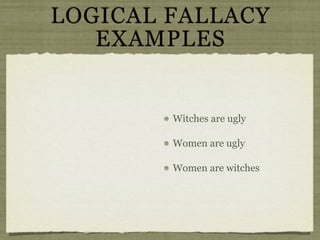
        Witches are ugly

        Women are ugly

        Women are witches
LOGICAL FALLACY
       EXAMPLES


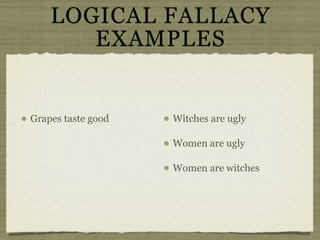
Grapes taste good   Witches are ugly

                    Women are ugly

                    Women are witches
LOGICAL FALLACY
       EXAMPLES


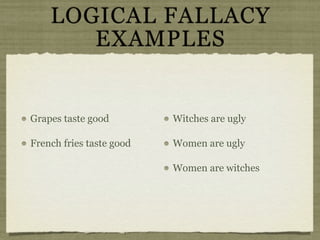
Grapes taste good         Witches are ugly

French fries taste good   Women are ugly

                          Women are witches
LOGICAL FALLACY
       EXAMPLES


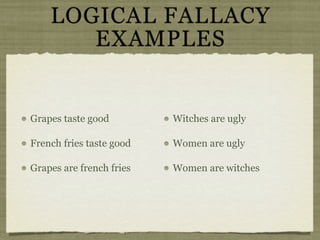
Grapes taste good         Witches are ugly

French fries taste good   Women are ugly

Grapes are french fries   Women are witches
ABOUT THE PLAY
ABOUT THE PLAY

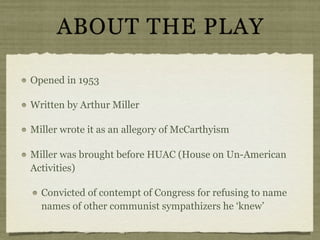
Opened in 1953
ABOUT THE PLAY

Opened in 1953

Written by Arthur Miller
ABOUT THE PLAY

Opened in 1953

Written by Arthur Miller

Miller wrote it as an allegory of McCarthyism
ABOUT THE PLAY

Opened in 1953

Written by Arthur Miller

Miller wrote it as an allegory of McCarthyism

Miller was brought before HUAC (House on Un-American
Activities)
ABOUT THE PLAY

Opened in 1953

Written by Arthur Miller

Miller wrote it as an allegory of McCarthyism

Miller was brought before HUAC (House on Un-American
Activities)

  Convicted of contempt of Congress for refusing to name
  names of other communist sympathizers he ‘knew’
GOOD TO KNOW!
GOOD TO KNOW!

The Salem witch trials occurred in 1692
GOOD TO KNOW!

The Salem witch trials occurred in 1692

The Crucible is VERY similar to the 1692 events, but it is
NOT exactly the same.
GOOD TO KNOW!

The Salem witch trials occurred in 1692

The Crucible is VERY similar to the 1692 events, but it is
NOT exactly the same.

Miller wrote The Crucible to make a point, not to recite
history
GOOD TO KNOW!

The Salem witch trials occurred in 1692

The Crucible is VERY similar to the 1692 events, but it is
NOT exactly the same.

Miller wrote The Crucible to make a point, not to recite
history

He used many of the same names, people, places and events
as a setting for his allegorical play!

Crucible background keynote

  • 1.
    THE CRUCIBLE Introduction Notes
  • 2.
  • 3.
    HISTORY OF WITCHCRAFT Witch: A person (woman) who rejected God and made a pact with the devil
  • 4.
    HISTORY OF WITCHCRAFT Witch: A person (woman) who rejected God and made a pact with the devil Witches were believed to fly, bewitch people, work magic, and turn into animals
  • 5.
    HISTORY OF WITCHCRAFT Witch: A person (woman) who rejected God and made a pact with the devil Witches were believed to fly, bewitch people, work magic, and turn into animals Malleus Maleficarum was the book that explained what witchcraft was and how to convict a witch
  • 6.
    HISTORY OF WITCHCRAFT Witch: A person (woman) who rejected God and made a pact with the devil Witches were believed to fly, bewitch people, work magic, and turn into animals Malleus Maleficarum was the book that explained what witchcraft was and how to convict a witch Subjects were thought to be guilty until proven innocent
  • 7.
    HISTORY OF WITCHCRAFT Witch: A person (woman) who rejected God and made a pact with the devil Witches were believed to fly, bewitch people, work magic, and turn into animals Malleus Maleficarum was the book that explained what witchcraft was and how to convict a witch Subjects were thought to be guilty until proven innocent English people believed in witches, so did Puritans
  • 8.
  • 9.
    ILLOGICAL CONVICTIONS Logical Fallacies: Apparently logical decisions based on hasty generalizations
  • 10.
    ILLOGICAL CONVICTIONS Logical Fallacies: Apparently logical decisions based on hasty generalizations Transitive Property (like in math!)
  • 11.
    ILLOGICAL CONVICTIONS Logical Fallacies: Apparently logical decisions based on hasty generalizations Transitive Property (like in math!) A=B
  • 12.
    ILLOGICAL CONVICTIONS Logical Fallacies: Apparently logical decisions based on hasty generalizations Transitive Property (like in math!) A=B B=C
  • 13.
    ILLOGICAL CONVICTIONS Logical Fallacies: Apparently logical decisions based on hasty generalizations Transitive Property (like in math!) A=B B=C A=C
  • 14.
  • 15.
    LOGICAL FALLACY EXAMPLES Witches are ugly Women are ugly Women are witches
  • 16.
    LOGICAL FALLACY EXAMPLES Grapes taste good Witches are ugly Women are ugly Women are witches
  • 17.
    LOGICAL FALLACY EXAMPLES Grapes taste good Witches are ugly French fries taste good Women are ugly Women are witches
  • 18.
    LOGICAL FALLACY EXAMPLES Grapes taste good Witches are ugly French fries taste good Women are ugly Grapes are french fries Women are witches
  • 19.
  • 20.
  • 21.
    ABOUT THE PLAY Openedin 1953 Written by Arthur Miller
  • 22.
    ABOUT THE PLAY Openedin 1953 Written by Arthur Miller Miller wrote it as an allegory of McCarthyism
  • 23.
    ABOUT THE PLAY Openedin 1953 Written by Arthur Miller Miller wrote it as an allegory of McCarthyism Miller was brought before HUAC (House on Un-American Activities)
  • 24.
    ABOUT THE PLAY Openedin 1953 Written by Arthur Miller Miller wrote it as an allegory of McCarthyism Miller was brought before HUAC (House on Un-American Activities) Convicted of contempt of Congress for refusing to name names of other communist sympathizers he ‘knew’
  • 25.
  • 26.
    GOOD TO KNOW! TheSalem witch trials occurred in 1692
  • 27.
    GOOD TO KNOW! TheSalem witch trials occurred in 1692 The Crucible is VERY similar to the 1692 events, but it is NOT exactly the same.
  • 28.
    GOOD TO KNOW! TheSalem witch trials occurred in 1692 The Crucible is VERY similar to the 1692 events, but it is NOT exactly the same. Miller wrote The Crucible to make a point, not to recite history
  • 29.
    GOOD TO KNOW! TheSalem witch trials occurred in 1692 The Crucible is VERY similar to the 1692 events, but it is NOT exactly the same. Miller wrote The Crucible to make a point, not to recite history He used many of the same names, people, places and events as a setting for his allegorical play!