CONTENT 
Introduction 
Meaning of charge 
The Purpose of Framing Charge 
When charge may be framed 
Contents of a Charge 
Form and requirements 
Alteration in Charge 
Joinder of charges 
Exceptions 
Framing of charge 
Conclusion 
Biblography
CODE OF CRIMINAL PROCEDURE 
TOPIC : PRINCIPLE OF FRAMING CHARGE 
NAME :M.SINDUJA (H10042) 
CLASS: V year “B”SECTION
Principles of Framing of Charges Page 1 
Introduction: 
One basic requirement of a fair trial in criminal cases is to give precise 
information to the accused as to the accusation against him. This is vitally 
important to the accused in the preparation of his defence. In all trials under the 
Code the accused is informed of the accusation in the beginning itself. In case 
of serious offences the Code requires that the accusations are to be formulated 
and reduced to writing with great precision and clarity. This “charge” 
Provisions relating to charge are aimed at giving full notice to the accused about 
the offence of which he is charged. It gives the accused accurate and precise 
information about the accusations made against him.1 Every charge under this 
Code shall state the offence with which the accused is charged. 
In the State v. Ajit Kumar Saha2 the material on record did not show a prima 
facie case but the charges were framed by the Magistrate. Since there was no 
application of mind by the Magistrate the order framing charges was set aside 
by the High Court. It is a basic principle of law that before summoning a person 
to face a charge and more particularly when a charge sheet is actually framed, 
the court concerned must be equipped with at least prima facie material to show 
that the person who is sought to be charged is guilty of an offence alleged 
against him.3 
In State of Karnataka v. Eshwaraiah4 two accused were separately charged for 
committing murder in furtherance of common intention. In the charge framed 
against one accused the name of the other was not mentioned but charges were 
read over to each of the accused in presence of the other accused and the plea 
has been recorded in the presence of each of the accused and their advocates. It 
was held that there was no scope for misunderstanding part played by each 
1 B.N. Srikantiah v. State of Mysore 
2 1988 Cr. L.J. (NOC) 2 Cal 
3 Nohar Chand v. State of Punjab 1984 Cr. LJ 886 (P&H) 
4 1987 Cr. LJ 1658 (Karn)
Principles of Framing of Charges Page 2 
accused and therefore the defect in framing of the charge was a mere 
irregularity. 
MEANING OF CHARGE: 
Charge is an accusation made against a person in respect of an offence alleged 
to have been committed by him.5 A charge is the first notice to the prisoner of 
the matter whereof he is accused and which must convey to him with sufficient 
clearness and certainty what the prosecution intends to prove against him and of 
which he would have to clear himself.6 The basic requirement is that the charge 
must be so framed as to give the accused person as fairly reasonable idea of the 
case which he has to face and the validity of the charge must be determined by 
the application of the test viz had the accused a reasonable sufficient notice of 
the matter with which he was charged.7 
Where an accused person is charged, along with others under Section 307/149 
and 302/149 of the Indian Penal Code but the others are acquitted and the 
accused alone is convicted under Section 302 and 307, the absence of specific 
charges against the accused under Section 302 and 307, is a very serious lacuna 
in the proceedings and it materially prejudices the accused and his conviction 
for those cannot be maintained.8 
In Musa Khan v. State of Maharashtra the Additional Sessions Judge framed 
charges against the accused persons under Section 149 and 395 of the Penal 
Code. Since offence under Section 395 of the Penal Code comes into existence 
only when act of dacoity is committed by five or more persons jointly the 
questions of applying Section 149 was held to be mere surplusage. That is 
5 Birichh Bhuian v. State of Bihar AIR 1963 SC 1120 
6 Manna Lal v. State 1967 Cr LJ 1272; Shyam Sunder Ker v. State 1960 Cr LJ 310; Krishnan v. The State AIR 
1958 LJ 516 
7 Chittranjandas v. State of W.B. AIR 1963 SC 1696 
8 Suraj Pal v. State of U.P. AIR 1955 SC 419
Principles of Framing of Charges Page 3 
where a charge under Section 395 of the Penal Code is framed no charge under 
Section 149 for the same offence need be framed. 
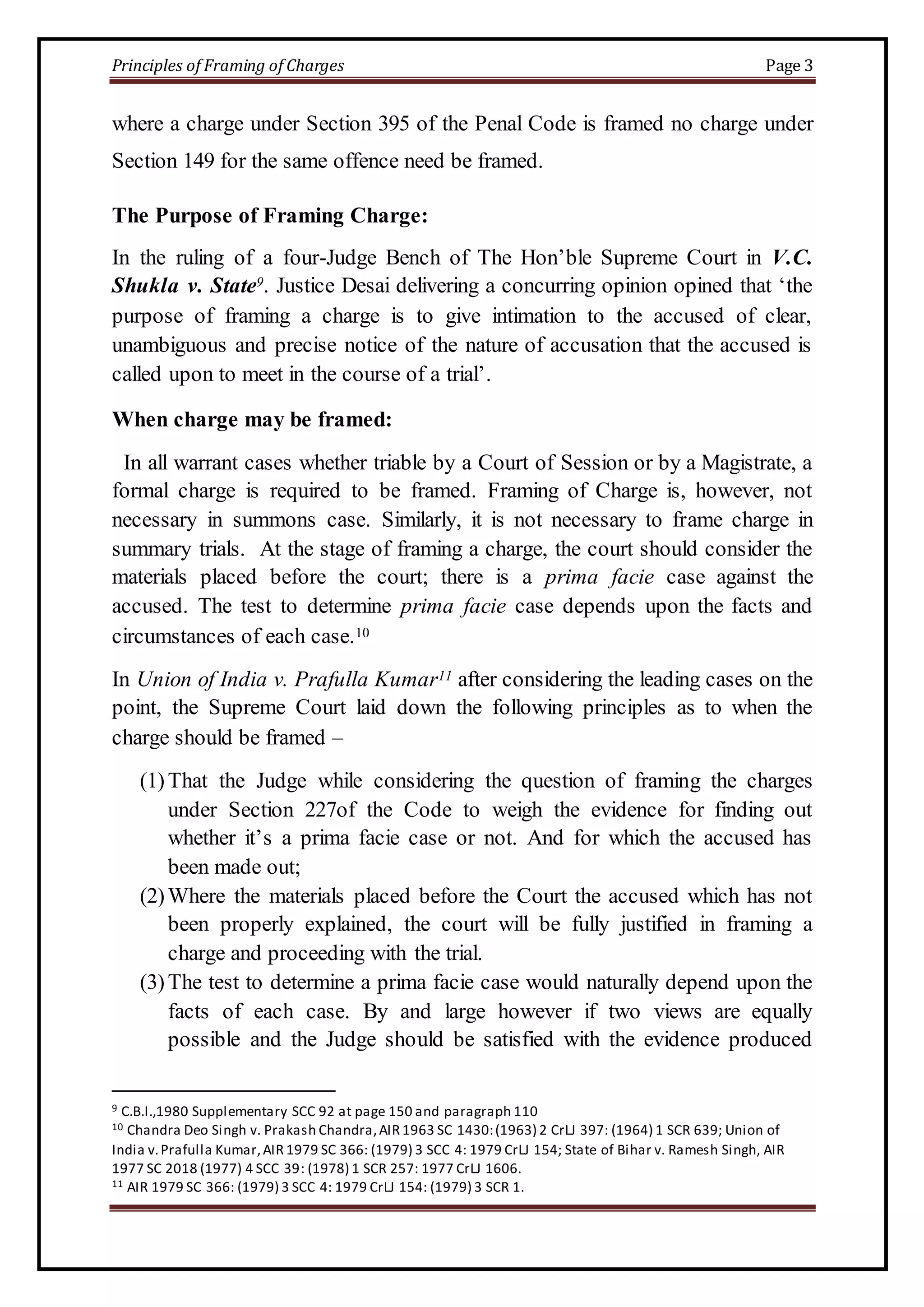
The Purpose of Framing Charge: 
In the ruling of a four-Judge Bench of The Hon’ble Supreme Court in V.C. 
Shukla v. State9. Justice Desai delivering a concurring opinion opined that ‘the 
purpose of framing a charge is to give intimation to the accused of clear, 
unambiguous and precise notice of the nature of accusation that the accused is 
called upon to meet in the course of a trial’. 
When charge may be framed: 
In all warrant cases whether triable by a Court of Session or by a Magistrate, a 
formal charge is required to be framed. Framing of Charge is, however, not 
necessary in summons case. Similarly, it is not necessary to frame charge in 
summary trials. At the stage of framing a charge, the court should consider the 
materials placed before the court; there is a prima facie case against the 
accused. The test to determine prima facie case depends upon the facts and 
circumstances of each case.10 
In Union of India v. Prafulla Kumar11 after considering the leading cases on the 
point, the Supreme Court laid down the following principles as to when the 
charge should be framed – 
(1) That the Judge while considering the question of framing the charges 
under Section 227of the Code to weigh the evidence for finding out 
whether it’s a prima facie case or not. And for which the accused has 
been made out; 
(2) Where the materials placed before the Court the accused which has not 
been properly explained, the court will be fully justified in framing a 
charge and proceeding with the trial. 
(3) The test to determine a prima facie case would naturally depend upon the 
facts of each case. By and large however if two views are equally 
possible and the Judge should be satisfied with the evidence produced 
9 C.B.I.,1980 Supplementary SCC 92 at page 150 and paragraph 110 
10 Chandra Deo Singh v. Prakash Chandra, AIR 1963 SC 1430: (1963) 2 CrLJ 397: (1964) 1 SCR 639; Union of 
India v. Prafulla Kumar, AIR 1979 SC 366: (1979) 3 SCC 4: 1979 CrLJ 154; State of Bihar v. Ramesh Singh, AIR 
1977 SC 2018 (1977) 4 SCC 39: (1978) 1 SCR 257: 1977 CrLJ 1606. 
11 AIR 1979 SC 366: (1979) 3 SCC 4: 1979 CrLJ 154: (1979) 3 SCR 1.
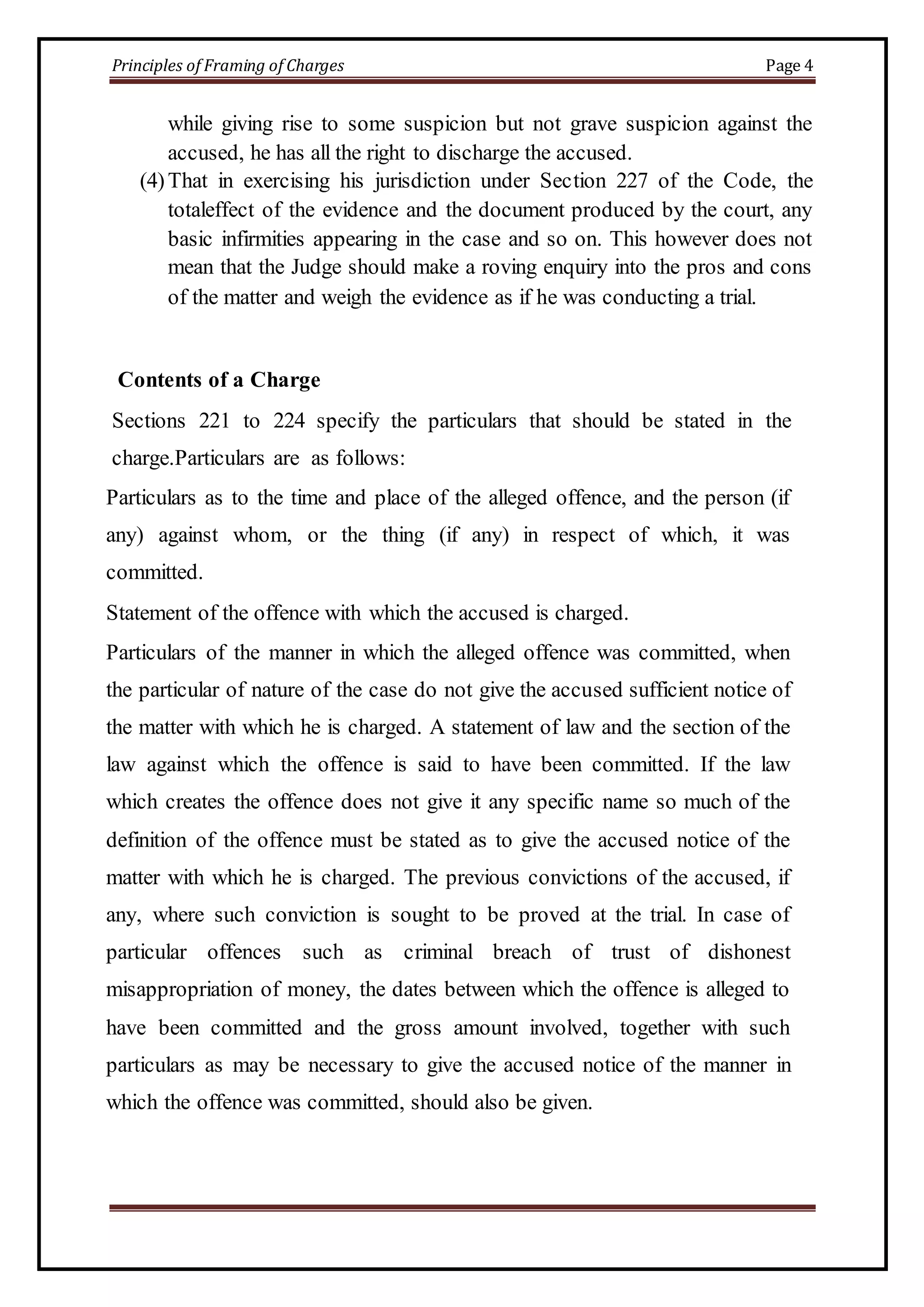
Principles of Framing of Charges Page 4 
while giving rise to some suspicion but not grave suspicion against the 
accused, he has all the right to discharge the accused. 
(4) That in exercising his jurisdiction under Section 227 of the Code, the 
totaleffect of the evidence and the document produced by the court, any 
basic infirmities appearing in the case and so on. This however does not 
mean that the Judge should make a roving enquiry into the pros and cons 
of the matter and weigh the evidence as if he was conducting a trial. 
Contents of a Charge 
Sections 221 to 224 specify the particulars that should be stated in the 
charge.Particulars are as follows: 
Particulars as to the time and place of the alleged offence, and the person (if 
any) against whom, or the thing (if any) in respect of which, it was 
committed. 
Statement of the offence with which the accused is charged. 
Particulars of the manner in which the alleged offence was committed, when 
the particular of nature of the case do not give the accused sufficient notice of 
the matter with which he is charged. A statement of law and the section of the 
law against which the offence is said to have been committed. If the law 
which creates the offence does not give it any specific name so much of the 
definition of the offence must be stated as to give the accused notice of the 
matter with which he is charged. The previous convictions of the accused, if 
any, where such conviction is sought to be proved at the trial. In case of 
particular offences such as criminal breach of trust of dishonest 
misappropriation of money, the dates between which the offence is alleged to 
have been committed and the gross amount involved, together with such 
particulars as may be necessary to give the accused notice of the manner in 
which the offence was committed, should also be given.
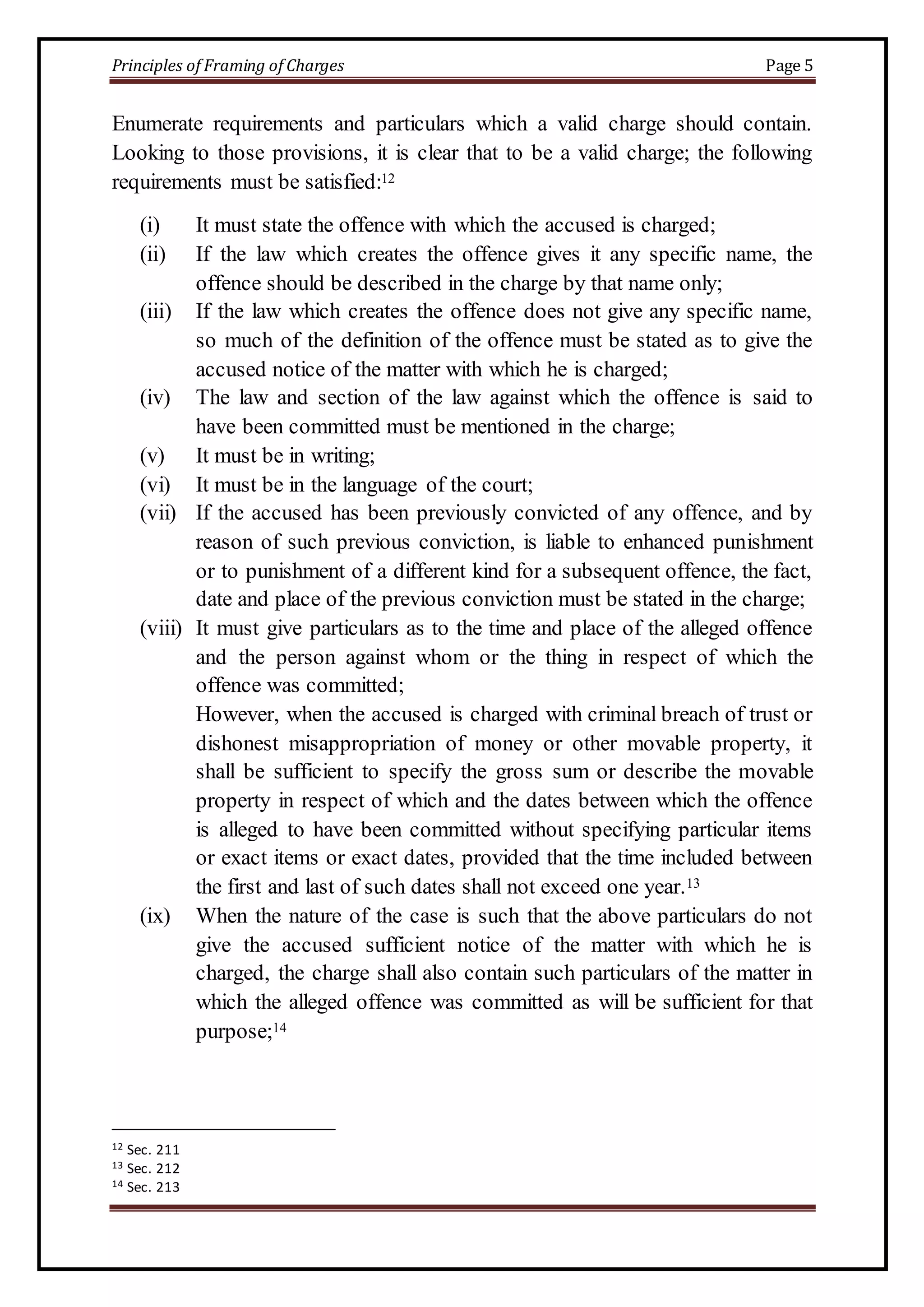
Principles of Framing of Charges Page 5 
Enumerate requirements and particulars which a valid charge should contain. 
Looking to those provisions, it is clear that to be a valid charge; the following 
requirements must be satisfied:12 
(i) It must state the offence with which the accused is charged; 
(ii) If the law which creates the offence gives it any specific name, the 
offence should be described in the charge by that name only; 
(iii) If the law which creates the offence does not give any specific name, 
so much of the definition of the offence must be stated as to give the 
accused notice of the matter with which he is charged; 
(iv) The law and section of the law against which the offence is said to 
have been committed must be mentioned in the charge; 
(v) It must be in writing; 
(vi) It must be in the language of the court; 
(vii) If the accused has been previously convicted of any offence, and by 
reason of such previous conviction, is liable to enhanced punishment 
or to punishment of a different kind for a subsequent offence, the fact, 
date and place of the previous conviction must be stated in the charge; 
(viii) It must give particulars as to the time and place of the alleged offence 
and the person against whom or the thing in respect of which the 
offence was committed; 
However, when the accused is charged with criminal breach of trust or 
dishonest misappropriation of money or other movable property, it 
shall be sufficient to specify the gross sum or describe the movable 
property in respect of which and the dates between which the offence 
is alleged to have been committed without specifying particular items 
or exact items or exact dates, provided that the time included between 
the first and last of such dates shall not exceed one year.13 
(ix) When the nature of the case is such that the above particulars do not 
give the accused sufficient notice of the matter with which he is 
charged, the charge shall also contain such particulars of the matter in 
which the alleged offence was committed as will be sufficient for that 
purpose;14 
12 Sec. 211 
13 Sec. 212 
14 Sec. 213
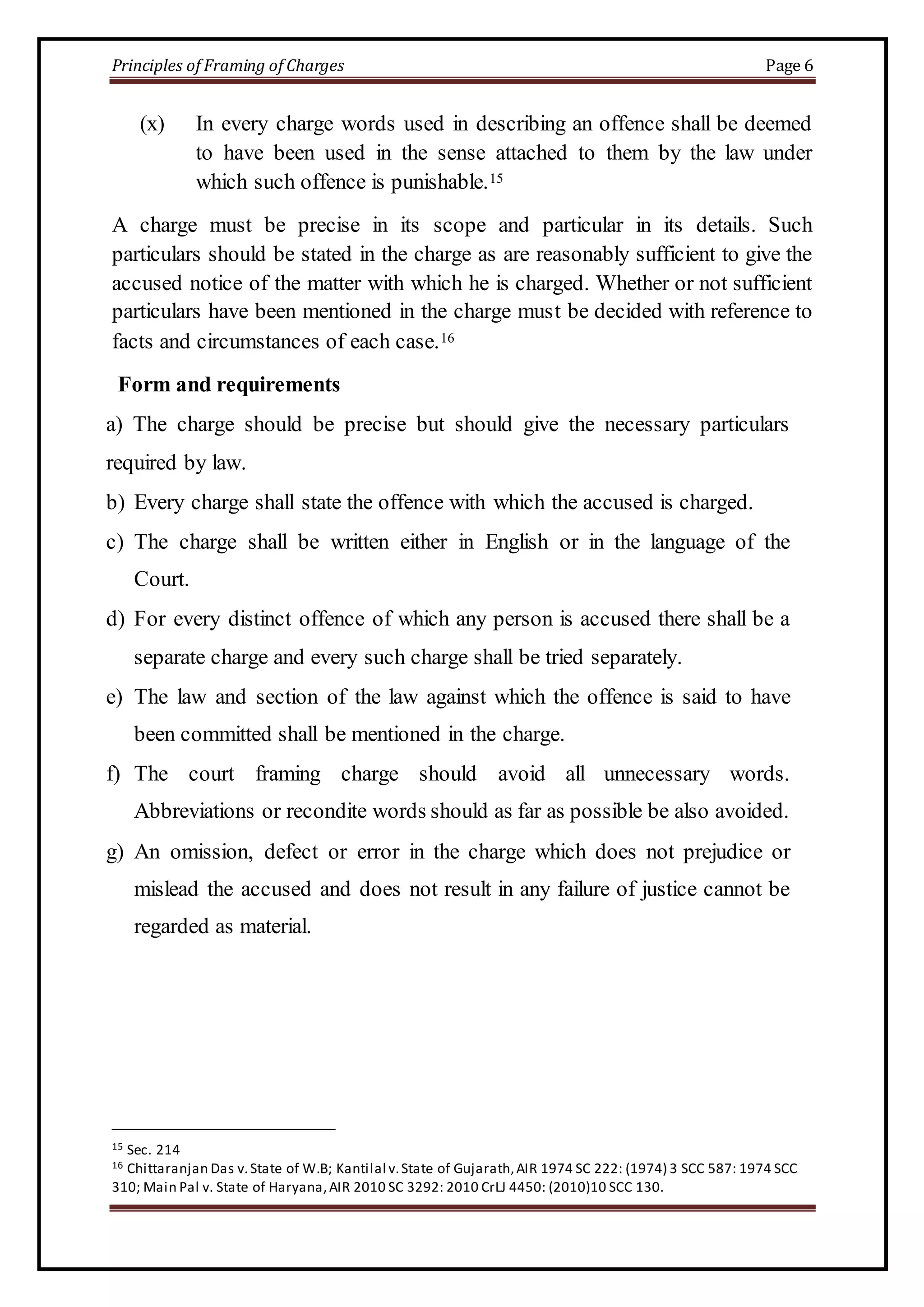
Principles of Framing of Charges Page 6 
(x) In every charge words used in describing an offence shall be deemed 
to have been used in the sense attached to them by the law under 
which such offence is punishable.15 
A charge must be precise in its scope and particular in its details. Such 
particulars should be stated in the charge as are reasonably sufficient to give the 
accused notice of the matter with which he is charged. Whether or not sufficient 
particulars have been mentioned in the charge must be decided with reference to 
facts and circumstances of each case.16 
Form and requirements 
a) The charge should be precise but should give the necessary particulars 
required by law. 
b) Every charge shall state the offence with which the accused is charged. 
c) The charge shall be written either in English or in the language of the 
Court. 
d) For every distinct offence of which any person is accused there shall be a 
separate charge and every such charge shall be tried separately. 
e) The law and section of the law against which the offence is said to have 
been committed shall be mentioned in the charge. 
f) The court framing charge should avoid all unnecessary words. 
Abbreviations or recondite words should as far as possible be also avoided. 
g) An omission, defect or error in the charge which does not prejudice or 
mislead the accused and does not result in any failure of justice cannot be 
regarded as material. 
15 Sec. 214 
16 Chittaranjan Das v. State of W.B; Kantilal v. State of Gujarath, AIR 1974 SC 222: (1974) 3 SCC 587: 1974 SCC 
310; Main Pal v. State of Haryana, AIR 2010 SC 3292: 2010 CrLJ 4450: (2010)10 SCC 130.
Principles of Framing of Charges Page 7 
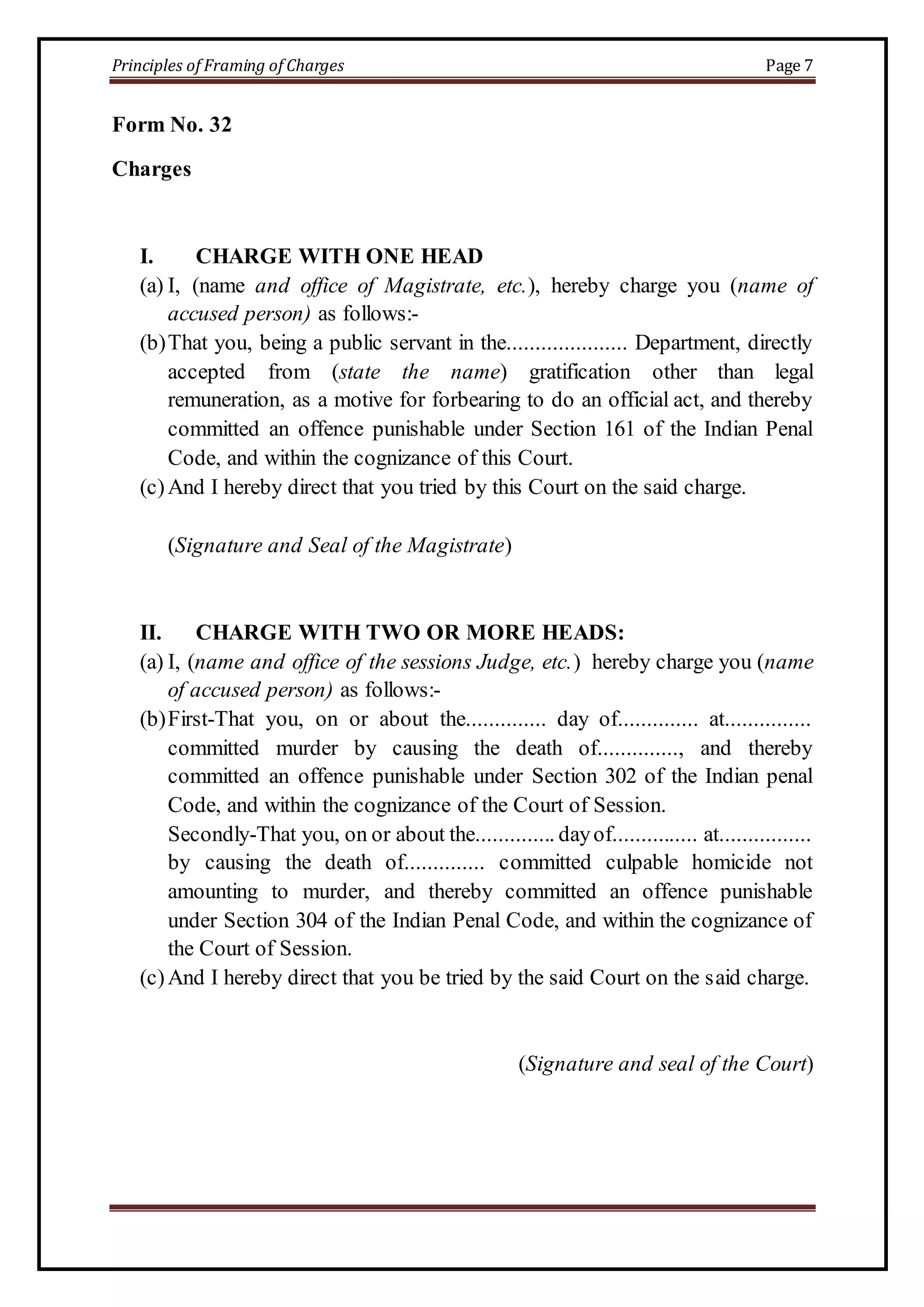
Form No. 32 
Charges 
I. CHARGE WITH ONE HEAD 
(a) I, (name and office of Magistrate, etc.), hereby charge you (name of 
accused person) as follows:- 
(b) That you, being a public servant in the..................... Department, directly 
accepted from (state the name) gratification other than legal 
remuneration, as a motive for forbearing to do an official act, and thereby 
committed an offence punishable under Section 161 of the Indian Penal 
Code, and within the cognizance of this Court. 
(c) And I hereby direct that you tried by this Court on the said charge. 
(Signature and Seal of the Magistrate) 
II. CHARGE WITH TWO OR MORE HEADS: 
(a) I, (name and office of the sessions Judge, etc.) hereby charge you (name 
of accused person) as follows:- 
(b) First-That you, on or about the.............. day of.............. at............... 
committed murder by causing the death of.............., and thereby 
committed an offence punishable under Section 302 of the Indian penal 
Code, and within the cognizance of the Court of Session. 
Secondly-That you, on or about the.............. day of............... at................ 
by causing the death of.............. committed culpable homicide not 
amounting to murder, and thereby committed an offence punishable 
under Section 304 of the Indian Penal Code, and within the cognizance of 
the Court of Session. 
(c) And I hereby direct that you be tried by the said Court on the said charge. 
(Signature and seal of the Court)
Principles of Framing of Charges Page 8 
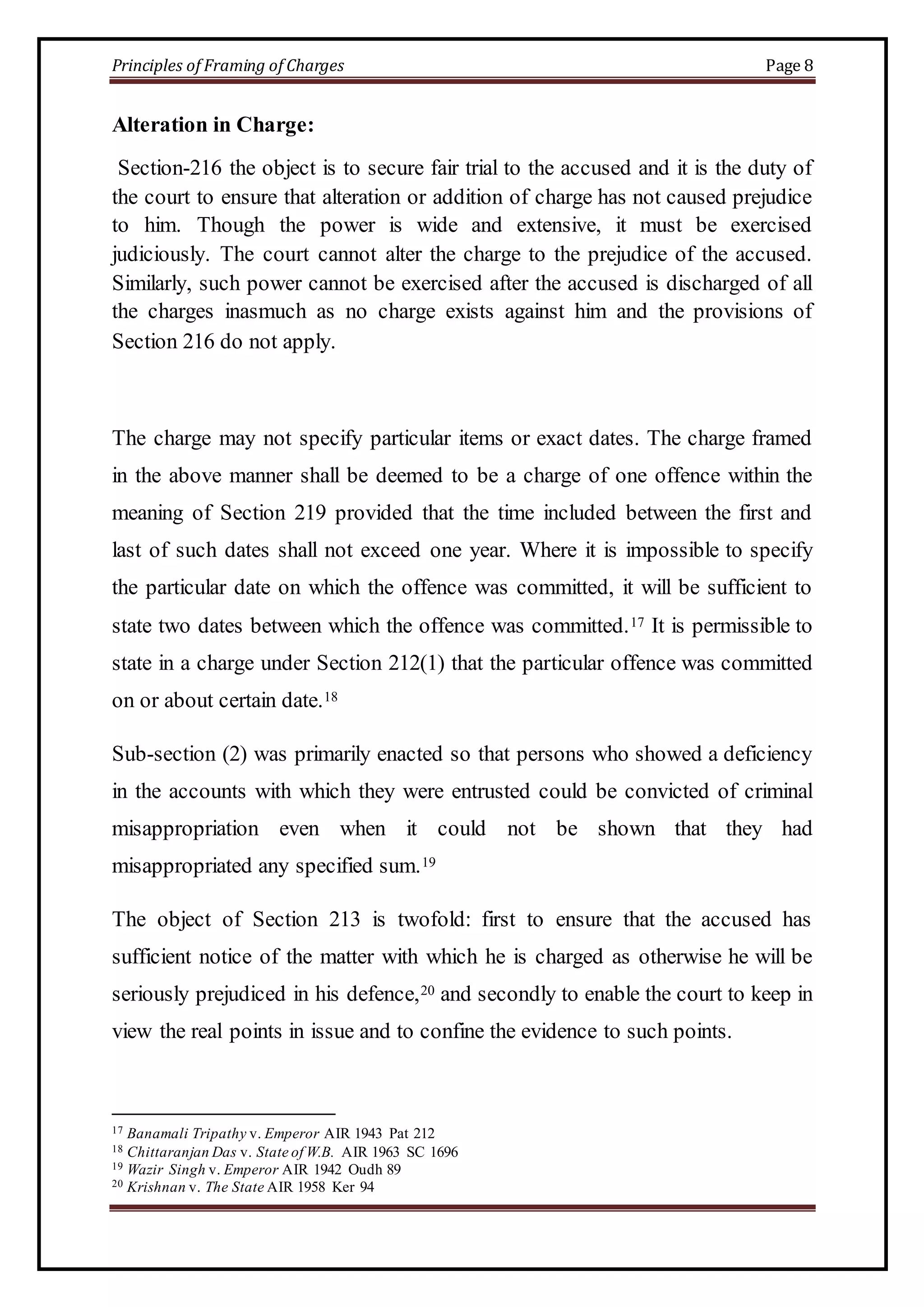
Alteration in Charge: 
Section-216 the object is to secure fair trial to the accused and it is the duty of 
the court to ensure that alteration or addition of charge has not caused prejudice 
to him. Though the power is wide and extensive, it must be exercised 
judiciously. The court cannot alter the charge to the prejudice of the accused. 
Similarly, such power cannot be exercised after the accused is discharged of all 
the charges inasmuch as no charge exists against him and the provisions of 
Section 216 do not apply. 
The charge may not specify particular items or exact dates. The charge framed 
in the above manner shall be deemed to be a charge of one offence within the 
meaning of Section 219 provided that the time included between the first and 
last of such dates shall not exceed one year. Where it is impossible to specify 
the particular date on which the offence was committed, it will be sufficient to 
state two dates between which the offence was committed.17 It is permissible to 
state in a charge under Section 212(1) that the particular offence was committed 
on or about certain date.18 
Sub-section (2) was primarily enacted so that persons who showed a deficiency 
in the accounts with which they were entrusted could be convicted of criminal 
misappropriation even when it could not be shown that they had 
misappropriated any specified sum.19 
The object of Section 213 is twofold: first to ensure that the accused has 
sufficient notice of the matter with which he is charged as otherwise he will be 
seriously prejudiced in his defence,20 and secondly to enable the court to keep in 
view the real points in issue and to confine the evidence to such points. 
17 Banamali Tripathy v. Emperor AIR 1943 Pat 212 
18 Chittaranjan Das v. State of W.B. AIR 1963 SC 1696 
19 Wazir Singh v. Emperor AIR 1942 Oudh 89 
20 Krishnan v. The State AIR 1958 Ker 94
Principles of Framing of Charges Page 9 
Omission in a charge cannot be regarded as material unless in terms of Section 
215 it is shown by the accused that he has in fact been misled by such omissions 
or that there has been a failure of justice as a result of such omission. 21 Where 
the accused is not misled defect in the charge is not material.22 The irregularity 
of charging together different offences instead of charging them separately are 
curable under this section and Section 465 if the accused is not prejudiced. 23 In 
considering the question whether the accused has been prejudiced in his defence 
by the defect in the charge regard must be had to the fact that the objection to 
the framing of the charge was not raised till a late stage in the proceedings.24 
The Code gives ample power to the courts to alter or amend a charge provided 
that the accused has not to face for a new offence or is not prejudiced either by 
keeping him in the dark about that charge or in not giving a full opportunity of 
meeting it and putting forward any defence open to him, on the charge finally 
preferred against him.25 Any addition or alteration of a charge will not be illegal 
only when it does not prejudice the accused.26 
Under Section 217 the accused has a right to recall prosecution witnesses alter 
the alteration of the charge, even if such alteration does not affect his 
defence.27Such right may be denied by the Court if it is of the opinion that the 
purpose is only delay or vexation or defeating the ends of justice. However the 
Courts do not owe a legal duty to ask the accused, after the charge has been 
altered to state whether he wishes to have any of the witnesses recalled or re-examined 
and whether the wishes to call any witnesses.28 The Code gives ample 
power to the trial as well as Appellate Courts to alter or amend a charge 
provided the accused has not to face a charge for a new offence or is not 
21 Jaswantrai Manilal Akhaney v. State of Bombay AIR 1956 SC 575 
22 Bhimbadhar Pradhan v. State of Orissa AIR 1956 SC 469 
23 Babulal v. Emperor AIR 1938 PC 130 
24 Sukha v. State of Rajasthan AIR 1956 SC 513 
25 Kantilal v. State of Maharashtra AIR 1970 SC 359 
26 Mathura Thakur (1901) 6 CWN 72 
27 Ramalinga Odayar v. Emperor AIR 1929 Mad 200 
28 Moosa Abdul Rahiman v. State of Kerala 1982 Cr. LJ 1384 (Ker)
Principles of Framing of Charges Page 10 
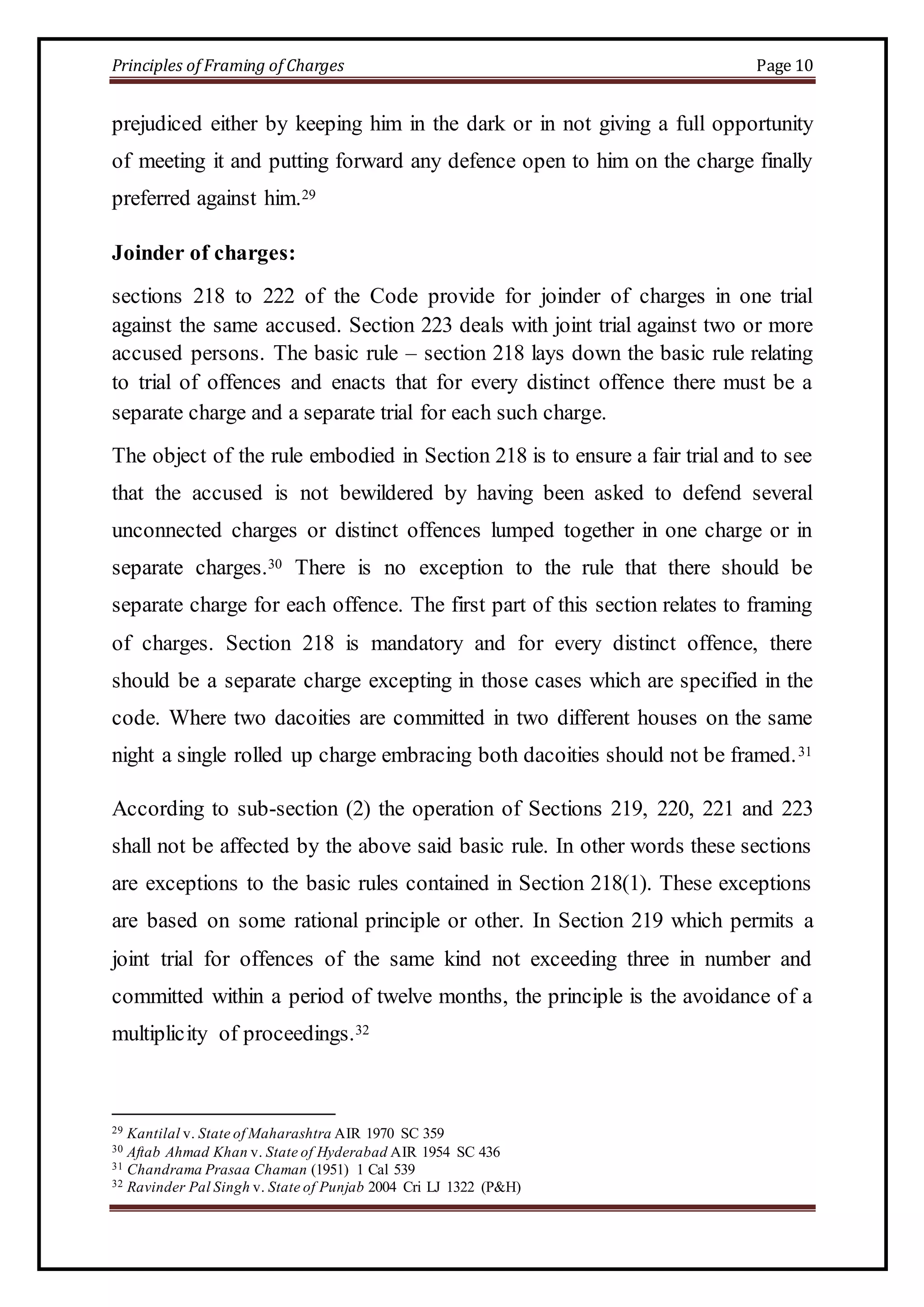
prejudiced either by keeping him in the dark or in not giving a full opportunity 
of meeting it and putting forward any defence open to him on the charge finally 
preferred against him.29 
Joinder of charges: 
sections 218 to 222 of the Code provide for joinder of charges in one trial 
against the same accused. Section 223 deals with joint trial against two or more 
accused persons. The basic rule – section 218 lays down the basic rule relating 
to trial of offences and enacts that for every distinct offence there must be a 
separate charge and a separate trial for each such charge. 
The object of the rule embodied in Section 218 is to ensure a fair trial and to see 
that the accused is not bewildered by having been asked to defend several 
unconnected charges or distinct offences lumped together in one charge or in 
separate charges.30 There is no exception to the rule that there should be 
separate charge for each offence. The first part of this section relates to framing 
of charges. Section 218 is mandatory and for every distinct offence, there 
should be a separate charge excepting in those cases which are specified in the 
code. Where two dacoities are committed in two different houses on the same 
night a single rolled up charge embracing both dacoities should not be framed. 31 
According to sub-section (2) the operation of Sections 219, 220, 221 and 223 
shall not be affected by the above said basic rule. In other words these sections 
are exceptions to the basic rules contained in Section 218(1). These exceptions 
are based on some rational principle or other. In Section 219 which permits a 
joint trial for offences of the same kind not exceeding three in number and 
committed within a period of twelve months, the principle is the avoidance of a 
multiplicity of proceedings.32 
29 Kantilal v. State of Maharashtra AIR 1970 SC 359 
30 Aftab Ahmad Khan v. State of Hyderabad AIR 1954 SC 436 
31 Chandrama Prasaa Chaman (1951) 1 Cal 539 
32 Ravinder Pal Singh v. State of Punjab 2004 Cri LJ 1322 (P&H)
Principles of Framing of Charges Page 11 
Exceptions: if the case falls in any of the exceptions, joinder of charges is 
permissible. 
(1) Desire of accused: where the accused the rule relating to separate trial is 
for the benefit of the accused and when the accused himself wants joint 
trial and the magistrate is satisfied that such joint trial will not prejudice 
the accused, joint trial is permissible.33 
(2) Three offences of same kind within one year: when a person is accused of 
more offences than one of the same kind committed within one year, 
whether in respect of the same person or not, he may be charged with and 
tried at one trial for any number of them not exceeding three.34 
(3) Offences in course of same transaction: if, in one series of acts so 
connected together as to form the same transaction, more offences than 
one are committed by the same person, he may be charged with and tried 
at one trial for every such offence.35 
(4) Offences of criminal breach of trust or misappropriation of property 
connected with falsification of accounts: where a person charged with one 
or more offences of criminal breach of trust or dishonest misappropriation 
of property is accused of committing falsification of accounts or the 
purpose of facilitating or concealing the commission of such offence, he 
may be charged with and tried at one trial for every such offence.36 
(5) Same act constituting different offences: if the acts alleged constitute an 
offence falling within two or more separate definitions of any law, the 
person accused of them may be charged with and tried at one trial for 
each of such offences.37 
(6) Same acts constituting one and also different offences: in several acts of 
which one or more than one would be itself or themselves constitute an 
offence, and constitute a different offence when combined, the person 
33 State of Punjab v. Rajesh, AIR 2002 SC 3687: (2002) 8 SCC 158. 
34 Manoharan v. Director General of Police, 2002 CrLJ NOC 51: (2001) 3 KerLT 509: (2001) 2 KerLJ 721; Chandra 
v. State, (1951) 53 Bom LR 928 (FB). 
35 Mohinder Singh v. State of Punjab, AIR 1999 SC 211: 1999 CrLJ 263: 1998 SCC (Cri) 1638; State of Punjab v. 
Rajesh Syal, 2003 CrLJ 60: (2002) 8 SCC 158: AIR 2002 SC 3687. 
36 Chandi Prasad v. State of U.P, AIR 1956 SC 149: (1955) 2 SCR 1035: 1956 CrLJ 322; Thankappan v. Union of 
India, 1989 CrLJ2374 (Ker). 
37 Emperor v. Dagdi, (1928) 30 Bom LR 342.
Principles of Framing of Charges Page 12 
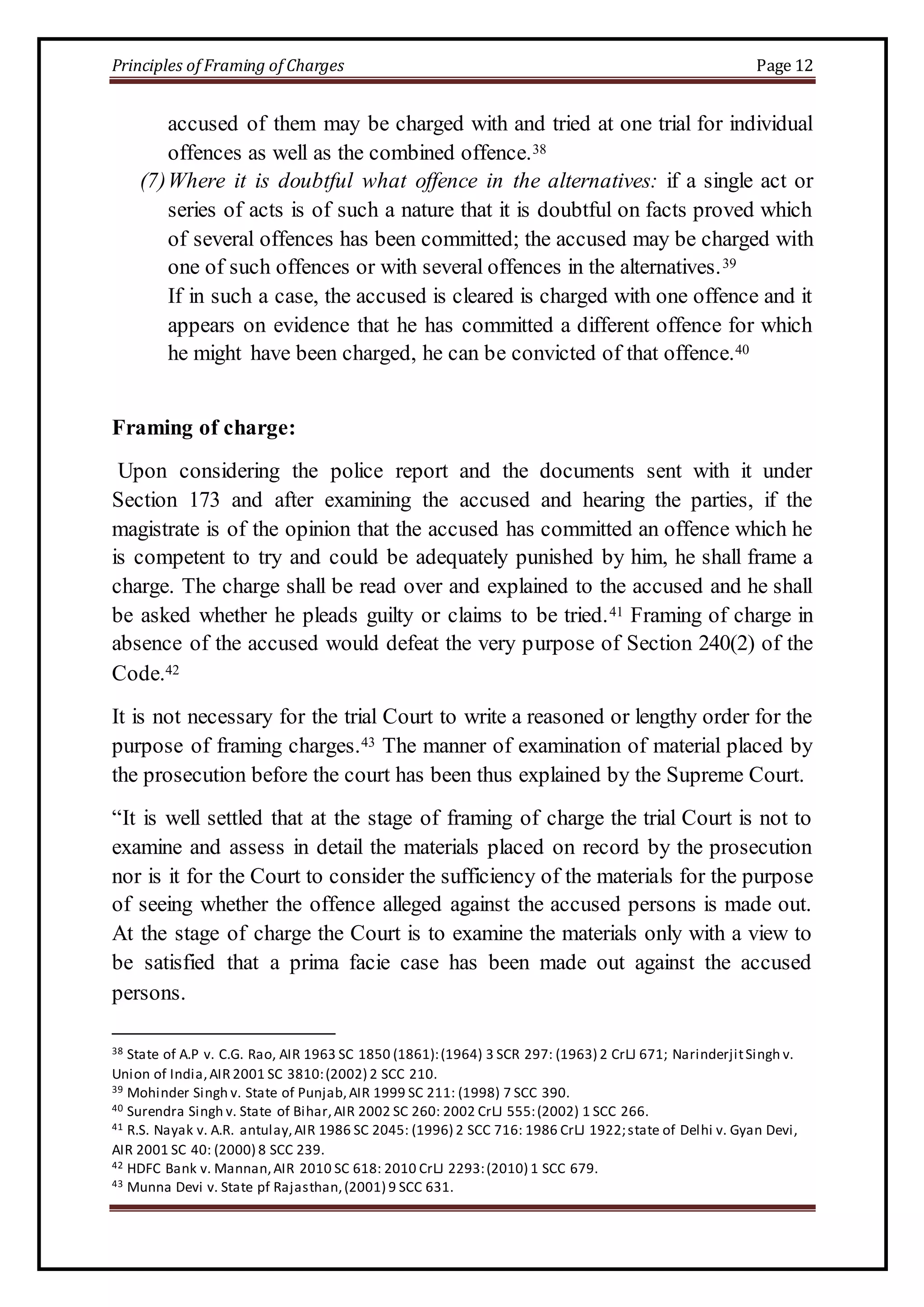
accused of them may be charged with and tried at one trial for individual 
offences as well as the combined offence.38 
(7) Where it is doubtful what offence in the alternatives: if a single act or 
series of acts is of such a nature that it is doubtful on facts proved which 
of several offences has been committed; the accused may be charged with 
one of such offences or with several offences in the alternatives.39 
If in such a case, the accused is cleared is charged with one offence and it 
appears on evidence that he has committed a different offence for which 
he might have been charged, he can be convicted of that offence.40 
Framing of charge: 
Upon considering the police report and the documents sent with it under 
Section 173 and after examining the accused and hearing the parties, if the 
magistrate is of the opinion that the accused has committed an offence which he 
is competent to try and could be adequately punished by him, he shall frame a 
charge. The charge shall be read over and explained to the accused and he shall 
be asked whether he pleads guilty or claims to be tried.41 Framing of charge in 
absence of the accused would defeat the very purpose of Section 240(2) of the 
Code.42 
It is not necessary for the trial Court to write a reasoned or lengthy order for the 
purpose of framing charges.43 The manner of examination of material placed by 
the prosecution before the court has been thus explained by the Supreme Court. 
“It is well settled that at the stage of framing of charge the trial Court is not to 
examine and assess in detail the materials placed on record by the prosecution 
nor is it for the Court to consider the sufficiency of the materials for the purpose 
of seeing whether the offence alleged against the accused persons is made out. 
At the stage of charge the Court is to examine the materials only with a view to 
be satisfied that a prima facie case has been made out against the accused 
persons. 
38 State of A.P v. C.G. Rao, AIR 1963 SC 1850 (1861): (1964) 3 SCR 297: (1963) 2 CrLJ 671; Narinderjit Singh v. 
Union of India, AIR 2001 SC 3810: (2002) 2 SCC 210. 
39 Mohinder Singh v. State of Punjab, AIR 1999 SC 211: (1998) 7 SCC 390. 
40 Surendra Singh v. State of Bihar, AIR 2002 SC 260: 2002 CrLJ 555: (2002) 1 SCC 266. 
41 R.S. Nayak v. A.R. antulay, AIR 1986 SC 2045: (1996) 2 SCC 716: 1986 CrLJ 1922; state of Delhi v. Gyan Devi, 
AIR 2001 SC 40: (2000) 8 SCC 239. 
42 HDFC Bank v. Mannan, AIR 2010 SC 618: 2010 CrLJ 2293: (2010) 1 SCC 679. 
43 Munna Devi v. State pf Rajasthan, (2001) 9 SCC 631.
Principles of Framing of Charges Page 13 
Where the material on record as product by the prosecution was sufficient for 
framing the charge of corruption, the Court need not wait for the public servant 
to satisfactorily explain the assets position.44 
Where the accused, in collusion with others, defrauded the bank to the tune of 
over 2 crore rupees, the Supreme Court observed that a blanket order enabling 
the accused not to appear before the court during investigation and even at trial 
should not be passed. His presence may become necessary for example, at the 
time of framing of charge. 
Examination of accused and framing of charge, two distinct stages – 
The Supreme Court deprecated the practice of examination of the accused and 
framing of charge are two important stages in criminal trial. 
In the case Sajjan Sharma v. State of Bihar45 the accused were police officers. 
They are arrested the deceased for taking bribe. He was patient of asthama. He 
was put in a window-less room which was full of dust and cobwebs which are 
known allergies for triggering an asthama attack. He was brought to the hospital 
the next day in a comatose condition. His body showed no signs of pulse, 
respiration, or blood pressure. The court said that prima facie the accused could 
be proceeded against under Section.304, and Section.330, of IPC. But not under 
Section. 302, as there was little evidence to establish intention to wilfully cause 
death.46 
the charge against the accused was that she dishonestly processed and verified 
fake bills. The bills in question were neither raised nor signed by the appropriate 
authority. The same was not entered in the bill register. The framing of charge 
against her was held to be proper. The duty by saying that the accounts section 
was negligent in its verification. The court said a person signing a document is 
expected to make some enquiry before signing. The presence of material on the 
record was sufficient to enable the court to form an opinion that the accused 
might have committed the offence. All the officers who dealt with the relevant 
files at one point of time or the other could not be taken to have participated in 
the conspiracy or guilty of aiding or abetting it. In such cases, it is necessary to 
deal with individual acts of criminal misconduct for finding out their respective 
44 State (CBI) v. Bangarappa, AIR 2001 SC 222: (2001) 1 SCC 369: 2001 CrLJ 111. 
45 AIR 2011 SC 632: 2011 CrLJ 1169. 
46 Indu Jain v. State of M.P., AIR 2009 SC 976: (2008) 15 SCC 341: 2009 CrLJ 951.
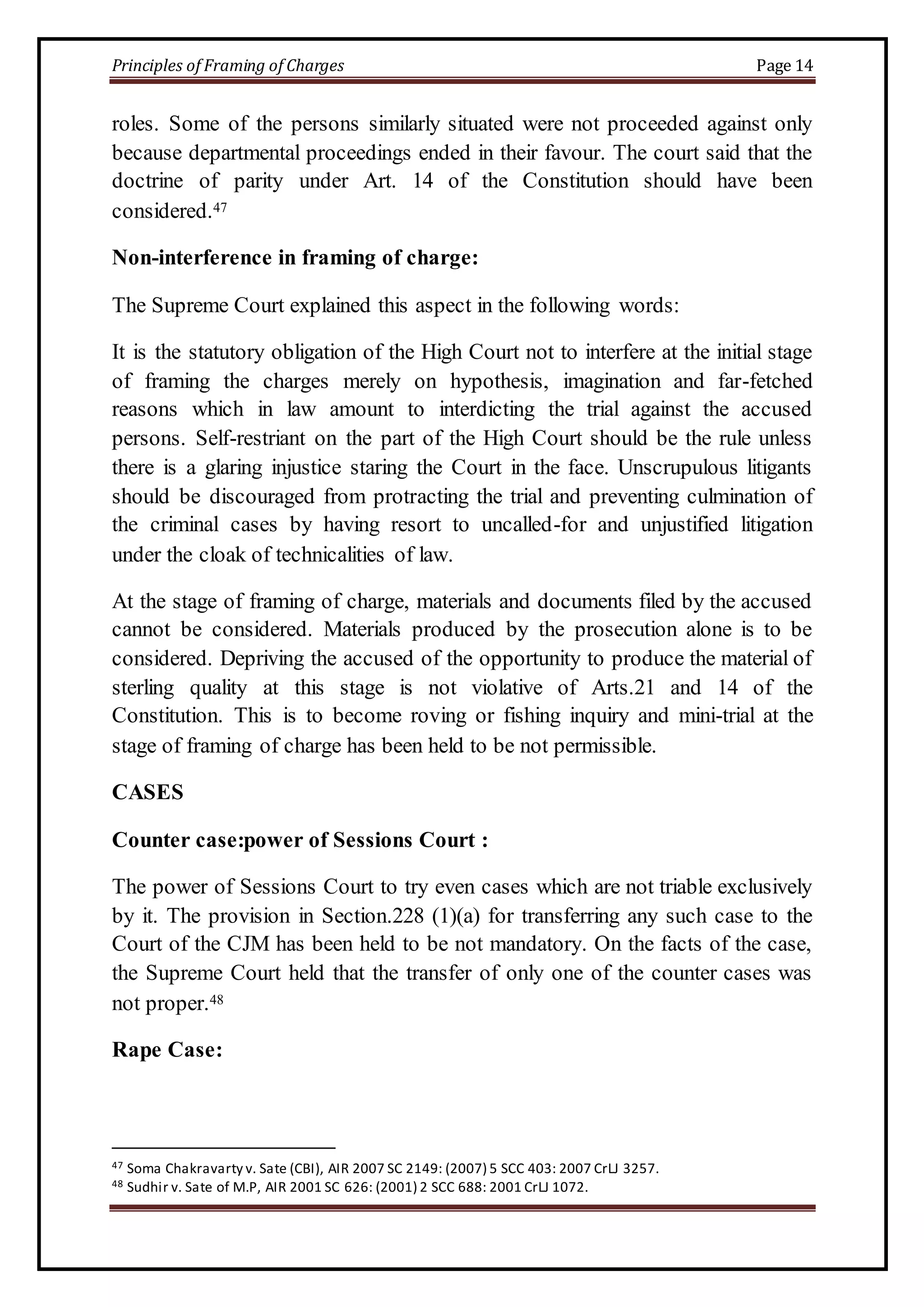
Principles of Framing of Charges Page 14 
roles. Some of the persons similarly situated were not proceeded against only 
because departmental proceedings ended in their favour. The court said that the 
doctrine of parity under Art. 14 of the Constitution should have been 
considered.47 
Non-interference in framing of charge: 
The Supreme Court explained this aspect in the following words: 
It is the statutory obligation of the High Court not to interfere at the initial stage 
of framing the charges merely on hypothesis, imagination and far-fetched 
reasons which in law amount to interdicting the trial against the accused 
persons. Self-restriant on the part of the High Court should be the rule unless 
there is a glaring injustice staring the Court in the face. Unscrupulous litigants 
should be discouraged from protracting the trial and preventing culmination of 
the criminal cases by having resort to uncalled-for and unjustified litigation 
under the cloak of technicalities of law. 
At the stage of framing of charge, materials and documents filed by the accused 
cannot be considered. Materials produced by the prosecution alone is to be 
considered. Depriving the accused of the opportunity to produce the material of 
sterling quality at this stage is not violative of Arts.21 and 14 of the 
Constitution. This is to become roving or fishing inquiry and mini-trial at the 
stage of framing of charge has been held to be not permissible. 
CASES 
Counter case:power of Sessions Court : 
The power of Sessions Court to try even cases which are not triable exclusively 
by it. The provision in Section.228 (1)(a) for transferring any such case to the 
Court of the CJM has been held to be not mandatory. On the facts of the case, 
the Supreme Court held that the transfer of only one of the counter cases was 
not proper.48 
Rape Case: 
47 Soma Chakravarty v. Sate (CBI), AIR 2007 SC 2149: (2007) 5 SCC 403: 2007 CrLJ 3257. 
48 Sudhir v. Sate of M.P, AIR 2001 SC 626: (2001) 2 SCC 688: 2001 CrLJ 1072.
Principles of Framing of Charges Page 15 
At the stage of framing of charge, the statements recorded under section. 164 as 
also the affidavits of the prosecutrix and her father in a rape case are not to 
taken into account.49 
Error or irregularity in framing charge : 
Where all other requirements of the section were complied with, the Supreme 
Court held that an error or irregularity in framing the charge was not to upset 
the trial because no inquiry or prejudiced to the accused was caused in the 
defence on merits. His acquittal on this ground was not proper.50 
Diluting or dropping charge : 
The Supreme Court explained the role of the judge at the stage of framing of 
charge. The words”if after such consideration” occurring in s. 228 provide an 
interconnection between Sections.227 and 228. While dropping or diluting a 
charge under a particular section, although the accused is not discharged, the 
court is expected to record reasons. The judgment showed non-application of 
mind to the statement in the charge-sheet and medical records. No reasons were 
stated as to why the material in the case diary was considered to be 
insufficient.51 
Taking transfer of property from unauthorised person: 
The complainant had executed a general power of attorney in the favour of M. 
the latter executed a sale deed for sale of a plot of land of the complainants. The 
general power of attorney given to him did not authorise him to transfer 
property. The transferee knew it, yet he went ahead with the transaction. The 
order framing charges against him was held to be proper.52 
49 Vikas Rusia v. State of M.p., 2002 CrLJ 2895 (MP) 
50 State of Punjab v. Harjagdev Singh, AIR 2009 SC 2693: (2009) 16 SCC 91. 
51 R.S. Mishra v.State of Orissa, AIR 2011 SC 1103: (2011) 2 SCC 689: 2011 CrLJ 1654. 
52 Chaman Lal v. State of Punjab, AIR 2009 SC 2972: (2009) 16 SCC 91.
Principles of Framing of Charges Page 16 
Conclusion: 
Charge is an accusation against a person with respect to the commission of an 
offence. Every charge shall state the section of the law along with the name of 
the offence, if any, which the accused is charge and shall also state the time, 
place and the manner of the occurrence as well as the person against whom or 
the thing in respect of which the offences has been committed. Previous 
conviction of the person charged with, if any, may also be mentioned, because it 
directs severe punishment. For every offences there shall be a separate Charge 
and the charge be tried separately except in the cases mentioned with the 
section. In one series of acts so connected together as to form the same 
transaction, more offences than one are committed by the same person, the 
person may be charged with and tried at one trial for every such offences. 
If the offences so committed falls with in the definition the accused may be 
charged with both offences and tried at one trial for each of such offences. On 
framing of charge the same be read over and explained to the accused and his 
reply shall have to be recorded in the prescribed form and the Magistrate shall 
sign the same. The matter of framing of the charge may also be noted in the 
order sheet of the case. In necessary charge can be attested. And if it attested it 
should be read over the same.
Principles of Framing of Charges Page 17
Principles of Framing of Charges Page 18 
BIBLIOGRAPHY 
Books 
 Kelkar, R.V., Criminal Procedure Code, 5th edition Eastern (2008) 
 Misra, S.N., The Code of Criminal Procedure, 1973 with Probation of Offenders Act & 
Juvenile Justice Act, 17th ed, Central Law Publications (2011) 
 Sarkar’s, The Code of Criminal Procedure, Dwivedi Law Agency Allahabad, Reprint (2007) 
Articles 
 Chitnis, S.R., “Framing of Charge in Criminal Cases”, Eastern Book Company (2002) 
 Jain, Tarun, “Framing of ‘charge’ in criminal trial: The law revisited”, Law in Perspective 
(2010) 
 Sathasivam, Justice P., “Framing of Charge: Principles and Law”, The Legal Blog, (2011) 
Websites 
 http://www.ebc- india.com/lawyer/articles/2002v2a3.htm 
 http://legalperspectives.blogspot.in/2010/10/framing-of-charge- in-criminal-trial- law.html 
 http://www.legalblog.in/2011/08/framing-of-charge-principles-and-law.html

Crpc ppt final sindu.pptx final word

  • 1.
    CONTENT Introduction Meaningof charge The Purpose of Framing Charge When charge may be framed Contents of a Charge Form and requirements Alteration in Charge Joinder of charges Exceptions Framing of charge Conclusion Biblography
  • 2.
    CODE OF CRIMINALPROCEDURE TOPIC : PRINCIPLE OF FRAMING CHARGE NAME :M.SINDUJA (H10042) CLASS: V year “B”SECTION
  • 4.
    Principles of Framingof Charges Page 1 Introduction: One basic requirement of a fair trial in criminal cases is to give precise information to the accused as to the accusation against him. This is vitally important to the accused in the preparation of his defence. In all trials under the Code the accused is informed of the accusation in the beginning itself. In case of serious offences the Code requires that the accusations are to be formulated and reduced to writing with great precision and clarity. This “charge” Provisions relating to charge are aimed at giving full notice to the accused about the offence of which he is charged. It gives the accused accurate and precise information about the accusations made against him.1 Every charge under this Code shall state the offence with which the accused is charged. In the State v. Ajit Kumar Saha2 the material on record did not show a prima facie case but the charges were framed by the Magistrate. Since there was no application of mind by the Magistrate the order framing charges was set aside by the High Court. It is a basic principle of law that before summoning a person to face a charge and more particularly when a charge sheet is actually framed, the court concerned must be equipped with at least prima facie material to show that the person who is sought to be charged is guilty of an offence alleged against him.3 In State of Karnataka v. Eshwaraiah4 two accused were separately charged for committing murder in furtherance of common intention. In the charge framed against one accused the name of the other was not mentioned but charges were read over to each of the accused in presence of the other accused and the plea has been recorded in the presence of each of the accused and their advocates. It was held that there was no scope for misunderstanding part played by each 1 B.N. Srikantiah v. State of Mysore 2 1988 Cr. L.J. (NOC) 2 Cal 3 Nohar Chand v. State of Punjab 1984 Cr. LJ 886 (P&H) 4 1987 Cr. LJ 1658 (Karn)
  • 5.
    Principles of Framingof Charges Page 2 accused and therefore the defect in framing of the charge was a mere irregularity. MEANING OF CHARGE: Charge is an accusation made against a person in respect of an offence alleged to have been committed by him.5 A charge is the first notice to the prisoner of the matter whereof he is accused and which must convey to him with sufficient clearness and certainty what the prosecution intends to prove against him and of which he would have to clear himself.6 The basic requirement is that the charge must be so framed as to give the accused person as fairly reasonable idea of the case which he has to face and the validity of the charge must be determined by the application of the test viz had the accused a reasonable sufficient notice of the matter with which he was charged.7 Where an accused person is charged, along with others under Section 307/149 and 302/149 of the Indian Penal Code but the others are acquitted and the accused alone is convicted under Section 302 and 307, the absence of specific charges against the accused under Section 302 and 307, is a very serious lacuna in the proceedings and it materially prejudices the accused and his conviction for those cannot be maintained.8 In Musa Khan v. State of Maharashtra the Additional Sessions Judge framed charges against the accused persons under Section 149 and 395 of the Penal Code. Since offence under Section 395 of the Penal Code comes into existence only when act of dacoity is committed by five or more persons jointly the questions of applying Section 149 was held to be mere surplusage. That is 5 Birichh Bhuian v. State of Bihar AIR 1963 SC 1120 6 Manna Lal v. State 1967 Cr LJ 1272; Shyam Sunder Ker v. State 1960 Cr LJ 310; Krishnan v. The State AIR 1958 LJ 516 7 Chittranjandas v. State of W.B. AIR 1963 SC 1696 8 Suraj Pal v. State of U.P. AIR 1955 SC 419
  • 6.
    Principles of Framingof Charges Page 3 where a charge under Section 395 of the Penal Code is framed no charge under Section 149 for the same offence need be framed. The Purpose of Framing Charge: In the ruling of a four-Judge Bench of The Hon’ble Supreme Court in V.C. Shukla v. State9. Justice Desai delivering a concurring opinion opined that ‘the purpose of framing a charge is to give intimation to the accused of clear, unambiguous and precise notice of the nature of accusation that the accused is called upon to meet in the course of a trial’. When charge may be framed: In all warrant cases whether triable by a Court of Session or by a Magistrate, a formal charge is required to be framed. Framing of Charge is, however, not necessary in summons case. Similarly, it is not necessary to frame charge in summary trials. At the stage of framing a charge, the court should consider the materials placed before the court; there is a prima facie case against the accused. The test to determine prima facie case depends upon the facts and circumstances of each case.10 In Union of India v. Prafulla Kumar11 after considering the leading cases on the point, the Supreme Court laid down the following principles as to when the charge should be framed – (1) That the Judge while considering the question of framing the charges under Section 227of the Code to weigh the evidence for finding out whether it’s a prima facie case or not. And for which the accused has been made out; (2) Where the materials placed before the Court the accused which has not been properly explained, the court will be fully justified in framing a charge and proceeding with the trial. (3) The test to determine a prima facie case would naturally depend upon the facts of each case. By and large however if two views are equally possible and the Judge should be satisfied with the evidence produced 9 C.B.I.,1980 Supplementary SCC 92 at page 150 and paragraph 110 10 Chandra Deo Singh v. Prakash Chandra, AIR 1963 SC 1430: (1963) 2 CrLJ 397: (1964) 1 SCR 639; Union of India v. Prafulla Kumar, AIR 1979 SC 366: (1979) 3 SCC 4: 1979 CrLJ 154; State of Bihar v. Ramesh Singh, AIR 1977 SC 2018 (1977) 4 SCC 39: (1978) 1 SCR 257: 1977 CrLJ 1606. 11 AIR 1979 SC 366: (1979) 3 SCC 4: 1979 CrLJ 154: (1979) 3 SCR 1.
  • 7.
    Principles of Framingof Charges Page 4 while giving rise to some suspicion but not grave suspicion against the accused, he has all the right to discharge the accused. (4) That in exercising his jurisdiction under Section 227 of the Code, the totaleffect of the evidence and the document produced by the court, any basic infirmities appearing in the case and so on. This however does not mean that the Judge should make a roving enquiry into the pros and cons of the matter and weigh the evidence as if he was conducting a trial. Contents of a Charge Sections 221 to 224 specify the particulars that should be stated in the charge.Particulars are as follows: Particulars as to the time and place of the alleged offence, and the person (if any) against whom, or the thing (if any) in respect of which, it was committed. Statement of the offence with which the accused is charged. Particulars of the manner in which the alleged offence was committed, when the particular of nature of the case do not give the accused sufficient notice of the matter with which he is charged. A statement of law and the section of the law against which the offence is said to have been committed. If the law which creates the offence does not give it any specific name so much of the definition of the offence must be stated as to give the accused notice of the matter with which he is charged. The previous convictions of the accused, if any, where such conviction is sought to be proved at the trial. In case of particular offences such as criminal breach of trust of dishonest misappropriation of money, the dates between which the offence is alleged to have been committed and the gross amount involved, together with such particulars as may be necessary to give the accused notice of the manner in which the offence was committed, should also be given.
  • 8.
    Principles of Framingof Charges Page 5 Enumerate requirements and particulars which a valid charge should contain. Looking to those provisions, it is clear that to be a valid charge; the following requirements must be satisfied:12 (i) It must state the offence with which the accused is charged; (ii) If the law which creates the offence gives it any specific name, the offence should be described in the charge by that name only; (iii) If the law which creates the offence does not give any specific name, so much of the definition of the offence must be stated as to give the accused notice of the matter with which he is charged; (iv) The law and section of the law against which the offence is said to have been committed must be mentioned in the charge; (v) It must be in writing; (vi) It must be in the language of the court; (vii) If the accused has been previously convicted of any offence, and by reason of such previous conviction, is liable to enhanced punishment or to punishment of a different kind for a subsequent offence, the fact, date and place of the previous conviction must be stated in the charge; (viii) It must give particulars as to the time and place of the alleged offence and the person against whom or the thing in respect of which the offence was committed; However, when the accused is charged with criminal breach of trust or dishonest misappropriation of money or other movable property, it shall be sufficient to specify the gross sum or describe the movable property in respect of which and the dates between which the offence is alleged to have been committed without specifying particular items or exact items or exact dates, provided that the time included between the first and last of such dates shall not exceed one year.13 (ix) When the nature of the case is such that the above particulars do not give the accused sufficient notice of the matter with which he is charged, the charge shall also contain such particulars of the matter in which the alleged offence was committed as will be sufficient for that purpose;14 12 Sec. 211 13 Sec. 212 14 Sec. 213
  • 9.
    Principles of Framingof Charges Page 6 (x) In every charge words used in describing an offence shall be deemed to have been used in the sense attached to them by the law under which such offence is punishable.15 A charge must be precise in its scope and particular in its details. Such particulars should be stated in the charge as are reasonably sufficient to give the accused notice of the matter with which he is charged. Whether or not sufficient particulars have been mentioned in the charge must be decided with reference to facts and circumstances of each case.16 Form and requirements a) The charge should be precise but should give the necessary particulars required by law. b) Every charge shall state the offence with which the accused is charged. c) The charge shall be written either in English or in the language of the Court. d) For every distinct offence of which any person is accused there shall be a separate charge and every such charge shall be tried separately. e) The law and section of the law against which the offence is said to have been committed shall be mentioned in the charge. f) The court framing charge should avoid all unnecessary words. Abbreviations or recondite words should as far as possible be also avoided. g) An omission, defect or error in the charge which does not prejudice or mislead the accused and does not result in any failure of justice cannot be regarded as material. 15 Sec. 214 16 Chittaranjan Das v. State of W.B; Kantilal v. State of Gujarath, AIR 1974 SC 222: (1974) 3 SCC 587: 1974 SCC 310; Main Pal v. State of Haryana, AIR 2010 SC 3292: 2010 CrLJ 4450: (2010)10 SCC 130.
  • 10.
    Principles of Framingof Charges Page 7 Form No. 32 Charges I. CHARGE WITH ONE HEAD (a) I, (name and office of Magistrate, etc.), hereby charge you (name of accused person) as follows:- (b) That you, being a public servant in the..................... Department, directly accepted from (state the name) gratification other than legal remuneration, as a motive for forbearing to do an official act, and thereby committed an offence punishable under Section 161 of the Indian Penal Code, and within the cognizance of this Court. (c) And I hereby direct that you tried by this Court on the said charge. (Signature and Seal of the Magistrate) II. CHARGE WITH TWO OR MORE HEADS: (a) I, (name and office of the sessions Judge, etc.) hereby charge you (name of accused person) as follows:- (b) First-That you, on or about the.............. day of.............. at............... committed murder by causing the death of.............., and thereby committed an offence punishable under Section 302 of the Indian penal Code, and within the cognizance of the Court of Session. Secondly-That you, on or about the.............. day of............... at................ by causing the death of.............. committed culpable homicide not amounting to murder, and thereby committed an offence punishable under Section 304 of the Indian Penal Code, and within the cognizance of the Court of Session. (c) And I hereby direct that you be tried by the said Court on the said charge. (Signature and seal of the Court)
  • 11.
    Principles of Framingof Charges Page 8 Alteration in Charge: Section-216 the object is to secure fair trial to the accused and it is the duty of the court to ensure that alteration or addition of charge has not caused prejudice to him. Though the power is wide and extensive, it must be exercised judiciously. The court cannot alter the charge to the prejudice of the accused. Similarly, such power cannot be exercised after the accused is discharged of all the charges inasmuch as no charge exists against him and the provisions of Section 216 do not apply. The charge may not specify particular items or exact dates. The charge framed in the above manner shall be deemed to be a charge of one offence within the meaning of Section 219 provided that the time included between the first and last of such dates shall not exceed one year. Where it is impossible to specify the particular date on which the offence was committed, it will be sufficient to state two dates between which the offence was committed.17 It is permissible to state in a charge under Section 212(1) that the particular offence was committed on or about certain date.18 Sub-section (2) was primarily enacted so that persons who showed a deficiency in the accounts with which they were entrusted could be convicted of criminal misappropriation even when it could not be shown that they had misappropriated any specified sum.19 The object of Section 213 is twofold: first to ensure that the accused has sufficient notice of the matter with which he is charged as otherwise he will be seriously prejudiced in his defence,20 and secondly to enable the court to keep in view the real points in issue and to confine the evidence to such points. 17 Banamali Tripathy v. Emperor AIR 1943 Pat 212 18 Chittaranjan Das v. State of W.B. AIR 1963 SC 1696 19 Wazir Singh v. Emperor AIR 1942 Oudh 89 20 Krishnan v. The State AIR 1958 Ker 94
  • 12.
    Principles of Framingof Charges Page 9 Omission in a charge cannot be regarded as material unless in terms of Section 215 it is shown by the accused that he has in fact been misled by such omissions or that there has been a failure of justice as a result of such omission. 21 Where the accused is not misled defect in the charge is not material.22 The irregularity of charging together different offences instead of charging them separately are curable under this section and Section 465 if the accused is not prejudiced. 23 In considering the question whether the accused has been prejudiced in his defence by the defect in the charge regard must be had to the fact that the objection to the framing of the charge was not raised till a late stage in the proceedings.24 The Code gives ample power to the courts to alter or amend a charge provided that the accused has not to face for a new offence or is not prejudiced either by keeping him in the dark about that charge or in not giving a full opportunity of meeting it and putting forward any defence open to him, on the charge finally preferred against him.25 Any addition or alteration of a charge will not be illegal only when it does not prejudice the accused.26 Under Section 217 the accused has a right to recall prosecution witnesses alter the alteration of the charge, even if such alteration does not affect his defence.27Such right may be denied by the Court if it is of the opinion that the purpose is only delay or vexation or defeating the ends of justice. However the Courts do not owe a legal duty to ask the accused, after the charge has been altered to state whether he wishes to have any of the witnesses recalled or re-examined and whether the wishes to call any witnesses.28 The Code gives ample power to the trial as well as Appellate Courts to alter or amend a charge provided the accused has not to face a charge for a new offence or is not 21 Jaswantrai Manilal Akhaney v. State of Bombay AIR 1956 SC 575 22 Bhimbadhar Pradhan v. State of Orissa AIR 1956 SC 469 23 Babulal v. Emperor AIR 1938 PC 130 24 Sukha v. State of Rajasthan AIR 1956 SC 513 25 Kantilal v. State of Maharashtra AIR 1970 SC 359 26 Mathura Thakur (1901) 6 CWN 72 27 Ramalinga Odayar v. Emperor AIR 1929 Mad 200 28 Moosa Abdul Rahiman v. State of Kerala 1982 Cr. LJ 1384 (Ker)
  • 13.
    Principles of Framingof Charges Page 10 prejudiced either by keeping him in the dark or in not giving a full opportunity of meeting it and putting forward any defence open to him on the charge finally preferred against him.29 Joinder of charges: sections 218 to 222 of the Code provide for joinder of charges in one trial against the same accused. Section 223 deals with joint trial against two or more accused persons. The basic rule – section 218 lays down the basic rule relating to trial of offences and enacts that for every distinct offence there must be a separate charge and a separate trial for each such charge. The object of the rule embodied in Section 218 is to ensure a fair trial and to see that the accused is not bewildered by having been asked to defend several unconnected charges or distinct offences lumped together in one charge or in separate charges.30 There is no exception to the rule that there should be separate charge for each offence. The first part of this section relates to framing of charges. Section 218 is mandatory and for every distinct offence, there should be a separate charge excepting in those cases which are specified in the code. Where two dacoities are committed in two different houses on the same night a single rolled up charge embracing both dacoities should not be framed. 31 According to sub-section (2) the operation of Sections 219, 220, 221 and 223 shall not be affected by the above said basic rule. In other words these sections are exceptions to the basic rules contained in Section 218(1). These exceptions are based on some rational principle or other. In Section 219 which permits a joint trial for offences of the same kind not exceeding three in number and committed within a period of twelve months, the principle is the avoidance of a multiplicity of proceedings.32 29 Kantilal v. State of Maharashtra AIR 1970 SC 359 30 Aftab Ahmad Khan v. State of Hyderabad AIR 1954 SC 436 31 Chandrama Prasaa Chaman (1951) 1 Cal 539 32 Ravinder Pal Singh v. State of Punjab 2004 Cri LJ 1322 (P&H)
  • 14.
    Principles of Framingof Charges Page 11 Exceptions: if the case falls in any of the exceptions, joinder of charges is permissible. (1) Desire of accused: where the accused the rule relating to separate trial is for the benefit of the accused and when the accused himself wants joint trial and the magistrate is satisfied that such joint trial will not prejudice the accused, joint trial is permissible.33 (2) Three offences of same kind within one year: when a person is accused of more offences than one of the same kind committed within one year, whether in respect of the same person or not, he may be charged with and tried at one trial for any number of them not exceeding three.34 (3) Offences in course of same transaction: if, in one series of acts so connected together as to form the same transaction, more offences than one are committed by the same person, he may be charged with and tried at one trial for every such offence.35 (4) Offences of criminal breach of trust or misappropriation of property connected with falsification of accounts: where a person charged with one or more offences of criminal breach of trust or dishonest misappropriation of property is accused of committing falsification of accounts or the purpose of facilitating or concealing the commission of such offence, he may be charged with and tried at one trial for every such offence.36 (5) Same act constituting different offences: if the acts alleged constitute an offence falling within two or more separate definitions of any law, the person accused of them may be charged with and tried at one trial for each of such offences.37 (6) Same acts constituting one and also different offences: in several acts of which one or more than one would be itself or themselves constitute an offence, and constitute a different offence when combined, the person 33 State of Punjab v. Rajesh, AIR 2002 SC 3687: (2002) 8 SCC 158. 34 Manoharan v. Director General of Police, 2002 CrLJ NOC 51: (2001) 3 KerLT 509: (2001) 2 KerLJ 721; Chandra v. State, (1951) 53 Bom LR 928 (FB). 35 Mohinder Singh v. State of Punjab, AIR 1999 SC 211: 1999 CrLJ 263: 1998 SCC (Cri) 1638; State of Punjab v. Rajesh Syal, 2003 CrLJ 60: (2002) 8 SCC 158: AIR 2002 SC 3687. 36 Chandi Prasad v. State of U.P, AIR 1956 SC 149: (1955) 2 SCR 1035: 1956 CrLJ 322; Thankappan v. Union of India, 1989 CrLJ2374 (Ker). 37 Emperor v. Dagdi, (1928) 30 Bom LR 342.
  • 15.
    Principles of Framingof Charges Page 12 accused of them may be charged with and tried at one trial for individual offences as well as the combined offence.38 (7) Where it is doubtful what offence in the alternatives: if a single act or series of acts is of such a nature that it is doubtful on facts proved which of several offences has been committed; the accused may be charged with one of such offences or with several offences in the alternatives.39 If in such a case, the accused is cleared is charged with one offence and it appears on evidence that he has committed a different offence for which he might have been charged, he can be convicted of that offence.40 Framing of charge: Upon considering the police report and the documents sent with it under Section 173 and after examining the accused and hearing the parties, if the magistrate is of the opinion that the accused has committed an offence which he is competent to try and could be adequately punished by him, he shall frame a charge. The charge shall be read over and explained to the accused and he shall be asked whether he pleads guilty or claims to be tried.41 Framing of charge in absence of the accused would defeat the very purpose of Section 240(2) of the Code.42 It is not necessary for the trial Court to write a reasoned or lengthy order for the purpose of framing charges.43 The manner of examination of material placed by the prosecution before the court has been thus explained by the Supreme Court. “It is well settled that at the stage of framing of charge the trial Court is not to examine and assess in detail the materials placed on record by the prosecution nor is it for the Court to consider the sufficiency of the materials for the purpose of seeing whether the offence alleged against the accused persons is made out. At the stage of charge the Court is to examine the materials only with a view to be satisfied that a prima facie case has been made out against the accused persons. 38 State of A.P v. C.G. Rao, AIR 1963 SC 1850 (1861): (1964) 3 SCR 297: (1963) 2 CrLJ 671; Narinderjit Singh v. Union of India, AIR 2001 SC 3810: (2002) 2 SCC 210. 39 Mohinder Singh v. State of Punjab, AIR 1999 SC 211: (1998) 7 SCC 390. 40 Surendra Singh v. State of Bihar, AIR 2002 SC 260: 2002 CrLJ 555: (2002) 1 SCC 266. 41 R.S. Nayak v. A.R. antulay, AIR 1986 SC 2045: (1996) 2 SCC 716: 1986 CrLJ 1922; state of Delhi v. Gyan Devi, AIR 2001 SC 40: (2000) 8 SCC 239. 42 HDFC Bank v. Mannan, AIR 2010 SC 618: 2010 CrLJ 2293: (2010) 1 SCC 679. 43 Munna Devi v. State pf Rajasthan, (2001) 9 SCC 631.
  • 16.
    Principles of Framingof Charges Page 13 Where the material on record as product by the prosecution was sufficient for framing the charge of corruption, the Court need not wait for the public servant to satisfactorily explain the assets position.44 Where the accused, in collusion with others, defrauded the bank to the tune of over 2 crore rupees, the Supreme Court observed that a blanket order enabling the accused not to appear before the court during investigation and even at trial should not be passed. His presence may become necessary for example, at the time of framing of charge. Examination of accused and framing of charge, two distinct stages – The Supreme Court deprecated the practice of examination of the accused and framing of charge are two important stages in criminal trial. In the case Sajjan Sharma v. State of Bihar45 the accused were police officers. They are arrested the deceased for taking bribe. He was patient of asthama. He was put in a window-less room which was full of dust and cobwebs which are known allergies for triggering an asthama attack. He was brought to the hospital the next day in a comatose condition. His body showed no signs of pulse, respiration, or blood pressure. The court said that prima facie the accused could be proceeded against under Section.304, and Section.330, of IPC. But not under Section. 302, as there was little evidence to establish intention to wilfully cause death.46 the charge against the accused was that she dishonestly processed and verified fake bills. The bills in question were neither raised nor signed by the appropriate authority. The same was not entered in the bill register. The framing of charge against her was held to be proper. The duty by saying that the accounts section was negligent in its verification. The court said a person signing a document is expected to make some enquiry before signing. The presence of material on the record was sufficient to enable the court to form an opinion that the accused might have committed the offence. All the officers who dealt with the relevant files at one point of time or the other could not be taken to have participated in the conspiracy or guilty of aiding or abetting it. In such cases, it is necessary to deal with individual acts of criminal misconduct for finding out their respective 44 State (CBI) v. Bangarappa, AIR 2001 SC 222: (2001) 1 SCC 369: 2001 CrLJ 111. 45 AIR 2011 SC 632: 2011 CrLJ 1169. 46 Indu Jain v. State of M.P., AIR 2009 SC 976: (2008) 15 SCC 341: 2009 CrLJ 951.
  • 17.
    Principles of Framingof Charges Page 14 roles. Some of the persons similarly situated were not proceeded against only because departmental proceedings ended in their favour. The court said that the doctrine of parity under Art. 14 of the Constitution should have been considered.47 Non-interference in framing of charge: The Supreme Court explained this aspect in the following words: It is the statutory obligation of the High Court not to interfere at the initial stage of framing the charges merely on hypothesis, imagination and far-fetched reasons which in law amount to interdicting the trial against the accused persons. Self-restriant on the part of the High Court should be the rule unless there is a glaring injustice staring the Court in the face. Unscrupulous litigants should be discouraged from protracting the trial and preventing culmination of the criminal cases by having resort to uncalled-for and unjustified litigation under the cloak of technicalities of law. At the stage of framing of charge, materials and documents filed by the accused cannot be considered. Materials produced by the prosecution alone is to be considered. Depriving the accused of the opportunity to produce the material of sterling quality at this stage is not violative of Arts.21 and 14 of the Constitution. This is to become roving or fishing inquiry and mini-trial at the stage of framing of charge has been held to be not permissible. CASES Counter case:power of Sessions Court : The power of Sessions Court to try even cases which are not triable exclusively by it. The provision in Section.228 (1)(a) for transferring any such case to the Court of the CJM has been held to be not mandatory. On the facts of the case, the Supreme Court held that the transfer of only one of the counter cases was not proper.48 Rape Case: 47 Soma Chakravarty v. Sate (CBI), AIR 2007 SC 2149: (2007) 5 SCC 403: 2007 CrLJ 3257. 48 Sudhir v. Sate of M.P, AIR 2001 SC 626: (2001) 2 SCC 688: 2001 CrLJ 1072.
  • 18.
    Principles of Framingof Charges Page 15 At the stage of framing of charge, the statements recorded under section. 164 as also the affidavits of the prosecutrix and her father in a rape case are not to taken into account.49 Error or irregularity in framing charge : Where all other requirements of the section were complied with, the Supreme Court held that an error or irregularity in framing the charge was not to upset the trial because no inquiry or prejudiced to the accused was caused in the defence on merits. His acquittal on this ground was not proper.50 Diluting or dropping charge : The Supreme Court explained the role of the judge at the stage of framing of charge. The words”if after such consideration” occurring in s. 228 provide an interconnection between Sections.227 and 228. While dropping or diluting a charge under a particular section, although the accused is not discharged, the court is expected to record reasons. The judgment showed non-application of mind to the statement in the charge-sheet and medical records. No reasons were stated as to why the material in the case diary was considered to be insufficient.51 Taking transfer of property from unauthorised person: The complainant had executed a general power of attorney in the favour of M. the latter executed a sale deed for sale of a plot of land of the complainants. The general power of attorney given to him did not authorise him to transfer property. The transferee knew it, yet he went ahead with the transaction. The order framing charges against him was held to be proper.52 49 Vikas Rusia v. State of M.p., 2002 CrLJ 2895 (MP) 50 State of Punjab v. Harjagdev Singh, AIR 2009 SC 2693: (2009) 16 SCC 91. 51 R.S. Mishra v.State of Orissa, AIR 2011 SC 1103: (2011) 2 SCC 689: 2011 CrLJ 1654. 52 Chaman Lal v. State of Punjab, AIR 2009 SC 2972: (2009) 16 SCC 91.
  • 19.
    Principles of Framingof Charges Page 16 Conclusion: Charge is an accusation against a person with respect to the commission of an offence. Every charge shall state the section of the law along with the name of the offence, if any, which the accused is charge and shall also state the time, place and the manner of the occurrence as well as the person against whom or the thing in respect of which the offences has been committed. Previous conviction of the person charged with, if any, may also be mentioned, because it directs severe punishment. For every offences there shall be a separate Charge and the charge be tried separately except in the cases mentioned with the section. In one series of acts so connected together as to form the same transaction, more offences than one are committed by the same person, the person may be charged with and tried at one trial for every such offences. If the offences so committed falls with in the definition the accused may be charged with both offences and tried at one trial for each of such offences. On framing of charge the same be read over and explained to the accused and his reply shall have to be recorded in the prescribed form and the Magistrate shall sign the same. The matter of framing of the charge may also be noted in the order sheet of the case. In necessary charge can be attested. And if it attested it should be read over the same.
  • 20.
    Principles of Framingof Charges Page 17
  • 21.
    Principles of Framingof Charges Page 18 BIBLIOGRAPHY Books  Kelkar, R.V., Criminal Procedure Code, 5th edition Eastern (2008)  Misra, S.N., The Code of Criminal Procedure, 1973 with Probation of Offenders Act & Juvenile Justice Act, 17th ed, Central Law Publications (2011)  Sarkar’s, The Code of Criminal Procedure, Dwivedi Law Agency Allahabad, Reprint (2007) Articles  Chitnis, S.R., “Framing of Charge in Criminal Cases”, Eastern Book Company (2002)  Jain, Tarun, “Framing of ‘charge’ in criminal trial: The law revisited”, Law in Perspective (2010)  Sathasivam, Justice P., “Framing of Charge: Principles and Law”, The Legal Blog, (2011) Websites  http://www.ebc- india.com/lawyer/articles/2002v2a3.htm  http://legalperspectives.blogspot.in/2010/10/framing-of-charge- in-criminal-trial- law.html  http://www.legalblog.in/2011/08/framing-of-charge-principles-and-law.html