IPWEA NSW Division Annual Conference 2010
COUNCIL ENGINEERING CADET PROGRAMS
Rosemary Crowhurst, Ryan Duff, Melissa Gaspari
City Works Manager Central, Cadet Engineer, Cadet Engineer, Wollongong City Council,
New South Wales, Australia
Paper Summary
With one of the highest youth unemployment rates in New South Wales, Wollongong has long
acknowledged it's responsibility to the community in providing opportunities for young people with its
Apprentice, Trainee and Cadet Programs. Wollongong City Council's Civil Engineering Cadet Program has
a history of producing high quality engineers in both technical and management streams. Working on the
conference theme of ‘Enhancing Skills, Empowering Communities’, what makes this a successful program
and how do we continue to improve it?
This paper intends to look at the Engineering Cadet Program and its successes, as well as the benefits to
young Engineers, Council and the Wollongong community. It also aims to outline the difficulties that have
been encountered and provide advice on how other Councils can implement similar programs.
This paper will discuss:
• The process of recruitment; including guidelines for selection of appropriate candidates for the
program.
• Rotation Programs of the Cadets; Work Outcomes and the participation of Supervisors and Cadets
in achieving quantifiable outcomes.
• The role and importance of Qualified Engineers as mentors.
• Outline the relationship with the University of Wollongong and the connection between Work
Outcomes and Learning Objectives.
• The retention of Graduates within Local Government in comparison to those leaving for the Private
Sector to gain more experience and their possible return.
• The crucial importance of Human Resources contribution to the entire process.
• Outlines the partnerships between Council's and their potential to share resources, experience and
knowledge.
The main objective of this paper is to encourage other Councils and Utility Providers to embrace Cadet
Programs. It also aims to highlight the diversity of Local Government engineering and to promote the vast
opportunities available to young developing and Graduate Engineers in a career at Council.
Page 1
IPWEA NSW Division Annual Conference 2010
Introduction
Wollongong City Council (WCC) has been
running an engineering cadet program for
over thirty years. We have recently
undertaken a survey of nineteen current and
past cadets. The aim of this survey was to
look at the continued successes and
improvements of the program, to guide
future cadet programs and to provide an aid
to current cadets on how they can ensure
their success through the program. The
results reflected that small effort produces
large results for both Wollongong City
Council and the engineering community.
This survey reaffirmed the benefits to
Council; the main benefit for Council is the
improving quality of young engineers. These
young professionals have a wide range of
experience and a sound understanding of
the Local Government Environment and its
diverse and complex roles, as well as the
community they represent. 58% of those
surveyed still work in local government and
many of the others are in industry associated
with Local Government. Cadets bring
vibrancy and enthusiasm into an aging
environment which can often and effectively
inspire existing staff. Cadets thrive on
learning and are very willing to work hard,
and the results of this can be very beneficial
to departments which they work. The people
that Wollongong City Council selects to
participate in the cadet program generally
hold characteristics of high achievers with
high work ethic and are often innovative
thinkers.
Cadet programs also benefit the community
with 89% of the cadets coming from
Wollongong and surrounding areas,
essentially generating local jobs. Programs
such as this create good quality engineers
and address the skills shortage in local
government engineering. The cadets
promote local government to fellow students,
and young people alike and help promote a
positive rapport with the younger community.
This program also improves the possibilities
that these skilled professionals will stay
within the community. Currently four former
cadets who completed our engineering
program are working at one of Wollongong’s
neighbouring Councils, while five are still
working at Wollongong.
Process of Recruitment
As with all projects, pre-planning helps in the
long term and running of the cadet program.
Most recruitment policies are based on the
assumption that staff know the majority of
the role that they are going to undertake. For
training positions you need to consider ways
that you can adapt that process to utilise
people’s potential, which can be a hit and
miss situation, however with some planning,
good results can be achieved more easily.
For recruitment at the start of a calendar
year the council needs to start the process
early in the previous calendar year, as the
target demographic for applicants are
generally Higher School Certificate
Graduates, or first year uni students. This
ideally allows job offers to be secured before
the commencement of HSC exams, offering
the reassurance of job security for students,
and allowing Council to guarantee the best
candidate.
The first step in the recruitment process,
which Wollongong starts in April the previous
year, begins with the human resources team.
Divisions are requested to consider their
needs in regards to the following criteria
• Contemplated changes
• The profile of existing staff
• succession planning and,
• forecast regional shortage
Human Resources then review these
requests before gaining executive approval
to proceed with the recruitment. The final
decision on who is recruited is based on the
above listed needs, available funds and the
future direction of Council.
Recruitment panels then need to be chosen,
to include people that are interested in the
program, enjoy training staff, and understand
the type of work. With only two people on
the panel, usually a representative from the
hiring department and human resources, the
Page 2
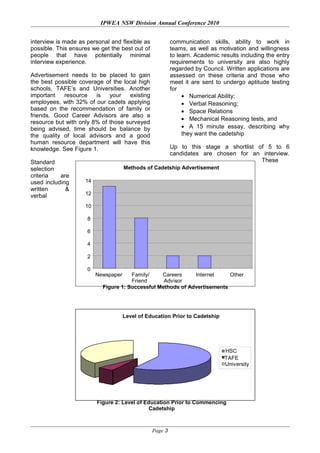
Methods of Cadetship Advertisement
0
2
4
6
8
10
12
14
Newspaper Family/
Friend
Careers
Advisor
Internet Other
Figure 1: Successful Methods of Advertisements
Level of Education Prior to Cadetship
University
TAFE
HSC
Figure 2: Level of Education Prior to Commencing
Cadetship
IPWEA NSW Division Annual Conference 2010
interview is made as personal and flexible as
possible. This ensures we get the best out of
people that have potentially minimal
interview experience.
Advertisement needs to be placed to gain
the best possible coverage of the local high
schools, TAFE’s and Universities. Another
important resource is your existing
employees, with 32% of our cadets applying
based on the recommendation of family or
friends. Good Career Advisors are also a
resource but with only 8% of those surveyed
being advised, time should be balance by
the quality of local advisors and a good
human resource department will have this
knowledge. See Figure 1.
Standard
selection
criteria are
used including
written &
verbal
communication skills, ability to work in
teams, as well as motivation and willingness
to learn. Academic results including the entry
requirements to university are also highly
regarded by Council. Written applications are
assessed on these criteria and those who
meet it are sent to undergo aptitude testing
for
• Numerical Ability;
• Verbal Reasoning;
• Space Relations
• Mechanical Reasoning tests, and
• A 15 minute essay, describing why
they want the cadetship
Up to this stage a shortlist of 5 to 6
candidates are chosen for an interview.
These
Page 3
IPWEA NSW Division Annual Conference 2010
interviewees are based on their application,
conformance to the criteria, and assessed
aptitude results. A good mix of academic
levels is desired, i.e. HSC, TAFE and first
year University. However the highest
academic results are often not successful in
securing the Cadetship. A balance between
academic results and lifestyle is much more
highly commended in WCC. Participation in
community events and Council sports teams
allows cadets to establish confidence,
network with employees and boost team
moral in the work environment. See Figure 2.
Interview questions are based around
applicant’s personalities and the way they
think. Use at least one standard question, eg
‘what do you wish to gain from this
cadetship?’ A good applicant would have
done some preparation and looked up
similar standard questions. You then want to
ask some unexpected questions that look at
how they balance demands, how they look at
the world and experiences they remember.
We have kept specific questions out of this
paper, however, a copy of sample questions
can be provided on request.
The applicants must show a willingness and
eagerness to learn and develop individually
and within a culture and learning. We look
for applicants who do more than the bare
minimum in expanding their experiences and
understanding.
Human Resources
Human Resources (HR) plays an important
role in the process from the beginning.
Amongst the selection of applicants HR
ensures the selection of cadets are held to
the merit based system and ensures cadets
are properly trained and feel they have
appropriate means to contact people who
understand the conditions of their contract,
mentors, managers and placements.
One method HR use to ensure consistent
professional and technical development of
cadets is by implementing our Performance
Management System at both an individual
placement level and for their overall
program. This allows HR to track a cadets
progress during their time spent in various
divisions. Those assessed criteria include
adherence to Council’s values, common
workplace skills (communication, leadership
and safety etc), as well as work outcomes
(see section over page). This allows
continual improvement of a cadet
individually, as well as the development of
the WCC cadetship system as a whole,
maintaining a high learning standard. Recent
revisions of the performance management
system have raised suggestions of adding
criterion to supervisors’ performance review
forms. These criteria enforce their
requirements to teach or aid their cadets and
thus, continuing the commitment to
enhancing skills in the Council environment.
Role and Importance of Qualified
Engineers
Qualified engineers within the organisation
are essentially the knowledge base for the
on the job learning and training of cadets. In
many situations qualified engineers act as
mentors for first year cadets. This gives
cadets an opportunity to connect with
someone in a position they are aiming for.
Essentially WCC mentors, mimic the basic
systems of many other successful and highly
regarded programs. Mentors make regular
meetings and use the opportunity to talk
about distinct issues regarding career, the
life issues related to successful progression
and promotes the development of
friendships with other engineers. WCC is
constantly looking at ways to improve the
quality of its mentors, with mentor training
and development.
Other cadets take on a more casual mentor
role, with encouragement from HR. Older
cadets make time to meet new cadets
outside and inside the work environment, so
they are aware of the base of young people
they can use for advice or help. A catalyst
for this can be an afternoon tea at the start
of the year organised by HR to introduce the
next cadets to the existing team.
Page 4
Rotation Programs
Cadets move through a number of different
departments/divisions within council to gain
the most experience, in a number of varied
fields. Cadets start off the with
placements/rotations, which are more
focused around tasks which involve knowing
the local government area, knowing the
boundaries between depots, and who in
council is responsible for what. This gives
them both engineering and technical skills as
well as understanding the organisation and
how their role or the role they are acting in
assists the organisation. An example of
engineer cadets primary rotations are
provided below in Figure 3.
Cadets do a number of different subjects at
university with specialist or focus areas.
Rotations are used to help assist in total
understanding of these subjects.
Engineering Cadets are given the freedom to
plan their own course selection through the
university, and are given the chance to
modify the plan of their rotations to best
reflect their studies or vice versa. This allows
cadets to gain the best experience from a
subject and a rotation, allowing them to see
theory and practical working together. It also
gives them a number of resources in the
working environment for advice, tips, tricks,
or help with developing technical skills for a
particular subject.
However, the nature of the courses and
rotations sometimes this link can not always
occur simultaneously, for some
course/placements prior knowledge can
further the learning experience far greater
than the simultaneous link. See Figure 4.
Most cadets feel the rotations at council hold
some benefit to their corresponding
university subjects. One cadet stated 'my
rotations particular to design, were very
beneficial to my design subjects… The
AutoCAD skills I had from work allowed me
to complete my UNI AutoCAD tasks quickly
and more efficiently than many of the tutors
could demonstrate.' Many cadets said they
gained a greater understanding when they
were able to see the theory from UNI
demonstrated in the workplace.
With this as the ultimate goal, cadets give
more of their time back to the organisation
as skilled professionals and it allows them to
further their learning experience as far as
possible.
Within the final stages of their time as cadets
the rotations guide is left open for them to
choose a path they would like more
experience within. As cadets usually take
part take in a thesis, this allows them to use
this and their rotations as a chance to
specialise or refine some of their
experiences and skills within that speciality.
It also gives them a longer duration with any
one department and this gives them the
opportunity to undertake a project more fully
or wholly and a chance to undertake multiple
projects.
Work Out Comes
One of the primary purposes of a cadetship
with WCC is to enhance the skills of its
young employees, and to continually review
the rotation program ensuring a high learning
standard. To do this efficiently, work
outcomes are employed into the HR
Performance Management System (see
former section on HR).
Page 5
Feb
Mar Asset Management
Apr
May
Jun GIS-Mapping
Year 1 Jul
Aug
Sep Environment
Oct
Nov
Dec Survey
Jan
Feb
Mar
Year 2 Apr Civil Design/Roads
May
Jun
July
Figure 1: Sample Rotations Guide for new Cadets
Work outcomes are measurable goals
agreed upon by a cadet and their supervisor
at the beginning of a placement in a new
division of Council. This allows an early
chance to establish what technical skills will
be learnt during the rotation, as well as
define what work output the cadet will
provide to the division. A set of general work
outcomes are defined by cadets and
supervisors to insure the minimum set of
goals are achieved, also assisting the
calibration between cadet and supervisor in
defining goals at the beginnings of a work
place. Some examples of work outcomes
area listed below in Figure 4.
Beyond this cadets are available to be part
of or responsible for projects within a
division. As a cadet matures after a number
of years in the Council environment, work
outcomes become broader. For example, the
theory gained from university subjects and
technical skills established from previous
rotations allow supervisors to give a young
engineer more responsibility. Cadets in their
senior years generally have more confidence
and knowledge to make important decisions,
whilst demanding much less supervisory
time. This allows cadets to work on larger
scale projects, some of these such projects
in the past include Wollongong’s foreshore
project, The Blue Mile; Southern Gateway in
Bulli Tops and the recently completed Civic
Page 6
Rotation: Supervisors/ Work Goals General Cadet-Cadet
notes and info
Recommended
subjects that relate
Civil
Design/
Roads
 AutoCAD and 12D for drafting
design jobs, modelling roads,
vehicle turning paths and other
standard templates
 Understanding of drafting
techniques controlled by the
Quality Management
System(QMS)
 Understanding process of
completing a design job from
beginning to end
 Recognise importance and value
of liaising with other
departments/clients
 Complete first 1 or 2
jobs with close
assistance-this section
is often busy so try to
get
supervisor/colleague
to give you a bit of
time to get the
process correct on the
initial jobs, it is
essential.
 Complete at least
one major 12D
project, by following
it from beginning to
end
 ENGG154 – Eng
Design: Before
rotation is most
relevant due to basic
knowledge of
AutoCAD learnt.
CIVL311 – Structural
Design 1:
before/during as this
rotation uses Aus
Standards and some
familiarity with these
is necessary to get the
full benefit and
understanding of this
rotation
Figure 2: Sample of Cadet Goals for specified rotations
Plaza Project in Wollongong’s CBD. Cadets
often work on these high calibre projects as
site engineers or project managers, making
critical decisions that govern a jobs structure,
finances and lead time for completion.
Employing cadets in these positions provide
Council with confident, informed and cheap
engineers, whilst providing great work
experience to them. Examples of these
senior work outcomes show the use of
cadets to local government and for any
engineering organisation.
On the job work experience is invaluable to a
student engineer, so much so that most
universities course requirements entail
students to participate in professional
experience over a period of 12 weeks
between semesters. Cadets being full-time
workers can participate in a professional
option subject. This requires the cadet to
work with the division/department supervisor
to come up with an appropriate topic and
goals that can be achieved at work to write a
professional and technical paper. This is
then approved by the university and flexibility
of both WCC and University Of Wollongong
(UOW) is a key contributor to this subject
being effective. Cadets are essentially
available to use this subject as an elective
substitute up to 3 times, on different topics,
and essentially enhance their skills and
involvement with a particular
department/division in the work environment.
The final key component of the work
outcomes is the relationship and flexibility of
the university that the cadet is attending. The
flexibility needs to exist to allow cadets to
alter timetables, have tutorials choice outside
work hours and minimising the number of
days that face to face attendance is
required. This will give minimal impact on
their work and university time and travel
associated. The survey showed that one of
the difficulties was the long days and
keeping motivated and up to date with full
time students was sometimes a very difficult
pressure. A strong relationship with the
university can help with this issue.
Partnerships with other Councils
Even with a Council as large as Wollongong
there are gaps in experience opportunities,
for example water and sewerage
engineering (provided by Sydney Water in
our area). We are also aware of the issues
of smaller councils in regards to the
attraction and retention of quality cadets.
Wollongong has created two partnerships
with other councils for this purpose.
The first, with Shoalhaven Council, is to
address their reduced ability to attract cadets
due to, among other things, their distance
from the universities. This cadet is employed
by a third party, Illawarra Group Training,
and the cadet rotated through 6 months full
time university, 6 months full time work with
Shoalhaven Council and 6 months combined
study and work at Wollongong Council. A
similar system would now be possible in rural
areas with the introduction of distance
education engineering courses.
The second is a professional services
agreement set up with our sister council,
Carrathool Council, which is an agreement
created to share skills for the purpose of
professional training and short term
replacements. The program has allowed
cadets to work for Carrathool Council during
the major terms breaks to learn about rural
engineering and water and sewerage
engineering. This also has the added
exposure of rural engineering to other
students through discussions when the
return to university.
Retention of Graduates
WCC produces high quality engineers in
both management and technical streams
and works towards providing a better service
to its community through these young
people.
Council loses many cadets due to lack of
mid level engineering positions and the
ability to match the rates of external
organisations. Councils need to remember
the reason that they employed the cadets; if
it was for either contemplated changes,
profile of existing staff or succession
planning. It is vital that Council’s continually
review their structure and look for
Page 7
opportunities to change and create
interesting positions that make cadets want
to stay with the organisation. Also
remembering that some may want to leave to
discover the world and in letting so they are
more likely to return at a later date, if though
has been given into the future positions in
the organisation.
Conclusion
Wollongong City Council’s Engineering
Cadetships provide a supreme mechanism
to obtain work experience in conjunction with
a bachelor degree. Enhancing skills by
allowing young engineers to apply university
theory to real life situations, and empowering
communities, with the opportunity to apply
this knowledge to local projects of all scales.
Continual improvement with recruitment,
rotation schedules, and work outcomes are
maintained with revision systems such as the
SPMAS and constant liaison between
cadets, supervisors and Human Resources.
This allows WCC to consistently revise
problems, and maintain its high calibre cadet
program.
This paper has demonstrated that cadet
programs allow an organisation to prepare
young students for industry, whilst benefiting
from their newly learnt theory and fresh,
contemporary ideas. This promotes diversity
within the workplace and has shown to
improve work output. The end result is a
group of established, well informed, and
confident graduates that are capable of
moving straight into a full-time engineering
position – in both the Public and Private
sector. Hence, it is strongly encouraged that
local governments and other public works
providers implement cadetships into their
work curriculum, for the benefit of young
starters, companies, and the community.
References
Crowhurst, Duff, Gaspari (2010),
“Engineering Cadet Survey, Wollongong City
Council”
Gaspari (2009). “Engineering Rotation
Outcomes”, Wollongong City Council
Wollongong City Council, Carrrathool Shire
Council (2008) “Professional Services
Exchange Agreement”
Rex Glencross-Grant (2009). “Re-
Engineering The Bush: An Innovative
Collaborative Engineering Degree At The
University Of New England, Armidale”,
Melbourne
Author Biography
Biographies
Rosemary Crowhurst – Rosemary has been City Works Area Manager at Wollongong City Council
for over 6 year managing construction and maintenance of civil infrastructure. Rosemary has also
been a mentor for the cadet program during this time. Rosemary was a nominee for the 2010
Women in Local Government Award for her work with Cadet.
Melissa Gaspari – Melissa has been an Engineering Cadet with Wollongong City Council for 2
years and is studying Bachelor of Engineering at University of Wollongong. Melissa volunteers for
several local groups and is an Executive Member of Junior Chamber International Illawarra and
Engineers Without Borders and enjoys travelling.
Ryan Duff – Ryan has been an Engineering Cadet with Wollongong City Council for 4 years and is
studying a Bachelor of Engineering at University of Wollongong. Participating in active roles with
UOW’s Civil Engineering Society, and an executive member of the Wollongong Chapter for
Golden Key - International Honour Society, Ryan enjoys networking and promoting the field of
Page 8
engineering to young people.
Contact Details – 41 Burelli St Wollongong, Phone 02 4227 7814, Mobile 0407 201 851, Fax
024227 7815
E-mails
rcrowhurst@wollongong.nsw.gov.au
mgaspari@wollongong.nsw.gov.au
rduff@wollongong.nsw.gov.au
Page 9
engineering to young people.
Contact Details – 41 Burelli St Wollongong, Phone 02 4227 7814, Mobile 0407 201 851, Fax
024227 7815
E-mails
rcrowhurst@wollongong.nsw.gov.au
mgaspari@wollongong.nsw.gov.au
rduff@wollongong.nsw.gov.au
Page 9

IPWEA NSW Division Conference: Engineering Cadet Programs

  • 1.
    IPWEA NSW DivisionAnnual Conference 2010 COUNCIL ENGINEERING CADET PROGRAMS Rosemary Crowhurst, Ryan Duff, Melissa Gaspari City Works Manager Central, Cadet Engineer, Cadet Engineer, Wollongong City Council, New South Wales, Australia Paper Summary With one of the highest youth unemployment rates in New South Wales, Wollongong has long acknowledged it's responsibility to the community in providing opportunities for young people with its Apprentice, Trainee and Cadet Programs. Wollongong City Council's Civil Engineering Cadet Program has a history of producing high quality engineers in both technical and management streams. Working on the conference theme of ‘Enhancing Skills, Empowering Communities’, what makes this a successful program and how do we continue to improve it? This paper intends to look at the Engineering Cadet Program and its successes, as well as the benefits to young Engineers, Council and the Wollongong community. It also aims to outline the difficulties that have been encountered and provide advice on how other Councils can implement similar programs. This paper will discuss: • The process of recruitment; including guidelines for selection of appropriate candidates for the program. • Rotation Programs of the Cadets; Work Outcomes and the participation of Supervisors and Cadets in achieving quantifiable outcomes. • The role and importance of Qualified Engineers as mentors. • Outline the relationship with the University of Wollongong and the connection between Work Outcomes and Learning Objectives. • The retention of Graduates within Local Government in comparison to those leaving for the Private Sector to gain more experience and their possible return. • The crucial importance of Human Resources contribution to the entire process. • Outlines the partnerships between Council's and their potential to share resources, experience and knowledge. The main objective of this paper is to encourage other Councils and Utility Providers to embrace Cadet Programs. It also aims to highlight the diversity of Local Government engineering and to promote the vast opportunities available to young developing and Graduate Engineers in a career at Council. Page 1
  • 2.
    IPWEA NSW DivisionAnnual Conference 2010 Introduction Wollongong City Council (WCC) has been running an engineering cadet program for over thirty years. We have recently undertaken a survey of nineteen current and past cadets. The aim of this survey was to look at the continued successes and improvements of the program, to guide future cadet programs and to provide an aid to current cadets on how they can ensure their success through the program. The results reflected that small effort produces large results for both Wollongong City Council and the engineering community. This survey reaffirmed the benefits to Council; the main benefit for Council is the improving quality of young engineers. These young professionals have a wide range of experience and a sound understanding of the Local Government Environment and its diverse and complex roles, as well as the community they represent. 58% of those surveyed still work in local government and many of the others are in industry associated with Local Government. Cadets bring vibrancy and enthusiasm into an aging environment which can often and effectively inspire existing staff. Cadets thrive on learning and are very willing to work hard, and the results of this can be very beneficial to departments which they work. The people that Wollongong City Council selects to participate in the cadet program generally hold characteristics of high achievers with high work ethic and are often innovative thinkers. Cadet programs also benefit the community with 89% of the cadets coming from Wollongong and surrounding areas, essentially generating local jobs. Programs such as this create good quality engineers and address the skills shortage in local government engineering. The cadets promote local government to fellow students, and young people alike and help promote a positive rapport with the younger community. This program also improves the possibilities that these skilled professionals will stay within the community. Currently four former cadets who completed our engineering program are working at one of Wollongong’s neighbouring Councils, while five are still working at Wollongong. Process of Recruitment As with all projects, pre-planning helps in the long term and running of the cadet program. Most recruitment policies are based on the assumption that staff know the majority of the role that they are going to undertake. For training positions you need to consider ways that you can adapt that process to utilise people’s potential, which can be a hit and miss situation, however with some planning, good results can be achieved more easily. For recruitment at the start of a calendar year the council needs to start the process early in the previous calendar year, as the target demographic for applicants are generally Higher School Certificate Graduates, or first year uni students. This ideally allows job offers to be secured before the commencement of HSC exams, offering the reassurance of job security for students, and allowing Council to guarantee the best candidate. The first step in the recruitment process, which Wollongong starts in April the previous year, begins with the human resources team. Divisions are requested to consider their needs in regards to the following criteria • Contemplated changes • The profile of existing staff • succession planning and, • forecast regional shortage Human Resources then review these requests before gaining executive approval to proceed with the recruitment. The final decision on who is recruited is based on the above listed needs, available funds and the future direction of Council. Recruitment panels then need to be chosen, to include people that are interested in the program, enjoy training staff, and understand the type of work. With only two people on the panel, usually a representative from the hiring department and human resources, the Page 2
  • 3.
    Methods of CadetshipAdvertisement 0 2 4 6 8 10 12 14 Newspaper Family/ Friend Careers Advisor Internet Other Figure 1: Successful Methods of Advertisements Level of Education Prior to Cadetship University TAFE HSC Figure 2: Level of Education Prior to Commencing Cadetship IPWEA NSW Division Annual Conference 2010 interview is made as personal and flexible as possible. This ensures we get the best out of people that have potentially minimal interview experience. Advertisement needs to be placed to gain the best possible coverage of the local high schools, TAFE’s and Universities. Another important resource is your existing employees, with 32% of our cadets applying based on the recommendation of family or friends. Good Career Advisors are also a resource but with only 8% of those surveyed being advised, time should be balance by the quality of local advisors and a good human resource department will have this knowledge. See Figure 1. Standard selection criteria are used including written & verbal communication skills, ability to work in teams, as well as motivation and willingness to learn. Academic results including the entry requirements to university are also highly regarded by Council. Written applications are assessed on these criteria and those who meet it are sent to undergo aptitude testing for • Numerical Ability; • Verbal Reasoning; • Space Relations • Mechanical Reasoning tests, and • A 15 minute essay, describing why they want the cadetship Up to this stage a shortlist of 5 to 6 candidates are chosen for an interview. These Page 3
  • 4.
    IPWEA NSW DivisionAnnual Conference 2010 interviewees are based on their application, conformance to the criteria, and assessed aptitude results. A good mix of academic levels is desired, i.e. HSC, TAFE and first year University. However the highest academic results are often not successful in securing the Cadetship. A balance between academic results and lifestyle is much more highly commended in WCC. Participation in community events and Council sports teams allows cadets to establish confidence, network with employees and boost team moral in the work environment. See Figure 2. Interview questions are based around applicant’s personalities and the way they think. Use at least one standard question, eg ‘what do you wish to gain from this cadetship?’ A good applicant would have done some preparation and looked up similar standard questions. You then want to ask some unexpected questions that look at how they balance demands, how they look at the world and experiences they remember. We have kept specific questions out of this paper, however, a copy of sample questions can be provided on request. The applicants must show a willingness and eagerness to learn and develop individually and within a culture and learning. We look for applicants who do more than the bare minimum in expanding their experiences and understanding. Human Resources Human Resources (HR) plays an important role in the process from the beginning. Amongst the selection of applicants HR ensures the selection of cadets are held to the merit based system and ensures cadets are properly trained and feel they have appropriate means to contact people who understand the conditions of their contract, mentors, managers and placements. One method HR use to ensure consistent professional and technical development of cadets is by implementing our Performance Management System at both an individual placement level and for their overall program. This allows HR to track a cadets progress during their time spent in various divisions. Those assessed criteria include adherence to Council’s values, common workplace skills (communication, leadership and safety etc), as well as work outcomes (see section over page). This allows continual improvement of a cadet individually, as well as the development of the WCC cadetship system as a whole, maintaining a high learning standard. Recent revisions of the performance management system have raised suggestions of adding criterion to supervisors’ performance review forms. These criteria enforce their requirements to teach or aid their cadets and thus, continuing the commitment to enhancing skills in the Council environment. Role and Importance of Qualified Engineers Qualified engineers within the organisation are essentially the knowledge base for the on the job learning and training of cadets. In many situations qualified engineers act as mentors for first year cadets. This gives cadets an opportunity to connect with someone in a position they are aiming for. Essentially WCC mentors, mimic the basic systems of many other successful and highly regarded programs. Mentors make regular meetings and use the opportunity to talk about distinct issues regarding career, the life issues related to successful progression and promotes the development of friendships with other engineers. WCC is constantly looking at ways to improve the quality of its mentors, with mentor training and development. Other cadets take on a more casual mentor role, with encouragement from HR. Older cadets make time to meet new cadets outside and inside the work environment, so they are aware of the base of young people they can use for advice or help. A catalyst for this can be an afternoon tea at the start of the year organised by HR to introduce the next cadets to the existing team. Page 4
  • 5.
    Rotation Programs Cadets movethrough a number of different departments/divisions within council to gain the most experience, in a number of varied fields. Cadets start off the with placements/rotations, which are more focused around tasks which involve knowing the local government area, knowing the boundaries between depots, and who in council is responsible for what. This gives them both engineering and technical skills as well as understanding the organisation and how their role or the role they are acting in assists the organisation. An example of engineer cadets primary rotations are provided below in Figure 3. Cadets do a number of different subjects at university with specialist or focus areas. Rotations are used to help assist in total understanding of these subjects. Engineering Cadets are given the freedom to plan their own course selection through the university, and are given the chance to modify the plan of their rotations to best reflect their studies or vice versa. This allows cadets to gain the best experience from a subject and a rotation, allowing them to see theory and practical working together. It also gives them a number of resources in the working environment for advice, tips, tricks, or help with developing technical skills for a particular subject. However, the nature of the courses and rotations sometimes this link can not always occur simultaneously, for some course/placements prior knowledge can further the learning experience far greater than the simultaneous link. See Figure 4. Most cadets feel the rotations at council hold some benefit to their corresponding university subjects. One cadet stated 'my rotations particular to design, were very beneficial to my design subjects… The AutoCAD skills I had from work allowed me to complete my UNI AutoCAD tasks quickly and more efficiently than many of the tutors could demonstrate.' Many cadets said they gained a greater understanding when they were able to see the theory from UNI demonstrated in the workplace. With this as the ultimate goal, cadets give more of their time back to the organisation as skilled professionals and it allows them to further their learning experience as far as possible. Within the final stages of their time as cadets the rotations guide is left open for them to choose a path they would like more experience within. As cadets usually take part take in a thesis, this allows them to use this and their rotations as a chance to specialise or refine some of their experiences and skills within that speciality. It also gives them a longer duration with any one department and this gives them the opportunity to undertake a project more fully or wholly and a chance to undertake multiple projects. Work Out Comes One of the primary purposes of a cadetship with WCC is to enhance the skills of its young employees, and to continually review the rotation program ensuring a high learning standard. To do this efficiently, work outcomes are employed into the HR Performance Management System (see former section on HR). Page 5 Feb Mar Asset Management Apr May Jun GIS-Mapping Year 1 Jul Aug Sep Environment Oct Nov Dec Survey Jan Feb Mar Year 2 Apr Civil Design/Roads May Jun July Figure 1: Sample Rotations Guide for new Cadets
  • 6.
    Work outcomes aremeasurable goals agreed upon by a cadet and their supervisor at the beginning of a placement in a new division of Council. This allows an early chance to establish what technical skills will be learnt during the rotation, as well as define what work output the cadet will provide to the division. A set of general work outcomes are defined by cadets and supervisors to insure the minimum set of goals are achieved, also assisting the calibration between cadet and supervisor in defining goals at the beginnings of a work place. Some examples of work outcomes area listed below in Figure 4. Beyond this cadets are available to be part of or responsible for projects within a division. As a cadet matures after a number of years in the Council environment, work outcomes become broader. For example, the theory gained from university subjects and technical skills established from previous rotations allow supervisors to give a young engineer more responsibility. Cadets in their senior years generally have more confidence and knowledge to make important decisions, whilst demanding much less supervisory time. This allows cadets to work on larger scale projects, some of these such projects in the past include Wollongong’s foreshore project, The Blue Mile; Southern Gateway in Bulli Tops and the recently completed Civic Page 6 Rotation: Supervisors/ Work Goals General Cadet-Cadet notes and info Recommended subjects that relate Civil Design/ Roads  AutoCAD and 12D for drafting design jobs, modelling roads, vehicle turning paths and other standard templates  Understanding of drafting techniques controlled by the Quality Management System(QMS)  Understanding process of completing a design job from beginning to end  Recognise importance and value of liaising with other departments/clients  Complete first 1 or 2 jobs with close assistance-this section is often busy so try to get supervisor/colleague to give you a bit of time to get the process correct on the initial jobs, it is essential.  Complete at least one major 12D project, by following it from beginning to end  ENGG154 – Eng Design: Before rotation is most relevant due to basic knowledge of AutoCAD learnt. CIVL311 – Structural Design 1: before/during as this rotation uses Aus Standards and some familiarity with these is necessary to get the full benefit and understanding of this rotation Figure 2: Sample of Cadet Goals for specified rotations
  • 7.
    Plaza Project inWollongong’s CBD. Cadets often work on these high calibre projects as site engineers or project managers, making critical decisions that govern a jobs structure, finances and lead time for completion. Employing cadets in these positions provide Council with confident, informed and cheap engineers, whilst providing great work experience to them. Examples of these senior work outcomes show the use of cadets to local government and for any engineering organisation. On the job work experience is invaluable to a student engineer, so much so that most universities course requirements entail students to participate in professional experience over a period of 12 weeks between semesters. Cadets being full-time workers can participate in a professional option subject. This requires the cadet to work with the division/department supervisor to come up with an appropriate topic and goals that can be achieved at work to write a professional and technical paper. This is then approved by the university and flexibility of both WCC and University Of Wollongong (UOW) is a key contributor to this subject being effective. Cadets are essentially available to use this subject as an elective substitute up to 3 times, on different topics, and essentially enhance their skills and involvement with a particular department/division in the work environment. The final key component of the work outcomes is the relationship and flexibility of the university that the cadet is attending. The flexibility needs to exist to allow cadets to alter timetables, have tutorials choice outside work hours and minimising the number of days that face to face attendance is required. This will give minimal impact on their work and university time and travel associated. The survey showed that one of the difficulties was the long days and keeping motivated and up to date with full time students was sometimes a very difficult pressure. A strong relationship with the university can help with this issue. Partnerships with other Councils Even with a Council as large as Wollongong there are gaps in experience opportunities, for example water and sewerage engineering (provided by Sydney Water in our area). We are also aware of the issues of smaller councils in regards to the attraction and retention of quality cadets. Wollongong has created two partnerships with other councils for this purpose. The first, with Shoalhaven Council, is to address their reduced ability to attract cadets due to, among other things, their distance from the universities. This cadet is employed by a third party, Illawarra Group Training, and the cadet rotated through 6 months full time university, 6 months full time work with Shoalhaven Council and 6 months combined study and work at Wollongong Council. A similar system would now be possible in rural areas with the introduction of distance education engineering courses. The second is a professional services agreement set up with our sister council, Carrathool Council, which is an agreement created to share skills for the purpose of professional training and short term replacements. The program has allowed cadets to work for Carrathool Council during the major terms breaks to learn about rural engineering and water and sewerage engineering. This also has the added exposure of rural engineering to other students through discussions when the return to university. Retention of Graduates WCC produces high quality engineers in both management and technical streams and works towards providing a better service to its community through these young people. Council loses many cadets due to lack of mid level engineering positions and the ability to match the rates of external organisations. Councils need to remember the reason that they employed the cadets; if it was for either contemplated changes, profile of existing staff or succession planning. It is vital that Council’s continually review their structure and look for Page 7
  • 8.
    opportunities to changeand create interesting positions that make cadets want to stay with the organisation. Also remembering that some may want to leave to discover the world and in letting so they are more likely to return at a later date, if though has been given into the future positions in the organisation. Conclusion Wollongong City Council’s Engineering Cadetships provide a supreme mechanism to obtain work experience in conjunction with a bachelor degree. Enhancing skills by allowing young engineers to apply university theory to real life situations, and empowering communities, with the opportunity to apply this knowledge to local projects of all scales. Continual improvement with recruitment, rotation schedules, and work outcomes are maintained with revision systems such as the SPMAS and constant liaison between cadets, supervisors and Human Resources. This allows WCC to consistently revise problems, and maintain its high calibre cadet program. This paper has demonstrated that cadet programs allow an organisation to prepare young students for industry, whilst benefiting from their newly learnt theory and fresh, contemporary ideas. This promotes diversity within the workplace and has shown to improve work output. The end result is a group of established, well informed, and confident graduates that are capable of moving straight into a full-time engineering position – in both the Public and Private sector. Hence, it is strongly encouraged that local governments and other public works providers implement cadetships into their work curriculum, for the benefit of young starters, companies, and the community. References Crowhurst, Duff, Gaspari (2010), “Engineering Cadet Survey, Wollongong City Council” Gaspari (2009). “Engineering Rotation Outcomes”, Wollongong City Council Wollongong City Council, Carrrathool Shire Council (2008) “Professional Services Exchange Agreement” Rex Glencross-Grant (2009). “Re- Engineering The Bush: An Innovative Collaborative Engineering Degree At The University Of New England, Armidale”, Melbourne Author Biography Biographies Rosemary Crowhurst – Rosemary has been City Works Area Manager at Wollongong City Council for over 6 year managing construction and maintenance of civil infrastructure. Rosemary has also been a mentor for the cadet program during this time. Rosemary was a nominee for the 2010 Women in Local Government Award for her work with Cadet. Melissa Gaspari – Melissa has been an Engineering Cadet with Wollongong City Council for 2 years and is studying Bachelor of Engineering at University of Wollongong. Melissa volunteers for several local groups and is an Executive Member of Junior Chamber International Illawarra and Engineers Without Borders and enjoys travelling. Ryan Duff – Ryan has been an Engineering Cadet with Wollongong City Council for 4 years and is studying a Bachelor of Engineering at University of Wollongong. Participating in active roles with UOW’s Civil Engineering Society, and an executive member of the Wollongong Chapter for Golden Key - International Honour Society, Ryan enjoys networking and promoting the field of Page 8
  • 9.
    engineering to youngpeople. Contact Details – 41 Burelli St Wollongong, Phone 02 4227 7814, Mobile 0407 201 851, Fax 024227 7815 E-mails rcrowhurst@wollongong.nsw.gov.au mgaspari@wollongong.nsw.gov.au rduff@wollongong.nsw.gov.au Page 9
  • 10.
    engineering to youngpeople. Contact Details – 41 Burelli St Wollongong, Phone 02 4227 7814, Mobile 0407 201 851, Fax 024227 7815 E-mails rcrowhurst@wollongong.nsw.gov.au mgaspari@wollongong.nsw.gov.au rduff@wollongong.nsw.gov.au Page 9