MESSAGE: BOARD OF DIRECTORS: CAPE ENTERS NEW PHASE
Having celebrated its twentieth Anniversary in 2013, CAPE Council for Access to the Profession of
Engineering entered a new phase in its history in January 2014. This new direction derives from two
considerations:
1. CAPE developed and initiated a multi-stakeholder employment strategy for immigrants with
engineering backgrounds to address persistent high unemployment and under-employment
amongst its members drawn from immigrants with engineering backgrounds. This was entitled
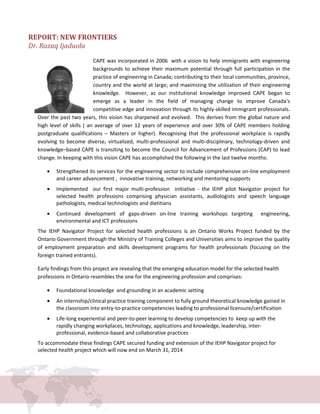
‘From Canadian First’ to ‘Canada First’ and released in May 2006. As shown in the chart below, the
percentage of members joining CAPE and practicing professionally in 2004 has more than doubled
by 2014 while the unemployed/marginally employed portion of our membership has dropped to its
ANNUAL REPORT 2013/2014
NEW FRONTIERS
lowest level since 2004. Further those not working in the professional setting but who hold jobs in
other fields had also been increasing in the last three years. This definitive trend indicates that
CAPE’s efforts and employment supports for its members over the last ten years are reaping fruitful
results.
Past Board Members of CAPE
2. CAPE has persistently has persistently faced issues in maintaining financial sustainability over the
last ten years. Consequently it has had to seek continuous project funding through its ground-
breaking action research initiatives. To support these initiatives and maintain employment support
for its members, CAPE has also developed a full suite of online career development tools and fee-
for-service programs for Service Providing Organizations (SPOs) serving immigrants with
engineering and other professional backgrounds. CAPE has become a partner of choice for many of
these organizations. Depite these efforts financial sustainability has remained an issue for CAPE.
These two developments have been main reason for CAPE to become a fully virtualized Organization in
2014.
3. While CAPE has So in 2003, CAPE initiated a new systematic community action research approach
to helping its members. This started with the Engineering Access Project, funded by Canadian
Heritage and Human Resources Skills Development Canada. CAPE set up an extensive database of
skills and competencies of its members compared these with the homegrown pool of engineers,
documented employer perspectives and the nature of access issues faced by immigrants with
engineering backgrounds coming to Canada. This project concluded that its members had been
locked out of practicing their
profession due to the saturated
professional practice market in
Canada, restrictive regulatory
practices, and risk-adverse
employers. Through six multi-
stakeholder consultative
roundtables Deriving from this
CAPE moved from access issues
to employment support,
advocating systemic change and
leveraging skilled immigrant
competencies through skills-gaps
and employer-driven training. Since 2006 CAPE has trained over 100 job developers and
employment counselors; incorporated CAPE employment supports and strengthened training in 80
service providing organizations across Ontario; and engaged with all levels of Government, 142
employers, 5 Universities, 9 community and private colleges, 2 regulators, 2 professional
associations, and 25 community partners through consultative roundtables.
Our efforts are finally showing results as seen on the right.
REPORT: NEW FRONTIERS
Dr. Razaq Ijaduola
CAPE was incorporated in 2006 with a vision to help immigrants with engineering
backgrounds to achieve their maximum potential through full participation in the
practice of engineering in Canada; contributing to their local communities, province,
country and the world at large; and maximizing the utilization of their engineering
knowledge. However, as our institutional knowledge improved CAPE began to
emerge as a leader in the field of managing change to improve Canada’s
competitive edge and innovation through its highly-skilled immigrant professionals.
Over the past two years, this vision has sharpened and evolved. This derives from the global nature and
high level of skills ( an average of over 12 years of experience and over 30% of CAPE members holding
postgraduate qualifications – Masters or higher). Recognising that the professional workplace is rapidly
evolving to become diverse, virtualized, multi-professional and multi-disciplinary, technology-driven and
knowledge–based CAPE is transiting to become the Council for Advancement of Professions (CAP) to lead
change. In keeping with this vision CAPE has accomplished the following in the last twelve months:
• Strengthened its services for the engineering sector to include comprehensive on-line employment
and career advancement , innovative training, networking and mentoring supports
• Implemented our first major multi-profession initiative - the IEHP pilot Navigator project for
selected health professions comprising physician assistants, audiologists and speech language
pathologists, medical technologists and dietitians
• Continued development of gaps-driven on-line training workshops targeting engineering,
environmental and ICT professions
The IEHP Navigator Project for selected health professions is an Ontario Works Project funded by the
Ontario Government through the Ministry of Training Colleges and Universities aims to improve the quality
of employment preparation and skills development programs for health professionals (focusing on the
foreign trained entrants).
Early findings from this project are revealing that the emerging education model for the selected health
professions in Ontario resembles the one for the engineering profession and comprises:
• Foundational knowledge and grounding in an academic setting
• An internship/clinical practice training component to fully ground theoretical knowledge gained in
the classroom into entry-to-practice competencies leading to professional licensure/certification
• Life-long experiential and peer-to-peer learning to develop competencies to keep up with the
rapidly changing workplaces, technology, applications and knowledge, leadership, inter-
professional, evidence-based and collaborative practices
To accommodate these findings CAPE secured funding and extension of the IEHP Navigator project for
selected health project which will now end on March 31, 2014
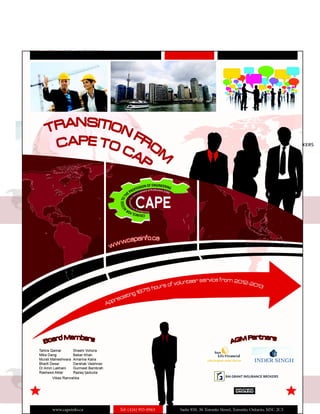
FROM CAPE TO CAP
Since 2006, CAPE has engaged its
members in annual knowledge
events aimed at expanding the
understanding of the nature of the
engineering profession and its
relation to global engineering skills.
In this vein, CAPE has hosted annual
knowledge events on topics such as
Transferability for Transformation-
Mobilizing Global Engineering
Experience (2007); Self-
Regulation, Governance, Public
Administration and the Profession of
Engineering (2008); From Regulation
to Innovation (2009). Innovative Solutions: Foreign Credential Recognition (2010), Nano to Mega:
Engineering (2011) and Transition and Transformation (2012) all seeking to discuss issues related to
technological convergence, innovation and new frontiers in engineering. Through these events CAPE has
increasing recognized the need to evolve, transform and position itself to accommodate these changes.
Half a millennium ago renaissance artist-engineers like Leonardo da Vinci, Filippo Brunelleschi, and
Benvenuto Cellini were masters of several professions and fields simultaneously. In contrast the last
hundred years have led to specialization that has splintered professions into hundreds of disciplines and
sub-disciplines. Today no one can master more than a tiny fragment of knowledge. Paradoxically the
convergence of sciences and technology are once
again calling for a renaissance; one that
embodies a holistic view of technology based on
transformative tools, collaborative engagement
between professions and across disciplines and a
unified understanding of the physical world from
the nano-scale to the planetary scale.
In positioning itself at the center of this call for
transformation; CAPE is undergoing a transition
to the Council for Advancement of Professions.
In the coming year CAPE will focus to completing
all its current projects, initiating detailed
consultations with its members, restructuring and strengthening organizational structure and culture
through extensive strategic planning and formalizing the transition to CAP.
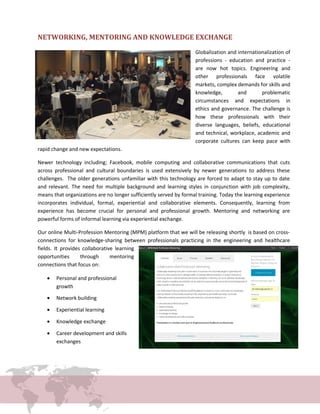
NETWORKING, MENTORING AND KNOWLEDGE EXCHANGE
Globalization and internationalization of
professions - education and practice -
are now hot topics. Engineering and
other professionals face volatile
markets, complex demands for skills and
knowledge, and problematic
circumstances and expectations in
ethics and governance. The challenge is
how these professionals with their
diverse languages, beliefs, educational
and technical, workplace, academic and
corporate cultures can keep pace with
rapid change and new expectations.
Newer technology including; Facebook, mobile computing and collaborative communications that cuts
across professional and cultural boundaries is used extensively by newer generations to address these
challenges. The older generations unfamiliar with this technology are forced to adapt to stay up to date
and relevant. The need for multiple background and learning styles in conjunction with job complexity,
means that organizations are no longer sufficiently served by formal training. Today the learning experience
incorporates individual, formal, experiential and collaborative elements. Consequently, learning from
experience has become crucial for personal and professional growth. Mentoring and networking are
powerful forms of informal learning via experiential exchange.
Our online Multi-Profession Mentoring (MPM) platform that we will be releasing shortly is based on cross-
connections for knowledge-sharing between professionals practicing in the engineering and healthcare
fields. It provides collaborative learning
opportunities through mentoring
connections that focus on:
• Personal and professional
growth
• Network building
• Experiential learning
• Knowledge exchange
• Career development and skills
exchanges
IEHP NAVIGATOR PROJECT FOR SELECTED HEALTH PROFESSIONS
Between October 2008 and October 2010, CAPE undertook the leveraging global engineering skills Project
funded by the Ministry of Training Colleges and Universities through its Labour Market Partnerships
Division. This resulted in an employer driven curricula development process to derive employment
preparation training for immigrants with engineering backgrounds (IEBs).
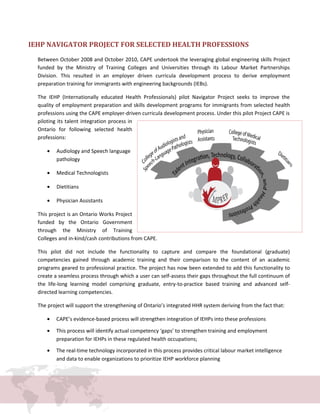
The IEHP (Internationally educated Health Professionals) pilot Navigator Project seeks to improve the
quality of employment preparation and skills development programs for immigrants from selected health
professions using the CAPE employer-driven curricula development process. Under this pilot Project CAPE is
piloting its talent integration process in
Ontario for following selected health
professions:
• Audiology and Speech language
pathology
• Medical Technologists
• Dietitians
• Physician Assistants
This project is an Ontario Works Project
funded by the Ontario Government
through the Ministry of Training
Colleges and in-kind/cash contributions from CAPE.
This pilot did not include the functionality to capture and compare the foundational (graduate)
competencies gained through academic training and their comparison to the content of an academic
programs geared to professional practice. The project has now been extended to add this functionality to
create a seamless process through which a user can self-assess their gaps throughout the full continuum of
the life-long learning model comprising graduate, entry-to-practice based training and advanced self-
directed learning competencies.
The project will support the strengthening of Ontario’s integrated HHR system deriving from the fact that:
• CAPE’s evidence-based process will strengthen integration of IEHPs into these professions
• This process will identify actual competency ‘gaps’ to strengthen training and employment
preparation for IEHPs in these regulated health occupations;
• The real-time technology incorporated in this process provides critical labour market intelligence
and data to enable organizations to prioritize IEHP workforce planning
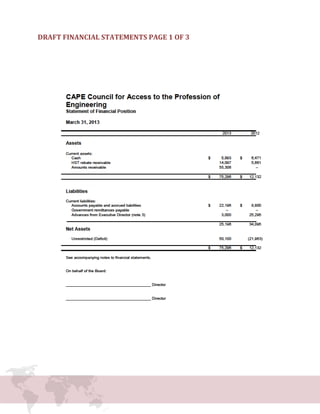
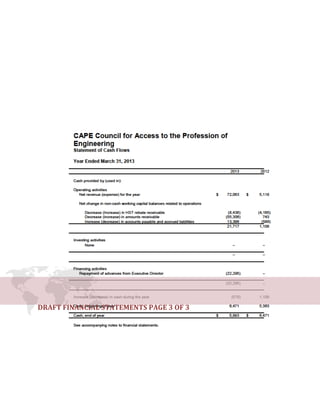
DRAFT FINANCIAL STATEMENTS PAGE 1 OF 3
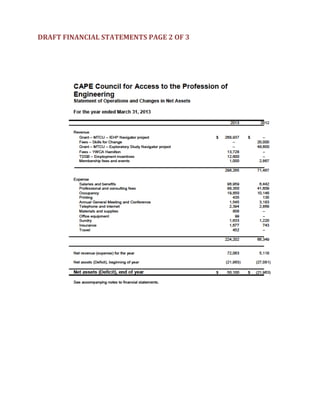
DRAFT FINANCIAL STATEMENTS PAGE 2 OF 3
DRAFT FINANCIAL STATEMENTS PAGE 3 OF 3
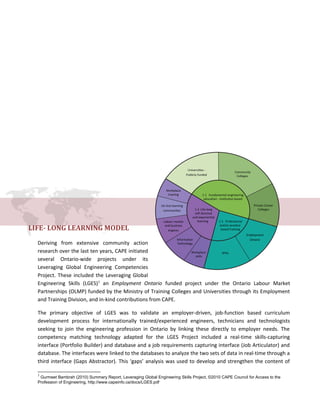
LIFE- LONG LEARNING MODEL
Deriving from extensive community action
research over the last ten years, CAPE initiated
several Ontario-wide projects under its
Leveraging Global Engineering Competencies
Project. These included the Leveraging Global
Engineering Skills (LGES)1
an Employment Ontario funded project under the Ontario Labour Market
Partnerships (OLMP) funded by the Ministry of Training Colleges and Universities through its Employment
and Training Division, and in-kind contributions from CAPE.
The primary objective of LGES was to validate an employer-driven, job-function based curriculum
development process for internationally trained/experienced engineers, technicians and technologists
seeking to join the engineering profession in Ontario by linking these directly to employer needs. The
competency matching technology adapted for the LGES Project included a real-time skills-capturing
interface (Portfolio Builder) and database and a job requirements capturing interface (Job Articulator) and
database. The interfaces were linked to the databases to analyze the two sets of data in real-time through a
third interface (Gaps Abstractor). This ‘gaps’ analysis was used to develop and strengthen the content of
1
Gurmeet Bambrah (2010) Summary Report, Leveraging Global Engineering Skills Project, ©2010 CAPE Council for Access to the
Profession of Engineering, http://www.capeinfo.ca/docs/LGES.pdf
curricula for piloting employer-driven job-function based training for engineering and selected health
professions
A significant finding of this work has been the modelling of an emerging life-long learning model for
education in the professions. This comprises three distinct components:
• Intense in-classroom education to attain foundational knowledge and grounding in the basis of
science, principles of professional practice and analytical capabilities
• A ‘co-op’ or work placement, internship or training practice-based component to fully ground
theoretical knowledge gained in the classroom into entry-to-practice leading to professional
licensure/certification
• Life-long experiential and peer-to-peer learning to keep up with the rapidly changing workplace,
society, technology, applications and knowledge.
In the coming years our work in advancing professions will focus on this life-long learning model.
BOARD OF DIRECTORS 2012-2014
CAPE is pleased to invite new members to join its Board of Directors which includes:
1. Michael Dang PhD P.Eng
2. Muralidhar Maheshwara
3. Tahira Qamar
4. Rasheed Aktar
5. Bharti Desai
6. Darshak Vaishnav
7. Baber Khan
8. Dr. A.Y Lakhani
ACKNOWLEDGEMENTS
IEHP Navigator Project –Employment Ontario project partly funded by the Ontario Government through the
Employment and training Division of the Ministry of Training Colleges and Universities
STRATEGIC PARTNERS
YWCA Hamilton – Bridging programs for Engineering, environmental and information/Communication
Technology
AGM SPONSORS
Amarina Kalra
Sun Life Financial Advisor
Amarina.Kalra@sunlife.com
Vikas Ramrakha
Rai Grant Insuarance Brokers
vramrakha@raigrantinsurance.com
Inder Singh
Remax Realtor
inder@sellwithsingh.com
Cape Annual Report 2013-2014 draft

Cape Annual Report 2013-2014 draft

  • 1.
    MESSAGE: BOARD OFDIRECTORS: CAPE ENTERS NEW PHASE Having celebrated its twentieth Anniversary in 2013, CAPE Council for Access to the Profession of Engineering entered a new phase in its history in January 2014. This new direction derives from two considerations: 1. CAPE developed and initiated a multi-stakeholder employment strategy for immigrants with engineering backgrounds to address persistent high unemployment and under-employment amongst its members drawn from immigrants with engineering backgrounds. This was entitled ‘From Canadian First’ to ‘Canada First’ and released in May 2006. As shown in the chart below, the percentage of members joining CAPE and practicing professionally in 2004 has more than doubled by 2014 while the unemployed/marginally employed portion of our membership has dropped to its ANNUAL REPORT 2013/2014 NEW FRONTIERS
  • 2.
    lowest level since2004. Further those not working in the professional setting but who hold jobs in other fields had also been increasing in the last three years. This definitive trend indicates that CAPE’s efforts and employment supports for its members over the last ten years are reaping fruitful results. Past Board Members of CAPE 2. CAPE has persistently has persistently faced issues in maintaining financial sustainability over the last ten years. Consequently it has had to seek continuous project funding through its ground- breaking action research initiatives. To support these initiatives and maintain employment support for its members, CAPE has also developed a full suite of online career development tools and fee- for-service programs for Service Providing Organizations (SPOs) serving immigrants with engineering and other professional backgrounds. CAPE has become a partner of choice for many of these organizations. Depite these efforts financial sustainability has remained an issue for CAPE. These two developments have been main reason for CAPE to become a fully virtualized Organization in 2014. 3. While CAPE has So in 2003, CAPE initiated a new systematic community action research approach to helping its members. This started with the Engineering Access Project, funded by Canadian Heritage and Human Resources Skills Development Canada. CAPE set up an extensive database of skills and competencies of its members compared these with the homegrown pool of engineers, documented employer perspectives and the nature of access issues faced by immigrants with engineering backgrounds coming to Canada. This project concluded that its members had been locked out of practicing their profession due to the saturated professional practice market in Canada, restrictive regulatory practices, and risk-adverse employers. Through six multi- stakeholder consultative roundtables Deriving from this CAPE moved from access issues to employment support, advocating systemic change and leveraging skilled immigrant competencies through skills-gaps and employer-driven training. Since 2006 CAPE has trained over 100 job developers and employment counselors; incorporated CAPE employment supports and strengthened training in 80 service providing organizations across Ontario; and engaged with all levels of Government, 142 employers, 5 Universities, 9 community and private colleges, 2 regulators, 2 professional associations, and 25 community partners through consultative roundtables. Our efforts are finally showing results as seen on the right.
  • 3.
    REPORT: NEW FRONTIERS Dr.Razaq Ijaduola CAPE was incorporated in 2006 with a vision to help immigrants with engineering backgrounds to achieve their maximum potential through full participation in the practice of engineering in Canada; contributing to their local communities, province, country and the world at large; and maximizing the utilization of their engineering knowledge. However, as our institutional knowledge improved CAPE began to emerge as a leader in the field of managing change to improve Canada’s competitive edge and innovation through its highly-skilled immigrant professionals. Over the past two years, this vision has sharpened and evolved. This derives from the global nature and high level of skills ( an average of over 12 years of experience and over 30% of CAPE members holding postgraduate qualifications – Masters or higher). Recognising that the professional workplace is rapidly evolving to become diverse, virtualized, multi-professional and multi-disciplinary, technology-driven and knowledge–based CAPE is transiting to become the Council for Advancement of Professions (CAP) to lead change. In keeping with this vision CAPE has accomplished the following in the last twelve months: • Strengthened its services for the engineering sector to include comprehensive on-line employment and career advancement , innovative training, networking and mentoring supports • Implemented our first major multi-profession initiative - the IEHP pilot Navigator project for selected health professions comprising physician assistants, audiologists and speech language pathologists, medical technologists and dietitians • Continued development of gaps-driven on-line training workshops targeting engineering, environmental and ICT professions The IEHP Navigator Project for selected health professions is an Ontario Works Project funded by the Ontario Government through the Ministry of Training Colleges and Universities aims to improve the quality of employment preparation and skills development programs for health professionals (focusing on the foreign trained entrants). Early findings from this project are revealing that the emerging education model for the selected health professions in Ontario resembles the one for the engineering profession and comprises: • Foundational knowledge and grounding in an academic setting • An internship/clinical practice training component to fully ground theoretical knowledge gained in the classroom into entry-to-practice competencies leading to professional licensure/certification • Life-long experiential and peer-to-peer learning to develop competencies to keep up with the rapidly changing workplaces, technology, applications and knowledge, leadership, inter- professional, evidence-based and collaborative practices To accommodate these findings CAPE secured funding and extension of the IEHP Navigator project for selected health project which will now end on March 31, 2014
  • 4.
    FROM CAPE TOCAP Since 2006, CAPE has engaged its members in annual knowledge events aimed at expanding the understanding of the nature of the engineering profession and its relation to global engineering skills. In this vein, CAPE has hosted annual knowledge events on topics such as Transferability for Transformation- Mobilizing Global Engineering Experience (2007); Self- Regulation, Governance, Public Administration and the Profession of Engineering (2008); From Regulation to Innovation (2009). Innovative Solutions: Foreign Credential Recognition (2010), Nano to Mega: Engineering (2011) and Transition and Transformation (2012) all seeking to discuss issues related to technological convergence, innovation and new frontiers in engineering. Through these events CAPE has increasing recognized the need to evolve, transform and position itself to accommodate these changes. Half a millennium ago renaissance artist-engineers like Leonardo da Vinci, Filippo Brunelleschi, and Benvenuto Cellini were masters of several professions and fields simultaneously. In contrast the last hundred years have led to specialization that has splintered professions into hundreds of disciplines and sub-disciplines. Today no one can master more than a tiny fragment of knowledge. Paradoxically the convergence of sciences and technology are once again calling for a renaissance; one that embodies a holistic view of technology based on transformative tools, collaborative engagement between professions and across disciplines and a unified understanding of the physical world from the nano-scale to the planetary scale. In positioning itself at the center of this call for transformation; CAPE is undergoing a transition to the Council for Advancement of Professions. In the coming year CAPE will focus to completing all its current projects, initiating detailed consultations with its members, restructuring and strengthening organizational structure and culture through extensive strategic planning and formalizing the transition to CAP.
  • 5.
    NETWORKING, MENTORING ANDKNOWLEDGE EXCHANGE Globalization and internationalization of professions - education and practice - are now hot topics. Engineering and other professionals face volatile markets, complex demands for skills and knowledge, and problematic circumstances and expectations in ethics and governance. The challenge is how these professionals with their diverse languages, beliefs, educational and technical, workplace, academic and corporate cultures can keep pace with rapid change and new expectations. Newer technology including; Facebook, mobile computing and collaborative communications that cuts across professional and cultural boundaries is used extensively by newer generations to address these challenges. The older generations unfamiliar with this technology are forced to adapt to stay up to date and relevant. The need for multiple background and learning styles in conjunction with job complexity, means that organizations are no longer sufficiently served by formal training. Today the learning experience incorporates individual, formal, experiential and collaborative elements. Consequently, learning from experience has become crucial for personal and professional growth. Mentoring and networking are powerful forms of informal learning via experiential exchange. Our online Multi-Profession Mentoring (MPM) platform that we will be releasing shortly is based on cross- connections for knowledge-sharing between professionals practicing in the engineering and healthcare fields. It provides collaborative learning opportunities through mentoring connections that focus on: • Personal and professional growth • Network building • Experiential learning • Knowledge exchange • Career development and skills exchanges
  • 6.
    IEHP NAVIGATOR PROJECTFOR SELECTED HEALTH PROFESSIONS Between October 2008 and October 2010, CAPE undertook the leveraging global engineering skills Project funded by the Ministry of Training Colleges and Universities through its Labour Market Partnerships Division. This resulted in an employer driven curricula development process to derive employment preparation training for immigrants with engineering backgrounds (IEBs). The IEHP (Internationally educated Health Professionals) pilot Navigator Project seeks to improve the quality of employment preparation and skills development programs for immigrants from selected health professions using the CAPE employer-driven curricula development process. Under this pilot Project CAPE is piloting its talent integration process in Ontario for following selected health professions: • Audiology and Speech language pathology • Medical Technologists • Dietitians • Physician Assistants This project is an Ontario Works Project funded by the Ontario Government through the Ministry of Training Colleges and in-kind/cash contributions from CAPE. This pilot did not include the functionality to capture and compare the foundational (graduate) competencies gained through academic training and their comparison to the content of an academic programs geared to professional practice. The project has now been extended to add this functionality to create a seamless process through which a user can self-assess their gaps throughout the full continuum of the life-long learning model comprising graduate, entry-to-practice based training and advanced self- directed learning competencies. The project will support the strengthening of Ontario’s integrated HHR system deriving from the fact that: • CAPE’s evidence-based process will strengthen integration of IEHPs into these professions • This process will identify actual competency ‘gaps’ to strengthen training and employment preparation for IEHPs in these regulated health occupations; • The real-time technology incorporated in this process provides critical labour market intelligence and data to enable organizations to prioritize IEHP workforce planning
  • 7.
  • 8.
  • 9.
  • 11.
    LIFE- LONG LEARNINGMODEL Deriving from extensive community action research over the last ten years, CAPE initiated several Ontario-wide projects under its Leveraging Global Engineering Competencies Project. These included the Leveraging Global Engineering Skills (LGES)1 an Employment Ontario funded project under the Ontario Labour Market Partnerships (OLMP) funded by the Ministry of Training Colleges and Universities through its Employment and Training Division, and in-kind contributions from CAPE. The primary objective of LGES was to validate an employer-driven, job-function based curriculum development process for internationally trained/experienced engineers, technicians and technologists seeking to join the engineering profession in Ontario by linking these directly to employer needs. The competency matching technology adapted for the LGES Project included a real-time skills-capturing interface (Portfolio Builder) and database and a job requirements capturing interface (Job Articulator) and database. The interfaces were linked to the databases to analyze the two sets of data in real-time through a third interface (Gaps Abstractor). This ‘gaps’ analysis was used to develop and strengthen the content of 1 Gurmeet Bambrah (2010) Summary Report, Leveraging Global Engineering Skills Project, ©2010 CAPE Council for Access to the Profession of Engineering, http://www.capeinfo.ca/docs/LGES.pdf
  • 12.
    curricula for pilotingemployer-driven job-function based training for engineering and selected health professions A significant finding of this work has been the modelling of an emerging life-long learning model for education in the professions. This comprises three distinct components: • Intense in-classroom education to attain foundational knowledge and grounding in the basis of science, principles of professional practice and analytical capabilities • A ‘co-op’ or work placement, internship or training practice-based component to fully ground theoretical knowledge gained in the classroom into entry-to-practice leading to professional licensure/certification • Life-long experiential and peer-to-peer learning to keep up with the rapidly changing workplace, society, technology, applications and knowledge. In the coming years our work in advancing professions will focus on this life-long learning model. BOARD OF DIRECTORS 2012-2014 CAPE is pleased to invite new members to join its Board of Directors which includes: 1. Michael Dang PhD P.Eng 2. Muralidhar Maheshwara 3. Tahira Qamar 4. Rasheed Aktar 5. Bharti Desai 6. Darshak Vaishnav 7. Baber Khan 8. Dr. A.Y Lakhani ACKNOWLEDGEMENTS IEHP Navigator Project –Employment Ontario project partly funded by the Ontario Government through the Employment and training Division of the Ministry of Training Colleges and Universities
  • 13.
    STRATEGIC PARTNERS YWCA Hamilton– Bridging programs for Engineering, environmental and information/Communication Technology AGM SPONSORS Amarina Kalra Sun Life Financial Advisor Amarina.Kalra@sunlife.com Vikas Ramrakha Rai Grant Insuarance Brokers vramrakha@raigrantinsurance.com Inder Singh Remax Realtor inder@sellwithsingh.com